- Physics Lab Equipment
- Chemistry Lab Equipment
- Biology Lab Equipment
- Anatomical Lab Equipment
- Learning
- Educational Lab Equipment
- Magnets
- Agriculture
- Astronomy
- Earth Science
- Geography Lab Equipment
- Safety Lab Coat
- Laboratory
- Meteorological
- Electricity & Magnetism
- Heat
- School Lab Equipment
- Lab Glassware
- Science Lab Equipment
- Tvet Lab Equipment
- Robotics Kits Supplier and Manufacturer for Schools India
- Math Lab Equipment Manufacturers and Exporters in Ambala
- STEM Kits Manufacturers and Supplier India
- Engineering Lab Equipment
- Hospital Lab Equipment
- Water, Sanitation & Hygiene Supplies
- Cold Chain, Solar & Communication Equipment
- Nutrition
Physics lab equipment for schools, colleges, universities and vocational training institutes is gathered in this main physics catalogue of 328 listed products, arranged by branch: mechanics, heat, electricity and magnetism, optics, waves, modern physics and measurement. Jain Scientific Equipments Pvt Ltd (ScienceLab), Ambala, India, manufactures and supplies the range. Use it to source a complete lab or to add individual physics lab instruments to an existing one.
Physics Lab Equipment by Topic
| Topic | What It Covers | Example Products |
|---|---|---|
| Mechanics & Motion | Motion, forces, collisions, elasticity, levers and pulleys | Linear Air Track, Apparatus Collision 2 Dimension, Hooke’s Law Apparatus |
| Heat & Thermodynamics | Expansion, conduction, convection, calorimetry and gas laws | Apparatus Heat/Thermal Conductivity, Calorimeter Set, Copper, Ball & Ring Apparatus |
| Electricity & Magnetism | Circuits, electrical meters, electrostatics, electromagnetism and induction | Ammeter Voltmeter, Electroscope, Gold Leaf, Lenz’s Law – Open & closed loop |
| Optics & Light | Reflection, refraction, dispersion, interference and spectra | Raybox, 12V, Prism, Borosilicate Glass, Apparatus Newton’s Ring |
| Waves & Sound | Water waves, resonance, vibration and sound frequency | Mini Ripple Tank, Sonometer, 3 Wire Pattern, Doppler Effect |
| Modern & Atomic Physics | Electron beams, radiation detection and quantum experiments | Teltron Dual Beam Tube D, Geiger Counter, Plancks Constant Determination Box |
| Measurement & Metering | Length, time and electrical readings used across most experiments | Caliper Vernier (Metal), Micrometer Screw Gauge, Lock Type, Standard Digital Multimeter |
Featured Physics Lab Equipment
| Product | Product Code | Typical Use |
|---|---|---|
| Dual Range Ammeter | SLE/PHY/01A | Measuring current in student circuit experiments, with two selectable ranges |
| Apparatus Air Track Light Gate | SLE/PHY/03 | Timing gliders on an air track for velocity and acceleration work |
| Wheatstone Bridge Four Gap | SLE/PHY/75 | Finding an unknown resistance with a balanced bridge circuit |
| Ripple Tank | SLE/PHY/121 | Showing reflection, refraction and interference of water waves |
| Van de Graaff Generator | SLE/PHY/123 | Electrostatic charge and discharge demonstrations |
| Optical Bench Set | SLE/PHY/266 | Focal length of lenses, curvature of mirrors and lens combinations |
| Spectrometer | SLE/PHY/299 | Quantitative work on refraction and dispersion of light |
| Planck’s Constant Apparatus | SLE/PHY/47 | Estimating Planck’s constant in senior physics practicals |
OEM Manufacturing & Supply
Jain Scientific Equipments Private Limited, which trades under the ScienceLab brand, both manufactures and supplies this range. Apparatus such as the linear air track, dynamics trolleys, pulleys, calorimeters, lenses, mirrors, prisms, optical benches, sonometers, tuning forks, electroscopes, circuit-kit holders and stackable leads is made at the company's licensed factory at 449, HSIIDC Industrial Area, Saha, Ambala. Electronic and specialist items such as digital multimeters, scaler and millisecond timers, power supplies, oscilloscopes, signal generators, Teltron electron tubes, the Geiger counter and sealed radioactive sources, spectral lamps, lasers, callipers, compound and binocular microscopes and the solar energy kits are supplied. The company is incorporated under CIN U29309HR2020PTC087597, and the Saha premises operate under Factory Licence AMB-ONLINE-CHD-J-414. Schools and colleges can order single items or complete lab sets, and the company handles bulk institutional orders, tender enquiries and export shipments to buyers in India and international markets. Buyers who need factory, OEM or tender details can refer to our physics manufacturing page.
Related Ranges
This page is the full physics catalogue by topic; the first two links below cover practical-lab setup and manufacturing.
- Physics Lab: apparatus for setting up a school or college physics practical lab
- Physics Lab Equipment Manufacturer Ambala: factory, tender and OEM supply of physics apparatus
- Physics STEM Kits Manufacturer and Supplier Ambala: kit-based, hands-on physics activities for classrooms
- Electricity & Magnetism: dedicated electrical, electromagnetism and electronics sub-ranges
- Heat: thermal physics apparatus for expansion, conduction and calorimetry
- Magnets: bar, horseshoe, ring and neodymium magnets
- Measuring: general measuring instruments
- Chemistry Lab Equipment and Biology Lab Equipment: companion ranges for a complete science block
Frequently Asked Questions
What does the Physics Lab Equipment range include?
328 listed products, from basic items such as circuit components and vernier callipers to demonstration apparatus such as ripple tanks, air tracks and electron-beam tubes.
Is the range suitable for both school and college physics?
Yes. It includes apparatus for secondary-school practicals as well as items used in senior-secondary and undergraduate labs, such as spectrometers, Teltron tubes and Planck’s constant apparatus. Send your class levels and experiment list for suggestions.
Can you supply a complete physics lab?
Yes. We supply individual apparatus as well as complete physics lab sets for new and upgrading institutions. For a lab planned from scratch, start with Physics Lab.
Do you accept bulk, tender and export orders?
Yes. Bulk quantities, tender enquiries and export orders are accepted, and product specifications are provided on request so they can be checked against your tender documents.
What should I include in a quotation request?
Product names or codes (for example SLE/PHY/120), quantities, the delivery location and any tender specification. This lets us confirm availability and quote accurately.
Request a Quote or Catalogue
To request pricing, specifications or the physics catalogue, contact our team or add products to your enquiry cart and submit it with your quantities.
Last updated: 24 September 2026
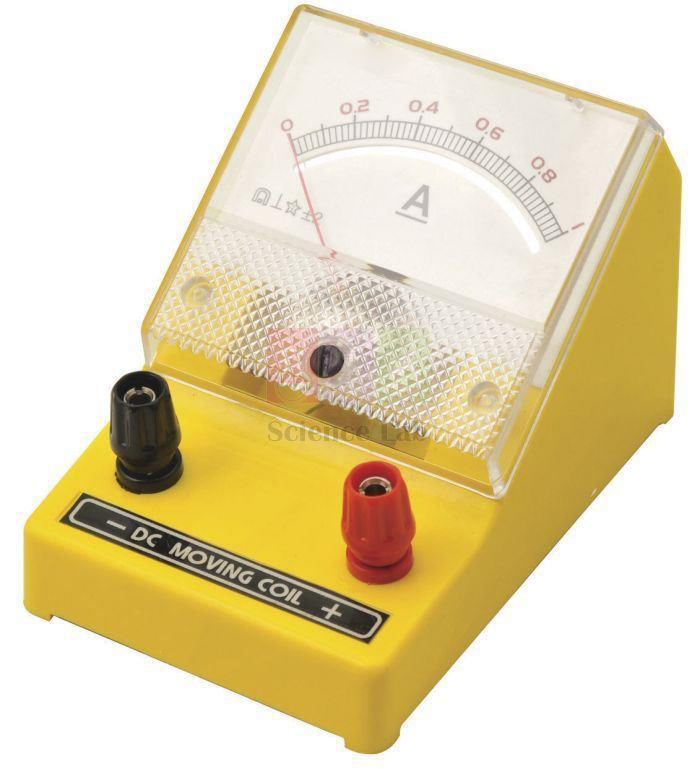
Dual Range Ammeter
Dual Range Ammeter (Product Code: SLE/PHY/01A) is a moving-coil DC ammeter used to measure circuit current in school and college physics laboratories. Students and lab technicians choose between its 0–1 A and 0–5 A ranges, both read on a single 60 mm scale, so one bench meter covers low- and higher-current experiments. It is made by Jain Scientific Equipments Pvt Ltd (ScienceLab), an OEM manufacturer, at its own factory in Ambala, India.
Specifications
| Parameter | Detail |
|---|---|
| Type | Moving-coil ammeter, DC only |
| Ranges | 0–1 A and 0–5 A (dual range, single scale) |
| Accuracy | 2.5% |
| Scale length | 60 mm |
| Overall size | 125 × 80 × 80 mm |
| Terminals | 4 mm socket terminals, with zero adjustment |
| Product code | SLE/PHY/01A |
| Manufacturer | Jain Scientific Equipments Pvt Ltd (ScienceLab) — OEM |
| Country of origin | India (made in Ambala, Haryana) |
What Is the Dual Range Ammeter Used For?
The meter is connected in series to read the direct current flowing in practical circuits: verifying Ohm’s law with a rheostat and voltmeter, comparing currents in series and parallel branches, checking the current in a potentiometer or meter bridge circuit, and monitoring current during electrolysis. As a core piece of physics lab equipment in India, it sits beside the power supply in most electricity practicals.
Start on the 0–5 A range whenever the current is unknown, then move to the 0–1 A range for a more readable deflection. Check that the pointer rests on zero and use the zero adjustment before each session, connect positive to the positive socket, and never place the meter directly across a supply without a load, as that would drive excessive current through the movement.
OEM Manufacturer
The Dual Range Ammeter is an original product of Jain Scientific Equipments Private Limited, the company behind the ScienceLab brand, which acts as the OEM (original equipment manufacturer) for its range of physics meters. Production takes place at the company’s own licensed factory at Saha, Ambala, Haryana, so schools, colleges, dealers and importers buy directly from the maker rather than from a trader.
The company is incorporated under CIN U29309HR2020PTC087597, and its factory at 449, HSIIDC Industrial Area, Saha, Ambala operates under Factory Licence AMB-ONLINE-CHD-J-414. For replacement parts or repeat batches of this ammeter, ask us; more background is on our company profile.
Related Physics Lab Equipment
Equipment that completes a DC circuit practical with this ammeter:
- Ammeter Voltmeter — a dual-purpose meter when voltage must be read in the same circuit
- Ammeter DC Dual Range OHP — a projectable version for whole-class demonstrations
- Circuits Kit Rheostat — varies the current for a set of Ohm’s law readings
- Power Supply, Stepped — a DC source with set voltage steps for the circuit
- Crocodile Clips & Leads — for wiring the meter to components on the bench
Browse the full Physics Lab Equipment range for more meters and circuit apparatus.
Frequently Asked Questions
What ranges does the Dual Range Ammeter have?
The Dual Range Ammeter SLE/PHY/01A has two DC current ranges, 0–1 A and 0–5 A, read on a single 60 mm scale. The lower range suits small classroom circuits, while the higher range covers heavier loads such as lamp circuits or electrolysis.
Can the Dual Range Ammeter measure AC current?
No, the Dual Range Ammeter is a moving-coil instrument for direct current only. For alternating current measurements, choose an AC-rated meter or contact us with the current range you need to measure so we can suggest a suitable instrument.
How accurate is the Dual Range Ammeter?
The Dual Range Ammeter is specified at 2.5% accuracy, which suits school and undergraduate practicals. If your institution needs a calibration certificate for the instrument, please discuss that requirement with us through the contact page before ordering.
What size is the Dual Range Ammeter and how does it connect?
The Dual Range Ammeter measures 125 × 80 × 80 mm overall and connects through 4 mm socket terminals, so standard 4 mm plug leads fit directly. A zero adjustment lets the pointer be reset before each practical session.
Who manufactures the Dual Range Ammeter?
The Dual Range Ammeter is manufactured by Jain Scientific Equipments Pvt Ltd (ScienceLab), the OEM, at its own licensed factory at Saha, Ambala, Haryana, India. Buyers deal directly with the maker for quotations, repeat orders and replacement-part enquiries.
Is the Dual Range Ammeter available in bulk for schools or export?
Yes, the Dual Range Ammeter can be quoted in classroom quantities for schools, colleges, tender buyers, dealers and importers in India and international markets. Share the number of meters and the delivery destination through our contact page.
Request a Quote
Quotations for the Dual Range Ammeter come direct from the manufacturer. Send your quantity and delivery location through the contact page, or add the meter to the enquiry cart with the rest of your electricity lab list.
Last updated: 24 September 2026
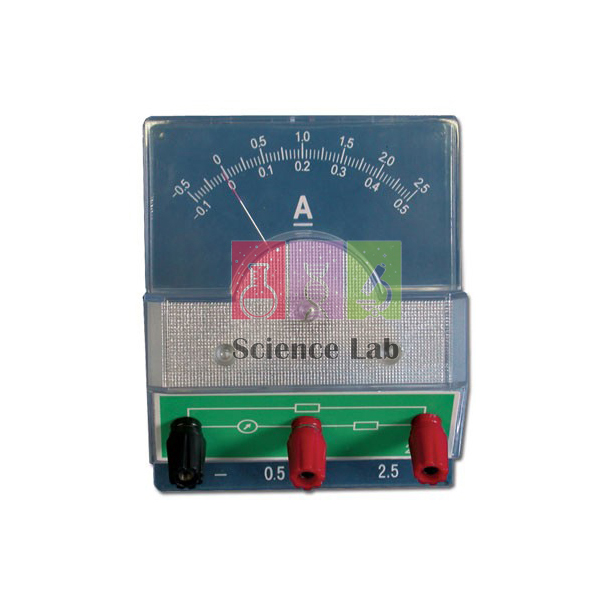
Ammeter DC Dual Range OHP
The Ammeter DC Dual Range OHP (Product Code: SLE/PHY/01) is a dual-range, DC-only ammeter manufactured by Jain Scientific Equipments Pvt Ltd (ScienceLab), Ambala, for school and college physics laboratories. Built into a transparent case, it is designed to sit directly on an overhead projector (OHP) so the needle and scale stay visible to a full classroom during demonstrations — a practical alternative to a standard bench ammeter for group teaching of physics lab equipment.
Specifications
| Parameter | Detail |
|---|---|
| Type | Moving-coil ammeter, DC only |
| Ranges | 0–0.5A and 0–2.5A (dual range, single scale) |
| Accuracy | ±2.5% |
| Case | Transparent, OHP-projectable housing |
| Additional features | Magnetic shielding and dampening for stable readings |
Typical Use
This ammeter is used wherever a class needs to read live current together rather than crowd around a bench meter — Ohm’s law demonstrations, series/parallel circuit teaching, and other core physics lab equipment sessions in schools and colleges. The dual 0–0.5A/0–2.5A range covers both low-current and higher-current classroom circuits without swapping instruments, and the magnetic shielding keeps the reading stable near other electrical apparatus on the same bench.
Manufacturer
The Ammeter DC Dual Range OHP is manufactured by Jain Scientific Equipments Private Limited, which trades under the brand ScienceLab. The company is based in Ambala, Haryana, India, with its registered office and manufacturing unit in the Ambala district. See our full company profile for more on our manufacturing background and product range.
Related Physics Lab Equipment
Equipment typically used in the same DC circuit demonstration:
- Ammeter Voltmeter — a compatible DC voltmeter/ammeter combination for the same circuit
- Power Supply, Variable — a suitable variable DC power supply for the demonstration circuit
- Circuits Kit Rheostat — variable resistance for Ohm’s law and current-control experiments
- Stackable Leads — connecting leads for wiring the demonstration circuit
- Dual Range Ammeter — a bench-mount dual-range DC ammeter (0–1A/0–5A) for non-projected setups
Browse the full Physics Lab Equipment range from a physics instruments and laboratory instruments supplier exporting to schools and colleges across India and internationally.
Frequently Asked Questions
Who manufactures the Ammeter DC Dual Range OHP?
It is manufactured by Jain Scientific Equipments Pvt Ltd (ScienceLab), based in Ambala, India — a physics lab equipment and laboratory instruments supplier to schools, colleges and technical institutes.
Why does it have a transparent case?
The transparent housing lets the meter sit on an overhead projector so the scale and needle movement are visible to the whole class during demonstrations.
Can this ammeter measure AC current?
No — it is a moving-coil instrument designed for DC current only.
Is bulk or institutional supply available?
Yes, this product can be supplied in bulk to schools, colleges, and distributors; contact us for quantity and export enquiries.
How are the two current ranges selected?
The meter offers 0–0.5A and 0–2.5A on a single dual-range scale. The exact terminal/selector configuration is confirmed on the datasheet — contact us if you need this before ordering.
What is the smallest scale division on each range?
Scale graduation isn’t listed in our current product documentation for this item; contact us for the detailed datasheet.
Are connecting leads included?
No, connecting leads are supplied separately — see Stackable Leads or Crocodile Clips & Leads in our Physics Lab Equipment range.
Is a calibration certificate available?
Calibration certificate availability depends on the order — contact us to discuss requirements for institutional or bulk purchases.
What is the warranty?
Warranty terms are confirmed at the time of quotation — contact us for current terms.
Can the instrument be used without an overhead projector?
Yes. The transparent case is an added feature for OHP projection; the meter works as a standard DC ammeter on any bench without a projector.
What information is required for an institutional quotation?
Please share the quantity required, delivery location (India or export destination), and any customisation needed via our contact form or enquiry cart, and we will follow up with pricing and lead time.
Request a Quote
For pricing or bulk order enquiries, please contact us or add this product to your enquiry cart.
Last updated: 23 September 2026
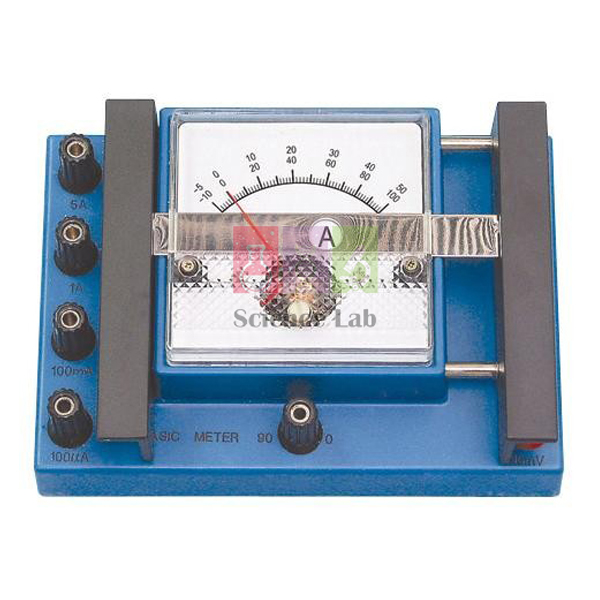
Ammeter Voltmeter
Ammeter Voltmeter (Product Code: SLE/PHY/02) is an analogue dual-purpose meter used to measure DC current and DC voltage in school and college electricity practicals. A slide selector switches between amps and volts, bringing in the internal shunting automatically, while four ranges on each function run from 100 µA to 5 A and from 100 mV to 50 V. It is supplied by Jain Scientific Equipments Pvt Ltd (ScienceLab), Ambala, India, to schools, colleges and laboratory dealers.
Specifications
| Parameter | Detail |
|---|---|
| Function | Measures current and the voltage between two points in an electric circuit |
| Selector | Slide selector for amps/volts; automatically selects internal shunting, indicates whether the meter is on amps or volts and secures the input sockets against incorrect connection |
| DC current ranges | 100 µA, 100 mA, 1 A and 5 A (dual scale) |
| DC voltage ranges | 100 mV, 1 V, 10 V and 50 V (dual scale) |
| Display | Analogue, quadruple range |
| Input connection | Dual 4 mm or terminal-type connection |
| Zero setting | Screw adjustment on the front of the meter |
| Dimensions | 160 × 114 × 60 mm |
| Product code | SLE/PHY/02 |
| Supplied by | Jain Scientific Equipments Pvt Ltd (ScienceLab), Ambala, India |
What Is the Ammeter Voltmeter Used For?
One instrument covers both readings that most DC practicals need. Set the slide to amps and connect the meter in series to measure current, from the microamp level of a high-resistance circuit up to 5 A for lamps and heating coils; slide to volts and connect it in parallel to read potential difference from 100 mV to 50 V. Teachers choosing an ammeter voltmeter for school labs in India use it for Ohm’s law, internal-resistance and cell-emf experiments.
Choose the highest range first and step down until the needle gives a clear reading. Reset the pointer with the front zero screw before each session, and never connect the meter in series while set to volts or across a supply while set to amps. A bench that must read current and voltage at the same moment needs two meters, so plan quantities per bench accordingly.
Supplier
Jain Scientific Equipments Private Limited trades as ScienceLab and supplies this Ammeter Voltmeter from Ambala, Haryana, India, as part of its range of meters for school and college electricity practicals. The company sources the meter and handles quotations and supply for schools, colleges, laboratory dealers and importers in India and international markets. Questions about matching an earlier supply or placing a repeat order can be sent to us directly. Learn more on our company profile.
Related Physics Lab Equipment
Items commonly wired up with this meter:
- Dual Range Ammeter — a second, current-only meter so current and voltage can be read together
- Micro Voltmeter — for potential differences below the 100 mV range
- Standard Digital Multimeter — a digital alternative with a numeric readout
- Power Supply Variable — an adjustable DC source for the test circuit
- Stackable Leads — connecting leads for the meter’s input sockets
See the complete Physics Lab Equipment category for more meters and circuit apparatus.
Frequently Asked Questions
What ranges does the Ammeter Voltmeter cover?
The Ammeter Voltmeter SLE/PHY/02 has four DC current ranges (100 µA, 100 mA, 1 A and 5 A) and four DC voltage ranges (100 mV, 1 V, 10 V and 50 V), each shown on a dual scale for easy reading.
How do you switch between current and voltage on the Ammeter Voltmeter?
The Ammeter Voltmeter uses a slide selector for amps or volts. Moving it automatically selects the internal shunting, shows which quantity the meter is set to read, and secures the input sockets so leads cannot be connected incorrectly for that mode.
Can the Ammeter Voltmeter measure AC?
No AC ranges are listed for the Ammeter Voltmeter; its current and voltage ranges are all DC. If your practicals need alternating current or voltage readings, contact us with the ranges required and we will advise on a suitable meter.
What are the dimensions of the Ammeter Voltmeter?
The Ammeter Voltmeter measures 160 × 114 × 60 mm, a compact size for a student bench. Inputs are made through a dual 4 mm or terminal-type connection, and the pointer is zeroed with a screw adjustment on the front.
Who supplies the Ammeter Voltmeter?
The Ammeter Voltmeter is supplied by Jain Scientific Equipments Pvt Ltd (ScienceLab), Ambala, Haryana, India. The company sources this analogue meter and handles quotations and dispatch for schools, colleges, laboratory dealers and institutional buyers in India and international markets.
Is a calibration certificate available for the Ammeter Voltmeter?
Calibration-certificate requirements for the Ammeter Voltmeter should be discussed with us before you order. Tell us which ranges need documenting and why, for example an institutional audit, through the contact page, and we will reply with what can be arranged.
What should a quotation request for the Ammeter Voltmeter include?
A quotation request for the Ammeter Voltmeter should state the product code SLE/PHY/02, the number of meters, any leads or power supplies needed with them, and the delivery location in India or abroad. Send it through our contact page or enquiry cart.
Request a Quote
Pricing for the Ammeter Voltmeter is quoted directly by ScienceLab as the supplier. Send your requirement through the contact page or add the meter to the enquiry cart.
Last updated: 24 September 2026
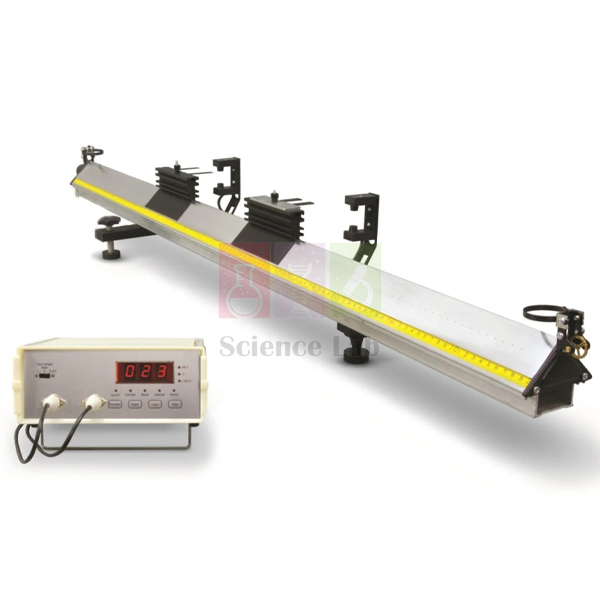
Apparatus Air Track Light Gate
Apparatus Air Track Light Gate (Product Code: SLE/PHY/03) is an air-cushion linear track with photo light gates and a timer, used to study motion under virtually frictionless conditions in school and college mechanics labs. One to four carts ride on the air supplied by the blower, so teachers can run collision, momentum and acceleration experiments with electronic timing. It is made by Jain Scientific Equipments Pvt Ltd (ScienceLab), an OEM manufacturer, at its own factory in Ambala, India.
Key Details
| Parameter | Detail |
|---|---|
| Purpose | Study of linear motion under virtually frictionless conditions |
| Carts | One to four carts riding on a cushion of air |
| Timing system | Photo light gate system complete with timer and light gates |
| Air source | Blower |
| Accessories | Accessories kit; spring bumpers can be attached to record impact forces; weights can be attached to each cart for momentum and force studies |
| Pulleys | High-precision pulleys included, to mount on the ends for free-fall and incline experiments |
| Product code | SLE/PHY/03 |
| Manufacturer | Jain Scientific Equipments Pvt Ltd (ScienceLab) — OEM |
| Country of origin | India (made in Ambala, Haryana) |
What Is the Air Track with Light Gates Used For?
With friction almost removed, the air track lets students test Newton’s laws and conservation principles with results that sit close to theory. Typical sessions include measuring velocity and acceleration as a cart passes the light gates, pulling a cart with a falling mass over an end pulley to relate force and acceleration, setting up incline runs, and colliding two carts to compare momentum before and after impact. That makes it a central item of mechanics lab equipment in India for senior secondary and undergraduate courses.
Level the track carefully before each run, since a slight tilt adds an unwanted acceleration. Switch the blower on before placing carts on the track and lift them off before switching it off, so cart and track surfaces do not rub. Load the attachable weights evenly to keep carts running straight, and fit the spring bumpers when students are studying impact forces at the ends.
What to Specify When Ordering
- The number of complete air track sets required for your laboratory
- How many carts you plan to run together (the apparatus allows one to four)
- Whether to add the Apparatus Air Track Part Kit of spare vehicles, buffers and catapults
OEM Manufacturer
This air track is produced by Jain Scientific Equipments Private Limited, which trades as ScienceLab and is the OEM (original equipment manufacturer) of the apparatus. It is made and assembled at the company’s own licensed factory at Saha, Ambala, Haryana, India, rather than bought in from a trader, and is supplied factory-direct to schools, colleges, universities and dealers. Spare carts, bumpers and other replacement parts can be requested from the manufacturer itself; ask us. See our company profile for more.
Related Physics Lab Equipment
Items that extend or support the air track set-up:
- Apparatus Air Track Part Kit — replacement vehicles, buffers, catapults and other spares
- Linear Air Track Blower — a separately listed blower for air track work
- Linear Air Track — an alternative air track listing in the same range
- Apparatus Newton’s Second Law — a dedicated set-up for force and acceleration studies
- Ticker Tape Timer — a traditional timing method to compare with light-gate results
Explore the full Physics Lab Equipment category for more mechanics apparatus.
Frequently Asked Questions
What is included with the Apparatus Air Track Light Gate?
The Apparatus Air Track Light Gate comes with a photo light gate system complete with timer and light gates, an accessories kit, a blower air source and high-precision pulleys for the track ends. Spring bumpers and cart weights attach as needed; confirm their quantities in your quotation.
How many carts can run on the air track at once?
The Apparatus Air Track Light Gate allows one to four carts to ride along its cushion of air, so it handles single-cart motion studies as well as two-cart collisions and multi-cart momentum demonstrations. Tell us how many carts you need when requesting a quote.
Can the air track be used for free-fall and incline experiments?
Yes, the Apparatus Air Track Light Gate includes high-precision pulleys that mount on the track ends, so a falling mass can pull a cart for free-fall and force studies, and the track can also be set up for incline experiments.
How does the light gate timing work on the air track?
On the Apparatus Air Track Light Gate, a cart passing through a light gate interrupts its beam and the timer records the time. From the length of the part that blocks the beam, students calculate velocity, and with two gates they can find the acceleration between them.
Who manufactures the Apparatus Air Track Light Gate?
The Apparatus Air Track Light Gate is manufactured by Jain Scientific Equipments Pvt Ltd (ScienceLab), the OEM, at its own licensed factory at Saha, Ambala, Haryana, India. Quotations, spare parts and repeat orders are handled by the manufacturer directly.
Is the Apparatus Air Track Light Gate available for export?
Yes, the Apparatus Air Track Light Gate can be quoted for schools, colleges, dealers and importers in India and international markets. Share the number of sets, the delivery country and any accessories required through our contact page to receive a quotation.
Request a Quote
Request a manufacturer-direct quotation for the Apparatus Air Track Light Gate through our contact page, or add it to the enquiry cart together with the part kit and any other mechanics apparatus you need.
Last updated: 24 September 2026
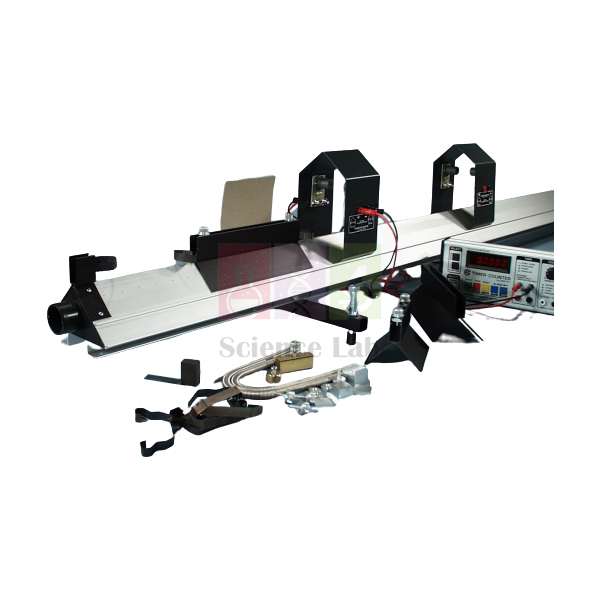
Apparatus Air Track Part Kit
Apparatus Air Track Part Kit (Product Code: SLE/PHY/04) is a set of replacement parts and vehicles used to keep an air track running for collision, momentum and motion experiments in school and college physics labs. It supplies two heavy vehicles and one light vehicle with a 2:1 mass ratio, plus buffers, catapults and consumables such as plasticine, thread and elastic bands. It is made by Jain Scientific Equipments Pvt Ltd (ScienceLab), an OEM manufacturer, at its own factory in Ambala, India.
Specifications
| Parameter | Detail |
|---|---|
| Kit type | Replacement parts for the apparatus air track |
| Vehicles | 2 heavy and 1 light, mass ratio 2:1 |
| Buffers | 2 magnetic buffers |
| Plasticine holders | 2, with central hole |
| Needles | 24 |
| Cards | 20 black plain cards |
| Catapults | 4, with slots for elastic band |
| Thread | 1 reel of nylon thread |
| Rods | 2 white rods, 4 mm diameter × 150 mm long |
| Plasticine | 1 pack |
| Elastic bands | 20 |
| Documentation | 1 instruction manual |
| Product code | SLE/PHY/04 |
| Manufacturer | Jain Scientific Equipments Pvt Ltd (ScienceLab) — OEM |
| Country of origin | India (made in Ambala, Haryana) |
What Is the Air Track Part Kit Used For?
The kit replaces parts that wear out or go missing from a busy air track and adds the items needed for classic collision work. The 2:1 mass ratio between heavy and light vehicles lets students predict and check velocities after a collision. Magnetic buffers can give repelling, nearly elastic interactions, while a needle meeting plasticine in a holder can make two vehicles stick together for an inelastic collision; catapults with elastic bands launch vehicles at repeatable speeds.
Keeping one kit per track is a practical way for schools and colleges to hold lab equipment spare parts in India, so a lost buffer or a worn elastic band does not stop a practical. Store the plasticine wrapped, keep the needles in a labelled container, and check the nylon thread for fraying before it is used to tow or hang masses.
What to Specify When Ordering
- The number of part kits required (for example, one per air track)
- Which air track the kits will serve, so compatibility can be confirmed
- Any individual parts you need in extra quantity, so we can confirm availability
OEM Manufacturer
Jain Scientific Equipments Private Limited, trading as ScienceLab, is the OEM (original equipment manufacturer) of the Apparatus Air Track Part Kit and of the air track apparatus it serves. Kits are assembled at the company’s own licensed factory in Saha, Ambala, Haryana, so buyers of its air tracks get replacement parts from the same maker rather than from a third-party stockist.
For vendor records, the company’s Corporate Identification Number is U29309HR2020PTC087597, and its Saha works at 449, HSIIDC Industrial Area holds Factory Licence AMB-ONLINE-CHD-J-414. Read more on our company profile.
Related Physics Lab Equipment
Apparatus used with these spare parts:
- Apparatus Air Track Light Gate — the complete air track with light gates, timer and blower
- Linear Air Track Blower — supplies the air cushion the vehicles ride on
- Linear Air Track — an alternative air track listing; confirm part compatibility with us
- Apparatus Collision 2 Dimension — extends momentum studies to collisions in two dimensions
The complete Physics Lab Equipment category lists more mechanics apparatus.
Frequently Asked Questions
What does the Apparatus Air Track Part Kit contain?
The Apparatus Air Track Part Kit contains 2 heavy and 1 light vehicle (mass ratio 2:1), 2 magnetic buffers, 2 plasticine holders, 24 needles, 20 black plain cards, 4 catapults, a reel of nylon thread, 2 white rods, a pack of plasticine, 20 elastic bands and an instruction manual.
Why do the vehicles in the part kit have a 2:1 mass ratio?
The 2:1 mass ratio between the heavy and light vehicles in the Apparatus Air Track Part Kit gives simple, predictable numbers in momentum calculations, so students can compare predicted and measured velocities after collisions without complicated arithmetic.
Will the Apparatus Air Track Part Kit fit my air track?
The Apparatus Air Track Part Kit is described as replacement parts for the apparatus air track. If your track came from another source or is an older model, tell us its details through the contact page so we can confirm compatibility before you order.
What size are the white rods in the Air Track Part Kit?
The Apparatus Air Track Part Kit includes 2 white rods, each 4 mm in diameter and 150 mm long, along with 2 plasticine holders that have a central hole. Refer to the instruction manual supplied in the kit when setting these parts up.
Who manufactures the Apparatus Air Track Part Kit?
The Apparatus Air Track Part Kit is manufactured by Jain Scientific Equipments Pvt Ltd (ScienceLab), the OEM, at its own licensed factory at Saha, Ambala, Haryana, India. Repeat orders and replacement-part enquiries go directly to the manufacturer.
Can labs order several part kits or ship them abroad?
Yes, the Apparatus Air Track Part Kit can be quoted in multiple units for schools, colleges, dealers and importers in India and international markets. Send the quantity, the air tracks the kits will serve and the delivery destination through the contact page.
Request a Quote
Quotations for the Apparatus Air Track Part Kit are issued directly by the manufacturer. Send your requirement via the contact page, or add the kit to the enquiry cart with your air track order.
Last updated: 24 September 2026
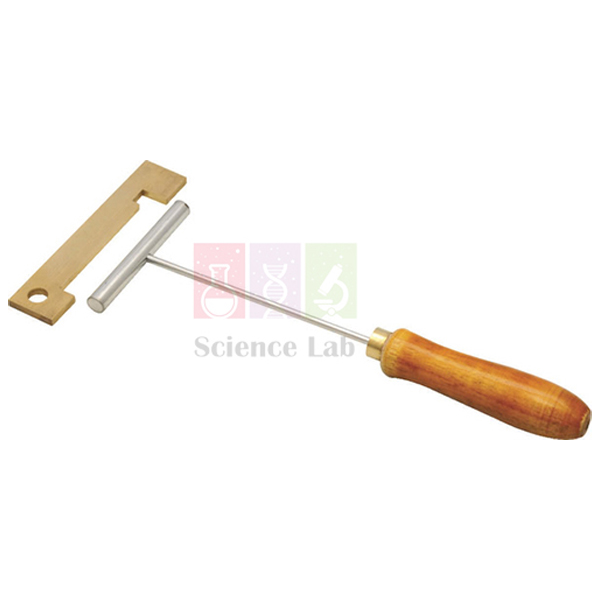
Apparatus Bar & Gauge
Apparatus Bar & Gauge (Product Code: SLE/PHY/05) is a heat-expansion demonstrator used to show that a solid grows when heated and shrinks when cooled, in school and college physics classes. An iron bar 108 mm long and 12.7 mm in diameter just fits the cut-out and hole of a brass gauge when cold, and stops fitting once heated. It is made by Jain Scientific Equipments Pvt Ltd (ScienceLab), an OEM manufacturer, at its own factory in Ambala, India.
Specifications
| Parameter | Detail |
|---|---|
| Purpose | Illustrates expansion by heat and contraction by cooling |
| Overall length | Approx. 225 mm |
| Bar | Iron, 108 mm long × 12.7 mm diameter |
| Bar mounting | On a support rod fitted with a wooden handle |
| Gauge | Brass, 150 × 38 mm |
| Gauge openings | A cut-out that just admits the bar lengthways and a hole that passes the bar endways when cold |
| Product code | SLE/PHY/05 |
| Manufacturer | Jain Scientific Equipments Pvt Ltd (ScienceLab) — OEM |
| Country of origin | India (made in Ambala, Haryana) |
What Is the Bar and Gauge Apparatus Used For?
The demonstration takes a few minutes and needs only a flame. At room temperature, students check that the bar slides lengthways into the cut-out and passes endways through the hole. The bar is then heated in a burner flame and tried again: it no longer enters either opening, showing that both its length and its diameter have increased. As it cools, or is dipped in cold water, it fits once more, proving the change is reversible.
Because a length gauge and a diameter gauge share one brass plate, the apparatus shows linear expansion and expansion in cross-section in the same lesson, a natural lead-in to the coefficient of linear expansion and to everyday cases such as gaps in railway lines. It is a staple of the physics practical equipment CBSE and state-board schools use when teaching thermal properties of matter. Hold the bar only by its wooden handle while heating, rest it on a heat-proof mat afterwards, and let students handle the gauge only once it has cooled.
OEM Manufacturer
The Apparatus Bar & Gauge comes from Jain Scientific Equipments Private Limited, trading as ScienceLab, which is the OEM (original equipment manufacturer) of this item. It is manufactured at the company’s licensed factory at Saha, Ambala, Haryana, India, and reaches schools, colleges, science dealers and importers factory-direct. Questions about repeat orders or a replacement gauge go straight to the maker; just ask us. More on our company profile.
Related Physics Lab Equipment
Apparatus that pairs with the bar and gauge in a thermal-expansion lesson:
- Ball & Ring Apparatus — the companion demonstration of expansion with a ball and ring
- Bar & Gauge Apparatus — a separately listed bar and gauge in the same range
- Bar Compound Copper & Iron — shows unequal expansion of two metals bending a bonded bar
- Bunsen Burner — the heat source for warming the iron bar
- Expansion Of Liquids Apparatus — extends the topic from solids to liquids
Browse the full Physics Lab Equipment range for more heat apparatus.
Frequently Asked Questions
What are the dimensions of the Apparatus Bar & Gauge?
The Apparatus Bar & Gauge is about 225 mm long overall. Its iron bar measures 108 mm in length and 12.7 mm in diameter, and the brass gauge measures 150 × 38 mm, with a cut-out and a hole sized to the cold bar.
How does the Apparatus Bar & Gauge show expansion?
With the Apparatus Bar & Gauge, the cold iron bar just fits the gauge’s cut-out lengthways and passes through its hole endways. After heating it fits neither, showing expansion in length and diameter; once cooled it fits again, showing contraction.
What heat source is needed for the Bar & Gauge demonstration?
The Apparatus Bar & Gauge only needs a flame that can heat the iron bar for a short time, such as a Bunsen burner or a spirit lamp. Hold the bar by its wooden handle throughout and place it on a heat-proof surface afterwards.
What materials are the bar and gauge made of?
In the Apparatus Bar & Gauge the bar is iron and the gauge is brass, with the bar mounted on a support rod fitted with a wooden handle. The wooden handle keeps the user’s hand away from the heated metal during the demonstration.
Who manufactures the Apparatus Bar & Gauge?
The Apparatus Bar & Gauge is manufactured by Jain Scientific Equipments Pvt Ltd (ScienceLab), the OEM, at its licensed factory at Saha, Ambala, Haryana, India, and is supplied factory-direct to schools, colleges and dealers.
Can the Apparatus Bar & Gauge be ordered in class sets or for export?
Yes, the Apparatus Bar & Gauge can be quoted in class-set quantities for schools, colleges, tender buyers, dealers and importers in India and international markets. Send the quantity and delivery location through our contact page for a quotation.
Request a Quote
Ask for a factory-direct quotation on the Apparatus Bar & Gauge through our contact page, or add it to the enquiry cart alongside the ball and ring and other heat apparatus for your lab.
Last updated: 24 September 2026
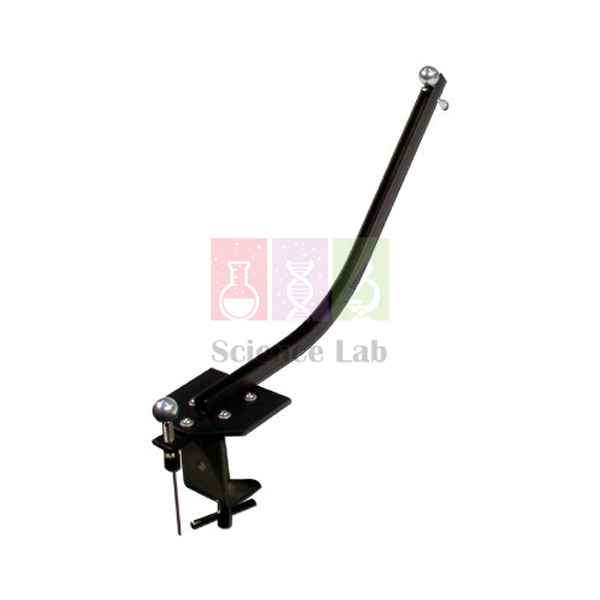
Apparatus Collision 2 Dimension
Apparatus Collision 2 Dimension (Product Code: SLE/PHY/06) is a curved-track ball collision apparatus used to study how momentum and energy change in elastic and inelastic collisions in school and college physics labs. A support on its fixed base holds a target ball at the right height for a centre-to-centre impact, and a pin with three holes gives a repeatable release height. It is made by Jain Scientific Equipments Pvt Ltd (ScienceLab), an OEM manufacturer, at its own factory in Ambala, India.
Key Details
| Parameter | Detail |
|---|---|
| Purpose | Study of energy and momentum changes in elastic and inelastic collisions |
| Track | Curved track with a base permanently mounted at one end |
| Collision plane | Track is level so the collision occurs only in the horizontal plane, simplifying calculations |
| Target support | Support on the base holds a ball at the proper height for a centre-to-centre collision with a second ball rolling down the track |
| Release control | A pin and three holes in the track keep the drop height of the ball consistent |
| Product code | SLE/PHY/06 |
| Manufacturer | Jain Scientific Equipments Pvt Ltd (ScienceLab) — OEM |
| Country of origin | India (made in Ambala, Haryana) |
What Is the 2D Collision Apparatus Used For?
The apparatus is set at the edge of a bench so that balls leaving the base fall to the floor as projectiles. Students first release the incident ball alone from one of the pin positions and mark where it lands, then place the target ball on the support and repeat. Because every ball leaves from the same height, the horizontal distance to each landing mark is proportional to its velocity just after impact, so momentum before and after can be compared directly.
Repeating runs from the other holes shows how a greater drop height raises the incident speed, and comparing kinetic energy before and after tells students whether a collision was elastic or inelastic. Where the balls leave in different directions, their momenta are resolved into components in the horizontal plane. A plumb line marks the floor point below the launch position, making the apparatus a natural companion to the projectile motion kit school labs already use.
What to Specify When Ordering
- The number of sets needed for your laboratory
- Confirmation of the incident and target balls supplied, and any spare balls
- Measuring accessories to order with it, such as a plumb line and a metre scale
OEM Manufacturer
Jain Scientific Equipments Private Limited, the company that trades as ScienceLab, is the OEM (original equipment manufacturer) of the Apparatus Collision 2 Dimension. The apparatus is manufactured at its licensed factory at Saha, Ambala, Haryana, India, and sold factory-direct, so schools, colleges and dealers deal with the maker itself for quotations, repeat orders and any replacement parts they need. Company background is on our company profile.
Related Physics Lab Equipment
Items used with this apparatus when measuring collisions:
- Apparatus Falling Bodies (Projectile) — studies the projectile paths the balls follow after impact
- Plumb Line Level — marks the floor point directly below the launch position
- Meter Scale 100 cm — measures the horizontal range of each ball
- Vernier Calliper — measures ball diameters when locating the centres of impact
- Apparatus Air Track Light Gate — one-dimensional collisions with carts and electronic timing
More mechanics apparatus is listed in the Physics Lab Equipment category.
Frequently Asked Questions
What does the Apparatus Collision 2 Dimension demonstrate?
The Apparatus Collision 2 Dimension demonstrates how momentum and kinetic energy change when one ball strikes another, letting students compare elastic and inelastic collisions. The collision takes place only in the horizontal plane, which keeps the calculations simple.
How is the drop height kept the same on every run?
The Apparatus Collision 2 Dimension has a pin and three holes in its curved track. Setting the pin in a hole fixes where the incident ball is released, so the drop height, and therefore the speed at impact, stays consistent between runs.
How is the target ball positioned on the Apparatus Collision 2 Dimension?
On the Apparatus Collision 2 Dimension, a support on the base holds the target ball at the proper height for a centre-to-centre collision with the ball rolling down the track. The base is permanently mounted at one end of the curved track.
Are the balls included with the Apparatus Collision 2 Dimension?
The Apparatus Collision 2 Dimension is designed around an incident ball rolling down the track and a target ball on the support. Please confirm the balls supplied, and any spares you want, when you request a quotation through our contact page.
Who manufactures the Apparatus Collision 2 Dimension?
The Apparatus Collision 2 Dimension is manufactured by Jain Scientific Equipments Pvt Ltd (ScienceLab), the OEM, at its licensed factory at Saha, Ambala, Haryana, India. Institutions and dealers buy it directly from the manufacturer.
What should a quotation request for this apparatus include?
A quotation request for the Apparatus Collision 2 Dimension should give the product code SLE/PHY/06, the number of sets, any accessories such as a plumb line or metre scale, and the delivery location in India or international markets.
Request a Quote
Quotations for the Apparatus Collision 2 Dimension come direct from the manufacturer. Use our contact page or add the apparatus to the enquiry cart with the rest of your mechanics list.
Last updated: 24 September 2026
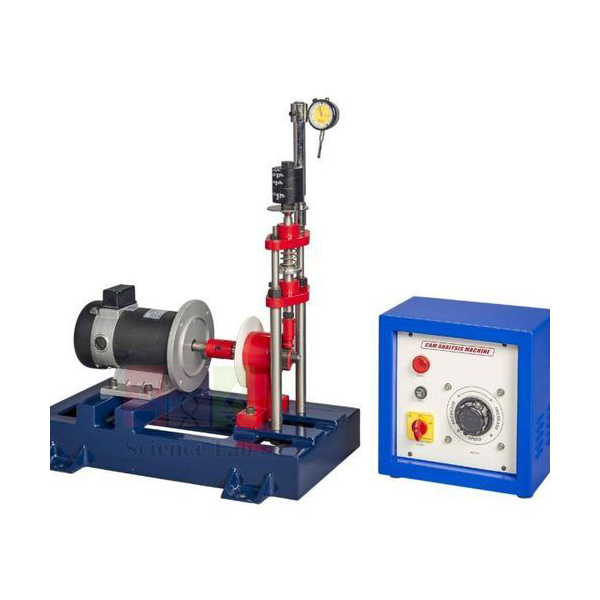
Apparatus Conductivity Cam
Apparatus Conductivity Cam (Product Code: SLE/PHY/07) is a thermal-conductivity demonstrator used to compare how well different metals conduct heat in school and college physics classes. Metal rods are mounted vertically on the outside of the base of a cylindrical copper vessel, and the indices supplied with it let students mark results so they can be studied later. It is made by Jain Scientific Equipments Pvt Ltd (ScienceLab), an OEM manufacturer, at its own factory in Ambala, India.
Key Details
| Parameter | Detail |
|---|---|
| Purpose | Demonstrates the different thermal conductivities of different metals |
| Vessel | Cylindrical copper vessel with a thick rim at the top |
| Mounting | Rim rests on a ring fitted to a retort stand |
| Test rods | Metal rods mounted vertically on the outer side at the base of the vessel |
| Indices | Supplied complete with indices, so observations can be studied at a later stage |
| Product code | SLE/PHY/07 |
| Manufacturer | Jain Scientific Equipments Pvt Ltd (ScienceLab) — OEM |
| Country of origin | India (made in Ambala, Haryana) |
What Is the Metal Conductivity Apparatus Used For?
The vessel is supported by its rim in a ring on a retort stand, so the rods hang below it. Hot water fills the copper vessel and heat travels down each rod at a rate set by the conductivity of its metal. A common way to make the difference visible is to coat the rods thinly with wax beforehand: the wax melts furthest along the better conductors, and students use the indices to mark how far the melting has reached on each rod.
Because the indices hold the readings, the class can compare the rods after the apparatus has cooled, rank the metals from better to poorer conductor, and relate the result to everyday choices such as copper-bottomed pans. Keep the vessel steady in its ring while filling it, keep hands clear of the hot copper, and let everything cool before the indices are handled.
OEM Manufacturer
Jain Scientific Equipments Private Limited, which markets its products under the ScienceLab name, is the OEM (original equipment manufacturer) of this conductivity apparatus and one of the physics instruments manufacturers based in Ambala, Haryana. The apparatus is manufactured at the company’s own licensed factory at Saha, Ambala, and shipped factory-direct to schools, colleges, science dealers and importers. For replacement indices or a repeat order, ask us directly; our company profile has more about the company.
Related Physics Lab Equipment
Apparatus used alongside it in heat-transfer lessons:
- Apparatus Heat/Thermal Conductivity — another conductivity apparatus in the same range
- Thermal Conductivity Bars — bars for comparing conduction in different materials
- Retort Stand — with a ring, supports the vessel by its rim
- Wax — for coating the rods so the progress of heat along them is visible
- Bunsen Burner — heats the water used in the vessel
See the full Physics Lab Equipment range for more heat apparatus.
Frequently Asked Questions
What does the Apparatus Conductivity Cam demonstrate?
The Apparatus Conductivity Cam demonstrates that different metals conduct heat at different rates. Heat from hot water in its copper vessel travels down metal rods mounted on the base, and students compare how far the heating effect progresses along each rod.
Which metals are the rods of the Apparatus Conductivity Cam made from?
The metals used for the rods of the Apparatus Conductivity Cam are not listed on this page. Please ask us through the contact page for the rod metals and number of rods before you order, especially if your syllabus names specific metals.
What are the indices on the Apparatus Conductivity Cam for?
The indices supplied with the Apparatus Conductivity Cam let students mark the position reached on each rod, so the observations can be studied at a later stage, after the apparatus has cooled or when the class returns to its results.
How is the Apparatus Conductivity Cam mounted?
The Apparatus Conductivity Cam has a thick rim at the top of its cylindrical copper vessel. The rim rests on a ring fitted to a retort stand, which holds the vessel steady with the metal rods hanging vertically below it.
Who manufactures the Apparatus Conductivity Cam?
The Apparatus Conductivity Cam is manufactured by Jain Scientific Equipments Pvt Ltd (ScienceLab), the OEM, at its own licensed factory at Saha, Ambala, Haryana, India, and is supplied factory-direct to schools, colleges and dealers.
Can the Apparatus Conductivity Cam be supplied in bulk or for export?
Yes, the Apparatus Conductivity Cam can be quoted in quantity for schools, colleges, tender buyers, dealers and importers in India and international markets. Share the number of units, any retort stands needed and the delivery destination through our contact page.
Request a Quote
Send your enquiry for the Apparatus Conductivity Cam through our contact page for a quotation direct from the manufacturer, or add it to the enquiry cart together with retort stands and other heat apparatus.
Last updated: 24 September 2026
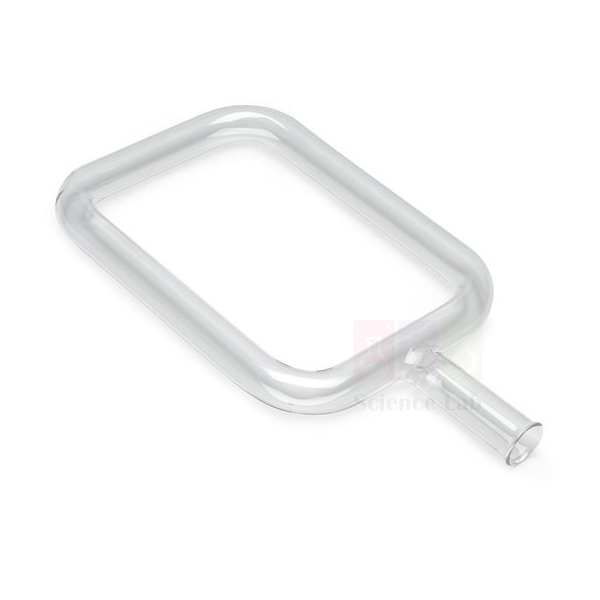
Apparatus Convection In Liquid
Apparatus Convection In Liquid (Product Code: SLE/PHY/08) is a rectangular loop of glass tubing used to show convection currents circulating in water in school and college physics and science classes. The 350 × 210 mm rectangle is made from 22 mm glass tubing, so a few potassium permanganate crystals trace the moving water clearly when one lower corner is gently heated. It is made by Jain Scientific Equipments Pvt Ltd (ScienceLab), an OEM manufacturer, at its own factory in Ambala, India.
Specifications
| Parameter | Detail |
|---|---|
| Form | Rectangle of glass tubing |
| Size | 350 × 210 mm |
| Tubing | 22 mm glass tubing |
| Operation | Convection currents generated by gently heating one of the lower corners |
| Indicator | A small amount of potassium permanganate (VII) crystals dropped into the tube |
| Mounting in use | Mounted vertically in a retort stand |
| Product code | SLE/PHY/08 |
| Manufacturer | Jain Scientific Equipments Pvt Ltd (ScienceLab) — OEM |
| Country of origin | India (made in Ambala, Haryana) |
What Is the Convection Tube Used For?
Fill the rectangle with water, clamp it upright in a retort stand and drop a few potassium permanganate crystals into the tube. When a small flame warms one lower corner, the heated water expands, becomes less dense and rises up that side, while cooler water sinks down the opposite side to replace it, and the purple colour shows the whole loop circulating. The demonstration links directly to sea breezes, hot-water systems and the way a pan of water heats from the bottom.
Use only a gentle flame on one corner, never the whole base, so that a single clear current forms. Warm the glass gradually to avoid thermal shock, use just a few crystals so the colour stays traceable, and let the water cool before emptying and rinsing the tube. It gives any heat energy science kit a vivid, reusable convection demonstration for middle and secondary classes.
OEM Manufacturer
The Apparatus Convection In Liquid is produced by Jain Scientific Equipments Private Limited, better known by its trading name ScienceLab, which acts as the OEM (original equipment manufacturer) for its heat and physics apparatus. It is manufactured at the company’s own licensed factory at Saha, Ambala, Haryana, India, and supplied factory-direct to schools, colleges, dealers and importers; enquiries about repeat orders or replacement glass go straight to the maker, so just ask us.
The company is a registered MSME (Udyam UDYAM-HR-01-0003714), and its export orders are shipped under Importer-Exporter Code AAECJ8618A (DGFT). See our company profile for more.
Related Physics Lab Equipment
Items needed to run the convection demonstration, plus related apparatus:
- Potassium Permanganate — the crystals that colour the moving water
- Retort Stand — holds the glass rectangle upright during heating
- Glass Spirit Lamp — a gentle flame for warming one lower corner
- Convection in Air Apparatus — shows the same principle in a gas
- Convection of Gas Apparatus — a further demonstration of convection in gases
Explore the full Physics Lab Equipment category for more heat apparatus.
Frequently Asked Questions
What size is the Apparatus Convection In Liquid?
The Apparatus Convection In Liquid is a 350 × 210 mm rectangle made from 22 mm glass tubing. In use it is mounted vertically in a retort stand, so check that your stand and clamp can hold a frame of that size securely.
How do you show convection currents with this apparatus?
To use the Apparatus Convection In Liquid, fill it with water, mount it vertically, drop a few potassium permanganate crystals into the tube and gently heat one lower corner. The coloured water rises on the heated side and circulates around the rectangle.
Is potassium permanganate included with the Apparatus Convection In Liquid?
The Apparatus Convection In Liquid uses potassium permanganate crystals as its indicator, and the crystals are also listed as a separate product in our range. Tell us in your enquiry whether you need them, so the quotation covers everything for the demonstration.
What heat source should be used with the convection apparatus?
The Apparatus Convection In Liquid needs only gentle heat at one lower corner, so a spirit lamp or a low Bunsen flame is suitable. Warm the glass gradually and never heat the whole base, which would blur the single convection current.
Who manufactures the Apparatus Convection In Liquid?
The Apparatus Convection In Liquid is manufactured by Jain Scientific Equipments Pvt Ltd (ScienceLab), the OEM, at its own licensed factory at Saha, Ambala, Haryana, India. Schools, colleges and dealers buy it directly from the manufacturer.
Can the Apparatus Convection In Liquid be ordered for several labs or for export?
Yes, the Apparatus Convection In Liquid can be quoted in multiple units for schools, colleges, dealers and importers in India and international markets. Because it is glassware, mention the destination so suitable protective packing can be included in the quotation.
Request a Quote
For a manufacturer-direct quotation on the Apparatus Convection In Liquid, write to us via the contact page or add it to the enquiry cart along with potassium permanganate and a retort stand.
Last updated: 24 September 2026

Apparatus Coulomb's Law
Apparatus Coulomb's Law (Product Code: SLE/PHY/09) is an electrostatics apparatus used to verify Coulomb's law by directly measuring the force between two charged spheres in school and college physics labs. One sphere hangs from the top of a box and the other rests on its bottom; students read the hanging sphere's deflection on a ruler, with a mirror to remove parallax. It is made by Jain Scientific Equipments Pvt Ltd (ScienceLab), an OEM manufacturer, at its own factory in Ambala, India.
Key Details
| Parameter | Detail |
|---|---|
| Purpose | Verifies Coulomb's law of the force between charges by direct measurement |
| Sphere arrangement | One sphere suspended from the top of a box; the other rests on the bottom |
| Measurement | Deflection of the hanging sphere read on an easy-to-read ruler, from which the force is calculated |
| Parallax control | A mirror assures accuracy by eliminating parallax |
| Construction | Fully assembled and self-contained |
| Product code | SLE/PHY/09 |
| Manufacturer | Jain Scientific Equipments Pvt Ltd (ScienceLab) — OEM |
| Country of origin | India (made in Ambala, Haryana) |
What Is the Coulomb's Law Apparatus Used For?
When the two spheres carry like charges and are brought together, the hanging sphere is pushed aside. Its sideways deflection, read on the ruler while lining the sphere up with its reflection in the mirror, lets students calculate the electrostatic force from the geometry of the suspension. Repeating the reading at different separations shows the force falling as the spheres move apart, which students then compare with the inverse-square relationship.
Electrostatic experiments work best in dry air, so run them away from open windows and humid corners, and discharge both spheres by touching them to earth between trials. Charge them from a source such as a friction rod or a suitable high-voltage supply, and keep hands and sleeves clear of the box while readings are taken. As educational physics lab equipment, it turns an abstract formula into a quantity students can measure for themselves.
OEM Manufacturer
Jain Scientific Equipments Private Limited sells under the ScienceLab brand and is the OEM (original equipment manufacturer) of the Apparatus Coulomb's Law. The apparatus is manufactured at the company’s licensed factory at Saha, Ambala, Haryana, India, and delivered fully assembled, so institutions and dealers buy it straight from the maker and can ask us directly about repeat orders or replacement parts. The company profile has more about the business.
Related Physics Lab Equipment
Electrostatics items used with this apparatus:
- Van de Graaff Generator — a source of charge for the spheres
- EHT Power Supply — an adjustable high-voltage supply for charging
- Friction Rod, Brass/Ebonite — charges the spheres by friction and contact in simple classes
- Electroscope, Gold Leaf — confirms the presence of charge before readings are taken
- Electrostatic Investigation — a related electrostatics item in the same range
Browse the full Physics Lab Equipment range for more electricity and electrostatics apparatus.
Frequently Asked Questions
What does the Apparatus Coulomb's Law measure?
The Apparatus Coulomb's Law measures the force between two charged spheres directly. One sphere hangs from the top of a box and deflects away from the other, and students read that deflection on a ruler to calculate the force and test Coulomb's law.
How does the mirror improve accuracy on the Apparatus Coulomb's Law?
The Apparatus Coulomb's Law includes a mirror that eliminates parallax. Students line up the hanging sphere with its reflection before reading the ruler, so the eye is square to the scale and every reading is taken from the same viewpoint.
Does the Apparatus Coulomb's Law need assembly?
No, the Apparatus Coulomb's Law is fully assembled and self-contained, with the spheres, box, ruler and mirror arranged ready for use. Teachers only need a means of charging the spheres before the class starts taking readings.
How are the spheres of the Apparatus Coulomb's Law charged?
The charging method is not specified in the description of the Apparatus Coulomb's Law. A friction rod or a suitable high-voltage source is commonly used in electrostatics work; tell us what your lab already has and we will advise on what fits.
Why can readings on the Apparatus Coulomb's Law vary from day to day?
Readings on the Apparatus Coulomb's Law can vary because charge leaks away faster in humid air. Work in a dry room, recharge the spheres before each set of readings, and take several measurements at each separation to average out the effect.
Who manufactures the Apparatus Coulomb's Law?
The Apparatus Coulomb's Law is manufactured by Jain Scientific Equipments Pvt Ltd (ScienceLab), the OEM, at its licensed factory at Saha, Ambala, Haryana, India, and sold factory-direct to schools, colleges, dealers and importers.
Can the Apparatus Coulomb's Law be supplied for export?
Yes, the Apparatus Coulomb's Law can be quoted for schools, colleges, dealers and importers in India and international markets. Send the quantity and destination through our contact page, and the quotation will come directly from the manufacturer.
Request a Quote
To request pricing for the Apparatus Coulomb's Law, use the contact page or add it to the enquiry cart; quotations are prepared directly by the manufacturer.
Last updated: 24 September 2026
44.jpg)
Apparatus Falling Bodies (Projectile)
Apparatus Falling Bodies (Projectile) (Product Code: SLE/PHY/10) is a spring-release demonstration block used to show that the horizontal and vertical motions of a projectile are independent in school and college physics labs. One press of the trigger catch drops one steel ball straight down and projects a second sideways, and both strike the floor at the same instant. This compact projectile motion kit for school classrooms is made by Jain Scientific Equipments Pvt Ltd (ScienceLab), an OEM manufacturer, at its own factory in Ambala, India.
Specifications
| Parameter | Detail |
|---|---|
| Demonstrates | Independence of horizontal and vertical motion |
| Body | Wooden block, approx. 190 x 58 x 30 mm |
| Launch mechanism | Pivoted L-section, spring-loaded metal launching bar with a trigger catch |
| Projectiles | 2 steel balls |
| Storage | Recess in the block to hold the steel balls |
| Result on release | One ball drops vertically, the other is projected horizontally; both hit the floor at the same time |
| Product code | SLE/PHY/10 |
| Manufacturer | Jain Scientific Equipments Pvt Ltd (ScienceLab) — OEM |
| Country of origin | India (made in Ambala, Haryana) |
What Is the Falling Bodies Projectile Apparatus Used For?
Many students expect a ball fired sideways to stay in the air longer than one that is simply let go. This apparatus tests that idea directly: set the block at the edge of a level bench, place the two steel balls in position and release the trigger catch. The launching bar swings, one ball falls straight down while the other flies out horizontally, and the class hears a single sound as both land together.
The lesson is that gravity gives both balls the same downward acceleration whatever their sideways speed, so the horizontal motion does not change the time of fall. Run it over a hard floor so the landings are easy to hear, keep the landing zone clear, and return the balls to the recess in the block after use. It fits naturally into mechanics lab equipment for secondary and senior-secondary projectile lessons.
OEM Manufacturer
ScienceLab is the trading name of Jain Scientific Equipments Private Limited, the OEM (original equipment manufacturer) of this falling bodies apparatus. It is produced at the company's own licensed factory at Saha, Ambala, Haryana, India, and sold factory-direct rather than through a trading middleman. Schools, colleges, laboratory dealers and importers deal with the maker itself, so questions about spare steel balls or repeat orders reach the people who build the unit — just ask us. More about the company is on the ScienceLab company profile.
Related Physics Lab Equipment
These items help a teacher build a full lesson on falling bodies and projectile motion around this demonstration:
- G By Freefall Apparatus and Timer — moves the class from a qualitative demonstration to a measured value of g.
- Guinea & Feather Apparatus — shows how air resistance, not mass, changes how bodies fall.
- Apparatus Newton's Second Law — a clamp-mounted spring unit that also drops one ball while projecting another.
- Meter Stick, White — for measuring the drop height and the horizontal landing distance.
See the complete range of Physics Lab Equipment from ScienceLab.
Frequently Asked Questions
What does the Apparatus Falling Bodies (Projectile) demonstrate?
The Apparatus Falling Bodies (Projectile) demonstrates that horizontal and vertical motions are independent. When the trigger catch is released, one steel ball drops vertically while the other is projected horizontally, and both hit the floor at the same time because gravity accelerates each of them downward equally.
What comes with the falling bodies projectile apparatus?
The falling bodies projectile apparatus consists of a wooden block of about 190 x 58 x 30 mm carrying a pivoted L-section, spring-loaded metal launching bar with a trigger catch. It is supplied with 2 steel balls, which are kept in a storage recess in the block.
How should the projectile apparatus be set up in class?
Place the Apparatus Falling Bodies (Projectile) at the edge of a level bench above a hard floor, so the two landings can be heard clearly. Keep students out of the landing area, release the trigger catch, and then return both steel balls to the recess in the block.
Who manufactures the Apparatus Falling Bodies (Projectile)?
The Apparatus Falling Bodies (Projectile) is manufactured by Jain Scientific Equipments Pvt Ltd, trading as ScienceLab, as the OEM at its own factory in Saha, Ambala, Haryana, India. Buyers order it direct from the manufacturer instead of through a reseller.
What should a quotation request for SLE/PHY/10 include?
A quotation request for the Apparatus Falling Bodies (Projectile), code SLE/PHY/10, should state the quantity, the delivery city or country, and any other physics items you want on the same order. Send these details through the ScienceLab contact page for a quote from the manufacturer.
Can schools and dealers order the falling bodies apparatus in bulk?
Yes. ScienceLab supplies the Apparatus Falling Bodies (Projectile) in class-set and bulk quantities to schools, colleges, dealers and importers in India and international markets. Share the quantity and destination through the contact page so the order and shipment can be planned.
Request a Quote
To order the Apparatus Falling Bodies (Projectile), send your quantity and delivery location through the ScienceLab contact page, or add the item to the enquiry cart together with the rest of your physics list. The quotation comes straight from the manufacturer.
Last updated: 24 September 2026
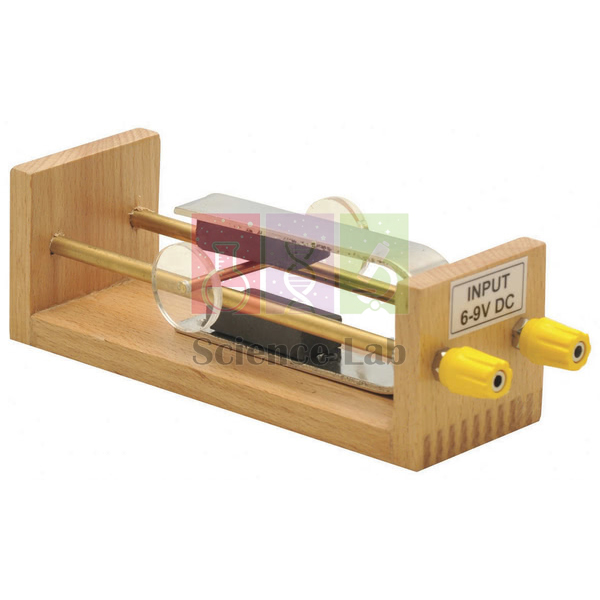
Apparatus Force of Conductor
Apparatus Force of Conductor (Product Code: SLE/PHY/11) is a rolling-axle demonstration unit used to show Fleming's left-hand rule, the force on a current-carrying conductor in a magnetic field, in school physics labs. A brass axle with plastic discs rests on a pair of brass rails between the poles of a strong U-shaped magnet, and it rolls one way or the other depending on the direction of the current. It is made by Jain Scientific Equipments Pvt Ltd (ScienceLab), an OEM manufacturer, at its own factory in Ambala, India.
Specifications
| Parameter | Detail |
|---|---|
| Principle shown | Fleming's law: a conductor carrying current in a magnetic field experiences a force whose direction depends on the direction of the current |
| Moving conductor | Brass axle with plastic discs, free to roll along the rails |
| Rails | Pair of brass rails |
| Terminals | 4 mm socket terminals |
| Magnet | Strong U-shaped magnet |
| Product code | SLE/PHY/11 |
| Manufacturer | Jain Scientific Equipments Pvt Ltd (ScienceLab) — OEM |
| Country of origin | India (made in Ambala, Haryana) |
What Is the Force of Conductor Apparatus Used For?
This is the classic "motor effect" demonstration. Current enters one brass rail through a 4 mm socket, crosses the brass axle and leaves by the other rail, so the axle itself becomes the conductor sitting in the field of the U-shaped magnet. As soon as current flows, the axle is pushed along the rails; reverse the supply leads, or turn the magnet over, and it rolls back the other way. Students can predict each result with Fleming's left-hand rule before switching on.
Use a low-voltage DC source and switch the current on only briefly, as a short circuit through the rails and axle warms the leads quickly. The plastic discs keep the axle rolling true on the rails, so the effect is easy to see from the back of the room. As an electromagnetic kit for school physics, it links neatly to lessons on electric motors and on current-carrying coils.
OEM Manufacturer
Jain Scientific Equipments Private Limited, which trades as ScienceLab, is the original equipment manufacturer (OEM) of the Apparatus Force of Conductor. The unit is built at the company's licensed factory at Saha, Ambala, Haryana, India, and goes out factory-direct to schools, teacher-training colleges, dealers and importers. If you later need a replacement axle, rails or magnet, or want to repeat an earlier order, ask the manufacturer directly. Read more on the company profile page.
Related Physics Lab Equipment
To run the demonstration and extend it into a full electromagnetism lesson, labs usually add:
- Power Supply, Stepped — a bench supply for sending current through the rails.
- Stackable Leads — leads for joining the supply to the socket terminals.
- Knife Switch – Single Pole — lets the teacher apply current in short bursts.
- Force on a Conductor Apparatus — an alternative design for the same Fleming's rule experiment.
- Induced Current Apparatus — shows the reverse effect, where motion in a field produces current.
More items are listed under Physics Lab Equipment.
Frequently Asked Questions
What does the Apparatus Force of Conductor demonstrate?
The Apparatus Force of Conductor demonstrates that a conductor carrying current in a magnetic field is pushed by a force. The brass axle rolls along the brass rails in one direction, and reverses when the current direction is reversed, which students can check with Fleming's left-hand rule.
What parts make up the force of conductor apparatus?
The force of conductor apparatus comprises a strong U-shaped magnet, a pair of brass rails fitted with 4 mm socket terminals, and a brass axle with plastic discs that is free to roll along the rails. A DC supply and connecting leads are needed to run it.
What power source does the Apparatus Force of Conductor need?
The Apparatus Force of Conductor is run from a low-voltage DC source connected to the 4 mm sockets on the brass rails. Switch the current on only for short periods. For advice on a supply that suits your lab, send your existing equipment list through the ScienceLab contact page.
Who manufactures the Apparatus Force of Conductor?
Jain Scientific Equipments Pvt Ltd, trading as ScienceLab, manufactures the Apparatus Force of Conductor as the OEM at its own factory in Saha, Ambala, Haryana, India. Schools and dealers buy it direct from the manufacturer and can ask the same team for replacement parts.
Which class levels use the force of conductor apparatus?
The Apparatus Force of Conductor suits secondary-school lessons on the motor effect and Fleming's left-hand rule, and it is also used for revision demonstrations in senior-secondary and junior college physics. Teachers use it before introducing the electric motor so students first see the basic force on a single conductor.
How can I get a quotation for SLE/PHY/11?
For a quotation on the Apparatus Force of Conductor, code SLE/PHY/11, send the quantity, delivery city or country and any supply or lead requirements through the ScienceLab contact page or enquiry cart. ScienceLab supplies schools, dealers and importers in India and international markets.
Request a Quote
Add the Apparatus Force of Conductor to the enquiry cart or write to us through the contact page with your quantity and destination. Because ScienceLab is the manufacturer, the quote comes directly from the factory team.
Last updated: 24 September 2026
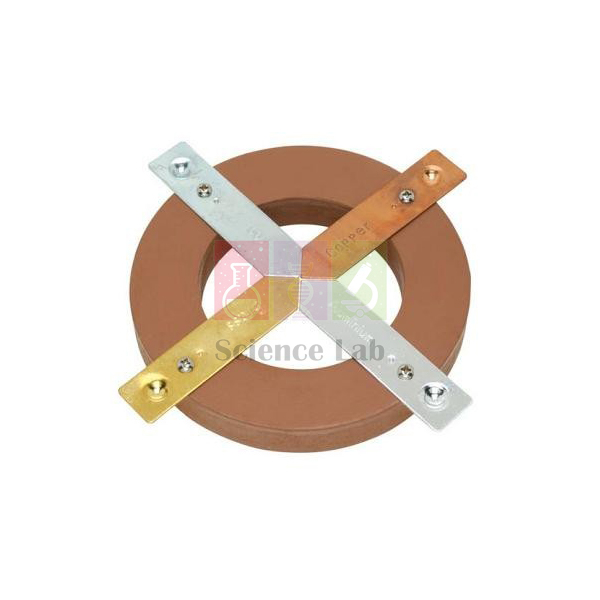
Apparatus Heat/Thermal Conductivity
Apparatus Heat/Thermal Conductivity (Product Code: SLE/PHY/12) is a four-metal comparison ring used to show that different metals conduct heat at different rates in school science and physics labs. Four pointed strips of aluminium, brass, copper and iron meet at the centre of a wooden compound ring, and each carries a small water-holding indentation at its outer end, so the class can watch which drop dries first. It is made by Jain Scientific Equipments Pvt Ltd (ScienceLab), an OEM manufacturer, at its own factory in Ambala, India.
Specifications
| Parameter | Detail |
|---|---|
| Frame | Wood compound ring |
| Metal strips | 4 pointed strips, each of a different metal: aluminium, brass, copper and iron |
| Strip layout | Attached at 90 degrees to each other around the ring, with their points meeting at the centre |
| Outer end of each strip | Indentation for holding water |
| Observation | The water evaporates at different times depending on the conductivity of each metal |
| Product code | SLE/PHY/12 |
| Manufacturer | Jain Scientific Equipments Pvt Ltd (ScienceLab) — OEM |
| Country of origin | India (made in Ambala, Haryana) |
What Is the Thermal Conductivity Apparatus Used For?
The apparatus turns an abstract property into a race. Put an equal drop of water in the indentation at the end of each strip, then warm the centre of the ring where the four points meet, for example over a small spirit-lamp flame. Heat travels outward along each strip at a rate set by its metal, so the drops begin to steam and dry in a clear order. Copper, which conducts heat fastest of the four, usually finishes first and iron last, with aluminium and brass in between.
Because all four strips share one heat source, the comparison is fair without any extra measuring instruments, which makes it a simple heat energy science kit for middle and secondary classes. Let the ring cool before refilling the indentations, and keep the flame under the centre only so the wooden ring is not scorched. Older students can follow up with measured experiments on conduction in rods.
OEM Manufacturer
This thermal conductivity ring is an OEM product of Jain Scientific Equipments Private Limited, the company behind the ScienceLab name. It is produced at the company's licensed factory at Saha, Ambala, Haryana, India, and reaches schools, colleges, dealers and importers directly from the manufacturer, not through a trading house. For institutional vendor registration, the company's details are GSTIN 06AAECJ8618A1ZT and LEI 3358004HRD1JIVXKYX49. Background on the company is on the ScienceLab profile page.
Related Physics Lab Equipment
For a complete lesson sequence on conduction of heat, these items work well alongside the ring:
- Thermal Conductivity Bars — another way to compare how well different materials conduct heat.
- Conductivity of Metal Apparatus — a further conduction experiment for comparing metals.
- Apparatus Conductivity Cam — a related conduction demonstration from the same physics range.
- Glass Spirit Lamp — a small, steady flame for heating the centre of the ring.
Browse all Physics Lab Equipment for more heat and thermodynamics apparatus.
Frequently Asked Questions
What does the Apparatus Heat/Thermal Conductivity show?
The Apparatus Heat/Thermal Conductivity shows that metals conduct heat at different rates. When the centre of the ring is heated, the water held at the end of the aluminium, brass, copper and iron strips evaporates at different times, revealing which metal carries heat fastest.
Which metals are used in the thermal conductivity apparatus?
The thermal conductivity apparatus uses four pointed strips, each made of a different metal: aluminium, brass, copper and iron. They are fixed at 90 degrees to each other around a wood compound ring, with their points meeting at the centre, where heat is applied.
In what order does the water dry on the conductivity ring?
On the Apparatus Heat/Thermal Conductivity, the water at the end of the copper strip usually dries first because copper conducts heat fastest of the four metals, and iron is usually last. Room draughts and uneven drops can change the result, so repeat the test for a fair comparison.
Who manufactures the Apparatus Heat/Thermal Conductivity?
Jain Scientific Equipments Pvt Ltd, trading as ScienceLab, is the OEM manufacturer of the Apparatus Heat/Thermal Conductivity. It is made at the company's own factory in Saha, Ambala, Haryana, India, and supplied direct to schools, colleges, dealers and importers.
What heat source is needed for the thermal conductivity ring?
The Apparatus Heat/Thermal Conductivity needs a small flame, such as a spirit lamp or a low Bunsen flame, placed under the centre where the four metal points meet. The heat source is not part of the apparatus, so order it separately if your lab does not already have one.
Can ScienceLab supply this apparatus for a whole school lab or export order?
Yes. ScienceLab supplies the Apparatus Heat/Thermal Conductivity singly or in quantity for school labs, dealers and importers in India and international markets. Send the required quantity and destination through the contact page to receive a quotation from the manufacturer.
Request a Quote
Ask for a quotation on the Apparatus Heat/Thermal Conductivity through the contact page, or place it in the enquiry cart with the rest of your heat experiments. Quotes are issued directly by the manufacturer, ScienceLab.
Last updated: 24 September 2026
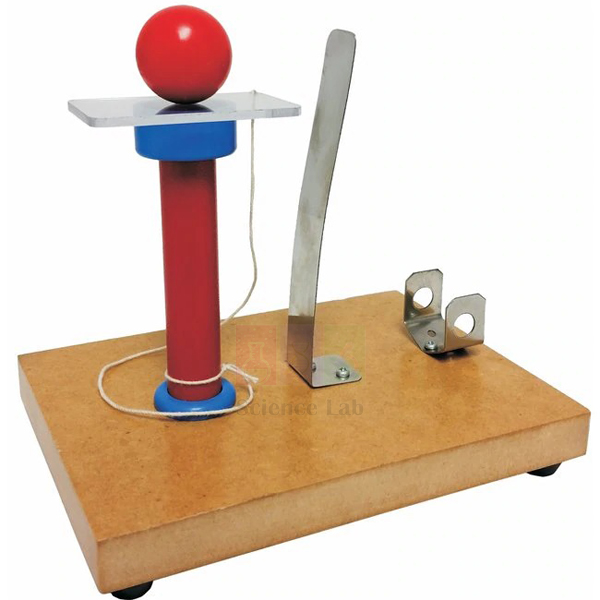
Apparatus Inertia
Apparatus Inertia (Product Code: SLE/PHY/13) is a spring-flick demonstration set used to illustrate inertia, the tendency of a body at rest to stay at rest, in primary, middle and secondary school science classes. In this hands-on physics demonstration kit, a spring snaps a card out from under a glass ball, and the ball drops into the cup on the post instead of flying off with the card. It is made by Jain Scientific Equipments Pvt Ltd (ScienceLab), an OEM manufacturer, at its own factory in Ambala, India.
Specifications
| Parameter | Detail |
|---|---|
| Purpose | Illustrating an effect of inertia |
| Contents | Glass ball, card, plastic base, post, hardware and instructions |
| Action | Pulling back and releasing the spring shoots the card forward while the ball drops back into the cup on the post |
| Glass ball | Has a 5 mm flat spot that lets it rest on the card |
| Extension | The same experiment can be tried with a coin |
| Product code | SLE/PHY/13 |
| Manufacturer | Jain Scientific Equipments Pvt Ltd (ScienceLab) — OEM |
| Country of origin | India (made in Ambala, Haryana) |
What Is the Inertia Apparatus Used For?
It is the classroom version of pulling a tablecloth from under the dishes. The card is laid over the cup on the post, the glass ball rests on the card on its 5 mm flat spot, and the spring is pulled back. When the spring is let go it strikes the card sharply and sends it flying, but the ball, which was at rest, tends to stay at rest. The brief friction from the card moves it only a little, so it drops straight down and settles into the cup instead of travelling with the card.
Ask students to predict the outcome before each release, then repeat with a coin in place of the ball to show the same effect on a different object. A quick, confident release gives the cleanest result; a slow push drags the ball along and is itself a useful comparison. As a force motion experiment kit, it opens discussion of Newton's first law, seat belts and why loose objects slide in a braking bus.
OEM Manufacturer
ScienceLab is the brand name of Jain Scientific Equipments Private Limited, which is the OEM for the Apparatus Inertia. The set is manufactured at the company's own licensed factory in Saha, Ambala, Haryana, India, and supplied straight from there to schools, science centres, dealers and importers. Because the maker handles every enquiry, spare glass balls or cards and repeat class sets can simply be requested from us. Company details are on the ScienceLab profile.
Related Physics Lab Equipment
Teachers covering Newton's laws and momentum often pair this set with:
- Newton's Pendulum (Newton's Cradle) — carries the lesson on to momentum and energy transfer in collisions.
- Dynamics Trolley, Plastic — for experiments on force, mass and acceleration.
- Apparatus Collision 2 Dimension — a follow-on apparatus for studying collisions.
- Apparatus Falling Bodies (Projectile) — another quick mechanics demonstration built around a spring release.
The full list is under Physics Lab Equipment.
Frequently Asked Questions
What does the Apparatus Inertia demonstrate?
The Apparatus Inertia demonstrates that a body at rest tends to stay at rest. When the spring flicks the card away, the glass ball does not travel with it; it drops into the cup on the post, showing inertia and introducing Newton's first law of motion.
What is included in the Apparatus Inertia set?
The Apparatus Inertia set contains a glass ball, a card, a plastic base, a post, the fitting hardware and instructions. The spring used to flick the card forms part of the apparatus, and the glass ball has a 5 mm flat spot so it can rest steadily on the card.
Why does the inertia apparatus ball have a flat spot?
The glass ball of the Apparatus Inertia has a 5 mm flat spot so it can sit on the card without rolling off before the spring is released. The flat spot keeps each trial starting from rest, which makes the inertia effect repeatable for the whole class.
Can the inertia apparatus be used with other objects?
Yes. Besides the glass ball supplied with the Apparatus Inertia, the same experiment can be tried with a coin placed on the card. Comparing the two helps students see that inertia is a property of all objects, not only of the ball.
Who manufactures the Apparatus Inertia?
The Apparatus Inertia is manufactured by Jain Scientific Equipments Pvt Ltd (ScienceLab) as the OEM, at its own factory in Saha, Ambala, Haryana, India. The company supplies it directly to schools, dealers and importers, and handles requests for replacement parts itself.
What information is needed for a quote on SLE/PHY/13?
For a quote on the Apparatus Inertia, code SLE/PHY/13, tell ScienceLab how many sets you need, the delivery location in India or abroad, and whether spare balls or cards should be included. Use the contact page or enquiry cart to send the request.
Request a Quote
Put the Apparatus Inertia in the enquiry cart or send quantities through the contact page. You will receive the quotation directly from ScienceLab as the manufacturer.
Last updated: 24 September 2026

Apparatus Newton's Ring
Apparatus Newton's Ring (Product Code: SLE/PHY/14) is an optical interference unit used to display the ring pattern formed when light reflects between two surfaces, in physics and optics lab classes. A convex lens rests on a flat lens inside a metallic frame with three terminals, and the complete ring measures 4 inches in diameter and 1-1/2 inches thick. Schools and colleges use it as a sturdy Newton rings apparatus made in India by Jain Scientific Equipments Pvt Ltd (ScienceLab), an OEM manufacturer, at its own factory in Ambala.
Specifications
| Parameter | Detail |
|---|---|
| Phenomenon shown | Interference pattern caused by the reflection of light between two surfaces |
| Optical parts | Convex lens mounted over a flat lens |
| Mounting | Metallic frame with three terminals |
| Size | 4 inches in diameter, 1-1/2 inches thick |
| With monochromatic light | A series of dark and light rings |
| With white light | A series of rainbow-coloured rings |
| Product code | SLE/PHY/14 |
| Manufacturer | Jain Scientific Equipments Pvt Ltd (ScienceLab) — OEM |
| Country of origin | India (made in Ambala, Haryana) |
What Is the Newton's Ring Apparatus Used For?
Where the curved face of the convex lens meets the flat lens, a very thin film of air is trapped, growing thicker away from the contact point. Light reflected from the two surfaces bounding this film interferes, and wherever the path difference matches, the reflections reinforce or cancel. The result is a set of concentric rings centred on the point of contact, a clear visual proof that light behaves as a wave.
Viewed under a monochromatic source such as a sodium lamp, the unit shows crisp alternating dark and light rings that advanced students can measure to find the radius of curvature of the lens or the wavelength of the light. Under ordinary white light the same pattern appears as rainbow-coloured rings, which is ideal for a quick class demonstration. Handle the lenses by the frame only and keep them free of dust, since any particle between the glass surfaces spoils the rings. It suits any optics lab equipment set for senior-secondary and undergraduate practicals.
OEM Manufacturer
Jain Scientific Equipments Private Limited, trading as ScienceLab, is the OEM (original equipment manufacturer) of the Apparatus Newton's Ring. The unit is manufactured at the company's licensed factory at Saha, Ambala, Haryana, India, and supplied factory-direct to colleges, schools, laboratory dealers and importers. Buying from the maker means one point of contact for quotations and for any later replacement parts or matching units — just ask us. See the company profile for background.
Related Physics Lab Equipment
A complete Newton's rings experiment normally needs a light source and a measuring instrument as well:
- Sodium Spectral Lamp — a monochromatic source for sharp dark and light rings.
- Spectral Lamp Power Supply with Lamp Holder — powers and holds the spectral lamp.
- Vernier Travelling Microscope — for measuring ring diameters in quantitative work.
- Newton's Ring Model — an alternative Newton's ring unit in a different frame design.
Explore more optics items in Physics Lab Equipment.
Frequently Asked Questions
What does the Apparatus Newton's Ring show?
The Apparatus Newton's Ring shows the interference pattern produced when light reflects between two surfaces: the curved face of a convex lens and the flat lens beneath it. The trapped air film produces concentric rings around the contact point, demonstrating the wave nature of light.
What size is the Newton's ring apparatus?
The Apparatus Newton's Ring measures 4 inches in diameter and 1-1/2 inches thick. Its convex lens and flat lens are held together in a metallic frame with three terminals, making it compact enough to place on an optical bench or under a microscope.
What light source is needed to see the rings?
The Apparatus Newton's Ring can be viewed with monochromatic light, which gives a series of dark and light rings, or with white light, which gives rainbow-coloured rings. For measurements, a monochromatic source such as a sodium lamp is the usual choice.
Who manufactures the Apparatus Newton's Ring?
The Apparatus Newton's Ring is manufactured by Jain Scientific Equipments Pvt Ltd, which trades as ScienceLab, as the OEM at its own factory in Saha, Ambala, Haryana, India. Colleges and dealers buy it direct from the manufacturer rather than through a trader.
How should the Newton's ring lenses be cared for?
Keep the Apparatus Newton's Ring in a dust-free box, hold it only by the metallic frame, and clean the outer glass faces with a soft lens tissue. Dust or fingerprints between or on the surfaces distort the rings and make diameter readings unreliable.
Can a calibration certificate be provided with SLE/PHY/14?
Whether any calibration or test document can accompany the Apparatus Newton's Ring, code SLE/PHY/14, should be discussed with ScienceLab before ordering. Mention this requirement in your enquiry through the contact page along with the quantity and delivery location.
Request a Quote
Send your requirement for the Apparatus Newton's Ring through the ScienceLab contact page or add it to the enquiry cart with any light source you need. The quotation is prepared by ScienceLab directly as the manufacturer.
Last updated: 24 September 2026
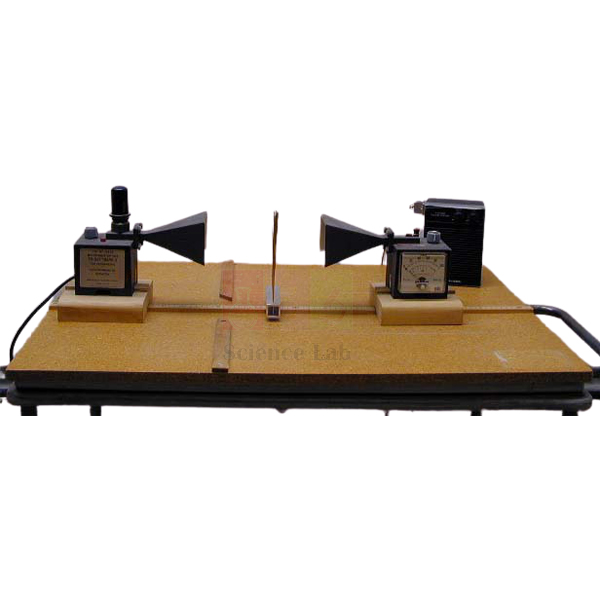
Apparatus Microwave
Apparatus Microwave (Product Code: SLE/PHY/15) is a microwave optics kit used to demonstrate the wave properties of electromagnetic microwaves, namely reflection, polarization, diffraction and interference, in senior school and college physics labs. It pairs a microwave transmitter with a receiver, audio amplifier and loudspeaker, so students hear as well as measure changes in the signal, and it runs from a 12V DC supply. It is supplied by Jain Scientific Equipments Pvt Ltd (ScienceLab), Ambala, India, as a wave motion kit for school and college use.
Specifications
| Parameter | Detail |
|---|---|
| Purpose | Demonstrating wave properties of electromagnetic microwaves for comparison with the behaviour of visible light |
| Effects demonstrated | Reflection, polarization, diffraction, interference |
| Power requirement | 12V DC supply |
| Source and detection | Microwave transmitter; receiver; audio amplifier and loudspeaker |
| Reflectors | Two large aluminium reflectors; one narrow aluminium reflector |
| Other parts | Black hardboard mirror; polarization grille; battery charging lead |
| Documentation | Instruction booklet |
| Product code | SLE/PHY/15 |
| Supplied by | Jain Scientific Equipments Pvt Ltd (ScienceLab), Ambala, India |
What Is the Microwave Apparatus Used For?
Microwaves have wavelengths of a few centimetres, so effects that need a microscope or a laser with visible light can be shown on an ordinary bench. With the transmitter aimed at the receiver, students tilt an aluminium reflector and follow the reflected beam, rotate the polarization grille to make the signal fade and return, send the beam past the narrow reflector to see it spread by diffraction, and set up two paths to produce interference maxima and minima. The loudspeaker makes every change audible to the whole class.
Each result can then be compared directly with the matching experiment in light, which is the main teaching value of the kit. Keep the reflectors flat and clean, work on a clear bench away from metal cupboards that cause stray reflections, and follow the instruction booklet for set-up and safe use. It is a useful piece of physics lab equipment for India's senior-secondary and undergraduate wave-optics topics.
Supplier
Jain Scientific Equipments Private Limited, which trades as ScienceLab, supplies the Apparatus Microwave from Ambala, Haryana, India. The company sources this kit and handles the enquiry, quotation, packing and dispatch for schools, colleges, laboratory dealers and importers. If you need guidance on the contents, the 12V DC supply or items to order alongside it, our team will help — just ask. Read about the company on the ScienceLab profile page.
Related Physics Lab Equipment
These items help extend microwave work or connect it to other wave experiments:
- Microwave Transmitter/Receiver — a separate transmitter and receiver listing; ask us which suits your lab.
- Microwave Accessories Hollow Plano-convex Lens — for refraction and focusing studies; confirm compatibility with us.
- Microwave Accessories Rotating Protractor — helps measure angles in reflection work; confirm compatibility with us.
- Battery Eliminator 12 Volt — a possible bench source; check with us that it matches the kit's 12V DC need.
- Ripple Tank — shows reflection, diffraction and interference with water waves for comparison.
See the wider Physics Lab Equipment range.
Frequently Asked Questions
What experiments can be done with the Apparatus Microwave?
The Apparatus Microwave demonstrates reflection, polarization, diffraction and interference of electromagnetic microwaves. Students compare each result with the behaviour of visible light, using the transmitter, receiver, aluminium reflectors, polarization grille and hardboard mirror supplied in the kit.
What is included in the microwave apparatus kit?
The Apparatus Microwave kit consists of a microwave transmitter, a receiver, an audio amplifier and loudspeaker, two large aluminium reflectors, one narrow aluminium reflector, a black hardboard mirror, a polarization grille, a battery charging lead and an instruction booklet.
What power supply does the Apparatus Microwave need?
The Apparatus Microwave requires a 12V DC supply. The kit includes a battery charging lead, but for the exact connection arrangement and a suitable bench source, ask ScienceLab through the contact page before ordering so the supply matches your laboratory.
Who supplies the Apparatus Microwave?
The Apparatus Microwave is supplied by Jain Scientific Equipments Pvt Ltd (ScienceLab), Ambala, Haryana, India. The company handles quotations, packing and dispatch for schools, colleges, dealers and importers in India and international markets.
Why use microwaves instead of light for wave experiments?
Microwaves have much longer wavelengths than visible light, so with the Apparatus Microwave the spacing of interference maxima and the spreading by diffraction are large enough to find with a receiver on a normal bench. This makes wave behaviour easier to measure and discuss in class.
What should an enquiry for SLE/PHY/15 include?
An enquiry for the Apparatus Microwave, code SLE/PHY/15, should give the number of kits, the delivery location and whether you also need a 12V DC source or microwave accessories. Send it through the ScienceLab contact page or add the kit to the enquiry cart.
Request a Quote
Request a quotation for the Apparatus Microwave via the contact page, or add it to the enquiry cart together with any accessories and power supply you want quoted.
Last updated: 24 September 2026

Apparatus Newton's Second Law
Apparatus Newton's Second Law (Product Code: SLE/PHY/16) is a clamp-mounted spring launcher used to help students visualize and grasp Newton's Second Law of Motion in school physics labs. The sturdy unit projects one ball horizontally while another drops vertically, and both land at the same time; its spring can propel a ball 48 inches from the starting point. It is made by Jain Scientific Equipments Pvt Ltd (ScienceLab), an OEM manufacturer, at its own factory in Ambala, India, for school physics lab equipment sets in India and abroad.
Specifications
| Parameter | Detail |
|---|---|
| Teaching aim | Visualizing Newton's Second Law of Motion |
| Demonstration | A horizontally projected ball and a vertically dropped ball land at the same time |
| Launcher | Spring device that can propel a ball 48 inches from its starting point |
| Mounting | Detachable rod for clamping to a table or stand |
| Size | 12 x 4-1/2 x 2 inches |
| Weight | 1.21 lb |
| Documentation | Instructions provided |
| Product code | SLE/PHY/16 |
| Manufacturer | Jain Scientific Equipments Pvt Ltd (ScienceLab) — OEM |
| Country of origin | India (made in Ambala, Haryana) |
What Is the Newton's Second Law Apparatus Used For?
Once released, each ball has only one force acting on it, its weight, which points straight down. By Newton's second law, the same force per unit mass gives both balls the same downward acceleration, so the one that is launched sideways and the one that simply drops reach the floor together. No horizontal force acts after launch, so the projected ball keeps a steady sideways speed as it falls. Students see and hear the second law at work.
Clamp the unit with its detachable rod to the edge of a bench or to a laboratory stand so it stays rigid when the spring fires. With the horizontal range of up to 48 inches marked on the floor and the launch height measured, older students can calculate the launch speed and fall time. Keep the landing area clear and let the class predict the result before each trial.
OEM Manufacturer
ScienceLab is the trading name of Jain Scientific Equipments Private Limited (CIN U29309HR2020PTC087597), the OEM behind the Apparatus Newton's Second Law. The company produces it at its licensed factory at 449, HSIIDC Industrial Area, Saha, Ambala (Factory Licence AMB-ONLINE-CHD-J-414), and sells it straight from the manufacturer to schools, colleges, dealers and importers. Requests for a replacement rod or spring mechanism, or for matching units on a repeat order, go to the same team — just ask. The company profile has more background.
Related Physics Lab Equipment
Useful companions for Newton's-law and projectile lessons include:
- Apparatus Falling Bodies (Projectile) — a free-standing wooden-block version of the drop-and-project demonstration.
- Retort Stand — a stand the detachable rod can be clamped to when no bench edge is free.
- Meter Stick, White — for measuring launch height and horizontal range.
- Dynamics Trolley, Wooden — for measuring force, mass and acceleration directly.
- Ticker Tape Timer — records motion so students can calculate acceleration.
Find more under Physics Lab Equipment.
Frequently Asked Questions
How does the Apparatus Newton's Second Law demonstrate the law?
The Apparatus Newton's Second Law launches one ball horizontally while another drops vertically. Both land at the same time because the only force on each is its weight, giving the same downward acceleration, which lets students connect force and acceleration as the second law describes.
How far can the Newton's second law apparatus launch a ball?
The spring device of the Apparatus Newton's Second Law can propel a ball 48 inches from its starting point. Plan a clear landing area of at least that distance in front of the bench or stand where the unit is clamped.
How is the Apparatus Newton's Second Law mounted?
The Apparatus Newton's Second Law has a detachable rod for clamping to a table or a laboratory stand. The unit itself measures 12 x 4-1/2 x 2 inches and weighs 1.21 lb, so it is easy to fix rigidly and to store after class.
Who manufactures the Apparatus Newton's Second Law?
Jain Scientific Equipments Pvt Ltd (ScienceLab) manufactures the Apparatus Newton's Second Law as the OEM at its own licensed factory in Saha, Ambala, Haryana, India. It is sold factory-direct, so buyers deal with the manufacturer for quotations and later parts.
What comes in the Apparatus Newton's Second Law pack?
The Apparatus Newton's Second Law comes as the spring launcher unit with its detachable clamping rod, and instructions are provided. To confirm the exact pack contents, including the balls, before ordering, ask ScienceLab through the contact page.
What do I need to send for a quotation on SLE/PHY/16?
For a quotation on the Apparatus Newton's Second Law, code SLE/PHY/16, send the number of units, delivery address or country, and any stands or measuring items to include. ScienceLab supplies schools and dealers in India and international markets directly.
Request a Quote
Use the contact page or the enquiry cart to request the Apparatus Newton's Second Law. The quote is issued by ScienceLab itself, the manufacturer of the unit.
Last updated: 24 September 2026

Apparatus Young Modulus Searle's
Apparatus Young Modulus Searle's (Product Code: SLE/PHY/17) is a twin-frame extension apparatus used to determine the Young's modulus of a wire by Searle's method in college and senior-secondary physics labs. Two hinged cast metal frames, a spirit level on a pivoted cross-bar and a micrometer head reading to 0.01 mm let students measure very small extensions; brass and steel wires are included. It is made by Jain Scientific Equipments Pvt Ltd (ScienceLab), an OEM manufacturer, at its own factory in Ambala, India.
Specifications
| Parameter | Detail |
|---|---|
| Measures | Young's modulus (modulus of elasticity) of a wire: for small strains, the ratio of the rate of change of stress with strain |
| Frames | Two cast metal rectangular frames, hinged together parallel to each other so that only vertical relative motion is possible |
| Reference indicator | Spirit level fixed on a cross-bar pivoted across the frames |
| Wire and load fittings | Self-centering chuck at the upper end of each frame for holding the wire; load hook at the lower end of each frame |
| Scale | Vertical scale 10 – 0 – 10 mm on one frame |
| Micrometer | Micrometer head along the scale, reading to 0.01 mm, for adjusting the spirit level |
| Also included | Ceiling bracket carrying a pair of chucks; counterpoise weight; set of two wires, one brass and one steel |
| Product code | SLE/PHY/17 |
| Manufacturer | Jain Scientific Equipments Pvt Ltd (ScienceLab) — OEM |
| Country of origin | India (made in Ambala, Haryana) |
What Is the Searle's Young Modulus Apparatus Used For?
Young's modulus tells us how stiff a material is, and Searle's method measures it on a long, thin wire. The two wires hang from the chucks of the ceiling bracket and pass into the self-centering chucks of the two frames. One frame carries the counterpoise weight to keep its wire taut as a reference, while load is added to the hook of the other. Because the frames are hinged to move only vertically, any stretch of the loaded wire tilts the spirit level on the cross-bar.
After each load change, the micrometer head is turned until the bubble is level again, and the change in reading gives the extension to 0.01 mm. Plotting load against extension, then using the wire's length and diameter, gives Young's modulus as stress divided by strain. The Searle's method Young's modulus experiment is a standard practical in India's senior-secondary (including CBSE class 11) and undergraduate physics courses. Add and remove load gently, and stay well within the elastic limit so the wire returns to its original length.
What to Specify When Ordering
- Number of complete apparatus sets required for the lab.
- Whether you need extra brass or steel wires beyond the set of two supplied.
- Loading weights and hanger, which are not listed in the kit contents.
- Mounting: the kit includes a ceiling bracket; mention it if a wall mounting suits your lab better.
OEM Manufacturer
The Apparatus Young Modulus Searle's is an OEM product of Jain Scientific Equipments Private Limited, the company that trades as ScienceLab. It is manufactured as a complete apparatus at the company's own licensed factory at Saha, Ambala, Haryana, India, and dispatched factory-direct to universities, colleges, schools, dealers and importers. Replacement wires or chucks and repeat orders can be requested from the manufacturer itself — just ask us. Visit the ScienceLab profile to learn more.
Related Physics Lab Equipment
A Searle's experiment also needs loading and measuring items such as:
- Hangers with Slotted Weights — to load the experimental wire in equal steps.
- Micrometer Screw Gauge, Lock Type — for measuring the wire diameter to find its cross-sectional area.
- Meter Stick, White — for measuring the original length of the wire.
- Wall Mount For Searle Apparatus — an alternative mounting where a ceiling fixing is impractical.
- Searle's Apparatus — another Searle's apparatus listing in the physics range.
More instruments are listed in Physics Lab Equipment.
Frequently Asked Questions
What is the Apparatus Young Modulus Searle's used to measure?
The Apparatus Young Modulus Searle's measures the Young's modulus of a wire, a measure of the stiffness of its material. The extension of a loaded wire is compared with a reference wire, and the micrometer reading after re-levelling the spirit level gives the extension.
How accurate is the micrometer on the Searle's apparatus?
The micrometer head on the Apparatus Young Modulus Searle's reads to 0.01 mm. It runs along a vertical scale of 10 – 0 – 10 mm on one frame and is used to bring the spirit level back to level after each change of load.
Which wires are supplied with the Apparatus Young Modulus Searle's?
The Apparatus Young Modulus Searle's includes a set of two wires, one of brass and one of steel, together with a ceiling bracket carrying a pair of chucks and a counterpoise weight. Each frame has a self-centering chuck to grip its wire.
Who manufactures the Apparatus Young Modulus Searle's?
Jain Scientific Equipments Pvt Ltd, trading as ScienceLab, manufactures the Apparatus Young Modulus Searle's as the OEM at its own factory in Saha, Ambala, Haryana, India. Colleges and dealers order it direct from the manufacturer, who also handles requests for spare wires.
Are slotted weights included with the Searle's apparatus?
Slotted weights are not listed among the contents of the Apparatus Young Modulus Searle's, which lists a counterpoise weight for the reference frame. Order a hanger with slotted weights separately, or ask ScienceLab to include suitable weights in the same quotation.
Can a calibration certificate be supplied for the micrometer?
Availability of any calibration document for the micrometer of the Apparatus Young Modulus Searle's should be discussed with ScienceLab before you order. State this requirement, the number of sets and your delivery location in your enquiry through the contact page.
Request a Quote
To receive a quotation for the Apparatus Young Modulus Searle's, write to us through the contact page or add it to the enquiry cart along with weights and measuring instruments. Quotes come straight from ScienceLab as the manufacturer.
Last updated: 24 September 2026
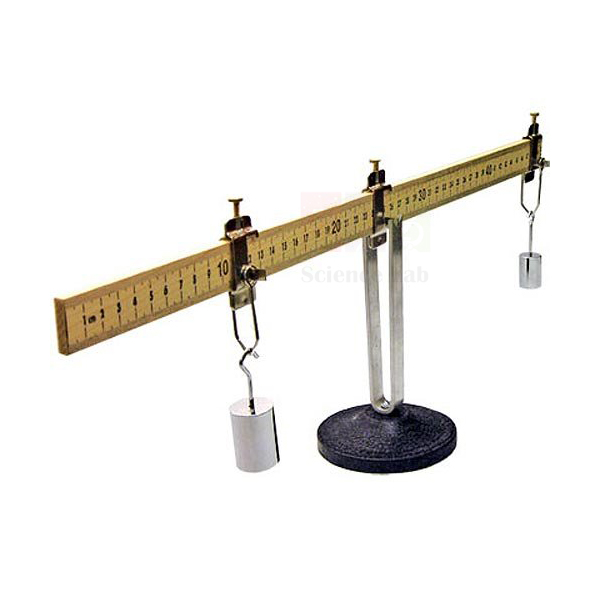
Balance Demonstration Fulcrum/Lever
Balance Demonstration Fulcrum/Lever (Product Code: SLE/PHY/18) is a meter-stick lever set used to teach the relationship between the length of a lever arm, the moment of a force and the amount of force, in school physics labs. With a meter stick, a stand, three knife-edge clamps and 50 gram and 100 gram hooked weights, students balance real loads and see the law of moments at work. It is made by Jain Scientific Equipments Pvt Ltd (ScienceLab), an OEM manufacturer, at its own factory in Ambala, India.
Specifications
| Parameter | Detail |
|---|---|
| Teaching aim | Relationship between length of lever arm, moment of force and amount of force; law of torque |
| Lever | Meter stick |
| Support | Stand |
| Clamps | Three knife-edge clamps |
| Weights | One 50 gram hooked weight; one 100 gram hooked weight |
| Product code | SLE/PHY/18 |
| Manufacturer | Jain Scientific Equipments Pvt Ltd (ScienceLab) — OEM |
| Country of origin | India (made in Ambala, Haryana) |
What Is the Lever and Fulcrum Balance Used For?
One knife-edge clamp on the meter stick rests on the stand as the fulcrum, and the other two clamps carry the 50 gram and 100 gram hooked weights. Students slide the weights along the stick until it balances, then read each distance from the fulcrum straight off the stick's scale. They soon find that the 50 gram weight must hang twice as far from the pivot as the 100 gram weight, because the moments on either side must be equal: force multiplied by distance on the left equals force multiplied by distance on the right.
Moving the fulcrum away from the centre brings the stick's own weight into play, which lets older students locate its centre of gravity or estimate its mass from the balance point. The set works well as a moment bar apparatus for school practicals and as a quick teacher demonstration of why a long spanner or crowbar makes work easier. Handle the knife edges carefully and keep them clean so the stick pivots freely.
OEM Manufacturer
ScienceLab is how Jain Scientific Equipments Private Limited trades, and the company is the OEM (original equipment manufacturer) of the Balance Demonstration Fulcrum/Lever. The set is manufactured at its licensed factory at Saha, Ambala, Haryana, India, then supplied factory-direct to schools, colleges, dealers and importers. Extra knife-edge clamps, replacement weights or repeat class sets are handled by the manufacturer itself, so just ask us. Read more on the company profile.
Related Physics Lab Equipment
For a wider unit on moments, levers and forces, consider:
- Moments Kit — further experiments on turning effects for older students.
- Disk for the Balance of Moments — shows balanced moments on a rotating disc instead of a straight lever.
- Hangers with Slotted Weights — adds more load values for extended balancing tasks.
- Balance Spring Tubular Plastic — measures the force needed to hold the lever in balance.
The complete range is in Physics Lab Equipment.
Frequently Asked Questions
What does the Balance Demonstration Fulcrum/Lever teach?
The Balance Demonstration Fulcrum/Lever teaches the relationship between the length of a lever arm, the moment of force and the amount of force. By adjusting weights on the meter stick until it balances, students observe the law of torque, also called the principle of moments.
What parts are in the fulcrum and lever balance set?
The Balance Demonstration Fulcrum/Lever consists of a meter stick, a stand, three knife-edge clamps, one 50 gram hooked weight and one 100 gram hooked weight. One clamp forms the fulcrum on the stand and the other two hold the weights on the stick.
How do students find the balance point with this lever set?
With the Balance Demonstration Fulcrum/Lever, students move the hooked weights along the meter stick until it rests level, then read each distance from the fulcrum. Multiplying each weight by its distance shows that the moments on both sides are equal at equilibrium.
Who manufactures the Balance Demonstration Fulcrum/Lever?
Jain Scientific Equipments Pvt Ltd, trading as ScienceLab, manufactures the Balance Demonstration Fulcrum/Lever as the OEM at its own factory in Saha, Ambala, Haryana, India. It is sold direct from the manufacturer to schools, colleges, dealers and importers.
Can more weights be used with the lever balance?
Yes. The Balance Demonstration Fulcrum/Lever is supplied with one 50 gram and one 100 gram hooked weight, and extra hooked or slotted weights can be hung from the knife-edge clamps for further balancing problems. Ask ScienceLab to add suitable weights to your quotation.
How can a school order the fulcrum/lever balance in quantity?
Schools can order the Balance Demonstration Fulcrum/Lever, code SLE/PHY/18, in class-set quantities by sending the number of sets and delivery location through the contact page. ScienceLab supplies schools, dealers and importers in India and international markets.
Request a Quote
For a quotation on the Balance Demonstration Fulcrum/Lever, add it to the enquiry cart or contact us via the contact page. You deal directly with the manufacturer from enquiry to dispatch.
Last updated: 24 September 2026
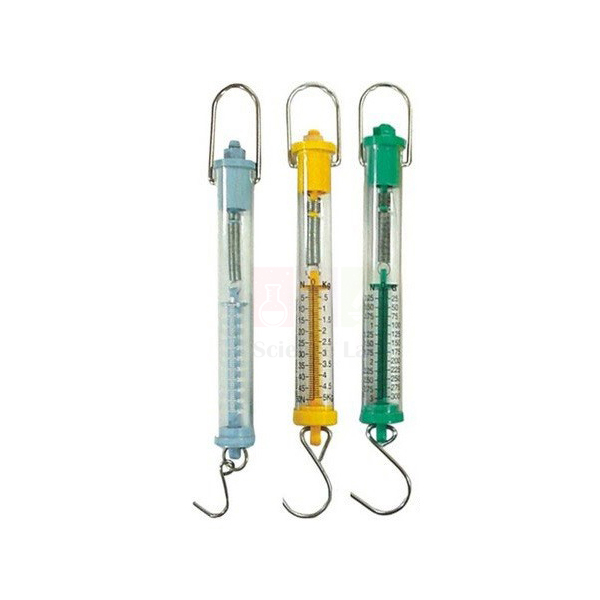
Balance Spring Tubular Plastic
Balance Spring Tubular Plastic (Product Code: SLE/PHY/19) is a tubular spring balance used to measure forces, such as the pull of gravity on a mass, in school physics and science labs. It is 250 mm long overall including its ring and hook, the spring mechanism is clearly visible through the plastic tube, and it carries a zero adjustment plus colour-coded ranges scaled in both grams and newtons. It is made by Jain Scientific Equipments Pvt Ltd (ScienceLab), an OEM manufacturer, at its own factory in Ambala, India.
Specifications
| Parameter | Detail |
|---|---|
| Measures | Force, such as the force of gravity exerted on a mass; can be calibrated for measuring mass |
| Body | Tubular plastic |
| Overall length | 250 mm, including ring and hook |
| Mechanism | Spring mechanism clearly visible |
| Zero setting | Zero adjustment incorporated |
| Scales | Graduated in both grams and newtons |
| Range identification | Each range is colour-coded |
| Product code | SLE/PHY/19 |
| Manufacturer | Jain Scientific Equipments Pvt Ltd (ScienceLab) — OEM |
| Country of origin | India (made in Ambala, Haryana) |
What Is the Tubular Spring Balance Used For?
A spring balance is often the first force-measuring instrument students handle. Hang the balance by its ring, set the pointer to zero with the zero adjustment, then attach the load to the hook and read the scale. Because the scale is marked in both grams and newtons, one reading lets the class connect mass and weight and see how a load in grams corresponds to a force in newtons. The visible spring shows how the extension grows with the load, a direct link to Hooke's law.
Beyond weighing, students use it to measure friction by dragging a block across the bench, the pull needed to raise a load with pulleys, or the effort on a lever. The colour coding makes it easy to hand the right range to each group and to collect them again after class. Hold it vertically when weighing, re-zero before each set of readings and never load it past the end of its scale. It is everyday physics lab equipment in India's schools and junior colleges.
What to Specify When Ordering
- The range or ranges you need; each range is colour-coded, so ask us which ranges are available.
- Quantity per range, for example one per student group.
- Whether you want a mixed set of ranges for one lab.
OEM Manufacturer
Jain Scientific Equipments Private Limited trades as ScienceLab and is the OEM for the Balance Spring Tubular Plastic. The balance is produced at the company's licensed factory at Saha, Ambala, Haryana, India, and supplied directly by the maker to schools, colleges, dealers and importers, which keeps repeat orders for the same range and colour code simple. For replacements or additional ranges, just ask us. The ScienceLab profile explains more about the company.
Related Physics Lab Equipment
Spring balances are used alongside masses and other force experiments such as:
- Mass Set — known masses for checking readings and weighing practice.
- Newton Mass Set 1N Set — masses matched to newton values for force work.
- Hooke's Law Apparatus — explores the spring extension that the balance relies on.
- Force Meter/Spring Balance — another force meter option in the measuring range.
- Balance Demonstration Fulcrum/Lever — a lever experiment where the balance can measure the effort.
Browse more in Physics Lab Equipment.
Frequently Asked Questions
What is the Balance Spring Tubular Plastic used to measure?
The Balance Spring Tubular Plastic measures force, such as the force of gravity exerted on a mass, and it can be calibrated for measuring mass. Its scales are marked in both grams and newtons, so students can relate mass and weight from a single reading.
How long is the tubular plastic spring balance?
The Balance Spring Tubular Plastic is 250 mm long overall, including its ring and hook. The compact tubular plastic body keeps the spring mechanism clearly visible, which helps students see the spring stretch as the load increases.
How is the tubular spring balance set to zero?
The Balance Spring Tubular Plastic has a built-in zero adjustment. Hang it vertically by its ring with nothing on the hook, adjust the pointer to zero, and then attach the load. Re-check the zero before each new set of readings for consistent results.
Why are the spring balance ranges colour-coded?
Each range of the Balance Spring Tubular Plastic is colour-coded so teachers and students can pick the correct range quickly and avoid overloading a lighter one. Tell ScienceLab which ranges and how many of each you need when you request a quote.
Who manufactures the Balance Spring Tubular Plastic?
Jain Scientific Equipments Pvt Ltd (ScienceLab) manufactures the Balance Spring Tubular Plastic as the OEM at its own factory in Saha, Ambala, Haryana, India. Schools, dealers and importers in India and international markets buy it directly from the manufacturer.
Can a calibration certificate be provided for the spring balance?
Whether a calibration document can be provided with the Balance Spring Tubular Plastic should be discussed with ScienceLab before ordering. Include this request, the ranges needed and your delivery location when you contact us through the contact page.
Request a Quote
List the ranges and quantities of the Balance Spring Tubular Plastic you need and send them through the contact page, or add the item to the enquiry cart. The quotation is prepared by ScienceLab as the manufacturer.
Last updated: 24 September 2026
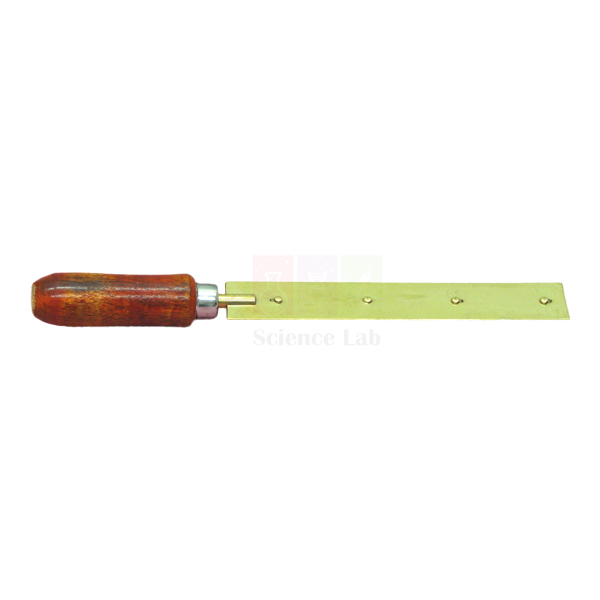
Bar Compound Copper & Iron
Bar Compound Copper & Iron (Product Code: SLE/PHY/20) is a bimetallic compound bar used to demonstrate the principle of the thermostat in school physics and general science labs. An iron strip and a copper-based strip are riveted together from end to end and mounted in a wooden handle, and when the bar is heated the unequal expansion of the two metals makes it bend. It is made by Jain Scientific Equipments Pvt Ltd (ScienceLab), an OEM manufacturer, at its own factory in Ambala, India.
Specifications
| Parameter | Detail |
|---|---|
| Demonstrates | Principle of the thermostat |
| Construction | Bimetal strip: one strip of each metal, riveted together from end to end |
| Metals | Iron and a copper-based strip. The product name lists copper; our earlier catalogue description lists brass. Please confirm the metal pair in your enquiry. |
| Handle | Wooden handle |
| Behaviour on heating | The bar bends because the two metals expand unequally |
| Product code | SLE/PHY/20 |
| Manufacturer | Jain Scientific Equipments Pvt Ltd (ScienceLab) — OEM |
| Country of origin | India (made in Ambala, Haryana) |
What Is the Compound Bar Used For?
As a piece of physics lab equipment for India's heat and expansion lessons, it takes only a flame to use. Hold the bar by its wooden handle and pass it slowly through the flame so both strips warm evenly. The copper-based strip expands more than the iron for the same rise in temperature, but the rivets stop the strips from sliding past each other, so the whole bar curls with the iron on the inside of the curve. As it cools, the bar straightens again, showing that the effect is reversible.
That bending movement is exactly what switches a thermostat: in an iron, a room heater or a fire alarm, a bimetal strip moves as it warms and opens or closes an electrical contact. Students can predict which way the bar will bend before heating, then check. Keep the heating gentle, rest the hot bar on a heat-proof mat afterwards, and never touch the metal until it has cooled.
What to Specify When Ordering
- Confirm the metal pair you need: the product name lists copper and iron, while the earlier catalogue text lists brass and iron.
- Number of compound bars, for example one per student group or one for teacher demonstration.
- Whether a heat source such as a Bunsen burner should be quoted with the bars.
OEM Manufacturer
ScienceLab is the trading name of Jain Scientific Equipments Private Limited, the OEM (original equipment manufacturer) of the Bar Compound Copper & Iron. The company manufactures it at its licensed factory in Saha, Ambala, Haryana, India, and sells factory-direct to schools, colleges, dealers and importers. Jain Scientific Equipments Private Limited is a registered MSME whose major activity is manufacturing (Udyam UDYAM-HR-01-0003714), and export consignments move under Importer-Exporter Code AAECJ8618A issued by the DGFT. See the company profile for more.
Related Physics Lab Equipment
For a full set of thermal expansion demonstrations, pair the compound bar with:
- Bimetallic Strip — another bimetal item for the same thermostat lesson.
- Ball & Ring Apparatus — shows expansion of a solid when heated in a single metal.
- Apparatus Bar & Gauge — demonstrates linear expansion of a heated bar.
- Bunsen Burner — a heat source for warming the bar evenly.
More apparatus is listed in Physics Lab Equipment.
Frequently Asked Questions
What does the Bar Compound Copper & Iron demonstrate?
The Bar Compound Copper & Iron demonstrates the principle of the thermostat. Its two riveted metal strips expand by different amounts when heated, so the bar bends, just as the bimetal strip inside a thermostat bends to open or close an electrical contact.
Which way does the compound bar bend when heated?
When the Bar Compound Copper & Iron is heated, it bends with the iron strip on the inside of the curve, because the copper-based strip expands more than iron. On cooling, the bar returns towards its original straight shape.
What metals is the compound bar made of?
The Bar Compound Copper & Iron joins an iron strip to a copper-based strip, riveted from end to end in a wooden handle. The product name lists copper, while our earlier catalogue text lists brass, so please confirm the metal pair with ScienceLab when you enquire.
Who manufactures the Bar Compound Copper & Iron?
Jain Scientific Equipments Pvt Ltd, trading as ScienceLab, manufactures the Bar Compound Copper & Iron as the OEM at its own factory in Saha, Ambala, Haryana, India. It is supplied factory-direct to schools, colleges, dealers and importers.
How should the compound bar be heated safely?
Hold the Bar Compound Copper & Iron only by its wooden handle and warm it gently and evenly in a flame. Place the hot bar on a heat-proof mat after the demonstration and do not touch the metal strips until they have cooled completely.
How do I request a quotation for SLE/PHY/20?
To request a quotation for the Bar Compound Copper & Iron, code SLE/PHY/20, send the quantity, the metal pair you require and your delivery location through the ScienceLab contact page. ScienceLab supplies buyers in India and international markets.
Request a Quote
Send your requirement for the Bar Compound Copper & Iron through the contact page or add it to the enquiry cart. As the manufacturer, ScienceLab quotes directly and can confirm the metal pair with you.
Last updated: 24 September 2026
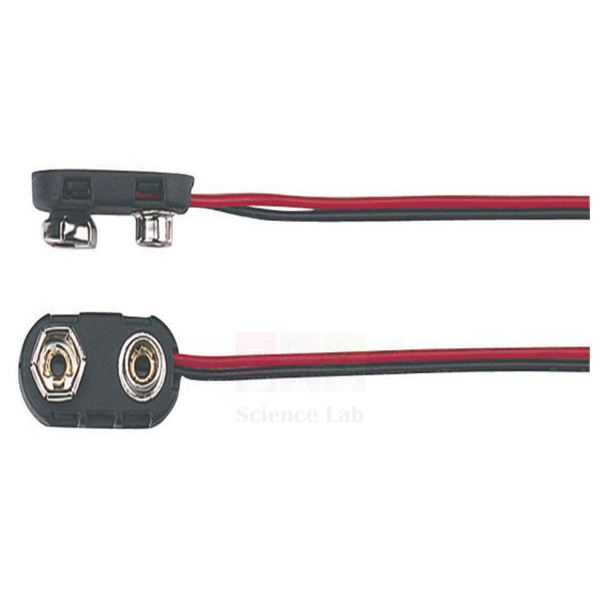
Battery Clip, PP3
Battery Clip, PP3 (Product Code: SLE/PHY/21) is a standard snap-on battery connector used to take power from a PP3 battery into simple circuits in school physics and electronics labs. It has 150 mm leads and fits both PP3 batteries and press-stud type battery holders, so one clip style serves both power options on the bench. It is supplied by Jain Scientific Equipments Pvt Ltd (ScienceLab), Ambala, India, as a basic part for any electricity experiment kit a school assembles.
Specifications
| Parameter | Detail |
|---|---|
| Type | Standard PP3 battery clip |
| Lead length | 150 mm |
| Fits | PP3 batteries; press-stud type battery holders |
| Product code | SLE/PHY/21 |
| Supplied by | Jain Scientific Equipments Pvt Ltd (ScienceLab), Ambala, India |
What Is the PP3 Battery Clip Used For?
A PP3 battery has two press-stud terminals of different sizes at one end, and the clip snaps onto them in only one orientation, so the battery cannot be connected the wrong way round at the clip. The 150 mm leads then carry the supply to the rest of the circuit, whether that is a bulb holder, a buzzer, a small motor or a breadboard. The same clip also snaps onto press-stud type battery holders, which lets a class switch between a PP3 battery and a holder of cells without rewiring.
Before wiring, note which lead goes to the positive terminal and keep that polarity throughout the circuit. Never let the two lead ends touch while a battery is attached, as that shorts the battery and heats the wires. Unclip the battery at the end of each lesson so it does not drain in storage, and bend the leads gently so the joints at the clip last longer.
Supplier
ScienceLab is the trading name of Jain Scientific Equipments Private Limited, which supplies the Battery Clip, PP3 from Ambala, Haryana, India. The company sources it as a standard component and ships it with other electricity and circuit items, so a school or dealer can place a single order for the whole circuit list. Ask us about quantities for class kits or for dealer stock. Company information is on the ScienceLab profile page.
Related Physics Lab Equipment
These items complete a simple battery circuit with the PP3 clip:
- Battery Snap with Crocodile Clip — a battery connector with crocodile clips already attached for clip-on wiring.
- Crocodile Clip — for making quick connections at the ends of the leads.
- MES Bulb Holder — a bulb holder for a first lamp circuit.
- Circuits Kit Push Switch — lets students switch the circuit on and off.
- Battery Holder, C — a holder for C cells when a different battery format is wanted.
More circuit and electricity items are in Physics Lab Equipment.
Frequently Asked Questions
What is the Battery Clip, PP3 used for?
The Battery Clip, PP3 connects a PP3 battery, or a press-stud type battery holder, to a circuit. It snaps onto the battery terminals and carries the supply through its 150 mm leads to bulbs, buzzers, motors or other components in school experiments.
How long are the leads on the PP3 battery clip?
The leads on the Battery Clip, PP3 are 150 mm long. That length reaches comfortably across a small circuit board or bench layout while keeping the wiring short and tidy for student circuits.
Does the PP3 battery clip fit battery holders?
Yes. The Battery Clip, PP3 can be used with PP3 batteries or with press-stud type battery holders, so the same clip works whether a class uses a single PP3 battery or a holder of cells with press-stud terminals.
How can short circuits be avoided with the PP3 clip?
With the Battery Clip, PP3 attached to a battery, keep the two lead ends apart and connect them only into a complete circuit. Unclip the battery after use so it does not drain, and check the leads for damaged insulation before each lesson.
Who supplies the Battery Clip, PP3?
The Battery Clip, PP3 is supplied by Jain Scientific Equipments Pvt Ltd (ScienceLab), Ambala, Haryana, India, to schools, colleges, dealers and importers in India and international markets, often together with other circuit components on the same order.
What should I include when asking for a quote on SLE/PHY/21?
When asking for a quote on the Battery Clip, PP3, code SLE/PHY/21, give the quantity required, the delivery location and any other circuit items you want on the same order. Send the request through the ScienceLab contact page or the enquiry cart.
Request a Quote
Add the Battery Clip, PP3 to the enquiry cart with the rest of your circuit components, or send quantities through the contact page for a quotation.
Last updated: 24 September 2026
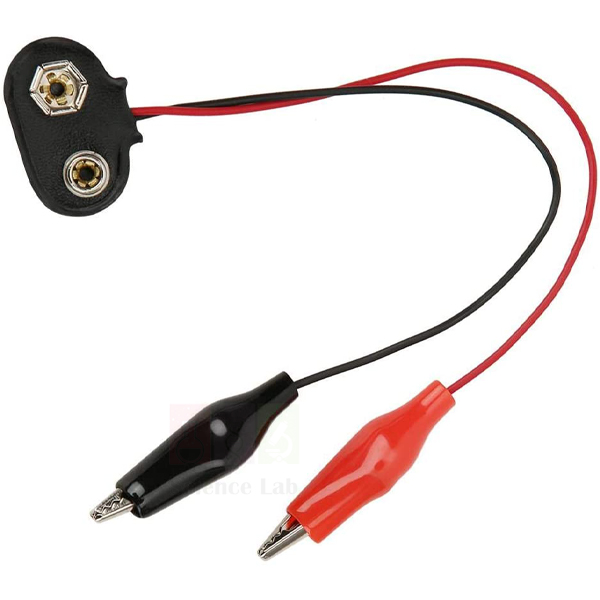
Battery Snap with Crocodile Clip
Battery Snap with Crocodile Clip (Product Code: SLE/PHY/22) is a battery connector with crocodile clips attached, used to link a battery quickly to circuit components in school science and physics lessons. Because the clips grip terminals, wires and component legs directly, students can build and change circuits on the desk without screwdrivers or soldering. It is supplied by Jain Scientific Equipments Pvt Ltd (ScienceLab), Ambala, India, and is a handy part of any hands-on science kit for primary school and middle-school classes.
Key Details
| Parameter | Detail |
|---|---|
| Type | Battery snap (battery connector) |
| Connection ends | Crocodile clips attached |
| Purpose | Easy connection of a battery to a circuit |
| Product code | SLE/PHY/22 |
| Supplied by | Jain Scientific Equipments Pvt Ltd (ScienceLab), Ambala, India |
What Is the Battery Snap with Crocodile Clip Used For?
Young students often struggle with small terminal screws, and loose connections are the most common reason a first circuit fails. With this connector the battery snaps on at one end and the crocodile clips at the other bite straight onto a bulb holder terminal, a switch, a buzzer lead or a bare wire. A circuit can be built, tested and rearranged in seconds, which keeps attention on the science rather than the wiring.
Teachers use it for series and parallel circuit activities, for testing which materials conduct electricity, and for quick demonstrations at the front of the class. Clip only onto metal parts, check that the jaws close firmly, and never let the two crocodile clips touch each other while the battery is connected. Disconnect the battery after the lesson so it stays fresh for the next class.
Supplier
Jain Scientific Equipments Private Limited, trading as ScienceLab, supplies the Battery Snap with Crocodile Clip from Ambala, Haryana, India. It is a sourced component that the company packs and dispatches alongside its wider range of physics and circuit items, so schools, colleges, dealers and importers can combine it with the rest of their order. For the battery type it fits, or for large class quantities, please ask us. Learn more on the company profile.
Related Physics Lab Equipment
To build complete circuits around this connector, schools usually add:
- Battery Clip, PP3 — a standard PP3 clip with 150 mm leads for boards and terminal blocks.
- Crocodile Clips & Leads — extra clip leads to extend the circuit to more components.
- MES Bulb Holder — holds a small bulb so students can see the circuit working.
- Knife Switch – Single Pole — an easy-to-see switch for opening and closing the circuit.
Find more under Physics Lab Equipment.
Frequently Asked Questions
What is the Battery Snap with Crocodile Clip used for?
The Battery Snap with Crocodile Clip connects a battery to circuit components through crocodile clips attached to the connector. Students clip it directly onto terminals, wires or component legs, making circuits quick to build and change without tools or soldering.
Why choose crocodile clips instead of plain leads?
Crocodile clips on the Battery Snap with Crocodile Clip grip a terminal or wire firmly with one squeeze, so connections are fast and secure even for young students. Plain leads need screw terminals or soldering, which take longer and are harder for beginners.
Which battery does the Battery Snap with Crocodile Clip fit?
The Battery Snap with Crocodile Clip is a snap-type battery connector. To confirm the battery type it fits for your planned experiments, ask ScienceLab through the contact page before ordering, and mention the batteries or holders your lab already uses.
How should students use the crocodile clip battery snap safely?
When using the Battery Snap with Crocodile Clip, attach the clips only to metal parts of the circuit, keep the two clips apart while a battery is connected, and remove the battery after the lesson. This prevents short circuits, warm wires and flat batteries.
Who supplies the Battery Snap with Crocodile Clip?
Jain Scientific Equipments Pvt Ltd (ScienceLab), Ambala, Haryana, India, supplies the Battery Snap with Crocodile Clip to schools, colleges, dealers and importers in India and international markets, together with other circuit parts on one order.
How do I get a quotation for SLE/PHY/22?
For a quotation on the Battery Snap with Crocodile Clip, code SLE/PHY/22, send the number required, your delivery location and any other circuit items you need through the ScienceLab contact page, or add everything to the enquiry cart.
Request a Quote
Place the Battery Snap with Crocodile Clip in the enquiry cart or ask for a quotation through the contact page, listing the quantity for your classes.
Last updated: 24 September 2026
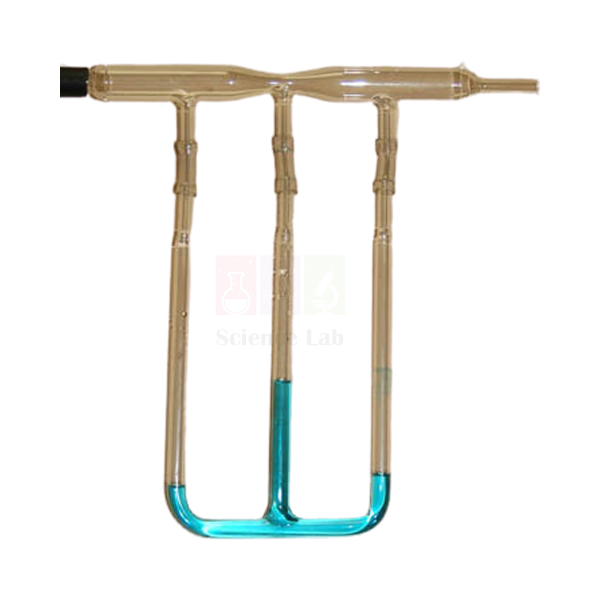
Bernoulli Tube Apparatus
Bernoulli Tube Apparatus (Product Code: SLE/PHY/23) is a glass flow-tube set used to explain Bernoulli's theorem by showing how the pressure and speed of a flowing liquid change with the bore of a tube, in physics labs. It pairs a Bernoulli tube with a central narrowed portion and a constant-bore gradient tube, each 500 x 13 mm with three side tubes for glass manometers. This physics demonstration kit is made by Jain Scientific Equipments Pvt Ltd (ScienceLab), an OEM manufacturer, at its own factory in Ambala, India.
Specifications
| Parameter | Detail |
|---|---|
| Flow tubes | Bernoulli tube with central narrowed portion; constant-bore gradient tube |
| Flow tube size | Each 500 x 13 mm (length x outer diameter) |
| Side tubes | Three sealed-in short side tubes on each flow tube, each 25 mm long, spaced about 150 mm apart |
| Constriction tapping | On the Bernoulli tube, the middle side tube comes out from the central narrowed portion |
| Manometer tubing | 6 lengths of glass tubing, connected to the side tubes for use as manometers |
| Outlets | 2 swan-necked outlet tubes |
| Connectors | 8 small pieces of rubber connecting tubing for joining the glass tubes as needed |
| Purpose | Observing the variation in pressure and speed of flow of an incompressible fluid with the bore or cross-section of the tube |
| Product code | SLE/PHY/23 |
| Manufacturer | Jain Scientific Equipments Pvt Ltd (ScienceLab) — OEM |
| Country of origin | India (made in Ambala, Haryana) |
What Is the Bernoulli Tube Used For?
Water from a steady supply is run through one flow tube at a time, with a length of glass tubing standing upright in each side tube as a manometer and a swan-necked outlet at the far end. In the constant-bore gradient tube, the water levels in the three manometers fall evenly along the tube, showing the pressure drop along a uniform pipe. In the Bernoulli tube, the middle manometer, which taps the narrowed portion, stands noticeably lower than its neighbours.
That dip is Bernoulli's theorem in action: to pass the same volume each second through the constriction, the water must speed up, and its pressure falls. Comparing the two tubes side by side separates this effect from the ordinary friction loss. Keep the flow steady, clamp the manometer tubes upright, and handle the glass with care when fitting the rubber connectors. It is a clear, low-cost piece of physics lab equipment in India's senior-secondary and college fluid-flow practicals.
What to Specify When Ordering
- Number of complete sets; each set includes both flow tubes, 6 glass tubing lengths, 2 swan-necked outlets and 8 rubber connectors.
- Any spare glass tubing lengths or rubber connectors you want quoted.
- Stands or clamps for holding the manometer tubes upright, if your lab needs them.
OEM Manufacturer
Jain Scientific Equipments Private Limited, known by its trading name ScienceLab, is the OEM of the Bernoulli Tube Apparatus. The set is manufactured at the company's licensed factory at Saha, Ambala, Haryana, India, and supplied factory-direct to schools, colleges, dealers and importers. Because glassware can break in use, replacement flow tubes, glass tubing or connectors are handled by the manufacturer itself — just ask us. More detail is on the ScienceLab profile page.
Related Physics Lab Equipment
These items support the experiment or take it further:
- Bernoulli's Theorem Demonstration module — a larger engineering-level unit for the same theorem.
- Rubber Tubing — for connecting the flow tube to the water supply.
- Borosilicate Glass Tubing — spare tubing for extra or replacement manometers.
- Retort Stand — holds the flow tube and manometer tubes steady.
See more apparatus in Physics Lab Equipment.
Frequently Asked Questions
What does the Bernoulli Tube Apparatus demonstrate?
The Bernoulli Tube Apparatus demonstrates Bernoulli's theorem: where a flowing incompressible liquid passes through a narrower section, its speed increases and its pressure falls. The manometer tapping at the narrowed portion of the Bernoulli tube shows this as a lower liquid level.
What is included in the Bernoulli Tube Apparatus?
The Bernoulli Tube Apparatus includes a Bernoulli tube with a central narrowed portion, a constant-bore gradient tube, 6 lengths of glass tubing, 2 swan-necked outlet tubes and 8 small pieces of rubber connecting tubing for joining the glass parts.
What size are the Bernoulli apparatus flow tubes?
Each flow tube of the Bernoulli Tube Apparatus measures 500 x 13 mm (length x outer diameter). Each has three sealed-in side tubes, 25 mm long and spaced about 150 mm apart, where glass tubing lengths are attached as manometers.
Why does the set include a constant-bore gradient tube?
The constant-bore gradient tube in the Bernoulli Tube Apparatus shows the steady pressure fall along a uniform tube. Comparing it with the Bernoulli tube lets students separate the pressure drop caused by the constriction from the ordinary loss along the length of the tube.
Who manufactures the Bernoulli Tube Apparatus?
Jain Scientific Equipments Pvt Ltd, trading as ScienceLab, manufactures the Bernoulli Tube Apparatus as the OEM at its own factory in Saha, Ambala, Haryana, India. It is supplied factory-direct, and replacement glass parts can be requested from the manufacturer.
What details should a quotation request for SLE/PHY/23 include?
A quotation request for the Bernoulli Tube Apparatus, code SLE/PHY/23, should state the number of sets, any spare tubing or connectors, and the delivery location in India or abroad. Send it through the ScienceLab contact page or enquiry cart.
Request a Quote
Request the Bernoulli Tube Apparatus through the contact page or add it to the enquiry cart with any spares you need. ScienceLab quotes directly as the manufacturer.
Last updated: 24 September 2026
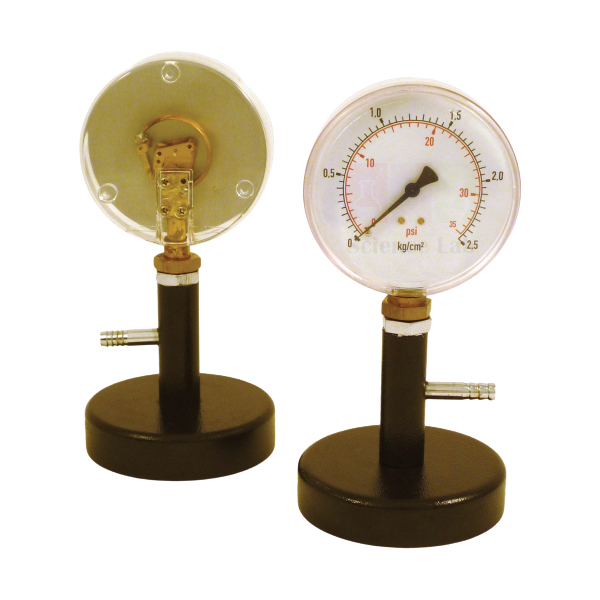
Bourdon Gauge
Bourdon Gauge (Product Code: SLE/PHY/24) is a dial pressure gauge used to measure and demonstrate positive gas and liquid pressures in general and laboratory work, including school and college physics classes. A substantial black needle reads against a 100 mm diameter white face scaled in kg/cm² and psi, and a clear Perspex back lets students watch the Bourdon mechanism move. It is supplied by Jain Scientific Equipments Pvt Ltd (ScienceLab), Ambala, India, a physics instruments supplier in India for schools, colleges and dealers.
Specifications
| Parameter | Detail |
|---|---|
| Use | General and laboratory use |
| Mounting | Rugged gauge on a heavy metal base for stability |
| Back cover | Clear Perspex, so the mechanism can be viewed |
| Inlet | Rifled metal input tube designed to fit rubber tubing of 8 mm internal diameter |
| Dial | 100 mm diameter white face with a substantial black needle |
| Scales | kg/cm² (black) and psi (red) |
| SI conversion | Multiply the kg/cm² reading by 105 for an approximate value in pascals |
| Pressure type | Positive pressures only (above atmospheric) |
| Product code | SLE/PHY/24 |
| Supplied by | Jain Scientific Equipments Pvt Ltd (ScienceLab), Ambala, India |
What Is the Bourdon Gauge Used For?
Inside the gauge is a Bourdon tube, a curved, flattened metal tube that tends to straighten as the pressure inside it rises; a linkage turns that small movement into the sweep of the needle. With the Perspex back, students can see this happen while a teacher pumps air into the gauge through rubber tubing pushed onto the rifled inlet. It is used for gas-law work such as pressure against volume, for checking the pressure in a sealed container, and as a readable demonstration dial at the front of the class.
The dual scale lets students compare engineering units, and multiplying the kg/cm² reading by 105 converts it to pascals with enough accuracy for class calculations. Use rubber tubing of 8 mm internal diameter so the connection seals well. The gauge is for positive pressures only: never connect it to a vacuum pump or any other source of negative pressure, as that could damage the apparatus.
Supplier
ScienceLab is the trading name of Jain Scientific Equipments Private Limited, which supplies the Bourdon Gauge from Ambala, Haryana, India. The company sources this gauge and looks after quotations, packing and dispatch for schools, colleges, laboratory dealers and importers in India and international markets. For vendor registration, the supplying company's details are GSTIN 06AAECJ8618A1ZT and LEI 3358004HRD1JIVXKYX49. The ScienceLab profile page gives more background.
Related Physics Lab Equipment
These items are commonly used with a pressure gauge in physics and fluid lessons:
- Rubber Tubing — for connecting the gauge inlet; specify 8 mm internal diameter to suit the gauge.
- Boyle's Law – Simple Type — a gas-law experiment on pressure and volume.
- Manometer, Glass — a liquid manometer for comparing small pressure differences.
- Calibration of a Pressure Gauge — an engineering unit for studying how pressure gauges are checked.
Browse more in Physics Lab Equipment.
Frequently Asked Questions
What is the Bourdon Gauge used for?
The Bourdon Gauge measures positive pressures, those above atmospheric, in general and laboratory use. In physics classes it demonstrates gas pressure and gas-law experiments, and its clear Perspex back lets students see how the Bourdon mechanism moves the needle.
What units does the Bourdon Gauge read?
The Bourdon Gauge has a 100 mm diameter white face with scales in kg/cm² (black) and psi (red). To express a reading in pascals, multiply the kg/cm² value by 105, which is accurate enough for school and college calculations.
What tubing fits the Bourdon Gauge inlet?
The Bourdon Gauge has a rifled metal input tube designed to fit rubber tubing of 8 mm internal diameter. Push the tubing well onto the rifled inlet so the joint holds under pressure, and check it for leaks before taking readings.
Can the Bourdon Gauge be used with a vacuum pump?
No. The Bourdon Gauge is for positive pressures only, that is, pressures in excess of atmospheric. Connecting it to a vacuum pump or any other source of negative pressure could damage the apparatus, so use a gauge meant for vacuum work instead.
Who supplies the Bourdon Gauge?
The Bourdon Gauge is supplied by Jain Scientific Equipments Pvt Ltd (ScienceLab), Ambala, Haryana, India. The company handles quotations and dispatch for schools, colleges, dealers and importers in India and international markets.
Is a calibration certificate available for the Bourdon Gauge?
Whether a calibration document can accompany the Bourdon Gauge, code SLE/PHY/24, should be discussed with ScienceLab before ordering. Mention the requirement, quantity and delivery location in your enquiry through the contact page.
Request a Quote
Ask for a quotation on the Bourdon Gauge through the contact page, or add it to the enquiry cart with any tubing or gas-law apparatus you need.
Last updated: 24 September 2026

Boyle's Law – Simple Type
Boyle's Law – Simple Type (Product Code: SLE/PHY/25) is a sealed-syringe apparatus used to demonstrate Boyle's Law, the inverse link between the pressure and volume of a trapped gas, in school and college physics laboratories. Students load its wooden platforms with different masses and read the shrinking air volume straight from the syringe scale. It is made by Jain Scientific Equipments Pvt Ltd (ScienceLab), an OEM manufacturer, at its own factory in Ambala, India, as simple, economical physics lab equipment for India and abroad.
Key Details
| Parameter | Detail |
|---|---|
| Law demonstrated | Boyle's Law (pressure and volume of a fixed quantity of air) |
| Working element | Sealed syringe containing air |
| Mounting | Syringe mounted on wooden platforms |
| How pressure is applied | Different masses are loaded on, compressing the air inside |
| Volume reading | Read directly from the syringe scale |
| Design | Simple, economical demonstration type |
| Product code | SLE/PHY/25 |
| Manufacturer | Jain Scientific Equipments Pvt Ltd (ScienceLab) — OEM |
| Country of origin | India (made in Ambala, Haryana) |
What Is the Boyle's Law Apparatus Used For?
The apparatus turns an abstract gas law into something students can see. With the syringe sealed, a known load is placed on the platform, the plunger settles, and the volume is noted from the scale. Adding further masses step by step shows the trapped air occupying less space each time the pressure on it rises, and a graph of volume against the inverse of the load brings out the relationship.
For cleaner results, add each mass gently and centrally, give the air a moment to return to room temperature between readings, and read the scale at eye level. Because it needs no pumps, gauges or oil, this simple type is a practical choice of physics practical equipment for CBSE and state-board classrooms where set-up time is short.
OEM Manufacturer
Jain Scientific Equipments Private Limited, which trades as ScienceLab, is the original equipment manufacturer of this Boyle's Law apparatus. It is produced at the company's own licensed factory at Saha, Ambala, Haryana, India, and reaches schools, colleges, dealers and importers factory-direct rather than through a trading intermediary.
Because the maker handles your enquiry itself, questions about replacement syringes, platform parts or repeat orders for additional lab benches come straight to the people who build the unit, so just ask us. Read more about the company on our company profile.
Related Physics Lab Equipment
These items extend the same gas-law practical or offer a different way to teach it:
- Boyle's Law — a separate bench apparatus for the same law, for labs comparing set-ups.
- Gay-Lussac's Law — follows pressure–volume work with the pressure–temperature law.
- Slotted Mass Hanger, 500g — a source of known loads; confirm the fit with us before ordering.
- Aneroid Barometer — gives atmospheric pressure for students working in absolute pressure.
See the complete Physics Lab Equipment range for more heat, mechanics and electricity apparatus.
Frequently Asked Questions
What does the Boyle's Law – Simple Type consist of?
The Boyle's Law – Simple Type consists of a sealed syringe mounted on wooden platforms. Air trapped in the syringe is compressed as different masses are loaded on, and the change in volume is read directly from the syringe scale.
Are masses included with the Boyle's Law – Simple Type?
The Boyle's Law – Simple Type is designed to be loaded with different masses, but its listing does not state that masses come with it. Mention the masses you need in your enquiry and we will confirm exactly what your quotation covers.
How is the Boyle's Law – Simple Type used in a practical class?
In a practical class, students add masses to the Boyle's Law – Simple Type one at a time and record the syringe-scale volume after each step. Comparing the readings shows the trapped air taking up less space as the pressure on it increases.
Who manufactures the Boyle's Law – Simple Type?
The Boyle's Law – Simple Type is manufactured by Jain Scientific Equipments Pvt Ltd (ScienceLab), the OEM, at its own licensed factory at Saha, Ambala, Haryana, India. Quotations, repeat orders and spare-part questions are handled directly by the manufacturer.
Is a calibration certificate available for the Boyle's Law – Simple Type?
The Boyle's Law – Simple Type is a demonstration apparatus read from its syringe scale. If your institution needs a calibration certificate or test report, please discuss it with us through the contact page before ordering so we can tell you what is possible.
How should the Boyle's Law – Simple Type be stored?
Store the Boyle's Law – Simple Type in a dry cupboard away from heaters, take the masses off after each class so the syringe is not left under load, and wipe the wooden platforms with a dry cloth to keep them in good condition.
Can the Boyle's Law – Simple Type be ordered in bulk or for export?
Yes, the Boyle's Law – Simple Type can be ordered in quantity for school laboratories, dealers and importers, and ScienceLab serves India and international markets. Include the quantity and delivery location in your enquiry to receive a quotation from the manufacturer.
Request a Quote
To request a quote for the Boyle's Law – Simple Type, send your quantity and delivery details through our contact page or add the item to the enquiry cart. Quotations come direct from the manufacturer, Jain Scientific Equipments Pvt Ltd (ScienceLab).
Last updated: 24 September 2026
60.jpg)
Bucket & Cylinder, (Large)
Bucket & Cylinder, (Large) (Product Code: SLE/PHY/26) is a brass bucket-and-cylinder unit used to demonstrate Archimedes' principle in school and college physics laboratories. Its larger 60 mm size, 160 mm overall, gives the whole class a clear view when the teacher runs the experiment at the front bench. The unit is made by Jain Scientific Equipments Pvt Ltd (ScienceLab), an OEM manufacturer, at its own factory in Ambala, India, and is part of its physics lab equipment range.
Specifications
| Parameter | Detail |
|---|---|
| Principle demonstrated | Archimedes' principle (buoyancy) |
| Material | Brass |
| Size | 60 mm; overall 160 mm |
| Bucket | Suspension loop at the top and a hook at the bottom |
| Cylinder | Suspension hook at one end |
| Suitable for | Class demonstration or individual use |
| Product code | SLE/PHY/26 |
| Manufacturer | Jain Scientific Equipments Pvt Ltd (ScienceLab) — OEM |
| Country of origin | India (made in Ambala, Haryana) |
What Is the Large Bucket and Cylinder Used For?
The bucket and cylinder is the classic way to show that the upward thrust on an immersed body equals the weight of liquid it pushes aside. The bucket hangs from a spring balance by its top loop and the cylinder hangs from the bucket's bottom hook. When the cylinder is lowered into water the balance reading falls; filling the empty bucket with water brings the reading back, because in the classic demonstration the cylinder matches the inside of the bucket.
The large version suits teachers who want a bigger, easier-to-follow set-up during a lecture demonstration, while still being simple enough for a student to repeat the experiment afterwards. Use a vessel deep enough to cover the cylinder completely, and dry the brass after use. It is a staple item of mechanics lab equipment in India for classes studying buoyancy, floating and sinking.
What to Specify When Ordering
- Size: this large unit (60 mm, overall 160 mm) or the smaller Bucket & Cylinder, Small.
- Use: one set for teacher demonstration or several sets for individual student work.
- Any spring balance or water vessel you also want quoted with the sets.
OEM Manufacturer
ScienceLab is the trading name of Jain Scientific Equipments Private Limited, the OEM that makes this brass bucket and cylinder at its own licensed factory in Saha, Ambala, Haryana, India. Buyers deal with the manufacturer itself, not a reseller, whether they are a school, a college, a dealer or an importer.
If a hook, bucket or cylinder goes missing from a set, or you want to add more sets next term, ask us and the request is handled by the factory that produced them. More about the company is on our company profile.
Related Physics Lab Equipment
Items commonly used alongside the large bucket and cylinder in buoyancy practicals:
- Bucket & Cylinder, Small — the smaller version for student benches.
- Force Meter/Spring Balance — to weigh the bucket and cylinder in air and in water.
- Glass Beaker — holds the water in which the cylinder is immersed.
- Wood & Metal Cylinder — extends the lesson to density, floating and sinking.
Browse all Physics Lab Equipment for further mechanics and fluids apparatus.
Frequently Asked Questions
What size is the Bucket & Cylinder, (Large)?
The Bucket & Cylinder, (Large) is listed at 60 mm with an overall size of 160 mm. A smaller Bucket & Cylinder, Small is also offered, so choose the large unit when the demonstration must be easy to see from the back of the room.
What material is the Bucket & Cylinder, (Large) made from?
The Bucket & Cylinder, (Large) is a simple brass unit. The bucket carries a suspension loop at its top and a hook at its bottom, and the cylinder has a suspension hook at one end so the two can hang together from a balance.
Is a spring balance included with the Bucket & Cylinder, (Large)?
The Bucket & Cylinder, (Large) listing covers the brass bucket and cylinder only and does not mention a spring balance. If you need a balance or a water vessel, list it in your enquiry and we will quote it separately.
Who manufactures the Bucket & Cylinder, (Large)?
The Bucket & Cylinder, (Large) is manufactured by Jain Scientific Equipments Pvt Ltd (ScienceLab), the OEM, at its own licensed factory in Saha, Ambala, Haryana, India, and is supplied factory-direct to schools, colleges, dealers and importers.
Can the Bucket & Cylinder, (Large) be used by students as well as teachers?
Yes. The Bucket & Cylinder, (Large) is described as suitable for class demonstration or individual use, so a teacher can show the experiment first and students can then repeat the same measurements themselves at the bench.
Is a calibration certificate available for the Bucket & Cylinder, (Large)?
The Bucket & Cylinder, (Large) is a teaching apparatus rather than a measuring instrument. If your tender or institution asks for a certificate or test report, please raise it on our contact page before ordering and we will explain what can be provided.
What should a quotation request for the Bucket & Cylinder, (Large) include?
A quotation request for the Bucket & Cylinder, (Large) should state the number of sets, whether you also need the small size, any balances or vessels required and the delivery location in India or abroad.
Request a Quote
For a quotation on the Bucket & Cylinder, (Large), write to us through the contact page or place it in the enquiry cart. Quotations are prepared directly by the manufacturer.
Last updated: 24 September 2026
805.jpg)
Bucket & Cylinder, Small
Bucket & Cylinder, Small (Product Code: SLE/PHY/27) is a compact brass apparatus used to verify Archimedes' principle at student benches in school and college physics labs. At 50 mm, 115 mm overall, it is sized for pairs or small groups who weigh, immerse and refill it themselves during a practical period. It is made by Jain Scientific Equipments Pvt Ltd (ScienceLab), an OEM manufacturer, at its own factory in Ambala, India, for school physics lab equipment in India and overseas.
Specifications
| Parameter | Detail |
|---|---|
| Size | 50 mm; overall 115 mm |
| Construction | Simple brass unit |
| Bucket fittings | Top suspension loop; hook underneath |
| Cylinder fitting | Suspension hook at one end |
| Experiment | Demonstrating Archimedes' principle |
| Intended use | Class demonstration or individual use |
| Product code | SLE/PHY/27 |
| Manufacturer | Jain Scientific Equipments Pvt Ltd (ScienceLab) — OEM |
| Country of origin | India (made in Ambala, Haryana) |
What Is the Small Bucket and Cylinder Used For?
Students use it to measure buoyant force for themselves. They record the balance reading with the cylinder hanging in air below the bucket, then again with the cylinder fully under water, and the difference gives the upthrust. Pouring water into the bucket until the first reading returns shows that the upthrust equals the weight of the water displaced, which is the heart of Archimedes' principle.
Because it is small, several sets fit on one bench and a narrow beaker or measuring cylinder is enough to submerge the cylinder. Encourage groups to lower the cylinder slowly so it does not touch the vessel walls, and to note each reading only after the balance stops moving. It makes an efficient addition to physics lab instruments in India where every pair of students needs its own set.
What to Specify When Ordering
- Number of sets, usually one per student pair or group.
- Whether you also want the larger Bucket & Cylinder, (Large) for the teacher's demonstration.
- Any balances or vessels to be included in the same quotation.
OEM Manufacturer
This small bucket and cylinder comes from Jain Scientific Equipments Private Limited, trading as ScienceLab, which manufactures it as the OEM at its own licensed factory at Saha, Ambala, Haryana, India. Schools and colleges, as well as dealers and importers buying for resale, order directly from the maker.
Class-set orders and later top-ups are quoted by the same manufacturer, and you can ask us about replacing an individual bucket or cylinder that has been lost from a set. Our company profile gives more background on ScienceLab.
Related Physics Lab Equipment
Useful companions for a student buoyancy practical:
- Bucket & Cylinder, (Large) — the larger unit for front-of-class demonstration.
- Balance Spring Tubular Plastic — a spring balance for student weighings in air and water.
- Beaker, Polypropylene — an unbreakable vessel for immersing the cylinder.
- Metal Density Cubes (Set of 6) — follow-up work on density and displacement.
More apparatus is listed in our Physics Lab Equipment category.
Frequently Asked Questions
How big is the Bucket & Cylinder, Small?
The Bucket & Cylinder, Small measures 50 mm, with an overall size of 115 mm. Its compact size lets several student groups work at once and keeps the amount of water needed for each immersion small.
How do students use the Bucket & Cylinder, Small?
With the Bucket & Cylinder, Small, students hang the bucket from a balance and the cylinder from the bucket's hook, immerse the cylinder in water and note the loss in weight, then refill the bucket with water to show the reading restored.
What is the Bucket & Cylinder, Small made of?
The Bucket & Cylinder, Small is a simple brass unit. It has a suspension loop on top of the bucket, a hook beneath the bucket and a suspension hook at one end of the cylinder, so the parts link together without extra fittings.
Who manufactures the Bucket & Cylinder, Small?
The Bucket & Cylinder, Small is manufactured by Jain Scientific Equipments Pvt Ltd (ScienceLab) as the OEM at its own licensed factory in Saha, Ambala, Haryana, India. Enquiries, class-set orders and replacement parts are handled by the manufacturer.
Does the Bucket & Cylinder, Small come with a spring balance?
The Bucket & Cylinder, Small is listed as the brass bucket and cylinder only. If you want a spring balance or beaker with each set, add it to your enquiry through the contact page and we will include it in the quotation.
Can the Bucket & Cylinder, Small be supplied in class-set quantities for export?
Yes, the Bucket & Cylinder, Small can be ordered in class-set quantities by schools, dealers and importers. ScienceLab serves India and international markets, so state the number of sets and the destination when you ask for a quotation.
Request a Quote
Ask for a quotation on the Bucket & Cylinder, Small through our contact page, or add it to the enquiry cart together with other practical items. You will receive a quotation direct from the manufacturer.
Last updated: 24 September 2026
978.jpg)
Caliper Vernier (Metal)
Caliper Vernier (Metal) (Product Code: SLE/PHY/28) is a nickel-plated steel vernier caliper used to measure external dimensions, internal dimensions and depth in school and college physics laboratories. Its metric scale reads from 0 to 120 mm in 1-mm divisions alongside a standard scale, and a roller adjustment moves the sliding head. It is supplied in a plastic case by Jain Scientific Equipments Pvt Ltd (ScienceLab), Ambala, India, for institutions buying a Vernier caliper for school labs in India and abroad.
Specifications
| Parameter | Detail |
|---|---|
| Measurements | External dimensions, internal dimensions and depth |
| Depth measurement | Shaft attached to the movable head, sliding along the centre of the body |
| Metric range | 0 to 120 mm |
| Metric divisions | 1 mm |
| Second scale | Standard scale |
| Material | Nickel-plated steel |
| Adjustment | Roller adjustment |
| Packing | Plastic case |
| Product code | SLE/PHY/28 |
| Supplied by | Jain Scientific Equipments Pvt Ltd (ScienceLab), Ambala, India |
What Is the Vernier Caliper Used For?
A vernier caliper is the standard tool for measuring small lengths more finely than a ruler allows. Students use the outside jaws for the diameter of a pendulum bob, rod or wire coil, the inside jaws for the bore of a tube or beaker, and the depth shaft for the depth of a calorimeter or a hole. Dimensions taken this way feed directly into volume and density calculations for metal blocks and cylinders.
Before each session, close the jaws gently and check whether the zero marks line up, so any zero error can be subtracted from later readings. Read the main scale first, then find the vernier mark that lines up most closely with a main-scale line. Wipe the steel clean after use and return it to its plastic case, a habit that suits any set of physics lab instruments in India that passes through many hands.
Supplier
Jain Scientific Equipments Private Limited, which trades as ScienceLab, supplies this metal vernier caliper from Ambala, Haryana, to schools, colleges, dealers and importers. It is sourced for educational use and can be quoted together with the rest of a physics practical list so that measuring tools and apparatus arrive in one consignment.
For vendor registration, the supplying company is Jain Scientific Equipments Private Limited (CIN U29309HR2020PTC087597, GSTIN 06AAECJ8618A1ZT). Company background is available on our company profile.
Related Physics Lab Equipment
Other measuring tools and specimens often used with a vernier caliper:
- Caliper, Digital — an alternative with a direct digital readout.
- Micrometer Screw Gauge, Lock Type — for wire diameters and thin sheets that need finer readings.
- Cylinders, Metal (Set of 6) — regular solids to measure for volume and density work.
- Microscope Travelling (Vernier) — applies the vernier principle to very small distances.
Find more apparatus in the Physics Lab Equipment category.
Frequently Asked Questions
What can the Caliper Vernier (Metal) measure?
The Caliper Vernier (Metal) measures external dimensions, internal dimensions and depth. Depth is taken with a shaft attached to the movable head, which slides along the centre of the body, so one tool covers diameters, bores and depths.
What is the measuring range of the Caliper Vernier (Metal)?
The Caliper Vernier (Metal) reads from 0 to 120 mm on its metric scale in 1-mm divisions and also carries a standard scale. For the vernier resolution needed for your syllabus, please ask us through the contact page.
What is the Caliper Vernier (Metal) made of?
The Caliper Vernier (Metal) is made of nickel-plated steel and has a roller adjustment for moving the sliding head. Each caliper is packed in a plastic case that protects the jaws and scales during storage and transport.
Who supplies the Caliper Vernier (Metal)?
The Caliper Vernier (Metal) is supplied by Jain Scientific Equipments Pvt Ltd (ScienceLab) of Ambala, Haryana, India, to schools, colleges, laboratories, dealers and importers, and can be quoted alongside other physics apparatus.
Is a calibration certificate available for the Caliper Vernier (Metal)?
Whether a calibration certificate can accompany the Caliper Vernier (Metal) should be discussed with us before you order. Please state the requirement on the contact page so we can confirm what documentation is possible.
How should the Caliper Vernier (Metal) be looked after?
Keep the Caliper Vernier (Metal) in its plastic case when not in use, wipe off moisture and fingerprints after each class, never force the jaws over an object, and check the zero reading before measurements to spot any zero error.
Can the Caliper Vernier (Metal) be ordered in bulk or for export?
Yes, the Caliper Vernier (Metal) can be ordered in class-set or bulk quantities, and ScienceLab supplies India and international markets. Give the quantity and destination in your enquiry to receive a quotation.
Request a Quote
To request a quote for the Caliper Vernier (Metal), use our contact page or add it to the enquiry cart with any other items on your list.
Last updated: 24 September 2026
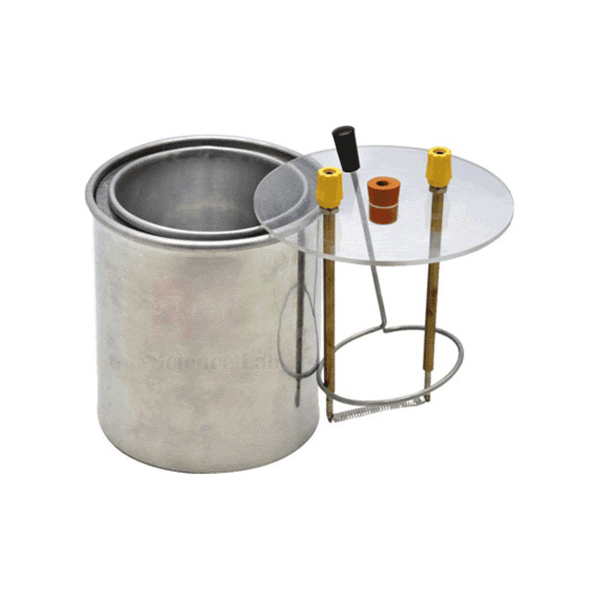
Calorimeter Set, Aluminium
Calorimeter Set, Aluminium (Product Code: SLE/PHY/29) is a Joule's calorimeter set used to heat a liquid electrically and find specific heat capacity in school and college physics laboratories. An aluminium inner vessel sits inside a plastic outer vessel with custom-made foam insulation, heated by a 12 W precision heater, with a stirrer, stopper and spare cap included. It is made by Jain Scientific Equipments Pvt Ltd (ScienceLab), an OEM manufacturer, at its own factory in Ambala, India, for calorimeter lab work across India and abroad.
Specifications
| Parameter | Detail |
|---|---|
| Type | Joule's calorimeter set |
| Inner vessel | Aluminium, 70 x 65 mm |
| Outer vessel | Plastic, 110 x 100 mm |
| Insulation | Custom-made foam plastic heat insulation |
| Heater | Precision heating element, 12 W |
| Heating resistor | 1% resistance tolerance, mounted on nickel-plated brass poles by a transverse screw |
| Included | Stirrer, stopper and a spare cap for experiments that do not need heat |
| Thermometer | Not included |
| Product code | SLE/PHY/29 |
| Manufacturer | Jain Scientific Equipments Pvt Ltd (ScienceLab) — OEM |
| Country of origin | India (made in Ambala, Haryana) |
What Is the Aluminium Calorimeter Set Used For?
The set is built for the electrical method of measuring specific heat capacity. A weighed quantity of water or another liquid goes into the aluminium vessel, the heater is switched on, and students log the voltage, current, heating time and temperature rise. Equating the electrical energy supplied with the heat taken up by the liquid and the vessel gives the specific heat capacity, and the foam lagging keeps heat loss to the room low.
When a practical needs no heating, such as a method-of-mixtures experiment, the spare cap replaces the heater cap so the same vessels can be reused. Stir steadily while heating, start the clock at the moment the current is switched on, and keep reading the temperature for a short while after switching off to catch the peak. A thermometer is not included, so plan for one per set.
What to Specify When Ordering
- Number of calorimeter sets for your student groups.
- A thermometer for each set, since none is included.
- Any power supply, meters or connecting leads you want quoted with the sets.
OEM Manufacturer
Jain Scientific Equipments Private Limited, known by its trading name ScienceLab, is the OEM behind this aluminium calorimeter set and produces it at its own licensed factory at Saha, Ambala, Haryana, India. Laboratories, dealers and importers buy it factory-direct, so questions about the heater, vessels and fittings are answered by the people who make them.
If a stirrer, stopper or cap needs replacing later, or you are extending a heat laboratory with more sets, ask us and the manufacturer will respond. Details of the company are on our company profile.
Related Physics Lab Equipment
These items complete an electrical specific-heat practical:
- Immersion Thermometer — the set has no thermometer, so add one per group.
- Power Supply Variable — a bench supply for the heater; confirm the voltage with us.
- Joulemeter, Student Digital — records the electrical energy delivered to the heater.
- Calorimeter, Aluminium — a plain aluminium calorimeter for mixture experiments.
- Calorimeter Set, Copper — a copper alternative with a Constantan heating coil.
The full Physics Lab Equipment category lists further heat apparatus.
Frequently Asked Questions
What is included in the Calorimeter Set, Aluminium?
The Calorimeter Set, Aluminium includes the aluminium inner vessel, plastic outer vessel with foam insulation, a precision heater, a stirrer, a stopper and a spare cap. A thermometer is not included and should be ordered separately.
What are the vessel sizes of the Calorimeter Set, Aluminium?
In the Calorimeter Set, Aluminium, the aluminium inner vessel measures 70 x 65 mm and the plastic outer vessel measures 110 x 100 mm. Custom-made foam plastic heat insulation is fitted to reduce heat loss during experiments.
What is the heater rating of the Calorimeter Set, Aluminium?
The Calorimeter Set, Aluminium uses a 12 W precision heater built around a 1% resistance-tolerance resistor on nickel-plated brass poles. For the supply voltage to use with your power unit, please check with us via the contact page.
Why does the Calorimeter Set, Aluminium have a spare cap?
The spare cap lets the Calorimeter Set, Aluminium be used for experiments that do not require heat. Fitting it in place of the heater cap turns the same insulated vessels into a simple calorimeter for mixture or cooling work.
Who manufactures the Calorimeter Set, Aluminium?
The Calorimeter Set, Aluminium is manufactured by Jain Scientific Equipments Pvt Ltd (ScienceLab), the OEM, at its own licensed factory at Saha, Ambala, Haryana, India. Orders, spares and technical questions go directly to the manufacturer.
Is a calibration certificate available for the Calorimeter Set, Aluminium?
If your institution needs a calibration certificate or test report with the Calorimeter Set, Aluminium, please discuss it with us before ordering through the contact page, and we will tell you what can be arranged.
What should a quotation request for the Calorimeter Set, Aluminium include?
A quotation request for the Calorimeter Set, Aluminium should give the number of sets, whether thermometers, power supplies or meters are needed, and the delivery address in India or overseas, so the manufacturer can quote the complete practical.
Request a Quote
Send your requirement for the Calorimeter Set, Aluminium through our contact page or add it to the enquiry cart. The quotation comes straight from the manufacturer, Jain Scientific Equipments Pvt Ltd (ScienceLab).
Last updated: 24 September 2026
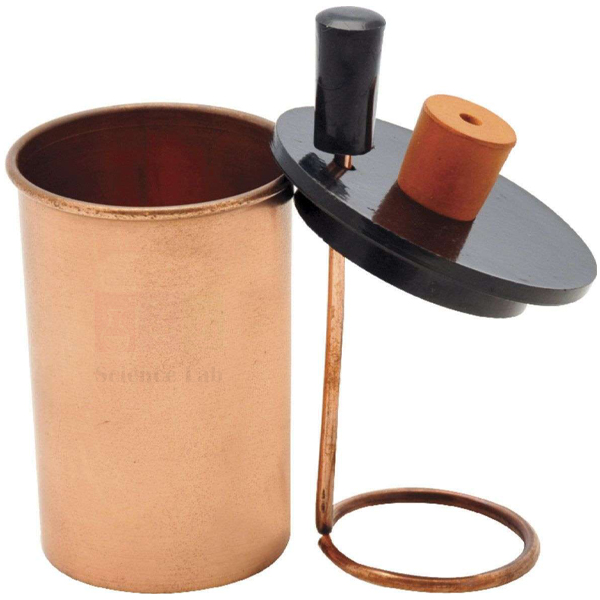
Calorimeter Set, Copper
Calorimeter Set, Copper (Product Code: SLE/PHY/30) is a lagged copper calorimeter with a built-in Constantan heating coil, used to determine the specific heat capacity of a liquid by the electrical method in physics laboratories. Its nickel-plated copper vessel sits inside an outer vessel, and a close-fitting ebonite lid carries a wire stirrer and 4 mm socket terminals. It is made by Jain Scientific Equipments Pvt Ltd (ScienceLab), an OEM manufacturer, at its own factory in Ambala, India, for heat practicals in India and abroad.
Specifications
| Parameter | Detail |
|---|---|
| Calorimeter | Nickel-plated copper, 75 x 50 mm (diameter) |
| Outer vessel | 100 x 75 mm (diameter); calorimeter lagged and enclosed within it |
| Lid | Close-fitting ebonite lid |
| Stirrer | Wire stirrer, provided with the lid |
| Terminals | Pair of 4 mm socket terminals |
| Heating coil | Constantan wire, approximately 6 Ω |
| Operating current | 0.5 A (maximum 1 A) |
| Application | Specific heat capacity of a liquid by the electrical method |
| Thermometer | Supplied without thermometer |
| Product code | SLE/PHY/30 |
| Manufacturer | Jain Scientific Equipments Pvt Ltd (ScienceLab) — OEM |
| Country of origin | India (made in Ambala, Haryana) |
What Is the Copper Calorimeter Set Used For?
This set answers a standard practical question: how much energy does it take to warm a given mass of liquid by one degree? Students pour a weighed amount of liquid into the copper vessel, connect the coil terminals to a supply through an ammeter, place a voltmeter across them and pass a steady current while stirring. From the voltage, current, time and temperature rise, and allowing for the heat taken by the copper vessel, they calculate the liquid's specific heat capacity.
Keep the current near the recommended 0.5 A and never above 1 A, make sure the coil is covered by liquid before switching on, and stir with the wire stirrer throughout. Because the calorimeter is lagged inside its outer vessel, heat loss stays modest, and this calorimeter lab equipment in India suits specific-heat experiments at school and college level.
What to Specify When Ordering
- Quantity of sets required for your laboratory.
- Thermometers, as the set is supplied without one.
- A DC supply, ammeter, voltmeter and 4 mm leads if you want the complete circuit quoted.
OEM Manufacturer
The Calorimeter Set, Copper is an original ScienceLab product: Jain Scientific Equipments Private Limited, which trades under the ScienceLab name, manufactures it as the OEM at its own licensed factory at Saha, Ambala, Haryana, India. Because there is no trader in between, questions about the coil, lid or terminals are answered by the manufacturer.
Schools, colleges, dealers and importers can place repeat orders with the same factory, and can ask us about replacement parts such as a lid or stirrer. Visit our company profile to learn more.
Related Physics Lab Equipment
Pair the copper calorimeter with these items to build the full electrical circuit and temperature measurement:
- Precision Variable Power Supply — sets the steady current through the Constantan coil.
- Digital Ammeter — confirms the current stays near 0.5 A.
- Digital Voltmeter — measures the voltage across the heating coil.
- Digital Thermometer — tracks the liquid's temperature rise.
- Calorimeter Set, Copper, Joules — another copper calorimeter set in the range.
Explore more in our Physics Lab Equipment category.
Frequently Asked Questions
What experiment is the Calorimeter Set, Copper designed for?
The Calorimeter Set, Copper is designed for determining the specific heat capacity of a liquid by the electrical method. The liquid is heated by the built-in Constantan coil while voltage, current, time and temperature rise are recorded.
What current should be used with the Calorimeter Set, Copper?
The Calorimeter Set, Copper should be used with a current of 0.5 A and a maximum of 1 A. Its Constantan heating coil has a resistance of approximately 6 ohms, so choose a supply that can hold the current steady.
Is a thermometer included with the Calorimeter Set, Copper?
No. The Calorimeter Set, Copper is supplied without a thermometer. Add a suitable thermometer for each set to your enquiry, and we will include it in the same quotation if required.
What are the dimensions of the Calorimeter Set, Copper?
The Calorimeter Set, Copper has a nickel-plated copper calorimeter of 75 x 50 mm (diameter), lagged and enclosed within an outer vessel of 100 x 75 mm (diameter), and closed by a close-fitting ebonite lid.
Who manufactures the Calorimeter Set, Copper?
The Calorimeter Set, Copper is manufactured by Jain Scientific Equipments Pvt Ltd (ScienceLab), the OEM, at its own licensed factory at Saha, Ambala, Haryana, India, and is supplied factory-direct to institutions, dealers and importers.
Is a calibration certificate available for the Calorimeter Set, Copper?
Documentation such as a calibration certificate for the Calorimeter Set, Copper should be discussed with us before you order. Please describe your requirement on the contact page and we will confirm what is possible.
Can the Calorimeter Set, Copper be ordered for export?
Yes, the Calorimeter Set, Copper can be ordered by institutions, dealers and importers in India and international markets. Share the quantity, any accessories needed and the destination so the manufacturer can prepare your quotation.
Request a Quote
Request a quotation for the Calorimeter Set, Copper through our contact page or by adding it to the enquiry cart. Quotations are issued directly by the manufacturer.
Last updated: 24 September 2026
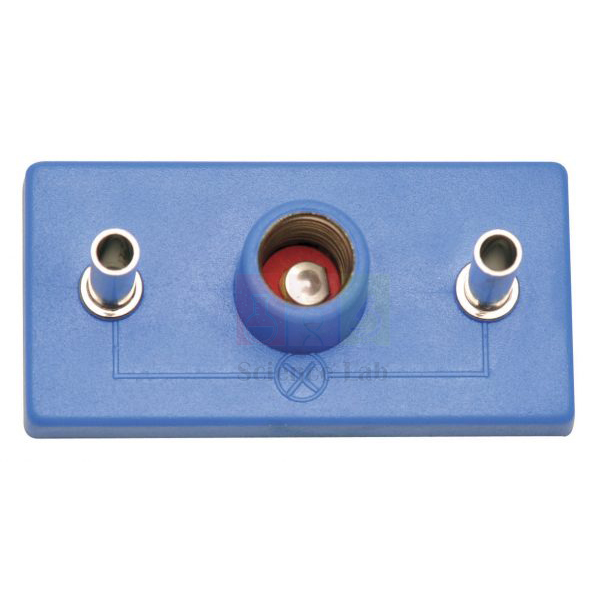
Circuits Kit Bulb Holder
Circuits Kit Bulb Holder (Product Code: SLE/PHY/31) is a panel-mounted lamp holder used as a spare component in a Circuits Kit for building simple electric circuits in school science and physics labs. Teachers order it to replace a lost or damaged holder, or to add extra lamps so students can compare brightness in series and parallel. It is made by Jain Scientific Equipments Pvt Ltd (ScienceLab), an OEM manufacturer, at its own factory in Ambala, India, as part of its electricity experiment kit range.
Key Details
| Parameter | Detail |
|---|---|
| Component | Bulb holder |
| Type | Spare component for the Circuits Kit |
| Mounting | Mounted on a sturdy panel |
| Design benefit | Panel mounting for ease of use and storage |
| Product code | SLE/PHY/31 |
| Manufacturer | Jain Scientific Equipments Pvt Ltd (ScienceLab) — OEM |
| Country of origin | India (made in Ambala, Haryana) |
What Is the Circuits Kit Bulb Holder Used For?
A bulb holder turns an invisible current into something pupils can see. Placed in a loop with a cell and a switch, the lamp lights only when the circuit is complete, which makes it the natural first component in lessons on open and closed circuits. Adding a second holder in series and then in parallel lets students compare brightness and discover how current and voltage are shared.
The lamp holder also works as a simple conductor tester: leave a gap in the circuit, bridge it with different materials, and the bulb shows which ones conduct. Because it sits on its own sturdy panel, it can be moved around the bench and packed away easily. Check that bulbs are screwed in firmly before switching on, and allow a lamp to cool before changing it.
What to Specify When Ordering
- The number of spare bulb holders needed for your kits.
- Whether bulbs are also required, and the lamp type your kits use.
- Any other Circuits Kit spares, such as switches or cell holders, to combine in one order.
OEM Manufacturer
Jain Scientific Equipments Private Limited, trading as ScienceLab, is the OEM that makes this bulb holder at its own licensed factory at Saha, Ambala, Haryana, India. Because the spare comes from the same manufacturer as the rest of its circuits range, schools and dealers can ask us to match it to the kits they already hold.
Replacement parts and repeat orders are handled by the factory rather than a middleman, and importers and institutions receive quotations direct. Learn more on our company profile.
Related Physics Lab Equipment
Components and kits that work alongside a spare bulb holder:
- Electricity Circuits Kit — a complete kit for building simple circuits; ask us which spares match yours.
- Circuits Kit Cell Holder — the power source that lights the lamp.
- Circuits Kit Push Switch — to switch the lamp on and off.
- MES Bulb Holder — a separate holder for labs that prefer loose components.
- Crocodile Clips & Leads — for joining components and testing materials.
See all items in Physics Lab Equipment.
Frequently Asked Questions
What is the Circuits Kit Bulb Holder?
The Circuits Kit Bulb Holder is a spare bulb holder for the Circuits Kit, mounted on a sturdy panel for ease of use and storage. It replaces a missing holder or adds another lamp position for series and parallel work.
Does the Circuits Kit Bulb Holder come with a bulb?
The Circuits Kit Bulb Holder listing describes the panel-mounted holder and does not state that a bulb is included. Mention the bulbs you need in your enquiry through the contact page and we will confirm them in the quotation.
Will the Circuits Kit Bulb Holder fit my existing circuits kit?
The Circuits Kit Bulb Holder is made as a spare for the Circuits Kit. If your kit came from another source, send us a photo or description of your panels and connectors, and we will advise whether this holder will match.
Who manufactures the Circuits Kit Bulb Holder?
The Circuits Kit Bulb Holder is manufactured by Jain Scientific Equipments Pvt Ltd (ScienceLab), the OEM, at its own licensed factory at Saha, Ambala, Haryana, India. Spares and repeat orders are quoted directly by the manufacturer.
What experiments use the Circuits Kit Bulb Holder?
The Circuits Kit Bulb Holder is used for complete and incomplete circuits, series and parallel brightness comparisons, and conductor-and-insulator tests, where the lamp lighting shows that current is flowing through the circuit.
Can the Circuits Kit Bulb Holder be ordered in bulk or for export?
Yes, the Circuits Kit Bulb Holder can be ordered in bulk for school kits, dealers and importers, and ScienceLab supplies India and international markets. State the quantity and destination to receive a quotation from the manufacturer.
Request a Quote
To order spare Circuits Kit Bulb Holders, contact us through the contact page or add them to the enquiry cart. You will receive a quotation direct from the manufacturer.
Last updated: 24 September 2026
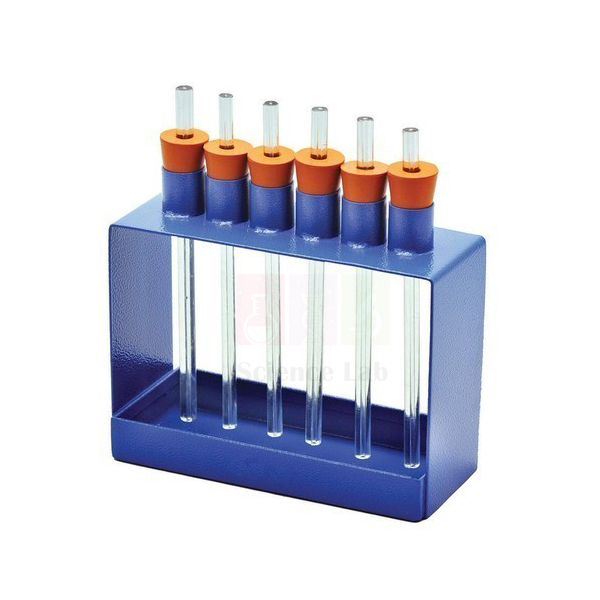
Capillary Tube Apparatus
Capillary Tube Apparatus (Product Code: SLE/PHY/32) is a demonstration apparatus used to show how the bore of a capillary tube affects the height to which water rises in it, in school and college physics laboratories. A metal frame holds six capillary tubes of different bores upright in a water trough, so the different column heights are visible at a glance. It is made by Jain Scientific Equipments Pvt Ltd (ScienceLab), an OEM manufacturer, at its own factory in Ambala, India, for capillary tube experiments in India and abroad.
Specifications
| Parameter | Detail |
|---|---|
| Capillary tubes | Six, each of a different bore |
| Length of capillary tubes | 150 mm |
| Frame | Metal frame holding the tubes vertically in a trough |
| Overall height of frame | 90 mm |
| Liquid | Trough filled with water |
| Demonstrates | Relationship between capillary pressure and the bore diameter of the tube |
| Product code | SLE/PHY/32 |
| Manufacturer | Jain Scientific Equipments Pvt Ltd (ScienceLab) — OEM |
| Country of origin | India (made in Ambala, Haryana) |
What Is the Capillary Tube Apparatus Used For?
The apparatus demonstrates capillarity, one of the most visible effects of surface tension. Once water is poured into the trough, it climbs each tube to a different height: the narrower the bore, the higher the column. Seeing all six columns side by side lets students link the rise directly to tube diameter and discuss why capillary pressure increases as the bore gets smaller.
For the clearest display, use clean tubes, since grease inside a tube reduces the rise, and add a drop of coloured ink to the water so the columns stand out from the back of the room. Rinse and dry the tubes after use. The unit makes a useful companion to surface tension apparatus in India when a lesson needs a quick qualitative demonstration before quantitative work.
OEM Manufacturer
ScienceLab is the trading name of Jain Scientific Equipments Private Limited, the OEM that manufactures this capillary tube apparatus at its own licensed factory at Saha, Ambala, Haryana, India. The company is a registered MSME enterprise (Udyam UDYAM-HR-01-0003714), and export consignments are shipped under Importer-Exporter Code AAECJ8618A issued by the DGFT.
Institutions, dealers and importers buy directly from the maker, so questions about replacement capillary tubes or additional units are answered by the factory itself; just ask us. Visit our company profile for more about ScienceLab.
Related Physics Lab Equipment
Items that support capillarity and fluid demonstrations:
- Capillary Tube Set — loose capillary tubes for further student investigations.
- Capillary Tube — single tubes for individual experiments.
- Microscope Travelling (Vernier) — for measuring column heights and bores in quantitative work.
- Bernoulli Tube Apparatus — another fluids demonstration for the same unit of study.
Browse the Physics Lab Equipment category for more properties-of-matter apparatus.
Frequently Asked Questions
How many tubes does the Capillary Tube Apparatus have?
The Capillary Tube Apparatus has six capillary tubes of different bores, held vertically in a trough by a metal frame. Each tube is 150 mm long, and the frame has an overall height of 90 mm.
What does the Capillary Tube Apparatus demonstrate?
The Capillary Tube Apparatus demonstrates the relationship between capillary pressure and the bore diameter of a capillary tube. When the trough is filled with water, the difference in height between the six water columns is immediately clear.
What liquid is used in the Capillary Tube Apparatus?
The Capillary Tube Apparatus is used with water poured into its trough. A little coloured ink can be added to make the columns easier to see, and the tubes should be rinsed and dried after each demonstration.
Who manufactures the Capillary Tube Apparatus?
The Capillary Tube Apparatus is manufactured by Jain Scientific Equipments Pvt Ltd (ScienceLab), the OEM, at its own licensed factory at Saha, Ambala, Haryana, India. Enquiries about replacement tubes and repeat orders are handled directly by the manufacturer.
Are the bore sizes of the Capillary Tube Apparatus specified?
The Capillary Tube Apparatus listing states that its six tubes have different bores but does not give individual diameters. If your experiment needs exact bore sizes, please ask us through the contact page before ordering.
Can the Capillary Tube Apparatus be supplied to dealers and importers?
Yes, the Capillary Tube Apparatus is supplied factory-direct to schools, colleges, dealers and importers in India and international markets. Include the quantity and destination in your enquiry so the manufacturer can prepare a quotation.
Request a Quote
For a quotation on the Capillary Tube Apparatus, write to us via the contact page or add it to the enquiry cart. Quotations are provided direct by the manufacturer, Jain Scientific Equipments Pvt Ltd (ScienceLab).
Last updated: 24 September 2026
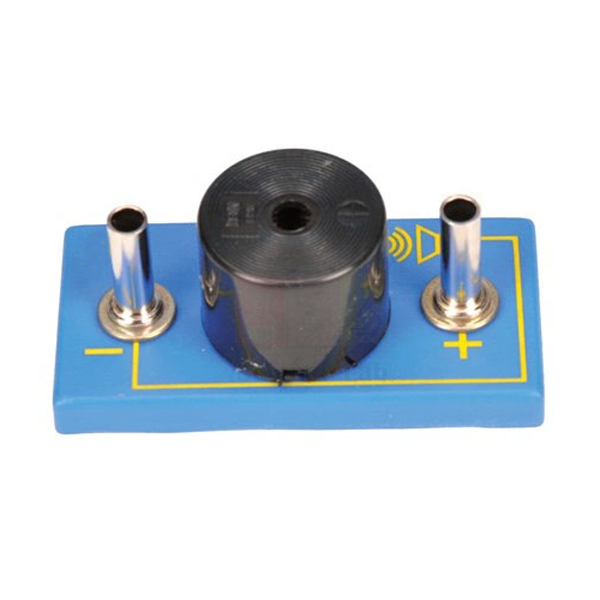
Circuits Kit Buzzer
Circuits Kit Buzzer (Product Code: SLE/PHY/33) is a panel-mounted buzzer offered as a spare component for the Circuits Kit, used to give an audible signal in simple electric circuits built in school science and physics labs. It lets pupils hear, rather than see, that a circuit is complete, and it helps with alarm and signalling projects. It is made by Jain Scientific Equipments Pvt Ltd (ScienceLab), an OEM manufacturer, at its own factory in Ambala, India, for electricity experiment kits in schools.
Key Details
| Parameter | Detail |
|---|---|
| Component | Buzzer |
| Role | Spare component for the Circuits Kit |
| Construction | Mounted on a sturdy panel |
| Practical benefit | Easy to use at the bench and easy to store |
| Product code | SLE/PHY/33 |
| Manufacturer | Jain Scientific Equipments Pvt Ltd (ScienceLab) — OEM |
| Country of origin | India (made in Ambala, Haryana) |
What Is the Circuits Kit Buzzer Used For?
The buzzer is the sound-producing output in a beginner's circuit. Connected with a cell and a switch, it sounds whenever current flows, which gives younger pupils a second way to recognise a complete circuit alongside a lamp. It is also the heart of classic design tasks such as a door alarm, a steady-hand game or a signalling circuit operated by a switch.
Some buzzers only work when connected the right way round, so if it stays silent, check the markings and reverse the connections before looking for other faults. Keep the panel dry, and store it flat with the other kit panels so the connections are not bent. As part of an electricity experiment kit for schools, it makes lessons on inputs, outputs and control more engaging.
OEM Manufacturer
This spare buzzer is manufactured by Jain Scientific Equipments Private Limited, which trades as ScienceLab, acting as the OEM at its own licensed factory at Saha, Ambala, Haryana, India. Ordering from the maker means spare panels for circuits kits can be matched and quoted without going through a trader.
Schools replacing worn components, and dealers or importers stocking spares, can ask us directly about quantities and repeat supplies. The company profile has more about ScienceLab.
Related Physics Lab Equipment
Pair the buzzer with these components to build working alarm and signalling circuits:
- Circuits Kit Push Switch — a switch to sound the buzzer on demand.
- Circuits Kit Cell Holder — supplies power to the circuit.
- Circuits Kit Bulb Holder — adds a visual output beside the sound.
- Simple Circuit Module Buzzer — a buzzer module from another circuit system.
- Electricity Circuits Kit — a complete kit for simple circuit work; ask us which spares suit it.
More components are listed under Physics Lab Equipment.
Frequently Asked Questions
What is the Circuits Kit Buzzer?
The Circuits Kit Buzzer is a spare buzzer component for the Circuits Kit. Like the other kit components it is mounted on a sturdy panel for ease of use and storage, and it gives an audible signal when current flows.
What voltage does the Circuits Kit Buzzer need?
The Circuits Kit Buzzer listing does not state an operating voltage. Please ask us through the contact page, mentioning the cells or supply your kits use, and we will confirm suitability before you order.
Why is my Circuits Kit Buzzer not sounding?
If the Circuits Kit Buzzer stays silent, first check that the circuit is complete and the cells are charged, then reverse the connections, because many buzzers only sound when current flows in one direction through them.
Who manufactures the Circuits Kit Buzzer?
The Circuits Kit Buzzer is manufactured by Jain Scientific Equipments Pvt Ltd (ScienceLab), the OEM, at its own licensed factory at Saha, Ambala, Haryana, India, and spare-part orders are handled by the manufacturer directly.
What projects can the Circuits Kit Buzzer be used for?
The Circuits Kit Buzzer suits door alarms, steady-hand games, signalling circuits and simple tests of whether a circuit is complete, giving pupils a sound output to compare with a lamp in introductory electricity lessons.
Can the Circuits Kit Buzzer be bought as a bulk spare?
Yes, the Circuits Kit Buzzer can be ordered in bulk by schools, dealers and importers, and ScienceLab supplies India and international markets. Give the quantity and delivery location in your enquiry to receive a quotation.
Request a Quote
Request a quote for the Circuits Kit Buzzer through our contact page or add it to the enquiry cart with other spares. Quotations come direct from the manufacturer.
Last updated: 24 September 2026
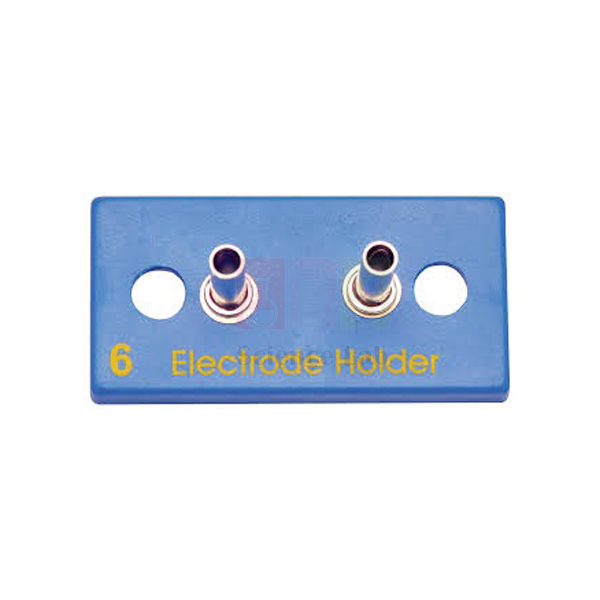
Circuits Kit Electrode Holder
Circuits Kit Electrode Holder (Product Code: SLE/PHY/34) is a panel-mounted electrode holder used as a spare component for the Circuits Kit, letting students bring a liquid into a simple circuit to test whether it conducts, in school science and physics labs. It suits lessons on conduction through solutions and introductory electrolysis. It is made by Jain Scientific Equipments Pvt Ltd (ScienceLab), an OEM manufacturer, at its own factory in Ambala, India, and fits into a wider range of school physics lab equipment.
Key Details
| Parameter | Detail |
|---|---|
| Component | Electrode holder |
| Kit | Spare component for the Circuits Kit |
| Mounting | Sturdy panel |
| Advantage | Easier handling during experiments and tidy storage |
| Product code | SLE/PHY/34 |
| Manufacturer | Jain Scientific Equipments Pvt Ltd (ScienceLab) — OEM |
| Country of origin | India (made in Ambala, Haryana) |
What Is the Circuits Kit Electrode Holder Used For?
The electrode holder extends circuit work from solid conductors to liquids. With electrodes held apart in a beaker of tap water, salt solution, sugar solution or dilute acid, and a lamp or buzzer in the same loop, students can see which liquids allow current to pass. The same arrangement introduces electrolysis, where gas bubbles or deposits form at the electrodes as the current flows.
Keep the electrodes from touching each other, rinse them with clean water between liquids so results are not contaminated, and dry the panel before it goes back into storage. Only use dilute solutions appropriate to the age group, with eye protection when acids or salts are involved.
OEM Manufacturer
Jain Scientific Equipments Private Limited, whose trading name is ScienceLab, manufactures this electrode holder as the OEM at its own licensed factory at Saha, Ambala, Haryana, India. Buying from the original manufacturer lets schools and distributors keep their circuits kits complete with spares from the same source.
Dealers, importers and institutions can ask us about matching spares and repeat orders, and quotations are issued by the manufacturer itself. Read about the company on our company profile.
Related Physics Lab Equipment
Useful additions for conduction-in-liquids and electrolysis lessons:
- Electrodes, Copper — electrodes for electrolysis work; confirm the fit with us.
- Electrode Rod Holders — an alternative style of holder for rod electrodes.
- Electrode Foil Holders — holders designed for foil electrodes.
- Circuits Kit Bulb Holder — a lamp that shows when the liquid conducts.
- Electricity Circuits Kit — a complete kit for simple circuits; ask us which spares match it.
Explore the Physics Lab Equipment category for more electricity apparatus.
Frequently Asked Questions
What is the Circuits Kit Electrode Holder used for?
The Circuits Kit Electrode Holder is used to hold electrodes in a liquid so that the liquid becomes part of a simple circuit. It supports lessons testing which solutions conduct electricity and introductory electrolysis demonstrations.
Are electrodes included with the Circuits Kit Electrode Holder?
The Circuits Kit Electrode Holder listing describes the panel-mounted holder and does not say that electrodes are included. Tell us which electrodes you need through the contact page and we will confirm them in the quotation.
How is the Circuits Kit Electrode Holder mounted?
The Circuits Kit Electrode Holder is mounted on a sturdy panel, like the other Circuits Kit components. The panel makes it easier to handle during experiments and allows it to be stored neatly with the rest of the kit.
Who manufactures the Circuits Kit Electrode Holder?
The Circuits Kit Electrode Holder is made by the OEM, Jain Scientific Equipments Pvt Ltd (ScienceLab), at its own licensed factory in Saha, Ambala, Haryana, India. Spares and repeat orders are handled directly by the manufacturer.
Is the Circuits Kit Electrode Holder safe for school use?
The Circuits Kit Electrode Holder is intended for supervised school practicals. Use low-voltage cells, dilute solutions suited to the age group and eye protection, and rinse the electrodes after each liquid so the holder stays clean for the next class.
Can the Circuits Kit Electrode Holder be ordered in bulk for export?
Yes, the Circuits Kit Electrode Holder can be ordered in bulk by schools, dealers and importers in India and international markets. Share the quantity and delivery location in your enquiry for a quotation from the manufacturer.
Request a Quote
To obtain a quote for the Circuits Kit Electrode Holder, reach us through the contact page or add it to the enquiry cart. The manufacturer will reply with a quotation directly.
Last updated: 24 September 2026
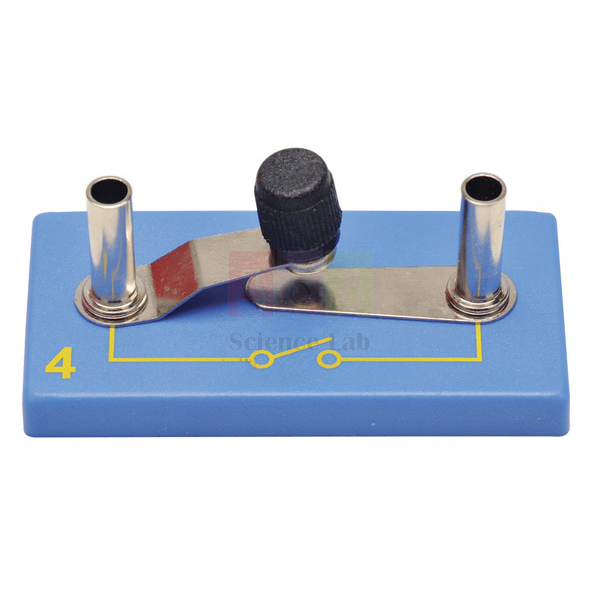
Circuits Kit Push Switch
Circuits Kit Push Switch (Product Code: SLE/PHY/35) is a panel-mounted push switch used as a spare component for the Circuits Kit to open and close simple electric circuits in school science and physics lessons. Pressing the switch gives students direct control over when a lamp, buzzer or motor receives current. It is made by Jain Scientific Equipments Pvt Ltd (ScienceLab), an OEM manufacturer, at its own factory in Ambala, India, as part of its physics lab equipment for schools in India and abroad.
Key Details
| Parameter | Detail |
|---|---|
| Component | Push switch |
| Role | Spare component for the Circuits Kit |
| Mounting | On a sturdy panel |
| Why a panel | Simple to use on the bench and to store after class |
| Product code | SLE/PHY/35 |
| Manufacturer | Jain Scientific Equipments Pvt Ltd (ScienceLab) — OEM |
| Country of origin | India (made in Ambala, Haryana) |
What Is the Circuits Kit Push Switch Used For?
A switch is how pupils learn that a circuit must be a complete loop. Wired between a cell and a lamp or buzzer, the push switch lets them make and break the circuit at will and see or hear the result immediately. It is also used to compare switch positions in series and parallel circuits, and to build simple control projects such as a doorbell.
Press the button squarely rather than at an angle, avoid leaving circuits connected between lessons so cells do not run down, and keep the panel with the rest of the kit so it is ready for the next class. To discuss different switch designs, set it beside a knife switch and compare how each one is operated.
OEM Manufacturer
ScienceLab, the trading name of Jain Scientific Equipments Private Limited, is the OEM for this push switch and manufactures it at its own licensed factory at Saha, Ambala, Haryana, India. Schools, colleges, dealers and importers order spares factory-direct instead of sourcing them through traders.
Replacement switches for existing kits and larger restocking orders are quoted by the manufacturer, so simply ask us for the quantity you need. Our company profile has more information.
Related Physics Lab Equipment
Other switches and components for circuit lessons:
- Contact Key (Push Switch) — a separate push key for bench circuits.
- Knife Switch – Single Pole, Single Throw — a switch that stays open or closed, for comparison.
- Circuits Kit Buzzer — pairs with the switch for a doorbell circuit.
- Circuits Kit Rheostat — adds variable control to the same circuit.
- Electricity Circuits Kit — a complete simple-circuits kit; ask us which spares match yours.
Visit the Physics Lab Equipment category for the full range.
Frequently Asked Questions
What is the Circuits Kit Push Switch?
The Circuits Kit Push Switch is a spare push switch for the Circuits Kit, mounted on a sturdy panel for ease of use and storage. It lets students open and close a simple circuit to control a lamp, buzzer or other output.
Is the Circuits Kit Push Switch momentary or latching?
The Circuits Kit Push Switch listing does not state whether the switch is momentary or latching. If your lesson depends on one type, please ask us through the contact page before ordering and we will confirm.
What lessons use the Circuits Kit Push Switch?
The Circuits Kit Push Switch is used in lessons on complete and broken circuits, switch placement in series and parallel circuits, and simple control projects such as a doorbell built with a buzzer and a cell.
Who manufactures the Circuits Kit Push Switch?
The OEM behind the Circuits Kit Push Switch is Jain Scientific Equipments Pvt Ltd (ScienceLab), which produces it at its own licensed factory at Saha, Ambala, Haryana, India. Spare-part enquiries and repeat orders are answered by the manufacturer.
Will the Circuits Kit Push Switch fit kits from other suppliers?
The Circuits Kit Push Switch is designed as a Circuits Kit spare. For kits from other sources, send us details or a photo of your existing panels and connections, and we will tell you whether it will match.
Can the Circuits Kit Push Switch be ordered in quantity?
Yes, the Circuits Kit Push Switch can be ordered in quantity by schools, dealers and importers, and ScienceLab supplies India and international markets. Include the quantity and destination in your enquiry to get a quotation.
Request a Quote
Ask for a quotation on the Circuits Kit Push Switch via our contact page or add it to the enquiry cart. Quotes are sent directly by the manufacturer.
Last updated: 24 September 2026
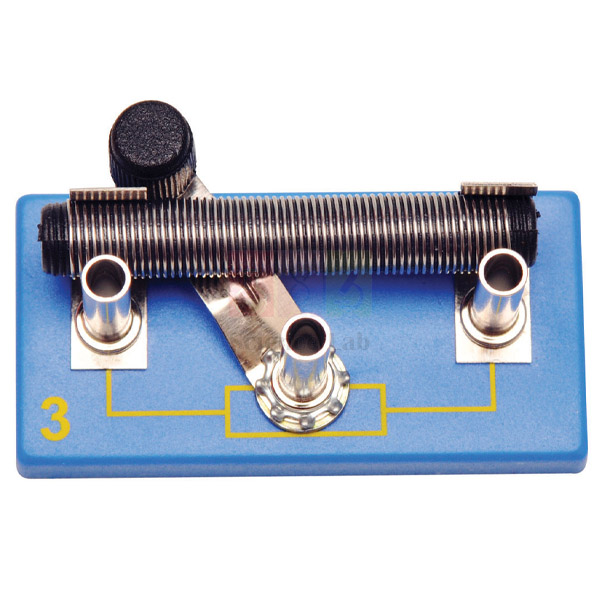
Circuits Kit Rheostat
Circuits Kit Rheostat (Product Code: SLE/PHY/36) is a panel-mounted variable resistor used as a spare component for the Circuits Kit to adjust the current in simple circuits in school science and physics labs. Adjusting the rheostat dims or brightens a lamp and changes meter readings, so pupils see resistance at work. It is made by Jain Scientific Equipments Pvt Ltd (ScienceLab), an OEM manufacturer, at its own factory in Ambala, India, as a panel rheostat for school labs in India and overseas.
Key Details
| Parameter | Detail |
|---|---|
| Component | Rheostat (variable resistor) |
| Category | Spare component for the Circuits Kit |
| Mounting | Mounted on a sturdy panel |
| Benefit | Ease of use and storage |
| Product code | SLE/PHY/36 |
| Manufacturer | Jain Scientific Equipments Pvt Ltd (ScienceLab) — OEM |
| Country of origin | India (made in Ambala, Haryana) |
What Is the Circuits Kit Rheostat Used For?
The rheostat is the component that shows resistance can be varied. In series with a cell and a lamp, adjusting it makes the lamp brighter or dimmer, which gives pupils an intuitive feel for how resistance limits current. With an ammeter and voltmeter added, the same set-up supports Ohm's law investigations, where the rheostat provides a range of current readings for a table and graph.
Start with the rheostat set to high resistance before switching on, then reduce it gradually so lamps and meters are not overloaded. Switch off between readings to stop the circuit warming up, and return the panel to kit storage after class. It is a practical introduction before students move on to larger bench rheostats in later years.
What to Specify When Ordering
- The number of spare rheostats needed for your circuits kits.
- The resistance range your lessons require, so we can confirm suitability.
- Any matching bulb holders, switches or meters to include in the quotation.
OEM Manufacturer
Jain Scientific Equipments Private Limited trades as ScienceLab and is the OEM for this circuits kit rheostat, which it manufactures at its own licensed factory at Saha, Ambala, Haryana, India. Schools, dealers and importers order it straight from the manufacturer, which also handles enquiries about replacement parts. For tender and vendor paperwork, the company's GSTIN is 06AAECJ8618A1ZT and its Legal Entity Identifier (LEI) is 3358004HRD1JIVXKYX49.
Ask us for repeat orders or for help matching this spare to your existing kits. More detail is on our company profile.
Related Physics Lab Equipment
Components and meters that complete a variable-resistance circuit:
- Circuits Kit Bulb Holder — a lamp to show the dimming effect.
- Circuits Kit Cell Holder — powers the circuit.
- Standard Digital Multimeter — measures current and voltage for Ohm's law work.
- Rheostat — a separate bench rheostat for more advanced circuits.
- Electricity Circuits Kit — a complete kit for simple circuits; ask us which spares match yours.
Find more in our Physics Lab Equipment category.
Frequently Asked Questions
What is the Circuits Kit Rheostat?
The Circuits Kit Rheostat is a spare variable resistor for the Circuits Kit, mounted on a sturdy panel for ease of use and storage. It lets students change the current in a simple circuit and observe the effect on lamps and meters.
What is the resistance value of the Circuits Kit Rheostat?
The Circuits Kit Rheostat listing does not state its resistance range or current rating. Please ask us through the contact page, describing the circuits you plan to build, and we will confirm the details before you order.
Which experiments use the Circuits Kit Rheostat?
The Circuits Kit Rheostat is used for dimming a lamp, showing how resistance controls current, and collecting a range of current and voltage readings in Ohm's law investigations with an ammeter and voltmeter.
Who manufactures the Circuits Kit Rheostat?
The Circuits Kit Rheostat comes from Jain Scientific Equipments Pvt Ltd (ScienceLab), which manufactures it as the OEM at its own licensed factory at Saha, Ambala, Haryana, India. Quotations, spares and repeat orders come directly from the manufacturer.
How should the Circuits Kit Rheostat be used safely?
Set the Circuits Kit Rheostat to high resistance before switching on, reduce it gradually while watching the lamp or meter, and switch off between readings so the circuit does not overheat during a long practical session.
Can the Circuits Kit Rheostat be ordered for dealers or export?
Yes, the Circuits Kit Rheostat can be ordered by dealers, importers and institutions in India and international markets. Give the quantity and destination in your enquiry and the manufacturer will prepare a quotation.
Request a Quote
For a quotation on the Circuits Kit Rheostat, contact us via the contact page or add it to the enquiry cart. The quote comes direct from the manufacturer, Jain Scientific Equipments Pvt Ltd (ScienceLab).
Last updated: 24 September 2026
257.jpg)
Compass Plotting (Clear)
Compass Plotting (Clear) (Product Code: SLE/PHY/37) is a plotting compass used to show magnetic field direction and trace the field around a bar magnet in school physics labs. Each 20 mm aluminium case has a clear plastic top and bottom, and the 10 mm steel needle, marked red at its north end, turns on a brass bearing. It is made by Jain Scientific Equipments Pvt Ltd (ScienceLab), an OEM manufacturer, at its own factory in Ambala, India, and is packed in 12s for magnetism practicals.
Specifications
| Parameter | Detail |
|---|---|
| Function | Indicates the direction of a magnetic field |
| Case | Aluminium, 20 mm diameter |
| Top and bottom | Clear plastic |
| Needle | Steel, 10 mm, north end marked in red |
| Bearing | Brass |
| Typical use | Tracing the field of a bar magnet |
| Pack size | Packs of 12 |
| Product code | SLE/PHY/37 |
| Manufacturer | Jain Scientific Equipments Pvt Ltd (ScienceLab) — OEM |
| Country of origin | India (made in Ambala, Haryana) |
What Is the Plotting Compass Used For?
Plotting compasses let students draw magnetic field lines for themselves. A bar magnet is laid on a sheet of paper, a compass is placed near one pole, and a dot is marked at each end of the needle; the compass is then moved so its tail sits on the last dot, and the process repeats until a line curves round to the other pole. Several lines drawn this way reveal the full field pattern, including neutral points when two magnets are used.
With a whole pack on the bench, a group can also set a ring of compasses around a magnet or a current-carrying wire and see the field direction at a glance. Keep compasses well away from strong magnets when stored, since this can weaken or reverse the needle, and check against the Earth's field that the red end points north before each lesson. They suit any bar magnet practical in Indian schools.
What to Specify When Ordering
- Number of packs; each pack contains 12 compasses.
- Whether you also need bar magnets for the same practical.
- Delivery location, for school, dealer or export supply.
OEM Manufacturer
Jain Scientific Equipments Private Limited, trading as ScienceLab, is the OEM that manufactures these clear plotting compasses at its own licensed factory at Saha, Ambala, Haryana, India. Schools, colleges, dealers and importers are supplied factory-direct, so pack quantities for whole classes are quoted by the maker itself.
Repeat orders to replace lost or damaged compasses are handled by the same manufacturer; simply ask us. You can read more about the company on our company profile.
Related Physics Lab Equipment
Items used with plotting compasses in magnetism lessons:
- Bar Magnet (Plastic) — the magnet whose field students plot.
- Plotting Compass, Single Glass Face — an alternative plotting compass design.
- Magnetic Compass Small Size — for finding north and general direction work.
- Oersted's Law Apparatus — shows the field around a current, detected with a compass.
Browse more apparatus in Physics Lab Equipment.
Frequently Asked Questions
How many compasses are in a pack of Compass Plotting (Clear)?
Compass Plotting (Clear) is supplied in packs of 12, which is enough for several student pairs or for one group to surround a magnet with compasses and see the whole field direction at once.
What size is the Compass Plotting (Clear)?
Each Compass Plotting (Clear) has a 20 mm diameter aluminium case with a clear plastic top and bottom. Inside, a 10 mm steel needle with its north end marked in red is mounted on a brass bearing.
What is the Compass Plotting (Clear) used for?
The Compass Plotting (Clear) indicates the direction of a magnetic field and is used for tracing the field of a bar magnet. Students mark the needle direction at successive points and join the marks to draw field lines.
Who manufactures the Compass Plotting (Clear)?
Compass Plotting (Clear) is manufactured by Jain Scientific Equipments Pvt Ltd (ScienceLab) as the OEM at its own licensed factory in Saha, Ambala, Haryana, India, and is sold factory-direct to institutions, dealers and importers.
How should the Compass Plotting (Clear) be stored?
Store Compass Plotting (Clear) away from strong magnets, which can weaken or reverse the needle, and keep steel objects clear while plotting. Before a lesson, check that the red-marked end points north when no magnet is nearby.
Can Compass Plotting (Clear) be ordered in bulk or for export?
Yes, Compass Plotting (Clear) can be ordered in multiple packs of 12 by schools, dealers and importers, and ScienceLab supplies India and international markets. Share the number of packs and the destination to receive a quotation.
Request a Quote
To request a quote for Compass Plotting (Clear), use our contact page or add it to the enquiry cart. Your quotation will be prepared by the manufacturer, Jain Scientific Equipments Pvt Ltd (ScienceLab), itself.
Last updated: 24 September 2026
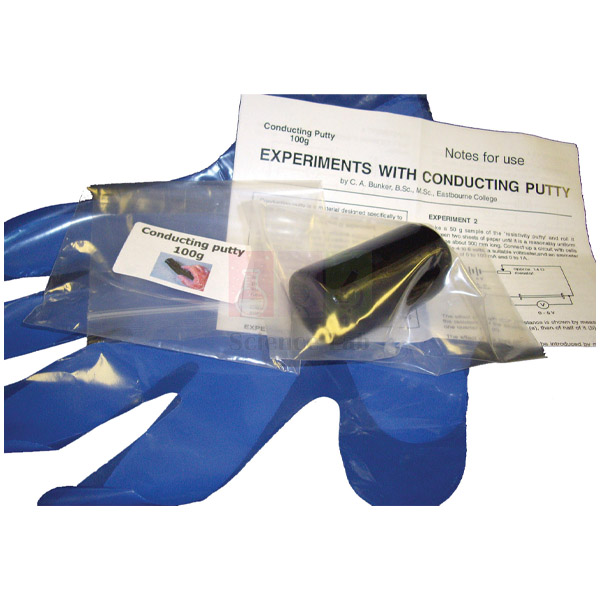
Conductive Putty
Conductive Putty (Product Code: SLE/PHY/38) is a mouldable conducting material used to teach resistivity and how the length and cross-sectional area of a conductor affect its resistance, in school and college physics labs. It comes as roughly 100 g of putty formed into a 60 mm long, 20 mm diameter cylinder of approximately 20 Ω that can be re-moulded to new shapes. It is supplied by Jain Scientific Equipments Pvt Ltd (ScienceLab), Ambala, India, as a hands-on addition to an Ohm's law experiment kit.
Specifications
| Parameter | Detail |
|---|---|
| Quantity | Approx. 100 g |
| Form supplied | Cylinder, 60 mm long and 20 mm in diameter |
| Resistance of cylinder | Approximately 20 Ω |
| Connection | Can readily be connected into an electrical circuit |
| Adjustability | Length and diameter changed by re-moulding the putty |
| Teaching use | Resistivity; effect of length and cross-sectional area on resistance |
| Product code | SLE/PHY/38 |
| Supplied by | Jain Scientific Equipments Pvt Ltd (ScienceLab), Ambala, India |
What Is Conductive Putty Used For?
Conductive putty turns the resistivity equation into something students can shape with their hands. Starting from the supplied cylinder, they measure its resistance, then roll it longer and thinner and measure again, or keep the length fixed and change the diameter. Plotting resistance against length, and against the inverse of cross-sectional area, shows the two relationships clearly and lets them estimate the material's resistivity.
For consistent readings, press the connecting probes or plates into the ends of the putty to the same depth each time, measure length and diameter carefully after every re-moulding, and keep the current small so the putty does not warm up. Work on a clean surface so dust and fibres are not folded into the material, and store it covered between lessons.
Supplier
Conductive Putty is supplied by Jain Scientific Equipments Private Limited, which trades as ScienceLab, from Ambala, Haryana, India. The company sources it for schools, colleges, dealers and importers and can include it in the same quotation as meters, leads and other resistance apparatus.
For details of pack quantities or combined orders, ask us, and see our company profile for more about ScienceLab.
Related Physics Lab Equipment
Tools and materials for a resistivity investigation with conductive putty:
- Standard Digital Multimeter — measures the putty's resistance after each change of shape.
- Caliper Vernier (Metal) — measures the diameter and length of the re-moulded putty.
- Crocodile Clips & Leads — connect the putty into the circuit.
- Conductive Paper — another conducting material for field and resistance work.
More items are in the Physics Lab Equipment category.
Frequently Asked Questions
How much Conductive Putty is supplied?
Conductive Putty is supplied as approximately 100 g, in the form of a cylinder 60 mm long and 20 mm in diameter. That starting shape has a resistance of approximately 20 ohms before students re-mould it.
What does Conductive Putty teach?
Conductive Putty is a teaching aid for resistivity and for the relationship between a conductor's length, its cross-sectional area and its resistance, because students can change both dimensions simply by re-moulding the putty and measuring again.
How is Conductive Putty connected into a circuit?
Conductive Putty can readily be connected into an electrical circuit by pressing leads, probes or contact plates into its ends. Keep the contact depth the same for each reading so that changes in resistance come from the shape, not the connections.
Who supplies Conductive Putty?
Conductive Putty is supplied by Jain Scientific Equipments Pvt Ltd (ScienceLab), Ambala, Haryana, India, to schools, colleges, dealers and importers, and can be quoted together with meters and leads for a complete resistivity practical.
How should Conductive Putty be stored?
Store Conductive Putty covered or in a closed container, away from heat and dust, so it stays clean and workable between lessons. For questions about keeping it for longer periods, please ask us through the contact page.
Can Conductive Putty be ordered in bulk or for export?
Yes, Conductive Putty can be ordered in class quantities by schools, dealers and importers, and ScienceLab supplies India and international markets. State the quantity and delivery location in your enquiry to receive a quotation.
Request a Quote
Request a quote for Conductive Putty through our contact page, or add it to the enquiry cart along with meters and leads for the same practical.
Last updated: 24 September 2026
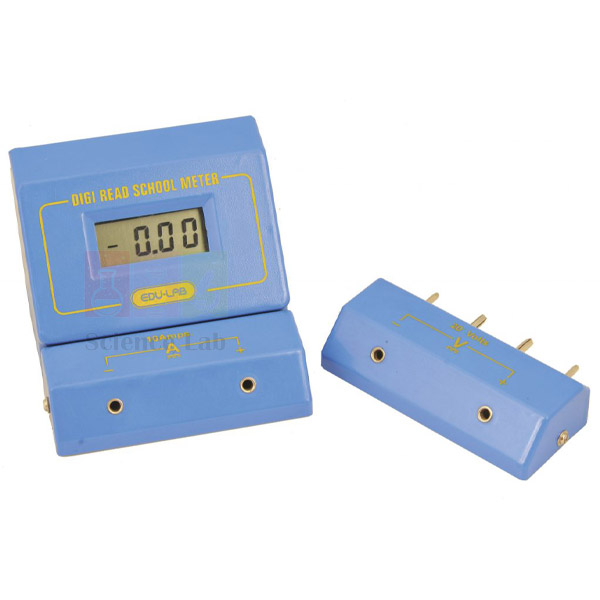
Digital Voltmeter/Ammeter With Shunts
Digital Voltmeter/Ammeter With Shunts (Product Code: SLE/PHY/39) is a battery-powered digital meter used to measure DC current or DC voltage in physics laboratory circuits, including experiments with Teltron Helmholtz coils. Two included attachments, 0-10 DC amps and 0-20 DC volts, let one unit act as an ammeter or a voltmeter, with 0.01 resolution and ± 2% accuracy. It is supplied by Jain Scientific Equipments Pvt Ltd (ScienceLab), Ambala, India, for colleges and schools in India and abroad.
Specifications
| Parameter | Detail |
|---|---|
| Type | Digital meter with shunts |
| Attachments included | Two: 0-10 A DC and 0-20 V DC |
| Modes | Ammeter or voltmeter, depending on the attachment fitted |
| Input impedance (basic unit) | 100 kΩ |
| Resolution | 0.01 |
| Accuracy | ± 2% |
| Power | PP3 battery, supplied; useful life of over 1000 hours |
| Suited to | Use with Teltron Helmholtz coils |
| Product code | SLE/PHY/39 |
| Supplied by | Jain Scientific Equipments Pvt Ltd (ScienceLab), Ambala, India |
What Is the Digital Voltmeter/Ammeter Used For?
The meter gives a clear digital reading of current or voltage in DC circuits without needing two separate instruments. In Helmholtz coil experiments it is typically used to monitor the coil current that sets the magnetic field, while in general electricity practicals it can be switched between roles by changing the attachment, reading currents up to 10 A or voltages up to 20 V.
Fit the current attachment and connect the meter in series when measuring amps; fit the voltage attachment and connect it across the component when measuring volts. Stay within the attachment's range, switch the meter off when not in use to make the most of the PP3 battery, and replace the battery when it runs low. It is a practical option among digital measuring instruments in India for teaching labs.
What to Specify When Ordering
- Number of meters required; each includes the 0-10 A DC and 0-20 V DC attachments.
- Whether the meters are for Helmholtz coil experiments or general DC circuit work.
- Any Helmholtz coils, leads or power supplies you want quoted together.
Supplier
Jain Scientific Equipments Private Limited, trading as ScienceLab, supplies this digital voltmeter/ammeter from Ambala, Haryana, India. The company sources electrical measuring instruments for colleges, schools, dealers and importers, and can quote the meter with coils and accessories so a complete experiment is covered in one order.
For availability of replacement attachments or larger quantities, ask us. More about ScienceLab is on our company profile.
Related Physics Lab Equipment
Items commonly used with this meter:
- Teltron Helmholtz Pair of Coils S — coils whose current this meter can monitor.
- Teltron Helmholtz Pair of Coils D — another Teltron Helmholtz coil pair in the range.
- Standard Digital Multimeter — a multi-function meter for resistance and other ranges.
- Crocodile Clips & Leads — connect the meter into the circuit.
Explore further instruments in Physics Lab Equipment.
Frequently Asked Questions
What ranges does the Digital Voltmeter/Ammeter With Shunts cover?
The Digital Voltmeter/Ammeter With Shunts comes with two attachments, 0-10 DC amps and 0-20 DC volts, so it can be used either as an ammeter or as a voltmeter. The resolution is 0.01 and the accuracy is ± 2%.
What is the input impedance of the Digital Voltmeter/Ammeter With Shunts?
The basic unit of the Digital Voltmeter/Ammeter With Shunts has an input impedance of 100 kohm. For other electrical details not given here, please ask us through the contact page before ordering.
What battery does the Digital Voltmeter/Ammeter With Shunts use?
The Digital Voltmeter/Ammeter With Shunts is supplied with a PP3 battery, which gives a useful life of over 1000 hours. Switching the meter off between readings helps the battery last through many practical sessions.
Can the Digital Voltmeter/Ammeter With Shunts be used with Helmholtz coils?
Yes. The Digital Voltmeter/Ammeter With Shunts is described as suited to use with Teltron Helmholtz coils, where it is commonly used to read the coil current. Confirm your coil model with us if you are unsure.
Who supplies the Digital Voltmeter/Ammeter With Shunts?
The Digital Voltmeter/Ammeter With Shunts is supplied by Jain Scientific Equipments Pvt Ltd (ScienceLab), Ambala, Haryana, India, to colleges, schools, dealers and importers, and can be quoted with coils, leads and other accessories.
Is a calibration certificate available for the Digital Voltmeter/Ammeter With Shunts?
Calibration documentation for the Digital Voltmeter/Ammeter With Shunts should be discussed with us before ordering. Please describe your requirement on the contact page and we will confirm what can be provided.
Can the Digital Voltmeter/Ammeter With Shunts be ordered for export?
Yes, the Digital Voltmeter/Ammeter With Shunts can be ordered by institutions, dealers and importers, and ScienceLab supplies India and international markets. Include the quantity and destination in your enquiry for a quotation.
Request a Quote
To request a quote for the Digital Voltmeter/Ammeter With Shunts, contact us through the contact page or add it to the enquiry cart.
Last updated: 24 September 2026
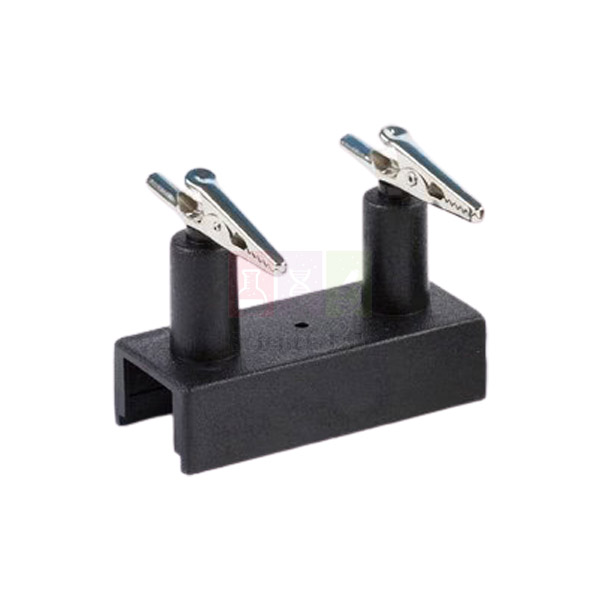
Component Holder
Component Holder (Product Code: SLE/PHY/40) is a pack of mounted clips used to hold components steady during physics investigations in school and college laboratories. Each pack contains 8 mounted clips, so one bench group can keep several parts of a set-up in position at once — a simple but useful item of physics lab equipment for schools in India. It is made by Jain Scientific Equipments Pvt Ltd (ScienceLab), an OEM manufacturer, at its own factory in Ambala, India.
Key Details
| Parameter | Detail |
|---|---|
| Product type | Mounted clips for holding components |
| Pack quantity | 8 mounted clips per pack |
| Application | Physics investigations; usable across a variety of experiments |
| Product code | SLE/PHY/40 |
| Manufacturer | Jain Scientific Equipments Pvt Ltd (ScienceLab) — OEM |
| Country of origin | India (made in Ambala, Haryana) |
What Is the Component Holder Used For?
Students use the Component Holder to grip a small part so it stays exactly where it is needed while the rest of the experiment is connected, observed or measured. In bench circuit work, for example, a held component no longer slides about when leads are clipped on, so meter readings stay steady and the layout on the bench matches the circuit diagram.
Because the clips are mounted rather than loose, they stand on the bench and can be arranged in a line or grid for series and parallel investigations, which makes them a handy addition to any electricity experiment kit at school level. A practical tip: give each group one pack of 8 and return the holders to a labelled tray after the lesson so the clips are not bent by heavier apparatus in storage.
OEM Manufacturer
ScienceLab is the trading name of Jain Scientific Equipments Private Limited, the OEM (original equipment manufacturer) of the Component Holder. The holders are made at the company's own licensed factory at Saha, Ambala, Haryana, India, and supplied factory-direct to schools, colleges, institutions, dealers and importers instead of passing through a trader.
The company is incorporated under CIN U29309HR2020PTC087597, and its production site at 449, HSIIDC Industrial Area, Saha, Ambala operates under Factory Licence AMB-ONLINE-CHD-J-414. For repeat packs or replacement holders, ask us directly — you deal with the manufacturer itself. Read more on our company profile.
Related Physics Lab Equipment
These items are often used alongside the Component Holder when students build and test circuits on the bench:
- Crocodile Clips & Leads — leads with a crocodile clip at each end for joining the parts you have clamped.
- Circuits Kit Cell Holder — panel-mounted cell holder to power the circuit.
- Circuits Kit Bulb Holder — adds a lamp to show current flow in the same circuit.
- Circuits Kit Rheostat — varies the current through the held components.
- Worcester Circuit Board — a board-based alternative for series and parallel circuit work.
Browse the full range of Physics Lab Equipment.
Frequently Asked Questions
What is included in one Component Holder pack?
One Component Holder pack (SLE/PHY/40) contains 8 mounted clips for holding components in physics investigations. Leads, cells, bulbs and other circuit parts are not part of the pack and can be quoted separately if you list them in your enquiry.
Which experiments is the Component Holder suitable for?
The Component Holder suits a variety of physics investigations in which a small part must stay steady, especially bench circuit work where components need to remain in place while students connect leads and take meter readings.
Who manufactures the Component Holder?
The Component Holder is manufactured by Jain Scientific Equipments Pvt Ltd (ScienceLab) as the OEM, at its own licensed factory at Saha, Ambala, Haryana, India. Quotations, repeat orders and replacement packs are handled directly by the manufacturer.
How many Component Holder packs does a class need?
Each Component Holder pack gives 8 mounted clips, so many schools order one pack per bench group plus a spare for the preparation room. Tell us how many groups work in your laboratory and we will quote the matching quantity.
Is a calibration certificate available for the Component Holder?
The Component Holder is a mechanical holding accessory with no measuring function, so calibration does not normally apply to it. If your purchase file needs a particular document, please discuss it with us through the contact page before you order.
Can the Component Holder be supplied in bulk or for export?
Yes, the Component Holder can be supplied in bulk to schools, colleges, dealers and importers in India and international markets. Share the number of packs and the delivery destination, and the manufacturer will send a quotation.
Request a Quote
To order the Component Holder, send your quantity through the contact page or add it to the enquiry cart. Quotes come direct from the manufacturer, with no trader between your laboratory and the factory.
Last updated: 24 September 2026

Protactinium Generator
Protactinium Generator (Product Code: SLE/PHY/41) is a sealed, leak-proof container of material from the uranium-238 decay series used to observe radioactive decay and measure a half-life in school and college physics laboratories. Teachers choose it because the protactinium-234 it yields has a half-life of about 70 seconds, so a complete decay curve can be recorded within one practical — a staple of nuclear physics lab equipment. It is supplied by Jain Scientific Equipments Pvt Ltd (ScienceLab), Ambala, India.
Specifications
| Parameter | Detail |
|---|---|
| Isotope studied | Protactinium-234, a product of the uranium-238 decay series |
| Half-life of protactinium-234 | About 70 seconds |
| Container | Sealed container with leak-proof closure |
| Main use | Observation of radioactive decay and half-life measurement |
| Product code | SLE/PHY/41 |
| Supplied by | Jain Scientific Equipments Pvt Ltd (ScienceLab), Ambala, India |
What Is the Protactinium Generator Used For?
The Protactinium Generator is used for the classic half-life practical, in which the count rate from protactinium-234 is recorded at regular intervals and plotted against time. With a half-life of about 70 seconds, the count rate falls clearly within a few minutes, so students can read the half-life straight from their decay graph or from a log plot of count rate.
In a typical radiation experiment, a Geiger–Müller tube connected to a counter is placed close to the container, a background count is taken first, and counts are then recorded over short fixed intervals with the background subtracted. Keep the container closed at all times, handle it for the shortest time needed, and return it to a labelled, locked radioactive-materials store after the lesson.
Supplier
Jain Scientific Equipments Private Limited, which trades as ScienceLab, supplies the Protactinium Generator to schools, colleges and institutions from Ambala, Haryana, India. The company sources this item for buyers and can combine it with detectors and counters from its physics range in one quotation. More about the company is on our profile page.
Related Physics Lab Equipment
A half-life practical with the Protactinium Generator needs a detector and a counter; these items complete the set-up:
- Geiger Muller Tube Holder — houses the GM tube socket and links the detector to the counter.
- Scaler Timer — counts pulses manually or over timed intervals for the decay curve.
- Geiger Counter — hand-held survey meter for checking background and the source store.
- Apparatus for studying the value of the half-decay period during radioactive decay — an alternative half-life experiment.
See more in our Physics Lab Equipment range.
Frequently Asked Questions
What half-life is measured with the Protactinium Generator?
The Protactinium Generator is used to measure the half-life of protactinium-234, which is about 70 seconds. This short half-life lets students record the fall in count rate and determine the half-life within a single practical session.
How is the Protactinium Generator packed?
The Protactinium Generator comes in a sealed container with a leak-proof closure. The container should stay closed during use and storage, and it should be kept in a labelled, secure radioactive-materials store whenever it is not in use.
What else do I need to use the Protactinium Generator?
To take readings with the Protactinium Generator you need a Geiger–Müller tube in a holder, connected to a counter such as a scaler timer, plus timed counting or a clock. These items are sold separately and can be added to the same quotation.
Is an authorisation needed to buy the Protactinium Generator?
Possibly. The Protactinium Generator contains material from the uranium-238 decay series, and radioactive materials are regulated in most countries. Before ordering, confirm with your national radiation-safety authority what your institution needs, and tell us the destination so we can discuss documents and shipping.
Who supplies the Protactinium Generator?
The Protactinium Generator is supplied by Jain Scientific Equipments Pvt Ltd (ScienceLab), Ambala, Haryana, India, to schools, colleges and institutions in India and international markets. Contact us with your quantity and destination for a quotation.
What should a Protactinium Generator quotation request include?
For a Protactinium Generator quotation, state the quantity, the delivery destination, whether you also need a GM tube holder and scaler timer, and any documents your purchase file requires. Send these through the contact page or the enquiry cart.
Request a Quote
Send your Protactinium Generator requirement through our contact page, or add it and the counting equipment to the enquiry cart, and we will reply with a quotation.
Last updated: 24 September 2026
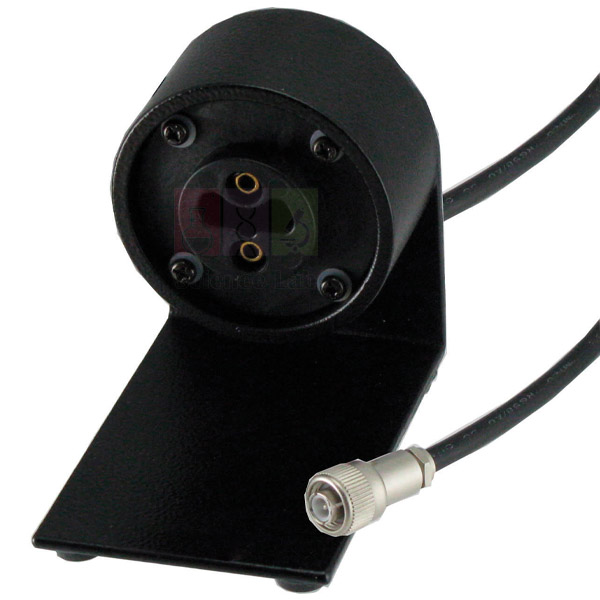
Geiger Muller Tube Holder
Geiger Muller Tube Holder (Product Code: SLE/PHY/42) is an aluminium box housing a G.M. tube socket, used to mount a Geiger–Müller tube and connect it to a counter for radioactivity measurements in physics laboratories. Designed for use with the Scaler Timer, it connects through a 1 m co-axial lead ending in a standard P.E.T. connector and has a stabilising resistor already wired inside. It is supplied by Jain Scientific Equipments Pvt Ltd (ScienceLab), Ambala, India.
Specifications
| Parameter | Detail |
|---|---|
| Housing | Aluminium box containing the G.M. tube socket |
| Connecting lead | 1 m long co-axial lead |
| Connector | Standard P.E.T. connector |
| Anode resistor | 2.2 megohm stabilising resistor, wired internally in series with the anode connection |
| For use with | Scaler Timer |
| Product code | SLE/PHY/42 |
| Supplied by | Jain Scientific Equipments Pvt Ltd (ScienceLab), Ambala, India |
What Is the GM Tube Holder Used For?
The Geiger Muller Tube Holder turns a bare GM tube into a bench-ready detector. The tube plugs into the socket inside the aluminium box, and the co-axial lead links it to the counter, so students can place the detector at a measured distance from a source and record counts. Common practicals include background counts, count rate against distance, absorption by paper or metal sheets, and half-life measurement.
Because the 2.2 megohm stabilising resistor sits inside the box in series with the anode, there is no loose resistor to wire on the bench, which keeps a Geiger Muller tube set-up in an Indian school or college lab tidy and repeatable. Before counting, set the tube voltage on the counter to suit your GM tube, and keep the delicate tube window away from fingers and sharp objects.
What to Specify When Ordering
- Number of detector stations, i.e. how many Geiger Muller Tube Holders you need.
- Whether you also need the Scaler Timer the holder is designed to work with.
- Whether you need a GM tube, as a tube is not listed as part of the holder.
Supplier
ScienceLab, the trading name of Jain Scientific Equipments Private Limited, supplies the Geiger Muller Tube Holder along with counting instruments and radioactivity accessories for physics laboratories. Buyers get one point of contact for the holder, the counter and related items, quoted together on request. Company details are on our profile page.
Related Physics Lab Equipment
Pair the Geiger Muller Tube Holder with a counter and one or more sources to complete a radioactivity practical:
- Scaler Timer — the counter this holder is designed to work with.
- Sealed Radioactive Source, Americium — alpha source for range and absorption work.
- Sealed Radioactive Source, Strontium — beta source for absorber experiments.
- Sealed Radioactive Source, Cobalt — gamma source for penetration and distance studies.
- Protactinium Generator — short half-life source for decay-rate practicals.
Explore the complete Physics Lab Equipment category.
Frequently Asked Questions
Is a GM tube included with the Geiger Muller Tube Holder?
The Geiger Muller Tube Holder is described as the aluminium housing with the G.M. tube socket, lead and stabilising resistor; a GM tube is not listed as part of it. Please ask us about a suitable tube when you request a quotation.
Which counter does the Geiger Muller Tube Holder work with?
The Geiger Muller Tube Holder is designed for use with the Scaler Timer. It connects through a 1 m co-axial lead terminated in a standard P.E.T. connector, so check that any other counter has a matching input before ordering.
Why does the Geiger Muller Tube Holder contain a resistor?
The Geiger Muller Tube Holder has a 2.2 megohm stabilising resistor wired internally in series with the anode connection. Keeping it inside the aluminium box means the bench wiring stays simple and the resistor stays protected from damage.
How should the Geiger Muller Tube Holder be handled?
Hold the Geiger Muller Tube Holder by its aluminium box rather than the lead, and avoid kinking the 1 m co-axial cable. Switch off the tube voltage at the counter before inserting or removing a GM tube, and cover the tube window when not in use.
Who supplies the Geiger Muller Tube Holder?
The Geiger Muller Tube Holder is supplied by Jain Scientific Equipments Pvt Ltd (ScienceLab), Ambala, India, to schools, colleges and institutions in India and international markets, together with scaler timers and other radioactivity items on request.
Request a Quote
For a Geiger Muller Tube Holder quotation, list the quantity and any counter or GM tube you need on our contact page, or add the items to the enquiry cart.
Last updated: 24 September 2026
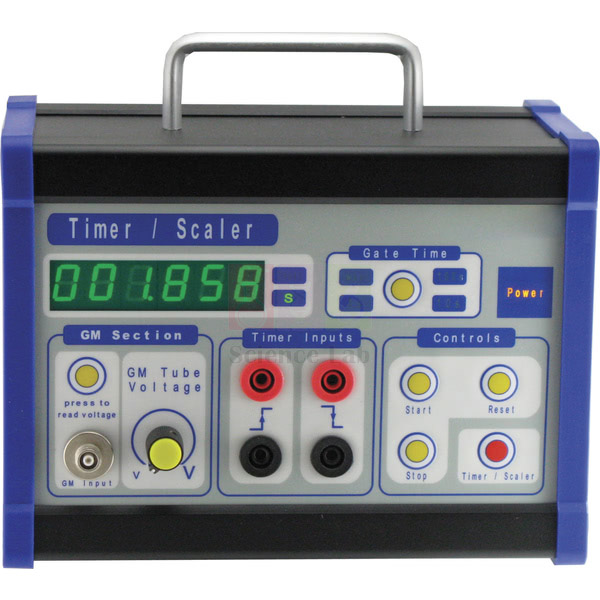
Scaler Timer
Scaler Timer (Product Code: SLE/PHY/43) is a general-purpose counting and timing instrument used for radioactivity counting with a GM tube and for millisecond digital timing in physics laboratories. Its 6-digit bright green LED display holds up to 999,999 counts or seconds, with manual counting or timed counts of 1, 10 or 100 seconds and manual or electronic triggering. It is supplied by Jain Scientific Equipments Pvt Ltd (ScienceLab), Ambala, India.
Specifications
| Parameter | Detail |
|---|---|
| Operation | Timer / Scaler |
| Display | 6-digit, bright green LED |
| Capacity | 999,999 counts or seconds |
| Counting | Manual, or timed counting of 1, 10 or 100 seconds |
| Timing | Millisecond digital timing with auto ranging on timing modes |
| Timing inputs | Manually switched start/stop; light gate(s) operated start/stop |
| GM tube voltage | 300 V to 500 V |
| Voltage check | Press-to-read switch shows the voltage applied to the GM tube |
| Audible counts | Built-in loudspeaker with on/off switch on the back |
| Fuse | 315 mA (L) slow-blow |
| Input power | 230 V ±5%, 50 Hz |
| Dimensions | 208 x 155 x 115 mm (W x H x D); 187 mm high including handle |
| Product code | SLE/PHY/43 |
| Supplied by | Jain Scientific Equipments Pvt Ltd (ScienceLab), Ambala, India |
What Is the Scaler Timer Used For?
In nuclear physics practicals, the Scaler Timer provides the GM tube voltage of 300 V to 500 V, counts each pulse and totals them, so students can measure background radiation, count rate against distance or absorber thickness, and half-life. The press-to-read switch lets them check the tube voltage, and the loudspeaker gives an audible click for each count when a class needs to hear the random nature of decay.
The same unit doubles as a millisecond timer for mechanics, with start and stop triggered by hand or by light gates, which suits timing a falling object, a trolley or a pendulum. Having one instrument serve both the radioactivity and the mechanics practicals is useful for any GM counter set-up in an Indian school or college lab where bench space is limited.
What to Specify When Ordering
- Whether you need the Geiger Muller Tube Holder and a GM tube for radioactivity counting.
- Whether you will trigger timing with light gates, and how many.
- Your mains supply: the unit is specified for 230 V ±5%, 50 Hz.
- Number of units per laboratory.
Supplier
Jain Scientific Equipments Private Limited trades as ScienceLab and supplies the Scaler Timer as part of its physics instrument range. The company can combine the timer, tube holder, sources and timing accessories in one quotation for a school, college or dealer. Background on the company is on our profile page.
Related Physics Lab Equipment
These items connect to the Scaler Timer or share the same practicals:
- Geiger Muller Tube Holder — GM tube housing designed for use with this timer.
- Protactinium Generator — short half-life source ideal for timed counting.
- Sealed Radioactive Source, Strontium — beta source for absorption practicals.
- Millisecond Timer — dedicated timer for free-fall and light-gate timing.
- Apparatus Air Track Light Gate — linear-motion track with a light gate system for timing experiments.
View all items in Physics Lab Equipment.
Frequently Asked Questions
What can the Scaler Timer count and time?
The Scaler Timer counts GM tube pulses for radioactivity work and also works as a millisecond digital timer. Its capacity is 999,999 counts or seconds, with manual counting or timed counts of 1, 10 or 100 seconds, and auto ranging on timing modes.
What GM tube voltage does the Scaler Timer provide?
The Scaler Timer provides a GM tube voltage of 300 V to 500 V. A press-to-read switch shows the voltage actually applied to the tube, so students can set it to suit their GM tube before they start counting.
Can the Scaler Timer be started and stopped by light gates?
Yes. The Scaler Timer accepts manually switched start/stop or light gate operated start/stop as timing inputs, so the same instrument can time motion experiments as well as count radioactivity in the physics laboratory.
What power supply does the Scaler Timer need?
The Scaler Timer runs on 230 V ±5%, 50 Hz mains and is protected by a 315 mA (L) slow-blow fuse. If your laboratory uses a different mains supply, mention it in your enquiry before ordering.
Is a GM tube included with the Scaler Timer?
A GM tube is not listed as part of the Scaler Timer. For radioactivity counting, add the Geiger Muller Tube Holder to your order and ask us about a suitable GM tube in the same enquiry.
Is a calibration certificate available for the Scaler Timer?
Please discuss any calibration-certificate requirement for the Scaler Timer with us before ordering, stating the document your purchase file needs. We will tell you what can be provided for the unit you are quoted.
Who supplies the Scaler Timer?
The Scaler Timer is supplied by Jain Scientific Equipments Pvt Ltd (ScienceLab), Ambala, India, to schools, colleges, institutions and dealers in India and international markets. Send your quantity through the contact page for a quotation.
Request a Quote
Request a Scaler Timer quotation through our contact page, or build a list with the tube holder and sources in the enquiry cart.
Last updated: 24 September 2026
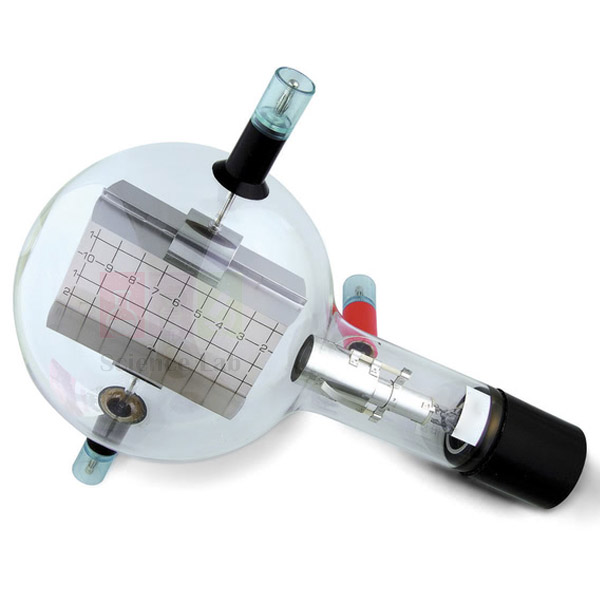
Teltron Electron Deflection Tube D
Teltron Electron Deflection Tube D (Product Code: SLE/PHY/44) is a highly evacuated electron tube used to show how electric and magnetic fields deflect an electron beam and to determine the specific charge e/m in physics laboratories. Its fluorescent screen, approx. 90 x 60 mm, is inclined to the beam axis so the whole beam path is visible, and a built-in plate capacitor provides the electric deflection. It is supplied by Jain Scientific Equipments Pvt Ltd (ScienceLab), Ambala, India.
Specifications
| Parameter | Detail |
|---|---|
| Tube type | Highly evacuated, with focusing electron gun and inclined fluorescent screen |
| Filament voltage | 6.3 V AC |
| Max. anode voltage | 5000 V |
| Anode current | Approx. 0.1 mA at 4000 V |
| Max. capacitor voltage | 5000 V |
| Fluorescent screen | Approx. 90 x 60 mm |
| Glass bulb | Approx. 130 mm diameter |
| Total length | Approx. 260 mm |
| Deflection | Electric: built-in plate capacitor; magnetic: Helmholtz coil pair D |
| Documentation | Instructions included |
| Product code | SLE/PHY/44 |
| Supplied by | Jain Scientific Equipments Pvt Ltd (ScienceLab), Ambala, India |
What Is the Electron Deflection Tube Used For?
With the Teltron Electron Deflection Tube D, students watch the electron beam trace a visible path across the inclined screen, then bend it with the electric field between the capacitor plates and with the magnetic field of the Helmholtz coil pair D. Adjusting the electric field until it exactly cancels the magnetic deflection straightens the beam again, and from the two field values the electron velocity and e/m can be calculated. This field-cancellation method makes it a core specific charge electron experiment for undergraduate physics.
Plan the power arrangement with the tube: it needs a 6.3 V AC filament supply and a high-voltage source for the anode and capacitor, each rated up to 5000 V. Mount the tube securely, use shrouded leads for every high-voltage connection, and let the filament warm up before raising the anode voltage.
What to Specify When Ordering
- Whether you need the Helmholtz coil pair D for the magnetic deflection.
- Whether you need a tube holder and a high-voltage power supply, or already own them.
- Number of tubes, for example one for demonstration or several for student groups.
Supplier
ScienceLab is the trading name of Jain Scientific Equipments Private Limited, which supplies Teltron electron tubes together with matching holders, coils and power supplies from Ambala, Haryana, India. Teltron is a third-party brand; the company sources the tube and quotes it with the accessories your experiment needs.
For vendor registration, the supplying company is Jain Scientific Equipments Private Limited (GSTIN 06AAECJ8618A1ZT), and export orders are handled under Importer-Exporter Code AAECJ8618A (DGFT). See our company profile for more.
Related Physics Lab Equipment
A complete e/m deflection set-up with the Teltron Electron Deflection Tube D usually includes these items:
- Teltron Tube Holder D — stand for the Teltron D-series tubes and coils.
- Teltron Helmholtz Pair of Coils D — magnetic field for the deflection and e/m measurement.
- EHT Power Supply — adjustable 5 kV supply with an auxiliary output for cathode heaters.
- Digital Voltmeter/Ammeter With Shunts — meter for reading the coil current.
- Teltron Maltese Cross Tube D — another D-series tube for electron-optics demonstrations.
Find more in our Physics Lab Equipment category.
Frequently Asked Questions
What can be measured with the Teltron Electron Deflection Tube D?
The Teltron Electron Deflection Tube D is used to determine the specific charge e/m and the velocity of the electrons. The electric field of the built-in plate capacitor is adjusted until it cancels the magnetic deflection produced by the Helmholtz coil pair D.
What voltages does the Teltron Electron Deflection Tube D need?
The Teltron Electron Deflection Tube D uses a 6.3 V AC filament supply, a maximum anode voltage of 5000 V and a maximum capacitor voltage of 5000 V. The anode current is approx. 0.1 mA at 4000 V.
Are Helmholtz coils included with the Teltron Electron Deflection Tube D?
The magnetic deflection uses the Helmholtz coil pair D, which is listed as a separate product. The Teltron Electron Deflection Tube D comes with instructions; add the coils, a tube holder and a power supply to your enquiry if you need them.
How large is the Teltron Electron Deflection Tube D?
The Teltron Electron Deflection Tube D has a glass bulb of approx. 130 mm diameter, a total length of approx. 260 mm and a fluorescent screen of approx. 90 x 60 mm. Store it in padded packaging, away from knocks, when not in use.
Who supplies the Teltron Electron Deflection Tube D?
The Teltron Electron Deflection Tube D is supplied by Jain Scientific Equipments Pvt Ltd (ScienceLab), Ambala, India. Teltron is a third-party brand; the company sources the tube for schools, colleges and institutions in India and international markets.
What should a Teltron Electron Deflection Tube D enquiry include?
For the Teltron Electron Deflection Tube D, state the number of tubes and whether you also need the Tube Holder D, Helmholtz Pair of Coils D and a high-voltage power supply. Send the list through our contact page or the enquiry cart.
Request a Quote
Ask for a Teltron Electron Deflection Tube D quotation on our contact page, or add the tube and its accessories to the enquiry cart.
Last updated: 24 September 2026
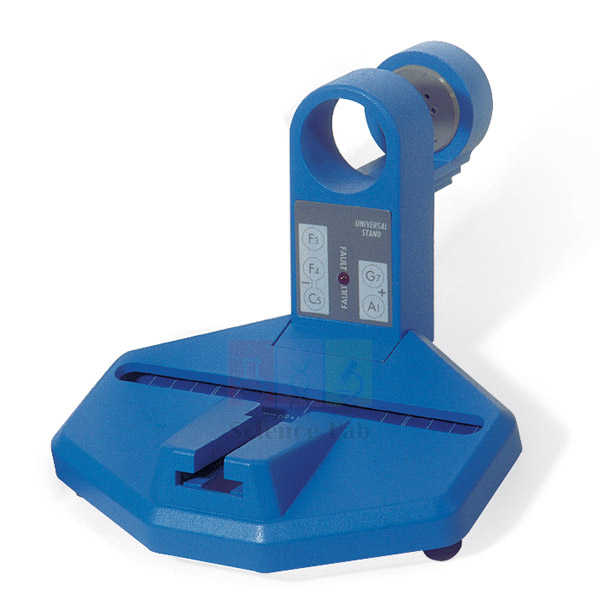
Teltron Tube Holder S
Teltron Tube Holder S (Product Code: SLE/PHY/45) is a stand used to mount Teltron Student (‘S’) Series electron tubes and their accessories for electron-beam experiments in physics laboratories. It carries the Helmholtz Coils S in slots with metric rulings that allow spacing up to 150 mm, and an easily replaceable fuse in the holder protects the tubes from excessive voltage. It is supplied by Jain Scientific Equipments Pvt Ltd (ScienceLab), Ambala, India.
Specifications
| Parameter | Detail |
|---|---|
| Compatible range | Entire line of Teltron Student (‘S’) Series tubes and related accessories |
| Accessories it holds | Helmholtz Coils S; Auxiliary Coil (inserts into the stepped front side) |
| Coil slots | Metric rulings for precise adjustment |
| Max. coil spacing | 150 mm |
| Tube protection | Easily replaceable fuse in the holder guards against excessive voltage |
| Product code | SLE/PHY/45 |
| Supplied by | Jain Scientific Equipments Pvt Ltd (ScienceLab), Ambala, India |
What Is the Teltron Tube Holder Used For?
The Teltron Tube Holder S is the base on which every S-series experiment is built: the tube sits in the holder and the Helmholtz coils slot in on either side. The metric rulings on the coil slots let students set and record the spacing — at the Helmholtz geometry for a uniform field, or at other distances up to 150 mm to see how the field shape changes the beam.
Because the fuse sits in the holder itself, an accidental over-voltage blows a replaceable fuse rather than damaging a valuable tube, so keep spare fuses of the correct rating with the kit. A stable, well-organised stand like this is the foundation of a physics demonstration kit for teaching electron beams to senior students in India.
What to Specify When Ordering
- Which S-series tubes you will use with the holder.
- Whether you need the Helmholtz Coils S and the Auxiliary Coil.
- Spare fuses for the holder.
Supplier
Jain Scientific Equipments Private Limited, trading as ScienceLab, supplies the Teltron Tube Holder S together with the S-series tubes and coils it supports. Teltron is a third-party brand, and the company sources and quotes the holder and matching items together for schools, colleges and dealers. Company background is on our profile page.
Related Physics Lab Equipment
These S-series items mount on the Teltron Tube Holder S:
- Teltron Helmholtz Pair of Coils S — the coil pair that slots into the holder.
- Teltron Dual Beam Tube S — helium-filled tube for e/m and gas-collision studies.
- Teltron Electron Diffraction Tube S — shows the wave nature of electrons.
- Teltron Thomson Tube S — e/m and electron velocity by field cancellation.
- Teltron Diode S — thermionic emission and diode characteristics.
Browse the wider Physics Lab Equipment range.
Frequently Asked Questions
Which tubes fit the Teltron Tube Holder S?
The Teltron Tube Holder S is the mounting point for the entire line of Teltron Student (‘S’) Series tubes and related accessories. Tell us which S-series tubes you have or plan to buy, and we will confirm the combination in our quotation.
What is the maximum coil spacing on the Teltron Tube Holder S?
The coil slots on the Teltron Tube Holder S allow a maximum spacing of 150 mm. The slots carry metric rulings, so a chosen spacing can be set precisely and repeated from one lesson to the next.
How does the Teltron Tube Holder S protect the tubes?
The Teltron Tube Holder S has an easily replaceable fuse located in the holder, which protects the tubes from excessive voltage. If the fuse blows, replace it with one of the same rating before switching the supply back on.
Can the Auxiliary Coil be used with the Teltron Tube Holder S?
Yes. The Auxiliary Coil can be inserted into the stepped front side of the Teltron Tube Holder S. Ask us about the Auxiliary Coil when you send your enquiry so it can be included in the same quotation.
Who supplies the Teltron Tube Holder S?
Jain Scientific Equipments Pvt Ltd (ScienceLab), Ambala, India, supplies the Teltron Tube Holder S. Teltron is a third-party brand; the company sources the holder for schools, colleges and institutions in India and international markets.
What should a Teltron Tube Holder S quotation request include?
State the number of Teltron Tube Holder S units, the S-series tubes and coils you want with them, and whether you need spare fuses. Send the list through our contact page or add the items to the enquiry cart.
Request a Quote
Get a price for the Teltron Tube Holder S through our contact page, or place it with your S-series tubes in the enquiry cart.
Last updated: 24 September 2026
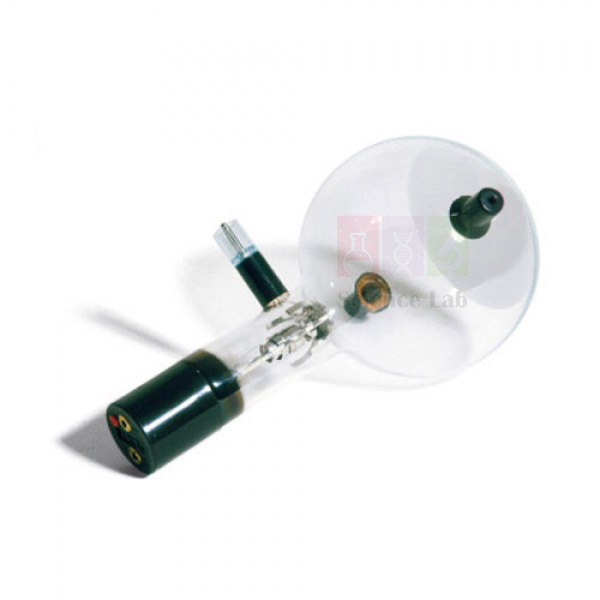
Teltron Electron Diffraction Tube D
Teltron Electron Diffraction Tube D (Product Code: SLE/PHY/46) is a highly evacuated electron tube used to demonstrate the wave nature of electrons by diffraction through a polycrystalline graphite lattice in physics laboratories. The resulting rings appear on a fluorescent screen, and from their radii students determine the electron wavelength as a function of anode voltage, confirming de Broglie's hypothesis. It is supplied by Jain Scientific Equipments Pvt Ltd (ScienceLab), Ambala, India.
Specifications
| Parameter | Detail |
|---|---|
| Tube type | Highly evacuated, with polycrystalline graphite lattice and fluorescent screen |
| Diffraction pattern | Debye–Scherrer rings |
| Max. filament voltage | 6.3 V AC |
| Max. anode voltage | 5 kV |
| Anode current | Approx. 0.1 mA at 4 kV |
| Graphite lattice constants | d10 = 0.213 nm; d11 = 0.123 nm |
| Documentation | Instructions included |
| Product code | SLE/PHY/46 |
| Supplied by | Jain Scientific Equipments Pvt Ltd (ScienceLab), Ambala, India |
What Is the Electron Diffraction Tube Used For?
The Teltron Electron Diffraction Tube D gives one of the most direct demonstrations of wave–particle duality. Electrons accelerated by the anode pass through polycrystalline graphite and interfere, forming concentric Debye–Scherrer rings on the screen; as the anode voltage rises, the electron wavelength shortens and the rings visibly shrink.
Students record the ring radii at a series of anode voltages, then use the graphite lattice plane spacings of 0.213 nm and 0.123 nm to calculate the wavelength and compare it with the de Broglie prediction. As physics lab equipment for undergraduate modern physics courses in India, the rings are easiest to read in a darkened room with a supply able to reach 5 kV.
Supplier
ScienceLab (Jain Scientific Equipments Private Limited) supplies the Teltron Electron Diffraction Tube D from Ambala, Haryana, India. Teltron is a third-party brand; the company sources the tube and can quote it together with a D-series holder and a suitable high-voltage supply. Learn more on our company profile.
Related Physics Lab Equipment
Items that complete or extend a diffraction practical with the Teltron Electron Diffraction Tube D:
- Teltron Tube Holder D — holder for the Teltron D-series tubes.
- EHT Power Supply — adjustable 5 kV output with an auxiliary heater output.
- Teltron Electron Deflection Tube D — shows the particle side of the electron through e/m measurement.
- Teltron Electron Diffraction Tube S — the S-series version of the same experiment.
- Planck's Constant Apparatus — photoelectric experiment for the same quantum physics unit.
See the full Physics Lab Equipment category.
Frequently Asked Questions
What does the Teltron Electron Diffraction Tube D demonstrate?
The Teltron Electron Diffraction Tube D demonstrates the wave nature of electrons. Electrons passing through polycrystalline graphite produce Debye–Scherrer diffraction rings on a fluorescent screen, which lets students confirm de Broglie's hypothesis experimentally.
Which values are needed to calculate the electron wavelength?
With the Teltron Electron Diffraction Tube D you measure the ring radii and use the graphite lattice constants d10 = 0.213 nm and d11 = 0.123 nm. Repeating the measurement at several anode voltages shows how the wavelength depends on voltage.
What power supply does the Teltron Electron Diffraction Tube D need?
The Teltron Electron Diffraction Tube D needs a filament supply of up to 6.3 V AC and an anode supply of up to 5 kV; the anode current is approx. 0.1 mA at 4 kV. Ask us to include a suitable supply in your quotation.
Are instructions included with the Teltron Electron Diffraction Tube D?
Yes, the Teltron Electron Diffraction Tube D is supplied with instructions. Read them before first use, paying particular attention to the voltage limits, and keep them with the tube for future classes.
How should the Teltron Electron Diffraction Tube D be stored?
Store the Teltron Electron Diffraction Tube D in padded packaging, away from knocks and heat, and carry it with both hands. Never operate an evacuated tube whose glass is cracked or chipped; set it aside and contact us for advice.
Who supplies the Teltron Electron Diffraction Tube D?
The Teltron Electron Diffraction Tube D is supplied by Jain Scientific Equipments Pvt Ltd (ScienceLab), Ambala, India. As Teltron is a third-party brand, the company sources the tube for colleges, universities and schools in India and international markets.
Request a Quote
Tell us how many Teltron Electron Diffraction Tube D units you need through the contact page, or add them with a holder and power supply to the enquiry cart.
Last updated: 24 September 2026

Planck's Constant Apparatus
Planck's Constant Apparatus (Product Code: SLE/PHY/47) is a ready-built circuit used to measure the photoelectric effect and determine Planck's constant in physics laboratories. Inside are a caesium antimony photocathode, a DC supply with a 10-turn potentiometer for the retarding voltage and a 0–19.99 V LED display, while six narrow-band filters vary the light frequency. It is supplied by Jain Scientific Equipments Pvt Ltd (ScienceLab), Ambala, India.
Specifications
| Parameter | Detail |
|---|---|
| Photocell | Caesium antimony cathode, spectral response range 185–650 nm |
| Stopping potential | DC, controlled by a 10-turn potentiometer |
| Voltage display | DC voltmeter with 0–19.99 V LED display |
| Filters | 6 narrow-band filters, FWHM bandwidth 4–15 nm |
| Filter wavelengths | 405 nm is among the listed wavelengths; ask us for the full set |
| Output socket | Female UHF socket for connection to a picoammeter |
| Lead included | 4 mm to UHF lead for connecting the picoammeter |
| Power source | 9 V PP3 battery |
| Dimensions | 205 x 150 x 115 mm (W x H x D) |
| Product code | SLE/PHY/47 |
| Supplied by | Jain Scientific Equipments Pvt Ltd (ScienceLab), Ambala, India |
What Is the Planck's Constant Apparatus Used For?
Light of a known frequency, selected with one of the six filters, falls on the caesium antimony cathode and releases photoelectrons. Students raise the retarding voltage with the 10-turn potentiometer until the picoammeter reading falls to zero and note this stopping potential on the digital display. Repeating with each filter gives a set of stopping potentials that, plotted against frequency, form a straight line whose gradient is h/e.
Because the circuit is ready-built and battery-powered, set-up time is short, which makes it a practical photoelectric effect kit for senior secondary and undergraduate courses in India. The photocurrent is tiny, so the apparatus is ideally used with a picoammeter, connected through the supplied 4 mm to UHF lead.
What to Specify When Ordering
- Whether you need a picoammeter, which the apparatus is designed to work with but which is not listed as included.
- Confirmation of the six filter wavelengths on your quotation.
- Spare 9 V PP3 batteries.
- Number of units needed for your practical groups.
Supplier
ScienceLab is the trading name of Jain Scientific Equipments Private Limited, which supplies the Planck's Constant Apparatus to schools, colleges and universities from Ambala, Haryana, India. The company sources the apparatus and can quote it with the other items needed for the photoelectric practical.
Institutional buyers completing vendor registration can use the company's GSTIN 06AAECJ8618A1ZT and its Legal Entity Identifier (LEI) 3358004HRD1JIVXKYX49. More about us is on the profile page.
Related Physics Lab Equipment
These items fit the same quantum physics teaching unit as the Planck's Constant Apparatus:
- Plancks Constant Determination Box — an LED-based method for estimating Planck's constant.
- Teltron Electron Diffraction Tube D — demonstrates the wave nature of electrons.
- Teltron Diode S — thermionic emission, for comparison with photoemission.
- Spectroscope, Direct Vision — for examining the spectral composition of light sources.
Browse all Physics Lab Equipment.
Frequently Asked Questions
What is included with the Planck's Constant Apparatus?
The Planck's Constant Apparatus includes the photocell circuit with a caesium antimony cathode, a DC retarding-voltage supply with 10-turn potentiometer, a 0–19.99 V LED display, six narrow-band filters and a 4 mm to UHF lead. A picoammeter is not listed as included.
Do I need a picoammeter with the Planck's Constant Apparatus?
Yes. The Planck's Constant Apparatus is ideally used in conjunction with a picoammeter, which reads the photocurrent through the female UHF socket. Please tell us if you need one, and we will advise on a suitable meter in our reply.
What light range does the Planck's Constant Apparatus respond to?
The caesium antimony photocell in the Planck's Constant Apparatus has a spectral response range of 185–650 nm. Six narrow-band filters, each with an FWHM bandwidth of 4–15 nm, select the light frequency; 405 nm is among the listed wavelengths.
How is the Planck's Constant Apparatus powered?
The Planck's Constant Apparatus runs on a 9 V PP3 battery, so no mains connection is needed at the bench. Keep a spare battery with the unit, and remove the battery if the apparatus will be stored for a long period.
How big is the Planck's Constant Apparatus?
The Planck's Constant Apparatus measures 205 x 150 x 115 mm (W x H x D). It is a compact bench unit that sits comfortably beside the light source and picoammeter on a normal laboratory table.
Who supplies the Planck's Constant Apparatus?
Jain Scientific Equipments Pvt Ltd (ScienceLab), Ambala, India, supplies the Planck's Constant Apparatus to schools, colleges and universities in India and international markets. Send your quantity and destination through our contact page for a quotation.
Request a Quote
Request a quotation for the Planck's Constant Apparatus on our contact page, or add it and any picoammeter requirement to the enquiry cart.
Last updated: 24 September 2026
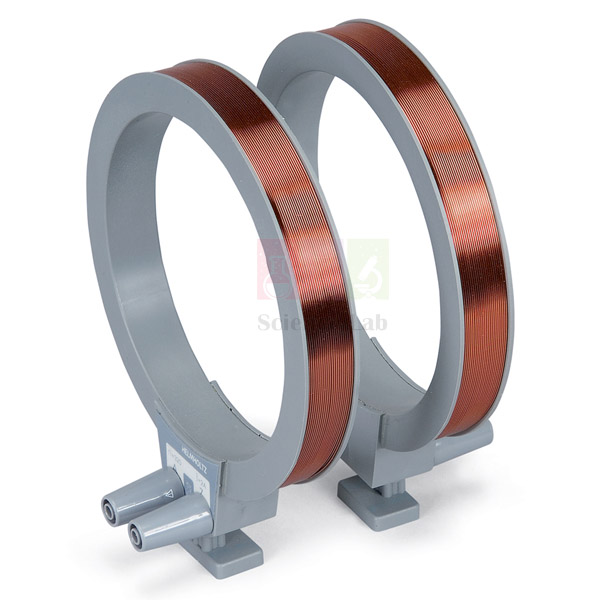
Teltron Helmholtz Pair of Coils S
Teltron Helmholtz Pair of Coils S (Product Code: SLE/PHY/48) is a pair of coils used to generate a uniform magnetic field perpendicular to the axis of a Teltron S-series electron tube in physics laboratories. Each coil has 320 turns on a 138 mm diameter and carries 1.0 A continuously, giving a maximum field of approx. 9 mT for bending electron beams in e/m experiments. It is supplied by Jain Scientific Equipments Pvt Ltd (ScienceLab), Ambala, India.
Specifications
| Parameter | Detail (each coil) |
|---|---|
| Number of turns | 320 |
| Coil diameter | 138 mm |
| Terminals | 4 mm safety sockets |
| Load rating | 1.0 A continuous operation; 1.5 A short-term operation |
| Effective impedance | Approx. 6.5 ohm |
| Max. field strength | Approx. 9 mT |
| Field direction | Perpendicular to the tube axis; vertical or coaxial arrangements possible with the Teltron Tube Holder S |
| Supplied as | Pair of coils, with instructions |
| Product code | SLE/PHY/48 |
| Supplied by | Jain Scientific Equipments Pvt Ltd (ScienceLab), Ambala, India |
What Are Helmholtz Coils Used For?
Mounted on the Teltron Tube Holder S, the two coils sit either side of the tube so that a current through them bends the electron beam into an arc or circle. From the coil current, number of turns and diameter, students calculate the field strength and combine it with the accelerating voltage and beam radius to find the specific charge of the electron — the heart of any EM ratio apparatus set-up in Indian physics laboratories.
The holder also lets the coils be set at variable distances, or arranged to give a vertical or coaxial field relative to the tube axis, so the same pair serves experiments that need a different field direction. Keep the current at or below 1.0 A for long runs and use the 1.5 A rating only briefly; an ammeter in series makes it easy to stay within these limits.
What to Specify When Ordering
- Whether you need the Teltron Tube Holder S on which the coils are configured.
- A DC supply and ammeter for the coil current, suited to 1.0 A continuous operation.
- Which S-series tubes you will use with the coils.
Supplier
Jain Scientific Equipments Private Limited, trading as ScienceLab, supplies the Teltron Helmholtz Pair of Coils S from Ambala, Haryana, India, as part of its electron-beam experiment range. Teltron is a third-party brand; the company sources the coils and can quote them with the holder, tubes and meters that complete the set-up. Visit our profile page to learn more.
Related Physics Lab Equipment
Use the Teltron Helmholtz Pair of Coils S with these items:
- Teltron Tube Holder S — sets the coil spacing and orientation around the tube.
- Digital Voltmeter/Ammeter With Shunts — meter for monitoring the coil current.
- Teltron Dual Beam Tube S — e/m from the diameter of a circular beam.
- Teltron Thomson Tube S — e/m by balancing electric and magnetic fields.
- Teltron Helmholtz Pair of Coils D — the equivalent coil pair for D-series tubes.
More items are listed under Physics Lab Equipment.
Frequently Asked Questions
What magnetic field do the Teltron Helmholtz Pair of Coils S produce?
Each coil of the Teltron Helmholtz Pair of Coils S has 320 turns and a 138 mm diameter, and the maximum field strength is approx. 9 mT. Set in Helmholtz geometry, the pair gives a uniform field across the tube.
What current can the Teltron Helmholtz Pair of Coils S carry?
The Teltron Helmholtz Pair of Coils S are rated at 1.0 A for continuous operation and 1.5 A for short-term operation, with an effective impedance of approx. 6.5 ohm per coil. A series ammeter helps keep the current within these limits.
How are the Teltron Helmholtz Pair of Coils S connected?
The Teltron Helmholtz Pair of Coils S connect through 4 mm safety sockets. Wire the two coils so the current flows the same way round in each; otherwise their fields oppose and the electron beam will not curve as expected.
Do the Teltron Helmholtz Pair of Coils S need the Tube Holder S?
Yes. The Teltron Tube Holder S lets the Teltron Helmholtz Pair of Coils S be configured in Helmholtz geometry or at variable distances, with the field vertical or coaxial to the tube axis. Order the holder too if your lab does not have one.
Who supplies the Teltron Helmholtz Pair of Coils S?
The Teltron Helmholtz Pair of Coils S are supplied by Jain Scientific Equipments Pvt Ltd (ScienceLab), Ambala, India. Teltron is a third-party brand, and the company sources the coils for institutions in India and international markets.
What should an enquiry for the Teltron Helmholtz Pair of Coils S include?
For the Teltron Helmholtz Pair of Coils S, give the number of pairs, the S-series tubes they will serve, and whether you need the Tube Holder S, a DC supply or a meter. Send it via our contact page or the enquiry cart.
Request a Quote
Ask for a quotation for the Teltron Helmholtz Pair of Coils S through the contact page, or collect the coils and matching S-series items in the enquiry cart.
Last updated: 24 September 2026
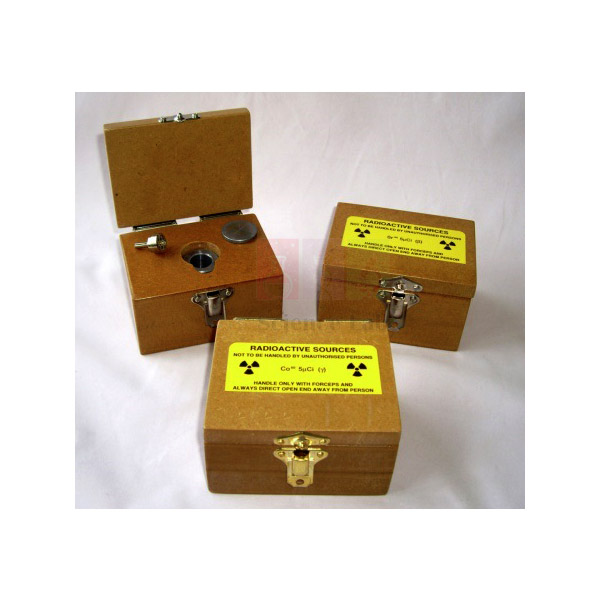
Sealed Radioactive Source, Americium
Sealed Radioactive Source, Americium (Product Code: SLE/PHY/49) is a 5 µCi (185 kBq) americium-241 sealed source used for alpha-particle experiments in school and college physics laboratories. Its active material sits in a silver-palladium disc that transmits a substantial proportion of the alpha particles plus a small amount of low-energy gamma emission, and the mount is colour-coded brown. It is supplied by Jain Scientific Equipments Pvt Ltd (ScienceLab), Ambala, India.
Specifications
| Parameter | Detail |
|---|---|
| Isotope | Americium-241 |
| Activity | 5 µCi (185 kBq) |
| Emissions | Alpha, plus a small amount of low-energy gamma |
| Active element | Silver-palladium disc; active material enclosed in metal foil |
| Mount | Cylindrical mount with a 4 mm diameter stem |
| Window protection | Wire gauze cap over the open window of the mount |
| Identification | Nature and strength engraved on the mount; colour code brown |
| Storage | Small lead castle inside a labelled MDF storage box, 100 x 75 x 65 mm high |
| Documentation | Data sheet enclosed with each source |
| Product code | SLE/PHY/49 |
| Supplied by | Jain Scientific Equipments Pvt Ltd (ScienceLab), Ambala, India |
What Is the Americium Source Used For?
The americium source is the usual alpha emitter for teaching radioactivity. With a GM tube and counter, students show that alpha particles have a short range in air and are stopped by a sheet of paper, then compare that with the greater penetration of beta and gamma radiation. The 4 mm stem lets the source be clamped at a fixed, repeatable distance from the detector, which makes it a reliable part of a radiation experiment kit for Indian schools and colleges.
Handle the source only with tongs or forceps, keep the window pointing away from the body, and return it to its lead castle and box as soon as readings are complete. Never touch or try to clean the foil; the wire gauze cap is there to protect it. Americium-241 is long-lived, so the count rate changes very little from one year to the next.
What to Specify When Ordering
- Which sources you need: this americium alpha source, and whether cobalt or strontium sources are needed too.
- Quantity of each source.
- Delivery destination and any radiation-source authorisation details your institution must provide.
Supplier
ScienceLab, the trading name of Jain Scientific Equipments Private Limited, supplies sealed radioactive sources for teaching laboratories from Ambala, Haryana, India. The company sources the americium source and can quote it together with the detector and counter needed to use it. Company details are on our profile page.
Related Physics Lab Equipment
Build a full alpha, beta and gamma practical around the Sealed Radioactive Source, Americium with these items:
- Sealed Radioactive Source, Cobalt — gamma source for penetration comparisons.
- Sealed Radioactive Source, Strontium — beta source for absorber experiments.
- Geiger Muller Tube Holder — mounts the GM tube that detects the radiation.
- Scaler Timer — counts the pulses over set intervals.
- Geiger Counter — survey meter for checking the source store and background.
See the complete Physics Lab Equipment range.
Frequently Asked Questions
What is the activity of the Sealed Radioactive Source, Americium?
The Sealed Radioactive Source, Americium contains 5 µCi (185 kBq) of americium-241. The nature and strength of the source are engraved on its mount, and a data sheet is enclosed with each source for your records.
What radiation does the Sealed Radioactive Source, Americium emit?
The Sealed Radioactive Source, Americium emits alpha particles and a small amount of low-energy gamma radiation. Its silver-palladium disc transmits a substantial proportion of the alpha particles, which suits alpha range and absorption practicals.
How is the Sealed Radioactive Source, Americium stored?
Each Sealed Radioactive Source, Americium comes in a small lead castle inside a labelled MDF storage box, 100 x 75 x 65 mm high. Keep it in a locked, labelled radioactive-source store and record every issue and return.
How can staff identify the Sealed Radioactive Source, Americium?
The Sealed Radioactive Source, Americium is colour-coded brown, and its nature and strength are engraved on the cylindrical mount. This lets staff tell it apart quickly from other sealed sources kept in the same store.
Is an authorisation needed to buy the Sealed Radioactive Source, Americium?
Radioactive sources are regulated in most countries, so check with your national radiation-safety authority what your institution needs before ordering the Sealed Radioactive Source, Americium. Share those requirements and the destination with us when you enquire.
Who supplies the Sealed Radioactive Source, Americium?
The Sealed Radioactive Source, Americium is supplied by Jain Scientific Equipments Pvt Ltd (ScienceLab), Ambala, India, to schools, colleges and institutions in India and international markets, subject to the destination's rules for radioactive materials.
Request a Quote
Send your source requirement and destination through our contact page, or list the sources and counting equipment in the enquiry cart for a quotation.
Last updated: 24 September 2026
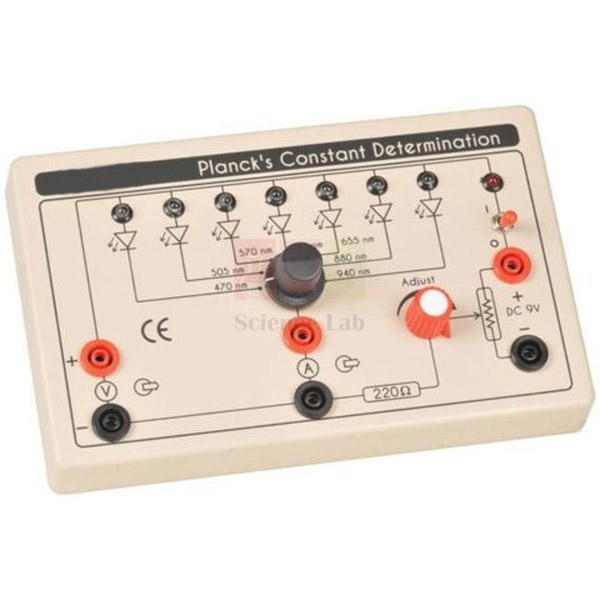
Plancks Constant Determination Box
Plancks Constant Determination Box (Product Code: SLE/PHY/50) is an LED-based apparatus used to find an approximate value of Planck's constant from the elbow voltage in LED characteristic curves in physics laboratories. Seven LEDs, from deep blue at 470 nm to near infrared at 940 nm, are mounted on the box with sockets for voltage and current measurements, making it a compact Planck constant experiment kit. It is supplied by Jain Scientific Equipments Pvt Ltd (ScienceLab), Ambala, India.
Specifications
| Parameter | Detail |
|---|---|
| Method | Elbow voltage in the characteristic curves of a number of LEDs |
| Number of LEDs | 7, mounted on the box |
| Wavelength range | 470 nm (deep blue) to 940 nm (near infrared) |
| Connections | Sockets for voltage and current measurements |
| Power | External 9 V power source or 9 V battery required |
| Leads | Connecting leads required |
| Product code | SLE/PHY/50 |
| Supplied by | Jain Scientific Equipments Pvt Ltd (ScienceLab), Ambala, India |
What Is the Planck's Constant Box Used For?
Students connect each LED in turn, raise the voltage slowly and note the value at which it just begins to emit light — the elbow of its current–voltage curve. That voltage multiplied by the electron charge gives the energy of the emitted photons; plotting energy against light frequency, worked out from each LED's wavelength, gives a straight line whose gradient approximates Planck's constant.
With seven LEDs spread from 470 nm to 940 nm, the graph has enough points for a clear straight-line fit, and the exercise doubles as an LED characteristics experiment kit for electronics topics. For the near-infrared LED the light cannot be seen, so read its turn-on point from the current meter instead of by eye.
What to Specify When Ordering
- Power: whether you will use an external 9 V source or a 9 V battery.
- Connecting leads and meters for the voltage and current sockets.
- Number of boxes, for example one per bench group or one for demonstration.
Supplier
Jain Scientific Equipments Private Limited, trading as ScienceLab, supplies the Plancks Constant Determination Box from Ambala, Haryana, India, to schools, colleges and dealers. The company sources the box and can add the meters, leads and power source needed for the practical to the same quotation.
Vendor details for purchase files: Jain Scientific Equipments Private Limited, CIN U29309HR2020PTC087597, GSTIN 06AAECJ8618A1ZT. More about the company is on our profile page.
Related Physics Lab Equipment
These items supply the power, connections and measurements the Plancks Constant Determination Box needs:
- Standard Digital Multimeter — measures the LED voltage and current.
- Digital Voltmeter — a dedicated bench voltmeter for the turn-on voltage.
- Crocodile Clips & Leads — connecting leads for the box and meters.
- Battery Clip, PP3 — connects a 9 V PP3 battery as the power source.
- Planck's Constant Apparatus — photoelectric method for a second, independent value.
Explore more Physics Lab Equipment.
Frequently Asked Questions
How does the Plancks Constant Determination Box find Planck's constant?
The Plancks Constant Determination Box uses the elbow voltage in the characteristic curve of each LED. Plotting the photon energy from that voltage against light frequency for all seven LEDs gives a line whose gradient is an approximate value of Planck's constant.
What LED wavelengths are on the Plancks Constant Determination Box?
The Plancks Constant Determination Box carries seven LEDs covering deep blue at 470 nm to near infrared at 940 nm. This spread gives a wide frequency range for the energy–frequency graph that students plot.
What else is needed to use the Plancks Constant Determination Box?
To use the Plancks Constant Determination Box you need an external 9 V power source or a 9 V battery, connecting leads, and meters for the voltage and current sockets on the box. These can be added to the same quotation on request.
How precise is the value from the Plancks Constant Determination Box?
The Plancks Constant Determination Box is designed to give an approximate value of Planck's constant, which suits teaching the link between photon energy and frequency. Students can compare their result with a second, independent method such as the photoelectric experiment.
Who supplies the Plancks Constant Determination Box?
The Plancks Constant Determination Box is supplied by Jain Scientific Equipments Pvt Ltd (ScienceLab), Ambala, India, to schools, colleges and dealers in India and international markets. Contact us with the quantity you need for a quotation.
What should a Plancks Constant Determination Box enquiry include?
For the Plancks Constant Determination Box, state the number of boxes, whether you need a 9 V battery or power source, and whether meters and leads should be quoted too. Use the contact page or the enquiry cart to send it.
Request a Quote
Price the Plancks Constant Determination Box by writing to us through the contact page, or add the box, meters and leads to the enquiry cart.
Last updated: 24 September 2026
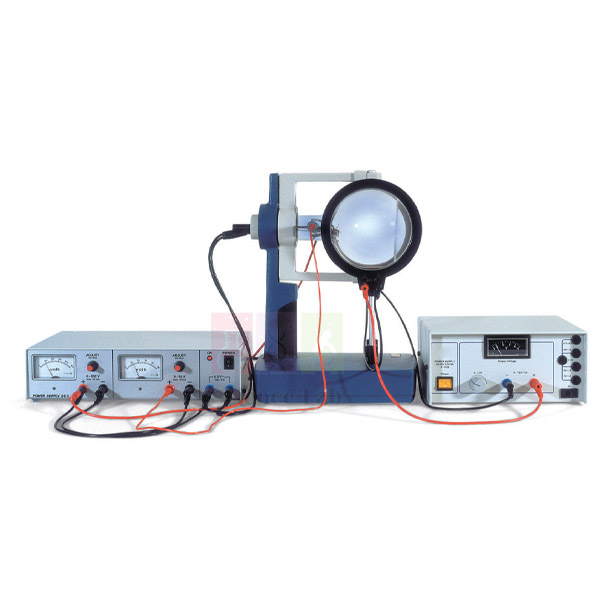
Teltron Dual Beam Tube D
Teltron Dual Beam Tube D (Product Code: SLE/PHY/51) is a semi-evacuated electron tube filled with low-pressure helium and fitted with both a tangential and an axial electron gun, used to study electron collisions and the electron charge-to-mass ratio in physics laboratories. Excited helium atoms make the beams glow as fine luminescent lines, so students see the electron path directly. It is supplied as the tube only by Jain Scientific Equipments Pvt Ltd (ScienceLab), Ambala, India.
Specifications
| Parameter | Detail |
|---|---|
| Tube type | Semi-evacuated, filled with low-pressure helium |
| Electron guns | Tangential and axial |
| Max. filament voltage | 7.5 V |
| Max. anode voltage | 300 V DC |
| Anode current | Approx. 30 mA at 200 V (anode) |
| Max. deflection voltage | 50 V DC |
| Scope of supply | Tube only; instructions included |
| Product code | SLE/PHY/51 |
| Supplied by | Jain Scientific Equipments Pvt Ltd (ScienceLab), Ambala, India |
What Is the Dual Beam Tube Used For?
Fire the axial gun with a magnetic field along the tube axis and the fine, luminous beam lets students study impact excitation and particle collisions — a visual link between electron physics and kinetic gas theory. Switch to the tangential gun with the field perpendicular, and the beam bends into a closed pattern whose diameter gives the fundamental electron charge-to-mass ratio, a classic specific charge electron experiment.
Because the Teltron Dual Beam Tube D is sold as the tube only, plan the full set-up before ordering: a D-series holder, a Helmholtz coil pair for the magnetic field, and a supply able to provide up to 300 V DC on the anode, 7.5 V on the filament and 50 V DC for deflection. Departments that already own Teltron D-series accessories can simply add the tube.
What to Specify When Ordering
- Whether you need the Teltron Tube Holder D and Teltron Helmholtz Pair of Coils D, since the product is the tube only.
- A power supply covering 300 V DC anode, 7.5 V filament and 50 V DC deflection.
- A meter for monitoring the coil current.
- Number of tubes required.
Supplier
ScienceLab is how Jain Scientific Equipments Private Limited trades, and the company supplies the Teltron Dual Beam Tube D from Ambala, Haryana, India. Teltron is a third-party brand; the company sources the tube and, because it ships as the tube only, can quote the holder, coils and supply alongside it. See our company profile.
Related Physics Lab Equipment
The Teltron Dual Beam Tube D is supplied as the tube only; these items complete the experiment:
- Teltron Tube Holder D — holder for the Teltron D-series tubes and coils.
- Teltron Helmholtz Pair of Coils D — provides the magnetic field that bends the beam.
- High Tension Power Supply — designed for thermionic experiments such as the Teltron double fine beam tube.
- Digital Voltmeter/Ammeter With Shunts — monitors the coil current.
- Teltron Dual Beam Tube S — the S-series version of this tube.
Visit the Physics Lab Equipment category for more.
Frequently Asked Questions
What is included with the Teltron Dual Beam Tube D?
The Teltron Dual Beam Tube D is supplied as the tube only, with instructions included. The holder, Helmholtz coils and power supply are separate items, and we can quote them together with the tube on request.
What gas is inside the Teltron Dual Beam Tube D?
The Teltron Dual Beam Tube D is semi-evacuated and filled with low-pressure helium. Electrons excite the helium atoms along their path, which makes the beams visible as fine luminescent lines during the experiment.
Why does the Teltron Dual Beam Tube D have two electron guns?
The Teltron Dual Beam Tube D uses its axial gun with a co-axial magnetic field to study impact excitation and particle collisions, and its tangential gun with a perpendicular field to find the electron charge-to-mass ratio from the beam pattern diameter.
What are the electrical ratings of the Teltron Dual Beam Tube D?
The Teltron Dual Beam Tube D has a maximum filament voltage of 7.5 V, a maximum anode voltage of 300 V DC and a maximum deflection voltage of 50 V DC. The anode current is approx. 30 mA at 200 V.
Who supplies the Teltron Dual Beam Tube D?
Jain Scientific Equipments Pvt Ltd (ScienceLab), Ambala, India, supplies the Teltron Dual Beam Tube D. Teltron is a third-party brand; the company sources the tube for colleges, universities and schools in India and international markets.
What should a Teltron Dual Beam Tube D enquiry include?
For the Teltron Dual Beam Tube D, list the number of tubes and say whether you already own a D-series holder, Helmholtz coils and a suitable supply, or need them quoted. Send the details through the contact page or the enquiry cart.
Request a Quote
Request pricing for the Teltron Dual Beam Tube D through our contact page, or add the tube and any missing accessories to the enquiry cart.
Last updated: 24 September 2026
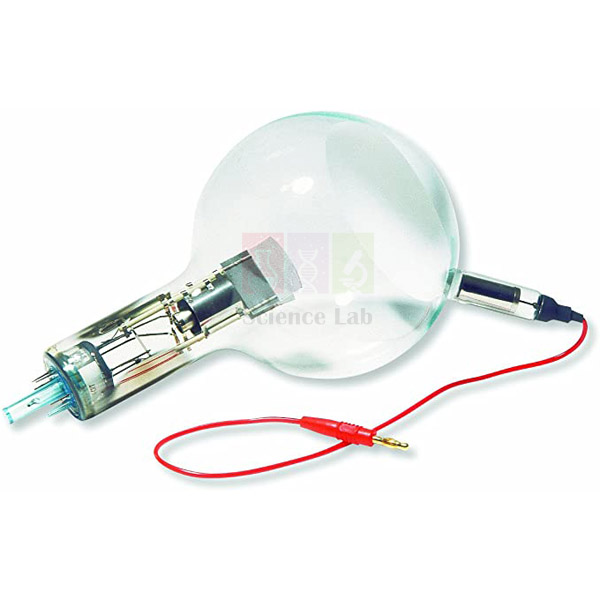
Teltron Perrin Tube S
Teltron Perrin Tube S (Product Code: SLE/PHY/52) is an evacuated electron tube from the Teltron S series used to repeat Jean Perrin's experiment, which shows that cathode rays carry negative charge, in college and senior school physics laboratories. It helps students connect a visible electron beam with the idea of the electron as a charged particle, a key step in any unit on the discovery of the electron. It is supplied by Jain Scientific Equipments Pvt Ltd (ScienceLab), Ambala, India.
Key Details
| Parameter | Detail |
|---|---|
| Product type | Evacuated electron tube for the Perrin experiment |
| Series | Teltron S series |
| Brand | Teltron (third-party brand) |
| Technical data | Ask us for the current specification sheet before ordering |
| Product code | SLE/PHY/52 |
| Supplied by | Jain Scientific Equipments Pvt Ltd (ScienceLab), Ambala, India |
What Is the Perrin Tube Used For?
In Perrin's classic experiment, an electron beam is steered by a magnetic field into a charge collector linked to an electroscope or meter; the collector gains negative charge, showing that cathode rays are negatively charged particles rather than a form of light. The Teltron Perrin Tube S brings this historic result into the teaching laboratory as a clear physics demonstration for students in India studying atomic structure.
Electron tubes of this kind run at high voltages, so the tube should be set up and switched on by a teacher or technician, mounted in a suitable holder and connected with shrouded leads. Confirm the operating voltages, holder and coil requirements with us before ordering; we will send the specification with your quotation.
Supplier
Jain Scientific Equipments Private Limited, which trades as ScienceLab, supplies the Teltron Perrin Tube S from Ambala, Haryana, India. Teltron is a third-party brand; the company sources the tube and will confirm its current specification and accessory needs in the quotation. Read more on our company profile.
Related Physics Lab Equipment
These items belong to the same S-series electron-beam teaching set as the Teltron Perrin Tube S:
- Teltron Tube Holder S — mounting point for the Teltron Student (S) series tubes.
- Teltron Helmholtz Pair of Coils S — magnetic field source for S-series tubes.
- Teltron Thomson Tube S — S-series tube for measuring e/m.
- Teltron Perrin Tube D — the D-series version of the Perrin tube.
- Electroscope, Gold Leaf — classic charge indicator for the electrostatics lessons that lead into electron-beam work.
Browse more in Physics Lab Equipment.
Frequently Asked Questions
What does the Teltron Perrin Tube S demonstrate?
The Teltron Perrin Tube S is used for Perrin's experiment, which shows that the electron beam, or cathode rays, carries negative charge. It is usually taught alongside other electron-beam experiments in a unit on the discovery of the electron.
What are the technical specifications of the Teltron Perrin Tube S?
Please ask us for the current specification sheet of the Teltron Perrin Tube S, including operating voltages and accessory requirements. We confirm these details with your quotation rather than list unverified figures on this page.
Which accessories does the Teltron Perrin Tube S need?
Teltron S-series tubes are mounted on the Teltron Tube Holder S, and electron-beam experiments generally need a high-voltage supply and often a pair of Helmholtz coils. Tell us what you already own and we will confirm what the Teltron Perrin Tube S set-up needs.
Can students operate the Teltron Perrin Tube S themselves?
The Teltron Perrin Tube S works at high voltages, so a teacher or lab technician should set it up and switch it on, with students observing and recording results. Always follow the operating instructions for the tube.
Who supplies the Teltron Perrin Tube S?
The Teltron Perrin Tube S is supplied by Jain Scientific Equipments Pvt Ltd (ScienceLab), Ambala, India. Teltron is a third-party brand; the company sources the tube for schools, colleges and institutions in India and international markets.
What should a Teltron Perrin Tube S enquiry include?
For the Teltron Perrin Tube S, state the quantity, the S-series holder, coils and power supply you already have, and your delivery destination. Send the details through the contact page or the enquiry cart and we will reply with a specification and quotation.
Request a Quote
Ask for the Teltron Perrin Tube S specification and price through our contact page, or add it to the enquiry cart with your other S-series items.
Last updated: 24 September 2026
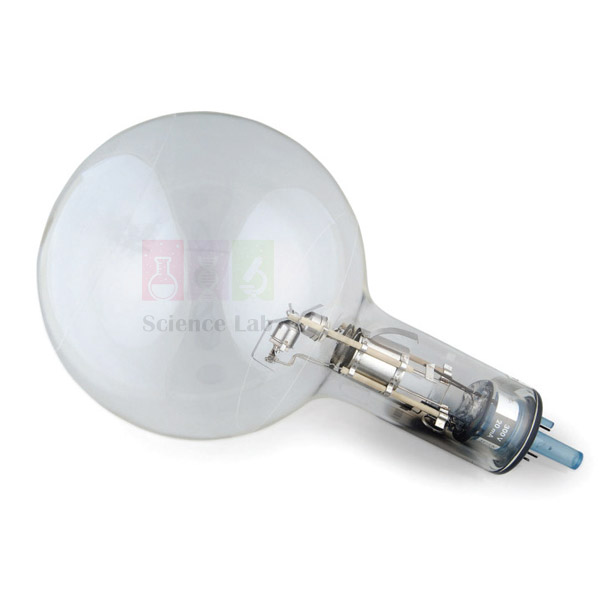
Teltron Dual Beam Tube S
Teltron Dual Beam Tube S (Product Code: SLE/PHY/53) is a Teltron S-series electron tube containing low-pressure helium and two electron guns, used to measure the electron charge-to-mass ratio from the diameter of a visible beam pattern in physics laboratories. Its anode runs at up to 300 V DC, with an anode current of approx. 30 mA at 200 V, and instructions are included. It is supplied by Jain Scientific Equipments Pvt Ltd (ScienceLab), Ambala, India.
Specifications
| Parameter | Detail |
|---|---|
| Series | Teltron S series |
| Tube type | Semi-evacuated, low-pressure helium filling |
| Electron guns | One tangential, one axial |
| Max. anode voltage | 300 V DC |
| Anode current | Approx. 30 mA at 200 V (anode) |
| Max. filament voltage | 7.5 V |
| Max. deflection voltage | 50 V DC |
| Documentation | Instructions included |
| Product code | SLE/PHY/53 |
| Supplied by | Jain Scientific Equipments Pvt Ltd (ScienceLab), Ambala, India |
What Is the Dual Beam Tube S Used For?
For the e/m experiment, the tube sits between Helmholtz coils so the magnetic field is perpendicular to the tangential beam. Students set an accelerating voltage, adjust the coil current until the glowing beam closes into a circle, and read its diameter; with the field worked out from the coil current, e/m follows from the standard relation. Repeating at several voltage and current settings gives a dependable average for this EM ratio apparatus exercise.
The axial gun adds a second investigation: with a co-axial magnetic field, the fine luminescent beams show impact excitation of helium atoms and particle collisions, linking electron physics to kinetic gas theory. Two investigations from one tube help physics departments in India get more from a single S-series set-up.
What to Specify When Ordering
- Whether your lab already has the Teltron Tube Holder S and Teltron Helmholtz Pair of Coils S.
- A power source able to give up to 300 V DC on the anode, 7.5 V on the filament and 50 V DC for deflection.
- An ammeter to set the Helmholtz coil current.
Supplier
Jain Scientific Equipments Private Limited, known by its trading name ScienceLab, supplies the Teltron Dual Beam Tube S from Ambala, Haryana, India. Teltron is a third-party brand; the company sources the tube for teaching laboratories and can bundle it with S-series holders and coils in a single quotation.
Buyers who need registration details can use GSTIN 06AAECJ8618A1ZT, and international orders are shipped under the company's Importer-Exporter Code AAECJ8618A issued by the DGFT. Visit our profile page for more.
Related Physics Lab Equipment
Complete an e/m practical with the Teltron Dual Beam Tube S using these items:
- Teltron Tube Holder S — stand for the S-series tube and its coils.
- Teltron Helmholtz Pair of Coils S — the perpendicular field that bends the beam into a circle.
- High Tension Power Supply — supply designed for thermionic experiments with Teltron fine beam tubes.
- Digital Voltmeter/Ammeter With Shunts — reads the coil current for the field calculation.
- Teltron Dual Beam Tube D — the D-series version of this tube.
More options are in Physics Lab Equipment.
Frequently Asked Questions
How is e/m found with the Teltron Dual Beam Tube S?
With the Teltron Dual Beam Tube S, the tangential beam is bent into a circle by a perpendicular magnetic field. Measuring the circle's diameter, the accelerating voltage and the field strength lets students calculate the electron charge-to-mass ratio.
Why is the beam visible in the Teltron Dual Beam Tube S?
The Teltron Dual Beam Tube S is semi-evacuated and filled with low-pressure helium. Electrons excite the helium atoms along their path, producing fine luminescent beams that make the trajectory visible to the whole group.
What voltages does the Teltron Dual Beam Tube S use?
The Teltron Dual Beam Tube S has a maximum anode voltage of 300 V DC, a maximum filament voltage of 7.5 V and a maximum deflection voltage of 50 V DC, with an anode current of approx. 30 mA at 200 V.
Are instructions provided with the Teltron Dual Beam Tube S?
Yes, instructions are included with the Teltron Dual Beam Tube S. Keep them with the tube, and check the voltage limits in them before connecting a new or different power supply.
Who supplies the Teltron Dual Beam Tube S?
The Teltron Dual Beam Tube S is supplied by Jain Scientific Equipments Pvt Ltd (ScienceLab), Ambala, India. Teltron is a third-party brand; the company sources the tube for schools, colleges and universities in India and international markets.
What should a Teltron Dual Beam Tube S quotation request include?
For the Teltron Dual Beam Tube S, give the number of tubes, say which S-series holder, coils and supply you already own, and name the delivery destination. Send the request through our contact page or the enquiry cart.
Request a Quote
Get a Teltron Dual Beam Tube S quotation by writing to us on the contact page, or add the tube and matching S-series items to the enquiry cart.
Last updated: 24 September 2026
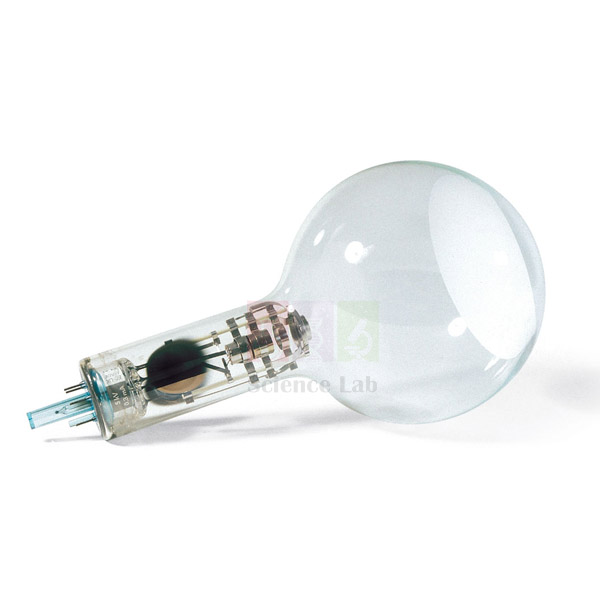
Teltron Electron Diffraction Tube S
Teltron Electron Diffraction Tube S (Product Code: SLE/PHY/54) is a highly evacuated Teltron S-series electron tube used to make electron interference visible as Debye–Scherrer rings on a fluorescent screen in physics laboratories. Students measure the rings produced by a polycrystalline graphite lattice and use the lattice spacing to find the electron wavelength at anode voltages up to 5 kV. It is supplied by Jain Scientific Equipments Pvt Ltd (ScienceLab), Ambala, India.
Specifications
| Parameter | Detail |
|---|---|
| Series | Teltron S series |
| Diffracting lattice | Polycrystalline graphite (Debye–Scherrer diffraction) |
| Lattice constant d10 | 0.213 nm |
| Lattice constant d11 | 0.123 nm |
| Max. anode voltage | 5 kV |
| Anode current | Approx. 0.1 mA at 4 kV |
| Max. filament voltage | 6.3 V AC |
| Documentation | Instructions included |
| Product code | SLE/PHY/54 |
| Supplied by | Jain Scientific Equipments Pvt Ltd (ScienceLab), Ambala, India |
What Is the Electron Diffraction Tube S Used For?
In the lab, the Teltron Electron Diffraction Tube S turns an abstract idea — electrons behaving as waves — into bright rings that students can measure. The inner and outer rings correspond to the two graphite lattice plane spacings, d10 = 0.213 nm and d11 = 0.123 nm, so each ring gives its own estimate of the electron wavelength.
A typical run records ring diameters at a series of anode voltages and then compares the measured wavelength with the de Broglie value calculated from each voltage. For departments buying from a physics instruments supplier in India, the tube slots into an existing S-series set-up and needs a filament supply of up to 6.3 V AC plus a high-voltage anode supply.
What to Specify When Ordering
- Whether you need the Teltron Tube Holder S to mount the tube.
- A power supply covering 6.3 V AC filament and up to 5 kV anode voltage.
- Number of tubes for demonstration or student groups.
Supplier
ScienceLab, the brand name of Jain Scientific Equipments Private Limited, supplies the Teltron Electron Diffraction Tube S to physics departments from Ambala, Haryana, India. Teltron is a third-party brand; the company sources the tube and can match it with the S-series holder and a high-voltage supply on one quotation. Find out more on our profile page.
Related Physics Lab Equipment
These items help you run the diffraction experiment with the Teltron Electron Diffraction Tube S:
- Teltron Tube Holder S — S-series stand with a fuse that protects tubes from excessive voltage.
- EHT Power Supply — adjustable 5 kV output with an auxiliary heater output.
- Teltron Dual Beam Tube S — S-series tube showing the electron's particle behaviour through e/m.
- Teltron Electron Diffraction Tube D — the D-series version of the same experiment.
Discover more in Physics Lab Equipment.
Frequently Asked Questions
How are the rings measured with the Teltron Electron Diffraction Tube S?
Students measure the diameters of the diffraction rings on the fluorescent screen of the Teltron Electron Diffraction Tube S, halve them to get the radii, and repeat at several anode voltages to see how the electron wavelength changes.
Which lattice spacings are used with the Teltron Electron Diffraction Tube S?
Calculations with the Teltron Electron Diffraction Tube S use the graphite lattice constants d10 = 0.213 nm and d11 = 0.123 nm, which correspond to the two diffraction rings seen on the screen.
What are the electrical limits of the Teltron Electron Diffraction Tube S?
The Teltron Electron Diffraction Tube S has a maximum filament voltage of 6.3 V AC and a maximum anode voltage of 5 kV, with an anode current of approx. 0.1 mA at 4 kV. Staying within these limits protects the tube.
Which holder is used with the Teltron Electron Diffraction Tube S?
Teltron S-series tubes are mounted on the Teltron Tube Holder S, which is listed as a separate product. Tell us whether your lab already has one when you request a quotation for the Teltron Electron Diffraction Tube S.
Who supplies the Teltron Electron Diffraction Tube S?
The Teltron Electron Diffraction Tube S is supplied by Jain Scientific Equipments Pvt Ltd (ScienceLab), Ambala, India. Teltron is a third-party brand, and the company sources the tube for teaching laboratories in India and international markets.
What should a Teltron Electron Diffraction Tube S enquiry include?
For the Teltron Electron Diffraction Tube S, state the quantity, whether you need the Tube Holder S and a high-voltage supply, and the delivery destination. Send the details through the contact page or add the items to the enquiry cart.
Request a Quote
For Teltron Electron Diffraction Tube S pricing, contact us through the contact page, or add the tube and S-series accessories to the enquiry cart.
Last updated: 24 September 2026
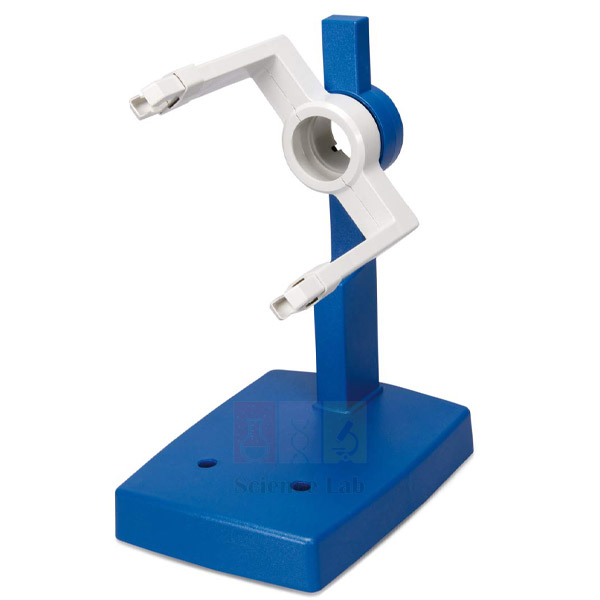
Teltron Tube Holder D
Teltron Tube Holder D (Product Code: SLE/PHY/55) is a support stand used to hold Teltron D-series electron tubes and their accessories securely during electron-beam experiments in physics laboratories. College and senior-school physics departments use it as the base of the whole D-series set-up, because its cast light alloy stand carries a 360° rotating clamp and two base holes for the Teltron D Helmholtz Coils. It is supplied by Jain Scientific Equipments Pvt Ltd (ScienceLab), Ambala, India, a physics instruments supplier to Indian and international buyers.
Specifications
| Parameter | Detail |
|---|---|
| Holds | The complete range of Teltron D-series tubes and accessories |
| Stand | Cast light alloy with a wishbone |
| Clamp | 360° rotating clamp made of heat-resistant plastic |
| Feet | Three rubber feet to prevent slipping and give stability |
| Coil mounting | Two holes in the base for affixing the Teltron D Helmholtz Coils |
| Earthing | 4 mm earthing socket in the pillar base |
| Dimensions | Approx. 230 x 175 x 320 mm |
| Weight | Approx. 1.5 kg |
| Documentation | Instructions included |
| Product code | SLE/PHY/55 |
| Supplied by | Jain Scientific Equipments Pvt Ltd (ScienceLab), Ambala, India |
What Is the Teltron Tube Holder D Used For?
The holder is the mechanical base of a Teltron D-series demonstration. The glass tube sits in the wishbone clamp, which turns through 360° so the tube screen can be angled towards the class, while a pair of Helmholtz coils fixes into the two base holes and stays lined up around the tube. This rigid arrangement is what makes electron-beam deflection, diffraction and specific charge (e/m) experiments with physics lab equipment repeatable from one lesson to the next.
Before switching on the tube supply, connect the 4 mm earthing socket in the pillar base as the included instructions describe. The three rubber feet keep the stand from sliding on a smooth bench, but it should still be placed away from the bench edge. Let a tube cool after use before loosening the clamp, and lift glass tubes by their bodies rather than by the connecting pins.
What to Specify When Ordering
- Tube series: this holder is for Teltron D-series tubes; laboratories using S-series tubes need the S version.
- Which D-series tubes you already have or are ordering with the holder.
- Whether the Teltron Helmholtz Pair of Coils D should be quoted together with the stand.
- Number of holders needed, usually one per demonstration station.
Supplier
Jain Scientific Equipments Private Limited trades as ScienceLab and supplies this Teltron-brand tube holder from Ambala, Haryana. Teltron is a separate brand, so the company sources the holder rather than producing it, and can quote it alongside the matching D-series tubes and coils so a department receives one consolidated offer. Company details are on the ScienceLab company profile.
Related Physics Lab Equipment
These items are used with the tube holder in electron-beam work:
- Teltron Helmholtz Pair of Coils D — fixes into the holder’s base holes to apply a uniform magnetic field across the tube.
- Teltron Electron Deflection Tube D — a D-series tube the clamp holds for beam-deflection experiments.
- Teltron Electron Diffraction Tube D — shows the wave nature of electrons using the same stand.
- Teltron Maltese Cross Tube D — another D-series tube for showing that electron beams travel in straight lines.
- Teltron Tube Holder S — the holder to choose if your laboratory works with S-series tubes.
See the full range in Physics Lab Equipment.
Frequently Asked Questions
What does the Teltron Tube Holder D hold?
The Teltron Tube Holder D holds the complete range of Teltron D-series tubes and their accessories. The tube sits in a 360° rotating clamp made of heat-resistant plastic, carried on a cast light alloy stand with a wishbone.
Can Helmholtz coils be mounted on the Teltron Tube Holder D?
Yes. The Teltron Tube Holder D has two holes in its base for affixing the Teltron D Helmholtz Coils, so the coils stay in position around the tube during magnetic-deflection experiments.
How big and heavy is the Teltron Tube Holder D?
The Teltron Tube Holder D measures approximately 230 x 175 x 320 mm and weighs about 1.5 kg. Three rubber feet under the base stop it from slipping on the laboratory bench.
Does the Teltron Tube Holder D have an earth connection?
Yes. The pillar base of the Teltron Tube Holder D includes a 4 mm earthing socket. Follow the instructions supplied with the holder and your tube when connecting it before an experiment.
Who supplies the Teltron Tube Holder D?
Jain Scientific Equipments Pvt Ltd (ScienceLab) of Ambala, India, supplies the Teltron Tube Holder D (SLE/PHY/55). Teltron is a separate brand; ScienceLab sources the holder and quotes it for schools, colleges and dealers.
What should a quotation request for the Teltron Tube Holder D include?
For the Teltron Tube Holder D, state the quantity, the D-series tubes you use, whether the D Helmholtz coils are needed and the delivery location. Send these details through the contact page.
Request a Quote
To order the Teltron Tube Holder D for your laboratory, send your requirement through the ScienceLab contact page or add the item to the enquiry cart. ScienceLab supplies institutions, dealers and importers in India and international markets.
Last updated: 24 September 2026
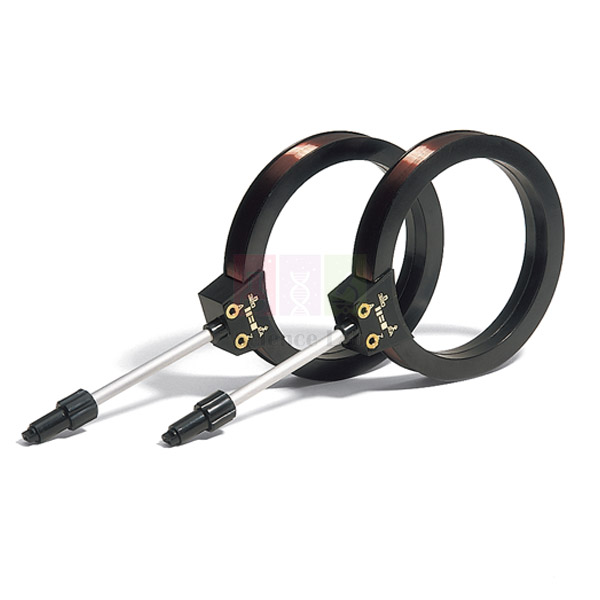
Teltron Helmholtz Pair of Coils D
Teltron Helmholtz Pair of Coils D (Product Code: SLE/PHY/56) is a pair of Helmholtz coils used to generate a uniform magnetic field perpendicular to the axis of Teltron D-series tubes in electron-beam experiments. University and senior-school physics laboratories use it with an EM ratio apparatus set-up; the coils have 320 turns and reach a maximum field of approximately 10 mT. It is supplied by Jain Scientific Equipments Pvt Ltd (ScienceLab), Ambala, India.
Specifications
| Parameter | Detail |
|---|---|
| Function | Uniform magnetic field perpendicular to the axis of Teltron D-series tubes |
| Configurations | Helmholtz geometry, or fields aligned vertically or coaxial with respect to the tube axis |
| Number of turns | 320 |
| Max. continuous current | 1.0 A |
| Max. momentary current | 1.5 A for 10 min; 2 A for 3 min |
| Effective impedance | 6 ohm |
| Max. field strength | Approx. 10 mT |
| Connectors | 4 mm sockets |
| Documentation | Instructions included |
| Product code | SLE/PHY/56 |
| Supplied by | Jain Scientific Equipments Pvt Ltd (ScienceLab), Ambala, India |
What Are Teltron Helmholtz Coils D Used For?
Two identical coils set up in Helmholtz geometry give a nearly uniform field in the space between them, which is where a D-series tube sits. When current flows, the electron beam inside the tube bends into a curve, and by recording the coil current and the tube’s accelerating voltage students can work through a specific charge electron experiment to estimate e/m. The same pair can also be arranged to give a vertical field or a field coaxial with the tube, so one set of coils covers several deflection studies.
Keep the coil current at or below 1.0 A for continuous running; 1.5 A is allowed for up to 10 minutes and 2 A for up to 3 minutes, after which the coils should rest. An ammeter in series makes it easy to stay within these limits. For scale, the approx. 10 mT maximum is about 300 times weaker than the roughly 3 T field of an MRI scanner.
What to Specify When Ordering
- Tube series: these coils suit Teltron D-series tubes; an S-series version is listed separately.
- Whether you also need the Teltron Tube Holder D, whose base has holes for fixing the coils.
- The DC supply and ammeter you will use to drive and monitor the coil current.
- Number of coil pairs, one per demonstration set-up.
Supplier
ScienceLab is the trading name of Jain Scientific Equipments Private Limited, which supplies this Teltron-brand coil pair from Ambala, Haryana. Because Teltron is an outside brand, the company sources the coils and quotes them together with the tube holder and D-series tubes when a department needs the complete arrangement. For vendor registration, the supplying company’s GSTIN is 06AAECJ8618A1ZT and its LEI is 3358004HRD1JIVXKYX49. More background is on the ScienceLab profile page.
Related Physics Lab Equipment
Items that complete a Helmholtz-coil experiment:
- Teltron Tube Holder D — stand whose two base holes take these coils and hold the tube between them.
- Teltron Electron Deflection Tube D — a D-series tube whose beam the coils deflect.
- Teltron Dual Beam Tube D — another D-series tube used inside the coil field.
- Power Supply Variable — a variable supply for setting the coil current; confirm its rating with us.
- Dual Range Ammeter — to monitor coil current against the 1.0 A continuous limit.
Browse more apparatus in Physics Lab Equipment.
Frequently Asked Questions
What field does the Teltron Helmholtz Pair of Coils D produce?
The Teltron Helmholtz Pair of Coils D produces a uniform magnetic field perpendicular to the axis of Teltron D-series tubes, with a maximum field strength of approximately 10 mT when set up in Helmholtz geometry.
How much current can the Teltron Helmholtz Pair of Coils D carry?
The Teltron Helmholtz Pair of Coils D is rated for 1.0 A continuous current. Higher currents are momentary only: 1.5 A for 10 minutes or 2 A for 3 minutes. The effective impedance is 6 ohm.
Can the Teltron Helmholtz Pair of Coils D be used in other arrangements?
Yes. Besides the Helmholtz geometry, the Teltron Helmholtz Pair of Coils D can be configured to produce magnetic fields aligned vertically, or coaxial, with respect to the tube axis, as described in the included instructions.
How are the Teltron Helmholtz Pair of Coils D connected?
The Teltron Helmholtz Pair of Coils D connects through 4 mm sockets, so standard 4 mm laboratory leads link it to a DC supply and a series ammeter. The coils have 320 turns.
Who supplies the Teltron Helmholtz Pair of Coils D?
Jain Scientific Equipments Pvt Ltd (ScienceLab), Ambala, India, supplies the Teltron Helmholtz Pair of Coils D (SLE/PHY/56). Teltron is a separate brand; ScienceLab sources the coils and quotes them for institutions and dealers.
What details speed up a quotation for the Teltron Helmholtz Pair of Coils D?
For the Teltron Helmholtz Pair of Coils D, give the quantity, the tubes and holder you use, any power supply or ammeter needed and the delivery location through the contact page.
Request a Quote
Ask for a price on the Teltron Helmholtz Pair of Coils D through the ScienceLab contact page, or add it to the enquiry cart with the matching holder and tubes. Supply covers India and international markets.
Last updated: 24 September 2026
206.jpg)
Cylinders, Metal (Set of 6)
Cylinders, Metal (Set of 6) (Product Code: SLE/PHY/57) is a set of six precision metal cylinders used to measure and compare the density of different metals in physics practicals. Each cylinder has a 10 mm diameter and is made of a different metal — brass, lead, iron, copper, aluminium or zinc — and the set comes in a wooden block. It is made by Jain Scientific Equipments Pvt Ltd (ScienceLab), an OEM manufacturer, at its own factory in Ambala, India, as physics practical equipment for CBSE and other syllabi.
Specifications
| Parameter | Detail |
|---|---|
| Purpose | Precision cylinders for experiments on density |
| Pieces per set | 6 |
| Metals | Brass, lead, iron, copper, aluminium and zinc |
| Diameter | 10 mm |
| Storage | Supplied in a wooden block |
| Product code | SLE/PHY/57 |
| Manufacturer | Jain Scientific Equipments Pvt Ltd (ScienceLab) — OEM |
| Country of origin | India (made in Ambala, Haryana) |
What Are Metal Density Cylinders Used For?
The classic exercise is to find the density of each metal from its dimensions. Students measure the diameter and length of a cylinder with a vernier caliper, work out the volume as πr²h, weigh the cylinder on a balance and divide mass by volume. Repeating this for all six metals shows clearly why a lead cylinder feels so much heavier than an aluminium one of the same diameter.
The same cylinders can be lowered into a measuring cylinder of water to find volume by displacement, letting a class compare the geometric and displacement methods and discuss measurement error. Return each cylinder to its place in the wooden block after use to avoid dents, and have students wash their hands after handling the lead piece.
OEM Manufacturer
Jain Scientific Equipments Private Limited, trading as ScienceLab, is the OEM (original equipment manufacturer) of this cylinder set and produces it at its own licensed factory at Saha, Ambala, Haryana, India. Because the maker supplies schools, colleges, dealers and importers directly, a lost or damaged cylinder can be raised with the same team that made the set — ask us about a replacement. Read more on the ScienceLab company profile.
Related Physics Lab Equipment
Other apparatus needed for a density practical:
- Caliper Vernier (Metal) — measures cylinder diameter and length for the volume calculation.
- Triple-Beam Balance — weighs each cylinder to find its mass.
- Glass Measuring Cylinder — finds volume by water displacement as a cross-check.
- Metal Density Cubes (Set of 6) — the same density study with equal-sized cubes instead of cylinders.
More apparatus is listed under Physics Lab Equipment.
Frequently Asked Questions
Which metals are in the Cylinders, Metal (Set of 6)?
The Cylinders, Metal (Set of 6) contains one cylinder each of brass, lead, iron, copper, aluminium and zinc. All six have a 10 mm diameter and are supplied together in a wooden block.
What size are the metal cylinders in this set?
Each cylinder in the Cylinders, Metal (Set of 6) has a diameter of 10 mm. The length is not listed on this page; if you need it for worksheets, ask us through the contact page before ordering.
How do students find density with the Cylinders, Metal (Set of 6)?
With the Cylinders, Metal (Set of 6), students measure each cylinder’s diameter and length, calculate its volume, weigh it on a balance and divide mass by volume to compare the densities of the six metals.
Who manufactures the Cylinders, Metal (Set of 6)?
Jain Scientific Equipments Pvt Ltd (ScienceLab) manufactures the Cylinders, Metal (Set of 6) as the OEM at its own licensed factory at Saha, Ambala, Haryana, India, and supplies it directly to institutions and dealers.
How should the Cylinders, Metal (Set of 6) be stored and handled?
Keep the Cylinders, Metal (Set of 6) in its wooden block when not in use so pieces are not lost or dented. Students should wash their hands after handling the lead cylinder.
Can ScienceLab supply the Cylinders, Metal (Set of 6) in bulk?
Yes. ScienceLab supplies the Cylinders, Metal (Set of 6) in class quantities to schools, colleges, dealers and importers in India and international markets. Share the number of sets and delivery location for a quotation.
Request a Quote
Send your quantity through the ScienceLab contact page or add the set to the enquiry cart. Quotations come direct from the manufacturer in Ambala.
Last updated: 24 September 2026
388.jpg)
Metal Density Cubes (Set of 6)
Metal Density Cubes (Set of 6) (Product Code: SLE/PHY/58) is a set of six equal-sized metal cubes used to show how density differs from one metal to another in physics and general science lessons. Because every cube has a 20 mm side, students can compare brass, lead, zinc, copper, aluminium and iron simply by weighing them, a staple of school physics lab equipment in India. The set is made by Jain Scientific Equipments Pvt Ltd (ScienceLab), an OEM manufacturer, at its own factory in Ambala, India.
Specifications
| Parameter | Detail |
|---|---|
| Cubes per set | 6 |
| Side length | 20 mm (2 cm) |
| Volume of each cube | 8 cm³ (calculated from the 20 mm side) |
| Metals | Brass, lead, zinc, copper, aluminium and iron |
| Product code | SLE/PHY/58 |
| Manufacturer | Jain Scientific Equipments Pvt Ltd (ScienceLab) — OEM |
| Country of origin | India (made in Ambala, Haryana) |
What Are Metal Density Cubes Used For?
Equal volume is the whole point of this set. Since each cube measures 2 cm along every edge, its volume is 8 cm³, so dividing the mass in grams by 8 gives the density in g/cm³ directly. Before weighing, ask students to rank the cubes by feel and then check their predictions on a balance — the gap between aluminium and lead usually surprises them.
The cubes also support class 9 density and relative density lessons in a science lab kit, and older students can measure the edges with a vernier caliper to confirm the volume rather than assuming it. Keep the six cubes together in a labelled tray or box, and remind learners to wash their hands after handling lead.
What to Specify When Ordering
- Set size: this six-cube set includes zinc; the seven-cube Metal Density Cube Set adds steel and tin instead of zinc.
- Number of sets, for example one per student group.
- Whether a balance or vernier caliper should be quoted with the cubes.
OEM Manufacturer
These density cubes come from Jain Scientific Equipments Private Limited, which trades as ScienceLab and acts as their OEM (original equipment manufacturer). They are produced at the company’s own licensed factory at Saha, Ambala, Haryana, India, rather than bought in from a trader, so schools, dealers and importers deal with the maker for quotations and repeat orders. Company background is on the ScienceLab profile page.
Related Physics Lab Equipment
Useful companions for density work:
- Metal Density Cube Set — seven-cube alternative that includes steel and tin.
- Cylinders, Metal (Set of 6) — 10 mm cylinders for practising volume calculation with a curved shape.
- Caliper Vernier (Metal) — checks the cube edges before calculating volume.
- Balance Triple Beam — weighs each cube to find its mass.
Find more in Physics Lab Equipment.
Frequently Asked Questions
Which metals are included in the Metal Density Cubes (Set of 6)?
The Metal Density Cubes (Set of 6) includes one cube each of brass, lead, zinc, copper, aluminium and iron, giving a spread from light to heavy metals for density comparisons.
What size is each cube in the Metal Density Cubes (Set of 6)?
Each cube in the Metal Density Cubes (Set of 6) has a 20 mm side. That gives every cube a volume of 8 cm³, so mass in grams divided by 8 gives density in g/cm³.
How does the Set of 6 differ from the Metal Density Cube Set?
The Metal Density Cubes (Set of 6) contains six 20 mm cubes including zinc. The Metal Density Cube Set has seven 20 mm cubes and swaps zinc for steel and tin.
Who manufactures the Metal Density Cubes (Set of 6)?
Jain Scientific Equipments Pvt Ltd (ScienceLab) is the OEM manufacturer of the Metal Density Cubes (Set of 6), producing them at its own licensed factory at Saha, Ambala, Haryana, India.
Do students need a measuring cylinder to use the Metal Density Cubes (Set of 6)?
No. The Metal Density Cubes (Set of 6) are regular 20 mm cubes, so volume comes from the side length. A balance is needed for mass; a measuring cylinder is optional for a displacement cross-check.
How can I get a quotation for the Metal Density Cubes (Set of 6)?
Send the number of Metal Density Cubes (Set of 6) sets, any balances or calipers needed and your delivery location through the contact page; the quotation comes from the manufacturer.
Request a Quote
Order the Metal Density Cubes (Set of 6) through the ScienceLab contact page or the enquiry cart. Prices are quoted directly by the manufacturer for schools, colleges and dealers in India and international markets.
Last updated: 24 September 2026
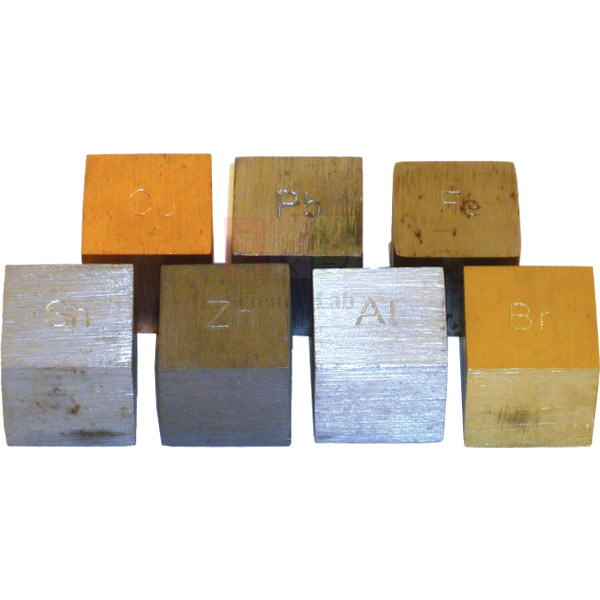
Metal Density Cube Set
Metal Density Cube Set (Product Code: SLE/PHY/59) is a set of seven 20 mm metal cubes used to investigate density and identify metals by measurement in physics, chemistry and materials classes. It covers brass, lead, steel, copper, aluminium, iron and tin, so learners can compare iron with steel as well as very light and very heavy metals in one physics experiment kit for school. It is made by Jain Scientific Equipments Pvt Ltd (ScienceLab), an OEM manufacturer, at its own factory in Ambala, India.
Specifications
| Parameter | Detail |
|---|---|
| Cubes in the set | 7 |
| Metals | Brass, lead, steel, copper, aluminium, iron and tin |
| Side of each cube | 20 mm |
| Product code | SLE/PHY/59 |
| Manufacturer | Jain Scientific Equipments Pvt Ltd (ScienceLab) — OEM |
| Country of origin | India (made in Ambala, Haryana) |
What Is a Metal Density Cube Set Used For?
A popular use is the “identify the metal” challenge: a group is handed one cube, measures its edges, weighs it, calculates density and matches the answer against data-book values. With a 20 mm edge the volume works out to 8 cm³, which keeps the arithmetic manageable for younger students while still rewarding careful weighing.
Including both iron and steel makes a useful teaching point: their densities are so close that density alone cannot always separate an element from its alloy, which opens a discussion about how alloys are told apart using other properties. Tin and lead, both soft metals, show that similar-feeling materials can still differ greatly in density. Students should wash their hands after handling the lead cube.
What to Specify When Ordering
- Seven-cube set (with steel and tin) or the six-cube set that includes zinc.
- Number of sets for your practical groups.
- Any balance, caliper or measuring cylinder to be quoted alongside.
OEM Manufacturer
ScienceLab is the trading name of Jain Scientific Equipments Private Limited (CIN U29309HR2020PTC087597), the OEM (original equipment manufacturer) behind this cube set. Production takes place at the company’s own licensed factory at 449, HSIIDC Industrial Area, Saha, Ambala, Haryana, India (Factory Licence AMB-ONLINE-CHD-J-414), and the sets go factory-direct to schools, colleges, dealers and importers. For repeat orders or a missing cube, ask the manufacturer directly; company details are on the ScienceLab profile.
Related Physics Lab Equipment
Apparatus that pairs with the cube set:
- Metal Density Cubes (Set of 6) — six-cube version that includes zinc.
- Caliper Vernier (Metal) — measures cube edges accurately before the volume is calculated.
- Double Beam Balance — finds the mass of each cube.
- Measuring Cylinder, Polypropylene — a plastic alternative to glass for checking volume by displacement.
- Cylinders, Metal (Set of 6) — density practice with cylindrical samples.
Explore the full Physics Lab Equipment range.
Frequently Asked Questions
Which metals are in the Metal Density Cube Set?
The Metal Density Cube Set contains seven cubes: brass, lead, steel, copper, aluminium, iron and tin. Having both iron and steel lets students compare a metal with a closely related alloy.
What is the size of the cubes in the Metal Density Cube Set?
Every cube in the Metal Density Cube Set has a 20 mm side, so each has a volume of 8 cm³ and density can be found from mass without a displacement measurement.
How is the Metal Density Cube Set different from the six-cube set?
The Metal Density Cube Set has seven 20 mm cubes and includes steel and tin. The Metal Density Cubes (Set of 6) has six 20 mm cubes and includes zinc instead.
Who manufactures the Metal Density Cube Set?
Jain Scientific Equipments Pvt Ltd (ScienceLab) manufactures the Metal Density Cube Set as the OEM at its own licensed factory at Saha, Ambala, Haryana, India, and quotes it directly to buyers.
Is the Metal Density Cube Set suitable for identifying unknown metals?
Yes. With the Metal Density Cube Set, students calculate density from mass and the 20 mm edge, then compare it with reference values to name the metal. Iron and steel may need an extra test.
What information should a quotation request for the Metal Density Cube Set include?
For the Metal Density Cube Set, state the number of sets, any balances or measuring cylinders required and the delivery location. Send the request through the contact page.
Request a Quote
Request pricing for the Metal Density Cube Set on the ScienceLab contact page or through the enquiry cart. You receive the quotation straight from the manufacturer, for delivery in India and international markets.
Last updated: 24 September 2026
Stackable Leads
Stackable Leads (Product Code: SLE/PHY/60) are black 4 mm stackable connecting leads used to wire power supplies, meters and components together in physics and electronics practicals. Each lead is 500 mm long, and the stackable design lets another lead plug into the back of the first, so several connections can share one terminal — everyday physics lab equipment for schools. They are made by Jain Scientific Equipments Pvt Ltd (ScienceLab), an OEM manufacturer, at its own factory in Ambala, India.
Specifications
| Parameter | Detail |
|---|---|
| Type | 4 mm stackable lead |
| Length | 500 mm |
| Colour | Black |
| Product code | SLE/PHY/60 |
| Manufacturer | Jain Scientific Equipments Pvt Ltd (ScienceLab) — OEM |
| Country of origin | India (made in Ambala, Haryana) |
What Are Black Stackable Leads Used For?
By convention, black leads carry the negative, 0 V or common-return side of a circuit. Teaching students to take every black lead back to the supply’s negative terminal makes a circuit on the bench easy to check against its diagram, and it cuts down wiring mistakes when meters are added. That habit carries straight into an Ohm’s law experiment kit or any series-and-parallel investigation.
Stacking is what saves time: when two branches must meet at the same terminal, the second black lead plugs into the back of the first rather than needing an extra connector. Pull a lead out by its plug body, not the cable, and set aside any lead whose plug has become loose or whose insulation is damaged.
What to Specify When Ordering
- Colour: this listing is black; red and yellow stackable leads are listed separately.
- Quantity of each colour per bench or per student group.
- Length: each lead is 500 mm, so check that it spans your usual bench layout.
OEM Manufacturer
Jain Scientific Equipments Private Limited, known by its trading name ScienceLab, is the OEM (original equipment manufacturer) of these leads and makes them at its own licensed factory at Saha, Ambala, Haryana, India. Because the black, red and yellow versions come from the same maker, a school can order a matched colour set in one quotation and reorder any single colour later. See the ScienceLab company profile for more about the company.
Related Physics Lab Equipment
Leads and instruments often ordered together:
- Stackable Leads Red — the positive-side partner to the black lead.
- Stackable Leads Yellow — a third colour for marking a separate branch or meter link.
- Crocodile Clips & Leads — for connecting to components that have no 4 mm socket.
- Digital Multimeter — measures the current and voltage in circuits wired with these leads.
- Power Supply Variable — a bench supply to power the circuit.
More items are in Physics Lab Equipment.
Frequently Asked Questions
What length and plug size are the Stackable Leads?
The Stackable Leads are 4 mm stackable leads with a length of 500 mm. The 4 mm size is the common socket size on school power supplies, meters and component boards.
What colour are the Stackable Leads in this listing?
The Stackable Leads listed under SLE/PHY/60 are black. Red and yellow Stackable Leads are listed separately, so a lab can colour-code negative, positive and branch connections.
What does “stackable” mean on the Stackable Leads?
Stackable means another lead can plug into the back of a Stackable Leads plug, so two or more connections can share one terminal without an extra junction block or adapter.
What voltage and current are the Stackable Leads rated for?
The voltage and current rating of the Stackable Leads is not stated in this listing. Ask us through the contact page and we will confirm it before you use the leads for your application.
Who manufactures the Stackable Leads?
Jain Scientific Equipments Pvt Ltd (ScienceLab) manufactures the Stackable Leads as the OEM at its own licensed factory at Saha, Ambala, Haryana, India, and supplies them directly to schools, colleges and dealers.
Can Stackable Leads be ordered in bulk for a whole lab?
Yes. Stackable Leads can be quoted in class and lab quantities, mixed with the red and yellow versions, for buyers in India and international markets. Share quantities per colour when requesting a price.
Request a Quote
List the number of black, red and yellow leads you need on the ScienceLab contact page or add them to the enquiry cart. The quotation comes directly from the manufacturer.
Last updated: 24 September 2026

Stackable Leads Red
Stackable Leads Red (Product Code: SLE/PHY/61) is a red 4 mm stackable lead used to make the positive-side connections in laboratory circuits, from the supply’s positive terminal to switches, meters and components. It measures 500 mm, and its stackable plug accepts a second lead in its back, so one positive terminal can feed several branches of an AC DC circuits experiment. It is made by Jain Scientific Equipments Pvt Ltd (ScienceLab), an OEM manufacturer, at its own factory in Ambala, India.
Specifications
| Parameter | Detail |
|---|---|
| Lead type | 4 mm stackable |
| Colour | Red |
| Length | 500 mm |
| Product code | SLE/PHY/61 |
| Manufacturer | Jain Scientific Equipments Pvt Ltd (ScienceLab) — OEM |
| Country of origin | India (made in Ambala, Haryana) |
What Are Red Stackable Leads Used For?
Red is the conventional colour for the positive side of a DC circuit, so a red lead signals “this goes to plus” before anyone traces the wire. Polarity matters most when ammeters, voltmeters, diodes and electrolytic components are in the circuit; with all positive links in red, a teacher can glance along a bench and spot a reversed meter before it is switched on.
When a circuit has several parallel branches, the red leads for each branch can be stacked on the supply’s positive socket instead of being squeezed into a terminal. Keep red and black leads hung separately on a lead rack after the lesson, so the next class picks up correctly coloured pairs without sorting.
What to Specify When Ordering
- How many red leads are needed, usually matched one-for-one with black leads.
- Whether yellow leads are also required for branch or meter connections.
- Delivery location and whether the leads are part of a larger lab order.
OEM Manufacturer
ScienceLab is the trading name of Jain Scientific Equipments Private Limited, a registered MSME manufacturer (Udyam UDYAM-HR-01-0003714) and the OEM (original equipment manufacturer) of these red leads, made at its own licensed factory at Saha, Ambala, Haryana, India. Export consignments go out under Importer-Exporter Code AAECJ8618A (DGFT), so dealers and importers abroad buy from the same source as Indian schools. More is on the ScienceLab profile page.
Related Physics Lab Equipment
Items that complete a colour-coded circuit set:
- Stackable Leads — black 4 mm leads for the negative or return side.
- Stackable Leads Yellow — for picking out an extra branch.
- Banana/Alligator Cords — when one end must clip onto a bare wire or component leg.
- Dual Range Ammeter — a meter where correct red-to-positive wiring matters.
- Power Supply, Stepped — a bench supply for the circuit.
Browse Physics Lab Equipment for more.
Frequently Asked Questions
What are the specifications of the Stackable Leads Red?
The Stackable Leads Red is a 4 mm stackable lead in red, 500 mm long. It suits the 4 mm sockets found on most school power supplies, meters and circuit boards.
Why use red leads for positive connections?
Using Stackable Leads Red for every positive connection follows the usual colour convention, so students and teachers can check polarity at a glance, especially before switching on meters or polarity-sensitive components.
Can Stackable Leads Red be stacked on one socket?
Yes. The Stackable Leads Red has a stackable 4 mm plug, so another lead can be plugged into its back and several branches can be fed from a single positive terminal.
Who manufactures the Stackable Leads Red?
Jain Scientific Equipments Pvt Ltd (ScienceLab) is the OEM manufacturer of the Stackable Leads Red and makes it at its own licensed factory at Saha, Ambala, Haryana, India.
Is a current rating available for the Stackable Leads Red?
A current and voltage rating for the Stackable Leads Red is not given in this listing. Please ask through the contact page so we can confirm it for your intended use.
How do I order Stackable Leads Red with other colours?
Request Stackable Leads Red together with black and yellow stackable leads in one enquiry, giving quantities per colour; ScienceLab quotes all three directly as the manufacturer for India and international markets.
Request a Quote
Send the quantity of red leads, and any black or yellow leads, through the ScienceLab contact page or add them to the enquiry cart. Quotes come direct from the manufacturer.
Last updated: 24 September 2026
MES Bulb Holder
MES Bulb Holder (Product Code: SLE/PHY/62) is a lamp holder for MES (miniature Edison screw) lamps, used to add a small bulb to series and parallel circuits in school science laboratories. Its screw terminals let students attach wires quickly without soldering, and 10 mm fixing centres allow it to be screwed onto a board or base, which suits any electricity experiment kit for schools. It is made by Jain Scientific Equipments Pvt Ltd (ScienceLab), an OEM manufacturer, at its own factory in Ambala, India.
Specifications
| Parameter | Detail |
|---|---|
| Lamp type | MES (miniature Edison screw) lamps |
| Connections | Screw terminals, so wires are easily attached |
| Fixing centres | 10 mm |
| Product code | SLE/PHY/62 |
| Manufacturer | Jain Scientific Equipments Pvt Ltd (ScienceLab) — OEM |
| Country of origin | India (made in Ambala, Haryana) |
What Is an MES Bulb Holder Used For?
A bulb in a holder is often the first “output” young learners meet: close the circuit and the lamp lights, break it and the lamp goes out. With two or three MES holders on the bench, a class can compare bulb brightness in series and in parallel, see what happens when one bulb is unscrewed, and use a lamp as a simple continuity tester for conductors and insulators.
Because the holder has screw terminals, stripped wire ends or crocodile clips connect directly; tighten each terminal just enough to grip the wire. Match the lamp’s voltage marking to the cells or supply in use, screw bulbs in gently by hand, and let a lamp cool before changing it. For permanent teaching boards, the 10 mm fixing centres let the holder be screwed down neatly beside switches and cell holders.
OEM Manufacturer
ScienceLab is the brand under which Jain Scientific Equipments Private Limited trades, and the company is the OEM (original equipment manufacturer) of this bulb holder, made at its own licensed factory at Saha, Ambala, Haryana, India. Dealers and importers stocking basic electricity items can source the holder straight from the manufacturer along with the rest of their circuit range. Visit the ScienceLab profile to learn more.
Related Physics Lab Equipment
Other parts for a simple lamp circuit:
- Circuits Kit Bulb Holder — a bulb holder in the panel-mounted Circuits Kit format.
- Lamp Holder — an alternative holder for lamp circuits.
- Crocodile Clips & Leads — clip straight onto the screw terminals for fast wiring.
- Battery Holder, C — holds the cells that power the lamp.
- Knife Switch – Single Pole, Single Throw — switches the lamp on and off visibly.
Explore Physics Lab Equipment for more circuit parts.
Frequently Asked Questions
Which lamps fit the MES Bulb Holder?
The MES Bulb Holder takes MES (miniature Edison screw) type lamps, the small screw-in bulbs widely used in school circuit work. Choose a lamp voltage that matches your cells or power supply.
How are wires connected to the MES Bulb Holder?
The MES Bulb Holder has screw terminals, so stripped wire ends or crocodile clips can be attached directly. Loosen the screw, place the wire under it and tighten gently until it grips.
Can the MES Bulb Holder be fixed to a board?
Yes. The MES Bulb Holder has 10 mm fixing centres, so it can be screwed onto a wooden board or base to build a permanent demonstration or practice circuit.
Are bulbs included with the MES Bulb Holder?
This listing covers the MES Bulb Holder itself; lamps are not mentioned as included. If you need MES lamps with the holders, say so in your enquiry through the contact page.
Who manufactures the MES Bulb Holder?
Jain Scientific Equipments Pvt Ltd (ScienceLab) manufactures the MES Bulb Holder as the OEM at its own licensed factory at Saha, Ambala, Haryana, India, and supplies schools, dealers and importers directly.
What should I include when asking for an MES Bulb Holder quotation?
For an MES Bulb Holder quotation, give the number of holders, whether lamps, leads or switches are needed and the delivery location, so ScienceLab can quote the full circuit set in one reply.
Request a Quote
Ask for pricing on the MES Bulb Holder through the ScienceLab contact page or add it to the enquiry cart. Quotations are issued by the manufacturer for buyers in India and international markets.
Last updated: 24 September 2026

Materials Kit
A selection of materials in the form of rectangular blocks intended to familiarize the student with appearance, feel, texture, hardness and density of a range of common substances.
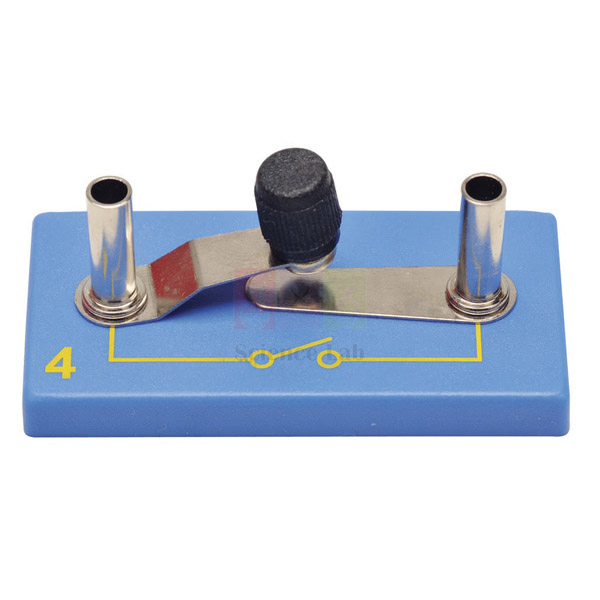
Push Switch Circuits Kit
Push Switch Circuits Kit (Product Code: SLE/PHY/64) is a spare push switch for the Circuits Kit, mounted on a sturdy panel and used to make or break a student circuit at the press of a button. Schools order it to replace a lost or worn switch or to extend existing kits, and the panel format is easy to use and store. It is made by Jain Scientific Equipments Pvt Ltd (ScienceLab), an OEM manufacturer, at its own factory in Ambala, India, for AC DC circuits experiment work.
Key Details
| Parameter | Detail |
|---|---|
| Item type | Spare component for the Circuits Kit |
| Component | Push switch |
| Mounting | Mounted on a sturdy panel for ease of use and storage |
| Product code | SLE/PHY/64 |
| Manufacturer | Jain Scientific Equipments Pvt Ltd (ScienceLab) — OEM |
| Country of origin | India (made in Ambala, Haryana) |
What Is the Circuits Kit Push Switch Used For?
A push switch gives students control that is easy to see and repeat: press the button and the circuit responds. Paired with a buzzer panel it becomes a model doorbell, and with a bulb holder it can flash signals in a simple code, turning a switching exercise into a communication activity that keeps younger learners engaged.
Because the switch comes on the same style of panel as the other Circuits Kit parts, it lines up neatly with cell holders, bulb holders and buzzers on the bench, and the whole set packs flat into storage afterwards. Check that panels are dry and connections tight before each lesson, and keep spares together so a missing switch never stops a practical.
OEM Manufacturer
Jain Scientific Equipments Private Limited trades as ScienceLab and is the OEM (original equipment manufacturer) of this spare switch panel, produced at its own licensed factory at Saha, Ambala, Haryana, India. Spares for the Circuits Kit are handled by the manufacturer itself, so schools can ask us for a single replacement or a batch for several kits. For tender and vendor forms, the company’s GSTIN is 06AAECJ8618A1ZT and its Legal Entity Identifier is 3358004HRD1JIVXKYX49. More details are on the ScienceLab profile.
Related Physics Lab Equipment
Other Circuits Kit parts used with the push switch:
- Electricity Circuits Kit — the complete circuit kit this spare switch is designed for.
- Circuits Kit Buzzer — sounds when the switch is pressed, as in a doorbell model.
- Circuits Kit Bulb Holder — lights a bulb under push-switch control.
- Circuits Kit Cell Holder — holds the cell that powers the circuit.
- Circuits Kit Rheostat — adds variable resistance to the same panel set.
The full range is in Physics Lab Equipment.
Frequently Asked Questions
Is the Push Switch Circuits Kit a complete circuit kit?
No. The Push Switch Circuits Kit is a spare push switch component for the Circuits Kit, mounted on a sturdy panel. The complete kit is listed separately as the Electricity Circuits Kit.
What is the Push Switch Circuits Kit used for?
The Push Switch Circuits Kit makes or breaks a student circuit when its button is pressed, for activities such as a doorbell model with a buzzer or a signalling circuit with a bulb holder.
Why is the Push Switch Circuits Kit mounted on a panel?
The Push Switch Circuits Kit is mounted on a sturdy panel for ease of use and storage, so it sits flat on the bench beside other Circuits Kit parts and packs away neatly after class.
Who manufactures the Push Switch Circuits Kit?
Jain Scientific Equipments Pvt Ltd (ScienceLab) manufactures the Push Switch Circuits Kit as the OEM at its own licensed factory at Saha, Ambala, Haryana, India, and supplies spares directly to schools and dealers.
Can I order several Push Switch Circuits Kit spares at once?
Yes. The Push Switch Circuits Kit can be ordered singly or in quantity to restock several kits; send the number required and delivery location through the contact page.
Request a Quote
Request spare push switches, or other Circuits Kit panels, through the ScienceLab contact page or add them to the enquiry cart. Quotations come direct from the manufacturer for buyers in India and international markets.
Last updated: 24 September 2026
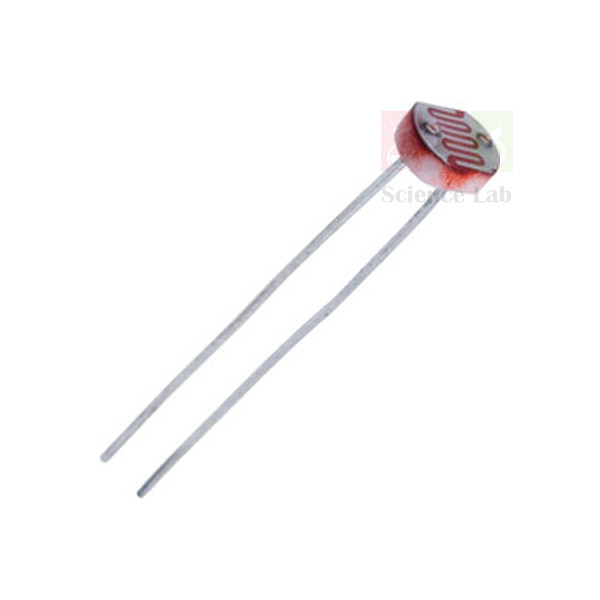
Miniature LDR
Miniature LDR (Product Code: SLE/PHY/65) is a 5 mm light dependent resistor used to sense light levels in physics and electronics experiments, from light-meter circuits to automatic night-lamp projects. Its resistance falls from about 1 MΩ in darkness to 2–4 kΩ at 100 lux, a change large enough to see clearly on a multimeter during physics practical work. It is supplied by Jain Scientific Equipments Pvt Ltd (ScienceLab), Ambala, India.
Specifications
| Parameter | Detail |
|---|---|
| Type | Light Dependent Resistor (LDR) housed in an epoxy package |
| Sensing material | Semiconductor whose conductance changes with luminance |
| Diameter | 5 mm |
| Dark resistance | 1 MΩ |
| Resistance at 10 lux | 10–20 kΩ |
| Resistance at 100 lux | 2–4 kΩ |
| Peak spectral response | 540 nm |
| Max. voltage | 150 V peak, AC or DC |
| Power dissipation | 100 mW |
| Lead pitch | 3 mm |
| Operating temperature | –30 °C to +70 °C |
| Product code | SLE/PHY/65 |
| Supplied by | Jain Scientific Equipments Pvt Ltd (ScienceLab), Ambala, India |
What Is a Miniature LDR Used For?
The simplest investigation connects the LDR to a multimeter on its resistance range and records readings as a lamp is moved closer or a hand shades the sensor; plotting resistance against light level shows how steeply the value falls. In an electronics context the LDR is placed in a potential divider with a fixed resistor, so the changing voltage can switch a transistor, LED or buzzer when it gets dark or bright.
Its peak spectral response at 540 nm lies in the green part of the spectrum, which makes it a good talking point about how sensors and the human eye respond to colour. Keep the power dissipated below 100 mW and the voltage within 150 V peak; in school circuits a series resistor keeps the current low. Solder the leads quickly, or mount the LDR in a component holder to avoid heat damage.
Supplier
Jain Scientific Equipments Private Limited, which trades as ScienceLab, supplies this miniature LDR from Ambala, Haryana, as a component for school and college electronics and physics practicals. It is a sourced semiconductor part rather than an item the company makes, and it can be quoted alongside the meters, holders and leads a sensor practical needs. Company details are on the ScienceLab profile page.
Related Physics Lab Equipment
Items used with the LDR in light-sensing experiments:
- Simple Circuit Module Light Dependent Resistor Board — an LDR already mounted on a board for plug-together circuits.
- LDR — another light dependent resistor listing to compare.
- Digital Multimeter — measures how the LDR’s resistance changes with light.
- Component Holder — holds small components such as the LDR without soldering.
- Crocodile Clips & Leads — clip onto the LDR’s leads for quick connections.
More sensors and meters are in Physics Lab Equipment.
Frequently Asked Questions
What is the resistance range of the Miniature LDR?
The Miniature LDR has a dark resistance of 1 MΩ, falling to 10–20 kΩ at 10 lux and 2–4 kΩ at 100 lux. Its resistance keeps reducing as more light falls on the device.
What are the size and lead spacing of the Miniature LDR?
The Miniature LDR is 5 mm in diameter, housed in an epoxy package, with a lead pitch of 3 mm, which keeps it compact enough for small student circuit layouts.
What are the electrical limits of the Miniature LDR?
The Miniature LDR is rated for a maximum of 150 V peak, AC or DC, and a power dissipation of 100 mW. It operates from –30 °C to +70 °C.
Which light colour does the Miniature LDR respond to most?
The Miniature LDR has its peak spectral response at 540 nm, in the green region of visible light, so it reacts most strongly to green and nearby wavelengths.
Who supplies the Miniature LDR?
Jain Scientific Equipments Pvt Ltd (ScienceLab), Ambala, India, supplies the Miniature LDR (SLE/PHY/65) to schools, colleges and dealers as a sourced electronic component, together with the meters and holders a practical needs.
How should I request a quotation for the Miniature LDR?
For the Miniature LDR, state the quantity, any related items such as multimeters or component holders, and the delivery location through the contact page to receive a single quotation.
Request a Quote
Send your Miniature LDR requirement through the ScienceLab contact page or add it to the enquiry cart. ScienceLab supplies buyers in India and international markets.
Last updated: 24 September 2026
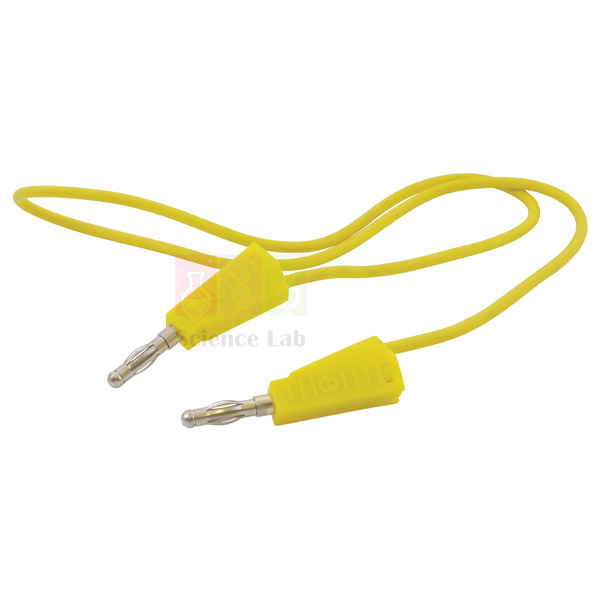
Stackable Leads Yellow
Stackable Leads Yellow (Product Code: SLE/PHY/66) is a yellow 4 mm stackable lead used to pick out a separate branch, meter connection or signal line in a laboratory circuit, so it is never confused with the red and black supply leads. It is 500 mm long and stacks with other 4 mm leads on a shared terminal, keeping physics lab instruments clearly wired. It is made by Jain Scientific Equipments Pvt Ltd (ScienceLab), an OEM manufacturer, at its own factory in Ambala, India.
Specifications
| Parameter | Detail |
|---|---|
| Colour | Yellow |
| Connector | 4 mm stackable lead |
| Length | 500 mm |
| Product code | SLE/PHY/66 |
| Manufacturer | Jain Scientific Equipments Pvt Ltd (ScienceLab) — OEM |
| Country of origin | India (made in Ambala, Haryana) |
What Are Yellow Stackable Leads Used For?
Once a circuit grows beyond a single loop, two colours are not enough. A yellow lead can mark the voltmeter connections across a component, the second branch of a parallel circuit, or the input signal to an oscilloscope or amplifier board, so a student tracing a fault always knows which wire belongs to which part of the diagram.
Teachers often agree a class rule — red to positive, black to negative, yellow for measurement or branch links — and write it into worksheets, which makes marking practical set-ups much quicker. As with any lead, inspect the plugs and insulation before use and coil leads loosely for storage rather than knotting them.
OEM Manufacturer
These yellow leads are made by Jain Scientific Equipments Private Limited (CIN U29309HR2020PTC087597), which trades as ScienceLab and is their OEM (original equipment manufacturer). Manufacturing is carried out at its own licensed factory at Saha, Ambala, Haryana, India — premises at 449, HSIIDC Industrial Area covered by Factory Licence AMB-ONLINE-CHD-J-414. Schools, colleges, dealers and importers order factory-direct; see the ScienceLab profile for more.
Related Physics Lab Equipment
Leads and meters that pair with yellow branch leads:
- Stackable Leads Red — positive-side leads for the supply connections.
- Stackable Leads — black leads for the negative or common return.
- Banana Plug Connectors Leads — an alternative set of plug-ended connecting leads.
- Standard Digital Multimeter — the meter a yellow measurement lead typically runs to.
- Ammeter Voltmeter — for reading current and voltage in branch circuits.
More apparatus is in Physics Lab Equipment.
Frequently Asked Questions
What are the Stackable Leads Yellow used for?
The Stackable Leads Yellow mark a connection that is neither supply positive nor negative, such as a meter link, a parallel branch or a signal line, keeping complex circuits easy to trace.
What length are the Stackable Leads Yellow?
The Stackable Leads Yellow are 500 mm long with a 4 mm stackable plug, the same length as the black and red stackable leads in the ScienceLab range.
Do the Stackable Leads Yellow work with red and black stackable leads?
Yes. The Stackable Leads Yellow share the 4 mm stackable format of the red and black versions, so all three colours can be plugged into each other on one terminal.
Who manufactures the Stackable Leads Yellow?
Jain Scientific Equipments Pvt Ltd (ScienceLab) manufactures the Stackable Leads Yellow as the OEM at its own licensed factory at Saha, Ambala, Haryana, India, and supplies them factory-direct.
Is an electrical rating listed for the Stackable Leads Yellow?
No current or voltage rating is stated for the Stackable Leads Yellow in this listing. Ask us through the contact page and we will confirm the rating for your intended use.
What should a quotation request for the Stackable Leads Yellow include?
For the Stackable Leads Yellow, give the quantity of yellow leads, any red or black leads needed and the delivery location; ScienceLab then quotes as the manufacturer for India and international markets.
Request a Quote
Request yellow leads, alone or with red and black sets, through the ScienceLab contact page or the enquiry cart. The quotation is issued directly by the manufacturer.
Last updated: 24 September 2026
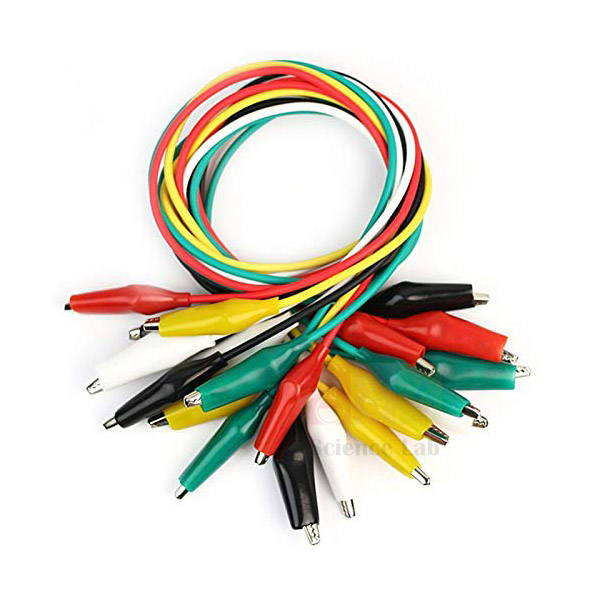
Crocodile Clips & Leads
Crocodile Clips & Leads (Product Code: SLE/PHY/67) are connecting leads with a crocodile clip at each end, used to make quick, temporary connections to component legs, bare wires, electrodes and terminals in school electricity experiments. They come as a pack of 20 leads, each 460 mm long — enough to equip several bench groups for an electricity experiment kit in school. They are made by Jain Scientific Equipments Pvt Ltd (ScienceLab), an OEM manufacturer, at its own factory in Ambala, India.
Specifications
| Parameter | Detail |
|---|---|
| Pack size | 20 leads |
| Lead length | 460 mm |
| Terminations | Crocodile clip at each end |
| Product code | SLE/PHY/67 |
| Manufacturer | Jain Scientific Equipments Pvt Ltd (ScienceLab) — OEM |
| Country of origin | India (made in Ambala, Haryana) |
What Are Crocodile Clip Leads Used For?
Crocodile leads connect things that have no socket. Students clip them onto the metal strips of an electrolysis cell, the legs of a resistor, the zinc and copper plates of a fruit cell or a test sample in a conductor-and-insulator experiment, then join the other end to a bulb holder, meter or cell. Because both ends are clips, the same lead works anywhere in the circuit.
For a firm contact, clip onto bare, clean metal rather than insulation, and avoid prising the jaws too wide. After the lesson, count the pack back in and store the leads loosely coiled so the cables and clip joints are not strained.
OEM Manufacturer
Jain Scientific Equipments Private Limited, the company behind the ScienceLab name, is the OEM (original equipment manufacturer) of these crocodile clip leads and makes them at its own licensed factory at Saha, Ambala, Haryana, India. Packs are supplied direct from the maker to schools, science kit assemblers, dealers and importers, with quotations prepared by the manufacturer rather than a trading middleman. Learn more on the ScienceLab profile page.
Related Physics Lab Equipment
Useful with crocodile leads:
- Crocodile Clip — individual clips for making up extra leads.
- Battery Snap with Crocodile Clip — links a snap-terminal battery into clip-lead circuits.
- Stackable Leads — 4 mm plug leads for connections to sockets.
- MES Bulb Holder — screw terminals that clip leads grip easily.
- Circuits Kit Electrode Holder — holds electrodes that crocodile leads connect to.
See more in Physics Lab Equipment.
Frequently Asked Questions
How many leads come in a pack of Crocodile Clips & Leads?
Crocodile Clips & Leads come as a pack of 20. Each lead is 460 mm long with a crocodile clip fitted at each end, ready for use in student circuits.
What are Crocodile Clips & Leads used for?
Crocodile Clips & Leads make quick temporary connections to items without sockets, such as component legs, electrodes, metal strips and bare wires, in electricity, electrolysis and conductivity experiments.
How long is each lead in the Crocodile Clips & Leads pack?
Each lead in the Crocodile Clips & Leads pack measures 460 mm, long enough to link components spread across a bench while keeping the circuit layout tidy.
Who manufactures the Crocodile Clips & Leads?
Jain Scientific Equipments Pvt Ltd (ScienceLab) manufactures the Crocodile Clips & Leads as the OEM at its own licensed factory at Saha, Ambala, Haryana, India, and supplies packs directly to buyers.
How should Crocodile Clips & Leads be looked after?
Store Crocodile Clips & Leads loosely coiled, clip only onto clean bare metal and avoid over-opening the jaws. Leads with damaged insulation should be taken out of use.
Can Crocodile Clips & Leads be ordered for many classrooms?
Yes. Crocodile Clips & Leads can be quoted in multiple packs of 20 for schools, dealers and importers in India and international markets; state the number of packs and delivery location.
Request a Quote
Ask for a price on packs of Crocodile Clips & Leads through the ScienceLab contact page or add them to the enquiry cart. The manufacturer quotes you directly.
Last updated: 24 September 2026

Knife Switch – Single Pole, Single Throw
Knife Switch – Single Pole, Single Throw (Product Code: SLE/PHY/68) is a knife switch on a plastic base used to open and close a single circuit in electricity practicals, with an exposed blade that shows at a glance whether the circuit is made or broken. Its poles and blade are brass to give good electrical connections, which makes it a dependable control in an Ohm law experiment kit. It is supplied by Jain Scientific Equipments Pvt Ltd (ScienceLab), Ambala, India.
Specifications
| Parameter | Detail |
|---|---|
| Switch type | Knife switch, single pole, single throw (SPST) |
| Base | Plastic |
| Poles and blade | Brass, to ensure good electrical connections |
| Application | Electricity circuits |
| Product code | SLE/PHY/68 |
| Supplied by | Jain Scientific Equipments Pvt Ltd (ScienceLab), Ambala, India |
What Is a Single Pole Knife Switch Used For?
A single-pole, single-throw switch has one job: connect or disconnect one line of a circuit. The knife pattern is popular in teaching because the moving blade is visible, so students see the physical gap that stops the current, which links the circuit symbol for a switch to the real object. It is the usual choice for switching the supply in resistance, Ohm’s law and heating-effect experiments.
Open the switch between readings so resistors and wires do not heat up and change the results. When closing, push the blade fully into the jaw so the brass parts meet firmly; a half-seated blade gives a poor contact and flickering meter readings. Operate the switch by its handle and keep fingers clear of the exposed metal when the circuit is live.
What to Specify When Ordering
- Switch pattern: this is single pole, single throw; double-pole knife switches are listed separately.
- Quantity per lab, typically one per circuit board or student pair.
- Any leads, meters or holders to be quoted with the switches.
Supplier
ScienceLab is the trade name of Jain Scientific Equipments Private Limited, which supplies this knife switch from Ambala, Haryana, India. The single-pole and double-pole knife switches in the range are sourced and quoted by the same company, so a lab can standardise on one style and order replacements from us directly. The ScienceLab profile has more about the company.
Related Physics Lab Equipment
Items used alongside the switch:
- Knife Switch Double Pole — for switching two lines at once.
- Contact Key (Push Switch) — a push-type key for taking brief readings.
- Crocodile Clips & Leads — connect the switch into the circuit.
- MES Bulb Holder — a simple load that shows when the switch is closed.
- Ammeter Voltmeter — takes readings in the switched circuit.
See all items in Physics Lab Equipment.
Frequently Asked Questions
What does single pole, single throw mean on this knife switch?
On the Knife Switch – Single Pole, Single Throw, one blade controls one circuit line and has one closed position, so the switch simply connects or disconnects that line.
What materials is the Knife Switch – Single Pole, Single Throw made of?
The Knife Switch – Single Pole, Single Throw is mounted on a plastic base, and its poles and blade are made of brass to ensure good electrical connections in student circuits.
Why use a knife switch instead of an enclosed switch in class?
The Knife Switch – Single Pole, Single Throw has a visible blade, so students can see the circuit open and close. This helps them connect the switch symbol in diagrams with how switching actually works.
Who supplies the Knife Switch – Single Pole, Single Throw?
Jain Scientific Equipments Pvt Ltd (ScienceLab), Ambala, Haryana, India, supplies the Knife Switch – Single Pole, Single Throw. The company sources the switch and quotes it to schools, colleges, dealers and importers in India and international markets.
Is a current rating given for the Knife Switch – Single Pole, Single Throw?
A current or voltage rating for the Knife Switch – Single Pole, Single Throw is not stated in this listing. Ask us through the contact page to confirm suitability for your circuit.
Can the Knife Switch – Single Pole, Single Throw be ordered in bulk?
Yes. ScienceLab quotes the Knife Switch – Single Pole, Single Throw in lab quantities directly as the supplier for schools, colleges, dealers and importers in India and international markets.
Request a Quote
Send the number of switches you need through the ScienceLab contact page or add the item to the enquiry cart. Quotes come directly from ScienceLab as the supplier.
Last updated: 24 September 2026
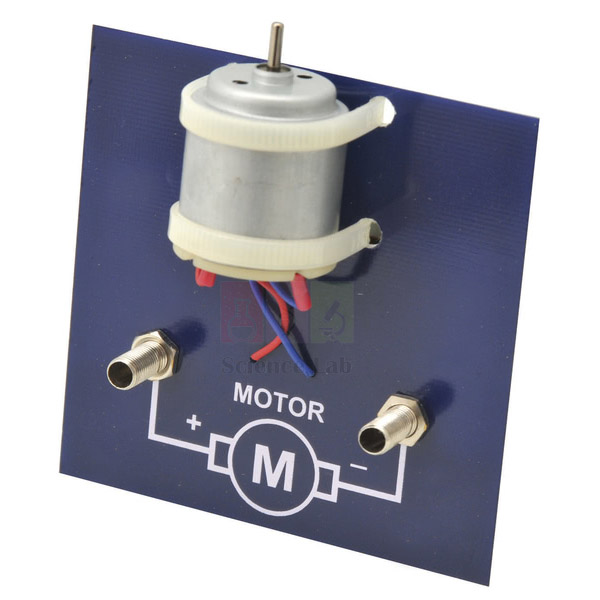
Simple Circuit Module Motor
Simple Circuit Module Motor (Product Code: SLE/PHY/69) is a low-voltage d.c. motor mounted on a base, used to show electrical energy turning into movement in simple circuit experiments at school. A series resistor is fitted to limit the motor’s current consumption, and the module belongs to the same Simple Circuit Modules range as the LED boards, so it combines with other modules in electricity experiment kits for schools. It is supplied by Jain Scientific Equipments Pvt Ltd (ScienceLab), Ambala, India.
Key Details
| Parameter | Detail |
|---|---|
| Range | Simple Circuit Modules |
| Component | Low-voltage d.c. motor |
| Current limiting | Series resistor fitted to limit current consumption |
| Mounting | On base |
| Product code | SLE/PHY/69 |
| Supplied by | Jain Scientific Equipments Pvt Ltd (ScienceLab), Ambala, India |
What Is the Simple Circuit Module Motor Used For?
A spinning motor is one of the most convincing ways to show that a circuit is complete. Students can compare the motor with a lamp or LED board as different “outputs”, add a switch module to control it, or reverse the supply connections to see the direction of rotation change — a quick introduction to how d.c. motors respond to polarity.
The fitted series resistor keeps current draw modest, which helps cells last through a lesson of beginners’ circuit building. A small paper flag or disc fixed to the shaft makes slow rotation easier to see from the back of the room. Keep the base on a flat surface while running and let the motor stop before changing connections.
What to Specify When Ordering
- Number of motor modules needed for your groups.
- Other Simple Circuit Modules to match, such as LED boards, push switch or LDR board.
- Whether you need a supply voltage recommendation for the module — ask us when enquiring.
Supplier
The Simple Circuit Module Motor is supplied by Jain Scientific Equipments Private Limited, trading as ScienceLab, from Ambala, Haryana, India, together with the other modules in the range. The company sources the motor module and quotes it for schools, colleges, dealers and importers in India and international markets. Institutional buyers who need vendor registration details can use the company’s GSTIN 06AAECJ8618A1ZT, and overseas consignments are handled under DGFT Importer-Exporter Code AAECJ8618A. Read more on the ScienceLab company profile.
Related Physics Lab Equipment
Modules and alternatives that work with the motor:
- Simple Circuit Module Push Switch — switches the motor on and off in the same module format.
- Simple Circuit Module LED Board Red — a light output to compare with the motor.
- Simple Circuit Module Light Dependent Resistor Board — for light-controlled circuit projects.
- Simple Circuit Module Lamp Holder — adds a lamp output to the module set.
- Mini Motor Unit — an alternative motor unit for classroom circuits.
Browse Physics Lab Equipment for the full range.
Frequently Asked Questions
What is the Simple Circuit Module Motor?
The Simple Circuit Module Motor is a low-voltage d.c. motor mounted on a base, with a series resistor to limit current consumption, designed to sit in school circuits alongside other Simple Circuit Modules.
Why does the Simple Circuit Module Motor have a series resistor?
The series resistor in the Simple Circuit Module Motor limits the current the motor draws, keeping consumption low in student circuits and reducing the load on the cells or supply.
What voltage should be used with the Simple Circuit Module Motor?
The Simple Circuit Module Motor is a low-voltage d.c. motor; an exact operating voltage is not stated in this listing, so ask us through the contact page before choosing cells or a supply.
Can the Simple Circuit Module Motor reverse direction?
Yes, as with most small d.c. motors, swapping the supply connections to the Simple Circuit Module Motor reverses its direction of rotation, a simple demonstration of polarity in class.
Who supplies the Simple Circuit Module Motor?
Jain Scientific Equipments Pvt Ltd (ScienceLab), Ambala, Haryana, India, supplies the Simple Circuit Module Motor. The company sources it together with the other Simple Circuit Modules and quotes it directly to schools, colleges and dealers in India and international markets.
What should I include in a quotation request for the Simple Circuit Module Motor?
For the Simple Circuit Module Motor, list the number of motor modules, any other Simple Circuit Modules required and the delivery location, so ScienceLab can quote the whole set in one reply.
Request a Quote
Request the Simple Circuit Module Motor through the ScienceLab contact page or add it to the enquiry cart. Quotations come directly from ScienceLab as the supplier for buyers in India and international markets.
Last updated: 24 September 2026
Electricity Economy Kit
Electricity Economy Kit (Product Code: SLE/PHY/70) is a basic assortment of circuit components used to build introductory electricity and electronics circuits in school science classrooms. Teachers running first lessons on current and circuits use it as an electricity experiment kit for school groups, with 10 crocodile leads, 10 MES bulbs, 10 MES lamp holders, five DPDT slide switches, a buzzer and a small motor in one pack. It is supplied by Jain Scientific Equipments Pvt Ltd (ScienceLab), Ambala, India.
Specifications
| Parameter | Detail |
|---|---|
| Kit type | Basic assortment of components for introductory electronics |
| Crocodile leads | 10 |
| Cell holders | 3, each for a 1.5 V cell |
| MES bulbs | 10 |
| MES lamp holders | 10 |
| Buzzer | 1, rated 6 V, with connecting leads |
| Electric motor | 1, rated 3–6 V |
| Switches | 5 DPDT slide switches |
| Cells | Not listed in the kit contents — ask us if you need them quoted |
| Product code | SLE/PHY/70 |
| Supplied by | Jain Scientific Equipments Pvt Ltd (ScienceLab), Ambala, India |
What Is the Electricity Economy Kit Used For?
Pupils use the kit to wire their first complete circuits. Cells placed in the three 1.5 V holders provide the supply, crocodile leads join the parts, and MES bulbs screwed into their holders light up when current flows. With ten bulbs and ten holders, a group can set up bulbs in series and in parallel side by side and compare how bright they glow.
The five DPDT slide switches add on/off control, and one can be wired to reverse the direction of the 3–6 V motor. The 6 V buzzer gives an audible output for simple alarm and doorbell circuits. Kept in good order, it serves as a reusable physics experiment kit for school benches: store bulbs where they cannot rattle and check lead clips for loose joints before each class.
What to Specify When Ordering
- Number of kits (for example, one per student pair or group)
- Whether cells for the three 1.5 V holders should be quoted with the kits
- Any extra crocodile leads or MES bulb holders you want alongside the standard contents
- Delivery location, within India or abroad
Supplier
Jain Scientific Equipments Private Limited trades as ScienceLab and supplies this Electricity Economy Kit from Ambala, Haryana, to schools, colleges, dealers and institutions in India and international markets. The kit is an assortment of standard components, so ask us to confirm the current make of motor, buzzer and switches when you request a quotation. More about the company is on the ScienceLab company profile.
Related Physics Lab Equipment
Classes that outgrow the economy kit usually add these items to their circuit work:
- Crocodile Clips & Leads — extra leads for larger group circuits
- MES Bulb Holder — more holders for longer series and parallel bulb arrays
- Electricity Circuits Kit — an alternative circuits kit for the same topics
- Electricity Kit Microscience — microscale kit for students working individually
- Standard Digital Multimeter — to measure cell voltage and circuit current
See the full range in Physics Lab Equipment.
Frequently Asked Questions
What is included in the Electricity Economy Kit?
The Electricity Economy Kit contains 10 crocodile leads, 3 holders for 1.5 V cells, 10 MES bulbs, 10 MES lamp holders, 1 buzzer rated 6 V with connecting leads, 1 electric motor rated 3–6 V and 5 DPDT slide switches.
Are cells included with the Electricity Economy Kit?
Cells are not listed among the Electricity Economy Kit contents; the kit provides three holders for 1.5 V cells. If you want cells quoted with the kits, mention it in your enquiry through the contact page and we will confirm what can be supplied.
What voltage do the motor and buzzer in the kit need?
In the Electricity Economy Kit, the electric motor is rated 3–6 V and the buzzer is rated 6 V. Cells from the kit's 1.5 V holders connected in series can run the motor within its range; check the buzzer's response before using it in a lesson.
How should the Electricity Economy Kit be stored between lessons?
Store the Electricity Economy Kit somewhere dry, keep the MES bulbs in a padded container so the glass does not break, and take cells out of the holders after each lesson. Check crocodile leads for loose clips before the next class.
Who supplies the Electricity Economy Kit?
The Electricity Economy Kit is supplied by Jain Scientific Equipments Pvt Ltd, which trades as ScienceLab from Ambala, Haryana, India. The kit is an assortment of standard components sourced for school electricity lessons, and quotations are issued by the company directly.
Can schools order the Electricity Economy Kit in bulk?
Yes, schools, dealers and education departments can order the Electricity Economy Kit in quantity for class sets, for delivery in India and international markets. Send the number of kits and the delivery location through the enquiry cart or contact page to receive a quotation.
Request a Quote
To order the Electricity Economy Kit, send the quantity and delivery address through the contact page or add it to the enquiry cart, and ScienceLab will reply with a quotation.
Last updated: 24 September 2026
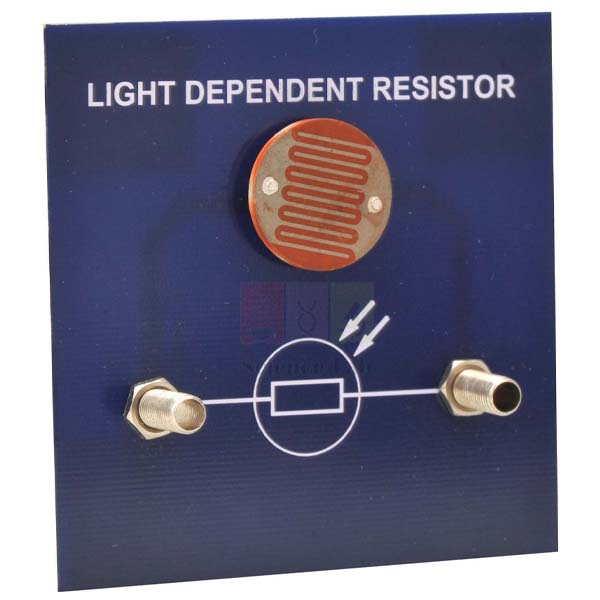
Light Dependent Resistor
Light Dependent Resistor (Product Code: SLE/PHY/71) is a cadmium sulphide (CdS) photoconductive cell used to sense light levels in school electronics circuits, physics practicals and student projects. Its resistance falls as more light reaches it, from a dark resistance of 1 MΩ, and its spectral response is similar to that of the human eye. It is supplied by Jain Scientific Equipments Pvt Ltd (ScienceLab), Ambala, India, as a component for school physics lab equipment in India and international markets.
Specifications
| Parameter | Detail |
|---|---|
| Type | Cadmium sulphide (CdS) photoconductive cell |
| Housing | Robust clear plastic package with clear end window; moisture-resistant coating |
| Top dimensions | 14.35 × 7 mm (diameter × depth) |
| Pin length | 9.53 mm |
| Dark resistance | 1 MΩ |
| Resistance at 1 ftc (foot-candle) | 5.4 kΩ min, 12.6 kΩ max |
| Maximum voltage | 250 V peak, AC or DC |
| Power dissipation | 250 mW max |
| Operating temperature | −60 °C to +75 °C |
| Spectral response | Similar to that of the human eye |
| Behaviour | Resistance reduces as the light falling on the LDR increases |
| Product code | SLE/PHY/71 |
| Supplied by | Jain Scientific Equipments Pvt Ltd (ScienceLab), Ambala, India |
What Is a Light Dependent Resistor Used For?
In class, the LDR is usually wired in series with a fixed resistor to form a voltage divider, so the output voltage changes with light level. That simple arrangement is the basis of automatic night lights, light meters and burglar-alarm circuits that students build in electronics lessons. It is a standard part in OPTO electronics experiment kit work alongside LEDs and phototransistors.
For a quick demonstration, connect the LDR to a multimeter on its resistance range and let students cover it, uncover it and move a lamp closer while they note the readings. Because its response is similar to the human eye, results relate well to how bright a room looks. Bend the pins gently near the body, and keep power dissipation well under the 250 mW limit.
What to Specify When Ordering
- Quantity of LDRs needed for the class or project
- Whether you want the bare component or the board-mounted Simple Circuit Module version
- Any meters or light sources to be quoted with them
Supplier
ScienceLab is the trading name of Jain Scientific Equipments Private Limited, which sources and supplies electronic components such as this light dependent resistor alongside its physics apparatus range. Schools, colleges and dealers can add LDRs to a wider laboratory order and receive a single quotation. Company details are on the ScienceLab profile page.
Related Physics Lab Equipment
These items are used with an LDR in light-sensing experiments:
- Simple Circuit Module Light Dependent Resistor Board — an LDR ready-mounted on a module board
- LED, 5 mm, White — a small light source for LDR response tests
- Standard Digital Multimeter — to read the LDR's resistance as light changes
- Crocodile Clips & Leads — to connect the LDR pins without soldering
- Light Energy Kit — for wider lessons on light as a form of energy
Browse more items in Physics Lab Equipment.
Frequently Asked Questions
What is the dark resistance of this Light Dependent Resistor?
The Light Dependent Resistor has a dark resistance of 1 MΩ, and at an illumination of 1 foot-candle its resistance lies between 5.4 kΩ and 12.6 kΩ. Brighter light lowers the resistance further, which is what makes it useful as a light sensor.
What are the maximum ratings of the Light Dependent Resistor?
The Light Dependent Resistor is rated for a maximum of 250 V peak AC or DC and 250 mW power dissipation, with an operating temperature range of −60 °C to +75 °C. School circuits normally run it far below these limits from low-voltage cells.
Is the LDR protected against moisture?
Yes, this Light Dependent Resistor is encapsulated in a moisture-resistant coating and enclosed in a robust clear plastic package with a clear end window. Keep it dry and wipe the window gently so dust does not reduce the light reaching the sensing surface.
What size is the Light Dependent Resistor?
The Light Dependent Resistor's top measures 14.35 × 7 mm (diameter × depth) and its pins are 9.53 mm long. The pins can be connected with crocodile leads for classroom circuits or soldered into a permanent project board.
Who supplies the Light Dependent Resistor?
The Light Dependent Resistor is supplied by Jain Scientific Equipments Pvt Ltd, trading as ScienceLab, from Ambala, Haryana, India. It is a sourced electronic component that the company adds to school and college orders together with circuit boards, meters and other physics items.
How do I get a quotation for LDRs?
To get a quotation for the Light Dependent Resistor, send the quantity you need and your delivery location through the contact page or the enquiry cart. Mention if you also want the board-mounted LDR module or meters, so everything can be quoted together.
Request a Quote
Ask for a price on the Light Dependent Resistor through the contact page, or add it to the enquiry cart with any other items for your lab.
Last updated: 24 September 2026
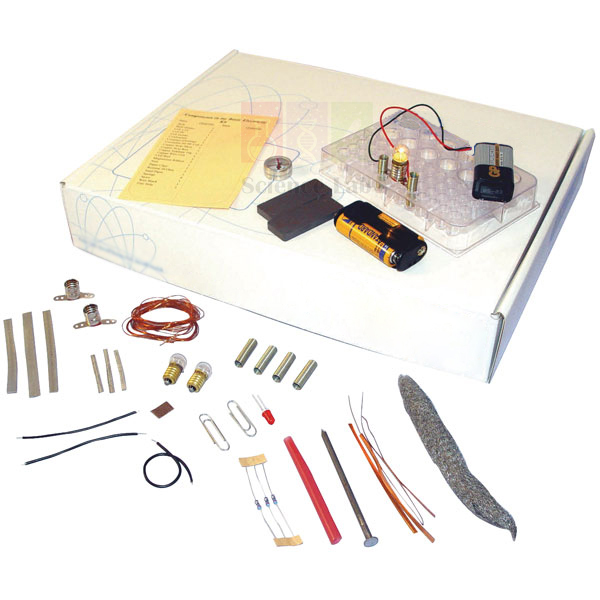
Electricity Kit Microscience
Electricity Kit Microscience (Product Code: SLE/PHY/72) is a microscale electricity kit used by students working on an individual basis to study the basic principles of electricity in school science lessons. Components clip into springs set in the wells of a combo plate, which acts as the circuit board, and the kit suits Key Stage 2 (Grade 4) and above. It is supplied by Jain Scientific Equipments Pvt Ltd (ScienceLab), Ambala, India, as a hands-on science kit for primary school and upper classes.
Key Details
| Parameter | Detail |
|---|---|
| Format | Individual student kit for the basic principles of electricity |
| Circuit board | Combo plate; components clip into springs inserted in the wells |
| Topics covered | Batteries & current flow; series & parallel circuits; magnetic effects & chemical reactions; circuits: direction; electricity in the home |
| Suitable for | Key Stage 2 (Grade 4) and above |
| Data logging | Listed as ideal for data-logging applications |
| Workbooks | Available — ask for them with your quotation |
| Product code | SLE/PHY/72 |
| Supplied by | Jain Scientific Equipments Pvt Ltd (ScienceLab), Ambala, India |
What Is the Microscience Electricity Kit Used For?
Each student builds circuits on a personal combo plate, so every learner handles the cells and components instead of watching a group demonstration. Lessons move from batteries and current flow to series and parallel circuits, then to the magnetic effects of a current and chemical reactions driven by electricity, and finish with how electricity is used in the home.
Because the parts are small and clip into place, the kit needs little bench space and packs away quickly at the end of a period. It works well as a science kit for students in India who follow activity-based syllabi, and the matching workbooks give teachers ready worksheets for each topic. Count the components back into the kit after each lesson so the next class starts complete.
What to Specify When Ordering
- Number of student kits (one per learner for individual work)
- Whether workbooks should be included, and how many
- Whether you plan data-logging work, and which logging system your school uses
- Any spare combo plates you want quoted separately
Supplier
ScienceLab, the trading name of Jain Scientific Equipments Private Limited, supplies the Electricity Kit Microscience together with related microscience items such as spare combo plates, so a school can source a complete microscale set-up in one order. For vendor registration, the supplying company holds GSTIN 06AAECJ8618A1ZT and Legal Entity Identifier (LEI) 3358004HRD1JIVXKYX49. Read more on the ScienceLab company profile.
Related Physics Lab Equipment
These items complement the kit in microscale and circuit lessons:
- Comboplate, Microscience — spare combo plates for the circuit board
- Basic Microscience Kit, Student — chemistry microscience kit for the same learners
- Microscience Work Station, Biology, Physics and Chemistry — a combined work station for several subjects
- Electricity Economy Kit — full-size component assortment for group circuits
- Electricity Circuits Kit — another option for circuit topics
More apparatus is listed under Physics Lab Equipment.
Frequently Asked Questions
What topics does the Electricity Kit Microscience cover?
The Electricity Kit Microscience covers batteries and current flow, series and parallel circuits, magnetic effects and chemical reactions, circuit direction, and electricity in the home. Together these take students from their first working circuit to everyday uses of electricity.
Which classes is the Electricity Kit Microscience suitable for?
The Electricity Kit Microscience is listed as suitable for Key Stage 2 (Grade 4) and above. It therefore fits upper-primary classes and remains useful in middle-school science, where students work individually on basic circuits.
How are components connected in the Microscience electricity kit?
In the Electricity Kit Microscience, the combo plate acts as the circuit board: springs are inserted in its wells and the components clip into those springs. This avoids loose wiring on the bench and lets students rebuild a circuit quickly.
Are workbooks available for the Electricity Kit Microscience?
Yes, workbooks are listed as available for the Electricity Kit Microscience. State how many workbooks you need, together with the number of kits, when you request a quotation, and we will confirm availability and include them in the quote.
Can the Electricity Kit Microscience be used for data logging?
The Electricity Kit Microscience is listed as ideal for data-logging applications, but the listing does not name a specific data logger or sensor. Tell us which logging system your school uses through the contact page and we will confirm what can be supplied.
Who supplies the Electricity Kit Microscience?
The Electricity Kit Microscience is supplied by Jain Scientific Equipments Pvt Ltd (ScienceLab) of Ambala, Haryana, India, to schools, dealers and education projects in India and international markets. Quotations can combine the kit with spare combo plates and workbooks.
Request a Quote
Send the number of Electricity Kit Microscience sets and workbooks you need through the contact page, or add the kit to the enquiry cart, and we will send a quotation.
Last updated: 24 September 2026
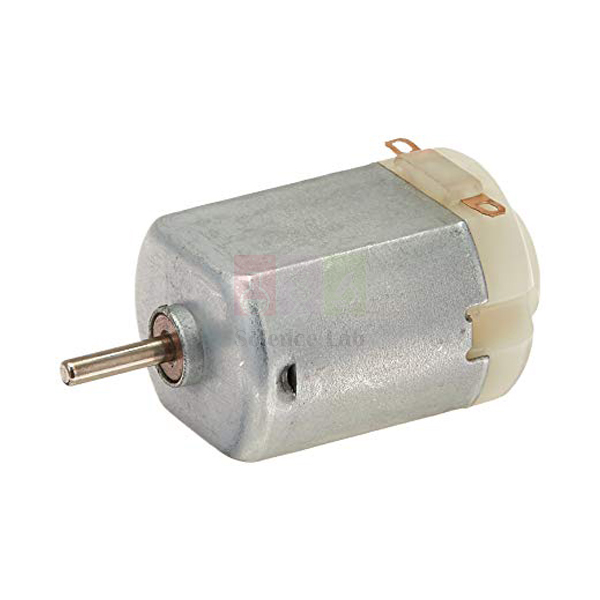
Electric Motor
Electric Motor (Product Code: SLE/PHY/73) is a miniature DC motor used to drive models, robotics projects and educational demonstration equipment in school and college labs. It runs on 1.5 to 4.5 V DC, has a 20 mm body with two flat sides for mounting on a PCB, and uses solder tag terminals. It is supplied by Jain Scientific Equipments Pvt Ltd (ScienceLab), Ambala, India, for STEM projects, science models and physics practicals.
Specifications
| Parameter | Detail |
|---|---|
| Type | Miniature DC motor |
| Operating voltage | 1.5 to 4.5 V DC |
| Body diameter | 20 mm |
| Width across flats | 15 mm |
| Shaft length | 9 mm |
| Shaft diameter | 2 mm |
| Weight | Approx. 17 g |
| Termination | Solder tags |
| Rotation | Counter-clockwise when viewed from the shaft end |
| Mounting | Two flat sides, suited to mounting on a PCB |
| Product code | SLE/PHY/73 |
| Supplied by | Jain Scientific Equipments Pvt Ltd (ScienceLab), Ambala, India |
What Is the Miniature Electric Motor Used For?
Connected to one, two or three 1.5 V cells, the motor shows electrical energy being turned into movement, and students can hear and see its speed rise as cells are added. In science model kit school project work it spins propellers, fan blades and wheels for model cars, windmills and simple robots, and it is a common part in STEM science kit builds.
Swapping the two supply connections reverses the rotation, a quick way to show that current direction affects motion. Solder leads to the tags quickly so the terminals do not overheat, or use crocodile leads for temporary circuits. The 2 mm shaft takes small push-fit pulleys and propellers, and the flat sides help it sit square on a board or panel.
What to Specify When Ordering
- Number of motors needed for the class or project batch
- Whether you prefer a loose motor or a mounted unit such as the Mini Motor Unit
- Cells, holders or leads to be quoted with the motors
Supplier
This miniature motor is a bought-in component that Jain Scientific Equipments Private Limited, trading as ScienceLab, supplies with its school physics range. Teachers and dealers can combine it with circuit parts and demonstration apparatus in one enquiry. See the company profile for background on ScienceLab in Ambala.
Related Physics Lab Equipment
Items that pair with the motor in energy and motion lessons:
- Simple Circuit Module Motor — a motor on a module board for plug-together circuits
- Mini Motor Unit — a mounted motor option for bench use
- Mounted Motor for Solar Cell — for solar energy demonstrations
- Demonstration, Electric Motor — shows the motor principle at teacher-demonstration scale
- Crocodile Clips & Leads — to connect the solder tags without soldering
Find more in Physics Lab Equipment.
Frequently Asked Questions
What voltage does the Electric Motor need?
The Electric Motor operates on 1.5 to 4.5 V DC, so it runs from a single 1.5 V cell up to three cells in series. Running it above 4.5 V is outside the listed operating range and can overheat the motor.
What are the dimensions of the Electric Motor?
The Electric Motor has a 20 mm body diameter, measures 15 mm across its two flats, has a 9 mm long shaft of 2 mm diameter and weighs approximately 17 g, which keeps it light enough for small models and robots.
Which way does the Electric Motor rotate?
Viewed from the shaft end, the Electric Motor rotates counter-clockwise as listed. As with other DC motors, swapping the two supply connections reverses the direction, which students can use to show how current direction changes the motion.
How is the Electric Motor connected and mounted?
The Electric Motor has solder tag terminals for wire connections and two flat sides that let it sit on a PCB or flat panel. Solder leads quickly to avoid heating the tags, or clip crocodile leads on for temporary classroom circuits.
Who supplies the Electric Motor?
The Electric Motor is supplied by Jain Scientific Equipments Pvt Ltd (ScienceLab), Ambala, Haryana, India. It is a sourced miniature DC motor that the company provides with its physics and STEM items for schools, colleges and dealers.
Can schools order the Electric Motor in quantity?
Yes, the Electric Motor can be ordered in quantity for class projects, workshops and dealer stock, for delivery in India and international markets. Send the number of motors and your location through the enquiry cart or contact page for a quotation.
Request a Quote
For a price on the Electric Motor, use the contact page or place it in the enquiry cart along with any cells and leads you need.
Last updated: 24 September 2026
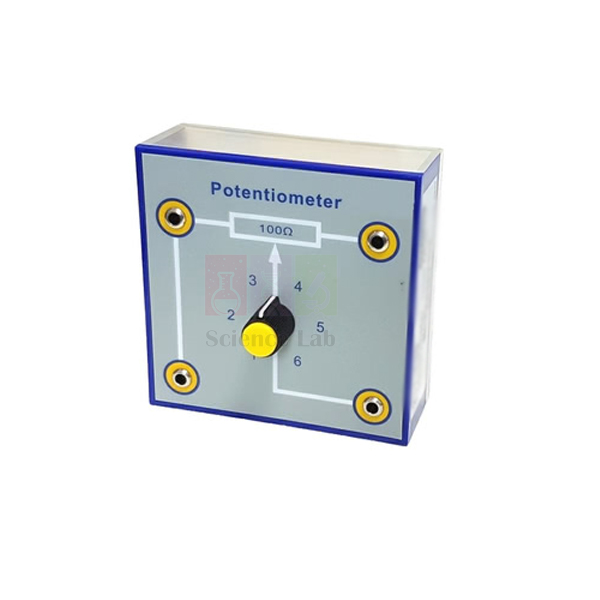
Potentiometer
Potentiometer (Product Code: SLE/PHY/74) is a slide-wire potentiometer used to compare the emf of cells and measure potential differences by the null method in school and college physics laboratories. A 24 SWG constantan wire runs along a metre scale divided in cm and mm between stout plated brass end plates, and a jockey is included. It is made by Jain Scientific Equipments Pvt Ltd (ScienceLab), an OEM manufacturer, at its own factory in Ambala, India.
Specifications
| Parameter | Detail |
|---|---|
| Resistance wire | 24 SWG constantan |
| Scale | Metre scale subdivided in cm and mm |
| End plates | Stout plated brass, with the wire clamped to them |
| Terminals | Heavy-duty 4 mm socket terminals on the terminating strips |
| Base | Polished hardwood baseboard |
| Included | Jockey |
| Overall size | Approx. 1.13 m × 80 mm × 50 mm |
| Product code | SLE/PHY/74 |
| Manufacturer | Jain Scientific Equipments Pvt Ltd (ScienceLab) — OEM |
| Country of origin | India (made in Ambala, Haryana) |
What Is the Slide-Wire Potentiometer Used For?
A steady driver cell connected across the wire sets up a uniform fall of potential along it. Students then use the jockey to find the balance point for a second cell or circuit, read the balancing length on the scale, and compare emfs, find the internal resistance of a cell or measure a small potential difference without drawing current at balance.
These experiments appear in most senior-secondary syllabi, which makes the potentiometer standard physics practical equipment for CBSE and state-board labs as well as first-year college courses. Press the jockey gently and lift it before moving along the wire; dragging it while pressed scratches the constantan and spoils the uniform resistance per centimetre. Keep the driver current low so the wire does not warm up during a reading.
OEM Manufacturer
ScienceLab is the trading name of Jain Scientific Equipments Private Limited, the OEM (original equipment manufacturer) of this potentiometer. The company makes it at its own licensed factory at Saha, Ambala, Haryana, India, rather than buying it in from a trader, and supplies it factory-direct to schools, colleges, dealers and importers. Replacement jockeys and other spares are handled by the manufacturer itself — ask us when you order. More background is on the ScienceLab company profile.
Related Physics Lab Equipment
A complete potentiometer circuit needs a few more items on the bench:
- Jockey with Insulated Handle (Single) — a spare or replacement jockey
- Moving Coil Galvanometer — the null detector for finding the balance point
- Rheostat — to set the driver current through the wire
- One Way Key — to switch the driver circuit on only while reading
- Potentiometer, 10 wire — a longer-wire model for finer balance lengths
See more apparatus in Physics Lab Equipment.
Frequently Asked Questions
What is included with the Potentiometer?
The Potentiometer comes mounted on a polished hardwood baseboard with its 24 SWG constantan wire, metre scale, plated brass end plates and 4 mm socket terminals, and a jockey is included. Cells, galvanometer, rheostat and connecting leads are ordered separately.
What wire does the Potentiometer use?
The Potentiometer uses 24 SWG constantan wire stretched along a metre scale divided in centimetres and millimetres. Constantan is chosen because its resistance changes very little with temperature, giving a steady potential gradient along the wire during an experiment.
How large is the Potentiometer?
The Potentiometer measures approximately 1.13 m × 80 mm × 50 mm, so it needs a bench length of just over a metre. Leave space beside it for the driver cell, galvanometer, rheostat and key used in the circuit.
Who manufactures the Potentiometer?
The Potentiometer is manufactured by Jain Scientific Equipments Pvt Ltd (ScienceLab) as the OEM at its own licensed factory in Saha, Ambala, Haryana, India. Schools, dealers and importers receive quotations and repeat-order support directly from the manufacturer.
Is a calibration certificate available for the Potentiometer?
The Potentiometer works by the null method, with results taken from balance lengths on its scale. If your institution needs a calibration certificate or test report for it, please discuss the requirement with us through the contact page before ordering.
What should a quotation request for the Potentiometer include?
A quotation request for the Potentiometer should give the quantity, the delivery location, and whether you also need spare jockeys, galvanometers, rheostats or keys. With those details the manufacturer can quote a complete set for your physics lab in one reply.
Request a Quote
Quotes for the Potentiometer come direct from the manufacturer. Send your requirement through the contact page or add the item to the enquiry cart.
Last updated: 24 September 2026
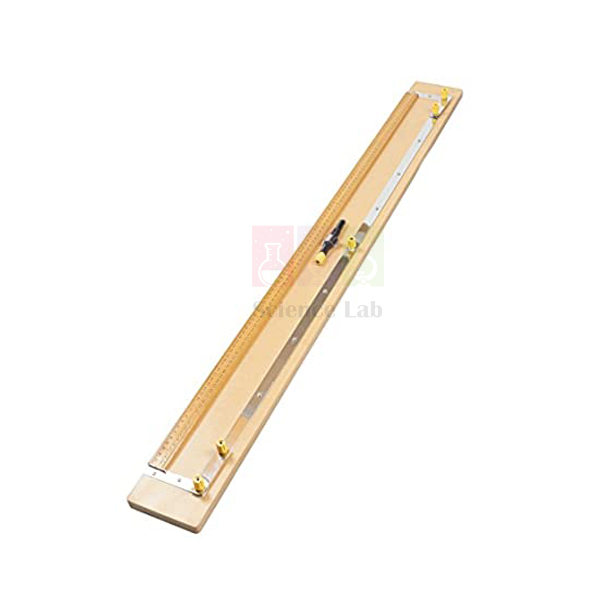
Wheatstone Bridge Four Gap
Wheatstone Bridge Four Gap (Product Code: SLE/PHY/75) is a metre-scale slide-wire bridge used to measure unknown resistances and compare resistors in school and college physics practicals. Broad, heavily plated brass strips with four gaps sit on a polished hardwood base, and 24 SWG constantan wire is stretched along the top of a metre scale marked in mm and cm. It is made by Jain Scientific Equipments Pvt Ltd (ScienceLab), an OEM manufacturer, at its own factory in Ambala, India.
Specifications
| Parameter | Detail |
|---|---|
| Bridge strips | Broad, heavily plated brass strips with four gaps |
| Resistance wire | 24 SWG constantan, stretched along the top of the scale |
| Scale | Metre scale marked in mm and cm |
| Terminals | Terminals with 4 mm sockets |
| Base | Polished hardwood |
| Included | Jockey |
| Dimensions | 1130 × 80 × 50 mm |
| Product code | SLE/PHY/75 |
| Manufacturer | Jain Scientific Equipments Pvt Ltd (ScienceLab) — OEM |
| Country of origin | India (made in Ambala, Haryana) |
What Is the Four-Gap Wheatstone Bridge Used For?
With a known resistance in one gap and the unknown in another, a galvanometer connected between the bridge and the jockey shows zero deflection at the balance point, and the two lengths of wire on either side give the ratio of the resistances. The extra gaps allow more elaborate set-ups, such as the Carey Foster arrangement for comparing two nearly equal resistances, in which the resistors are interchanged to cancel end errors.
Typical practicals include finding the resistance and specific resistance of a wire and checking the laws of resistors in series and parallel, which makes this a practical Wheatstone bridge experiment kit once a cell, key, galvanometer and resistance box are added. Tighten the terminals firmly, tap the jockey rather than sliding it along the wire, and repeat each balance with the resistors swapped for a more reliable mean.
OEM Manufacturer
Jain Scientific Equipments Private Limited, which trades as ScienceLab, is the OEM of this four-gap bridge and produces it at its own licensed factory at Saha, Ambala, Haryana, India. ScienceLab is the trading name of Jain Scientific Equipments Private Limited (CIN U29309HR2020PTC087597), and the factory at 449, HSIIDC Industrial Area, Saha operates under Factory Licence AMB-ONLINE-CHD-J-414. Laboratories and dealers deal with the manufacturer itself for quotations, repeat orders and spare jockeys — details are on the company profile.
Related Physics Lab Equipment
Items needed to complete a bridge experiment:
- Jockey with Insulated Handle (Single) — a spare jockey for the bridge wire
- Moving Coil Galvanometer — the balance detector across the bridge
- Resistance Box — supplies the known resistance in one gap
- Constantan Wire — sample wire for specific-resistance experiments
- Meter Bridge — an alternative bridge for resistance practicals
Browse the rest of Physics Lab Equipment.
Frequently Asked Questions
What is the Wheatstone Bridge Four Gap used to measure?
The Wheatstone Bridge Four Gap is used to measure an unknown resistance by balancing it against a known one, and to find the specific resistance of a wire. Its four gaps also allow comparison of two nearly equal resistances by the Carey Foster method.
What are the dimensions of the Wheatstone Bridge Four Gap?
The Wheatstone Bridge Four Gap measures 1130 × 80 × 50 mm. Its metre scale, marked in millimetres and centimetres, runs under the 24 SWG constantan wire, so allow a bench space of a little over a metre plus room for the other circuit items.
What comes with the Wheatstone Bridge Four Gap?
The Wheatstone Bridge Four Gap comes with a jockey, fitted with its plated brass strips, constantan wire, metre scale and 4 mm socket terminals on the hardwood base. The galvanometer, resistance box, cell, key and leads are ordered separately.
Who manufactures the Wheatstone Bridge Four Gap?
The Wheatstone Bridge Four Gap is manufactured by Jain Scientific Equipments Pvt Ltd (ScienceLab) as the OEM at its licensed factory in Saha, Ambala, Haryana, India, and is sold factory-direct to schools, colleges, dealers and importers in India and international markets.
How should the bridge wire be looked after?
On the Wheatstone Bridge Four Gap, tap the jockey onto the constantan wire and lift it before moving, because sliding it while pressed scratches the wire. Keep the brass strips and terminals clean and dry, and store the bridge flat so the wire stays taut.
Can we order Wheatstone bridges for a whole lab?
Yes, the Wheatstone Bridge Four Gap can be ordered in class quantities. Send the number of bridges, any matching galvanometers or resistance boxes, and your delivery location through the enquiry cart or contact page, and the manufacturer will quote the full set.
Request a Quote
Quotations for the Wheatstone Bridge Four Gap come straight from the manufacturer. Write to us through the contact page or add it to the enquiry cart.
Last updated: 24 September 2026
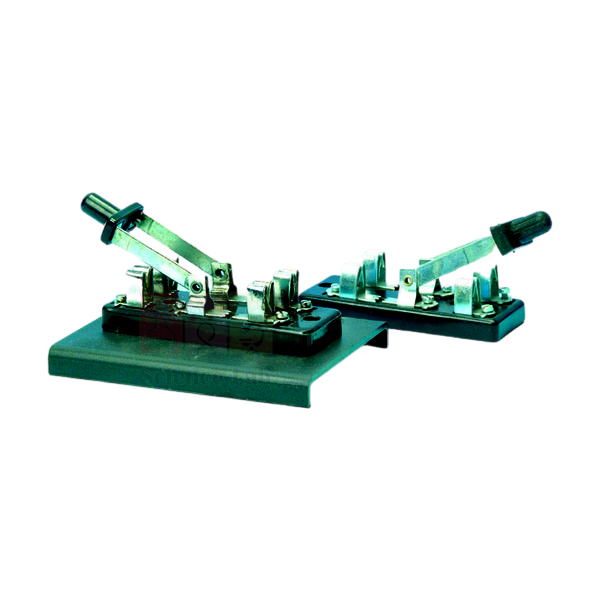
Knife Switch Double Pole
Knife Switch Double Pole (Product Code: SLE/PHY/76) is a double-pole, double-throw (DPDT) knife switch on a plastic base, used to open, close and change over circuits in school electricity experiments. Its poles and blades are made of brass for good electrical connections, and the lever position shows students at a glance whether a circuit is made or broken. It is supplied by Jain Scientific Equipments Pvt Ltd (ScienceLab), Ambala, India.
Key Details
| Parameter | Detail |
|---|---|
| Switch type | Knife switch, double pole, double throw (DPDT) |
| Base | Plastic |
| Poles and blades | Brass, for good electrical connections |
| Application | Electricity circuits in school and college labs |
| Current / voltage rating | Not stated in the listing — ask us before specialised use |
| Product code | SLE/PHY/76 |
| Supplied by | Jain Scientific Equipments Pvt Ltd (ScienceLab), Ambala, India |
What Is the Double Pole Knife Switch Used For?
A DPDT switch moves two separate contacts with one lever, so it can switch two circuits together or change a single load between two supplies. Its classic school use is as a reversing switch: with the outer terminals cross-connected, throwing the blades one way or the other reverses the current through a motor, coil or galvanometer. That makes it a handy part of any AC DC circuits experiment kit on the physics bench.
Teachers also like knife switches because the open blade is visible from the back of the room, unlike a sealed switch. Use it with cells or low-voltage supplies only, since the brass parts are exposed; close the blades firmly into their clips, and keep the brass clean so contact stays good.
What to Specify When Ordering
- Quantity of double-pole switches needed
- Whether you also need single-pole knife switches for simpler circuits
- Any current or voltage requirement, so we can confirm suitability
Supplier
Jain Scientific Equipments Private Limited, known by its trading name ScienceLab, supplies this double-pole knife switch as part of its range of switches, keys and circuit accessories for school laboratories. Buyers in India and international markets can combine it with other electricity items in one enquiry. Read more about the company on its profile page.
Related Physics Lab Equipment
Other switching and connection items for the same circuits:
- Knife Switch – Single Pole, Single Throw — for simple on/off control
- Knife Switch, Double Pole — another double-pole listing to compare
- Contact Key (Push Switch) — momentary switching for brief readings
- Demonstration Motor AC/DC — a motor whose direction a reversing switch can change
- Crocodile Clips & Leads — to wire the switch into a circuit
More items are in Physics Lab Equipment.
Frequently Asked Questions
What does double pole, double throw mean on this knife switch?
On the Knife Switch Double Pole, double pole means two separate circuits are switched by one lever, and double throw means each pole can connect to either of two contacts. Together they let the switch change over or reverse a circuit.
What is the Knife Switch Double Pole made of?
The Knife Switch Double Pole has poles and blades made of brass, chosen to ensure good electrical connections, mounted on a plastic base. Keeping the brass surfaces clean and dry helps the blades seat firmly in their clips each time.
What current and voltage can the knife switch handle?
The listing does not state a current or voltage rating for the Knife Switch Double Pole. It is intended for school electricity circuits run from cells or low-voltage supplies; contact us if you need a rating confirmed for a particular circuit.
How do I wire the Knife Switch Double Pole as a reversing switch?
To use the Knife Switch Double Pole as a reversing switch, connect the supply to the two centre terminals, cross-connect the two pairs of outer terminals, and take the load from one outer pair. Throwing the lever either way then reverses the current.
Who supplies the Knife Switch Double Pole?
The Knife Switch Double Pole is supplied by Jain Scientific Equipments Pvt Ltd (ScienceLab), Ambala, Haryana, India, to schools, colleges and dealers in India and international markets, together with keys, leads and other circuit accessories.
Can the Knife Switch Double Pole be ordered in class sets?
Yes, the Knife Switch Double Pole can be ordered in class quantities. Send the number of switches, any single-pole switches or leads you need, and your delivery location through the enquiry cart or contact page for a quotation.
Request a Quote
Request a price for the Knife Switch Double Pole on the contact page, or add it to the enquiry cart with the rest of your circuit items.
Last updated: 24 September 2026
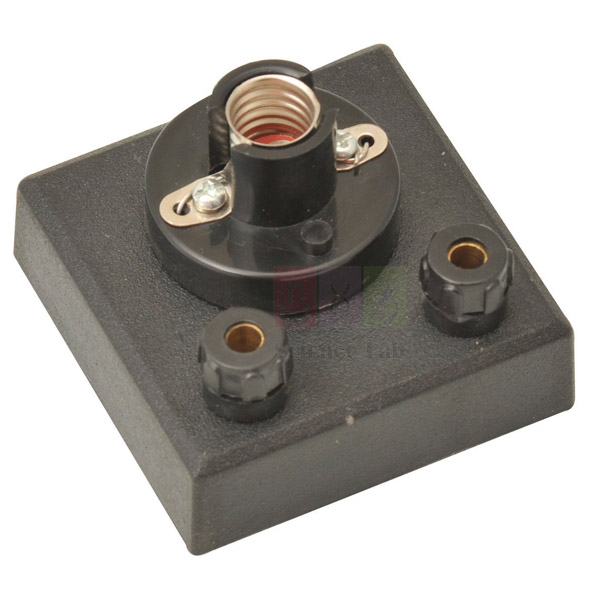
Lamp Holder
Lamp Holder (Product Code: SLE/PHY/77) is a bulb-holder unit used to connect a miniature screw lamp into circuits in school electricity lessons. It is fitted with an MES (miniature Edison screw) type bulb holder and terminals, so an MES bulb screws straight in and circuit leads attach to the terminals. It is supplied by Jain Scientific Equipments Pvt Ltd (ScienceLab), Ambala, India, as junior science lab equipment for primary and secondary classes.
Key Details
| Parameter | Detail |
|---|---|
| Bulb fitting | MES (miniature Edison screw) type bulb holder |
| Connections | Terminals for circuit leads |
| Bulb | Not listed as included — ask us if you need MES bulbs quoted |
| Product code | SLE/PHY/77 |
| Supplied by | Jain Scientific Equipments Pvt Ltd (ScienceLab), Ambala, India |
What Is the Lamp Holder Used For?
A small bulb is the simplest current indicator a class can use, and the lamp holder turns it into a part that connects cleanly into a circuit. Students use several holders to compare bulbs in series and in parallel, to build a continuity tester that sorts materials into conductors and insulators, and to show how a switch or a break in the wire stops the current.
Because the bulb screws in, a failed lamp can be replaced in seconds without rewiring, which keeps practical lessons moving. Screw the bulb in finger-tight only, match the bulb voltage to the cells in use, and tighten the leads under the terminals before switching on. It is everyday physics lab equipment in Indian school classrooms from the first circuits onwards.
What to Specify When Ordering
- Number of lamp holders per class or group
- Whether MES bulbs should be quoted with the holders, and at what voltage
- Leads or cell holders needed to complete each circuit
Supplier
ScienceLab is the trading name under which Jain Scientific Equipments Private Limited supplies this lamp holder, along with bulb holders, leads and other circuit parts, to schools and dealers from Ambala, Haryana. One enquiry can cover the holders and the accessories needed to use them. Company information is on the ScienceLab profile.
Related Physics Lab Equipment
Other holders and connectors used in the same bulb circuits:
- MES Bulb Holder — another MES holder listing for comparison
- Simple Circuit Module Lamp Holder — a lamp holder on a plug-together module board
- Lamp Holder (Economy Switch) — an economy option for large class sets
- Receptacle for Miniature Lamp — an alternative receptacle for small lamps
- Crocodile Clips & Leads — to connect the terminals into a circuit
The complete range is in Physics Lab Equipment.
Frequently Asked Questions
What bulb fits this Lamp Holder?
This Lamp Holder is fitted with an MES (miniature Edison screw) type bulb holder, so it takes MES screw-base bulbs. Choose a bulb voltage that matches the cells or supply used in the lesson so the lamp glows properly without burning out.
Is a bulb included with the Lamp Holder?
A bulb is not listed as part of the Lamp Holder, which is described as the holder with its MES fitting and terminals. If you want MES bulbs quoted along with the holders, state the quantity in your enquiry through the contact page.
How are wires connected to the Lamp Holder?
Wires connect to the Lamp Holder through its terminals. Fasten bare wire ends or leads under the terminals before switching on, and check the bulb is screwed fully into the MES holder so the circuit is complete.
Which experiments use the Lamp Holder?
The Lamp Holder is used in experiments on complete circuits, bulbs in series and parallel, conductors and insulators, and the effect of switches. Several holders on one bench let students compare bulb brightness directly as they change the circuit.
Who supplies the Lamp Holder?
The Lamp Holder is supplied by Jain Scientific Equipments Pvt Ltd (ScienceLab), Ambala, Haryana, India. It is sourced as a standard circuit part and can be supplied together with bulbs, leads and cell holders for school electricity lessons.
Can schools buy the Lamp Holder in bulk?
Yes, the Lamp Holder can be ordered in bulk for class sets and dealer stock, for delivery in India and international markets. Send the quantity and your location through the enquiry cart or contact page to receive a quotation.
Request a Quote
Ask for a Lamp Holder quotation through the contact page, or add it to the enquiry cart together with any bulbs and leads.
Last updated: 24 September 2026

Pylons Kit
Pylons Kit (Product Code: SLE/PHY/78) is a card model pack used to build miniature electricity pylons for lessons and displays on power transmission in schools. The pack contains 5 thick card sheets, and once the parts are cut out they produce 5 pylons for a model power line. It is supplied by Jain Scientific Equipments Pvt Ltd (ScienceLab), Ambala, India, as a science model kit for school project work.
Key Details
| Parameter | Detail |
|---|---|
| Contents | 5 thick card sheets |
| Finished models | 5 pylons, once the sheets are cut out |
| Material | Thick card |
| Tools and adhesive | Not listed as included — have scissors and glue ready |
| Product code | SLE/PHY/78 |
| Supplied by | Jain Scientific Equipments Pvt Ltd (ScienceLab), Ambala, India |
What Is the Pylons Kit Used For?
Five model pylons in a row are enough to show how electricity travels from a power station to towns across the country. Students cut out and assemble the pylons, stand them along a baseboard and run thread or wire between them to represent overhead lines, then label the power station, step-up and step-down transformers and the homes at the end of the line.
The finished line works as a science fair project kit for India's middle-school classes, or as a classroom display while teaching why electricity is sent at high voltage. Score fold lines before bending the card, let glued joints dry fully, and supervise any use of sharp scissors with younger pupils.
What to Specify When Ordering
- Number of packs (each pack makes 5 pylons)
- Whether scissors, glue or thread should be quoted with the packs
- Whether you also need transformer apparatus for the same lesson
Supplier
The Pylons Kit is supplied by Jain Scientific Equipments Private Limited, which trades as ScienceLab from Ambala, Haryana, alongside its wider range of physics teaching aids. Schools and dealers can add the packs to a larger science order and receive one quotation. Learn more on the ScienceLab company profile.
Related Physics Lab Equipment
Useful additions when building and teaching with the pylon model:
- Scissors, All Purpose, Sharp, 180mm — for cutting out the card parts
- Glue, Classroom Use, BOT-170ml — to fix the folded tabs
- Cotton Thread Roll — to string model power lines between pylons
- Demountable Transformer Kit — to show how voltage is stepped up and down
- Electricity Economy Kit — bulbs and leads to light the model town
See more in Physics Lab Equipment.
Frequently Asked Questions
What is in the Pylons Kit?
The Pylons Kit contains 5 thick card sheets. Once the parts are cut out and assembled, the pack produces 5 model electricity pylons, enough for a short model power line across a classroom display or project board.
What else is needed to build the Pylons Kit?
Tools and adhesive are not listed as part of the Pylons Kit, so have scissors and glue ready for cutting out and fixing the card parts. Thread or thin wire is useful for representing the overhead lines between the finished pylons.
Which lessons use the Pylons Kit?
The Pylons Kit supports lessons on how electricity is generated, transmitted and distributed, including the role of transformers and why power lines run at high voltage. It also suits science exhibitions and project work on energy and the power grid.
How many packs does a class need?
Each Pylons Kit makes 5 pylons, so one pack gives one group a complete model line. For a class working in groups, order one pack per group, and add extra packs if students will build longer lines or keep a display model.
Who supplies the Pylons Kit?
The Pylons Kit is supplied by Jain Scientific Equipments Pvt Ltd (ScienceLab), Ambala, Haryana, India. The company provides it with other physics teaching aids for schools, dealers and education programmes in India and international markets.
Request a Quote
For a Pylons Kit quotation, send the number of packs through the contact page or add the kit to the enquiry cart.
Last updated: 24 September 2026
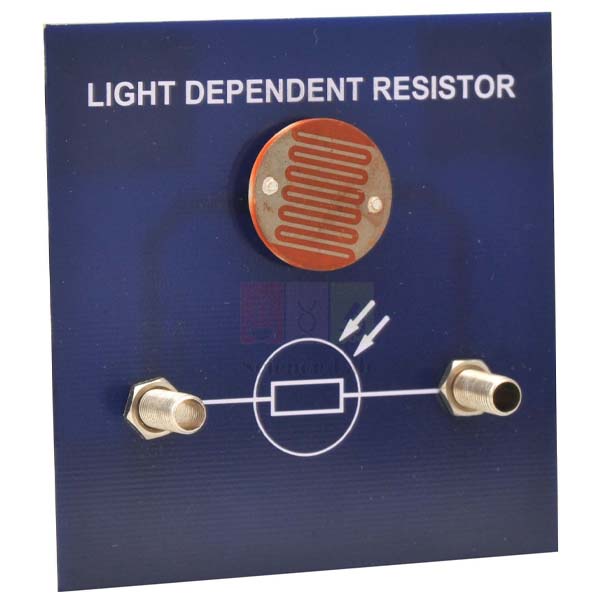
Simple Circuit Module Light Dependent Resistor Board
Simple Circuit Module Light Dependent Resistor Board (Product Code: SLE/PHY/79) is a board-mounted light dependent resistor from the Simple Circuit Modules range, used to add a light sensor to school electricity circuits. In normal room conditions its resistance is approximately 250 ohms, and shading it raises the resistance, so students can watch light level control a circuit. It is supplied by Jain Scientific Equipments Pvt Ltd (ScienceLab), Ambala, India.
Specifications
| Parameter | Detail |
|---|---|
| Module range | Simple Circuit Modules |
| Component | Light dependent resistor (LDR) on a module board |
| Resistance in normal room conditions | Approx. 250 ohms |
| Resistance when fully covered | Ask us to confirm for the current batch |
| Product code | SLE/PHY/79 |
| Supplied by | Jain Scientific Equipments Pvt Ltd (ScienceLab), Ambala, India |
What Is the LDR Circuit Module Used For?
Placed in series with a lamp or LED module and a few cells, the LDR board makes the light output change as students cover and uncover it, a direct way to show that resistance controls current. With a multimeter across it, groups can record resistance against the distance from a lamp and plot a graph, a common activity in OPTO electronics experiment kit lessons.
Because the resistor is already mounted, there are no fragile leads to bend and the module drops into a circuit alongside the other boards in the range. Take readings away from direct sunlight so results repeat from one group to the next, and compare the board with the bare component when explaining how sensors are built into real products.
What to Specify When Ordering
- Number of LDR boards needed
- Other Simple Circuit Modules to go with them, such as LED, lamp or switch boards
- Whether you need the fully covered resistance value confirmed before ordering
Supplier
Jain Scientific Equipments Private Limited, trading as ScienceLab, supplies this LDR board with the other boards in its Simple Circuit Modules range, so a school can assemble a matched set in one order. Institutions completing vendor forms can use the company's GSTIN 06AAECJ8618A1ZT and its Legal Entity Identifier 3358004HRD1JIVXKYX49. More about the company is on the ScienceLab profile.
Related Physics Lab Equipment
Boards and meters that complete a light-sensing circuit:
- Light Dependent Resistor — the bare component for soldered projects
- Simple Circuit Module LED Board Green — an indicator whose brightness the LDR can control
- Simple Circuit Module Lamp Holder — a lamp board for the same circuit
- Simple Circuit Module Push Switch — to switch the sensing circuit on and off
- Standard Digital Multimeter — to record resistance as light changes
Browse all items in Physics Lab Equipment.
Frequently Asked Questions
What is the resistance of the LDR board in normal light?
The Simple Circuit Module Light Dependent Resistor Board has a resistance of approximately 250 ohms in normal room conditions. The value rises as the resistor is shaded and falls in brighter light, which is how it senses light level in a circuit.
What is the LDR board's resistance when fully covered?
The listing for the Simple Circuit Module Light Dependent Resistor Board does not give a reliable covered value, so we do not quote one here. Ask us through the contact page and we will confirm the dark resistance of the boards currently supplied.
How is the LDR board used with other Simple Circuit Modules?
The Simple Circuit Module Light Dependent Resistor Board connects in series with lamp or LED boards and a cell supply, so shading the LDR dims the indicator. Adding a switch module lets students control the whole light-sensing circuit.
How is the board different from a loose LDR?
The Simple Circuit Module Light Dependent Resistor Board carries the LDR ready-mounted, so there are no thin leads to bend or break and it fits straight into module circuits. A loose LDR suits soldered projects and breadboards instead.
Who supplies the Simple Circuit Module Light Dependent Resistor Board?
The Simple Circuit Module Light Dependent Resistor Board is supplied by Jain Scientific Equipments Pvt Ltd (ScienceLab), Ambala, Haryana, India, together with the other boards in the Simple Circuit Modules range for schools and dealers.
Can the LDR board be ordered for a whole class?
Yes, the Simple Circuit Module Light Dependent Resistor Board can be ordered in class quantities with matching LED, lamp and switch modules. Send the quantities and delivery location through the enquiry cart or contact page to receive a quotation.
Request a Quote
Request a price for the Simple Circuit Module Light Dependent Resistor Board through the contact page, or add it to the enquiry cart with the other modules you need.
Last updated: 24 September 2026
905.jpg)
Jockey with Insulated Handle (Single)
Jockey with Insulated Handle (Single) (Product Code: SLE/PHY/80) is a hand-held contact probe used to find the balance point on the wire of a Wheatstone bridge or potentiometer in physics practicals. It is 100 mm long overall, with an insulated handle, a plated brass contact and a 4 mm plug terminal for connection to the circuit. It is made by Jain Scientific Equipments Pvt Ltd (ScienceLab), an OEM manufacturer, at its own factory in Ambala, India.
Specifications
| Parameter | Detail |
|---|---|
| Overall length | 100 mm |
| Handle | Insulated |
| Contact | Plated brass |
| Terminal | 4 mm plug |
| For use with | Wheatstone bridge and potentiometer work |
| Quantity | Single jockey |
| Product code | SLE/PHY/80 |
| Manufacturer | Jain Scientific Equipments Pvt Ltd (ScienceLab) — OEM |
| Country of origin | India (made in Ambala, Haryana) |
What Is the Insulated Jockey Used For?
In bridge and potentiometer experiments the jockey is the moving contact: the student touches it onto the resistance wire at different points until the galvanometer shows no deflection, then reads the balancing length from the scale. The 4 mm plug terminal pushes into a lead or socket, so the jockey links the wire to the galvanometer without a loose clip.
The insulated handle keeps fingers off the circuit and stops hand contact from disturbing the reading, which matters in any meter bridge lab in India where many students share the same apparatus. Tap the brass contact gently and lift it between trials rather than sliding it, since a dragged contact scores the wire. Wipe the tip clean if readings start to jump.
What to Specify When Ordering
- Number of jockeys (this listing is for a single jockey)
- The bridges or potentiometers they will be used with, if you also need those quoted
- Whether you prefer this plug-terminal jockey or a pencil (knife-edge) type
OEM Manufacturer
ScienceLab is the trading name of Jain Scientific Equipments Private Limited, the original equipment manufacturer of this jockey. It is produced at the company's own licensed factory at Saha, Ambala, Haryana, India, the same factory that makes the bridges and potentiometers it is used with, so labs can match jockeys to their apparatus through one manufacturer. Schools, dealers and importers order factory-direct, and repeat orders for spares are handled by the maker itself. See the company profile for more.
Related Physics Lab Equipment
Apparatus this jockey is used with:
- Wheatstone Bridge Four Gap — the bridge wire the jockey balances on
- Potentiometer — for emf comparison using the same jockey
- Meter Bridge — another slide-wire bridge that needs a jockey
- Moving Coil Galvanometer — shows the null point the jockey locates
- Pencil Jockey (Knife Edge Jockey) — an alternative knife-edge contact
The full list is in Physics Lab Equipment.
Frequently Asked Questions
How long is the Jockey with Insulated Handle?
The Jockey with Insulated Handle (Single) is 100 mm long overall. That length is easy to hold steady between finger and thumb while tapping the contact onto a bridge or potentiometer wire.
What type of terminal does the jockey have?
The Jockey with Insulated Handle (Single) has a 4 mm plug terminal, which fits standard 4 mm sockets and lead connectors. It connects the jockey to the galvanometer side of the circuit without crocodile clips.
Which apparatus is the Jockey with Insulated Handle used with?
The Jockey with Insulated Handle (Single) is made for Wheatstone bridge and potentiometer work, including metre bridges. It serves as the moving contact that finds the balance point along the resistance wire in these experiments.
Who manufactures the Jockey with Insulated Handle?
The Jockey with Insulated Handle (Single) is manufactured by Jain Scientific Equipments Pvt Ltd (ScienceLab), the OEM, at its own licensed factory in Saha, Ambala, Haryana, India, and is supplied factory-direct to labs and dealers.
Why does the jockey need an insulated handle?
The insulated handle on the Jockey with Insulated Handle (Single) keeps the user's hand out of the circuit. This prevents body contact from affecting the galvanometer reading and gives a firm, comfortable grip during repeated balance-point measurements.
Can jockeys be ordered as spares in quantity?
Yes, the Jockey with Insulated Handle (Single) can be ordered in quantity as spares for existing bridges and potentiometers. Send the number needed and your delivery location through the enquiry cart or contact page for a quotation from the manufacturer.
Request a Quote
Quotes for the Jockey with Insulated Handle (Single) come direct from the manufacturer — send your requirement through the contact page or the enquiry cart.
Last updated: 24 September 2026
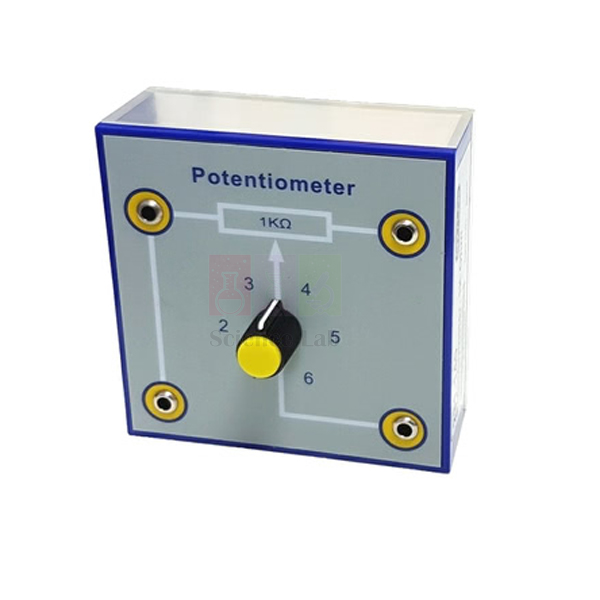
Potentiometer Module, 1 Kohm
Potentiometer Module, 1 Kohm (Product Code: SLE/PHY/81) is a 1 kΩ rotary linear potentiometer mounted on a channel box, used as a variable resistor or adjustable voltage divider in school electricity and electronics circuits. Connections are made through 4 mm sockets, and a fast-blow fuse protects the module when students connect it wrongly. It is supplied by Jain Scientific Equipments Pvt Ltd (ScienceLab), Ambala, India, to physics labs and dealers.
Specifications
| Parameter | Detail |
|---|---|
| Resistance value | 1 kΩ (the module is offered in a choice of values) |
| Potentiometer type | Rotary, linear |
| Mounting | Channel box |
| Connections | 4 mm sockets |
| Protection | Fast-blow fuse against wrong connection by students |
| Product code | SLE/PHY/81 |
| Supplied by | Jain Scientific Equipments Pvt Ltd (ScienceLab), Ambala, India |
What Is the Potentiometer Module Used For?
Wired with two of its sockets, the module acts as a variable resistor that dims a lamp or LED as the knob turns. Using all three sockets across a low-voltage supply, it becomes a voltage divider that gives a smoothly adjustable output, which students can measure with a voltmeter while they vary the load in Ohm law experiment kit set-ups.
Because the track is linear, equal turns of the knob give roughly equal changes in resistance, so students can relate knob position to the reading they see. If the module stops working after a wiring mistake, check the fast-blow fuse first. Keep supply voltages low and switch off before changing connections.
What to Specify When Ordering
- Resistance value — 1 kΩ for this listing, or another value from the range
- Number of modules for the class
- Spare fuses, and the fuse rating to be confirmed with us
- Leads with 4 mm plugs if your lab does not already have them
Supplier
This potentiometer module is supplied by Jain Scientific Equipments Private Limited, the company behind the ScienceLab name, as part of its range of plug-in circuit modules and physics instruments for schools and colleges. Orders can combine modules of different values with meters and power supplies. Company details are on the ScienceLab profile.
Related Physics Lab Equipment
Items used with the module in variable-resistance circuits:
- Potentiometer Module — the same module family, for other resistance values
- Simple Circuit Module LED Board Green — an LED load to dim with the module
- Standard Digital Multimeter — to measure the divider output and current
- Power Supply Variable — a low-voltage source for divider circuits
- Stackable Leads — leads for connecting the module into a circuit
More options are listed under Physics Lab Equipment.
Frequently Asked Questions
What resistance does the Potentiometer Module have?
The Potentiometer Module, 1 Kohm has a 1 kΩ rotary linear potentiometer. The module is offered in a choice of values, so state the resistance you need when ordering if another value suits your experiments better.
What does the fuse in the Potentiometer Module do?
The Potentiometer Module, 1 Kohm includes a fast-blow fuse that protects it when students connect it wrongly, for example directly across a supply. If the module stops responding, check and replace the fuse before assuming the potentiometer has failed.
How is the Potentiometer Module connected?
The Potentiometer Module, 1 Kohm connects through 4 mm sockets on its channel box. Use two sockets to wire it as a variable resistor, or all three across a supply to use it as an adjustable voltage divider.
What does linear mean for this potentiometer?
On the Potentiometer Module, 1 Kohm, linear means the resistance changes in proportion to how far the knob is turned. Students therefore see an even change in current or voltage as they rotate it, which makes readings easier to interpret.
Who supplies the Potentiometer Module, 1 Kohm?
The Potentiometer Module, 1 Kohm is supplied by Jain Scientific Equipments Pvt Ltd (ScienceLab), Ambala, Haryana, India, to schools, colleges and dealers in India and international markets, alongside meters and other circuit modules.
What should a quotation request for the module include?
A quotation request for the Potentiometer Module, 1 Kohm should give the number of modules, any other resistance values required, spare fuses and your delivery location. Send it through the enquiry cart or contact page for a combined quote.
Request a Quote
Price the Potentiometer Module, 1 Kohm through the contact page, or add it to the enquiry cart with any meters or leads you need.
Last updated: 24 September 2026
LED, 5 mm, White
LED, 5 mm, White (Product Code: SLE/PHY/82) is a standard 5 mm white light-emitting diode used as a light source and indicator in school electronics circuits, science projects and physics practicals. It comes in a pack of 100, enough to equip a whole class, and the same 5 mm LED is available in a range of colours. It is supplied by Jain Scientific Equipments Pvt Ltd (ScienceLab), Ambala, India.
Specifications
| Parameter | Detail |
|---|---|
| Type | Standard LED (light-emitting diode) |
| Size | 5 mm |
| Colour | White |
| Pack size | 100 LEDs |
| Other colours | Available in the same 5 mm range |
| Series resistor | Not listed as included — fit one in every circuit |
| Product code | SLE/PHY/82 |
| Supplied by | Jain Scientific Equipments Pvt Ltd (ScienceLab), Ambala, India |
What Is the 5 mm White LED Used For?
White LEDs give a clear, bright light, which makes them the natural choice when an experiment needs illumination rather than just an on/off signal. Students use them to light model houses and torches, to shine on a light dependent resistor in sensor experiments, and to compare the light and current of an LED with a filament bulb in LED characteristics experiment kit work.
A pack of 100 also covers science fair project kit needs in India's schools, where many pupils build lit displays at the same time. Always connect a suitable series resistor, observe polarity (the longer lead is usually the anode), and store the LEDs in their pack so the leads do not tangle or bend.
What to Specify When Ordering
- Number of packs of 100
- Any other colours from the 5 mm range, such as bright red or blue
- Whether you prefer board-mounted LED modules with a built-in resistor for younger classes
Supplier
ScienceLab, the trading name of Jain Scientific Equipments Private Limited, supplies these white LEDs with its range of components for school electronics and physics labs. The supplying company is registered as CIN U29309HR2020PTC087597 with GSTIN 06AAECJ8618A1ZT, details that tender and vendor-registration forms usually request. Read about the company on the ScienceLab profile.
Related Physics Lab Equipment
Other LEDs and parts for the same circuits:
- LED Bright Red — the same 5 mm LED in bright red
- LED Blue — a blue LED for colour-mixing and indicator work
- LED White — another white LED listing to compare
- Light Dependent Resistor — a sensor to test with the white LED as light source
- Simple Circuit Module LED Board Green — a board-mounted LED with its resistor fitted
Browse Physics Lab Equipment for more.
Frequently Asked Questions
How many LEDs are in a pack of LED, 5 mm, White?
Each pack of LED, 5 mm, White contains 100 standard 5 mm white LEDs. That is enough for a full class to build individual circuits, with spares left for replacements and project work.
Do the white LEDs need a resistor?
Yes, each LED, 5 mm, White needs a series resistor to limit the current, and resistors are not listed as part of the pack. Choose the value to suit your supply voltage, or ask us through the contact page for help.
How do I tell which way round to connect the LED?
An LED, 5 mm, White conducts in one direction only. The longer lead is normally the anode, which goes towards the positive side of the supply, and the flat edge on the rim usually marks the cathode. Reversed, the LED simply stays dark.
Are other colours available in the same 5 mm LED?
Yes, the standard 5 mm LED sold as LED, 5 mm, White is available in a range of colours, including bright red and blue listings. Mixed-colour orders can be quoted together, so state the number of packs of each colour in your enquiry.
Who supplies LED, 5 mm, White?
LED, 5 mm, White is supplied by Jain Scientific Equipments Pvt Ltd (ScienceLab), Ambala, Haryana, India. The company provides these LEDs as components for school electronics and physics labs in India and international markets.
Request a Quote
Send the number of packs through the contact page or add LED, 5 mm, White to the enquiry cart for a quotation.
Last updated: 24 September 2026
LED Bright Red
LED Bright Red (Product Code: SLE/PHY/83) is a standard 5 mm bright red light-emitting diode used as a status indicator and to teach diode polarity in school electronics and physics lessons. It is sold in a pack of 100, and the same 5 mm LED is offered in a range of colours for colour-coded circuits. It is supplied by Jain Scientific Equipments Pvt Ltd (ScienceLab), Ambala, India, for classroom and project use.
Specifications
| Parameter | Detail |
|---|---|
| Type | Standard LED, 5 mm |
| Colour | Bright red |
| Pack size | 100 |
| Range | Same 5 mm LED available in a range of colours |
| Product code | SLE/PHY/83 |
| Supplied by | Jain Scientific Equipments Pvt Ltd (ScienceLab), Ambala, India |
What Is the Bright Red LED Used For?
Red is the colour people read as "on" or "warning", so bright red LEDs are the usual choice for power indicators, alarm lights and the output lamps in logic gates experiment kit circuits, where a lit LED shows a logic 1. In a first diode lesson, students connect one each way round and see that it lights only when forward biased, a memorable demonstration of one-way conduction.
Paired with green LEDs, red ones let pupils build traffic-light models and two-colour polarity testers that show which way current is flowing. Fit a series resistor in every circuit, check the leads before soldering, and keep unused LEDs in the pack so the full 100 stay sorted by colour.
What to Specify When Ordering
- Number of packs of 100 bright red LEDs
- Other colours needed for colour-coded work, such as white or blue
- Whether a board-mounted red LED module would suit younger students better
Supplier
Jain Scientific Equipments Private Limited supplies these bright red LEDs under its ScienceLab name, as one of the stock components it provides to school electronics labs, teachers and dealers. They can be combined with white and blue LEDs and circuit modules in a single order. The company profile has more details.
Related Physics Lab Equipment
Useful with red LEDs in indicator and logic work:
- Simple Circuit Module LED Board Red — a red LED ready-mounted on a module board
- LED, 5 mm, White — white LEDs from the same 5 mm range
- LED Blue — for three-colour indicator circuits
- Logic Gate Apparatus — logic experiments where LEDs show the output state
- Battery Snap with Crocodile Clip — a quick way to power test circuits
See more items in Physics Lab Equipment.
Frequently Asked Questions
What size and quantity is the LED Bright Red pack?
The LED Bright Red is a standard 5 mm LED supplied in a pack of 100. The quantity suits a class set for diode and indicator experiments, with extra LEDs left over for projects and replacements.
How does the LED Bright Red show diode polarity?
The LED Bright Red conducts and glows only when its anode, usually the longer lead, is connected towards the positive supply. Reversing it leaves it dark, so students can see forward and reverse bias without needing a meter.
Can the LED Bright Red be connected straight to a battery?
No, the LED Bright Red should always have a series resistor to limit its current; connecting it directly to a battery can burn it out. Resistors are not listed with the pack, so ask us if you want suitable values quoted.
Is the LED Bright Red suitable for logic gate experiments?
Yes, the LED Bright Red is commonly used as an output indicator in logic gate experiments, lighting to show a high output. Check the gate circuit already has a current-limiting resistor for the LED before connecting it.
Who supplies the LED Bright Red?
The LED Bright Red is supplied by Jain Scientific Equipments Pvt Ltd (ScienceLab) of Ambala, Haryana, India, to schools, colleges and dealers in India and international markets, together with LEDs in other colours and circuit modules.
Request a Quote
To price the LED Bright Red, send the number of packs through the contact page or add it to the enquiry cart with any other colours.
Last updated: 24 September 2026
Simple Circuit Module LED Board Green
Simple Circuit Module LED Board Green (Product Code: SLE/PHY/84) is a board-mounted green light-emitting diode from the Simple Circuit Modules range, used as an indicator lamp in school electricity circuits. It carries a large LED with a series resistor of 220 ohms, so it can be used on potential differences of up to 6 V without adding a separate resistor. It is supplied by Jain Scientific Equipments Pvt Ltd (ScienceLab), Ambala, India.
Specifications
| Parameter | Detail |
|---|---|
| Module range | Simple Circuit Modules |
| LED | Large light-emitting diode, green |
| Series resistor | 220 ohms, fitted with the LED |
| Operating p.d. | Up to 6 V |
| Product code | SLE/PHY/84 |
| Supplied by | Jain Scientific Equipments Pvt Ltd (ScienceLab), Ambala, India |
What Is the Green LED Circuit Module Used For?
Younger students can drop the green LED board straight into a circuit with a few cells, because the 220 ohm resistor already limits the current. Connected one way it glows, and turned round it stays dark, which makes it a clear first demonstration of how a diode conducts in only one direction and a good starting point for LED characteristics experiment kit lessons.
Used alongside the red LED board, it shows which way current flows in a circuit or forms the "go" light in a traffic-light model. Keep the supply at 6 V or below, as listed, and add it to other boards in the range, such as a switch or light dependent resistor module, to build sensor and control circuits for an electricity experiment kit at school level.
What to Specify When Ordering
- Number of green LED boards
- Whether matching red LED boards are needed for polarity or traffic-light work
- Other Simple Circuit Modules, such as switch, buzzer or LDR boards, for complete circuits
Supplier
The green LED board is supplied by Jain Scientific Equipments Private Limited, trading as ScienceLab, as part of the Simple Circuit Modules range it offers to schools and dealers from Ambala, Haryana. Buyers can build a full module set from one quotation. Read more on the ScienceLab company profile.
Related Physics Lab Equipment
Modules that work alongside the green LED board:
- Simple Circuit Module LED Board Red — the red partner for polarity and traffic-light circuits
- Simple Circuit Module Light Dependent Resistor Board — lets light level control the LED
- Simple Circuit Module Push Switch — to switch the LED on and off
- Simple Circuit Module Buzzer — adds a sound output beside the light
- Potentiometer Module, 1 Kohm — to vary the LED brightness
Explore more in Physics Lab Equipment.
Frequently Asked Questions
What resistor is fitted on the LED Board Green?
The Simple Circuit Module LED Board Green has a 220 ohm series resistor with its large green LED. The resistor limits the current, so the board can be connected to classroom supplies without students having to choose and fit a resistor themselves.
What is the maximum voltage for the green LED board?
The Simple Circuit Module LED Board Green is listed for potential differences of up to 6 V. Keep the supply at or below this level, for example a small group of cells, so the LED and its 220 ohm resistor are not overloaded.
Why does the green LED board not light when connected?
If the Simple Circuit Module LED Board Green stays dark, it is most likely connected the wrong way round, because an LED conducts in one direction only. Reverse the connections, then check the cells and leads if it still does not light.
How is the LED board different from a loose LED?
The Simple Circuit Module LED Board Green carries a large LED with its 220 ohm resistor already fitted on a board, ready for module circuits. A loose 5 mm LED needs a separate resistor and suits soldered or breadboard projects instead.
Who supplies the Simple Circuit Module LED Board Green?
The Simple Circuit Module LED Board Green is supplied by Jain Scientific Equipments Pvt Ltd (ScienceLab), Ambala, Haryana, India, with the other boards in the Simple Circuit Modules range, for schools and dealers in India and international markets.
Request a Quote
For a quotation on the Simple Circuit Module LED Board Green, use the contact page or add it to the enquiry cart along with the other modules you need.
Last updated: 24 September 2026
Simple Circuit Module LED Board Red
Simple Circuit Module LED Board Red (Product Code: SLE/PHY/85) is a board-mounted red light-emitting diode used to show whether current is flowing in simple circuits built during school physics lessons. Its large LED is already wired to a 220 ohm series resistor, so pupils can connect it across potential differences of up to 6 V without adding their own protective resistor. It is supplied by Jain Scientific Equipments Pvt Ltd (ScienceLab), Ambala, India, as part of its Simple Circuit Modules range.
Specifications
| Parameter | Detail |
|---|---|
| Series | Simple Circuit Modules |
| Module type | LED board |
| LED | Large light-emitting diode, red |
| Series resistor | 220 ohms, fitted |
| Working potential difference | Up to 6 V |
| Product code | SLE/PHY/85 |
| Supplied by | Jain Scientific Equipments Pvt Ltd (ScienceLab), Ambala, India |
What Is the Red LED Board Used For?
The red LED board acts as a clear visual indicator in series and parallel circuit work: when it glows, pupils know current is passing through that branch. Because a diode conducts in one direction only, reversing the board in a circuit is also a simple way to introduce polarity before students meet the diode symbol on paper. It fits naturally into a school electricity experiment kit alongside switch, motor and sensor modules from the same series.
Keep the supply at or below 6 V, since the fitted resistor is matched to that range. Using the red board together with the green version lets a class build a two-colour indicator, for example to show which of two switches is closed. Store the modules dry and check each connection is firm before a practical begins.
What to Specify When Ordering
- LED colour: this listing is the red board; the green board is a separate item.
- Number of boards needed per student group or per laboratory.
- Other Simple Circuit Modules (push switch, motor, light-dependent resistor) to include in the same order.
- The supply you plan to use, keeping within the 6 V limit of the board.
Supplier
ScienceLab is the trading name of Jain Scientific Equipments Private Limited, which supplies this red LED board as part of the Simple Circuit Modules range for school electricity lessons. The company sources the modules and handles quotations and dispatch from Ambala, Haryana, India, for schools, dealers and importers in India and international markets. For vendor registration, the supplying company holds Importer-Exporter Code AAECJ8618A (DGFT) and GSTIN 06AAECJ8618A1ZT.
Replacement boards and repeat class sets can be requested from us directly. More about the company is on the ScienceLab profile page.
Related Physics Lab Equipment
These modules are commonly used with the red LED board in the same simple-circuit lessons:
- Simple Circuit Module LED Board Green — the green version, for two-colour indicator circuits.
- Simple Circuit Module Push Switch — an on/off push button on a base to control the LED.
- Simple Circuit Module Motor — a low-voltage motor module for comparing light and motion outputs.
- Simple Circuit Module Light Dependent Resistor Board — a light-sensing module for simple light-controlled circuits.
- Simple Circuit Module Buzzer — an audible indicator that complements the visual LED.
See the complete range of Physics Lab Equipment for more circuit apparatus.
Frequently Asked Questions
What voltage is the Simple Circuit Module LED Board Red designed for?
The Simple Circuit Module LED Board Red is intended for potential differences of up to 6 V. Its large red LED already has a 220 ohm series resistor fitted, so within that limit it can be connected straight into a low-voltage school circuit.
Why does the red LED board have a series resistor?
The series resistor on the Simple Circuit Module LED Board Red limits the current through the diode. An LED joined directly to a cell can draw too much current and fail, so the fitted 220 ohm resistor protects it during pupil experiments.
Will the red LED board light if it is connected the wrong way round?
No. An LED conducts in one direction only, so the Simple Circuit Module LED Board Red stays dark when its connections are reversed. Teachers often use this to introduce polarity; swapping the connections makes the board light again.
Who supplies the Simple Circuit Module LED Board Red?
Jain Scientific Equipments Pvt Ltd, trading as ScienceLab, supplies the Simple Circuit Module LED Board Red from Ambala, Haryana, India. The company sources the board together with the rest of the Simple Circuit Modules range and quotes it to schools, dealers and importers.
What should a quotation request for the red LED board include?
A quotation request for the Simple Circuit Module LED Board Red should state the quantity, whether you also need the green board or other Simple Circuit Modules, and the delivery location. Send these details through our contact page for a reply.
Can the Simple Circuit Module LED Board Red be ordered in bulk for export?
Yes. The Simple Circuit Module LED Board Red can be ordered in class-set or bulk quantities for schools and distributors in India and international markets. Share the quantity and destination, and ScienceLab will confirm packing and shipping options with the quotation.
Request a Quote
To order the Simple Circuit Module LED Board Red, send your quantity and delivery details through the contact page or add the item to the enquiry cart. Quotations come directly from ScienceLab as the supplier, and questions about matching modules or repeat orders are answered by the same team.
Last updated: 24 September 2026
Demountable Transformer Accessory Set No. 1
Demountable Transformer Accessory Set No. 1 (Product Code: SLE/PHY/86) is a transformer accessory set used to demonstrate the heavy currents a step-down transformer can deliver in school and college physics laboratories. With it, a teacher shows that these currents are large enough to weld metals or boil water, two striking results that make transformer theory memorable. The set is manufactured by Jain Scientific Equipments Pvt Ltd (ScienceLab), an OEM manufacturer, at its own factory in Ambala, India.
Key Details
| Parameter | Detail |
|---|---|
| Purpose | Shows that a step-down transformer can produce currents large enough to weld metals or boil water |
| Requirement | Mains coil required |
| Used with | Demountable transformer apparatus |
| Set | No. 1 (Set No. 2 is listed separately) |
| Product code | SLE/PHY/86 |
| Manufacturer | Jain Scientific Equipments Pvt Ltd (ScienceLab) — OEM |
| Country of origin | India (made in Ambala, Haryana) |
What Is the Transformer Accessory Set No. 1 Used For?
In a step-down transformer the secondary has fewer turns than the primary, so the voltage falls while the available current rises. Accessory Set No. 1 turns that principle into visible demonstrations, showing that the secondary side can supply enough current to weld metal or bring water to the boil. It works as a transformer experiment kit add-on for the teacher's demonstration bench rather than for pupil practicals.
Because the set runs with a mains coil and produces heavy currents and heat, the demonstration should be set up and switched on by a teacher or technician. Assemble the transformer completely before connecting the supply, keep students at a safe distance, and let hot parts cool before the apparatus is dismantled.
What to Specify When Ordering
- Whether your laboratory already has a demountable transformer with a mains coil, since the set requires one.
- Whether Accessory Set No. 2 should be quoted at the same time.
- The number of sets needed across your physics laboratories.
- Delivery location, so packing and freight can be included in the quotation.
OEM Manufacturer
ScienceLab is the brand used by Jain Scientific Equipments Private Limited, which manufactures this accessory set as the OEM at its own factory at Saha, Ambala, Haryana. Transformer demonstration apparatus leaves that factory for school and college physics departments, dealers and importers, and every quotation comes straight from the production source. If a part is lost or worn after years of demonstrations, ask us about replacements directly. The company profile gives more background.
Related Physics Lab Equipment
Transformer and induction apparatus that pairs with Accessory Set No. 1:
- Demountable Transformer Kit — laminated core and coils for step-up and step-down transformer demonstrations.
- Demountable Transformer Accessory Set No. 2 — the companion set for Lenz's law and pendulum damping demonstrations.
- Primary and Secondary Coil Set — enamelled copper coils on plastic spools for induction experiments.
- Demonstrative Transformer (for high school) — a working U-core transformer model for introductory lessons.
- Transformer Parts Kit — coils and support bases for building transformers from parts.
More electromagnetism apparatus is listed under Physics Lab Equipment.
Frequently Asked Questions
What does the Demountable Transformer Accessory Set No. 1 demonstrate?
The Demountable Transformer Accessory Set No. 1 demonstrates that a step-down transformer can produce currents large enough to weld metals or boil water. It turns the trade-off between voltage and current in a transformer into a visible, memorable result for students.
Does the Demountable Transformer Accessory Set No. 1 need a mains coil?
Yes. The Demountable Transformer Accessory Set No. 1 requires a mains coil to operate. If your laboratory does not already have one, mention this in your enquiry so ScienceLab can advise on a suitable coil in the quotation.
Who should operate the transformer accessory set?
Demonstrations with the Demountable Transformer Accessory Set No. 1 should be run by a teacher or trained technician, because the set works with a mains coil and produces heavy currents and heat. Students should watch from a safe distance.
How is Set No. 1 different from Set No. 2?
The Demountable Transformer Accessory Set No. 1 is aimed at heavy-current effects such as welding and boiling water, while Set No. 2 is listed for Lenz's law demonstrations. For an itemised contents list of either set, please ask us through the contact page.
Who manufactures the Demountable Transformer Accessory Set No. 1?
The Demountable Transformer Accessory Set No. 1 is manufactured by Jain Scientific Equipments Pvt Ltd (ScienceLab) as the OEM at its own factory in Ambala, Haryana, India, and is supplied direct to institutions, dealers and importers.
Can the accessory set be ordered for several laboratories or for export?
Yes. The Demountable Transformer Accessory Set No. 1 can be quoted for a single laboratory or for larger institutional and dealer orders across India and international markets. Give the quantity and destination, and ScienceLab will confirm packing and delivery details.
Request a Quote
For a price on the Demountable Transformer Accessory Set No. 1, tell us the quantity and whether you need a mains coil through the contact page, or place it in the enquiry cart. You receive the quotation directly from the manufacturer.
Last updated: 24 September 2026
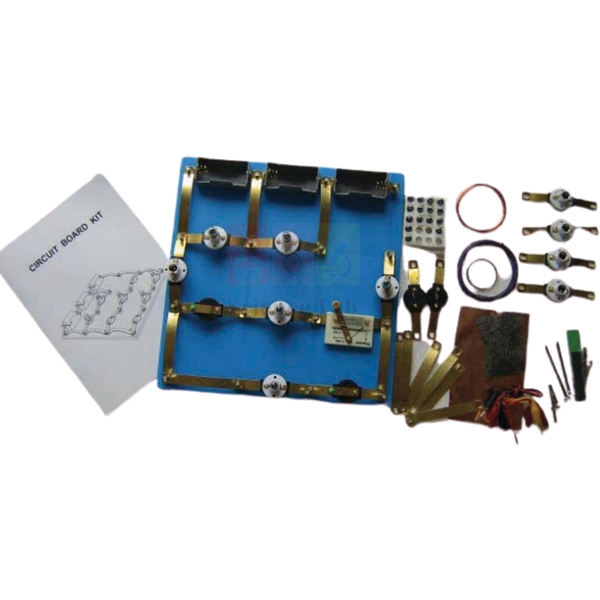
Worcester Circuit Board
Worcester Circuit Board (Product Code: SLE/PHY/87) is a circuit-building board used to investigate the nature and properties of electricity in school science and physics classes. Detachable battery holders, a mounted diode and resistor, and phosphor-bronze connectors let pupils assemble series and parallel circuits quickly and with dependable contacts. It is manufactured by Jain Scientific Equipments Pvt Ltd (ScienceLab), an OEM manufacturer, at its own factory in Ambala, India.
Key Details
| Parameter | Detail |
|---|---|
| Circuits supported | Simple series and parallel circuits |
| Battery holders | Detachable |
| Mounted components | Diode and resistor, for quick circuit construction |
| Connectors | Phosphor-bronze, for long life and good electrical conduction |
| Extension | Plugs and crocodile clips for outboard experiments |
| Product code | SLE/PHY/87 |
| Manufacturer | Jain Scientific Equipments Pvt Ltd (ScienceLab) — OEM |
| Country of origin | India (made in Ambala, Haryana) |
What Is the Worcester Circuit Board Used For?
A Worcester circuit board gives each pupil group a tidy base for building circuits without loose wires trailing across the bench. Students can begin with a single cell and component, then add a second path to compare series and parallel arrangements, and use the mounted diode to see that current passes one way only. The resistor shows how adding resistance changes what happens in the circuit.
When an investigation needs something that is not on the board, such as a separate lamp, a meter or a sample material to test for conduction, the plugs and crocodile clips carry the circuit out to that outboard item. This flexibility makes the board practical school physics lab equipment from early electricity topics through to open-ended investigations. Take the cells out of the detachable holders after each lesson so they do not run down in storage.
What to Specify When Ordering
- Number of boards required per class or per pupil pair.
- Whether cells for the detachable battery holders should be included in the quotation.
- Extra crocodile-clip leads if outboard experiments are planned.
- Delivery address, so freight can be quoted with the boards.
OEM Manufacturer
Jain Scientific Equipments Private Limited, which trades as ScienceLab, is the OEM behind this Worcester circuit board and produces it at its own factory at Saha, Ambala, Haryana. Because the board comes straight from the maker, schools, dealers and importers deal with one source for quotations, repeat class sets and replacement parts. Details of the company are on the ScienceLab profile.
Related Physics Lab Equipment
Items that extend Worcester circuit board lessons or offer another way to teach circuits:
- Circuit Board Worcester — a second Worcester-type board listing with clip-on phosphor-bronze strips.
- Crocodile Clips & Leads — leads with a clip at each end for connecting outboard items.
- MES Bulb Holder — a lamp holder with screw terminals for adding an external lamp.
- Standard Digital Multimeter — for measuring voltage and current in the circuits pupils build.
- Electricity Circuits Kit — a panel-based alternative to the circuit-board approach.
Explore further circuit apparatus in Physics Lab Equipment.
Frequently Asked Questions
What experiments can be done on the Worcester Circuit Board?
The Worcester Circuit Board is used to build simple series and parallel circuits and to investigate the nature and properties of electricity. Its mounted diode and resistor add one-way conduction and resistance effects, and outboard experiments are possible through its plugs and crocodile clips.
Are the battery holders on the Worcester Circuit Board removable?
Yes. The Worcester Circuit Board has detachable battery holders, which is what allows pupils to set up both series and parallel circuits. Cells can also be taken out for storage or replaced quickly between classes.
Why does the Worcester Circuit Board use phosphor-bronze connectors?
Phosphor-bronze connectors are used on the Worcester Circuit Board because they give long life and good electrical conduction. The springy alloy keeps contacts firm, helping the board cope with repeated class use without loose or intermittent connections.
Are cells included with the Worcester Circuit Board?
The Worcester Circuit Board comes with detachable battery holders, but cells are not listed as included. Please ask through our contact page if you would like suitable cells added to your quotation.
Who manufactures the Worcester Circuit Board?
Jain Scientific Equipments Pvt Ltd (ScienceLab) manufactures the Worcester Circuit Board as the OEM at its factory in Saha, Ambala, Haryana, India. Schools, colleges, dealers and importers can order it direct from the manufacturer.
Can the Worcester Circuit Board be ordered in class sets for export?
Yes. The Worcester Circuit Board can be quoted in class-set quantities for schools, education departments and distributors in India and international markets. Include the number of boards and the destination so that packing and freight can be priced.
Request a Quote
Send the quantity of Worcester Circuit Boards, plus any leads or bulb holders you need, through the contact page, or gather the items in the enquiry cart. ScienceLab replies with a quotation as the manufacturer.
Last updated: 24 September 2026
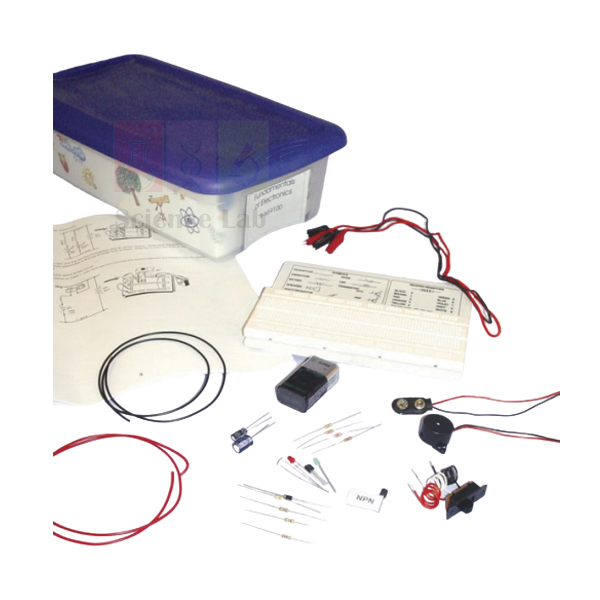
Fundamentals of Electronics
Fundamentals of Electronics (Product Code: SLE/PHY/88) is an electronics starter kit used to introduce students to basic components and circuits in school science and physics lessons. Built around a solderless breadboard, it brings together transistors, LEDs, capacitors, a photo resistor, a buzzer, a 9 volt battery and a Teacher's Guide in one set. The kit is made up by Jain Scientific Equipments Pvt Ltd (ScienceLab), an OEM manufacturer, at its own factory in Ambala, India.
Key Details
| Parameter | Detail |
|---|---|
| Circuit base | Solderless electronics breadboard |
| Semiconductors | NPN and PNP transistors; diode |
| Indicators | Red and green light-emitting diodes (LEDs); buzzer |
| Other components | Capacitors, resistors, photo resistor |
| Control and wiring | Switches and connection wires |
| Power | 9 volt battery |
| Documentation | Teacher's Guide |
| Product code | SLE/PHY/88 |
| Manufacturer | Jain Scientific Equipments Pvt Ltd (ScienceLab) — OEM |
| Country of origin | India (made in Ambala, Haryana) |
What Is the Fundamentals of Electronics Kit Used For?
The kit takes students from reading a circuit diagram to building a working circuit with no soldering iron: components push into the breadboard and can be moved as often as the lesson needs. Typical activities include lighting an LED through a resistor, sounding the buzzer from a switch, using a transistor as a simple electronic switch and making a light-sensitive circuit with the photo resistor. It is a hands-on route into semiconductor topics that also suits DIY science kit sessions and STEM clubs.
The Teacher's Guide helps staff plan each practical. Before a session, check the 9 volt battery, keep the small parts sorted so none go missing, and remind students that transistors, diodes and LEDs only work when inserted the right way round.
What to Specify When Ordering
- Number of kits, for example one per student pair or group.
- Any spares for heavy use, such as extra LEDs or 9 volt batteries.
- Delivery location, so packing and freight can be quoted together.
OEM Manufacturer
ScienceLab is the trading name of Jain Scientific Equipments Private Limited, the OEM that makes up this electronics kit at its own licensed factory at Saha, Ambala, Haryana. Kits are packed factory-direct for schools, colleges, training centres, dealers and importers, and every quotation comes from the manufacturer itself. If components go missing over a school year, ask us about replacement parts instead of buying a whole new kit. The company profile has more about the business.
Related Physics Lab Equipment
Useful additions for electronics lessons built on this kit:
- Light Dependent Resistor — a cased light sensor for further light-controlled circuit projects.
- LED Blue — 5 mm LEDs in bulk packs, handy as spares or an extra colour.
- LED Bright Red — standard 5 mm red LEDs for replacing worn indicator parts.
- Battery Clip, PP3 — a standard clip with leads for connecting a 9 volt battery.
- Standard Digital Multimeter — for measuring voltages and checking components in student circuits.
For more electronics teaching resources, browse Physics Lab Equipment and DIY Electronics Kits for Students.
Frequently Asked Questions
What is included in the Fundamentals of Electronics kit?
The Fundamentals of Electronics kit includes a solderless breadboard, switches, connection wires, NPN and PNP transistors, red and green LEDs, capacitors, a diode, a photo resistor, resistors, a buzzer, a 9 volt battery and a Teacher's Guide.
Does the Fundamentals of Electronics kit need soldering?
No. The Fundamentals of Electronics kit uses a solderless electronics breadboard, so components and connection wires simply push into place. Circuits can be changed or taken apart in seconds, which suits beginners and keeps parts reusable for the next class.
What powers the circuits in the Fundamentals of Electronics kit?
Circuits in the Fundamentals of Electronics kit run from the 9 volt battery supplied with it. Keep a spare battery for busy practical sessions, and disconnect the battery whenever circuits are left unattended or packed away.
Is a teacher's guide provided with the kit?
Yes. A Teacher's Guide is part of the Fundamentals of Electronics kit, giving staff a starting point for planning practical activities with the breadboard and components. For questions about particular activities or syllabus fit, contact ScienceLab before ordering.
Who manufactures the Fundamentals of Electronics kit?
The Fundamentals of Electronics kit is made up by Jain Scientific Equipments Pvt Ltd (ScienceLab) as the OEM at its own factory in Ambala, Haryana, India, and is supplied direct to schools, colleges, dealers and importers.
Can the Fundamentals of Electronics kit be ordered for a whole class?
Yes. The Fundamentals of Electronics kit can be quoted in class-set and larger institutional quantities for India and international markets. State the number of kits, any spare components wanted and the delivery destination when you contact us.
Request a Quote
Ask for a price on the Fundamentals of Electronics kit through the contact page, or add it to the enquiry cart with other items for your lab. The quotation comes direct from the manufacturer, including any spares you list.
Last updated: 24 September 2026
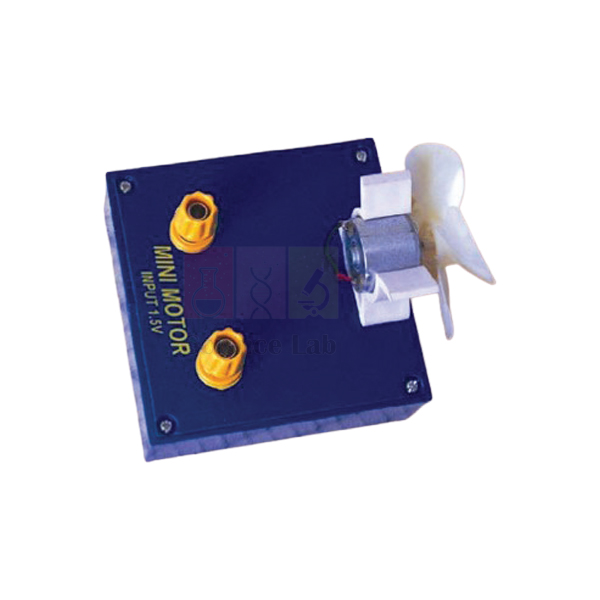
Mini Motor Unit
Mini Motor Unit (Product Code: SLE/PHY/89) is a small base-mounted DC motor used to show electrical energy being turned into motion in school physics and energy lessons. It runs from 1.5 to 4.5 V DC on a base of about 88 x 70 mm and is intended for use with a solar cell unit, so pupils can watch light drive a motor. It is manufactured by Jain Scientific Equipments Pvt Ltd (ScienceLab), an OEM manufacturer, at its own factory in Ambala, India.
Specifications
| Parameter | Detail |
|---|---|
| Type | Small DC motor mounted on a base |
| Operating voltage | 1.5 to 4.5 V DC |
| Base size | Approx. 88 x 70 mm |
| Intended use | With a solar cell unit |
| Product code | SLE/PHY/89 |
| Manufacturer | Jain Scientific Equipments Pvt Ltd (ScienceLab) — OEM |
| Country of origin | India (made in Ambala, Haryana) |
What Is the Mini Motor Unit Used For?
Connected to a solar cell unit, the Mini Motor Unit makes an energy-transfer chain visible: light becomes electrical energy, which the motor turns into movement. Shading the cell or moving a lamp closer shows pupils at once how motor speed depends on the light reaching the cell, making this a simple solar energy science kit activity for the classroom.
Because it works from 1.5 to 4.5 V DC, the unit can also run from one to three dry cells when there is not enough light, which is useful for comparing a battery supply with a solar one. Do not connect it to anything above 4.5 V, and keep the motor shaft free of dust and loose threads.
What to Specify When Ordering
- Number of motor units needed per class.
- Whether a matching solar cell unit should be quoted as well.
- The supply you intend to use, keeping within 1.5 to 4.5 V DC.
OEM Manufacturer
Jain Scientific Equipments Private Limited trades under the ScienceLab name and manufactures the Mini Motor Unit as the OEM at its factory at Saha, Ambala, Haryana. Energy and electricity apparatus from that factory reaches schools, dealers and importers directly, with no middle trader in the chain. Ask the manufacturer about replacement units or repeat orders when class sets need topping up. Read about the company on the profile page.
Related Physics Lab Equipment
Apparatus for energy-conversion and motor lessons alongside the Mini Motor Unit:
- Mounted Solar Cell — a base-mounted photovoltaic cell for light-to-electricity experiments.
- Mounted Motor for Solar Cell — a low-consumption motor with a small pulley for load-lifting demonstrations.
- Simple Circuit Module Motor — a low-voltage motor module with a current-limiting resistor for circuit work.
- Electric Motor — a miniature DC motor for models and robotics projects.
- Battery Holder, C — a single-cell holder for running the motor from a battery.
Find more energy and electricity apparatus under Physics Lab Equipment.
Frequently Asked Questions
What voltage does the Mini Motor Unit run on?
The Mini Motor Unit operates from 1.5 to 4.5 V DC. That range suits the output of a school solar cell unit or a small number of dry cells; higher supply voltages should not be used with this motor.
How big is the base of the Mini Motor Unit?
The Mini Motor Unit is mounted on a base measuring approximately 88 x 70 mm. The compact base sits steadily on the bench beside a solar cell unit and holds the motor in a fixed position during experiments.
Can the Mini Motor Unit be used with a solar cell?
Yes. The Mini Motor Unit is intended for use with a solar cell unit, turning the cell's electrical output into visible rotation. If you need a matching solar cell, include it in your enquiry so ScienceLab can quote both together.
Will the Mini Motor Unit run from batteries?
Yes, as long as the supply stays within its range. The Mini Motor Unit runs on 1.5 to 4.5 V DC, so a battery supply inside that range can drive it, which is handy for lessons held without enough light.
Who manufactures the Mini Motor Unit?
The Mini Motor Unit is manufactured by Jain Scientific Equipments Pvt Ltd (ScienceLab), the OEM, at its own factory in Ambala, Haryana, India. It is sold direct to schools, colleges, dealers and importers.
What should I include when asking for a Mini Motor Unit quotation?
A quotation request for the Mini Motor Unit should give the number of units, whether solar cells or battery holders are also needed, and your delivery location. Bulk orders for India and international markets are quoted on request through the contact page.
Request a Quote
To buy the Mini Motor Unit, message us through the contact page or place it in the enquiry cart together with any solar cells you need. Quotations are issued directly by the manufacturer.
Last updated: 24 September 2026
 with Fahnstock clips10.jpg)
Switches (Econ) with Fahnstock clips
Switches (Econ) with Fahnstock clips (Product Code: SLE/PHY/90) is a pack of economy switches used to open and close simple circuits in school electricity practicals. Each pack holds 25 switches fitted with Fahnstock (Fahnestock) spring clips, so bare wire ends can be connected without screwdrivers or soldering, a practical choice when equipping a whole class. They are manufactured by Jain Scientific Equipments Pvt Ltd (ScienceLab), an OEM manufacturer, at its own factory in Ambala, India.
Key Details
| Parameter | Detail |
|---|---|
| Switch type | Economy switch |
| Connections | Fahnstock (Fahnestock) spring clips |
| Pack size | 25 switches |
| Product code | SLE/PHY/90 |
| Manufacturer | Jain Scientific Equipments Pvt Ltd (ScienceLab) — OEM |
| Country of origin | India (made in Ambala, Haryana) |
What Are the Economy Switches with Fahnstock Clips Used For?
An economy switch lets pupils control a circuit by hand, so they see a lamp, buzzer or motor respond the moment the circuit is completed or broken. The spring clips grip a wire when pressed and released, which makes setting up and clearing away circuits quick for younger students and avoids small terminal screws going missing. With 25 switches in a pack, one pack can equip a typical class working in pairs or small groups.
Use the switches in low-voltage circuits powered by cells. Strip a short length of insulation from each wire, push it fully into the clip, and leave the switch open until the rest of the circuit is connected. They are a low-cost part of basic physics lab equipment for schools setting up electricity practicals.
What to Specify When Ordering
- Number of packs required (each pack contains 25 switches).
- Any lamp holders, cells or leads to be quoted with the switches.
- Delivery location for the order.
OEM Manufacturer
ScienceLab, the trading name of Jain Scientific Equipments Private Limited, manufactures these economy switches as the OEM at its own factory at Saha, Ambala, Haryana. Packing them in 25s straight from the factory keeps class quantities simple for schools, dealers and importers. When stocks run low, ask the manufacturer directly for repeat packs. The ScienceLab profile explains more about the company.
Related Physics Lab Equipment
Items that complete simple switch circuits in the classroom:
- Lamp Holder (Economy Switch) — a miniature lamp holder on a plastic base with the same style of spring clips.
- Knife Switch – Single Pole, Single Throw — a brass-bladed knife switch on a base as a sturdier alternative.
- Contact Key (Push Switch) — a spring contact key for momentary switching.
- Crocodile Clips & Leads — ready-made leads for joining switches, cells and lamps.
- Battery Holder, C — a single-cell holder to power simple switch circuits.
More circuit components are listed in Physics Lab Equipment.
Frequently Asked Questions
How many switches come in a pack of Switches (Econ) with Fahnstock clips?
Each pack of Switches (Econ) with Fahnstock clips contains 25 economy switches. That quantity lets a school equip a class working in pairs or small groups from a single pack, often with a few left over as spares.
What are Fahnstock clips?
Fahnstock clips, more often spelled Fahnestock clips, are spring connectors that grip a wire when pressed and released. On the Switches (Econ) with Fahnstock clips they let pupils connect bare wire ends quickly, without screw terminals or soldering.
What voltage are the economy switches rated for?
The listing for Switches (Econ) with Fahnstock clips does not state a voltage or current rating. They are intended for low-voltage school circuits powered by cells; for any other use, please confirm suitability with us through the contact page first.
Who manufactures the Switches (Econ) with Fahnstock clips?
Switches (Econ) with Fahnstock clips are manufactured by Jain Scientific Equipments Pvt Ltd (ScienceLab) as the OEM at its own factory in Ambala, Haryana, India, and are supplied in packs of 25 direct to schools and dealers.
Can several packs be ordered for export?
Yes. Switches (Econ) with Fahnstock clips can be ordered in multiple packs for schools, education projects and distributors in India and international markets. Tell us the number of packs and the destination, and the quotation will cover packing and freight.
Request a Quote
Tell us how many packs of Switches (Econ) with Fahnstock clips you need through the contact page, or add them to the enquiry cart. You will receive a quotation directly from the manufacturer.
Last updated: 24 September 2026
LED Blue
LED Blue (Product Code: SLE/PHY/91) is a pack of standard 5 mm blue light-emitting diodes used as indicators and light sources in electronics and physics practicals in schools and colleges. Each pack contains 100 LEDs, enough to keep a lab stocked for breadboard projects, circuit-building lessons and replacements across a term. It is supplied by Jain Scientific Equipments Pvt Ltd (ScienceLab), Ambala, India, alongside the same 5 mm LEDs in other colours.
Specifications
| Parameter | Detail |
|---|---|
| Component | Light-emitting diode (LED), standard type |
| Size | 5 mm |
| Colour | Blue |
| Pack quantity | 100 LEDs |
| Other colours | Available in a range of colours (listed separately) |
| Product code | SLE/PHY/91 |
| Supplied by | Jain Scientific Equipments Pvt Ltd (ScienceLab), Ambala, India |
What Are the Blue 5 mm LEDs Used For?
Blue LEDs are used on breadboards and circuit boards as on/off indicators, in simple logic and sensor projects, and to show that a diode lets current pass in one direction only. Comparing blue with red or green LEDs also lets older students explore how the voltage needed to light an LED changes with its colour, a common LED characteristics experiment.
An LED should always be wired with a series resistor to limit the current, because connecting it straight across a cell or supply can destroy it. The longer lead is normally the positive (anode) connection. Keep opened packs dry and sealed so the leads stay clean between lessons.
What to Specify When Ordering
- Number of packs (each pack holds 100 blue LEDs).
- Any other LED colours you want quoted in the same order.
- Resistors, breadboards or LED boards needed to complete student circuits.
Supplier
Jain Scientific Equipments Private Limited, trading as ScienceLab, supplies these standard 5 mm blue LEDs as part of its physics and electronics consumables range. Schools and colleges can add LED packs to the same enquiry as their circuit apparatus, so components and equipment arrive in one consignment. Read more about the company on the ScienceLab profile page.
Related Physics Lab Equipment
Components and kits often ordered with blue LEDs:
- LED Bright Red — the same standard LED size in bright red, also in packs.
- LED, 5 mm, White — white LEDs for lighting projects and colour comparisons.
- Simple Circuit Module LED Board Red — a ready-mounted LED with a series resistor for younger pupils.
- Fundamentals of Electronics — a breadboard kit in which LEDs serve as indicators.
- Battery Clip, PP3 — a clip with leads for powering LED circuits from a PP3 battery.
Browse the wider range of Physics Lab Equipment for circuit apparatus.
Frequently Asked Questions
How many LEDs are in a pack of LED Blue?
The LED Blue pack contains 100 standard 5 mm blue light-emitting diodes. Buying by the hundred keeps a school or college lab stocked for class projects and replacements, rather than ordering single LEDs each time one fails.
What size are the LED Blue diodes?
LED Blue diodes are the standard 5 mm size, which fits common breadboards, LED holders and circuit boards used in schools. The same 5 mm LEDs are also available in a range of other colours, listed as separate items.
Do the blue LEDs need a resistor?
Yes. Like any LED, each diode in the LED Blue pack should be connected with a suitable series resistor to limit the current. Without one, connecting it directly to a cell or power supply can damage the LED almost immediately.
Where can I find the electrical ratings for LED Blue?
The LED Blue listing gives the size, colour and pack quantity but not forward voltage, current or brightness figures. If your experiment needs these ratings, ask us through the contact page before ordering and we will advise on the batch quoted.
Who supplies LED Blue?
LED Blue is supplied by Jain Scientific Equipments Pvt Ltd (ScienceLab), Ambala, India, to schools, colleges, training institutes and dealers, and it can be included in larger laboratory orders for India and international markets.
Can other LED colours be ordered together with LED Blue?
Yes. The LED Blue pack can be quoted together with the same 5 mm LEDs in other colours, such as red and white, so a single order covers all the indicator colours your class projects need.
Request a Quote
Request a price for LED Blue by sending the number of packs and any other colours through the contact page, or add the item to the enquiry cart. ScienceLab will reply with a quotation for the full order.
Last updated: 24 September 2026
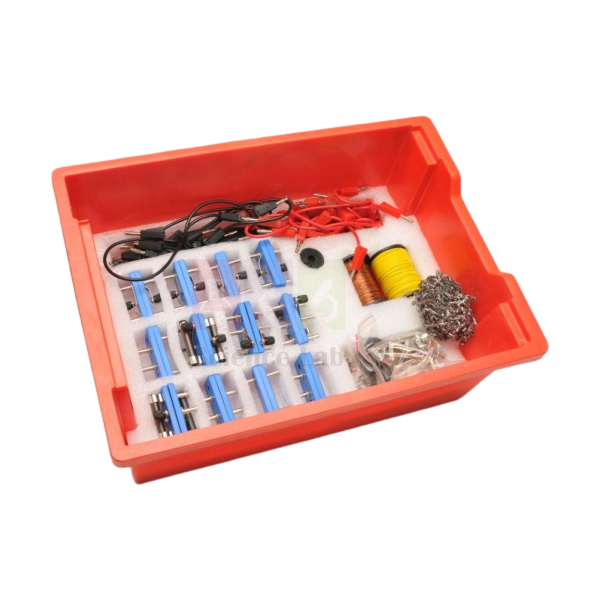
Electricity Circuits Kit
Electricity Circuits Kit (Product Code: SLE/PHY/92) is a panel-based electricity kit used for pupil investigations into simple circuits in primary and lower-secondary science. Each component, such as a switch, rheostat or bulb holder, sits on its own plastic panel with 4 mm sockets, and the panels are linked with 4 mm stackable leads instead of being fixed to a circuit board. The kit is manufactured by Jain Scientific Equipments Pvt Ltd (ScienceLab), an OEM manufacturer, at its own factory in Ambala, India.
Specifications
| Parameter | Detail |
|---|---|
| Kit type | Basic electricity kit with individual component panels |
| Components | Switch, rheostat, bulb holder, etc., each on its own plastic panel |
| Panel connections | 4 mm sockets |
| Linking method | 4 mm stackable leads |
| Curriculum level | Basic circuit concepts at key stage 2, with applications into key stage 3 |
| Storage | Two polystyrene trays per kit |
| Product code | SLE/PHY/92 |
| Manufacturer | Jain Scientific Equipments Pvt Ltd (ScienceLab) — OEM |
| Country of origin | India (made in Ambala, Haryana) |
What Is the Electricity Circuits Kit Used For?
Because every component is a separate panel, pupils lay out a circuit on the desk just as it appears in a circuit diagram, which makes the link between symbol and real component easier to grasp. The kit covers complete and broken circuits, switching and changing lamp brightness with the rheostat, and it is flexible enough to move on to series and parallel work later. That makes it a practical physics experiment kit for schools that want pupils to design their own circuits rather than follow a fixed board layout.
The two polystyrene trays hold every panel in its place, so a technician can see at a glance whether anything is missing before the kit goes back on the shelf. Push the stackable leads fully into the 4 mm sockets, and pull them out by the plug rather than the cable to keep connections reliable.
What to Specify When Ordering
- Number of kits, based on how many pupil groups work at once.
- Whether 4 mm stackable leads should be quoted with the kits.
- Spare component panels, such as bulb holders, rheostats or push switches, for heavily used classes.
- Delivery location for packing and freight.
OEM Manufacturer
ScienceLab is the trading name of Jain Scientific Equipments Private Limited (CIN U29309HR2020PTC087597), the OEM that manufactures this circuits kit. Production takes place at the company's licensed factory at 449, HSIIDC Industrial Area, Saha, Ambala, Haryana (Factory Licence AMB-ONLINE-CHD-J-414). Schools, dealers and importers buy the kit factory-direct and can ask the same source for spare panels when parts wear out. The company profile has further details.
Related Physics Lab Equipment
Leads, spare panels and an alternative approach for circuit lessons:
- Stackable Leads — 4 mm stackable leads for linking the component panels.
- Circuits Kit Bulb Holder — a spare panel-mounted bulb holder from the Circuits Kit spares range.
- Circuits Kit Rheostat — a spare panel-mounted rheostat for brightness-control activities.
- Circuits Kit Push Switch — a spare panel-mounted push switch.
- Worcester Circuit Board — the circuit-board approach, for schools comparing both methods.
See all circuit and electricity apparatus under Physics Lab Equipment.
Frequently Asked Questions
How are circuits built with the Electricity Circuits Kit?
Circuits are built with the Electricity Circuits Kit by connecting individual component panels together using 4 mm stackable leads. Each panel carries one component, such as a switch, rheostat or bulb holder, and has 4 mm sockets for the leads.
Which pupils is the Electricity Circuits Kit suitable for?
The Electricity Circuits Kit suits teaching basic circuit concepts at key stage 2, roughly the upper primary years, and it also has applications for further study into key stage 3. Teachers can begin simply and add components as pupils progress.
Are stackable leads included with the Electricity Circuits Kit?
The Electricity Circuits Kit is designed to be connected with 4 mm stackable leads, but the listing does not confirm how many leads come with each kit. Mention leads in your enquiry and ScienceLab will confirm what is included in the quotation.
How is the Electricity Circuits Kit stored?
Each Electricity Circuits Kit is supplied in two polystyrene trays that keep the component panels organised. The trays make it easy to check that every panel has come back after a lesson, and they protect the units in storage.
How does the kit compare with a circuit board?
The Electricity Circuits Kit is a low-cost, flexible alternative to the circuit-board approach. Instead of fixed positions on a board, separate panels let pupils arrange components freely, which suits open investigations and makes each circuit resemble its diagram.
Who manufactures the Electricity Circuits Kit?
The Electricity Circuits Kit is manufactured by Jain Scientific Equipments Pvt Ltd (ScienceLab) as the OEM at its own licensed factory in Saha, Ambala, Haryana, India, and is supplied direct to schools, dealers and importers.
Can the Electricity Circuits Kit be ordered for several classrooms?
Yes. The Electricity Circuits Kit can be quoted in class-set and institutional quantities for schools and distributors in India and international markets. Share the number of kits, any spare panels and the destination through the contact page.
Request a Quote
Ask for a quotation for the Electricity Circuits Kit, including leads and spare panels, through the contact page or the enquiry cart. Quotes are issued directly by the manufacturer, so questions about kit contents are answered at source.
Last updated: 24 September 2026
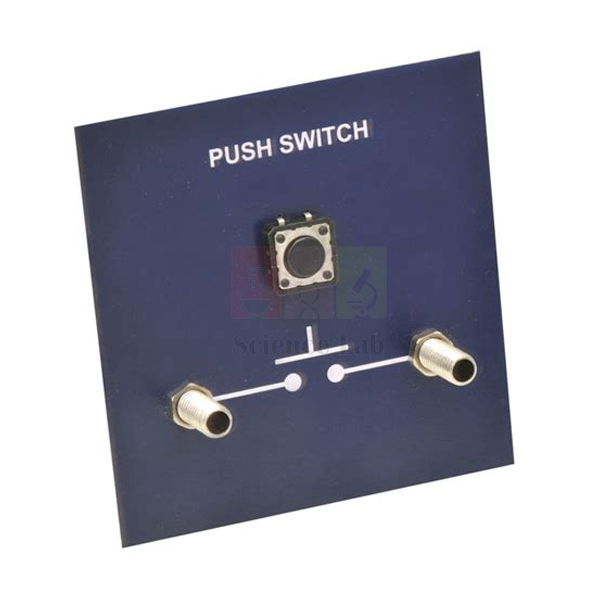
Simple Circuit Module Push Switch
Simple Circuit Module Push Switch (Product Code: SLE/PHY/93) is an on/off push-button switch mounted on a base, used to open and close simple circuits in school electricity lessons. As part of the Simple Circuit Modules series, it lets pupils control LED boards, motors and buzzers from the same range with a press of a button. It is supplied by Jain Scientific Equipments Pvt Ltd (ScienceLab), Ambala, India.
Key Details
| Parameter | Detail |
|---|---|
| Series | Simple Circuit Modules |
| Module type | Push switch |
| Action | On/off push button |
| Mounting | On base |
| Companion modules | LED boards and other Simple Circuit Modules (listed separately) |
| Product code | SLE/PHY/93 |
| Supplied by | Jain Scientific Equipments Pvt Ltd (ScienceLab), Ambala, India |
What Is the Push Switch Module Used For?
The push switch module gives pupils a hands-on way to see how a switch controls a circuit: press the button and the circuit changes state, press again and it changes back. Placed in series with an LED board it demonstrates a complete and a broken circuit. With two switch modules, pupils can model an output that works only when both switches are on (series) or when either one is on (parallel), a first step towards AND and OR logic.
Because the switch is fixed to its own base, it stays in place on the bench while pupils rearrange the rest of the circuit. Leave it in the off position while connecting the supply, and press the button firmly rather than striking it. It is a durable piece of junior science lab equipment for early electricity topics.
What to Specify When Ordering
- Number of push switch modules, for example two per group for series and parallel work.
- Other Simple Circuit Modules required: red or green LED boards, motor, buzzer or lamp holder.
- Delivery location for the complete order.
Supplier
Jain Scientific Equipments Private Limited, known by its trading name ScienceLab, supplies the Simple Circuit Modules range, including this push switch, from Ambala, Haryana, India. Ordering the switch, indicator and motor modules together lets the company quote the whole set at once. Replacement modules or repeat class sets can be requested from us directly. The ScienceLab profile describes the company.
Related Physics Lab Equipment
Output modules from the same series that the push switch can control:
- Simple Circuit Module LED Board Red — a red LED indicator to switch on and off.
- Simple Circuit Module LED Board Green — a green indicator for two-switch logic circuits.
- Simple Circuit Module Buzzer — a sound output module for alarm-style circuits.
- Simple Circuit Module Lamp Holder — a lamp module for classic switch-and-bulb circuits.
- Simple Circuit Module Motor — a low-voltage motor module for switching motion on and off.
The full range is listed under Physics Lab Equipment.
Frequently Asked Questions
What type of switch is the Simple Circuit Module Push Switch?
The Simple Circuit Module Push Switch is an on/off push-button switch mounted on a base. Pressing the button changes the circuit between on and off, so pupils can control lamps, LEDs, buzzers or motors in the circuits they build.
Which modules work with the push switch?
The Simple Circuit Module Push Switch is designed to work with other modules in the same series, such as the LED boards, motor, buzzer and lamp holder modules. Together they let pupils build complete switched circuits on the bench.
Is an LED board included with the Simple Circuit Module Push Switch?
No. The Simple Circuit Module Push Switch is the switch module only. LED boards and other Simple Circuit Modules are listed as separate items, so include every module you need in your enquiry to receive one combined quotation.
What voltage can the push switch module be used at?
The Simple Circuit Module Push Switch listing does not give a voltage or current rating. It is intended for the low-voltage circuits used with the Simple Circuit Modules range; confirm with us through the contact page before using it elsewhere.
Who supplies the Simple Circuit Module Push Switch?
Jain Scientific Equipments Pvt Ltd (ScienceLab), Ambala, Haryana, India, supplies the Simple Circuit Module Push Switch. The company sources it together with the other Simple Circuit Modules and quotes schools, colleges, dealers and importers in India and international markets.
Can the push switch module be ordered in bulk?
Yes. The Simple Circuit Module Push Switch can be ordered in class quantities, on its own or with a full set of Simple Circuit Modules, for customers in India and international markets. State quantities and the destination for an accurate quotation.
Request a Quote
List the push switches and any other Simple Circuit Modules you need and send them through the contact page, or use the enquiry cart. ScienceLab, as the supplier, will reply with one quotation for the whole set.
Last updated: 24 September 2026
309.jpg)
Contact Key (Push Switch)
Contact Key (Push Switch) (Product Code: SLE/PHY/94) is a single contact key on a base, used to close a circuit only while it is pressed during physics practicals such as galvanometer and induction experiments. A plated spring arm with a press knob lifts clear of the contact as soon as it is released, and 4 mm terminals make the key quick to wire into a circuit. It is manufactured by Jain Scientific Equipments Pvt Ltd (ScienceLab), an OEM manufacturer, at its own factory in Ambala, India.
Specifications
| Parameter | Detail |
|---|---|
| Type | Single contact key (push switch) |
| Mounting | On base |
| Moving part | Plated spring arm with press knob |
| Contact | Contact stud |
| Connecting strip | Plated |
| Terminals | 4 mm |
| Product code | SLE/PHY/94 |
| Manufacturer | Jain Scientific Equipments Pvt Ltd (ScienceLab) — OEM |
| Country of origin | India (made in Ambala, Haryana) |
What Is the Contact Key Used For?
A contact key is used wherever current should flow only for a moment: tapping it while watching a galvanometer, closing a circuit briefly to find the balance point on a meter bridge or potentiometer, or switching a coil on and off to show an induced current. Keeping the circuit closed only while a reading is taken also stops resistance wires and cells from warming up or running down, which improves the accuracy of student results.
Press the knob squarely so the spring arm meets the contact stud cleanly, and avoid holding it down longer than necessary. If connections become intermittent, wipe the contact surfaces and check that the 4 mm terminals are tight.
What to Specify When Ordering
- Number of contact keys, usually one per practical bench.
- 4 mm leads needed to connect the key into circuits.
- Delivery location for the quotation.
OEM Manufacturer
The Contact Key is made by ScienceLab, the trading name of Jain Scientific Equipments Private Limited, which acts as the OEM and manufactures it at its own factory at Saha, Ambala, Haryana. Physics departments, dealers and importers order these bench accessories straight from the maker, keeping repeat orders and replacement keys simple to arrange. You can read about the company on its profile page.
Related Physics Lab Equipment
Other switching and measuring items used in the same practicals:
- One Way Key — a plug-type key with brass blocks and a tapered plug for circuits that stay closed.
- Knife Switch – Single Pole, Single Throw — a brass knife switch on a base for latching on/off control.
- Switches (Econ) with Fahnstock clips — low-cost economy switches packed for class sets.
- Stackable Leads — 4 mm leads for wiring the key's terminals.
- Galvanometer 50-0-50mV — a centre-zero moving coil meter read while the key is tapped.
Browse more practical apparatus in Physics Lab Equipment.
Frequently Asked Questions
How does the Contact Key (Push Switch) work?
The Contact Key (Push Switch) closes a circuit when its press knob pushes a plated spring arm onto a contact stud. When the knob is released, the spring lifts the arm away and the circuit opens again, giving momentary control.
What terminals does the Contact Key (Push Switch) have?
The Contact Key (Push Switch) has 4 mm terminals linked through a plated connecting strip, so it accepts the standard 4 mm leads used in school and college physics laboratories.
Which experiments use a contact key?
The Contact Key (Push Switch) is used in experiments that need brief current flow, such as galvanometer null readings, meter bridge and potentiometer balancing, and induction demonstrations. Short contact prevents cells and resistance wires from heating or draining during measurements.
Does the contact key stay on when pressed?
No. The Contact Key (Push Switch) is a momentary key: the circuit is closed only while the knob is held down. For a switch that stays on, choose a knife switch or a plug key from the related items above.
Who manufactures the Contact Key (Push Switch)?
The Contact Key (Push Switch) is manufactured by Jain Scientific Equipments Pvt Ltd (ScienceLab) as the OEM at its own factory in Ambala, Haryana, India, and is sold direct to institutions, dealers and importers.
Can contact keys be ordered for a whole laboratory?
Yes. The Contact Key (Push Switch) can be quoted for a single bench or for entire physics laboratories in India and international markets. Send the quantity, any 4 mm leads required and the delivery destination through the contact page.
Request a Quote
For a quotation on the Contact Key (Push Switch), send your quantity through the contact page or add the key to the enquiry cart. The price comes directly from the manufacturer.
Last updated: 24 September 2026
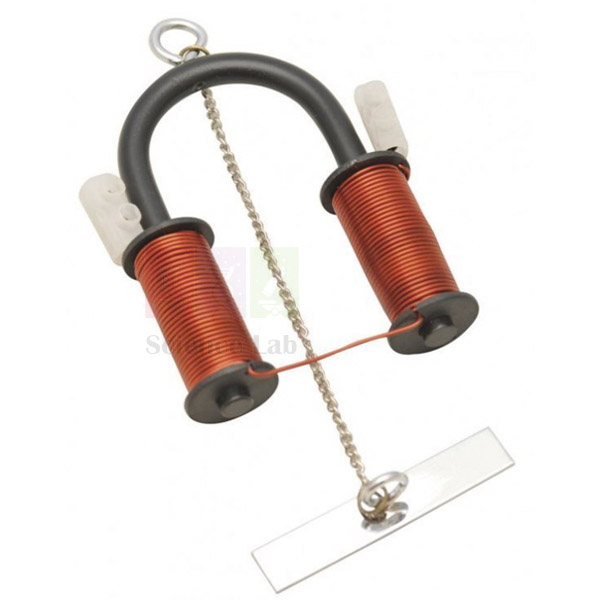
Electromagnet with Keeper
Electromagnet with Keeper (Product Code: SLE/PHY/95) is a U-shaped electromagnet used to demonstrate the magnetic effect of an electric current in school and college physics labs. Its circular-section core is wound with insulated copper wire, carries an armature with a hook for hanging loads and runs from 4-6 volts DC, so students can switch a magnetic pull on and off at will. It is manufactured by Jain Scientific Equipments Pvt Ltd (ScienceLab), an OEM manufacturer, at its own factory in Ambala, India.
Specifications
| Parameter | Detail |
|---|---|
| Core | U-shaped, circular section |
| Winding | Insulated copper wire |
| Connections | Barrel connections |
| Operating supply | 4-6 volts DC |
| Size (as listed) | 110 x 9 mm (diameter) |
| Fittings | Armature with carrying hook |
| Supplied with | Keeper |
| Product code | SLE/PHY/95 |
| Manufacturer | Jain Scientific Equipments Pvt Ltd (ScienceLab) — OEM |
| Country of origin | India (made in Ambala, Haryana) |
What Is the Electromagnet with Keeper Used For?
With the supply connected, the armature is pulled firmly onto the pole faces, and loads hung from the carrying hook show how strong the magnetic force is; switch off and the armature drops away. Students can compare the lifting effect at different voltages within the 4-6 V DC range, or reverse the current and use a plotting compass to see the poles swap. It is a classic electromagnetic kit item for school practicals on the magnetic effects of current.
Store the electromagnet with its keeper across the poles and away from loose steel items. Do not exceed the stated DC supply, and switch off between readings so the winding does not get warm.
What to Specify When Ordering
- Number of electromagnets needed for your class or demonstration bench.
- A DC supply that can provide 4-6 volts, if your lab does not already have one.
- Masses or hangers for load tests, which should be requested separately.
- Delivery location for packing and freight.
OEM Manufacturer
Jain Scientific Equipments Private Limited, trading as ScienceLab, manufactures this electromagnet as the OEM at its own licensed factory at Saha, Ambala, Haryana. Buying from the factory gives physics departments, dealers and importers a direct line to the maker for quotations and repeat orders, and you can ask us about a replacement keeper at any time. The company holds Udyam registration UDYAM-HR-01-0003714 as an MSME, and its Importer-Exporter Code AAECJ8618A (DGFT) covers shipments outside India. Visit the company profile for more.
Related Physics Lab Equipment
Other electromagnetism apparatus and accessories for these practicals:
- U-Shaped Electromagnet — a U-core electromagnet with two enamelled copper coils that slide onto the core arms.
- Electromagnet for Demo — a two-coil U-shaped electromagnet for teacher demonstrations.
- Electromagnet Kit — a student kit for building an electromagnet from coils and a U-shaped core.
- Power Supply, Stepped — an AC/DC bench supply for powering the electromagnet.
- Compass Plotting (Clear) — a plotting compass for identifying the electromagnet's poles.
Find more in Physics Lab Equipment and Magnets.
Frequently Asked Questions
What voltage does the Electromagnet with Keeper need?
The Electromagnet with Keeper is designed for use with 4-6 volts DC. A low-voltage DC bench supply or suitable cells can power it; stay within this range so the insulated copper winding does not overheat.
What size is the Electromagnet with Keeper?
The Electromagnet with Keeper is listed as 110 x 9 mm (diameter), with a U-shaped core of circular section. If you need full overall dimensions for a particular set-up, ask us through the contact page before ordering.
What is included with the Electromagnet with Keeper?
The Electromagnet with Keeper comes complete with its keeper, and the U-shaped wound core is fitted with an armature and carrying hook. Barrel connections are provided on the electromagnet for attaching the supply leads.
How is the electromagnet connected to a supply?
Connect the Electromagnet with Keeper to a 4-6 volts DC supply through its barrel connections. Switching the supply on energises the copper winding and pulls the armature onto the core; switching off releases it again.
Who manufactures the Electromagnet with Keeper?
The Electromagnet with Keeper is manufactured by Jain Scientific Equipments Pvt Ltd (ScienceLab) as the OEM at its own factory in Ambala, Haryana, India, and is supplied direct to schools, colleges, dealers and importers.
Can the electromagnet be ordered in quantity for export?
Yes. The Electromagnet with Keeper can be quoted for a single laboratory or for institutional and export orders across India and international markets. Include the quantity, any power supplies required and the destination in your enquiry.
Request a Quote
Send the number of Electromagnets with Keeper you need, together with any supply or accessory items, through the contact page, or add them to the enquiry cart. Quotations are prepared by the manufacturer itself.
Last updated: 24 September 2026

Lenz's Law – Open & closed loop
Lenz's Law – Open & closed loop (Product Code: SLE/PHY/96) is an electromagnetic induction demonstration used to show Faraday's law of induction and Lenz's law in school and college physics lessons. Passing a magnet through the complete loop makes the device move, while the split loop does not move at all, so students see that an induced current, not magnetism alone, causes the effect. It is manufactured by Jain Scientific Equipments Pvt Ltd (ScienceLab), an OEM manufacturer, at its own factory in Ambala, India.
Key Details
| Parameter | Detail |
|---|---|
| Demonstrates | Faraday's law of induction and Lenz's law |
| Loops | One complete (closed) loop and one split (open) loop |
| Closed loop | Device moves when a magnet is passed through the loop |
| Split loop | No movement at all |
| Magnet | Needed for the demonstration; confirm whether to include one when ordering |
| Product code | SLE/PHY/96 |
| Manufacturer | Jain Scientific Equipments Pvt Ltd (ScienceLab) — OEM |
| Country of origin | India (made in Ambala, Haryana) |
What Is the Lenz's Law Loop Apparatus Used For?
Moving a magnet into the closed loop induces a current in it, and by Lenz's law that current sets up a magnetic field opposing the change, so the loop is pushed away from, or drawn after, the moving magnet. Repeating the action with the split loop produces no movement, because the break stops any current from circulating. This side-by-side comparison makes the apparatus an effective electromagnetic induction kit for explaining why induced currents always oppose the change that creates them.
Move the magnet smoothly, then try faster and slower passes so students can relate the size of the response to the rate of change of magnetic flux. A strong magnet gives the clearest result; keep magnets away from meters and electronic devices while the demonstration is being set up.
What to Specify When Ordering
- Number of units, for a single teacher demonstration or for group work.
- Whether a suitable strong magnet should be quoted with the apparatus.
- Delivery location for the quotation.
OEM Manufacturer
ScienceLab is the name under which Jain Scientific Equipments Private Limited trades, and the company manufactures this Lenz's law apparatus as the OEM at its own factory at Saha, Ambala, Haryana. Induction demonstrations like this go factory-direct to schools, colleges, dealers and importers, so any question about the loops or spare parts reaches the maker straight away. The ScienceLab profile tells you more about the company.
Related Physics Lab Equipment
Magnets and induction apparatus that extend this demonstration:
- Device to Verify The Lenz's Law (for high school) — aluminium rings on a pivoted rocker arm, one ring slotted, for a comparable test.
- Eddy Current Unit — a copper tube in which a falling magnet is slowed by induced currents.
- Neodymium Magnets — strong rare-earth magnets that give clear induction effects.
- Neodymium Wand — neodymium button magnets on acrylic wands for safer handling.
- Demountable Transformer Accessory Set No. 2 — a Lenz's law accessory with pendulums with and without slits.
More electromagnetism apparatus is listed under Physics Lab Equipment.
Frequently Asked Questions
What does the Lenz's Law – Open & closed loop demonstrate?
The Lenz's Law – Open & closed loop apparatus demonstrates Faraday's law of induction and Lenz's law. A magnet passed through the complete loop makes the device move, showing that an induced current creates a field opposing the change in flux.
Why does the split loop not move?
No movement at all occurs with the split loop of the Lenz's Law – Open & closed loop because the gap prevents a current from circulating. With no induced current there is no opposing magnetic field, and so no force acts on the loop.
Is a magnet included with the Lenz's law apparatus?
The Lenz's Law – Open & closed loop listing describes passing a magnet through the loops but does not confirm that a magnet is supplied. Ask us through the contact page and a suitable magnet can be added to your quotation.
Which students is the open and closed loop demonstration suited to?
The Lenz's Law – Open & closed loop suits secondary, senior secondary and undergraduate physics wherever electromagnetic induction is taught. Younger classes see a striking effect, while older students can link it to Faraday's and Lenz's laws in mathematical form.
Who manufactures the Lenz's Law – Open & closed loop?
The Lenz's Law – Open & closed loop is manufactured by Jain Scientific Equipments Pvt Ltd (ScienceLab) as the OEM at its own factory in Ambala, Haryana, India, and is supplied direct to institutions, dealers and importers.
Can the apparatus be ordered in quantity or for export?
Yes. The Lenz's Law – Open & closed loop can be quoted individually or in quantity for schools, colleges and distributors in India and international markets. Share the quantity, any magnets needed and the destination for a complete quotation.
Request a Quote
To receive a price for the Lenz's Law – Open & closed loop, write to us through the contact page or add it to the enquiry cart. Your quotation comes directly from the manufacturer.
Last updated: 24 September 2026
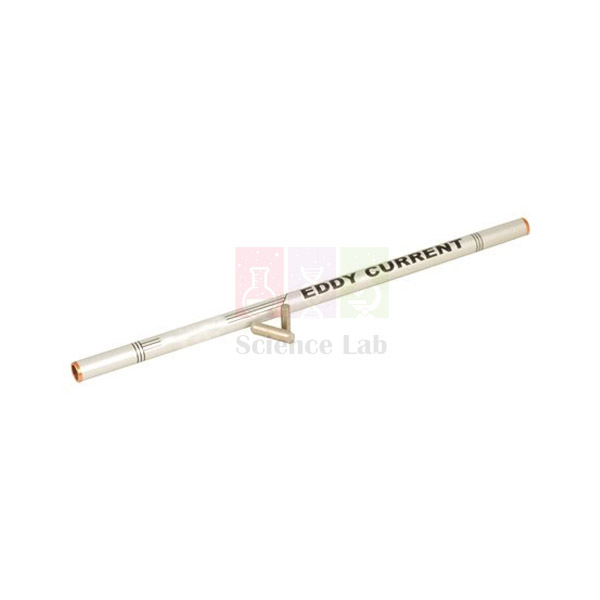
Eddy Current Unit
Eddy Current Unit (Product Code: SLE/PHY/97) is a copper-tube demonstration used to introduce eddy currents and electromagnetic braking in school and college physics. Two test masses, one of steel and one a neodymium magnet, are dropped down a 33 cm copper tube, and students see the magnet fall more slowly than the steel mass. It is manufactured by Jain Scientific Equipments Pvt Ltd (ScienceLab), an OEM manufacturer, at its own factory in Ambala, India.
Specifications
| Parameter | Detail |
|---|---|
| Tube | Copper, 33 cm |
| Test masses | Two, included: one steel, one neodymium magnet |
| Observation | The magnetic mass falls more slowly than the steel mass |
| Principle | Eddy currents induced in the tube oppose the falling magnet's motion |
| Product code | SLE/PHY/97 |
| Manufacturer | Jain Scientific Equipments Pvt Ltd (ScienceLab) — OEM |
| Country of origin | India (made in Ambala, Haryana) |
What Is the Eddy Current Unit Used For?
As the neodymium magnet falls, its moving field induces circulating eddy currents in the copper walls, and these currents produce their own field that opposes the downward motion. The steel mass is not a magnet, so it induces no such currents and simply falls freely, which turns the two drops into a fair test with a striking difference. Teachers use the result to connect Lenz's law with real applications such as magnetic braking, making this one of the simplest physics demonstration kits for showing induction without meters.
Hold the tube upright over a soft surface or catch the masses at the bottom, and time each drop with a stopwatch if students are to compare results in numbers. Keep the neodymium magnet away from the steel mass, electronic devices and fingers, because strong magnets can snap together sharply.
What to Specify When Ordering
- Number of units, for a teacher demonstration or for several student groups.
- Whether spare test masses (steel or neodymium magnet) are needed.
- Delivery location for packing and freight.
OEM Manufacturer
Jain Scientific Equipments Private Limited, which trades as ScienceLab, is the OEM of this eddy current apparatus and makes it at its own factory at Saha, Ambala, Haryana. Physics departments, dealers and importers can order it directly from the manufacturer, and if a test mass goes missing a replacement can be requested from the same source. Company background is on the profile page.
Related Physics Lab Equipment
Further induction and magnetism apparatus for the same topic:
- Eddy Current Unit 120 mm — an aluminium-disc eddy current demonstration driven by a hand-wheel unit.
- Lenz's Law – Open & closed loop — closed and split loops showing induced current opposing a moving magnet.
- Neodymium Magnets — strong magnets for further induction experiments.
- Adjustable Magnet — a magnet unit supplied with an eddy current pendulum demonstration.
- Search Coil — a hand-held coil for investigating changing magnetic fields with a meter or oscilloscope.
Explore more apparatus in Physics Lab Equipment.
Frequently Asked Questions
How does the Eddy Current Unit work?
In the Eddy Current Unit, a neodymium magnet falling through a copper tube induces eddy currents in the tube walls. Those currents create a magnetic field that opposes the magnet's downward motion, so it falls more slowly than the steel test mass.
What is included with the Eddy Current Unit?
The Eddy Current Unit includes a 33 cm copper tube and its test masses: one steel mass and one neodymium magnet. Together they let students compare an ordinary fall with a magnetically braked fall through the same tube.
Why does the Eddy Current Unit include a steel mass?
The steel mass in the Eddy Current Unit acts as the control. Because it is not a magnet, it induces no eddy currents and falls freely, so the slower fall of the neodymium magnet can be attributed to induced currents.
How should the neodymium magnet be handled?
The neodymium magnet in the Eddy Current Unit is strong, so handle it with care: keep it away from electronic devices and other magnets, and avoid trapping fingers. Younger pupils should use the unit under teacher supervision.
Who manufactures the Eddy Current Unit?
The Eddy Current Unit is manufactured by Jain Scientific Equipments Pvt Ltd (ScienceLab) as the OEM at its own factory in Ambala, Haryana, India, and is supplied direct to schools, colleges, dealers and importers.
What does a quotation for the Eddy Current Unit need?
A quotation for the Eddy Current Unit needs the quantity, whether spare test masses are required and the delivery destination. Orders are accepted from institutions and distributors in India and international markets through the contact page.
Request a Quote
Request a price for the Eddy Current Unit through the contact page, or place it in the enquiry cart with any magnets or other apparatus you need. The manufacturer sends the quotation directly.
Last updated: 24 September 2026
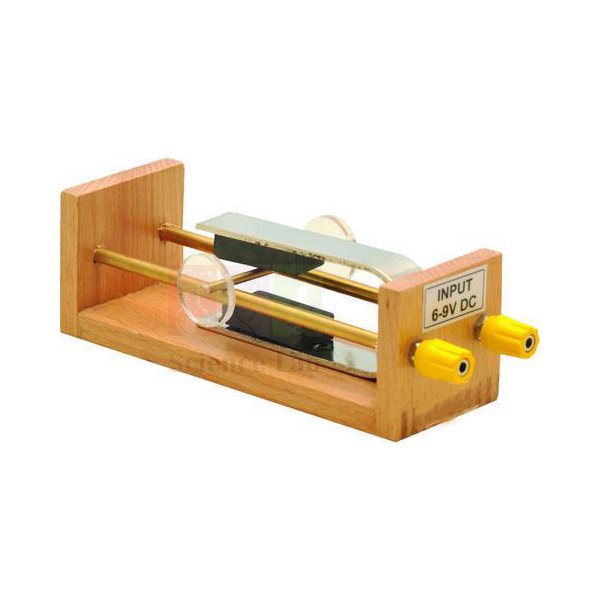
Force on a Conductor Apparatus
Force on a Conductor Apparatus (Product Code: SLE/PHY/98) is a rolling-axle demonstration used to show the force on a current-carrying conductor in a magnetic field, the motor effect behind Fleming's left-hand rule, in physics lessons. A brass axle resting on a pair of brass rails between the poles of a strong U-shaped magnet rolls away from the centre of the field as soon as a power supply is connected. It is manufactured by Jain Scientific Equipments Pvt Ltd (ScienceLab), an OEM manufacturer, at its own factory in Ambala, India.
Specifications
| Parameter | Detail |
|---|---|
| Magnet | Strong U-shaped magnet |
| Rails | Pair of brass rails with 4 mm socket terminals |
| Conductor | Brass axle with plastic discs, free to roll along the rails |
| Electrical contact | The axle completes the circuit between the two rails |
| Observed effect | Axle is repelled and rolls away from the centre of the magnetic field |
| Power | External power supply unit, connected at the rail terminals |
| Product code | SLE/PHY/98 |
| Manufacturer | Jain Scientific Equipments Pvt Ltd (ScienceLab) — OEM |
| Country of origin | India (made in Ambala, Haryana) |
What Is the Force on a Conductor Apparatus Used For?
Current flows along one rail, through the brass axle and back along the other, so the axle itself becomes the conductor lying across the magnetic field. The resulting force pushes it along the rails, and reversing either the current or the magnet reverses the direction it rolls, letting students check Fleming's left-hand rule for themselves. It is a staple piece of physics practical equipment for showing the principle behind every electric motor.
Connect a low-voltage supply to the 4 mm socket terminals and switch on only briefly, since the path through the axle has very little resistance. Keep the rails and axle clean so the contact stays good, and store the U-shaped magnet carefully to preserve its strength.
What to Specify When Ordering
- Number of sets, for a teacher demonstration or for group practicals.
- Whether a suitable low-voltage, high-current supply should be quoted as well.
- 4 mm leads for connecting the rails to the supply.
- Delivery location for packing and freight.
OEM Manufacturer
ScienceLab is the trading name of Jain Scientific Equipments Private Limited, which manufactures this force-on-a-conductor apparatus as the OEM at its own factory at Saha, Ambala, Haryana. Schools, universities, dealers and importers buy it direct from the maker, and questions about a spare axle or magnet are answered at source. For vendor registration, institutional and tender buyers can use GSTIN 06AAECJ8618A1ZT and LEI 3358004HRD1JIVXKYX49. The company profile gives more information.
Related Physics Lab Equipment
Supplies, magnets and alternatives for motor-effect practicals:
- Apparatus Force of Conductor — a Fleming's law version with a brass axle rolling on rails.
- Electromagnetic Power Supply — a low-voltage, high-current supply intended for Fleming's apparatus.
- Power Supply, Stepped — an AC/DC bench supply for general electricity practicals.
- Steel Horseshoe Magnet — horseshoe magnets with keepers for further magnetic field work.
- Stackable Leads — 4 mm leads for connecting the rails to the supply.
See more electromagnetism apparatus in Physics Lab Equipment.
Frequently Asked Questions
What does the Force on a Conductor Apparatus demonstrate?
The Force on a Conductor Apparatus demonstrates that a current-carrying conductor in a magnetic field experiences a force. When a supply is connected, the brass axle between the magnet's poles is repelled and rolls along the rails away from the centre of the field.
What parts make up the Force on a Conductor Apparatus?
The Force on a Conductor Apparatus comprises a strong U-shaped magnet, a pair of brass rails with 4 mm socket terminals, and a brass axle with plastic discs that rolls freely along the rails and completes the electrical contact between them.
What power supply does the apparatus need?
The Force on a Conductor Apparatus needs an external power supply unit connected to its 4 mm socket terminals, and the listing does not name a specific one. A low-voltage, high-current type such as the Electromagnetic Power Supply is worth discussing with us.
How does the apparatus relate to Fleming's left-hand rule?
The Force on a Conductor Apparatus lets students test Fleming's left-hand rule directly: field, current and motion are at right angles, and reversing either the current or the magnet makes the brass axle roll the opposite way along the rails.
Who manufactures the Force on a Conductor Apparatus?
Jain Scientific Equipments Pvt Ltd (ScienceLab) manufactures the Force on a Conductor Apparatus as the OEM at its own factory in Saha, Ambala, Haryana, India, and supplies it direct to schools, colleges, dealers and importers.
Can the Force on a Conductor Apparatus be ordered for export?
Yes. The Force on a Conductor Apparatus can be quoted for single laboratories or larger orders from institutions and distributors in India and international markets. Include the quantity, any power supplies or leads, and the destination when you contact us.
Request a Quote
For a quotation on the Force on a Conductor Apparatus, write to us through the contact page or add it to the enquiry cart along with any supply you need. Prices come straight from the manufacturer.
Last updated: 24 September 2026
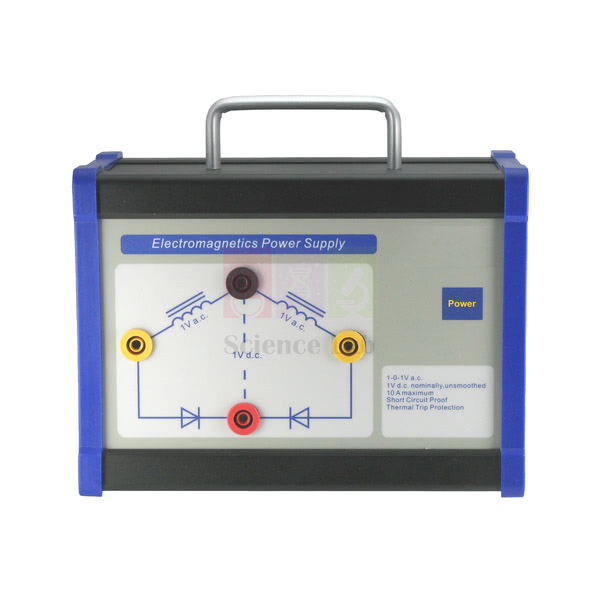
Electromagnetic Power Supply
Electromagnetic Power Supply (Product Code: SLE/PHY/99) is a low-voltage, high-current bench supply used to power electromagnetism kits and Fleming's apparatus in school and college physics labs. It gives students access to 1 V a.c. from a 1-0-1 V a.c. output or 2 V d.c. (unsmoothed), tolerates short circuits and has a short-circuit current of 10 A. It is supplied by Jain Scientific Equipments Pvt Ltd (ScienceLab), Ambala, India.
Specifications
| Parameter | Detail |
|---|---|
| Input voltage | 230 V ±10%, 50 Hz |
| Outputs | 1-0-1 V a.c. nominal; 2 V d.c. nominal |
| Student access | 1 V a.c. or 2 V d.c. |
| D.C. output | Rectified from 2 V a.c., unsmoothed |
| Short circuit | Tolerated; short-circuit current 10 A |
| Rectifier | 40 A Schottky barrier diode |
| Protection | Transformer protected by thermal fuses and a slow-blow fuse |
| Dimensions (W x H x D) | 208 x 155 x 115 mm |
| Height including handle | 187 mm |
| Product code | SLE/PHY/99 |
| Supplied by | Jain Scientific Equipments Pvt Ltd (ScienceLab), Ambala, India |
What Is the Electromagnetic Power Supply Used For?
Electromagnetism practicals such as the force on a conductor need a large current at a very low voltage, which general-purpose school supplies are not built to give. This unit fills that gap: its 1 V a.c. and 2 V d.c. outputs let a low-resistance conductor carry a heavy current, so the forces and fields involved are strong enough to see. It is a specialised power supply unit for the physics lab, and because the d.c. output is unsmoothed it is meant for these demonstrations rather than for sensitive electronics.
The supply tolerates short circuits, and its transformer is guarded by thermal fuses and a slow-blow fuse, which suits student benches where leads are often shorted by mistake. Use leads suited to heavy current and switch off between experiments. At 208 x 155 x 115 mm with a carrying handle, it moves easily from bench to bench.
What to Specify When Ordering
- Number of units required per laboratory.
- The apparatus it will power, such as Fleming's apparatus or an electromagnetism kit, so suitability can be checked.
- Your mains supply, since the unit's input is 230 V ±10%, 50 Hz.
- Any heavy-current leads you want quoted with it.
Supplier
Jain Scientific Equipments Private Limited, which trades as ScienceLab, supplies this electromagnetic power supply to schools, colleges, dealers and importers as part of its physics laboratory range. Quoting it together with the force-on-a-conductor apparatus or other electromagnetism kits it serves lets a department equip a complete practical in one order. Learn more about the company on the profile page.
Related Physics Lab Equipment
Apparatus powered by this supply, and alternative supplies for other work:
- Force on a Conductor Apparatus — a rolling-axle motor-effect demonstration that needs a heavy-current supply.
- Apparatus Force of Conductor — a Fleming's law apparatus with a brass axle on rails.
- Power Supply, Stepped — a stepped AC/DC supply for general electricity practicals.
- Power Supply, Smoothed — a smoothed supply for electronics work where ripple matters.
- Stackable Leads — 4 mm leads for connecting apparatus to the supply.
Browse more supplies and apparatus in Physics Lab Equipment.
Frequently Asked Questions
What outputs does the Electromagnetic Power Supply provide?
The Electromagnetic Power Supply provides a 1-0-1 V a.c. nominal output, giving students access to 1 V a.c., and a 2 V d.c. nominal output produced by rectifying 2 V a.c. The d.c. output is unsmoothed.
Is the Electromagnetic Power Supply protected against short circuits?
Yes. The Electromagnetic Power Supply tolerates short circuits, with a short-circuit current of 10 A. Its transformer is protected by thermal fuses and a slow-blow fuse, and a 40 A Schottky barrier diode handles the rectification.
What mains input does the Electromagnetic Power Supply need?
The Electromagnetic Power Supply runs from a 230 V ±10%, 50 Hz mains input. Buyers in regions with a different mains voltage or frequency should mention this in their enquiry so suitability can be checked before quoting.
How big is the Electromagnetic Power Supply?
The Electromagnetic Power Supply measures 208 x 155 x 115 mm (W x H x D), and its height including the handle is 187 mm, so it sits comfortably on a standard laboratory bench.
Can the Electromagnetic Power Supply be used for electronics circuits?
The Electromagnetic Power Supply is designed for low-voltage, high-current electromagnetism work, and its 2 V d.c. output is unsmoothed. For electronics circuits that need a steady d.c. supply, a smoothed bench power supply is the better choice.
Is a test or calibration certificate available for this power supply?
Documentation for the Electromagnetic Power Supply, such as a test or calibration certificate, should be discussed with us before ordering. Please state what your institution or tender requires through the contact page so we can confirm what can be provided.
Who supplies the Electromagnetic Power Supply?
The Electromagnetic Power Supply is supplied by Jain Scientific Equipments Pvt Ltd (ScienceLab), Ambala, India, to schools, colleges, dealers and importers in India and international markets. Contact us with quantities and the apparatus it will power for a quotation.
Request a Quote
To request a price for the Electromagnetic Power Supply, send the quantity and the apparatus you plan to use it with through the contact page, or add it to the enquiry cart. ScienceLab will reply with a quotation.
Last updated: 24 September 2026
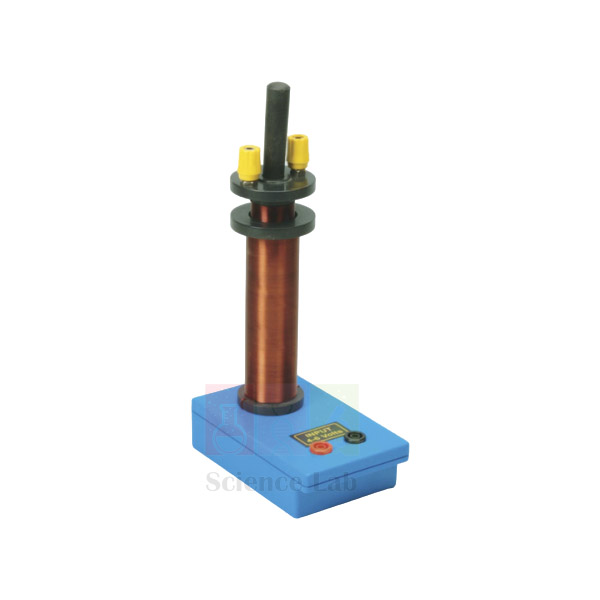
Induced Current Apparatus
Induced Current Apparatus (Product Code: SLE/PHY/100) is a two-coil demonstration set used to show how a changing magnetic field produces an electric current in school and college physics laboratories. Teachers use it for electromagnetic induction and mutual induction lessons, and its soft iron core fits the primary cylinder to strengthen the effect. It is made by Jain Scientific Equipments Pvt Ltd (ScienceLab), an OEM manufacturer, at its own factory in Ambala, India, as a practical electromagnetic induction kit for Indian classrooms.
Key Details
| Parameter | Detail |
|---|---|
| Primary coil | Insulated copper wire wound upon a cylinder, fitted with terminals |
| Secondary coil | Wound upon a cylinder into which the primary coil fits |
| Core | Soft iron core that fits the cylinder of the primary |
| Connections | Supplied complete with terminals |
| Product code | SLE/PHY/100 |
| Manufacturer | Jain Scientific Equipments Pvt Ltd (ScienceLab) — OEM |
| Country of origin | India (made in Ambala, Haryana) |
What Is the Induced Current Apparatus Used For?
The apparatus lets students see Faraday's law at work. Connect the secondary coil to a centre-zero galvanometer and the primary coil to a cell through a tap key: each time the primary circuit is made or broken, the needle kicks briefly, first one way and then the other. Pushing the energised primary into the secondary, or pulling it out, gives the same result and shows that only a change in magnetic flux induces a current.
Adding the soft iron core to the primary cylinder makes the deflections noticeably larger, a simple way to discuss how iron concentrates magnetic flux in transformers and induction coils. For clear readings, reverse the galvanometer connections to show that the direction of the induced current depends on the change, and switch the primary off between trials so the coil does not warm up. It is a dependable piece of physics lab equipment for schools in India preparing electromagnetism practicals.
OEM Manufacturer
The Induced Current Apparatus is made and assembled by ScienceLab, the trading name of Jain Scientific Equipments Private Limited, at its own licensed factory at Saha, Ambala, Haryana, India. As the original equipment manufacturer, the company produces this coil set at its factory rather than sourcing it from a trader, so schools, colleges, dealers and importers buy it factory-direct. Questions about a replacement coil or a spare soft iron core go straight to the manufacturer — just ask us. Learn more about the company on our company profile.
Related Physics Lab Equipment
These items complete an induction practical built around this apparatus:
- Galvanometer, Centre Zero Universal Meter — shows the direction and size of the induced current.
- One Way Key — makes and breaks the primary circuit cleanly.
- Connecting Wire — links the coils to the meter and the cell.
- Primary and Secondary Coil Set — an alternative coil pair for mutual induction work.
- Eddy Current Unit — extends the lesson to induced currents in solid conductors.
See the complete Physics Lab Equipment range.
Frequently Asked Questions
What is included with the Induced Current Apparatus?
The Induced Current Apparatus includes a primary coil of insulated copper wire wound on a cylinder with terminals, a secondary coil on a cylinder that receives the primary, and a soft iron core that fits the primary cylinder. A galvanometer, cell and leads are not part of the listing.
What else do I need to demonstrate electromagnetic induction?
To demonstrate induction with the Induced Current Apparatus you also need a sensitive centre-zero galvanometer for the secondary coil, a low-voltage DC source such as a cell for the primary, a tap key and connecting leads. We can quote these accessories together with the coils.
Why does the apparatus come with a soft iron core?
The soft iron core of the Induced Current Apparatus concentrates the magnetic field of the primary coil, so the change in flux through the secondary is larger. Students therefore see a bigger galvanometer deflection with the core in place than when the coils are used with air alone.
Who manufactures the Induced Current Apparatus?
The Induced Current Apparatus is manufactured by Jain Scientific Equipments Pvt Ltd, trading as ScienceLab, which is the OEM. It is made at the company's own factory at Saha, Ambala, Haryana, India, and supplied direct to schools, colleges, dealers and importers.
What should I include in a quotation request?
When requesting a quote for the Induced Current Apparatus (SLE/PHY/100), state the number of sets, whether you also need galvanometers, keys and leads, and the delivery address. Send these details through our contact page and the manufacturer will reply with a quotation.
Do you supply schools in bulk and handle export orders?
Yes. The Induced Current Apparatus is supplied in bulk for school and college laboratories and to dealers across India and international markets. Tell us the quantity and destination through the contact page, and we will confirm packing and dispatch details with the quotation.
Request a Quote
To get a quotation for the Induced Current Apparatus, contact ScienceLab or add it to the enquiry cart. Quotations come straight from the manufacturer, with no trading intermediary.
Last updated: 24 September 2026
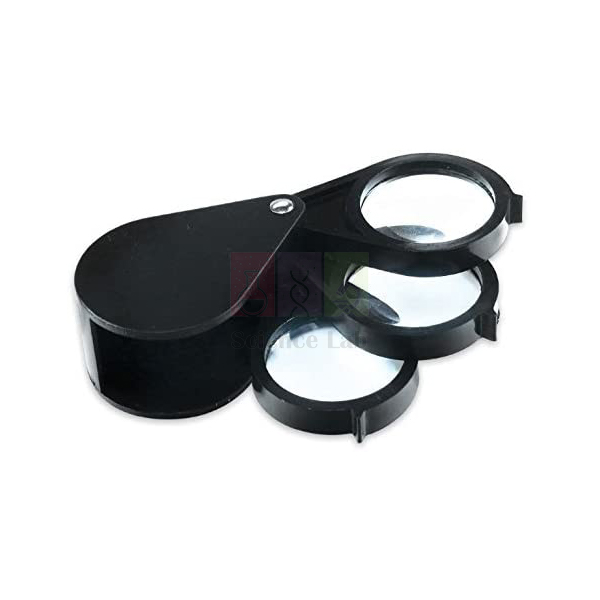
Magnifier, Folding
Magnifier, Folding (Product Code: SLE/PHY/101) is a compact 4x hand lens used to enlarge small objects and fine detail for close inspection in classrooms, laboratories and field studies. Students and teachers carry it on nature walks and in practical lessons, and its 25 mm lens is fitted in a folding frame that protects it when closed. It is supplied by Jain Scientific Equipments Pvt Ltd (ScienceLab), Ambala, India, as a handy hand lens magnifier for schools in India.
Specifications
| Parameter | Detail |
|---|---|
| Type | Folding, lens fitted in frame |
| Magnification | 4x |
| Diameter | 25 mm |
| Listing note | “Triple” — please confirm the lens arrangement when you enquire |
| Product code | SLE/PHY/101 |
| Supplied by | Jain Scientific Equipments Pvt Ltd (ScienceLab), Ambala, India |
What Is the Folding Magnifier Used For?
A folding magnifier is the everyday tool for looking closely at leaf veins, insect legs, seeds, crystals, fabric weave or small print. At 4x it reveals detail the naked eye misses, while keeping a wide enough view for beginners to find their subject quickly. Because the lens folds away, it can travel in a pocket or field bag on outdoor ecology lessons without getting scratched.
For the sharpest view, hold the lens close to the eye and move the object, not the lens, until it comes into focus; daylight or a desk lamp helps. In physics lessons the same magnifier illustrates how a converging lens forms an enlarged, upright virtual image when the object sits inside its focal length. Many school labs in India keep one as a pocket magnifier loupe for quick checks, wiping it with a soft cloth and folding it closed after use.
What to Specify When Ordering
- Quantity — one per student, or one per pair for group work.
- Magnification and size: 4x with a 25 mm diameter lens, as listed.
- The “Triple” note in the listing — confirm the lens arrangement you need.
- Whether a lens cleaning cloth should be quoted with the magnifiers.
Supplier
Jain Scientific Equipments Private Limited, which trades as ScienceLab, supplies the Magnifier, Folding alongside its wider range of school science equipment. The company sources this magnifier for its customers, so schools and dealers can add it to a larger laboratory order and deal with a single supplier. Read more about the company on our company profile.
Related Physics Lab Equipment
Pair the folding magnifier with these items for close-observation work:
- Folding Magnifier, Single — a single-lens folding alternative.
- Magnifier, Reading — a larger handled lens for reading small print.
- Minibeast Magnifier — for observing small living creatures.
- Microfiber Lens Cloth — cleans the lens without scratching it.
Browse more optics and observation items in our Physics Lab Equipment category.
Frequently Asked Questions
What magnification does the Magnifier, Folding provide?
The Magnifier, Folding provides 4x magnification through a lens listed at 25 mm diameter. That level suits general observation of leaves, insects, seeds and printed detail in school science, while keeping the field of view easy for students to use.
How does the folding design help?
The lens of the Magnifier, Folding is fitted in a frame that folds, so the lens is shielded when the magnifier is closed. This makes it easier to carry in a pocket, pencil case or field bag during outdoor lessons without scratching the lens.
What does “Triple” in the listing mean?
The original listing for the Magnifier, Folding carries the note “Triple”, which may refer to the lens arrangement. Because this is not fully described, please confirm the exact configuration with us through the contact page before you place a large order.
Who supplies the Magnifier, Folding?
The Magnifier, Folding is supplied by Jain Scientific Equipments Pvt Ltd, which trades as ScienceLab and is based in Ambala, Haryana, India. It can be combined with other school laboratory items in one order and one quotation.
How should the magnifier be cleaned and stored?
Clean the Magnifier, Folding with a soft, dry lens cloth, avoiding paper towels or abrasive cleaners that can scratch the lens surface. Fold it closed after each lesson and store it in a dry drawer or box so dust and grit stay off the lens.
Can you supply class sets and export orders?
Yes. The Magnifier, Folding can be ordered in class-set quantities by schools, colleges and dealers across India and international markets. Share the quantity and destination through our contact page, and we will confirm availability and dispatch details with the quotation.
Request a Quote
To receive a quotation for the Magnifier, Folding, send us your requirement or place it in the enquiry cart together with other items for your laboratory.
Last updated: 24 September 2026

Magnifier, Reading
Magnifier, Reading (Product Code: SLE/PHY/102) is a hand-held magnifying lens used to enlarge printed text and small detail for comfortable reading and inspection in schools, libraries and laboratories. Staff and students use it to read fine print, instrument scales and labels, and it has a chrome-plated metal frame with a bakelite handle. It is supplied by Jain Scientific Equipments Pvt Ltd (ScienceLab), Ambala, India, packed in a cardboard box.
Specifications
| Parameter | Detail |
|---|---|
| Frame | Metal, chrome plated |
| Handle | Bakelite |
| Diameter (as listed) | 7.5/20 cm — please confirm the lens size you need |
| Intended use | Reading |
| Packing | Cardboard box |
| Product code | SLE/PHY/102 |
| Supplied by | Jain Scientific Equipments Pvt Ltd (ScienceLab), Ambala, India |
What Is the Reading Magnifier Used For?
A reading magnifier makes small type, maps, dictionary entries, labels on reagent bottles and the fine graduations of measuring instruments easier to see. The handle lets the user hold the lens steady at the distance that gives the clearest, largest image, while the other hand keeps the page or object in place.
In the classroom it doubles as a simple demonstration of a convex lens: moving it slowly away from the page shows the image growing, then turning blurred and finally inverted once the page lies beyond the focal length. Keep the chrome frame dry, wipe the lens with a soft cloth, and return the magnifier to its cardboard box to protect it in storage. It suits school physics lab equipment sets in India as well as library and staff-room use.
What to Specify When Ordering
- Lens diameter — the listing shows “7.5/20 cm”, so state the size you require.
- Quantity for classrooms, the library or staff use.
- Packing — the magnifier is listed as packed in a cardboard box.
Supplier
ScienceLab is the trading name of Jain Scientific Equipments Private Limited in Ambala, Haryana. The company supplies this reading magnifier as part of its catalogue of school and laboratory items, so it can be quoted alongside optics, glassware and teaching aids in a single order. Visit our company profile for background on the business.
Related Physics Lab Equipment
Other magnifiers and accessories from the same range:
- Magnifier, Folding — a pocket-size 4x lens for field work.
- Hand Lens — a simple hand lens for biology observation.
- Watchmakers Eye Glass — a hands-free lens for close work on small parts.
- Microfiber Lens Cloth — keeps the lens clean and free of scratches.
Find the full range on our Physics Lab Equipment page.
Frequently Asked Questions
What is the Magnifier, Reading made of?
The Magnifier, Reading has a chrome-plated metal frame and a bakelite handle. The listing does not state the lens material, so if your requirement specifies glass or acrylic, please ask us through the contact page before ordering.
What size is the lens?
The listing for the Magnifier, Reading gives the diameter as 7.5/20 cm, which does not make the exact lens size clear. Please tell us the diameter you need when you enquire, and we will confirm the size we can supply with the quotation.
Is the reading magnifier useful in laboratories as well?
Yes. Although the Magnifier, Reading is listed for reading, the same hand-held lens is handy in laboratories for checking small labels, instrument scales and specimen detail. It also serves as a simple convex-lens example in physics lessons on image formation.
How is the Magnifier, Reading packed?
The Magnifier, Reading is packed in a cardboard box, which protects the lens and chrome finish during transport and gives a convenient place to store it between lessons. Ask us if your order needs any special packing for export.
Who supplies this magnifier?
The Magnifier, Reading is supplied by Jain Scientific Equipments Pvt Ltd, trading as ScienceLab, from Ambala, Haryana, India. Schools, colleges, dealers and importers can order it with other laboratory equipment on one quotation.
What should my enquiry include?
An enquiry for the Magnifier, Reading (SLE/PHY/102) should state the quantity, the lens diameter you require and the delivery location in India or abroad. Use the contact page or the enquiry cart, and we will reply with a quotation.
Request a Quote
Ask for a quotation on the Magnifier, Reading through our contact page, or collect it with other items in the enquiry cart and submit one request.
Last updated: 24 September 2026
Watchmakers Eye Glass
Watchmakers Eye Glass (Product Code: SLE/PHY/103) is an eyepiece magnifier, or loupe, worn in the eye socket to enlarge small parts and fine detail while leaving both hands free. Hobbyists, technicians and science students use it for close inspection of components, specimens and minerals, and it has a plastic lens with a 25 mm diameter. It is supplied by Jain Scientific Equipments Pvt Ltd (ScienceLab), Ambala, India, as a handy magnifier loupe for lab work in India.
Specifications
| Parameter | Detail |
|---|---|
| Type | Watchmaker's eyeglass (eye loupe) |
| Lens | Plastic |
| Diameter | 25 mm |
| Product code | SLE/PHY/103 |
| Supplied by | Jain Scientific Equipments Pvt Ltd (ScienceLab), Ambala, India |
What Is the Watchmakers Eye Glass Used For?
Held in place by the brow and cheek, the eye glass lets the wearer handle tweezers, a small screwdriver or a specimen while viewing it enlarged. That makes it useful for checking solder joints and small electronic parts, sorting seeds and tiny insects, examining mineral grains, or reading fine engraving and markings.
To wear it, fit the rim into the eye socket, keep the other eye open to reduce strain, and bring the work closer until it is sharp. The plastic lens is light and less likely to shatter if dropped, but it scratches more easily than glass, so clean it gently with a soft cloth and keep it covered in storage.
Supplier
Jain Scientific Equipments Private Limited trades under the ScienceLab name from Ambala, Haryana, India, and supplies this eye glass as one of many small tools for school and workshop laboratories. Ordering it with the rest of a laboratory list keeps purchasing simple for schools, training institutes and dealers. More about the company is on our company profile.
Related Physics Lab Equipment
Useful companions for close-up inspection work:
- Forceps (Tweezers) — hold small parts or specimens steady under the lens.
- Magnifier, Folding — a 4x hand magnifier for pocket use.
- Magnifier, Reading — a handled lens for larger areas and print.
- Microfiber Lens Cloth — gentle cleaning for the plastic lens.
More magnifiers and optics items are listed under Physics Lab Equipment.
Frequently Asked Questions
What is the lens of the Watchmakers Eye Glass made of?
The Watchmakers Eye Glass has a plastic lens with a listed diameter of 25 mm. Plastic keeps the loupe light to wear in the eye socket and less prone to shattering if dropped, but it should be cleaned gently to avoid scratches.
What magnification does it give?
The magnification of the Watchmakers Eye Glass is not stated in its listing. If your practical or workshop task needs a particular power, please ask through our contact page and we will confirm what can be supplied before you order.
How do I wear a watchmaker's eye glass comfortably?
Place the Watchmakers Eye Glass in the eye socket and hold it lightly with the brow and cheek, keeping the other eye open. Bring the object towards the lens until it is sharp, and take short breaks during long inspection sessions.
Who supplies the Watchmakers Eye Glass?
The Watchmakers Eye Glass is supplied by Jain Scientific Equipments Pvt Ltd, trading as ScienceLab, of Ambala, Haryana, India. It can be quoted together with tweezers, magnifiers and other laboratory tools in a single order.
Is it suitable for students?
Yes, the Watchmakers Eye Glass suits older students in electronics, biology, geology and technical workshops who need a hands-free view of small objects. Younger pupils may find a hand-held folding magnifier easier to use at first.
Can I order it in bulk or for export?
The Watchmakers Eye Glass can be ordered in quantity by schools, training institutes and dealers in India and international markets. Send the quantity and destination through the contact page or enquiry cart, and we will reply with a quotation.
Request a Quote
Request a quotation for the Watchmakers Eye Glass via the ScienceLab contact page, or add it to the enquiry cart with the other tools on your list.
Last updated: 24 September 2026
Friction Rod, Glass/Brass, 300mm
Friction Rod, Glass/Brass, 300mm (Product Code: SLE/PHY/106) is an electrostatics rod used to produce and study static electricity by rubbing in school physics experiments. Teachers and students use it to charge objects, attract light scraps of paper and compare like and unlike charges, and it measures 300 x 12 mm. It is made by Jain Scientific Equipments Pvt Ltd (ScienceLab), an OEM manufacturer, at its own factory in Ambala, India, for schools buying physics lab instruments in India.
Specifications
| Parameter | Detail |
|---|---|
| Material | Glass/Brass (as listed) |
| Dimensions | 300 x 12 mm |
| Application | Various experiments involving static electricity |
| Product code | SLE/PHY/106 |
| Manufacturer | Jain Scientific Equipments Pvt Ltd (ScienceLab) — OEM |
| Country of origin | India (made in Ambala, Haryana) |
What Is the Friction Rod Used For?
Rubbing a glass rod with silk leaves it positively charged, which students can show by bringing it near scraps of paper, a thin stream of tap water or the cap of an electroscope. Hanging one charged rod in a paper stirrup and approaching it with another reveals repulsion between like charges, and attraction when the second rod is ebonite or polythene.
Where brass is used, the lesson turns to conductors: a metal rod held directly in the hand will not keep its charge, because the charge leaks away through the body, which is how conductors and insulators are contrasted in class. Static experiments work best on dry days, so wipe the rod clean, warm it slightly if the room is humid and store it in a dry cupboard. The rod fits naturally into physics practical equipment for CBSE-style electrostatics lessons.
What to Specify When Ordering
- Material — glass, brass or both, since the listing gives glass/brass.
- Quantity for group or whole-class work.
- A rubbing cloth and other friction rods (perspex, nylon, ebonite) for comparison.
- An electroscope, if you want to detect and compare the charges produced.
OEM Manufacturer
ScienceLab — the trading name of Jain Scientific Equipments Private Limited — makes this friction rod at its licensed factory in Saha, Ambala, Haryana, India. Buying from the original equipment manufacturer means the rod comes factory-direct rather than through a trader, and matching rods for a complete electrostatics set can be ordered from the same maker. Ask us about replacements, and read our company profile for more about the business.
Related Physics Lab Equipment
Build a full electrostatics kit with these related items:
- Friction Rod, Brass/Ebonite — ebonite takes the opposite charge to glass for comparison.
- Friction Rod, Perspex — another insulating rod for charge experiments.
- Friction Cloth, Cotton — a cloth for rubbing the rods.
- Electroscope, Gold Leaf — detects and compares the charge produced.
Explore the wider Physics Lab Equipment category for more electrostatics apparatus.
Frequently Asked Questions
What size is the Friction Rod, Glass/Brass, 300mm?
The Friction Rod, Glass/Brass, 300mm measures 300 x 12 mm. That length gives students room to hold one end while rubbing the other, and to bring the charged end near paper scraps or an electroscope without touching them.
Is it a glass rod, a brass rod or both?
The listing gives the material of the Friction Rod, Glass/Brass, 300mm as glass/brass. Please state whether you need glass, brass or both when you enquire, and we will confirm exactly what the quotation covers.
What cloth should be used to charge the rod?
Silk is the traditional choice for charging a glass rod such as the Friction Rod, Glass/Brass, 300mm. Other clean, dry fabrics can be compared too, and testing two or three cloths makes a useful student investigation into how well each one charges the rod.
Why do static experiments sometimes fail?
Moisture is the usual reason. On humid days a thin film of water lets charge leak away from the Friction Rod, Glass/Brass, 300mm, so wipe it dry, warm it gently and repeat the rubbing. Grease from fingers can also reduce the effect.
Who manufactures this friction rod?
The Friction Rod, Glass/Brass, 300mm is manufactured by Jain Scientific Equipments Pvt Ltd (ScienceLab) as the OEM at its own factory at Saha, Ambala, Haryana, India. Schools, dealers and importers can order it direct from the manufacturer.
Can I order class sets or export quantities?
Yes. The Friction Rod, Glass/Brass, 300mm can be quoted in class-set or dealer quantities for India and international markets. Give the quantity, the material required and the destination through our contact page to receive a quotation.
Request a Quote
Contact the manufacturer for a quotation on the Friction Rod, Glass/Brass, 300mm through our contact page, or add it to the enquiry cart; quotes come directly from ScienceLab.
Last updated: 24 September 2026
Laser Pen, Red
Laser Pen, Red (Product Code: SLE/PHY/107) is a lightweight red laser pointer used for ray optics demonstrations and simple diffraction work in school and college physics labs. Teachers also use it as a presentation pointer, and its 0.5 milliwatt beam stays on after one press of the button until it is pressed again. It is supplied by Jain Scientific Equipments Pvt Ltd (ScienceLab), Ambala, India, for users of optics lab equipment in India.
Specifications
| Parameter | Detail |
|---|---|
| Beam colour | Red |
| Power | 0.5 milliwatts (0.5 mW) |
| Switch | Latching — press once to switch on, press again to switch off |
| Build | Lightweight pen format |
| Uses | Ray optics demonstrations, simple diffraction work, pointing on overhead images |
| Caution | Laser light — do not stare into the beam or view it directly with optical instruments |
| Product code | SLE/PHY/107 |
| Supplied by | Jain Scientific Equipments Pvt Ltd (ScienceLab), Ambala, India |
What Is the Laser Pen Used For?
A narrow, bright beam makes light paths easy to see. Shone through a glass block or prism resting on paper, the red beam lets students mark incident, refracted and emerging rays; aimed at a plane mirror, it shows the angle of incidence equalling the angle of reflection. Passed through a narrow slit or a pair of slits onto a distant wall, it produces a simple diffraction or interference pattern.
Because the button latches, the pen can be laid on a support and left running while the class takes measurements, and a little chalk dust in the air makes the beam visible in flight. Always follow the caution on the listing: never look into the beam, never point it at anyone's face and keep optical instruments out of its path. Teachers should supervise its use at all times.
Supplier
The Laser Pen, Red is supplied by ScienceLab, the trade name of Jain Scientific Equipments Private Limited, Ambala, Haryana. It is sourced for the company's customers and can be packed with prisms, lenses, mirrors and other optics items, so a school receives its whole optics order from one supplier. See our company profile for more about ScienceLab.
Related Physics Lab Equipment
Items commonly used with the laser pen in optics practicals:
- Prism – Glass Rectangular Block — traces refraction and the sideways shift of the beam.
- Prism, Clear Glass — shows deviation of a single ray through a 60-degree prism.
- Mirror, Plane Glass — demonstrates the law of reflection.
- Semiconductor Laser — an alternative laser source for optics experiments.
More light and optics apparatus is available in our Physics Lab Equipment range.
Frequently Asked Questions
What is the output power of the Laser Pen, Red?
The Laser Pen, Red has a listed power of 0.5 milliwatts. That low output is enough to trace ray paths through blocks, prisms and mirrors in a darkened room, but the beam must still never be viewed directly or aimed at eyes.
Do I need to keep pressing the button?
No. The Laser Pen, Red has a latching button: press it once and the beam stays on until you press it again. This leaves both hands free to position blocks, mirrors or slits and to mark ray paths on paper.
How should the laser pen be used safely in class?
The Laser Pen, Red carries a caution: do not stare into the beam or view it directly with optical instruments. Keep the beam below eye level and away from faces, and let students use it only under teacher supervision during ray optics demonstrations.
What batteries does it use?
The battery type for the Laser Pen, Red is not given in its listing. Please ask through our contact page if you need to know the battery size or want spare batteries included with your order.
Can it be used for diffraction experiments?
Yes, the listing describes the Laser Pen, Red as suitable for simple diffraction work. Shine it through a narrow slit, a pair of slits or a fine grating onto a screen a few metres away to see a pattern of bright and dark bands.
Who supplies the Laser Pen, Red?
The Laser Pen, Red is supplied by Jain Scientific Equipments Pvt Ltd, which trades as ScienceLab from Ambala, Haryana, India. It can be quoted with prisms, lenses and other optics items so your laboratory order comes from one source.
Request a Quote
For a quotation on the Laser Pen, Red, write to ScienceLab or put it in the enquiry cart along with the other optics items you need.
Last updated: 24 September 2026
Lenses Cylindrical Glass, Biconcave
Lenses Cylindrical Glass, Biconcave (Product Code: SLE/PHY/108) is a diverging cylindrical glass lens used to spread rays of light apart in ray-tracing and optics experiments in school and college laboratories. Physics students use it to locate a virtual focus on paper, and it has a listed focal length of 75 mm and dimensions of 50 x 45. It is made by Jain Scientific Equipments Pvt Ltd (ScienceLab), an OEM manufacturer, at its own factory in Ambala, India.
Specifications
| Parameter | Detail |
|---|---|
| Lens type | Biconcave (diverging), cylindrical |
| Material | Glass |
| Dimensions | 50 x 45 (as listed; unit not stated) |
| Focal length | 75 mm |
| Finish | Single, precision finished lens for light and optics experiments |
| Packing | Individually pouched and supplied in a presentation case |
| Product code | SLE/PHY/108 |
| Manufacturer | Jain Scientific Equipments Pvt Ltd (ScienceLab) — OEM |
| Country of origin | India (made in Ambala, Haryana) |
What Is the Biconcave Cylindrical Lens Used For?
A cylindrical lens curves in one direction only, so it turns a flat sheet of light from a ray box into a clear fan of rays on paper rather than bringing it to a point. Stood on its edge in the path of parallel rays, this biconcave lens spreads them outwards; tracing the emerging rays backwards with a ruler shows that they appear to come from a virtual focus on the same side as the light.
Measuring from that point to the lens centre gives the focal length, which students can compare with the listed 75 mm. Placed against the biconvex lens of the same series, it makes parallel rays leave nearly parallel, showing that equal and opposite lens powers cancel. As part of a convex and concave lens set for school optics, it should be handled by its edges and returned to its pouch after use.
What to Specify When Ordering
- Lens type — biconcave, biconvex or planoconvex from the same series.
- Number of lenses per student group or class.
- Whether you need the full three-lens series for comparison work.
- A light source such as a laser pen, if your lab has no ray box.
OEM Manufacturer
This biconcave lens is manufactured by ScienceLab, the trading name of Jain Scientific Equipments Private Limited, at the company's own licensed factory at Saha, Ambala, Haryana, India. Because the maker supplies it directly, laboratories and optics dealers can match further lenses of the same series later, with quotations coming straight from the factory. Find out more on our company profile.
Related Physics Lab Equipment
Complete your cylindrical lens experiments with:
- Lenses Cylindrical Glass, Biconvex — the converging partner with the same 75 mm focal length.
- Lenses Cylindrical Glass, Planoconvex — a converging lens with one flat face.
- Prism – Glass Rectangular Block — compares refraction in a parallel-sided block.
- Laser Pen, Red — a narrow beam for single-ray tracing.
View all lenses, prisms and optics items under Physics Lab Equipment.
Frequently Asked Questions
What is the focal length of the Lenses Cylindrical Glass, Biconcave?
The Lenses Cylindrical Glass, Biconcave has a listed focal length of 75 mm. Because the lens is diverging, this focal point is virtual: students find it by tracing the spread-out rays backwards until they meet on the incoming side.
What are the lens dimensions?
The listing gives the dimensions of the Lenses Cylindrical Glass, Biconcave as 50 x 45 but does not state the unit. If your ray box or lens holder needs an exact fit, please confirm the size with us through the contact page before ordering.
How is the lens packed?
Each Lenses Cylindrical Glass, Biconcave is individually pouched and supplied in a neat presentation case. The pouch protects the finished curved faces from scratches, and the case keeps the lens safe in a school optics cupboard between practicals.
How is a cylindrical lens different from an ordinary spherical lens?
A spherical lens curves in all directions and acts on light around a single point, while the Lenses Cylindrical Glass, Biconcave curves in one direction only. It spreads a sheet of rays into a flat fan, which is ideal for drawing ray diagrams directly on paper.
Who manufactures this biconcave lens?
The Lenses Cylindrical Glass, Biconcave is manufactured by Jain Scientific Equipments Pvt Ltd, trading as ScienceLab, the OEM. It is made at the company's own factory at Saha, Ambala, Haryana, India, and supplied factory-direct to institutions, dealers and importers.
Can I order it with the biconvex and planoconvex lenses?
Yes. The Lenses Cylindrical Glass, Biconcave belongs to a series that also includes biconvex and planoconvex versions. List the quantity of each type in your enquiry, and we will quote the lenses together for your laboratory or dealership.
Request a Quote
Quotes for the Lenses Cylindrical Glass, Biconcave come straight from the manufacturer — contact us or add the lens to the enquiry cart.
Last updated: 24 September 2026
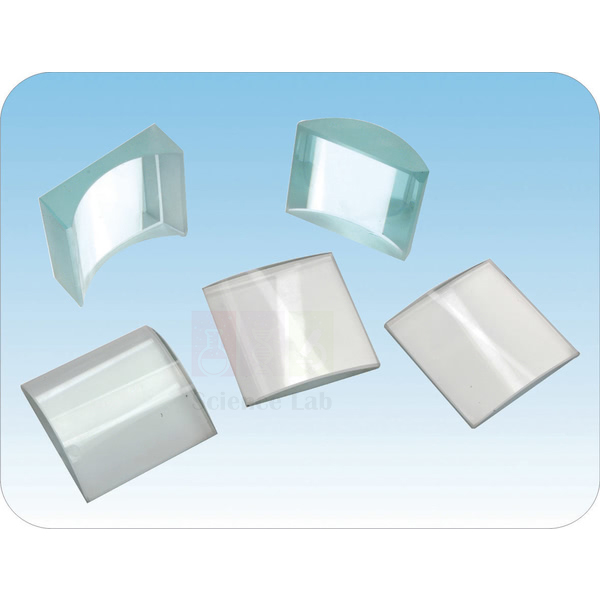
Lenses Cylindrical Glass, Biconvex
Lenses Cylindrical Glass, Biconvex (Product Code: SLE/PHY/109) is a converging cylindrical glass lens used to bring parallel rays of light to a line focus in optics and ray-diagram experiments. School and college physics students use it to measure focal length directly on paper, and it is listed with a 75 mm focal length and 50 x 45 dimensions. It is made by Jain Scientific Equipments Pvt Ltd (ScienceLab), an OEM manufacturer, at its own factory in Ambala, India, as optics lab equipment for India.
Specifications
| Parameter | Detail |
|---|---|
| Lens type | Biconvex (converging), cylindrical |
| Material | Glass |
| Dimensions | 50 x 45 (as listed; unit not stated) |
| Focal length | 75 mm |
| Finish | Precision finished, for a variety of light and optics experiments |
| Packing | Individually pouched in a neat presentation case |
| Product code | SLE/PHY/109 |
| Manufacturer | Jain Scientific Equipments Pvt Ltd (ScienceLab) — OEM |
| Country of origin | India (made in Ambala, Haryana) |
What Is the Biconvex Cylindrical Lens Used For?
With both faces curved outwards, this lens bends a fan of parallel rays inwards so that they cross at a bright focus about 75 mm behind it. Students stand the lens on a sheet of paper, mark the incoming and outgoing rays with a sharp pencil, and measure from the lens centre to the crossing point to find the focal length for themselves.
Moving the light source closer than the focal length shows the rays leaving the lens still diverging, the ray-diagram basis of a magnifying glass. Outer rays usually cross slightly nearer the lens than central ones, giving a visible example of spherical aberration for advanced classes. Keep fingerprints off the curved faces and slide the lens back into its pouch after each practical.
What to Specify When Ordering
- Which lens you need: biconvex, biconcave or planoconvex.
- Quantity per student group or laboratory.
- Whether all three shapes should be quoted for comparison experiments.
OEM Manufacturer
ScienceLab, the brand of Jain Scientific Equipments Private Limited, is the original equipment manufacturer of this biconvex lens and produces it at its licensed factory in Saha, Ambala, Haryana, India. Schools, colleges and optics dealers buy it direct from the maker rather than a reseller, which keeps repeat orders and replacement lenses simple — just ask us. Visit the ScienceLab company profile to learn more.
Related Physics Lab Equipment
Items that extend a converging-lens practical:
- Lenses Cylindrical Glass, Biconcave — the diverging lens of the same 75 mm series.
- Lenses Cylindrical Glass, Planoconvex — a converging lens with one flat face for comparison.
- Prism, Clear Glass — adds dispersion and deviation to the same optics session.
- Laser Pen, Red — a single narrow beam for precise ray tracing.
The full optics range is in our Physics Lab Equipment category.
Frequently Asked Questions
What focal length does the Lenses Cylindrical Glass, Biconvex have?
The Lenses Cylindrical Glass, Biconvex has a listed focal length of 75 mm. Parallel rays entering one curved face converge to a real line focus about that distance behind the lens, which students can mark and measure on paper.
What does the lens come packed in?
The Lenses Cylindrical Glass, Biconvex is individually pouched and supplied in a neat presentation case. This protects the precision-finished faces in transit and gives teachers a tidy way to issue and collect the lens during practicals.
Can the biconvex lens show spherical aberration?
Yes. With a wide fan of parallel rays, the outer rays passing through the Lenses Cylindrical Glass, Biconvex usually cross a little nearer the lens than the central rays. Drawing both crossing points on paper makes spherical aberration easy for students to see.
What size is the lens?
The Lenses Cylindrical Glass, Biconvex is listed as 50 x 45, but the original description does not give the unit. If you need an exact size for a holder or ray box, please confirm it with us through the contact page when you enquire.
Who makes the Lenses Cylindrical Glass, Biconvex?
Jain Scientific Equipments Pvt Ltd, trading as ScienceLab, manufactures the Lenses Cylindrical Glass, Biconvex as the OEM at its own factory at Saha, Ambala, Haryana, India. Quotations and repeat orders are handled directly by the manufacturer.
What should a quotation request include?
A quotation request for the Lenses Cylindrical Glass, Biconvex (SLE/PHY/109) should give the number of lenses, any other lens shapes from the series you need, and the delivery destination in India or abroad. Send it through the contact page or enquiry cart.
Request a Quote
Contact ScienceLab for a quotation on the Lenses Cylindrical Glass, Biconvex, or save it in the enquiry cart. The quotation comes directly from the factory that makes it.
Last updated: 24 September 2026
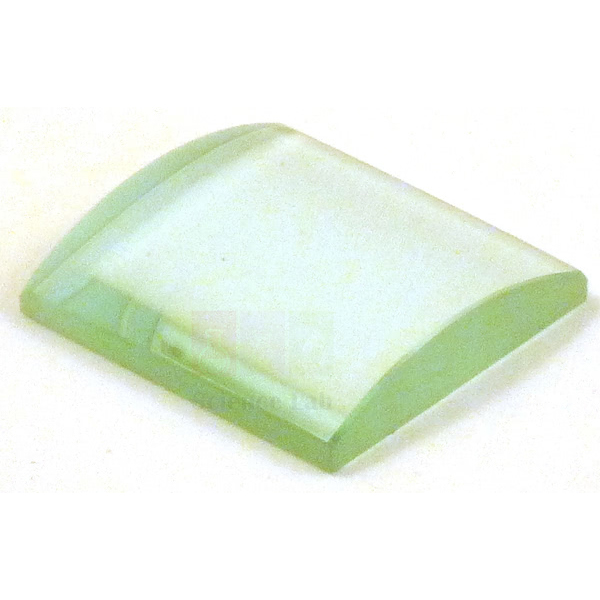
Lenses Cylindrical Glass, Planoconvex
Lenses Cylindrical Glass, Planoconvex (Product Code: SLE/PHY/110) is a converging cylindrical glass lens with one flat and one curved face, used to focus light and study refraction in physics optics practicals. Students and teachers use it to compare lens shapes and the effect of lens orientation, and it has a listed focal length of 75 mm. It is made by Jain Scientific Equipments Pvt Ltd (ScienceLab), an OEM manufacturer, at its own factory in Ambala, India, for school optics experiments.
Specifications
| Parameter | Detail |
|---|---|
| Lens type | Planoconvex (converging), cylindrical |
| Material | Glass |
| Dimensions | 50 x 45 (as listed; unit not stated) |
| Focal length | 75 mm |
| Finish | Single, high quality precision finished lens |
| Packing | Individually pouched and supplied in a neat presentation case |
| Product code | SLE/PHY/110 |
| Manufacturer | Jain Scientific Equipments Pvt Ltd (ScienceLab) — OEM |
| Country of origin | India (made in Ambala, Haryana) |
What Is the Planoconvex Cylindrical Lens Used For?
The flat back face makes this lens ideal for showing that orientation matters. Send parallel rays onto the curved face first and they converge to a fairly sharp line focus; turn the lens round so the flat face meets the light and the rays cross over a longer, more spread-out region. Students can record both ray patterns on paper and discuss why optical designers usually point the curved side towards parallel light.
The flat face also sits neatly against a glass block or plane mirror, so the lens can be combined with other components in ray-box experiments. Used with the biconvex and biconcave lenses of the same series, it rounds out a convex and concave lens set for school optics. Handle it by the edges and store it in its pouch and case.
What to Specify When Ordering
- Lens shape — planoconvex, biconvex or biconcave.
- Number of lenses required for each student group.
- Whether the whole three-lens series should be quoted together.
OEM Manufacturer
The planoconvex lens is produced by ScienceLab, which is the trading name of Jain Scientific Equipments Private Limited, at its licensed factory in Saha, Ambala, Haryana, India. The company is a registered MSME enterprise with manufacturing as its major activity (Udyam UDYAM-HR-01-0003714), and its export shipments are handled under Importer-Exporter Code AAECJ8618A (DGFT). As the OEM, it sells direct to schools, colleges, dealers and importers; see our company profile for more.
Related Physics Lab Equipment
Useful partners for planoconvex lens experiments:
- Lenses Cylindrical Glass, Biconvex — shows the effect of curving both faces.
- Lenses Cylindrical Glass, Biconcave — a diverging lens for comparison.
- Prism – Glass Rectangular Block — pairs with the flat face in refraction set-ups.
- Mirror, Plane Glass — combines with the lens for reflection-and-refraction ray work.
See every lens and prism in the Physics Lab Equipment category.
Frequently Asked Questions
What is the focal length of the Lenses Cylindrical Glass, Planoconvex?
The Lenses Cylindrical Glass, Planoconvex has a listed focal length of 75 mm, the same figure given for the biconvex and biconcave lenses in the series. That makes side-by-side comparisons of lens shape straightforward in one practical session.
Which way round should the planoconvex lens face the light?
For the sharpest focus, turn the curved face of the Lenses Cylindrical Glass, Planoconvex towards incoming parallel rays and the flat face towards the focus. Reversing it spreads the crossing points over a longer distance, which is itself a good experiment on aberration.
How is the lens supplied?
The Lenses Cylindrical Glass, Planoconvex comes as a single precision-finished lens, individually pouched and supplied in a neat presentation case. Teachers can issue each lens in its pouch and collect it back after the lesson to keep the faces clean.
What are the lens dimensions?
The Lenses Cylindrical Glass, Planoconvex is listed at 50 x 45, but the original description does not state the unit. Please confirm the dimensions through our contact page if the lens must fit a particular ray box, holder or storage tray.
Who manufactures the planoconvex lens?
The Lenses Cylindrical Glass, Planoconvex is manufactured by Jain Scientific Equipments Pvt Ltd (ScienceLab), acting as OEM, at its own factory at Saha, Ambala, Haryana, India. The manufacturer quotes and supplies it directly to institutions, dealers and importers.
Do you supply export orders?
Yes. The Lenses Cylindrical Glass, Planoconvex can be supplied to schools, colleges and dealers across India and international markets. Share the quantity, any other lenses you need from the series and the destination through the contact page for a quotation.
Request a Quote
Send your requirement for the Lenses Cylindrical Glass, Planoconvex through the contact page or the enquiry cart, and the manufacturer will quote you directly.
Last updated: 24 September 2026
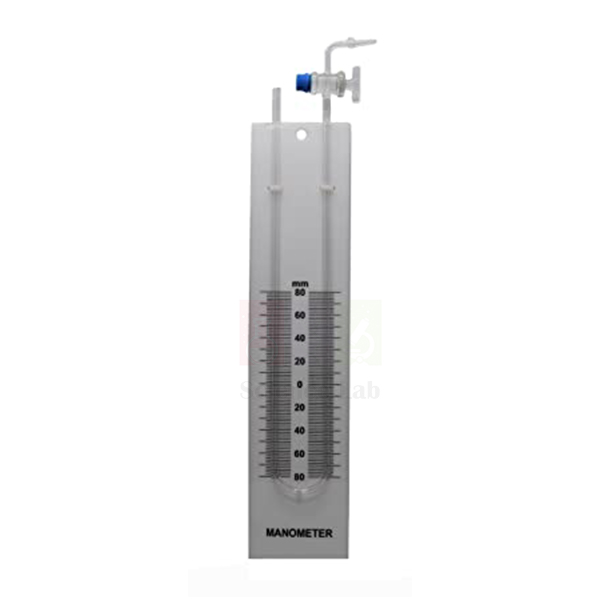
Manometer, Glass
Manometer, Glass (Product Code: SLE/PHY/111) is a liquid-column pressure gauge used to measure small gas pressure differences in physics and chemistry laboratory experiments. Students read the liquid levels against its 80-0-80 centre-zero scale, and the glass tube has a built-in stopcock and is mounted on a 400 x 80 mm backing plate. It is made by Jain Scientific Equipments Pvt Ltd (ScienceLab), an OEM manufacturer, at its own factory in Ambala, India.
Specifications
| Parameter | Detail |
|---|---|
| Construction | Glass manometer with built-in stopcock, mounted on a backing plate |
| Backplate dimensions | 400 x 80 mm |
| Scale | 80-0-80 with 2 mm subdivisions |
| Tube length | Approx. 406 mm |
| Tube diameter | 5 mm |
| Retaining ring | 9.5 mm |
| Tubing connection | External diameter 5 mm, increasing to 7 mm at the end near the retaining ring |
| Product code | SLE/PHY/111 |
| Manufacturer | Jain Scientific Equipments Pvt Ltd (ScienceLab) — OEM |
| Country of origin | India (made in Ambala, Haryana) |
What Is the Glass Manometer Used For?
Connect one side of the manometer to the system under test with rubber tubing and leave the other open to the air; the difference in liquid level then shows the gauge pressure. Typical school uses include checking laboratory gas supply pressure, showing how pressure increases with depth using a thistle funnel covered with a thin membrane, and measuring the small pressure changes in gas-law demonstrations — core physics lab equipment for schools in India.
Fill it with coloured water to about the zero mark so both levels are easy to read. Because the scale runs 80-0-80, read how far the liquid has fallen on one side and risen on the other, then add the two values for the total level difference. The built-in stopcock lets you isolate the line between readings, and the connector, tapering from 5 mm to 7 mm, holds tubing securely.
What to Specify When Ordering
- Number of manometers needed for your laboratory.
- Rubber tubing to suit the 5–7 mm tapered connector.
- Whether a dye for colouring the manometer water should be included.
OEM Manufacturer
ScienceLab (Jain Scientific Equipments Private Limited) is the original equipment manufacturer of the Manometer, Glass, making and assembling it at its own licensed factory in Saha, Ambala, Haryana, India. Buyers deal with the manufacturer rather than a trading house, so questions about the scale, the stopcock or a replacement tube can be raised directly — ask us. Read our company profile for more.
Related Physics Lab Equipment
Items that help set up pressure measurements with this manometer:
- Rubber Tubing — connects the manometer to gas taps or apparatus.
- Food Colouring Red — tints the water so the levels are easy to read.
- Open Manometer — an alternative manometer for pressure work.
- Boyle’s Law – Simple Type — a related gas-pressure experiment.
Browse our Physics Lab Equipment category for more pressure and fluids apparatus.
Frequently Asked Questions
What scale does the Manometer, Glass have?
The Manometer, Glass has an 80-0-80 scale with 2 mm subdivisions. The centre zero lets students read the rise and fall of liquid on either side and add them to find the total difference in level for the pressure being measured.
What size is the manometer?
The Manometer, Glass is mounted on a backing plate of 400 x 80 mm. Its tube measures approximately 406 mm long with a 5 mm diameter, and the retaining ring is 9.5 mm, which keeps the unit compact on a laboratory bench.
What tubing fits the manometer connection?
The connector on the Manometer, Glass has an external diameter of 5 mm, increasing to 7 mm at the end near the retaining ring. Flexible laboratory tubing with a bore to suit this taper will push on and hold securely.
What liquid should be used in the manometer?
Water tinted with a little food colouring is the usual choice for the Manometer, Glass in school experiments because it is safe and easy to read. The liquid is not specified in the listing, so ask us if your practical calls for a different fluid.
Who manufactures the Manometer, Glass?
The Manometer, Glass is manufactured by Jain Scientific Equipments Pvt Ltd (ScienceLab), the OEM, at its own factory at Saha, Ambala, Haryana, India. It is supplied direct from the manufacturer to schools, colleges, laboratories, dealers and importers.
Is a calibration certificate available?
The Manometer, Glass is a teaching instrument with an 80-0-80 scale. If your institution requires a calibration certificate or other documentation, please discuss it with us through the contact page before ordering so we can confirm what can be provided.
Request a Quote
For a quotation on the Manometer, Glass, reach the manufacturer through our contact page or add it to the enquiry cart.
Last updated: 24 September 2026
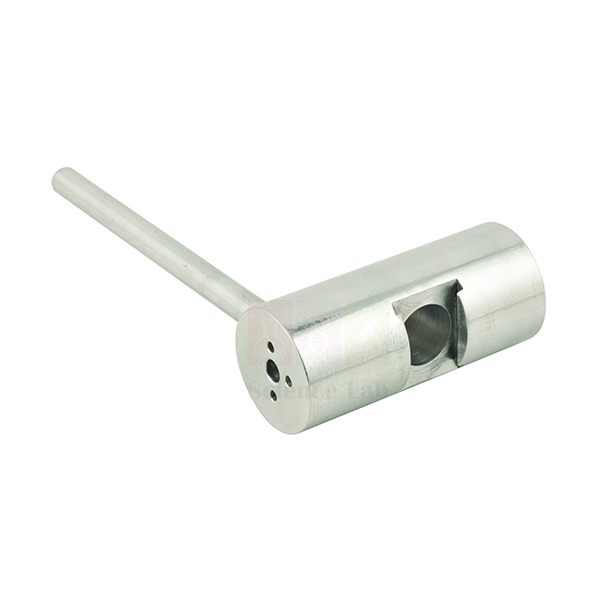
Melting Point Block
Melting Point Block (Product Code: SLE/PHY/112) is a basic aluminium heating block used to determine the melting point of substances in school chemistry and physics practicals. Designed for individual student use, it has a 7 mm hole for a thermometer and comes with a 75 x 25 mm glass slide; the thermometer is not supplied. It is made by Jain Scientific Equipments Pvt Ltd (ScienceLab), an OEM manufacturer, at its own factory in Ambala, India.
Specifications
| Parameter | Detail |
|---|---|
| Block material | Aluminium |
| Thermometer hole | 7 mm |
| Glass slide | Included, 75 x 25 mm |
| Thermometer | Not supplied |
| Intended use | Determining melting points; individual student use |
| Product code | SLE/PHY/112 |
| Manufacturer | Jain Scientific Equipments Pvt Ltd (ScienceLab) — OEM |
| Country of origin | India (made in Ambala, Haryana) |
What Is the Melting Point Block Used For?
A few crystals of the test substance are placed on the glass slide resting on the block, a thermometer goes into the thermometer hole, and the block is warmed slowly from below. Aluminium spreads heat evenly, so the thermometer reading follows the temperature under the slide closely; the reading at which the crystals turn clear and liquid is recorded as the melting point.
Students can compare a pure sample with one containing an impurity, which melts lower and over a wider range, or identify an unknown solid against a table of values. Heat gently near the expected melting point for an accurate result, handle the hot block with tongs, and let it cool before cleaning the slide. Giving every learner a block of their own makes it a practical choice among physics lab instruments in India.
What to Specify When Ordering
- Number of blocks — the listing presents it for individual student use.
- A thermometer for each block, with a stem that fits the 7 mm hole.
- A heat source and support, such as a burner, tripod and gauze.
OEM Manufacturer
The Melting Point Block is manufactured by ScienceLab — the trade name of Jain Scientific Equipments Private Limited — at its own licensed factory in Saha, Ambala, Haryana, India. Since the block comes straight from the OEM, schools ordering a full class set and dealers restocking can ask the maker directly about spare glass slides or repeat supplies. Background on the company is on our company profile.
Related Physics Lab Equipment
Heating equipment and alternatives for melting-point work:
- Bunsen Burner — provides gentle, controllable heat under the block.
- Tripod Cast Iron Varnished — supports the block above the flame.
- Gauze Wire — spreads the burner heat evenly under the block.
- Melting Point Apparatus Simple — an alternative set-up for melting-point tests.
More heat and measurement apparatus is listed under Physics Lab Equipment.
Frequently Asked Questions
What is included with the Melting Point Block?
The Melting Point Block includes the aluminium block and a glass slide measuring 75 x 25 mm. A thermometer is not supplied, so order one separately or use a suitable thermometer already in your laboratory.
What size of thermometer fits the block?
The thermometer hole in the Melting Point Block is 7 mm. Choose a thermometer whose stem passes easily into a 7 mm opening and whose range covers the melting points your students will measure; ask us if you want one quoted.
Why is the block made of aluminium?
Aluminium conducts heat well, so the Melting Point Block warms evenly and the thermometer reading stays close to the temperature under the glass slide. This helps students record a clearer melting point with simple school heating equipment.
Is it suitable for individual student work?
Yes. The Melting Point Block is described as ideal for individual student use, so each learner or pair can carry out their own melting-point determination instead of watching a single demonstration at the front of the class.
Who manufactures the Melting Point Block?
The Melting Point Block is manufactured by Jain Scientific Equipments Pvt Ltd, trading as ScienceLab, as the OEM at its own factory at Saha, Ambala, Haryana, India. Quotations come directly from the manufacturer.
What should I include when requesting a quote?
To request a quote for the Melting Point Block (SLE/PHY/112), give the number of blocks, whether thermometers should be included, and the delivery destination in India or abroad. Use the contact page or enquiry cart to send the details.
Request a Quote
Get a factory-direct quotation for the Melting Point Block by contacting ScienceLab or adding it to the enquiry cart.
Last updated: 24 September 2026
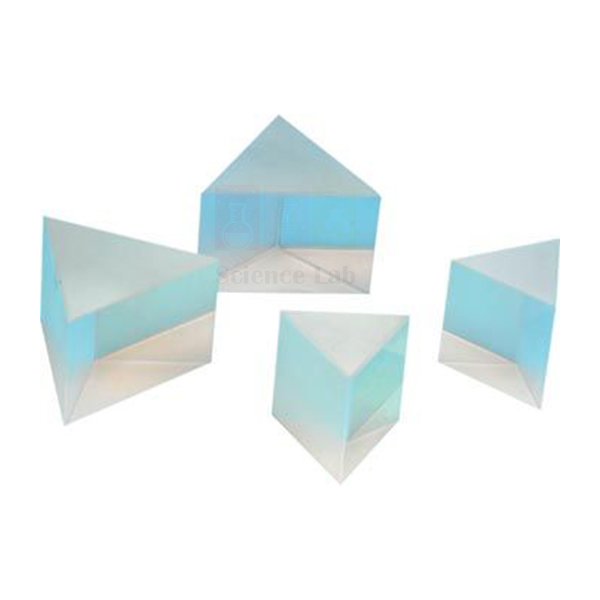
Prism, Borosilicate Glass
Prism, Borosilicate Glass (Product Code: SLE/PHY/113) is an optically worked equilateral prism used on a spectrometer to measure refractive index and study the dispersion of light in college and senior school physics laboratories. It measures 32 x 32 mm, has two polished faces and is listed as crown glass with a refractive index of 1.51. It is made by Jain Scientific Equipments Pvt Ltd (ScienceLab), an OEM manufacturer, at its own factory in Ambala, India.
Specifications
| Parameter | Detail |
|---|---|
| Material | Borosilicate glass |
| Glass type and refractive index | Crown, R.I. 1.51 |
| Shape | Equilateral triangle |
| Dimensions | 32 x 32 mm |
| Surfaces | Optically worked; two faces polished |
| Intended use | With a spectrometer |
| Product code | SLE/PHY/113 |
| Manufacturer | Jain Scientific Equipments Pvt Ltd (ScienceLab) — OEM |
| Country of origin | India (made in Ambala, Haryana) |
What Is the Borosilicate Glass Prism Used For?
On a spectrometer table, the prism's two polished faces act as the refracting surfaces. Students first measure the angle of the prism using reflections from those faces, then rotate the table to find the angle of minimum deviation for a spectral line. From these two angles the refractive index follows from n = sin((A + Dm)/2) / sin(A/2), the standard prism spectrometer practical in India.
With a sodium or mercury source, the same set-up shows dispersion: each colour leaves the prism at a slightly different angle, so the refractive index can be measured for several lines and plotted against wavelength. Hold the prism by its unpolished face or edges, set the polished faces towards the collimator and telescope, and clean it only with a lens tissue or soft cloth.
What to Specify When Ordering
- Number of spectrometer stations to equip with a prism.
- Refractive index required — this prism is listed at 1.51 (crown).
- Whether the spectrometer and a spectral lamp supply should also be quoted.
OEM Manufacturer
Jain Scientific Equipments Private Limited, known by its brand ScienceLab, manufactures this borosilicate prism as the OEM at its licensed factory in Saha, Ambala, Haryana, India. Physics departments and optics dealers get the prism direct from the maker, and matching prisms for extra spectrometer stations can be requested the same way. See the company profile for details of the business.
Related Physics Lab Equipment
Instruments and accessories for spectrometer work with this prism:
- Spectrometer — the instrument this prism is intended for.
- Spectral Lamp Power Supply with Lamp Holder — powers the light source for line spectra.
- Prism, Clear Glass — a larger 60-degree prism for school dispersion work.
- Microfiber Lens Cloth — cleans the polished faces safely.
Explore more optics apparatus in our Physics Lab Equipment category.
Frequently Asked Questions
What is the refractive index of the Prism, Borosilicate Glass?
The Prism, Borosilicate Glass is listed as crown glass with a refractive index of 1.51. Students can check this value themselves on a spectrometer by measuring the angle of the prism and the angle of minimum deviation.
What size is the prism, and which faces are polished?
The Prism, Borosilicate Glass is an equilateral triangle measuring 32 x 32 mm, with two faces polished and optically worked. The polished faces are the refracting surfaces, so place them towards the collimator and telescope of the spectrometer.
Will the prism fit my spectrometer?
The Prism, Borosilicate Glass is intended for use with a spectrometer and measures 32 x 32 mm. If your prism table has limited space or a particular clamp, please share its dimensions through our contact page so we can confirm the fit before you order.
How should the prism be cleaned?
Clean the polished faces of the Prism, Borosilicate Glass with a lens tissue or soft microfibre cloth, holding it by the edges or the unpolished face. Avoid touching the refracting faces, as fingerprints scatter light and blur the spectral lines seen in the telescope.
Who manufactures this prism?
The Prism, Borosilicate Glass is manufactured by Jain Scientific Equipments Pvt Ltd (ScienceLab), the OEM, at its own factory at Saha, Ambala, Haryana, India. Colleges, schools, dealers and importers can order it direct from the manufacturer.
Can a calibration certificate be supplied?
A prism such as the Prism, Borosilicate Glass is an optical component rather than a calibrated instrument. If your purchase rules require a test report or certificate of any kind, please discuss it with us through the contact page before ordering.
Request a Quote
Ask ScienceLab for a manufacturer's quotation on the Prism, Borosilicate Glass, or add it to the enquiry cart with your spectrometer order.
Last updated: 24 September 2026
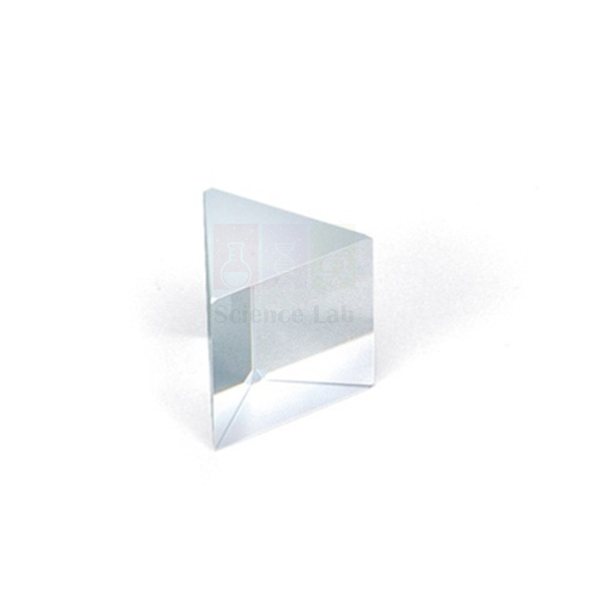
Prism, Clear Glass
Prism, Clear Glass (Product Code: SLE/PHY/114) is an equilateral glass prism used to show refraction, deviation and the dispersion of white light into a spectrum in school and college physics labs. Measuring 50 x 50 mm with 60-degree angles, it has optically worked surfaces, slightly bevelled edges and bubble-free glass. It is made by Jain Scientific Equipments Pvt Ltd (ScienceLab), an OEM manufacturer, at its own factory in Ambala, India, as prism glass for labs across India.
Specifications
| Parameter | Detail |
|---|---|
| Material | Clear glass, free from bubbles |
| Angles | 60 x 60 x 60 degrees |
| Dimensions | 50 x 50 mm |
| Surfaces | Optically worked |
| Edges | Slightly bevelled |
| Product code | SLE/PHY/114 |
| Manufacturer | Jain Scientific Equipments Pvt Ltd (ScienceLab) — OEM |
| Country of origin | India (made in Ambala, Haryana) |
What Is the Clear Glass Prism Used For?
The classic school practical places the prism on a sheet of paper pinned to a drawing board, draws its outline and uses sighting pins to trace a ray through it. By repeating the tracing for several angles of incidence, students plot angle of deviation against angle of incidence and read off the minimum deviation, from which the refractive index of the glass can be calculated.
Held in a beam of sunlight or a bright white source, the same prism splits the light into a visible spectrum on a white screen, a memorable way to introduce dispersion. With a laser pointer, students can also find the angle at which light is totally internally reflected at the second face. The slightly bevelled edges make the prism comfortable to handle, but keep the working faces free of fingerprints.
OEM Manufacturer
This 60-degree prism is one of the optical items ScienceLab, the brand of Jain Scientific Equipments Private Limited, makes at its licensed factory in Saha, Ambala, Haryana, India. As the OEM, the company sells it directly to schools, colleges, dealers and importers, so quotations, class-set orders and replacement prisms are handled by the maker itself — just ask us. More about ScienceLab is on our company profile.
Related Physics Lab Equipment
Everything needed for a prism ray-tracing practical:
- Drawing Board — a firm base for pin-tracing ray paths through the prism.
- Board Pin Packet — sighting pins for locating rays.
- Laser Pen, Red — a narrow beam for deviation and internal reflection work.
- Prism – Glass Rectangular Block — a parallel-sided block for comparing refraction.
- Prism, Borosilicate Glass — a smaller polished prism for spectrometer use.
For the complete optics range, visit Physics Lab Equipment.
Frequently Asked Questions
What are the angles and size of the Prism, Clear Glass?
The Prism, Clear Glass is an equilateral prism with angles of 60 x 60 x 60 degrees and dimensions of 50 x 50 mm. This size gives enough face area for pin-tracing experiments on a drawing board and for projecting a spectrum.
Is the glass free from bubbles?
Yes. The Prism, Clear Glass is described as high quality glass with optically worked surfaces, free from bubbles. Bubble-free glass avoids stray scattering, so traced rays and projected spectra appear cleaner for students to observe and record.
Why are the edges bevelled?
The edges of the Prism, Clear Glass are slightly bevelled, which removes sharp corners. This makes the prism more comfortable for students to handle and helps reduce chipping when it is placed on benches or stored with other optical components.
Which experiments can be done with this prism?
With the Prism, Clear Glass, students can trace refraction with pins, plot deviation against angle of incidence, find minimum deviation and refractive index, project a spectrum of white light, and study total internal reflection using a narrow beam such as a laser pen.
Who manufactures the Prism, Clear Glass?
Jain Scientific Equipments Pvt Ltd, trading as ScienceLab, is the OEM that manufactures the Prism, Clear Glass at its own factory at Saha, Ambala, Haryana, India. It is supplied direct to schools, colleges, dealers and importers.
Can you supply class sets for export?
Yes. The Prism, Clear Glass can be ordered in class-set quantities for schools and dealers in India and international markets. Send the number of prisms and your destination through the contact page, and the manufacturer will reply with a quotation.
Request a Quote
For a direct quotation on the Prism, Clear Glass, get in touch with ScienceLab or add it to the enquiry cart together with boards and pins.
Last updated: 24 September 2026

Prism – Glass Rectangular Block
Prism – Glass Rectangular Block (Product Code: SLE/PHY/115) is a parallel-sided clear glass block used to study the refraction of light and measure refractive index in school physics practicals. Students trace rays through it with pins or a narrow beam, and its glass has a listed refractive index of 1.52 with all angles accurately worked. It is made by Jain Scientific Equipments Pvt Ltd (ScienceLab), an OEM manufacturer, at its own factory in Ambala, India.
Specifications
| Parameter | Detail |
|---|---|
| Material | Clear glass, completely bubble-free |
| Refractive index | 1.52 |
| Surfaces | Optically worked |
| Angles | All accurately worked |
| Edges | Slightly bevelled |
| Product code | SLE/PHY/115 |
| Manufacturer | Jain Scientific Equipments Pvt Ltd (ScienceLab) — OEM |
| Country of origin | India (made in Ambala, Haryana) |
What Is the Glass Rectangular Block Used For?
Laid flat on paper, the block's outline is drawn and a ray is traced in and out with pins or a laser beam. Joining the points shows the ray bending towards the normal on entry and away from it on exit, emerging parallel to its original direction but shifted sideways. Measuring the angles of incidence and refraction lets students apply Snell's law and compare their answer with the listed index of 1.52.
The block also demonstrates real and apparent depth: looking down through it, a mark underneath appears raised, and the ratio of real to apparent thickness gives another estimate of refractive index. Because the angles are accurately worked, opposite faces stay parallel, which is what makes the sideways-shift experiment reliable. It is core physics practical equipment for CBSE and state-board refraction experiments.
What to Specify When Ordering
- Block size — the listing does not give dimensions, so state what you need.
- Quantity for pairs or small groups.
- Drawing boards and pins, or a laser pen, for ray tracing.
OEM Manufacturer
ScienceLab, the trading name of Jain Scientific Equipments Private Limited, is the OEM for this rectangular glass block and makes it at its licensed factory in Saha, Ambala, Haryana, India. Institutions and dealers therefore buy from the maker rather than a middleman, and can raise size or quantity questions directly with the manufacturer. Learn more about us on the company profile page.
Related Physics Lab Equipment
Tools that complete a refraction practical with the glass block:
- Board Pin Packet — pins for tracing rays through the block.
- Drawing Board — a firm base for the paper and pins.
- Professional Protractor — measures the angles of incidence and refraction.
- Laser Pen, Red — a visible single ray for quick demonstrations.
- Prism, Clear Glass — a triangular prism for deviation and dispersion.
Find more optics equipment in the Physics Lab Equipment category.
Frequently Asked Questions
What is the refractive index of the Prism – Glass Rectangular Block?
The Prism – Glass Rectangular Block has a listed refractive index of 1.52. Students can compare this with their own value from Snell's law, using the angles of incidence and refraction measured on their ray-tracing sheet.
What size is the glass block?
The dimensions of the Prism – Glass Rectangular Block are not stated in its listing. Please tell us the size your practical requires, or ask through the contact page, and we will confirm the block dimensions with your quotation.
Why does the ray come out parallel but shifted?
The opposite faces of the Prism – Glass Rectangular Block are parallel, so the bending on entry is reversed on exit. The emerging ray therefore travels parallel to the incident ray but displaced sideways, and the displacement grows with thickness and angle of incidence.
Is the block free from bubbles and sharp edges?
Yes. The Prism – Glass Rectangular Block is made of clear glass described as completely bubble-free, with optically worked surfaces and slightly bevelled edges. This keeps traced rays clean and makes the block more comfortable for students to handle.
Who manufactures this glass block?
The Prism – Glass Rectangular Block is manufactured by Jain Scientific Equipments Pvt Ltd, trading as ScienceLab, as the OEM at its own factory at Saha, Ambala, Haryana, India. Orders and quotations are handled directly by the manufacturer.
Do you take bulk and export orders?
Yes. The Prism – Glass Rectangular Block can be supplied in bulk to schools, colleges and dealers across India and international markets. Share the quantity, required size and destination through our contact page to receive a quotation.
Request a Quote
Request a manufacturer's quotation for the Prism – Glass Rectangular Block through our contact page, or place it in the enquiry cart.
Last updated: 24 September 2026
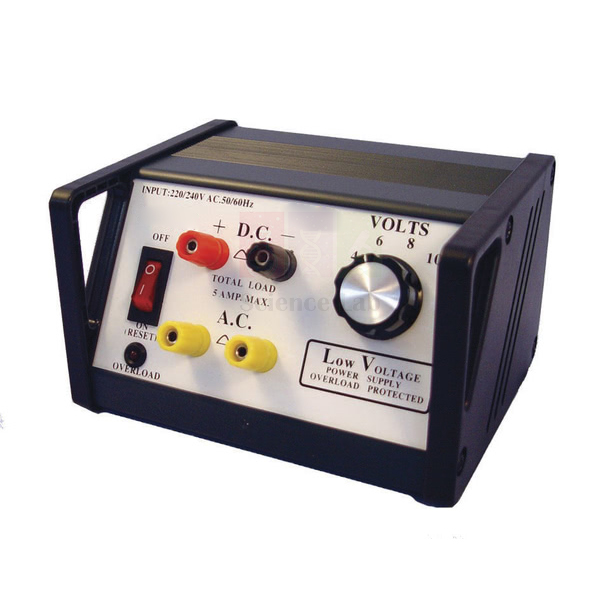
Power Supply, Stepped
Power Supply, Stepped (Product Code: SLE/PHY/116) is a low-voltage AC/DC bench supply used to power electricity, magnetism and heating experiments in school and college physics labs. It gives 2–12 V AC or DC in 6 steps from a 230 V AC, 50 Hz input, with a cooling fan and built-in microprocessor overload protection. It is supplied by Jain Scientific Equipments Pvt Ltd (ScienceLab), Ambala, India, as a power supply unit for lab use in India.
Specifications
| Parameter | Detail |
|---|---|
| Output | 2–12 V AC/DC in 6 steps |
| Input | 230 V AC, 50 Hz |
| Current | 5 A |
| Protection | Built-in microprocessor overload protection |
| Cooling | Cooling fan |
| Dimensions (W x H x D) | 180 x 110 x 145 mm |
| Product code | SLE/PHY/116 |
| Supplied by | Jain Scientific Equipments Pvt Ltd (ScienceLab), Ambala, India |
What Is the Stepped Power Supply Used For?
A stepped supply gives students fixed, repeatable voltages without the risk of over-turning a knob. Typical uses include lighting lamps in series and parallel circuits, driving electromagnets and small motors, running induction and transformer demonstrations on the AC output, and powering heating coils or electrolysis cells on DC.
Start on the lowest step and increase one step at a time, switching off before changing connections. Keep the total load within the 5 A current rating, and leave space around the case so the cooling fan can draw air. If the overload protection operates, remove the fault or reduce the load before switching back on.
What to Specify When Ordering
- Whether your experiments need the AC output, the DC output or both.
- Quantity — one per bench or one per demonstration table.
- Mains supply at the destination — the unit is listed for 230 V AC, 50 Hz input.
- Connecting leads and a meter, if your laboratory does not already have them.
Supplier
Jain Scientific Equipments Private Limited, which trades as ScienceLab, supplies the Power Supply, Stepped to schools, colleges and dealers from Ambala, Haryana, India. For vendor registration and import paperwork, the supplying company's Importer-Exporter Code is AAECJ8618A (DGFT) and its GSTIN is 06AAECJ8618A1ZT. Read more about the business on our company profile.
Related Physics Lab Equipment
Items commonly connected to this power supply:
- Rheostat — varies the current between the fixed voltage steps.
- Stackable Leads — connect the supply to circuit boards and apparatus.
- Standard Digital Multimeter — checks the actual voltage and current in the circuit.
- Power Supply Variable — an alternative when continuously adjustable voltage is needed.
- Induced Current Apparatus — a coil demonstration that runs from a low-voltage supply.
See all electricity apparatus in our Physics Lab Equipment category.
Frequently Asked Questions
What voltages does the Power Supply, Stepped provide?
The Power Supply, Stepped provides 2–12 V AC or DC in 6 steps, powered from a 230 V AC, 50 Hz mains input. Fixed steps make it easy for students to repeat readings at the same voltage in circuit experiments.
What is the current rating?
The Power Supply, Stepped is listed with a current of 5 A. Keep the combined load of lamps, coils or motors within this figure; the built-in microprocessor overload protection is there to guard the unit if a circuit draws too much.
Does it have overload protection and cooling?
Yes. The Power Supply, Stepped has built-in microprocessor overload protection and a cooling fan. Leave clear space around the case so air can circulate, and reduce the load if the protection operates during an experiment.
What are the dimensions of the unit?
The Power Supply, Stepped measures 180 x 110 x 145 mm (width x height x depth). That compact footprint lets it sit on a student bench beside the circuit board, meters and other apparatus without crowding the workspace.
Who supplies the Power Supply, Stepped?
The Power Supply, Stepped is supplied by Jain Scientific Equipments Pvt Ltd, trading as ScienceLab, from Ambala, Haryana, India. It can be quoted with leads, meters and electricity apparatus so your laboratory order comes from one supplier.
Can it be used outside India?
The Power Supply, Stepped is listed for a 230 V AC, 50 Hz input. Buyers in international markets should confirm that their mains supply matches before ordering; share your requirement through the contact page and we will advise with the quotation.
Request a Quote
To receive a quotation for the Power Supply, Stepped, contact ScienceLab or add it to the enquiry cart with the leads and meters you need.
Last updated: 24 September 2026

Geiger Counter
Geiger Counter (Product Code: SLE/PHY/119) is a compact, general-purpose radiation survey meter used to detect alpha, beta, gamma and X-radiation in school and college nuclear physics practicals. Physics teachers use it to make radioactive decay visible and audible, because a red count light flashes and a beep sounds with every event it detects across its 3 selectable ranges. It is supplied by Jain Scientific Equipments Pvt Ltd (ScienceLab), Ambala, India, as part of its nuclear physics lab equipment range.
Specifications
| Parameter | Detail |
|---|---|
| Instrument type | Compact, ergonomic, general-purpose survey meter |
| Radiation detected | Alpha, beta, gamma and X-rays |
| Measuring ranges | 3 selectable ranges |
| Linearity | More linear reading for gamma and X-rays above 40 keV |
| Event indication | Red count light flashes and a beep sounds with each event detected |
| Product code | SLE/PHY/119 |
| Supplied by | Jain Scientific Equipments Pvt Ltd (ScienceLab), Ambala, India |
What Is the Geiger Counter Used For?
In the physics laboratory the Geiger Counter is the quickest way to show students that ionising radiation can be detected and counted. A typical lesson starts by recording the background count in the room, then brings a sealed school source closer to show the count rising, and finally places sheets of paper, aluminium or lead between source and detector to compare how far alpha, beta and gamma radiation penetrate.
Because every detected event produces a flash and a beep, the meter also demonstrates that decay is random: students can listen to the irregular clicks and count them over fixed intervals. For any radiation experiment, keep sources in their storage containers when not in use, handle them with tongs, and follow your institution's radiation-safety rules.
Supplier
ScienceLab is the trading name of Jain Scientific Equipments Private Limited, an Ambala, Haryana company that supplies laboratory equipment to schools, colleges and institutions in India and international markets. The Geiger Counter is a sourced survey meter, and we can quote it together with the sealed sources, tube holder and scaler timer listed in our physics range. Read more about the company on our company profile.
Related Physics Lab Equipment
These items from our physics range are used in the same radioactivity lessons as the Geiger Counter:
- Sealed Radioactive Source, Americium — sealed school source for count-rate and absorption experiments.
- Sealed Radioactive Source, Strontium — a second sealed source for comparing penetration through absorbers.
- Sealed Radioactive Source, Cobalt — completes a set of sources for distance and shielding investigations.
- Scaler Timer — bench counter for timed counts when a GM tube is used instead of a survey meter.
- Geiger Muller Tube Holder — houses a GM tube and connects it to the scaler timer.
Browse the full Physics Lab Equipment range for more nuclear physics and electricity apparatus.
Frequently Asked Questions
What radiation does the Geiger Counter detect?
The Geiger Counter (SLE/PHY/119) detects alpha, beta, gamma and X-rays over 3 selectable ranges. Its reading is more linear for gamma and X-rays above 40 keV, which suits classroom comparisons of different sources and absorbers.
How does the Geiger Counter show that radiation has been detected?
The Geiger Counter signals each detected event in two ways: a red count light flashes and a beep sounds. This lets a whole class see and hear individual counts during a demonstration, even from the back of the room.
Are radioactive sources included with the Geiger Counter?
No radioactive sources are listed as part of the Geiger Counter; the product is the survey meter itself. Sealed americium, strontium and cobalt sources appear as separate products, so name any sources you need in your quotation request.
Who supplies the Geiger Counter?
The Geiger Counter is supplied by Jain Scientific Equipments Pvt Ltd (ScienceLab) of Ambala, Haryana, India. The company sources this survey meter and delivers it with its wider physics range to schools, colleges and institutional buyers in India and international markets.
Is a calibration certificate available for the Geiger Counter?
Calibration paperwork for the Geiger Counter is not part of the standard listing, so please raise it before ordering. Tell us through the contact page what documentation your institution needs and we will confirm what can be provided.
What should I include when requesting a quote for the Geiger Counter?
For a Geiger Counter quotation, state the quantity, the delivery address or destination country, and whether you also need sealed sources, a GM tube holder or a scaler timer. Orders for several laboratories can be combined in one enquiry.
Request a Quote
Send your Geiger Counter requirement through our contact page, or add it to the enquiry cart with other physics items so that we can prepare one combined quotation.
Last updated: 24 September 2026
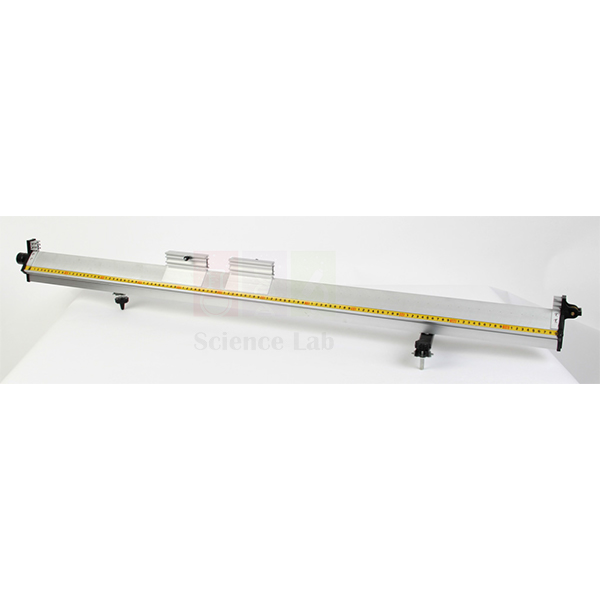
Linear Air Track
Linear Air Track (Product Code: SLE/PHY/120) is a compact (mini) air track used to study dynamics in a virtually friction-free environment in school and college mechanics laboratories. Gliders ride on a cushion of air along a high-strength 56 x 56 mm extruded aluminium track, which makes collisions and the conservation of momentum especially clear to students. It is made by Jain Scientific Equipments Pvt Ltd (ScienceLab), an OEM manufacturer, at its own factory in Ambala, India, as cost-effective mechanics lab equipment.
Specifications
| Parameter | Detail |
|---|---|
| Design | Mini linear air track for dynamics experiments in a virtually friction-free environment |
| Track profile | High-strength 56 x 56 mm extruded aluminium |
| Track length | 1.2 m in the technical specification; the description also quotes 1.5 m overall — please confirm when ordering |
| Gliders | Accept standard slotted masses for additional loads |
| Accessory pack | Vehicles with mass attachments, catapults and buffers |
| Air source | Required to operate the track; Laboratory Air Blower not included |
| Speed measurement | Requires standard light gates and timers; can also be used with light gates and a Wi-Fi module |
| Experiments covered | Velocity; force and acceleration; potential and kinetic energy; conservation of energy; SHM; motion on level and inclined planes |
| Product code | SLE/PHY/120 |
| Manufacturer | Jain Scientific Equipments Pvt Ltd (ScienceLab) — OEM |
| Country of origin | India (made in Ambala, Haryana) |
What Is the Linear Air Track Used For?
With the air supply running, the gliders float with almost no friction, so students can measure velocity, test force and acceleration, and follow the exchange between potential and kinetic energy without friction hiding the result. Launching one glider into another with the catapults and buffers turns momentum conservation from a formula into something they can watch and time.
The same set-up covers simple harmonic motion and motion on level and inclined planes, and the gliders take standard slotted masses when a heavier load is needed. For reliable timing, pair the track with light gates and a timer, level the track carefully before each run, and keep the air holes free of dust. It suits both teacher demonstrations and force and motion practicals run by student groups.
What to Specify When Ordering
- Track length — confirm the length on your quotation, as the listing quotes 1.2 m and 1.5 m overall.
- Air source — whether you also need the Linear Air Track Blower, since no blower is included.
- Timing — which light gates and timer you will use to measure glider speeds.
- Quantity — the number of tracks for your laboratory or student groups.
OEM Manufacturer
The Linear Air Track is an OEM product of Jain Scientific Equipments Private Limited, which trades as ScienceLab. The company makes and assembles its air tracks at its own licensed factory at Saha, Ambala, Haryana, so schools, colleges, dealers and importers buy directly from the maker rather than through a trader. When you need replacement gliders, buffers or other accessory-pack parts later, ask us and the request is handled by the manufacturer itself. See our company profile for more about ScienceLab.
Related Physics Lab Equipment
These items complete an air track set-up for timing and collision work:
- Linear Air Track Blower — supplies the air cushion the track needs, connected through a flexible hose.
- Light Gates/Timing Gates — pair of gates for measuring glider speeds with a timer.
- Millisecond Timer — timer with inputs for light gates, for velocity and acceleration readings.
- Apparatus Collision 2 Dimension — extends collision studies from one dimension to two.
More mechanics apparatus is listed under Physics Lab Equipment.
Frequently Asked Questions
What experiments can be done with the Linear Air Track?
The Linear Air Track covers velocity, force and acceleration, potential and kinetic energy, conservation of energy, SHM, and motion on level and inclined planes. It is particularly effective for collisions, where conservation of momentum is clearly demonstrated.
Is an air blower included with the Linear Air Track?
No. The Linear Air Track needs an air source to operate, and the Laboratory Air Blower is not included. You can add the Linear Air Track Blower to the same enquiry so that the track and its air supply are quoted together.
How long is the Linear Air Track?
The Linear Air Track's technical specification gives a length of 1.2 m, while its description quotes 1.5 m overall. Please confirm the exact length with us through the contact page before ordering so the quotation matches the track you expect.
What accessories come with the Linear Air Track?
The Linear Air Track is supplied with an accessory pack that includes vehicles with mass attachments, catapults and buffers. The gliders accept standard slotted masses for extra load, while the light gates and timers used to measure glider speeds are needed separately.
Who manufactures the Linear Air Track?
The Linear Air Track is manufactured by Jain Scientific Equipments Pvt Ltd (ScienceLab) as the OEM, at its own licensed factory in Saha, Ambala, Haryana, India. Quotations, repeat orders and spare-part requests are handled by the manufacturer directly.
Can the Linear Air Track be ordered in bulk or for export?
Yes. The Linear Air Track can be quoted in multiple units for schools, colleges, dealers and importers across India and international markets. Give the quantity and delivery destination in your enquiry so that we can prepare the quotation.
Request a Quote
Ask for a Linear Air Track quotation through our contact page or place it in the enquiry cart. The quote comes direct from the manufacturer, and the blower and timing gates can be added to the same request.
Last updated: 24 September 2026
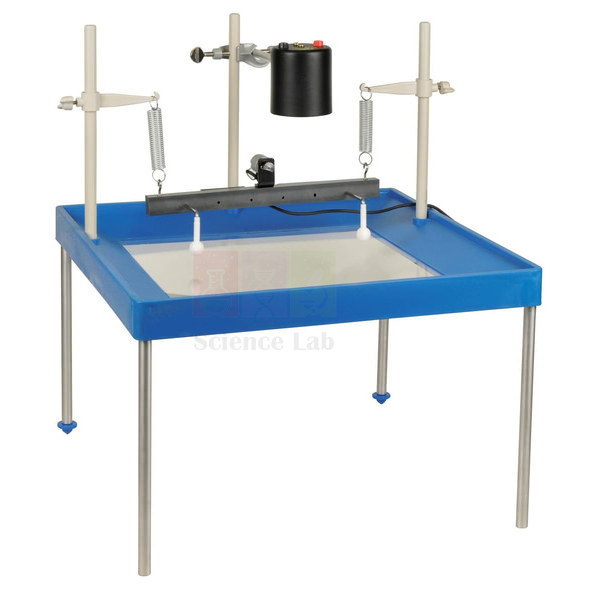
Ripple Tank
Ripple Tank (Product Code: SLE/PHY/121) is an economy ripple tank system used to show how water waves reflect, refract, diffract and interfere in school physics laboratories. Teachers choose it for its tough moulded frame, a 405 x 405 mm internal tank whose sloping sides minimise noise, and a 12V halogen lamp that lights the wave patterns clearly on the large transparent viewing surface. It is made by Jain Scientific Equipments Pvt Ltd (ScienceLab), an OEM manufacturer, at its own factory in Ambala, India.
Specifications
| Parameter | Detail |
|---|---|
| System type | Economy ripple tank system |
| Frame | Tough moulded frame with a large transparent viewing surface |
| Tank internal dimensions | 405 x 405 mm |
| Tank external dimensions | 420 x 420 mm |
| Tank sides | Sloping, to minimise noise |
| Light source | 12V halogen lamp on a lamp unit with adjustable arm |
| Wave generator | Ripple motor with eccentric cam mounted on the ripple bar |
| Power supply | Not included |
| Product code | SLE/PHY/121 |
| Manufacturer | Jain Scientific Equipments Pvt Ltd (ScienceLab) — OEM |
| Country of origin | India (made in Ambala, Haryana) |
The Ripple Tank system comes complete with:
- Ripple tank
- Ripple motor, eccentric cam mounted on ripple bar
- 4 push-fit legs
- 3 support pillars for supporting the light source and rippler bar
- 2 motor support springs
- Lamp unit with adjustable arm
- 2 rippler bar hanging hooks
- Curved reflector
- 2 barriers
- Roller bar
- Hand stroboscope
- Concave perspex plate
- Rectangular perspex plate
What Is the Ripple Tank Used For?
A ripple tank turns wave behaviour into something a class can see. With a shallow layer of water in the tank and the motor driving the ripple bar, straight wavefronts travel across the tank and their bright and dark bands appear on the viewing surface, while the hand stroboscope makes the moving pattern appear to stand still so students can measure the wavelength.
Each accessory maps onto a wave motion topic: the curved reflector shows reflection and focusing, the two barriers form a gap for diffraction, and the perspex plates placed under the water create a shallower region where waves slow down and refract. The roller bar is useful for sending single straight pulses by hand before switching to continuous waves from the motor.
What to Specify When Ordering
- Power supply — none is included, so say whether you want a supply for the 12V lamp and ripple motor quoted with the tank.
- Stroboscope — a hand stroboscope is supplied; state if you would also like an electronic stroboscope.
- Quantity — the number of tanks, for example one per demonstration bench.
OEM Manufacturer
Jain Scientific Equipments Private Limited, trading as ScienceLab, is the original equipment manufacturer of this Ripple Tank. Frames, tanks and accessory sets are produced and packed at the company's own licensed factory in Saha, Ambala, Haryana, and the finished system is dispatched factory-direct to schools, institutions and distributors. If a barrier, reflector or perspex plate is lost later, ask us for a replacement quote from the maker. Visit our company profile to learn more.
Related Physics Lab Equipment
Pair the Ripple Tank with a power source, or compare it with our other wave tanks:
- Power Supply, Stepped — low-voltage AC/DC bench supply to consider, since the tank ships without power.
- Xenon Stroboscope — electronic flash alternative to the hand stroboscope for freezing wave patterns.
- Mini Ripple Tank — compact tank with built-in strobe and frequency meter for student groups.
- Ripple Tank – Premium Model — projection model with its own power supply for whole-class demonstrations.
See the complete Physics Lab Equipment range for more wave and optics apparatus.
Frequently Asked Questions
What is included with the Ripple Tank?
The Ripple Tank comes with the tank, a ripple motor with eccentric cam on the ripple bar, 4 push-fit legs, 3 support pillars, 2 motor support springs, a lamp unit, 2 hanging hooks, a curved reflector, 2 barriers, a roller bar, a hand stroboscope and two perspex plates.
Is a power supply included with the Ripple Tank?
No, a power supply is not included with the Ripple Tank. You will need a suitable supply for its 12V halogen lamp and ripple motor; tell us what you already have, or ask us to quote one alongside the tank.
What size is the Ripple Tank?
The Ripple Tank measures 405 x 405 mm internally and 420 x 420 mm externally. Its sloping sides minimise noise in the wave pattern, and the large transparent viewing surface lets a group watch the same pattern together.
How should the Ripple Tank be looked after?
Empty and dry the Ripple Tank after each lesson, wipe the transparent surface with a soft cloth, and store the perspex plates flat so they are not scratched. Keep water away from the lamp unit and switch off the power before adjusting the ripple bar.
Who manufactures the Ripple Tank?
The Ripple Tank is manufactured by Jain Scientific Equipments Pvt Ltd (ScienceLab), the OEM, at its own licensed factory at Saha, Ambala, Haryana, India. Buyers deal directly with the maker for quotations, accessory replacements and repeat orders.
Can the Ripple Tank be supplied to several schools at once?
Yes. The Ripple Tank can be quoted in quantity for school groups, education departments, dealers and importers in India and international markets. Share the number of units, the delivery destination and any power supplies you want quoted.
Request a Quote
To receive a Ripple Tank quotation straight from the manufacturer, write to us through the contact page or add the tank to your enquiry cart together with any power supply you need.
Last updated: 24 September 2026
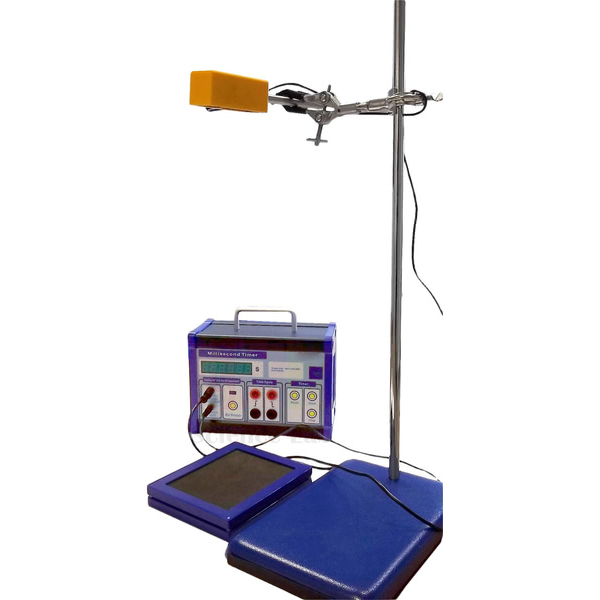
G By Freefall Apparatus and Timer
G By Freefall Apparatus and Timer (Product Code: SLE/PHY/122) is an electromagnetic release apparatus used to measure the acceleration due to gravity, g, by timing a falling steel ball in school and college physics laboratories. An electromagnet in a plastic moulded case holds a heavy steel sphere, and a platform unit containing a microswitch has terminals for an external timer, so the fall time is captured electrically. It is made by Jain Scientific Equipments Pvt Ltd (ScienceLab), an OEM manufacturer, at its own factory in Ambala, India.
Key Details
| Parameter | Detail |
|---|---|
| Release unit | Electromagnet housed in a plastic moulded case, with connections for an external timer |
| Falling mass | Heavy steel sphere, supplied |
| Landing unit | Platform unit containing a microswitch and terminals for the external timer |
| Timing start | Timer is triggered as soon as the ball release button is pressed |
| Priming | Electromagnet is primed when the stopping plate and solenoid are connected with the leads provided |
| Timer | External timer connected through the terminals — confirm with us whether a timer is part of your quotation |
| Product code | SLE/PHY/122 |
| Manufacturer | Jain Scientific Equipments Pvt Ltd (ScienceLab) — OEM |
| Country of origin | India (made in Ambala, Haryana) |
What Is the G By Freefall Apparatus Used For?
The G By Freefall Apparatus gives students a direct measurement of g. With the sphere held on the electromagnet, pressing the release button drops the ball and starts the timer at the same instant; the ball striking the platform operates the microswitch and ends the timing. Measuring the drop height and the fall time lets students apply h = ½gt² to calculate g.
Repeating the drop from several heights and plotting height against the square of the time gives a straight line whose gradient is half of g, a standard mechanics practical. Measure the height from the bottom of the sphere to the platform, take several readings at each height, and stand the platform on a firm, level surface so the microswitch responds cleanly.
What to Specify When Ordering
- Timer — the apparatus connects to an external timer; state whether you need a timer quoted with it.
- Leads — connecting leads are provided; ask if you want spares for several benches.
- Quantity — the number of sets needed for your laboratory or student groups.
OEM Manufacturer
ScienceLab is the trading name under which Jain Scientific Equipments Private Limited makes this freefall apparatus as the OEM. The electromagnet unit and landing platform are made and assembled at the company's own licensed factory at Saha, Ambala, Haryana, and orders from schools, colleges, dealers and importers are dispatched direct from there. For vendor registration, institutional buyers can note GSTIN 06AAECJ8618A1ZT and LEI 3358004HRD1JIVXKYX49. Company background is on our profile page.
Related Physics Lab Equipment
Complete the freefall practical with a timer, or extend it with related motion apparatus:
- Millisecond Timer — timer with a G by Free Fall facility for reading the fall time.
- Light Gates/Timing Gates — an alternative way to time moving objects with a suitable timer.
- Apparatus Falling Bodies (Projectile) — follow-up apparatus comparing vertical fall with projectile motion.
- Stackable Leads — spare connecting leads for wiring the apparatus to a timer.
The full Physics Lab Equipment range lists more mechanics and timing apparatus.
Frequently Asked Questions
Does the G By Freefall Apparatus and Timer include a timer?
The G By Freefall Apparatus and Timer is described with connections and terminals for an external timer. Please confirm through our contact page whether your quotation should include a timer, such as a millisecond timer, so the set is complete for your practical.
What is supplied with the G By Freefall Apparatus and Timer?
The G By Freefall Apparatus and Timer comes with an electromagnet unit in a plastic moulded case, a heavy steel sphere, a platform unit containing a microswitch with timer terminals, and the leads used to connect the stopping plate and solenoid.
How is the fall time started and stopped?
On the G By Freefall Apparatus and Timer, timing starts as soon as the ball release button is pressed. The sphere then lands on the platform unit, whose microswitch is wired to the external timer's terminals to end the measurement of the fall.
Who manufactures the G By Freefall Apparatus and Timer?
Jain Scientific Equipments Pvt Ltd (ScienceLab) manufactures the G By Freefall Apparatus and Timer as the OEM at its own licensed factory in Saha, Ambala, Haryana, India. Quotations and replacement parts, such as an extra steel sphere, are handled by the manufacturer directly.
Can the G By Freefall Apparatus and Timer be ordered for a whole class?
Yes. The G By Freefall Apparatus and Timer can be quoted in class sets for schools, colleges, dealers and importers across India and international markets. Tell us the number of sets and whether each needs its own timer.
Request a Quote
Request a G By Freefall Apparatus and Timer quotation direct from the manufacturer through our contact page, or save it in the enquiry cart alongside a timer and spare leads.
Last updated: 24 September 2026
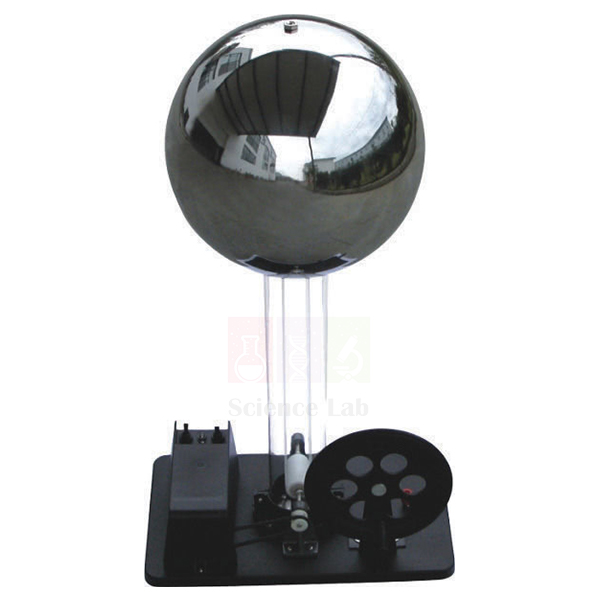
Van de Graaff Generator
Van de Graaff Generator (Product Code: SLE/PHY/123) is an electrostatic generator used to build up a large static charge on a metal dome for demonstrations of static electricity in schools and colleges. Students crank it by hand, so the charge depends on how hard and how long they turn, or run it from a laboratory DC supply up to 12V; the 23 cm dome is listed at 400kV. It is made by Jain Scientific Equipments Pvt Ltd (ScienceLab), an OEM manufacturer, at its own factory in Ambala, India.
Specifications
| Parameter | Detail |
|---|---|
| Operation | Hand crank (supplied), or DC source from a laboratory power supply up to 12V |
| DC operation | Gives the user control of belt speed and charge |
| Dome diameter | 23 cm |
| Voltage | 400kV |
| Dimensions | 63 x 25 x 25 cm |
| Weight | 5.68 kg |
| Product code | SLE/PHY/123 |
| Manufacturer | Jain Scientific Equipments Pvt Ltd (ScienceLab) — OEM |
| Country of origin | India (made in Ambala, Haryana) |
What Is the Van de Graaff Generator Used For?
The Van de Graaff Generator makes static electricity dramatic. As the belt runs, charge collects on the dome, and students can watch sparks jump to an earthed conductor, see strips of light paper or hair stand apart as like charges repel, and use an electroscope to show charge being transferred. Because the hand crank links effort directly to charge, it gives a true hands-on experience rather than a push-button demonstration.
For longer or steadier runs, drive it from a laboratory DC supply of up to 12V and set the belt speed to control how quickly charge builds. Work in dry air where possible, discharge the dome with an earthed conductor before anyone touches it, and keep the generator away from sensitive electronics. As a physics demonstration kit piece, it supports lessons on charge, electric fields and lightning.
What to Specify When Ordering
- Power mode — hand crank only, or also a laboratory DC power supply (up to 12V) for powered running.
- Companion items — electroscopes or other electrostatics apparatus to be quoted alongside.
- Quantity — one per demonstration room, or more for student groups.
OEM Manufacturer
This Van de Graaff Generator is manufactured by Jain Scientific Equipments Private Limited, the company behind the ScienceLab name, as an original equipment manufacturer. Each unit is built and assembled at its own licensed factory at Saha, Ambala, Haryana, and supplied factory-direct to schools, colleges, dealers and importers without a trading middleman. For belts, cranks or other replacement parts in future, ask us and the manufacturer will respond directly. Learn more on our company profile.
Related Physics Lab Equipment
Build a complete electrostatics lesson around the Van de Graaff Generator with these items:
- Electroscope, Gold Leaf — detects and compares charge transferred from the dome.
- Electroscope in Flask, Gold Leaf — simple glass-flask electroscope for student groups.
- Electrostatic Investigation — friction rods, fabrics and a pith ball for charging-by-rubbing experiments.
- Power Supply Variable — continuously variable bench supply to consider for running the generator from DC.
Explore the wider Physics Lab Equipment range for more electricity and magnetism apparatus.
Frequently Asked Questions
Can the Van de Graaff Generator be used without mains power?
Yes. The Van de Graaff Generator is cranked by hand with the supplied crank, so no power supply is needed for basic demonstrations. It can also be powered from a DC source by a laboratory power supply up to 12V when you want control of belt speed.
What are the dimensions and weight of the Van de Graaff Generator?
The Van de Graaff Generator measures 63 x 25 x 25 cm and weighs 5.68 kg, with a dome diameter of 23 cm. That size lets a teacher carry it between classrooms and stand it on an ordinary demonstration bench.
What voltage does the Van de Graaff Generator produce?
The Van de Graaff Generator is listed at 400kV. In practice the charge built up depends on how hard and how long the crank is turned, or on the belt speed set through the DC supply, and results also vary with conditions such as humidity.
How should the Van de Graaff Generator be used safely in class?
The Van de Graaff Generator should be operated by, or under the supervision of, a teacher. Discharge the dome with an earthed conductor before touching it, keep it away from electronic equipment, and do not let anyone with a heart pacemaker take part in demonstrations.
Who manufactures the Van de Graaff Generator?
The Van de Graaff Generator is manufactured by Jain Scientific Equipments Pvt Ltd (ScienceLab) as the OEM, at its own licensed factory in Saha, Ambala, Haryana, India. Schools and resellers receive quotations and after-sales help from the maker itself.
What should a Van de Graaff Generator quotation request include?
For a Van de Graaff Generator quotation, give the number of units, the delivery city or country, and whether you want a laboratory DC power supply or electroscopes included. Dealers and importers in India and international markets can request quantity quotations the same way.
Request a Quote
Contact the manufacturer for a Van de Graaff Generator quotation through our contact page, or collect it in the enquiry cart with the electroscopes and power supply you need.
Last updated: 24 September 2026
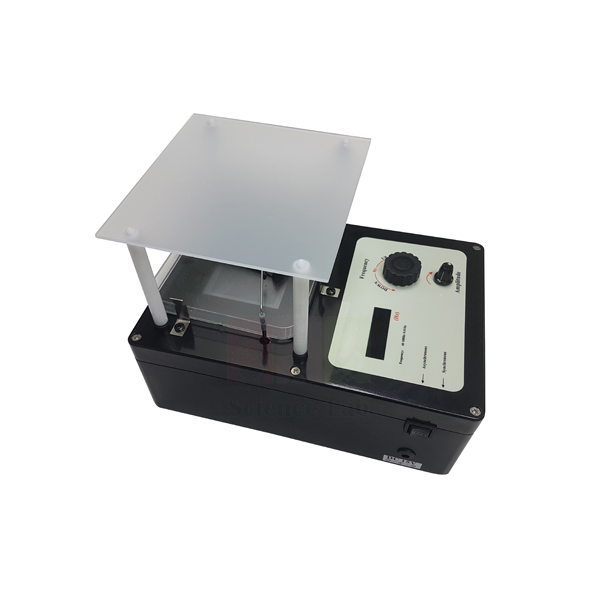
Mini Ripple Tank
Mini Ripple Tank (Product Code: SLE/PHY/124) is a compact ripple tank with a built-in strobe and frequency meter, used to show water-wave patterns to small groups in school physics laboratories. Its strong light source is synchronised with the wave generator across a 60 to 100 Hz working range, so students see a steady pattern; the unit measures 265 x 185 x 195 mm and weighs 2 kg. It is supplied by Jain Scientific Equipments Pvt Ltd (ScienceLab), Ambala, India.
Specifications
| Parameter | Detail |
|---|---|
| Type | Mini ripple tank with strobe and frequency meter |
| Working range | 60 to 100 Hz |
| Illumination | Strong light source synchronised with the wave generator |
| Overall size | 265 x 185 x 195 mm |
| Product weight | 2 kg |
| Product code | SLE/PHY/124 |
| Supplied by | Jain Scientific Equipments Pvt Ltd (ScienceLab), Ambala, India |
What Is the Mini Ripple Tank Used For?
The Mini Ripple Tank is built for student benches where a full-size tank would be too large. Because the light is synchronised with the wave generator, the ripples appear to stand still, so students can sketch wavefronts, compare wavelengths at different frequencies across the 60 to 100 Hz range and read each frequency directly from the meter.
Many teachers give one compact tank to each group, so every student can adjust the frequency and see how the pattern responds instead of crowding around a single demonstration. Fill it with a shallow layer of clean water, set it on a level bench, and empty and dry it after the lesson. It fits neatly into a wave motion kit for secondary school practicals.
Supplier
Jain Scientific Equipments Private Limited, which trades as ScienceLab, supplies the Mini Ripple Tank from Ambala, Haryana, India. The company sources this compact tank with its built-in strobe and frequency meter for school and college physics laboratories and quotes single units, class sets and repeat orders, so schools and resellers can add tanks as student numbers grow. Our company profile has more background.
Related Physics Lab Equipment
Other wave apparatus that complements the Mini Ripple Tank:
- Ripple Tank — economy full-size tank with barriers, reflector and perspex plates for demonstrations.
- Ripple Tank – Premium Model — projects wave patterns onto a screen for a whole class.
- Wave Form, Helix — steel helix for showing waves along a spring alongside water waves.
- Metal Slinky, Helical Spring — for transverse and longitudinal wave demonstrations on the bench.
Find more apparatus in our Physics Lab Equipment category.
Frequently Asked Questions
What frequency range does the Mini Ripple Tank cover?
The Mini Ripple Tank has a working range from 60 to 100 Hz. Its built-in frequency meter shows the setting, so students can record the frequency for each wave pattern they observe without needing a separate instrument.
How big is the Mini Ripple Tank?
The Mini Ripple Tank has an overall size of 265 x 185 x 195 mm and a product weight of 2 kg. That compact footprint suits individual student benches and makes the tank easy to store between lessons.
Does the Mini Ripple Tank need a separate stroboscope?
No separate stroboscope is needed for the Mini Ripple Tank, because a strobe is built in. The tank is lit by a strong light source synchronised with the wave generator, which helps students observe steady wave patterns.
How is the Mini Ripple Tank different from the full-size Ripple Tank?
The Mini Ripple Tank is a compact 2 kg unit with a built-in strobe and frequency meter, intended for group work on the bench. The full-size Ripple Tank is a larger demonstration system supplied with its own accessory set for reflection, refraction and diffraction.
Who supplies the Mini Ripple Tank?
The Mini Ripple Tank is supplied by Jain Scientific Equipments Pvt Ltd (ScienceLab), Ambala, Haryana, India. The company sources the tank and quotes single units or class sets directly to schools, colleges, dealers and importers in India and international markets.
What should I include in a Mini Ripple Tank enquiry?
For a Mini Ripple Tank quotation, give the number of tanks, the delivery city or country, and any questions about power input, which we will answer with the quote. Schools, dealers and importers in India and international markets can all order this way.
Request a Quote
Get a Mini Ripple Tank quotation directly from ScienceLab, the supplier, by writing through our contact page, or add a class set to the enquiry cart.
Last updated: 24 September 2026
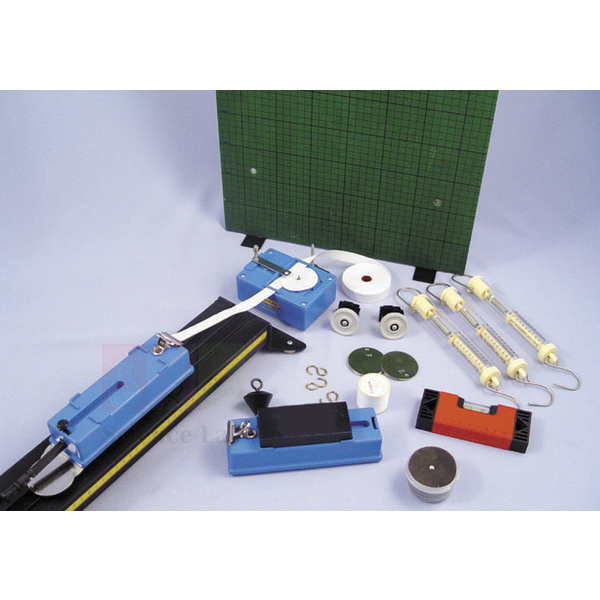
Force, Motion & Dynamics Kit
Force, Motion & Dynamics Kit (Product Code: SLE/PHY/125) is a trolley-and-bench system used to investigate forces, acceleration, collisions and kinetic energy in school physics laboratories. At its centre is a rigid 1.2 m aluminium profiled bench with a built-in scale, worked with two 740 g low-friction trolleys, a 6V AC ticker tape timer and a force board with pulleys and spring balances. It is made by Jain Scientific Equipments Pvt Ltd (ScienceLab), an OEM manufacturer, at its own factory in Ambala, India.
Specifications
| Parameter | Detail |
|---|---|
| Bench | Aluminium profiled bench, 1.2 m, rigid construction, with built-in scale |
| Trolleys | 1 spring-loaded trolley and 1 standard trolley, each 740 g, low friction |
| Added mass | Trolley weight (brick), 500 g; 10 x 10 g masses with securing hole |
| Timer | Ticker tape timer, 6V AC operation |
| Timer consumables | 100 carbon discs; 5 ticker tape rolls, 30 m length |
| Force board | With legs for bench mounting; 2 pulleys with integral clamp, reel of cotton, 3 hooks, pendulum bob |
| Spring balances | 3 x 10N/1kg, beige |
| Set-up aid | Line level for setting up the bench |
| Product code | SLE/PHY/125 |
| Manufacturer | Jain Scientific Equipments Pvt Ltd (ScienceLab) — OEM |
| Country of origin | India (made in Ambala, Haryana) |
Full contents of the kit:
- 1 x Aluminium Profiled Bench, 1.2 m rigid construction
- 1 x Spring Loaded Trolley, 740 g low friction trolley
- 1 x Standard Trolley, 740 g low friction trolley
- 1 x Trolley Weight (brick), 500 g for additional mass
- 10 x 10 g Masses, with securing hole
- 1 x Ticker Tape Timer, 6V AC operation
- 1 x Line Level, for setting up bench
- 1 x Force Board, with legs for bench mounting
- 2 x Pulleys, with integral clamp for force board
- 1 x Reel of Cotton, accessory for force board
- 3 x Hooks, accessory for force board
- 1 x Pendulum Bob, accessory for force board
- 3 x Spring Balances, 10N/1kg, beige
- 100 x Carbon discs, for ticker tape timer
- 5 x Ticker Tape Rolls, 30 m length
What Is the Force, Motion & Dynamics Kit Used For?
The kit is built around the core force and motion experiments: pulling a trolley with different accelerating forces, repeating the run with added masses, and colliding the spring-loaded trolley with the standard trolley to compare elastic and inelastic collisions. Tilting the bench turns it into an inclined plane for acceleration studies, and the ticker tape record lets students work out velocity and kinetic energy from the spacing of the dots.
The force board adds a second set of investigations with pulleys, hooks, cotton and spring balances, such as resolving forces and balancing loads, while the pendulum bob supports simple oscillation work. Level the bench with the line level before each run and keep the carbon discs and tape rolls together so the timer is always ready. As a force motion experiment kit, it gives a class a broad set of mechanics lab equipment in one purchase.
What to Specify When Ordering
- AC supply — the ticker tape timer runs on 6V AC, so confirm you have a suitable low-voltage supply or ask us to quote one.
- Consumables — extra carbon discs and 30 m ticker tape rolls for repeat practicals.
- Quantity — one kit per student group or per demonstration bench.
OEM Manufacturer
Jain Scientific Equipments Private Limited, known to schools as ScienceLab, is the OEM behind the Force, Motion & Dynamics Kit and puts each kit together at its own factory in Ambala instead of buying it in from a trader. The company is incorporated under CIN U29309HR2020PTC087597, and production runs at its licensed premises at 449, HSIIDC Industrial Area, Saha, Ambala (Factory Licence AMB-ONLINE-CHD-J-414). Schools, colleges, dealers and importers receive quotations from the manufacturer, and requests for replacement parts are answered by the same team. More details are on our company profile.
Related Physics Lab Equipment
Keep the kit running and extend it with these items:
- Ticker Tape Carbon Disc — replacement carbon discs for the kit's ticker tape timer.
- Ticker Tape Timer — an extra timer so two groups can record runs at the same time.
- Power Supply, Stepped — low-voltage AC/DC bench supply to consider for running the 6V AC timer.
- Dynamics Trolley, Plastic — additional low-friction trolley for multi-trolley collision experiments.
- Linear Air Track — friction-free alternative for momentum and collision studies.
Browse all mechanics apparatus under Physics Lab Equipment.
Frequently Asked Questions
What is included in the Force, Motion & Dynamics Kit?
The Force, Motion & Dynamics Kit includes a 1.2 m aluminium profiled bench, spring-loaded and standard 740 g trolleys, a 500 g trolley weight, 10 x 10 g masses, a 6V AC ticker tape timer, a force board with accessories, 3 spring balances, carbon discs and tape rolls.
Does the Force, Motion & Dynamics Kit need a power supply?
The ticker tape timer in the Force, Motion & Dynamics Kit operates on 6V AC. A power supply is not listed among the kit contents, so check that you have a low-voltage AC source or ask us to include one in your quotation.
How much ticker tape and how many carbon discs are supplied?
The Force, Motion & Dynamics Kit comes with 5 ticker tape rolls, each 30 m long, and 100 carbon discs for the ticker tape timer. Replacement consumables can be quoted separately when a class needs more for repeat practicals.
Which experiments can students carry out with the kit?
With the Force, Motion & Dynamics Kit, students investigate the effect of different accelerating forces on different masses, elastic and inelastic collisions between two trolleys, acceleration on an inclined plane and kinetic energy, plus force-board work with pulleys and spring balances.
Who manufactures the Force, Motion & Dynamics Kit?
Jain Scientific Equipments Pvt Ltd (ScienceLab) manufactures the Force, Motion & Dynamics Kit as the OEM at its own licensed factory in Saha, Ambala, Haryana, India. Quotations and spare-part requests are handled by the manufacturer rather than a reseller.
Can the kit be supplied in bulk for schools or export?
Yes. The Force, Motion & Dynamics Kit can be quoted in quantity for schools, education departments, dealers and importers in India and international markets. State the number of kits, the delivery destination and whether AC supplies or extra consumables are required.
Request a Quote
For a Force, Motion & Dynamics Kit quotation direct from the manufacturer, use our contact page or add the kit and any spare consumables to the enquiry cart.
Last updated: 24 September 2026
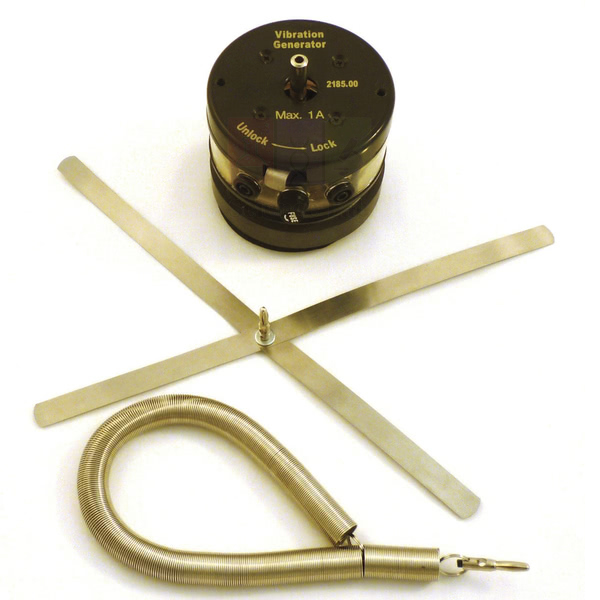
Vibration Generator
Vibration Generator (Product Code: SLE/PHY/126) is an electromechanical driver used to produce electronically controlled vibrations that set up waves on springs, strings and similar media in physics laboratories. Driven by a signal generator, it covers a frequency range of 30 to 10,000 Hz from an electrical input of 5W, 1A maximum, in a compact 120 x 120 x 120 mm body weighing 1.5 kg. It is supplied by Jain Scientific Equipments Pvt Ltd (ScienceLab), Ambala, India.
Specifications
| Parameter | Detail |
|---|---|
| Function | Provides electronically controlled vibrations to generate waves |
| Drive signal | Used in conjunction with a signal generator |
| Frequency range | 30 to 10,000 Hz |
| Electrical input | 5W, 1A max |
| Dimensions | 120 x 120 x 120 mm |
| Weight | 1.5 kg |
| Product code | SLE/PHY/126 |
| Supplied by | Jain Scientific Equipments Pvt Ltd (ScienceLab), Ambala, India |
What Is the Vibration Generator Used For?
Connected to a signal generator, the Vibration Generator turns an electrical signal into mechanical movement, so students can set up standing waves and change the frequency to find each resonant mode. With a wave spring attached, it illustrates mechanical wave properties such as frequency, wavelength and interference in a way the whole room can see.
Start at a low amplitude, raise the frequency slowly until a clear pattern of nodes and antinodes appears, and record the frequency for each pattern. Keep the drive within the 5W, 1A maximum input and clamp the unit firmly so it does not creep across the bench. Used this way, it becomes the core of a wave motion kit for school and college practicals.
What to Specify When Ordering
- Signal source — a signal generator is needed to drive it; say if you want one quoted.
- Wave medium — whether a spring or string set-up should be quoted alongside.
- Quantity — the number of units for demonstration and student benches.
Supplier
The Vibration Generator is supplied by Jain Scientific Equipments Private Limited, which trades as ScienceLab from Ambala, Haryana. We source this driver and can combine it with signal generators, springs and other wave apparatus from our physics list, so a school or college can order a complete wave set-up through one supplier. Details of the company are on our company profile.
Related Physics Lab Equipment
These items are used with the Vibration Generator in wave experiments:
- Signal Generator and Amplifier — combined signal source and power amplifier to drive the vibrator.
- Metal Slinky, Helical Spring — spring medium for showing waves and standing-wave patterns.
- Sonometer, Simple Pattern — string apparatus for related resonance and frequency work.
- Xenon Stroboscope — flash stroboscope that makes a vibrating string or spring appear to stand still.
More wave and sound apparatus is listed under Physics Lab Equipment.
Frequently Asked Questions
What do I need to drive the Vibration Generator?
The Vibration Generator should be used with a signal generator, which supplies the electrical signal it converts into vibration. Its electrical input is rated at 5W, 1A maximum, so choose a signal source and amplitude setting that stay within that rating.
What frequency range does the Vibration Generator cover?
The Vibration Generator works from 30 to 10,000 Hz. The low end suits slow, clearly visible standing waves on springs and strings, while higher settings let students explore how wavelength shortens as frequency rises.
How large and heavy is the Vibration Generator?
The Vibration Generator measures 120 x 120 x 120 mm and weighs 1.5 kg. It is small enough to clamp at the end of a bench or stand, leaving room for the spring or string it drives.
What can students demonstrate with the Vibration Generator?
Paired with a wave spring, the Vibration Generator illustrates mechanical wave properties such as frequency, wavelength and interference. Students can also find resonant modes by adjusting the signal frequency until stable standing-wave patterns form.
Who supplies the Vibration Generator?
The Vibration Generator is supplied by Jain Scientific Equipments Pvt Ltd (ScienceLab), Ambala, Haryana, India. The company sources it for schools, colleges and institutional buyers in India and international markets, and can quote it with a signal generator.
What should a Vibration Generator quotation request include?
For a Vibration Generator quotation, list the number of units, the delivery destination, and whether you also need a signal generator, spring or stroboscope. Tender and bulk requirements can be sent through the contact page in the same way.
Request a Quote
Place the Vibration Generator in the enquiry cart with any signal generator or spring you need, or send the details through our contact page for a quotation.
Last updated: 24 September 2026

Ripple Tank – Premium Model
Ripple Tank – Premium Model (Product Code: SLE/PHY/127) is a projection-type ripple tank used to display wave propagation phenomena on a screen for whole-class demonstrations of the general properties of waves. Its frequency is set from 30 Hz to 100 Hz in 0.01 steps, and a 12V, 5A DC power supply is included, with everything housed in a lightweight aluminium case. It is supplied by Jain Scientific Equipments Pvt Ltd (ScienceLab), Ambala, India.
Specifications
| Parameter | Detail |
|---|---|
| Display method | Wave propagation phenomena projected onto a screen |
| Frequency | 30 Hz to 100 Hz in 0.01 steps |
| Power supply | 12V, 5A DC, included |
| Housing | Lightweight aluminium case |
| Documentation | Manual with teacher's notes and experiments |
| Product code | SLE/PHY/127 |
| Supplied by | Jain Scientific Equipments Pvt Ltd (ScienceLab), Ambala, India |
What Is the Premium Ripple Tank Used For?
Projecting the waves onto a screen means the whole class sees the same enlarged pattern at once, which is why this model suits lecture rooms and large demonstration benches. Teachers use it to show reflection, refraction, diffraction and interference in turn, following the experiments set out in the manual that accompanies the tank.
The fine frequency control, in 0.01 steps between 30 Hz and 100 Hz, lets you hold a pattern steady or change the wavelength gradually while students take notes. Darken the room for the sharpest projection and allow a moment after each frequency change for the pattern to settle. For a physics demonstration kit on waves, set-up stays simple because the power supply travels in the same case.
Supplier
ScienceLab is the brand of Jain Scientific Equipments Private Limited, which supplies this Premium Model ripple tank from Ambala, Haryana, India. The company sources the tank, together with its included power supply and manual, for schools, colleges, training institutes, dealers and importers, and quotes single units or additional tanks on request. Questions about the manual or about matching an earlier supply can be sent to us directly. See our company profile for background.
Related Physics Lab Equipment
Compare other wave tanks, or extend the lesson to electromagnetic waves:
- Ripple Tank — economy bench system with its own accessory set and hand stroboscope.
- Mini Ripple Tank — compact tank with built-in strobe for student group work.
- Microwave Transmitter/Receiver — carries reflection, refraction and interference over to microwaves.
- Electromagnetic Spectrum Chart — wall chart linking wave behaviour to the wider spectrum.
Visit the Physics Lab Equipment category for the full range.
Frequently Asked Questions
Is a power supply included with the Ripple Tank – Premium Model?
Yes. The Ripple Tank – Premium Model includes a 12V, 5A DC power supply, and everything is housed in a lightweight aluminium case, so no separate supply has to be sourced for demonstrations.
What frequency range does the Premium Model ripple tank offer?
The Ripple Tank – Premium Model runs from 30 Hz to 100 Hz, adjustable in 0.01 steps. That fine control helps a teacher hold a wave pattern steady or change the wavelength gradually during a demonstration.
How are the wave patterns displayed?
The Ripple Tank – Premium Model projects wave propagation phenomena onto a screen. A whole class can therefore watch reflection, refraction, diffraction and interference together instead of gathering around a small tank.
Does the Ripple Tank – Premium Model come with instructions?
Yes. The Ripple Tank – Premium Model is provided with a manual containing teacher's notes and experiments, giving a ready sequence of demonstrations on the general properties of waves for lesson planning.
Who supplies the Ripple Tank – Premium Model?
The Ripple Tank – Premium Model is supplied by Jain Scientific Equipments Pvt Ltd (ScienceLab), Ambala, Haryana, India. The company sources this projection ripple tank and answers quotation and after-sales questions for schools, colleges, dealers and importers in India and international markets.
How does the Premium Model differ from the economy Ripple Tank?
The Ripple Tank – Premium Model projects wave patterns onto a screen and carries its own 12V, 5A DC power supply in an aluminium case, while the economy Ripple Tank is a bench system with its own accessory set. Choose the Premium Model for whole-class demonstrations.
Request a Quote
Ask ScienceLab, the supplier, for a Ripple Tank – Premium Model quotation through our contact page, or list it in the enquiry cart with other wave apparatus.
Last updated: 24 September 2026
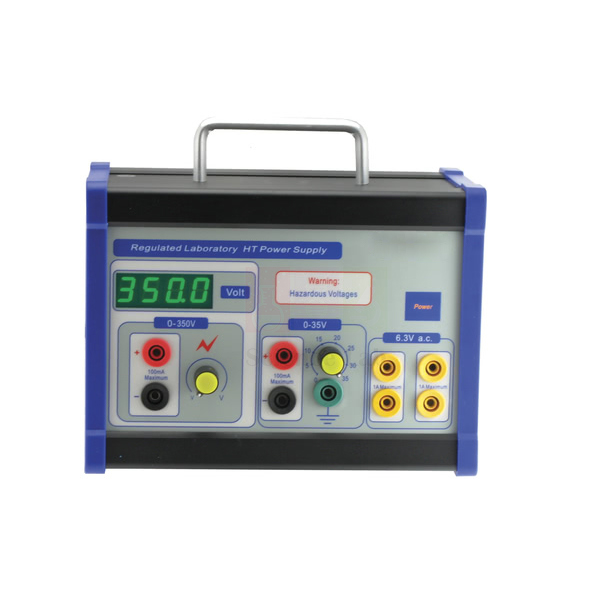
High Tension Power Supply
High Tension Power Supply (Product Code: SLE/PHY/128) is a regulated laboratory power supply used to provide the high-tension voltages needed for thermionic experiments, such as a double fine beam tube, in college and senior school physics laboratories. It gives two independent, continuously adjustable outputs of 0-35V and 0-350V at 100mA maximum, plus two 6.3V AC cathode heater outputs, all fully isolated from earth. It is supplied by Jain Scientific Equipments Pvt Ltd (ScienceLab), Ambala, India.
Specifications
| Parameter | Detail |
|---|---|
| HT outputs | Two independent outputs, 0-35V and 0-350V, continuously adjustable and fully regulated |
| Maximum current | 100mA |
| Heater outputs | Two auxiliary outputs, 6.3V a.c. 1A, for cathode heaters, protected by resettable fuse |
| Display | Bright 12.5 mm green LED display indicating HT output |
| Output sockets | Shrouded sockets suitable for standard 4 mm plugs or shrouded plugs |
| Isolation | All outputs fully isolated from earth; independent earth terminal provided |
| Input | 220V-240V, 50/60 Hz (mains supply stated as 230V ±5%, 50Hz) |
| Protection | Fuse 1A (L); primary protected by slow-blow fuse and thermal trips |
| Dimensions | 208 x 155 x 115 mm (W x H x D); height including handle 187 mm |
| Applications | Thermionic experiments such as the double fine beam tube; experiments needing a high tension supply, such as ionization current |
| Product code | SLE/PHY/128 |
| Supplied by | Jain Scientific Equipments Pvt Ltd (ScienceLab), Ambala, India |
What Is the High Tension Power Supply Used For?
Thermionic tubes need two things at once: a low heater voltage to warm the cathode so it emits electrons, and a high anode voltage to accelerate those electrons into a visible beam. The High Tension Power Supply provides both from one unit, with its 6.3V AC heater outputs and adjustable 0-350V HT output, which is why it suits fine beam tube work such as the specific charge of the electron experiment.
It also serves other experiments that need a high tension supply, including ionization current studies. Always switch off and turn the voltage controls to zero before changing connections, use shrouded 4 mm leads, and connect the independent earth terminal where the experiment requires it. The voltages involved are hazardous, so the unit should be used under a teacher's supervision.
What to Specify When Ordering
- Mains supply — the unit is specified for 220V-240V, 50/60 Hz input; tell us your local mains.
- Tube and holder — which thermionic tube and holder you will run from it, so we can check the combination.
- Leads — whether shrouded 4 mm leads should be included in the quotation.
Supplier
ScienceLab, the trading name of Jain Scientific Equipments Private Limited in Ambala, Haryana, supplies this High Tension Power Supply as a sourced instrument for electron-physics teaching. We can quote it together with the tubes, holders, coils and leads that make up a working thermionic set-up, which saves institutions from coordinating several vendors. Read about the company on our company profile.
Related Physics Lab Equipment
Items used alongside the High Tension Power Supply in electron-beam experiments:
- Teltron Dual Beam Tube D — electron tube for beam experiments; confirm its voltage needs with us.
- Teltron Helmholtz Pair of Coils D — coil pair giving a uniform magnetic field to bend the electron beam.
- Teltron Tube Holder D — stand for D-series tubes and their Helmholtz coils.
- EHT Power Supply — extra-high-tension supply for experiments beyond the 350V range.
- Stackable Leads — 4 mm leads for connecting the outputs.
See more power supplies and electron-physics apparatus in Physics Lab Equipment.
Frequently Asked Questions
What outputs does the High Tension Power Supply provide?
The High Tension Power Supply has two independent, continuously adjustable and fully regulated outputs of 0-35V and 0-350V with 100mA maximum current, plus two auxiliary 6.3V AC, 1A cathode heater outputs protected by a resettable fuse.
Which experiments is the High Tension Power Supply designed for?
The High Tension Power Supply is designed specifically for thermionic experiments such as the double fine beam tube. It can also be used for other experiments that require a high tension supply, for example ionization current measurements.
Are the outputs of the High Tension Power Supply isolated from earth?
Yes. All outputs of the High Tension Power Supply are fully isolated from earth, and an independent earth terminal is provided. The shrouded output sockets accept standard 4 mm plugs or shrouded plugs for safer connections.
What mains supply does the High Tension Power Supply need?
The High Tension Power Supply takes a 220V-240V, 50/60 Hz input, with the mains supply stated as 230V ±5%, 50Hz. It has a 1A (L) fuse, and its primary is protected by a slow-blow fuse and thermal trips.
Who supplies the High Tension Power Supply?
The High Tension Power Supply is supplied by Jain Scientific Equipments Pvt Ltd (ScienceLab), Ambala, Haryana, India. The company sources it for colleges, schools and institutions in India and international markets and can quote matching tubes and leads.
Is a calibration certificate available for the High Tension Power Supply?
A calibration document is not listed with the High Tension Power Supply. If your laboratory needs one, mention it through our contact page before ordering and we will confirm what paperwork can accompany the unit.
Request a Quote
Send us your High Tension Power Supply requirement, including the tubes and leads you plan to use, through the contact page, or add everything to the enquiry cart for one quotation.
Last updated: 24 September 2026
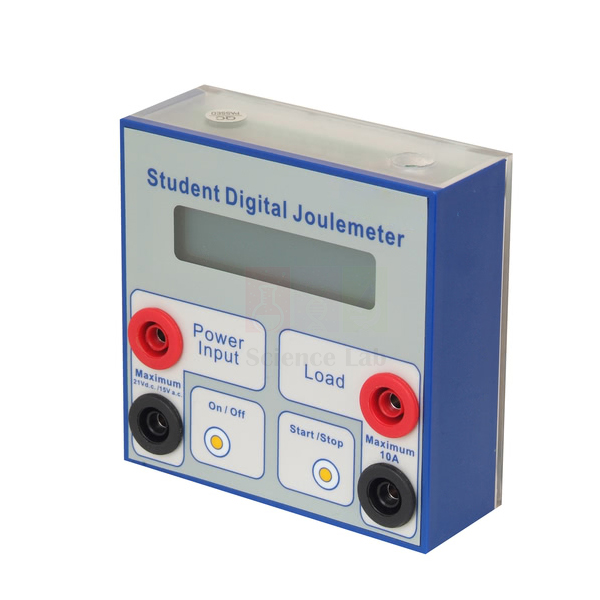
Joulemeter, Student Digital
Joulemeter, Student Digital (Product Code: SLE/PHY/129) is a digital energy meter used to measure the electrical energy delivered to a load in school and college heat and electricity practicals. Designed specifically for student use, it reads from 1 joule to 999,999 joules with 3% accuracy (1% typical) and has a built-in timer that starts and stops with the measurement. It is supplied by Jain Scientific Equipments Pvt Ltd (ScienceLab), Ambala, India.
Specifications
| Parameter | Detail |
|---|---|
| Energy range | 1 J to 999,999 J |
| Accuracy | 3%, with 1% typical |
| Input voltage | 0V to 15V AC, or 0V to 21V DC (maximum) |
| Maximum load current | 10A AC/DC |
| Circuitry | Microprocessor, combined with precision voltage multiplier |
| Start button | Starts the timer and joulemeter together and powers up the load |
| Stop button | Stops the timer and joulemeter and disconnects input power from the load |
| Display | 2 x 16 character LCD |
| Power | 9V DC mains adaptor, included |
| Dimensions | 90 x 90 x 33 mm |
| Product code | SLE/PHY/129 |
| Supplied by | Jain Scientific Equipments Pvt Ltd (ScienceLab), Ambala, India |
What Is the Student Digital Joulemeter Used For?
The Student Joulemeter sits between a low-voltage supply and the load, so students read the energy transferred directly instead of combining separate voltmeter, ammeter and stopwatch readings. It is most often used with an immersion heater in a metal block or calorimeter to find specific heat capacity, and for comparing the energy used by lamps, small motors and heaters.
Because one press of the start button powers the load and starts both the timer and the energy count, and the stop button cuts the power again, every group's readings begin and end at the same moment. Keep the input within 15V AC or 21V DC and the load current below 10A. That combination makes it a practical digital measuring instrument for calorimeter lab work.
Supplier
Jain Scientific Equipments Private Limited, trading as ScienceLab, supplies the Joulemeter, Student Digital from Ambala, Haryana to schools, colleges and institutions in India and international markets. It is a sourced electronic meter, and we can combine it in one order with heaters, calorimeters and power supplies from our physics list. For vendor registration and export documents, the supplying company's details are GSTIN 06AAECJ8618A1ZT and Importer-Exporter Code AAECJ8618A (DGFT). Visit our company profile for more.
Related Physics Lab Equipment
Build a specific heat capacity or energy-transfer practical with these items:
- Immersion Heater — sheathed miniature heater for metal-block calorimetry.
- Calorimeter Set, Copper, Joules — lagged calorimeter with a heating coil for electrical heating experiments.
- Power Supply, Stepped — low-voltage AC/DC source for powering the load through the meter.
- Joulemeter / Wattmeter, Digital — alternative meter that also reads power level.
Find more heat and electricity apparatus in Physics Lab Equipment.
Frequently Asked Questions
What range and accuracy does the Joulemeter, Student Digital have?
The Joulemeter, Student Digital measures energy from 1 joule to 999,999 joules. Its stated accuracy is 3%, with 1% accuracy typical, which is suitable for school and college energy-transfer practicals.
What input voltage and current can the Student Joulemeter handle?
The Joulemeter, Student Digital accepts 0V to 15V AC or 0V to 21V DC at most, with a maximum load current of 10A AC or DC. Stay within these limits when choosing the supply and load for an experiment.
How is the Joulemeter, Student Digital powered?
The Joulemeter, Student Digital runs from a 9V DC mains adaptor, which is included. Inside, a microprocessor combined with a precision voltage multiplier calculates the energy, and results appear on a 2 x 16 character LCD.
How does the built-in timer on the Student Joulemeter work?
On the Joulemeter, Student Digital, the start button starts the timer and joulemeter together and powers up the load. The stop button stops both and disconnects input power from the load, so energy and time are recorded over exactly the same period.
Who supplies the Joulemeter, Student Digital?
The Joulemeter, Student Digital is supplied by Jain Scientific Equipments Pvt Ltd (ScienceLab), Ambala, Haryana, India. The company sources this meter and ships it with other physics items to buyers in India and international markets.
Is a calibration certificate available for the Student Joulemeter?
Calibration documents are not listed for the Joulemeter, Student Digital. If your institution requires one, raise it through our contact page before ordering and we will confirm what can be supplied with the meter.
Request a Quote
For a quotation on a class set of Student Digital Joulemeters, write to us via the contact page or add them, with heaters and calorimeters, to the enquiry cart.
Last updated: 24 September 2026
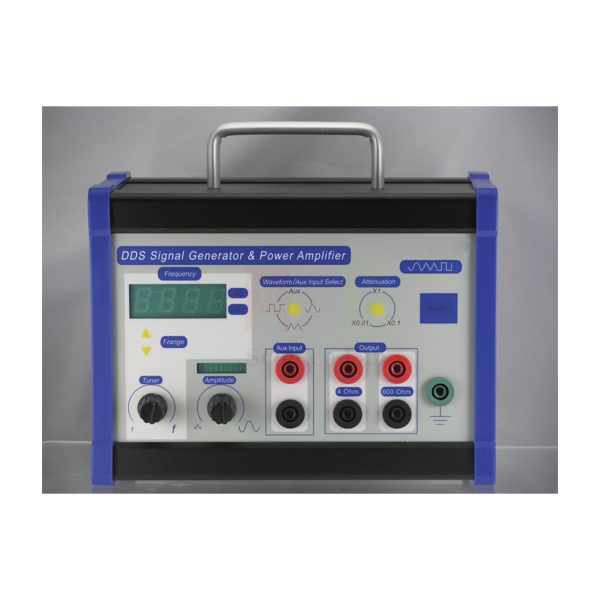
Signal Generator and Amplifier
Signal Generator and Amplifier (Product Code: SLE/PHY/130) is a combined function generator and power amplifier used to drive loudspeakers, vibrators and other wave apparatus in school and college physics and electronics laboratories. It produces sine, rectangular and triangular waves from 0.1 Hz to 99.9 kHz, shown on a digital display with 0.01% frequency accuracy, and delivers up to 4.5W into a 4 Ω load. It is supplied by Jain Scientific Equipments Pvt Ltd (ScienceLab), Ambala, India.
Specifications
| Parameter | Detail |
|---|---|
| Frequency range | 0.1 Hz to 99.9 kHz in six decades, read on digital display |
| Frequency accuracy | 0.01% (100 ppm) in all ranges |
| Output waveforms | Sine, rectangular and triangular |
| High impedance output | Maximum 17V peak to peak from an internal source impedance of 600 Ω |
| Low impedance output | 6V RMS at 4 Ω (about 8.8V peak for all waveforms) |
| Power output | Maximum 4.5W over the entire frequency range for all waveforms; maximum power transfer into a 4 Ω load: 6²/(4+4) = 4.5W |
| Frequency response | DC to 100 kHz, -3 dB, output power 4.5W into 4 Ω |
| Amplitude control | Zero to maximum in 256 increments, displayed on a 10-segment bar graph |
| Attenuation | x1, x0.1, x0.01, ±1%, on the 600 Ω output only |
| Amplifier voltage gain | 100 |
| Settings memory | All control settings except amplitude are stored and updated on any change |
| Output protection | Withstands prolonged short circuit; output floating with respect to ground; earth connected through the power cord |
| Electric supply | 220V~240V, 50Hz; detachable power lead; internal fuse T315mA L |
| Dimensions | Approx. 210 x 155 x 118 mm (L x W x D) |
| Weight | Approx. 2.05 kg without power cord |
| Product code | SLE/PHY/130 |
| Supplied by | Jain Scientific Equipments Pvt Ltd (ScienceLab), Ambala, India |
What Is the Signal Generator and Amplifier Used For?
One instrument covers two jobs. As a signal generator it supplies clean test waveforms for oscilloscope and circuit work, and as an amplifier it has enough power to drive a loudspeaker, vibration generator or resonance apparatus directly, which makes it a natural choice for standing waves on strings, air-column resonance, sound demonstrations and frequency-response measurements.
Use the 600 Ω output with its x1, x0.1 and x0.01 attenuator for low-level signals into electronic circuits, and the low-impedance output for loads around 4 Ω, where maximum power transfer occurs. The output withstands prolonged short circuits, which suits student benches, but it is still good practice to turn the amplitude to zero before connecting a new load. It works equally well as a signal generator for the electronics lab and as a driver for physics wave practicals.
Supplier
This Signal Generator and Amplifier is supplied by Jain Scientific Equipments Private Limited, which trades as ScienceLab and is based in Ambala, Haryana. It is a sourced electronic instrument, and we can quote it together with loudspeakers, vibration generators and oscilloscopes so a physics department can equip its wave and sound experiments through a single order. More about the company is on our company profile.
Related Physics Lab Equipment
Loads and instruments commonly connected to the Signal Generator and Amplifier:
- Vibration Generator — converts the amplified signal into vibrations for wave experiments.
- Loudspeaker Unit — mounted loudspeaker for sound and interference demonstrations.
- Oscilloscope Dual Trace — displays and compares the waveforms produced.
- Resonance Apparatus with Brass Tube — air-column resonance experiment that needs a steady sound source.
Browse the rest of our Physics Lab Equipment range.
Frequently Asked Questions
What waveforms and frequency range does the Signal Generator and Amplifier offer?
The Signal Generator and Amplifier produces sine, rectangular and triangular waves from 0.1 Hz to 99.9 kHz in six decades. The frequency is read on a digital display with 0.01% (100 ppm) accuracy on all ranges.
How much power can the Signal Generator and Amplifier deliver?
The Signal Generator and Amplifier delivers a maximum of 4.5W over its entire frequency range for all waveforms. Its low-impedance output gives 6V RMS at 4 Ω, and maximum power transfer occurs when the load is 4 Ω.
Is the Signal Generator and Amplifier protected against short circuits?
Yes. The Signal Generator and Amplifier is a robust instrument that can withstand a prolonged short circuit on its output. The output is floating with respect to ground, while the earth terminal connects to physical earth through the power cord.
What is the amplifier gain and attenuation of this unit?
The Signal Generator and Amplifier has an amplifier voltage gain of 100. Attenuation of x1, x0.1 and x0.01 (±1%) works on the 600 Ω output only, and amplitude is set in 256 increments shown on a 10-segment bar graph.
What mains supply does the Signal Generator and Amplifier use?
The Signal Generator and Amplifier runs on 220V~240V, 50Hz, with a detachable power lead for easy storage and an internal T315mA L fuse. It measures about 210 x 155 x 118 mm and weighs about 2.05 kg without the cord.
Who supplies the Signal Generator and Amplifier?
The Signal Generator and Amplifier is supplied by Jain Scientific Equipments Pvt Ltd (ScienceLab), Ambala, Haryana, India. The company sources it for schools, colleges and training institutes in India and international markets and can add loudspeakers or vibrators to the quotation.
Request a Quote
Tell us how many Signal Generator and Amplifier units you need, and which loudspeakers or vibrators should go with them, through our contact page or the enquiry cart.
Last updated: 24 September 2026
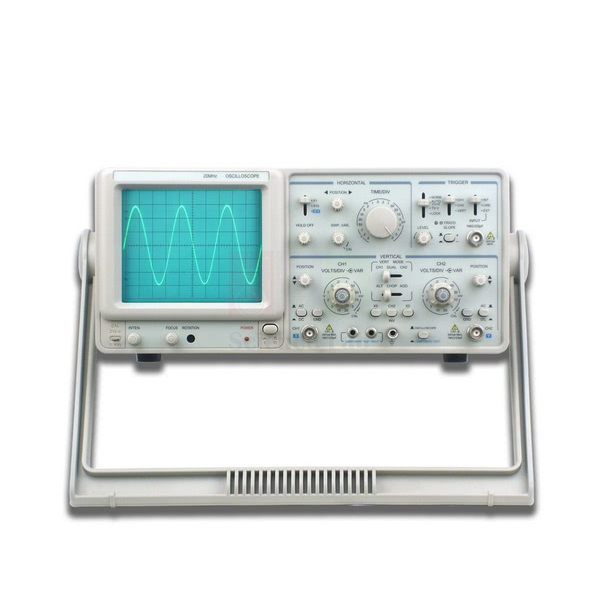
Oscilloscope Dual Trace
Oscilloscope Dual Trace (Product Code: SLE/PHY/131) is a 20MHz dual-channel cathode ray oscilloscope used to display and compare electrical waveforms in school, college and electronics laboratories. Both independent channels offer 5mV/div sensitivity, and a 6-inch rectangular CRT with red internal graticule, X-Y mode and algebraic addition and subtraction make it a versatile teaching CRO; a microphone is included for sound-wave work. It is supplied by Jain Scientific Equipments Pvt Ltd (ScienceLab), Ambala, India.
Specifications
| Parameter | Detail |
|---|---|
| Bandwidth and channels | 20MHz, dual channel, CH1 and CH2 independent |
| Vertical sensitivity | 5mV/div on both channels |
| Display | 6-inch rectangular cathode ray tube with red internal graticule |
| Time base | High-speed sweep; maximum sweep time 0.2 µs/div, 20 ns/div when magnified by 10 |
| Trigger | Alternate trigger function for observing two waveforms of different frequency |
| Operating modes | X-Y; algebraic addition and subtraction |
| Signal output | CH1 signal output |
| Accessory | Microphone included |
| Product code | SLE/PHY/131 |
| Supplied by | Jain Scientific Equipments Pvt Ltd (ScienceLab), Ambala, India |
What Is the Dual Trace Oscilloscope Used For?
In a physics or electronics laboratory the dual trace oscilloscope makes invisible signals visible. Students measure the amplitude and period of AC waveforms, compare the input and output of a circuit on the two channels, and use X-Y mode to form Lissajous figures for frequency and phase comparison. With the included microphone, sound from a tuning fork or loudspeaker appears as a trace they can measure.
The alternate trigger holds two signals of different frequency steady at the same time, and addition and subtraction of the channels demonstrate superposition. Set the trigger level first, begin on a less sensitive volts/div setting and increase it until the trace fills the screen. It fits wherever a CRO oscilloscope is part of the electronics or wave-physics syllabus.
Supplier
Jain Scientific Equipments Private Limited, which trades as ScienceLab from Ambala, Haryana, supplies the Oscilloscope Dual Trace as a sourced test instrument. We supply it to schools, colleges, polytechnics and training institutes in India and international markets, and can quote it alongside signal generators and other items for an electronics or physics laboratory. See the company profile for more about ScienceLab.
Related Physics Lab Equipment
Signal sources that pair naturally with the Oscilloscope Dual Trace:
- Signal Generator and Amplifier — waveform source with power output, for display and measurement on the scope.
- Signal Generator & Amplifier — function generator option with sine, square, triangular and pulse outputs.
- Loudspeaker Unit — sound source to pick up with the included microphone.
- Tuning Fork Set, Steel — steady tones for displaying and comparing sound waves on screen.
Explore more measuring instruments in Physics Lab Equipment.
Frequently Asked Questions
What is the bandwidth and sensitivity of the Oscilloscope Dual Trace?
The Oscilloscope Dual Trace is a 20MHz dual-channel instrument with 5mV/div sensitivity on both channels. CH1 and CH2 work independently, and a CH1 signal output is provided for passing the signal on to other equipment.
What sweep speeds does the Oscilloscope Dual Trace offer?
The Oscilloscope Dual Trace has a high-speed time base with a maximum sweep time of 0.2 µs/div. When magnified by 10, the sweep speed reaches 20 ns/div, which helps students examine fast-changing signals in detail.
Does the Oscilloscope Dual Trace have X-Y mode?
Yes. The Oscilloscope Dual Trace offers X-Y operation for Lissajous figures, algebraic addition and subtraction of the two channels, and an alternate trigger function that lets two waveforms of different frequency be observed together.
What accessories come with the Oscilloscope Dual Trace?
A microphone is included with the Oscilloscope Dual Trace for displaying sound waves. Other accessories such as probes are not listed, so please confirm the full accessory set through our contact page before ordering.
Who supplies the Oscilloscope Dual Trace?
The Oscilloscope Dual Trace is supplied by Jain Scientific Equipments Pvt Ltd (ScienceLab), Ambala, Haryana, India. The company sources this CRO for schools, colleges and training institutes in India and international markets.
Is a calibration certificate available for the Oscilloscope Dual Trace?
Calibration paperwork is not part of the Oscilloscope Dual Trace listing. If your laboratory needs it, ask through the contact page when you request a quotation, and we will confirm what documentation can be arranged.
Request a Quote
Request an Oscilloscope Dual Trace quotation for your laboratory through our contact page, or add it and a signal generator to the enquiry cart.
Last updated: 24 September 2026
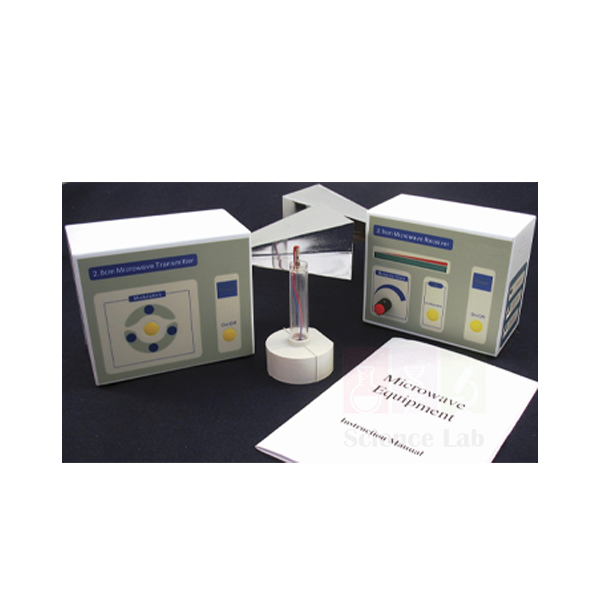
Microwave Transmitter/Receiver
Microwave Transmitter/Receiver (Product Code: SLE/PHY/132) is an apparatus for investigating transverse waves with microwaves, used to demonstrate reflection, refraction, polarisation and interference in school and college physics laboratories. The transmitter sends a plane polarised wave, modulated with a 1KHz tone, music or no modulation, while the receiver has gain control, a 30-bar signal-strength display and a built-in loudspeaker. It is supplied by Jain Scientific Equipments Pvt Ltd (ScienceLab), Ambala, India.
Specifications
| Parameter | Detail |
|---|---|
| Purpose | Investigation of transverse waves, at a convenient wavelength |
| Transmitter | Plane polarised wave, internally modulated with a 1KHz tone, or music, or no modulation |
| Auxiliary input | For external simple tones to transmit through microwaves |
| Receiver gain | Built-in gain control |
| Signal display | 30 bar graphs indicating signal strength |
| Receiver outputs | External outputs to data-loggers and external meters |
| Loudspeaker | Built into the receiver, with on/off control |
| Probe detector | For non-directional reception of the microwaves |
| Documentation | Detailed instruction booklet illustrating microwave experiments on reflection, refraction, polarisation, interference and more |
| Product code | SLE/PHY/132 |
| Supplied by | Jain Scientific Equipments Pvt Ltd (ScienceLab), Ambala, India |
What Is the Microwave Transmitter/Receiver Used For?
Microwaves behave like light but on a scale that fits comfortably on a laboratory bench, so wave effects that are hard to see with light become easy to measure. With this transmitter and receiver, students reflect the beam off metal plates, refract it through a prism, show polarisation by rotating the receiver or inserting a grille, and locate interference maxima and minima.
The receiver's loudspeaker turns signal strength into sound that a class can hear rising and falling as the receiver moves, and the probe detector maps standing waves regardless of direction. Outputs for data-loggers and external meters let older students record readings, and the auxiliary input shows how microwaves can carry an audio signal. The instruction booklet sets out each experiment for the teacher.
Supplier
The Microwave Transmitter/Receiver is supplied by Jain Scientific Equipments Private Limited, the Ambala, Haryana company that trades as ScienceLab. We source this apparatus and can quote it together with the plates, prism, lens and protractor accessories in our physics range, so a department can complete its microwave optics bench in one purchase. The company profile has more background.
Related Physics Lab Equipment
Accessories and alternatives for microwave wave experiments:
- Microwave Accessories Set of Plates — aluminium and perspex plates with a polarisation grille for reflection and polarisation work.
- Microwave Accessories Hollow Prism — perspex prism filled with paraffin for refraction experiments.
- Microwave Accessories Hollow Plano-convex Lens — oil-filled lens for focusing the microwave beam.
- Microwave Accessories Rotating Protractor — for measuring the directivity of the transmission.
- Apparatus Microwave — alternative kit for demonstrating the wave properties of microwaves.
More wave and optics apparatus is available in Physics Lab Equipment.
Frequently Asked Questions
What experiments can be done with the Microwave Transmitter/Receiver?
The Microwave Transmitter/Receiver is used to investigate transverse waves, including reflection, refraction, polarisation and interference. A detailed instruction booklet illustrating these and other microwave experiments is provided to guide teachers and students.
How is the microwave signal modulated?
The Microwave Transmitter/Receiver transmits a plane polarised wave that can be internally modulated with a 1KHz tone, with music, or left unmodulated. An auxiliary input also allows external simple tones to be transmitted through the microwaves.
How does the receiver show signal strength?
The receiver of the Microwave Transmitter/Receiver has built-in gain control and 30 bar graphs indicating signal strength. A built-in loudspeaker with on/off control makes changes audible, and external outputs connect to data-loggers and meters.
What is the probe detector for?
The probe detector of the Microwave Transmitter/Receiver gives non-directional reception of the microwaves. It is useful for mapping the field at different points, such as the nodes and antinodes of a standing wave, without depending on which way it faces.
What power supply does the Microwave Transmitter/Receiver need?
The power arrangement of the Microwave Transmitter/Receiver is not stated in our listing. Please ask through our contact page so we can confirm the supply it uses before you place an order.
Who supplies the Microwave Transmitter/Receiver?
The Microwave Transmitter/Receiver is supplied by Jain Scientific Equipments Pvt Ltd (ScienceLab), Ambala, Haryana, India. The company sources this apparatus for schools, colleges and institutions in India and international markets, along with its microwave accessories.
Request a Quote
For a Microwave Transmitter/Receiver quotation, with or without the plate, prism and lens accessories, contact us through the contact page or collect the items in the enquiry cart.
Last updated: 24 September 2026
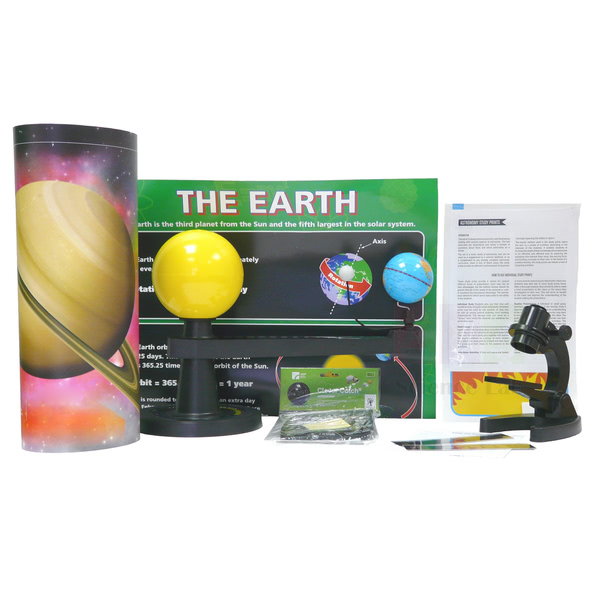
Astronomy Activity Kit
Astronomy Activity Kit (Product Code: SLE/PHY/133) is a classroom activity set used to teach the solar system, from the names and positions of the planets to eclipses, constellations and the seasons, in school science lessons. Its materials also introduce students to other bodies in the solar system, such as asteroids, meteors and comets, which keeps the topic hands-on and engaging. It is made by Jain Scientific Equipments Pvt Ltd (ScienceLab), an OEM manufacturer, at its own factory in Ambala, India.
Key Details
| Parameter | Detail |
|---|---|
| Type | Activity set for exploring the solar system |
| Topics covered | Names and positions of the planets; eclipses; constellations; seasons; the Earth, Sun and Moon |
| Other bodies introduced | Asteroids, meteors and comets |
| Contents | Not itemised in our listing — ask us for the current contents list |
| Product code | SLE/PHY/133 |
| Manufacturer | Jain Scientific Equipments Pvt Ltd (ScienceLab) — OEM |
| Country of origin | India (made in Ambala, Haryana) |
What Is the Astronomy Activity Kit Used For?
The kit follows the natural order of an astronomy unit. Students first become familiar with the names and positions of the planets, then move on to how eclipses happen, how constellations are recognised, and how the Earth, Sun and Moon together explain the seasons. Along the way the materials bring in asteroids, meteors and comets, so learners see that the solar system holds far more than the planets alone.
Teachers can run it as a guided whole-class lesson or split the materials between groups, each taking one topic and reporting back to the class. It pairs well with a solar system model or globe on the teacher's desk, and it suits earth science periods and science clubs as well as regular physics lessons.
What to Specify When Ordering
- Contents — ask for the current contents list so you can check it against your syllabus.
- Quantity — one kit per class, or one per student group.
- Companion models — whether a solar system model, planetarium set or globe should be quoted with it.
OEM Manufacturer
The Astronomy Activity Kit is produced by Jain Scientific Equipments Private Limited under its ScienceLab name, acting as the original equipment manufacturer. Kits are put together at the company's own licensed factory at Saha, Ambala, Haryana, and go straight to schools, education departments, distributors and importers. Buyers completing vendor forms can use the company's GSTIN 06AAECJ8618A1ZT and Legal Entity Identifier 3358004HRD1JIVXKYX49. Read more on our company profile.
Related Laboratory Equipment
Models and instruments that extend the Astronomy Activity Kit in the classroom:
- Solar System Model — mounted model of the planets for the teacher's desk.
- Project Planetarium Set — lets students plot eclipses, moon phases and planet positions.
- Mini Science Kit – Earth, Sun and Moon — activities on seasons, day and night and phases of the Moon.
- Celestial Star Globe — shows constellations and the apparent positions of stars.
- Astronomical Telescope — for moving from classroom activities to observing the night sky.
The kit is listed under Physics Lab Equipment, and more astronomy models appear in our Geography Lab Equipment range.
Frequently Asked Questions
What topics does the Astronomy Activity Kit cover?
The Astronomy Activity Kit takes students from the names and positions of the planets to eclipses, constellations, the seasons and the Earth, Sun and Moon. Its materials also introduce asteroids, meteors and comets as other members of the solar system.
What is included in the Astronomy Activity Kit?
Our listing does not itemise the contents of the Astronomy Activity Kit. Please ask through our contact page for the current contents list before ordering, so you can check it against your syllabus and class size.
Which students is the Astronomy Activity Kit suitable for?
The Astronomy Activity Kit is designed to help school students explore the mysteries of the solar system as an introductory unit. Tell us the class level you teach when you enquire, and we will help you judge whether it fits your curriculum.
Who manufactures the Astronomy Activity Kit?
The Astronomy Activity Kit is manufactured by Jain Scientific Equipments Pvt Ltd (ScienceLab) as the OEM, at its own licensed factory in Saha, Ambala, Haryana, India. Schools and resellers receive quotations directly from the manufacturer, without a trading intermediary.
Can the Astronomy Activity Kit be ordered in bulk?
Yes. The Astronomy Activity Kit can be quoted in class and school sets for education departments, dealers and importers in India and international markets. Share the number of kits and the delivery destination, and mention any companion models you need.
Request a Quote
To receive an Astronomy Activity Kit quotation direct from the manufacturer, message us through the contact page or add the kit and any companion models to the enquiry cart.
Last updated: 24 September 2026
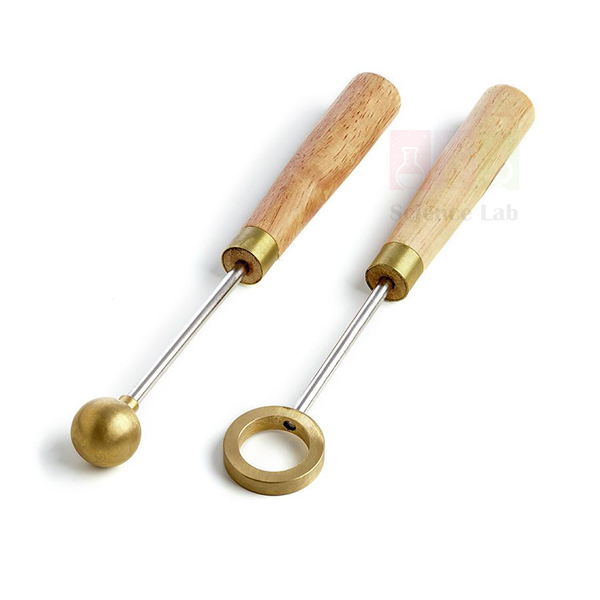
Ball & Ring Apparatus
Ball & Ring Apparatus (Product Code: SLE/PHY/134) is a two-piece thermal expansion demonstrator used to show that a heated metal ball will no longer pass through a ring it cleared when cold, in school and college physics laboratories. Its brass ball, 22 mm in diameter, and brass ring each sit on a brass rod with a wooden handle, so they can be held safely over a flame. It is made by Jain Scientific Equipments Pvt Ltd (ScienceLab), an OEM manufacturer, at its own factory in Ambala, India.
Specifications
| Parameter | Detail |
|---|---|
| Type | Two-piece apparatus for demonstrating thermal expansion |
| Ball | Brass, 22 mm diameter |
| Ring | Brass |
| Mounting | Ball and ring each individually mounted on a brass rod |
| Handles | Wooden, one on each rod |
| Product code | SLE/PHY/134 |
| Manufacturer | Jain Scientific Equipments Pvt Ltd (ScienceLab) — OEM |
| Country of origin | India (made in Ambala, Haryana) |
What Is the Ball and Ring Apparatus Used For?
The ball and ring apparatus gives a quick, visible proof that solids expand when heated. At room temperature the ball slips through the ring; the teacher then warms the ball in a Bunsen or spirit-lamp flame and tries again, and this time the ball rests on the ring instead of dropping through. As it cools, it falls through once more, which shows contraction on cooling as well.
A second run, heating the ring instead of the ball, lets students test their prediction of what happens to a hole when the metal around it expands. This makes it a staple of school physics lab equipment in India for the heat chapter. Hold the parts only by the wooden handles, rest the hot brass on a heat-proof mat, and let it cool in air rather than quenching it.
OEM Manufacturer
ScienceLab is the trading name of Jain Scientific Equipments Private Limited, the OEM (original equipment manufacturer) of this Ball & Ring Apparatus. It is made and assembled at the company's own licensed factory at Saha, Ambala, Haryana, India, rather than bought in from a trader, and goes factory-direct to schools, colleges, dealers and importers in India and international markets. Repeat orders and replacement parts are handled by the manufacturer itself, so ask us about availability. More background is on the ScienceLab company profile.
Related Physics Lab Equipment
These items are used alongside the ball and ring in heat and expansion lessons:
- Bar & Gauge Apparatus — shows the same effect with an iron bar tested against a brass gauge.
- Bimetallic Strip — shows that brass and steel expand by different amounts.
- Gravesand Ring-Device to Demonstrate Thermal Expansion — an alternative ring-type expansion demonstrator.
- Bunsen Burner — the usual heat source for warming the ball or the ring.
- Expansion Of Liquids Apparatus — extends the lesson from solids to liquids.
See the complete Physics Lab Equipment range for more heat apparatus.
Frequently Asked Questions
What does the Ball & Ring Apparatus include?
The Ball & Ring Apparatus is a two-piece set: a brass ball 22 mm in diameter and a brass ring, each mounted individually on its own brass rod with a wooden handle. A flame source such as a Bunsen burner is not part of the set and is ordered separately.
How does the Ball & Ring Apparatus demonstrate thermal expansion?
With the Ball & Ring Apparatus, students first pass the cold ball through the ring, then heat the ball in a flame and try again. The expanded ball no longer passes through, and once it cools it slips through again, showing both expansion and contraction of a solid.
Why do the Ball & Ring Apparatus parts have wooden handles?
The wooden handles on the Ball & Ring Apparatus keep hands away from the hot brass, because wood conducts heat far less than metal. Students can hold the ball and ring over a flame and bring them together without touching the heated parts.
Who manufactures the Ball & Ring Apparatus?
The Ball & Ring Apparatus is manufactured by Jain Scientific Equipments Pvt Ltd (ScienceLab) as the OEM, at its own licensed factory at Saha, Ambala, Haryana, India. Schools, colleges and dealers buy it factory-direct, with quotations and repeat orders handled by the manufacturer.
Is a calibration certificate available for the Ball & Ring Apparatus?
The Ball & Ring Apparatus is a qualitative demonstration piece rather than a measuring instrument, so it is not normally calibrated. If your tender asks for any test or inspection document, please discuss it with us through the contact page before ordering.
What should a quotation request for the Ball & Ring Apparatus include?
For a Ball & Ring Apparatus quotation, give the product code SLE/PHY/134, the number of sets, your delivery address and whether you also need burners or other expansion apparatus. The quotation then covers everything for your heat practicals in one reply.
Can the Ball & Ring Apparatus be supplied in bulk for export?
Yes, the Ball & Ring Apparatus can be supplied in quantity to school networks, dealers and importers in India and international markets. Share the quantity and destination through the enquiry cart or contact page, and packing and shipping details are confirmed in the quotation.
Request a Quote
To price the Ball & Ring Apparatus, send your quantity through the contact page or add it to the enquiry cart. Quotations come direct from the manufacturer in Ambala.
Last updated: 24 September 2026
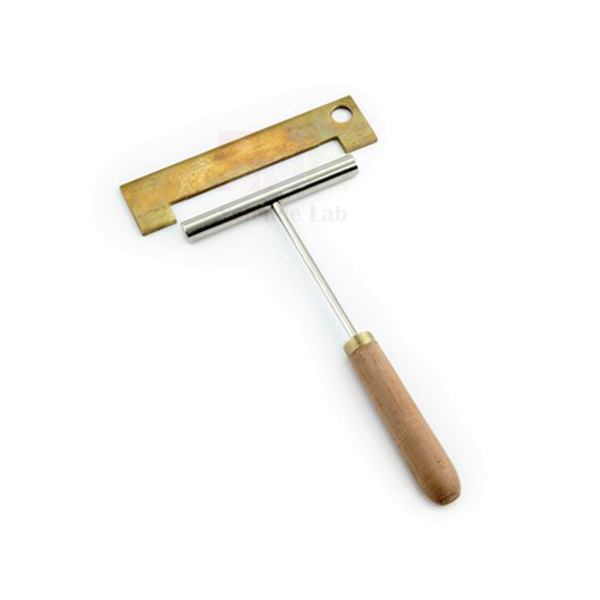
Bar & Gauge Apparatus
Bar & Gauge Apparatus (Product Code: SLE/PHY/135) is a heat-expansion demonstrator used to test an iron bar against a brass gauge before and after heating, in school and college physics labs. The gauge has a cut-out that barely admits the cold bar lengthways and a hole that passes it endways only while cold, so a heated bar visibly fails both checks. It is made by Jain Scientific Equipments Pvt Ltd (ScienceLab), an OEM manufacturer, at its own factory in Ambala, India.
Key Details
| Parameter | Detail |
|---|---|
| Bar | Iron, mounted on a support rod with a wooden handle |
| Gauge | Brass, with a lengthways cut-out and an endways hole |
| Fit when cold | Cut-out barely admits the bar lengthways; hole passes the bar endways |
| Fit after heating | The heated bar is compared with the gauge to show that it has expanded |
| Demonstrates | Expansion by heating and contraction by cooling |
| Product code | SLE/PHY/135 |
| Manufacturer | Jain Scientific Equipments Pvt Ltd (ScienceLab) — OEM |
| Country of origin | India (made in Ambala, Haryana) |
What Is the Bar and Gauge Used For?
Because the gauge checks the bar in two directions, the bar and gauge shows students that heating makes a solid grow in length and in thickness at the same time. A typical sequence is to test both fits while the bar is cold, heat the bar in a Bunsen flame, show that it no longer enters the cut-out or the hole, and then cool it and show that it fits again.
Many schools group it with a ball and ring and a bimetallic strip as a simple heat energy science kit for the thermal-expansion lesson. Hold the apparatus only by the wooden handle, never force a hot bar into the gauge, and rest the heated iron on a heat-proof mat while the class discusses the result.
OEM Manufacturer
Jain Scientific Equipments Private Limited, which trades as ScienceLab, is the original equipment manufacturer (OEM) of the Bar & Gauge Apparatus. Each unit is built at the company's own licensed factory at Saha, Ambala, Haryana, India, so buyers deal with the maker directly instead of a reseller. Schools, colleges, institutions, dealers and importers can ask us about repeat orders and replacement gauges or bars. Company background is on the ScienceLab profile page.
Related Physics Lab Equipment
Pair the bar and gauge with these items for a complete expansion practical:
- Apparatus Bar & Gauge — a companion bar-and-gauge model whose listing gives bar and gauge dimensions.
- Ball & Ring Apparatus — the same principle shown with a brass ball and ring.
- Bar Compound Copper & Iron — a two-metal bar that bends when heated, showing the thermostat principle.
- Bunsen Burner with Stopcock — heat source with gas-flow control for warming the bar.
More heat and mechanics apparatus is listed under Physics Lab Equipment.
Frequently Asked Questions
What is included with the Bar & Gauge Apparatus?
The Bar & Gauge Apparatus consists of an iron bar mounted on a support rod with a wooden handle, and a brass gauge with a lengthways cut-out and an endways hole. A burner or other heat source is not listed as part of the apparatus.
How does the Bar & Gauge Apparatus show thermal expansion?
In the Bar & Gauge Apparatus, the cold iron bar just fits the gauge's cut-out lengthways and passes through its hole endways. After heating, the expanded bar no longer fits, and once it cools it fits again, showing expansion by heating and contraction by cooling.
What are the dimensions of the Bar & Gauge Apparatus?
The listing for the Bar & Gauge Apparatus (SLE/PHY/135) does not state bar or gauge dimensions. If your syllabus or tender specifies sizes, send them through the contact page and we will confirm the dimensions of the unit we quote.
Can the bar of the Bar & Gauge Apparatus be cooled in water?
Yes, the heated iron bar of the Bar & Gauge Apparatus can be cooled in air or dipped in cold water to show contraction more quickly. Keep the wooden handle out of the water and dry the iron thoroughly afterwards, because wet iron rusts.
Who manufactures the Bar & Gauge Apparatus?
The Bar & Gauge Apparatus is manufactured by Jain Scientific Equipments Pvt Ltd (ScienceLab), the OEM, at its own licensed factory at Saha, Ambala, Haryana, India. Quotations, repeat orders and spare-part requests are handled directly by the manufacturer.
What details should a Bar & Gauge Apparatus enquiry include?
A Bar & Gauge Apparatus enquiry should give the product code SLE/PHY/135, the number of units, the delivery location and any other heat-expansion items you need. Institutions and importers can list everything in one enquiry for a combined quotation.
Request a Quote
For a price on the Bar & Gauge Apparatus, write to us through the contact page or place it in the enquiry cart. You receive the quotation straight from the manufacturer.
Last updated: 24 September 2026
Battery Holder, C
Battery Holder, C (Product Code: SLE/PHY/136) is a single-cell battery holder used to hold one C-size battery and connect it into simple circuits in school physics and electronics labs. It measures 58 mm long by 29 mm wide and has tag terminals, so leads can be soldered on or clipped to it for bench circuits and student projects. It is supplied by Jain Scientific Equipments Pvt Ltd (ScienceLab), Ambala, India.
Specifications
| Parameter | Detail |
|---|---|
| Type | Battery holder |
| Battery size | C |
| Number of cells | 1 |
| Length | 58 mm |
| Width | 29 mm |
| Terminal type | Tag |
| Product code | SLE/PHY/136 |
| Supplied by | Jain Scientific Equipments Pvt Ltd (ScienceLab), Ambala, India |
What Is a C Battery Holder Used For?
A C battery holder turns a loose cell into a secure, reusable power source for electricity experiment kit practicals in school: lighting a lamp, running a small motor or buzzer, or measuring the voltage of a single cell. The tag terminals accept a crocodile clip for quick lessons or a soldered wire for a permanent project board.
Several holders can be wired in series when an investigation needs a higher voltage. Match the positive end of the cell to the positive contact before connecting, take batteries out at the end of term to avoid leakage damage, and use insulated leads when connecting the holder to meters.
Supplier
Jain Scientific Equipments Private Limited trades as ScienceLab and supplies this C battery holder from Ambala, Haryana, alongside the leads, clips and meters used with it. Schools, colleges, dealers and importers in India and international markets can combine it with other electricity items in a single enquiry. Read about the company on the ScienceLab profile page.
Related Physics Lab Equipment
Useful companions for battery-powered circuit work:
- Battery Clip, PP3 — connects a PP3 battery instead of a C cell.
- Battery Snap with Crocodile Clip — battery connector with crocodile clips already fitted.
- Circuits Kit Cell Holder — panel-mounted holder for a D cell in the Circuits Kit.
- Crocodile Clips & Leads — leads for connecting to the tag terminals.
- Standard Digital Multimeter — checks the voltage of the cell in the holder.
Find more circuit components in the Physics Lab Equipment category.
Frequently Asked Questions
Which battery fits the Battery Holder, C?
The Battery Holder, C takes one C-size cell. The listing describes the holder only, so the cell itself is not shown as included; if you need batteries quoted together with the holders, mention it in your enquiry.
What are the dimensions of the Battery Holder, C?
The Battery Holder, C measures 58 mm in length and 29 mm in width. That compact footprint lets it sit on a circuit board, inside a project box or on a bench next to other components without taking much space.
How are wires connected to the Battery Holder, C?
The Battery Holder, C has tag terminals. A wire can be soldered to each tag for a permanent connection, or a crocodile clip can be attached for quick temporary circuits that students build and take apart during a lesson.
Can several Battery Holder, C units be connected together?
Yes, several Battery Holder, C units can be wired positive-to-negative in series to raise the circuit voltage, or side by side in parallel to share the load between cells. Students can compare lamp brightness for each arrangement.
Who supplies the Battery Holder, C?
The Battery Holder, C is supplied by Jain Scientific Equipments Pvt Ltd (ScienceLab), Ambala, Haryana, India, to schools, colleges, dealers and importers. It can be quoted together with leads, clips and meters for complete electricity practicals.
What should a Battery Holder, C quotation request include?
A Battery Holder, C quotation request should state the product code SLE/PHY/136, the quantity of holders, whether cells or connecting leads are also needed, and the delivery address in India or abroad.
Request a Quote
Ask for a price on the Battery Holder, C through the contact page, or add it to the enquiry cart with the other circuit items you need.
Last updated: 24 September 2026
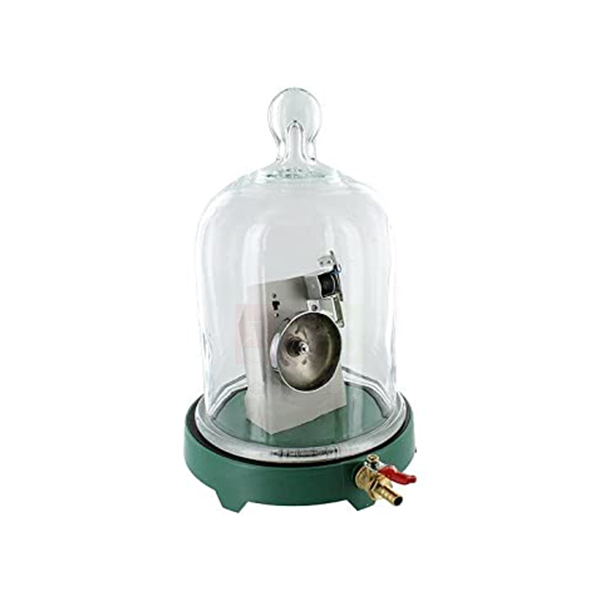
Bell In Glass Jar and Base
Bell In Glass Jar and Base (Product Code: SLE/PHY/137) is a vacuum demonstration unit used to show that sound cannot travel through a vacuum, along with other properties of a vacuum, in school and college physics labs. It combines a sturdy baseplate with a tap, a glass bell jar and a detachable battery-operated bell, and works with a hand pump or, ideally, an electric vacuum pump. It is made by Jain Scientific Equipments Pvt Ltd (ScienceLab), an OEM manufacturer, at its own factory in Ambala, India.
Key Details
| Parameter | Detail |
|---|---|
| Purpose | Demonstrating the properties of a vacuum |
| Base | Sturdy baseplate with tap |
| Jar | Glass bell jar |
| Sound source | Detachable battery-operated bell |
| Pump to use | Hand pump, or ideally an electric vacuum pump (not among the listed parts) |
| Product code | SLE/PHY/137 |
| Manufacturer | Jain Scientific Equipments Pvt Ltd (ScienceLab) — OEM |
| Country of origin | India (made in Ambala, Haryana) |
What Is the Bell in Jar Apparatus Used For?
In the classic experiment the bell is switched on, the jar is placed over it on the base, and the class hears it ringing clearly. As the pump draws air out through the tap, the sound fades even though students can still see the hammer striking, which shows that sound needs a medium to travel. Opening the tap lets air back in and the ringing returns.
Schools often teach it together with a tuning fork set as a sound wave experiment kit for the secondary science chapter on sound. A thin film of vacuum grease on the jar rim helps it seal on the plate, and the glass should be checked for chips or cracks before every evacuation.
What to Specify When Ordering
- The number of Bell In Glass Jar and Base units required (one per demonstration bench is typical).
- Whether a hand vacuum pump or an electric vacuum pump should be quoted with it.
- Whether connecting tubing between the tap and the pump is needed.
- Whether batteries for the bell should be included in the quotation.
OEM Manufacturer
The Bell In Glass Jar and Base is an own-make product: Jain Scientific Equipments Private Limited, trading as ScienceLab, is the OEM and makes the unit at its own licensed factory at Saha, Ambala, Haryana, India. The company is incorporated under CIN U29309HR2020PTC087597, and its factory premises operate under Factory Licence AMB-ONLINE-CHD-J-414. Quotations, repeat orders and requests for a replacement jar or bell come straight to the manufacturer, so ask us about availability. More about the company is on the ScienceLab profile.
Related Physics Lab Equipment
These items complete a vacuum and air-pressure demonstration set:
- Vacuum Pump, Hand — manual pump for evacuating the bell jar.
- Vacuum Pump, Electric — the preferred pump type for this unit.
- Vacuum Tubing — connects the baseplate tap to the pump.
- Magdeburg Hemisphere — another air-pressure demonstration that uses the same pump.
- Tuning Fork Set, Steel — for the rest of the sound lesson.
Browse all Physics Lab Equipment for further sound and pressure apparatus.
Frequently Asked Questions
What does the Bell In Glass Jar and Base consist of?
The Bell In Glass Jar and Base comprises a sturdy baseplate with a tap, a glass bell jar and a detachable battery-operated bell. A vacuum pump is not among the listed parts, so it is chosen and ordered separately to suit your lab.
Which vacuum pump works with the Bell In Glass Jar and Base?
The Bell In Glass Jar and Base can be used with a hand pump or, ideally, with an electric vacuum pump connected to the baseplate tap. The tap lets you hold the reduced pressure or let air back in during the demonstration.
Why does the bell sound fainter as air is pumped out of the jar?
In the Bell In Glass Jar and Base, sound reaches the class as vibrations passed through air. As the pump removes air, fewer molecules are left to carry those vibrations, so the ringing fades while the hammer can still be seen moving.
Is the bell in the Bell In Glass Jar and Base removable?
Yes, the bell in the Bell In Glass Jar and Base is detachable and battery-operated, so it can be taken out for changing cells or for storage. Ask us whether cells are included when you request a quotation.
Who manufactures the Bell In Glass Jar and Base?
The Bell In Glass Jar and Base is manufactured by Jain Scientific Equipments Pvt Ltd (ScienceLab), the OEM, at its own licensed factory at Saha, Ambala, Haryana, India. Schools, dealers and importers buy it direct from the maker.
How should the glass jar of the Bell In Glass Jar and Base be handled?
Before lifting the glass jar of the Bell In Glass Jar and Base, open the tap so air re-enters and the jar releases from the plate. Inspect the jar for chips or cracks before each use and store it with the rim protected.
What should a quotation request for the Bell In Glass Jar and Base include?
For the Bell In Glass Jar and Base, give the product code SLE/PHY/137, the number of units, the pump type you want quoted with it and your delivery address. Institutions and importers can add other vacuum apparatus to the same request.
Request a Quote
Send your requirement for the Bell In Glass Jar and Base through the contact page or add it to the enquiry cart. The quotation comes direct from the manufacturer.
Last updated: 24 September 2026
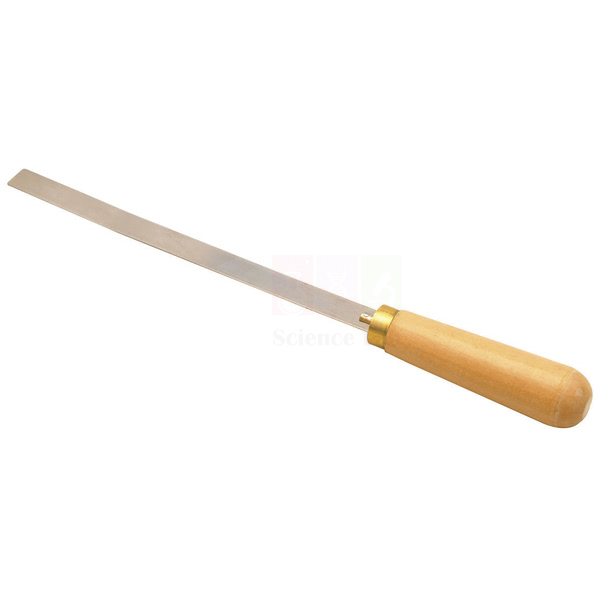
Bimetallic Strip
Bimetallic Strip (Product Code: SLE/PHY/138) is a brass-and-steel strip used to demonstrate the unequal expansion of two metals, which makes the strip curve when it is heated in a flame, in school and college physics labs. The 200 x 15 mm strip is riveted with heat-resistant rivets and set in a well-finished wooden handle for safe holding. It is made by Jain Scientific Equipments Pvt Ltd (ScienceLab), an OEM manufacturer, at its own factory in Ambala, India.
Specifications
| Parameter | Detail |
|---|---|
| Strip size | 200 x 15 mm |
| Metals | Brass and steel |
| Joining | Riveted together with heat-resistant rivets |
| Handle | Well-finished wooden handle |
| Demonstrates | Differential expansion of two metals, shown by the curvature produced when the strip is heated in a flame |
| Product code | SLE/PHY/138 |
| Manufacturer | Jain Scientific Equipments Pvt Ltd (ScienceLab) — OEM |
| Country of origin | India (made in Ambala, Haryana) |
What Is a Bimetallic Strip Used For?
Held in a Bunsen or spirit-lamp flame, the bimetallic strip curls because brass expands more than steel for the same rise in temperature, so the brass ends up on the outside of the curve. Students can then predict how it will bend when chilled instead, and check that it curves the opposite way.
The same effect is the working principle of thermostats, fire alarms and flashing indicator units, which makes the strip a useful bridge between physics lab equipment in India syllabuses and everyday devices. Heat the strip evenly along its length, keep the wooden handle well clear of the flame, and let the metal cool naturally before it goes back into storage.
OEM Manufacturer
Jain Scientific Equipments Private Limited, better known by its trading name ScienceLab, makes this Bimetallic Strip as the OEM at its own licensed factory at Saha, Ambala, Haryana, India. Because the strip comes straight from the maker, institutions, dealers and importers get factory-direct quotations and can ask us about repeat batches for several labs at once. See the company profile for background.
Related Physics Lab Equipment
Other apparatus for the thermal expansion topic:
- Ball & Ring Apparatus — shows a single metal expanding until a ball no longer fits a ring.
- Bar & Gauge Apparatus — tests a heated iron bar against a brass gauge.
- Bar Compound Copper & Iron — another two-metal bar used to explain the thermostat principle.
- Glass Spirit Lamp — a steady, gentle flame for heating the strip.
View the full Physics Lab Equipment category for related heat apparatus.
Frequently Asked Questions
What metals are used in the Bimetallic Strip?
The Bimetallic Strip is made of brass and steel riveted together with heat-resistant rivets. The strip measures 200 x 15 mm and is mounted in a well-finished wooden handle so it can be held in a flame comfortably.
Which way does the Bimetallic Strip bend when heated?
When heated, the Bimetallic Strip bends towards the steel side, because the brass expands more and forms the outer, longer side of the curve. When cooled below room temperature, it bends the other way as the brass contracts more.
What heat source should be used with the Bimetallic Strip?
A Bunsen burner or spirit lamp works well with the Bimetallic Strip. Move the strip slowly through the flame so both metals warm evenly, and hold it by the wooden handle so the hand stays well away from the heated metal.
How does the Bimetallic Strip relate to a thermostat?
The Bimetallic Strip shows the same bending that a thermostat uses: as temperature changes, a two-metal strip curves and can open or close an electrical contact. Showing the strip first helps students understand how irons, heaters and alarms switch themselves.
Who manufactures the Bimetallic Strip?
The Bimetallic Strip is manufactured by Jain Scientific Equipments Pvt Ltd (ScienceLab), the OEM, at its own licensed factory at Saha, Ambala, Haryana, India. It is supplied factory-direct to schools, colleges, institutions, dealers and importers.
How do I get a quotation for the Bimetallic Strip?
To get a quotation for the Bimetallic Strip, send the product code SLE/PHY/138, the quantity you need and your delivery location through our contact page or enquiry cart. Bulk and export enquiries for India and international markets are welcome.
Request a Quote
Request a price for the Bimetallic Strip via the contact page or the enquiry cart; the quotation is prepared directly by the manufacturer.
Last updated: 24 September 2026
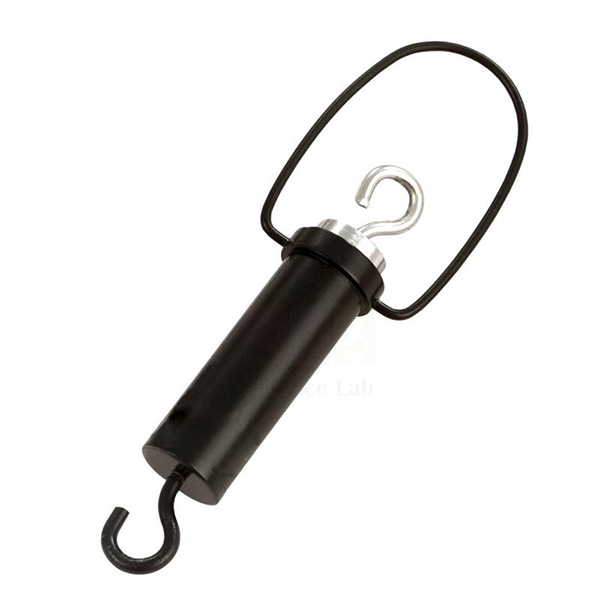
Bucket & Cylinder
Bucket & Cylinder (Product Code: SLE/PHY/140) is a brass apparatus used to verify Archimedes' principle, showing that the upthrust on a submerged cylinder equals the weight of liquid it displaces, in school and college physics labs. The cylinder hooks beneath the bucket, and the unit, listed at 60 mm with an overall size of 160 mm, suits both teacher demonstrations and individual student work. It is made by Jain Scientific Equipments Pvt Ltd (ScienceLab), an OEM manufacturer, at its own factory in Ambala, India.
Specifications
| Parameter | Detail |
|---|---|
| Material | Brass (simple brass unit) |
| Size (as listed) | 60 mm; overall 160 mm |
| Bucket fittings | Suspension loop at the top, hook at the bottom |
| Cylinder fitting | Suspension hook at one end |
| Use | Class demonstration or individual use |
| Demonstrates | Archimedes' principle |
| Product code | SLE/PHY/140 |
| Manufacturer | Jain Scientific Equipments Pvt Ltd (ScienceLab) — OEM |
| Country of origin | India (made in Ambala, Haryana) |
What Is a Bucket and Cylinder Apparatus Used For?
Students record three readings. First, the bucket hangs from a spring balance by its top loop with the cylinder on the bottom hook, in air. Second, the cylinder alone is lowered fully into water and the lower reading is noted. Third, the empty bucket is filled with water while the cylinder stays submerged, and the balance returns to the first reading.
Because the solid cylinder and the inside of the bucket hold the same volume in this type of apparatus, the water added to the bucket weighs exactly as much as the upthrust lost in step two. It is a low-cost addition to physics lab instruments in India for the fluids topic. Wipe the brass dry after each class and hang the parts by their hooks so the loop and hooks keep their shape.
What to Specify When Ordering
- The product code SLE/PHY/140, since other bucket and cylinder sizes are also listed on the site.
- How many sets you need: one for a teacher demonstration or one per student group for individual use.
- Whether spring balances or measuring cylinders should be quoted with the sets.
OEM Manufacturer
This Bucket & Cylinder is produced by Jain Scientific Equipments Private Limited, which trades as ScienceLab and acts as the OEM, at the company's own licensed factory at Saha, Ambala, Haryana, India. Ordering from the maker means one point of contact for price, quantity and any later request for a matching bucket or cylinder. The company supplies schools, colleges, institutions, dealers and importers in India and international markets. Read more on the ScienceLab profile.
Related Physics Lab Equipment
Items that complete an Archimedes' principle practical:
- Bucket & Cylinder, Small — a smaller version for student benches.
- Balance Spring Tubular Plastic — weighs the bucket and cylinder in air and in water.
- Glass Measuring Cylinder — measures the volume of water used to refill the bucket.
- Set to Demonstrate Archimedes' Principle/Law — an alternative plastic set with a dynamometer.
More mechanics and fluids apparatus is in Physics Lab Equipment.
Frequently Asked Questions
How does the Bucket & Cylinder verify Archimedes' principle?
With the Bucket & Cylinder hanging from a spring balance, the reading drops when the cylinder is submerged in water. Filling the bucket with water restores the reading, showing that the upthrust equals the weight of the water the cylinder displaced.
What size is the Bucket & Cylinder (SLE/PHY/140)?
The Bucket & Cylinder (SLE/PHY/140) is listed as 60 mm with an overall size of 160 mm. The listing does not say which part the 60 mm refers to, so ask us through the contact page if you need exact bucket or cylinder dimensions.
Can students use the Bucket & Cylinder individually?
Yes, the Bucket & Cylinder is suitable for class demonstration or individual use. Many labs order one set for the teacher and further sets so that small groups can take their own three readings and compare results.
What else is needed with the Bucket & Cylinder?
To use the Bucket & Cylinder you also need a spring balance to hang it from, a vessel of water deep enough to cover the cylinder, and a stand or hand to hold the balance. These are ordered separately if required.
Who manufactures the Bucket & Cylinder?
The Bucket & Cylinder is manufactured by Jain Scientific Equipments Pvt Ltd (ScienceLab), the OEM, at its own licensed factory at Saha, Ambala, Haryana, India. Quotations and repeat orders for extra sets come directly from the manufacturer.
What should a Bucket & Cylinder quotation request include?
A Bucket & Cylinder quotation request should mention the product code SLE/PHY/140, the number of sets, any spring balances or measuring cylinders you want added, and the delivery address in India or overseas.
Request a Quote
Get a price for the Bucket & Cylinder through the contact page or by adding it to the enquiry cart. Quotations are issued by the manufacturer itself.
Last updated: 24 September 2026
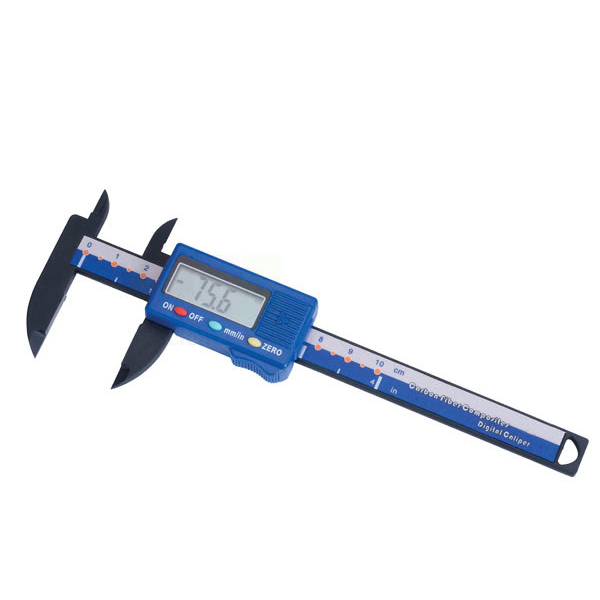
Caliper, Digital
Caliper, Digital (Product Code: SLE/PHY/141) is an LCD digital caliper used to measure the length, thickness and diameter of small objects up to 100 mm (4 in) in school, college and workshop labs. Its body is carbon fibre composite, and the clear LCD can show each reading in either millimetres or inches. It is supplied by Jain Scientific Equipments Pvt Ltd (ScienceLab), Ambala, India.
Specifications
| Parameter | Detail |
|---|---|
| Type | LCD digital caliper |
| Measuring capacity | 100 mm (4 in) |
| Display | Clear LCD |
| Units | Millimetres or inches |
| Construction | Carbon fibre composite |
| Power | 1.55 V battery |
| Product code | SLE/PHY/141 |
| Supplied by | Jain Scientific Equipments Pvt Ltd (ScienceLab), Ambala, India |
What Is a Digital Caliper Used For?
In physics practicals a digital caliper speeds up routine measurement: the diameter of a rod or wire, the side of a density cube, the length and diameter of a metal cylinder, or the thickness of a glass slab. Because the value appears directly on the display, younger students can collect data quickly without first mastering vernier-scale reading, which makes it a handy entry point into digital measuring instruments in India's school labs.
Close the jaws and zero the display before each set of readings, and close the jaws gently on the object rather than forcing them. Keep the jaws clean and dry, switch the unit off after use, and take the battery out if the caliper will be stored for a long time.
Supplier
Jain Scientific Equipments Private Limited, which trades as ScienceLab, supplies this digital caliper from Ambala, Haryana, together with other measuring instruments for physics labs. For vendor registration, the supplying company's Importer-Exporter Code is AAECJ8618A (DGFT) and its GSTIN is 06AAECJ8618A1ZT. Company details are on the ScienceLab profile page.
Related Physics Lab Equipment
Other measuring tools and samples used with a caliper:
- Caliper Vernier (Metal) — the scale-reading alternative for teaching vernier reading.
- Micrometer Screw Gauge, Lock Type — for finer measurement of wire and sheet thickness.
- Metal Density Cubes, Set of 7 — regular solids to measure and weigh in density practicals.
- Cylinders, Metal (Set of 6) — cylinders for diameter and length measurement.
Further measuring apparatus is listed under Physics Lab Equipment.
Frequently Asked Questions
What is the measuring range of the Caliper, Digital?
The Caliper, Digital has a measurement capacity of 100 mm, which is 4 inches. Readings can be shown in either millimetres or inches on its clear LCD display, so the same caliper suits metric and imperial worksheets.
What battery does the Caliper, Digital use?
The Caliper, Digital is powered by a 1.55 V battery. If you would like spare cells quoted with the calipers, mention the quantity in your enquiry, and remove the battery before storing the caliper for a long period.
What is the Caliper, Digital made of?
The Caliper, Digital has carbon fibre composite construction rather than a steel body. Handle it with the same care as any measuring tool: avoid dropping it, keep the jaws clean, and do not use it as a scriber or spanner.
What is the resolution or accuracy of the Caliper, Digital?
The listing for the Caliper, Digital does not state its resolution or accuracy. If your syllabus or tender specifies these values, send the requirement through the contact page and we will confirm the figures for the model we quote.
Is a calibration certificate available for the Caliper, Digital?
A calibration certificate is not listed for the Caliper, Digital. If your institution needs calibration documents for measuring instruments, please discuss the requirement with us before ordering so we can tell you what can be provided.
Who supplies the Caliper, Digital?
The Caliper, Digital is supplied by Jain Scientific Equipments Pvt Ltd (ScienceLab), Ambala, Haryana, India, to schools, colleges, dealers and importers. It can be quoted together with vernier calipers, micrometers and measurement samples.
What should a Caliper, Digital quotation request include?
For a Caliper, Digital quotation, give the product code SLE/PHY/141, the number of calipers, whether spare batteries are wanted and your delivery address. Bulk orders for several labs and export enquiries are welcome.
Request a Quote
Ask for a price on the Caliper, Digital through the contact page or add it to the enquiry cart along with your other measuring instruments.
Last updated: 24 September 2026
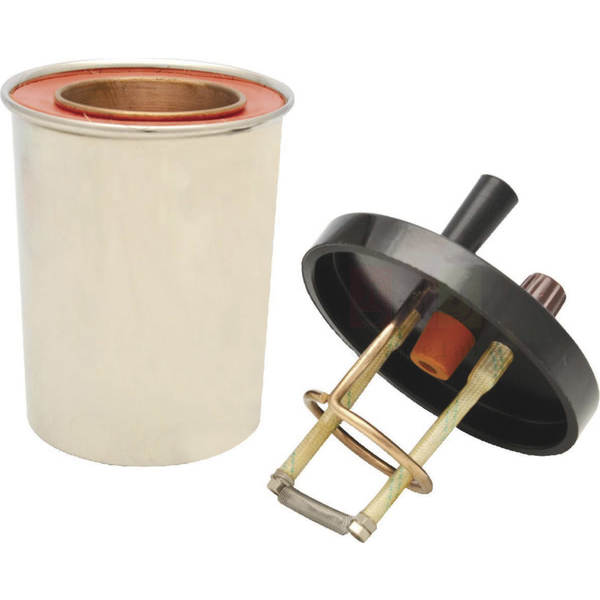
Calorimeter Set, Copper, Joules
Calorimeter Set, Copper, Joules (Product Code: SLE/PHY/142) is an electrically heated calorimeter used to find the specific heat capacity of a liquid by Joule's electrical method in senior-school and college physics labs. A Constantan coil of about 6 ohms, fed through two 4 mm sockets in the ebonite lid, runs at 0.5 A (1 A maximum) inside a lagged, nickel-plated copper vessel. It is made by Jain Scientific Equipments Pvt Ltd (ScienceLab), an OEM manufacturer, at its own factory in Ambala, India.
Specifications
| Parameter | Detail |
|---|---|
| Inner calorimeter | Nickel-plated copper, 75 x 50 mm (diameter) |
| Outer vessel | 100 x 75 mm (diameter); the calorimeter is lagged and enclosed within it |
| Lid | Close-fitting ebonite lid with wire stirrer |
| Terminals | Pair of 4 mm socket terminals connected to the heating coil |
| Heating coil | Constantan wire, approximately 6 ohms |
| Current | 0.5 A recommended, 1 A maximum |
| Thermometer | Not supplied |
| Application | Specific heat capacity of a liquid by the electrical method |
| Product code | SLE/PHY/142 |
| Manufacturer | Jain Scientific Equipments Pvt Ltd (ScienceLab) — OEM |
| Country of origin | India (made in Ambala, Haryana) |
What Is the Joule Calorimeter Used For?
Joule's method equates electrical energy with heat. The energy put in by the coil, voltage × current × time, or the reading on a joulemeter, is set equal to the heat gained by the liquid plus the heat gained by the copper vessel, and the only unknown left is the specific heat capacity of the liquid. Recording the temperature every half minute also lets students plot a heating graph and apply a cooling correction.
As a calorimeter experiment kit for India's Class 11 and 12 thermal physics practicals, the set needs only a low-voltage supply, meters and a thermometer. Constantan is chosen for heating coils because its resistance changes very little as it warms, so the current stays steady. Switch on only when the coil is fully covered by liquid, and keep stirring throughout the run.
What to Specify When Ordering
- Number of sets for your practical batch.
- A thermometer for each set, since none is supplied; state the type or ask us to suggest one.
- A low-voltage supply able to deliver 0.5 A (1 A maximum) and leads with 4 mm plugs.
- Either an ammeter and voltmeter pair or a joulemeter for measuring the energy supplied.
OEM Manufacturer
ScienceLab, the trading name of Jain Scientific Equipments Private Limited, is the OEM for the Calorimeter Set, Copper, Joules and builds it at the company's own licensed factory at Saha, Ambala, Haryana, India. Buying from the manufacturer means requests for a spare lid, stirrer or coil, and repeat orders for new batches, go to the people who make the set; ask us what is currently available. The company supplies schools, colleges, universities, dealers and importers in India and international markets. Find out more on the ScienceLab profile.
Related Physics Lab Equipment
Instruments that complete a Joule's-method practical:
- Joulemeter, Student Digital — reads the electrical energy delivered to the coil directly.
- Joulemeter / Wattmeter, Digital — shows both energy and power during the heating run.
- Power Supply, Stepped — low-voltage supply for driving the heating coil.
- Immersion Thermometer — measures the liquid's temperature, as no thermometer is included.
- Calorimeter Set, Copper — a companion copper calorimeter set listed under code SLE/PHY/30.
See the wider Physics Lab Equipment range for more heat apparatus.
Frequently Asked Questions
Why is it called the Calorimeter Set, Copper, Joules?
The Calorimeter Set, Copper, Joules takes its name from Joule's electrical method, in which a known amount of electrical energy heats a liquid. Comparing that energy with the temperature rise gives the liquid's specific heat capacity.
How is the specific heat capacity calculated with the Calorimeter Set, Copper, Joules?
With the Calorimeter Set, Copper, Joules, the energy supplied (voltage × current × time) equals the mass of liquid × its specific heat × temperature rise, plus the same product for the copper vessel. Rearranging gives the liquid's specific heat capacity.
Can a joulemeter be used with the Calorimeter Set, Copper, Joules?
Yes, a joulemeter can be connected between the supply and the 4 mm terminals of the Calorimeter Set, Copper, Joules to read the energy directly. This saves timing and multiplying, and students can focus on stirring and temperature readings.
What current should the Calorimeter Set, Copper, Joules be run at?
The Calorimeter Set, Copper, Joules should be run at 0.5 A, with 1 A as the maximum. Its Constantan coil is approximately 6 ohms, so a low-voltage supply is enough to drive the recommended current through it.
Does the Calorimeter Set, Copper, Joules include a thermometer?
No, the Calorimeter Set, Copper, Joules is supplied without a thermometer. Choose one that reads the temperature range of your experiment and add it to your enquiry so it can be quoted with the sets.
Who manufactures the Calorimeter Set, Copper, Joules?
The Calorimeter Set, Copper, Joules is manufactured by Jain Scientific Equipments Pvt Ltd (ScienceLab), the OEM, at its own licensed factory at Saha, Ambala, Haryana, India. Quotations and repeat orders come from the manufacturer directly.
What should a quotation request for the Calorimeter Set, Copper, Joules include?
For the Calorimeter Set, Copper, Joules, state the product code SLE/PHY/142, the number of sets, and whether thermometers, a power supply or a joulemeter should be added. Include the delivery address for India or export shipment.
Request a Quote
Request pricing for the Calorimeter Set, Copper, Joules through the contact page or the enquiry cart. Quotes are sent direct from the manufacturer.
Last updated: 24 September 2026
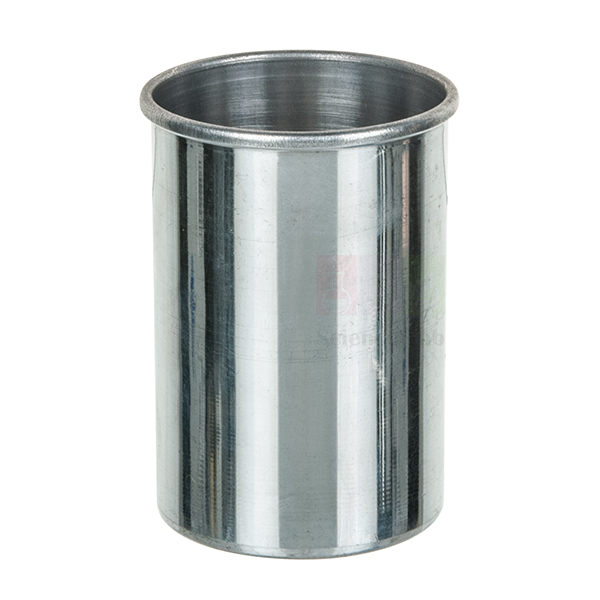
Calorimeter, Aluminium
Calorimeter, Aluminium (Product Code: SLE/PHY/143) is a plain aluminium calorimeter cup used to hold water or another liquid during heat-exchange experiments such as the method of mixtures in school and college physics labs. It has parallel sides and a rolled rim, measures 75 mm long by 50 mm in diameter, and comes without a stirrer. It is made by Jain Scientific Equipments Pvt Ltd (ScienceLab), an OEM manufacturer, at its own factory in Ambala, India.
Specifications
| Parameter | Detail |
|---|---|
| Material | Aluminium |
| Form | Parallel sides with rolled rim |
| Length | 75 mm |
| Diameter | 50 mm |
| Stirrer | Not included (supplied without stirrer) |
| Product code | SLE/PHY/143 |
| Manufacturer | Jain Scientific Equipments Pvt Ltd (ScienceLab) — OEM |
| Country of origin | India (made in Ambala, Haryana) |
What Is an Aluminium Calorimeter Used For?
The aluminium calorimeter is the container in which heat is exchanged and measured. Typical practicals include finding the specific heat capacity of a metal by dropping a heated sample into cold water in the cup, measuring the latent heat of fusion of ice, and recording cooling curves. The cup itself absorbs some heat, so students weigh it empty first and include it in their heat balance.
For better results in calorimeter lab work in India's school and college labs, stand the cup inside a lagging jacket or an insulated outer container to cut heat loss, and stir with a separate stirrer so the temperature is even. Rinse and dry the cup after use; the rolled rim gives a smooth edge for handling and pouring.
What to Specify When Ordering
- The number of aluminium calorimeters needed for your student groups.
- Stirrers and thermometers, which are not included with the cup.
- Lagging or an outer container if you want to reduce heat loss.
- Whether you also need copper calorimeters for comparison work.
OEM Manufacturer
Jain Scientific Equipments Private Limited, trading under the ScienceLab name, is the OEM that makes this aluminium calorimeter at its own licensed factory at Saha, Ambala, Haryana, India. Laboratories that need matching cups for a whole class can order them straight from the factory, and later top-up orders are handled by the same manufacturer. Schools, colleges, dealers and importers in India and international markets are supplied factory-direct. More on the company is on the ScienceLab profile page.
Related Physics Lab Equipment
Items commonly used with an aluminium calorimeter:
- Calorimeter, Copper — a larger copper cup for comparison experiments.
- Calorimeter Set, Aluminium — an aluminium set with stirrer and heating element for electrical methods.
- Calorimeter Lagging — felt jacket and mat that reduce heat loss from the cup.
- Immersion Thermometer — reads the water temperature before and after mixing.
- Cylinders, Metal (Set of 6) — metal samples for specific heat by the method of mixtures.
More heat apparatus is available in Physics Lab Equipment.
Frequently Asked Questions
What are the dimensions of the Calorimeter, Aluminium?
The Calorimeter, Aluminium is 75 mm long and 50 mm in diameter, with parallel sides and a rolled rim. The compact size suits student benches where small volumes of water are heated or mixed during a practical period.
Does the Calorimeter, Aluminium come with a stirrer?
No, the Calorimeter, Aluminium is supplied without a stirrer. A separate stirrer should be used to mix the contents during experiments, and it can be added to your enquiry along with thermometers if you need them.
Which experiments use the Calorimeter, Aluminium?
The Calorimeter, Aluminium is used for specific heat capacity by the method of mixtures, latent heat of fusion of ice, and cooling-curve experiments. In each case the cup holds the liquid while temperatures are measured before and after heat is exchanged.
Should I choose the Calorimeter, Aluminium or a copper calorimeter?
Choose the Calorimeter, Aluminium when your practical manual specifies aluminium or when a smaller cup suits the experiment. A copper calorimeter is also listed; follow the metal named in your method, since the cup's specific heat enters the calculation.
Who manufactures the Calorimeter, Aluminium?
The Calorimeter, Aluminium is manufactured by Jain Scientific Equipments Pvt Ltd (ScienceLab), the OEM, at its own licensed factory at Saha, Ambala, Haryana, India. Quotations and repeat orders are handled by the manufacturer directly.
What should a Calorimeter, Aluminium quotation request include?
Include the product code SLE/PHY/143, the number of Calorimeter, Aluminium cups, any stirrers, thermometers or lagging you want added, and the delivery address. Bulk orders for several labs and export enquiries are welcome.
Request a Quote
For a price on the Calorimeter, Aluminium, contact us through the contact page or use the enquiry cart. Quotations come direct from the manufacturer.
Last updated: 24 September 2026
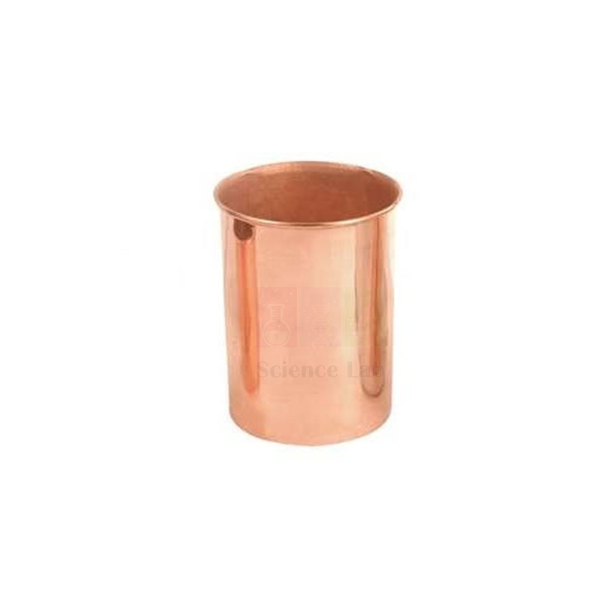
Calorimeter, Copper
Calorimeter, Copper (Product Code: SLE/PHY/144) is a plain copper calorimeter vessel used to contain water or other liquids in specific-heat, latent-heat and cooling experiments in school and college physics laboratories. At 100 mm long and 65 mm in diameter, with parallel sides and a rolled rim, it leaves room for a thermometer, a stirrer and a solid sample; no stirrer is included. It is made by Jain Scientific Equipments Pvt Ltd (ScienceLab), an OEM manufacturer, at its own factory in Ambala, India.
Specifications
| Parameter | Detail |
|---|---|
| Material | Copper |
| Shape | Parallel sides, rolled rim |
| Length | 100 mm |
| Diameter | 65 mm |
| Stirrer | Without stirrer |
| Product code | SLE/PHY/144 |
| Manufacturer | Jain Scientific Equipments Pvt Ltd (ScienceLab) — OEM |
| Country of origin | India (made in Ambala, Haryana) |
What Is a Copper Calorimeter Used For?
Copper conducts heat very well, so the vessel and its contents settle to the same temperature quickly, which keeps readings consistent. Common practicals include the specific heat capacity of a solid by the method of mixtures, the latent heat of vaporisation of water by condensing steam into the cup, and Newton's law of cooling, where the copper cup is filled with hot water and its temperature is logged as it cools.
It is a standard piece of thermometry apparatus in India's physics labs. Keep the outside surface clean and bright to limit heat lost by radiation, weigh the empty vessel before each experiment, and dry it straight after use to slow tarnishing. A separate stirrer is needed, since the cup is supplied bare.
What to Specify When Ordering
- The quantity of copper calorimeters per lab or per student pair.
- Stirrers and thermometers to go with them, as none are included.
- Any lagging or outer container for insulated work.
- Whether aluminium calorimeters are also needed for comparison.
OEM Manufacturer
This copper calorimeter is made by Jain Scientific Equipments Private Limited, the company behind the ScienceLab brand, which is the OEM and produces it at its own licensed factory at Saha, Ambala, Haryana, India. Institutions ordering class sets deal with the maker itself, so quotations, repeat orders and delivery questions are answered at source rather than by a trading intermediary. Dealers and importers in India and international markets are supplied on the same factory-direct basis. Visit the ScienceLab profile for more about the company.
Related Physics Lab Equipment
Apparatus used with a copper calorimeter in heat practicals:
- Calorimeter, Aluminium — a smaller aluminium cup for comparison work.
- Calorimeter Set, Copper, Joules — lagged copper set with its own heating coil for the electrical method.
- Apparatus for Newton's Cooling Law — dedicated set-up for cooling-rate experiments.
- Calorimeter Lagging — felt jacket and base mat to insulate the vessel.
- Digital Pocket Thermometer — quick temperature readings of the water in the cup.
Explore the full Physics Lab Equipment category for more heat apparatus.
Frequently Asked Questions
What size is the Calorimeter, Copper?
The Calorimeter, Copper is 100 mm long and 65 mm in diameter, with parallel sides and a rolled rim. This gives enough room for a thermometer, a stirrer and a solid sample to sit in the liquid at the same time.
Is a stirrer included with the Calorimeter, Copper?
No, the Calorimeter, Copper is supplied without a stirrer. Order a stirrer separately, or tell us in your enquiry and we will quote one with the calorimeters, together with thermometers if your lab needs them.
Which practicals use the Calorimeter, Copper?
The Calorimeter, Copper is used for specific heat capacity of solids by the method of mixtures, latent heat of vaporisation of water, and Newton's law of cooling. Its good thermal conductivity helps the vessel and its contents reach a common temperature quickly.
How should the Calorimeter, Copper be cleaned and stored?
Rinse the Calorimeter, Copper with clean water after each practical, dry it thoroughly and store it upright in a dry cupboard. Keeping the outside bright reduces heat loss by radiation, and prompt drying slows the dull tarnish that copper develops.
Who manufactures the Calorimeter, Copper?
The Calorimeter, Copper is manufactured by Jain Scientific Equipments Pvt Ltd (ScienceLab), the OEM, at its own licensed factory at Saha, Ambala, Haryana, India. Schools, colleges and importers buy it direct from the manufacturer.
What details does a Calorimeter, Copper quotation need?
For a Calorimeter, Copper quotation, send the product code SLE/PHY/144, the number of vessels, any stirrers, thermometers or lagging to include, and your delivery address. We quote for buyers in India and international markets.
Request a Quote
Price the Calorimeter, Copper by writing to us on the contact page or adding it to the enquiry cart. The manufacturer sends the quotation directly.
Last updated: 24 September 2026
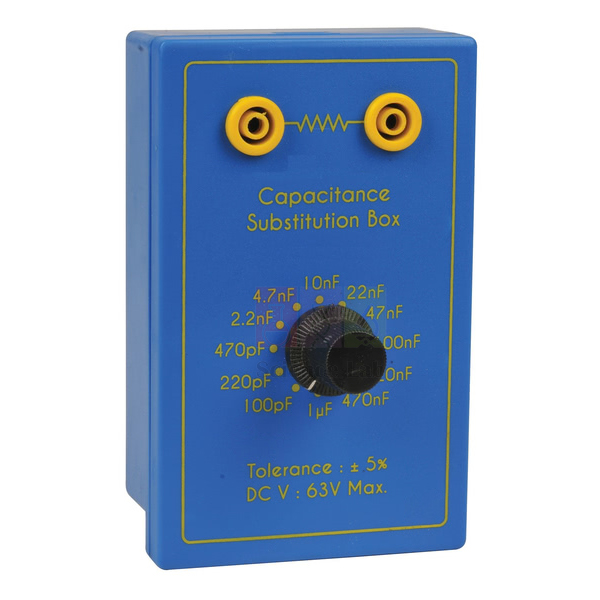
Capacitance Substitution Box
Capacitance Substitution Box (Product Code: SLE/PHY/145) is a switch-selected capacitor box used to insert a known capacitance into a circuit for RC timing, filter and AC reactance experiments in physics and electronics labs. A rotary selector switch chooses preferred values from 100 pF to 1 µF, each within ±5% and rated at 63 V, through two 4 mm safety sockets on a 75 x 100 x 40 mm ABS case. It is supplied by Jain Scientific Equipments Pvt Ltd (ScienceLab), Ambala, India.
Specifications
| Parameter | Detail |
|---|---|
| Case | Robust ABS, 75 x 100 x 40 mm |
| Selector | Rotary selector switch |
| Connections | Two 4 mm safety sockets |
| Capacitance values | 100 pF, 220 pF, 470 pF, 2.2 nF, 4.7 nF, 10 nF, 22 nF, 47 nF, 100 nF, 220 nF, 470 nF, 1 µF |
| Range | Preferred values from 100 pF to 1 µF |
| Accuracy | ±5% (all values) |
| Voltage rating | 63 V (all values) |
| Product code | SLE/PHY/145 |
| Supplied by | Jain Scientific Equipments Pvt Ltd (ScienceLab), Ambala, India |
What Is a Capacitance Substitution Box Used For?
Instead of soldering individual capacitors, students turn the selector to swap values and see at once how capacitance changes the time constant of an RC circuit, the cut-off point of a simple filter, or the reactance of a capacitor in an AC circuit driven by a signal generator and viewed on an oscilloscope. That flexibility makes it a useful part of any AC DC circuits experiment kit at college level.
Because the values run from picofarads to one microfarad, the box suits signal-frequency work; slow charge-and-discharge demonstrations read on a meter usually use larger capacitors. Keep the applied voltage below the 63 V rating, switch the supply off before changing value, and connect with shrouded 4 mm leads.
What to Specify When Ordering
- The number of capacitance substitution boxes needed.
- Whether a resistance substitution box should be quoted for RC work.
- Whether a signal generator and oscilloscope are also required.
- Connecting leads with 4 mm plugs for the safety sockets.
Supplier
ScienceLab is the trading name of Jain Scientific Equipments Private Limited, which supplies this capacitance substitution box from Ambala, Haryana, for physics and electronics laboratories. Institutional and tender buyers who need vendor registration details can use GSTIN 06AAECJ8618A1ZT and LEI 3358004HRD1JIVXKYX49. Background on the company is on the ScienceLab profile page.
Related Physics Lab Equipment
Instruments used with a capacitance box in circuit experiments:
- Resistance Substitution Box — switch-selected resistors to pair with the capacitors in RC circuits.
- Signal Generator and Amplifier — AC source for reactance and filter experiments.
- Oscilloscope Dual Trace — displays charging curves and phase differences.
- Advanced Digital Multimeter — measures circuit voltages and currents.
- Stackable Leads — 4 mm leads for the safety sockets.
Browse all Physics Lab Equipment for further electricity apparatus.
Frequently Asked Questions
What capacitance values does the Capacitance Substitution Box provide?
The Capacitance Substitution Box selects 100 pF, 220 pF, 470 pF, 2.2 nF, 4.7 nF, 10 nF, 22 nF, 47 nF, 100 nF, 220 nF, 470 nF and 1 µF, a set of preferred values chosen with its rotary switch.
What are the accuracy and voltage rating of the Capacitance Substitution Box?
Every value in the Capacitance Substitution Box has an accuracy of ±5% and a rating of 63 V. Keep circuit voltages below that rating, and allow for the ±5% tolerance when comparing measured time constants with calculated ones.
How is the Capacitance Substitution Box connected to a circuit?
The Capacitance Substitution Box connects through two 4 mm safety sockets on its ABS case, so standard 4 mm plug leads fit directly. The selected capacitor appears between the two sockets as soon as the rotary switch is turned.
Can the Capacitance Substitution Box be used for RC time-constant experiments?
Yes, the Capacitance Substitution Box can be combined with a resistor or resistance box for RC experiments. With its picofarad-to-microfarad values the time constants are short, so a signal generator and oscilloscope are the usual way to observe them.
Is a calibration certificate available for the Capacitance Substitution Box?
A calibration certificate is not listed for the Capacitance Substitution Box. If your tender or quality system asks for calibration documents, please raise it through the contact page before ordering so we can confirm what is possible.
Who supplies the Capacitance Substitution Box?
The Capacitance Substitution Box is supplied by Jain Scientific Equipments Pvt Ltd (ScienceLab), Ambala, Haryana, India. Schools, colleges, universities, dealers and importers can order it alongside resistance boxes, meters and signal sources.
What should a Capacitance Substitution Box quotation request include?
For a Capacitance Substitution Box quotation, give the product code SLE/PHY/145, the quantity, any companion instruments or leads you want quoted, and your delivery address in India or abroad.
Request a Quote
Ask for a price on the Capacitance Substitution Box through the contact page or add it to the enquiry cart with your other electricity items.
Last updated: 24 September 2026
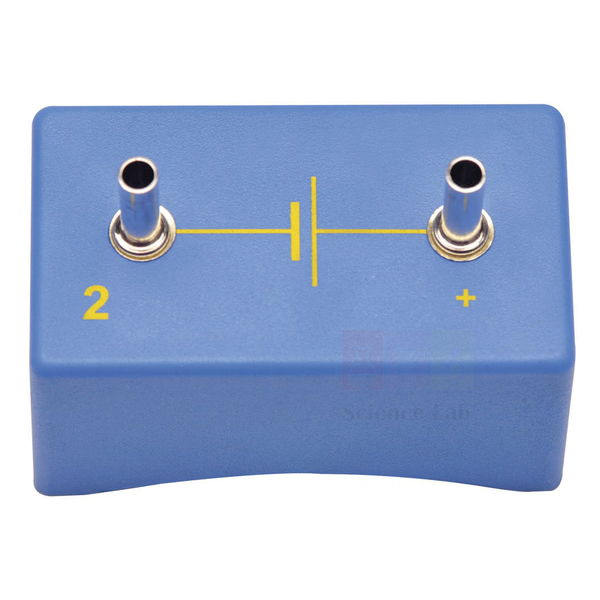
Circuits Kit Cell Holder
Circuits Kit Cell Holder (Product Code: SLE/PHY/146) is a panel-mounted battery holder used as the power source in a Circuits Kit for building simple series and parallel circuits in school science labs. It takes one D-size battery and, like the other Circuits Kit spares, sits on a sturdy panel that is easy to handle during lessons and to stack away afterwards. It is made by Jain Scientific Equipments Pvt Ltd (ScienceLab), an OEM manufacturer, at its own factory in Ambala, India.
Key Details
| Parameter | Detail |
|---|---|
| Type | Spare cell holder for the Circuits Kit |
| Battery | Uses 1 x D battery |
| Mounting | Sturdy panel, for ease of use and storage |
| Product code | SLE/PHY/146 |
| Manufacturer | Jain Scientific Equipments Pvt Ltd (ScienceLab) — OEM |
| Country of origin | India (made in Ambala, Haryana) |
What Is the Circuits Kit Cell Holder Used For?
The cell holder is where every Circuits Kit investigation starts: it supplies the voltage that drives current through lamps, buzzers, switches and rheostats. Adding a second or third holder in series lets students see a lamp glow brighter as the voltage rises, while holders side by side show how cells in parallel share the load, a core idea in any electricity experiment kit for school.
Extra holders are useful when a class splits into more groups than the original kit allows. Take the D cells out at the end of each lesson so they cannot leak, check the contacts for corrosion now and then, and store the panels flat with the other kit spares.
What to Specify When Ordering
- How many spare cell holders you need for your Circuits Kits.
- Whether D batteries should be quoted with the holders.
- Any other Circuits Kit spares required, such as bulb holders, push switches, buzzers or rheostats.
OEM Manufacturer
The Circuits Kit Cell Holder is one of the kit spares that Jain Scientific Equipments Private Limited, trading as ScienceLab, makes as the OEM at its own licensed factory at Saha, Ambala, Haryana, India. Because ScienceLab also makes the other Circuits Kit spares, schools can top up or extend their kits by ordering individual panels direct, without going through a trader. Dealers and importers in India and international markets are also supplied factory-direct. See the ScienceLab profile for company details.
Related Physics Lab Equipment
Other Circuits Kit panels and accessories:
- Circuits Kit Bulb Holder — lamp panel powered by the cell holder.
- Circuits Kit Push Switch — opens and closes the circuit.
- Circuits Kit Buzzer — an audible output component for circuit tests.
- Circuits Kit Rheostat — varies the current in the circuit.
- Electricity Circuits Kit — a panel-based kit for simple circuit investigations.
Find more circuit apparatus in Physics Lab Equipment.
Frequently Asked Questions
Which battery does the Circuits Kit Cell Holder take?
The Circuits Kit Cell Holder uses one D-size battery. The listing describes the holder panel only, so if you want D cells supplied with it, add them to your enquiry and they can be quoted together.
Is the Circuits Kit Cell Holder compatible with other kits?
The Circuits Kit Cell Holder is a spare for the Circuits Kit and matches its other panel-mounted components. If you want to use it with a kit from another source, send us details of that kit's connections through the contact page first.
Can several Circuits Kit Cell Holders be used together?
Yes, several Circuits Kit Cell Holders can be connected in series to increase the voltage, or in parallel so the cells share the load. Comparing lamp brightness for each arrangement is a common lesson.
Why is the Circuits Kit Cell Holder mounted on a panel?
The Circuits Kit Cell Holder is mounted on a sturdy panel for ease of use and storage. The panel gives students a stable base when building circuits on the bench and lets teachers stack components neatly between classes.
Who manufactures the Circuits Kit Cell Holder?
The Circuits Kit Cell Holder is manufactured by Jain Scientific Equipments Pvt Ltd (ScienceLab), the OEM, at its own licensed factory at Saha, Ambala, Haryana, India, alongside the other Circuits Kit spares.
What should a Circuits Kit Cell Holder quotation request include?
For a Circuits Kit Cell Holder quotation, give the product code SLE/PHY/146, the number of holders, whether D batteries or other kit spares should be included, and the delivery address for India or export.
Request a Quote
Request a price for the Circuits Kit Cell Holder via the contact page or the enquiry cart. Quotations are issued directly by the manufacturer.
Last updated: 24 September 2026
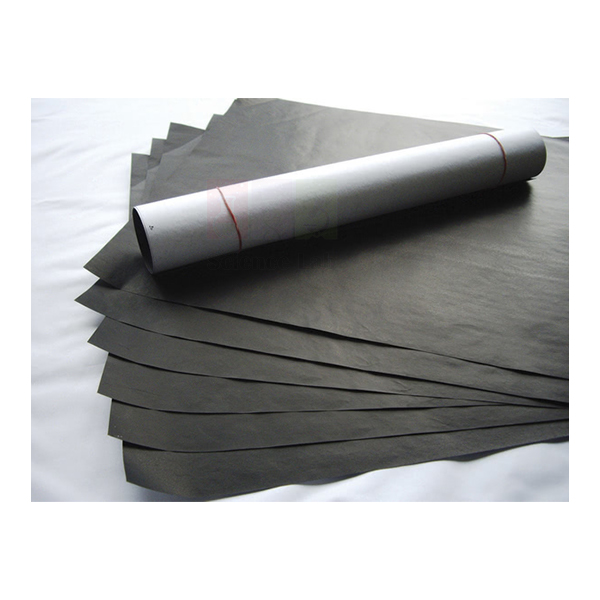
Conductive Paper
Conductive Paper (Product Code: SLE/PHY/147) is a resistive paper used to map electric fields by the equipotential points method in school and college physics labs. It comes as sheets of 38 cm x 53 cm, packed ten to a pack, and can also be cut into strips to make simple home-made resistors for electricity investigations. It is supplied by Jain Scientific Equipments Pvt Ltd (ScienceLab), Ambala, India.
Specifications
| Parameter | Detail |
|---|---|
| Material | Conductive paper sheet |
| Sheet size | 38 cm x 53 cm |
| Pack | Pack of 10 sheets |
| Main use | Plotting electric fields by the equipotential points method |
| Other use | Producing home-made strip resistors |
| Product code | SLE/PHY/147 |
| Supplied by | Jain Scientific Equipments Pvt Ltd (ScienceLab), Ambala, India |
What Is Conductive Paper Used For?
To plot a field, two electrodes are fixed on the sheet and connected to a low-voltage DC supply. A probe linked to a voltmeter or centre-zero galvanometer is moved across the paper to find points at the same potential; students mark them, join them into equipotential lines, and then sketch field lines at right angles. Changing the electrode shapes, such as two points, two parallel bars, or a point and a ring, shows how the field pattern follows the geometry.
Cut into strips, the same paper becomes a cheap resistor whose resistance rises with length and falls with width, which makes a neat investigation for physics lab equipment in India at secondary level. Store the sheets flat and dry, avoid folding or creasing them, and handle them by the edges to keep the surface even.
What to Specify When Ordering
- The number of packs (each pack holds 10 sheets of 38 cm x 53 cm).
- Whether a probe, galvanometer or voltmeter is needed for field plotting.
- Whether a low-voltage DC power supply should be quoted as well.
Supplier
Jain Scientific Equipments Private Limited, trading as ScienceLab, supplies conductive paper from Ambala, Haryana, as a consumable for electrostatics and electricity practicals. Schools, colleges, dealers and importers in India and international markets can order it together with the meters and supplies used in field-plotting work. Company information is on the ScienceLab profile page.
Related Physics Lab Equipment
Apparatus used with conductive paper:
- Galvanometer, Centre Zero Universal Meter — null indicator for locating equipotential points.
- Jockey with Insulated Handle (Single) — insulated probe for touching points on the sheet.
- Power Supply, Stepped — low-voltage source for the electrodes.
- Standard Digital Multimeter — reads potential at each point or the resistance of a strip.
- Conductive Putty — another shape-it-yourself conductor for resistance experiments.
See more in the Physics Lab Equipment category.
Frequently Asked Questions
What size is Conductive Paper and how many sheets are in a pack?
Conductive Paper comes in sheets of 38 cm x 53 cm, with 10 sheets in each pack. One sheet can be cut into smaller pieces so several student groups can plot fields or make strip resistors at the same time.
How is Conductive Paper used to plot electric fields?
On Conductive Paper, two electrodes are connected to a DC supply and a probe finds points of equal potential using a meter or galvanometer. Joining those points gives equipotential lines, and field lines are drawn at right angles to them.
Can Conductive Paper be used to make resistors?
Yes, Conductive Paper can be cut into strips to produce home-made resistors. Students can compare strips of different lengths and widths to see how resistance depends on the shape of a conductor, using a multimeter to take the readings.
What else is needed with Conductive Paper?
To use Conductive Paper for field plotting you need electrodes, a low-voltage DC power supply, connecting leads, a probe and a voltmeter or centre-zero galvanometer. These are ordered separately and can be quoted together with the paper.
How should Conductive Paper be stored?
Store Conductive Paper flat in a dry cupboard, away from damp and direct sunlight. Avoid folding or creasing the sheets and handle them by the edges, because a damaged surface can distort the equipotential pattern during an experiment.
Who supplies Conductive Paper?
Conductive Paper is supplied by Jain Scientific Equipments Pvt Ltd (ScienceLab), Ambala, Haryana, India. Schools, colleges, dealers and importers can order it in packs of 10 sheets alongside the meters and power supplies used with it.
What should a Conductive Paper quotation request include?
A Conductive Paper quotation request should give the product code SLE/PHY/147, the number of packs, any meters, probes or power supplies you want added, and the delivery address in India or abroad.
Request a Quote
For a price on Conductive Paper, get in touch through the contact page or add it to the enquiry cart with the rest of your electricity consumables.
Last updated: 24 September 2026
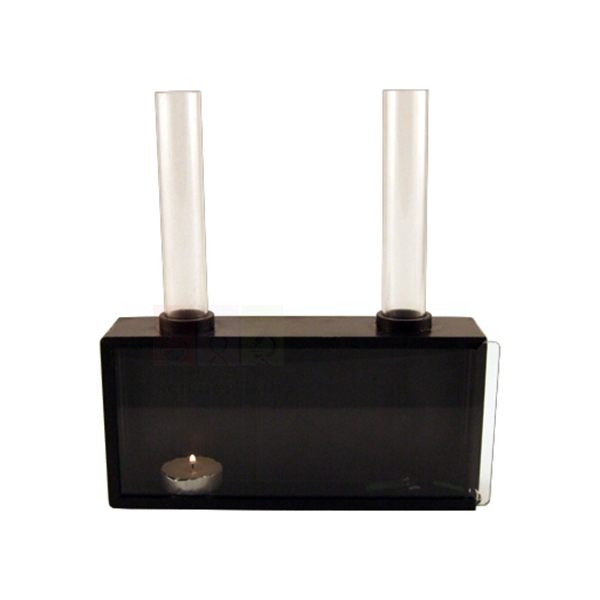
Convection in Air Apparatus
Convection in Air Apparatus (Product Code: SLE/PHY/148) is a two-chimney box used to make convection currents in air visible, with smoke drawn down one chimney and up the other over a candle, in school science labs. It is a metal box of 220 x 100 x 165 mm with a sliding glass front, two detachable glass chimneys and a candle holder fixed beneath the left chimney. It is made by Jain Scientific Equipments Pvt Ltd (ScienceLab), an OEM manufacturer, at its own factory in Ambala, India.
Specifications
| Parameter | Detail |
|---|---|
| Box | Metal, 220 x 100 x 165 mm |
| Front | Sliding glass front |
| Chimneys | Two detachable glass chimneys |
| Candle holder | Fixed to the base beneath the left chimney |
| Candles | Not included |
| Product code | SLE/PHY/148 |
| Manufacturer | Jain Scientific Equipments Pvt Ltd (ScienceLab) — OEM |
| Country of origin | India (made in Ambala, Haryana) |
What Is the Convection in Air Apparatus Used For?
A candle is lit in the holder under the left chimney and the glass front is slid shut. When smouldering paper or an incense stick is held over the right chimney, the smoke is pulled down into the box, drifts across to the flame and rises out through the left chimney. Students see that warm air rises and cooler air flows in to replace it, which is the basis of convection currents.
This simple demonstration model for the physics lab links directly to sea and land breezes, room ventilation and why chimneys draw. Use a short candle so the flame sits well below the chimney, keep the glass front closed during the demonstration, and let the chimneys cool before lifting them off to wipe away soot.
What to Specify When Ordering
- The number of Convection in Air Apparatus units needed.
- Candles, since none are included with the apparatus.
- Whether spare glass chimneys should be quoted with the order.
OEM Manufacturer
Jain Scientific Equipments Private Limited, trading as ScienceLab (CIN U29309HR2020PTC087597), is the OEM of the Convection in Air Apparatus. The apparatus is made at the company's own licensed factory at 449, HSIIDC Industrial Area, Saha, Ambala, which operates under Factory Licence AMB-ONLINE-CHD-J-414. Schools, institutions, dealers and importers receive it factory-direct, and replacement glass chimneys can be requested from the manufacturer, so ask us about availability. Learn more on the ScienceLab profile page.
Related Physics Lab Equipment
Apparatus covering the other ways heat travels:
- Apparatus Convection In Liquid — shows convection currents in water.
- Convection of Gas Apparatus — an alternative box-and-chimney air convection unit.
- Apparatus Heat/Thermal Conductivity — compares conduction in different metals.
- Heat Absorption & Radiation Comparator — compares absorption by black and shiny surfaces.
- Investigating Heat Poster — laminated chart summarising heat transfer.
Browse the full Physics Lab Equipment range for more heat apparatus.
Frequently Asked Questions
What are the dimensions of the Convection in Air Apparatus?
The Convection in Air Apparatus is a metal box measuring 220 x 100 x 165 mm, with a sliding glass front and two detachable glass chimneys on top. The candle holder is fixed to the base beneath the left chimney.
Are candles included with the Convection in Air Apparatus?
No, candles are not included with the Convection in Air Apparatus. Any short candle that fits the fixed holder can be used; add candles to your enquiry if you would like them quoted along with the apparatus.
How does the Convection in Air Apparatus show convection?
In the Convection in Air Apparatus, the candle heats the air under the left chimney so it rises out of the box. Cooler air is drawn in through the right chimney, and smoke held above it makes this current of air clearly visible.
Can the chimneys of the Convection in Air Apparatus be removed?
Yes, both glass chimneys of the Convection in Air Apparatus are detachable. They can be lifted off for cleaning soot or for compact storage, but always allow them to cool completely after a demonstration before handling.
Who manufactures the Convection in Air Apparatus?
The Convection in Air Apparatus is manufactured by Jain Scientific Equipments Pvt Ltd (ScienceLab), the OEM, at its own licensed factory at Saha, Ambala, Haryana, India. Buyers receive quotations and repeat supplies direct from the manufacturer.
What should a Convection in Air Apparatus quotation request include?
A Convection in Air Apparatus quotation request should give the product code SLE/PHY/148, the number of units, whether candles or spare chimneys are wanted, and the delivery address in India or overseas.
Request a Quote
Send your enquiry for the Convection in Air Apparatus through the contact page or add it to the enquiry cart. Quotations are prepared by the manufacturer itself.
Last updated: 24 September 2026

Crocodile Clip
Crocodile Clip (Product Code: SLE/PHY/149) is a standard-size spring clip used to make quick, temporary connections to wires, terminals and component legs in school and college electricity labs. Each nickel-plated steel clip is 50 mm long and rated at 10 A, with a 4 mm socket at the rear and a screw connection that can also be soldered; clips come in packs of 100. They are supplied by Jain Scientific Equipments Pvt Ltd (ScienceLab), Ambala, India.
Specifications
| Parameter | Detail |
|---|---|
| Size | Standard |
| Material | Nickel-plated steel |
| Length | 50 mm |
| Current rating | 10 A |
| Rear connection | 4 mm socket |
| Wire connection | Screw connection; can also be soldered |
| Pack | 100 clips |
| Product code | SLE/PHY/149 |
| Supplied by | Jain Scientific Equipments Pvt Ltd (ScienceLab), Ambala, India |
What Is a Crocodile Clip Used For?
Pushing a 4 mm plug lead into the rear socket turns any lead into a clip-on lead, so students can grip a resistor leg, an electrode, a lamp terminal or a bare wire without tools. Alternatively, a wire can be clamped under the screw or soldered on to make custom test leads, battery connectors or jumper wires for a class set.
A pack of 100 is sized for school lab equipment bulk supply, equipping several benches or replacing clips lost over a term. The 10 A rating comfortably covers low-voltage student circuits; keep the jaws clean for good contact, check that screws are tight, and never use these open clips on mains wiring.
Supplier
ScienceLab, the trading name of Jain Scientific Equipments Private Limited, supplies these crocodile clips from Ambala, Haryana, together with the leads and wire used to make up connections. Schools, colleges, dealers and importers in India and international markets can include them in a single order with other electricity accessories. Visit the ScienceLab profile page for company information.
Related Physics Lab Equipment
Leads and connectors that work with crocodile clips:
- Crocodile Clips & Leads — ready-made leads with a clip at each end.
- Stackable Leads — 4 mm plug leads that fit the clip's rear socket.
- Banana Plug Connectors Leads — 4 mm plug leads for meters and power supplies.
- Battery Snap with Crocodile Clip — battery connector with clips already attached.
- Connecting Wire — copper wire for making your own clip leads.
More connectors and circuit parts are in Physics Lab Equipment.
Frequently Asked Questions
How many clips are in a pack of Crocodile Clip (SLE/PHY/149)?
The Crocodile Clip (SLE/PHY/149) is sold in packs of 100 standard-size clips. That quantity lets a school equip several benches at once or keep spares in stock for clips that go missing during practicals.
What is the current rating of the Crocodile Clip?
Each Crocodile Clip is rated at 10 A. This is ample for the low-voltage circuits used in school and college electricity practicals, such as lamps, motors, resistors and electrolysis cells powered from a bench supply.
How is a wire or lead attached to the Crocodile Clip?
The Crocodile Clip has a 4 mm socket at the rear that accepts a standard 4 mm plug. A bare wire can also be fixed under its screw connection, or soldered to it for a permanent joint.
What is the Crocodile Clip made of and how long is it?
The Crocodile Clip is made of nickel-plated steel and is 50 mm long. The standard size gives a firm grip on terminals and component leads while staying small enough to work on crowded circuit boards.
Who supplies the Crocodile Clip?
The Crocodile Clip is supplied by Jain Scientific Equipments Pvt Ltd (ScienceLab), Ambala, Haryana, India. Schools, colleges, dealers and importers can order packs together with leads, wire and other electricity accessories.
What should a Crocodile Clip quotation request include?
A Crocodile Clip quotation request should give the product code SLE/PHY/149, the number of packs of 100, any leads or connecting wire you want added, and the delivery address in India or abroad.
Request a Quote
Request a price for the Crocodile Clip through the contact page or add packs to the enquiry cart with your other circuit accessories.
Last updated: 24 September 2026
Crushing Can
Crushing Can (Product Code: SLE/PHY/150) is a light-walled tin plate can with an air-tight screw cap used to demonstrate the force exerted by atmospheric pressure in school and college physics laboratories. Teachers rely on it for a memorable class demonstration in which the 75 mm diameter can collapses once the air inside has been driven out by steam. It is made by Jain Scientific Equipments Pvt Ltd (ScienceLab), an OEM manufacturer, at its own factory in Ambala, India, as part of its physics lab equipment for schools.
Specifications
| Parameter | Detail |
|---|---|
| Construction | Light-walled tin plate can |
| Closure | Air-tight screw cap |
| Dimensions | 260 x 75 mm (75 mm diameter) |
| Demonstrates | Force exerted by atmospheric pressure |
| Product code | SLE/PHY/150 |
| Manufacturer | Jain Scientific Equipments Pvt Ltd (ScienceLab) — OEM |
| Country of origin | India (made in Ambala, Haryana) |
What Is the Crushing Can Used For?
The crushing can experiment shows students that the air around them presses on every surface with a surprisingly large force. A little water is heated in the open can until steam pushes most of the air out, the heat is removed and the cap is screwed on tight. As the steam cools and condenses, the pressure inside falls far below the pressure outside, and the atmosphere crumples the thin walls, often with an audible crack. Pouring cold water over the sealed can makes the collapse faster and more dramatic.
For safety, never heat the can with the cap in place, and handle the hot can with tongs or heat-resistant gloves. Only a shallow layer of water is needed, which keeps heating time short. The demonstration fits naturally into lessons on air pressure, gas laws and weather, and it is a practical addition to any physics lab equipment list for schools in India and abroad.
What to Specify When Ordering
- Number of cans — the light-walled can is designed to deform, so plan one per demonstration or group.
- Confirmation that the 260 x 75 mm size suits your burner and tripod set-up.
- Any heating accessories you also need, such as a burner, tripod or gauze.
- Delivery location, within India or overseas, so the quotation can include dispatch details.
OEM Manufacturer
Jain Scientific Equipments Private Limited trades as ScienceLab and is the OEM (original equipment manufacturer) of the Crushing Can. The can is produced at the company's own licensed factory at Saha, Ambala, Haryana, India, so schools, colleges, laboratory dealers and importers deal directly with the maker instead of a trading intermediary. Replacement cans for future terms can be ordered from the same source — ask us about current availability. You can read more about the company on our company profile.
Related Physics Lab Equipment
These items are used alongside the crushing can or extend the same atmospheric-pressure lesson:
- Bunsen Burner — heat source for boiling the small amount of water in the can.
- Tripod Cast Iron Varnished — stable support for the can over the flame.
- Gauze Wire — spreads the heat evenly under the base of the can.
- Magdeburg Hemisphere — a second classic demonstration of atmospheric pressure for the same topic.
Browse the full range of Physics Lab Equipment for other pressure, heat and mechanics apparatus.
Frequently Asked Questions
What size is the Crushing Can?
The Crushing Can measures 260 x 75 mm, with a 75 mm diameter body made from light-walled tin plate and closed by an air-tight screw cap. The thin walls are what allow atmospheric pressure to crush it visibly during a class demonstration.
How does the Crushing Can show atmospheric pressure?
The Crushing Can shows atmospheric pressure by replacing the air inside with steam. Once the cap is sealed and the steam condenses, the pressure inside drops sharply, so the unbalanced pressure of the outside air pushes the thin tin plate walls inward until the can collapses.
Can the Crushing Can be heated with the cap closed?
No. The Crushing Can must always be heated with the screw cap removed so that steam can escape freely. Fit the air-tight cap only after the heat source has been taken away, then let the can cool or pour cold water over it.
Can one Crushing Can be used for several demonstrations?
A Crushing Can is light-walled and meant to deform, so a collapsed can generally cannot be returned to its original shape. Most teachers treat it as a demonstration consumable and order enough cans for the number of classes or groups they plan to teach.
Who manufactures the Crushing Can?
The Crushing Can is manufactured by Jain Scientific Equipments Pvt Ltd (ScienceLab), the OEM, at its own factory at Saha, Ambala, Haryana, India. Buyers receive quotations and repeat supplies directly from the manufacturer rather than through a trader.
What does a quotation for the Crushing Can need?
A quotation for the Crushing Can needs the product code SLE/PHY/150, the number of cans, any related items such as burners or tripods, and the delivery location. Send these details through our contact page and we will reply with a quotation.
Do you supply the Crushing Can in bulk or for export?
Yes. ScienceLab supplies the Crushing Can in bulk to schools, colleges, dealers and institutional buyers across India and international markets. Share the quantity and destination on the contact page and we will confirm packing and dispatch in the quotation.
Request a Quote
To request a quotation for the Crushing Can (SLE/PHY/150), send your quantity and delivery details through our contact page or add the item to the enquiry cart. Quotations come straight from the manufacturer, with no intermediary between you and the factory.
Last updated: 24 September 2026
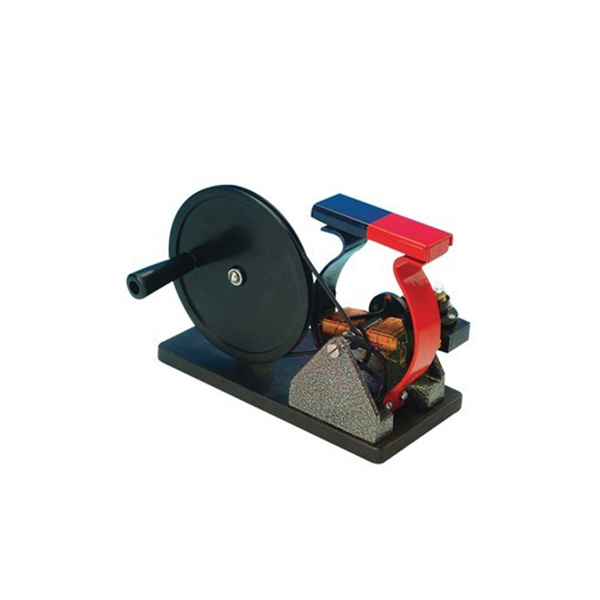
Demonstration Dynamo Model
Demonstration Dynamo Model (Product Code: SLE/PHY/151) is a hand-driven dynamo on a base plate used to show how mechanical work is turned into electrical energy in school and college physics lessons. A 120 mm hand-drive pulley turns the smaller dynamo pulley through a rubber belt for a step-up ratio, and a lamp lights up to show the output. It is made by Jain Scientific Equipments Pvt Ltd (ScienceLab), an OEM manufacturer, at its own factory in Ambala, India.
Specifications
| Parameter | Detail |
|---|---|
| Construction | Same basic assembly as the Demonstration Electric Motor, mounted on a base plate |
| Base plate | 230 x 90 mm |
| Hand-drive pulley | 120 mm diameter |
| Drive | Rubber belt to the smaller dynamo pulley, giving a step-up ratio |
| Electrical output | Pair of 4 mm sockets |
| Output indicator | Lamp, provided |
| Motor use | Can also be run as a motor on a 6–8 V DC supply |
| Product code | SLE/PHY/151 |
| Manufacturer | Jain Scientific Equipments Pvt Ltd (ScienceLab) — OEM |
| Country of origin | India (made in Ambala, Haryana) |
What Is the Demonstration Dynamo Used For?
The model turns an abstract idea — electromagnetic induction — into something a whole class can see. A student cranks the large pulley, the belt spins the dynamo much faster than the hand moves, and the lamp glows; cranking harder makes it brighter, which links rotation speed to the voltage generated. Teachers can also take the output from the 4 mm sockets to a meter so students record readings instead of judging lamp brightness.
The same unit works in reverse. Connect a 6–8 V DC supply and it runs as a motor, which makes a clear point that motors and generators are the same machine used in opposite directions. This two-way use makes it a practical demonstration model for the physics lab when teaching energy conversion, electromagnetic induction and power generation.
What to Specify When Ordering
- Number of models — one per demonstration bench or per student group.
- Whether you need a 6–8 V DC supply to use the model as a motor.
- 4 mm leads and a meter, if students will measure the output rather than watch the lamp.
- Whether the matching Demonstration, Electric Motor should be quoted as well for side-by-side teaching.
OEM Manufacturer
ScienceLab is the trading name of Jain Scientific Equipments Private Limited, the OEM (original equipment manufacturer) of the Demonstration Dynamo Model. The model is made at the company's own licensed factory at Saha, Ambala, Haryana, India, and sold factory-direct to schools, colleges, laboratory dealers and importers. Because the maker handles your order itself, questions about replacement belts, lamps or repeat orders come straight to the people who build the model. Learn more on our company profile.
Related Physics Lab Equipment
These products support the same generator-and-motor lesson:
- Demonstration, Electric Motor — the same basic assembly, used to teach the motor side of the topic.
- Demonstration Motor AC/DC — hand-wheel generator that shows AC and DC output with LEDs.
- Water Turbine with Dynamo Model — a water-driven example of mechanical-to-electrical energy conversion.
- Power Supply, Stepped — low-voltage AC/DC bench supply for running the model as a motor.
- Stackable Leads — 4 mm leads for connecting the output sockets to a meter.
See more apparatus in our Physics Lab Equipment range.
Frequently Asked Questions
What is included with the Demonstration Dynamo Model?
The Demonstration Dynamo Model comes on a 230 x 90 mm base plate carrying a 120 mm hand-drive pulley, a rubber belt to the smaller dynamo pulley, a pair of 4 mm output sockets and a lamp that acts as a simple output indicator.
Can the Demonstration Dynamo Model work as a motor?
Yes. The Demonstration Dynamo Model can be run as a motor on a 6–8 V DC supply instead of being turned by hand. This lets teachers show that a motor and a generator are the same machine, used to convert energy in opposite directions.
Why does the Demonstration Dynamo Model use a belt drive?
The Demonstration Dynamo Model uses a rubber belt from the large hand-drive pulley to the smaller dynamo pulley to give a step-up ratio. The dynamo therefore spins faster than the hand turns, so a comfortable cranking speed is enough to light the lamp.
How can students measure the output of the Demonstration Dynamo Model?
Students can measure the output of the Demonstration Dynamo Model by connecting a suitable meter to its pair of 4 mm sockets with standard leads. The built-in lamp gives a quick visual check, while the meter allows readings at different cranking speeds.
Who manufactures the Demonstration Dynamo Model?
The Demonstration Dynamo Model is manufactured by Jain Scientific Equipments Pvt Ltd (ScienceLab) as the OEM, at its own factory at Saha, Ambala, Haryana, India. Orders, quotations and after-sales questions are handled directly by the manufacturer.
Can I get replacement belts or lamps for the Demonstration Dynamo Model?
Ask us. Share the product code SLE/PHY/151 and the part you need, such as a rubber belt or indicator lamp, through our contact page, and the manufacturer will confirm what can be supplied for your Demonstration Dynamo Model.
Can the Demonstration Dynamo Model be ordered in bulk or for export?
Yes. The Demonstration Dynamo Model is supplied in bulk to schools, colleges, dealers and institutions across India and international markets. State the quantity and delivery destination in your enquiry so the quotation can cover packing and dispatch.
Request a Quote
Send the quantity and destination for the Demonstration Dynamo Model (SLE/PHY/151) through our contact page, or add it to the enquiry cart with any leads or power supplies you need. Your quotation comes directly from the manufacturer.
Last updated: 24 September 2026
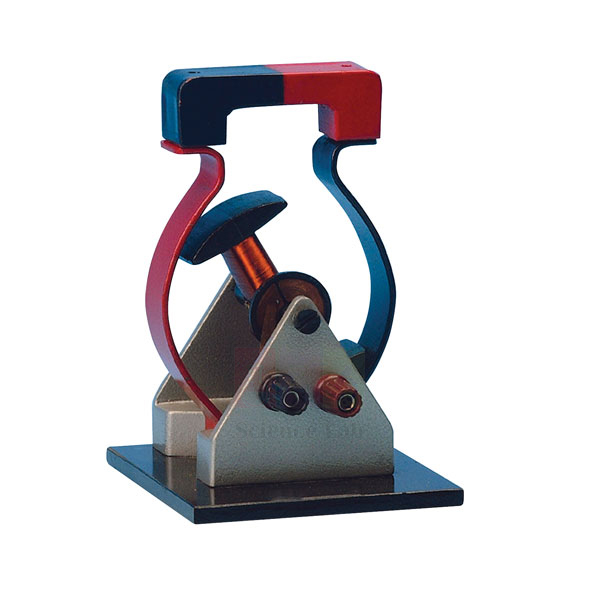
Demonstration, Electric Motor
Demonstration, Electric Motor (Product Code: SLE/PHY/152) is a simple DC electric motor used to show how a current-carrying armature turns in a magnetic field in school and college physics classes. Its 2-pole armature is wound with enamelled copper wire, the field comes from a removable bar magnet, and it runs on 6–8 V DC. It is made by Jain Scientific Equipments Pvt Ltd (ScienceLab), an OEM manufacturer, at its own factory in Ambala, India.
Specifications
| Parameter | Detail |
|---|---|
| Motor type | Simple form of DC electric motor |
| Armature | 2-pole, wound with enamelled copper wire |
| Magnetic field | Permanent field from a removable bar magnet |
| Commutator | Disc-type |
| Brushes | Phosphor-bronze |
| External connection | Pair of 4 mm sockets connected to the brushes |
| Operating supply | 6–8 V DC |
| Product code | SLE/PHY/152 |
| Manufacturer | Jain Scientific Equipments Pvt Ltd (ScienceLab) — OEM |
| Country of origin | India (made in Ambala, Haryana) |
What Is the Demonstration Electric Motor Used For?
Because every working part is on view, students can follow the current from the 4 mm sockets through the phosphor-bronze brushes and the disc-type commutator into the armature windings. The teacher can then explain how the commutator reverses the current in the 2-pole armature every half turn, so the turning force keeps acting in the same direction. It links directly to the motor effect and Fleming's left-hand rule in electromagnetism lessons.
The removable bar magnet makes simple investigations possible. Turning the magnet round, or swapping the supply leads, reverses the direction of rotation, and taking the magnet away shows that without a field there is no turning force. Keep the supply within 6–8 V DC and switch off before handling the armature. It is a dependable item for any physics demonstration kit in India or overseas.
What to Specify When Ordering
- Number of motors, for a single teacher demonstration or for several student groups.
- Whether you need a low-voltage supply that can provide 6–8 V DC.
- 4 mm connecting leads for the brush sockets.
- Whether the Demonstration Dynamo Model should be quoted as well, to teach motors and generators together.
OEM Manufacturer
Jain Scientific Equipments Private Limited, which trades as ScienceLab, is the OEM (original equipment manufacturer) of this demonstration motor and makes it at its own licensed factory at Saha, Ambala, Haryana, India. The company is a registered MSME with manufacturing as its major activity (Udyam UDYAM-HR-01-0003714), and overseas orders are shipped under Importer-Exporter Code AAECJ8618A issued by the DGFT. Schools, colleges, dealers and importers buy directly from the maker — ask us about spare bar magnets or brushes when you order. Company details are on our profile page.
Related Physics Lab Equipment
Pair the motor with these items for a complete electromagnetism practical:
- Demonstration Dynamo Model — the same basic assembly on a hand-driven base, for the generator half of the lesson.
- Power Supply, Stepped — low-voltage AC/DC bench supply for powering the motor.
- Stackable Leads — 4 mm leads to connect the supply to the brush sockets.
- Standard Digital Multimeter — for measuring the current the motor draws.
- St. Louis Motor — another classic teaching motor for comparing designs.
Explore the complete Physics Lab Equipment category for more electricity and magnetism apparatus.
Frequently Asked Questions
What supply does the Demonstration, Electric Motor need?
The Demonstration, Electric Motor operates on 6–8 V DC. The supply is connected through a pair of 4 mm sockets that lead to the phosphor-bronze brushes, so any low-voltage laboratory DC source with 4 mm leads can be used.
Why is the bar magnet on the Demonstration, Electric Motor removable?
The removable bar magnet on the Demonstration, Electric Motor lets teachers show the role of the magnetic field. Reversing the magnet reverses the rotation, and removing it stops the turning force, which helps students connect the motor effect to the field direction.
What type of commutator does the Demonstration, Electric Motor have?
The Demonstration, Electric Motor has a disc-type commutator with phosphor-bronze brushes. It reverses the current in the 2-pole armature every half turn, keeping the turning force in one direction so the motor rotates continuously on DC.
How is the Demonstration, Electric Motor different from the Demonstration Dynamo Model?
The Demonstration, Electric Motor is the basic DC motor on its own. The Demonstration Dynamo Model uses the same basic assembly but adds a base plate, hand-drive pulley, belt and indicator lamp so it can be cranked by hand as a generator.
Who manufactures the Demonstration, Electric Motor?
The Demonstration, Electric Motor is manufactured by Jain Scientific Equipments Pvt Ltd (ScienceLab), the OEM, at its own factory at Saha, Ambala, Haryana, India. Quotations, repeat orders and spare-part questions are handled directly by the manufacturer.
What should I include in a quotation request for the Demonstration, Electric Motor?
Include the product code SLE/PHY/152, the number of motors, any power supplies or leads you need, and the delivery location. Send these through our contact page and ScienceLab will reply with a quotation for the Demonstration, Electric Motor.
Is the Demonstration, Electric Motor available in bulk or for export?
Yes. The Demonstration, Electric Motor is supplied in bulk to schools, colleges, dealers and institutions across India and international markets. Mention the quantity and destination so packing and dispatch can be included in your quotation.
Request a Quote
Ask for a quotation for the Demonstration, Electric Motor (SLE/PHY/152) through our contact page, or add it to the enquiry cart together with any supplies or leads. Every quotation is issued directly by the manufacturer.
Last updated: 24 September 2026
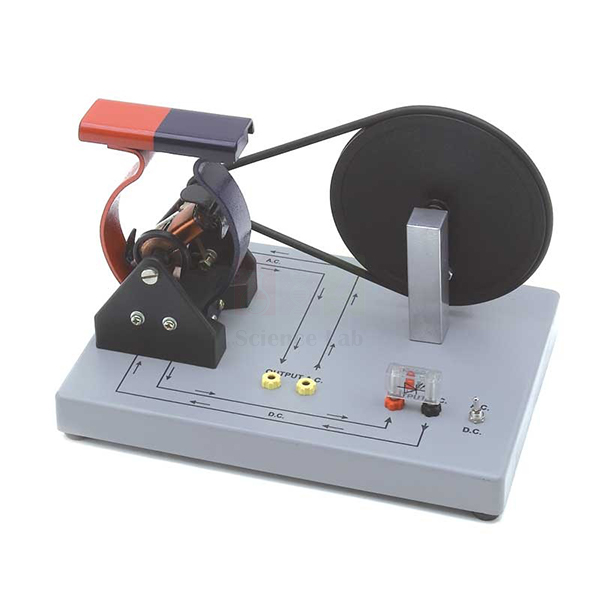
Demonstration Motor AC/DC
Demonstration Motor AC/DC (Product Code: SLE/PHY/153) is a hand-wheel operated demonstration machine used to show the generation of alternating and direct current in physics classrooms and laboratories. Turning the hand wheel produces AC and DC at the same time, and LED diodes make the generated voltage visible to the whole class. It is made by Jain Scientific Equipments Pvt Ltd (ScienceLab), an OEM manufacturer, at its own factory in Ambala, India.
Key Details
| Parameter | Detail |
|---|---|
| Operation | Hand wheel, turned by hand |
| Output | AC and DC current produced simultaneously |
| Indication | LED diodes represent the AC and DC voltage being generated |
| Product code | SLE/PHY/153 |
| Manufacturer | Jain Scientific Equipments Pvt Ltd (ScienceLab) — OEM |
| Country of origin | India (made in Ambala, Haryana) |
What Is the AC/DC Demonstration Motor Used For?
Students often find it hard to picture the difference between alternating and direct current, because both simply "make a bulb light". This model tackles that directly: as the hand wheel turns, it produces AC and DC together and shows each through LED diodes, so the class can compare the two outputs side by side. Since an LED lights only when current passes through it in one direction, it is a natural way to reveal how the generated output behaves.
A good routine is to turn the wheel slowly first so students can watch the LEDs closely, then faster to show how the output responds to speed. The demonstration supports textbook topics such as electromagnetic induction, generators and the role of the commutator, and it complements any AC DC circuits experiment kit used later in student practicals.
OEM Manufacturer
The Demonstration Motor AC/DC is built by Jain Scientific Equipments Private Limited, the company behind the ScienceLab name, acting as OEM (original equipment manufacturer). Production takes place at its own licensed factory at Saha, Ambala, Haryana, India, and the model is supplied factory-direct to schools, colleges, teacher-training institutes, dealers and importers. If an indicator or other part needs attention after years of classroom use, ask us — the request goes straight to the maker. Read about the company on our company profile.
Related Physics Lab Equipment
Teachers often combine this model with the following apparatus for a full unit on generators and motors:
- Demonstration Dynamo Model — belt-driven dynamo with a lamp as its output indicator.
- Demonstration, Electric Motor — simple DC motor for teaching the motor effect.
- A.C. Generator — hand-held generator whose output can be shown on a meter or oscilloscope.
- Galvanometer, Centre Zero Universal Meter — centre-zero indicator suited to showing slow AC.
For more teaching apparatus, visit the Physics Lab Equipment category.
Frequently Asked Questions
What does the Demonstration Motor AC/DC show?
The Demonstration Motor AC/DC shows the generation of alternating and direct current. When its hand wheel is turned it produces AC and DC simultaneously, and LED diodes represent each generated voltage, so students can compare the two outputs during a single demonstration.
Does the Demonstration Motor AC/DC need a power supply?
The Demonstration Motor AC/DC generates its own output when the hand wheel is turned, so the LED display of AC and DC generation works by hand. If you want to discuss other ways of using it, contact us before ordering.
Why does the Demonstration Motor AC/DC use LED diodes?
The Demonstration Motor AC/DC uses LED diodes because an LED lights only when current flows through it in one direction. That property makes LEDs a clear, simple way to represent the difference between the alternating and direct voltage being generated.
Which lessons is the Demonstration Motor AC/DC suitable for?
The Demonstration Motor AC/DC suits lessons on electromagnetic induction, generators, alternating versus direct current and the purpose of a commutator. It works as a teacher demonstration at the front of the class and as a hands-on station for small student groups.
Who manufactures the Demonstration Motor AC/DC?
The Demonstration Motor AC/DC is manufactured by Jain Scientific Equipments Pvt Ltd (ScienceLab) as the OEM, at its own factory at Saha, Ambala, Haryana, India. Enquiries, quotations and repeat orders go directly to the manufacturer.
Where can I get details not listed for the Demonstration Motor AC/DC?
For dimensions, packing or other details of the Demonstration Motor AC/DC that are not listed on this page, send your question with the product code SLE/PHY/153 through our contact page and we will reply with the information.
Can schools order the Demonstration Motor AC/DC in bulk or for export?
Yes. The Demonstration Motor AC/DC is supplied in bulk to schools, colleges, dealers and institutions throughout India and international markets. Include the quantity and delivery destination in your enquiry for an accurate quotation.
Request a Quote
To get a quotation for the Demonstration Motor AC/DC (SLE/PHY/153), use our contact page or place it in the enquiry cart with the quantity required. You receive the quotation directly from the manufacturer.
Last updated: 24 September 2026
Demountable Transformer Accessory Set No. 2
Demountable Transformer Accessory Set No. 2 (Product Code: SLE/PHY/154) is a Lenz's law accessory for a demountable transformer, used to demonstrate the production of large magnetic fields and Lenz's law damping in school and college physics labs. Its pendulums with and without slits let students compare how induced currents slow a swinging conductor. It is made by Jain Scientific Equipments Pvt Ltd (ScienceLab), an OEM manufacturer, at its own factory in Ambala, India.
Key Details
| Parameter | Detail |
|---|---|
| Type | Lenz's law transformer accessory |
| Demonstrates | Production of large magnetic fields; Lenz's law damping |
| Pendulums | With and without slits |
| Used with | A demountable transformer |
| Product code | SLE/PHY/154 |
| Manufacturer | Jain Scientific Equipments Pvt Ltd (ScienceLab) — OEM |
| Country of origin | India (made in Ambala, Haryana) |
What Is the Transformer Accessory Set No. 2 Used For?
The set turns Lenz's law from a rule in a textbook into motion students can watch. With the demountable transformer set up to produce a strong magnetic field, a metal pendulum is allowed to swing through it; currents induced in the metal oppose the motion, so a pendulum without slits is brought to rest very quickly. A pendulum with slits breaks up the paths those induced currents can take, so it swings much more freely, and the contrast makes the principle obvious.
Teachers use the demonstration to explain eddy currents and real applications such as magnetic braking and the damping of moving parts in meters. Keep watches, phones and loose steel items away from the strong field, and energise the coil only for as long as the demonstration needs. It is a natural extension of a transformer experiment kit for senior school and college electromagnetic induction lessons.
What to Specify When Ordering
- Whether you already have a demountable transformer core and coils, or need the Demountable Transformer Kit quoted as well.
- The set number — No. 2 is the Lenz's law pendulum set; Accessory Set No. 1 is a separate product.
- Number of sets required for demonstration benches or student groups.
- Whether a low-voltage supply for energising the coils should be included.
OEM Manufacturer
Jain Scientific Equipments Private Limited, known to schools as ScienceLab, is the OEM (original equipment manufacturer) of the Demountable Transformer Accessory Set No. 2 and makes it at its own licensed factory at Saha, Ambala, Haryana, India. Because the accessory set and the Demountable Transformer Kit come from the same maker, you can source the complete demonstration from one manufacturer rather than matching parts from different traders. Institutions, dealers and importers are supplied factory-direct. More about the company is on our company profile.
Related Physics Lab Equipment
These items belong to the same transformer and electromagnetic induction workflow:
- Demountable Transformer Kit — laminated core and labelled coils that the accessory set works with.
- Demountable Transformer Accessory Set No. 1 — companion set showing that step-down transformers can deliver large currents.
- Lenz’s Law – Open & closed loop — magnet-and-loop demonstration of the same law.
- Power Supply, Stepped — low-voltage AC/DC bench supply for energising coils.
Browse more apparatus in the Physics Lab Equipment category.
Frequently Asked Questions
What does the Demountable Transformer Accessory Set No. 2 demonstrate?
The Demountable Transformer Accessory Set No. 2 demonstrates the production of large magnetic fields and Lenz's law damping. Pendulums with and without slits swing through the field, and the difference in how quickly they stop shows the effect of induced currents.
Why do some pendulums in the Accessory Set No. 2 have slits?
The slits in some pendulums of the Demountable Transformer Accessory Set No. 2 interrupt the paths that induced eddy currents can follow. A slotted pendulum therefore swings more freely than a solid one, giving a clear side-by-side comparison of Lenz's law damping.
Is a transformer core included with the Demountable Transformer Accessory Set No. 2?
The Demountable Transformer Accessory Set No. 2 is an accessory for a demountable transformer, so plan to use it with a core and coils such as our Demountable Transformer Kit. Confirm exact contents and fit with your existing core through our contact page.
How does Accessory Set No. 2 differ from Accessory Set No. 1?
Demountable Transformer Accessory Set No. 2 focuses on large magnetic fields and Lenz's law damping with pendulums. Accessory Set No. 1 is a separate product for showing that step-down transformers can produce large currents, so many labs order both.
Who manufactures the Demountable Transformer Accessory Set No. 2?
The Demountable Transformer Accessory Set No. 2 is manufactured by Jain Scientific Equipments Pvt Ltd (ScienceLab), the OEM, at its own factory at Saha, Ambala, Haryana, India. Quotations and repeat orders come directly from the manufacturer.
What does a quotation for the Accessory Set No. 2 need?
A quotation for the Demountable Transformer Accessory Set No. 2 needs the product code SLE/PHY/154, the number of sets, whether the transformer kit or a power supply should be added, and the delivery location for dispatch.
Can the Demountable Transformer Accessory Set No. 2 be supplied in bulk or exported?
Yes. The Demountable Transformer Accessory Set No. 2 is supplied in bulk to schools, colleges, dealers and institutions across India and international markets. Share quantities and destination in your enquiry for packing and dispatch details.
Request a Quote
Request a quotation for the Demountable Transformer Accessory Set No. 2 (SLE/PHY/154) through our contact page, or add it to the enquiry cart along with the transformer kit if needed. The quotation comes to you straight from the manufacturer.
Last updated: 24 September 2026
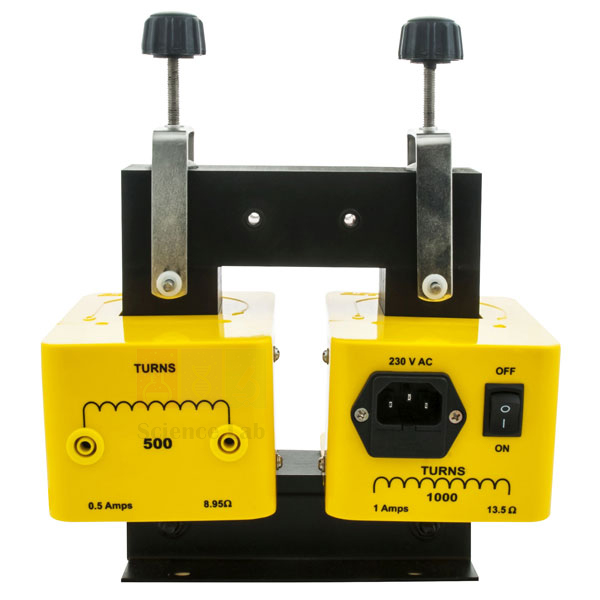
Demountable Transformer Kit
Demountable Transformer Kit (Product Code: SLE/PHY/155) is a laminated low-loss transformer core with clearly labelled coils, used to demonstrate the step-up and step-down transformer principle in school and college physics laboratories. Its highly permeable U-shaped core, 40 x 40 mm in cross-section, closes with two clamps and tightening screws, and suits GCSE and A-Level physics demonstrations. It is made by Jain Scientific Equipments Pvt Ltd (ScienceLab), an OEM manufacturer, at its own factory in Ambala, India.
Specifications
| Parameter | Detail |
|---|---|
| Core | Laminated, low-loss; highly permeable U-shaped metal sheeting |
| Core closure | Two clamps with tightening screws |
| Coils | Clearly labelled; different coils can be attached to the core |
| Core cross-section | 40 x 40 mm |
| Overall size | 150 mm (L) x 170 mm (H) |
| Demonstrates | Step-up and step-down transformer principle |
| Course level | GCSE physics and science; A-Level physics demonstrations |
| Product code | SLE/PHY/155 |
| Manufacturer | Jain Scientific Equipments Pvt Ltd (ScienceLab) — OEM |
| Country of origin | India (made in Ambala, Haryana) |
What Is the Demountable Transformer Used For?
With this kit a teacher builds a working transformer in front of the class: coils are fitted on the limbs of the U-shaped core, the core is closed with its clamps, an alternating supply is applied to the primary and the output of the secondary is measured. Swapping coils shows the step-up and step-down cases and lets students test the turns-ratio relationship between primary and secondary voltage. The clearly labelled coils make it easy for everyone to see which winding is in use.
The kit also links classroom physics to everyday technology, from the transformers inside domestic electrical appliances to the step-up and step-down stages that make long-distance power transmission efficient. Loosening the clamps to open the core is a quick way to show how much the magnetic circuit matters. Use only supply voltages suited to the fitted coils and switch off before changing them; for many schools this is the core item of a transformer experiment kit.
What to Specify When Ordering
- Number of kits, for teacher demonstration or for student groups.
- The coils you expect to receive or add — ask us to confirm the coil set supplied with the kit.
- Whether Demountable Transformer Accessory Set No. 1 or No. 2 should be quoted with it.
- Any low-voltage AC supply and meters you need for measuring primary and secondary voltages.
OEM Manufacturer
ScienceLab is the trading name of Jain Scientific Equipments Private Limited, the OEM (original equipment manufacturer) of the Demountable Transformer Kit. The kit is made at the company's own licensed factory at Saha, Ambala, Haryana, India, and supplied factory-direct to schools, colleges, dealers and importers. For tender and vendor-registration paperwork, the company's GSTIN is 06AAECJ8618A1ZT and its LEI is 3358004HRD1JIVXKYX49. Ask us about repeat orders or extra coils, as those requests go straight to the manufacturer — see our company profile for more.
Related Physics Lab Equipment
Extend the transformer lesson with these items:
- Demountable Transformer Accessory Set No. 1 — shows that step-down transformers can produce very large currents.
- Demountable Transformer Accessory Set No. 2 — Lenz's law damping with pendulums with and without slits.
- Power Supply, Stepped — low-voltage AC/DC supply for driving the primary coil.
- Standard Digital Multimeter — for comparing primary and secondary readings.
More electricity and magnetism apparatus is listed under Physics Lab Equipment.
Frequently Asked Questions
What are the dimensions of the Demountable Transformer Kit?
The Demountable Transformer Kit has a core cross-section of 40 x 40 mm and an overall size of 150 mm in length by 170 mm in height. The U-shaped laminated core is closed with two clamps fitted with tightening screws.
How does the Demountable Transformer Kit show step-up and step-down action?
The Demountable Transformer Kit shows step-up and step-down action by letting different coils be attached to its laminated core. Choosing a secondary coil with more or fewer turns than the primary raises or lowers the output voltage, which students can measure and compare.
Why is the core of the Demountable Transformer Kit laminated?
The Demountable Transformer Kit uses a laminated, low-loss core of highly permeable U-shaped metal sheeting. Lamination limits the eddy currents that would otherwise waste energy as heat, so the demonstration gives a more realistic picture of how practical transformers work.
Which courses is the Demountable Transformer Kit suited to?
The Demountable Transformer Kit is suited to GCSE physics and science and A-Level physics demonstrations. It is equally useful for senior secondary and college courses in other education systems that cover transformers, electromagnetic induction and power transmission.
Can accessory sets be used with the Demountable Transformer Kit?
ScienceLab offers Demountable Transformer Accessory Set No. 1 and No. 2 as transformer accessories for extending the demonstration. Ask us through the contact page to confirm which accessories suit your Demountable Transformer Kit before you order.
Who manufactures the Demountable Transformer Kit?
The Demountable Transformer Kit is manufactured by Jain Scientific Equipments Pvt Ltd (ScienceLab) as the OEM, at its own factory at Saha, Ambala, Haryana, India. Quotations, repeat orders and questions about extra coils are handled directly by the manufacturer.
Can the Demountable Transformer Kit be ordered in bulk or for export?
Yes. The Demountable Transformer Kit is supplied in bulk to schools, colleges, dealers and institutions across India and international markets. Include the product code SLE/PHY/155, quantity and destination in your enquiry for a complete quotation.
Request a Quote
For a quotation on the Demountable Transformer Kit (SLE/PHY/155), write to us through the contact page or add the kit to the enquiry cart with any accessory sets you need. The quotation comes directly from the manufacturer.
Last updated: 24 September 2026
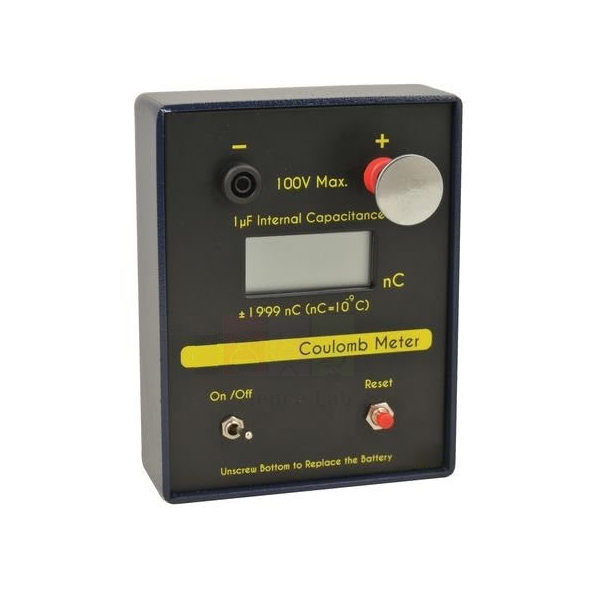
Digital Coulomb Meter
Digital Coulomb Meter (Product Code: SLE/PHY/156) is a digital instrument used to measure electric charge in nanocoulombs in physics laboratories and electrostatics lessons. It displays up to 1999 nC with an accuracy of ±10 nC, showing the charge deposited into it by a current through a resistance, from a capacitor or from a source of static electricity. It is supplied by Jain Scientific Equipments Pvt Ltd (ScienceLab), Ambala, India.
Specifications
| Parameter | Detail |
|---|---|
| Measures | Electric charge (coulombs deposited into the instrument) |
| Display range | Up to 1999 nC |
| Accuracy | ±10 nC |
| Charge sources | Current through a resistance; a capacitor; a source of static electricity |
| Product code | SLE/PHY/156 |
| Supplied by | Jain Scientific Equipments Pvt Ltd (ScienceLab), Ambala, India |
What Is the Digital Coulomb Meter Used For?
Electrostatics is usually taught with leaf electroscopes that only show "more" or "less" charge; a coulomb meter puts a number on it. Students can charge a rod by friction, transfer the charge to the meter and compare materials, or sample the charge on a Van de Graaff generator. With a capacitor, they charge it to a known voltage, discharge it into the meter and use Q = CV to find the capacitance. It is one of the more specialised digital measuring instruments in a school or college physics lab.
Because the stated accuracy is ±10 nC, experiments that deposit charges well above that figure give a smaller percentage uncertainty than very small charges. Work in dry conditions where possible, since damp air lets static charge leak away before it can be measured, and keep readings within the 1999 nC display range.
What to Specify When Ordering
- Number of meters, for teacher demonstration or for student groups.
- The charge sources you plan to use, such as friction rods, a Van de Graaff generator or capacitors.
- Whether you need a calibration certificate — ask us whether one can be provided before ordering.
- Delivery destination in India or abroad.
Supplier
Jain Scientific Equipments Private Limited, which trades as ScienceLab, supplies the Digital Coulomb Meter from Ambala, Haryana, India, to schools, colleges, research laboratories, dealers and institutional buyers. Because the company also supplies the wider range of electrostatics apparatus, a lab can place a single enquiry for the meter and the charge sources it will be used with. Orders are handled for buyers across India and international markets. Read more about the company on our company profile.
Related Physics Lab Equipment
These items provide the charge sources and comparisons for coulomb meter experiments:
- Van de Graaff Generator — hand-cranked static source whose charge can be sampled and measured.
- Friction Rod, Nylon — for charging by friction in electrostatics experiments.
- Friction Cloth, Cotton — cloth for rubbing friction rods.
- Electroscope, Gold Leaf — qualitative charge detector to compare with the meter's numerical readings.
See the full Physics Lab Equipment range for more electrostatics apparatus.
Frequently Asked Questions
What range does the Digital Coulomb Meter measure?
The Digital Coulomb Meter displays charge up to 1999 nC with an accuracy of ±10 nC. That range suits the small charges produced in school and college electrostatics experiments, such as charging by friction or discharging a small capacitor.
Which charge sources can the Digital Coulomb Meter measure?
The Digital Coulomb Meter shows the charge deposited into it by a current through a resistance, from a capacitor, or from a source of static electricity. This makes it useful for both current electricity and electrostatics topics.
How is the Digital Coulomb Meter used to find capacitance?
To find capacitance with the Digital Coulomb Meter, charge a capacitor to a known voltage, discharge it into the meter and read the charge. Dividing the measured charge by the charging voltage gives the capacitance, following the relationship Q = CV.
Is a calibration certificate available for the Digital Coulomb Meter?
Calibration-certificate availability for the Digital Coulomb Meter should be discussed with us before you order. Mention the requirement in your enquiry through our contact page and we will tell you what documentation can be supplied.
Who supplies the Digital Coulomb Meter?
The Digital Coulomb Meter is supplied by Jain Scientific Equipments Pvt Ltd (ScienceLab), Ambala, Haryana, India. The company supplies schools, colleges, laboratories, dealers and institutional buyers across India and international markets.
What should a quotation request for the Digital Coulomb Meter include?
A quotation request for the Digital Coulomb Meter should include the product code SLE/PHY/156, the quantity, any related electrostatics items, documentation needs and the delivery location, so the quotation covers everything in one reply.
Request a Quote
Send your requirement for the Digital Coulomb Meter (SLE/PHY/156) through our contact page, or add it to the enquiry cart with the related electrostatics items you need, and we will reply with a quotation.
Last updated: 24 September 2026
Digital Timer
Digital Timer (Product Code: SLE/PHY/157) is a large digital countdown timer used to time set intervals of up to 99 minutes 59 seconds in school laboratories, classrooms and practical examinations. Its 64 x 38 mm LCD is easy to read from across a bench, and it comes with a stand, clip and magnetic fixing so it can be placed wherever the class can see it. It is supplied by Jain Scientific Equipments Pvt Ltd (ScienceLab), Ambala, India.
Specifications
| Parameter | Detail |
|---|---|
| Type | Large digital countdown timer (countdown only) |
| Range | Up to 99 minutes 59 seconds |
| Resolution | 1 second |
| Display | LCD, 64 x 38 mm |
| Overall size | 80 x 70 x 20 mm |
| Mounting | Stand, clip and magnetic fixing included |
| Product code | SLE/PHY/157 |
| Supplied by | Jain Scientific Equipments Pvt Ltd (ScienceLab), Ambala, India |
What Is the Digital Countdown Timer Used For?
A countdown timer takes the clock-watching out of practical work. Teachers set it for heating or cooling periods in thermal experiments, for fixed reaction, soaking or drying times in chemistry and biology, and for the time allowed in a practical assessment. The magnetic fixing lets it sit on a whiteboard or steel cabinet, the clip holds it on a folder or stand rod, and the stand keeps it upright on the bench.
Choose it for intervals rather than for timing fast events: it counts down only, in 1 second steps. For pendulum periods, reaction times or other elapsed-time readings, a stop clock or electronic timer is the better tool. Many labs keep one countdown timer per bench as part of their everyday physics lab instruments.
Supplier
ScienceLab, the trading name of Jain Scientific Equipments Private Limited, supplies the Digital Timer from Ambala, Haryana, India. Schools and colleges often add timers to a larger order of physics, chemistry and biology apparatus, and the company can include them in the same quotation so one enquiry covers the whole list. Buyers across India and international markets are served. Company background is on our company profile.
Related Physics Lab Equipment
For timing jobs the countdown timer is not designed for, consider these instruments:
- Stop Clock (Metal Case) — mechanical stop clock with large start and reset triggers for elapsed-time readings.
- Digital Stopclock — electronic stopclock with split (lap) timing.
- Millisecond Timer — for free-fall and light-gate timing of very short intervals.
Find more measuring apparatus in the Physics Lab Equipment category.
Frequently Asked Questions
What is the longest time the Digital Timer can count?
The Digital Timer counts down from a maximum of 99 minutes and 59 seconds with a resolution of 1 second. That covers most lesson-length activities, from short timed tasks to heating or cooling runs lasting well over an hour.
Can the Digital Timer be used as a stopwatch?
No. The Digital Timer is a countdown-only timer, so it is designed for timing set intervals rather than measuring elapsed time. For stopwatch-style readings, use a stop clock or digital stopclock alongside it.
How can the Digital Timer be mounted in the lab?
The Digital Timer comes with a stand, a clip and a magnetic fixing. It can stand on a bench, clip onto a folder or holder, or be fixed to a whiteboard or other steel surface so the whole group can see the countdown.
How big is the Digital Timer display?
The Digital Timer has a large 64 x 38 mm LCD in a body measuring 80 x 70 x 20 mm. The large display is what makes it practical for a teacher to show the remaining time to a class or practical group.
Is the Digital Timer suitable for timing short experiments such as pendulum swings?
The Digital Timer is not the right choice for short, fast events because it counts down in 1 second steps. For pendulum periods or free-fall timing, a stopclock or millisecond timer gives the finer resolution those experiments need.
Who supplies the Digital Timer?
The Digital Timer is supplied by Jain Scientific Equipments Pvt Ltd (ScienceLab), Ambala, Haryana, India, to schools, colleges, dealers and institutions in India and international markets. Quotations are sent in response to enquiries through the contact page.
Can the Digital Timer be ordered in bulk?
Yes. The Digital Timer can be ordered in bulk, for example one per bench or per student group. Include the product code SLE/PHY/157, the quantity and the delivery location in your enquiry for a quotation.
Request a Quote
Request a quotation for the Digital Timer (SLE/PHY/157) through our contact page, or add it to the enquiry cart along with the rest of your laboratory list.
Last updated: 24 September 2026
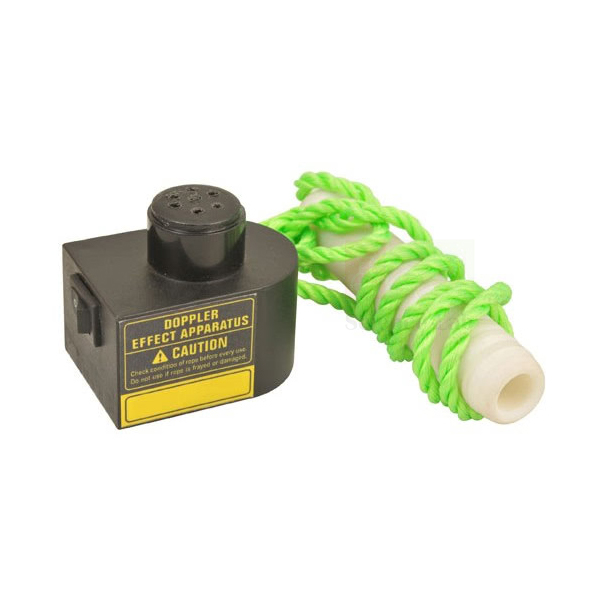
Doppler Effect
Doppler Effect (Product Code: SLE/PHY/158) is a demonstration apparatus used to let a class hear the Doppler effect — the change in pitch from a moving sound source — in physics lessons on sound and waves. It consists of a plastic box with a sound source that runs on 9 V batteries (not included) and a strong string for whirling it in a circle. It is supplied by Jain Scientific Equipments Pvt Ltd (ScienceLab), Ambala, India.
Specifications
| Parameter | Detail |
|---|---|
| Components | Plastic box with sound source; strong string for rotation |
| Power | 9 V batteries (not included) |
| Length | 13 cm |
| Height | 8 cm |
| Width | 9 cm |
| Demonstrates | The Doppler effect with sound |
| Product code | SLE/PHY/158 |
| Supplied by | Jain Scientific Equipments Pvt Ltd (ScienceLab), Ambala, India |
What Is the Doppler Effect Apparatus Used For?
With the sound source switched on, the teacher whirls the box in a circle on its string. Students standing to one side hear the pitch rise as the box moves towards them and fall as it moves away, while the person swinging it hears an almost steady note because their distance from the box hardly changes. That contrast is a memorable way to show that the effect depends on relative motion between source and listener.
The demonstration leads naturally to everyday examples such as passing sirens, and to applications like speed measurement and the red shift of distant galaxies. Use a hall or open space, check the string and its attachment before each session, and keep students well back from the swinging box. It is a compact Doppler effect kit that fits into any sound wave experiment unit for schools in India and abroad.
What to Specify When Ordering
- Number of units required for your classes.
- Batteries — 9 V batteries are not included, so arrange them locally or ask us about adding them to the quotation.
- Any other sound and wave apparatus you want quoted at the same time.
Supplier
The Doppler Effect apparatus is supplied by Jain Scientific Equipments Private Limited, trading as ScienceLab, from Ambala, Haryana, India. It sits alongside the company's range of sound and wave teaching apparatus, so a school equipping a waves unit can request everything in one enquiry. Schools, colleges, dealers and institutional buyers across India and international markets are supplied. Learn more on our company profile.
Related Physics Lab Equipment
These items complete a practical unit on sound and waves:
- Tuning Fork Set, Steel — boxed forks marked with their frequencies, for pitch and frequency lessons.
- Resonance Apparatus with Brass Tube — for resonance investigations in air columns.
- Signal Generator & Amplifier — produces tones of chosen frequency for sound experiments.
- Loudspeaker Unit — boxed speaker with 4 mm sockets for playing generated tones.
Browse more apparatus in our Physics Lab Equipment category.
Frequently Asked Questions
What is included with the Doppler Effect apparatus?
The Doppler Effect apparatus includes a plastic box containing a sound source and a strong string for swinging the box in a circle. The 9 V batteries that power the sound source are not included and must be arranged separately.
How is the Doppler Effect apparatus used in class?
To use the Doppler Effect apparatus, switch on the sound source and whirl the box in a circle on its string. Listeners at the side hear the pitch rise as the box approaches and fall as it moves away, demonstrating the Doppler effect.
Why does the person swinging the Doppler Effect apparatus hear little change?
The person swinging the Doppler Effect apparatus stays at the centre of the circle, so the box neither approaches nor recedes from them. Without relative motion towards or away from the listener there is little pitch change, which helps explain the effect.
What size is the Doppler Effect apparatus?
The Doppler Effect apparatus measures 13 cm in length, 8 cm in height and 9 cm in width. The compact plastic box is designed to be swung on its string, so the whole demonstration fits easily into a classroom or hall.
Who supplies the Doppler Effect apparatus?
The Doppler Effect apparatus is supplied by Jain Scientific Equipments Pvt Ltd (ScienceLab), Ambala, Haryana, India, to schools, colleges, dealers and institutions across India and international markets.
What details should I send for a Doppler Effect apparatus quotation?
For a Doppler Effect apparatus quotation, send the product code SLE/PHY/158, the quantity, whether batteries or other sound apparatus should be added, and the delivery location through our contact page.
Request a Quote
To request a quotation for the Doppler Effect apparatus (SLE/PHY/158), use our contact page or add it to the enquiry cart with the other sound and wave items on your list.
Last updated: 24 September 2026
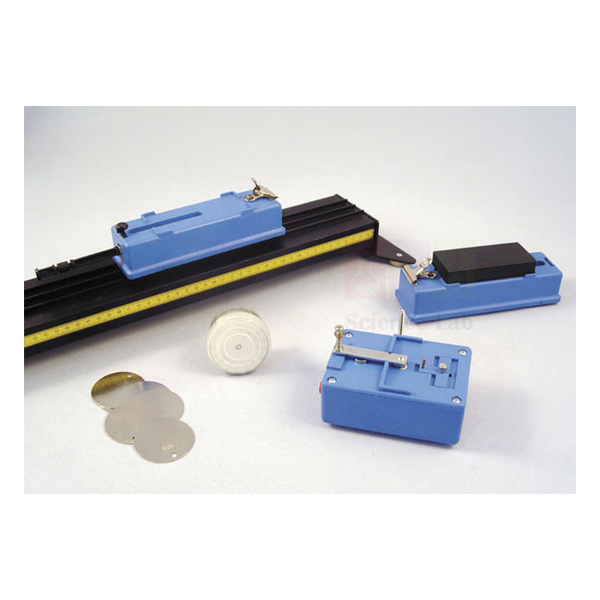
Dynamics Kit, Track & Accessories
Dynamics Kit, Track & Accessories (Product Code: SLE/PHY/159) is a force and motion experiment kit used to study velocity, acceleration, momentum and Newton's laws in school and college physics labs. It brings together a 1.2 m aluminium track, two high-impact moulded trolleys (one spring loaded), masses, a ticker tape timer and carbon discs as one matched set for curriculum-based experiments. It is made by Jain Scientific Equipments Pvt Ltd (ScienceLab), an OEM manufacturer, at its own factory in Ambala, India.
Specifications
| Parameter | Detail |
|---|---|
| Track | Aluminium, 1.2 m |
| Trolleys | 2 high-impact moulded trolleys (1 spring loaded) |
| Masses | 10 x 10 g |
| Timer | 1 x ticker tape timer |
| Trolley weight | 1 |
| Carbon discs | 20 |
| Topic | Curriculum-based Force & Motion experiments |
| Product code | SLE/PHY/159 |
| Manufacturer | Jain Scientific Equipments Pvt Ltd (ScienceLab) — OEM |
| Country of origin | India (made in Ambala, Haryana) |
What Is the Dynamics Kit Used For?
The kit covers the core mechanics practicals in one box. Students run a trolley down the tilted aluminium track while the ticker tape timer marks dots at regular intervals, then use the dot spacing to calculate velocity and acceleration. Adding the 10 g masses or the trolley weight changes the mass being accelerated, which leads straight into Newton's second law. The spring-loaded trolley and its partner are used for collision and "explosion" experiments on conservation of momentum.
For cleaner results, first raise one end of the track just enough for a gently pushed trolley to run at constant speed; evenly spaced dots show that friction has been compensated. Note that ticker tape and a power supply for the timer are not listed among the kit contents, so check what your lab already has. It is a practical force motion experiment kit for schools and colleges in India and abroad.
What to Specify When Ordering
- Number of kits — usually one per student group.
- Ticker tape and a suitable supply for the timer, if your lab does not already have them.
- Extra trolleys, timers or carbon discs for larger classes.
- Delivery location within India or overseas.
OEM Manufacturer
Jain Scientific Equipments Private Limited (CIN U29309HR2020PTC087597), trading as ScienceLab, is the OEM (original equipment manufacturer) of the Dynamics Kit, Track & Accessories. Production takes place at the company's licensed factory at 449, HSIIDC Industrial Area, Saha, Ambala (Factory Licence AMB-ONLINE-CHD-J-414), and complete kits are supplied factory-direct to schools, colleges, dealers and importers. If a kit in use needs a replacement trolley, masses or carbon discs, ask us and the manufacturer will advise. See our company profile for more.
Related Physics Lab Equipment
These items extend or resupply the dynamics kit:
- Ticker Tape Carbon Disc — boxed replacement discs for ticker tape timers.
- Ticker Tape Timer — additional timers for more student groups.
- Dynamics Trolley, Plastic — extra low-friction trolleys for collision experiments.
- Pulley, Bench Mounting, Ball Bearing — for pulling a trolley with a hanging mass.
- Linear Air Track — near friction-free alternative for momentum studies.
More mechanics apparatus is available in the Physics Lab Equipment category.
Frequently Asked Questions
What is included in the Dynamics Kit, Track & Accessories?
The Dynamics Kit, Track & Accessories contains a 1.2 m aluminium track, 2 high-impact moulded trolleys (1 spring loaded), 10 x 10 g masses, 1 ticker tape timer, 1 trolley weight and 20 carbon discs for force and motion experiments.
What is the spring-loaded trolley in the Dynamics Kit used for?
The spring-loaded trolley in the Dynamics Kit, Track & Accessories pushes the two trolleys apart or cushions their impact. Students use it for recoil and collision experiments, comparing momentum before and after to test the conservation of momentum.
How does the ticker tape timer in the Dynamics Kit measure motion?
The ticker tape timer in the Dynamics Kit, Track & Accessories marks dots on a paper tape pulled by the trolley at regular time intervals. Wider spacing means faster motion, so students can work out velocity and acceleration from the tape.
Are ticker tape and a power supply included with the Dynamics Kit?
Ticker tape and a power supply are not listed among the contents of the Dynamics Kit, Track & Accessories. Ask us through the contact page what the timer needs, and include any extra items in the same quotation.
Who manufactures the Dynamics Kit, Track & Accessories?
The Dynamics Kit, Track & Accessories is manufactured by Jain Scientific Equipments Pvt Ltd (ScienceLab), the OEM, at its own factory at Saha, Ambala, Haryana, India. Quotations and repeat orders come directly from the manufacturer.
Can the Dynamics Kit, Track & Accessories be ordered in bulk or for export?
Yes. The Dynamics Kit, Track & Accessories is supplied in bulk to schools, colleges, dealers and institutions across India and international markets. Give the product code SLE/PHY/159, the number of kits and the destination for a full quotation.
Request a Quote
Request a quotation for the Dynamics Kit, Track & Accessories (SLE/PHY/159) through our contact page, or add it to the enquiry cart with any extra trolleys or discs. Your quotation comes straight from the manufacturer.
Last updated: 24 September 2026
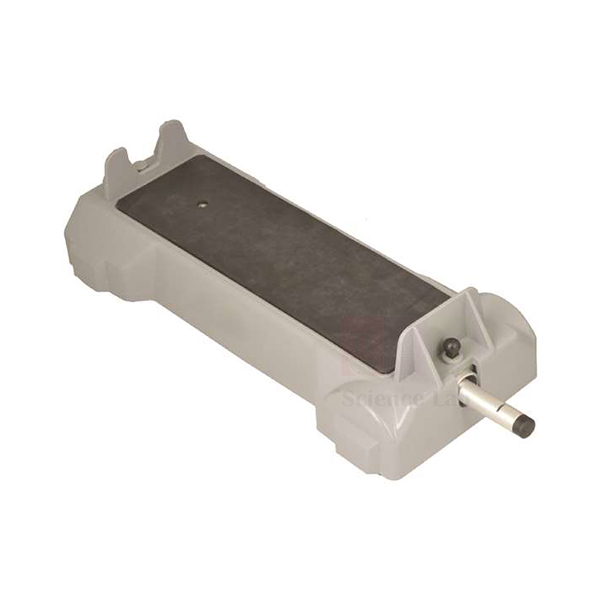
Dynamics Trolley, Plastic
Dynamics Trolley, Plastic (Product Code: SLE/PHY/160) is a rigid ABS plastic laboratory trolley used for kinematics, collision and momentum experiments in school and college physics. It has accurately aligned, very low-friction wheels, an accurate mass of 600 g and velcro pads for inelastic collisions, and it can withstand loads up to 60 kg. It is made by Jain Scientific Equipments Pvt Ltd (ScienceLab), an OEM manufacturer, at its own factory in Ambala, India.
Specifications
| Parameter | Detail |
|---|---|
| Material | Rigid ABS plastic |
| Wheels | Accurately aligned, very low friction |
| Firing pins | Two-position, with locking catch for safety |
| Collision pads | Velcro pads for inelastic collision experiments |
| Mass | 600 g (accurate) |
| Load capacity | Up to 60 kg |
| Design | Stackable, low profile |
| Dimensions | 310 mm (L) x 130 mm (W) x 90 mm (H) |
| Product code | SLE/PHY/160 |
| Manufacturer | Jain Scientific Equipments Pvt Ltd (ScienceLab) — OEM |
| Country of origin | India (made in Ambala, Haryana) |
What Is the Plastic Dynamics Trolley Used For?
The accurate 600 g mass means students can put the trolley straight into momentum and force calculations without weighing it first. Stacking one trolley on another doubles the moving mass, and the high load capacity allows extra masses to be piled on for Newton's second law investigations. Very low-friction wheels keep losses small, so results from collisions and accelerations stay close to theory.
For collisions, the velcro pads make two trolleys stick together to model a perfectly inelastic impact, while the two-position firing pins push trolleys apart for "explosion" experiments. Keep the firing pin on its locking catch until the moment of release, and store trolleys stacked to save bench space. It is a rigid, practical piece of mechanics lab equipment for schools and colleges in India and abroad.
What to Specify When Ordering
- Number of trolleys — collision and explosion experiments need at least two per group.
- Whether you would prefer the complete Dynamics Kit, Track & Accessories instead of single trolleys.
- Any ticker tape timers, pulleys or masses needed for the experiments you plan.
- Delivery location for the quotation.
OEM Manufacturer
ScienceLab, the trading name of Jain Scientific Equipments Private Limited, is the OEM (original equipment manufacturer) of the plastic Dynamics Trolley and produces it at its own licensed factory at Saha, Ambala, Haryana, India. Buying from the maker means a lab that starts with a few trolleys and later expands to a full class set can come back to the same source — ask us about repeat orders. Schools, colleges, dealers and importers are supplied factory-direct. Read more on our company profile.
Related Physics Lab Equipment
These items are used with the trolley in mechanics practicals:
- Dynamics Trolley, Wooden — a pair of three-wheeled wooden trolleys with a spring-loaded rod, for simpler impulse work.
- Dynamics Kit, Track & Accessories — complete set with aluminium track, trolleys and ticker tape timer.
- Ticker Tape Timer — records the trolley's motion as dots on a tape.
- Pulley, Bench Mounting, Ball Bearing — for accelerating the trolley with a hanging mass.
- Mass Set — steel masses for loading the trolley.
See more mechanics apparatus under Physics Lab Equipment.
Frequently Asked Questions
What is the mass of the Dynamics Trolley, Plastic?
The Dynamics Trolley, Plastic has an accurate mass of 600 g. Because the trolleys are stackable, students can double the moving mass by stacking one on another, which is useful in momentum and Newton's second law experiments.
How much load can the Dynamics Trolley, Plastic carry?
The Dynamics Trolley, Plastic can withstand loads up to 60 kg. Its rigid ABS body therefore takes stacked trolleys and added masses in class experiments without difficulty, which suits busy school and college labs.
What are the velcro pads on the Dynamics Trolley, Plastic for?
The velcro pads on the Dynamics Trolley, Plastic make two trolleys stick together when they collide. This models an inelastic collision, so students can compare momentum before and after impact when the trolleys move off as one.
How do the firing pins on the Dynamics Trolley, Plastic work?
The Dynamics Trolley, Plastic has two-position firing pins that are used to push trolleys apart in explosion experiments. A locking catch holds the pin safely until release, reducing the chance of an accidental firing during set-up.
What are the dimensions of the Dynamics Trolley, Plastic?
The Dynamics Trolley, Plastic measures 310 mm long, 130 mm wide and 90 mm high. Its low profile keeps the trolley stable on the bench or track during collision and acceleration experiments.
Who manufactures the Dynamics Trolley, Plastic?
The Dynamics Trolley, Plastic is manufactured by Jain Scientific Equipments Pvt Ltd (ScienceLab) as the OEM, at its own factory at Saha, Ambala, Haryana, India. Quotations and repeat orders are handled directly by the manufacturer.
Can the Dynamics Trolley, Plastic be ordered in bulk or exported?
Yes. The Dynamics Trolley, Plastic is supplied in bulk to schools, colleges, dealers and institutions across India and international markets. Send the product code SLE/PHY/160, the quantity and destination through our contact page.
Request a Quote
Ask for a quotation for the Dynamics Trolley, Plastic (SLE/PHY/160) through our contact page, or add it to the enquiry cart with any timers or masses. Quotations are issued directly by the manufacturer.
Last updated: 24 September 2026
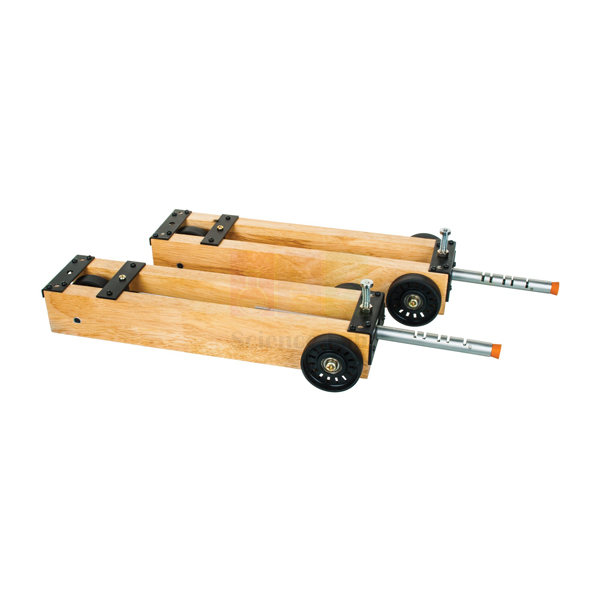
Dynamics Trolley, Wooden
Dynamics Trolley, Wooden (Product Code: SLE/PHY/161) is a pair of 300 mm long wooden trolleys on three wheels, used to demonstrate impulse, recoil and momentum in school physics lessons. A spring-loaded rod is fitted to give an impulse when released, which is used to drive the two trolleys apart in simple recoil experiments. It is made by Jain Scientific Equipments Pvt Ltd (ScienceLab), an OEM manufacturer, at its own factory in Ambala, India.
Specifications
| Parameter | Detail |
|---|---|
| Material | Wooden |
| Supplied as | A pair of trolleys |
| Length | 300 mm |
| Wheels | Mounted on three wheels |
| Impulse mechanism | Spring-loaded rod that gives an impulse when released |
| Product code | SLE/PHY/161 |
| Manufacturer | Jain Scientific Equipments Pvt Ltd (ScienceLab) — OEM |
| Country of origin | India (made in Ambala, Haryana) |
What Is the Wooden Dynamics Trolley Used For?
The classic use is the recoil or "explosion" experiment. The two trolleys are placed end to end, the spring-loaded rod is set, and on release the trolleys shoot apart in opposite directions. With equal loads they travel roughly equal distances; add extra mass to one and it moves off more slowly, which gives students a clear, hands-on feel for Newton's third law and conservation of momentum.
Because the pair is simple to set up, it suits younger classes meeting forces and motion for the first time, before they move on to ticker-timer measurements. Keep the wooden trolleys dry, store them flat and check that the wheels turn freely before each lesson. The set is a straightforward addition to physics lab equipment for schools in India and overseas.
What to Specify When Ordering
- Number of pairs required — the trolleys come as a pair.
- Masses for loading one trolley in unequal-mass recoil experiments.
- Whether plastic trolleys or the full dynamics kit with track and timer should be quoted as well.
OEM Manufacturer
The wooden Dynamics Trolley pair is made by Jain Scientific Equipments Private Limited, the company behind the ScienceLab brand, as OEM (original equipment manufacturer) at its own licensed factory at Saha, Ambala, Haryana, India. Teaching apparatus like this is supplied factory-direct to schools, teacher-training colleges, dealers and importers, so quotations come from the maker rather than a reseller. Ask us when you need more pairs for additional classes. Visit our company profile to learn more.
Related Physics Lab Equipment
These items build on the wooden trolleys for fuller mechanics practicals:
- Dynamics Trolley, Plastic — ABS trolley with velcro pads and firing pins for more detailed collision work.
- Dynamics Kit, Track & Accessories — track, trolleys and ticker tape timer for quantitative measurements.
- Ticker Tape Timer — records trolley motion so speeds can be calculated.
- Mass Set — steel masses for loading one trolley in unequal-mass experiments.
Explore more in our Physics Lab Equipment category.
Frequently Asked Questions
How many trolleys come with the Dynamics Trolley, Wooden?
The Dynamics Trolley, Wooden is a pair of trolleys. Each is 300 mm long, made of wood and mounted on three wheels, and a spring-loaded rod is fitted to give an impulse when released.
What does the spring-loaded rod on the Dynamics Trolley, Wooden do?
The spring-loaded rod on the Dynamics Trolley, Wooden gives an impulse when it is released. Teachers use it to push the two trolleys apart, so students can observe recoil and compare the motion of each trolley.
Which experiments can be done with the Dynamics Trolley, Wooden?
The Dynamics Trolley, Wooden is mainly used for recoil and impulse demonstrations that illustrate Newton's third law and conservation of momentum. Loading one trolley with extra mass shows how a heavier trolley moves off more slowly after release.
How does the Dynamics Trolley, Wooden differ from the plastic trolley?
The Dynamics Trolley, Wooden is a simple pair of three-wheeled wooden trolleys with a spring-loaded rod. The plastic trolley adds low-friction wheels, velcro pads and firing pins for more detailed collision experiments at higher levels.
How should the Dynamics Trolley, Wooden be looked after?
Keep the Dynamics Trolley, Wooden dry and store the pair flat when not in use. Check that all three wheels turn freely and that the spring-loaded rod releases cleanly before each lesson for consistent results.
Who manufactures the Dynamics Trolley, Wooden?
The Dynamics Trolley, Wooden is manufactured by Jain Scientific Equipments Pvt Ltd (ScienceLab) as the OEM, at its own factory at Saha, Ambala, Haryana, India. Enquiries and repeat orders are handled directly by the manufacturer.
Can the Dynamics Trolley, Wooden be ordered in bulk or exported?
Yes. The Dynamics Trolley, Wooden is supplied in bulk to schools, colleges, dealers and institutions across India and international markets. Share the product code SLE/PHY/161, the number of pairs and the destination on our contact page.
Request a Quote
Request a quotation for the Dynamics Trolley, Wooden (SLE/PHY/161) through our contact page, or add it to the enquiry cart together with any masses or timers. The quotation is sent directly by the manufacturer.
Last updated: 24 September 2026
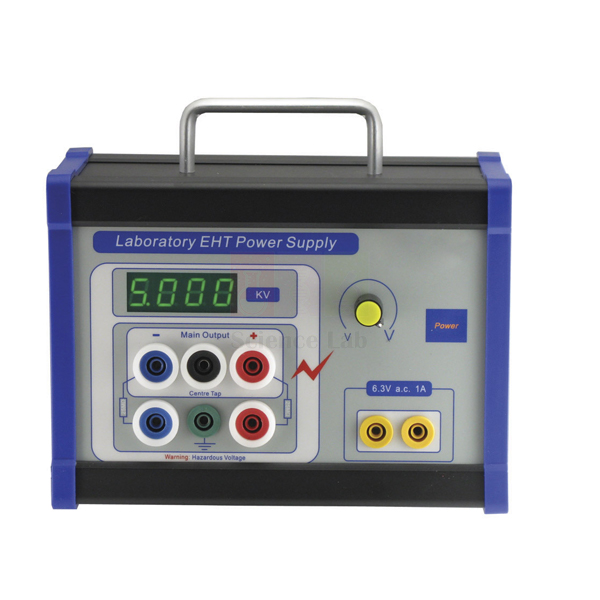
EHT Power Supply
EHT Power Supply (Product Code: SLE/PHY/162) is an extra-high-tension laboratory power supply used to drive electron tubes and electrostatic experiments in college and advanced school physics labs. It gives a fully isolated, continuously variable output of 0–2.5 kV or 0–5 kV DC at a maximum of 2 mA, shown on a bright 12.5 mm green LED display, plus a 6.3 V AC auxiliary output for cathode heaters. It is supplied by Jain Scientific Equipments Pvt Ltd (ScienceLab), Ambala, India.
Specifications
| Parameter | Detail |
|---|---|
| EHT output | Continuously variable, 0–2.5 kV DC or 0–5 kV DC, maximum 2 mA; fully isolated |
| Current limiting | Electronically limited to 2 mA; outputs also current-limited by 100 kΩ resistors to avoid larger transient currents |
| Output stability | Specially wound switching transformer keeps the output voltage stable with time |
| Secondary outputs | Two, via 25 MΩ safety resistors (total 50 MΩ on the 5 kV range); short-circuit current 60 µA for electrostatic experiments |
| Auxiliary output | 6.3 V AC at 1 A for cathode heaters, protected by resettable fuse |
| Display | Bright 12.5 mm green LED display indicating EHT output |
| Earthing | Independent earth terminal for earthing any one of the five output sockets |
| Sockets | Shrouded; suitable for standard 4 mm plugs or shrouded plugs |
| Input | 220–240 V, 50/60 Hz |
| Mains supply (as listed) | 230 V ±5%, 50 Hz |
| Fuse | 315 mA (L) |
| Dimensions | 208 x 155 x 115 mm (W x H x D); height including handle 187 mm |
| Suitable for | Driving Teltron tubes and electrostatic experiments |
| Product code | SLE/PHY/162 |
| Supplied by | Jain Scientific Equipments Pvt Ltd (ScienceLab), Ambala, India |
What Is the EHT Power Supply Used For?
Electron-beam tubes need a high accelerating voltage on the anode and a low-voltage supply for the cathode heater. This unit provides both: the variable EHT output accelerates the beam, and the 6.3 V AC auxiliary output heats the cathode, so one supply can run deflection and fine-beam experiments such as measuring the specific charge of the electron. The bright LED display lets the class read the accelerating voltage as it is adjusted.
For electrostatics, the secondary outputs pass through 25 MΩ resistors, which limit the short-circuit current to 60 µA while still delivering a high voltage for charging plates and electroscopes. High voltage demands care: only trained staff should set up the unit, use shrouded leads where possible, turn the output to zero before making connections, and use the independent earth terminal as the experiment requires.
What to Specify When Ordering
- The tubes or electrostatic experiments you plan to run, so matching tubes and holders can be quoted together.
- Whether shrouded leads are needed for the output sockets.
- Your local mains supply, checked against the listed 220–240 V input.
- Any documentation required, such as a calibration certificate — ask us before ordering.
Supplier
Jain Scientific Equipments Private Limited, trading as ScienceLab, supplies the EHT Power Supply from Ambala, Haryana, India. The company also supplies the electron tubes, tube holders and electrostatics apparatus this unit is typically used with, so a physics department can source the supply and the experiments it powers through a single quotation. Colleges, universities, schools, dealers and institutional buyers across India and international markets are served. More about the company is on our company profile.
Related Physics Lab Equipment
These items are commonly powered by, or used alongside, an EHT supply:
- Teltron Electron Deflection Tube D — for studying electric and magnetic deflection of an electron beam.
- Teltron Dual Beam Tube D — helium-filled tube for observing fine luminous electron beams.
- Teltron Tube Holder D — holder for mounting D-series tubes.
- High Tension Power Supply — companion supply designed for thermionic experiments.
- Electroscope, Gold Leaf — for electrostatic experiments using the current-limited outputs.
Browse more power supplies and electrical apparatus in the Physics Lab Equipment category.
Frequently Asked Questions
What output does the EHT Power Supply provide?
The EHT Power Supply provides a fully isolated, continuously variable output of 0–2.5 kV or 0–5 kV DC at a maximum current of 2 mA. The output is shown on a bright 12.5 mm green LED display for easy reading during experiments.
Can the EHT Power Supply drive Teltron tubes?
Yes. The EHT Power Supply is described as suitable for driving Teltron tubes. Alongside the high-voltage output it has an auxiliary 6.3 V AC output at 1 A for cathode heaters, protected by a resettable fuse.
What are the secondary outputs on the EHT Power Supply for?
The two secondary outputs on the EHT Power Supply are linked through 25 MΩ safety resistors, totalling 50 MΩ on the 5 kV range. They limit the short-circuit current to 60 µA, making them appropriate for electrostatic experiments.
How does the EHT Power Supply limit current?
The EHT Power Supply limits output current electronically to 2 mA, and its outputs are also current-limited by 100 kΩ resistors to avoid larger transient currents. The auxiliary heater output is separately protected by a resettable fuse.
What mains supply does the EHT Power Supply need?
The EHT Power Supply is listed with an input of 220–240 V, 50/60 Hz, a mains supply rating of 230 V ±5%, 50 Hz, and a 315 mA (L) fuse. Check these figures against your local mains supply before ordering.
What are the dimensions of the EHT Power Supply?
The EHT Power Supply measures 208 x 155 x 115 mm (width x height x depth), and its height including the handle is 187 mm. It has five shrouded output sockets suitable for standard 4 mm plugs or shrouded plugs.
Is a calibration certificate available for the EHT Power Supply?
Calibration-certificate availability for the EHT Power Supply should be discussed with us before ordering. State the requirement in your enquiry through our contact page and we will confirm what documentation can accompany the unit.
Who supplies the EHT Power Supply?
The EHT Power Supply is supplied by Jain Scientific Equipments Pvt Ltd (ScienceLab), Ambala, Haryana, India, to colleges, schools, dealers and institutions across India and international markets. Send the product code SLE/PHY/162 and quantity for a quotation.
Request a Quote
To request a quotation for the EHT Power Supply (SLE/PHY/162), write to us through the contact page or add it to the enquiry cart with the tubes and leads you plan to use.
Last updated: 24 September 2026
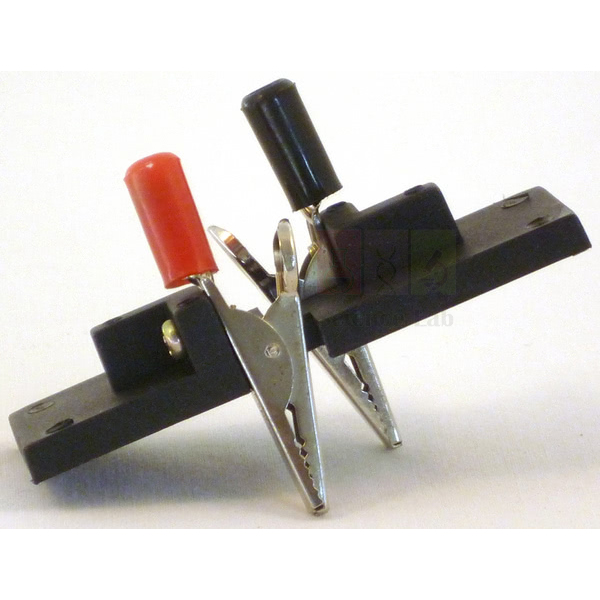
Electrode Foil Holders
Electrode Foil Holders (Product Code: SLE/PHY/163) are plastic strips with 4 mm socket terminals and two crocodile clips, used to hold electrode foils in place and connect them into a circuit during electricity and electrochemistry practicals. Listed as "Foils, Pack of 5", they let students set up simple cells, electrolysis and electroplating experiments with the foils held steady and wired through standard 4 mm leads. They are made by Jain Scientific Equipments Pvt Ltd (ScienceLab), an OEM manufacturer, at its own factory in Ambala, India.
Specifications
| Parameter | Detail |
|---|---|
| Listed as | Foils, pack of 5 |
| Construction | Plastic strip |
| Terminals | 4 mm socket terminals |
| Clips | Two crocodile clips |
| Function | Holds electrode rods and foils in place during use |
| Product code | SLE/PHY/163 |
| Manufacturer | Jain Scientific Equipments Pvt Ltd (ScienceLab) — OEM |
| Country of origin | India (made in Ambala, Haryana) |
What Are Electrode Foil Holders Used For?
Thin metal foils are awkward to keep upright in a solution and even harder to connect reliably. The holder solves both problems: its crocodile clips grip the foils, and the 4 mm socket terminals take ordinary laboratory leads to a meter or power supply. Typical experiments include building simple cells from two different metal foils, ranking metals in an electrochemical series by the voltage they produce, electroplating copper onto another foil, and electrolysis of salt solutions.
For consistent readings, clean the foils before each run and keep the crocodile clips above the liquid so they do not corrode or take part in the reaction. Rinse and dry the holders after practicals and store them with the foils. They are a small but useful part of any electricity experiment kit for school labs in India and abroad.
What to Specify When Ordering
- Number of packs — the item is listed as foils, pack of 5; confirm the pack contents in your quotation.
- Whether you also need the Electrode Rod Holders version for carbon or metal rods.
- Metal foils or strips and 4 mm leads to use with the holders.
OEM Manufacturer
ScienceLab is the trading name of Jain Scientific Equipments Private Limited, an MSME registered with manufacturing as its major activity (Udyam UDYAM-HR-01-0003714). As the OEM (original equipment manufacturer), the company makes the Electrode Foil Holders at its own licensed factory at Saha, Ambala, Haryana, India, and exports under DGFT Importer-Exporter Code AAECJ8618A. Schools, colleges, dealers and importers buy them factory-direct, and repeat orders for new lab sections are handled by the manufacturer itself — just ask us. More details are on our company profile.
Related Physics Lab Equipment
Use the holders with these items to complete cell and electrolysis practicals:
- Electrode Rod Holders — the matching holder listed for electrode rods.
- Metal Strips Set — aluminium, brass, copper, steel and zinc strips for comparing metals.
- Electrodes, Copper — copper electrodes for plating and simple cell work.
- Simple Cell Kit — glass jar with zinc and copper plates for making simple cells.
- Standard Digital Multimeter — for reading the voltage produced by each cell.
Find more electrical apparatus in the Physics Lab Equipment category.
Frequently Asked Questions
What do Electrode Foil Holders hold?
Electrode Foil Holders hold electrode foils, and also electrode rods, in place during use. Each is a plastic strip with two crocodile clips that grip the electrodes and 4 mm socket terminals for connecting them into a circuit.
How many Electrode Foil Holders are in a pack?
Electrode Foil Holders are listed as "Foils, Pack of 5". Please confirm the exact pack contents when you request a quotation through our contact page, so the number ordered matches your class size.
How are Electrode Foil Holders connected to a circuit?
Electrode Foil Holders connect to a circuit through their 4 mm socket terminals, which accept standard 4 mm laboratory leads. This lets students link the clipped foils to a meter, power supply or another cell without soldering or twisting wires.
Which experiments use Electrode Foil Holders?
Electrode Foil Holders are used in simple cell experiments, electrochemical series investigations, electroplating and electrolysis of solutions. Any practical that needs a foil electrode held steady and connected to a meter or supply can use them.
What is the difference between Electrode Foil Holders and Electrode Rod Holders?
Electrode Foil Holders and Electrode Rod Holders share the same plastic strip, 4 mm socket terminals and two crocodile clips. The foil version is listed as "Foils, Pack of 5" and the rod version as "Rods, Pack of 5", so choose by electrode type.
Who manufactures Electrode Foil Holders?
Electrode Foil Holders are manufactured by Jain Scientific Equipments Pvt Ltd (ScienceLab), the OEM, at its own factory at Saha, Ambala, Haryana, India. Quotations and repeat orders come directly from the manufacturer.
Can Electrode Foil Holders be ordered in bulk or for export?
Yes. Electrode Foil Holders are supplied in bulk to schools, colleges, dealers and institutions across India and international markets. Give the product code SLE/PHY/163, the number of packs and the destination for a complete quotation.
Request a Quote
Request a quotation for Electrode Foil Holders (SLE/PHY/163) through our contact page, or add them to the enquiry cart with any foils, leads or meters you need. Quotations come directly from the manufacturer.
Last updated: 24 September 2026
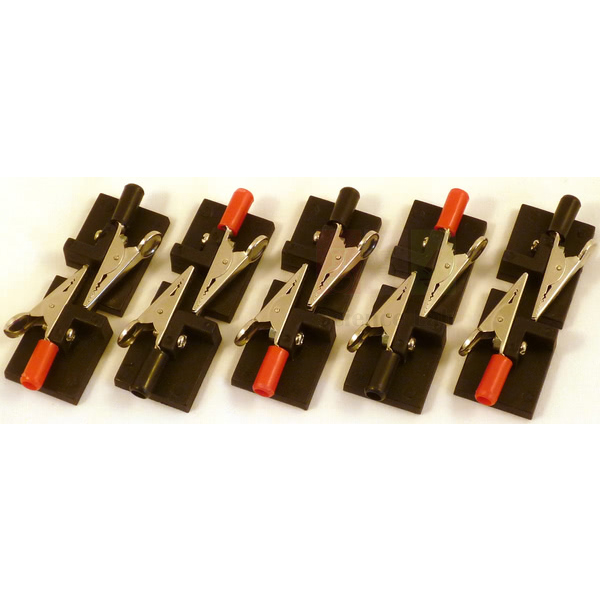
Electrode Rod Holders
Electrode Rod Holders (Product Code: SLE/PHY/164) are plastic strips fitted with two crocodile clips and 4 mm socket terminals, used to grip electrode rods and wire them to a power supply in electrolysis and conductivity experiments. Listed as "Rods, Pack of 5", they hold a pair of carbon or metal rods steady in the solution so students can concentrate on what happens at each electrode. They are made by Jain Scientific Equipments Pvt Ltd (ScienceLab), an OEM manufacturer, at its own factory in Ambala, India.
Specifications
| Parameter | Detail |
|---|---|
| Pack listing | Rods, pack of 5 |
| Body | Plastic strip |
| Connections | 4 mm socket terminals |
| Grips | Two crocodile clips |
| Purpose | Holds electrode rods and foils in place during use |
| Product code | SLE/PHY/164 |
| Manufacturer | Jain Scientific Equipments Pvt Ltd (ScienceLab) — OEM |
| Country of origin | India (made in Ambala, Haryana) |
What Are Electrode Rod Holders Used For?
Electrolysis with carbon rods is one of the most common school practicals, and it gives clear results only when the rods stay still. Clip two rods into the holder, lower them into the electrolyte and connect the 4 mm sockets to a low-voltage DC supply; students can then watch metal deposit on the cathode and gas form at the anode, and test the products. The same set-up checks whether a solution conducts, using a lamp or meter in series.
Carbon rods are brittle, so clip them gently near the top and keep the crocodile clips clear of the liquid. Use red and black leads to keep track of polarity, switch off before removing the rods, and ventilate the room when electrolysing chloride solutions. The holders are a practical item among chemistry and physics lab equipment for schools in India and abroad.
What to Specify When Ordering
- Number of packs — listed as rods, pack of 5; ask us to confirm exactly what each pack contains.
- Electrode rods to use with the holders, such as carbon rods, if you need them separately.
- A low-voltage DC supply and 4 mm leads for each group.
- Whether the Electrode Foil Holders version should be added for foil electrodes.
OEM Manufacturer
Electrode Rod Holders are produced by Jain Scientific Equipments Private Limited, which trades as ScienceLab and is the OEM (original equipment manufacturer) of this accessory. They are made at the company's own licensed factory at Saha, Ambala, Haryana, India, and sold straight from the factory to schools, colleges, lab-supply dealers and importers. If your department wants more holders later, reordering from the manufacturer is straightforward — ask us for repeat supply. See our company profile for background.
Related Physics Lab Equipment
These items complete an electrolysis or conductivity set-up:
- Electrode Foil Holders — the matching holder listed for flat foil electrodes.
- Electrode, Carbon Rod — carbon rods for electrolysis.
- Power Supply, Stepped — low-voltage AC/DC supply providing DC for electrolysis.
- Stackable Leads — 4 mm leads for the socket terminals.
Browse related apparatus in the Physics Lab Equipment category.
Frequently Asked Questions
What are Electrode Rod Holders?
Electrode Rod Holders are plastic strips with 4 mm socket terminals and two crocodile clips. They hold electrode rods, and also foils, in place during use, and let the electrodes be connected to a supply or meter with standard leads.
Are electrode rods included with Electrode Rod Holders?
Electrode Rod Holders are listed as "Rods, Pack of 5". To be sure whether rods are included or should be ordered separately, ask us through the contact page; carbon rods are also available as a separate item.
Can Electrode Rod Holders be used for electrolysis with carbon rods?
Yes. Electrode Rod Holders grip carbon rods with their crocodile clips while the 4 mm sockets connect to a low-voltage DC supply. Keep the clips above the electrolyte so that only the rods take part in the reaction.
When should I choose Electrode Rod Holders instead of Electrode Foil Holders?
Choose Electrode Rod Holders when your practicals use cylindrical electrodes such as carbon rods, and the foil version when you work with flat metal foils. Both use the same strip, clip and 4 mm socket design, so many labs stock both.
How should Electrode Rod Holders be cared for?
After each practical, rinse Electrode Rod Holders in clean water and let them dry before storage, paying attention to the crocodile clips. Handle carbon rods gently when clipping them in, because they can snap if gripped too hard.
Who manufactures Electrode Rod Holders?
Electrode Rod Holders are manufactured by Jain Scientific Equipments Pvt Ltd (ScienceLab) as the OEM, at its own factory at Saha, Ambala, Haryana, India. Quotations and repeat orders are handled directly by the manufacturer.
Can Electrode Rod Holders be ordered in bulk or for export?
Yes. Electrode Rod Holders are supplied in bulk to schools, colleges, dealers and institutions across India and international markets. Share the product code SLE/PHY/164, the number of packs and the delivery destination for a quotation.
Request a Quote
To request a quotation for Electrode Rod Holders (SLE/PHY/164), use our contact page or place them in the enquiry cart with any rods, leads or power supplies. You receive the quotation directly from the manufacturer.
Last updated: 24 September 2026
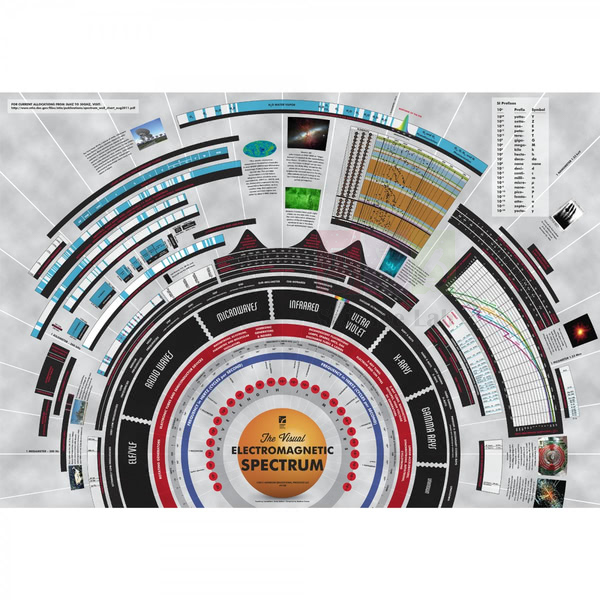
Electromagnetic Spectrum Chart
Electromagnetic Spectrum Chart (Product Code: SLE/PHY/165) is a large visual aid used to show students how the unseen electric and magnetic waves around us are arranged by wavelength and frequency in school and college physics classrooms. At 69 cm x 99 cm (height x width) it can be read by a whole class, and it is accompanied by an explanatory sheet. It is made by Jain Scientific Equipments Pvt Ltd (ScienceLab), an OEM manufacturer of physics lab equipment, at its own factory in Ambala, India.
Specifications
| Parameter | Detail |
|---|---|
| Type | Visual aid chart on the electromagnetic spectrum |
| Dimensions | 69 cm x 99 cm (H x W) |
| Topics shown | Wavelength and frequency scales; radio and microwave usage; X-ray and gamma-ray absorption |
| Supplied with | Explanatory sheet |
| Product code | SLE/PHY/165 |
| Manufacturer | Jain Scientific Equipments Pvt Ltd (ScienceLab) — OEM |
| Country of origin | India (made in Ambala, Haryana) |
What Is the Electromagnetic Spectrum Chart Used For?
We live in a sea of waves we cannot see, and this chart gives teachers one reference for walking a class from long radio waves to short gamma rays. Because the wavelength and frequency scales sit side by side, learners can see that as one increases the other decreases, which leads naturally into the wave equation. It is a useful wall reference for school physics lab equipment in India, from secondary science to senior physics.
The chart also frames everyday questions: how radio and microwaves are put to use, and why X-rays and gamma rays are absorbed differently by different materials. Mount it at eye level near the demonstration bench, keep it out of direct sunlight to limit fading, and use the explanatory sheet to plan discussion questions before the lesson.
OEM Manufacturer
ScienceLab is the trading name of Jain Scientific Equipments Private Limited, the original equipment manufacturer (OEM) behind this chart. The company produces its teaching aids at its own licensed factory at Saha, Ambala, Haryana, instead of reselling a trader's stock, and supplies schools, colleges, dealers and importers directly. Read more on the ScienceLab company profile.
Related Physics Lab Equipment
These items turn the chart into hands-on lessons on waves and spectra:
- Apparatus Microwave — demonstrates reflection, polarisation, diffraction and interference with real microwaves.
- Microwave Transmitter/Receiver — lets students investigate transverse waves in the microwave band.
- Hydrogen Spectrum Set — shows a line spectrum for a closer look at visible wavelengths.
- Prism, Borosilicate Glass — disperses white light to reveal the visible band of the spectrum.
- Wave Form, Helix — models wavelength and frequency with a wave students can see.
Browse the full range in our Physics Lab Equipment category.
Frequently Asked Questions
What size is the Electromagnetic Spectrum Chart?
The Electromagnetic Spectrum Chart measures 69 cm high by 99 cm wide, a format large enough to be read across a typical classroom when it is mounted on a wall or display board near the teaching area.
What comes with the Electromagnetic Spectrum Chart?
The Electromagnetic Spectrum Chart is accompanied by an explanatory sheet that helps teachers expand on wavelength, frequency and the uses of different wave bands. Mounting hardware and lamination are not listed, so ask us if you need them.
Which topics does the Electromagnetic Spectrum Chart cover?
The Electromagnetic Spectrum Chart compares wavelength and frequency scales and covers radio and microwave usage along with X-ray and gamma-ray absorption, so students can connect the unseen electric and magnetic waves around them to real applications.
Who manufactures the Electromagnetic Spectrum Chart?
The Electromagnetic Spectrum Chart is manufactured by Jain Scientific Equipments Pvt Ltd (ScienceLab), an OEM manufacturer, at its own factory in Ambala, Haryana, India. Quotations and repeat orders are handled directly by the manufacturer.
Can schools order the Electromagnetic Spectrum Chart in bulk or for export?
Yes, the Electromagnetic Spectrum Chart can be quoted in classroom quantities for schools, dealers and importers in India and international markets. Share the quantity and delivery location on our contact page and we will reply with a quotation.
What should a quotation request for the chart include?
A quotation request for the Electromagnetic Spectrum Chart should give the product code SLE/PHY/165, the number of charts, the delivery address and any questions about language or finish, so the quotation matches what your classrooms need.
Request a Quote
To order the Electromagnetic Spectrum Chart, send your requirement through our contact page or add it to the enquiry cart. Quotations come direct from the manufacturer, with no trading intermediary.
Last updated: 24 September 2026

Electroscope in Flask, Gold Leaf
Electroscope in Flask, Gold Leaf (Product Code: SLE/PHY/166) is a simple charge detector used to show whether an object carries static electricity in school physics lessons. A glass conical flask encloses the gold leaf, which hangs from a brass rod held in a rubber bung, so air currents in the room do not disturb the leaf. It is made by Jain Scientific Equipments Pvt Ltd (ScienceLab), an OEM manufacturer, at its own factory in Ambala, India.
Key Details
| Parameter | Detail |
|---|---|
| Enclosure | Glass conical flask |
| Stopper | Rubber bung supporting the rod |
| Conductor | Brass rod |
| Indicator | Gold leaf attached to the brass rod |
| Spares | Replacement gold leaves available separately |
| Product code | SLE/PHY/166 |
| Manufacturer | Jain Scientific Equipments Pvt Ltd (ScienceLab) — OEM |
| Country of origin | India (made in Ambala, Haryana) |
What Is the Flask Gold Leaf Electroscope Used For?
Bring a charged rod near the top of the brass rod and the gold leaf lifts away, because the charge it receives repels the like charge on the rod; take the rod away and the leaf settles again. Students use it to detect charge, to compare how well different materials charge when rubbed, and to see the difference between charging by contact and by induction. It is an affordable starting point when equipping a school physics lab in India with electrostatics apparatus.
Work in a dry room, since humid air lets charge leak away quickly. Keep the flask upright, avoid touching the leaf, and ease the bung out gently when fitting a new leaf — gold leaf is extremely thin and tears easily.
What to Specify When Ordering
- The number of flask electroscopes needed for demonstration or student groups.
- How many replacement gold leaves you want, as these are available separately.
- Friction rods and cloths for charging, if your lab does not already have them.
OEM Manufacturer
Jain Scientific Equipments Private Limited, trading as ScienceLab, is the original equipment manufacturer of this flask electroscope and produces its physics apparatus at its own licensed factory at Saha, Ambala, Haryana. Because orders are handled by the maker rather than a trader, questions about replacement leaves or repeat supplies go straight to the team that builds the apparatus — just ask us. See the ScienceLab company profile for more.
Related Physics Lab Equipment
Pair the flask electroscope with these items for a complete static electricity bench:
- Electroscope, Gold Leaf — metal-cased version with a scale for measuring leaf deflection.
- Electroscope, Needle — uses a metal vane pointer and graduated scale for angle readings.
- Friction Rod, Brass/Ebonite — a rod for charging by rubbing before touching the brass rod.
- Friction Cloth, Cotton — square cloth for rubbing friction rods.
- Van de Graaff Generator — hand-cranked charge source for larger demonstrations.
See every item in our Physics Lab Equipment range.
Frequently Asked Questions
What is the Electroscope in Flask, Gold Leaf made of?
The Electroscope in Flask, Gold Leaf uses a glass conical flask fitted with a rubber bung. The bung supports a brass rod, and the gold leaf is attached to that rod so it hangs protected inside the flask.
Are replacement gold leaves available for the flask electroscope?
Yes. Replacement gold leaves for the Electroscope in Flask, Gold Leaf are available separately, so a torn leaf does not mean replacing the whole instrument. Mention how many spare leaves you want when you request a quotation.
How does the Electroscope in Flask, Gold Leaf show charge?
The Electroscope in Flask, Gold Leaf shows charge when the leaf moves away from the brass rod. Charge given to the rod spreads onto the leaf, and because both then carry the same sign they repel, making the leaf rise.
Who manufactures the Electroscope in Flask, Gold Leaf?
Jain Scientific Equipments Pvt Ltd (ScienceLab) manufactures the Electroscope in Flask, Gold Leaf as an OEM at its own factory in Ambala, Haryana, India, and supplies it factory-direct to schools, colleges, dealers and importers.
Is a calibration certificate available for this electroscope?
The Electroscope in Flask, Gold Leaf is a qualitative charge indicator without a measuring scale, so calibration is not usually needed. If your tender asks for any certificate or test document, please discuss it with us through the contact page before ordering.
Can the Electroscope in Flask, Gold Leaf be ordered in bulk for export?
Yes, the Electroscope in Flask, Gold Leaf can be quoted in bulk for schools and distributors in India and international markets. Send the quantity, destination and any spare-leaf needs via the contact page for a manufacturer's quotation.
Request a Quote
Ask for a price on the Electroscope in Flask, Gold Leaf through our contact page, or add it to the enquiry cart with any other electrostatics items. You receive the quotation directly from the manufacturer.
Last updated: 24 September 2026
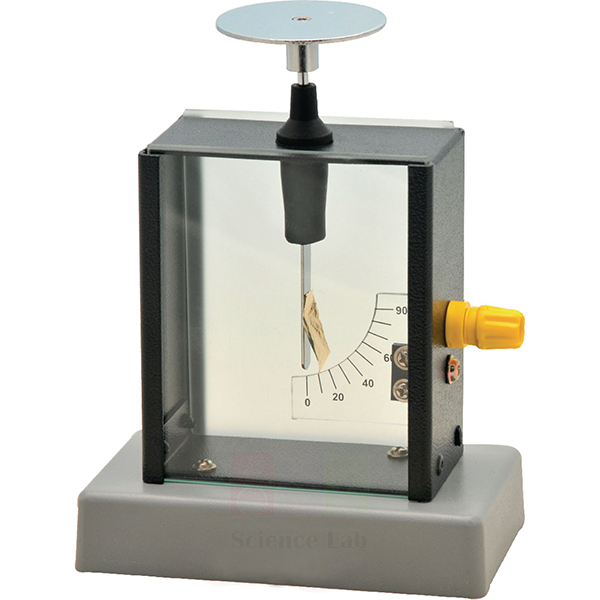
Electroscope, Gold Leaf
Electroscope, Gold Leaf (Product Code: SLE/PHY/167) is a metal-cased electrostatic instrument used to detect charge and compare its size in secondary school and college physics labs. A single gold leaf attaches to a metal plate held on an insulating bush, and a scale lets students measure how far the leaf deflects. It is manufactured by Jain Scientific Equipments Pvt Ltd (ScienceLab), an OEM, at its own factory in Ambala, India, as part of its range of physics lab instruments.
Specifications
| Parameter | Detail |
|---|---|
| Design | Dual purpose gold leaf electroscope |
| Leaf mounting | Metal plate to which a single gold leaf may be attached |
| Insulation | Plate supported by an insulating bush |
| Housing | Metal case |
| Earthing | 4 mm socket earthing terminal |
| Measurement | Scale provided for measuring the deflection of the leaf |
| Spares | Replacement gold leaves available separately |
| Product code | SLE/PHY/167 |
| Manufacturer | Jain Scientific Equipments Pvt Ltd (ScienceLab) — OEM |
| Country of origin | India (made in Ambala, Haryana) |
What Is the Gold Leaf Electroscope Used For?
With its scale, this electroscope takes students beyond a yes-or-no answer: they can compare deflections when a rod is rubbed with different cloths, watch the leaf fall as charge leaks away, and record the results in a table. The earthing terminal takes a 4 mm lead, so the case can be earthed whenever an experiment calls for it, and the instrument works well alongside Faraday's pails for charge-distribution studies.
Charging by induction is a classic exercise: hold a charged rod near the plate, touch the plate briefly to earth, remove the earth connection and then the rod, and the leaf stays deflected with the opposite charge. Store the electroscope in a dry cupboard, because moisture on the insulating bush lets charge leak away and shortens readings.
What to Specify When Ordering
- The number of instruments for demonstration or group practicals.
- The quantity of replacement gold leaves, which are supplied separately.
- 4 mm earthing leads, if your lab does not already stock them.
- Charging accessories such as friction rods, cloths or a proof plane.
OEM Manufacturer
ScienceLab is the trading name of Jain Scientific Equipments Private Limited, which manufactures this gold leaf electroscope as the OEM at its own licensed factory in Saha, Ambala, Haryana. Buying from the maker means spare leaves and repeat orders are discussed with the same company that produces the instrument. Institutional and tender buyers who need vendor registration details can note GSTIN 06AAECJ8618A1ZT and LEI 3358004HRD1JIVXKYX49. Learn more on our company profile.
Related Physics Lab Equipment
These items extend the gold leaf electroscope into full electrostatics practicals:
- Faraday’s Pails — nesting aluminium containers for ice-pail and charge-distribution experiments.
- Proof Plane 20mm Dia — metal plate on an insulating handle for transferring small samples of charge.
- Friction Rod, Nylon — a rod for charging the plate by contact or induction.
- Electroscope in Flask, Gold Leaf — simpler flask version for introductory charge detection.
Explore more in our Physics Lab Equipment category.
Frequently Asked Questions
What does the scale on the Electroscope, Gold Leaf do?
The scale on the Electroscope, Gold Leaf lets students measure the deflection of the leaf, so they can compare charges and record how quickly charge leaks away instead of only noting whether the leaf moved.
How is the Electroscope, Gold Leaf earthed?
The Electroscope, Gold Leaf has a 4 mm socket earthing terminal on its metal case. Connect a 4 mm lead from this socket to an earth point when an experiment, such as charging by induction, requires the case to be earthed.
Can a damaged gold leaf be replaced?
Yes. The Electroscope, Gold Leaf uses a metal plate to which a single gold leaf may be attached, and replacement gold leaves are available separately, so a torn leaf can be renewed without buying a new instrument.
Who manufactures the Electroscope, Gold Leaf?
The Electroscope, Gold Leaf is manufactured by Jain Scientific Equipments Pvt Ltd (ScienceLab), an OEM manufacturer based in Ambala, Haryana, India. It is produced at the company's own factory and supplied factory-direct to institutions, dealers and importers.
Is a calibration certificate supplied with the Electroscope, Gold Leaf?
No calibration certificate is listed for the Electroscope, Gold Leaf, whose scale is intended for comparing leaf deflections in teaching. If a tender requires a certificate or test document, please raise it with us through the contact page before ordering.
What details should I send for a quotation?
For the Electroscope, Gold Leaf, send product code SLE/PHY/167, the quantity, the number of spare gold leaves and your delivery location in India or international markets. We then quote directly as the manufacturer.
Request a Quote
Send your Electroscope, Gold Leaf requirement through our contact page or place it in the enquiry cart. Every quotation is prepared by the manufacturer itself.
Last updated: 24 September 2026
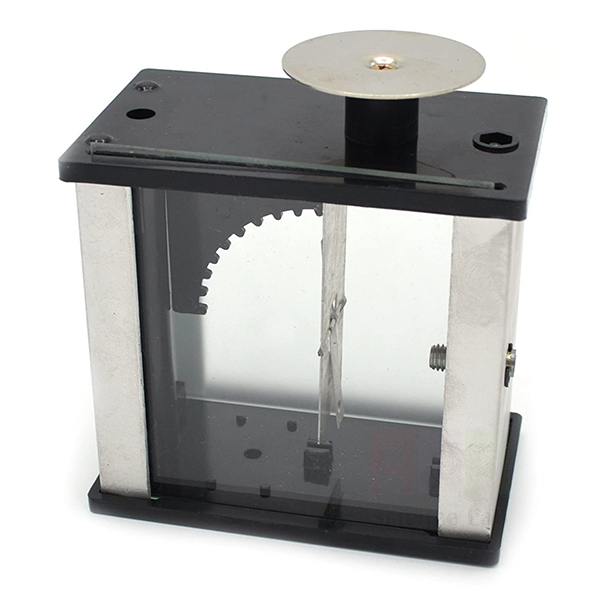
Electroscope, Needle
Electroscope, Needle (Product Code: SLE/PHY/168) is a vane-type electroscope used to show and measure electrostatic charge in physics classrooms and labs. Instead of a fragile leaf, a light-weight metal vane acts as the pointer and swings across a graduated scale when the plate is charged, giving hands-on experience with electrostatic principles. It is made by Jain Scientific Equipments Pvt Ltd (ScienceLab), an OEM manufacturer, at its own factory in Ambala, India.
Key Details
| Parameter | Detail |
|---|---|
| Pointer | Light-weight metal vane (blade) that deflects when the electroscope plate is charged |
| Scale | Graduated scale for measuring the angle of deflection |
| Walls | Sheet metal |
| Base and top | Plastic |
| Front window | Glass; slides up to allow ionising material to be inserted into the chamber |
| Product code | SLE/PHY/168 |
| Manufacturer | Jain Scientific Equipments Pvt Ltd (ScienceLab) — OEM |
| Country of origin | India (made in Ambala, Haryana) |
What Is the Needle Electroscope Used For?
Because the vane's angle can be read off the graduated scale, students can compare charge levels, time how fast charge decays and plot simple graphs — a step up from purely qualitative observation. The robust vane also stands up to repeated student handling better than a leaf, which makes this a practical item of physics lab equipment for schools in India running regular electrostatics practicals.
The sliding glass window gives access to the chamber, so a teacher can place ionising material inside and show that ionised air makes the charged vane fall back as the charge is neutralised. Any radioactive source must be handled under your institution's safety rules; no source is listed as part of this item.
OEM Manufacturer
Jain Scientific Equipments Private Limited (trading as ScienceLab) is the original equipment manufacturer of this needle electroscope. Production takes place at the company's own licensed factory at Saha, Ambala, Haryana, and finished instruments go straight from the factory to schools, colleges, laboratory dealers and importers. If you need a replacement part later, ask us — you will be dealing with the manufacturer, not a middleman. Company background is on our profile page.
Related Physics Lab Equipment
Useful companions for charging the needle electroscope and comparing results:
- Electroscope, Gold Leaf — leaf-type instrument with its own deflection scale and 4 mm earthing terminal.
- Electrostatic Investigation — kit of friction rods, fabrics and a pith ball for producing charge.
- Friction Rod, Glass/Brass, 300mm — rod for charging the plate by friction.
- Van de Graaff Generator — stronger charge source for large vane deflections.
For the complete range, visit Physics Lab Equipment.
Frequently Asked Questions
How does the Electroscope, Needle indicate charge?
The Electroscope, Needle indicates charge with a light-weight metal vane that deflects when the electroscope plate is charged. The vane acts as a pointer over a graduated scale, so the angle of deflection can be read and compared.
What is the Electroscope, Needle made of?
The Electroscope, Needle has sheet metal walls attached to a plastic base and top, a glass front window that slides up, and a light-weight metal vane pointer with a graduated scale for reading the deflection angle.
What is the sliding window on the Electroscope, Needle for?
The front glass window of the Electroscope, Needle slides up so ionising material can be placed in the chamber to demonstrate how ionised air discharges the vane. No ionising source is listed with the item, so discuss requirements with us.
Is the Electroscope, Needle suitable for student practicals?
Yes, the Electroscope, Needle is designed for hands-on experience with electrostatic principles in physics classrooms and labs, and its graduated scale suits practicals where students record the angle of deflection rather than simply observing movement.
Who manufactures the Electroscope, Needle?
Jain Scientific Equipments Pvt Ltd (ScienceLab) manufactures the Electroscope, Needle as an OEM at its own factory in Ambala, Haryana, India. Quotations, repeat orders and questions about spare parts are handled directly by the company.
Can I get a calibration certificate for the Electroscope, Needle?
A calibration certificate is not listed for the Electroscope, Needle, as its scale serves comparative classroom readings. If your purchase terms need one, please discuss it with us on the contact page before placing the order.
Can the Electroscope, Needle be supplied in bulk or for export?
Yes, the Electroscope, Needle can be supplied in bulk to schools, colleges and distributors in India and international markets. Share the quantity, delivery destination and any accessories you need through the contact page to receive a quotation.
Request a Quote
Request a quotation for the Electroscope, Needle on our contact page, or collect it with other items in the enquiry cart. Quotes are issued directly by the manufacturer in Ambala.
Last updated: 24 September 2026
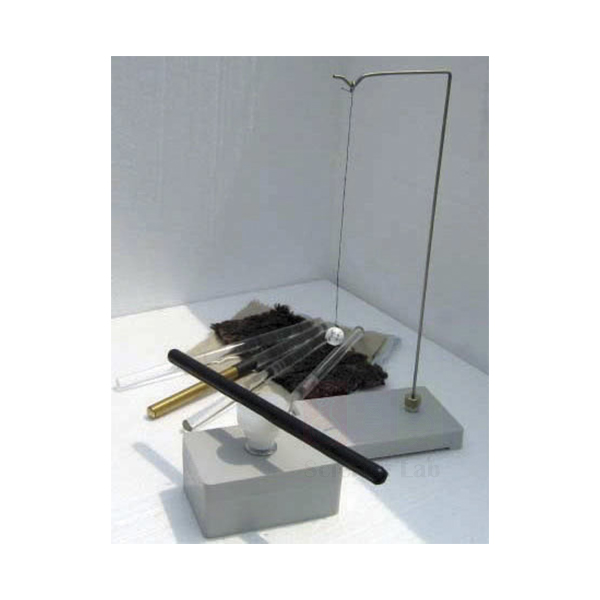
Electrostatic Investigation
Electrostatic Investigation (Product Code: SLE/PHY/169) is a static electricity kit used to explore attraction and repulsion between charged objects in school science and physics lessons. It brings together various friction rods and fabrics with a pith ball suspended from a support, so students can charge a rod and watch the ball respond. The kit is made by Jain Scientific Equipments Pvt Ltd (ScienceLab), an OEM manufacturer, at its own factory in Ambala, India.
Key Details
| Parameter | Detail |
|---|---|
| Kit type | Electrostatics investigation kit |
| Charging items | Various friction rods and fabrics |
| Indicator | Pith ball suspended from the support |
| Demonstrates | Attraction and repulsion of electric charges |
| Product code | SLE/PHY/169 |
| Manufacturer | Jain Scientific Equipments Pvt Ltd (ScienceLab) — OEM |
| Country of origin | India (made in Ambala, Haryana) |
What Is the Electrostatic Investigation Kit Used For?
Students rub a rod with one of the fabrics and bring it close to the hanging pith ball. At first the ball is pulled towards the rod; once it touches, it shares the rod's charge and is pushed away. Repeating this with different rod and fabric pairs lets a class compare which combinations charge best, making the set a simple physics experiment kit for school electrostatics topics.
Clear results depend on dry conditions, so run the activity away from open windows on humid days and wipe the rods clean before use. The individual rods and fabrics are not itemised, so confirm the kit contents with us if your syllabus names particular materials.
What to Specify When Ordering
- The number of kits for your student groups.
- Any specific rod or fabric materials your syllabus requires, so we can confirm them against the kit contents.
- An electroscope, if you also want to detect and compare charge with a scale.
OEM Manufacturer
This kit comes from Jain Scientific Equipments Private Limited, which trades as ScienceLab and acts as the OEM for its educational apparatus. The company makes its products at its own licensed factory in Saha, Ambala, Haryana, and deals directly with schools, training institutes, dealers and importers, so quotations and follow-up questions are answered by the maker itself. Read the company profile for background.
Related Physics Lab Equipment
Extend the kit with extra charging materials and a way to measure charge:
- Friction Cloth, Cotton — extra cotton cloths so more groups can rub rods at once.
- Friction Rod, Perspex — acrylic rod for comparing charging behaviour.
- Friction Rod, Nylon — synthetic rod to widen the range of materials tested.
- Electroscope, Gold Leaf — shows the charge picked up from the rods on a deflection scale.
More apparatus is listed under Physics Lab Equipment.
Frequently Asked Questions
What is included in the Electrostatic Investigation kit?
The Electrostatic Investigation kit contains various friction rods and fabrics for electrostatic experiments, plus a pith ball suspended from a support. The exact rod and fabric types are not itemised, so ask us to confirm the list before ordering.
What does the Electrostatic Investigation kit demonstrate?
The Electrostatic Investigation kit demonstrates attraction and repulsion. A charged rod first attracts the suspended pith ball; once the ball touches the rod and shares its charge, the two repel, showing clearly that like charges push apart.
Which classes can use the Electrostatic Investigation kit?
The Electrostatic Investigation kit suits middle and secondary school science, where static electricity is first introduced, and it also works as a quick warm-up demonstration in higher classes before moving on to electroscopes and Van de Graaff generator experiments.
Why does the pith ball sometimes fail to move?
Humidity is the usual reason: moist air lets charge leak from the rods of the Electrostatic Investigation kit before it reaches the pith ball. Work in a dry room, keep the rods clean and rub them briskly for a clear response.
Who makes the Electrostatic Investigation kit?
The Electrostatic Investigation kit is made by Jain Scientific Equipments Pvt Ltd (ScienceLab), an OEM manufacturer, at its own factory in Ambala, Haryana, India, and it is supplied factory-direct to schools, dealers and importers.
How do I request a quotation for the Electrostatic Investigation kit?
To get a quotation for the Electrostatic Investigation kit, send product code SLE/PHY/169, the number of kits and your delivery location in India or international markets through the contact page or the enquiry cart.
Request a Quote
Tell us how many Electrostatic Investigation kits you need via the contact page, or add the kit to the enquiry cart. The quotation comes straight from the manufacturer.
Last updated: 24 September 2026
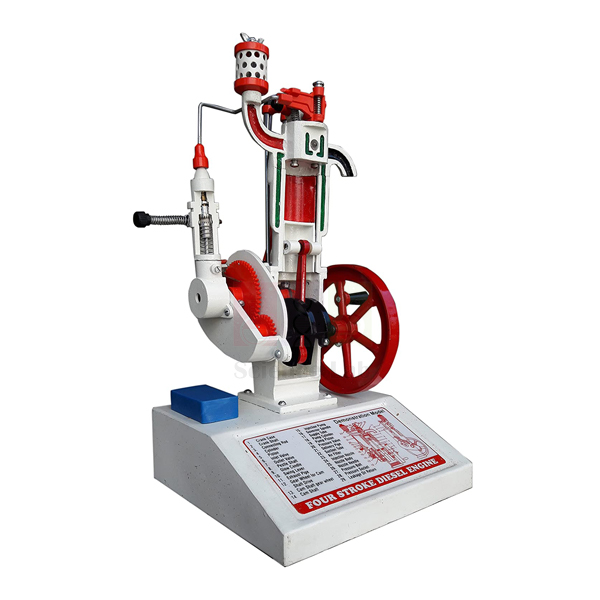
Engine, Diesel, 4 Stroke
Engine, Diesel, 4 Stroke (Product Code: SLE/PHY/170) is a hand-cranked working model used to demonstrate how a four-stroke diesel engine operates in physics and automotive training classrooms. Turning the main shaft by hand drives the crankshaft, cam, valves, piston and fuel pump through every stage of diesel firing, and a 6 V supply lights the ignition light and glow plug. It is made by Jain Scientific Equipments Pvt Ltd (ScienceLab), an OEM manufacturer, at its own factory in Ambala, India.
Specifications
| Parameter | Detail |
|---|---|
| Model type | 4-stroke diesel hand-crank model with actuating movable parts |
| Materials | Cast alloys and ABS plastic |
| Operation | Cranking the main shaft by hand actuates all parts to show the stages of a 4-stroke diesel motor firing |
| Functioning parts | Crankshaft, cam, cam gear, connecting rods, piston, intake/exhaust valves, rocker arms, push rods, fuel pump |
| Identifiable parts | Crank case, crank shaft, connecting rod, cylinder, piston, intake valve, exhaust valve, pestle shaft, glow candle (glow plug), swing lever, exhaust manifold/pipe, cam shaft gear, injection pump, governor spindle, supply line, cylinder pump, piston pump, pressure valve, delivery pipe, suction sub, air filter, injection nozzle, nozzle body, nozzle needle, pressure bolt, pressure socket, oil return |
| Electrical | Ignition light and glow plug can be activated using a 6 V power supply |
| Product code | SLE/PHY/170 |
| Manufacturer | Jain Scientific Equipments Pvt Ltd (ScienceLab) — OEM |
| Country of origin | India (made in Ambala, Haryana) |
What Is the 4 Stroke Diesel Engine Model Used For?
Teachers crank the model slowly to walk students through intake, compression, power and exhaust, pointing out how the cam, push rods and rocker arms open each valve at the right moment and how the injection pump and nozzle deliver fuel. Because a diesel engine ignites fuel by the heat of compression rather than a spark, the model is also a good way to explain why a glow plug helps with cold starts.
Its long list of identifiable parts makes it a ready labelling exercise for mechanics lab equipment in India used in physics, ITI and automotive courses. Crank gently without forcing the mechanism, keep moving parts free of dust, and switch off the 6 V supply after the lesson.
What to Specify When Ordering
- Whether you need a 6 V power supply for the ignition light and glow plug, or already have one.
- The number of models required for demonstration or group work.
- Any parts your syllabus asks students to identify, so we can check them against the list above.
OEM Manufacturer
Jain Scientific Equipments Private Limited, known by its trading name ScienceLab, is the OEM behind this engine model and produces its teaching models at its own licensed factory in Saha, Ambala, Haryana. Colleges, technical institutes, dealers and importers buy directly from the factory, and any request for a spare part or a repeat batch is handled by the manufacturer — simply ask us. Company details are on our profile page.
Related Physics Lab Equipment
Models and a power source that fit the same heat-engine lessons:
- Section Model Of Four-Stroke Diesel Engine — sectioned model for comparing internal detail.
- Cut Section Model Of Four Stroke Petrol Engine — contrasts spark ignition with compression ignition.
- Hand-Powered Engine Models — further hand-cranked engine demonstrations.
- Power Supply, Stepped — 2–12 V stepped bench supply; ask us to confirm the setting for the 6 V lamp circuit.
Find more apparatus in our Physics Lab Equipment category.
Frequently Asked Questions
How does the Engine, Diesel, 4 Stroke model work?
The Engine, Diesel, 4 Stroke model works by cranking the main shaft by hand, which actuates all its parts to show the stages of a four-stroke diesel motor firing. No fuel is burned; it is a demonstration model.
Which parts move on the Engine, Diesel, 4 Stroke model?
The functioning parts of the Engine, Diesel, 4 Stroke model are the crankshaft, cam, cam gear, connecting rods, piston, intake and exhaust valves, rocker arms, push rods and fuel pump, all driven from the hand crank.
Does the Engine, Diesel, 4 Stroke need electricity?
The Engine, Diesel, 4 Stroke runs mechanically by hand, but its ignition light and glow plug can be activated using a 6 V power supply. A supply is not listed with the model, so tell us if you need one quoted.
What is the Engine, Diesel, 4 Stroke model made of?
The Engine, Diesel, 4 Stroke model is made of cast alloys and ABS plastic, built for repeated classroom demonstrations. Handle it on a stable bench and avoid forcing the crank if any part feels stiff.
Who manufactures the Engine, Diesel, 4 Stroke model?
The Engine, Diesel, 4 Stroke model is manufactured by Jain Scientific Equipments Pvt Ltd (ScienceLab), an OEM, at its own factory in Ambala, Haryana, India, and supplied factory-direct to institutions, dealers and importers.
Can the Engine, Diesel, 4 Stroke be exported?
Yes, the Engine, Diesel, 4 Stroke model can be quoted for schools, colleges, training centres and distributors in India and international markets. Send the quantity, destination and whether you need a 6 V supply via our contact page.
Request a Quote
For a quotation on the Engine, Diesel, 4 Stroke model, write to us through the contact page or add it to the enquiry cart. You deal directly with the manufacturer from enquiry to dispatch.
Last updated: 24 September 2026
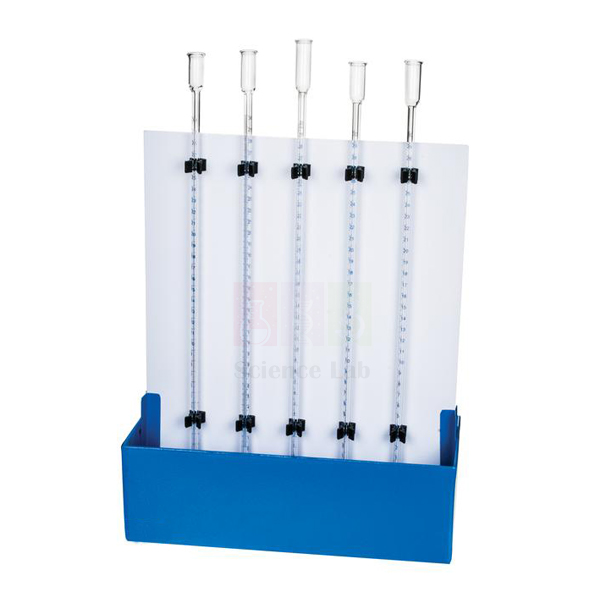
Expansion Of Liquids Apparatus
Expansion Of Liquids Apparatus (Product Code: SLE/PHY/171) is a heat demonstration set used to compare how much different liquids expand when warmed, in school and college physics labs. Five removable glass bulbs with tubes sit in a sliding frame supported in a water trough, so all the liquids are heated together and their rising levels can be compared side by side. It is manufactured by Jain Scientific Equipments Pvt Ltd (ScienceLab), an OEM, at its own factory in Ambala, India.
Key Details
| Parameter | Detail |
|---|---|
| Glassware | Five removable glass bulbs with tubes |
| Frame | Special sliding arrangement with clips to hold the glass bulbs |
| Filling | Funnel formation on top of each bulb for easy filling |
| Heating bath | Water trough supporting the frame |
| Purpose | Demonstrating the different thermal expansions of various liquids |
| Product code | SLE/PHY/171 |
| Manufacturer | Jain Scientific Equipments Pvt Ltd (ScienceLab) — OEM |
| Country of origin | India (made in Ambala, Haryana) |
What Is the Expansion of Liquids Apparatus Used For?
Fill each bulb to the same starting level with a different liquid — for example water, alcohol, glycerine or a light oil — then pour hot water into the trough. As the liquids warm together, their columns rise by different amounts, giving a clear visual comparison of how expansion depends on the liquid. It is a staple among the thermometry apparatus that schools in India use for heat and temperature topics.
The funnel tops make filling quick and reduce spills, and because the bulbs clip into the sliding frame they can be lifted out for emptying and cleaning. Handle the glass with care, let hot water cool before draining the trough, and label each bulb so students know which liquid is which.
OEM Manufacturer
Jain Scientific Equipments Private Limited, trading as ScienceLab, is the original equipment manufacturer of this apparatus. The company (CIN U29309HR2020PTC087597) carries out production at its licensed factory at 449, HSIIDC Industrial Area, Saha, Ambala (Factory Licence AMB-ONLINE-CHD-J-414). Buying from the factory means the quotation, the dispatch and any later question about replacement glassware come from one source. Read our company profile.
Related Physics Lab Equipment
Items that support heating, temperature readings and comparison with solids:
- Expansion Apparatus — demonstrates linear expansion of solids for a direct comparison.
- Gravesand Ring-Device to Demonstrate Thermal Expansion — ball-and-ring demonstration of expansion in metals.
- Glass Beaker — for heating water and pouring it into the trough.
- Digital Thermometer — monitors the trough temperature while the liquids expand.
See the wider range under Physics Lab Equipment.
Frequently Asked Questions
How many tubes does the Expansion Of Liquids Apparatus have?
The Expansion Of Liquids Apparatus has five removable glass bulbs with tubes, held in a sliding frame, so up to five different liquids can be compared in a single heating run in front of the class.
How are the bulbs filled and removed?
Each bulb of the Expansion Of Liquids Apparatus has a funnel formation on top for easy filling, and the frame's sliding arrangement with clips allows the bulbs to be removed and fixed quickly for emptying, cleaning or changing liquids.
How is the Expansion Of Liquids Apparatus heated?
The Expansion Of Liquids Apparatus is supported in a water trough. Filling the trough with hot water warms all five bulbs together, so differences in liquid level come from the liquids themselves rather than from uneven heating.
Are spare glass bulbs available for the Expansion Of Liquids Apparatus?
Spare bulbs are not listed as a separate item for the Expansion Of Liquids Apparatus. Because the bulbs are removable, ask us through the contact page about replacement glass bulbs with tubes when you request your quotation.
Who manufactures the Expansion Of Liquids Apparatus?
Jain Scientific Equipments Pvt Ltd (ScienceLab) is the OEM manufacturer of the Expansion Of Liquids Apparatus, producing it at its own licensed factory in Saha, Ambala, Haryana, India, and quoting directly to institutions and trade buyers.
Can the Expansion Of Liquids Apparatus be supplied for export?
Yes, the Expansion Of Liquids Apparatus can be quoted for schools, colleges and distributors in India and international markets. Share the quantity and destination on our contact page, and ask about packing for the glass parts when you request the quotation.
Request a Quote
Send the quantity of Expansion Of Liquids Apparatus you need through our contact page, or add it to the enquiry cart. Quotations are issued directly by the manufacturer.
Last updated: 24 September 2026

Faraday's Pails
Faraday's Pails (Product Code: SLE/PHY/172) is a set of nesting metal containers used to study how charge collects on the outside of a hollow conductor in school and college electrostatics lessons. The four aluminium cylinders, ranging from 150 mm down to 75 mm in diameter, each stand on insulating feet so they can be used singly or one inside another. The set is manufactured by Jain Scientific Equipments Pvt Ltd (ScienceLab), an OEM, at its own factory in Ambala, India.
Specifications
| Parameter | Detail |
|---|---|
| Set contents | 4 nesting, cylindrical containers |
| Material | Aluminium |
| Insulation | Each container fitted with insulating feet |
| Largest pail | 150 mm dia x 120 mm high |
| Second pail | 120 mm dia x 110 mm high |
| Third pail | 90 mm dia x 90 mm high |
| Smallest pail | 75 mm dia x 75 mm high |
| Product code | SLE/PHY/172 |
| Manufacturer | Jain Scientific Equipments Pvt Ltd (ScienceLab) — OEM |
| Country of origin | India (made in Ambala, Haryana) |
What Are Faraday's Pails Used For?
In the classic ice-pail experiment, a charged object is lowered into a pail connected to an electroscope: the reading rises as the object enters and then stays the same wherever the object sits inside, showing that the induced charge appears on the outer surface. Nesting the four pails lets students go further, testing electrostatic shielding and charge transfer between concentric conductors.
The insulating feet keep each pail isolated from whatever it stands on, so charge stays where the experiment puts it. Keep the feet clean and dry, since dust or moisture lets charge leak away. The set is a natural addition when building an electrostatics bench as part of physics lab equipment for schools and colleges in India.
What to Specify When Ordering
- The number of sets required (each set is four nesting pails).
- An electroscope or coulomb meter for reading the charge, if not already in your lab.
- A charge source, such as friction rods or a Van de Graaff generator.
OEM Manufacturer
ScienceLab is the trading name of Jain Scientific Equipments Private Limited, the OEM that makes these pails at its own licensed factory in Saha, Ambala, Haryana. Institutions, dealers and importers order straight from the manufacturer, so quotations, repeat sets and questions about individual pails are answered by the company that makes them. Visit our company profile to learn more.
Related Physics Lab Equipment
The pails are used with a charge detector and a charge source; these items complete the set-up:
- Electroscope, Gold Leaf — connects to a pail to show the induced charge on its scale.
- Digital Coulomb Meter — displays the charge collected from a source of static electricity.
- Proof Plane 20mm Dia — samples charge from inner and outer surfaces.
- Van de Graaff Generator — supplies charge for the experiments.
Browse more in our Physics Lab Equipment category.
Frequently Asked Questions
What sizes are included in Faraday's Pails?
Faraday's Pails is a set of four nesting containers measuring 150 mm dia x 120 mm high, 120 mm dia x 110 mm high, 90 mm dia x 90 mm high and 75 mm dia x 75 mm high.
What are Faraday's Pails made of?
Faraday's Pails are aluminium, cylindrical containers, each fitted with insulating feet. Aluminium conducts well and keeps the set light, while the feet isolate every pail from the bench or from the larger pail it stands in.
What experiment are Faraday's Pails used for?
Faraday's Pails are used for the ice-pail experiment, which shows that charge induced by an object inside a hollow conductor appears on its outer surface, and for shielding and charge-transfer studies using the nested containers.
Do Faraday's Pails come with an electroscope?
No electroscope is listed with Faraday's Pails; the set comprises the four aluminium containers. Pair it with a gold leaf electroscope or a coulomb meter from our physics range to read the charge, and ask us to quote both together.
Who manufactures Faraday's Pails?
Faraday's Pails are manufactured by Jain Scientific Equipments Pvt Ltd (ScienceLab), an OEM based in Ambala, Haryana, India, at its own factory, and supplied directly to schools, universities, dealers and importers without a trading intermediary.
How do I get a quotation for Faraday's Pails?
For a quotation on Faraday's Pails, send product code SLE/PHY/172, the number of sets and your delivery location in India or international markets through our contact page or enquiry cart.
Request a Quote
Ask for Faraday's Pails through our contact page or add the set to the enquiry cart. You will receive a quotation from the manufacturer directly.
Last updated: 24 September 2026

Floating Magnets – Coloured
Floating Magnets – Coloured (Product Code: SLE/PHY/173) is a magnet demonstration set used to show magnetic repulsion in primary and secondary school science classes. Five coloured ceramic magnets, each 32 mm in external diameter, are mounted on a 150 mm high wooden pole and hover apart when like poles face each other. The set is made by Jain Scientific Equipments Pvt Ltd (ScienceLab), an OEM manufacturer, at its own factory in Ambala, India.
Specifications
| Parameter | Detail |
|---|---|
| Magnets | Set of 5 ceramic magnets, coloured |
| Magnet size | 32 mm external diameter |
| Support | Wooden pole, 150 mm high |
| Demonstrates | Magnetic repulsion forces |
| Product code | SLE/PHY/173 |
| Manufacturer | Jain Scientific Equipments Pvt Ltd (ScienceLab) — OEM |
| Country of origin | India (made in Ambala, Haryana) |
What Are Floating Magnets Used For?
When the magnets are stacked on the pole with like poles facing, each one floats above the next, and pressing the top magnet down lets students feel the repulsive force pushing back. Turning one magnet over so that unlike poles face makes it snap onto its neighbour, giving an instant contrast between attraction and repulsion. It is a quick, visual addition to any magnetism experiment kit in Indian classrooms.
Students can also notice that the gaps are smaller towards the bottom, because the lower magnets carry the weight of those above — a neat link between magnetic force and gravity. Keep the set away from computers and magnetic cards, and do not drop the ceramic magnets, which can chip.
OEM Manufacturer
Jain Scientific Equipments Private Limited — the company behind the ScienceLab name — is the OEM for this floating magnet set and makes its magnetism apparatus at its own licensed factory in Saha, Ambala, Haryana. Schools and distributors deal directly with the manufacturer, and questions about spare magnets or repeat sets go to the same source; just ask us. Company background is on our profile page.
Related Physics Lab Equipment
Magnetism items that build on the floating-magnet demonstration:
- Magnets, Ring — separate pack of ceramic ring magnets for further floating-magnet activities.
- Steel Horseshoe Magnet — classic magnet shape for pole and field work.
- Compass Plotting (Clear) — maps the direction of the field around the magnets.
- Magnetic Field Demonstrator — shows field-line patterns without loose iron filings.
Explore our full Physics Lab Equipment range.
Frequently Asked Questions
How many magnets are in Floating Magnets – Coloured?
Floating Magnets – Coloured contains a set of 5 ceramic magnets, each with a 32 mm external diameter, mounted on a 150 mm high wooden pole so they can float above one another by magnetic repulsion.
What are the floating magnets made of?
The magnets in Floating Magnets – Coloured are ceramic magnets. Ceramic magnets are strong for their size but brittle, so students should lift them off the wooden pole gently and avoid dropping them onto hard floors.
What does Floating Magnets – Coloured demonstrate?
Floating Magnets – Coloured illustrates magnetic repulsion forces: with like poles facing, each magnet hovers above the next. Reversing one magnet shows attraction instead, so both behaviours can be compared in one short demonstration.
Is Floating Magnets – Coloured suitable for young learners?
Floating Magnets – Coloured suits primary and middle school science because the effect is visible without instruments. Supervise younger children, as small magnets should never be swallowed and ceramic pieces can chip if dropped.
Who manufactures Floating Magnets – Coloured?
Floating Magnets – Coloured is manufactured by Jain Scientific Equipments Pvt Ltd (ScienceLab), an OEM manufacturer, at its own factory in Ambala, Haryana, India, and supplied directly to schools, colleges, dealers and importers.
Can Floating Magnets – Coloured be ordered in class quantities?
Yes, Floating Magnets – Coloured can be quoted in classroom quantities for schools and distributors in India and international markets. Send the number of sets and your delivery location through the contact page to receive a quotation.
Request a Quote
To buy Floating Magnets – Coloured, send your requirement via our contact page or the enquiry cart. The manufacturer prepares every quotation directly.
Last updated: 24 September 2026
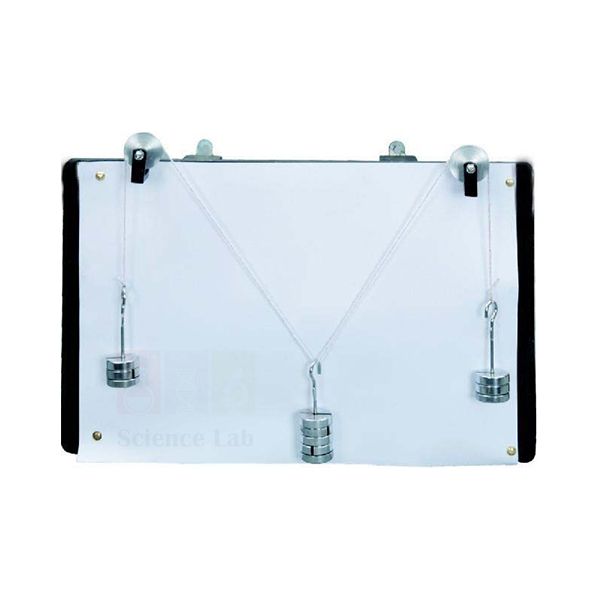
Force Board, Wall Type
Force Board, Wall Type (Product Code: SLE/PHY/174) is a wall-mounted board used to demonstrate the parallelogram and polygon of forces in school and college mechanics lessons. Measuring 750 x 600 mm, it leaves a clear space all round the edge for attaching pulleys, and it comes complete with mounting brackets, cords, pulleys and masses. It is manufactured by Jain Scientific Equipments Pvt Ltd (ScienceLab), an OEM, at its own factory in Ambala, India.
Specifications
| Parameter | Detail |
|---|---|
| Board size | 750 x 600 mm |
| Mounting | Fitted with metal brackets for fixing to a wall |
| Layout | Clear space left all round the edge of the board for attaching pulleys and similar fittings |
| Supplied with | Mounting brackets, cords, pulleys and masses |
| Demonstrates | Principles of the parallelogram and polygon of forces |
| Product code | SLE/PHY/174 |
| Manufacturer | Jain Scientific Equipments Pvt Ltd (ScienceLab) — OEM |
| Country of origin | India (made in Ambala, Haryana) |
What Is the Wall Force Board Used For?
Pulleys attached at the board's edge carry cords to a common knot, with masses hanging from each cord. When the knot comes to rest, students trace the cord directions on a sheet of paper fixed to the board, draw the forces to scale and check that they close into a triangle or polygon — the heart of vector addition in mechanics lab equipment for Indian schools and colleges.
Because the board hangs on the wall, a whole class can watch the same demonstration without crowding round a bench, and the teacher can leave it set up between lessons. Fix the brackets into a solid wall, check the board is vertical, and let the knot settle fully before recording any angles.
OEM Manufacturer
Jain Scientific Equipments Private Limited trades as ScienceLab and is the OEM manufacturer of this force board. It is made at the company's own licensed factory at Saha, Ambala, Haryana, and dispatched directly to schools, engineering colleges, dealers and importers, so the quotation and any later request for replacement cords or pulleys are handled by the maker — ask us. See our company profile.
Related Physics Lab Equipment
Other apparatus for forces, equilibrium and vector work:
- Force Table — horizontal apparatus for three-force and four-force equilibrium at student benches.
- Equilibrium Of A Force — masses, hooks, pulleys and cords for forces acting on a point.
- Force Meter/Spring Balance — measures pulling forces directly to cross-check results.
- Pulley, Rod & Bench Mounting — clamp-on pulley for extending force set-ups on a bench.
More options are in our Physics Lab Equipment category.
Frequently Asked Questions
What size is the Force Board, Wall Type?
The Force Board, Wall Type measures 750 x 600 mm and is designed with a clear space all round the edge of the board, so pulleys and other fittings can be attached without crowding the working area.
What comes with the Force Board, Wall Type?
The Force Board, Wall Type is supplied complete with mounting brackets, cords, pulleys and masses, so it is ready for parallelogram and polygon of forces demonstrations once the metal brackets are fixed to a wall.
How is the Force Board, Wall Type installed?
The Force Board, Wall Type is fitted with metal brackets for fixing to a wall. Choose a solid wall at a height the class can see, use suitable wall fixings, and check the board hangs vertically before experiments.
Which experiments can be done on the Force Board, Wall Type?
The Force Board, Wall Type is designed for demonstrating the principles of the parallelogram and polygon of forces, letting students verify vector addition and the equilibrium of several forces acting at a point using cords, pulleys and hanging masses.
Who manufactures the Force Board, Wall Type?
Jain Scientific Equipments Pvt Ltd (ScienceLab) manufactures the Force Board, Wall Type as an OEM at its own factory in Ambala, Haryana, India, and supplies it factory-direct to schools, colleges, dealers and importers.
What should a quotation request for the Force Board, Wall Type include?
To request a quotation for the Force Board, Wall Type, send product code SLE/PHY/174, the number of boards and the delivery address in India or international markets through our contact page or enquiry cart.
Request a Quote
Order the Force Board, Wall Type by writing to us on the contact page or adding it to the enquiry cart. Quotations come direct from the manufacturer.
Last updated: 24 September 2026
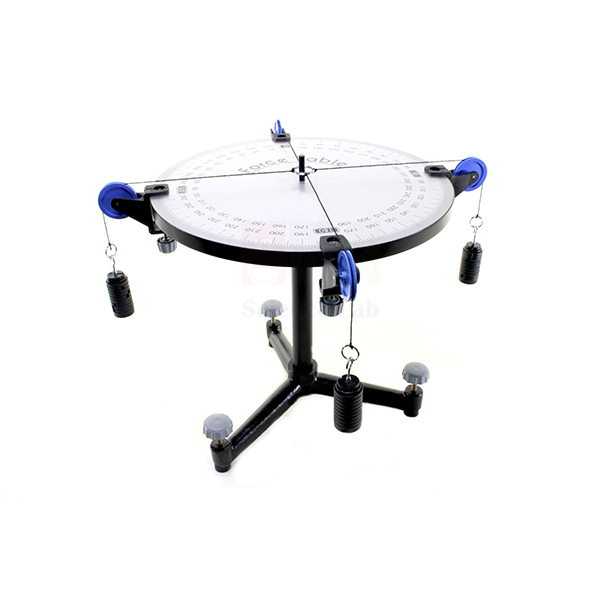
Force Table
Force Table (Product Code: SLE/PHY/175) is a circular vector-addition apparatus used to balance three or four forces and verify equilibrium in school and college physics labs. It has a 40 cm diameter polymer tabletop with an angle scale in 0.5° divisions, a heavy cast base with levelling screws, and four clamp pulleys with slotted masses. It is manufactured by Jain Scientific Equipments Pvt Ltd (ScienceLab), an OEM, at its own factory in Ambala, India.
Specifications
| Parameter | Detail |
|---|---|
| Tabletop | 40 cm diameter, durable polymer |
| Angle scale | 0.5° divisions, marked every 10° in both rotation directions |
| Support column | 3 cm thick |
| Base | Heavy cast base with levelling screws |
| Table height | 41 cm |
| Pulleys | 4 table clamp pulleys, each with a circular cut-out and fiducial mark for accurate angle measurement |
| Masses | 4 sets of slotted masses, each 150 g x 5 g including hangers; keyhole pattern secures them during adjustments |
| Cords | Cords with split rings for three-force and four-force equilibrium arrangements |
| Accessory | Spirit level included |
| Product code | SLE/PHY/175 |
| Manufacturer | Jain Scientific Equipments Pvt Ltd (ScienceLab) — OEM |
| Country of origin | India (made in Ambala, Haryana) |
What Is the Force Table Used For?
Students hang known masses over two or three pulleys, work out the resultant by scale drawing or by components, then set the last pulley at the predicted angle with the balancing mass. If the prediction is right, the point where the cords meet settles over the centre of the table — vector addition made tangible. The split rings let groups switch between three-force and four-force equilibrium in moments, which suits any basic physics lab.
Level the tabletop with the spirit level and the base's levelling screws before each session so the masses pull horizontally across the scale. Line each cord up with the fiducial mark on its pulley to read angles to the nearest scale division. It is a standard item of mechanics lab equipment in India for vector topics in senior secondary and first-year college practicals.
What to Specify When Ordering
- The number of force tables needed for your student groups.
- Whether you want extra slotted mass sets beyond the four supplied.
- Spare cords, hangers or pulleys for heavy use — ask us about availability.
OEM Manufacturer
ScienceLab is the trading name of Jain Scientific Equipments Private Limited, the OEM that manufactures this force table at its own licensed factory at Saha, Ambala, Haryana. The company is a registered MSME enterprise with manufacturing as its major activity (Udyam UDYAM-HR-01-0003714), and export orders are shipped under Importer-Exporter Code AAECJ8618A issued by the DGFT. Quotations and follow-up on spare masses or pulleys come straight from the manufacturer. More on our company profile.
Related Physics Lab Equipment
Useful additions for force and equilibrium practicals:
- Force Board, Wall Type — wall-mounted board for whole-class polygon of forces demonstrations.
- Spirit Level — spare level for checking the tabletop between groups.
- Slotted Mass Hanger, 500g — large-format cast hanger for heavier loading experiments.
- Force, Motion & Dynamics Kit — aluminium-bench system for follow-on dynamics topics.
See all items in Physics Lab Equipment.
Frequently Asked Questions
What is included with the Force Table?
The Force Table comes with four table clamp pulleys, four sets of slotted masses (each 150 g x 5 g including hangers), cords with split rings and a spirit level, all on a 40 cm polymer tabletop with a cast levelling base.
How finely can angles be read on the Force Table?
The Force Table's polymer tabletop carries an angle scale with 0.5° divisions, marked every 10° in both rotation directions, and each pulley's circular cut-out has a fiducial mark for lining cords up during angle measurement.
How tall is the Force Table and how is it levelled?
The Force Table is 41 cm high, with a 3 cm thick support column on a heavy cast base. Levelling screws in the base and the included spirit level let you set the tabletop level before taking measurements.
Can the Force Table set up four-force equilibrium?
Yes. The Force Table includes four clamp pulleys and four mass sets, and the split rings on the cords allow three-force and four-force equilibrium arrangements to be constructed rapidly for vector-addition experiments.
Who manufactures the Force Table?
The Force Table is manufactured by Jain Scientific Equipments Pvt Ltd (ScienceLab), an OEM manufacturer, at its own factory in Ambala, Haryana, India, and supplied directly to schools, colleges, dealers and importers.
Is a calibration certificate available for the Force Table masses?
No calibration certificate is listed for the Force Table or its slotted masses. If your laboratory needs verified mass values or a test document, please discuss the requirement with us through the contact page before ordering.
Request a Quote
Send your Force Table enquiry through the contact page or add it to the enquiry cart with the quantity required. The manufacturer quotes you directly.
Last updated: 24 September 2026
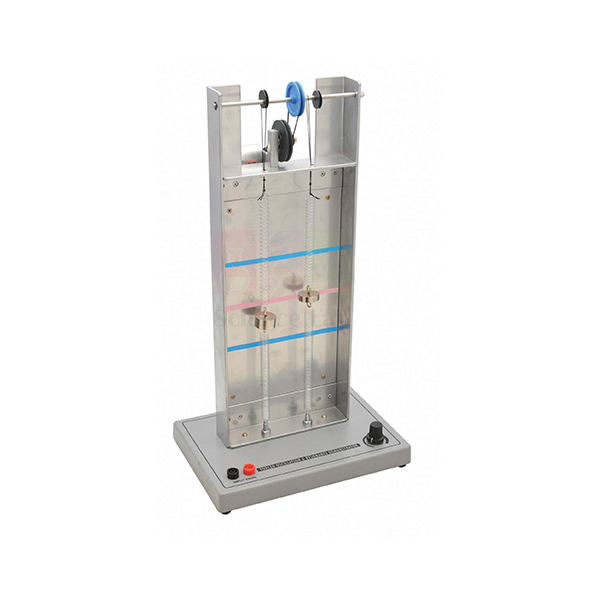
Forced Oscillation and Resonance Demo
Forced Oscillation and Resonance Demo (Product Code: SLE/PHY/176) is a motor-driven demonstrator used to show how an object vibrates under repeated impulses and when resonance occurs, in secondary and college physics classes. Two cams driven by a 6 V motor with speed control act on two weights of different natural frequencies, working together with four springs. It is made by Jain Scientific Equipments Pvt Ltd (ScienceLab), an OEM manufacturer, at its own factory in Ambala, India.
Specifications
| Parameter | Detail |
|---|---|
| Size | 30 x 15 x 45 cm |
| Oscillators | Two weights of different natural frequencies |
| Drive | Two cams driven by a 6 V motor |
| Frequency control | Speed control to adjust the frequency of the applied force for resonance |
| Springs | Four |
| Documentation | Manual included |
| Power source | Not included |
| Product code | SLE/PHY/176 |
| Manufacturer | Jain Scientific Equipments Pvt Ltd (ScienceLab) — OEM |
| Country of origin | India (made in Ambala, Haryana) |
What Is the Forced Oscillation and Resonance Demo Used For?
Start the motor slowly and raise the speed: at first both weights move only slightly, then one begins to vibrate strongly as the driving frequency matches its natural frequency while the other stays fairly calm. Increase the speed further and the second weight takes its turn. Resonance, and its dependence on natural frequency, becomes visible in a way equations alone cannot show, supporting the forced-vibration part of any SHM experiment kit used in Indian syllabi.
Because the speed control allows a wide range of driving frequencies, students can locate each resonance and discuss real examples such as swaying bridges and vibrating machines. Connect a suitable 6 V source, begin at low speed, and read the included manual before the first run.
What to Specify When Ordering
- A 6 V power source, since none is included with the demonstrator.
- The number of units for your physics department.
- Whether you would like other oscillation or resonance apparatus quoted in the same order.
OEM Manufacturer
Jain Scientific Equipments Private Limited operates as ScienceLab and is the original equipment manufacturer of this resonance demonstrator. The unit is produced at the company's own licensed factory in Saha, Ambala, Haryana, and sold factory-direct to schools, universities, laboratory dealers and importers; for springs, cams or other spares, ask the manufacturer directly. Background on the company is on our profile page.
Related Physics Lab Equipment
A power source and further apparatus for oscillation and resonance topics:
- Power Supply, Smoothed — 2–12 V stepped bench supply; ask us to confirm the setting for the 6 V motor.
- Xenon Stroboscope — synchronised flashes appear to freeze the vibrating weights.
- Resonance Apparatus with Brass Tube — resonance in air columns for comparison.
- Tuning Fork on Resonance Box — acoustic resonance with forks on a wooden box.
- Metal Slinky, Helical Spring — demonstrates different types of waves on a steel coil.
Find more in the Physics Lab Equipment category.
Frequently Asked Questions
Does the Forced Oscillation and Resonance Demo include a power supply?
No. The power source is not included with the Forced Oscillation and Resonance Demo. Its cams are driven by a 6 V motor, so you will need a suitable 6 V supply, which we can quote alongside the demonstrator on request.
What size is the Forced Oscillation and Resonance Demo?
The Forced Oscillation and Resonance Demo measures 30 x 15 x 45 cm, compact enough for a teacher's bench while giving the class a clear view of the two weights as they respond to the driving cams.
How does the Forced Oscillation and Resonance Demo show resonance?
The Forced Oscillation and Resonance Demo uses two weights of different natural frequencies. As the speed control raises the cam frequency, each weight vibrates strongly only when the applied frequency matches its own natural frequency, which is resonance.
What is included with the Forced Oscillation and Resonance Demo?
The Forced Oscillation and Resonance Demo includes two weights of different natural frequencies, two cams driven by a 6 V motor with speed control, four springs and a manual. A power source is not part of the item.
Who manufactures the Forced Oscillation and Resonance Demo?
Jain Scientific Equipments Pvt Ltd (ScienceLab) manufactures the Forced Oscillation and Resonance Demo as an OEM at its own factory in Ambala, Haryana, India. Quotations and spare-part enquiries are handled directly by the manufacturer.
Can the Forced Oscillation and Resonance Demo be ordered for export?
Yes, the Forced Oscillation and Resonance Demo can be quoted for single labs or larger orders for schools and distributors in India and international markets. Send the quantity and whether you need a 6 V supply through the contact page.
Request a Quote
Request the Forced Oscillation and Resonance Demo through our contact page or via the enquiry cart, mentioning any power supply you need. Your quotation comes from the manufacturer itself.
Last updated: 24 September 2026
Friction Cloth, Cotton
Friction Cloth, Cotton (Product Code: SLE/PHY/177) is a square cotton rubbing cloth used to charge friction rods in static electricity experiments in school physics labs. Each 300 x 300 mm cloth gives enough area to grip a rod and rub it firmly along its length before bringing it near an electroscope or pith ball. It is supplied by Jain Scientific Equipments Pvt Ltd (ScienceLab), Ambala, India, as an accessory for electrostatics work.
Specifications
| Parameter | Detail |
|---|---|
| Material | Cotton |
| Dimensions | 300 x 300 mm |
| Shape | Square |
| Use | Producing friction with friction rods |
| Product code | SLE/PHY/177 |
| Supplied by | Jain Scientific Equipments Pvt Ltd (ScienceLab), Ambala, India |
What Is the Cotton Friction Cloth Used For?
Rubbing a rod with the cloth transfers electrons between the two surfaces, leaving the rod charged and ready to deflect an electroscope, lift small scraps of paper or swing a pith ball. Using the same cotton cloth with rods of different materials lets students compare which pairings charge most strongly, so it earns a place in the consumables drawer of any school physics lab in India.
Keep cloths dry and clean, because moisture or grease reduces charging. Store them in a closed bag between lessons, and give each student group its own cloth so that rubbing conditions stay consistent across the class.
Supplier
Jain Scientific Equipments Private Limited, which trades as ScienceLab, supplies this cotton friction cloth from Ambala, Haryana, alongside the electrostatics apparatus in its catalogue, so a school can source rods, cloths and electroscopes in a single order. Learn more about the company on our profile page.
Related Physics Lab Equipment
Friction rods to use with the cloth, and a complete starter kit:
- Friction Rod, Brass/Ebonite — 300 x 12 mm rod for static electricity experiments.
- Friction Rod, Nylon — synthetic rod for comparing charging behaviour.
- Friction Rod, Perspex — acrylic option for the same rubbing tests.
- Friction Rod, Glass/Brass, 300mm — glass/brass rod to widen the comparison.
- Electrostatic Investigation — kit of rods, fabrics and a suspended pith ball.
Visit our Physics Lab Equipment category for more.
Frequently Asked Questions
What size is the Friction Cloth, Cotton?
The Friction Cloth, Cotton is a square cloth measuring 300 x 300 mm, large enough to wrap around a friction rod and rub it firmly along its length during static electricity experiments.
What is the Friction Cloth, Cotton used for?
The Friction Cloth, Cotton is used for producing friction with friction rods. Rubbing a rod with the cloth charges it, so the rod can then be used with an electroscope, a pith ball or small paper pieces.
Which rods work with the Friction Cloth, Cotton?
The Friction Cloth, Cotton can be used with the friction rods in our physics range, such as brass/ebonite, nylon, Perspex and glass/brass rods. Different pairings charge differently, which is useful for comparative student work.
Who supplies the Friction Cloth, Cotton?
The Friction Cloth, Cotton is supplied by Jain Scientific Equipments Pvt Ltd (ScienceLab), Ambala, Haryana, India, which can include it in the same quotation as friction rods, electroscopes and other electrostatics apparatus.
How should the Friction Cloth, Cotton be stored?
Store the Friction Cloth, Cotton clean and dry, ideally in a closed bag or box. Damp or greasy cloth reduces the charge produced on friction rods, so replace any cloth that becomes soiled.
Can the Friction Cloth, Cotton be ordered in bulk?
Yes, the Friction Cloth, Cotton can be quoted in quantity for schools, colleges and distributors in India and international markets. Tell us how many cloths you need and your delivery location through the contact page.
Request a Quote
Add the Friction Cloth, Cotton to the enquiry cart together with any rods you need, or send the quantity through our contact page for a quotation.
Last updated: 24 September 2026
Friction Rod, Brass/Ebonite
Friction Rod, Brass/Ebonite (Product Code: SLE/PHY/178) is a charging rod used for various experiments involving static electricity in school and college physics labs. Listed in brass/ebonite and measuring 300 x 12 mm, it is rubbed with a cloth to build up charge that can then be passed to an electroscope or used to attract light objects. It is made by Jain Scientific Equipments Pvt Ltd (ScienceLab), an OEM manufacturer, at its own factory in Ambala, India.
Specifications
| Parameter | Detail |
|---|---|
| Material | Brass/Ebonite |
| Dimensions | 300 x 12 mm |
| Use | Friction rod for various experiments involving static electricity |
| Product code | SLE/PHY/178 |
| Manufacturer | Jain Scientific Equipments Pvt Ltd (ScienceLab) — OEM |
| Country of origin | India (made in Ambala, Haryana) |
What Is the Brass/Ebonite Friction Rod Used For?
Ebonite, a hard rubber, is a traditional material for static demonstrations because it charges readily when rubbed, while brass is a conductor. Having both materials lets teachers discuss why an insulator holds charge where it was rubbed, whereas a conductor held in the hand loses its charge to earth — a key idea in school physics lab equipment courses across India.
Rub the rod briskly with a dry cloth, then bring it near an electroscope plate or a suspended pith ball. Wipe the rod after handling, since skin oils and moisture reduce charging, and store it somewhere dry. If your experiment depends on how the brass and ebonite portions are arranged, confirm this with us when you request a quotation.
OEM Manufacturer
ScienceLab is the brand of Jain Scientific Equipments Private Limited, the OEM manufacturer of this friction rod. The company makes its electrostatics apparatus at its own licensed factory in Saha, Ambala, Haryana, and deals directly with schools, colleges, dealers and importers, so any question about materials or repeat quantities goes to the maker rather than a reseller. Company details are on our profile page.
Related Physics Lab Equipment
Pair the rod with a rubbing cloth, other rod materials and a charge detector:
- Friction Cloth, Cotton — 300 x 300 mm cloth for rubbing the rod.
- Friction Rod, Glass/Brass, 300mm — companion rod for comparing the charge on a different material.
- Electroscope, Needle — reads the charge as a deflection angle on a graduated scale.
- Electroscope in Flask, Gold Leaf — simple detector for showing that the rod is charged.
Browse the rest of our Physics Lab Equipment.
Frequently Asked Questions
What are the dimensions of the Friction Rod, Brass/Ebonite?
The Friction Rod, Brass/Ebonite measures 300 x 12 mm, a length that is easy to hold at one end while rubbing the other and bringing it close to an electroscope plate or pith ball.
What material is the Friction Rod, Brass/Ebonite?
The Friction Rod, Brass/Ebonite is listed in brass/ebonite. If your experiment depends on how the brass and ebonite sections are arranged, please confirm the construction with us through the contact page before ordering.
What experiments use the Friction Rod, Brass/Ebonite?
The Friction Rod, Brass/Ebonite is used for various experiments involving static electricity, such as charging an electroscope by contact or induction, attracting light objects and showing repulsion between like charges with a suspended pith ball.
What should the Friction Rod, Brass/Ebonite be rubbed with?
Rub the Friction Rod, Brass/Ebonite with a clean, dry cloth such as our cotton friction cloth. Keeping both rod and cloth dry and grease-free gives a stronger, more dependable charge in classroom conditions.
Who manufactures the Friction Rod, Brass/Ebonite?
The Friction Rod, Brass/Ebonite is manufactured by Jain Scientific Equipments Pvt Ltd (ScienceLab), an OEM, at its own factory in Ambala, Haryana, India, and supplied factory-direct in single or class quantities.
What does a quotation for the Friction Rod, Brass/Ebonite need?
For a Friction Rod, Brass/Ebonite quotation, send product code SLE/PHY/178, the number of rods and your delivery location in India or international markets via the contact page or the enquiry cart.
Request a Quote
Use our contact page or the enquiry cart to request the Friction Rod, Brass/Ebonite in the quantity you need. The quotation is issued by the manufacturer.
Last updated: 24 September 2026
Friction Rod, Nylon
Friction Rod, Nylon (Product Code: SLE/PHY/179) is a synthetic charging rod used to produce static charge by rubbing in school and college electrostatics experiments. The nylon rod is 300 mm long and 13 mm in diameter, a comfortable size for students to hold while charging it and bringing it near an electroscope or pith ball. It is manufactured by Jain Scientific Equipments Pvt Ltd (ScienceLab), an OEM, at its own factory in Ambala, India.
Specifications
| Parameter | Detail |
|---|---|
| Material | Nylon |
| Length | 300 mm |
| Diameter | 13 mm |
| Use | Electrostatics experiments |
| Product code | SLE/PHY/179 |
| Manufacturer | Jain Scientific Equipments Pvt Ltd (ScienceLab) — OEM |
| Country of origin | India (made in Ambala, Haryana) |
What Is the Nylon Friction Rod Used For?
Nylon sits at a different place in the triboelectric series from glass, acrylic and ebonite, so adding a nylon rod to a set lets students test which materials gain or lose electrons when rubbed. Once charged with a cloth it will deflect an electroscope, pick up paper scraps or bend a thin stream of tap water — simple, memorable electrostatics for any physics experiment kit at school.
A smooth, clean surface charges best, so wipe off fingerprints before use and keep the rod dry. Label rods by material in the storage tray so groups can repeat their comparisons in later lessons.
OEM Manufacturer
Jain Scientific Equipments Private Limited, trading as ScienceLab, is the OEM that makes this nylon rod at its own licensed factory in Saha, Ambala, Haryana, and supplies it straight to schools, colleges, dealers and importers. For supplier onboarding, the company's GSTIN is 06AAECJ8618A1ZT and its Legal Entity Identifier (LEI) is 3358004HRD1JIVXKYX49. See our company profile for more.
Related Physics Lab Equipment
Other rods, a rubbing cloth and apparatus that use a charged rod:
- Friction Rod, Perspex — acrylic rod to compare with nylon.
- Friction Rod, Brass/Ebonite — traditional ebonite-based rod for a further comparison.
- Friction Cloth, Cotton — square cotton cloth for rubbing the rod.
- Faraday's Pails — lower the charged rod into a pail for the ice-pail experiment.
Find more in our Physics Lab Equipment category.
Frequently Asked Questions
What size is the Friction Rod, Nylon?
The Friction Rod, Nylon is 300 mm long with a 13 mm diameter, giving students enough length to hold one end comfortably while charging and using the other end in electrostatics experiments.
Why use a nylon friction rod?
The Friction Rod, Nylon adds a synthetic material to a set of charging rods, so students can compare how different materials charge when rubbed. This comparison is central to learning the triboelectric series in electrostatics lessons.
What is the Friction Rod, Nylon rubbed with?
The Friction Rod, Nylon can be rubbed with a dry cloth such as our cotton friction cloth. Trying other fabrics shows students that the amount and sign of charge depend on the pairing of materials.
How should the Friction Rod, Nylon be cared for?
Keep the Friction Rod, Nylon clean and dry, wipe away fingerprints before use and store it away from heat sources. A clean surface charges more readily and gives more consistent results between student groups.
Who manufactures the Friction Rod, Nylon?
Jain Scientific Equipments Pvt Ltd (ScienceLab) manufactures the Friction Rod, Nylon as an OEM at its own factory in Ambala, Haryana, India, and quotations for single rods or class sets come directly from the manufacturer.
Can the Friction Rod, Nylon be ordered in bulk for export?
Yes, the Friction Rod, Nylon can be quoted in class-set quantities for schools, colleges and distributors in India and international markets. Share the number of rods and your delivery location through the contact page for a quotation.
Request a Quote
Request the Friction Rod, Nylon through our contact page, or add it to the enquiry cart alongside other electrostatics items. Quotes come straight from the manufacturer.
Last updated: 24 September 2026
Friction Rod, Perspex
Friction Rod, Perspex (Product Code: SLE/PHY/180) is a 300 x 12 mm Perspex rod used to build up electric charge by rubbing in static electricity experiments in school and college physics laboratories. Teachers use it to attract paper scraps, charge an electroscope and compare how rods of different materials behave. It is made by Jain Scientific Equipments Pvt Ltd (ScienceLab), an OEM manufacturer, at its own factory in Ambala, India, as part of its physics lab equipment range for schools in India.
Specifications
| Parameter | Detail |
|---|---|
| Material | Perspex (acrylic) |
| Dimensions | 300 x 12 mm |
| Application | Experiments involving static electricity |
| Product code | SLE/PHY/180 |
| Manufacturer | Jain Scientific Equipments Pvt Ltd (ScienceLab) — OEM |
| Country of origin | India (made in Ambala, Haryana) |
What Is the Perspex Friction Rod Used For?
Rubbing the Perspex rod briskly with a dry cloth transfers charge by friction, so the rod can then lift small pieces of paper, bend a thin stream of tap water or make the leaf of an electroscope rise. It is a simple way to show charging by friction, charging by contact and the attraction and repulsion between charged objects in a physics lab equipment school India practical.
Static experiments are most reliable in dry air, because moisture lets the charge leak away within seconds. Hold the rod at one end, keep it free of grease and fingerprints, and wipe it with a clean dry cloth before each lesson. Comparing the Perspex rod with rods of other materials lets students see that the material decides how the rod charges.
What to Specify When Ordering
- The rod material you need — Perspex, or other friction rods for side-by-side comparison.
- Number of rods, for example one per student group.
- Whether friction cloths or an electroscope should be included in the same quotation.
OEM Manufacturer
Jain Scientific Equipments Private Limited, which trades as ScienceLab, is the OEM (original equipment manufacturer) of this Perspex friction rod. It is produced at the company's own licensed factory at Saha, Ambala, Haryana, and supplied factory-direct to schools, colleges, dealers and importers across India and international markets, rather than through a trading intermediary.
Because the rods come straight from the maker, a school that later needs matching replacements for a whole class can ask us for a repeat order of the same item. Read more about the company on the ScienceLab company profile.
Related Physics Lab Equipment
These items are used alongside a Perspex rod in the same static electricity lessons:
- Friction Rod, Nylon — a second material for comparing how different rods charge.
- Friction Rod, Brass/Ebonite — another classic pair for charging experiments.
- Friction Cloth, Cotton — a cloth for rubbing the rod.
- Electroscope, Gold Leaf — detects the charge carried by the rod.
See the full range in Physics Lab Equipment.
Frequently Asked Questions
What size is the Friction Rod, Perspex?
The Friction Rod, Perspex measures 300 x 12 mm. That length lets a student hold one end comfortably while the other end is rubbed and brought close to paper scraps, a water stream or an electroscope cap.
What is the Perspex friction rod used to demonstrate?
The Perspex friction rod demonstrates static electricity: charging by friction, transfer of charge by contact, and attraction or repulsion between charged objects. It is used in school and college physics practicals on electrostatics.
Why does the Perspex rod sometimes fail to hold a charge?
A Perspex friction rod loses charge quickly in humid air or when its surface is greasy. Work in a dry room, wipe the rod with a clean dry cloth, and handle it only at one end for more reliable results.
Is a rubbing cloth included with the Friction Rod, Perspex?
The Friction Rod, Perspex is listed as the rod itself. If you also need a rubbing cloth, add the cotton friction cloth to your enquiry and we will confirm the complete contents in the quotation.
Who manufactures the Friction Rod, Perspex?
The Friction Rod, Perspex is manufactured by Jain Scientific Equipments Pvt Ltd (ScienceLab) as the OEM, at its own licensed factory in Saha, Ambala, Haryana, India, and is supplied direct from the manufacturer.
Can ScienceLab supply Perspex friction rods in bulk?
Yes, ScienceLab quotes Perspex friction rods for single labs, school groups, dealers and export buyers in India and international markets. Tell us the quantity and delivery location so we can prepare an accurate quotation.
Request a Quote
To price the Friction Rod, Perspex, send your quantity through our contact page or add it to the enquiry cart. Quotations come directly from the manufacturer, so you deal with the people who make the rods.
Last updated: 24 September 2026
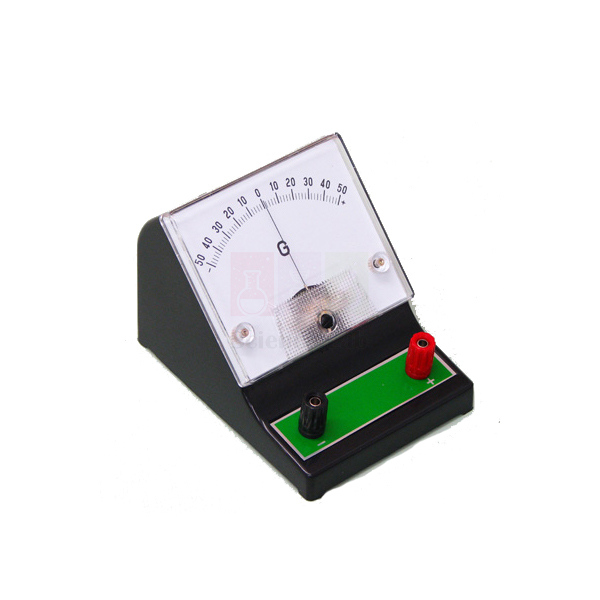
Galvanometer 50-0-50mV
Galvanometer 50-0-50mV (Product Code: SLE/PHY/181) is a centre-zero moving coil meter with a 50-0-50 scale, used for DC-only readings that can swing either side of zero in school and college electricity practicals. Its colour-coded 4 mm socket terminals make it a quick-to-wire galvanometer for school labs in India. It is supplied by Jain Scientific Equipments Pvt Ltd (ScienceLab), Ambala, India; please confirm the range unit (mV or mA) when ordering, as explained below.
Specifications
| Parameter | Detail |
|---|---|
| Movement | Moving coil |
| Scale | 50-0-50, centre zero |
| Range unit | Product name states mV; an earlier listing stated mA — confirm the unit when ordering |
| Current type | DC only |
| Terminals | Colour-coded 4 mm sockets |
| Product code | SLE/PHY/181 |
| Supplied by | Jain Scientific Equipments Pvt Ltd (ScienceLab), Ambala, India |
What Is the 50-0-50 Galvanometer Used For?
With its pointer resting at the middle of the scale, this meter shows both the size and the direction of a small DC reading. Typical uses are electromagnetic induction demonstrations, where a magnet pushed into a coil and pulled out swings the needle one way and then the other, and null-point detection in bridge and potentiometer circuits.
Connect it only to DC circuits and follow the colour coding on the terminals. When trying a new circuit, put a rheostat or high resistance in series first so the pointer stays on scale, then reduce it gradually. It pairs naturally with the coils and magnets of an electromagnetic induction kit.
What to Specify When Ordering
- The range unit you need — millivolts (as in the product name) or milliamps.
- Quantity, for example one meter per practical bench.
- Any connecting leads, rheostats or low-voltage power supplies to quote together.
Supplier
Jain Scientific Equipments Private Limited trades as ScienceLab and supplies this 50-0-50 galvanometer from Ambala, Haryana, to schools, colleges, institutions, dealers and importers in India and international markets. It is offered as a bought-in meter, so a lab can source its meters, leads and power supplies together on one quotation.
For company background, see the ScienceLab profile.
Related Physics Lab Equipment
A galvanometer is usually wired into a circuit with these items:
- Galvanometer, Centre Zero Universal Meter — a more sensitive microamp alternative.
- Banana Plug Connectors Leads — plug-in leads for wiring the meter into a circuit.
- Rheostat — limits current while a new circuit is being set up.
- Power Supply, Stepped — a low-voltage source for bench circuits.
- Primary and Secondary Coil Set — coils for induction experiments read on the galvanometer.
Browse more meters and apparatus in Physics Lab Equipment.
Frequently Asked Questions
What is the range of the Galvanometer 50-0-50mV?
The Galvanometer 50-0-50mV has a centre-zero 50-0-50 scale for DC only. The product name gives the unit as millivolts while an earlier listing showed milliamps, so please confirm which unit you need when you request a quotation.
Can the Galvanometer 50-0-50mV be used with AC?
No. The Galvanometer 50-0-50mV is listed for DC only. For alternating supplies, choose a meter specified for AC use, and ask us if you are unsure which instrument suits your experiment.
How do I connect the Galvanometer 50-0-50mV?
The Galvanometer 50-0-50mV has colour-coded 4 mm socket terminals, so it connects with plug-in leads. Follow the colour coding for polarity and add a series resistance when first testing a circuit to keep the pointer on scale.
Who supplies the Galvanometer 50-0-50mV?
The Galvanometer 50-0-50mV is supplied by Jain Scientific Equipments Pvt Ltd (ScienceLab), Ambala, Haryana, India, which quotes it for schools, colleges, dealers and export buyers together with leads and power supplies.
Is a calibration certificate available for this galvanometer?
Please discuss calibration documents for the Galvanometer 50-0-50mV with us before ordering. Tell us what your institution requires through the contact page and we will confirm what can be provided with the meters you order.
What should a quotation request for this galvanometer include?
For the Galvanometer 50-0-50mV, state the quantity, the range unit you need (mV or mA), any leads, rheostats or power supplies to add, and the delivery location in India or abroad.
Request a Quote
Ask for a price on the Galvanometer 50-0-50mV through our contact page, or add it to the enquiry cart with the other meters and accessories your lab needs.
Last updated: 24 September 2026
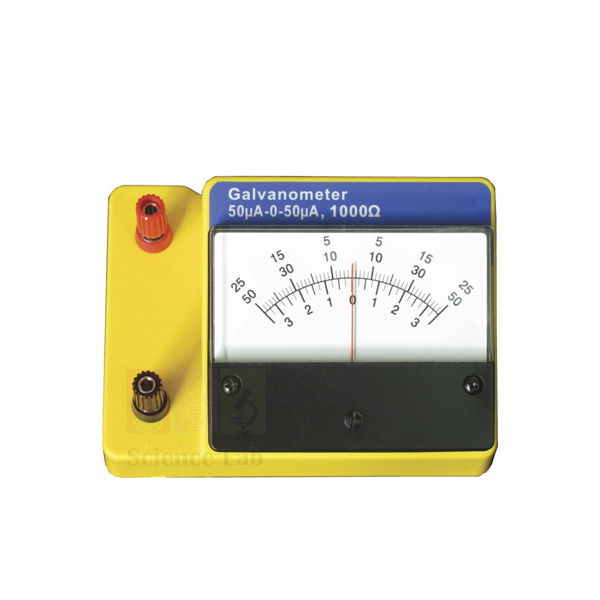
Galvanometer, Centre Zero Universal Meter
Galvanometer, Centre Zero Universal Meter (Product Code: SLE/PHY/182) is a sensitive moving coil galvanometer reading 50 µA-0-50 µA, used to detect very small currents and their direction in school and college physics practicals. Also called a universal galvanometer, it is electrically identical to the universal meter, with a 1000 ohm movement and diode protection against overload up to 12 V DC. It is supplied by Jain Scientific Equipments Pvt Ltd (ScienceLab), Ambala, India.
Specifications
| Parameter | Detail |
|---|---|
| Type | Centre zero universal meter (universal galvanometer) |
| Range | 50 µA-0-50 µA |
| Movement | Moving coil, 1000 ohm |
| Overload protection | Diode protection up to 12 V DC |
| AC use | Suitable as an indicator in slow AC |
| Electrical design | Identical to the universal meter |
| Product code | SLE/PHY/182 |
| Supplied by | Jain Scientific Equipments Pvt Ltd (ScienceLab), Ambala, India |
What Is the Centre Zero Universal Galvanometer Used For?
A 50 microamp range makes this meter respond to the tiny currents produced in induction experiments, and the centre zero shows at a glance which way each current flows. Because it works as an indicator in slow AC, it can follow a current that reverses slowly — for example a coil with a magnet swinging back and forth in front of it, where the needle moves left and right with every reversal.
The stated 1000 ohm movement and 50 microamp range also give students the two values they need to calculate a shunt for an ammeter or a series resistance for a voltmeter, a standard exercise in physics practical equipment CBSE syllabuses. The diode protection helps the meter survive wiring mistakes, but a high series resistance should still be used for first trials.
What to Specify When Ordering
- Number of meters, for example one per practical group.
- Whether you need this sensitive 50 µA centre-zero meter or a less sensitive 50-0-50 galvanometer.
- Any leads, coils or resistances to include for induction or meter-conversion practicals.
Supplier
ScienceLab is the trading name of Jain Scientific Equipments Private Limited, which supplies this universal galvanometer from Ambala, Haryana. The company sources sensitive meters of this kind for schools, universities, tender buyers and distributors in India and international markets, and can quote them alongside coils, magnets and leads.
Learn more about the company on the ScienceLab profile page.
Related Physics Lab Equipment
These items complete induction and meter experiments built around a sensitive galvanometer:
- Galvanometer 50-0-50mV — a less sensitive centre-zero meter for DC work.
- Apparatus for Studying the Production of Electricity by Induction — produces small induced currents to display.
- A.C. Generator — a source of alternating output to observe on a centre-zero scale.
- Standard Digital Multimeter — for checking readings after converting the galvanometer.
- Banana Plug Connectors Leads — leads for connecting the meter.
More instruments are listed under Physics Lab Equipment.
Frequently Asked Questions
How sensitive is the Galvanometer, Centre Zero Universal Meter?
The Galvanometer, Centre Zero Universal Meter reads 50 µA-0-50 µA with its zero at the centre of the scale, so it detects very small currents and shows their direction. Its moving coil movement is rated at 1000 ohm.
Can the centre zero universal meter be used on AC?
The centre zero universal meter is suitable as an indicator in slow AC, where the current reverses slowly enough for the pointer to follow. It is not meant for reading the value of fast-changing mains-frequency alternating current.
What overload protection does this galvanometer have?
The Galvanometer, Centre Zero Universal Meter has diode protection against overload up to 12 V DC. This lowers the risk of damage from wiring errors, but students should still start each circuit with a high resistance in series.
Can students convert this galvanometer into an ammeter or voltmeter?
Yes. With the stated 1000 ohm movement and 50 µA range, the Galvanometer, Centre Zero Universal Meter can be used in shunt and series-resistance conversion practicals. Ask us about suitable resistances when you enquire.
Who supplies the Galvanometer, Centre Zero Universal Meter?
The Galvanometer, Centre Zero Universal Meter is supplied by Jain Scientific Equipments Pvt Ltd (ScienceLab), Ambala, Haryana, India, to schools, colleges, institutions, dealers and export buyers in India and international markets.
What details should I send for a quotation?
For the Galvanometer, Centre Zero Universal Meter, send the quantity, any leads, coils or resistances to include, the delivery location, and any document requirements such as calibration paperwork, which we will discuss with you.
Request a Quote
Request pricing for the Galvanometer, Centre Zero Universal Meter through the contact page or place it in the enquiry cart together with the rest of your electricity bench items.
Last updated: 24 September 2026
Guinea & Feather Apparatus
Guinea & Feather Apparatus (Product Code: SLE/PHY/183) is a glass-tube physics demonstration kit used to show that objects fall at the same rate in a vacuum, regardless of weight, in school and college classes. It consists of a 16 mm diameter glass tube 50 cm long, two rubber bungs and a 40 cm length of tube for connecting a vacuum pump. It is made by Jain Scientific Equipments Pvt Ltd (ScienceLab), an OEM manufacturer, at its own factory in Ambala, India.
Specifications
| Parameter | Detail |
|---|---|
| Tube | Glass, 16 mm diameter, 50 cm long |
| Stoppers | Two rubber bungs |
| Pump connection | 40 cm length of tube for connection to a vacuum pump |
| Demonstrates | Objects of different weight fall at the same rate in a vacuum |
| Extension study | Timing the fall of paper at different air pressures in the tube |
| Product code | SLE/PHY/183 |
| Manufacturer | Jain Scientific Equipments Pvt Ltd (ScienceLab) — OEM |
| Country of origin | India (made in Ambala, Haryana) |
What Is the Guinea and Feather Tube Used For?
Two objects with different weight and air resistance — for example a small mass and a feather or a piece of paper — are placed at the foot of the tube. After the air is pumped out, the tube is inverted and both objects drop back to the bottom together. Let the air back in, repeat, and the feather or paper trails behind, showing that air resistance, not weight, caused the difference.
For a deeper investigation, students can time the fall of a piece of paper at several different air pressures inside the tube and judge how air resistance changes the acceleration of an object under gravity. Check that both bungs are seated firmly and the connecting tube is airtight before pumping, invert the tube smoothly, and wear eye protection when working with glass under vacuum.
What to Specify When Ordering
- Whether a hand or electric vacuum pump should be quoted with the tube.
- Whether you need falling objects supplied or will use your own feather, paper and small mass — ask us to confirm.
- Number of apparatus sets, for teacher demonstration or group work.
- Any stopwatches needed for the timed air-pressure study.
OEM Manufacturer
ScienceLab is the trading name of Jain Scientific Equipments Private Limited (CIN U29309HR2020PTC087597), the OEM (original equipment manufacturer) of this guinea and feather apparatus. It is made and assembled at the company's licensed factory at 449, HSIIDC Industrial Area, Saha, Ambala, Haryana (Factory Licence AMB-ONLINE-CHD-J-414), and supplied factory-direct to schools, colleges, dealers and importers rather than through a trader.
If a glass tube or bung is damaged in use, replacement parts can be requested from the manufacturer itself — ask us about availability. Company details are on the ScienceLab profile.
Related Physics Lab Equipment
Items used with the guinea and feather tube in free-fall and air-resistance lessons:
- Vacuum Pump, Hand — a manual way to evacuate the tube.
- Vacuum Pump, Electric — for quicker evacuation in repeated demonstrations.
- Vacuum Tubing — spare tubing for pump connections.
- Stopwatch, Digital — times the fall at different air pressures.
- Apparatus for Demonstrating the Free Fall of Bodies — a companion free-fall demonstration.
Explore the wider Physics Lab Equipment range.
Frequently Asked Questions
What does the Guinea & Feather Apparatus consist of?
The Guinea & Feather Apparatus consists of a 16 mm diameter glass tube 50 cm long, fitted with two rubber bungs, and a 40 cm length of tube for connecting the apparatus to a vacuum pump.
Is a vacuum pump included with the Guinea & Feather Apparatus?
The Guinea & Feather Apparatus is listed as the tube, bungs and connecting tube, designed to be joined to a vacuum pump. If you need a pump, add a hand or electric vacuum pump to your enquiry and we will confirm the full scope.
What does the guinea and feather experiment prove?
The guinea and feather experiment proves that, in a vacuum, objects fall at the same rate whatever their weight. When air is present, the lighter object with more air resistance falls more slowly, showing the effect of air resistance.
Can the Guinea & Feather Apparatus be used for measurements?
Yes. With the Guinea & Feather Apparatus, students can time the fall of paper at different air pressures in the tube to gauge how air resistance affects the acceleration of an object under gravity.
Who manufactures the Guinea & Feather Apparatus?
The Guinea & Feather Apparatus is manufactured by Jain Scientific Equipments Pvt Ltd (ScienceLab) as the OEM at its own licensed factory in Saha, Ambala, Haryana, India, and quotations come straight from the manufacturer.
How should the glass tube be handled safely?
Handle the Guinea & Feather Apparatus glass tube with both hands, avoid knocking it while it is under vacuum, and wear eye protection. Release the vacuum slowly and store the tube where it cannot roll off the bench.
Request a Quote
For a price on the Guinea & Feather Apparatus, contact us through the contact page or add it to the enquiry cart. You receive the quotation directly from the manufacturer, including any pump or timer you add.
Last updated: 24 September 2026
Gyroscope
Gyroscope (Product Code: SLE/PHY/184) is a spinning-wheel demonstration instrument used to show gyroscopic stability, precession and angular momentum in school and college mechanics lessons. This simple gyroscope keeps running for more than five minutes once set in motion, giving a whole class time to watch how it behaves. It is made by Jain Scientific Equipments Pvt Ltd (ScienceLab), an OEM manufacturer, at its own factory in Ambala, India, as part of its mechanics lab equipment range.
Key Details
| Parameter | Detail |
|---|---|
| Type | Simple demonstration gyroscope |
| Run time | More than five minutes once set in motion |
| Product code | SLE/PHY/184 |
| Manufacturer | Jain Scientific Equipments Pvt Ltd (ScienceLab) — OEM |
| Country of origin | India (made in Ambala, Haryana) |
What Is the Classroom Gyroscope Used For?
A fast-spinning gyroscope resists any attempt to tilt its axis. Supported at one end, it does not simply topple over; instead its axis swings slowly around the support, an effect called precession. As a demonstration model for the physics lab, it makes angular momentum visible and links classroom theory to bicycles, spinning tops, navigation instruments and spacecraft orientation.
Because this gyroscope runs for more than five minutes, students have time to observe how its steadiness changes as the wheel gradually slows, and to time the precession at different stages. Spin it up fully before each demonstration, keep the wheel and bearings free of dust, and store it where the axle cannot be knocked.
OEM Manufacturer
Jain Scientific Equipments Private Limited, which trades as ScienceLab, is the OEM (original equipment manufacturer) of this gyroscope and produces it at the company's licensed factory at Saha, Ambala, Haryana, India.
Schools, colleges, institutional buyers and distributors in India and international markets buy it factory-direct, so questions about repeat orders or replacement parts go straight to the people who make it — just ask us. More about the company is on the ScienceLab profile.
Related Physics Lab Equipment
These items support gyroscope and rotational-motion lessons:
- Gyroscope Experiment Manual — an engineering-lab gyroscope set-up for higher-level study.
- Apparatus Inertia — explores inertia, the idea behind the gyroscope's stability.
- Stopwatch, Digital — times the run-down and the precession.
- Newton's Pendulum (Newton's Cradle) — another classroom demonstration of momentum.
Find more in the Physics Lab Equipment category.
Frequently Asked Questions
How long does the Gyroscope keep spinning?
The ScienceLab Gyroscope runs for more than five minutes once it is set in motion. That gives enough time for a full class demonstration and for students to see how its behaviour changes as the wheel slows down.
What can students learn from the Gyroscope?
The Gyroscope shows that a spinning wheel resists changes to the direction of its axis, and that a supported gyroscope precesses instead of falling. These ideas explain angular momentum and the stability of bicycles, tops and navigation instruments.
How should the Gyroscope be looked after?
Keep the Gyroscope clean and dry, protect the wheel and bearings from dust, and store it so that the axle cannot be bent or knocked. Avoid dropping it while it is spinning.
Which classes is the Gyroscope suitable for?
The Gyroscope suits secondary-school demonstrations and introductory college mechanics lessons on rotation and angular momentum. For engineering-level measurements, ask us about the dedicated gyroscope apparatus in our Theory of Machines range.
Who manufactures the Gyroscope?
The Gyroscope (SLE/PHY/184) is manufactured by Jain Scientific Equipments Pvt Ltd (ScienceLab) as the OEM, at its own licensed factory in Saha, Ambala, Haryana, India, and is supplied factory-direct.
Can I order Gyroscopes for several schools at once?
Yes. ScienceLab quotes the Gyroscope for single schools, school chains, tender buyers and distributors in India and international markets. Share the quantity and delivery addresses and we will prepare a combined quotation.
Request a Quote
Ask for Gyroscope pricing via the contact page or add it to your enquiry cart. The quotation comes direct from the manufacturer, with no trading middleman in between.
Last updated: 24 September 2026
Hand Held UV Lamp
Hand Held UV Lamp (Product Code: SLE/PHY/185) is a battery-operated ultraviolet light source used to reveal fluorescent marks and traces in forensic science investigations and school science practicals. It is fitted with a 150 mm UV fluorescent tube and runs on 4 x AA cells (not supplied), so it can be carried to any bench or mock crime scene without a mains socket. It is supplied by Jain Scientific Equipments Pvt Ltd (ScienceLab), Ambala, India.
Specifications
| Parameter | Detail |
|---|---|
| Light source | 150 mm UV fluorescent tube |
| Power | Battery operated, 4 x AA cells (not supplied) |
| Application | Forensic science investigations |
| Product code | SLE/PHY/185 |
| Supplied by | Jain Scientific Equipments Pvt Ltd (ScienceLab), Ambala, India |
What Is the Hand Held UV Lamp Used For?
Many substances glow visibly when ultraviolet light falls on them. In a forensic science lesson, students use the lamp to reveal messages written in invisible ink, examine fluorescent fingerprint powders, check security printing on documents and compare traces collected from a mock crime scene. Physics teachers also use it to show fluorescence when explaining the part of the electromagnetic spectrum beyond violet light.
Darken the room for clearer results and hold the lamp close to the sample. Never look directly at the lit tube or shine it towards anyone's eyes, keep skin exposure short, and supervise students throughout. Take the cells out if the lamp will be stored for a long time.
What to Specify When Ordering
- Number of lamps, for example one per forensic investigation group.
- Whether AA cells should be quoted, since they are not supplied with the lamp.
- Any specific UV wavelength your procedure requires, so we can confirm suitability before you order.
Supplier
Jain Scientific Equipments Private Limited, trading as ScienceLab, supplies this hand held UV lamp from Ambala, Haryana. As a lab instruments supplier in India, the company sources items like this for schools, colleges, forensic science courses, dealers and importers, and ships to international markets.
You can read about the company on the ScienceLab profile.
Related Physics Lab Equipment
These kits and safety items are often used with a UV lamp in forensic lessons:
- Forensic Chemistry of Dusting for Fingerprints — fingerprint work that can be examined under the lamp.
- Forensic Science Lab Investigation — a complete investigation activity for student groups.
- Forensic Chemistry of Chromatography (Document Analysis) — document analysis that pairs with UV inspection.
- Safety Goggles — eye protection for the practical session.
See more items under Physics Lab Equipment.
Frequently Asked Questions
What batteries does the Hand Held UV Lamp need?
The Hand Held UV Lamp takes 4 x AA cells, which are not supplied with the lamp. Add AA cells to your enquiry if you want them quoted, or use your own stock of standard AA batteries.
What size is the tube in the Hand Held UV Lamp?
The Hand Held UV Lamp is fitted with a 150 mm UV fluorescent tube, which gives a strip of ultraviolet light wide enough to scan documents, fingerprint cards and small evidence items during forensic practicals.
What UV wavelength does the Hand Held UV Lamp emit?
The wavelength of the Hand Held UV Lamp is not stated in our current listing. If your forensic or chemistry procedure needs a particular UV band, contact us before ordering and we will confirm whether this lamp suits it.
Is the Hand Held UV Lamp safe for students to use?
The Hand Held UV Lamp should be used under teacher supervision. Students must not look directly at the lit tube or aim it at anyone's eyes, and should keep skin exposure brief and wear eye protection.
Who supplies the Hand Held UV Lamp?
The Hand Held UV Lamp is supplied by Jain Scientific Equipments Pvt Ltd (ScienceLab), Ambala, Haryana, India, to schools, colleges, forensic science courses, dealers and buyers in India and international markets.
Can the Hand Held UV Lamp be used outside forensic science?
Yes. Besides forensic science investigations, the Hand Held UV Lamp is handy for fluorescence demonstrations in physics and chemistry lessons, such as showing invisible-ink messages or fluorescent markers glowing under ultraviolet light.
Request a Quote
Price the Hand Held UV Lamp by writing to us through the contact page, or add it to the enquiry cart along with cells and forensic kits.
Last updated: 24 September 2026
Handwheel Drive Unit
Handwheel Drive Unit (Product Code: SLE/PHY/186) is a hand-turned pulley drive used to power other units of an energy transfer kit, such as a dynamo, line shaft, flywheel or pump, in school physics lessons on energy conversion. Its 75 mm driving and output pulleys and 20 mm intermediate pulley give a step-up ratio of 3.75, on a 165 x 100 mm base. It is made by Jain Scientific Equipments Pvt Ltd (ScienceLab), an OEM manufacturer, at its own factory in Ambala, India.
Specifications
| Parameter | Detail |
|---|---|
| Kit | Unit of the Energy Transfer Kit (units available separately) |
| Driving pulley | 75 mm diameter |
| Output pulley | 75 mm diameter |
| Intermediate pulley | 20 mm diameter |
| Step-up ratio | 3.75 |
| Base size | 165 x 100 mm (common to all kit units) |
| Kit connections | 4 mm socket terminals on kit units where appropriate |
| Drives | Dynamo, line shafts, flywheels, pumps and similar units |
| Product code | SLE/PHY/186 |
| Manufacturer | Jain Scientific Equipments Pvt Ltd (ScienceLab) — OEM |
| Country of origin | India (made in Ambala, Haryana) |
What Is the Handwheel Drive Unit Used For?
Turning the handwheel converts a student's muscular work into rotational kinetic energy, and the pulley train steps the speed up by a ratio of 3.75 before passing it on. Coupled to a dynamo it shows kinetic energy becoming electrical energy; driving a flywheel it shows energy being stored as rotation; with a line shaft or pump it shows useful work being done. Every stage also loses some energy as heat and sound through friction, a useful discussion point.
Because all units of the Energy Transfer Kit share the same 165 x 100 mm base, they line up neatly on the bench and can be rearranged into different energy chains, making the set a flexible physics demonstration kit. Turn the handle at a steady speed, keep the pulley grooves clean, and line the unit up squarely with the unit it drives.
What to Specify When Ordering
- Which other Energy Transfer Kit units you need — dynamo, line shaft, flywheel or pump — since each is available separately.
- Number of handwheel units, for example one per energy chain or student group.
- Ask us to confirm what is included with each unit and how the units are linked.
OEM Manufacturer
Jain Scientific Equipments Private Limited, trading as ScienceLab, is the OEM (original equipment manufacturer) of this handwheel drive unit. It is produced at the company's own licensed factory at Saha, Ambala, Haryana, and supplied factory-direct to schools, colleges, institutions, dealers and importers in India and international markets.
Since every unit in the energy transfer range comes from the same maker, you can start with a few units and ask us later for matching additions. Company information is on the ScienceLab profile.
Related Physics Lab Equipment
These units and models extend energy-conversion lessons built around the handwheel:
- Line Shaft Unit — a line shaft of the kind the handwheel is designed to drive.
- Demonstration Dynamo Model — shows kinetic energy turning into electrical energy.
- Mini Motor Unit — demonstrates the reverse conversion, electrical to kinetic.
- Water Turbine with Dynamo Model — another energy-conversion demonstration for comparison.
Browse the full Physics Lab Equipment range.
Frequently Asked Questions
What is the step-up ratio of the Handwheel Drive Unit?
The Handwheel Drive Unit has a step-up ratio of 3.75. Its driving and output pulleys are both 75 mm in diameter and the intermediate pulley is 20 mm in diameter, so the drive runs faster than the handwheel is turned.
What can the Handwheel Drive Unit drive?
The Handwheel Drive Unit is designed for driving a dynamo, line shafts, flywheels, pumps and similar units of the Energy Transfer Kit, so students can follow energy from muscular effort to electrical, stored or useful mechanical energy.
Is the Handwheel Drive Unit sold on its own?
Yes. The Handwheel Drive Unit is one of several Energy Transfer Kit units that are available separately. You can order it alone or together with other units, and we will confirm the contents of each in the quotation.
What size base does the Handwheel Drive Unit have?
The Handwheel Drive Unit sits on a 165 x 100 mm base, the same base measurement used by all units of the Energy Transfer Kit, so the units line up neatly when set out on a bench.
Who manufactures the Handwheel Drive Unit?
The Handwheel Drive Unit is manufactured by Jain Scientific Equipments Pvt Ltd (ScienceLab) as the OEM, at its own licensed factory in Saha, Ambala, Haryana, India, and is supplied direct from the factory.
What should a quotation request for this unit include?
For the Handwheel Drive Unit, tell us how many units you need, which other Energy Transfer Kit units to add, and the delivery location in India or abroad, so we can prepare one complete quotation.
Request a Quote
Get a price for the Handwheel Drive Unit through the contact page or the enquiry cart. The quotation is prepared by the manufacturer itself and can cover the other energy transfer units you need.
Last updated: 24 September 2026
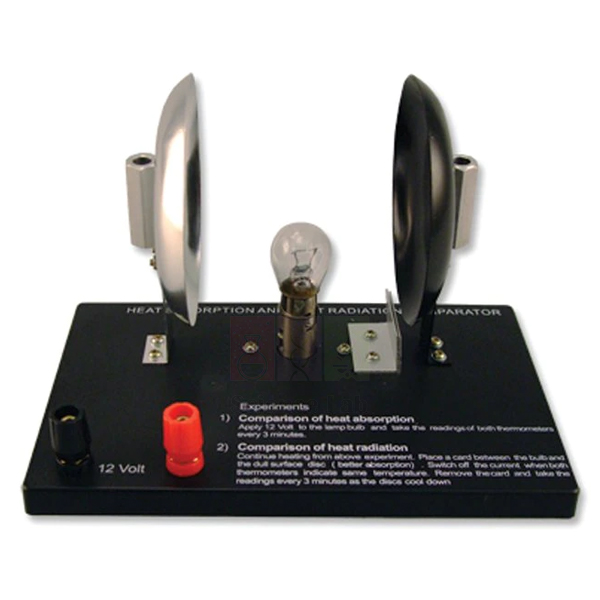
Heat Absorption & Radiation Comparator
Heat Absorption & Radiation Comparator (Product Code: SLE/PHY/187) is a thermal radiation demonstration used to compare how a black surface and a shiny metal surface absorb and give out heat in school physics lessons. A 12 V bulb serves as the heat source for two parabolic metal bodies, one finished black and one shiny, each fitted with a thermometer holder. It is made by Jain Scientific Equipments Pvt Ltd (ScienceLab), an OEM manufacturer, at its own factory in Ambala, India.
Specifications
| Parameter | Detail |
|---|---|
| Heat source | 12 V bulb |
| Test bodies | 2 parabolic metal bodies — one black, one shiny metal |
| Temperature readings | 2 thermometer holders attached to the bodies |
| Thermometers | Not included |
| Instructions | Included |
| Demonstrates | Heat absorption and radiation by black versus shiny surfaces |
| Product code | SLE/PHY/187 |
| Manufacturer | Jain Scientific Equipments Pvt Ltd (ScienceLab) — OEM |
| Country of origin | India (made in Ambala, Haryana) |
What Is the Heat Radiation Comparator Used For?
With the bulb switched on, students record both thermometer readings at regular intervals and find that the black body warms up faster, because a dull black surface absorbs radiant heat better than a shiny one. After the bulb is switched off, the readings show the black body also cooling faster, since good absorbers are also good radiators. It is a compact radiation experiment kit for classes in India studying heat transfer.
The result explains everyday choices such as black-painted solar water heater panels and shiny insulating surfaces. For fair results, use two matching thermometers, start both bodies at room temperature, keep the set-up away from draughts, and power the bulb from a suitable 12 V supply rather than the mains.
What to Specify When Ordering
- Two thermometers, since they are not included — tell us if you want them quoted.
- A 12 V supply for the bulb, if your lab does not already have one.
- Number of comparators, for a teacher demonstration or several student groups.
OEM Manufacturer
Jain Scientific Equipments Private Limited trades as ScienceLab and is the OEM (original equipment manufacturer) of this comparator, which it makes at its own licensed factory at Saha, Ambala, Haryana. The company is a registered MSME with manufacturing as its major activity (Udyam UDYAM-HR-01-0003714), and export consignments are shipped under Importer-Exporter Code AAECJ8618A issued by the DGFT.
Schools, colleges, dealers and importers in India and international markets order it direct from the factory rather than through a trader. Company background is on the ScienceLab profile.
Related Physics Lab Equipment
These items help complete heat radiation practicals:
- Battery Eliminator 12 Volt — a possible 12 V source for the bulb; ask us to confirm suitability.
- Immersion Thermometer — thermometers for the two holders.
- Leslie's Cube — compares radiation from different surfaces at the same temperature.
- Radiation Kit — further experiments on thermal radiation.
More heat apparatus is listed in Physics Lab Equipment.
Frequently Asked Questions
What does the Heat Absorption & Radiation Comparator include?
The Heat Absorption & Radiation Comparator includes a 12 V bulb heat source, two parabolic metal bodies (one black, one shiny) with two thermometer holders attached, and instructions. Thermometers are not included.
Do I need to buy thermometers separately?
Yes. Thermometers are not included with the Heat Absorption & Radiation Comparator, so you will need two for the attached holders. Tell us if you would like matching thermometers added to your quotation.
What power supply does the comparator need?
The Heat Absorption & Radiation Comparator uses a 12 V bulb as its heat source, so it should be run from a suitable 12 V supply, never directly from the mains. Ask us to quote a supply if you need one.
What result should students expect from the comparator?
With the Heat Absorption & Radiation Comparator, the black body normally heats up faster than the shiny body and also cools faster afterwards, showing that dull black surfaces are better absorbers and better radiators of heat.
Who manufactures the Heat Absorption & Radiation Comparator?
The Heat Absorption & Radiation Comparator is manufactured by Jain Scientific Equipments Pvt Ltd (ScienceLab) as the OEM, at its own licensed factory in Saha, Ambala, Haryana, India.
Can ScienceLab export the comparator?
Yes. ScienceLab supplies the Heat Absorption & Radiation Comparator to schools and dealers in India and international markets, handling exports under its Importer-Exporter Code. Share the quantity and destination to receive a quotation.
Request a Quote
To price the Heat Absorption & Radiation Comparator, use the contact page or add it to the enquiry cart. Quotes come direct from the manufacturer and can include thermometers and a 12 V supply.
Last updated: 24 September 2026

Heat Sensitive Paper
Heat Sensitive Paper (Product Code: SLE/PHY/188) is a thermochromic paper used to show temperature differences as colour changes in school science lessons on heat, insulation and body temperature. Each pack holds 40 A4 sheets in four colour pairs, and the paper reacts even to the warmth of a hand, so results are visible at once. It is supplied by Jain Scientific Equipments Pvt Ltd (ScienceLab), Ambala, India.
Specifications
| Parameter | Detail |
|---|---|
| Type | Thermochromic heat sensitive paper |
| Pack size | 40 A4 sheets |
| Colours | Four: blue/white, purple/pink, pink/white and green/yellow |
| Response | Changes colour as temperature rises, even from the heat of a hand |
| Topics | Temperature, insulation and body temperature |
| Product code | SLE/PHY/188 |
| Supplied by | Jain Scientific Equipments Pvt Ltd (ScienceLab), Ambala, India |
What Is Heat Sensitive Paper Used For?
Press a palm onto a sheet and a coloured handprint appears, strongest where the skin is warmest — an instant way to talk about body temperature. Wrap strips around containers of warm water covered with different materials and the colour change shows which material insulates better. Laid over a warm object, a sheet maps the hotter and cooler areas, making the paper a low-cost addition to any heat energy science kit.
Cut sheets into strips so one pack can serve several groups, and use the four colour pairs to tell different trials apart. Keep unused sheets flat, dry and away from direct sunlight and heaters, and never hold the paper near a flame or a very hot surface.
What to Specify When Ordering
- Number of packs, each containing 40 A4 sheets.
- Any specific colour-change temperature your activity needs — ask us to confirm before ordering.
- Thermometers or heat apparatus you want quoted in the same order.
Supplier
ScienceLab, the trading name of Jain Scientific Equipments Private Limited, supplies heat sensitive paper from Ambala, Haryana, to primary and secondary schools, teacher training institutes, dealers and importers in India and international markets.
Because it is a classroom consumable, it is often ordered with thermometers and heat apparatus so a whole heat topic arrives in one delivery. Read more on the ScienceLab profile.
Related Physics Lab Equipment
These items fit the same heat and insulation lessons:
- Apparatus Heat/Thermal Conductivity — a conduction experiment to pair with colour-change observations.
- Heat Transfer Kit — a broader kit for heat transfer lessons.
- Digital Thermometer — gives numerical readings to compare with the colour changes.
Explore more in Physics Lab Equipment.
Frequently Asked Questions
How many sheets are in a pack of Heat Sensitive Paper?
A pack of Heat Sensitive Paper contains 40 A4 sheets, supplied across four colour pairs. The sheets can be cut into smaller strips so that one pack covers several student groups or repeated experiments.
What colours does the Heat Sensitive Paper come in?
Heat Sensitive Paper is supplied in four colour pairs: blue/white, purple/pink, pink/white and green/yellow. Using different pairs helps students tell separate trials apart when comparing temperatures or insulating materials.
How warm does Heat Sensitive Paper need to be to change colour?
Heat Sensitive Paper changes colour as its temperature rises, and even the heat of a hand is enough to see a change. The exact change temperature is not stated in our listing, so contact us if you need that value.
What experiments can students do with Heat Sensitive Paper?
Students use Heat Sensitive Paper to investigate temperature, compare insulating materials and look at body temperature, for example by making handprints or wrapping strips around warm containers covered with different materials.
Who supplies Heat Sensitive Paper?
Heat Sensitive Paper is supplied by Jain Scientific Equipments Pvt Ltd (ScienceLab), Ambala, Haryana, India, to schools, colleges, dealers and importers in India and international markets as a classroom consumable.
Can schools order Heat Sensitive Paper in bulk?
Yes. Schools and dealers can order Heat Sensitive Paper in multiple packs of 40 A4 sheets. Tell us the number of packs and the delivery location, and we will send a quotation.
Request a Quote
Request a price for Heat Sensitive Paper through the contact page or add packs to the enquiry cart with your other heat apparatus.
Last updated: 24 September 2026
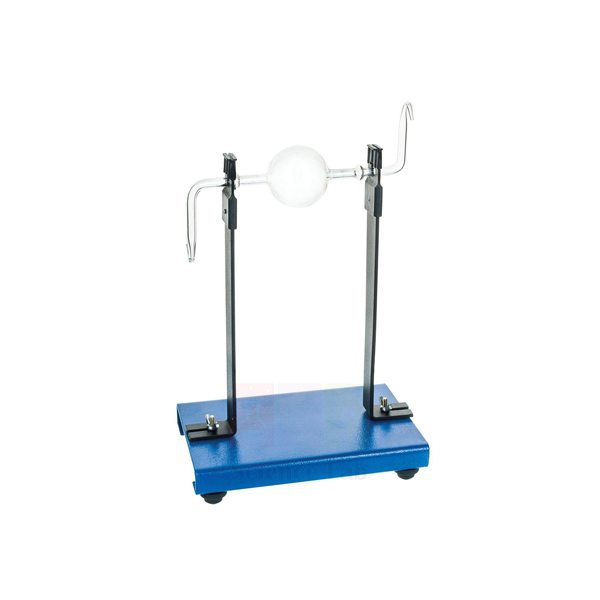
Hero Engine
Hero Engine (Product Code: SLE/PHY/189) is a glass model of the steam engine invented by Hero of Alexandria in about 60 AD, used to demonstrate energy transformation and Newton's third law in physics lessons. Heated by a Bunsen burner (not supplied), it spins as steam jets out of its nozzles, working in a similar way to a rocket engine. It is made by Jain Scientific Equipments Pvt Ltd (ScienceLab), an OEM manufacturer, at its own factory in Ambala, India.
Specifications
| Parameter | Detail |
|---|---|
| Type | Glass model of Hero's steam engine |
| Original design | Hero of Alexandria, about 60 AD |
| Heat source | Bunsen burner (not supplied) |
| Principle | Steam jets from the nozzles create a turning force about the long axis of the glassware (Newton's third law) |
| Demonstrates | Thermal energy to kinetic energy; aspects of Newton's laws of motion; rocket-style propulsion |
| Product code | SLE/PHY/189 |
| Manufacturer | Jain Scientific Equipments Pvt Ltd (ScienceLab) — OEM |
| Country of origin | India (made in Ambala, Haryana) |
What Is the Hero Engine Used For?
Heat from the burner turns the water inside the glass vessel into steam, which escapes through the nozzles as fast jets. Those jets carry momentum, and by Newton's third law — action and reaction are equal and opposite — they push the nozzles backwards, producing a turning movement that makes the whole glass apparatus rotate. The model is one of the earliest machines to turn thermal energy into kinetic energy.
As a demonstration model for the physics lab, it links ancient engineering to modern rockets and jet propulsion. Heat it gently, never let it boil dry, keep students clear of the steam jets, wear eye protection, and allow the glass to cool fully before handling or refilling.
What to Specify When Ordering
- Whether a Bunsen burner and gas tubing should be quoted, since the burner is not supplied.
- Number of Hero engines, for a teacher demonstration or several groups.
- Any safety goggles needed for students watching the demonstration.
OEM Manufacturer
The glass Hero engine is produced by Jain Scientific Equipments Private Limited, which trades as ScienceLab and is the OEM (original equipment manufacturer), at its licensed factory at Saha, Ambala, Haryana, India. Schools, colleges, dealers and importers in India and international markets buy it straight from the maker.
Glass apparatus can break in everyday use, so replacement engines can be requested from the manufacturer directly — just ask us. See the ScienceLab profile for company background.
Related Physics Lab Equipment
These items are needed or useful when running the Hero engine demonstration:
- Bunsen Burner — the heat source the engine needs.
- Bunsen Burner Tubing — connects the burner to the gas supply.
- Gas Lighter, Piezo Electric — lights the burner without matches.
- Safety Goggles — eye protection near hot glass and steam.
- Steam Engine Model — a later steam engine design for comparison.
See more demonstrations in Physics Lab Equipment.
Frequently Asked Questions
How does the Hero Engine work?
In the Hero Engine, heated water turns to steam that escapes through the nozzles as jets. By Newton's third law, the jets push the nozzles backwards, creating a turning force about the long axis so the glass apparatus rotates.
Is a Bunsen burner included with the Hero Engine?
No. The Hero Engine is heated by a Bunsen burner, which is not supplied with it. Add a Bunsen burner, gas tubing and a lighter to your enquiry if your lab needs them, and we will include them in the quotation.
What topics does the Hero Engine teach?
The Hero Engine teaches the transformation of thermal energy into kinetic energy, aspects of Newton's laws of motion, especially action and reaction, and the basic principle behind rocket engines, all in one short demonstration.
Who invented the original Hero engine?
The original engine was invented by Hero of Alexandria in about 60 AD. The ScienceLab Hero Engine is a glass model of that design and represents an early example of a machine converting thermal energy into kinetic energy.
Who manufactures the Hero Engine?
The Hero Engine (SLE/PHY/189) is manufactured by Jain Scientific Equipments Pvt Ltd (ScienceLab) as the OEM, at its own licensed factory in Saha, Ambala, Haryana, India, and is quoted direct from the factory.
What safety precautions apply to the Hero Engine?
When using the Hero Engine, heat gently, never let it boil dry, keep faces and hands away from the steam jets, and wear eye protection. Let the glass cool completely before touching, refilling or packing it away.
Request a Quote
Ask for a Hero Engine price through the contact page or use the enquiry cart. Your quotation comes direct from the manufacturer and can include burners and safety goggles.
Last updated: 24 September 2026

Hooke's Law Apparatus
Hooke's Law Apparatus (Product Code: SLE/PHY/190) is a spring-extension stand used to show that the extension of a spring is proportional to the load applied to it, in school and college physics practicals. It has a 150 mm adjustable mirror scale marked in millimetres, mounted on a sturdy 300 mm rod and wooden base, and comes complete with a 250 g slotted weight set and 3 springs. It is made by Jain Scientific Equipments Pvt Ltd (ScienceLab), an OEM manufacturer, at its own factory in Ambala, India.
Specifications
| Parameter | Detail |
|---|---|
| Scale | 150 mm adjustable mirror scale, marked in millimetres |
| Mirror | Helps prevent parallax error when reading |
| Support | Sturdy 300 mm rod mounted on a wooden base |
| Spring mounting | Hook on the rod supporting a coiled spring with mass hanger and indicator |
| Supplied with | 250 g slotted weight set and 3 springs |
| Demonstrates | Extension of a spring is proportional to the load applied |
| Product code | SLE/PHY/190 |
| Manufacturer | Jain Scientific Equipments Pvt Ltd (ScienceLab) — OEM |
| Country of origin | India (made in Ambala, Haryana) |
What Is the Hooke's Law Apparatus Used For?
Students add slotted masses to the hanger one at a time and read the indicator against the millimetre scale after each addition. Plotting load against extension gives a straight line, and its gradient gives the spring constant. Repeating the test with each of the 3 springs shows that a stiffer spring stretches less under the same load, which makes this a complete Hooke law spring kit for Indian school and college labs.
Before loading, slide the adjustable scale so the indicator sits at a convenient starting mark. Read each value with the indicator lined up with its own reflection in the mirror to avoid parallax, add masses gently, and remove them at the end to check that the spring returns to its starting point.
What to Specify When Ordering
- Number of sets, for example one per practical group.
- Any extra slotted weights or spare springs beyond the included 250 g set and 3 springs.
- Delivery location, for school, college or export orders.
OEM Manufacturer
Each Hooke's law apparatus is built by Jain Scientific Equipments Private Limited, trading as ScienceLab, which is the OEM (original equipment manufacturer) and makes it at its own licensed factory in Saha, Ambala, Haryana. The company supplies it factory-direct to schools, colleges, institutions and distributors in India and international markets.
Spare springs or weights for sets already in use can be requested from the maker itself — ask us. Company information is on the ScienceLab profile.
Related Physics Lab Equipment
These items extend spring and elasticity experiments:
- Extension Spring, Steel — additional springs to test.
- Hangers with Slotted Weights 500 gm — extra load for further trials.
- Force Meter/Spring Balance — an everyday instrument that works on Hooke's law.
- Hook's Law And Spring Rate — an engineering-lab version for spring-rate testing.
Browse more in Physics Lab Equipment.
Frequently Asked Questions
What comes with the Hooke's Law Apparatus?
The Hooke's Law Apparatus has a 150 mm adjustable mirror scale on a 300 mm rod with wooden base, a hook holding a coiled spring with mass hanger and indicator, and is supplied complete with a 250 g slotted weight set and 3 springs.
Why does the Hooke's Law Apparatus have a mirror scale?
The mirror scale on the Hooke's Law Apparatus helps prevent parallax error. Students line up the indicator with its reflection before reading, so every reading is taken from directly in front of the scale.
How do students find the spring constant with this apparatus?
With the Hooke's Law Apparatus, students record the extension for each added load, plot load against extension and measure the gradient of the straight line. That gradient is the spring constant of the spring being tested.
What is the maximum load for the springs?
The Hooke's Law Apparatus is supplied with a 250 g slotted weight set. Safe maximum loads for the individual springs are not stated in our listing, so ask us before adding heavier masses to avoid overstretching a spring.
Who manufactures the Hooke's Law Apparatus?
The Hooke's Law Apparatus is manufactured by Jain Scientific Equipments Pvt Ltd (ScienceLab) as the OEM, at its own licensed factory in Saha, Ambala, Haryana, India, and quotations come directly from the manufacturer.
Can ScienceLab supply sets for a whole physics lab?
Yes. ScienceLab supplies the Hooke's Law Apparatus in quantities for full practical classes, dealers and export buyers in India and international markets. Share the number of sets and your location for a quotation.
Request a Quote
For Hooke's Law Apparatus pricing, contact us through the contact page or add sets to the enquiry cart. The manufacturer quotes you directly, including any extra springs or weights.
Last updated: 24 September 2026

Hope's Law Apparatus
Hope's Law Apparatus (Product Code: SLE/PHY/191) is a heat demonstration apparatus used to show that water has its maximum density at 4 °C, in school and college physics lessons on the unusual behaviour of water. It helps students explain why ponds and lakes freeze from the top down while aquatic life survives in the warmer water beneath the ice. It is made by Jain Scientific Equipments Pvt Ltd (ScienceLab), an OEM manufacturer, at its own factory in Ambala, India.
Key Details
| Parameter | Detail |
|---|---|
| Demonstrates | Water has its maximum density at 4 °C |
| Process shown | Convection continues until a dense layer of water at 4 °C forms at the bottom |
| Real-world link | Why ponds and lakes freeze from the top and aquatic life survives below the ice |
| Product code | SLE/PHY/191 |
| Manufacturer | Jain Scientific Equipments Pvt Ltd (ScienceLab) — OEM |
| Country of origin | India (made in Ambala, Haryana) |
What Is the Hope's Law Apparatus Used For?
In the classic Hope's experiment, a column of water is cooled around its middle and its temperature is watched near the top and near the bottom. The lower reading falls steadily to 4 °C and stays there, and only then does the upper reading drop towards 0 °C, because water cooled below 4 °C becomes less dense and rises. Convection carries on until a dense layer of water at 4 °C sits at the bottom, making this a useful piece of thermometry apparatus for senior classes.
The same behaviour explains frozen ponds. Lakes are cooled from above; the surface water cools until it freezes, and the ice then insulates the denser water beneath so it cools more slowly, leaving a comparatively warm bottom layer where fish and plants survive. If water were densest at its freezing point, lakes would freeze solid and, since heat passes only slowly between air and ice, might not thaw even in summer.
What to Specify When Ordering
- Whether thermometers should be quoted — ask us to confirm exactly what is included with the apparatus.
- Number of sets, for a teacher demonstration or group practicals.
- Delivery location, for school, college, dealer or export orders.
OEM Manufacturer
ScienceLab is the brand under which Jain Scientific Equipments Private Limited manufactures this Hope's law apparatus as the OEM (original equipment manufacturer), at its own licensed factory at Saha, Ambala, Haryana. For institutions that must register a vendor before buying, the company's details are GSTIN 06AAECJ8618A1ZT and LEI 3358004HRD1JIVXKYX49.
Quotations, repeat orders and questions about replacement parts are handled by the manufacturer directly for buyers in India and international markets. More about the company is on the ScienceLab profile.
Related Physics Lab Equipment
These items support lessons on the density and expansion of water:
- Immersion Thermometer — for taking the temperature readings.
- Digital Thermometer — an easy-to-read alternative for group work.
- Expansion Of Liquids Apparatus — shows how liquids expand when heated.
- Apparatus Convection In Liquid — makes convection currents in water visible.
Find more heat apparatus in Physics Lab Equipment.
Frequently Asked Questions
What does the Hope's Law Apparatus demonstrate?
The Hope's Law Apparatus demonstrates that water has its maximum density at 4 °C. As the water cools, convection continues until a dense layer at 4 °C collects at the bottom of the column.
How does the Hope's Law Apparatus explain frozen lakes?
The Hope's Law Apparatus shows why lakes freeze from the top: water densest at 4 °C sinks, surface water cools and freezes, and the ice insulates the warmer water below, so aquatic life can survive through winter.
What readings should students expect?
In a typical Hope's experiment, the lower temperature reading falls to 4 °C and then stays steady, while the upper reading later drops towards 0 °C. This pattern confirms that water is densest at 4 °C.
Are thermometers included with the Hope's Law Apparatus?
The contents of the Hope's Law Apparatus are not listed in detail on this page. Contact us before ordering and we will confirm what is included and quote thermometers separately if you need them.
Who manufactures the Hope's Law Apparatus?
The Hope's Law Apparatus is manufactured by Jain Scientific Equipments Pvt Ltd (ScienceLab) as the OEM, at its own licensed factory in Saha, Ambala, Haryana, India, and is supplied factory-direct.
Can ScienceLab export the Hope's Law Apparatus?
Yes. ScienceLab supplies the Hope's Law Apparatus to schools, colleges and dealers in India and international markets. Send the quantity and destination country, and we will prepare a quotation for you.
Request a Quote
Ask for Hope's Law Apparatus pricing via the contact page or add it to the enquiry cart. The quotation comes straight from the manufacturer.
Last updated: 24 September 2026
Immersion Heater
Immersion Heater (Product Code: SLE/PHY/192) is a sheathed miniature 12 V, 50 W heater used to deliver a measured amount of electrical energy to metal block calorimeters in specific heat capacity experiments. It is 100 mm long and 12 mm in diameter, and connects through 200 mm leads with heat-resisting insulation and 4 mm terminals, a practical choice for any calorimeter lab in India. It is supplied by Jain Scientific Equipments Pvt Ltd (ScienceLab), Ambala, India.
Specifications
| Parameter | Detail |
|---|---|
| Type | Sheathed miniature immersion heater |
| Designed for | Metal block calorimeters |
| Power | 12 V, 50 W |
| Length | 100 mm |
| Diameter | 12 mm |
| Connection | 200 mm leads with heat-resisting insulation and 4 mm terminals |
| Product code | SLE/PHY/192 |
| Supplied by | Jain Scientific Equipments Pvt Ltd (ScienceLab), Ambala, India |
What Is the 12 V Immersion Heater Used For?
In the classic specific heat capacity practical, the heater is placed in a metal calorimeter block together with a thermometer and switched on from a 12 V supply for a timed period. The energy supplied is found from a joulemeter, or from voltage, current and time, and dividing it by the block's mass and temperature rise gives the specific heat capacity of the metal. Repeating the test with blocks of different metals lets students compare their results.
Run the heater only from a 12 V supply, never from the mains, and switch it on only when it is seated in the block so it cannot overheat in open air. A few drops of water or oil in the heater hole improve thermal contact. Let the heater cool before lifting it out.
What to Specify When Ordering
- Number of heaters, usually one per calorimeter block.
- Whether a 12 V power supply, joulemeter or thermometers should be quoted with it.
- Confirmation that your calorimeter blocks accept a heater 100 mm long and 12 mm in diameter.
Supplier
Jain Scientific Equipments Private Limited, trading as ScienceLab, supplies this immersion heater from Ambala, Haryana, to schools and colleges setting up calorimetry practicals, and to dealers and importers in India and international markets.
It can be combined with power supplies, joulemeters and thermometers on a single quotation. Company details are on the ScienceLab profile.
Related Physics Lab Equipment
These items complete an electrical specific heat capacity set-up:
- Joulemeter, Student Digital — measures the energy delivered to the block.
- Power Supply, Stepped — a low-voltage source; confirm it suits a 12 V, 50 W heater.
- Digital Thermometer — records the temperature rise of the block.
- Calorimeter, Electric — another route to electrical heating experiments.
See more in Physics Lab Equipment.
Frequently Asked Questions
What is the power rating of the Immersion Heater?
The Immersion Heater is rated at 12 V, 50 W. It should be powered only from a suitable 12 V low-voltage supply capable of delivering that power, and never connected directly to the mains.
What are the dimensions of the Immersion Heater?
The Immersion Heater is 100 mm long and 12 mm in diameter, and its 200 mm connecting leads have heat-resisting insulation. Check that the heater hole in your calorimeter blocks matches these dimensions.
How is the Immersion Heater connected?
The Immersion Heater connects through 200 mm heat-resistant leads ending in 4 mm terminals. Wire it to a 12 V supply, usually through a joulemeter or an ammeter and voltmeter, so the energy supplied can be calculated.
Can the Immersion Heater be used in liquids?
The Immersion Heater is specially designed for use with metal block calorimeters. If you plan to use it in liquids or in another set-up, contact us first so we can advise whether it is suitable.
Who supplies the Immersion Heater?
The Immersion Heater is supplied by Jain Scientific Equipments Pvt Ltd (ScienceLab), Ambala, Haryana, India, to schools, colleges, dealers and importers in India and international markets for calorimetry practicals.
What should I send for an Immersion Heater quotation?
For an Immersion Heater quotation, send the number of heaters, any power supplies, joulemeters or thermometers to include, and your delivery location in India or abroad, and we will reply with pricing.
Request a Quote
Price the Immersion Heater through the contact page or add it to the enquiry cart with the rest of your calorimetry equipment.
Last updated: 24 September 2026
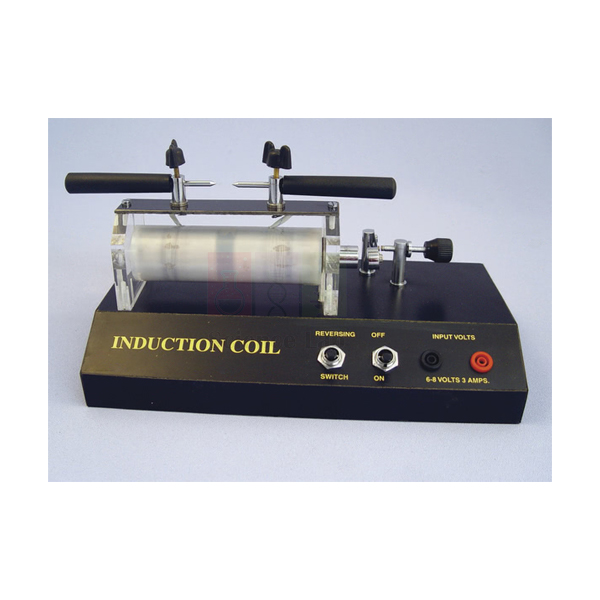
Induction Coil, 50mm Spark
Induction Coil, 50mm Spark (Product Code: SLE/PHY/193) is a traditional induction coil used to turn a low DC input into a high voltage that produces a 50 mm spark, for physics and chemistry demonstrations in colleges and schools. It runs from a 6-12 V DC input through two baseboard-mounted 4 mm sockets and is suited to powering vacuum tubes and eudiometers. It is supplied by Jain Scientific Equipments Pvt Ltd (ScienceLab), Ambala, India.
Specifications
| Parameter | Detail |
|---|---|
| Spark length | 50 mm |
| Input | 6-12 V DC |
| Input connection | Pair of baseboard-mounted 4 mm sockets |
| Interrupter | Fully adjustable vibrator system |
| Suppression | Spark suppression capacitors in the base |
| Electrodes | Pair of pointer electrodes supplied; pointer electrode has an insulating handle for spark gap adjustment |
| Typical uses | Vacuum tubes, eudiometers and similar apparatus |
| Product code | SLE/PHY/193 |
| Supplied by | Jain Scientific Equipments Pvt Ltd (ScienceLab), Ambala, India |
What Is the Induction Coil Used For?
The vibrator repeatedly makes and breaks the DC current in the coil's primary winding. Each sudden change in the magnetic field induces a much higher voltage in the secondary winding, and that voltage jumps the gap between the pointer electrodes as a visible spark. The coil is a striking way to show electromagnetic induction and transformer action, and it complements a classroom electromagnetic induction kit.
In chemistry the spark is used to ignite gas mixtures in a eudiometer, and in physics the high voltage drives discharge through vacuum tubes. Use only a 6-12 V DC supply, adjust the vibrator for a steady action, keep hands well away from the electrodes while the coil is live, and set the spark gap with the insulated handle after switching off.
What to Specify When Ordering
- Whether a 6-12 V DC supply should be quoted with the coil.
- The vacuum tubes or eudiometer you plan to use, so we can advise on the set-up.
- Number of coils, usually one per demonstration bench.
Supplier
ScienceLab, the trading name of Jain Scientific Equipments Private Limited, supplies this induction coil from Ambala, Haryana, to school, college and university physics and chemistry departments, and to dealers and importers in India and international markets.
It can be quoted together with a suitable low-voltage supply and the apparatus it will drive. Find out more on the ScienceLab profile.
Related Physics Lab Equipment
These items are commonly used with an induction coil:
- Water Synthesis Apparatus (Eudiometer) — a eudiometer in which the coil's spark ignites the gas mixture.
- Power Supply, Stepped — a low-voltage source; confirm it suits the 6-12 V DC input.
- Banana Plug Connectors Leads — leads for the input sockets.
- Primary and Secondary Coil Set — shows the transformer principle behind the coil.
More electrical apparatus is in Physics Lab Equipment.
Frequently Asked Questions
What input voltage does the Induction Coil, 50mm Spark need?
The Induction Coil, 50mm Spark works from a 6-12 V DC input, connected through a pair of baseboard-mounted 4 mm sockets. Do not connect it to AC or to the mains; use a suitable low-voltage DC supply.
How long a spark does the induction coil produce?
The Induction Coil, 50mm Spark is rated for a 50 mm spark. The gap between the pointer electrodes can be adjusted with the insulated handle to suit the tube or apparatus being powered.
What apparatus is the Induction Coil, 50mm Spark used with?
The Induction Coil, 50mm Spark is suited to use with vacuum tubes, eudiometers and similar apparatus that need a high-voltage spark or discharge, in both physics and chemistry demonstrations.
Are electrodes included with the induction coil?
Yes. A pair of pointer electrodes is supplied with the Induction Coil, 50mm Spark, and the pointer electrode has an insulating handle so the spark gap can be adjusted without touching bare metal.
Who supplies the Induction Coil, 50mm Spark?
The Induction Coil, 50mm Spark is supplied by Jain Scientific Equipments Pvt Ltd (ScienceLab), Ambala, Haryana, India, to schools, colleges, universities, dealers and importers in India and international markets.
Is the induction coil suitable for student use?
The Induction Coil, 50mm Spark produces a high voltage, so it should be used mainly for teacher-led demonstrations. Keep hands away from the electrodes while it is live and switch off before adjusting the spark gap.
Request a Quote
Request a price for the Induction Coil, 50mm Spark through the contact page, or add it to the enquiry cart with a power supply and the tubes you need.
Last updated: 24 September 2026
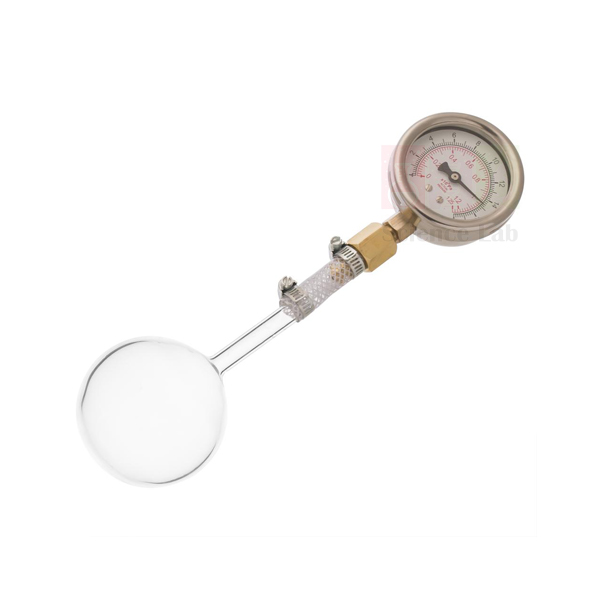
Jolly Bulb with Gauge
Jolly Bulb with Gauge (Product Code: SLE/PHY/194) is a gas-pressure apparatus used to study how the pressure of a fixed volume of air changes with temperature in school and college physics practicals. It comprises a thin-walled spherical bulb connected to a mechanical pressure gauge, which gives instant pressure readings without the inconvenience of a manometer. It is made by Jain Scientific Equipments Pvt Ltd (ScienceLab), an OEM manufacturer, at its own factory in Ambala, India.
Key Details
| Parameter | Detail |
|---|---|
| Bulb | Thin-walled spherical bulb |
| Gauge | Mechanical pressure gauge connected to the bulb |
| Advantage | Instant pressure readings, avoiding the inconvenience of a manometer |
| Clamp | Not included |
| Product code | SLE/PHY/194 |
| Manufacturer | Jain Scientific Equipments Pvt Ltd (ScienceLab) — OEM |
| Country of origin | India (made in Ambala, Haryana) |
What Is the Jolly Bulb Used For?
The bulb is clamped so that it sits fully under water in a heated bath, alongside a thermometer. As the water is warmed in stages, students wait for each temperature to settle and read the pressure straight off the gauge. A graph of pressure against temperature gives a straight line, and extending it back to zero pressure gives an estimate of absolute zero — the classic pressure law practical.
Because there are no liquid columns to balance, readings are quicker than with a manometer, which suits large classes using physics lab instruments in India. Keep the bulb clear of the bottom of the heated vessel, stir the bath before each reading, and handle the thin-walled bulb gently without over-tightening the clamp.
What to Specify When Ordering
- A retort stand and clamp, since the clamp is not included.
- A beaker for the water bath and a thermometer, if your lab needs them.
- Number of Jolly bulb sets for your practical groups.
OEM Manufacturer
Jain Scientific Equipments Private Limited, which trades as ScienceLab, is the OEM (original equipment manufacturer) of the Jolly bulb with gauge and makes it at its own licensed factory at Saha, Ambala, Haryana. Schools, colleges, dealers and importers in India and international markets receive it factory-direct.
Because the manufacturer prepares every quotation itself, you can come back later for extra sets or a replacement bulb — just ask us. Company background is on the ScienceLab profile.
Related Physics Lab Equipment
These items complete a pressure law set-up with the Jolly bulb:
- Retort Stand — supports the bulb in the water bath.
- Retort Clamp Three Finger — a clamp to hold the apparatus, as none is included.
- Glass Beaker — serves as the water bath.
- Immersion Thermometer — measures the bath temperature.
- Manometer, Glass — the traditional alternative for reading gas pressure.
Browse more in Physics Lab Equipment.
Frequently Asked Questions
What does the Jolly Bulb with Gauge consist of?
The Jolly Bulb with Gauge consists of a thin-walled spherical bulb connected to a mechanical pressure gauge. The clamp is not included, so the bulb must be held with a retort stand and clamp during experiments.
Why use a gauge instead of a manometer?
The gauge on the Jolly Bulb with Gauge gives instant pressure readings, reducing the inconvenience of setting up and reading a manometer. Students read the dial directly instead of measuring the difference between liquid levels.
Is a clamp included with the Jolly Bulb with Gauge?
No, a clamp is not included with the Jolly Bulb with Gauge. Add a retort stand and clamp to your enquiry if your lab needs them, and we will include them in the quotation.
What experiment is the Jolly Bulb with Gauge used for?
The Jolly Bulb with Gauge is used for pressure law experiments, where the pressure of a fixed volume of air is read at different water-bath temperatures and plotted to show a straight-line relationship and estimate absolute zero.
Who manufactures the Jolly Bulb with Gauge?
The Jolly Bulb with Gauge is manufactured by Jain Scientific Equipments Pvt Ltd (ScienceLab) as the OEM, at its own licensed factory in Saha, Ambala, Haryana, India, and is supplied direct from the factory.
What pressure range does the gauge cover?
The gauge range of the Jolly Bulb with Gauge is not stated in our current listing. Contact us before ordering if your experiment needs a particular range, and we will confirm the details for you.
Request a Quote
To get a price for the Jolly Bulb with Gauge, use the contact page or add it to the enquiry cart. Quotations come directly from the manufacturer and can include stands, clamps and thermometers.
Last updated: 24 September 2026
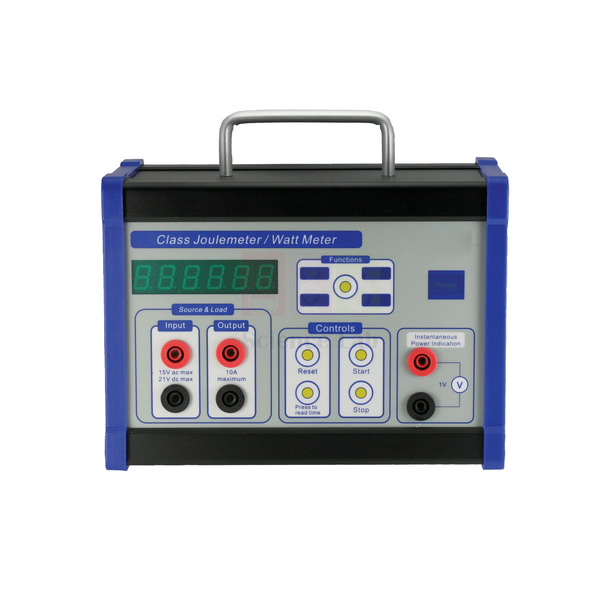
Joulemeter / Wattmeter, Digital
Joulemeter / Wattmeter, Digital (Product Code: SLE/PHY/195) is a combined digital energy and power meter used to measure the joules and watts taken up by an AC or DC load in school and college electricity and heat practicals. Light and compact, it suits both class demonstration and student use, reading energy from 1J to 999,999J (or 1mJ to 999,999mJ) and power from 200mW to 200W. It is supplied by Jain Scientific Equipments Pvt Ltd (ScienceLab), Ambala, India, within its physics lab equipment range for India and international markets.
Specifications
| Parameter | Detail |
|---|---|
| Measures | Energy taken up by a load and its power level, from AC or DC power |
| Energy range | 1J to 999,999J, or 1mJ to 999,999mJ |
| Power range | 200mW to 200W |
| Full-scale deflection | 1V represents 100mW on the mW/mJ range, or 100W on the W/J range |
| Instantaneous power sockets | One pair of 4mm sockets |
| Design | Single-chip microprocessor with a dedicated precision analogue multiplier for power measurement |
| Timing | Built-in timing function |
| Input voltage | 0 to 15V AC (0 to 21V DC); absolute maximum 35V DC, 24V AC |
| Input frequency | 0 to 500Hz maximum |
| Maximum current | 10A AC/DC |
| Accuracy | 5%, typically better than 3% at full scale |
| Energy / power indication | 6 digits |
| Power supply | 220V AC, 50/60Hz |
| Dimensions | 208 x 155 x 115mm |
| Intended use | Class demonstration or student use |
| Product code | SLE/PHY/195 |
| Supplied by | Jain Scientific Equipments Pvt Ltd (ScienceLab), Ambala, India |
What Is the Digital Joulemeter Used For?
Connected between a low-voltage supply and a load, the meter totals the energy transferred while its built-in timer runs. Students can then find the specific heat capacity of a metal block or liquid, compare electrical energy input with temperature rise, or work out the efficiency of a small motor or lamp without multiplying voltage, current and time by hand. Because it reads AC as well as DC at frequencies up to 500Hz, the same instrument works on a transformer output or a DC bench supply.
For demonstrations, the pair of 4mm instantaneous-power sockets can be taken to a voltmeter or data logger so the class sees power change as a load is switched in or out. In routine use keep the input within 15V AC or 21V DC, never exceed the absolute maximum of 35V DC or 24V AC, and keep the load current at or below 10A. These physics instruments from a supplier in India give schools a direct reading of energy and power in one bench unit.
What to Specify When Ordering
- The model: this combined joulemeter and wattmeter, or the energy-only student joulemeter listed below
- Your mains supply, since the unit is listed for 220V AC, 50/60Hz
- How many units you need for demonstration benches and for student groups
- Any 4mm leads, power supplies or heater loads you want priced in the same quotation
Supplier
Jain Scientific Equipments Private Limited trades as ScienceLab and sources this digital joulemeter/wattmeter for schools, colleges, training institutes, dealers and importers. One enquiry can cover the meter together with the supplies, leads and calorimetry items your energy practical needs. For vendor registration, the supplying company is Jain Scientific Equipments Private Limited (CIN U29309HR2020PTC087597, GSTIN 06AAECJ8618A1ZT). You can read more about us on the ScienceLab company profile.
Related Physics Lab Equipment
These items are commonly used with the joulemeter/wattmeter in energy and power experiments:
- Joulemeter, Student Digital — an energy-only digital meter for student groups
- Immersion Heater — a low-voltage heating load whose energy input the meter can record
- Calorimeter Set, Aluminium — for specific heat capacity measurements
- Power Supply, Stepped — an AC/DC bench source for the load circuit
- Stackable Leads — 4mm leads to connect supply, meter and load
Browse the full range of Physics Lab Equipment.
Frequently Asked Questions
What does the Joulemeter / Wattmeter, Digital measure?
The Joulemeter / Wattmeter, Digital measures both the energy taken up by a load, from 1J to 999,999J or 1mJ to 999,999mJ, and the power level, from 200mW to 200W. It works with AC or DC loads and shows the result on a 6-digit indication.
What input voltage and current can the digital joulemeter accept?
The Joulemeter / Wattmeter, Digital accepts 0 to 15V AC or 0 to 21V DC in normal use, with an absolute maximum of 35V DC or 24V AC. It handles input frequencies up to 500Hz and a maximum current of 10A AC or DC.
How accurate is the Joulemeter / Wattmeter, Digital?
The Joulemeter / Wattmeter, Digital has a stated accuracy of 5% and is typically better than 3% at full scale. A single-chip microprocessor works with a dedicated precision analogue multiplier, which is what lets it measure power on AC as well as DC.
How is the digital joulemeter powered?
The Joulemeter / Wattmeter, Digital runs from a 220V AC, 50/60Hz mains supply and measures 208 x 155 x 115mm on the bench. If your laboratory uses a different mains voltage, mention it in your enquiry so we can advise before you order.
Who supplies the Joulemeter / Wattmeter, Digital?
The Joulemeter / Wattmeter, Digital is supplied by Jain Scientific Equipments Pvt Ltd (ScienceLab), Ambala, Haryana, India, to schools, colleges, dealers and importers in India and international markets. Quotations can also include the leads, supplies and calorimetry items used with it.
Is a calibration certificate available for this joulemeter?
Calibration certificate availability for the Joulemeter / Wattmeter, Digital should be discussed with us before you order. Please mention the requirement when you contact us, and we will confirm what documentation can accompany the instrument.
What should a quotation request for the joulemeter include?
A quotation request for the Joulemeter / Wattmeter, Digital should state the quantity, the delivery location, your mains supply voltage and any accessories such as leads or a power supply you want priced together, so the offer covers the complete practical setup.
Request a Quote
To request a quotation for the Joulemeter / Wattmeter, Digital, send your requirement through our contact page or add it to the enquiry cart with any other physics lab items you need. We reply with availability and shipping options for India and international markets.
Last updated: 24 September 2026
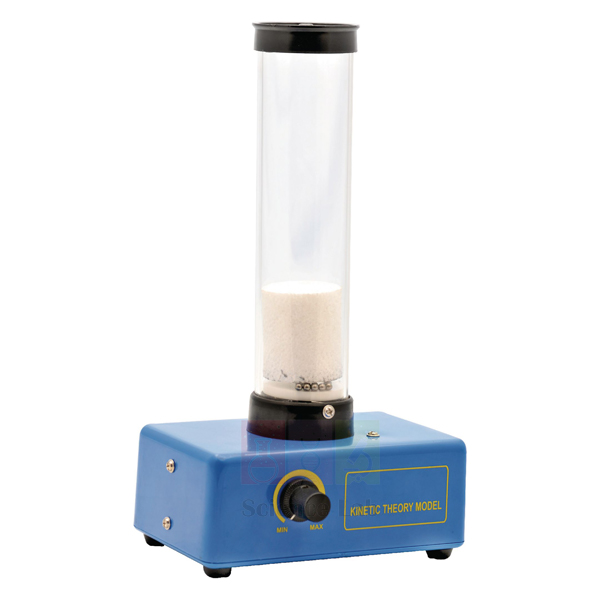
Kinetic Theory Model
Kinetic Theory Model (Product Code: SLE/PHY/196) is a large demonstration model used to show how the constant random motion of particles explains the behaviour of gases in school physics and chemistry classrooms. Run from a 6V AC supply, it keeps the included polystyrene balls in motion so a whole class can watch the “molecules” collide and spread out. It is made by Jain Scientific Equipments Pvt Ltd (ScienceLab), an OEM manufacturer, at its own factory in Ambala, India.
Key Details
| Parameter | Detail |
|---|---|
| Type | Large demonstration model |
| Power | 6V AC |
| Particles | Polystyrene balls, included |
| Topic | Kinetic theory of matter and gas behaviour |
| Product code | SLE/PHY/196 |
| Manufacturer | Jain Scientific Equipments Pvt Ltd (ScienceLab) — OEM |
| Country of origin | India (made in Ambala, Haryana) |
What Is the Kinetic Theory Model Used For?
The model turns an invisible idea into something students can watch. The polystyrene balls stand in for gas molecules, and their movement shows why a gas spreads to fill its container, why it pushes on the walls through countless collisions, and why diffusion happens without any stirring. The discussion can then move on to how faster particle motion corresponds to a higher temperature and a higher pressure.
As a demonstration model for the physics lab, it works best at the front of the room before students take readings with pressure gauges and thermometers. Power it from a low-voltage laboratory unit with a 6V AC output, never directly from the mains, and switch off before handling the balls. Polystyrene is very light and can cling through static, so keep the balls together in a closed bag between lessons.
What to Specify When Ordering
- The number of models required for your classrooms or science department
- Whether you already have a low-voltage supply with a 6V AC output, or want one quoted
- Any extra polystyrene balls you would like to keep in reserve (ask us)
OEM Manufacturer
ScienceLab is the trading name of Jain Scientific Equipments Private Limited, the OEM (original equipment manufacturer) of this kinetic theory model. It is made at the company’s own licensed factory at Saha, Ambala, Haryana, India, and goes factory-direct to schools, colleges, science centres, dealers and importers instead of passing through a trading intermediary.
Because the manufacturer handles your order itself, questions about replacement parts or repeat quantities come back to the same team — just ask us. More about the company is on the ScienceLab company profile.
Related Physics Lab Equipment
These items take the particle-model lesson on to measurements of gas pressure, temperature and movement:
- Power Supply, Stepped — an AC/DC bench supply to run the model at low voltage
- Jolly Bulb with Gauge — for following how gas pressure changes with temperature
- Bourdon Gauge — reads gas pressure in Boyle’s law work
- Convection of Gas Apparatus — shows gas movement caused by heating
See more models and apparatus in Physics Lab Equipment.
Frequently Asked Questions
What is included with the Kinetic Theory Model?
The Kinetic Theory Model comes with polystyrene balls that represent gas molecules during the demonstration. The model runs from a 6V AC supply; if you need a suitable low-voltage supply, ask us to include one in the same quotation.
What power does the Kinetic Theory Model need?
The Kinetic Theory Model needs a 6V AC supply. Use a low-voltage laboratory power unit that provides an AC output rather than connecting it to the mains, and switch off before adjusting the model or handling the balls.
Is the Kinetic Theory Model suitable for showing a whole class?
Yes. The Kinetic Theory Model is a large demonstration model, intended for a teacher to run at the front of the room so that students watch the particle motion together rather than working individually at their benches.
Which topics can be taught with the kinetic theory model?
The Kinetic Theory Model supports lessons on the particle model of matter, gas pressure from molecular collisions, diffusion, and the link between particle speed and temperature. It helps students picture the gas laws before they take readings with gauges and thermometers.
Who manufactures the Kinetic Theory Model?
The Kinetic Theory Model is manufactured by Jain Scientific Equipments Pvt Ltd (ScienceLab) as the OEM at its own factory in Saha, Ambala, Haryana, India, and is supplied factory-direct to schools, colleges, dealers and importers.
Can replacement polystyrene balls be ordered?
Replacement polystyrene balls for the Kinetic Theory Model can be discussed directly with the manufacturer. Tell us the quantity you need through our contact page and we will confirm availability with your quotation.
Can the Kinetic Theory Model be supplied in bulk or for export?
The Kinetic Theory Model can be quoted for a single school or in larger quantities for institutions, dealers and importers in India and international markets. Include the quantity and destination in your enquiry so the quotation covers packing and shipping.
Request a Quote
Quotations for the Kinetic Theory Model come direct from the manufacturer. Send your requirement through our contact page or add the model to the enquiry cart along with any power supply or gas-law apparatus you need.
Last updated: 24 September 2026

Knife Switch – Single Pole
Knife Switch – Single Pole (Product Code: SLE/PHY/197) is a single-pole, single-throw (SPST) knife switch on a plastic base used to turn one path of a circuit on and off in school and college electricity practicals. It comes from a range of knife switches made for electricity circuits, and its pole and blade are brass so that the closed switch makes a good electrical connection. It is supplied by Jain Scientific Equipments Pvt Ltd (ScienceLab), Ambala, India.
Key Details
| Parameter | Detail |
|---|---|
| Switch type | Knife switch, single pole, single throw (SPST) |
| Mounting | Plastic base |
| Pole and blade | Brass, to ensure good electrical connections |
| Suitable for | Electricity circuits |
| Range | One of a range of knife switches on plastic bases; a double-pole version is also listed |
| Product code | SLE/PHY/197 |
| Supplied by | Jain Scientific Equipments Pvt Ltd (ScienceLab), Ambala, India |
What Is the Single Pole Knife Switch Used For?
Wired in series with the cell or power supply, the switch acts as the main key of a student circuit: resistance measurements, meter bridge and potentiometer set-ups, lamp and motor circuits all need a way to break the current between readings. Opening the switch after each reading stops a resistance wire from warming up and drifting in value, and it saves dry cells from running down while students record their results.
For dependable readings, push the blade fully home between the brass contacts and keep the contact faces clean and free of tarnish. Because the brass parts are exposed, use it only in low-voltage circuits, not for mains switching. As everyday school physics lab equipment in India, a few spare switches per laboratory make it easy to build several circuits at once.
What to Specify When Ordering
- Single pole (this item) or the double-pole, double-throw version from the same range
- The number of switches needed per bench or per laboratory
- Any connecting leads, clips or rheostats you want quoted with the switches
Supplier
Jain Scientific Equipments Private Limited, which trades as ScienceLab, supplies this single pole knife switch from Ambala, Haryana, India to schools, colleges, laboratory dealers and importers. One enquiry can cover the switch together with the leads, rheostats and other circuit parts a physics laboratory usually orders alongside it.
If you need matching switches for a repeat order, or want the double-pole version from the same range on the same quotation, ask us when you enquire. You can learn more on the ScienceLab company profile.
Related Physics Lab Equipment
These items complete a basic switched circuit on the student bench:
- Knife Switch, Double Pole — for reversing current or changing over between circuits
- Contact Key (Push Switch) — closes the circuit only while it is pressed
- Rheostat — varies the current in the switched circuit
- Crocodile Clips & Leads — quick connections to the switch terminals
- Lamp Holder — a simple lamp load for on/off demonstrations
More circuit components are listed under Physics Lab Equipment.
Frequently Asked Questions
What type of switch is the Knife Switch – Single Pole?
The Knife Switch – Single Pole is a single-pole, single-throw (SPST) knife switch, so one brass blade opens or closes one circuit path. It is mounted on a plastic base and suits simple on/off control in student electricity circuits.
What are the contacts of the single pole knife switch made of?
The pole and blade of the Knife Switch – Single Pole are made of brass to ensure good electrical connections. Keeping the brass contact faces clean and closing the blade fully gives the most reliable contact during experiments.
When should I choose a single pole rather than a double pole knife switch?
Choose the Knife Switch – Single Pole when a circuit only needs switching on and off. For reversing a current or moving one supply between two circuits, the double-pole, double-throw version from the same range is the better choice.
Can the Knife Switch – Single Pole be used on mains voltage?
No. The Knife Switch – Single Pole is intended for low-voltage electricity circuits in school and college laboratories. Its brass pole and blade are exposed, so it should not be used for switching mains-voltage equipment.
Who supplies the Knife Switch – Single Pole?
The Knife Switch – Single Pole is supplied by Jain Scientific Equipments Pvt Ltd (ScienceLab), Ambala, Haryana, India, to schools, colleges, dealers and importers in India and international markets. It can be quoted together with the other circuit components needed for the same practicals.
What should a quotation request for knife switches include?
A quotation request for the Knife Switch – Single Pole should state the quantity, whether any double-pole switches are needed as well, the leads or other components to be included, and the delivery location, so the offer can be prepared in one step.
Request a Quote
Prices for the Knife Switch – Single Pole are quoted on request. Use our contact page or add the switch to the enquiry cart with the other circuit items your laboratory needs, and ScienceLab will send one combined offer.
Last updated: 24 September 2026

Knife Switch, Double Pole
Knife Switch, Double Pole (Product Code: SLE/PHY/198) is a double-pole, double-throw (DPDT) knife switch used to reverse the direction of a current or to change a circuit over between two paths in physics and electrical practicals. Its brass poles and blades sit on a plastic base and are chosen to ensure good electrical connections on both poles at once. It is supplied by Jain Scientific Equipments Pvt Ltd (ScienceLab), Ambala, India.
Key Details
| Parameter | Detail |
|---|---|
| Switch type | Knife switch, double pole, double throw (DPDT) |
| Mounting | Plastic base |
| Poles and blades | Brass, to ensure good electrical connections |
| Suitable for | Electricity circuits |
| Range | One of a range of knife switches on plastic bases; a single-pole version is also listed |
| Product code | SLE/PHY/198 |
| Supplied by | Jain Scientific Equipments Pvt Ltd (ScienceLab), Ambala, India |
What Is the Double Pole Knife Switch Used For?
With its outer terminals cross-connected, the switch becomes a reversing key: one throw sends current through a solenoid, motor or galvanometer in one direction, and the other throw reverses it. That is exactly what is needed to show a magnetic field changing direction, to run a small DC motor backwards, or to average tangent galvanometer readings taken with the current both ways. Wired without the cross-connection, it moves one supply between two circuits, for example charging a capacitor and then discharging it through a meter.
Check that both blades seat fully in their contacts on each throw, since a half-closed pole gives erratic readings. Keep the brass faces clean and limit use to low-voltage circuits, because the conductors are exposed. It is a practical addition to any set of AC DC circuits experiment kits in a school or college laboratory.
What to Specify When Ordering
- Double pole, double throw (this item) or the single-pole version from the same range
- The quantity required for student benches and the demonstration table
- Connecting wire or other circuit components you want included in the same quotation
Supplier
This double pole knife switch is supplied by Jain Scientific Equipments Private Limited, the company behind the ScienceLab name, from Ambala, Haryana, India. Laboratories, training institutes, dealers and importers can source it on one order with the motors, capacitors, power supplies and wiring used in reversing and changeover circuits.
Need more switches to match an earlier delivery, or a mix of single-pole and double-pole switches? Mention it in your enquiry and we will include it in the offer. Company background is on the ScienceLab company profile.
Related Physics Lab Equipment
These items are used with a double pole switch in reversing and changeover circuits:
- Knife Switch – Single Pole — for circuits that only need on/off control
- Capacitor (Charging and Discharging) — a changeover switch moves it between charge and discharge
- Electric Motor — shows reversal of rotation when the current is reversed
- Power Supply, Stepped — a low-voltage DC source for the reversing circuit
- Connecting Wire — for the cross-connection and circuit wiring
Explore the wider range of Physics Lab Equipment.
Frequently Asked Questions
What does DPDT mean on the Knife Switch, Double Pole?
On the Knife Switch, Double Pole, DPDT means double pole, double throw: two separate circuit paths are switched together, and each can be connected to either of two positions. One movement can therefore reverse a current or swap between two circuits.
How do I wire the double pole knife switch as a reversing switch?
To use the Knife Switch, Double Pole as a reversing switch, connect the supply to the common (hinge) terminals, the load to one pair of outer terminals, and cross-connect the outer terminals diagonally. Throwing the blades the other way then reverses the current through the load.
What is the Knife Switch, Double Pole made of?
The Knife Switch, Double Pole has brass poles and blades to ensure good electrical connections, mounted on a plastic base. Wipe the contacts clean if they tarnish, and keep the switch for low-voltage laboratory circuits because the brass parts are exposed.
Which experiments need a double pole knife switch?
The Knife Switch, Double Pole is useful whenever a current must be reversed or a supply moved between circuits: reversing a solenoid or motor, taking tangent galvanometer readings in both directions, switching a capacitor between charge and discharge, or comparing two cells.
Who supplies the Knife Switch, Double Pole?
Jain Scientific Equipments Pvt Ltd (ScienceLab) of Ambala, Haryana, India supplies the Knife Switch, Double Pole to schools, colleges, laboratory dealers and importers. Orders can combine the switch with the single-pole version and the other electricity apparatus used in the same experiments.
Can double pole knife switches be supplied in bulk?
Yes. The Knife Switch, Double Pole can be quoted for a single school or in larger quantities for colleges, dealers and importers in India and international markets. State the quantity and destination in your enquiry, and add any single-pole switches you also need.
Request a Quote
To receive a quotation for the Knife Switch, Double Pole, send the quantity and delivery location through our contact page, or place the switch in the enquiry cart together with other electricity apparatus for a single combined offer from ScienceLab.
Last updated: 24 September 2026
LED White
LED White (Product Code: SLE/PHY/199) is a standard 5mm white light-emitting diode used as a low-power light source in student circuits and LED characteristics experiments in physics and electronics labs. It is packed 100 to a pack, and its listed data — forward voltage values of 3.3 and 3.8, a luminous intensity of 10 mcd and an IF value of 30 — help students plan current-limiting resistors and compare white LEDs with other colours. It is supplied by Jain Scientific Equipments Pvt Ltd (ScienceLab), Ambala, India.
Specifications
| Parameter | Detail |
|---|---|
| Type | Standard LED (light-emitting diode) |
| Size | 5mm |
| Colour | White |
| Pack size | 100 LEDs |
| Forward current (IF) | 30 (listed value; forward-current ratings for 5mm LEDs are normally stated in mA) |
| Forward voltage (VF) | 3.3 V and 3.8 V (two values listed) |
| Colour coordinates | x: 0.31, y: 0.30 (listed under wavelength in the source data; white LEDs are described by colour coordinates rather than one wavelength) |
| Luminous intensity | 10 mcd |
| Other colours | The same standard 5mm LED is available in a range of colours |
| Product code | SLE/PHY/199 |
| Supplied by | Jain Scientific Equipments Pvt Ltd (ScienceLab), Ambala, India |
What Is the White LED Used For?
In an LED characteristics experiment kit, students plot current against voltage for the white LED and see that it only begins to conduct and glow once the forward voltage is reached — a noticeably higher turn-on voltage than a red LED, which opens a discussion of photon energy and colour. The same LEDs serve as the light source for light-dependent resistor circuits, as indicators on circuit boards, and in simple optics and science-fair projects.
Always wire a series resistor with each LED: subtract the forward voltage from the supply voltage and divide by the chosen current, keeping that current below the IF rating. Check polarity before switching on — on standard LEDs the longer lead is normally the anode — because a reversed LED will not light.
What to Specify When Ordering
- The colour: white (this item) or another colour from the standard 5mm range
- The number of packs, remembering each pack holds 100 LEDs
- Battery clips, circuit boards or sensors you want quoted with the LEDs
Supplier
These white LEDs are supplied by Jain Scientific Equipments Private Limited, the company behind the ScienceLab name, to schools, colleges, electronics training centres, dealers and importers. Packs can be combined with circuit boards, battery connectors and other physics items in a single consignment. For vendor records, buyers can note the supplying company’s Importer-Exporter Code AAECJ8618A (DGFT) and GSTIN 06AAECJ8618A1ZT. The ScienceLab company profile has more background.
Related Physics Lab Equipment
These items are often ordered with white LEDs for circuit and sensor work:
- LED Bright Red — compare its forward voltage with the white LED
- LED Blue — another colour for colour and photon-energy comparisons
- Light Dependent Resistor — detects the LED’s light in sensor circuits
- Battery Snap with Crocodile Clip — a quick battery connection for LED circuits
- Worcester Circuit Board — a base for building student circuits
Find more components in Physics Lab Equipment.
Frequently Asked Questions
How many LEDs are in a pack of LED White?
LED White is supplied in packs of 100 standard 5mm white LEDs, enough for a class to build circuits and keep spares for replacements. Order the number of packs you need, and mention any other colours from the same range.
What forward voltage does the white LED need?
The data for LED White lists forward voltage (VF) values of 3.3 V and 3.8 V. White LEDs need a higher forward voltage than red ones, so allow for this when you choose the supply voltage and the series resistor.
Does LED White need a series resistor?
Yes. LED White should always be used with a series resistor that keeps the current below its listed IF value of 30. Work out the resistor by subtracting the forward voltage from the supply voltage and dividing by the chosen current.
Why is no single wavelength given for a white LED?
LED White is specified with colour coordinates of x: 0.31, y: 0.30 rather than one wavelength, because a white LED emits a broad spread of colours. The coordinates describe its white tint, and its luminous intensity is listed as 10 mcd.
Who supplies LED White?
LED White is supplied by Jain Scientific Equipments Pvt Ltd (ScienceLab), Ambala, Haryana, India, to schools, colleges, electronics labs, dealers and importers in India and international markets, usually alongside other circuit components and physics lab equipment.
What should a quotation request for white LEDs include?
A quotation request for LED White should give the number of packs, any other LED colours needed, related components such as battery clips or circuit boards, and the delivery location, so everything can be quoted together in one offer.
Request a Quote
To get a price for LED White, write to us through the contact page or add the packs to the enquiry cart with any other components you need.
Last updated: 24 September 2026

Lens Holder, Wooden
Lens Holder, Wooden (Product Code: SLE/PHY/200) is a bench-top wooden stand used to hold a lens or mirror upright while students locate images and measure focal lengths in school optics practicals. It takes lenses or mirrors up to 76mm in diameter in the V-shaped slot of a 100mm upright, and an index mark engraved on each end of its 100 x 50mm base shows its position against a scale. It is made by Jain Scientific Equipments Pvt Ltd (ScienceLab), an OEM manufacturer, at its own factory in Ambala, India.
Specifications
| Parameter | Detail |
|---|---|
| Holds | Lenses or mirrors up to 76mm diameter |
| Material | Wood |
| Upright | 100mm high, with a V-shaped slot to hold a convex or concave lens |
| Base | Rectangular, 100 x 50mm |
| Position reference | Index mark engraved on each end of the base |
| Product code | SLE/PHY/200 |
| Manufacturer | Jain Scientific Equipments Pvt Ltd (ScienceLab) — OEM |
| Country of origin | India (made in Ambala, Haryana) |
What Is the Wooden Lens Holder Used For?
The holder is the fixed point of most focal-length experiments. Students stand it beside a metre rule, line up an index mark with the scale, and move a screen or object until a sharp image forms, then read off the distances for a convex lens or a concave mirror. Because it simply rests on the bench, it can be moved in small steps and re-read quickly, which suits the u–v method and the distant-object method alike.
Let the lens settle to the bottom of the V so that its centre stays at the same height as the object and screen, which keeps the image on the principal axis. Clean lenses before use and handle them by the edges. Simple items like this form the backbone of optics lab equipment in India, where many student groups work at the same time.
What to Specify When Ordering
- The number of holders per student group or per laboratory
- The diameter of the lenses and mirrors you use, which must be 76mm or less for this holder
- Any lenses, mirrors or metre rules you want quoted in the same enquiry
OEM Manufacturer
ScienceLab, the trading name of Jain Scientific Equipments Private Limited, is the OEM (original equipment manufacturer) of this wooden lens holder. It is made and finished at the company’s own licensed factory at Saha, Ambala, Haryana, India, and dispatched directly to schools, colleges, dealers and importers without a middleman.
Buying from the manufacturer means that matching repeat orders and questions about the holder go to the people who make it — ask us whenever you need more. See the ScienceLab company profile for more about the company.
Related Physics Lab Equipment
These items are used with the wooden lens holder in focal-length and image experiments:
- Convex Lens — the lens held in the V-slot for image formation
- Mirror, Concave — for concave-mirror focal-length work
- Meter Stick, White — the scale against which the index marks are read
- Lens Holder with Base — a plastic holder with a locking ring for smaller lenses
- Optical Bench Kit — for a more complete optics set-up
View all items in Physics Lab Equipment.
Frequently Asked Questions
What size lenses fit the Lens Holder, Wooden?
The Lens Holder, Wooden takes lenses or mirrors up to 76mm in diameter. They rest in the V-shaped slot of its 100mm upright, which centres round optics of different sizes without any clamping or adjustment.
Can the wooden lens holder hold mirrors as well as lenses?
Yes. The Lens Holder, Wooden is designed to take lenses or mirrors up to 76mm in diameter, so one stand serves convex and concave lens experiments as well as curved-mirror experiments on the laboratory bench.
What are the index marks on the base for?
The Lens Holder, Wooden has an index mark engraved on each end of its 100 x 50mm base. Lining a mark up with a metre rule lets students read the exact position of the lens and so measure object and image distances accurately.
What is the Lens Holder, Wooden made of?
The Lens Holder, Wooden is made of wood, with a 100mm upright on a rectangular 100 x 50mm base. Keep it dry and away from heat sources, and wipe it with a dry cloth after use so the engraved marks stay easy to read.
Who manufactures the Lens Holder, Wooden?
The Lens Holder, Wooden is manufactured by Jain Scientific Equipments Pvt Ltd (ScienceLab), the OEM, at its own factory in Saha, Ambala, Haryana, India. It is supplied factory-direct to schools, colleges, dealers and importers in India and international markets.
Can the wooden lens holder be ordered in class sets?
Yes. The Lens Holder, Wooden can be quoted in class sets for schools or in larger quantities for dealers and importers. Give the quantity, any lenses or mirrors to include, and the delivery location in your enquiry.
Request a Quote
Quotations for the Lens Holder, Wooden are issued directly by the manufacturer. Reach us through the contact page or add the holder to the enquiry cart with the lenses and mirrors you need.
Last updated: 24 September 2026
Lens Holder with Base
Lens Holder with Base (Product Code: SLE/PHY/201) is a black plastic lens mount on its own base, used to hold a lens firmly upright during light and optics experiments in school and college labs. It houses lenses up to 50mm, a simple locking ring keeps the lens in position, and it comes in a pack of 5 so a group can line up several lenses at once. It is made by Jain Scientific Equipments Pvt Ltd (ScienceLab), an OEM manufacturer, at its own factory in Ambala, India.
Specifications
| Parameter | Detail |
|---|---|
| Material | Plastic |
| Colour | Black |
| Lens size | Houses lenses up to 50mm |
| Mounting | Mounted on a base |
| Lens retention | Simple locking ring holds the lens firmly in position |
| Pack size | 5 holders |
| Application | Light and optics experiments |
| Product code | SLE/PHY/201 |
| Manufacturer | Jain Scientific Equipments Pvt Ltd (ScienceLab) — OEM |
| Country of origin | India (made in Ambala, Haryana) |
What Is the Lens Holder with Base Used For?
Whenever an experiment needs more than one lens standing at a time, these holders do the job: two convex lenses set up as a simple telescope or compound microscope model, lenses placed in contact to find a combined focal length, or a lens in front of a light source to throw an image on a screen. Paired with a convex concave lens set, school students can set up and change arrangements quickly because the locking ring stops the lens tipping or dropping out when the holder is moved.
Tighten the locking ring by hand only until the lens no longer moves; there is no need to force it against the glass. Wipe lenses with a soft lens cloth before fitting them, and keep each pack of five holders together so a complete set is ready for the next class.
What to Specify When Ordering
- The number of packs, each containing 5 holders
- The diameter of your lenses, which should be 50mm or less for this holder
- Any lenses, light sources or optical benches you want quoted together
OEM Manufacturer
The Lens Holder with Base is produced by Jain Scientific Equipments Private Limited, known by its trading name ScienceLab, as the OEM (original equipment manufacturer). Production takes place at the company’s own licensed factory at Saha, Ambala, Haryana, India, and packs are shipped from there to schools, colleges, dealers and importers.
Since the quotation comes from the maker, extra packs to match an earlier order, or a question about a part, can be raised with the same team — ask us at any time. The ScienceLab company profile explains more about the business.
Related Physics Lab Equipment
These items are used with the plastic lens holders in light and optics lessons:
- Lens Holder, Wooden — takes larger lenses and mirrors in a V-shaped slot
- Convex Lens — the most common lens fitted in the holder
- Light Box and Optical Set — a light source and optics for image and ray work
- Optical Bench with 3 Stands — for measured lens positions along a scale
- Microfiber Lens Cloth — keeps lenses clean before they are mounted
Browse more optics items in Physics Lab Equipment.
Frequently Asked Questions
How many holders are in a pack of Lens Holder with Base?
The Lens Holder with Base comes in a pack of 5 black plastic holders, each mounted on its own base. Five holders let one group line up several lenses at once, or let five groups each work with a single lens.
What size lens does the Lens Holder with Base take?
The Lens Holder with Base houses lenses up to 50mm. For larger lenses, or for holding mirrors, the wooden lens holder in the same physics range is the better fit, as it holds the optic in a V-shaped slot.
How does the locking ring on the lens holder work?
The Lens Holder with Base has a simple locking ring that holds the lens firmly in position. Tighten it by hand until the lens no longer moves; forcing it further is unnecessary and could stress the glass.
Which experiments use the Lens Holder with Base?
The Lens Holder with Base is used in light and optics experiments such as finding focal length, combining lenses, and building simple telescope or microscope models from two lenses, where each lens must stay upright and steady.
Who manufactures the Lens Holder with Base?
The Lens Holder with Base is manufactured by Jain Scientific Equipments Pvt Ltd (ScienceLab) as the OEM at its own factory in Saha, Ambala, Haryana, India, and is supplied factory-direct to schools, colleges, dealers and importers in India and international markets.
What should a quotation request for lens holders include?
A quotation request for the Lens Holder with Base should state the number of packs of 5, the lens sizes you use, any lenses or optics sets to be included, and the delivery location, so the complete order can be quoted at once.
Request a Quote
Ask the manufacturer directly for a quotation on the Lens Holder with Base through our contact page, or add packs to the enquiry cart alongside your other optics items.
Last updated: 24 September 2026
Levers Kit
Levers Kit (Product Code: SLE/PHY/202) is a class set of graduated plywood beams, fulcrums and matched metal blanks used to investigate the principle of moments and lever balance in school physics practicals. Designed for eight pupils, it contains five 600 x 44 x 3mm beams graduated every 38mm, four 32 x 32 x 64mm fulcrums and forty 25mm square metal blanks whose masses are matched to ±1%. It is made by Jain Scientific Equipments Pvt Ltd (ScienceLab), an OEM manufacturer, at its own factory in Ambala, India.
Specifications
| Parameter | Detail |
|---|---|
| Designed for | Eight pupils |
| Beams | Five plywood beams, 600 x 44 x 3mm |
| Beam graduations | Every 38mm |
| Fulcrum location | Groove across the centre of each beam |
| Fulcrums | Four, 32 x 32 x 64mm |
| Metal blanks | Forty, 25mm square |
| Blank mass matching | Matched to ±1% |
| Product code | SLE/PHY/202 |
| Manufacturer | Jain Scientific Equipments Pvt Ltd (ScienceLab) — OEM |
| Country of origin | India (made in Ambala, Haryana) |
What Is the Levers Kit Used For?
Pupils rest a beam on a fulcrum at its centre groove and load metal blanks at the graduation marks on either side until it balances. Because the blanks are matched in mass, each one counts as an equal unit, and because the graduations are evenly spaced, each mark counts as an equal unit of distance. The rule that the turning effect on one side equals the turning effect on the other can then be checked simply by counting — for example, two blanks at four marks balance four blanks at two marks.
Check that the empty beam balances before adding loads, and centre each blank on its graduation line so distances stay true. Keep the plywood beams flat and dry when stored. As mechanics lab equipment in India, the kit gives a whole group a hands-on introduction to moments before they move on to spring balances and standard masses.
What to Specify When Ordering
- The number of kits, based on one kit per eight pupils
- Whether you would like additional blanks or beams held in reserve (ask us)
- Any force meters or mass sets you want quoted for extension work
OEM Manufacturer
Jain Scientific Equipments Private Limited, which trades as ScienceLab, is the OEM (original equipment manufacturer) of the Levers Kit and makes it at its own licensed factory in Saha, Ambala, Haryana, India. Schools, colleges, dealers and importers receive the kit straight from the factory rather than from a trading house.
Working directly with the manufacturer means a request for extra kits, or for a replacement beam or blank, is answered by the team that produces them — just ask us. Read more on the ScienceLab company profile.
Related Physics Lab Equipment
These items extend lever and moments work beyond the class kit:
- Balance Demonstration Fulcrum/Lever — for a teacher demonstration of lever balance
- Apparatus for Demonstrating the Moment of Force — shows turning effect at the front of the class
- Lever — a further lever apparatus for comparing designs
- Force Meter/Spring Balance — measures effort forces in extended lever experiments
- Mass Set — standard masses for quantitative moment calculations
See the complete Physics Lab Equipment range.
Frequently Asked Questions
What is included in the Levers Kit?
The Levers Kit contains five plywood beams measuring 600 x 44 x 3mm, four fulcrums of 32 x 32 x 64mm and forty 25mm square metal blanks. Together these parts equip eight pupils to investigate balance and turning effects.
How many pupils can use one Levers Kit?
One Levers Kit is designed for eight pupils. The class shares the five graduated beams and four fulcrums between its groups and divides the forty matched metal blanks among them to load the beams.
Why are the metal blanks in the Levers Kit matched?
The Levers Kit blanks have masses matched to ±1%, so each blank counts as one equal unit of weight. Students can verify the principle of moments by counting blanks and graduations instead of weighing every load.
How are the Levers Kit beams marked?
Each Levers Kit beam is graduated every 38mm along its 600mm length and has a groove across its centre that locates the fulcrum point, so the beam balances in the same place every time and distances can be counted in equal steps.
Who manufactures the Levers Kit?
The Levers Kit is manufactured by Jain Scientific Equipments Pvt Ltd (ScienceLab), the OEM, at its own factory in Saha, Ambala, Haryana, India. It is supplied factory-direct to schools, colleges, dealers and importers in India and international markets.
Can the Levers Kit be supplied for several classes?
Yes. The Levers Kit can be quoted for a single class or as several sets for schools, dealers and importers. State the number of kits, any extra force meters or masses, and the delivery location in your enquiry.
Request a Quote
For a quotation straight from the manufacturer, send your Levers Kit requirement through the contact page or add it to the enquiry cart with your other mechanics apparatus.
Last updated: 24 September 2026
Solar Bio Energy Ready-To-Go
Solar Bio Energy Ready-To-Go (Product Code: SLE/PHY/203) is an extensive experiment system used to reconstruct and understand the whole biomass cycle, from seed germination to the energetic use of biomass, in school and college science labs. Students grow plants in a cultivation box and hydroculture, then follow the aerobic and anaerobic degradation of that biomass in compost and biogas processes, without any additional equipment. It is supplied by Jain Scientific Equipments Pvt Ltd (ScienceLab), Ambala, India.
Specifications
| Parameter | Detail |
|---|---|
| System type | Experiment system for the whole biomass cycle, usable without additional equipment |
| Plant growth | Cultivation box and hydroculture for observing sprouting and growth |
| Degradation processes | Aerobic degradation in a compost; anaerobic degradation in biogas processes |
| Analysis | Water and nutrient consumption in the different growth phases |
| Energy parts | PEM fuel cell module, motor module without gear, Solar-Base unit small and propeller |
| Cases | Aluminium case 1710, silver, and aluminium case 1710, blue |
| Consumables shelf life | Depends on the item (seeds, fertilizer, compost catalyst) and its storage; ask us for the dates of the batch you are quoted |
| Product code | SLE/PHY/203 |
| Supplied by | Jain Scientific Equipments Pvt Ltd (ScienceLab), Ambala, India |
Experiments:
- Germination of plant seeds
- Aerobic degradation of biomass in a compost
- Anaerobic degradation of biomass to form hydrogen
- Anaerobic degradation of biomass to form methane
- Plant growth in a hydroculture
- Consumption of water and nutrients
Components:
- Modules and electrical parts: 1 x motor module without gear, 1 x PEM fuel cell module, 1 x Solar-Base unit small, 1 x propeller, 2 x short-circuit plug, 1 x test lead black 25 cm, 1 x test lead red 25 cm
- Growing parts: 1 x seed set, 1 x sprout box, 50 x net cup planter, 2 x expanded clay pebbles, 1 x fertilizer, 2 x pot holder Bio Energy, 2 x plant light, 1 x tripod plant lighting, 1 x air pump, 2 x aeration stone, 1 x nebulizer, 2 x timer, 1 x EC meter
- Compost and gas parts: 1 x composter, 1 x compost catalyst, 1 x gas collecting container, 1 x Erlenmeyer flask 1000 ml, 1 x rubber plug with tube, 24 x stopper red, 1.5 x silicone tube 4mm, 1 x Y-switch 4mm, 1 x hose clamp, 1 x burner, 1 x tripod, 1 x box 6 L
- Measuring and handling: 1 x temperature logger, 1 x weight, 1 x tweezers, 1 x ID tags
- Cases, inserts and documents: 1 x aluminium case 1710 silver, 1 x aluminium case 1710 blue, 2 x plastic box (Gratnells) 75 mm deep, 1 x insert Bio Energy Rtg, 2 x info sheet initial startup, 1 x layout diagram Bio Energy Ready-to-go
What Is the Solar Bio Energy Ready-To-Go Used For?
The system joins biology and energy science in one sequence. Students germinate seeds in the sprout box, move the seedlings into net cups in the hydroculture under plant lights switched by timers, and track water and nutrient uptake through each growth phase with the EC meter. The grown biomass then goes into the composter for aerobic degradation, where the temperature logger can follow the process, and into sealed vessels for anaerobic degradation that forms hydrogen and methane. The fuel cell, motor and propeller modules take the lesson on to the energetic use of biomass.
As a plant growth experiment kit that also covers renewable energy, it suits project work that runs over several lessons, so plan space for the hydroculture and label trays with the ID tags. Treat any collected gas with care, since both hydrogen and methane are flammable, and follow the start-up info sheets before the first run.
What to Specify When Ordering
- The number of complete systems required for your classes or teacher-training centre
- Whether you want replacement consumables such as seeds, fertilizer, compost catalyst or net cup planters quoted (ask us)
- Other Ready-to-go renewable-energy cases you would like priced in the same enquiry
Supplier
Jain Scientific Equipments Private Limited, which trades as ScienceLab, supplies the Solar Bio Energy Ready-To-Go to schools, colleges, teacher-training centres, dealers and importers in India and international markets. The complete system is sourced by the company and can be quoted together with related renewable-energy experiment cases in one consignment. Institutional buyers completing vendor forms can use the company’s GSTIN 06AAECJ8618A1ZT and Legal Entity Identifier 3358004HRD1JIVXKYX49. More background is on the ScienceLab company profile.
Related Physics Lab Equipment
These cases and kits continue the renewable-energy and plant-science topics of this system:
- Solar Bio Fuel Ready-to-go — carries biomass on to bioethanol and biodiesel production
- Solar H2 Ready-To-Go — a Ready-to-go case on hydrogen as an energy carrier
- Solar Photovoltaic Ready-To-Go — the solar electricity side of renewable energy
- Kit for Demonstrating Seed Respiration in Germination — the biology of germinating seeds
See all items in Physics Lab Equipment.
Frequently Asked Questions
What experiments does the Solar Bio Energy Ready-To-Go cover?
The Solar Bio Energy Ready-To-Go covers germination of plant seeds, plant growth in a hydroculture, consumption of water and nutrients, aerobic degradation of biomass in a compost, and anaerobic degradation of biomass to form hydrogen and to form methane.
Is additional equipment needed for the Solar Bio Energy Ready-To-Go?
The Solar Bio Energy Ready-To-Go is described as letting you reconstruct and understand the whole biomass cycle without any additional equipment. It includes plant lights, timers, an air pump, an EC meter and a temperature logger alongside the growing and degradation parts.
Are seeds and other consumables included in the Solar Bio Energy Ready-To-Go?
Yes. The Solar Bio Energy Ready-To-Go includes a seed set, fertilizer, compost catalyst, expanded clay pebbles and 50 net cup planters. Their shelf life depends on the item and storage conditions, so ask us for the dates of the batch you are quoted.
How is the Solar Bio Energy Ready-To-Go packed?
The Solar Bio Energy Ready-To-Go comes in two aluminium cases, type 1710 in silver and in blue, with a fitted insert, two 75 mm deep plastic boxes, a layout diagram and two info sheets for initial start-up.
Who supplies the Solar Bio Energy Ready-To-Go?
The Solar Bio Energy Ready-To-Go is supplied by Jain Scientific Equipments Pvt Ltd (ScienceLab), Ambala, Haryana, India, to schools, colleges, dealers and importers in India and international markets, and can be quoted alongside related renewable-energy cases.
What should a quotation request for this bio energy kit include?
A quotation request for the Solar Bio Energy Ready-To-Go should state the number of systems, any replacement consumables you want priced, other renewable-energy kits of interest, and the delivery location, so we can prepare one complete offer.
Request a Quote
Send your requirement for the Solar Bio Energy Ready-To-Go through our contact page, or add it to the enquiry cart with any other renewable-energy kits you are considering.
Last updated: 24 September 2026
Solar Bio Fuel Large
Solar Bio Fuel Large (Product Code: SLE/PHY/204) is a biofuel experiment set used to demonstrate the entire process of producing biofuels, from alcoholic fermentation to electricity from an ethanol fuel cell, in school and college science labs. Besides bioethanol it also covers biodiesel production through transesterification of fats, and the fermented mash is distilled with a Solar-condenser developed for this experiment. It is supplied by Jain Scientific Equipments Pvt Ltd (ScienceLab), Ambala, India.
Specifications
| Parameter | Detail |
|---|---|
| Process covered | The entire process of producing biofuels |
| Fuels | Bioethanol, and biodiesel through transesterification of fats |
| Step 1 | Alcoholic fermentation (the biological step) |
| Step 2 | Distillation of the mash with the Solar-condenser developed for this experiment |
| Step 3 | Conversion of the biofuel into usable energy, such as electrical energy, with the provided ethanol fuel cell |
| Distilling head | 2 cores, 75°, NS 19/26 |
| Yeast shelf life | Depends on storage conditions; ask us for the date of the batch you are quoted |
| Product code | SLE/PHY/204 |
| Supplied by | Jain Scientific Equipments Pvt Ltd (ScienceLab), Ambala, India |
Components:
- Fuel cell and electrical modules: 1 x solar ethanol fuel cell module, 1 x potentiometer module, 1 x motor module without gear, 1 x yellow propeller
- Glassware and fittings: 1 x Erlenmeyer flask 1000 ml, 1 x distilling head (2 cores, 75°, NS 19/26), 1 x condenser, 1 x beaker 250 ml, 1 x measuring cylinder 100ml, 3 x test tubes, 1 x airlock, 1 x rubber stopper, 1 x grip stopper, 1 x silicone ring, 1 x plug with hose
- Measuring and dosing: 1 x laboratory thermometer, 1 x alcoholmeter, 1 x areometer, 1 x syringe 2ml, 3 x Pasteur pipette
- Consumable: 1 x yeast
- Storage and documents: 1 x box, 1 x lid for tray, 1 x padding “Bio Fuel-Large”, 1 x Solar-CD, 1 x packing layout plan (Einräumplan) Bio Fuel Large, 4 x transparent bump-on feet 5.0 mm high x 11.1 mm diameter
What Is the Solar Bio Fuel Large Used For?
The set follows the chain from sugar to electricity. Students ferment a sugar-containing mash with yeast under the airlock, follow the change in density with the areometer, distil the mash through the distilling head and condenser, and check the strength of the distillate with the alcoholmeter. The ethanol then feeds the fuel cell module, whose output drives the motor and propeller or is studied with the potentiometer module. A separate strand shows how fats are turned into biodiesel by transesterification.
As an environmental science kit, school and college groups can use it to compare fuels made from plants with fossil fuels. Note that the component list does not include a stand or heat source for the distillation step. Ethanol is flammable, so heat carefully, keep open flames away from the collecting vessel and wear eye protection.
What to Specify When Ordering
- The number of sets required
- Whether the Solar Bio Fuel Supplement accessory box should be quoted with each set
- The fermentation and transesterification substances you need, which are not in the component list apart from yeast (ask us)
Supplier
Solar Bio Fuel Large is supplied by Jain Scientific Equipments Private Limited, which trades under the ScienceLab name, to schools, colleges, universities, dealers and importers in India and international markets. The company sources the complete set and can quote it with the accessory box and other renewable-energy kits so that a laboratory receives everything in one delivery. See the ScienceLab company profile for company details.
Related Physics Lab Equipment
These items are used with, or build on, the Bio Fuel Large experiments:
- Solar Bio Fuel Supplement — the extension box of accessories for Bio Fuel Large
- Solar Bio Fuel Ready-to-go — the case version designed for student experiments
- Bunsen Burner — a heat source for the distillation step
- Green Chemistry: Production Of Biodiesel — a further biodiesel practical
- Solar Bio Energy Ready-To-Go — the biomass cycle that comes before fuel production
Browse the wider Physics Lab Equipment range.
Frequently Asked Questions
Which fuels can be produced with Solar Bio Fuel Large?
Solar Bio Fuel Large covers the production of bioethanol by alcoholic fermentation and distillation, and also the production of biodiesel through transesterification of fats, so students see both kinds of plant-based liquid fuel in one experiment set.
How does Solar Bio Fuel Large produce electricity?
In the last step of the Solar Bio Fuel Large process, the produced biofuel is converted into usable energy, such as electrical energy, using the provided ethanol fuel cell module. A potentiometer module, motor module and yellow propeller are included for the energy experiments.
Are chemicals included with Solar Bio Fuel Large?
The Solar Bio Fuel Large component list includes yeast but no other chemicals, so substances for fermentation and transesterification should be arranged separately. Ask us which ones you need; shelf life depends on the item and its storage conditions.
What glassware comes with Solar Bio Fuel Large?
Solar Bio Fuel Large includes a 1000 ml Erlenmeyer flask, a 250 ml beaker, a 100ml measuring cylinder, three test tubes, a distilling head (2 cores, 75°, NS 19/26), a condenser, an airlock, a 2ml syringe and three Pasteur pipettes.
Who supplies Solar Bio Fuel Large?
Solar Bio Fuel Large is supplied by Jain Scientific Equipments Pvt Ltd (ScienceLab), Ambala, Haryana, India, to schools, colleges, dealers and importers in India and international markets, and can be quoted together with its accessory box.
What should a quotation request for Solar Bio Fuel Large include?
A quotation request for Solar Bio Fuel Large should give the number of sets, whether the supplement box is needed, any consumables you want priced, and the delivery location, so one complete offer can be prepared.
Request a Quote
Ask for a quotation on Solar Bio Fuel Large through our contact page, or add it to the enquiry cart together with its supplement box and any related kits.
Last updated: 24 September 2026
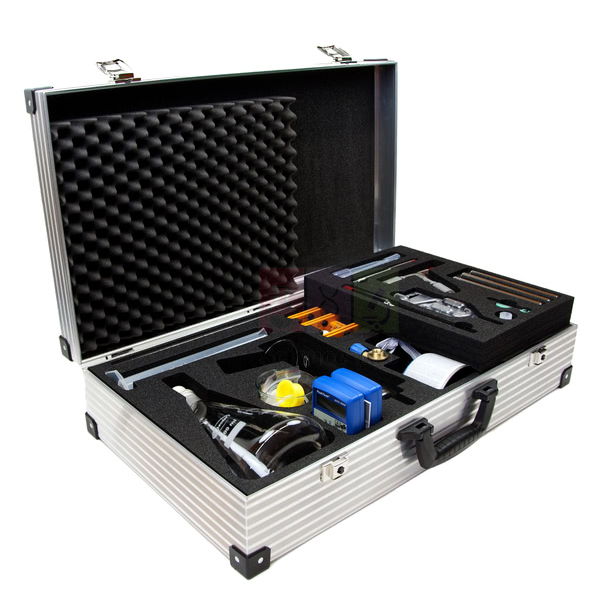
Solar Bio Fuel Ready-to-go
Solar Bio Fuel Ready-to-go (Product Code: SLE/PHY/205) is a portable biofuel experiment case used to run the entire process of producing biofuel as student experiments, from resource selection and fermentation through distillation to electricity from an ethanol fuel cell. Its aluminium suitcase holds the parts and components, including two digital multimeters and a stand set, so it can be used from any location, and it also covers biodiesel made by transesterification of fats. It is supplied by Jain Scientific Equipments Pvt Ltd (ScienceLab), Ambala, India.
Specifications
| Parameter | Detail |
|---|---|
| Format | Aluminium suitcase containing the parts and components; usable from any location |
| Experiment programme | Four parts: biodiesel production, alcohol fermentation, distillation and production of bioethanol, ethanol fuels |
| Distillation | Custom-built Solar-condenser; the resulting ethanol is then characterised |
| Energy conversion | Provided ethanol fuel cell converts the biofuel into electricity |
| Measuring instruments | 2 digital multimeters, laboratory thermometer, alcoholmeter, areometer |
| Extras needed (not included) | 1 x Supplementary BioFuel; 1 x Bunsen burner |
| Yeast shelf life | Depends on storage conditions; ask us for the date of the batch you are quoted |
| Product code | SLE/PHY/205 |
| Supplied by | Jain Scientific Equipments Pvt Ltd (ScienceLab), Ambala, India |
Experiments:
- Part 1, biodiesel production: transesterification from fat to biodiesel (FAME); determination of fat parameters; extraction of fats from foods and oil plants
- Part 2, alcohol fermentation: production of a mash / alcoholic fermentation; fermentation of different sugar types, including catalytic splitting of starch; proof of fermentation gases
- Part 3, distillation and production of bioethanol: distillation of mash; characteristics of the produced ethanol
- Part 4, ethanol fuels: introduction to the ethanol fuel cell; I-V curve of ethanol fuel cells; dependency of ethanol fuel cells on concentration and temperature; energy balance of the whole process
Components:
- Fuel cell and electrical: 1 x solar ethanol fuel cell module, 1 x potentiometer module, 1 x motor module without gear, 1 x propeller, 2 x digital multimeter, 3 x test lead black 25 cm, 2 x test lead red 25 cm
- Glassware and fittings: 1 x Erlenmeyer flask 1000 ml, 1 x distilling head (2 cores, 75°, NS 19/26), 1 x condenser, 1 x beaker 250 ml, 1 x measuring cylinder 100ml, 3 x test tubes, 1 x airlock, 1 x rubber stopper, 1 x grip stopper, 1 x silicone ring, 1 x plug with hose
- Stand parts: 1 x stand base plate, 1 x stand rod 60cm, 1 x universal stand clamp, 2 x double clamp, 1 x chain clamp
- Measuring and dosing: 1 x laboratory thermometer, 1 x alcoholmeter, 1 x areometer, 1 x syringe 2ml, 3 x Pasteur pipette
- Consumable: 1 x yeast
- Case and documents: 1 x aluminium case Bio Fuel, 1 x insert Bio Fuel, 1 x info sheet initial startup, 1 x packing layout plan (Einräumplan) Bio Fuel Ready-to-go, 4 x transparent bump-on feet 5.0 mm high x 11.1 mm diameter
What Is the Solar Bio Fuel Ready-to-go Used For?
It gives student groups a complete, structured course on biofuels. They extract fats from foods and oil seeds, determine fat parameters and convert the fat into biodiesel; they ferment different sugars, split starch catalytically and prove the gases given off; they distil the mash and characterise the ethanol obtained. The final part turns to the fuel cell, where the two multimeters let students record an I-V curve and see how concentration and temperature change the output, before drawing up an energy balance for the whole process.
As a STEM science kit in India’s senior secondary and college labs, it links biology, chemistry and physics in one project. Start fermentations well before the distillation lesson, set up the stand and clamps securely before heating, and keep flames away from ethanol vapour. The Bunsen burner and Supplementary BioFuel listed as extras need to be on hand before the first run.
What to Specify When Ordering
- The number of cases, based on how many student groups will work at the same time
- Whether the listed extras, a Supplementary BioFuel and a Bunsen burner, should be quoted with each case
- Any replacement yeast or other consumables you want priced (ask us)
Supplier
Jain Scientific Equipments Private Limited, operating as ScienceLab, supplies the Solar Bio Fuel Ready-to-go to schools, colleges, universities, teacher-training institutes, dealers and importers in India and international markets. It sources the complete case and can combine it with the listed extras and other renewable-energy experiment cases in one quotation. Company information is on the ScienceLab company profile.
Related Physics Lab Equipment
These items support or extend the Bio Fuel Ready-to-go course:
- Bunsen Burner — the burner listed as a needed extra
- Yeast — for re-supplying the fermentation experiments
- Solar Bio Fuel Large — a larger set demonstrating the same biofuel chain
- Solar H2 Ready-To-Go — a companion Ready-to-go case on hydrogen
- Solar Bio Energy Ready-To-Go — growing and degrading the biomass behind biofuels
Find more in Physics Lab Equipment.
Frequently Asked Questions
What extras are needed for Solar Bio Fuel Ready-to-go?
Solar Bio Fuel Ready-to-go lists two extras that are needed but not included in the case: one Supplementary BioFuel and one Bunsen burner. Mention both in your enquiry if you would like them priced together with the case.
Which experiments are included in Solar Bio Fuel Ready-to-go?
Solar Bio Fuel Ready-to-go is organised in four parts: biodiesel production from fats, alcohol fermentation of different sugars, distillation and production of bioethanol, and ethanol fuels, including the I-V curve of the ethanol fuel cell and the energy balance of the whole process.
Can Solar Bio Fuel Ready-to-go be used outside a fully equipped laboratory?
Solar Bio Fuel Ready-to-go is made for flexible use: its suitcase holds the parts and components and can be used from any location. You will still need a Bunsen burner and the Supplementary BioFuel, which are listed as extras.
Which measuring instruments come with Solar Bio Fuel Ready-to-go?
Solar Bio Fuel Ready-to-go includes two digital multimeters, a laboratory thermometer, an alcoholmeter and an areometer, plus a 100ml measuring cylinder, a 2ml syringe and three Pasteur pipettes for measuring and dosing liquids during the experiments.
Who supplies Solar Bio Fuel Ready-to-go?
Solar Bio Fuel Ready-to-go is supplied by Jain Scientific Equipments Pvt Ltd (ScienceLab), Ambala, Haryana, India, to schools, colleges, dealers and importers in India and international markets, together with its listed extras when requested.
What should a quotation request for this biofuel case include?
A quotation request for Solar Bio Fuel Ready-to-go should state the number of cases, whether the Supplementary BioFuel and Bunsen burner are required, any consumables to include, and the delivery location, so a single complete offer can be sent.
Request a Quote
Request pricing for Solar Bio Fuel Ready-to-go through our contact page, or place it in the enquiry cart along with the listed extras.
Last updated: 24 September 2026
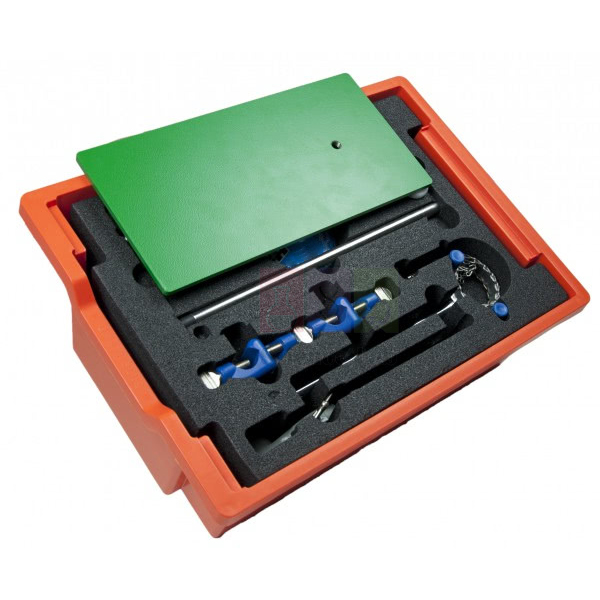
Solar Bio Fuel Supplement
Solar Bio Fuel Supplement (Product Code: SLE/PHY/206) is an extension box of accessories used to complete the Solar Bio Fuel Large biofuel experiment set with a stand, clamps, a Bunsen burner, an AV-Module and test leads. It suits schools and colleges that own or are buying Bio Fuel Large; no chemicals are included, and air shipments are sent without the Bunsen burner. It is supplied by Jain Scientific Equipments Pvt Ltd (ScienceLab), Ambala, India.
Specifications
| Parameter | Detail |
|---|---|
| Purpose | Extension box with accessories for Solar Bio Fuel Large |
| Stand parts | 1 x stand base plate, 1 x stand rod 60cm, 1 x universal stand clamp, 2 x double clamp, 1 x chain clamp |
| Heat source | 1 x Bunsen burner (not sent with air shipments) |
| Electrical | 1 x AV-Module |
| Test leads | 2 x black 25 cm, 2 x red 25 cm |
| Chemicals | Not included |
| Product code | SLE/PHY/206 |
| Supplied by | Jain Scientific Equipments Pvt Ltd (ScienceLab), Ambala, India |
What Is the Solar Bio Fuel Supplement Used For?
A biofuel practical needs more than glassware: the flask, distilling head and condenser have to be clamped firmly over a heat source, and the electrical side of the experiment needs a measuring module and leads. This box supplies exactly those support items for Bio Fuel Large — a base plate and 60cm rod to build the stand, a universal clamp, two double clamps and a chain clamp to hold the glassware, a Bunsen burner for heating, and an AV-Module with red and black test leads for the electrical connections.
These lab equipment accessories turn the set into a complete bench station. If your order travels by air, the Bunsen burner will not be in the box, so plan a burner and gas connection locally. No chemicals are included either, so arrange the substances for your experiments before the first lesson.
What to Specify When Ordering
- The number of supplement boxes, matching your Solar Bio Fuel Large sets
- The shipping mode, since air shipments are sent without the Bunsen burner
- Any chemicals or a separate burner you want quoted, as neither is in an air-shipped box (ask us)
Supplier
The Solar Bio Fuel Supplement is supplied by Jain Scientific Equipments Private Limited, whose trading name is ScienceLab, to schools, colleges, dealers and importers in India and international markets. It can be quoted on its own for an existing Bio Fuel Large set, or together with a new set so both arrive in one shipment. Company background is on the ScienceLab company profile.
Related Physics Lab Equipment
These items are used with the supplement box or replace parts not sent by air:
- Solar Bio Fuel Large — the biofuel experiment set this box extends
- Bunsen Burner — a burner to source separately when shipping by air
- Bunsen Burner Tubing — the gas connection for the burner
- Retort Stand — an additional stand for larger glassware set-ups
- Standard Digital Multimeter — an extra meter for electrical readings
Explore more in Physics Lab Equipment.
Frequently Asked Questions
What is the Solar Bio Fuel Supplement for?
The Solar Bio Fuel Supplement is an extension box with accessories for Solar Bio Fuel Large. It adds a stand base plate, a 60cm stand rod, clamps, a Bunsen burner, an AV-Module and red and black test leads to that experiment set.
Are chemicals included in the Solar Bio Fuel Supplement?
No. The Solar Bio Fuel Supplement does not include any chemicals. Substances needed for the biofuel experiments must be sourced separately; ask us which ones you need and for batch dates, as shelf life depends on the chemical and its storage.
Is the Bunsen burner sent with every Solar Bio Fuel Supplement?
The Solar Bio Fuel Supplement includes one Bunsen burner, but air shipments are sent without it. If your order travels by air, arrange a burner locally or ask us about supplying one by another route.
Which stand parts and clamps are in the Solar Bio Fuel Supplement?
The Solar Bio Fuel Supplement contains one stand base plate, one 60cm stand rod, one universal stand clamp, two double clamps and one chain clamp, giving a complete support set for clamping glassware during the experiments.
Who supplies the Solar Bio Fuel Supplement?
The Solar Bio Fuel Supplement is supplied by Jain Scientific Equipments Pvt Ltd (ScienceLab), Ambala, Haryana, India, to schools, colleges, dealers and importers in India and international markets, either alone or with a Solar Bio Fuel Large set.
What should a quotation request for the supplement box include?
A quotation request for the Solar Bio Fuel Supplement should state the quantity, whether Solar Bio Fuel Large is being ordered too, the shipping mode (air shipments exclude the Bunsen burner) and the delivery location.
Request a Quote
Send your Solar Bio Fuel Supplement enquiry through our contact page, or add it to the enquiry cart with the Bio Fuel Large set it completes.
Last updated: 24 September 2026
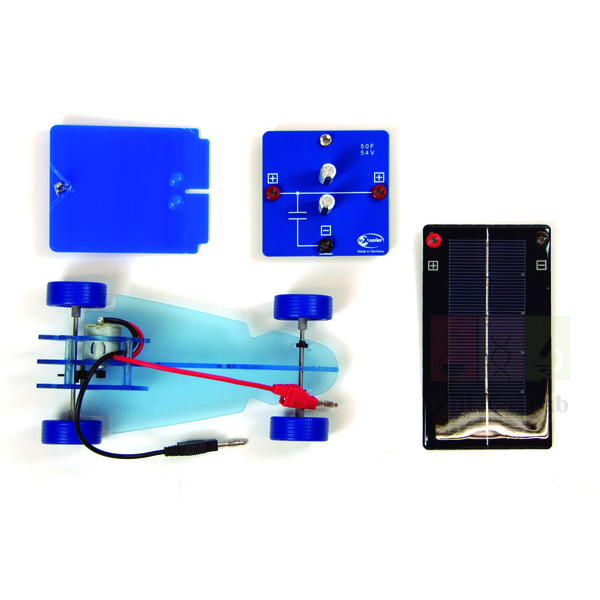
Solar EMobility Basic
Solar EMobility Basic (Product Code: SLE/PHY/207) is an electric-mobility experiment kit used to let students drive an electric model car from a supercapacitor or directly from a solar module in primary and junior high school science lessons. It brings energy storage and an electric vehicle together in one kit, with a 2.5 V, 420 mA solar module and a 5.0F/5.4V capacitor module, and works alongside the Solar-Minikit Basic or Solar-Kit Basic. It is supplied by Jain Scientific Equipments Pvt Ltd (ScienceLab), Ambala, India.
Specifications
| Parameter | Detail |
|---|---|
| Solar module | 2.5 V, 420 mA |
| Capacitor module | 5.0F / 5.4V (supercapacitor) |
| Vehicle | Electric model car, powered by the supercapacitor or directly by the solar module in sunlight |
| Expansion | Combined with Solar-H2 Basic, a fuel cell car can be built |
| Also needed | Solar-Minikit Basic (primary school) or Solar-Kit Basic (junior high school), each containing the necessary accessories |
| Product code | SLE/PHY/207 |
| Supplied by | Jain Scientific Equipments Pvt Ltd (ScienceLab), Ambala, India |
Components:
- 1 x solar module 2.5 V, 420 mA
- 1 x capacitor module 5.0F/5.4V
- 1 x electric model car
- 1 x insert EMobility basic
- 1 x layout diagram EMobility Basic
- 1 x info sheet initial startup
- 1 x carton
What Is the Solar EMobility Basic Used For?
Students experience electric mobility close up. In one run they store energy in the capacitor module and watch the model car race across the classroom on that stored charge; in another they connect the solar module and drive the car straight from sunlight. Comparing the two raises the key questions of electric transport — why a vehicle needs storage, what happens when a cloud passes, and how storage and generation work together. As a solar energy science kit, India’s primary and junior high classes can use it to introduce these ideas with simple, illustrative experiments.
For solar runs, work outdoors or in strong direct light, as the module depends on sunlight. Observe the polarity marked on the capacitor module and never charge it beyond its 5.4V rating. The layout diagram and start-up info sheet show how the parts fit together with your base kit.
What to Specify When Ordering
- The number of Solar EMobility Basic kits required
- Which base kit you have or need: Solar-Minikit Basic for primary school or Solar-Kit Basic for junior high school
- Whether you plan to build a fuel cell car with Solar-H2 Basic (ask us)
Supplier
Solar EMobility Basic is supplied by Jain Scientific Equipments Private Limited, the company that trades as ScienceLab, to schools, STEM centres, dealers and importers in India and international markets. It can be quoted together with the base kit your school needs, so the EMobility components arrive ready to use. Schools registering a new vendor can use the supplying company’s details: CIN U29309HR2020PTC087597 and GSTIN 06AAECJ8618A1ZT. Further information is on the ScienceLab company profile.
Related Physics Lab Equipment
These kits complete or extend Solar EMobility Basic:
- Solar Minikit Basic — the base kit needed for primary school use
- Solar Kit Basic — the base kit needed for junior high school use
- Solar EMobility Large — a follow-on kit on battery technologies
- Solar EMobility Ready-To-Go — a case kit covering many storage types
- Solar Photovoltaic Basic — an introduction to solar electricity
See the full Physics Lab Equipment range.
Frequently Asked Questions
What else do I need to use Solar EMobility Basic?
Solar EMobility Basic needs one base kit in addition: the Solar-Minikit Basic for primary school use or the Solar-Kit Basic for junior high school use. Each of these contains the necessary accessories to work with the EMobility components.
How is the model car in Solar EMobility Basic powered?
The electric model car in Solar EMobility Basic can run from the 5.0F/5.4V capacitor module, which stores energy so the car can cross the classroom, or directly from the 2.5 V, 420 mA solar module when it is in sunlight.
Can a fuel cell car be built with Solar EMobility Basic?
Yes. When Solar EMobility Basic is combined with Solar-H2 Basic, a fuel cell car can be built. Ask us about Solar-H2 Basic availability if you want to extend the kit in this direction.
What is in the Solar EMobility Basic box?
Solar EMobility Basic contains a solar module (2.5 V, 420 mA), a capacitor module (5.0F/5.4V), an electric model car, an insert, a layout diagram and an info sheet for initial start-up, all packed in a carton.
Which age group is Solar EMobility Basic suitable for?
Solar EMobility Basic is intended for primary school when used with the Solar-Minikit Basic, and for junior high school when used with the Solar-Kit Basic. Its illustrative experiments teach the basics of energy storage and electric vehicles.
Who supplies Solar EMobility Basic?
Solar EMobility Basic is supplied by Jain Scientific Equipments Pvt Ltd (ScienceLab), Ambala, Haryana, India, to schools, dealers and importers in India and international markets, and can be quoted together with the base kit it needs.
Request a Quote
Ask for a Solar EMobility Basic quotation through our contact page, or add it to the enquiry cart with your chosen base kit.
Last updated: 24 September 2026
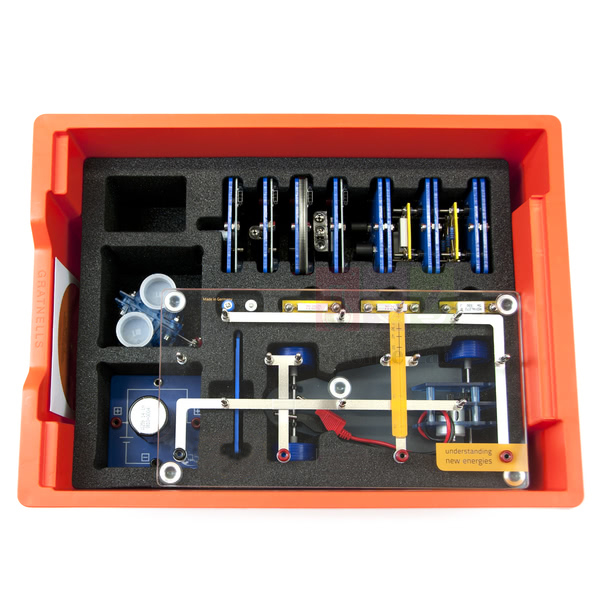
Solar EMobility Large
Solar EMobility Large (Product Code: SLE/PHY/208) is a battery-technology experiment kit used to teach the physical and technical foundations and applications of different battery types, with an electric model car to explore electric mobility, in secondary school and college labs. Students analyse NiMH, NiZn and LiFePo cells, a capacitor module and a reversible fuel cell in qualitative and quantitative experiments on dimensioning, life expectancy and charging methods. It is supplied by Jain Scientific Equipments Pvt Ltd (ScienceLab), Ambala, India.
Specifications
| Parameter | Detail |
|---|---|
| Subject | Physical and technical foundations and applications of different battery technologies |
| Storage types included | NiMH (3xAAA module and a single AAA cell), NiZn AAA, LiFePo AAA, capacitor module, reversible fuel cell |
| Load and circuit parts | Potentiometer module 110 Ohm Pro; resistor module (triple) Pro; resistor plug elements 1 Ohm, 10 Ohm (x2) and 100 Ohm |
| Vehicle | Electric model car |
| Topics | Dimensioning and application of battery types, life expectancy, charging methods |
| Expandable with | A lithium-polymer battery module and a lead battery module |
| Extras needed (not included) | AV-Module, Charger Module, digital multimeter, test leads red 50 cm, black 50 cm, red 25 cm and black 25 cm |
| Product code | SLE/PHY/208 |
| Supplied by | Jain Scientific Equipments Pvt Ltd (ScienceLab), Ambala, India |
Components:
- Storage modules and cells: 1 x battery module NiMH 3xAAA Pro, 1 x battery module holder 1xAAA Pro, 1 x NiMH battery AAA, 1 x NiZn-battery AAA, 1 x LiFePo-battery AAA, 1 x capacitor module Pro, 1 x reversible fuel cell, 1 x distilled water (100 ml)
- Load and circuit modules: 1 x potentiometer module 110 Ohm Pro, 1 x resistor module (triple) Pro, 1 x resistor plug element 1 Ohm, 2 x resistor plug element 10 Ohm, 1 x resistor plug element 100 Ohm, 1 x Solar-Base unit EMobility
- Vehicle: 1 x electric model car
- Storage and documents: 1 x box, 1 x lid for tray, 1 x insert 4E energy storage box (Energiespeicherbox), 1 x packing layout plan (Einräumplan) EMobility Large, 1 x info sheet initial startup
What Is the Solar EMobility Large Used For?
The kit makes battery chemistry measurable. Using the potentiometer module and resistor plug elements as defined loads, students record how each storage type behaves under current, compare the cells with the capacitor and the reversible fuel cell, and discuss which technology suits which job — the dimensioning question that engineers face when they design an electric vehicle or store renewable electricity. Life expectancy and charging methods are treated in the same practical way, and the electric model car shows the result on the move.
As a physics experiment kit for school and college labs, it needs the listed extras for quantitative work, so plan the AV-Module, Charger Module, multimeter and test leads before the first lesson. Reversible fuel cells of this kind work with distilled water, which is why 100 ml is part of the kit; top up only with distilled water.
What to Specify When Ordering
- The number of Solar EMobility Large kits
- Which listed extras to quote: AV-Module, Charger Module, digital multimeter and the four test leads
- Whether you want the lithium-polymer and lead battery modules that expand the kit (ask us)
Supplier
Jain Scientific Equipments Private Limited, known to customers as ScienceLab, supplies Solar EMobility Large to schools, colleges, polytechnics, dealers and importers in India and international markets. It can be quoted with its listed extras and expansion modules so a laboratory receives a working set in one delivery. The ScienceLab company profile gives more background.
Related Physics Lab Equipment
These kits and instruments go with Solar EMobility Large:
- Standard Digital Multimeter — a meter for the digital multimeter listed as an extra
- Solar EMobility Ready-To-Go — the case version of the battery-technology topic
- Solar EMobility Basic — an introductory e-mobility kit for younger classes
- Solar H2 Ready-To-Go — more on hydrogen and fuel cells
- Solar Smart Grid Ready-To-Go — storage within a renewable electricity grid
Browse all Physics Lab Equipment.
Frequently Asked Questions
Which battery types are included in Solar EMobility Large?
Solar EMobility Large includes a NiMH 3xAAA battery module, a single NiMH AAA battery, a NiZn AAA battery, a LiFePo AAA battery, a capacitor module and a reversible fuel cell, so students can compare several storage technologies side by side.
What extras are needed for Solar EMobility Large?
Solar EMobility Large lists these extras as needed: an AV-Module, a Charger Module, a digital multimeter and four test leads (red and black, in 25 cm and 50 cm lengths). Include them in your enquiry if you want them priced together.
Can Solar EMobility Large be expanded?
Yes. Solar EMobility Large is expandable with a lithium-polymer battery module and a lead battery module, which add two further storage types to the experiments. Ask us about these modules when you request a quotation.
What topics does Solar EMobility Large teach?
Solar EMobility Large covers the dimensioning and application of different battery types, their life expectancy and charging methods, and electric mobility with a model car, linking all of these to the storage problems of renewable energy.
Who supplies Solar EMobility Large?
Solar EMobility Large is supplied by Jain Scientific Equipments Pvt Ltd (ScienceLab), Ambala, Haryana, India, to schools, colleges, dealers and importers in India and international markets, together with its listed extras when requested.
What should a quotation request for Solar EMobility Large include?
A quotation request for Solar EMobility Large should give the number of kits, which extras and expansion modules to include, and the delivery location, so that one offer covers everything needed to run the experiments.
Request a Quote
Request a quotation for Solar EMobility Large through our contact page, or add it to the enquiry cart with the extras you need.
Last updated: 24 September 2026
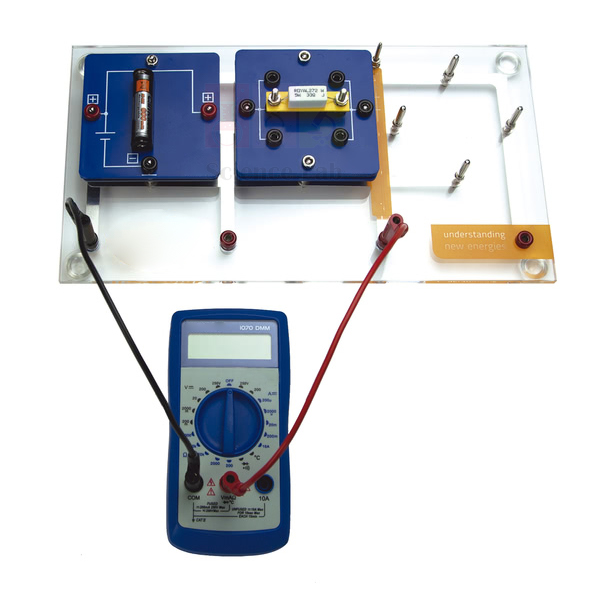
Solar EMobility Ready-To-Go
Solar EMobility Ready-To-Go (Product Code: SLE/PHY/209) is a portable battery-technology experiment case used to teach the foundations and applications of energy storage, from Ohm’s law to fuel cells, in secondary school, college and teacher-training labs. Eight different battery types, including a lithium-polymer battery, a capacitor and a reversible fuel cell, can each run the included electric car, and an integrated Charger Module keeps the batteries ready for use. It is supplied by Jain Scientific Equipments Pvt Ltd (ScienceLab), Ambala, India.
Specifications
| Parameter | Detail |
|---|---|
| Subject | Physical and technical foundations and applications of different battery technologies |
| Storage types | Eight different battery types, including NiMH, NiZn, LiFePo, lead and lithium-polymer batteries, a capacitor and a reversible hydrogen fuel cell |
| Electric car | Can be run with all included storage types |
| Charging | Integrated Charger Module keeps batteries ready to use and lets charging methods be studied |
| Measurement and loads | AV-Module, potentiometer module 110 Ohm Pro, resistor module (triple) Pro, resistor plug elements 1 Ohm, 10 Ohm (x2) and 100 Ohm |
| Use | Flexible and location-independent; no additional equipment required |
| Product code | SLE/PHY/209 |
| Supplied by | Jain Scientific Equipments Pvt Ltd (ScienceLab), Ambala, India |
Experiments:
- Circuit basics: Ohm’s law; series connection and parallel connection of ohmic resistances
- Capacitor: the charging process and the discharge process of a capacitor
- I-V characteristics of the single NiMH, triple NiMH, NiZn, LiFePo, lead and lithium-polymer battery modules
- The charging process of the NiMH, NiZn, LiFePo, lead and lithium-polymer batteries; the discharging process of a battery module
- Voltage sources: nominal voltage and capacity; four-terminal sensing; internal resistance; series connection of voltage sources
- Battery module performance: capacitance, energy density, Ri efficiency and total efficiency
- Temperature-dependent behaviour of the lithium-polymer cell
- Hydrogen: hydrogen production in the reversible hydrogen fuel cell; characteristic curve of the electrolyzer; hydrogen consumption of a fuel cell; characteristic curve of the fuel cell; efficiency of the hydrogen fuel cell
- Electric car: operation with several battery modules; operation with the reversible fuel cell
Components:
- Storage modules and cells: 1 x battery module NiMH 3xAAA Pro, 1 x battery module holder 1xAAA Pro, 1 x NiMH battery AAA, 1 x NiZn-battery AAA, 1 x LiFePo-battery AAA, 1 x lithium-polymer (LiPo) battery module, 1 x lead (Pb) battery module Pro, 1 x capacitor module Pro, 1 x reversible fuel cell, 1 x distilled water (100 ml)
- Measurement, charging and loads: 1 x AV-Module, 1 x Charger Module, 1 x potentiometer module 110 Ohm Pro, 1 x resistor module (triple) Pro, 1 x resistor plug element 1 Ohm, 2 x resistor plug element 10 Ohm, 1 x resistor plug element 100 Ohm, 1 x Solar-Base unit EMobility, 2 x test lead black 25 cm, 2 x test lead red 25 cm
- Vehicle: 1 x electric model car
- Case and documents: 1 x case (Koffer), 1 x insert EMobility, 1 x studded lid foam (Deckelschaum mit Noppen), 1 x packing layout plan (Einräumplan) EMobility Ready-to-go, 1 x info sheet initial startup
What Is the Solar EMobility Ready-To-Go Used For?
It packs a full course on energy storage into one case. Students begin with Ohm’s law and resistor networks, then plot the I-V characteristic and charging curve of each battery chemistry, measure internal resistance with four-terminal sensing, and compare capacity, energy density and efficiency. The hydrogen section adds the electrolyzer and fuel cell curves, and the course ends by running the electric car on different storage types to see how each choice performs in a vehicle.
As physics lab equipment in India’s senior classes and teacher-training colleges, it can be carried between rooms and used without other apparatus. Charge the batteries with the Charger Module before each session, handle the lithium-polymer module carefully and never puncture or overheat it, and use only distilled water in the reversible fuel cell.
What to Specify When Ordering
- The number of cases, based on how many student groups will work in parallel
- Whether you want replacement cells or modules quoted for later use (ask us)
- Any other Ready-to-go renewable-energy cases to be priced in the same enquiry
Supplier
Solar EMobility Ready-To-Go is supplied by Jain Scientific Equipments Private Limited, trading as ScienceLab, to schools, colleges, universities, teacher-training institutes, dealers and importers in India and international markets. The company sources the complete case and can quote it alongside other energy-storage and renewable-energy kits for a single delivery. More about the company is on the ScienceLab company profile.
Related Physics Lab Equipment
These kits and cases sit alongside Solar EMobility Ready-To-Go in an energy curriculum:
- Solar EMobility Large — the tray-based battery-technology kit
- Solar EMobility Basic — a simpler e-mobility kit for younger students
- Solar H2 Ready-To-Go — a deeper look at hydrogen technology
- Solar New Energy Ready-To-Go — a broader renewable-energy case
- Solar Wind Ready-To-Go — wind generation, whose output needs storage
View the complete Physics Lab Equipment range.
Frequently Asked Questions
Which storage types are included in Solar EMobility Ready-To-Go?
Solar EMobility Ready-To-Go includes eight different battery types for study, among them NiMH, NiZn, LiFePo, lead and lithium-polymer batteries, a capacitor module and a reversible hydrogen fuel cell, and the electric car can be run with every one of them.
Is additional equipment needed for Solar EMobility Ready-To-Go?
Like the other products of the Ready-to-go line, Solar EMobility Ready-To-Go is designed for flexible, location-independent use that does not require any additional equipment. The Charger Module, AV-Module and test leads are already inside the case.
Which experiments can be carried out with Solar EMobility Ready-To-Go?
Solar EMobility Ready-To-Go supports experiments from Ohm’s law and series or parallel resistances to I-V characteristics and charging of each battery, internal resistance, energy density and efficiency, electrolyzer and fuel cell curves, and running the electric car on different storage types.
How are the batteries in Solar EMobility Ready-To-Go charged?
Solar EMobility Ready-To-Go has an integrated Charger Module, so the batteries are always ready to use, and the charging processes of the NiMH, NiZn, LiFePo, lead and lithium-polymer batteries become experiments in their own right.
Who supplies Solar EMobility Ready-To-Go?
Solar EMobility Ready-To-Go is supplied by Jain Scientific Equipments Pvt Ltd (ScienceLab), Ambala, Haryana, India, to schools, colleges, dealers and importers in India and international markets, and can be quoted with related energy kits.
What should a quotation request for this EMobility case include?
A quotation request for Solar EMobility Ready-To-Go should state the number of cases, any replacement cells or modules you want priced, other renewable-energy kits of interest and the delivery location, so a single complete offer can be prepared.
Request a Quote
For pricing on Solar EMobility Ready-To-Go, contact us through the contact page or add the case to the enquiry cart with any related kits.
Last updated: 24 September 2026
Solar H2 Ready-To-Go
Solar H2 Ready-To-Go (Product Code: SLE/PHY/210) is a complete hydrogen and fuel cell experiment set used to build and examine a solar-hydrogen cycle in the science classroom. Teachers choose it because it lets students compare PEM fuel cells with an ethanol fuel cell, and every ancillary part, down to two digital multimeters, travels in one aluminium suitcase. This solar energy science kit is supplied by Jain Scientific Equipments Pvt Ltd (ScienceLab), Ambala, India.
Specifications
| Parameter | Detail |
|---|---|
| Kit type | Fuel cell and hydrogen technology experiment set from the Ready-to-go series, with all ancillary equipment included |
| Energy chain demonstrated | Solar module → electrolyzer → hydrogen storage → fuel cell (solar-hydrogen cycle) |
| Solar module | 2.5 V, 420 mA |
| Fuel cells | 3 x PEM fuel cell module and 1 x solar ethanol fuel cell module |
| Hydrogen generation and storage | Electrolyzer module 2.0, H2 Charger, H2 Storage with valve, gas storage module |
| Measuring instruments | 2 x digital multimeter; potentiometer module for load variation |
| Load and light source | Motor module without gear with propeller; lamp with table clamp |
| Case | Aluminium suitcase with H2 Ready-to-go insert |
| Experiments covered | What an electrolyzer does; characteristics of the electrolyzer, PEM fuel cell and ethanol fuel cell; Faraday and energy efficiency of the electrolyzer and PEM fuel cell; hydrogen production with the H2 Charger; hydrogen storage with H2 Storage; parallel and series connection of PEM fuel cells; setting up the electrolyzer and the fuel cells |
| Product code | SLE/PHY/210 |
| Supplied by | Jain Scientific Equipments Pvt Ltd (ScienceLab), Ambala, India |
Complete list of components:
- 1 x Solar-Base unit Large
- 1 x Potentiometer module
- 1 x Motor module without gear
- 1 x Solar module 2.5 V, 420 mA
- 1 x H2 Charger
- 1 x H2 Storage
- 1 x Valve for H2 Storage
- 1 x Gas storage module
- 1 x Electrolyzer module 2.0
- 1 x Solar ethanol fuel cell module
- 3 x PEM fuel cell module
- 2 x Digital multimeter
- 1 x Lamp with table clamp
- 1 x Propeller
- 1 x Test lead black 50 cm and 1 x test lead red 50 cm
- 2 x Test lead black 25 cm and 2 x test lead red 25 cm
- Silicone tube 2 mm, cut length (part L2-02-048)
- 1 x Case with 1 x insert H2 Ready-to-go
- 1 x Info sheet for initial startup and 1 x layout diagram H2 Ready-to-go 2.0
What Is the Solar H2 Ready-To-Go Used For?
The Solar H2 Ready-To-Go is used to show, step by step, how electricity from a solar module splits water in an electrolyzer, how the hydrogen is charged and held in storage, and how fuel cells turn it back into electrical energy to drive a motor and propeller. Students measure the working principle, efficiency and characteristic curves of both the electrolyzer and the fuel cells, which makes the kit a good fit for senior physics and chemistry units on energy conversion.
Because two digital multimeters are included, one group can read voltage and current at the same time while plotting a characteristic curve. The lamp with table clamp lets the solar module work indoors when sunlight is not available, and the three PEM fuel cell modules can be wired in series and in parallel to compare outputs. As a STEM science kit for India and abroad, it suits demonstration lessons as well as small-group practicals.
What to Specify When Ordering
- Number of complete kits needed for your class groups
- Whether you want extra digital multimeters or test leads for additional work stations
- Whether spare PEM fuel cell modules should be quoted (ask us about availability)
- Delivery location in India or abroad, so packing and freight can be quoted
Supplier
ScienceLab is the trading name of Jain Scientific Equipments Private Limited, a supplier of laboratory and teaching equipment based in Ambala, Haryana. The company sources the Solar H2 Ready-To-Go and supplies it to schools, colleges, training centres and dealers, often packed together with other physics apparatus in one consignment.
Our team can advise on which kit in the renewable-energy range matches your syllabus before you order. Read more on the ScienceLab company profile.
Related Physics Lab Equipment
These items fit alongside hydrogen and fuel cell lessons:
- Solar New Energy Ready-To-Go — broader case kit adding wind, hydro and e-mobility topics with a reversible fuel cell
- Solar Smart Grid Ready-To-Go — extends fuel cell and storage ideas into a laboratory-scale smart grid
- Hoffman Electrolysis Apparatus — glass apparatus for showing the electrolysis of water in chemistry lessons
- Digital Multimeter — an additional meter for groups that want more measuring points
- Solar Photovoltaic Ready-To-Go — deeper study of the solar cells that power the hydrogen cycle
More energy and electricity apparatus is listed under Physics Lab Equipment.
Frequently Asked Questions
What is included in the Solar H2 Ready-To-Go?
The Solar H2 Ready-To-Go includes a 2.5 V, 420 mA solar module, electrolyzer module 2.0, H2 Charger, H2 Storage with valve, gas storage module, three PEM fuel cell modules, an ethanol fuel cell module, two digital multimeters, a lamp with table clamp, motor with propeller, test leads and an aluminium suitcase.
Which fuel cell types can students compare with the Solar H2 Ready-To-Go?
Students can compare PEM fuel cells with an ethanol fuel cell using the Solar H2 Ready-To-Go. The set contains three PEM fuel cell modules, which can be connected in series and in parallel, and one solar ethanol fuel cell module, so characteristic curves of both technologies can be measured side by side.
Does the Solar H2 Ready-To-Go need any extra equipment?
The Solar H2 Ready-To-Go already contains its ancillary equipment, including meters, lamp, test leads and hydrogen storage. Operating liquids for the electrolyzer and the ethanol fuel cell do not appear in the components list, so confirm them with us when you request a quotation.
Who supplies the Solar H2 Ready-To-Go?
The Solar H2 Ready-To-Go is supplied by Jain Scientific Equipments Pvt Ltd (ScienceLab), Ambala, Haryana, India. ScienceLab sources the kit and supplies it to schools, colleges, laboratories and dealers, and can combine it with other physics apparatus on the same order.
How should the Solar H2 Ready-To-Go be stored between lessons?
The Solar H2 Ready-To-Go should go back into its aluminium suitcase after each lesson, with every module placed as shown on the layout diagram. Follow the info sheet for initial startup when handling the electrolyzer, H2 Storage and fuel cells, and ask us if any handling question remains.
What should a quotation request for the Solar H2 Ready-To-Go include?
A quotation request for the Solar H2 Ready-To-Go should state product code SLE/PHY/210, the number of kits, any extra meters or spare modules you want, and the delivery location. Send it through the contact page or add the kit to the enquiry cart.
Can the Solar H2 Ready-To-Go be supplied in bulk or for export?
Yes, the Solar H2 Ready-To-Go can be quoted for several classrooms at once and for buyers in India and international markets. Share the quantity and destination so ScienceLab can confirm availability, packing and shipping in a written quotation.
Request a Quote
To order the Solar H2 Ready-To-Go (SLE/PHY/210), send your quantity and delivery details through the ScienceLab contact page, or add it to the enquiry cart with other items for one combined quotation.
Last updated: 24 September 2026
Solar Hydropower Basic
Solar Hydropower Basic (Product Code: SLE/PHY/211) is a beginner add-on set used to teach how a small hydropower plant turns moving water into electricity, both in the classroom and outdoors. Built around a water wheel module with a Pelton turbine and an attached hose, it is a hands-on science kit for primary school and junior high classes that already use the Basic series base kits. It is supplied by Jain Scientific Equipments Pvt Ltd (ScienceLab), Ambala, India.
Specifications
| Parameter | Detail |
|---|---|
| Kit type | Hydropower add-on set for the Basic series, beginner level |
| Turbine | Water wheel module with Pelton turbine |
| Water connection | Attached hose; silicone tube 12 mm |
| Output indicator | Buzzer module |
| Experiment style | Qualitative and quantitative experiments, indoors or outdoors |
| Required base kit (not included) | Solar Minikit Basic for primary school, or Solar Kit Basic for junior high school; each contains all necessary accessories |
| Packing | Carton with Hydropower Basic insert |
| Documentation | Layout diagram Hydropower Basic; info sheet for initial startup |
| Product code | SLE/PHY/211 |
| Supplied by | Jain Scientific Equipments Pvt Ltd (ScienceLab), Ambala, India |
Components supplied in the set:
- 1 x Water wheel module
- 1 x Buzzer module
- 1 x Silicone tube 12 mm
- 1 x Insert Hydropower Basic
- 1 x Carton
- 1 x Layout diagram Hydropower Basic
- 1 x Info sheet for initial startup
What Is the Solar Hydropower Basic Used For?
The Solar Hydropower Basic is used to introduce hydroelectric power through short, playful experiments. Water is led through the hose onto the Pelton turbine of the water wheel module, the turbine turns, and the electricity it produces sounds the buzzer module, so students can see and hear the energy conversion. From there, classes explore the basic characteristics of a hydropower plant, first qualitatively and then with measurements.
Younger pupils work with the Solar Minikit Basic, while junior high students connect the set to the Solar Kit Basic for quantitative readings. Because the experiments can also be carried out outdoors, teachers can run the lesson next to a water source and keep the classroom dry. Keep the base-kit modules and cables away from splashing water during every run.
What to Specify When Ordering
- Which school level the set is for, so the matching base kit (Solar Minikit Basic or Solar Kit Basic) can be quoted
- Whether your school already owns the required base kit
- Number of Hydropower Basic sets needed per class
- Delivery location in India or abroad
Supplier
Jain Scientific Equipments Private Limited, trading as ScienceLab, is an Ambala-based supplier of school and college laboratory equipment. It sources the Solar Hydropower Basic together with the base kits it depends on, so a school can receive the add-on and the required base kit in a single delivery.
For import or export paperwork, the supplying company holds Importer-Exporter Code AAECJ8618A (DGFT) and GSTIN 06AAECJ8618A1ZT. Company background is on the ScienceLab profile page.
Related Physics Lab Equipment
Hydropower lessons usually draw on these items as well:
- Solar Minikit Basic — the base kit this set needs in primary school
- Solar Kit Basic — the base kit this set needs for junior high quantitative work
- Solar Hydropower Ready-to-go — self-contained case kit with several turbine types for deeper study
- Pelton Wheel (Turbine) — larger impulse turbine for fluid mechanics demonstrations
- Water Turbine with Dynamo Model — simple model showing mechanical energy becoming electrical energy
Find other energy apparatus in the Physics Lab Equipment category.
Frequently Asked Questions
Is the Solar Hydropower Basic a complete kit on its own?
No, the Solar Hydropower Basic is an add-on set. It needs the Solar Minikit Basic in primary school or the Solar Kit Basic in junior high school, each of which contains all the necessary accessories. The add-on itself provides the water wheel module, buzzer module, silicone tube and insert.
What turbine does the Solar Hydropower Basic use?
The Solar Hydropower Basic uses a water wheel module with a Pelton turbine fed through an attached hose. This arrangement lets students carry out both qualitative and quantitative experiments on how a hydropower plant turns the energy of moving water into electricity.
Can the Solar Hydropower Basic be used outdoors?
Yes, the Solar Hydropower Basic is described for experiments in the classroom and outdoors. Working outside near a water source keeps the classroom dry; make sure the modules and cables of the base kit stay away from splashing water during each experiment.
What comes in the Solar Hydropower Basic box?
The Solar Hydropower Basic box contains one water wheel module, one buzzer module, one silicone tube 12 mm, the Hydropower Basic insert, a carton, a layout diagram and an info sheet for initial startup. The required base kit is ordered separately.
Who supplies the Solar Hydropower Basic?
The Solar Hydropower Basic is supplied by Jain Scientific Equipments Pvt Ltd (ScienceLab), Ambala, Haryana, India. ScienceLab can quote it together with the Solar Minikit Basic or Solar Kit Basic so that schools receive a working set in one order.
What details help ScienceLab quote the Solar Hydropower Basic quickly?
To quote the Solar Hydropower Basic quickly, ScienceLab needs the product code SLE/PHY/211, the quantity, the school level, whether you already own a base kit and the delivery location in India or abroad. Bulk orders for several schools can be combined in one quotation.
Request a Quote
Ask for a quotation for the Solar Hydropower Basic (SLE/PHY/211), with or without its base kit, through the contact form, or collect items in the enquiry cart and send them together.
Last updated: 24 September 2026
Solar Hydropower Ready-to-go
Solar Hydropower Ready-to-go (Product Code: SLE/PHY/212) is a self-contained water turbine experiment kit used to take junior high school students from first qualitative hydropower trials to fundamental quantitative measurements on turbines. What sets it apart is a set of different turbine types, from a simple water wheel to a Pelton turbine, packed with manometers, flow sets and a water meter in one aluminium case. This physics experiment kit for schools is supplied by Jain Scientific Equipments Pvt Ltd (ScienceLab), Ambala, India.
Specifications
| Parameter | Detail |
|---|---|
| Kit type | Hydropower experiment kit from the Ready-to-go series, in an aluminium case |
| Turbines | Water turbine casing with a turbine set ranging from a simple water wheel to a Pelton turbine |
| Generator | Induction generator, 12-fold |
| Pressure measurement | Manometer set 2 bar and manometer set 4 bar |
| Flow control | Flow sets 4 mm, 8 mm and 12 mm; intake connector; flow box; connection set |
| Water quantity | Water flow meter; collecting box 6 L |
| Electrical loads | Light bulb module, LED module 2 mA (red), buzzer module, motor module without gear, resistor module |
| Electrical measurement | AV module used with the Solar-Base unit Large |
| Experiment level | Qualitative introduction to hydropower for junior high school, plus fundamental quantitative experiments on the physics of water turbines |
| Product code | SLE/PHY/212 |
| Supplied by | Jain Scientific Equipments Pvt Ltd (ScienceLab), Ambala, India |
Complete list of components (German part names from the packing list translated):
- 1 x Water turbine casing and 1 x turbines set
- 1 x Induction generator, 12-fold
- 1 x Manometer set 2 bar and 1 x manometer set 4 bar
- 1 x Intake connector
- 1 x Flow set 4 mm, 1 x flow set 8 mm and 1 x flow set 12 mm
- 1 x Flow box and 1 x connection set
- 1 x Water flow meter (Wassermengenzähler)
- 1 x Collecting box 6 L
- Fabric-reinforced hose 12/18 mm, cut length
- 2 x Hose clamp, plus 1 x stainless steel hose clamp with turn knob and hex screw
- 1 x Solar-Base unit Large and 1 x AV module
- 1 x Light bulb module, 1 x LED module 2 mA (red), 1 x buzzer module
- 1 x Motor module without gear and 1 x resistor module
- 1 x Color discs - Set 1
- 1 x Test lead black 50 cm, 1 x test lead red 50 cm, 1 x test lead black 25 cm, 1 x test lead red 25 cm
- 1 x Aluminium case with HydroPower insert
- 1 x Info sheet for initial startup and 1 x packing layout plan Hydropower Ready-to-go
What Is the Solar Hydropower Ready-to-go Used For?
The Solar Hydropower Ready-to-go is used to connect school physics with real hydropower practice. Students fit different turbines into the casing, change the nozzle size with the 4, 8 and 12 mm flow sets, and watch how the water wheel and the Pelton turbine respond. Loads such as the LED, buzzer, light bulb and motor show the generated power, while the AV module records voltage and current for quantitative work.
With pressure read on the manometers and water volume logged on the flow meter, older students can compare the energy supplied by the water with the electrical output of the induction generator. Plan the lesson near a water supply, route the outflow into the collecting box, and check that every hose clamp is tight before the first run.
What to Specify When Ordering
- Number of kits for your student groups
- How water will be supplied in your lab, so we can advise on connecting the intake connector and hose
- Whether extra hose, hose clamps or test leads should be quoted as spares
- Delivery location in India or abroad
Supplier
The Solar Hydropower Ready-to-go is a sourced renewable-energy teaching kit that Jain Scientific Equipments Private Limited supplies under its ScienceLab trading name from Ambala, Haryana. Institutions, dealers and project buyers can order it on its own or bundle it with fluid mechanics and electricity apparatus from the same catalogue.
For details of the company and the ranges it handles, visit the ScienceLab profile.
Related Physics Lab Equipment
Useful companions for water-power and turbine lessons:
- Solar Hydropower Basic — smaller add-on for introducing hydropower in primary and junior classes
- Demonstration Pelton Turbine — larger impulse turbine for fluid mechanics teaching
- Francis Turbine — reaction turbine for comparing turbine designs
- Solar Wind Ready-To-Go — case kit for the companion topic of wind energy
- Solar New Energy Ready-To-Go — overview kit covering hydro, wind, solar, e-mobility and fuel cells
The Physics Lab Equipment category lists more apparatus for energy topics.
Frequently Asked Questions
Which turbine types come with the Solar Hydropower Ready-to-go?
The Solar Hydropower Ready-to-go comes with a water turbine casing and a turbines set that ranges from a simple water wheel to a Pelton turbine. Students can swap turbines in the same casing and compare how each design converts the energy of flowing water.
What can students measure with the Solar Hydropower Ready-to-go?
With the Solar Hydropower Ready-to-go, students read water pressure on the 2 bar and 4 bar manometers, water volume on the flow meter, and voltage and current through the AV module. Together these support quantitative experiments on the physics of water turbines.
What else is needed to run the Solar Hydropower Ready-to-go?
The Solar Hydropower Ready-to-go carries its turbines, generator, measuring module, loads, hoses and collecting box in one case, but it needs a water supply at the place of use. Tell us how water is available in your lab and we will advise on the connection.
Is the Solar Hydropower Ready-to-go suitable for beginners?
Yes, the Solar Hydropower Ready-to-go starts with qualitative experiments that introduce hydropower use to junior high school students, then moves on to fundamental quantitative experiments. Teachers can therefore use one kit across several years of physics lessons.
Who supplies the Solar Hydropower Ready-to-go?
The Solar Hydropower Ready-to-go is supplied by Jain Scientific Equipments Pvt Ltd (ScienceLab), Ambala, Haryana, India. ScienceLab sources the kit and delivers it to schools, colleges, training centres and dealers in India and international markets.
How should the Solar Hydropower Ready-to-go be packed away?
After using the Solar Hydropower Ready-to-go, drain the turbine casing, hoses and collecting box, let the parts dry, and return each item to the HydroPower insert following the packing layout plan. This keeps the electrical modules and manometers ready for the next lesson.
How can I get a quotation for the Solar Hydropower Ready-to-go?
For a Solar Hydropower Ready-to-go quotation, send product code SLE/PHY/212, the quantity, any spares wanted and the delivery location through the contact page or enquiry cart. ScienceLab replies with availability, packing and shipping details for single or bulk orders.
Request a Quote
Request your Solar Hydropower Ready-to-go (SLE/PHY/212) quotation through the contact page, or add it to the enquiry cart alongside other physics items.
Last updated: 24 September 2026
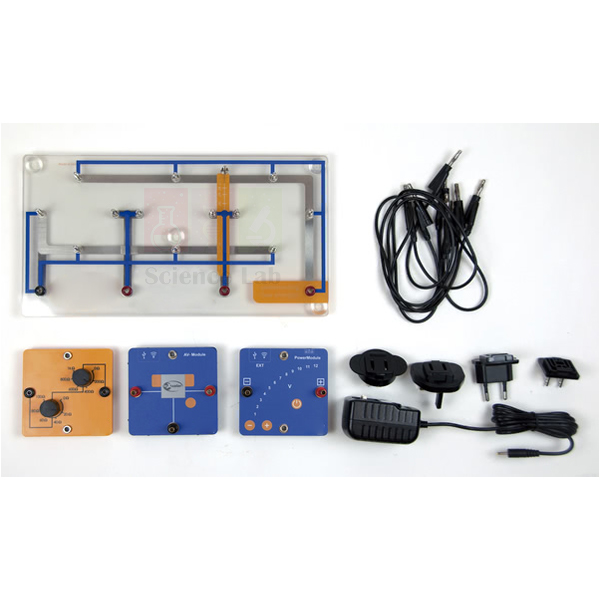
Solar Kit Basic
Solar Kit Basic (Product Code: SLE/PHY/213) is a base kit used to power, connect and measure quantitative renewable-energy experiments with the Basics add-on sets in junior high school. It brings the power module, an AV module for voltage and current readings, Smart Control components, a potentiometer, the large base unit and test leads, so each topic set becomes a measurable electricity experiment kit for school groups. It is supplied by Jain Scientific Equipments Pvt Ltd (ScienceLab), Ambala, India.
Specifications
| Parameter | Detail |
|---|---|
| Kit type | Base kit for the Basic series, junior high school level |
| Experiment type | Mainly quantitative experiments with the Basics add-on sets |
| Power supply | Power module, a compact power supply for experiments |
| Measurement | AV module for simple voltage and current measurement |
| Measuring and control | Smart Control components; potentiometer module |
| Base | Solar-Base unit Large |
| Cables | Test leads 25 cm and 50 cm, one black and one red of each length |
| Packing | Carton with Kit Basic insert |
| Documentation | Layout diagram Kit Basic; info sheet for initial startup |
| Product code | SLE/PHY/213 |
| Supplied by | Jain Scientific Equipments Pvt Ltd (ScienceLab), Ambala, India |
Components in the Solar Kit Basic:
- 1 x Power module
- 1 x AV module
- 1 x Potentiometer module
- 1 x Solar-Base unit Large
- 1 x Test lead black 25 cm and 1 x test lead red 25 cm
- 1 x Test lead black 50 cm and 1 x test lead red 50 cm
- 1 x Insert Kit Basic
- 1 x Carton
- 1 x Layout diagram Kit Basic
- 1 x Info sheet for initial startup
What Is the Solar Kit Basic Used For?
The Solar Kit Basic is used as the common platform on which junior high students run the quantitative part of the Basics experiments. The topic add-on sets supply the solar, water or wind modules, while this kit supplies the base unit to mount them on, the leads to wire them, the power module to feed them and the AV module to read voltage and current.
A typical lesson has students plug modules onto the Solar-Base unit Large, use the potentiometer as an adjustable load, and note readings from the AV module to draw simple characteristic curves. With the Smart Control components, the same set also serves as a measuring and control system, which helps teachers move from observing an effect to recording numbers without changing equipment.
What to Specify When Ordering
- School level: this kit is for junior high school; primary classes use the Solar Minikit Basic
- Which Basics add-on sets you plan to use with it
- Number of base kits, usually one per student group
- Delivery location in India or abroad
Supplier
ScienceLab, the trading name of Jain Scientific Equipments Private Limited in Ambala, Haryana, supplies the Solar Kit Basic as part of a sourced range of renewable-energy teaching kits. Buyers can order the base kit and the add-on sets together, which keeps every group in a class working with matching modules.
Learn more about the company on the ScienceLab profile page.
Related Physics Lab Equipment
Add-on sets and alternatives that work with this base kit:
- Solar Photovoltaic Basic — solar cell topic set that uses this kit in junior high school
- Solar Hydropower Basic — water wheel topic set for hydropower lessons
- Solar Wind Basic — wind energy topic set for rotor experiments
- Solar EMobility Basic — electric mobility topic set with a model car
- Solar Minikit Basic — the primary school base kit with a hand generator
Browse the wider Physics Lab Equipment range for electricity and energy apparatus.
Frequently Asked Questions
What is the Solar Kit Basic used with?
The Solar Kit Basic is used with the Basics add-on sets when junior high school students carry out quantitative experiments. It supplies the power module, AV module, potentiometer, Solar-Base unit Large and test leads that the topic sets rely on for powering and measuring.
What does the power module in the Solar Kit Basic do?
The power module in the Solar Kit Basic is a compact power supply for experiments. It feeds the modules on the base unit so that experiments can run without depending only on sunlight, while the AV module shows the voltage and current in the circuit.
Is the Solar Kit Basic suitable for primary school?
The Solar Kit Basic is aimed at junior high school and mainly quantitative experiments. For primary classes the Basic series uses the Solar Minikit Basic, which relies on a hand generator and focuses on qualitative experiments; ask us which fits your syllabus.
What comes in the Solar Kit Basic carton?
The Solar Kit Basic carton holds a power module, AV module, potentiometer module, Solar-Base unit Large, four test leads (black and red in 25 cm and 50 cm), the Kit Basic insert, a layout diagram and an info sheet for initial startup.
Who supplies the Solar Kit Basic?
The Solar Kit Basic is supplied by Jain Scientific Equipments Pvt Ltd (ScienceLab), Ambala, Haryana, India. ScienceLab sources the kit and can deliver it together with the matching Basics add-on sets to schools, dealers and institutions in India and international markets.
What should I include when asking for a Solar Kit Basic quotation?
When asking for a Solar Kit Basic quotation, include product code SLE/PHY/213, the number of base kits, the add-on sets you want with them and your delivery location. ScienceLab then confirms availability and packing for the complete order.
Request a Quote
Send your Solar Kit Basic (SLE/PHY/213) requirement through the ScienceLab contact page, or add it with its add-on sets to the enquiry cart for one quotation.
Last updated: 24 September 2026
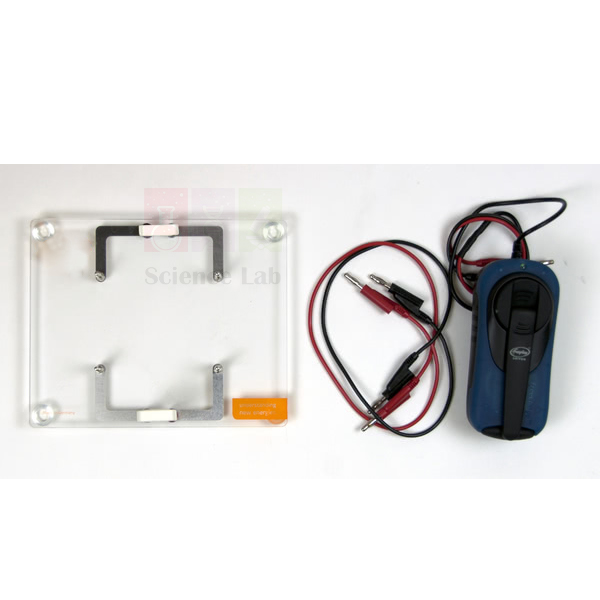
Solar Minikit Basic
Solar Minikit Basic (Product Code: SLE/PHY/214) is a primary school base kit used to run mainly qualitative renewable-energy experiments with the Basics add-on sets. Its hand crank generator lets children produce the electricity for each experiment themselves, so no mains connection or separate voltage source is needed in the room. This hands-on science kit for primary school is supplied by Jain Scientific Equipments Pvt Ltd (ScienceLab), Ambala, India.
Specifications
| Parameter | Detail |
|---|---|
| Kit type | Base kit for the Basic series, elementary (primary) school level |
| Experiment type | Mainly qualitative experiments with the Basics add-on sets |
| Energy source | Hand crank generator; no extra electrical connection or voltage source needed |
| Base | Base unit small |
| Connections | 2 x short-circuit plug for linking modules; test leads 50 cm, one black and one red |
| Packing | Carton with Minikit Basic insert |
| Documentation | Layout diagram Minikit Basic; info sheet for initial startup |
| Product code | SLE/PHY/214 |
| Supplied by | Jain Scientific Equipments Pvt Ltd (ScienceLab), Ambala, India |
Components in the Solar Minikit Basic:
- 1 x Hand generator
- 1 x Base unit small
- 2 x Short-circuit plug
- 1 x Test lead black 50 cm
- 1 x Test lead red 50 cm
- 1 x Insert Minikit Basic
- 1 x Carton
- 1 x Layout diagram Minikit Basic
- 1 x Info sheet for initial startup
What Is the Solar Minikit Basic Used For?
The Solar Minikit Basic is used to give young learners their first experience of making and using electricity. Children place the modules of an add-on set on the small base unit, bridge them with the short-circuit plugs or leads, and then turn the hand generator to make something light up, move or sound. Turning faster or slower gives an immediate, visible link between effort and electrical energy.
Because the kit needs no socket or battery pack, teachers can run lessons in any classroom, hall or outdoor space. Keeping the plugs, leads and generator in the insert, as shown on the layout diagram, makes it quick to check that every group has returned a complete set at the end of the period.
What to Specify When Ordering
- School level: this kit is for primary classes; junior high groups use the Solar Kit Basic
- Which Basics add-on sets you plan to combine with it
- Number of Minikits, typically one per group of pupils
- Delivery location in India or abroad
Supplier
Jain Scientific Equipments Private Limited trades as ScienceLab and supplies teaching equipment from Ambala, Haryana. The Solar Minikit Basic is part of a sourced renewable-energy range that the company offers to primary schools, education departments and dealers, so a complete set of base kits and add-ons can arrive in one shipment.
Company details are on the ScienceLab profile.
Related Physics Lab Equipment
Items often chosen with a primary school base kit:
- Solar Photovoltaic Basic — first solar cell experiments that pair with this base kit
- Solar Hydropower Basic — water wheel experiments for the same age group
- Solar Wind Basic — playful wind rotor experiments
- Solar Kit Basic — the junior high base kit for quantitative work
- Solar New Energy MiniKit — all-in-one primary kit covering several energy topics
More classroom apparatus is available in Physics Lab Equipment.
Frequently Asked Questions
Why does the Solar Minikit Basic include a hand generator?
The Solar Minikit Basic includes a hand crank generator so that pupils produce the electrical energy for their experiments themselves. This removes the need for a mains connection or separate voltage source and makes the link between effort and electricity easy to feel.
Which age group is the Solar Minikit Basic intended for?
The Solar Minikit Basic is intended for elementary or primary school pupils and mainly qualitative experiments. Older junior high students who need measured values normally use the Solar Kit Basic, which adds a power module and an AV module.
What is in the Solar Minikit Basic carton?
The Solar Minikit Basic carton contains a hand generator, a small base unit, two short-circuit plugs, one black and one red test lead of 50 cm, the Minikit Basic insert, a layout diagram and an info sheet for initial startup.
Does the Solar Minikit Basic work without an add-on set?
The Solar Minikit Basic provides the energy source, base and connections, while the experiment modules come from the Basics add-on sets. Order at least one add-on set with it, such as a solar, water or wind topic set, so pupils have modules to connect.
Who supplies the Solar Minikit Basic?
The Solar Minikit Basic is supplied by Jain Scientific Equipments Pvt Ltd (ScienceLab), Ambala, Haryana, India. ScienceLab sources the kit and supplies it with matching add-on sets to schools, dealers and institutional buyers in India and international markets.
What does ScienceLab need to quote the Solar Minikit Basic?
To quote the Solar Minikit Basic, ScienceLab needs product code SLE/PHY/214, the number of kits, the add-on sets you want and the delivery location. Orders for many schools can be combined in one written quotation.
Request a Quote
For a Solar Minikit Basic (SLE/PHY/214) quotation, write to us through the contact page or add the kit and its add-on sets to the enquiry cart.
Last updated: 24 September 2026
Solar New Energy Kit
Solar New Energy Kit (Product Code: SLE/PHY/215) is a multi-topic renewable-energy experiment kit used to teach photovoltaics, wind power, hydropower, electric mobility and fuel cells to junior high school students. It mixes qualitative and quantitative experiments and already contains its power module, AV measuring module and cables, along with three solar modules, a wind machine and a reversible fuel cell. This environmental science kit for schools is supplied by Jain Scientific Equipments Pvt Ltd (ScienceLab), Ambala, India.
Specifications
| Parameter | Detail |
|---|---|
| Kit type | Renewable-energy experiment kit for junior high school, packed in a box |
| Topics | Photovoltaics, wind power, hydropower, electric mobility and fuel cells |
| Solar modules | 0.5 V, 840 mA; 1.5 V, 280 mA; 2.5 V, 420 mA; plus solar cell cover set (4 pieces) and lighting module |
| Wind energy parts | Wind machine, wind turbine module, Solar-Wind rotor set, wind rotor set (assembled), padding universal wind |
| Hydropower parts | Water wheel module; silicone tube 12 mm |
| Storage and fuel cell | Capacitor module 5.0 F / 5.4 V; reversible fuel cell; distilled water (100 ml) |
| Electric mobility | Electric model car |
| Loads | Buzzer module, light bulb module, LED module 2 mA (red), motor module without gear with color discs set 1 |
| Power and measurement | Power module, AV module, potentiometer module; Smart Control measuring and control components |
| Base and cables | Solar-Base unit Large; test leads black and red in 25 cm and 50 cm |
| Packing | Box with NewEnergy Kit insert and 2 lids for tray |
| Documentation | Layout diagram New Energy Kit; info sheet for initial startup; instruction for use of finger protector |
| Product code | SLE/PHY/215 |
| Supplied by | Jain Scientific Equipments Pvt Ltd (ScienceLab), Ambala, India |
What Is the Solar New Energy Kit Used For?
The Solar New Energy Kit is used to cover the main renewable-energy topics of a junior high syllabus with one set of modules. Groups can start with qualitative observations, such as a solar module running the motor or the wind machine turning the rotor, and then switch to quantitative work using the power module, potentiometer and AV module to measure voltage and current.
Storage and mobility lessons build on the same parts: the capacitor module and reversible fuel cell show how energy can be held and released, and the electric model car turns the stored energy into motion. Before running the wind machine, go through the instruction for use of the finger protector with the class, and pack every module back into the insert using the layout diagram.
What to Specify When Ordering
- Number of kits, usually one per student group
- Whether younger classes also need the Solar New Energy MiniKit
- Any spare modules or replacement distilled water to quote (ask us about availability)
- Delivery location in India or abroad
Supplier
ScienceLab is the trading name of Jain Scientific Equipments Private Limited, an Ambala-based supplier that sources the Solar New Energy Kit for schools, colleges and education projects. Keeping this kit alongside other physics apparatus on one order simplifies purchasing for science departments.
Institutional buyers completing vendor registration can use the supplying company's GSTIN 06AAECJ8618A1ZT and Legal Entity Identifier (LEI) 3358004HRD1JIVXKYX49. See the ScienceLab company profile for more.
Related Physics Lab Equipment
Related kits for extending or adapting renewable-energy lessons:
- Solar New Energy MiniKit — elementary school version with a hand generator
- Solar New Energy Ready-To-Go — case version for primary and junior high use in any location
- Solar Wind Large — more detailed wind turbine experiments
- Solar H2 Ready-To-Go — dedicated hydrogen and fuel cell experiments
- Solar EMobility Ready-To-Go — battery technologies and the electric car in more depth
Explore further energy and electricity apparatus under Physics Lab Equipment.
Frequently Asked Questions
Which topics does the Solar New Energy Kit cover?
The Solar New Energy Kit covers photovoltaics, wind power, hydropower, electric mobility and fuel cells. Junior high school students work through both qualitative and quantitative experiments on each topic using the same base unit, loads and measuring modules.
Does the Solar New Energy Kit include a power supply and meters?
Yes, the Solar New Energy Kit includes the power module, the AV module for voltage and current measurement, a potentiometer module and test leads. All necessary accessories for its experiments, including cables and measuring devices, are packed in the kit.
Which solar modules are in the Solar New Energy Kit?
The Solar New Energy Kit contains three solar modules rated 0.5 V, 840 mA; 1.5 V, 280 mA; and 2.5 V, 420 mA. A solar cell cover set of four pieces and a lighting module support experiments on shading and indoor illumination.
What are the reversible fuel cell and distilled water for in the Solar New Energy Kit?
In the Solar New Energy Kit, the reversible fuel cell can split the supplied distilled water (100 ml) into hydrogen and oxygen and then turn those gases back into electricity. This lets students study energy storage and power the electric model car.
Who supplies the Solar New Energy Kit?
The Solar New Energy Kit is supplied by Jain Scientific Equipments Pvt Ltd (ScienceLab), Ambala, Haryana, India. ScienceLab sources the kit and delivers it to schools, colleges, dealers and project buyers in India and international markets.
What information does a Solar New Energy Kit quotation need?
A Solar New Energy Kit quotation needs product code SLE/PHY/215, the number of kits, any spare modules you want and the delivery location. Send the details through the contact page or enquiry cart for a written quotation.
Request a Quote
Request a quotation for the Solar New Energy Kit (SLE/PHY/215) through the ScienceLab contact page, or add it to the enquiry cart with any related kits.
Last updated: 24 September 2026
Solar New Energy MiniKit
Solar New Energy MiniKit (Product Code: SLE/PHY/216) is a beginner renewable-energy kit used to introduce elementary school children to solar, wind and water power, electric mobility and fuel cells through playful experiments. In place of a power module it relies on a hand generator and a small base unit, and it adds a model electric car, a wind machine and a reversible fuel cell. This STEM science kit for young learners is supplied by Jain Scientific Equipments Pvt Ltd (ScienceLab), Ambala, India.
Specifications
| Parameter | Detail |
|---|---|
| Kit type | Beginner renewable-energy kit for elementary school, packed in a box |
| Topics | Photovoltaics, wind power, hydropower, electric mobility and fuel cells |
| Hand-powered source | Hand generator |
| Solar modules | 0.5 V, 840 mA; 1.5 V, 280 mA; 2.5 V, 420 mA; plus solar cell cover set (4 pieces) and lighting module |
| Wind energy parts | Wind machine, wind turbine module, Solar-Wind rotor set, wind rotor set (assembled), padding universal wind |
| Hydropower parts | Water wheel module; silicone tube 12 mm |
| Storage and fuel cell | Capacitor module 5.0 F / 5.4 V; reversible fuel cell; distilled water (100 ml) |
| Electric mobility | Electric model car |
| Loads | Buzzer module, light bulb module, LED module 2 mA (red), motor module without gear with color discs set 1 |
| Base and connections | Base unit small; 2 x short-circuit plug; test leads 50 cm, one black and one red |
| Packing | Box with NewEnergy Kit insert and 2 lids for tray |
| Documentation | Layout diagram New Energy Minikit; info sheet for initial startup; instruction for use of finger protector |
| Product code | SLE/PHY/216 |
| Supplied by | Jain Scientific Equipments Pvt Ltd (ScienceLab), Ambala, India |
What Is the Solar New Energy MiniKit Used For?
The Solar New Energy MiniKit is used as a first, play-based tour of renewable energy for younger pupils. Children turn the hand generator to make the buzzer sound or the LED glow, hold a solar module under the lighting module to run the motor, let the wind machine spin the rotor, and pour water over the water wheel to see another way of making electricity.
Later lessons introduce storage: the capacitor module keeps energy for a short time, and the reversible fuel cell works with the included distilled water to show how hydrogen can carry energy to the model car. Short-circuit plugs keep wiring simple on the small base unit. Show the class how the finger protector is used before the wind machine is switched on.
What to Specify When Ordering
- Number of MiniKits needed, usually one per group of pupils
- Whether older classes also need the Solar New Energy Kit with power and measuring modules
- Any spare modules or replacement distilled water to quote (ask us)
- Delivery location in India or abroad
Supplier
Jain Scientific Equipments Private Limited, which trades as ScienceLab, supplies the Solar New Energy MiniKit from Ambala, Haryana, as part of a sourced range of energy education kits. Primary schools, education programmes and dealers can order it in class quantities together with other science teaching aids.
More about the company is on the ScienceLab profile page.
Related Physics Lab Equipment
Kits that suit the same age group or the next stage:
- Solar New Energy Kit — junior high version with power module and AV measuring module
- Solar New Energy Ready-To-Go — case version covering primary and junior high experiments
- Solar Minikit Basic — primary base kit for single-topic Basics add-on sets
- Solar Sunstick — solar learning toy for children from 6 years
- Light Energy Kit — activities on light sources, reflection and colour
Other primary and secondary apparatus is listed in Physics Lab Equipment.
Frequently Asked Questions
Which age group is the Solar New Energy MiniKit designed for?
The Solar New Energy MiniKit is designed for young students in elementary school. Its experiments are playful and mainly qualitative, giving children a first understanding of photovoltaics, wind power, hydropower, electric mobility and fuel cells before they move on to measured experiments.
How is the Solar New Energy MiniKit powered without a power module?
The Solar New Energy MiniKit is powered by the energy sources it teaches: a hand generator, three solar modules with a lighting module, a wind machine with rotor sets, a water wheel and a reversible fuel cell. No separate power module is part of the kit.
What is the difference between the Solar New Energy MiniKit and the Solar New Energy Kit?
The Solar New Energy MiniKit targets elementary school and uses a hand generator, small base unit and short-circuit plugs. The Solar New Energy Kit targets junior high school and adds a power module, AV module and potentiometer for quantitative measurements.
Does the Solar New Energy MiniKit include safety guidance for the wind machine?
Yes, the Solar New Energy MiniKit includes an instruction for use of the finger protector, alongside the info sheet for initial startup and a layout diagram. Teachers should go through the finger protector instruction with pupils before the wind machine is used.
Who supplies the Solar New Energy MiniKit?
The Solar New Energy MiniKit is supplied by Jain Scientific Equipments Pvt Ltd (ScienceLab), Ambala, Haryana, India. ScienceLab sources the kit and supplies it to primary schools, education projects and dealers in India and international markets.
How do I request a quotation for the Solar New Energy MiniKit?
To request a quotation for the Solar New Energy MiniKit, send product code SLE/PHY/216, the number of kits, any spares wanted and the delivery location through the contact page or enquiry cart. Class sets and bulk orders can be quoted together.
Request a Quote
Ask for a Solar New Energy MiniKit (SLE/PHY/216) quotation on the contact page, or place it in the enquiry cart with other classroom items.
Last updated: 24 September 2026
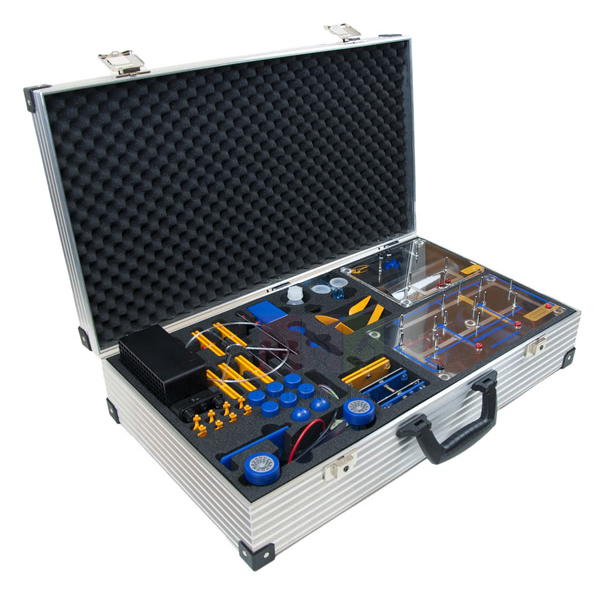
Solar New Energy Ready-To-Go
Solar New Energy Ready-To-Go (Product Code: SLE/PHY/217) is a renewable-energy experiment system in a carry case, used to teach photovoltaics, wind power, hydropower, electric mobility and fuel cells at both primary and junior high school level. It needs no additional equipment, because the power module, hand generator, AV measuring module, cables and both base units travel together, ready for use in any location. This portable science kit for students is supplied by Jain Scientific Equipments Pvt Ltd (ScienceLab), Ambala, India.
Specifications
| Parameter | Detail |
|---|---|
| Kit type | Ready-to-go renewable-energy system in a case; no additional equipment required |
| School levels | Primary and junior high school; qualitative and quantitative experiments |
| Topics | Photovoltaics, wind power, hydropower, electric mobility and fuel cells |
| Energy sources | Hand generator; solar modules 0.5 V, 840 mA, 1.5 V, 280 mA and 2.5 V, 420 mA; wind machine with wind turbine module; water wheel module; reversible fuel cell |
| Storage | Capacitor module 5.0 F / 5.4 V; distilled water (100 ml) for the reversible fuel cell |
| Loads | Buzzer module, light bulb module, LED module 2 mA (red), motor module without gear with color discs set 1, electric model car |
| Power and measurement | Power module, AV module, potentiometer module; Smart Control measuring and control components |
| Bases and connections | Solar-Base unit Large and Solar-Base unit small; 2 x short-circuit plug; test leads: 1 black and 1 red 25 cm, 2 black and 1 red 50 cm |
| Other parts | Lighting module; solar cell cover set (4 pieces); Solar-Wind rotor set; wind rotor set (assembled); silicone tube 12 mm |
| Case and packing | Case New Energy with insert and studded lid foam |
| Documentation | Layout diagram Solar-New Energy; info sheet for initial startup; instruction for use of finger protector |
| Primary-level experiments | From muscular strength to current, then to light, motion and noise; solar cell and solar module driving a motor, buzzer and LED; wind turbine powering a buzzer and an LED; influence of wind direction, rotor blade shape and wind speed; the larger the solar cell, the ...?; from solar cell to solar module; shading of solar modules; water wheel powering a buzzer; influence of water falling height; storage of solar and wind energy; what is an electrolyzer, how can water be split, what is a fuel cell; fuel cell driving the motor and buzzer; energy demand of several consumers; light bulb versus LED; storage and output of energy for e-mobility |
| Secondary-level experiments | Forms of energy and consumers; rotation discs, colour qualities, mixing colours, colour deception with the Benham disk and relief disk; characteristic curves of the electrolyzer and fuel cell; solar cell power versus area, angle of incidence (qualitative and quantitative), illumination intensity and load; I-V characteristics and fill factor, and their dependence on illuminance; changing wind speeds, start-up wind speed, turbine voltage with several consumers and characteristic curves of a wind turbine; number of rotor blades, wind direction, rotor blade pitch and blade shape (qualitative and quantitative); water falling height and water as an energy source (qualitative and quantitative); what an electrolyzer and a fuel cell do; running the electric car on the reversible fuel cell |
| Product code | SLE/PHY/217 |
| Supplied by | Jain Scientific Equipments Pvt Ltd (ScienceLab), Ambala, India |
What Is the Solar New Energy Ready-To-Go Used For?
The Solar New Energy Ready-To-Go is used when one kit has to serve several age groups and several rooms. Primary pupils start with the hand generator, feeling how muscular strength becomes light, motion and sound, then move on to solar modules, the wind machine and the water wheel. Older students use the same case for measured work, plotting I-V characteristics, fill factor and wind turbine curves with the AV module and potentiometer.
The motor module and color discs also support short lessons on colour mixing and the Benham disk, which makes the kit useful beyond energy topics. Since everything sits in one case, teachers can carry it between classrooms or to outreach events; check the insert against the layout diagram after each lesson so the next class finds a complete set.
What to Specify When Ordering
- Number of cases for your school or programme
- Whether the kit will serve primary, junior high or both, so we can suggest matching add-ons
- Any spare modules or replacement distilled water to quote (ask us about availability)
- Delivery location in India or abroad
Supplier
ScienceLab, the trading name of Jain Scientific Equipments Private Limited of Ambala, Haryana, supplies the Solar New Energy Ready-To-Go as a sourced teaching system. Schools, teacher-training centres and outreach programmes can order it on its own or with other physics apparatus, and our team can help match it to the grades you teach.
Read about the company on the ScienceLab profile page.
Related Physics Lab Equipment
Kits that complement or scale this system:
- Solar New Energy Kit — boxed junior high version for classes that stay in one lab
- Solar New Energy MiniKit — elementary version built around a hand generator
- Solar Smart Grid Ready-To-Go — next step into smart grids and energy management
- Solar H2 Ready-To-Go — dedicated electrolyzer and fuel cell experiments
- Solar Photovoltaic Ready-To-Go — deeper photovoltaic experiments in a carry case
See all items in Physics Lab Equipment.
Frequently Asked Questions
Does the Solar New Energy Ready-To-Go need any additional equipment?
No, the Solar New Energy Ready-To-Go is designed for use in any location without additional equipment. Its case already holds the power module, hand generator, AV module, cables, base units, energy sources and loads needed for the listed experiments.
Which school levels can use the Solar New Energy Ready-To-Go?
The Solar New Energy Ready-To-Go serves primary and junior high school. Its experiment list is split into a primary level, with playful qualitative experiments, and a secondary level with quantitative work such as I-V characteristics, fill factor and wind turbine characteristic curves.
Why does the Solar New Energy Ready-To-Go include both a hand generator and a power module?
The Solar New Energy Ready-To-Go includes a hand generator for primary experiments that turn muscular strength into light, motion and noise, and a power module for measured experiments with the AV module. One case therefore covers both hands-on and quantitative lessons.
How does the Solar New Energy Ready-To-Go differ from the Solar New Energy Kit?
The Solar New Energy Ready-To-Go comes in a carry case and covers primary and junior high levels, adding a hand generator, small base unit and short-circuit plugs. The Solar New Energy Kit is a boxed set aimed at junior high school only.
Who supplies the Solar New Energy Ready-To-Go?
The Solar New Energy Ready-To-Go is supplied by Jain Scientific Equipments Pvt Ltd (ScienceLab), Ambala, Haryana, India. ScienceLab sources the system and delivers it to schools, training centres, dealers and education projects in India and international markets.
What should a Solar New Energy Ready-To-Go enquiry include?
A Solar New Energy Ready-To-Go enquiry should include product code SLE/PHY/217, the number of cases, the grades you teach, any spares required and the delivery location. ScienceLab then sends a written quotation covering availability, packing and shipping.
Request a Quote
Get a quotation for the Solar New Energy Ready-To-Go (SLE/PHY/217) through the contact page, or add it to the enquiry cart with other kits.
Last updated: 24 September 2026
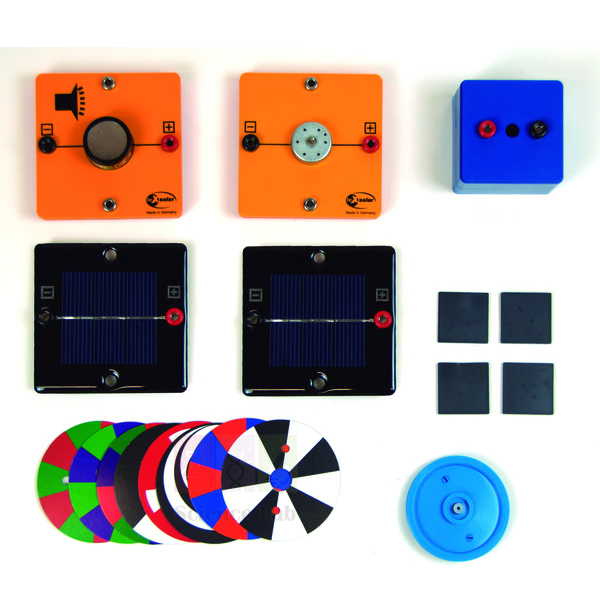
Solar Photovoltaic Basic
Solar Photovoltaic Basic (Product Code: SLE/PHY/218) is a photovoltaics add-on set used to answer first questions about solar cells: what a solar cell and a solar panel are, what they can power, and how a cell should be aligned to the sun. Its qualitative experiments suit elementary and junior high students and run on the Solar Minikit Basic or Solar Kit Basic. As an entry-level solar energy science kit, it is supplied by Jain Scientific Equipments Pvt Ltd (ScienceLab), Ambala, India.
Specifications
| Parameter | Detail |
|---|---|
| Kit type | Photovoltaics add-on set for the Basic series |
| School level | Elementary and junior high school; all experiments are qualitative |
| Solar modules | 0.5 V, 840 mA and 1.5 V, 280 mA |
| Light and shading | Lighting module; solar cell cover set (4 pieces) |
| Loads | Buzzer module; motor module without gear with color discs set 1 |
| Required base kit (not included) | Solar Minikit Basic in primary school, or Solar Kit Basic in junior high school; each contains all necessary accessories |
| Packing | Carton with PV Basic insert |
| Documentation | Layout diagram PV Basic; info sheet for initial startup |
| Product code | SLE/PHY/218 |
| Supplied by | Jain Scientific Equipments Pvt Ltd (ScienceLab), Ambala, India |
What Is the Solar Photovoltaic Basic Used For?
The Solar Photovoltaic Basic is used for a pupil-friendly introduction to photovoltaics. Students connect a solar module to the motor or buzzer, then tilt it towards the sun or the lighting module and watch the motor speed up or the sound change. Comparing the 0.5 V and 1.5 V modules shows the difference between a single solar cell and a small solar panel.
The four-piece cover set lets pupils shade part of a module and see how the output drops, while the color discs on the motor make changes in speed easy to spot. All of this is qualitative, so younger classes can reach sound conclusions without meters; junior high groups using the Solar Kit Basic can extend the same lessons with readings.
What to Specify When Ordering
- School level, so the matching base kit (Solar Minikit Basic or Solar Kit Basic) is included in the quotation
- Whether your school already has the base kit
- Number of PV Basic sets per class
- Delivery location in India or abroad
Supplier
Jain Scientific Equipments Private Limited, known by its trading name ScienceLab, supplies the Solar Photovoltaic Basic from Ambala, Haryana. The company sources this add-on together with the base kits and other topic sets, so schools and dealers can assemble a complete renewable-energy corner from one supplier.
Company information is available on the ScienceLab profile.
Related Physics Lab Equipment
Base kits and next steps for solar cell lessons:
- Solar Minikit Basic — primary base kit that this set needs
- Solar Kit Basic — junior high base kit that this set needs
- Solar Photovoltaic Large — larger photovoltaic system for school physics
- Mounted Solar Cell — single mounted cell for energy-conversion demonstrations
- Solar Energy Kit — separate cell kit for series and parallel connection work
More solar and electricity apparatus is available in Physics Lab Equipment.
Frequently Asked Questions
What questions does the Solar Photovoltaic Basic help students answer?
The Solar Photovoltaic Basic helps students answer what a solar cell is, what a solar panel is, what can be powered with a solar cell and how a solar cell should be aligned to the sun, along with many related questions explored through simple experiments.
Can the Solar Photovoltaic Basic be used on its own?
No, the Solar Photovoltaic Basic is an add-on set. It needs the Solar Minikit Basic in primary school or the Solar Kit Basic in junior high school, each of which contains all necessary accessories such as the base unit and cables.
Are the Solar Photovoltaic Basic experiments qualitative or quantitative?
All Solar Photovoltaic Basic experiments are designed to be qualitative. They are adapted for young students in elementary school and junior high school, who observe effects such as motor speed or buzzer sound rather than recording measured values.
What is supplied in the Solar Photovoltaic Basic carton?
The Solar Photovoltaic Basic carton contains a 0.5 V, 840 mA solar module, a 1.5 V, 280 mA solar module, a lighting module, a solar cell cover set of four pieces, a buzzer module, a motor module with color discs, the PV Basic insert and printed guidance sheets.
Who supplies the Solar Photovoltaic Basic?
The Solar Photovoltaic Basic is supplied by Jain Scientific Equipments Pvt Ltd (ScienceLab), Ambala, Haryana, India. ScienceLab sources the set and supplies it, with or without base kits, to schools, dealers and institutions in India and international markets.
How do I order the Solar Photovoltaic Basic?
To order the Solar Photovoltaic Basic, send product code SLE/PHY/218, the quantity, the base kit you need and your delivery location through the contact page or enquiry cart. ScienceLab replies with a written quotation for single or bulk orders.
Request a Quote
Request the Solar Photovoltaic Basic (SLE/PHY/218) on the contact page, or add it and its base kit to the enquiry cart.
Last updated: 24 September 2026
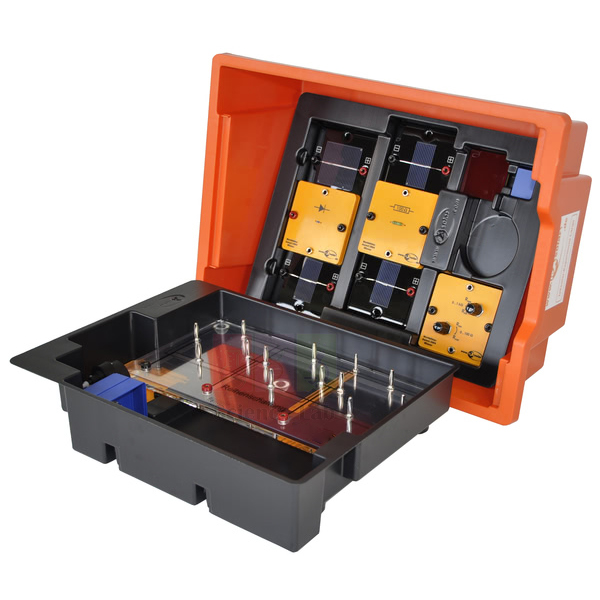
Solar Photovoltaic Large
Solar Photovoltaic Large (Product Code: SLE/PHY/219) is a photovoltaic experiment system used to connect school physics lessons with the practical use of solar cells. Five solar modules, together with diode, capacitor, resistor and potentiometer modules, let students build and test real PV circuits, and most experiments work in normal room lighting without an external power supply. This physics experiment kit for school labs is supplied by Jain Scientific Equipments Pvt Ltd (ScienceLab), Ambala, India.
Specifications
| Parameter | Detail |
|---|---|
| Kit type | Photovoltaic experiment system, packed in a box with lid |
| Solar modules | 3 x 0.5 V, 420 mA; 1 x 0.5 V, 840 mA; 1 x 1.5 V, 280 mA |
| Circuit modules | Diode module, resistor module, potentiometer module, capacitor module 220 mF, 2.5 V |
| Loads | Motor module without gear with color discs set 1; gear motor module; buzzer module |
| Light and filters | Lighting module (needed only for a few experiments and operated with a student power supply); color filters; solar cell cover set (4 pieces) |
| Lighting conditions | Most experiments can be carried out in normal room lighting without an external power supply |
| Base | Solar-Base unit Large |
| Packing | Box with black vacuum padding (1 top piece, 2 lower pieces) and lid for tray |
| Documentation | Layout diagram PV Large; info sheet for initial startup |
| Extras needed (not included) | 1 x AV module, 1 x power module, 2 x test lead black 25 cm, 2 x test lead red 25 cm, 1 x laboratory thermometer |
| Product code | SLE/PHY/219 |
| Supplied by | Jain Scientific Equipments Pvt Ltd (ScienceLab), Ambala, India |
What Is the Solar Photovoltaic Large Used For?
The Solar Photovoltaic Large is used to turn textbook photovoltaic theory into circuits students can build on the bench. With three identical 0.5 V, 420 mA modules, classes can compare series and parallel connections, then set them against the 0.5 V, 840 mA and 1.5 V, 280 mA modules. The diode, resistor, potentiometer and capacitor modules bring in the components found in real solar installations.
Because most experiments run in ordinary room light, lessons do not depend on the weather or on a darkened lab; the lighting module is only needed for a few experiments. The color filters and cover set show how light colour and shading affect output. Plan for the extras list, an AV module, power module, test leads and a laboratory thermometer, before the first practical.
What to Specify When Ordering
- Whether the extras (AV module, power module, 25 cm test leads, laboratory thermometer) should be quoted with the kit
- Number of systems for your student groups
- Whether a student power supply is available in your lab for the lighting module experiments
- Delivery location in India or abroad
Supplier
ScienceLab is the trading name under which Jain Scientific Equipments Private Limited supplies the Solar Photovoltaic Large from Ambala, Haryana. The company sources this system and can quote the extras it needs in the same order, so a school receives everything required for its first photovoltaic practical.
For vendor registration, the supplying company is Jain Scientific Equipments Private Limited (CIN U29309HR2020PTC087597, GSTIN 06AAECJ8618A1ZT). See the ScienceLab profile for company details.
Related Physics Lab Equipment
Items that complete or extend a photovoltaic practical:
- Solar Kit Basic — includes an AV module, power module and test leads
- Digital Thermometer — a laboratory thermometer for the extras list
- Solar Photovoltaic Basic — qualitative introduction for younger classes
- Solar Photovoltaic Professional — system-level PV training with regulators, MPP tracker and inverter
- Solar Photovoltaic Ready-To-Go — fully equipped PV kit in a carry case
Browse the Physics Lab Equipment category for further apparatus.
Frequently Asked Questions
What extra equipment does the Solar Photovoltaic Large need?
The Solar Photovoltaic Large needs one AV module, one power module, two black and two red test leads of 25 cm, and a laboratory thermometer. These extras are not in the box, so ask us to include them in your quotation if your lab does not already have them.
Can Solar Photovoltaic Large experiments run in normal room light?
Yes, most Solar Photovoltaic Large experiments can be conducted in normal room lighting, and no external power supply is needed for them. The included lighting module is required only for a few experiments and can be operated with a student power supply.
Which solar modules come with the Solar Photovoltaic Large?
The Solar Photovoltaic Large comes with five solar modules: three rated 0.5 V, 420 mA, one rated 0.5 V, 840 mA and one rated 1.5 V, 280 mA. The matching trio makes series and parallel connection experiments straightforward.
Which circuit components are included in the Solar Photovoltaic Large?
The Solar Photovoltaic Large includes a diode module, resistor module, potentiometer module and a capacitor module of 220 mF, 2.5 V, plus a gear motor module, a motor module with color discs and a buzzer module as loads.
Who supplies the Solar Photovoltaic Large?
The Solar Photovoltaic Large is supplied by Jain Scientific Equipments Pvt Ltd (ScienceLab), Ambala, Haryana, India. ScienceLab sources the system and delivers it, with its extras if required, to schools, colleges and dealers in India and international markets.
What should a Solar Photovoltaic Large quotation request include?
A Solar Photovoltaic Large quotation request should include product code SLE/PHY/219, the number of systems, whether the extras list should be added and the delivery location. Send it through the contact page or enquiry cart.
Request a Quote
Send your Solar Photovoltaic Large (SLE/PHY/219) enquiry, with or without its extras, through the contact page or the enquiry cart.
Last updated: 24 September 2026
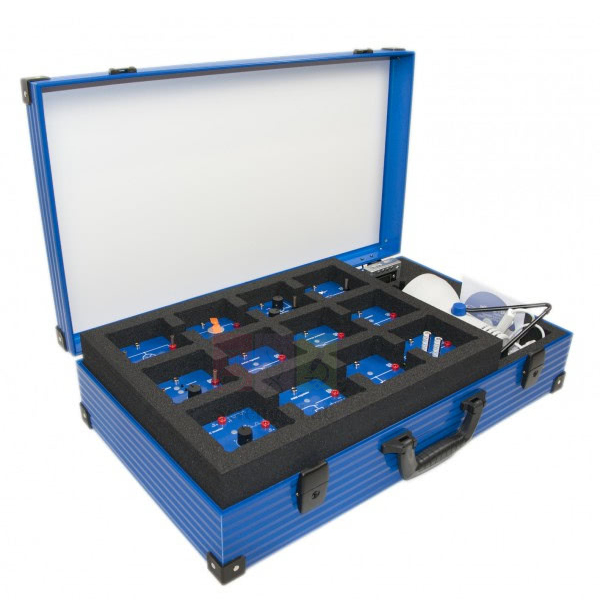
Solar Photovoltaic Professional
Solar Photovoltaic Professional (Product Code: SLE/PHY/220) is a modular photovoltaic training system used to teach PV fundamentals, component analysis and the design of complete off-grid PV systems on a laboratory scale. Built for vocational courses, apprentices, technicians, PV installers, sales training and engineering students, it works as a full solar cell characteristic kit and adds an MPP tracker, PWM, series and shunt regulators and a DC/AC inverter. It is supplied by Jain Scientific Equipments Pvt Ltd (ScienceLab), Ambala, India.
Specifications
| Parameter | Detail |
|---|---|
| System type | Modular photovoltaic training system in an aluminium case |
| Intended users | Studies and courses in renewable energies: training of sales representatives, apprenticeship, in-service training of technicians and PV installers, basic education of engineers |
| Solar modules | 1 x 5.33 V, 370 mA; 3 x 0.5 V, 420 mA; 3 x 0.5 V, 840 mA; base for solar panel; solar cell cover set (4 pieces) |
| Light source | Lamp housing with 80 W illuminant; 3 x lighting module (with safety sockets) |
| PV system modules | MPP-Tracker Pro with manual mode, PWM regulator Pro, series regulator module Pro, shunt regulator module Pro, deep discharge protection module Pro, DC/AC-Inverter Pro, capacitor module Pro, diode module Pro |
| Consumers | LED module (high brightness) Pro, light bulb module Pro, motor module Pro with propeller, radio module Pro |
| Resistors | Potentiometer module Pro; 2 x resistor module (triple) Pro; resistor plug elements: 1 x 33 ohm, 3 x 100 ohm, 2 x 10 ohm |
| Measurement and power | 2 x AV module; 1 x power module |
| Base and connections | Solar-base unit Professional; safety test leads: 4 red and 3 black 25 cm, 2 red and 1 black 50 cm; 3 x safety short-circuit plug with mid socket |
| Case | Aluminium case PV Professional with insert |
| Documentation | Layout diagram 1118 PV Professional; info sheet for initial startup |
| Electrical engineering experiments | Measurement of voltage, current and power; Ohm's law; parallel connection of resistors (current divider); series connection of resistors (voltage divider) |
| Photovoltaic basic experiments | Characteristic curve of solar modules; dark characteristic curve of solar cells; I-V characteristics versus illumination and temperature; series and parallel connection of solar cells; power versus surface area, angle of incidence, illumination and illumination under load; internal resistance versus illumination; shading effect; I-V characteristics, MPP and fill factor; I-V characteristics of partly shaded modules; temperature coefficient of solar cells |
| Photovoltaic system experiments | Components and possible operating conditions of an off-grid system; PWM versus series regulator; load characteristic of PWM regulators; characteristics and working principle of an MPP tracker; working principle of shunt and series regulators; deep discharge protection; working principle of an inverter; output voltage progression at an inverter |
| Product code | SLE/PHY/220 |
| Supplied by | Jain Scientific Equipments Pvt Ltd (ScienceLab), Ambala, India |
What Is the Solar Photovoltaic Professional Used For?
The Solar Photovoltaic Professional is used for practical courses where learners must understand a PV system component by component. Sessions can start with electrical basics, such as Ohm's law and voltage and current dividers, so the system also doubles as an Ohm law experiment kit for technical institutes in India and elsewhere. Trainees then move to solar module curves, fill factor and temperature coefficient before wiring regulators, protection and inverter into a working off-grid system.
Because the setup is modular, instructors can isolate details such as the switching threshold of a series or shunt regulator. The manual mode of the MPP tracker makes maximum power point tracking visible step by step, the PWM regulator shows pulse width modulated charging, and the inverter demonstrates alternating current produced from solar module current. The radio module and the comparison of the high-brightness LED with the light bulb keep learners engaged while they study efficiency.
What to Specify When Ordering
- Number of training systems or work stations
- The course level (apprentice, technician, installer or engineering), so we can confirm the system suits your syllabus
- Whether additional AV modules or safety test leads should be quoted
- Delivery location in India or abroad
Supplier
Jain Scientific Equipments Private Limited, trading as ScienceLab from Ambala, Haryana, supplies the Solar Photovoltaic Professional to technical institutes, colleges, training providers and dealers. The system is sourced by the company and can be combined with other energy trainers and measuring instruments in one institutional order.
Background on the company is on the ScienceLab company profile.
Related Physics Lab Equipment
Related trainers and instruments for PV and energy courses:
- Solar Smart Grid Professional — grid stability and storage training for the same course level
- Solar Photovoltaic Large — school-level PV system for earlier stages
- Solar Photovoltaic Ready-To-Go — portable PV kit for workshops and demonstrations
- Advanced Digital Multimeter — extra handheld meter for cross-checking readings
Other training apparatus is listed in Physics Lab Equipment.
Frequently Asked Questions
Who is the Solar Photovoltaic Professional designed for?
The Solar Photovoltaic Professional is designed for studies and courses in renewable energies, including training of sales representatives, apprenticeships, in-service training of technicians and PV installers, and basic education of engineers. Its main focus is laboratory experiments on photovoltaic systems.
Which PV system components can be studied with the Solar Photovoltaic Professional?
With the Solar Photovoltaic Professional, learners study an MPP tracker, a PWM regulator, series and shunt regulators, deep discharge protection and a DC/AC inverter, along with solar modules, a capacitor, a diode and several consumers, all as separate modules on the professional base unit.
How does the MPP tracker manual mode help in the Solar Photovoltaic Professional?
The MPP tracker in the Solar Photovoltaic Professional has an integrated manual mode, so learners can move the operating point themselves and see why tracking the maximum power point matters. This gives a descriptive understanding before automatic tracking is observed.
What light source is included with the Solar Photovoltaic Professional?
The Solar Photovoltaic Professional includes a lamp housing with an 80 W illuminant and three lighting modules with safety sockets, so illumination-dependent experiments can be carried out indoors under controlled conditions rather than relying on sunlight.
Can calibration documents be supplied with the Solar Photovoltaic Professional meters?
Calibration documents for the AV modules of the Solar Photovoltaic Professional should be discussed with us before ordering. Share your requirement through the contact page and we will confirm what documentation can accompany the system.
Who supplies the Solar Photovoltaic Professional?
The Solar Photovoltaic Professional is supplied by Jain Scientific Equipments Pvt Ltd (ScienceLab), Ambala, Haryana, India. ScienceLab sources the system and supplies it to technical institutes, colleges, training centres and dealers in India and international markets.
What details should a Solar Photovoltaic Professional enquiry include?
A Solar Photovoltaic Professional enquiry should include product code SLE/PHY/220, the number of systems, the course level, any extra modules or leads required and the delivery location. ScienceLab replies with a written quotation for single or multiple work stations.
Request a Quote
Request a quotation for the Solar Photovoltaic Professional (SLE/PHY/220) through the ScienceLab contact page, or add it to the enquiry cart with other trainers.
Last updated: 24 September 2026
Solar Photovoltaic Ready-To-Go
Solar Photovoltaic Ready-To-Go (Product Code: SLE/PHY/221) is a fully equipped photovoltaic experiment system in an aluminium carry case, used to demonstrate solar energy from simple first trials up to I-V characteristics and the temperature dependence of solar cells. Since the measuring equipment and all ancillary parts are included, it works wherever you are without further components, in teaching labs, company workshops and sales demonstrations alike. This physics demonstration kit is supplied by Jain Scientific Equipments Pvt Ltd (ScienceLab), Ambala, India.
Key Details
| Parameter | Detail |
|---|---|
| System type | Fully equipped photovoltaic experiment system from the Ready-to-go series |
| Further components needed | None; all necessary ancillary equipment, including measuring equipment, is included |
| Experiment range | From simple trials on the basic characteristics of solar energy to more challenging experiments on I-V characteristics and temperature dependency of solar cells |
| Suitable for | Photovoltaics teaching, internal workshops in companies, and use as a demonstration kit for sales representatives |
| Case | Aluminium carry case with heavy-duty foam inserts |
| Product code | SLE/PHY/221 |
| Supplied by | Jain Scientific Equipments Pvt Ltd (ScienceLab), Ambala, India |
What Is the Solar Photovoltaic Ready-To-Go Used For?
The Solar Photovoltaic Ready-To-Go is used when photovoltaics has to be taught or demonstrated away from a fixed lab bench. A lesson can open with simple trials that show how a solar cell responds to light, then progress to recording I-V characteristics and examining how cell temperature changes the output, all with the measuring equipment packed in the same case.
Its wide range of experiments makes it equally useful for in-house training at companies and for sales representatives who need to show customers how solar cells behave. For reliable results, give the cells time to settle under steady light before taking readings, and return each part to its foam cut-out so the case travels safely to the next session.
Supplier
ScienceLab is the trading name of Jain Scientific Equipments Private Limited, an Ambala, Haryana supplier of teaching and laboratory equipment. The company sources the Solar Photovoltaic Ready-To-Go for schools, colleges, training departments and dealers who need a portable PV system rather than a bench-bound trainer.
You can read about the company on the ScienceLab profile page.
Related Physics Lab Equipment
Other photovoltaic and energy systems in the same range:
- Solar Photovoltaic Professional — modular trainer covering regulators, MPP tracking and inverters
- Solar Photovoltaic Large — boxed PV system for school physics labs
- Solar Smart Grid Ready-To-Go — portable smart grid system in the same case format
- Solar New Energy Ready-To-Go — portable overview of several renewable-energy topics
Find more apparatus in Physics Lab Equipment.
Frequently Asked Questions
Does the Solar Photovoltaic Ready-To-Go need any additional components?
No, the Solar Photovoltaic Ready-To-Go is a fully equipped experiment system that can be used wherever you are without further components. All necessary ancillary equipment, including the measuring equipment, is already included in its case.
Which experiments can be done with the Solar Photovoltaic Ready-To-Go?
The Solar Photovoltaic Ready-To-Go covers simple trials that demonstrate the basic characteristics of solar energy as well as more challenging experiments such as I-V characteristics and the temperature dependency of solar cells.
Is the Solar Photovoltaic Ready-To-Go only for schools?
No, the Solar Photovoltaic Ready-To-Go suits teaching labs and is also appropriate for internal workshops in companies and as a demonstration kit for sales representatives, thanks to its large range of potential experiments and portable case.
Where can I see the full component list of the Solar Photovoltaic Ready-To-Go?
The detailed component list of the Solar Photovoltaic Ready-To-Go is not published on this page. Ask us through the contact page and we will share the current packing list with your quotation, so you can check it against your syllabus.
How is the Solar Photovoltaic Ready-To-Go protected during transport?
The Solar Photovoltaic Ready-To-Go is enclosed in an aluminium carry case with heavy-duty foam inserts. Returning every part to its foam position after use keeps the modules and measuring equipment protected when the kit is carried between rooms or sites.
Who supplies the Solar Photovoltaic Ready-To-Go?
The Solar Photovoltaic Ready-To-Go is supplied by Jain Scientific Equipments Pvt Ltd (ScienceLab), Ambala, Haryana, India. ScienceLab sources the kit and supplies it to schools, colleges, companies and dealers in India and international markets.
What does ScienceLab need to quote the Solar Photovoltaic Ready-To-Go?
To quote the Solar Photovoltaic Ready-To-Go, ScienceLab needs product code SLE/PHY/221, the number of kits and the delivery location in India or abroad. Send these details through the contact page or add the kit to the enquiry cart.
Request a Quote
For a Solar Photovoltaic Ready-To-Go (SLE/PHY/221) quotation, contact us through the contact page or add it to the enquiry cart.
Last updated: 24 September 2026
Solar Smart Grid Professional
Solar Smart Grid Professional (Product Code: SLE/PHY/222) is a basic training system used to build, measure and control a smart grid on a laboratory scale in vocational and technical education. As advanced physics lab equipment, it combines wind and photovoltaic generation with lithium-iron-phosphate battery and fuel cell storage, while two Smart Meters let learners measure and steer energy flows during grid stability scenarios. It is supplied by Jain Scientific Equipments Pvt Ltd (ScienceLab), Ambala, India.
Specifications
| Parameter | Detail |
|---|---|
| System type | Smart grid training system for vocational and technical education, in a case |
| Generation | Solar module 5.22 V, 380 mA with base for solar panel; Solar-Wind turbine module Pro with wind machine, Solar-Wind rotor set and propeller; 2 x power module |
| Light source | Lamp housing with illuminant 120 W, 12°; azimuth angle scale |
| Energy storage | LiFePO4 battery, AAA size, in battery module holder 1 x AAA Pro; reversible fuel cell with fuel cell holder Pro; capacitor module Pro |
| Grid and control modules | 2 x Smart Meter; 2 x grid module Pro; MPP-Tracker Pro; diode module Pro; potentiometer module 110 ohm Pro |
| Consumers | 2 x light bulb module Pro; motor module Pro |
| Measurement | Smart Meters for measuring and controlling energy flows; AV module |
| Base and connections | 2 x Solar-base unit Professional; safety test leads 25 cm (5 red, 4 black) and 50 cm (4 red, 4 black); 6 x safety short-circuit plug with mid socket |
| Case | Smart Grid Pro case with insert and lid foam cut to 625 x 345 x 5 mm |
| Documentation | Info sheet for initial startup; packing layout plan Smart Grid Professional |
| Smart grid experiments | Daily power fluctuations of a PV power plant and of a wind power plant; energy supply of a building by conventional plants, by conventional and PV plants, and by conventional and PV plants with storage; grid stability with PV plants, depending on consumer load, depending on wire length, with smart transformer stations and with storages; grid integration of e-mobility; voltage behaviour and grid stability in a radial distribution system; conductor rope management |
| Further topics | Fundamental experiments on the individual components; pre-set or user-created scenarios; demand-side management; conductor rope monitoring |
| Product code | SLE/PHY/222 |
| Supplied by | Jain Scientific Equipments Pvt Ltd (ScienceLab), Ambala, India |
What Is the Solar Smart Grid Professional Used For?
The Solar Smart Grid Professional is used to show trainees how renewable generators, energy stores and consumers interact in a modern power grid. Learners set up a small grid on two professional base units, feed it from the solar module and wind turbine, add battery and fuel cell storage, and then follow the energy flows on the Smart Meters while loads and scenarios change.
A central theme is the influence of renewable energy on grid stability. Students first meet the problem in an experiment, for example voltage changes caused by PV feed-in or long lines, then design their own countermeasures such as storage, smart transformer stations or demand-side management, and verify them in a follow-up experiment. Pre-set scenarios help beginners, while user-created ones stretch advanced groups.
What to Specify When Ordering
- Number of training systems or work stations
- The course level, so we can confirm the system matches your curriculum
- Whether a spare LiFePO4 AAA battery or extra safety leads should be quoted (ask us about availability)
- Delivery location in India or abroad
Supplier
ScienceLab is the trading name of Jain Scientific Equipments Private Limited, which supplies the Solar Smart Grid Professional from Ambala, Haryana to polytechnics, engineering colleges, vocational centres and dealers. The system is sourced by the company, and it can be quoted with PV and energy trainers from the same range for a complete renewable-energy lab.
For company background, visit the ScienceLab profile.
Related Physics Lab Equipment
Trainers and instruments that pair well with smart grid courses:
- Solar Smart Grid Ready-To-Go — portable smart grid system with SmartControl software logging
- Solar Photovoltaic Professional — detailed PV component training with regulators and inverter
- Solar H2 Ready-To-Go — deeper study of electrolyzers and fuel cells
- Advanced Digital Multimeter — handheld meter for extra measuring points
Further training apparatus is available in Physics Lab Equipment.
Frequently Asked Questions
What is the Solar Smart Grid Professional used to teach?
The Solar Smart Grid Professional is used to teach the interaction of renewable energies, energy stores and consumers in a smart grid. In vocational and technical courses, learners set up grids on a laboratory scale and study the electro-technical challenges of mains operation through measurement and control.
What do the Smart Meters do in the Solar Smart Grid Professional?
The two Smart Meters in the Solar Smart Grid Professional are the basis for most experiments. They measure and control the energy flows between generators, storage and consumers, so learners can see how each change in the grid affects supply and stability.
Which energy stores are included in the Solar Smart Grid Professional?
The Solar Smart Grid Professional includes a lithium-iron-phosphate (LiFePO4) battery of AAA size in its holder module, a reversible fuel cell with holder, and a capacitor module. These stores let learners test how storage improves grid stability.
Which smart grid experiments does the Solar Smart Grid Professional cover?
The Solar Smart Grid Professional covers daily power fluctuations of PV and wind plants, building supply scenarios, grid stability under load, wire length, smart transformer stations and storage, e-mobility grid integration, radial distribution systems and conductor rope management.
Can learners create their own scenarios with the Solar Smart Grid Professional?
Yes, the Solar Smart Grid Professional works with pre-set or user-created scenarios. Learners can build knowledge step by step with their own experiments, including concepts such as demand-side management and conductor rope monitoring.
Who supplies the Solar Smart Grid Professional?
The Solar Smart Grid Professional is supplied by Jain Scientific Equipments Pvt Ltd (ScienceLab), Ambala, Haryana, India. ScienceLab sources the system and supplies it to technical colleges, vocational centres and dealers in India and international markets.
What should a Solar Smart Grid Professional enquiry contain?
A Solar Smart Grid Professional enquiry should contain product code SLE/PHY/222, the number of systems, the course level, any spares required and the delivery location. ScienceLab then prepares a written quotation for single or multiple work stations.
Request a Quote
Request your Solar Smart Grid Professional (SLE/PHY/222) quotation through the contact page, or add it to the enquiry cart with related trainers.
Last updated: 24 September 2026
Solar Smart Grid Ready-To-Go
Solar Smart Grid Ready-To-Go (Product Code: SLE/PHY/223) is a fully equipped smart grid experiment system in an aluminium suitcase, used to build a laboratory-scale grid fed by several renewable sources and to analyse how generation, storage and consumers interact. Wind and solar power, a reversible fuel cell, capacitor storage and an electric model car are included, and energy flows can be read on two SmartMeters or logged with the SmartControl software. It is supplied by Jain Scientific Equipments Pvt Ltd (ScienceLab), Ambala, India.
Specifications
| Parameter | Detail |
|---|---|
| System type | Fully equipped product of the Smart Grid line (Ready-to-go series), ready to use anytime and anywhere |
| Case | Durable aluminium case Smart Grid (L3-01-140) with Smart Grid insert |
| Solar generation | Solar module 5.22 V, 380 mA with 4 mm plugs; base for solar panel; lamp housing with illuminant 120 W, 12°; azimuth angle scale |
| Wind generation | Wind machine, wind turbine module, Solar-Wind rotor set, propeller |
| Storage | Capacitor module 5.0 F / 5.4 V; reversible fuel cell |
| Electric mobility | Electric model car |
| Grid, measurement and control | 2 x SmartMeter; 2 x grid module; AV module; diode module; potentiometer module 110 ohm; 2 x power module; all necessary Smart Control components |
| Consumers | 2 x light bulb module; motor module without gear |
| Software | Solar-CD included; energy flows can be logged, and the system controlled, with the SmartControl software |
| Base and cables | Solar-Base unit Large; test leads 25 cm (4 black, 7 red) and 50 cm (3 black, 3 red) |
| Accessories | 12 x transparent bump-on feet, 5.0 mm high x 11.1 mm diameter |
| Documentation | Packing layout plan Smart Grid Ready-to-go; instruction for use of finger protector |
| Product code | SLE/PHY/223 |
| Supplied by | Jain Scientific Equipments Pvt Ltd (ScienceLab), Ambala, India |
What Is the Solar Smart Grid Ready-To-Go Used For?
The Solar Smart Grid Ready-To-Go is used to let students assemble their own miniature smart grid and watch it respond. They choose different energy generation profiles for the solar module and wind turbine, connect storage units and consumers such as light bulbs, the motor and the electric model car, and then observe how the balance between supply and demand shifts across the grid modules.
The two SmartMeters show the energy flows directly on their displays, and the same flows can be logged with the SmartControl software for later analysis. Students can control the grid by hand or let the software manage it, which makes the kit suitable for both introductory lessons and project work. Run through the finger protector instruction before the wind machine is switched on.
What to Specify When Ordering
- Number of systems for your class or lab
- Whether a computer will be used with the SmartControl software, so we can advise on setup (ask us)
- Whether extra test leads or spare modules should be quoted
- Delivery location in India or abroad
Supplier
Jain Scientific Equipments Private Limited operates as ScienceLab from Ambala, Haryana, and supplies the Solar Smart Grid Ready-To-Go to schools, colleges, technical institutes and dealers. The system is sourced by the company and can be shipped together with other energy and physics apparatus as one consignment.
Buyers arranging imports can reference the supplying company's Importer-Exporter Code AAECJ8618A, issued by the DGFT, together with GSTIN 06AAECJ8618A1ZT on purchase documents. More on the ScienceLab profile page.
Related Physics Lab Equipment
Related systems for energy management lessons:
- Solar Smart Grid Professional — vocational-level smart grid trainer with LiFePO4 storage and MPP tracker
- Solar EMobility Ready-To-Go — battery technologies and charging for the electric car
- Solar Wind Ready-To-Go — focused wind energy experiments in a carry case
- Solar New Energy Ready-To-Go — introductory multi-topic renewable-energy case
Explore the full Physics Lab Equipment category.
Frequently Asked Questions
How are energy flows monitored in the Solar Smart Grid Ready-To-Go?
In the Solar Smart Grid Ready-To-Go, energy flows can be read directly from the displays of the two SmartMeters or logged with the SmartControl software. This lets students compare scenarios live in class and analyse recorded data afterwards.
Can students control the Solar Smart Grid Ready-To-Go manually?
Yes, students can control the Solar Smart Grid Ready-To-Go manually or with the help of the SmartControl software. All necessary Smart Control components for measuring and control are already included in the aluminium suitcase.
Which energy sources and stores does the Solar Smart Grid Ready-To-Go include?
The Solar Smart Grid Ready-To-Go includes a 5.22 V, 380 mA solar module with lamp, a wind machine with wind turbine module, a reversible fuel cell and a 5.0 F / 5.4 V capacitor module, plus an electric model car for e-mobility scenarios.
Does the Solar Smart Grid Ready-To-Go need any other equipment?
The Solar Smart Grid Ready-To-Go is a fully equipped system ready to use anywhere. A computer for running the SmartControl software is not part of the components list, so tell us if you plan to log data and we will advise on setup.
How does the Solar Smart Grid Ready-To-Go differ from the Solar Smart Grid Professional?
The Solar Smart Grid Ready-To-Go is a portable suitcase system with an electric model car and capacitor storage. The Solar Smart Grid Professional targets vocational and technical training, adding professional base units, a LiFePO4 battery, an MPP tracker and safety test leads.
Who supplies the Solar Smart Grid Ready-To-Go?
The Solar Smart Grid Ready-To-Go is supplied by Jain Scientific Equipments Pvt Ltd (ScienceLab), Ambala, Haryana, India. ScienceLab sources the system and supplies it to schools, colleges, institutes and dealers in India and international markets.
What should a Solar Smart Grid Ready-To-Go quotation request include?
A Solar Smart Grid Ready-To-Go quotation request should include product code SLE/PHY/223, the number of systems, whether software logging will be used and the delivery location. ScienceLab replies with availability, packing and shipping details.
Request a Quote
Ask for a Solar Smart Grid Ready-To-Go (SLE/PHY/223) quotation through the contact page, or add it to the enquiry cart with other kits.
Last updated: 24 September 2026
Solar Sunstick
Solar Sunstick (Product Code: SLE/PHY/224) is a learning toy used to introduce children from 6 years of age to solar energy through play. It combines two renewable resources, solar energy and wood, so young learners can discover several natural phenomena while their imagination and creativity are encouraged. As a simple STEM learning aid for early science lessons, it is supplied by Jain Scientific Equipments Pvt Ltd (ScienceLab), Ambala, India.
Key Details
| Parameter | Detail |
|---|---|
| Product type | Solar energy learning toy for children |
| Recommended age | From 6 years |
| Resources combined | Solar energy and wood, two regenerative resources, for an ecologically aware playing environment |
| Learning goals | Building knowledge of solar technology; discovering and understanding several natural phenomena; encouraging imagination and creativity |
| Play value | A variety of uses designed to keep children stimulated and interested |
| Product code | SLE/PHY/224 |
| Supplied by | Jain Scientific Equipments Pvt Ltd (ScienceLab), Ambala, India |
What Is the Solar Sunstick Used For?
The Solar Sunstick is used to give young children an early, practical feel for solar energy. Rather than starting with diagrams, pupils play with an object that depends on the sun, which leads naturally to questions about where energy comes from, why sunlight matters and how natural phenomena around them work.
Teachers and parents can use it to open conversations about renewable resources, since the toy itself pairs solar energy with wood. Because it relies on solar energy, plan activities for a bright day or a well-lit window, and keep younger children supervised during play as with any learning toy.
Supplier
ScienceLab, the trading name of Jain Scientific Equipments Private Limited in Ambala, Haryana, supplies the Solar Sunstick alongside its wider range of school science and renewable-energy teaching aids. The toy is sourced by the company, which lets pre-primary and primary buyers add it to orders for classroom apparatus.
Find out more on the ScienceLab profile page.
Related Physics Lab Equipment
Next steps for young learners exploring energy and the sun:
- Solar New Energy MiniKit — playful renewable-energy experiments for elementary school
- Solar Minikit Basic — hand-generator base kit for first electricity experiments
- Light Energy Kit — activities on light sources, reflection and colour
- Solar System Model — shows the planets revolving around the Sun
More learning aids are listed in Physics Lab Equipment.
Frequently Asked Questions
What age is the Solar Sunstick suitable for?
The Solar Sunstick is suitable for children from 6 years of age. It is designed as a learning toy that lets young children learn about solar energy and build their understanding of this technology through play, with supervision appropriate to their age.
What does the Solar Sunstick teach children?
The Solar Sunstick teaches children about solar energy and helps them discover and understand several natural phenomena. Its variety of uses keeps them stimulated and interested, and it encourages imagination and creativity alongside early science learning.
What is the Solar Sunstick made from?
The Solar Sunstick combines two regenerative resources, solar energy and wood, which makes it suited to an ecologically aware playing environment. For exact materials, dimensions and contents, ask us through the contact page before ordering.
Does the Solar Sunstick need batteries or mains power?
The Solar Sunstick is built around solar energy, so plan activities in sunlight or bright light. Its detailed technical data are not listed on this page; please confirm any power questions with us through the contact page before placing an order.
Who supplies the Solar Sunstick?
The Solar Sunstick is supplied by Jain Scientific Equipments Pvt Ltd (ScienceLab), Ambala, Haryana, India. ScienceLab sources the toy and supplies it to schools, activity centres, dealers and institutional buyers in India and international markets.
Can the Solar Sunstick be ordered in class quantities?
Yes, the Solar Sunstick can be quoted in class or bulk quantities. Send product code SLE/PHY/224, the number of pieces and the delivery location through the contact page or enquiry cart, and ScienceLab will reply with a written quotation.
Request a Quote
To request the Solar Sunstick (SLE/PHY/224), use the contact page or add it to the enquiry cart with other classroom items.
Last updated: 24 September 2026
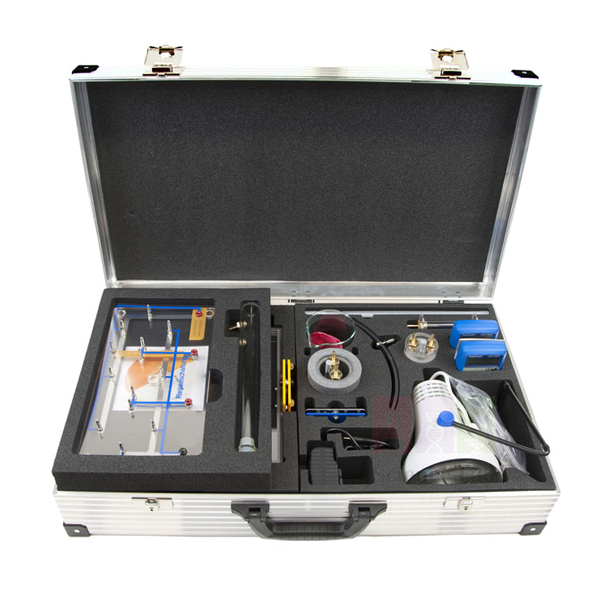
Solar Thermal Energy Ready-To-Go
Solar Thermal Energy Ready-To-Go (Product Code: SLE/PHY/225) is a complete, case-packed experiment system used to teach the different technologies of solar thermal energy conversion in school and college physics classes. Teachers use it to compare solar collectors run with or without a pump, concentrated solar power (CSP) and direct generation of electricity with a Peltier element. It is supplied by Jain Scientific Equipments Pvt Ltd (ScienceLab), Ambala, India, as a solar energy science kit that needs no additional equipment.
Specifications
| Parameter | Detail |
|---|---|
| Product line | Ready-to-go (fully equipped, location-independent use) |
| Technologies covered | Solar collector systems operated with or without pumps; CSP (Concentrated Solar Power); Peltier element for direct transformation into electrical energy |
| Thermodynamics basics | Absorption of heat radiation; convective flow of heat |
| Light source | Illuminant 120W, 12°, with lamp housing |
| Measuring items | 2 x digital multimeter, 1 x laboratory thermometer, 1 x temperature measuring sensor |
| Storage | Aluminium case "Thermal Energy RtG" with insert |
| Product code | SLE/PHY/225 |
| Supplied by | Jain Scientific Equipments Pvt Ltd (ScienceLab), Ambala, India |
List of components in the set:
- 1 x Solar-Base unit Large
- 1 x Solar collector
- 1 x Parabolic reflector
- 1 x Absorber tube
- 1 x Lens module and 1 x Absorber module for lens
- 1 x Hose-set and 1 x Pump module
- 1 x Power Module
- 1 x Motor module without gear and 1 x Propeller
- 1 x Lamp housing and 1 x Illuminant 120W, 12°
- 1 x Absorber B/W
- 1 x Peltier module
- 1 x Heat exchanger water and 1 x Heat exchanger paraffin
- 2 x Digital multimeter
- 1 x Laboratory thermometer and 1 x Temperature measuring sensor
- 1 x Cooling pad
- 2 x Sorting rubber d=65, mark P
- 1 x Beaker 250 ml
- 1 x Solar-CD
- 2 x Test lead black 50 cm and 2 x Test lead red 50 cm
- 1 x Aluminium case "Thermal Energy RtG" and 1 x Insert "Thermal Energy Ready-to-go"
- 1 x Packing layout plan (Einräumplan) Thermal Energy Ready-to-Go 2.0
What Is the Solar Thermal Energy Ready-To-Go Used For?
In a renewable energy or heat lesson, students can connect the solar collector to the pump module and hose set, watch the temperature of the circulating water rise, and then run the collector without the pump to compare the two arrangements. The parabolic reflector with its absorber tube, and the lens with its own absorber module, show how concentrating light produces higher temperatures, which is the idea behind CSP power stations. The Peltier module then turns heat directly into electrical energy that pupils can measure with the multimeters.
The 120W illuminant in its lamp housing lets the class work indoors, and the two digital multimeters, thermometer and temperature sensor let pupils record readings as each experiment runs. The black/white absorber supports work on the absorption of heat radiation, while the water and paraffin heat exchangers and the cooling pad support experiments on heat transfer, including the convective flow of heat. As a physics experiment kit for school and college labs, it keeps every part in one labelled aluminium case.
What to Specify When Ordering
- The number of complete Ready-To-Go cases needed for your student groups.
- Your mains supply, so we can confirm how the 120W illuminant and power module are to be powered at your site.
- Whether other Ready-To-Go sets (photovoltaic, wind, hydropower) are wanted for a complete renewable energy bench.
- Any extra test leads or multimeters you would like quoted alongside the kit.
Supplier
Jain Scientific Equipments Private Limited, which trades as ScienceLab, supplies the Solar Thermal Energy Ready-To-Go from Ambala, Haryana, to schools, colleges, vocational institutes and dealers in India and international markets. It is a sourced renewable energy kit, and our team can help you plan it alongside the other solar, wind and fuel-cell sets in the range. Read more about the company on the ScienceLab company profile.
Related Physics Lab Equipment
These items help build a wider renewable energy and heat-transfer bench around this kit:
- Solar Photovoltaic Ready-To-Go — the matching case-packed set for solar cell experiments.
- Solar Wind Ready-To-Go — a portable wind energy set for comparing another renewable source.
- Flat Plate Solar Thermal Energy Collector — a larger collector for engineering-level solar thermal work.
- Focusing Solar Energy Collector — extends concentrating (CSP-style) studies beyond the classroom kit.
- Thermal Conductivity Bars — simple apparatus for the heat-conduction basics behind collector design.
See the full range in Physics Lab Equipment.
Frequently Asked Questions
What is included with the Solar Thermal Energy Ready-To-Go?
The Solar Thermal Energy Ready-To-Go includes a large Solar-Base unit, solar collector, parabolic reflector, absorber tube, lens and absorber modules, pump and Peltier modules, water and paraffin heat exchangers, a 120W illuminant, two digital multimeters, a thermometer, a temperature sensor, test leads and a 250 ml beaker in an aluminium case.
Does the Solar Thermal Energy Ready-To-Go need any extra equipment?
No additional equipment is required for the Solar Thermal Energy Ready-To-Go. It belongs to the Ready-to-go line, which is designed for flexible, location-independent use, and it carries its own illuminant, power module, measuring instruments and leads inside the aluminium case.
Which topics can students study with the Solar Thermal Energy Ready-To-Go?
With the Solar Thermal Energy Ready-To-Go, students can study solar collectors with and without a pump, concentrated solar power, direct conversion of heat into electricity with a Peltier element, and thermodynamics basics such as the absorption of heat radiation and the convective flow of heat.
Who supplies the Solar Thermal Energy Ready-To-Go?
Jain Scientific Equipments Pvt Ltd (ScienceLab), Ambala, Haryana, supplies the Solar Thermal Energy Ready-To-Go to schools, colleges, dealers and institutions in India and international markets. It is a sourced kit, and we can advise on combining it with other renewable energy sets in the same range.
Is a calibration certificate available for the multimeters in the Solar Thermal Energy Ready-To-Go?
Calibration-certificate availability for the two digital multimeters in the Solar Thermal Energy Ready-To-Go should be discussed with us before ordering. Mention the requirement in your enquiry on the contact page so we can confirm what documentation can accompany the kit.
What should a quotation request for the Solar Thermal Energy Ready-To-Go include?
A quotation request for the Solar Thermal Energy Ready-To-Go should state the number of kits, the delivery city or country, and whether other Ready-To-Go sets are needed. Send it through the contact page or the enquiry cart, and we will reply with price and availability.
Request a Quote
To order the Solar Thermal Energy Ready-To-Go (SLE/PHY/225), send your requirement through the ScienceLab contact page or add it to the enquiry cart. We supply schools, colleges and distributors across India and international markets.
Last updated: 24 September 2026
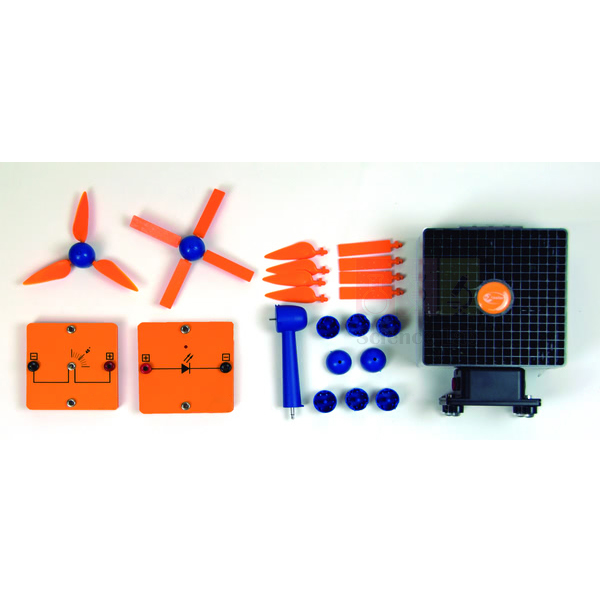
Solar Wind Basic
Solar Wind Basic (Product Code: SLE/PHY/226) is a beginner wind energy set used to introduce the working of wind turbines in primary and junior high school science lessons. Pupils change the number, shape and pitch of the rotor blades on a wind turbine module blown by the included wind machine, and a red LED module (2mA) is provided for simple output demonstrations. It is supplied by Jain Scientific Equipments Pvt Ltd (ScienceLab), Ambala, India, for use together with the Solar Minikit Basic or Solar Kit Basic.
Specifications
| Parameter | Detail |
|---|---|
| Level | Beginner package for the topic of wind energy |
| Parameters studied | Number of rotor blades, shape of rotor blades, rotor blade pitch |
| Wind source | Wind machine (included) |
| Output module | LED-module 2mA, red |
| Packing | Carton with insert "Wind basic" and layout diagram |
| Also required | Solar Minikit Basic (primary school) or Solar Kit Basic (junior high school), each containing the necessary accessories |
| Product code | SLE/PHY/226 |
| Supplied by | Jain Scientific Equipments Pvt Ltd (ScienceLab), Ambala, India |
List of components:
- 1 x Wind machine
- 1 x Wind turbine module
- 1 x Solar-Wind rotor set
- 1 x Wind rotor set (assembled)
- 1 x LED-module 2mA, red
- 1 x Carton and 1 x Insert Wind basic
- 1 x Layout diagram Wind Basic
- 1 x Instruction for use of finger protector
- 1 x Info sheet initial startup
What Is the Solar Wind Basic Used For?
A typical lesson starts with the assembled rotor set on the wind turbine module and the wind machine placed in front of it. Pupils then swap in rotors from the Solar-Wind rotor set, changing how many blades there are, their shape and their pitch, and compare how well each version turns. This playful approach builds an early understanding of why real wind turbines use the blade designs they do.
Before switching on, teachers should read the finger-protector instruction and the initial start-up sheet, and keep fingers clear of turning rotors. Schools that already use the Solar Minikit Basic or Solar Kit Basic can add wind energy topics with this hands-on science kit for primary school and junior classes, because those kits carry the accessories the wind set relies on.
What to Specify When Ordering
- The class level: primary school (pair with Solar Minikit Basic) or junior high school (pair with Solar Kit Basic).
- Whether you already own the Minikit Basic or Kit Basic, or need one quoted with the wind set.
- The number of Solar Wind Basic sets per class.
- Whether a larger wind system is planned later, so the sets can be matched.
Supplier
ScienceLab is the trading name of Jain Scientific Equipments Private Limited, Ambala, Haryana. We supply the Solar Wind Basic as a sourced renewable energy set to primary schools, secondary schools, science centres and distributors in India and international markets, and we can quote it together with its companion base kits so the order arrives ready for class. Company details are on the ScienceLab profile page.
Related Physics Lab Equipment
Pair or extend this wind energy set with:
- Solar Minikit Basic — the companion base kit for primary-level experiments.
- Solar Kit Basic — the companion kit for quantitative work in junior high school.
- Solar Wind Large — a fuller wind energy system for older students.
- Solar Hydropower Basic — another beginner renewable energy topic from the same line.
More apparatus is listed under Physics Lab Equipment.
Frequently Asked Questions
What does the Solar Wind Basic contain?
The Solar Wind Basic contains a wind machine, a wind turbine module, a Solar-Wind rotor set, an assembled wind rotor set, a red 2mA LED module, a carton with insert and layout diagram, a finger-protector instruction and an initial start-up info sheet.
Do I need anything else to use the Solar Wind Basic?
Yes. The Solar Wind Basic is used with the Solar Minikit Basic in primary school or with the Solar Kit Basic in junior high school. Each of those kits contains the accessories needed to run the wind experiments, so one of them should be ordered if you do not already have it.
What can pupils investigate with the Solar Wind Basic?
Pupils using the Solar Wind Basic can investigate how the number of rotor blades, the shape of the blades and the rotor blade pitch affect a wind turbine. These are the core beginner experiments that explain how wind turbines convert moving air into useful energy.
How should teachers prepare the Solar Wind Basic for a class?
Teachers should read the initial start-up info sheet and the finger-protector instruction supplied with the Solar Wind Basic before the lesson. Set the wind machine in front of the turbine module, supervise pupils while rotors turn, and keep fingers and loose items away from the blades.
Who supplies the Solar Wind Basic?
Jain Scientific Equipments Pvt Ltd (ScienceLab), Ambala, Haryana, supplies the Solar Wind Basic to schools, institutions and dealers in India and international markets. It is a sourced set, and we can quote the matching Solar Minikit Basic or Solar Kit Basic in the same order.
How do I get a quotation for the Solar Wind Basic?
To get a quotation for the Solar Wind Basic, send the number of sets, the class level and your delivery location through the contact page. Mention whether you also need the Minikit Basic or Kit Basic so we can price everything together.
Request a Quote
For prices and availability of the Solar Wind Basic (SLE/PHY/226), contact us through the ScienceLab contact page or place it in the enquiry cart with any companion kits you need.
Last updated: 24 September 2026
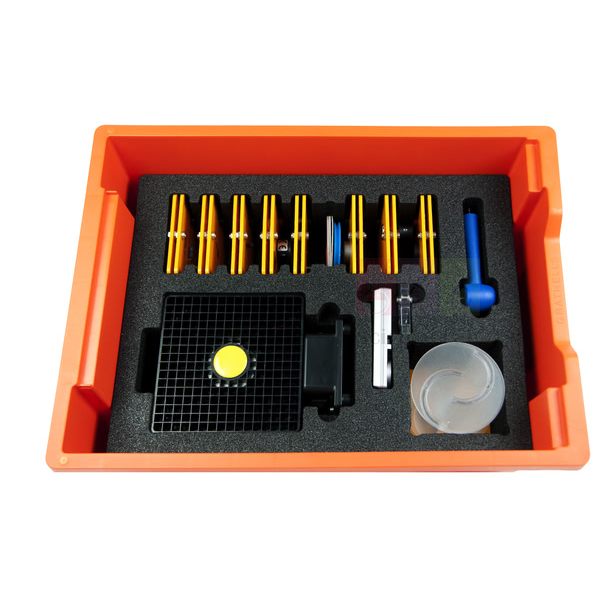
Solar Wind Large
Solar Wind Large (Product Code: SLE/PHY/227) is a wind energy experiment system used to teach the basics of using wind power in school physics, from simple qualitative trials to complete quantitative experiments. Students investigate how wind speed, wind direction and rotor type influence power output, with curriculum-based trials described for learners from age 11 to 13 and up to age 19. It is supplied by Jain Scientific Equipments Pvt Ltd (ScienceLab), Ambala, India, for schools building a renewable energy course.
Key Details
| Parameter | Detail |
|---|---|
| System type | Experiment system on the basics of using wind energy |
| Example investigations | Effect of wind speed, wind direction and rotor type on power output |
| Teaching approach | Curriculum-based trials on the topics needed to understand wind power plants |
| Qualitative experiments | For students aged 11 to 13 |
| Quantitative experiments | Complete trials for physics lessons up to age 19 |
| Experiment descriptions | Qualitative and quantitative trials described in detail |
| Contents list | Available on request before ordering |
| Product code | SLE/PHY/227 |
| Supplied by | Jain Scientific Equipments Pvt Ltd (ScienceLab), Ambala, India |
What Is the Solar Wind Large Used For?
One system can serve several year groups. Younger students aged 11 to 13 carry out qualitative experiments, for example noticing how a rotor responds when the wind gets stronger or changes direction. Older physics classes, up to age 19, follow the detailed quantitative trials and record how power output changes with wind speed, wind direction and the type of rotor fitted.
Because the trials are built around how wind power plants actually function, the results lead naturally into discussions of turbine siting, rotor choice and why output varies from day to day. It suits schools looking for physics lab equipment in India that covers renewable energy across middle and senior classes, and a separate wind speed meter can be added for measuring conditions in the room.
What to Specify When Ordering
- The age groups you teach: qualitative work (11 to 13), quantitative work (up to 19) or both.
- How many systems you need for your student groups.
- Whether you want the current contents list sent to you with the quotation.
- Any companion items, such as a wind speed meter or other sets from the same renewable energy line.
Supplier
Jain Scientific Equipments Private Limited trades as ScienceLab and supplies the Solar Wind Large from Ambala, Haryana, to schools, colleges, teacher-training centres and distributors in India and international markets. For vendor registration, the supplying company's details are GSTIN 06AAECJ8618A1ZT and LEI 3358004HRD1JIVXKYX49. See the ScienceLab company profile for more about us.
Related Physics Lab Equipment
Useful additions for a wind energy teaching bench:
- Solar Wind Basic — a beginner wind set for younger pupils.
- Solar Wind Ready-To-Go — a portable case version for teaching away from the lab.
- Thermo-Anemometer — a hand-held meter for checking air velocity during wind-speed trials.
- Solar Photovoltaic Large — the photovoltaic system for solar power lessons alongside wind.
Explore the full Physics Lab Equipment range.
Frequently Asked Questions
What experiments does the Solar Wind Large support?
The Solar Wind Large supports experiments on the basics of wind energy, including how wind speed, wind direction and rotor type influence power output. Its curriculum-based trials cover the topics students need to understand how wind power plants function.
Which age groups is the Solar Wind Large designed for?
The Solar Wind Large is designed for a wide age range: qualitative experiments are described for students aged 11 to 13, and complete quantitative trials are described for physics lessons up to age 19, so one system can follow students through several years.
What components come with the Solar Wind Large?
The component list for the Solar Wind Large is not shown on this page. Ask us through the contact page for the current contents list, so you can check it against your syllabus and existing equipment before ordering.
How is the Solar Wind Large different from a beginner wind set?
The Solar Wind Large goes beyond beginner blade experiments: it covers wind speed, wind direction and rotor type, with qualitative trials for ages 11 to 13 and full quantitative trials up to age 19. For younger beginners only, the Solar Wind Basic may be the better starting point.
Who supplies the Solar Wind Large?
Jain Scientific Equipments Pvt Ltd (ScienceLab), Ambala, Haryana, supplies the Solar Wind Large to schools, colleges and dealers in India and international markets. It is a sourced renewable energy system, and we can quote it with other sets from the same line.
What information does a quotation for the Solar Wind Large need?
A quotation for the Solar Wind Large needs the number of systems, the age groups you teach, your delivery location and any companion items. Send these details through the contact page or the enquiry cart and we will respond with price and availability.
Request a Quote
Ask for a price on the Solar Wind Large (SLE/PHY/227) through the ScienceLab contact page, or add it to the enquiry cart and submit your list in one go.
Last updated: 24 September 2026
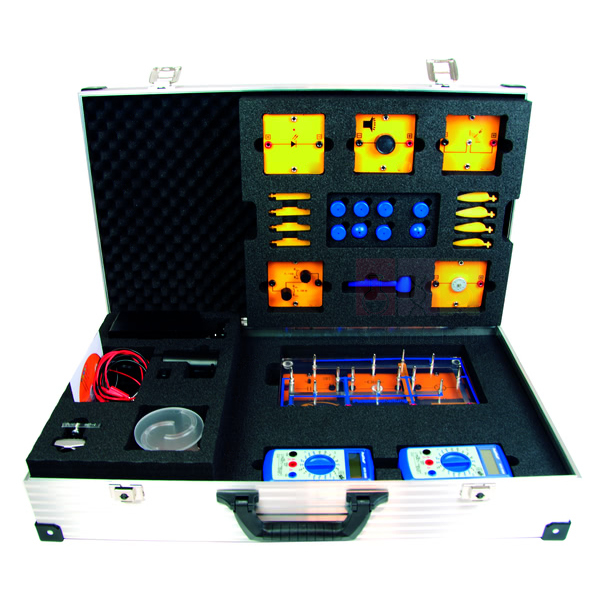
Solar Wind Ready-To-Go
Solar Wind Ready-To-Go (Product Code: SLE/PHY/228) is a portable wind energy experiment kit used to teach how wind turbines produce power in secondary school and vocational education classes. Its distinguishing point is that the Measurements without Meters and Digital Anemometer extension sets are already included, packed in a handy, sturdy aluminium carry case with accompanying teaching resources. It is supplied by Jain Scientific Equipments Pvt Ltd (ScienceLab), Ambala, India.
Key Details
| Parameter | Detail |
|---|---|
| Design | Wind Ready-to-go system geared for portability and utility |
| Extension sets included | Measurements without Meters; Digital Anemometer |
| Suitable for | Secondary school students and vocational education |
| Case | Handy, sturdy aluminium carry case |
| Teaching material | Accompanying teaching resources |
| Full contents list | Sent on request with the quotation |
| Product code | SLE/PHY/228 |
| Supplied by | Jain Scientific Equipments Pvt Ltd (ScienceLab), Ambala, India |
What Is the Solar Wind Ready-To-Go Used For?
The kit is built for teachers who move between rooms or run sessions away from a fixed lab: open the aluminium case, set out the wind experiment, and pack it away again at the end of the period. With the Digital Anemometer set, students can measure the wind speed reaching the rotor and link it to what the turbine delivers, while the Measurements without Meters set is intended for experiments that do not depend on separate measuring instruments.
In vocational education, the same case supports practical sessions on renewable energy for trainee technicians, and the accompanying teaching resources help instructors plan each activity. For schools, it works as a portable science kit for students in secondary classes who are studying energy resources and electricity generation.
What to Specify When Ordering
- The number of cases required for your groups.
- Whether the kit is for secondary school or vocational training, so we can advise on companion sets.
- Whether you would like the full contents list confirmed before you place the order.
- Any other Ready-To-Go sets (photovoltaic, solar thermal, smart grid) wanted in the same shipment.
Supplier
The Solar Wind Ready-To-Go is supplied by Jain Scientific Equipments Private Limited, known by its trading name ScienceLab, from Ambala, Haryana. We source this case-packed wind kit for secondary schools, polytechnics, vocational training centres and dealers in India and international markets, and we can combine it with other renewable energy sets on one quotation. Find out more on the ScienceLab company profile.
Related Physics Lab Equipment
Other items that fit a renewable energy course with this kit:
- Solar Wind Large — a classroom wind system with qualitative and quantitative trials.
- Solar Wind Basic — an entry-level set for younger pupils.
- Solar Photovoltaic Ready-To-Go — the case-packed partner for solar cell experiments.
- Solar Smart Grid Ready-To-Go — a case-packed set for combining several renewable sources in one grid.
Browse all Physics Lab Equipment.
Frequently Asked Questions
What is included with the Solar Wind Ready-To-Go?
The Solar Wind Ready-To-Go includes the Measurements without Meters and Digital Anemometer extension sets, an aluminium carry case and accompanying teaching resources. Ask us through the contact page for the full component-by-component contents list before ordering.
Who is the Solar Wind Ready-To-Go suitable for?
The Solar Wind Ready-To-Go is equally suited to secondary school students and to vocational education. Teachers and instructors use it to show how wind turbines turn moving air into electrical energy, with a wider range of experiments made possible by its two included extension sets.
Why choose the Ready-To-Go version of the wind kit?
The Solar Wind Ready-To-Go is geared for portability: the parts travel together in a sturdy aluminium carry case, so the kit can be taken to any classroom and packed away quickly. It also comes with the Digital Anemometer and Measurements without Meters sets already included.
How is the Solar Wind Ready-To-Go powered?
The power arrangement for the wind machine in the Solar Wind Ready-To-Go is not stated on this page. Please tell us your local mains supply when you enquire, and we will confirm how the kit is powered and what is needed at your site.
Who supplies the Solar Wind Ready-To-Go?
Jain Scientific Equipments Pvt Ltd (ScienceLab), Ambala, Haryana, supplies the Solar Wind Ready-To-Go to schools, vocational institutes and dealers in India and international markets. It is a sourced kit, and we can quote it alongside other Ready-To-Go sets from the same line.
How can I request a quotation for the Solar Wind Ready-To-Go?
Request a quotation for the Solar Wind Ready-To-Go by sending the quantity, the type of institution and the delivery location through the contact page or the enquiry cart. We will reply with price, availability and the contents list if you ask for it.
Request a Quote
For the Solar Wind Ready-To-Go (SLE/PHY/228), contact our sales team via the ScienceLab contact page or add the kit to the enquiry cart.
Last updated: 24 September 2026
Light Energy Kit
Light Energy Kit (Product Code: SLE/PHY/229) is a classroom activity kit used to help students understand the properties of light energy in school science and physics lessons. It provides 18 activities covering light transmission, light theory and colour, light sources, reflection, refraction and diffraction, and a Teacher's Guide is included. It is supplied by Jain Scientific Equipments Pvt Ltd (ScienceLab), Ambala, India, as an optics experiment kit for schools.
Key Details
| Parameter | Detail |
|---|---|
| Number of activities | 18 |
| Topics covered | Light transmission; light theory and colour; light sources; reflection; refraction; diffraction of light |
| Teacher support | Teacher's Guide included |
| Learning aim | Understanding the properties of light energy |
| Component list | Available on request |
| Product code | SLE/PHY/229 |
| Supplied by | Jain Scientific Equipments Pvt Ltd (ScienceLab), Ambala, India |
What Is the Light Energy Kit Used For?
Teachers can run the 18 activities as a complete unit on light. A sensible order is to begin with light sources and how light is transmitted through different materials, move on to light theory and colour, then study reflection and refraction, and finish with diffraction, where light spreads as it passes edges and narrow openings. Each step builds on the one before, so students see light as a form of energy with predictable behaviour.
The Teacher's Guide helps both specialist and non-specialist staff prepare each session. For reflection and refraction activities, a dimmed room makes rays easier to see, and keeping all parts together in the kit after each lesson makes the set ready for the next class. It is a straightforward optics experiment kit for school science departments.
What to Specify When Ordering
- How many kits you need: one per student group or one for teacher demonstration.
- The class level and syllabus you are teaching, so we can confirm the kit suits it.
- Whether you want the component list sent with the quotation.
- Any companion optics items, such as a raybox or prism set.
Supplier
Jain Scientific Equipments Private Limited, trading as ScienceLab from Ambala, Haryana, supplies the Light Energy Kit to schools, science centres, teacher-training institutes and dealers in India and international markets. We can combine it with other optics apparatus on a single quotation so a physics department can equip its light unit in one order. Learn more on the ScienceLab profile page.
Related Physics Lab Equipment
Optics apparatus that extends the kit's activities:
- Raybox, 12V — a ray light source for reflection and refraction work.
- Light Guide Demonstrator — an acrylic bar for showing total internal reflection.
- Prism – Acrylic, Set of 7 — shaped blocks for tracing refracted rays.
- Light Box and Optical Set — for reflection, refraction and colour mixing experiments.
See more in Physics Lab Equipment.
Frequently Asked Questions
How many activities does the Light Energy Kit include?
The Light Energy Kit includes 18 activities. They cover light transmission, light theory and colour, light sources, reflection, refraction and diffraction of light, giving teachers a structured sequence for a full unit on the properties of light energy.
Is a teacher's guide included with the Light Energy Kit?
Yes, a Teacher's Guide is included with the Light Energy Kit. It supports teachers in preparing and running the activities, which is helpful for schools where light and optics lessons are taught by general science staff.
What components are in the Light Energy Kit?
The individual components of the Light Energy Kit are not listed on this page. Please ask for the contents list through the contact page so you can check it against your syllabus and the equipment you already have.
Which classes can use the Light Energy Kit?
The Light Energy Kit is intended for school students learning about the properties of light. Tell us your class level and syllabus when you enquire and we will confirm how well its 18 activities match what you teach.
Who supplies the Light Energy Kit?
Jain Scientific Equipments Pvt Ltd (ScienceLab), Ambala, Haryana, supplies the Light Energy Kit to schools, institutions and dealers in India and international markets, and can quote it with rayboxes, prisms and other optics items.
What should I include when requesting a quotation for the Light Energy Kit?
When requesting a quotation for the Light Energy Kit, include the number of kits, your class level, the delivery location and any companion optics items. Send it through the contact page or the enquiry cart and we will reply with price and availability.
Request a Quote
To get a price for the Light Energy Kit (SLE/PHY/229), write to us through the ScienceLab contact page or add it to the enquiry cart.
Last updated: 24 September 2026
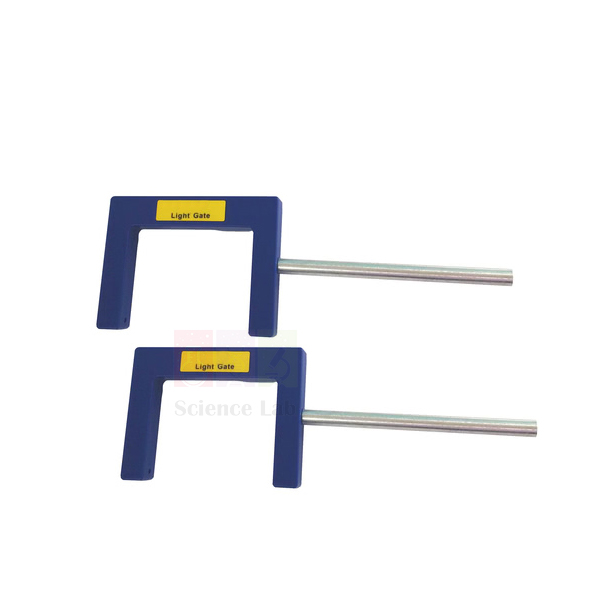
Light Gates/Timing Gates
Light Gates/Timing Gates (Product Code: SLE/PHY/230) is a pair of timer gates used to start and stop an electronic timer as a moving object passes, in school and college mechanics experiments. The two gates link to the timer through DIN connections, so the time between them is recorded electronically instead of with a hand-held stopwatch. They are supplied by Jain Scientific Equipments Pvt Ltd (ScienceLab), Ambala, India, for motion and acceleration practicals.
Key Details
| Parameter | Detail |
|---|---|
| Quantity | Pair of timer gates |
| Connection | DIN connections |
| Used with | A timer (ask us to confirm the match with your timer's inputs) |
| Typical use | Timing moving objects in speed, acceleration and free-fall experiments |
| Product code | SLE/PHY/230 |
| Supplied by | Jain Scientific Equipments Pvt Ltd (ScienceLab), Ambala, India |
What Are Light Gates/Timing Gates Used For?
A light gate senses the moment an object breaks its beam. With two gates set a measured distance apart, the timer records how long a trolley, air-track glider or falling object takes to travel between them, giving an average speed. Passing a card of known length through the gates lets students work out speed at each gate, and from the change in speed, the acceleration.
For reliable readings, mount both gates so the card or object crosses the beam cleanly, measure the gap between them carefully, and run a few trial passes before recording results. Electronic timing removes human reaction time from the measurement, which is why light gates are standard mechanics lab equipment in India for Newton's laws, momentum and free-fall practicals.
What to Specify When Ordering
- The timer you will connect the gates to, so we can confirm the DIN connections suit its inputs.
- The number of pairs needed for your practical groups.
- Whether a timer, track or trolley should be quoted with the gates.
Supplier
ScienceLab, the trading name of Jain Scientific Equipments Private Limited in Ambala, Haryana, supplies these light gates to schools, colleges, polytechnics and dealers in India and international markets. Tell us which timer your lab uses and we will help you put together a matching set of mechanics apparatus. Company information is on the ScienceLab company profile.
Related Physics Lab Equipment
Apparatus that is often timed with light gates:
- Millisecond Timer — a timer with input sockets for light gates and manual switches.
- Linear Air Track — a low-friction track whose gliders can be timed between gates.
- Dynamics Trolley, Plastic — a runway trolley for speed and acceleration runs.
- G By Freefall Apparatus and Timer — for measuring the acceleration due to gravity.
Find more apparatus in Physics Lab Equipment.
Frequently Asked Questions
How many gates are supplied as Light Gates/Timing Gates?
Light Gates/Timing Gates are supplied as a pair of timer gates with DIN connections. Using two gates lets students time an object between two points, which is the basis of most speed and acceleration measurements in school mechanics.
Which timer works with the Light Gates/Timing Gates?
The Light Gates/Timing Gates are made for use with a timer through DIN connections. Tell us the make and input sockets of your timer through the contact page, and we will confirm compatibility or suggest a suitable timer from our range.
What experiments can be done with Light Gates/Timing Gates?
Light Gates/Timing Gates can be used to measure the speed and acceleration of trolleys and air-track gliders, time collisions for momentum work, and record falling objects in acceleration-due-to-gravity experiments, wherever an electronic start and stop signal is more accurate than hand timing.
How should Light Gates/Timing Gates be positioned?
Position the Light Gates/Timing Gates so the moving object or its card passes cleanly through each beam, then measure the distance between the gates accurately. A few trial runs before recording help confirm the timer starts and stops as expected.
Who supplies the Light Gates/Timing Gates?
Jain Scientific Equipments Pvt Ltd (ScienceLab), Ambala, Haryana, supplies the Light Gates/Timing Gates to schools, colleges and dealers in India and international markets, and can quote them together with timers, tracks and trolleys.
What does a quotation for Light Gates/Timing Gates need?
A quotation for Light Gates/Timing Gates needs the number of pairs, the timer you will use and your delivery location. Send these through the contact page or the enquiry cart, and we will reply with price, availability and any compatibility notes.
Request a Quote
Send your enquiry for Light Gates/Timing Gates (SLE/PHY/230) through the ScienceLab contact page, or add them to the enquiry cart with any timer or track you need.
Last updated: 24 September 2026

Light Guide Demonstrator
Light Guide Demonstrator (Product Code: SLE/PHY/231) is an S-shaped acrylic bar used to demonstrate total internal reflection and the principle behind optical fibres in school physics optics lessons. Measuring 220 x 20 x 20 mm, it is used with a raybox, and the bottom of the bar is painted white to aid visibility of the light path. It is made by Jain Scientific Equipments Pvt Ltd (ScienceLab), an OEM manufacturer, at its own factory in Ambala, India.
Specifications
| Parameter | Detail |
|---|---|
| Shape | 'S' shaped bar |
| Material | Acrylic |
| Dimensions | 220 x 20 x 20 mm |
| Finish | Bottom of the bar painted white to aid visibility |
| Light source | Used with a raybox (listed separately) |
| Demonstrates | Total internal reflection; principles of optical communications |
| Product code | SLE/PHY/231 |
| Manufacturer | Jain Scientific Equipments Pvt Ltd (ScienceLab) — OEM |
| Country of origin | India (made in Ambala, Haryana) |
What Is the Light Guide Demonstrator Used For?
When a raybox beam is directed into one end of the bar, the light does not leak out at the bends. Each time it meets the acrylic surface at a large enough angle it is totally internally reflected, so it zig-zags along the S-shape and emerges from the far end. Students can see that light can be guided around corners, which is exactly how optical fibres carry telephone and internet signals.
For the clearest view, dim the room lights and align the beam squarely with the end face; the white-painted base helps the reflected path stand out. Wipe the acrylic with a soft, clean cloth and store it where it will not be scratched, because surface marks let light escape. It is a simple, durable piece of optics lab equipment for school and college physics departments across India.
OEM Manufacturer
Jain Scientific Equipments Private Limited trades as ScienceLab and is the OEM (original equipment manufacturer) of the Light Guide Demonstrator. The company is incorporated under CIN U29309HR2020PTC087597, and production takes place at the company's licensed factory at 449, HSIIDC Industrial Area, Saha, Ambala (Factory Licence AMB-ONLINE-CHD-J-414). Because the demonstrator is made by the manufacturer itself rather than bought from a trader, schools, colleges, dealers and importers receive it factory-direct, and replacement bars or repeat orders can be discussed with us directly. Read more on the ScienceLab company profile.
Related Physics Lab Equipment
Items used alongside the light guide in optics practicals:
- Raybox, 12V — the ray light source needed to send a beam into the bar.
- Raybox Mirrored with Accessories — a raybox with channels for slit plates and colour filters.
- Prism – Acrylic, Set of 7 — includes a semi-circular block for critical-angle work.
- Prism – Glass Rectangular Block — for tracing refraction through glass.
- Light Energy Kit — activities on reflection, refraction and other properties of light.
Browse the complete Physics Lab Equipment range.
Frequently Asked Questions
What does the Light Guide Demonstrator show?
The Light Guide Demonstrator shows total internal reflection: light entering one end of the curved acrylic bar is reflected inside it and follows the S-shape to the other end. This helps students understand the principles of optical communications and how optical fibres guide light.
What size and material is the Light Guide Demonstrator?
The Light Guide Demonstrator is an S-shaped acrylic bar measuring 220 x 20 x 20 mm. The bottom of the bar is painted white to aid visibility, so the path of the light inside the bar is easier for a class to follow.
Is a raybox included with the Light Guide Demonstrator?
The Light Guide Demonstrator is the acrylic bar itself and is designed to be used with a raybox, which is listed as a separate product. If you need both, ask us through the contact page to quote the bar and a raybox together.
Who manufactures the Light Guide Demonstrator?
The Light Guide Demonstrator is manufactured by Jain Scientific Equipments Pvt Ltd (ScienceLab), the OEM, at its own licensed factory at Saha, Ambala, Haryana, India. Buyers deal directly with the maker for quotations, repeat orders and replacement bars.
How should the Light Guide Demonstrator be cared for?
Keep the Light Guide Demonstrator clean and scratch-free: wipe it with a soft cloth, avoid abrasive cleaners, and store it separately from metal apparatus. Scratches on the acrylic surface let light escape and weaken the total internal reflection effect.
Can the Light Guide Demonstrator be ordered in bulk for several labs?
Yes, the Light Guide Demonstrator can be quoted in class-set quantities for schools, institutions, dealers and importers in India and international markets. State the quantity and delivery location in your enquiry and the quotation will come directly from the manufacturer.
Request a Quote
For the Light Guide Demonstrator (SLE/PHY/231), send your requirement through the ScienceLab contact page or add it to the enquiry cart; quotations come straight from the manufacturer in Ambala.
Last updated: 24 September 2026
Line Shaft Unit
Line Shaft Unit (Product Code: SLE/PHY/232) is a base-mounted shaft and pulley unit used to show electrical energy being converted into potential energy, by winding up a weight on a cord, in school physics energy lessons. It is one of the separately available units of the Energy Transfer Kit, built on a 165 x 100 mm base with a 6 mm steel shaft and a 56 mm aluminium 'V' pulley. It is made by Jain Scientific Equipments Pvt Ltd (ScienceLab), an OEM manufacturer, at its own factory in Ambala, India.
Specifications
| Parameter | Detail |
|---|---|
| Kit | Energy Transfer Kit (units available separately) |
| Base size | 165 x 100 mm (common to all kit units) |
| Shaft | 6 mm steel |
| Pulley | 56 mm diameter aluminium 'V' pulley at one end |
| Opposite end | Cord anchoring collar |
| Terminals | Kit units have 4 mm socket terminals where appropriate |
| Demonstrates | Conversion of electrical energy to potential energy by winding up a weight on a cord |
| Product code | SLE/PHY/232 |
| Manufacturer | Jain Scientific Equipments Pvt Ltd (ScienceLab) — OEM |
| Country of origin | India (made in Ambala, Haryana) |
What Is the Line Shaft Unit Used For?
In an energy-transfer lesson, an electrically driven unit turns the line shaft through its V pulley. The cord, fixed by the anchoring collar, winds onto the turning shaft and lifts a weight, so the electrical energy put in ends up stored as gravitational potential energy of the raised mass. Students can note the mass and the height gained to calculate that stored energy, then compare it with the electrical energy supplied to discuss efficiency and losses.
Because every unit in the Energy Transfer Kit shares the same 165 x 100 mm base, the line shaft lines up neatly beside the other units on the bench, and teachers can build different chains of energy conversion from the same set. It is a practical piece of school physics lab equipment in India for teaching energy stores and transfers.
What to Specify When Ordering
- Which other Energy Transfer Kit units you need to drive or extend the line shaft.
- The number of Line Shaft Units per lab or per student group.
- Whether a weight and cord should be quoted, as these are not listed with the unit.
OEM Manufacturer
The Line Shaft Unit is produced by Jain Scientific Equipments Private Limited, trading as ScienceLab, which is the OEM (original equipment manufacturer) for its Energy Transfer Kit units. The company makes this apparatus at its own licensed factory in Saha, Ambala, Haryana, and supplies it factory-direct to schools, colleges, laboratory dealers and importers in India and international markets. If you need extra units to complete a kit, or spare parts later, ask the manufacturer directly. More about the company is on the ScienceLab profile page.
Related Physics Lab Equipment
Other units and items used with the line shaft:
- Handwheel Drive Unit — a hand-turned pulley drive from the same kit.
- Spring Unit — stores energy in a clock spring and can also wind a weight on a cord.
- Mounted Motor for Solar Cell — a small motor unit on the same base size for light-to-motion chains.
- Mass, Cast Alloy, Hanger — slotted masses that can serve as the load lifted on the cord.
See all Physics Lab Equipment.
Frequently Asked Questions
What does the Line Shaft Unit demonstrate?
The Line Shaft Unit demonstrates the conversion of electrical energy into potential energy. When the shaft is driven, a cord anchored at one end winds up and lifts a weight, showing students how energy supplied electrically can be stored in a raised mass.
What are the main dimensions of the Line Shaft Unit?
The Line Shaft Unit is built on a 165 x 100 mm base, like every Energy Transfer Kit unit. It has a 6 mm steel shaft carrying a 56 mm diameter aluminium 'V' pulley at one end and a cord anchoring collar at the other.
What drives the Line Shaft Unit?
The Line Shaft Unit is driven through its 56 mm V pulley by another unit, and it is intended for showing electrical energy turning into potential energy. Tell us which drive or motor unit you plan to use via the contact page and we will confirm the best arrangement.
Are a weight and cord included with the Line Shaft Unit?
A weight and cord are not listed as part of the Line Shaft Unit. Ask us when you enquire if you would like suitable masses and cord quoted with it, so the unit is ready for the winding experiment as soon as it arrives.
Who manufactures the Line Shaft Unit?
The Line Shaft Unit is manufactured by Jain Scientific Equipments Pvt Ltd (ScienceLab), the OEM, at its own licensed factory at Saha, Ambala, Haryana, India. Quotations, repeat orders and additional kit units are handled by the manufacturer itself.
Can other Energy Transfer Kit units be ordered with the Line Shaft Unit?
Yes. The Energy Transfer Kit is made up of separately available units, so the Line Shaft Unit can be ordered alone or together with drive, spring and motor units. List the units and quantities in your enquiry for a combined quotation.
Request a Quote
For the Line Shaft Unit (SLE/PHY/232), request a factory-direct quotation through the ScienceLab contact page or add it to the enquiry cart with the other kit units you need.
Last updated: 24 September 2026
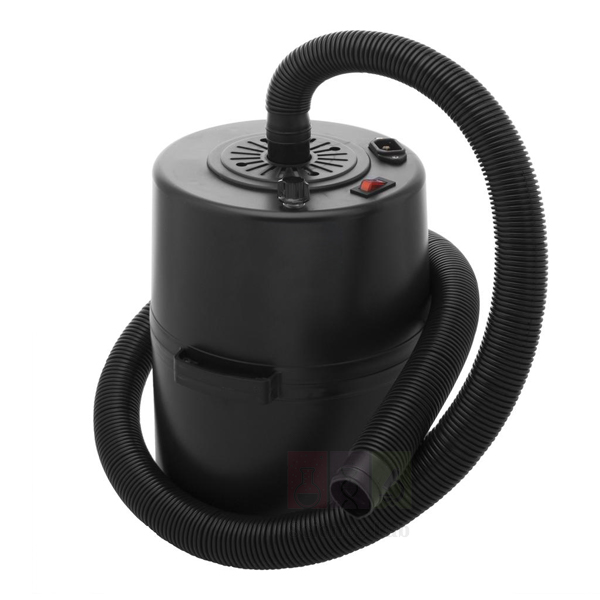
Linear Air Track Blower
Linear Air Track Blower (Product Code: SLE/PHY/233) is an electronically controlled air supply unit used to feed a steady flow of air to a linear air track in school and college mechanics laboratories. Its 700W motor runs on 220-240V 50Hz and delivers a constant volume and pressure through a flexible hose with a 30 mm internal diameter, helping experiments give more accurate results. It is supplied by Jain Scientific Equipments Pvt Ltd (ScienceLab), Ambala, India.
Specifications
| Parameter | Detail |
|---|---|
| Control | Electronically controlled |
| Motor | 220-240V 50Hz, 700W |
| Air delivery | Constant volume and pressure |
| Hose | Flexible hose for connection to the Linear Air Track |
| Hose internal diameter | 30 mm |
| Recommended for | Linear Air Track |
| Designed for | Laboratory use |
| Product code | SLE/PHY/233 |
| Supplied by | Jain Scientific Equipments Pvt Ltd (ScienceLab), Ambala, India |
What Is the Linear Air Track Blower Used For?
The blower is the air source that makes an air track work. Once the hose is attached to the track's inlet and the unit is switched on, air escapes through the small holes along the track and the gliders float on a thin cushion, so friction almost disappears. Students can then study Newton's laws, collisions and the conservation of momentum with results that are much closer to theory than on a normal runway.
Because the unit keeps the volume and pressure of air constant, the gliders ride at a steady height throughout each run, which makes repeated timings consistent. Check that the hose is pushed fully onto the track inlet, stand the blower where its airflow and vibration will not disturb the track, and switch it on before placing gliders. We act as a physics instruments supplier in India for schools that already own, or are buying, an air track.
What to Specify When Ordering
- Your mains supply; the motor is rated 220-240V 50Hz, so tell us if your site differs.
- The air track the blower will feed, so we can check the 30 mm hose suits its inlet.
- The number of blowers needed (usually one per track in use at the same time).
- Whether light gates or a timer should be quoted for glider experiments.
Supplier
Jain Scientific Equipments Private Limited, trading as ScienceLab in Ambala, Haryana, supplies the Linear Air Track Blower to schools, colleges, engineering institutes and dealers in India and international markets. We can quote the blower on its own as a replacement air source, or together with a track and timing equipment as a complete set-up. Visit the ScienceLab company profile to learn more about us.
Related Physics Lab Equipment
Complete an air-track workstation with:
- Linear Air Track — the track this blower is recommended for.
- Apparatus Air Track Part Kit — parts for building up air-track experiments.
- Light Gates/Timing Gates — a pair of gates for timing gliders electronically.
- Millisecond Timer — a timer with inputs for light gates.
View the whole Physics Lab Equipment category.
Frequently Asked Questions
What power supply does the Linear Air Track Blower need?
The Linear Air Track Blower has a 700W motor rated for 220-240V 50Hz mains. If your laboratory uses a different supply voltage or frequency, mention it in your enquiry so we can advise before you order.
Which air track does the Linear Air Track Blower suit?
The Linear Air Track Blower is recommended for use with the Linear Air Track and connects through a flexible hose with a 30 mm internal diameter. For another make of track, send us its inlet size through the contact page and we will check the fit.
Why does a constant air supply matter on an air track?
A constant air supply matters because it keeps gliders floating at a steady height. The Linear Air Track Blower delivers a constant volume and pressure, so friction stays low and even along the track and repeated measurements of speed and momentum give more accurate results.
Is a hose included with the Linear Air Track Blower?
Yes, the Linear Air Track Blower has a flexible hose for connection to the Linear Air Track. The hose has an internal diameter of 30 mm; ask us if you need a longer run or a spare hose quoted.
Who supplies the Linear Air Track Blower?
Jain Scientific Equipments Pvt Ltd (ScienceLab), Ambala, Haryana, supplies the Linear Air Track Blower to schools, colleges and dealers in India and international markets. It is a sourced electrical unit, and we can supply it with a matching air track and timing apparatus.
What should a quotation request for the Linear Air Track Blower include?
A quotation request for the Linear Air Track Blower should include the quantity, your mains supply, the air track it will serve and your delivery location. Send it through the contact page or the enquiry cart and we will reply with price and availability.
Request a Quote
To buy the Linear Air Track Blower (SLE/PHY/233), send an enquiry through the ScienceLab contact page or add it to the enquiry cart along with any track or timing items.
Last updated: 24 September 2026
Loudspeaker Unit
Loudspeaker Unit (Product Code: SLE/PHY/234) is a boxed 75 mm loudspeaker used to turn the output of a signal generator or amplifier into audible sound for school physics experiments on sound and waves. The 8 ohm, 5W speaker is mounted in an ABS plastic box of 150 x 98 x 60 mm, with two 4 mm sockets for connection and a boss for retort stand mounting. It is supplied by Jain Scientific Equipments Pvt Ltd (ScienceLab), Ambala, India.
Specifications
| Parameter | Detail |
|---|---|
| Loudspeaker diameter | 75 mm |
| Resistance | 8 ohm |
| Nominal power | 5W |
| Housing | ABS plastic box |
| Box dimensions | 150 x 98 x 60 mm (depth 60 mm; described as about 150 x 100 x 60 mm) |
| Connections | Two 4 mm sockets |
| Mounting | Boss for retort stand mounting |
| Product code | SLE/PHY/234 |
| Supplied by | Jain Scientific Equipments Pvt Ltd (ScienceLab), Ambala, India |
What Is the Loudspeaker Unit Used For?
Connected to a signal generator with 4 mm leads, the unit lets a class hear how changing frequency changes pitch and how changing amplitude changes loudness. Teachers use it to explore the range of human hearing, to show interference patterns by driving two speakers from one source, and to supply sound for resonance-tube and standing-wave experiments.
The boss means the speaker can be clamped to a retort stand at any height and pointed exactly where it is needed, for example into the mouth of a tube or towards a microphone. Start each experiment at low amplitude and keep the drive within the speaker's 5W nominal rating. It is a handy item of physics lab equipment in India for any department teaching sound waves.
What to Specify When Ordering
- The quantity: one unit per bench, or two where interference experiments are planned.
- The signal generator or amplifier you will use, so we can check it suits an 8 ohm, 5W load.
- Whether retort stands or 4 mm connecting leads should be quoted as well.
Supplier
ScienceLab is the trading name of Jain Scientific Equipments Private Limited, based in Ambala, Haryana. We supply the Loudspeaker Unit to schools, colleges, teacher-training institutes and laboratory dealers in India and international markets, and can match it with a signal generator and stand so the set is ready for sound lessons. Company details are on the ScienceLab profile page.
Related Physics Lab Equipment
Items that work with the loudspeaker in sound experiments:
- Signal Generator & Amplifier — supplies sine, square and triangular signals to drive the speaker.
- Signal Generator and Amplifier — an alternative generator for frequency and pitch work.
- Retort Stand — for holding the unit by its boss at the right height.
- Resonance Apparatus with Brass Tube — for resonance experiments driven by a sound source.
- Tuning Fork on Resonance Box — a fixed-pitch source for comparing with the speaker.
More items are listed under Physics Lab Equipment.
Frequently Asked Questions
What are the specifications of the Loudspeaker Unit?
The Loudspeaker Unit has a 75 mm diameter speaker with 8 ohm resistance and 5W nominal power. It is mounted in an ABS plastic box measuring 150 x 98 x 60 mm, fitted with two 4 mm sockets and a boss for retort stand mounting.
How is the Loudspeaker Unit connected?
The Loudspeaker Unit connects through two 4 mm sockets on its ABS box, so standard 4 mm laboratory leads can link it to a signal generator or amplifier output. Check polarity is consistent when two units are used together.
Can the Loudspeaker Unit be mounted on a stand?
Yes, the Loudspeaker Unit comes with a boss for convenient retort stand mounting. Clamping it on a stand lets teachers set the height and direction of the speaker precisely, which is useful for resonance tubes and sound-measurement experiments.
What should drive the Loudspeaker Unit?
The Loudspeaker Unit should be driven by a signal generator or amplifier that suits an 8 ohm load, with the output kept within its 5W nominal power. Tell us your generator model via the contact page if you would like us to check the match.
Who supplies the Loudspeaker Unit?
Jain Scientific Equipments Pvt Ltd (ScienceLab), Ambala, Haryana, supplies the Loudspeaker Unit to schools, colleges and dealers in India and international markets, and can quote it together with signal generators, stands and leads.
How do I request a quotation for the Loudspeaker Unit?
To request a quotation for the Loudspeaker Unit, send the quantity, the generator you plan to use and your delivery location through the contact page or the enquiry cart. We will reply with price and availability for the unit and any matching items.
Request a Quote
Enquire about the Loudspeaker Unit (SLE/PHY/234) through the ScienceLab contact page, or add it to the enquiry cart with any generator or stand you need.
Last updated: 24 September 2026
Magdeburg Hemisphere
Magdeburg Hemisphere (Product Code: SLE/PHY/235) is a brass hemisphere apparatus used to demonstrate the existence of atmospheric pressure in school and college physics lessons. It has a diameter of 75 mm and is fitted with a stopcock and handle, so air can be drawn out and the halves then resist being pulled apart. It is made by Jain Scientific Equipments Pvt Ltd (ScienceLab), an OEM manufacturer, at its own factory in Ambala, India, as educational physics lab equipment.
Specifications
| Parameter | Detail |
|---|---|
| Purpose | Demonstrating the existence of atmospheric pressure |
| Diameter | 75 mm |
| Material | Brass |
| Fittings | Stopcock and handle |
| Evacuation | Through the stopcock with a vacuum pump (listed separately) |
| Product code | SLE/PHY/235 |
| Manufacturer | Jain Scientific Equipments Pvt Ltd (ScienceLab) — OEM |
| Country of origin | India (made in Ambala, Haryana) |
What Is the Magdeburg Hemisphere Used For?
This apparatus recreates, on a bench scale, the famous 17th-century demonstration by Otto von Guericke in the town of Magdeburg. Wipe the rims clean and apply a thin film of vacuum grease, press the two halves together, and connect the stopcock to a vacuum pump. After pumping, close the stopcock and disconnect the pump: students will find the hemispheres very hard to separate, even though nothing seems to be holding them.
The explanation is that air outside pushes on the whole surface of the sphere, while there is very little air left inside to push back. Opening the stopcock lets air rush in and the halves come apart easily, which makes the role of atmospheric pressure obvious. Keep the rims free of dents and grit, and store the brass hemispheres dry so they continue to seal well between demonstrations.
What to Specify When Ordering
- The version: this brass 75 mm set with stopcock, or the larger plastic model with wooden handles.
- Whether a hand or electric vacuum pump and tubing should be quoted with it.
- The number of sets for demonstration or group practicals.
OEM Manufacturer
Jain Scientific Equipments Private Limited, which trades as ScienceLab, is the OEM (original equipment manufacturer) of this brass Magdeburg Hemisphere and makes it at its own licensed factory at Saha, Ambala, Haryana. The company is a registered MSME enterprise with manufacturing as its major activity (Udyam UDYAM-HR-01-0003714), and its export shipments are handled under Importer-Exporter Code AAECJ8618A (DGFT). Schools, colleges, dealers and importers buy directly from the maker, and repeat orders or replacement parts can be discussed with us at any time. See the ScienceLab company profile for more.
Related Physics Lab Equipment
Items needed or useful for air-pressure demonstrations:
- Magdeburg Hemisphere, Plastic — a larger plastic model with wooden handles.
- Vacuum Pump, Hand — a lightweight hand pump for evacuating the hemispheres.
- Vacuum Pump, Electric — a rotary pump for quicker evacuation.
- Vacuum Tubing — for connecting the stopcock to the pump.
- Bell In Glass Jar and Base — another vacuum demonstration using the same pumps.
Browse the full Physics Lab Equipment range.
Frequently Asked Questions
What does the Magdeburg Hemisphere demonstrate?
The Magdeburg Hemisphere demonstrates the existence of atmospheric pressure. Once air is pumped out through the stopcock, the pressure of the surrounding air holds the two brass halves together so firmly that students struggle to pull them apart.
What size and material is the Magdeburg Hemisphere?
This Magdeburg Hemisphere is made of brass with a diameter of 75 mm, and it is fitted with a stopcock and handle. A larger plastic model with wooden handles is also listed for schools that prefer a lighter version.
Is a vacuum pump needed with the Magdeburg Hemisphere?
Yes, a vacuum pump is needed to remove air through the stopcock of the Magdeburg Hemisphere. Hand and electric vacuum pumps are listed separately; ask us through the contact page to quote a pump and tubing with the hemispheres.
Who manufactures the Magdeburg Hemisphere?
The Magdeburg Hemisphere is manufactured by Jain Scientific Equipments Pvt Ltd (ScienceLab), the OEM, at its own licensed factory at Saha, Ambala, Haryana, India. Quotations, repeat orders and replacement parts come directly from the manufacturer.
How should the Magdeburg Hemisphere be looked after?
Keep the rims of the Magdeburg Hemisphere clean and undamaged, use a thin film of vacuum grease when demonstrating, and store the brass parts dry. Leaving the stopcock slightly open during storage prevents the halves from sticking together between lessons.
Can the Magdeburg Hemisphere be supplied in bulk or for export?
Yes, the Magdeburg Hemisphere can be supplied in quantity to schools, institutions, dealers and importers in India and international markets. Include quantities and delivery location in your enquiry, and the quotation will come straight from the manufacturer.
Request a Quote
For the brass Magdeburg Hemisphere (SLE/PHY/235), request a factory-direct price through the ScienceLab contact page or add it to the enquiry cart with any pump you need.
Last updated: 24 September 2026
Magdeburg Hemisphere, Plastic
Magdeburg Hemisphere, Plastic (Product Code: SLE/PHY/236) is a plastic hemisphere model used to show the force of atmospheric pressure in school science and physics classes. At 120 mm in diameter it is a large, light model, and its wooden handles give students a firm grip when they try to pull the halves apart. It is made by Jain Scientific Equipments Pvt Ltd (ScienceLab), an OEM manufacturer, at its own factory in Ambala, India.
Specifications
| Parameter | Detail |
|---|---|
| Construction | Plastic model |
| Diameter | 120 mm |
| Handles | Wooden |
| Demonstrates | The effect of atmospheric pressure |
| Air removal | Method not stated; ask us to confirm before ordering |
| Product code | SLE/PHY/236 |
| Manufacturer | Jain Scientific Equipments Pvt Ltd (ScienceLab) — OEM |
| Country of origin | India (made in Ambala, Haryana) |
What Is the Plastic Magdeburg Hemisphere Used For?
This model turns an abstract idea into a tug-of-war. Once the air between the two halves is removed, two students each take a wooden handle and pull, and they find the hemispheres held together by the air pressing on them from outside. Letting air back in releases the halves at once, which shows clearly that it is the air, not any glue or catch, that was holding them.
Its 120 mm diameter gives a useful teaching point: the force from atmospheric pressure depends on the area it acts on, so a wider sphere is held more strongly than a smaller one. Plastic keeps the model light enough for younger pupils to handle. Keep the rims clean, avoid solvents and store it away from heat. It is a practical, lightweight option among physics lab equipment for schools in India.
What to Specify When Ordering
- The version: this 120 mm plastic model or the smaller brass set with stopcock.
- Whether you want us to confirm the air-removal method and quote a vacuum pump if needed.
- The number of models for classroom demonstrations or student groups.
OEM Manufacturer
ScienceLab is the trading name of Jain Scientific Equipments Private Limited, the OEM (original equipment manufacturer) that makes this plastic Magdeburg Hemisphere at its own licensed factory in Saha, Ambala, Haryana. Rather than passing through a chain of traders, the model goes factory-direct to schools, colleges, dealers and importers in India and international markets, and quotations are prepared by the manufacturer itself. For repeat orders or replacement handles, ask us. More details are on the ScienceLab profile page.
Related Physics Lab Equipment
Apparatus for a complete air-pressure lesson:
- Magdeburg Hemisphere — the smaller brass version with stopcock and handle.
- Vacuum Pump, Hand — a lightweight hand-operated pump for vacuum demonstrations.
- Vacuum Pump with Pressure Gauge — for evacuating air in gas-process experiments.
- Bell In Glass Jar and Base — shows that sound needs air to travel.
Explore more in Physics Lab Equipment.
Frequently Asked Questions
What size is the Magdeburg Hemisphere, Plastic?
The Magdeburg Hemisphere, Plastic has a diameter of 120 mm and is fitted with wooden handles. Its size makes it easy for a whole class to see, and the handles give pupils a secure grip during the pulling demonstration.
How does the plastic model differ from the brass Magdeburg Hemisphere?
The Magdeburg Hemisphere, Plastic is a larger 120 mm plastic model with wooden handles, while the brass version is smaller and fitted with a stopcock. Choose the plastic model for a lighter, bigger class demonstration and the brass set for use with a vacuum pump.
How is air removed from the Magdeburg Hemisphere, Plastic?
The method of removing air from the Magdeburg Hemisphere, Plastic is not stated on this page. Ask us through the contact page and we will confirm how the model you are quoted is used and whether a vacuum pump is required.
Why does the diameter of a Magdeburg hemisphere matter?
The diameter matters because the holding force comes from atmospheric pressure acting over the sphere's cross-sectional area. With its 120 mm diameter, the Magdeburg Hemisphere, Plastic presents a larger area than a smaller sphere, so more force is needed to separate the halves once the air is removed.
Who manufactures the Magdeburg Hemisphere, Plastic?
The Magdeburg Hemisphere, Plastic is manufactured by Jain Scientific Equipments Pvt Ltd (ScienceLab), the OEM, at its own licensed factory at Saha, Ambala, Haryana, India, and is supplied factory-direct to institutions, dealers and importers.
What should a quotation request for the Magdeburg Hemisphere, Plastic include?
A quotation request for the Magdeburg Hemisphere, Plastic should include the quantity, your delivery location and whether a vacuum pump or the brass version is also wanted. Send it through the contact page or the enquiry cart for a price from the manufacturer.
Request a Quote
Ask for a factory-direct quotation for the Magdeburg Hemisphere, Plastic (SLE/PHY/236) through the ScienceLab contact page, or add it to the enquiry cart.
Last updated: 24 September 2026
Magnetic Needle Jewel Bearing
Magnetic Needle Jewel Bearing (Product Code: SLE/PHY/237) is a pivoted carbon steel magnetic needle used to show the direction of magnetic fields, from the Earth's field to the field around a magnet or a current-carrying wire, in school physics lessons. This 50 mm needle turns on a jewel pivot bearing, which lets it swing freely with very little friction. It is made by Jain Scientific Equipments Pvt Ltd (ScienceLab), an OEM manufacturer, at its own factory in Ambala, India.
Specifications
| Parameter | Detail |
|---|---|
| Needle material | Carbon steel |
| Length | 50 mm |
| Bearing | Jewel pivot bearing |
| Bearing options in this range | Jewel or brass pivot bearing |
| Product code | SLE/PHY/237 |
| Manufacturer | Jain Scientific Equipments Pvt Ltd (ScienceLab) — OEM |
| Country of origin | India (made in Ambala, Haryana) |
What Is the Jewel Bearing Magnetic Needle Used For?
A freely pivoted magnetic needle always lines up with the magnetic field where it sits. Students use it to find north and south, to trace the curved field around a bar magnet by moving the needle step by step and marking its direction, and to repeat Oersted's classic observation that a needle swings when current flows in a nearby wire.
The jewel bearing is the point of choosing this version: because the pivot has so little friction, the needle responds to weak fields and comes to rest in a true direction rather than sticking. Store it away from strong magnets so its own magnetism is not disturbed, keep it dry, and handle it by the needle rather than pressing on the pivot. It sits well among the physics lab instruments India's schools use for magnetism practicals.
What to Specify When Ordering
- The bearing and length you need: this 50 mm jewel-bearing needle or the longer brass-bearing version.
- The number of needles per class or per practical group.
- Whether magnets, plotting compasses or field demonstrators should be quoted with them.
OEM Manufacturer
This magnetic needle is made by Jain Scientific Equipments Private Limited, trading as ScienceLab, which is the OEM (original equipment manufacturer) and produces it at its own licensed factory at Saha, Ambala, Haryana. Buying from the maker means schools, colleges, laboratory dealers and importers in India and international markets receive factory-direct pricing and can place repeat orders for the same pattern of needle. Ask us about replacement needles when you need them. The ScienceLab company profile has more about the company.
Related Physics Lab Equipment
Magnetism apparatus to use with the needle:
- Magnetic Needle, Brass — a longer needle on a brass pivot bearing.
- Plotting Compass, Single Glass Face — small compasses for plotting field lines as a group.
- Steel Horseshoe Magnet — a strong field source for needle experiments.
- Magnet Set — magnets and iron filings for comparing field strength and shape.
Find more items in Physics Lab Equipment.
Frequently Asked Questions
What length is the Magnetic Needle Jewel Bearing?
The Magnetic Needle Jewel Bearing is 50 mm long. It is a carbon steel needle mounted on a jewel pivot bearing, sized for bench experiments where students trace magnetic field directions around magnets and wires.
What is the advantage of a jewel bearing on a magnetic needle?
A jewel bearing gives the Magnetic Needle Jewel Bearing a very low-friction pivot, so the needle turns freely, responds to weak fields and settles in a true direction. That makes it useful where small deflections, such as those near a current-carrying wire, need to be seen clearly.
What experiments can be done with the Magnetic Needle Jewel Bearing?
The Magnetic Needle Jewel Bearing can be used to find north and south, plot the magnetic field around bar and horseshoe magnets, and show the deflection caused by an electric current in a nearby conductor, which introduces electromagnetism.
How should the Magnetic Needle Jewel Bearing be stored?
Store the Magnetic Needle Jewel Bearing away from strong magnets, in a dry place, and protect the pivot from knocks. Strong fields can weaken or reverse the needle's magnetism, and moisture can mark carbon steel over time.
Who manufactures the Magnetic Needle Jewel Bearing?
The Magnetic Needle Jewel Bearing is manufactured by Jain Scientific Equipments Pvt Ltd (ScienceLab), the OEM, at its own licensed factory at Saha, Ambala, Haryana, India. Quotations and repeat orders are handled directly by the manufacturer.
Can the Magnetic Needle Jewel Bearing be ordered in class sets?
Yes, the Magnetic Needle Jewel Bearing can be quoted in class-set quantities for schools, institutions, dealers and importers. Send the quantity and delivery location through the contact page and we will reply with a factory-direct price.
Request a Quote
To order the Magnetic Needle Jewel Bearing (SLE/PHY/237), contact the manufacturer through the ScienceLab contact page or add it to the enquiry cart.
Last updated: 24 September 2026
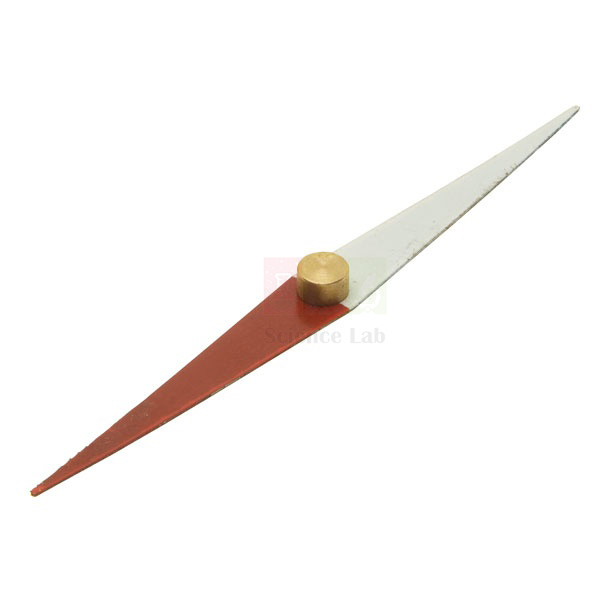
Magnetic Needle, Brass
Magnetic Needle, Brass (Product Code: SLE/PHY/238) is a 75 mm carbon steel magnetic needle on a brass pivot bearing, used to indicate magnetic field direction and to explain how a compass works in school physics classes. Its longer 75 mm length makes the needle's position easy to follow from the back of the room during teacher demonstrations. It is made by Jain Scientific Equipments Pvt Ltd (ScienceLab), an OEM manufacturer, at its own factory in Ambala, India.
Specifications
| Parameter | Detail |
|---|---|
| Needle material | Carbon steel |
| Length | 75 mm |
| Bearing | Brass pivot bearing |
| Bearing options in this range | Jewel or brass pivot bearing |
| Product code | SLE/PHY/238 |
| Manufacturer | Jain Scientific Equipments Pvt Ltd (ScienceLab) — OEM |
| Country of origin | India (made in Ambala, Haryana) |
What Is the Brass Magnetic Needle Used For?
This needle is a simple way to show what is inside every compass: a magnetised strip of steel, free to turn, that settles pointing north and south. Teachers bring a bar magnet towards each end to show that like poles repel and unlike poles attract, and then place the needle beside a current-carrying coil to find which end of the coil behaves as a north pole.
For accurate results, set the needle on a wooden or plastic bench away from steel stands and other magnets, and let it come to rest before reading its direction. Lift it gently on and off the brass pivot, and keep it separated from strong magnets in storage. As a product from a school lab equipment manufacturer, it is intended for regular classroom handling in magnetism lessons.
What to Specify When Ordering
- The version: this 75 mm brass-bearing needle or the shorter jewel-bearing needle.
- The quantity for demonstration benches or student groups.
- Any magnets, coils or plotting compasses to be quoted in the same order.
OEM Manufacturer
Jain Scientific Equipments Private Limited, trading as ScienceLab, is the OEM (original equipment manufacturer) of the Magnetic Needle, Brass and makes it at its own licensed factory at Saha, Ambala, Haryana, for schools, colleges, dealers and importers in India and international markets. Institutional and tender buyers who need vendor registration details can use GSTIN 06AAECJ8618A1ZT and LEI 3358004HRD1JIVXKYX49. Repeat orders and replacement needles are handled by the manufacturer directly. Read more on the ScienceLab company profile.
Related Physics Lab Equipment
Apparatus that pairs with the needle in magnetism lessons:
- Magnetic Needle Jewel Bearing — a shorter needle on a low-friction jewel pivot.
- Magnetising and Demagnetising Coil — for magnetising steel bars and strips.
- Magnetic Field Demonstrator — shows field-line patterns without loose iron filings.
- Compass Plotting (Clear) — small compasses for plotting fields around a bar magnet.
Visit Physics Lab Equipment for the full range.
Frequently Asked Questions
What size is the Magnetic Needle, Brass?
The Magnetic Needle, Brass is 75 mm long. It is a carbon steel needle mounted on a brass pivot bearing, and its length makes the pointing direction clear to a whole class during demonstrations of magnetic fields and compass action.
How does the Magnetic Needle, Brass differ from the jewel-bearing needle?
The Magnetic Needle, Brass is 75 mm long and turns on a brass pivot bearing, while the Magnetic Needle Jewel Bearing is a shorter needle on a jewel pivot. Choose the brass version for larger, easy-to-see demonstrations and the jewel version where very free movement matters most.
How is the Magnetic Needle, Brass used to explain a compass?
The Magnetic Needle, Brass shows the principle of a compass: the magnetised carbon steel needle, free to turn on its pivot, lines up with the Earth's magnetic field. Bringing a magnet close then shows how nearby magnetic fields change the direction it points.
What if the Magnetic Needle, Brass loses its magnetism?
If the Magnetic Needle, Brass becomes weak after long use or storage near strong magnets, it can generally be re-magnetised, for example with a magnetising coil. Ask us through the contact page for advice or a replacement needle.
Who manufactures the Magnetic Needle, Brass?
The Magnetic Needle, Brass is manufactured by Jain Scientific Equipments Pvt Ltd (ScienceLab), the OEM, at its own licensed factory at Saha, Ambala, Haryana, India. Buyers receive quotations directly from the manufacturer.
Can the Magnetic Needle, Brass be supplied in bulk?
Yes, the Magnetic Needle, Brass can be supplied in bulk to schools, institutions, dealers and importers in India and international markets. State the quantity and delivery location in your enquiry and we will send a factory-direct quotation.
Request a Quote
For the Magnetic Needle, Brass (SLE/PHY/238), send your enquiry through the ScienceLab contact page or add it to the enquiry cart; the quotation comes straight from the manufacturer.
Last updated: 24 September 2026
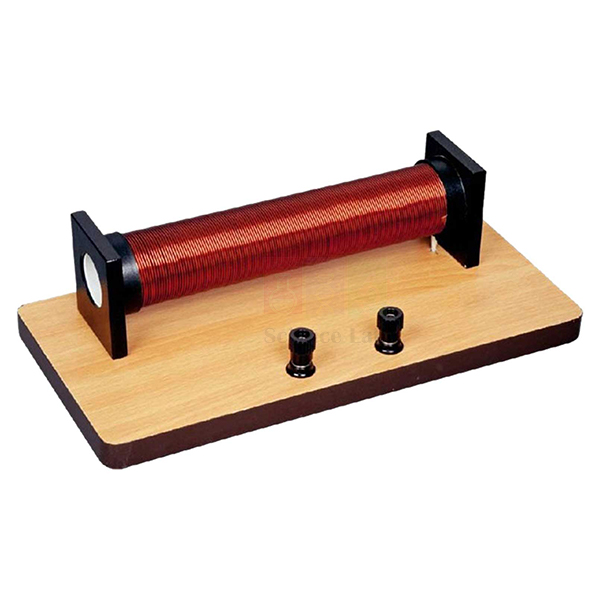
Magnetising and Demagnetising Coil
Magnetising and Demagnetising Coil (Product Code: SLE/PHY/239) is a base-mounted solenoid used to magnetise and demagnetise ordinary magnets, iron bars and strips in school physics magnetism lessons. It is wound with insulated copper wire, works at low voltage, and comes complete with a switch and 4 mm socket terminals for connection to a laboratory supply. It is supplied by Jain Scientific Equipments Pvt Ltd (ScienceLab), Ambala, India, for electromagnetism practicals.
Key Details
| Parameter | Detail |
|---|---|
| Type | Solenoid mounted on a base |
| Winding | Insulated copper wire |
| Control | Switch fitted |
| Connections | 4 mm socket terminals |
| Operating voltage | Low voltage (confirm the exact supply with us) |
| Suitable for | Magnetising and demagnetising ordinary magnets, iron bars, strips and similar items |
| Product code | SLE/PHY/239 |
| Supplied by | Jain Scientific Equipments Pvt Ltd (ScienceLab), Ambala, India |
What Is the Magnetising and Demagnetising Coil Used For?
When current flows through a solenoid, it produces a strong magnetic field along its centre. Placing an iron or steel bar inside the coil and switching on briefly lines up the tiny magnetic regions in the metal, so the bar comes out magnetised; students can then check its poles with a compass needle or see how many pins it lifts. Science departments also use the coil to restore bar magnets that have weakened over years of classroom use.
Demagnetising is generally done by exposing the item to a field that is steadily reduced, often an alternating one, as the bar is slowly withdrawn. Use only a low-voltage laboratory supply, keep current-on periods short so the winding does not warm up, and use the right-hand grip rule to predict which end becomes the north pole. As a laboratory instruments supplier in India, we can advise on a suitable power source.
What to Specify When Ordering
- The low-voltage supply you have (AC or DC, and voltage), so we can confirm it suits the coil.
- The size of the magnets or bars you want to treat, so we can check they fit the coil.
- The number of coils needed for your lab.
Supplier
ScienceLab, the trading name of Jain Scientific Equipments Private Limited in Ambala, Haryana, supplies the Magnetising and Demagnetising Coil to schools, colleges, polytechnics and dealers in India and international markets. We can quote it together with a low-voltage power supply, magnets and compass needles so a department receives a working magnetism set. Company information is on the ScienceLab profile page.
Related Physics Lab Equipment
Items used with the coil in magnetism practicals:
- Power Supply, Stepped — a low-voltage AC/DC laboratory supply.
- Magnetic Needle, Brass — for checking the poles of a newly magnetised bar.
- Magnet Set — magnets and iron filings for comparing strength before and after treatment.
- Iron-Clad Electromagnet — another demonstration of magnetism produced by current.
See more in Physics Lab Equipment.
Frequently Asked Questions
What can the Magnetising and Demagnetising Coil be used on?
The Magnetising and Demagnetising Coil is suitable for magnetising and demagnetising ordinary magnets, iron bars, strips and similar items. It is intended for school and college laboratories that need to prepare or restore magnets for experiments.
What power supply does the Magnetising and Demagnetising Coil need?
The Magnetising and Demagnetising Coil is a low-voltage coil connected through 4 mm socket terminals and switched by its own switch. The exact voltage and whether AC or DC should be used are not stated here, so please confirm them with us through the contact page.
How is a bar magnetised with the Magnetising and Demagnetising Coil?
To magnetise a bar with the Magnetising and Demagnetising Coil, place the bar inside the solenoid, switch the current on briefly, then switch off and remove the bar. Test its poles with a compass needle; the right-hand grip rule predicts which end becomes north.
How does demagnetising work with the Magnetising and Demagnetising Coil?
Demagnetising generally relies on a magnetic field that is gradually reduced, often an alternating field while the item is slowly withdrawn. Ask us how the Magnetising and Demagnetising Coil should be connected for demagnetising, so you use the correct supply for your model.
Who supplies the Magnetising and Demagnetising Coil?
Jain Scientific Equipments Pvt Ltd (ScienceLab), Ambala, Haryana, supplies the Magnetising and Demagnetising Coil to schools, colleges and dealers in India and international markets, and can quote it with power supplies and magnetism apparatus.
What should a quotation request for the Magnetising and Demagnetising Coil include?
A quotation request for the Magnetising and Demagnetising Coil should include the quantity, the power supply you plan to use and your delivery location. Send it through the contact page or the enquiry cart and we will reply with price and availability.
Request a Quote
To buy the Magnetising and Demagnetising Coil (SLE/PHY/239), contact us via the ScienceLab contact page or add it to the enquiry cart with any power supply or magnets you need.
Last updated: 24 September 2026
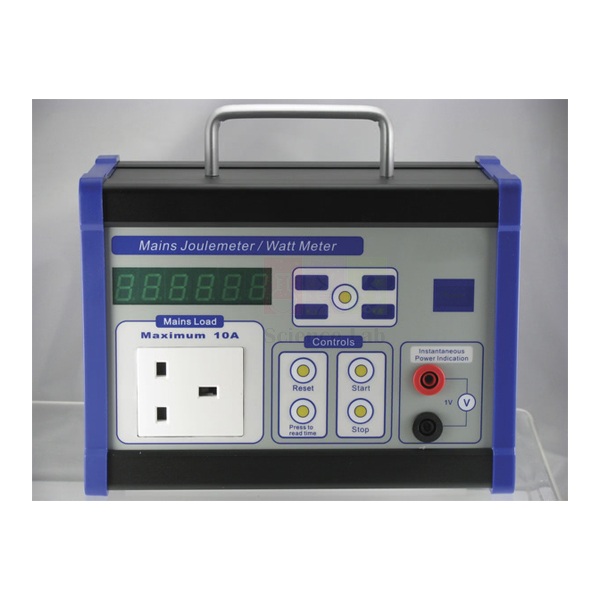
Mains Joule & Watt Meter
Mains Joule & Watt Meter (Product Code: SLE/PHY/240) is a compact electronic instrument used to measure the power drawn by, and the energy delivered to, a mains-powered appliance in school and college physics laboratories. Designed for both class demonstration and student use, it reads power on 200 W and 2 kW full-scale ranges and has a built-in timing function. This electronic lab instrument is supplied by Jain Scientific Equipments Pvt Ltd (ScienceLab), Ambala, India.
Specifications
| Parameter | Detail |
|---|---|
| Measures | Power and energy delivered to a mains appliance |
| Power ranges | 200 W and 2 kW full-scale reading |
| Energy ranges | 0 to 999,999 J or 0 to 999,999 kJ |
| Resolution | 0.5 J / 0.5 W on the 200 W range; 0.005 kJ / 0.005 kW on the kW range |
| Maximum current | 10 A, protected by a 10 A fast-blow fuse |
| Isolation | Current transformers and a sampling voltage transformer isolate the unit from the mains |
| Input impedance | 1 MΩ |
| Mains supply | 230 V ±5%, 50 Hz |
| Internal fuse | 315 mA (L) |
| External fuse | 10 A fast blow, in the IEC socket |
| Analogue output | 1 V full-scale instantaneous power indication on a pair of 4 mm meter output sockets, for a datalogger or oscilloscope |
| Energy display | Six 7-segment LEDs |
| Timing | Built-in timing function |
| Accuracy | 3%, typically better than 1% |
| Linearity | 2%, typically better than 1% |
| Dimensions | 208 x 155 x 115 mm (W x H x D); height including handle 187 mm |
| Build | Light and compact |
| Product code | SLE/PHY/240 |
| Supplied by | Jain Scientific Equipments Pvt Ltd (ScienceLab), Ambala, India |
What Is the Mains Joule & Watt Meter Used For?
The appliance under test is plugged into the meter, so students can read how many watts it draws and how many joules it uses over a timed run. Typical practicals include finding the energy consumed by a domestic appliance, comparing the efficiency of different types of lamp bulbs and, with a variable mains transformer unit (required for this test), comparing the power taken by lamp bulbs at different voltages.
Because instantaneous power is also available as an analogue signal on 4 mm sockets, the meter can feed a datalogger or oscilloscope to show how power changes while a lamp warms up or an appliance switches on and off. It is one of the physics lab instruments that turns the relation E = P × t into real readings: note the power, time the run with the built-in timer and compare the result with the energy display. Keep every load within the 10 A maximum and replace fuses only with the listed ratings.
What to Specify When Ordering
- How many meters you need: one for teacher demonstration or several for student groups.
- Whether you also need a variable mains transformer unit for the lamp-voltage comparison.
- Whether readings will be logged on a datalogger or oscilloscope, so connecting items can be quoted together.
- That your laboratory mains matches the 230 V ±5%, 50 Hz supply the meter is specified for.
Supplier
Jain Scientific Equipments Private Limited trades under the name ScienceLab and operates from Ambala, Haryana, India. The company supplies this Mains Joule & Watt Meter as part of its physics laboratory range, so schools, colleges, dealers and training institutes in India and international markets can source electrical-energy instruments together with their other lab equipment from one vendor. Background on the company is on the ScienceLab company profile.
Related Physics Lab Equipment
These items are commonly used alongside the Mains Joule & Watt Meter when teaching electrical power and energy:
- Oscilloscope Dual Trace — displays the meter's analogue power output as a trace.
- Electric Bulb — a lamp for efficiency comparisons (confirm the voltage rating you need).
- Standard Digital Multimeter — for voltage and current checks in low-voltage circuit work.
- Digital Coulomb Meter — a companion digital instrument for charge measurements in electricity topics.
More electrical and mechanics apparatus is listed in the Physics Lab Equipment category.
Frequently Asked Questions
What does the Mains Joule & Watt Meter measure?
The Mains Joule & Watt Meter measures the power, in watts or kilowatts, and the energy, in joules or kilojoules, delivered to a mains appliance plugged into it. Power is read on 200 W or 2 kW full-scale ranges, and energy is counted up to 999,999 J or 999,999 kJ on six LED digits.
How accurate is the Mains Joule & Watt Meter?
The Mains Joule & Watt Meter has a stated accuracy of 3% and linearity of 2%, both typically better than 1%. Resolution is 0.5 J or 0.5 W on the 200 W range and 0.005 kJ or 0.005 kW on the kilowatt range.
Can the Mains Joule & Watt Meter be connected to a datalogger or oscilloscope?
Yes. The Mains Joule & Watt Meter gives instantaneous power as a 1 V full-scale analogue signal on a pair of 4 mm meter output sockets, which can be connected to a datalogger or an oscilloscope to record how an appliance's power changes over time.
What is the maximum load for the Mains Joule & Watt Meter?
The Mains Joule & Watt Meter accepts a maximum current of 10 A, protected by a 10 A fast-blow fuse in the IEC socket, and runs from a 230 V ±5%, 50 Hz mains supply. A separate 315 mA (L) internal fuse protects the unit itself.
Who supplies the Mains Joule & Watt Meter?
The Mains Joule & Watt Meter is supplied by Jain Scientific Equipments Pvt Ltd (ScienceLab) of Ambala, Haryana, India, which serves schools, colleges, dealers and institutional buyers in India and international markets. Contact the team for current availability and a quotation.
Is a calibration certificate available for the Mains Joule & Watt Meter?
Calibration-certificate availability for the Mains Joule & Watt Meter should be discussed with ScienceLab before ordering. Share your requirement through the contact page and the team will confirm what documentation can accompany the instrument.
What should a quotation request for the Mains Joule & Watt Meter include?
A quotation request for the Mains Joule & Watt Meter should state the quantity, whether a variable mains transformer unit is also needed for lamp-voltage tests, any related items such as an oscilloscope, and your delivery location, so everything can be priced together.
Request a Quote
To request a price for the Mains Joule & Watt Meter (SLE/PHY/240), send your quantity and delivery details through the ScienceLab contact page, or add the item to the enquiry cart together with any other laboratory equipment you need.
Last updated: 24 September 2026
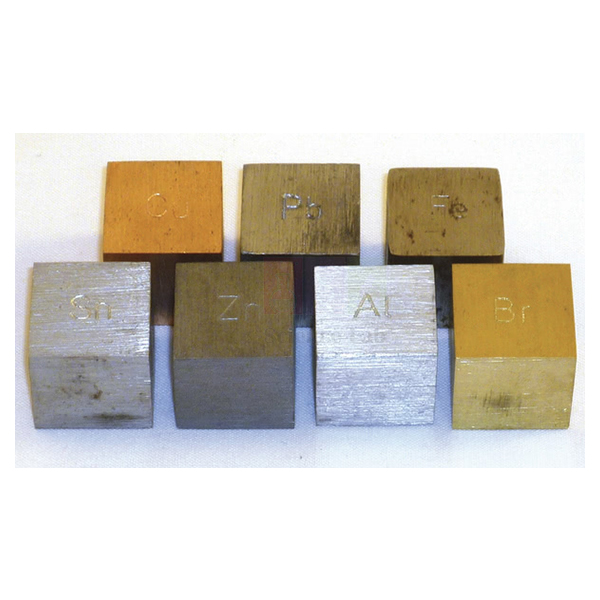
Metal Density Cubes, Set of 7
Metal Density Cubes, Set of 7 (Product Code: SLE/PHY/241) is a set of seven 20 mm metal cubes used to measure and compare the density of common metals in school and college physics laboratories. Students work with equal-sized cubes of brass, lead, steel, copper, aluminium, iron and tin, so any difference in mass comes straight from a difference in density. The set is made by Jain Scientific Equipments Pvt Ltd (ScienceLab), an OEM manufacturer, at its own factory in Ambala, India.
Specifications
| Parameter | Detail |
|---|---|
| Number of cubes | 7 (one of each metal) |
| Metals included | Brass, lead, steel, copper, aluminium, iron and tin |
| Cube size | 20 mm |
| Product code | SLE/PHY/241 |
| Manufacturer | Jain Scientific Equipments Pvt Ltd (ScienceLab) — OEM |
| Country of origin | India (made in Ambala, Haryana) |
What Are Metal Density Cubes Used For?
Because every cube in the set has the same nominal 20 mm side, each has roughly the same volume, about 8 cm³, so weighing them on a balance shows at once which metals are denser. Students calculate density as mass divided by volume, rank the seven metals and compare their answers with textbook values; lead and aluminium sit at opposite ends of the list, which makes the result easy to remember.
For a more careful practical, measure each side with a vernier caliper instead of relying on the nominal size, and cross-check the volume by displacement. The cubes also support lessons on identifying unknown materials, making them useful physics lab equipment for schools in India and abroad. Wash hands after handling the lead cube and store the set dry so the iron and steel cubes stay free of rust.
What to Specify When Ordering
- The number of sets: one for teacher demonstration or one per student group.
- Whether a balance and a vernier caliper should be quoted with the cubes for the full practical.
- Whether you want this seven-metal set or one of the six-cube alternatives listed on the site.
OEM Manufacturer
Jain Scientific Equipments Private Limited, which trades as ScienceLab, is the OEM (original equipment manufacturer) of the Metal Density Cubes, Set of 7. The set is produced at the company's own licensed factory at Saha, Ambala, Haryana, India, rather than bought in from a trader, so schools, colleges, dealers and importers receive it factory-direct. ScienceLab is the trading name of Jain Scientific Equipments Private Limited (CIN U29309HR2020PTC087597), and its production site at 449, HSIIDC Industrial Area, Saha, Ambala operates under Factory Licence AMB-ONLINE-CHD-J-414. For replacement cubes or repeat orders, ask the manufacturer directly; more about the company is on the ScienceLab profile page.
Related Physics Lab Equipment
A density practical with these cubes usually needs the following items as well:
- Caliper Vernier (Metal) — measures each cube's side so the volume is calculated accurately.
- Electronic Compact Balance — gives the mass reading for each cube.
- Glass Measuring Cylinder — for the displacement method of finding volume.
- Metal Density Cubes (Set of 6) — an alternative six-cube set.
- Cylinders, Metal (Set of 6) — extends the density practical to a second regular shape.
See the full Physics Lab Equipment range for more mechanics and properties-of-matter apparatus.
Frequently Asked Questions
Which metals are in the Metal Density Cubes, Set of 7?
The Metal Density Cubes, Set of 7 contains one cube each of brass, lead, steel, copper, aluminium, iron and tin. Having seven metals of the same size lets students compare densities side by side and rank them from lightest to heaviest simply by weighing.
What size are the cubes in the Metal Density Cubes, Set of 7?
Each cube in the Metal Density Cubes, Set of 7 measures 20 mm, giving a volume of about 8 cm³. Students should still measure the sides with a vernier caliper, because real dimensions can differ slightly from the nominal size and this affects the calculated density.
How do students find density with the Metal Density Cubes, Set of 7?
With the Metal Density Cubes, Set of 7, students weigh each cube on a balance, calculate its volume from the measured side length and divide mass by volume. Repeating this for all seven metals shows how strongly density varies between materials of identical size.
Who manufactures the Metal Density Cubes, Set of 7?
The Metal Density Cubes, Set of 7 is manufactured by Jain Scientific Equipments Pvt Ltd (ScienceLab), an OEM manufacturer, at its own licensed factory at Saha, Ambala, Haryana, India. Buyers receive the set factory-direct, and quotations come straight from the manufacturer.
How should the lead cube in the Metal Density Cubes, Set of 7 be handled?
The lead cube in the Metal Density Cubes, Set of 7 should be handled with normal lab hygiene: students wash their hands after the practical, keep the cube away from mouths and food, and return the whole set to dry storage when the lesson ends.
Can the Metal Density Cubes, Set of 7 be ordered in bulk?
Yes, the Metal Density Cubes, Set of 7 can be quoted in bulk for schools, colleges, dealers and importers in India and international markets. State the number of sets and your delivery location through the contact page and the manufacturer will reply with a quotation.
Request a Quote
Quotations for the Metal Density Cubes, Set of 7 (SLE/PHY/241) come direct from the manufacturer. Tell us how many sets you need on the ScienceLab contact page, or add the product to the enquiry cart with the rest of your physics order.
Last updated: 24 September 2026

Metal Discs – Set of 8
Metal Discs – Set of 8 (Product Code: SLE/PHY/242) is a set of eight 25 mm metal discs used to identify and compare the properties of everyday metals and alloys in school science and physics laboratories. Each disc is stamped with the name of its metal, which makes this educational lab equipment easy to use without a separate answer key. The set is made by Jain Scientific Equipments Pvt Ltd (ScienceLab), an OEM manufacturer, at its own factory in Ambala, India.
Specifications
| Parameter | Detail |
|---|---|
| Number of discs | 8 |
| Metals included | Brass, copper, bronze, nickel, mild steel, stainless steel, zinc and aluminium |
| Diameter | 25 mm |
| Marking | Each disc stamped with the metal name |
| Product code | SLE/PHY/242 |
| Manufacturer | Jain Scientific Equipments Pvt Ltd (ScienceLab) — OEM |
| Country of origin | India (made in Ambala, Haryana) |
What Are Metal Discs Used For?
Laying the eight discs side by side lets students compare colour, lustre and weight in the hand, and separate pure metals such as copper, nickel, zinc and aluminium from alloys such as brass, bronze and the two steels. A magnet quickly divides the discs into those that are attracted and those that are not, which opens a discussion of why mild steel and stainless steel can behave differently although both are iron-based.
As junior science lab equipment, the set also works as a labelled reference: students compare an unknown metal piece with the stamped discs before confirming their guess with other tests. Teachers can press a pair of dissimilar discs, such as copper and zinc, against paper soaked in electrolyte to show that two different metals produce a small voltage. Keep the discs clean and dry, and avoid scratching the stamped faces so the names stay legible.
What to Specify When Ordering
- The number of sets required for your class or number of student groups.
- Whether magnets should be quoted with the discs for magnetic sorting activities.
- Whether you also want the twelve-strip Metal Testing Strips set for extended magnetism work.
OEM Manufacturer
The Metal Discs – Set of 8 is made by Jain Scientific Equipments Private Limited, the company behind the ScienceLab name, acting as OEM (original equipment manufacturer). Sets are produced at its own licensed factory in Saha, Ambala, Haryana, India, and go factory-direct to schools, colleges, laboratory dealers and importers in India and international markets. Because the manufacturer handles enquiries itself, questions about replacement discs or repeat orders can be sent straight to us. Read more on the ScienceLab company profile.
Related Physics Lab Equipment
These items pair well with the metal discs in properties-of-materials lessons:
- Metal Testing Strips — twelve lettered strips for more detailed magnetism tests.
- Steel Horseshoe Magnet — for sorting magnetic from non-magnetic discs.
- Metal Density Cubes, Set of 7 — equal-sized cubes for comparing the density of similar metals.
- Galvanometer 50-0-50mV — detects the small voltage from a pair of dissimilar discs.
- Metal Strips Set — a further set of metal samples for comparison work.
Browse the Physics Lab Equipment category for more materials and magnetism apparatus.
Frequently Asked Questions
Which metals are included in the Metal Discs – Set of 8?
The Metal Discs – Set of 8 includes brass, copper, bronze, nickel, mild steel, stainless steel, zinc and aluminium. This mix of pure metals and common alloys gives students a realistic range of colours, weights and magnetic behaviour to compare in a single lesson.
How are the discs in the Metal Discs – Set of 8 identified?
Every disc in the Metal Discs – Set of 8 is stamped with the name of its metal, so students and teachers can identify each sample directly. The stamped label also lets the set act as a reference when students examine unknown metal pieces.
What size are the Metal Discs – Set of 8?
Each disc in the Metal Discs – Set of 8 is 25 mm in diameter. The uniform diameter makes the discs easy to compare by eye and by feel, and the size suits handling at a bench or passing around a classroom.
Who manufactures the Metal Discs – Set of 8?
Jain Scientific Equipments Pvt Ltd (ScienceLab) manufactures the Metal Discs – Set of 8 as an OEM at its own licensed factory in Saha, Ambala, Haryana, India. Schools, dealers and importers buy directly from the manufacturer, which also handles repeat orders.
Can the Metal Discs – Set of 8 be used for magnetism experiments?
Yes. With a magnet, the Metal Discs – Set of 8 can be sorted into discs that are attracted and discs that are not, showing students that magnetic behaviour depends on the metal or alloy rather than on appearance alone.
What details should a quotation request for the Metal Discs – Set of 8 include?
A quotation request for the Metal Discs – Set of 8 should give the number of sets, any related items such as magnets or metal testing strips, and your delivery location, so the manufacturer can price the complete order in one reply.
Request a Quote
Quotes for the Metal Discs – Set of 8 (SLE/PHY/242) come directly from the manufacturer. Send your requirement through the ScienceLab contact page or place the item in the enquiry cart.
Last updated: 24 September 2026
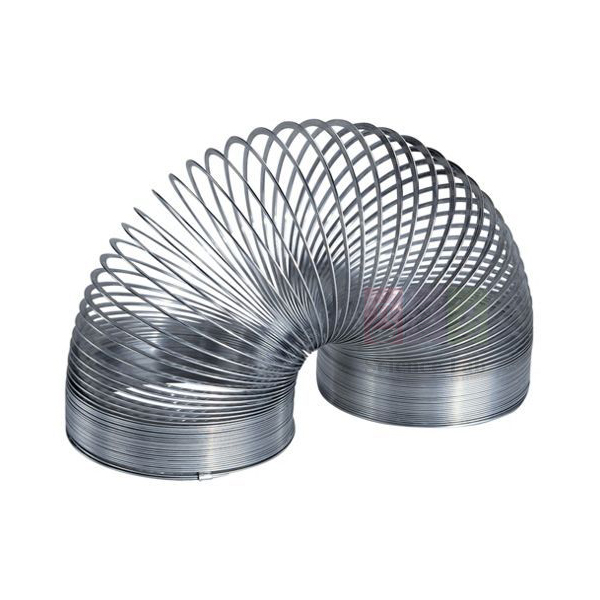
Metal Slinky, Helical Spring
Metal Slinky, Helical Spring (Product Code: SLE/PHY/243) is a steel helical coil spring used to demonstrate different types of waves in school and college physics lessons. Its 75 mm coil diameter gives a wide spring that is easy for a class to watch as a teacher or two students send pulses along it across a bench or floor. It is made by Jain Scientific Equipments Pvt Ltd (ScienceLab), an OEM manufacturer, at its own factory in Ambala, India.
Specifications
| Parameter | Detail |
|---|---|
| Material | Steel |
| Form | Helical coil spring |
| Coil diameter | 75 mm |
| Closed length | 100 (unit not stated in the original listing — ask us to confirm) |
| Purpose | Demonstrating different types of waves |
| Product code | SLE/PHY/243 |
| Manufacturer | Jain Scientific Equipments Pvt Ltd (ScienceLab) — OEM |
| Country of origin | India (made in Ambala, Haryana) |
What Is a Metal Slinky Used For?
Stretched out on a smooth floor or long bench, the spring shows both main wave types. Pushing one end back and forth sends a longitudinal wave of compressions and rarefactions along the coils, while flicking the end sideways sends a transverse pulse. Students can watch pulses reflect from a held end, see two pulses pass through each other and set up standing waves by shaking at a steady rate.
Timing a pulse over a measured length gives a simple estimate of wave speed, and changing the stretch shows how tension affects it, which makes the spring a good hands-on start to any wave motion unit in school. Tie a short piece of coloured thread to one coil so the motion of a single point is easy to follow. Avoid over-stretching or tangling the spring, and store it closed so the coils keep their shape.
What to Specify When Ordering
- The number of springs: one for demonstration or one per pair of students.
- Whether you need the closed length confirmed before ordering, as the listing does not state its unit.
- Whether other wave apparatus, such as a ripple tank, should be quoted for the same topic.
OEM Manufacturer
ScienceLab is the trading name of Jain Scientific Equipments Private Limited, the OEM (original equipment manufacturer) of this Metal Slinky, Helical Spring. The springs are produced at the company's own licensed factory in Saha, Ambala, Haryana, India, and supplied directly, not through a trading intermediary, to schools, colleges, distributors and importers. Enquiries about replacements or repeat quantities are answered by the manufacturer itself, and company details are on the ScienceLab profile page.
Related Physics Lab Equipment
Use these items with the spring to build a complete lesson on waves:
- Wave Form, Helix — a companion helix for wave-shape demonstrations.
- Ripple Tank — shows reflection and refraction of water waves after the spring demonstration.
- Stop Clock (Metal Case) — times pulses for a wave-speed estimate.
- Meter Stick, White — measures the distance a pulse travels.
- Slinky Spring — an alternative slinky listed in the catalogue.
More wave and mechanics apparatus is available in the Physics Lab Equipment category.
Frequently Asked Questions
What types of waves can the Metal Slinky, Helical Spring demonstrate?
The Metal Slinky, Helical Spring demonstrates longitudinal waves, by pushing and pulling one end along the spring's length, and transverse waves, by moving the end sideways. It also shows pulse reflection, superposition and standing waves when shaken at a steady rate.
What is the Metal Slinky, Helical Spring made of?
The Metal Slinky, Helical Spring is a helical coil made of steel with a coil diameter of 75 mm. To keep the coils even, handle it within a normal stretch during lessons and store it in its closed position afterwards.
What is the closed length of the Metal Slinky, Helical Spring?
The product listing gives the closed length of the Metal Slinky, Helical Spring as 100 without stating the unit. If an exact closed length matters for your lesson plan, ask ScienceLab through the contact page to confirm it before ordering.
Who manufactures the Metal Slinky, Helical Spring?
The Metal Slinky, Helical Spring is manufactured by Jain Scientific Equipments Pvt Ltd (ScienceLab), an OEM manufacturer with its own licensed factory in Saha, Ambala, Haryana, India. Schools and dealers buy it factory-direct, with quotations issued by the manufacturer.
How should students use the Metal Slinky, Helical Spring safely?
Use the Metal Slinky, Helical Spring on a clear floor or bench with one student holding each end firmly. Never let a stretched spring snap back towards anyone, avoid over-stretching, and ease out any kinks gently before storing the spring closed.
Can the Metal Slinky, Helical Spring be ordered for a whole class?
Yes, the Metal Slinky, Helical Spring can be quoted in class quantities for schools, colleges, dealers and importers in India and international markets. Mention how many springs you need and your delivery location when you send the enquiry.
Request a Quote
For a quotation on the Metal Slinky, Helical Spring (SLE/PHY/243) direct from the manufacturer, use the ScienceLab contact page or add it to the enquiry cart along with any other wave apparatus you need.
Last updated: 24 September 2026
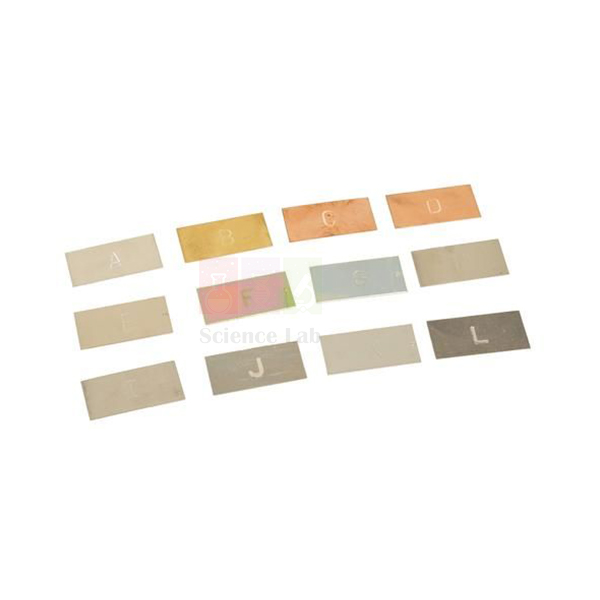
Metal Testing Strips
Metal Testing Strips (Product Code: SLE/PHY/244) is a set of twelve lettered metal strips used to test which metals and alloys are attracted by a magnet in school and college magnetism experiments. This compact magnetism experiment kit mixes magnetic and non-magnetic samples, and each 50 x 25 mm strip carries a stamped key letter for easy identification. It is made by Jain Scientific Equipments Pvt Ltd (ScienceLab), an OEM manufacturer, at its own factory in Ambala, India.
Specifications
| Parameter | Detail |
|---|---|
| Number of strips | 12 |
| Strip size | 50 x 25 mm |
| Identification | Each strip stamped with a key letter |
| Purpose | Magnetism experiments; set contains magnetic and non-magnetic metals |
| Strip A | Soft aluminium |
| Strip B | Brass |
| Strip C | Copper |
| Strip D | Mild steel |
| Strip E | Magnetic stainless steel |
| Strip F | Non-magnetic stainless steel |
| Strip G | Galvanised steel |
| Strip H | Hard aluminium |
| Strip I | Phosphor bronze |
| Strip J | Nickel silver |
| Strip K | Zinc-plated mild steel |
| Strip L | Zinc |
| Product code | SLE/PHY/244 |
| Manufacturer | Jain Scientific Equipments Pvt Ltd (ScienceLab) — OEM |
| Country of origin | India (made in Ambala, Haryana) |
What Are Metal Testing Strips Used For?
Students bring a bar magnet up to each strip in turn and record, by key letter, whether it is attracted strongly, weakly or not at all. Because the key is a letter rather than a printed name, the activity works as a genuine test: learners predict first, then check against the teacher's list from A to L. The set includes instructive pairs, such as magnetic and non-magnetic stainless steel or galvanised and zinc-plated mild steel, so students see that appearance alone does not reveal magnetic behaviour.
The strips also support follow-on work, such as checking whether a zinc coating changes the result or using the brass, copper, phosphor bronze and nickel silver strips to show that many everyday alloys are non-magnetic. Keep the strips dry, and store them away from strong magnets so the steel samples do not stay magnetised between lessons.
What to Specify When Ordering
- The number of sets, usually one per student group.
- Whether magnets should be quoted with the strips, as the listing does not mention one.
- Whether you also want the Metal Discs – Set of 8 for metal-identification lessons.
OEM Manufacturer
Jain Scientific Equipments Private Limited, known to customers as ScienceLab, makes the Metal Testing Strips as an OEM (original equipment manufacturer) at its own licensed factory in Saha, Ambala, Haryana, India. Buying from the maker means schools, colleges, dealers and importers deal with the company that produces the set, and questions about replacement strips or extra sets are answered directly — just ask us. Quotations are issued by the manufacturer, and more about the company appears on the ScienceLab profile.
Related Physics Lab Equipment
These items complete a magnetism practical built around the strips:
- Steel Horseshoe Magnet — a magnet for testing each strip.
- Magnet Set of 4 — several magnets so groups can test at the same time.
- Compass Plotting (Clear) — checks whether a steel strip has become magnetised.
- Metal Discs – Set of 8 — name-stamped discs for metal identification.
- Metal Strips Set — an alternative set of metal samples.
Find more magnetism and electricity apparatus in the Physics Lab Equipment category.
Frequently Asked Questions
Which metals are in the Metal Testing Strips set?
The Metal Testing Strips set contains twelve strips: A soft aluminium, B brass, C copper, D mild steel, E magnetic stainless steel, F non-magnetic stainless steel, G galvanised steel, H hard aluminium, I phosphor bronze, J nickel silver, K zinc-plated mild steel and L zinc.
How are the Metal Testing Strips identified?
Each of the Metal Testing Strips is stamped with a key letter from A to L instead of the metal name. Students can therefore predict and test first, then check their results against the teacher's key, which keeps the magnetism activity a genuine investigation.
What size are the Metal Testing Strips?
Every strip in the Metal Testing Strips set measures 50 x 25 mm. The equal size keeps comparisons fair, so differences in how strongly each strip is attracted come from the metal itself rather than from the shape of the sample.
Who manufactures the Metal Testing Strips?
The Metal Testing Strips are manufactured by Jain Scientific Equipments Pvt Ltd (ScienceLab), an OEM manufacturer with its own licensed factory at Saha, Ambala, Haryana, India. The company supplies the set factory-direct to schools, colleges, dealers and importers in India and international markets.
Are magnets included with the Metal Testing Strips?
The listing for the Metal Testing Strips describes the twelve strips only and does not mention a magnet. If you need magnets for the experiment, add them to your enquiry and ScienceLab can quote suitable magnets from its range together with the strips.
What should a quotation request for the Metal Testing Strips include?
A quotation request for the Metal Testing Strips should give the number of sets, any magnets or related items you need, and your delivery location. The quotation then comes directly from ScienceLab as the manufacturer, covering the complete order.
Request a Quote
Request a manufacturer-direct quote for the Metal Testing Strips (SLE/PHY/244) through the ScienceLab contact page, or add the set to the enquiry cart with your other magnetism items.
Last updated: 24 September 2026
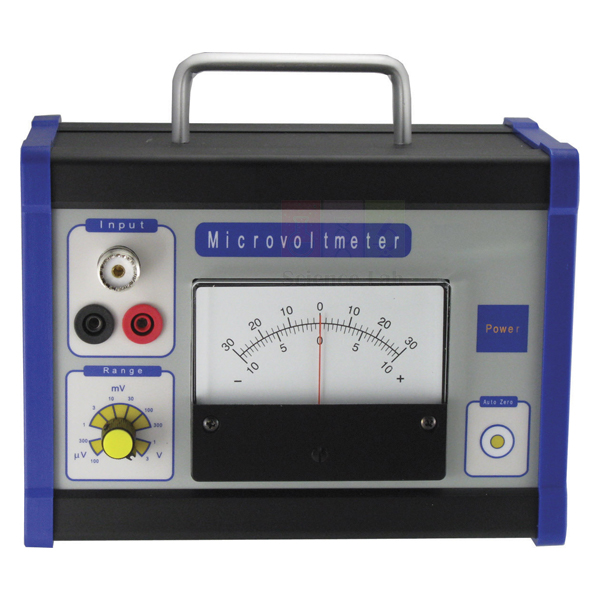
Micro Voltmeter
Micro Voltmeter (Product Code: SLE/PHY/245) is a battery-powered, high-sensitivity voltmeter used to measure very small potential differences in school and college physics laboratories, as an effective and robust replacement for a spot galvanometer. It offers nine ranges starting at 100 µV, a large moving coil meter with push-button auto-zero, and 4 mm or UHF inputs. It is supplied to laboratories by Jain Scientific Equipments Pvt Ltd (ScienceLab), Ambala, India.
Specifications
| Parameter | Detail |
|---|---|
| Instrument type | Microvoltmeter with a large moving coil meter |
| Measurement ranges | 9 ranges, starting at 100 µV (ask us for the complete range list) |
| Zeroing | Auto-zero by membrane button switch |
| Input impedance | 10 MΩ per volt, maximum 30 MΩ |
| Inputs | 4 mm sockets, or UHF socket for very low voltages where a shielded lead is preferred; 4 mm socket for the negative input |
| Power | PP3 9 V battery |
| Dimensions | 208 x 155 x 115 mm (W x H x D); height including handle 187 mm |
| Replaces | Spot galvanometer |
| Product code | SLE/PHY/245 |
| Supplied by | Jain Scientific Equipments Pvt Ltd (ScienceLab), Ambala, India |
What Is the Micro Voltmeter Used For?
The Micro Voltmeter measures potential differences far too small for an ordinary school voltmeter, such as the output of a thermocouple, the voltage across a low resistance or the small emf induced when a magnet moves near a coil. Its input resistance is considerably better than that of a spot galvanometer, so it draws very little current from the circuit and disturbs the experiment less.
Where schools in India once relied on a galvanometer, the meter also serves as a sensitive null detector for Wheatstone bridge and potentiometer experiments. Press the membrane button to auto-zero before each set of readings, begin on a less sensitive range and step down, and use the UHF socket with a shielded lead at the lowest voltages to reduce pick-up. Remove the PP3 battery if the meter is to be stored for a long time.
What to Specify When Ordering
- The number of meters needed for demonstration or student benches.
- Whether 4 mm leads or a shielded lead for the UHF socket should be quoted, as leads are not listed.
- The full-scale values your experiments need, so the nine ranges can be confirmed for you.
- Whether spare PP3 9 V batteries should be added to the order.
Supplier
ScienceLab is the trading name of Jain Scientific Equipments Private Limited, based in Ambala, Haryana, India. The company supplies the Micro Voltmeter within its electrical measurement range for schools, colleges and institutional buyers in India and international markets, so a laboratory can order sensitive meters together with its other physics apparatus. For vendor registration and export paperwork, the supplying company's details are IEC AAECJ8618A (DGFT) and GSTIN 06AAECJ8618A1ZT. More background is on the ScienceLab company profile.
Related Physics Lab Equipment
These items create the small voltages the meter is built to measure, or connect it to the circuit:
- Thermoelectric Effects Apparatus — produces small thermoelectric emfs for measurement.
- Wheatstone Bridge Four Gap — a bridge experiment where the meter acts as the null detector.
- Potentiometer — needs a sensitive indicator to find the balance point.
- Galvanometer 50-0-50mV — a centre-zero meter for less sensitive work.
- Banana Plug Connectors Leads — connecting leads for the input sockets.
Browse more meters and electrical apparatus in the Physics Lab Equipment category.
Frequently Asked Questions
What can the Micro Voltmeter measure?
The Micro Voltmeter measures very small potential differences on nine ranges, starting at 100 µV. Typical uses are thermocouple outputs, induced emfs and voltages across low resistances; ask ScienceLab for the complete range list if your experiment needs a particular full-scale value.
Why use the Micro Voltmeter instead of a spot galvanometer?
The Micro Voltmeter is a robust replacement for a spot galvanometer: its input resistance of 10 MΩ per volt is considerably better than a spot galvanometer's, and its large moving coil meter auto-zeros at the press of a membrane button.
How is the Micro Voltmeter powered?
The Micro Voltmeter runs from a PP3 9 V battery, so it needs no mains connection on the bench and moves easily between laboratories. Check the battery before a practical and remove it if the meter will be stored for a long period.
What inputs does the Micro Voltmeter have?
The Micro Voltmeter accepts signals through 4 mm sockets or, for very low voltages where a shielded lead is preferred, through a UHF socket. A 4 mm socket is provided for the negative input, so either connection method completes the circuit.
Who supplies the Micro Voltmeter?
The Micro Voltmeter is supplied by Jain Scientific Equipments Pvt Ltd (ScienceLab) of Ambala, Haryana, India, to schools, colleges, dealers and institutional buyers in India and international markets. Contact ScienceLab for availability, documentation and a quotation.
Is a calibration certificate available for the Micro Voltmeter?
Whether a calibration certificate can accompany the Micro Voltmeter should be discussed with ScienceLab before you order. Send your requirement through the contact page and the team will confirm what documentation is available for this instrument.
How big is the Micro Voltmeter?
The Micro Voltmeter case measures 208 x 155 x 115 mm (W x H x D), and its height including the handle is 187 mm, so it sits on a laboratory bench next to the experiment without taking much space.
Request a Quote
For a Micro Voltmeter (SLE/PHY/245) quotation, send the quantity and any leads or batteries you need through the ScienceLab contact page, or add the meter to the enquiry cart.
Last updated: 24 September 2026
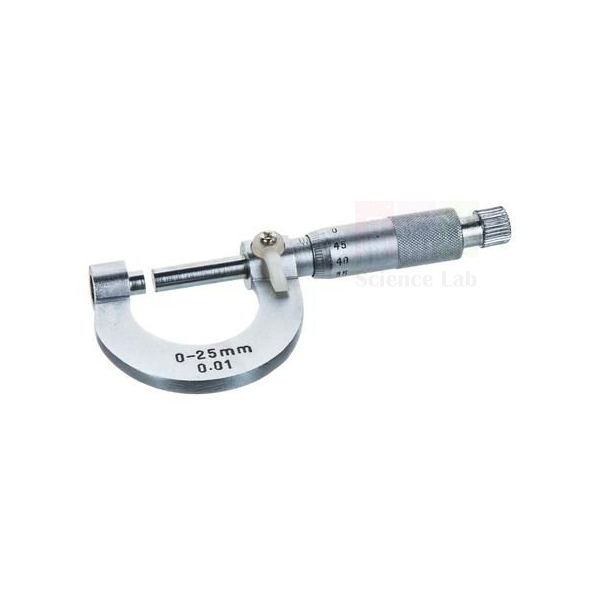
Micrometer Screw Gauge, Lock Type
Micrometer Screw Gauge, Lock Type (Product Code: SLE/PHY/246) is a precision hand instrument used to measure small outside dimensions, such as wire diameter or sheet thickness, from 0 to 25 mm in school and college physics laboratories. Built from nickel-plated brass with a ratchet top and a lock, this physics lab instrument reads to 1/100 mm and comes in a plastic case. It is made by Jain Scientific Equipments Pvt Ltd (ScienceLab), an OEM manufacturer, at its own factory in Ambala, India.
Specifications
| Parameter | Detail |
|---|---|
| Body material | Nickel-plated brass |
| Rod | Accurately machined stainless steel |
| Range | 0–25 mm x 0.01 mm |
| Precision | 1/100 mm (0.01 mm) |
| Measurement type | Outside measurements up to 25 mm |
| Top | Ratchet top |
| Type | Lock type |
| Packing | Supplied in a plastic case |
| Product code | SLE/PHY/246 |
| Manufacturer | Jain Scientific Equipments Pvt Ltd (ScienceLab) — OEM |
| Country of origin | India (made in Ambala, Haryana) |
What Is a Micrometer Screw Gauge Used For?
In lab practicals across India, the screw gauge is used to measure the diameter of a wire, the thickness of a glass slide or metal sheet and the diameter of small spheres, each to the nearest 0.01 mm. It handles the wire-diameter step of experiments such as Young's modulus by Searle's method and the resistivity of a wire, and it teaches students about pitch, least count and zero error.
Always turn the thimble using the ratchet top so the same gentle pressure is applied at every reading, and check for zero error by closing the jaws before you start. Once a reading is set, the lock holds the spindle so the value can be read or shown to a teacher without shifting. Wipe the measuring faces clean and keep the gauge in its plastic case between practicals.
What to Specify When Ordering
- The number of gauges, typically one per student pair or group.
- Whether you want this lock-type model or the standard screw gauge also listed in the catalogue.
- Whether vernier calipers should be quoted as well for dimensions above 25 mm.
OEM Manufacturer
Jain Scientific Equipments Private Limited trades as ScienceLab and is the OEM (original equipment manufacturer) of this Micrometer Screw Gauge, Lock Type, produced at the company's own licensed factory at Saha, Ambala, Haryana, India. Because the gauge comes straight from the maker rather than a reseller, schools, colleges, dealers and importers in India and international markets deal directly with the company that produces it. Ask us about repeat orders or replacement cases, and see the ScienceLab company profile for more about the business.
Related Physics Lab Equipment
These instruments and set-ups are commonly used with a micrometer screw gauge:
- Caliper Vernier (Metal) — for larger dimensions beyond the gauge's 25 mm range.
- Apparatus Young Modulus Searle's — the test wire's diameter is measured with a screw gauge.
- Vernier Travelling Microscope — measures very small distances without touching the sample.
- Screw Gauge — an alternative screw gauge in the catalogue.
More measuring instruments are listed under Physics Lab Equipment.
Frequently Asked Questions
What is the least count of the Micrometer Screw Gauge, Lock Type?
The Micrometer Screw Gauge, Lock Type has a precision of 1/100 mm, so it reads to 0.01 mm across its 0–25 mm range. That resolution suits measuring wire diameters, sheet thickness and small spheres in school and college physics practicals.
What is the measuring range of the Micrometer Screw Gauge, Lock Type?
The Micrometer Screw Gauge, Lock Type measures outside dimensions from 0 to 25 mm. For objects larger than 25 mm a vernier caliper is the better choice, and ScienceLab can quote both instruments together for a complete measurement set.
What does the lock on the Micrometer Screw Gauge, Lock Type do?
The lock on the Micrometer Screw Gauge, Lock Type holds the spindle in position once a reading is taken, so the value does not shift while it is read, recorded or checked by a teacher. Release the lock before turning the thimble again.
What is the Micrometer Screw Gauge, Lock Type made of?
The Micrometer Screw Gauge, Lock Type has a nickel-plated brass body with a ratchet top and an accurately machined stainless steel rod. It is supplied in a plastic case that protects the measuring faces between practicals.
Who manufactures the Micrometer Screw Gauge, Lock Type?
The Micrometer Screw Gauge, Lock Type is manufactured by Jain Scientific Equipments Pvt Ltd (ScienceLab), an OEM manufacturer with its own licensed factory at Saha, Ambala, Haryana, India. Schools and dealers buy it factory-direct, with quotations issued by the manufacturer.
Is a calibration certificate available for the Micrometer Screw Gauge, Lock Type?
Calibration-certificate availability for the Micrometer Screw Gauge, Lock Type should be discussed with ScienceLab when you enquire. Use the contact page to state your requirement, and the team will confirm what documentation can be provided with the gauges.
Can the Micrometer Screw Gauge, Lock Type be ordered in bulk?
Yes, the Micrometer Screw Gauge, Lock Type can be ordered in class and institutional quantities for schools, colleges, dealers and importers in India and international markets. Send the quantity and delivery location with your enquiry to receive a manufacturer-direct quotation.
Request a Quote
Quotations for the Micrometer Screw Gauge, Lock Type (SLE/PHY/246) are issued directly by the manufacturer. Send your quantity through the ScienceLab contact page or add the gauge to the enquiry cart.
Last updated: 24 September 2026
Microwave Accessories Hollow Plano-convex Lens
Microwave Accessories Hollow Plano-convex Lens (Product Code: SLE/PHY/247) is a large liquid-filled lens used to focus microwaves and demonstrate the refraction of electromagnetic waves in school and college physics laboratories. It consists of a thin moulded plastic dome, 260 mm in diameter, bonded to a 3 mm thick plastic plate 315 mm square, held upright on a channel base and filled with paraffin oil when in use. It is made by Jain Scientific Equipments Pvt Ltd (ScienceLab), an OEM manufacturer, at its own factory in Ambala, India.
Specifications
| Parameter | Detail |
|---|---|
| Lens type | Hollow plano-convex |
| Curved face | Thin moulded plastic dome, 260 mm diameter |
| Flat face | Plastic plate, 3 mm thick, 315 mm square |
| Construction | Dome bonded to the plate |
| Mounting | In a vertical plane by a channel base |
| Filling in use | Paraffin oil |
| Application | Microwave experiments |
| Product code | SLE/PHY/247 |
| Manufacturer | Jain Scientific Equipments Pvt Ltd (ScienceLab) — OEM |
| Country of origin | India (made in Ambala, Haryana) |
What Is the Microwave Hollow Plano-convex Lens Used For?
Placed between a microwave transmitter and receiver, the oil-filled lens converges the beam in the same way a glass lens converges light, so students can find a focus by moving the receiver until the signal peaks. It shows a class that microwaves and visible light obey the same laws of refraction, and it pairs naturally with the other microwave accessories for reflection, polarisation and prism work.
Microwaves have a far longer wavelength than light, so microwave lenses are built much larger than glass ones; the 260 mm dome also makes the idea of a focal point easy to show to a whole class. Fill the lens with paraffin oil on a level bench, make sure the channel base is stable before switching the transmitter on, and drain and wipe the lens before storing it. As optics lab equipment for the electromagnetic-spectrum topic, it helps bridge ray optics and wave physics.
What to Specify When Ordering
- Whether paraffin oil for filling should be included in the quotation, as the listing does not say it is supplied.
- Whether your laboratory already has a microwave transmitter and receiver, or needs them quoted.
- Which other microwave accessories you need: hollow prism, rotating protractor or set of plates.
OEM Manufacturer
This Microwave Accessories Hollow Plano-convex Lens is manufactured by Jain Scientific Equipments Private Limited, trading as ScienceLab, which acts as the OEM (original equipment manufacturer) at its own licensed factory in Saha, Ambala, Haryana, India. Schools, colleges, dealers and importers that buy from ScienceLab receive the lens factory-direct, and quotations come from the maker itself. If you need a replacement lens or matching microwave accessories later, ask us directly; company details are on the ScienceLab profile.
Related Physics Lab Equipment
These items make up a complete microwave optics practical with the lens:
- Microwave Transmitter/Receiver — the source and detector for the focusing experiment.
- Apparatus Microwave — microwave apparatus for the wider set of experiments.
- Microwave Accessories Hollow Prism — shows refraction and deviation using the same liquid-filled idea.
- Microwave Accessories Rotating Protractor — measures angles around the set-up.
- Microwave Accessories Set of Plates — plates and grille for reflection and polarisation.
See the Physics Lab Equipment category for more wave and optics apparatus.
Frequently Asked Questions
How does the Microwave Accessories Hollow Plano-convex Lens focus microwaves?
The Microwave Accessories Hollow Plano-convex Lens focuses microwaves by refraction: filled with paraffin oil, its curved dome bends the waves so they converge, just as a glass lens converges light. Moving a receiver along the axis shows where the signal is strongest.
What are the dimensions of the Microwave Accessories Hollow Plano-convex Lens?
The Microwave Accessories Hollow Plano-convex Lens has a thin moulded plastic dome 260 mm in diameter, bonded to a 3 mm thick plastic plate that is 315 mm square. A channel base holds the lens in a vertical plane during experiments.
What liquid goes into the Microwave Accessories Hollow Plano-convex Lens?
The Microwave Accessories Hollow Plano-convex Lens is filled with paraffin oil when in use. The listing does not state that oil is included, so mention it in your enquiry if you would like ScienceLab to advise on or quote for the filling.
Who manufactures the Microwave Accessories Hollow Plano-convex Lens?
The Microwave Accessories Hollow Plano-convex Lens is manufactured by Jain Scientific Equipments Pvt Ltd (ScienceLab), an OEM manufacturer, at its own licensed factory in Saha, Ambala, Haryana, India, and supplied factory-direct to schools, colleges, dealers and importers.
What else is needed to use the Microwave Accessories Hollow Plano-convex Lens?
Using the Microwave Accessories Hollow Plano-convex Lens requires a microwave transmitter and receiver, paraffin oil for filling and a level bench. ScienceLab also lists a hollow prism, rotating protractor and set of plates for a fuller microwave optics practical.
What should a quotation request for the Microwave Accessories Hollow Plano-convex Lens include?
A quotation request for the Microwave Accessories Hollow Plano-convex Lens should state the quantity, whether a transmitter/receiver or other microwave accessories are needed, and your delivery location, so the manufacturer can reply with one complete quotation.
Request a Quote
Ask for a manufacturer-direct price on the Microwave Accessories Hollow Plano-convex Lens (SLE/PHY/247) through the ScienceLab contact page, or add it to the enquiry cart with the rest of your microwave kit.
Last updated: 24 September 2026
Microwave Accessories Hollow Prism
Microwave Accessories Hollow Prism (Product Code: SLE/PHY/248) is a hollow perspex prism used to show the refraction and deviation of microwaves in school and college physics experiments. Filled with paraffin it bends a microwave beam, and filled with water the same piece of physics lab equipment serves for optics experiments with light. It stands about 21 cm high with a longest side of roughly 30 cm and is made by Jain Scientific Equipments Pvt Ltd (ScienceLab), an OEM manufacturer, at its own factory in Ambala, India.
Specifications
| Parameter | Detail |
|---|---|
| Type | Hollow prism |
| Material | Perspex sheets |
| Height | 21 cm (approx.) |
| Longest side | 30 cm (approx.) |
| Filling for microwave experiments | Paraffin |
| Filling for optics experiments | Water |
| Product code | SLE/PHY/248 |
| Manufacturer | Jain Scientific Equipments Pvt Ltd (ScienceLab) — OEM |
| Country of origin | India (made in Ambala, Haryana) |
What Is the Microwave Hollow Prism Used For?
With the prism filled with paraffin and placed in the beam of a microwave transmitter, students move the receiver around the prism to find the direction in which the signal emerges, then measure the angle of deviation. Repeating the test with the prism empty suggests that the filling, not the thin perspex walls, does most of the bending, which shows clearly that microwaves refract in the same way as light.
Drained, rinsed and refilled with water, the prism becomes a large liquid prism for light-ray work with a ray box, so students can compare refraction in water with refraction in a solid prism from a standard optics lab equipment set. Keep perspex away from solvents and abrasive cleaners, which can craze or scratch it, and wipe it dry with a soft cloth after each use.
What to Specify When Ordering
- The number of prisms required.
- Whether paraffin for the microwave experiments should be quoted, as the listing does not say it is included.
- Whether a microwave transmitter/receiver and rotating protractor are also needed.
OEM Manufacturer
ScienceLab, the trading name of Jain Scientific Equipments Private Limited, is the OEM (original equipment manufacturer) of the Microwave Accessories Hollow Prism and makes it at the company's own licensed factory at Saha, Ambala, Haryana, India. Laboratories, dealers and importers therefore order it straight from the producer instead of through a trader, with the quotation prepared by the manufacturer. For replacement prisms or additions to an existing microwave kit, ask us; background on the company is on the ScienceLab profile page.
Related Physics Lab Equipment
These items are used with the hollow prism in microwave and light refraction lessons:
- Microwave Transmitter/Receiver — produces and detects the beam that the prism deviates.
- Microwave Accessories Rotating Protractor — measures the angle of deviation.
- Microwave Accessories Hollow Plano-convex Lens — a companion accessory for focusing microwaves.
- Raybox Mirrored with Accessories — a light source for the water-filled optics experiment.
- Prism – Acrylic, Set of 7 — solid prisms for comparison in light-refraction lessons.
Explore more optics and wave apparatus in the Physics Lab Equipment category.
Frequently Asked Questions
What is the Microwave Accessories Hollow Prism made of?
The Microwave Accessories Hollow Prism is made of perspex sheets formed into a hollow prism. Because it is hollow, it is filled with paraffin for microwave experiments or with water for optics work, and the liquid inside does the refracting.
What size is the Microwave Accessories Hollow Prism?
The Microwave Accessories Hollow Prism is approximately 21 cm high, and its longest side measures about 30 cm. The large size suits microwave beams, which need bigger components than visible light, and makes the prism easy to see across a classroom.
Can the Microwave Accessories Hollow Prism be used with light?
Yes. Filled with water, the Microwave Accessories Hollow Prism can be used for optics experiments, letting students trace light rays through a liquid prism and compare the deviation with that produced by a solid glass or acrylic prism.
Who manufactures the Microwave Accessories Hollow Prism?
The Microwave Accessories Hollow Prism is manufactured by Jain Scientific Equipments Pvt Ltd (ScienceLab), an OEM manufacturer, at its own licensed factory at Saha, Ambala, Haryana, India. Schools, colleges and dealers receive it factory-direct, with a quotation from the manufacturer.
How should the Microwave Accessories Hollow Prism be cleaned?
Drain the Microwave Accessories Hollow Prism after each practical, rinse it if water was used, and wipe the perspex with a soft cloth. Avoid solvents and abrasive cleaners, which can scratch or craze perspex and spoil the clear faces.
What is needed for the microwave refraction experiment with the Microwave Accessories Hollow Prism?
The microwave refraction experiment with the Microwave Accessories Hollow Prism needs a microwave transmitter and receiver, paraffin for filling and ideally a rotating protractor to measure deviation. ScienceLab lists these accessories and can quote them with the prism.
Request a Quote
To receive a quotation from the manufacturer for the Microwave Accessories Hollow Prism (SLE/PHY/248), use the ScienceLab contact page or add the prism to the enquiry cart.
Last updated: 24 September 2026
Microwave Accessories Rotating Protractor
Microwave Accessories Rotating Protractor (Product Code: SLE/PHY/249) is an angle-measuring accessory used to measure the directivity of microwave transmission in school and college physics experiments. Students use it to read the angle between a microwave transmitter and receiver as the set-up is turned, converting signal readings into a clear picture of how the beam spreads. It is made by Jain Scientific Equipments Pvt Ltd (ScienceLab), an OEM manufacturer, at its own factory in Ambala, India.
Key Details
| Parameter | Detail |
|---|---|
| Type | Rotating protractor (microwave accessory) |
| Purpose | Measuring the directivity of microwave transmission |
| Used in | Microwave experiments |
| Dimensions and scale | Not stated in the product listing — ask us for details |
| Product code | SLE/PHY/249 |
| Manufacturer | Jain Scientific Equipments Pvt Ltd (ScienceLab) — OEM |
| Country of origin | India (made in Ambala, Haryana) |
What Is the Microwave Rotating Protractor Used For?
Directivity describes how strongly a transmitter sends energy in each direction. With the transmitter fixed and the receiver moved in steps around the protractor, students record the received signal at each angle and plot a polar diagram that shows the main beam and how quickly the signal falls away to either side.
The same angular scale helps when other microwave accessories are placed in the beam: measuring the angle of reflection from a metal plate, the deviation produced by a liquid-filled prism or the effect of turning a polarising grille. Align the zero mark with the transmitter axis before taking readings, and take several readings at each angle to average out fluctuations. Used this way, the protractor turns a qualitative microwave demonstration into a measured physics practical.
OEM Manufacturer
Jain Scientific Equipments Private Limited, trading as ScienceLab, is the OEM (original equipment manufacturer) of the Microwave Accessories Rotating Protractor and produces it at its own licensed factory at Saha, Ambala, Haryana, India. Schools, colleges, dealers and importers buy it directly from the manufacturer, so questions about using it with an existing microwave kit, replacement parts or repeat orders go straight to the company that makes it. For institutional and tender buyers who need vendor registration details, the company's GSTIN is 06AAECJ8618A1ZT and its LEI is 3358004HRD1JIVXKYX49. Read more on the ScienceLab company profile.
Related Physics Lab Equipment
The rotating protractor works alongside these microwave items:
- Microwave Transmitter/Receiver — the beam source and detector whose directivity is measured.
- Apparatus Microwave — microwave apparatus for the wider experiment set.
- Microwave Accessories Set of Plates — plates and grille for reflection and polarisation angles.
- Microwave Accessories Hollow Prism — its angle of deviation is read with the protractor.
- Microwave Accessories Hollow Plano-convex Lens — for focusing experiments in the same set-up.
More wave and electromagnetism apparatus is available in the Physics Lab Equipment category.
Frequently Asked Questions
What does the Microwave Accessories Rotating Protractor measure?
The Microwave Accessories Rotating Protractor measures angles in microwave experiments, chiefly the directivity of microwave transmission: students record the received signal at a series of angles around the transmitter and plot how beam strength varies with direction.
Which experiments use the Microwave Accessories Rotating Protractor?
Besides directivity, the Microwave Accessories Rotating Protractor helps measure angles of reflection from metal plates, deviation through a hollow prism and the orientation of a polarising grille, making microwave apparatus quantitative rather than purely demonstrative.
What are the dimensions and scale of the Microwave Accessories Rotating Protractor?
The product listing for the Microwave Accessories Rotating Protractor does not give its dimensions, scale divisions or mounting details. Ask ScienceLab through the contact page and the team will confirm them for the microwave apparatus you already have.
Who manufactures the Microwave Accessories Rotating Protractor?
The Microwave Accessories Rotating Protractor is manufactured by Jain Scientific Equipments Pvt Ltd (ScienceLab), an OEM manufacturer, at its own licensed factory at Saha, Ambala, Haryana, India, and supplied factory-direct to schools, colleges, dealers and importers.
Does the Microwave Accessories Rotating Protractor include a transmitter?
No transmitter or receiver is described as part of the Microwave Accessories Rotating Protractor, which is listed as an accessory on its own. ScienceLab lists a Microwave Transmitter/Receiver separately and can quote the complete set if your laboratory needs it.
What should a quotation request for the Microwave Accessories Rotating Protractor include?
A quotation request for the Microwave Accessories Rotating Protractor should give the quantity, the microwave apparatus it will be used with, any other accessories required and your delivery location, so the manufacturer can prepare one complete quotation.
Request a Quote
Quotes for the Microwave Accessories Rotating Protractor (SLE/PHY/249) come straight from the manufacturer: send your enquiry through the ScienceLab contact page or add the item to the enquiry cart.
Last updated: 24 September 2026
Microwave Accessories Set of Plates
Microwave Accessories Set of Plates (Product Code: SLE/PHY/250) is a set of five free-standing plates used to demonstrate the reflection, interference, partial transmission and polarisation of microwaves in school and college physics laboratories. It combines three aluminium plates, one perspex plate and a polarization grille, each on supporting feet so it stands upright in the beam. The set is made by Jain Scientific Equipments Pvt Ltd (ScienceLab), an OEM manufacturer, at its own factory in Ambala, India.
Specifications
| Parameter | Detail |
|---|---|
| Narrow aluminium plate | 1 plate, 60 x 280 mm (approx.) |
| Large aluminium plates | 2 plates, 200 x 280 mm (approx.) |
| Perspex plate | 1 plate, 200 x 280 mm (approx.) |
| Polarization grille | 1 grille, 200 x 200 mm (approx.) |
| Mounting | All pieces on supporting feet |
| Product code | SLE/PHY/250 |
| Manufacturer | Jain Scientific Equipments Pvt Ltd (ScienceLab) — OEM |
| Country of origin | India (made in Ambala, Haryana) |
What Is the Microwave Set of Plates Used For?
A large aluminium plate acts as a mirror for microwaves, so students can check that the angle of reflection equals the angle of incidence, or face it towards the transmitter and move the receiver between them to detect standing waves. Standing the two large aluminium plates either side of the narrow 60 mm plate creates a double slit, and moving the receiver across the far side reveals the interference pattern — a microwave version of the Young double slit experiment.
The perspex plate reflects part of the beam and transmits the rest, which is useful when discussing partial reflection. The polarization grille shows that the transmitter's output is polarised: the signal passes in one orientation and falls sharply when the grille is turned through a right angle. Stand each piece firmly on its feet, keep the aluminium faces clean and flat, and store the set so the grille cannot be bent.
What to Specify When Ordering
- The number of sets required for your laboratory.
- Whether a microwave transmitter/receiver and rotating protractor should be quoted with the plates.
- Whether the hollow lens or hollow prism accessories are also needed to complete the kit.
OEM Manufacturer
The Microwave Accessories Set of Plates comes from Jain Scientific Equipments Private Limited, which trades as ScienceLab and is the OEM (original equipment manufacturer) of the set. It is produced at the company's own licensed factory in Saha, Ambala, Haryana, India, and supplied factory-direct to schools, colleges, laboratory dealers and importers in India and international markets. If a plate or the grille needs replacing, or you want to extend the kit, ask the manufacturer directly; see the ScienceLab profile for company details.
Related Physics Lab Equipment
These items complete a microwave reflection, interference and polarisation practical:
- Microwave Transmitter/Receiver — provides and detects the beam the plates act on.
- Microwave Accessories Rotating Protractor — measures reflection and interference angles.
- Apparatus Microwave — microwave apparatus for the wider experiment set.
- Microwave Accessories Hollow Prism — adds refraction to the same lesson.
- Ripple Tank — shows double-slit interference with water waves for comparison.
The Physics Lab Equipment category lists more wave and optics apparatus.
Frequently Asked Questions
What is included in the Microwave Accessories Set of Plates?
The Microwave Accessories Set of Plates includes one aluminium plate of about 60 x 280 mm, two aluminium plates of about 200 x 280 mm, one perspex plate of about 200 x 280 mm and a polarization grille of about 200 x 200 mm, all on supporting feet.
How is a double slit made with the Microwave Accessories Set of Plates?
A double slit is made with the Microwave Accessories Set of Plates by standing the two large aluminium plates in line with the narrow 60 mm plate between them, leaving two gaps. Moving the receiver across the far side then shows the microwave interference pattern.
What does the polarization grille in the Microwave Accessories Set of Plates show?
The polarization grille in the Microwave Accessories Set of Plates shows that microwaves are polarised: the received signal changes strongly as the 200 x 200 mm grille is rotated in the beam, being greatest in one orientation and smallest at right angles to it.
Do the pieces of the Microwave Accessories Set of Plates stand on their own?
Yes. Every piece of the Microwave Accessories Set of Plates, including the polarization grille, is mounted on supporting feet, so each stands upright on the bench and can be positioned quickly in the microwave beam without extra clamps.
Who manufactures the Microwave Accessories Set of Plates?
The Microwave Accessories Set of Plates is manufactured by Jain Scientific Equipments Pvt Ltd (ScienceLab), an OEM manufacturer with its own licensed factory in Saha, Ambala, Haryana, India. Quotations and repeat orders are handled directly by the manufacturer.
What should a quotation request for the Microwave Accessories Set of Plates include?
A quotation request for the Microwave Accessories Set of Plates should give the number of sets, any transmitter, receiver or other microwave accessories you want included, and the delivery location, so the manufacturer can reply with a single complete price.
Request a Quote
For a manufacturer-direct quotation on the Microwave Accessories Set of Plates (SLE/PHY/250), contact us through the ScienceLab contact page or add the set to the enquiry cart.
Last updated: 24 September 2026
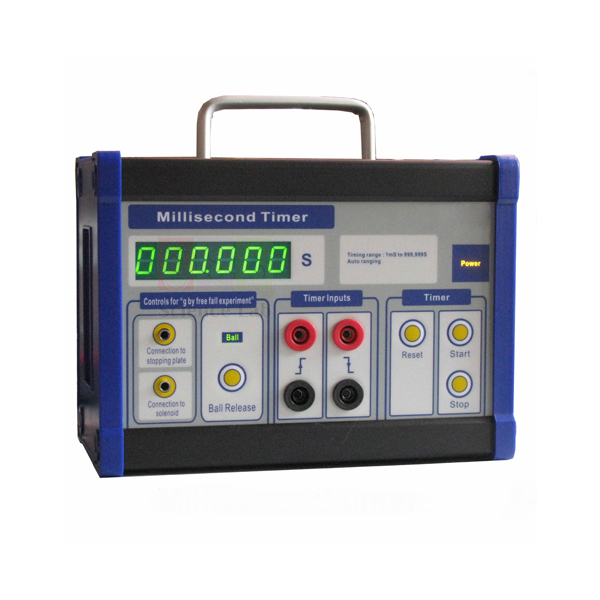
Millisecond Timer
Millisecond Timer (Product Code: SLE/PHY/251) is an electronic laboratory timer used to measure short time intervals in school and college mechanics experiments, including finding the acceleration due to gravity (g) by free fall. It works with free-fall apparatus and/or light gates and also supports manual timing, with 2 switch input sockets and 4 rear sockets for light gates. It is supplied by Jain Scientific Equipments Pvt Ltd (ScienceLab), Ambala, India.
Key Details
| Parameter | Detail |
|---|---|
| Functions | g by free fall experiment; manual timing |
| Works with | G by free fall apparatus and/or light gates |
| Manual switch inputs | 2 input sockets |
| Light gate inputs | 4 input sockets at the back |
| Resolution, range and power | Not stated in the product listing — ask us |
| Product code | SLE/PHY/251 |
| Supplied by | Jain Scientific Equipments Pvt Ltd (ScienceLab), Ambala, India |
What Is a Millisecond Timer Used For?
In the classic g-by-free-fall experiment, the timer starts when a ball is released and stops when it strikes a switch below, giving the fall time for a measured height. Repeating the drop from several heights lets students plot a graph and find g from its gradient. The two manual-switch sockets make the same unit useful for any start-stop event that is too quick to time with a hand-held stopwatch.
With light gates connected to the rear sockets, the timer records how long a card takes to pass through a beam, or the interval between two gates, so students can work out the speeds and accelerations of trolleys and gliders. That flexibility makes it a practical piece of mechanics lab equipment for motion, collision and free-fall work. Keep leads clear of moving parts and reset the display before each run so no earlier reading is carried over.
What to Specify When Ordering
- The number of timers needed for demonstration or student benches.
- Whether you need free-fall apparatus, light gates or both, and how many gates (up to the 4 rear sockets).
- Whether manual switches should be quoted for the 2 switch input sockets.
Supplier
ScienceLab is the brand name used by Jain Scientific Equipments Private Limited of Ambala, Haryana, India. The company supplies the Millisecond Timer to schools, colleges, dealers and institutional buyers in India and international markets, so it can be ordered in one enquiry with the free-fall and light-gate apparatus it works with. Read about the company on the ScienceLab profile page.
Related Physics Lab Equipment
These items are timed with, or can replace, the Millisecond Timer in mechanics practicals:
- G By Freefall Apparatus and Timer — free-fall set-up for the g experiment.
- Apparatus Air Track Light Gate — a light gate for timing gliders on an air track.
- Dynamics Kit, Track & Accessories — trolley experiments that are timed with light gates.
- Digital Timer — an alternative timer in the range.
- Scaler Timer — a combined counting and timing instrument.
Find more mechanics and timing apparatus in the Physics Lab Equipment category.
Frequently Asked Questions
What experiments can the Millisecond Timer be used for?
The Millisecond Timer is designed for the g by free fall experiment and for manual timing, and it can also time motion using light gates. Typical uses are finding the acceleration due to gravity, measuring trolley or glider speeds and timing short switch-controlled events.
How many inputs does the Millisecond Timer have?
The Millisecond Timer has 2 input sockets for connecting a manual switch and 4 input sockets at the back for connecting light gates. One unit can therefore handle simple start-stop timing as well as motion experiments that use several gates.
Does the Millisecond Timer work with light gates?
Yes. The Millisecond Timer can be used with G By Freefall apparatus and/or light gates, which connect to the 4 input sockets at the back. Tell ScienceLab which light gates you already have so the connection can be confirmed before you order.
What is the resolution of the Millisecond Timer?
The product listing for the Millisecond Timer does not state its display resolution, maximum range or power supply. Ask ScienceLab through the contact page for these details before ordering, especially if your experiment needs a particular timing resolution.
Who supplies the Millisecond Timer?
The Millisecond Timer is supplied by Jain Scientific Equipments Pvt Ltd (ScienceLab) of Ambala, Haryana, India, to schools, colleges, dealers and institutional buyers in India and international markets, together with free-fall and light-gate apparatus when required.
Is a calibration certificate available for the Millisecond Timer?
Whether a calibration certificate can be supplied with the Millisecond Timer should be discussed with ScienceLab at the enquiry stage. Share your requirement through the contact page, and the team will confirm what documentation is available for this timer.
Request a Quote
Send the quantity of Millisecond Timers (SLE/PHY/251) and any free-fall or light-gate items you need through the ScienceLab contact page, or add them to the enquiry cart to receive a quotation.
Last updated: 24 September 2026
Mirror, Concave
Mirror, Concave (Product Code: SLE/PHY/252) is a 50 mm diameter glass concave mirror used to form real and virtual images and to find focal length in school and college optics practicals. Optically worked, with a 75 mm focal length and a silvered back under a protective coating, it comes in packs of 10 so a whole class can work at the same time. It is made by Jain Scientific Equipments Pvt Ltd (ScienceLab), an OEM manufacturer, at its own factory in Ambala, India.
Specifications
| Parameter | Detail |
|---|---|
| Mirror type | Concave |
| Material | Glass, optically worked |
| Diameter | 50 mm |
| Focal length | 75 mm |
| Backing | Silvered back with protective coating |
| Pack size | 10 mirrors |
| Product code | SLE/PHY/252 |
| Manufacturer | Jain Scientific Equipments Pvt Ltd (ScienceLab) — OEM |
| Country of origin | India (made in Ambala, Haryana) |
What Is a Concave Mirror Used For?
Students find the focal length quickly by focusing a distant window or lamp onto a screen and measuring the mirror-to-image distance, which should come out close to 75 mm. They then move an object, such as an illuminated pin, to different distances and watch the image change from real and inverted to virtual, upright and magnified once the object is inside the focal point — the principle behind shaving mirrors and torch reflectors.
For the u–v method, the mirror is set on an optical bench and pairs of object and image distances are recorded to calculate f from the mirror formula. Because the reflecting silver is on the back of the glass, clean the front gently with a soft cloth and take care not to scratch the protective coating. With ten mirrors per pack, this physics lab equipment lets every group in a school class run the practical together.
What to Specify When Ordering
- The number of packs required (each pack holds 10 mirrors).
- Whether mirror holders or an optical bench should be quoted, as the listing covers the mirrors only.
- Whether convex and plane mirrors are also needed for a complete reflection unit.
OEM Manufacturer
Jain Scientific Equipments Private Limited, the company behind the ScienceLab brand, is the OEM (original equipment manufacturer) of the Mirror, Concave, which is produced at its own licensed factory at Saha, Ambala, Haryana, India. Schools, colleges, dealers and importers receive the mirrors factory-direct instead of through a middleman, and repeat packs can be ordered from the same source. For replacements or larger quantities, ask us; the ScienceLab profile has more about the company.
Related Physics Lab Equipment
These items help run a complete curved-mirror practical:
- Mirror, Convex — the diverging counterpart for comparing image types.
- Mirror, Plane Glass — for introducing the laws of reflection first.
- Optical Bench Kit — supports the u–v method of finding focal length.
- Meter Stick, White — measures object and image distances on the bench.
- Concave Mirror — an alternative concave mirror listed separately.
More optics apparatus is listed in the Physics Lab Equipment category.
Frequently Asked Questions
What is the focal length of the Mirror, Concave?
The Mirror, Concave has a focal length of 75 mm and a diameter of 50 mm. The short focal length lets students find the focus on an ordinary bench and form real images of a distant object only a few centimetres in front of the mirror.
How many mirrors come in a pack of the Mirror, Concave?
The Mirror, Concave is supplied in packs of 10. One pack equips several student groups at once, so a whole class can carry out focal-length and image-formation practicals together rather than waiting to share a single mirror.
What is the Mirror, Concave made of?
The Mirror, Concave is made of optically worked glass with a silvered back protected by a coating. Light passes through the glass front to the silvered back, so keep both faces free of scratches and clean them only with a soft cloth.
How do students measure focal length with the Mirror, Concave?
To measure focal length with the Mirror, Concave, focus light from a distant object onto a screen and measure the distance from mirror to sharp image. For better accuracy, use the u–v method on an optical bench and calculate f from the mirror formula.
Who manufactures the Mirror, Concave?
The Mirror, Concave is manufactured by Jain Scientific Equipments Pvt Ltd (ScienceLab), an OEM manufacturer, at its own licensed factory at Saha, Ambala, Haryana, India. Buyers order packs direct from the manufacturer, which also handles repeat orders and quotations.
Is a holder included with the Mirror, Concave?
The listing for the Mirror, Concave describes the mirrors only and does not mention a holder or stand. If you need mirror holders or an optical bench for the practical, include them in your enquiry and ScienceLab will quote a complete set.
Request a Quote
Quotations for the Mirror, Concave (SLE/PHY/252) come direct from the manufacturer. Tell us how many packs you need through the ScienceLab contact page, or add the mirrors to the enquiry cart.
Last updated: 24 September 2026
Mirror, Convex
Mirror, Convex (Product Code: SLE/PHY/253) is a 50 mm diameter glass convex mirror used to show how diverging mirrors form small, upright virtual images in school and college optics lessons. It has a 100 mm focal length, an optically worked surface and a silvered back with a protective coating, and it comes in packs of 10 for class sets. It is made by Jain Scientific Equipments Pvt Ltd (ScienceLab), an OEM manufacturer, at its own factory in Ambala, India.
Specifications
| Parameter | Detail |
|---|---|
| Mirror type | Convex |
| Material | Glass, optically worked |
| Diameter | 50 mm |
| Focal length | 100 mm |
| Backing | Silvered back with protective coating |
| Pack size | 10 mirrors |
| Product code | SLE/PHY/253 |
| Manufacturer | Jain Scientific Equipments Pvt Ltd (ScienceLab) — OEM |
| Country of origin | India (made in Ambala, Haryana) |
What Is a Convex Mirror Used For?
Whatever the object distance, a convex mirror gives an image that is virtual, upright and smaller than the object, and students can confirm this by viewing a pencil or their own face at different distances. Comparing its wide field of view with that of a plane mirror explains why convex mirrors are used as vehicle rear-view mirrors and at blind corners.
Finding the 100 mm focal length takes more care than with a concave mirror because the image cannot be caught on a screen; a common method uses a convex lens to form a real image first and then places the mirror in the converging beam so the light retraces its path. Mount the mirror securely, handle it by its edge and keep the protective backing free of scratches. Alongside concave and plane mirrors, it completes a set of optics lab equipment for the reflection topic.
What to Specify When Ordering
- The number of packs required (each pack holds 10 mirrors).
- Whether a convex lens and optical bench should be quoted for the focal-length method.
- Whether concave and plane mirrors are also needed so students can compare all three types.
OEM Manufacturer
The Mirror, Convex is manufactured by Jain Scientific Equipments Private Limited, which trades as ScienceLab and acts as the OEM (original equipment manufacturer) for this mirror. It is made at the company's own licensed factory in Saha, Ambala, Haryana, India, and schools, colleges, dealers and importers buy it factory-direct, with quotations from the maker. For buyers who need company details on file, Jain Scientific Equipments Private Limited is incorporated under CIN U29309HR2020PTC087597, and its Saha factory holds Factory Licence AMB-ONLINE-CHD-J-414. For repeat packs or replacements, ask us, and visit the ScienceLab profile for more about the company.
Related Physics Lab Equipment
These items are used with the convex mirror in reflection and image-formation lessons:
- Mirror, Concave — the converging counterpart for comparing real and virtual images.
- Mirror, Plane Glass — for comparing field of view with a flat mirror.
- Convex Lens — forms the real image used in the lens-and-mirror focal-length method.
- Optical Bench Set — holds lens, mirror and object in line for measurements.
- Convex Mirror — an alternative convex mirror listed separately.
Browse more optics apparatus in the Physics Lab Equipment category.
Frequently Asked Questions
What is the focal length of the Mirror, Convex?
The Mirror, Convex has a focal length of 100 mm and a diameter of 50 mm. Because a convex mirror diverges light, its focus is virtual and lies behind the mirror, so students measure it with an auxiliary convex lens rather than a simple screen.
What kind of image does the Mirror, Convex form?
The Mirror, Convex always forms a virtual, upright and diminished image, whatever the distance of the object. This property gives convex mirrors their wide field of view and links the lesson directly to vehicle and road-safety mirrors students see every day.
How many mirrors are in a pack of the Mirror, Convex?
The Mirror, Convex comes in packs of 10, enough for several student groups to compare convex, concave and plane mirrors in the same lesson. Order the number of packs that matches your class size and number of benches.
What is the Mirror, Convex made of?
The Mirror, Convex is optically worked glass with a silvered back and a protective coating over the silvering. Handle it by its edge, avoid placing it face-down on rough benches and wipe it only with a soft, clean cloth.
Who manufactures the Mirror, Convex?
The Mirror, Convex is manufactured by Jain Scientific Equipments Pvt Ltd (ScienceLab), an OEM manufacturer, at its own licensed factory in Saha, Ambala, Haryana, India. Schools, dealers and importers buy it direct from the manufacturer, which also issues quotations.
Can the Mirror, Convex be ordered in bulk?
Yes, the Mirror, Convex can be quoted in bulk packs for schools, colleges, dealers and importers in India and international markets. State the number of packs, any related optics items and your delivery location when you send an enquiry through the contact page.
Request a Quote
Request a manufacturer-direct quotation for the Mirror, Convex (SLE/PHY/253) through the ScienceLab contact page, or add the packs you need to the enquiry cart.
Last updated: 24 September 2026
Mirror, Plane Glass
Mirror, Plane Glass (Product Code: SLE/PHY/254) is an unmounted 150 x 100 mm flat glass mirror used to study the laws of reflection and image formation in school and college physics laboratories. Made of optically worked glass, silver backed with a protective coating, it is sold in packs of 10 so each student group can have its own mirror. It is made by Jain Scientific Equipments Pvt Ltd (ScienceLab), an OEM manufacturer, at its own factory in Ambala, India.
Specifications
| Parameter | Detail |
|---|---|
| Mirror type | Plane, unmounted |
| Material | Optically worked glass |
| Size | 150 x 100 mm |
| Backing | Silver backed with protective coating |
| Pack size | 10 mirrors |
| Product code | SLE/PHY/254 |
| Manufacturer | Jain Scientific Equipments Pvt Ltd (ScienceLab) — OEM |
| Country of origin | India (made in Ambala, Haryana) |
What Is a Plane Glass Mirror Used For?
The classic ray-tracing practical stands the mirror upright on a sheet of paper and uses pins or a ray box to show that the angle of reflection equals the angle of incidence, and that the image lies as far behind the mirror as the object is in front. The 150 x 100 mm size gives a wide reflecting area for these drawings, and students can also study lateral inversion by reading text in the mirror.
Two mirrors placed at an angle produce multiple images, so students can test how the number of images depends on the angle between them, while a pair of mirrors in a tube makes a simple periscope. Because the mirrors are unmounted, support them with a block, clip or holder so they stand vertical, handle them carefully by the edges and keep the silvered back from being scratched. Packs of ten make this basic laboratory equipment for schools in India easy to issue to every bench.
What to Specify When Ordering
- The number of packs required (each pack holds 10 mirrors).
- Whether mirror holders or supports should be quoted, as the mirrors are supplied unmounted.
- Whether a ray box or curved mirrors are also needed for the full reflection topic.
OEM Manufacturer
Jain Scientific Equipments Private Limited makes the Mirror, Plane Glass under its ScienceLab name as the OEM (original equipment manufacturer), at the company's own licensed factory at Saha, Ambala, Haryana, India. Schools, colleges, dealers and importers therefore source class quantities directly from the manufacturer rather than from a trader, with quotations issued by the maker. Replacement mirrors and repeat packs can be requested straight from us, and the ScienceLab profile explains more about the company.
Related Physics Lab Equipment
These items are used with plane mirrors in reflection practicals:
- Raybox Mirrored with Accessories — produces light rays for tracing reflection angles.
- Laser Pen, Red — a bright single ray for teacher demonstrations (never aim it at eyes).
- Mirror, Concave — a converging mirror for the next stage of the topic.
- Mirror, Convex — a diverging mirror for comparing image types.
- Plane Mirror — an alternative plane mirror listed separately.
See the Physics Lab Equipment category for more optics apparatus.
Frequently Asked Questions
What size is the Mirror, Plane Glass?
The Mirror, Plane Glass measures 150 x 100 mm. That reflecting area is large enough for ray-tracing drawings with pins or a ray box, and for multiple-image and lateral-inversion activities, while still fitting easily on a student bench.
Is the Mirror, Plane Glass mounted?
No. The Mirror, Plane Glass is supplied unmounted, as a bare glass mirror. For ray-tracing practicals it needs a small block, clip or holder to keep it upright; include holders in your enquiry if your laboratory does not already have them.
How many mirrors are in a pack of the Mirror, Plane Glass?
The Mirror, Plane Glass is sold in packs of 10, so one pack can equip ten student pairs or groups. Order enough packs to cover every bench, plus a few spares to replace mirrors that become chipped or scratched.
What is the Mirror, Plane Glass made of?
The Mirror, Plane Glass is made of optically worked glass, silver backed and finished with a protective coating. Keep the backing unscratched and clean the front with a soft cloth so images stay clear for measuring object and image distances.
Who manufactures the Mirror, Plane Glass?
The Mirror, Plane Glass is manufactured by Jain Scientific Equipments Pvt Ltd (ScienceLab), an OEM manufacturer, at its own licensed factory at Saha, Ambala, Haryana, India. Schools and dealers buy packs direct from the manufacturer, which also handles repeat orders.
What should a quotation request for the Mirror, Plane Glass include?
A quotation request for the Mirror, Plane Glass should state the number of packs, whether mirror holders, a ray box or curved mirrors are also needed, and the delivery location, so the manufacturer can price the full optics order at once.
Request a Quote
For a quotation direct from the manufacturer on the Mirror, Plane Glass (SLE/PHY/254), write to us via the ScienceLab contact page or add the packs to the enquiry cart.
Last updated: 24 September 2026
Mounted Motor for Solar Cell
Mounted Motor for Solar Cell (Product Code: SLE/PHY/255) is a small, low-consumption electric motor on a base, used to show light energy being converted into electrical and then mechanical energy in school physics lessons. Science teachers pair it with a solar cell because it runs directly from the cell’s output, and its spindle carries a 16mm diameter pulley that can raise a mass of at least 4g. It is supplied by Jain Scientific Equipments Pvt Ltd (ScienceLab), Ambala, India, with its other physics lab equipment for schools.
Specifications
| Parameter | Detail |
|---|---|
| Type | Small, low-consumption electric motor, mounted on a base |
| Power source | Designed to run directly from the output of a solar cell |
| Pulley | Simple pulley of 16mm diameter on the motor spindle |
| Lifting capability | Raises a mass of at least 4g when powered by the solar cell |
| Base size | 165mm x 100mm (the common base size of the Transfer Kit units) |
| Terminals | 4mm socket terminals, where appropriate |
| System | One of the separately available units of the Transfer Kit, which shows conversions of one form of energy to another |
| Product code | SLE/PHY/255 |
| Supplied by | Jain Scientific Equipments Pvt Ltd (ScienceLab), Ambala, India |
What Is the Solar Cell Motor Used For?
This motor completes an energy chain that starts with light: light falls on the solar cell, the cell produces an electric current, and the motor turns that current into motion. Because it is a low-consumption design, it can run from the modest output of a classroom solar cell with no battery or bench supply in the circuit, so students can see that the only energy input is light. It also works well as part of a physics demonstration kit on energy transfer.
For a lifting demonstration, tie a light thread to the 16mm pulley and hang a small mass (the motor can raise at least 4g); students then watch light energy end up as gravitational potential energy. Move the lamp closer or further away, or shade part of the cell, and the motor slows or stops, which links motor speed to light intensity. Strong sunlight or a bright lamp gives the clearest result.
What to Specify When Ordering
- Whether you need the motor alone or together with the Mounted Solar Cell that powers it
- Which other separately available Transfer Kit units you want, so the set matches your lesson plan
- The number of motor units per lab or per student group
- Connecting leads for the 4mm socket terminals, if your lab does not already have them
Supplier
ScienceLab is the trading name of Jain Scientific Equipments Private Limited, based in Ambala, Haryana. The company supplies the Mounted Motor for Solar Cell to schools, colleges, institutions and dealers in India and international markets, and it can be listed with other physics and energy-teaching items in a single enquiry. Company background is available on the ScienceLab company profile.
Related Physics Lab Equipment
These items support the same light-to-motion experiment:
- Mounted Solar Cell — the selenium photovoltaic unit this motor is designed to run from
- Crocodile Clips & Leads — for wiring the cell to the motor
- Mini Motor Unit — an alternative small motor for general circuit work
- Light Energy Kit — for further lessons on light as an energy source
- Solar Photovoltaic Basic — a kit for taking photovoltaic topics further
Browse the full range in Physics Lab Equipment.
Frequently Asked Questions
What does the Mounted Motor for Solar Cell demonstrate?
The Mounted Motor for Solar Cell demonstrates the direct conversion of light energy into electrical energy and then into mechanical energy. Powered only by a solar cell, it turns and can lift a small mass, so students see each stage of the energy chain.
How much mass can the Mounted Motor for Solar Cell lift?
The Mounted Motor for Solar Cell can raise a mass of at least 4g when powered by the solar cell, using the simple 16mm diameter pulley on its spindle. Performance depends on the light reaching the cell, so a bright lamp or direct sunlight gives the clearest result.
Does the Mounted Motor for Solar Cell need a battery?
No battery is needed: the Mounted Motor for Solar Cell is a low-consumption motor designed to run directly from the output of a solar cell. Connect it to the cell with leads, place the cell in strong light, and the motor starts turning.
Is the solar cell included with the Mounted Motor for Solar Cell?
The Mounted Motor for Solar Cell is one of the separately available units of the Transfer Kit, so the solar cell is listed as its own item, the Mounted Solar Cell. Mention both in your enquiry if you need a complete light-to-motion set.
What size is the Mounted Motor for Solar Cell?
The Mounted Motor for Solar Cell sits on a base measuring 165mm x 100mm, the base size shared by the Transfer Kit units, with 4mm socket terminals where appropriate. The matching footprint lets units stand neatly side by side on a bench.
Who supplies the Mounted Motor for Solar Cell?
The Mounted Motor for Solar Cell is supplied by Jain Scientific Equipments Pvt Ltd (ScienceLab) of Ambala, Haryana, India. The company handles enquiries from schools, colleges, dealers and institutional buyers across India and international markets for this and other physics teaching items.
What should a quotation request for the Mounted Motor for Solar Cell include?
For a quotation on the Mounted Motor for Solar Cell, state the product code SLE/PHY/255, the quantity, whether you also need the Mounted Solar Cell and other Transfer Kit units, and the delivery location. Send these details through the contact page or the enquiry cart.
Request a Quote
To order the Mounted Motor for Solar Cell, send your requirement through the ScienceLab contact page or add it to the enquiry cart with the quantity you need, and the team will reply with pricing and supply details.
Last updated: 24 September 2026
Mounted Solar Cell
Mounted Solar Cell (Product Code: SLE/PHY/256) is a selenium photovoltaic cell on a base, used to produce electrical energy directly from light energy in school physics demonstrations. Teachers pair it with the Mounted Motor for Solar Cell, and it shares the 165 x 100mm base and 4mm socket terminals used across the Energy Transfer Kit units. It is supplied by Jain Scientific Equipments Pvt Ltd (ScienceLab), Ambala, India, for schools putting together a physics experiment kit on energy.
Specifications
| Parameter | Detail |
|---|---|
| Cell type | Selenium photovoltaic cell |
| Function | Produces electrical energy directly from light energy |
| Intended use | With the motor unit, to demonstrate light-to-electrical energy conversion |
| Base size | 165 x 100mm |
| Terminals | 4mm socket terminals, where appropriate |
| System | Separately available unit of the Energy Transfer Kit |
| Product code | SLE/PHY/256 |
| Supplied by | Jain Scientific Equipments Pvt Ltd (ScienceLab), Ambala, India |
What Is the Mounted Solar Cell Used For?
The Mounted Solar Cell is the input stage of an energy-transfer demonstration. When light falls on the selenium cell it produces a small voltage and current, which can drive the matching motor unit or be read on a meter. It shows students that electrical energy can be produced without a battery, a generator or the mains.
Simple investigations work well with it: compare the output in daylight, under a desk lamp and with the cell partly covered, change the distance to the lamp, or tilt the cell away from the light. Adding a multimeter or galvanometer to the output turns a qualitative demonstration into a measurement exercise. Keep the cell face clean and free from scratches, and store it in a dry cupboard between lessons.
What to Specify When Ordering
- Whether you also need the Mounted Motor for Solar Cell as the load
- Any other Energy Transfer Kit units your lessons require
- The number of cells per lab or student group
- A meter for output readings, if your lab does not have one
Supplier
Jain Scientific Equipments Private Limited, which trades as ScienceLab from Ambala in Haryana, supplies the Mounted Solar Cell together with related energy-transfer units, meters and leads, so a school can source a complete demonstration from one vendor. Orders are handled for buyers in India and international markets. See the ScienceLab profile for more about the company.
Related Physics Lab Equipment
Items that complete or extend a solar-cell experiment:
- Mounted Motor for Solar Cell — the low-consumption motor designed to run from this cell
- Standard Digital Multimeter — to measure the voltage and current the cell produces
- Galvanometer, Centre Zero Universal Meter — to detect small currents from the cell
- LDR — a light-sensitive component whose resistance changes with light, for comparison
- Crocodile Clips & Leads — for connecting the cell to its load or meter
See more in the Physics Lab Equipment category.
Frequently Asked Questions
What type of cell is used in the Mounted Solar Cell?
The Mounted Solar Cell uses a selenium photo-voltaic cell, which generates electricity when light falls on its surface. It is mounted on a 165 x 100mm base so it can be placed on a bench and connected like the other Energy Transfer Kit units.
What can the Mounted Solar Cell power?
The Mounted Solar Cell is intended for use with the Mounted Motor for Solar Cell, to demonstrate electrical energy produced directly from light energy. If you plan to connect a different load, describe it in your enquiry and we will advise.
Can the Mounted Solar Cell be connected to a meter?
Yes, the Mounted Solar Cell can be connected to a multimeter or galvanometer through leads, letting students record how its output changes with light level. Readings depend on the brightness and angle of the light, so keep the set-up constant when comparing results.
Is the Mounted Solar Cell sold as part of a kit?
The Mounted Solar Cell is one of the separately available units of the Energy Transfer Kit, so it can be ordered on its own or with other units such as the motor. List every unit you need in your enquiry to receive a combined quotation.
Who supplies the Mounted Solar Cell?
The Mounted Solar Cell is supplied by Jain Scientific Equipments Pvt Ltd (ScienceLab), Ambala, Haryana, India. The company serves schools, colleges, science centres and dealers throughout India and international markets with physics demonstration equipment.
What details are needed to quote for the Mounted Solar Cell?
To quote for the Mounted Solar Cell, send the product code SLE/PHY/256, the number of cells, any matching units such as the motor or a meter, and the delivery address. The contact page or enquiry cart is the quickest route.
Request a Quote
Ready to add the Mounted Solar Cell to your lab? Place it in the enquiry cart or write to us through the contact page, and include the quantity and delivery location so we can prepare your quotation.
Last updated: 24 September 2026
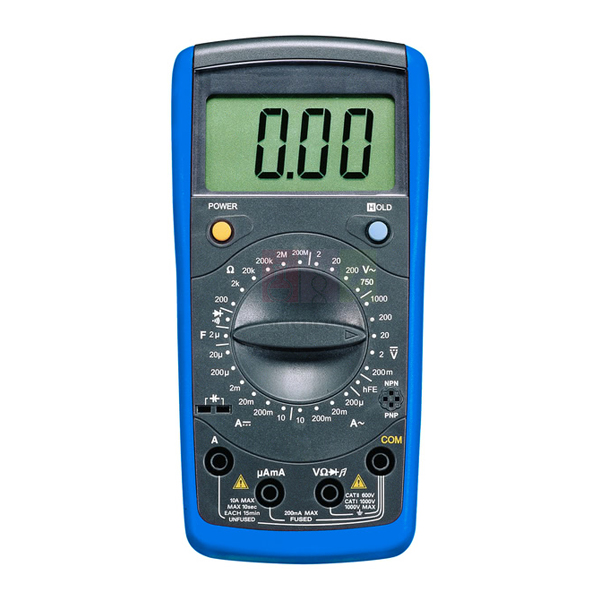
Advanced Digital Multimeter
Advanced Digital Multimeter (Product Code: SLE/PHY/257) is a portable digital multimeter used to measure DC and AC voltage, current, resistance and capacitance in physics and electronics labs. College and senior-school labs choose it for its 1000V DC and 750V AC ranges, a 2µF capacitance range, triode and diode tests and a 1999 maximum display. It is supplied by Jain Scientific Equipments Pvt Ltd (ScienceLab), Ambala, India, as one of the digital measuring instruments it offers in India and international markets.
Specifications
| Parameter | Detail |
|---|---|
| Type | Advanced portable digital multimeter |
| DC voltage | 200mV / 2V / 20V / 200V / 1000V; accuracy ±(0.5%+1) |
| AC voltage | 2V / 20V / 200V / 750V; accuracy ±(0.8%+3) |
| DC current | 20µA / 200µA, 2mA / 20mA, 200mA / 10A; accuracy ±(0.8%+1) |
| Additional current ranges | 200µA / 20mA, 200mA / 10A; accuracy ±(1%+3) — please confirm the function of these ranges with us when ordering |
| Resistance | 200Ω / 2kΩ / 20kΩ, 200kΩ / 2MΩ / 200MΩ; accuracy ±(0.8%+1) |
| Capacitance | 2µF; accuracy ±(4%+3) |
| Test functions | Diode test, triode test, on/off buzzer |
| Convenience features | Data hold, auto power off, low battery warning |
| Input resistance | ≥10MΩ |
| Maximum display | 1999 |
| Power supply | 9V (6F22) battery |
| Weight | 310 g |
| Dimensions (W × H × D) | 172 × 83 × 38 mm |
| Product code | SLE/PHY/257 |
| Supplied by | Jain Scientific Equipments Pvt Ltd (ScienceLab), Ambala, India |
What Is the Advanced Digital Multimeter Used For?
In a physics or electronics practical, the Advanced Digital Multimeter stands in for a separate voltmeter, ammeter and ohmmeter. Students can check the terminal voltage of a cell, the current through a resistor, the resistance of a length of wire or the value of a small capacitor with one handheld instrument. The diode and triode tests support semiconductor practicals, and the buzzer gives a quick continuity check on leads and circuit boards, which makes it a practical choice among electronic lab instruments for teaching labs.
Good practice is to select the function and the highest suitable range before connecting, then step down for a finer reading; use the 10A range only for larger currents, and never measure resistance in a live circuit. Data hold lets a student freeze a reading to write it down, while auto power off saves the 9V battery between experiments.
What to Specify When Ordering
- The number of meters needed per lab or per student group
- Whether you need this advanced model or the more basic Standard Digital Multimeter for routine class work
- Spare 9V (6F22) batteries, if required, and confirmation of what comes in the box
- Any calibration-certificate requirement, to be discussed before ordering
Supplier
ScienceLab is the trading name of Jain Scientific Equipments Private Limited, Ambala, which supplies the Advanced Digital Multimeter to schools, colleges, training institutes and dealers in India and international markets. For vendor registration and export paperwork, the supplying company’s details are Importer-Exporter Code AAECJ8618A (DGFT) and GSTIN 06AAECJ8618A1ZT. More about the company is on the ScienceLab profile page.
Related Physics Lab Equipment
Useful items for circuit practicals where this multimeter takes the readings:
- Standard Digital Multimeter — a more basic model for routine class measurements
- Power Supply Variable — an adjustable source for the circuits being measured
- Decade Resistance Box — known resistance values for checking readings
- Worcester Circuit Board — for building circuits to measure
- Crocodile Clips & Leads — quick connections to components
Explore more in Physics Lab Equipment.
Frequently Asked Questions
What can the Advanced Digital Multimeter measure?
The Advanced Digital Multimeter measures DC voltage up to 1000V, AC voltage up to 750V, DC current up to 10A, resistance up to 200MΩ and capacitance on a 2µF range. It also offers diode, triode and buzzer continuity tests.
How accurate is the Advanced Digital Multimeter?
The Advanced Digital Multimeter is specified at ±(0.5%+1) on DC voltage, ±(0.8%+3) on AC voltage, ±(0.8%+1) on DC current and resistance, and ±(4%+3) on capacitance. The second figure in each bracket is a number of counts in the last displayed digit.
What battery does the Advanced Digital Multimeter use?
The Advanced Digital Multimeter runs on a single 9V (6F22) battery. A low battery warning tells students when to replace it, and the auto power off function switches the meter off when it is left unused, which helps the battery last between practicals.
When should I choose the Advanced Digital Multimeter?
Choose the Advanced Digital Multimeter when your practicals need its capacitance range, triode test, 1000V DC and 750V AC ranges or its 200MΩ resistance range. For routine class work, compare it with the Standard Digital Multimeter page before ordering.
Does the Advanced Digital Multimeter come with a calibration certificate?
Calibration-certificate availability for the Advanced Digital Multimeter should be discussed with us before you order. Mention the requirement in your enquiry through the contact page so that it can be confirmed along with the quotation.
Who supplies the Advanced Digital Multimeter?
Jain Scientific Equipments Pvt Ltd (ScienceLab) of Ambala, Haryana, India supplies the Advanced Digital Multimeter. It handles orders from schools, colleges, polytechnics and dealers in India and international markets, often alongside other electrical teaching equipment.
What should I include when requesting a quote for the Advanced Digital Multimeter?
When requesting a quote for the Advanced Digital Multimeter, give the product code SLE/PHY/257, the quantity, any spare batteries or accessories wanted, any calibration-certificate need and the delivery location, so the offer can be prepared in one step.
Request a Quote
For pricing on the Advanced Digital Multimeter, use the contact page or add the item to the enquiry cart. Bulk orders for several labs can be quoted together.
Last updated: 24 September 2026
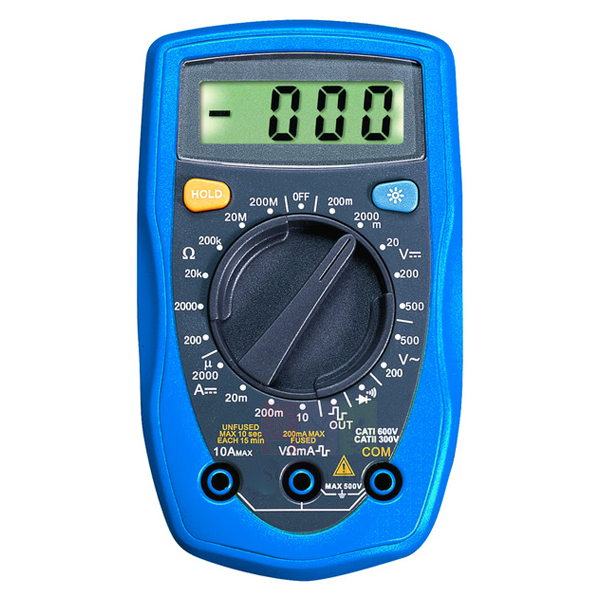
Standard Digital Multimeter
Standard Digital Multimeter (Product Code: SLE/PHY/258) is a portable digital multimeter used to measure DC and AC voltage, DC current and resistance in school and college electricity practicals. Students find it easy to handle because it weighs 156 g, and it adds a backlight, data hold and a square wave output to its 1999 maximum display. It is supplied by Jain Scientific Equipments Pvt Ltd (ScienceLab), Ambala, India, alongside its other physics lab instruments.
Specifications
| Parameter | Detail |
|---|---|
| Type | Standard portable digital multimeter |
| DC voltage | 200mV / 2000mV, 20V / 200V / 500V; accuracy ±(0.5%+2) |
| AC voltage | 200V / 500V; accuracy ±(1.2%+10) |
| DC current | 2000µA / 20mA, 200mA / 10A; accuracy ±(1%+2) |
| Resistance | 200Ω / 2kΩ / 20kΩ, 200kΩ / 20MΩ; accuracy ±(0.8%+2) |
| Input resistance | DCV ≥10MΩ, ACV ≥5MΩ |
| Maximum display | 1999 |
| Functions | Diode test, on/off buzzer, square wave output, data hold |
| Display and power features | Backlight, low battery warning |
| Power supply | 9V (6F22) battery |
| Weight | 156 g |
| Dimensions (W × H × D) | 130 × 73.5 × 35 mm |
| Product code | SLE/PHY/258 |
| Supplied by | Jain Scientific Equipments Pvt Ltd (ScienceLab), Ambala, India |
What Is the Standard Digital Multimeter Used For?
The Standard Digital Multimeter covers the everyday measurements of a school electricity syllabus: reading the voltage across and the current through a resistor for Ohm’s law, checking cells in series and parallel, and measuring the resistance of wires, resistors or a light dependent resistor in light and dark. It pairs naturally with an Ohm’s law experiment kit, giving each student group its own meter.
The square wave output provides a simple test signal for basic circuit checks, the backlight helps in a dim room, and data hold freezes a reading while students note it down. Start on the highest suitable range, keep the 10A range for larger currents only, and leave the AC voltage ranges to teacher-led work where higher voltages are involved.
What to Specify When Ordering
- How many meters you need per bench or student group
- Whether this model’s ranges suit your syllabus or the Advanced Digital Multimeter is needed
- Spare 9V (6F22) batteries, if required
- Confirmation of the accessories supplied with each meter
Supplier
Jain Scientific Equipments Private Limited trades under the ScienceLab name from Ambala, Haryana, and supplies the Standard Digital Multimeter to schools, coaching labs, colleges and distributors. Because the company also supplies circuit components and power sources, a full electricity bench can be quoted in one enquiry for delivery in India and international markets. Learn more on the company profile.
Related Physics Lab Equipment
Pair the meter with these items for complete circuit practicals:
- Advanced Digital Multimeter — the higher-specification model in the same range
- Power Supply, Stepped — a low-voltage source for student circuits
- Worcester Circuit Board Kit — components and board for building circuits to test
- LDR — its resistance changes with light, a classic multimeter exercise
- Crocodile Clips & Leads — for connecting the meter into a circuit
Find more in Physics Lab Equipment.
Frequently Asked Questions
What ranges does the Standard Digital Multimeter cover?
The Standard Digital Multimeter measures DC voltage from 200mV to 500V, AC voltage on 200V and 500V ranges, DC current from 2000µA to 10A and resistance from 200Ω to 20MΩ, with a maximum display of 1999.
Does the Standard Digital Multimeter have a backlight?
Yes, the Standard Digital Multimeter has a backlight for reading the display in poorly lit rooms, together with data hold to freeze a reading and a low battery warning that signals when its 9V (6F22) battery needs replacing.
What is the square wave output on the Standard Digital Multimeter for?
The square wave output on the Standard Digital Multimeter provides a simple test signal that can be fed into basic circuits during electronics practicals. For details of the signal, contact us before ordering so we can confirm it suits your intended experiment.
How accurate is the Standard Digital Multimeter?
The Standard Digital Multimeter is specified at ±(0.5%+2) on DC voltage, ±(1.2%+10) on AC voltage, ±(1%+2) on DC current and ±(0.8%+2) on resistance. Input resistance is at least 10MΩ on DC voltage and 5MΩ on AC voltage.
Is the Standard Digital Multimeter suitable for students?
The Standard Digital Multimeter suits student use: it weighs 156 g and measures 130 × 73.5 × 35 mm, so it is easy to hold. Measurements on higher AC voltages should always be carried out or supervised by a teacher.
Who supplies the Standard Digital Multimeter?
The Standard Digital Multimeter is supplied by Jain Scientific Equipments Pvt Ltd (ScienceLab), Ambala, Haryana, India. Schools, colleges and dealers in India and international markets can order it on its own or with other circuit and measurement items.
How do I get a quotation for the Standard Digital Multimeter?
To get a quotation for the Standard Digital Multimeter, send the product code SLE/PHY/258, the number of meters, any spare batteries needed and your delivery location through the contact page or the enquiry cart, and a reply will follow with pricing.
Request a Quote
Equipping several benches? Add the Standard Digital Multimeter to the enquiry cart with your quantity, or describe your full requirement on the contact page for a combined quotation.
Last updated: 24 September 2026
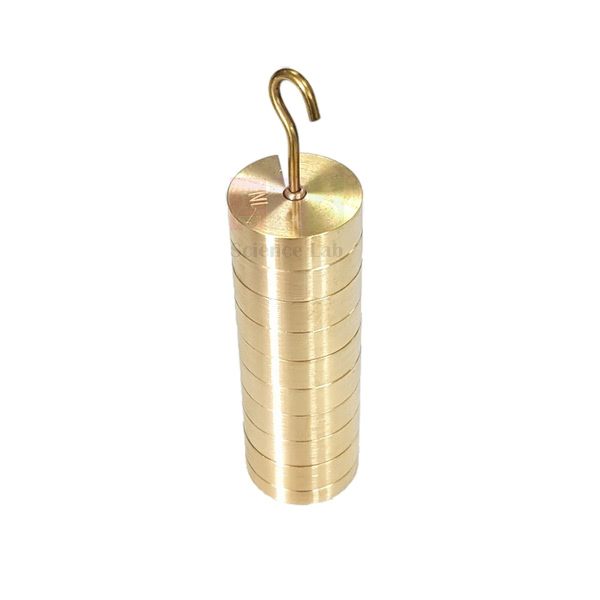
Newton Mass Set 10N Set
Newton Mass Set 10N Set (Product Code: SLE/PHY/259) is a set of slotted brass masses graded in newtons, used to apply known forces in school and college physics experiments. Physics teachers rely on it as core mechanics lab equipment: nine 1N slotted masses and a 1N hanger let loads be built up in 1N steps to a total of 10N. It is made by Jain Scientific Equipments Pvt Ltd (ScienceLab), an OEM manufacturer, at its own factory in Ambala, India.
Specifications
| Parameter | Detail |
|---|---|
| Material | Brass |
| Contents | 9 x 1N slotted brass masses and 1 x 1N hanger |
| Step size | 1N per slotted mass |
| Total load (hanger plus all masses) | 10N |
| Product code | SLE/PHY/259 |
| Manufacturer | Jain Scientific Equipments Pvt Ltd (ScienceLab) — OEM |
| Country of origin | India (made in Ambala, Haryana) |
What Is the Newton Mass Set 10N Used For?
Because every piece is marked in newtons rather than grams, students work directly with force (weight) and need no conversion during the experiment. Typical uses include Hooke’s law, where a spring is stretched 1N at a time and extension is plotted against load; the principle of moments on a metre rule; pulley and inclined plane experiments; tension in strings; and checking the scale of force meters and spring balances.
For safe handling, stagger the slots as the masses are added so they do not slide off the hanger, lower each load gently, and remove the masses once readings are taken so springs are not left overstretched. Wipe the brass clean and store the set dry. It suits physics practical work under CBSE and state board syllabuses where force is measured in newtons.
What to Specify When Ordering
- Whether this 10N set suits your springs and apparatus, or the smaller Newton Mass Set 1N Set is needed
- The number of sets per lab (often one per student group)
- Any additional hangers or loose masses you want to discuss with us
- Force meters or pulleys to be used with the set, if you also need them
OEM Manufacturer
Jain Scientific Equipments Private Limited, trading as ScienceLab, is the OEM (original equipment manufacturer) of the Newton Mass Set 10N Set. The company makes the set at its own licensed factory at Saha, Ambala, Haryana, India, rather than buying it in from a trader, and supplies it factory-direct to schools, colleges, institutions, dealers and importers.
If a piece goes missing or you need a repeat order of the same set, ask us — the manufacturer handles it directly. Read more about the company on the ScienceLab profile page.
Related Physics Lab Equipment
Items commonly used with newton masses in force and mechanics practicals:
- Newton Mass Set 1N Set — a lighter set for smaller forces
- Force Meter/Spring Balance — to compare readings against known loads
- Pulley, Bench Mounting, Ball Bearing — to run a string over the bench edge with the hanger attached
- Apparatus Newton’s Second Law — for experiments on force and acceleration
- Slotted Mass Hanger, 1kg — a heavier slotted mass hanger for larger loads
View the full Physics Lab Equipment range.
Frequently Asked Questions
What is included in the Newton Mass Set 10N Set?
The Newton Mass Set 10N Set contains nine 1N slotted brass masses and one 1N hanger. With every mass loaded onto the hanger the total is 10N, and the load can be changed in steps of 1N.
Why are the masses in the Newton Mass Set 10N Set marked in newtons?
The Newton Mass Set 10N Set is marked in newtons so students can read the applied force directly. This keeps Hooke’s law, moments and pulley experiments focused on force, without a separate step converting grams to newtons.
What material is the Newton Mass Set 10N Set made from?
The Newton Mass Set 10N Set is made of brass. Brass is dense, so each 1N piece stays compact on the hanger, and it resists corrosion in normal lab use; wipe the pieces clean and keep them dry after practicals.
Can the masses of the Newton Mass Set 10N Set be used without the hanger?
The slotted masses of the Newton Mass Set 10N Set are designed to stack on the 1N hanger. Remember that the hanger itself counts as 1N of the load, so include it when totalling the force applied.
Who manufactures the Newton Mass Set 10N Set?
The Newton Mass Set 10N Set is manufactured by Jain Scientific Equipments Pvt Ltd (ScienceLab), the OEM, at its own licensed factory at Saha, Ambala, Haryana, India. Quotations, repeat orders and replacement pieces are handled by the manufacturer itself.
Is a calibration certificate available for the Newton Mass Set 10N Set?
Calibration-certificate availability for the Newton Mass Set 10N Set should be discussed with us before ordering. State the requirement in your enquiry via the contact page so it can be addressed together with your quotation.
What should a quotation request for the Newton Mass Set 10N Set include?
A quotation request for the Newton Mass Set 10N Set should give the product code SLE/PHY/259, the number of sets, any extra hangers or matching apparatus, and the delivery location, whether that is within India or an export destination.
Request a Quote
Quotations for the Newton Mass Set 10N Set come direct from the manufacturer. Send your quantity through the contact page or add the set to the enquiry cart.
Last updated: 24 September 2026
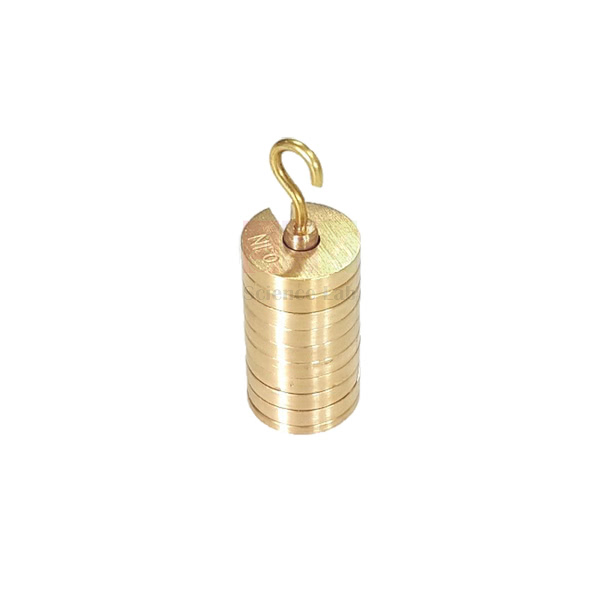
Newton Mass Set 1N Set
Newton Mass Set 1N Set (Product Code: SLE/PHY/260) is a set of small slotted brass masses graded in tenths of a newton, used to apply light, finely stepped forces in physics practicals. With nine 0.1N slotted masses on a 0.1N hanger it builds loads in 0.1N increments up to 1N, which suits soft springs and low-range force meters used by students. It is made by Jain Scientific Equipments Pvt Ltd (ScienceLab), an OEM manufacturer, at its own factory in Ambala, India.
Specifications
| Parameter | Detail |
|---|---|
| Material | Brass |
| Contents | 9 x 0.1N slotted brass masses with 1 x 0.1N hanger |
| Increment | 0.1N per slotted mass |
| Maximum load (all pieces on the hanger) | 1N |
| Product code | SLE/PHY/260 |
| Manufacturer | Jain Scientific Equipments Pvt Ltd (ScienceLab) — OEM |
| Country of origin | India (made in Ambala, Haryana) |
What Is the Newton Mass Set 1N Used For?
Where a full newton would overstretch a soft spring or swamp a sensitive measurement, 0.1N steps give students many data points across a small range. The set is used for the extension of soft springs and rubber bands, for checking low-range force meters, for balancing small moments on a metre rule and for loading light pulleys and friction blocks. It complements a Hooke’s law spring kit, where a smooth, well-populated graph matters more than a large total load.
The pieces are small, so keep them in a tray or box during the practical and count them back in at the end of each lesson. Place masses on the hanger gently rather than dropping them, and keep the brass dry so it stays easy to handle and read.
What to Specify When Ordering
- Whether you need this 1N set for light loads, the Newton Mass Set 10N Set for heavier ones, or both
- The number of sets for your student groups
- Springs, force meters or pulleys to be supplied with the sets, if needed
OEM Manufacturer
The Newton Mass Set 1N Set is a ScienceLab-made product. Jain Scientific Equipments Private Limited, which trades as ScienceLab, is its original equipment manufacturer (OEM) and produces it at the company’s licensed factory in Saha, Ambala, Haryana, India. Because quotations come straight from the manufacturer, schools, colleges, dealers and importers deal with the source of the product rather than an intermediary.
Ask us about replacement masses if pieces are lost over time. Company details are on the ScienceLab profile.
Related Physics Lab Equipment
Pieces of apparatus that work well with light, finely stepped loads:
- Newton Mass Set 10N Set — the heavier companion set for larger forces
- Spring Scales, Green, 500 g (5 N) — a spring scale to check against known small loads
- Balance Spring Tubular Plastic — a spring balance for student force measurements
- Balance Demonstration Fulcrum/Lever — for moments experiments with small loads
- Pulley, Metal, Single, Parallel — for string-and-load set-ups
Browse all Physics Lab Equipment.
Frequently Asked Questions
What does the Newton Mass Set 1N Set contain?
The Newton Mass Set 1N Set contains nine slotted brass masses of 0.1N each and one 0.1N hanger. Loading every piece gives a total of 1N, so students can build forces in ten equal steps.
What is the smallest step with the Newton Mass Set 1N Set?
The smallest step with the Newton Mass Set 1N Set is 0.1N, the value of each slotted mass and of the hanger. This fine increment gives more readings over a small range, which is useful for soft springs and sensitive force meters.
When should I choose the Newton Mass Set 1N Set over the 10N set?
Choose the Newton Mass Set 1N Set when your springs, balances or lever experiments need light loads in fine steps. For stiffer springs and larger forces, the Newton Mass Set 10N Set is the better match, and many labs keep both.
How should the Newton Mass Set 1N Set be stored?
Store the Newton Mass Set 1N Set in a dry box or tray with the masses stacked on or beside the hanger. The pieces are small, so count them after each practical to make sure the set stays complete for the next class.
Who manufactures the Newton Mass Set 1N Set?
The Newton Mass Set 1N Set is manufactured by Jain Scientific Equipments Pvt Ltd (ScienceLab) as the OEM, at its own licensed factory in Saha, Ambala, India. Buyers get quotations and answers on replacement pieces directly from the maker.
Can the Newton Mass Set 1N Set be ordered in bulk for several labs?
Bulk orders for the Newton Mass Set 1N Set are handled by the manufacturer for schools, institutions and dealers in India and international markets. State the number of sets and the delivery location in your enquiry for a combined quotation.
Request a Quote
Ask for a price on the Newton Mass Set 1N Set through the contact page, or add it to the enquiry cart together with any related apparatus — the quotation comes direct from the manufacturer.
Last updated: 24 September 2026

Newton's Colour Disc
Newton's Colour Disc (Product Code: SLE/PHY/261) is a hand-driven rotating disc carrying the spectral colours, used to show that white light is made up of all the colours of the spectrum in school optics lessons. Teachers turn a hand wheel that drives the 180mm diameter disc through a belt, and as it spins on its metal stand the colours appear to merge into a whitish shade. It is made by Jain Scientific Equipments Pvt Ltd (ScienceLab), an OEM manufacturer, at its own factory in Ambala, India.
Specifications
| Parameter | Detail |
|---|---|
| Disc diameter | 180mm |
| Disc | Multi-coloured, carrying the spectral colours |
| Drive | Belt drive from a hand-driven wheel |
| Mounting | Metal stand |
| Demonstrates | That white light may be composed from all the spectral colours, by rotation of the disc |
| Product code | SLE/PHY/261 |
| Manufacturer | Jain Scientific Equipments Pvt Ltd (ScienceLab) — OEM |
| Country of origin | India (made in Ambala, Haryana) |
What Is Newton's Colour Disc Used For?
Newton’s colour disc is the natural partner to prism dispersion. A prism splits white light into a band of colours; the disc does the reverse, recombining them. When it spins fast enough, the eye can no longer separate the coloured sectors (persistence of vision), so they blend into a pale, near-white colour. It is a quick, memorable addition to any optics experiment kit for school classes.
Show the disc at rest first so students can name the colours, then turn the wheel steadily and build up speed rather than jerking it. Bright, white room light gives the clearest effect. Use the moment to discuss why the spinning disc looks greyish-white rather than pure white: coloured surfaces reflect only part of the light that falls on them. Keep the belt free of oil so the drive does not slip.
OEM Manufacturer
Jain Scientific Equipments Private Limited trades as ScienceLab and is the OEM (original equipment manufacturer) of Newton’s Colour Disc, making it at its licensed factory at Saha, Ambala, Haryana, India. Schools, colleges, institutions, dealers and importers buy it factory-direct, and questions about a replacement belt or other spare parts go to the manufacturer itself — just ask us.
For institutional vendor registration, the company’s details are GSTIN 06AAECJ8618A1ZT and LEI 3358004HRD1JIVXKYX49. More background is on the ScienceLab profile.
Related Physics Lab Equipment
Pair the colour disc with these items for a complete lesson on white light and colour:
- Prism, Clear Glass — splits white light into the spectrum that the disc recombines
- Prism – Acrylic, Set of 7 — shapes for refraction and dispersion activities
- Raybox, 12V — a light source for dispersion experiments
- Electromagnetic Spectrum Chart — places the visible colours within the wider spectrum
See the complete Physics Lab Equipment category.
Frequently Asked Questions
What does Newton's Colour Disc demonstrate?
Newton’s Colour Disc demonstrates that white light may be composed from all the spectral colours. When the multi-coloured disc is spun quickly, the eye blends the colours together and the disc appears whitish, reversing the splitting seen with a prism.
How is Newton's Colour Disc rotated?
Newton’s Colour Disc is rotated by hand: a hand-driven wheel turns the disc through a belt. No electrical supply is involved, so it can be used in any classroom, and the teacher controls the speed directly by how fast the wheel is turned.
What size is the disc on Newton's Colour Disc?
The disc on Newton’s Colour Disc is 180mm in diameter and is mounted on a metal stand, giving a clear view for a group gathered round the teacher’s bench. In a large room, invite students forward in small groups so everyone sees the colours merge.
Why does Newton's Colour Disc look greyish-white instead of pure white?
Newton’s Colour Disc usually looks greyish-white because coloured surfaces are not pure spectral light: each sector reflects only part of the light falling on it. The blend is therefore duller than true white light, a useful discussion point for students.
Who manufactures Newton's Colour Disc?
Newton’s Colour Disc is manufactured by Jain Scientific Equipments Pvt Ltd (ScienceLab), the OEM, at its own licensed factory in Saha, Ambala, Haryana, India. The company supplies it directly to schools, dealers and importers in India and international markets.
What should I include in a quotation request for Newton's Colour Disc?
For a quotation on Newton’s Colour Disc, mention the product code SLE/PHY/261, the quantity required, any prisms or light sources you want quoted alongside, and the delivery location. Send it through the contact page or the enquiry cart.
Request a Quote
Newton’s Colour Disc is quoted directly by its manufacturer. Add it to the enquiry cart or reach the team through the contact page with your quantity and delivery details.
Last updated: 24 September 2026
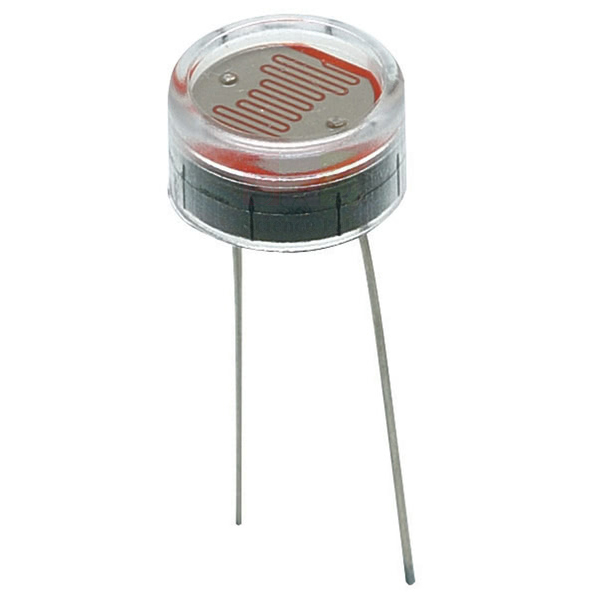
LDR
LDR (Product Code: SLE/PHY/262) is a cadmium sulphide light dependent resistor, a photoconductive cell whose resistance falls as more light reaches it, used for light-sensing experiments in school and college physics and electronics labs. Teachers choose it because its spectral response is similar to that of the human eye, its dark resistance is 1MΩ, and it sits in a robust clear plastic case with a clear end window. It is supplied by Jain Scientific Equipments Pvt Ltd (ScienceLab), Ambala, India.
Specifications
| Parameter | Detail |
|---|---|
| Type | Cadmium sulphide (CdS) light dependent resistor — photoconductive cell |
| Spectral response | Similar to that of the human eye |
| Behaviour | Resistance reduces as the light falling on the LDR increases |
| Dark resistance | 1MΩ |
| Resistance at 1 ftc (foot-candle) | 5.4kΩ min, 12.6kΩ max |
| Maximum voltage | 250V peak AC or DC |
| Power dissipation | 250mW max. |
| Operating temperature | –60°C to +75°C |
| Dimensions, top | 14.35 x 7mm (dia. x d) |
| Pin length | 9.53mm |
| Protection | Moisture-resistant coating; enclosed in a robust clear plastic case with a clear end window |
| Product code | SLE/PHY/262 |
| Supplied by | Jain Scientific Equipments Pvt Ltd (ScienceLab), Ambala, India |
What Is an LDR Used For?
In class, the simplest investigation is to connect the LDR to a multimeter set to resistance and take readings in darkness, in room light and under a lamp, or at several distances from the lamp, then plot resistance against light level. In circuits, an LDR is combined with a fixed resistor as a potential divider so that the output voltage changes with brightness — the principle behind automatic night lights, light meters and light-operated alarms. Its eye-like spectral response makes it a sensible choice for any opto-electronics experiment kit that measures light as people perceive it.
Keep within the 250V peak and 250mW limits by adding a suitable series resistor, bend the pins gently when fitting it to a board, and keep the clear window free of fingerprints. Because the sensing element contains cadmium, do not break open the casing, and dispose of damaged units according to local rules for electronic waste.
Supplier
Jain Scientific Equipments Private Limited, known by its trading name ScienceLab, supplies this LDR from Ambala, Haryana, as part of its range of physics and electronics teaching components. Schools, colleges, training institutes and dealers in India and international markets can order it with meters, resistors and power sources in one enquiry. Visit the ScienceLab profile for company information.
Related Physics Lab Equipment
Items that help students build and measure light-sensing circuits:
- Simple Circuit Module Light Dependent Resistor Board — an LDR on a module for plug-together circuit kits
- Miniature LDR — a smaller alternative for compact circuits
- Standard Digital Multimeter — to measure the change in resistance with light
- Lamp Holder — to hold a bulb as a controllable light source
- Mounted Solar Cell — a light-sensitive device that generates a voltage, for comparison
More items are listed under Physics Lab Equipment.
Frequently Asked Questions
How does the LDR work?
The LDR is a cadmium sulphide photoconductive cell: light falling on it frees charge carriers in the material, so its resistance drops as the light gets brighter. In darkness its resistance is high, at 1MΩ, which gives a large and easily measured change.
What is the resistance of the LDR in light and dark?
The LDR has a dark resistance of 1MΩ. At an illumination of 1 foot-candle its resistance lies between 5.4kΩ minimum and 12.6kΩ maximum, so students see a clear fall in resistance as light increases.
What voltage and power can the LDR handle?
The LDR is rated for a maximum of 250V peak AC or DC and a power dissipation of 250mW maximum. In student circuits, a series resistor keeps the current, and therefore the power in the LDR, safely below that limit.
Can the LDR be used in humid or cold conditions?
The LDR is encapsulated in a moisture-resistant coating inside a plastic case, and its operating temperature range is –60°C to +75°C. It should still be kept away from direct water and stored dry between practicals.
What experiments can students do with the LDR?
Students can use the LDR to plot resistance against light level, build a potential divider whose output voltage changes with brightness, or make a simple light-activated switch or alarm. Each shows how a sensor turns light into an electrical signal.
Who supplies the LDR?
The LDR is supplied by Jain Scientific Equipments Pvt Ltd (ScienceLab) of Ambala, Haryana, India. The company provides it to schools, colleges, electronics training centres and dealers in India and international markets, alongside other circuit components.
What should I send to get a quote for the LDR?
To get a quote for the LDR, send the product code SLE/PHY/262, the number of pieces, any meters or circuit boards you want with it, and the delivery location through the contact page or the enquiry cart.
Request a Quote
To buy LDRs for your lab, add the item to the enquiry cart or use the contact page; mention the quantity and whether you need matching components.
Last updated: 24 September 2026

Oersted's Apparatus
Oersted's Apparatus (Product Code: SLE/PHY/263) is a pivoted magnetic needle inside a current-carrying frame, used to show the action of an electric current on a magnet in school electromagnetism lessons. Physics teachers use it to repeat Oersted’s classic observation: its 75mm cobalt steel needle turns on an agate bearing within a 130 x 50mm rectangular frame fitted with 4mm socket terminals. It is made by Jain Scientific Equipments Pvt Ltd (ScienceLab), an OEM manufacturer, at its own factory in Ambala, India.
Specifications
| Parameter | Detail |
|---|---|
| Needle | Cobalt steel, 75mm long |
| Bearing | Agate bearing, supported by a pivot |
| Base | Plastic, carrying the pivot |
| Frame | Rectangular, 130 x 50mm, in the vertical plane, surrounding the needle |
| Terminals | Two 4mm socket terminals at one end of the frame and one at the other |
| Purpose | To show the action of an electric current on a magnet |
| Product code | SLE/PHY/263 |
| Manufacturer | Jain Scientific Equipments Pvt Ltd (ScienceLab) — OEM |
| Country of origin | India (made in Ambala, Haryana) |
What Is Oersted's Apparatus Used For?
Set the apparatus so the frame lies north–south with the needle resting along it. When a current is passed through the frame, the needle swings away from that direction; reverse the current and it swings the other way; switch off and it settles back. This shows directly that a current-carrying conductor produces a magnetic field, and it gives a practical way to test direction rules such as the right-hand grip rule. It is a core piece of any electromagnetic kit for schools in India.
Use a low-voltage DC supply with a switch in the circuit, and pass the current only for short periods so the frame does not heat up. Keep bar magnets and steel objects away from the bench while observing, and lift the apparatus rather than sliding it, as the needle sits on a delicate agate bearing.
OEM Manufacturer
ScienceLab is the trading name of Jain Scientific Equipments Private Limited, the OEM (original equipment manufacturer) of Oersted’s Apparatus. The apparatus is made and assembled at the company’s own licensed factory at Saha, Ambala, Haryana, India, and supplied direct to schools, colleges, institutions, dealers and importers without a trading middleman.
Repeat orders and questions about replacement parts are answered by the manufacturer itself, so ask us whenever you need them. The ScienceLab profile has more about the company.
Related Physics Lab Equipment
Items used alongside this apparatus in magnetic-effect-of-current lessons:
- Power Supply, Smoothed — a DC source for the frame current
- Knife Switch – Single Pole — to switch the current on only briefly
- Plotting Compass, Single Glass Face — to trace the field around a current-carrying wire
- Ampere’s Rule Apparatus — another demonstration of the magnetic effect of current
- Oersted’s Law Apparatus — an alternative design listed with electricity equipment
Browse more in Physics Lab Equipment.
Frequently Asked Questions
What does Oersted's Apparatus demonstrate?
Oersted’s Apparatus demonstrates the action of an electric current on a magnet. When current flows through its rectangular frame, the pivoted needle inside is deflected, proving that an electric current produces a magnetic field around the conductor.
What is the needle in Oersted's Apparatus made of?
The needle in Oersted’s Apparatus is cobalt steel, 75mm long, and turns on an agate bearing supported by a pivot. Agate is hard and smooth, so the needle swings freely and responds to a small magnetic effect from the frame current.
How is Oersted's Apparatus connected?
Oersted’s Apparatus connects through 4mm socket terminals on its 130 x 50mm frame, two at one end and one at the other. Wire it to a low-voltage DC supply through a switch, and pass current only briefly while students watch the needle.
Why should the frame of Oersted's Apparatus point north–south?
Aligning the frame of Oersted’s Apparatus north–south means the needle rests along the frame before the current is switched on. The field from the current then acts across the needle, producing a clear, easily seen deflection.
Who manufactures Oersted's Apparatus?
Oersted’s Apparatus is manufactured by Jain Scientific Equipments Pvt Ltd (ScienceLab), the OEM, at its own licensed factory in Saha, Ambala, Haryana, India. It is supplied directly by the manufacturer to buyers in India and international markets.
What information does a quotation for Oersted's Apparatus need?
A quotation for Oersted’s Apparatus needs the product code SLE/PHY/263, the number of units, whether you also want a power supply, switch or compasses, and where the goods should be delivered. Use the contact page or the enquiry cart.
Request a Quote
Get a manufacturer-direct price for Oersted’s Apparatus by listing your quantity on the contact page or adding it to the enquiry cart.
Last updated: 24 September 2026
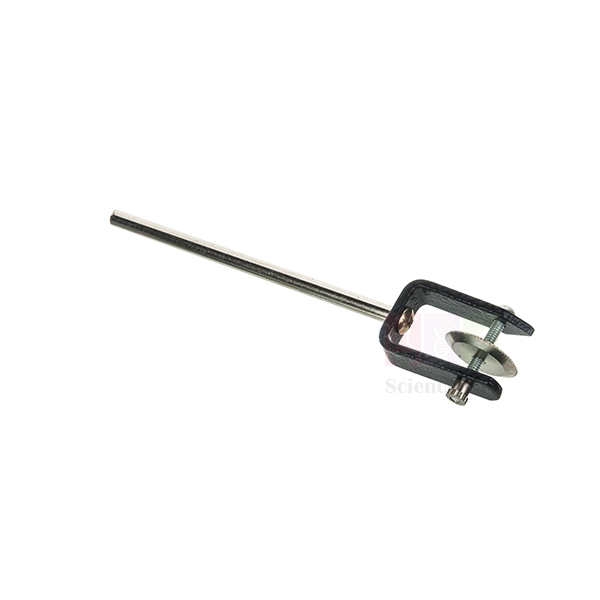
Opisometer
Opisometer (Product Code: SLE/PHY/264) is a hand-held map measurer used to find the length of curved lines on maps, drawings and diagrams in geography, physics and mathematics classrooms. Students and teachers use it wherever a ruler cannot follow a bend: its knurled wheel runs on a transversely mounted threaded spindle, so the distance traced along a curve can be re-run along a straight scale. It is made by Jain Scientific Equipments Pvt Ltd (ScienceLab), an OEM manufacturer, at its own factory in Ambala, India.
Key Details
| Parameter | Detail |
|---|---|
| Instrument | Opisometer (curvimeter) for curved-line measurement |
| Mechanism | Knurled wheel running on a transversely mounted threaded spindle |
| Purpose | Measuring the length of curved lines |
| Product code | SLE/PHY/264 |
| Manufacturer | Jain Scientific Equipments Pvt Ltd (ScienceLab) — OEM |
| Country of origin | India (made in Ambala, Haryana) |
What Is an Opisometer Used For?
To take a reading, turn the knurled wheel until it reaches the stop at one end of its spindle, then roll it along the curve — a river, road, coastline or boundary. As the wheel turns it travels along the threaded spindle. Next, roll it backwards along a ruler or the map’s scale bar until it returns to the stop: the straight distance covered equals the length of the curve, and the map scale converts it to a real-world distance.
In geography it measures river lengths and route distances; in physics and mathematics it measures curved wires drawn on paper, graph curves and arcs, which students can compare with values calculated from a radius. Keep the wheel upright, trace slowly, and repeat each measurement to take an average. It is a handy, low-maintenance piece of laboratory equipment for schools in India and elsewhere.
OEM Manufacturer
ScienceLab is the trading name of Jain Scientific Equipments Private Limited (CIN U29309HR2020PTC087597), the OEM (original equipment manufacturer) of this opisometer. It is produced at the company’s licensed factory at 449, HSIIDC Industrial Area, Saha, Ambala, Haryana (Factory Licence AMB-ONLINE-CHD-J-414), and sent factory-direct to schools, colleges, institutions, dealers and importers.
Because quotations come straight from the manufacturer, repeat orders are simple to arrange. Read the ScienceLab profile for more about the company.
Related Physics Lab Equipment
Other measuring tools that complement the opisometer:
- Metal Ruler — a straight scale to read off the distance rolled by the wheel
- Meter Stick, White — for longer straight measurements on wall maps and charts
- Trundle Wheel — measures real distances outdoors, the field counterpart to map work
- Caliper Vernier (Metal) — for precise measurement of small straight lengths
Explore the Physics Lab Equipment category for more.
Frequently Asked Questions
What is an Opisometer used for?
An Opisometer is used to measure the length of curved lines, such as rivers, roads and boundaries on maps, or curves on drawings and graphs. It follows bends that a straight ruler cannot, giving a length that can then be converted using the map scale.
How do you read a measurement from the Opisometer?
After tracing a curve with the Opisometer, roll it backwards along a ruler or map scale bar until the wheel returns to its starting stop. The straight distance rolled equals the curve’s length on paper, which the map scale converts to real distance.
How does the Opisometer work mechanically?
The Opisometer has a knurled wheel running on a transversely mounted threaded spindle. Each turn of the wheel moves it along the thread, so its position records the distance travelled; rolling it back the same distance returns it to the start.
Can the Opisometer be used on any map scale?
Yes, the Opisometer measures length on the paper itself, so it works with any map. Roll it back along that map’s own scale bar to read the real distance directly, or measure on a ruler and multiply by the scale.
Who manufactures the Opisometer?
The Opisometer is manufactured by Jain Scientific Equipments Pvt Ltd (ScienceLab), the OEM, at its licensed factory in Saha, Ambala, Haryana, India. Schools, dealers and importers in India and international markets receive it directly from the manufacturer.
What should a quotation request for the Opisometer include?
Include the product code SLE/PHY/264, the number of Opisometers needed (for example one per student group), any rulers or other measuring tools to quote with it, and the delivery location in your request via the contact page or enquiry cart.
Request a Quote
Order the Opisometer direct from its manufacturer: send your quantity through the contact page or place it in the enquiry cart.
Last updated: 24 September 2026
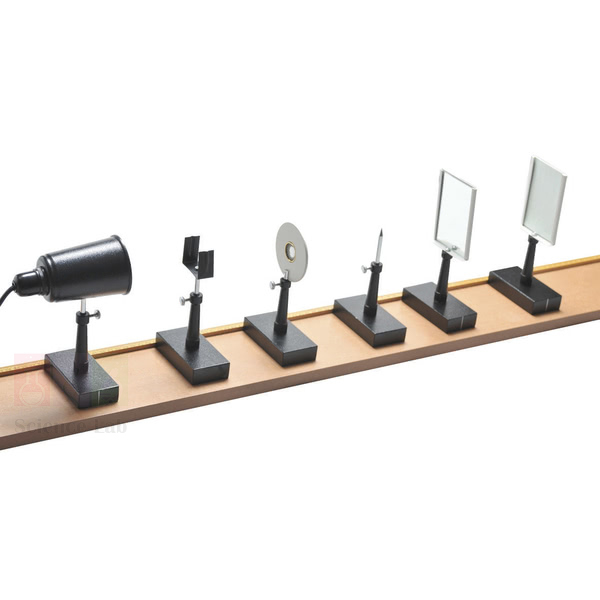
Optical Bench Kit
Optical Bench Kit (Product Code: SLE/PHY/265) is a 1.5 metre wooden optical bench with millimetre divisions and mounted accessories, used to locate images and measure focal lengths in school and college optics practicals. It comes with a lamp housing, object and receiving screens, a lens holder for 38mm lenses, an object needle and a 100x75mm plane mirror, so a full ray-optics practical can run on one bench. It is made by Jain Scientific Equipments Pvt Ltd (ScienceLab), an OEM manufacturer, at its own factory in Ambala, India.
Specifications
| Parameter | Detail |
|---|---|
| Bench | Wooden optical bench, 1.5 metres long |
| Scale | Millimetre divisions |
| Light source | Lamp housing with white lamp (mounted) |
| Object screen | White metal, 75mm diameter (mounted) |
| Lens holder | For 38mm diameter lenses (mounted) |
| Object needle | Mounted on a 6mm metal rod |
| Plane mirror | In metal frame, 100x75mm (mounted) |
| Receiving screen | White metal, with slot for squared paper (mounted) |
| Product code | SLE/PHY/265 |
| Manufacturer | Jain Scientific Equipments Pvt Ltd (ScienceLab) — OEM |
| Country of origin | India (made in Ambala, Haryana) |
What Is the Optical Bench Kit Used For?
The kit covers the standard ray-optics practicals: finding the focal length of a convex lens by measuring object and image distances, studying how image position and size change as the object moves, and locating images in a plane mirror using the object needle and the no-parallax method. The slot in the receiving screen holds squared paper, so students can measure image size and work out magnification directly. For schools building up optics lab equipment, it puts every basic accessory on a single graduated bench.
Work in a darkened room and set the lamp, object, lens and screen at the same height so the light travels along the bench axis. Read each position from the millimetre scale using the same edge of every mount, keep lenses and the mirror free of fingerprints, and store the wooden bench flat and dry so it stays straight.
What to Specify When Ordering
- Which 38mm diameter lenses you need for the holder — lenses are not listed among the kit’s accessories, so confirm with us
- The power arrangement for the lamp housing — ask us what supply the lamp needs
- The number of benches for your student groups
- Whether a wooden bench suits you or the aluminium-alloy Optical Bench Set is preferred
OEM Manufacturer
Jain Scientific Equipments Private Limited, trading as ScienceLab, is the OEM (original equipment manufacturer) of the Optical Bench Kit. The bench and its mounted accessories are made at the company’s own licensed factory in Saha, Ambala, Haryana, India, and supplied factory-direct to schools, colleges, institutions, dealers and importers.
If a mount, screen or mirror needs replacing later, ask us — spares and repeat orders are handled by the manufacturer. See the ScienceLab profile for more about the company.
Related Physics Lab Equipment
Optics items commonly used on or beside the bench:
- Optical Bench Set — an aluminium-alloy bench alternative with its own accessories
- Convex Lens — for focal-length practicals (confirm the diameter suits the 38mm holder)
- Concave Lens — for diverging-lens and lens-combination work
- Mirror, Concave — for curved-mirror image experiments
- Mirror, Plane Glass — for further plane-mirror activities
Find more in Physics Lab Equipment.
Frequently Asked Questions
What accessories come with the Optical Bench Kit?
The Optical Bench Kit comes with mounted accessories: a lamp housing with white lamp, a 75mm white metal object screen, a lens holder for 38mm lenses, an object needle on a 6mm metal rod, a 100x75mm plane mirror in a metal frame, and a white metal receiving screen.
How long is the Optical Bench Kit bench?
The Optical Bench Kit uses a wooden bench 1.5 metres long, marked with millimetre divisions. The length gives room for object and image distances on either side of a lens, and the millimetre scale lets students record positions precisely.
Are lenses included with the Optical Bench Kit?
The Optical Bench Kit includes a lens holder for 38mm diameter lenses, but lenses are not in its listed accessories. Tell us which lenses you need when you enquire, and we will confirm what can be supplied to fit the holder.
What is the slot in the Optical Bench Kit’s receiving screen for?
The slot in the Optical Bench Kit’s white metal receiving screen holds a piece of squared paper. Students focus the image onto the grid and count squares to measure image size, making magnification calculations quick and accurate.
Who manufactures the Optical Bench Kit?
The Optical Bench Kit is manufactured by Jain Scientific Equipments Pvt Ltd (ScienceLab), the OEM, at its own licensed factory in Saha, Ambala, Haryana, India. It is supplied factory-direct to buyers in India and international markets.
What should I include when asking for an Optical Bench Kit quotation?
For an Optical Bench Kit quotation, give the product code SLE/PHY/265, the number of benches, the lenses you want for the 38mm holder, any lamp supply needed, and your delivery location. Send the details through the contact page or enquiry cart.
Request a Quote
The Optical Bench Kit is quoted directly by the manufacturer. Share your requirement via the contact page or add the kit to the enquiry cart, listing any lenses you need.
Last updated: 24 September 2026
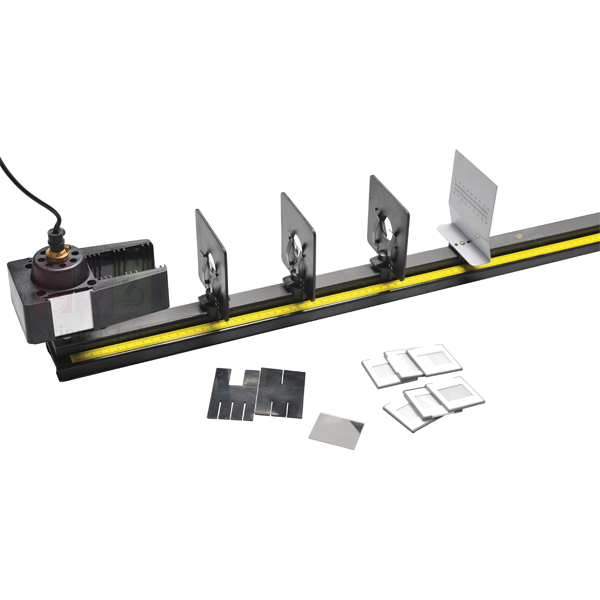
Optical Bench Set
Optical Bench Set (Product Code: SLE/PHY/266) is a complete optics set built on a 1,200mm non-twisting aluminium alloy bench, used for experiments on the focal length of lenses, curvature of mirrors and lens combinations. It includes a raybox with a 12V, 24W bulb, three universal holders on sliders, a 100x100mm double-sided scaled screen and two slit sets, forming a ready optics lab equipment package. It is made by Jain Scientific Equipments Pvt Ltd (ScienceLab), an OEM manufacturer, at its own factory in Ambala, India.
Specifications
| Parameter | Detail |
|---|---|
| Bench | Non-twisting aluminium alloy, 1,200mm |
| Scale | Easy-to-read scale divided into cm and mm |
| Universal holders | 3, on sliders |
| Slides | 6 x 50x50mm |
| Screen | 100x100mm, double-sided, scaled, on slider |
| Light source | Raybox/light source with mounting rod |
| Bulb | 12V, 24W |
| Power lead | 2m of flex with 2 x 4mm plugs |
| Slit sets | 2 |
| Plane mirror | 50x50 |
| Aluminium plates | 50x50 |
| Product code | SLE/PHY/266 |
| Manufacturer | Jain Scientific Equipments Pvt Ltd (ScienceLab) — OEM |
| Country of origin | India (made in Ambala, Haryana) |
What Is the Optical Bench Set Used For?
The set is designed for a wide range of optics experiments: measuring the focal length of lenses, finding the curvature of mirrors, and studying lens combinations, where two lenses in contact or at a set separation behave as a single lens of a different focal length. The raybox and slit sets produce narrow beams for tracing rays, and the double-sided scaled screen lets students read image size from either side of the bench. These are core practicals in any physics practical equipment list for CBSE and university labs.
The non-twisting aluminium alloy bench keeps the sliders aligned along its full length, so readings from the cm and mm scale stay consistent. Connect the raybox through its 4mm plugs to a suitable 12V supply, let the 24W bulb cool before handling the housing, and wipe the sliders clean so they move smoothly.
What to Specify When Ordering
- A 12V supply for the raybox bulb, if your lab does not already have one (a power supply is not in the listed contents)
- The lenses and curved mirrors you want to use in the universal holders
- Spare 12V, 24W bulbs, if required — ask us
- The number of sets for your practical groups
OEM Manufacturer
The Optical Bench Set comes from its original equipment manufacturer (OEM): Jain Scientific Equipments Private Limited, which trades as ScienceLab. The company makes the set at its licensed factory in Saha, Ambala, Haryana, India, and sells it straight to schools, colleges, institutions, dealers and importers, so there is no trader between the buyer and the maker.
Holders, slit sets and other parts for existing sets can be discussed with the manufacturer directly — ask us. More about the company is on the ScienceLab profile.
Related Physics Lab Equipment
Items that extend what the set can do:
- Optical Bench Kit — a wooden bench alternative with its own mounted accessories
- Power Supply Variable — a low-voltage source for the raybox (confirm the output with us)
- Convex Lens — for focal-length and lens-combination experiments
- Mirror, Convex — for curved-mirror work alongside the plane mirror
- Raybox Slit Plates — additional slit patterns for ray tracing
Browse the Physics Lab Equipment range.
Frequently Asked Questions
What is included in the Optical Bench Set?
The Optical Bench Set includes a 1,200mm aluminium alloy bench, 3 universal holders on sliders, 6 slides of 50x50mm, a 100x100mm double-sided scaled screen on a slider, a raybox with mounting rod and 12V, 24W bulb, 2 slit sets, a 50x50 plane mirror and 50x50 aluminium plates.
What power does the Optical Bench Set raybox need?
The raybox in the Optical Bench Set uses a 12V, 24W bulb and connects through 2m of flex ending in two 4mm plugs. A power supply is not in the listed contents, so use your lab’s 12V supply or ask us to quote one.
Why does the Optical Bench Set use an aluminium alloy bench?
The Optical Bench Set bench is non-twisting aluminium alloy, which keeps every slider in line along its 1,200mm length. Its easy-to-read scale is divided into cm and mm, so object and image positions can be measured consistently.
Which experiments can be done with the Optical Bench Set?
The Optical Bench Set supports a wide range of optics experiments, including the focal length of lenses, the curvature of mirrors and lens combinations. The slit sets and raybox also allow ray-tracing work with narrow beams of light.
Who manufactures the Optical Bench Set?
The Optical Bench Set is manufactured by Jain Scientific Equipments Pvt Ltd (ScienceLab), the OEM, at its own licensed factory in Saha, Ambala, Haryana, India. Quotations and repeat orders are handled by the manufacturer for buyers in India and international markets.
What details should an Optical Bench Set enquiry contain?
An Optical Bench Set enquiry should state the product code SLE/PHY/266, the number of sets, whether a 12V supply, spare bulbs, lenses or mirrors are needed, and the delivery location, so a complete quotation can be prepared.
Request a Quote
For a manufacturer-direct quotation on the Optical Bench Set, add it to the enquiry cart or write to us via the contact page with your quantity and any extras.
Last updated: 24 September 2026
Plotting Compass, Single Glass Face
Plotting Compass, Single Glass Face (Product Code: SLE/PHY/267) is a small magnetic compass in an aluminium case, used to trace magnetic field lines around magnets and current-carrying wires in school physics practicals. Teachers order it in packs of 10 for group work; each compass is 16mm in diameter, glass-faced on one side, with a dial marked with the cardinal and ordinal points. It is made by Jain Scientific Equipments Pvt Ltd (ScienceLab), an OEM manufacturer, at its own factory in Ambala, India, and suits any magnetism experiment kit.
Specifications
| Parameter | Detail |
|---|---|
| Case | Aluminium |
| Face | Glass, on one side |
| Dial | Marked with the cardinal and ordinal points of the compass |
| Diameter | 16mm |
| Pack size | Pack of 10 |
| Product code | SLE/PHY/267 |
| Manufacturer | Jain Scientific Equipments Pvt Ltd (ScienceLab) — OEM |
| Country of origin | India (made in Ambala, Haryana) |
What Is a Plotting Compass Used For?
To map a field, place a bar magnet on a sheet of paper and set the compass near one pole. Mark a dot at each end of the needle, move the compass so its tail sits on the front dot, and repeat; joining the dots traces one field line, and starting from several points builds up the whole pattern. The same method locates neutral points between two magnets and shows the circular field around a straight current-carrying wire or the field of a coil. Because each compass is only 16mm across, plotted points sit close together and the lines come out smooth.
Before use, check that every needle settles in the same direction when the compasses are laid well away from magnets. Store the compasses in their pack, away from strong magnets that could weaken or reverse a needle, and handle them by the aluminium case to protect the glass face. Pair them with a bar magnet for school practicals, and with a current-carrying frame or coil for electromagnetism lessons.
What to Specify When Ordering
- The number of packs of 10 you need for your student groups
- Whether you want this glass-faced style or the Compass Plotting (Clear) version
- Magnets or electromagnetism apparatus to be quoted alongside, if required
OEM Manufacturer
Jain Scientific Equipments Private Limited, trading as ScienceLab, is the OEM (original equipment manufacturer) of the Plotting Compass, Single Glass Face. The compasses are made and packed at the company’s own licensed factory in Saha, Ambala, Haryana, India, and supplied factory-direct to schools, colleges, institutions, dealers and importers who need them in quantity.
Repeat packs for new classes can be ordered from the manufacturer at any time — just ask us. Company information is on the ScienceLab profile.
Related Physics Lab Equipment
Apparatus used with plotting compasses in magnetism lessons:
- Compass Plotting (Clear) — an alternative plotting compass style
- Bar Magnet (Plastic) — a bar magnet whose field students can plot
- Steel Horseshoe Magnet — for plotting the field between two close poles
- Oersted's Apparatus — shows the magnetic effect of a current that the compasses can map
- Magnetic Field Demonstrator — another way to visualise magnetic fields
See all items in Physics Lab Equipment.
Frequently Asked Questions
What size is the Plotting Compass, Single Glass Face?
The Plotting Compass, Single Glass Face is 16mm in diameter, housed in an aluminium case. The small size lets students plot points close together around a magnet, so the field lines they draw are smooth and detailed.
How many compasses are in a pack of the Plotting Compass, Single Glass Face?
The Plotting Compass, Single Glass Face is supplied as a pack of 10. One pack can be shared across several student groups, or each group can have its own pack so several field lines are plotted at the same time.
How do students plot field lines with the Plotting Compass, Single Glass Face?
With the Plotting Compass, Single Glass Face, students mark the needle’s two ends as dots, move the compass forward so its tail sits on the front dot, and repeat. Joining the dots gives one field line around the magnet.
What does “single glass face” mean on this plotting compass?
On the Plotting Compass, Single Glass Face, only one side is glass-faced; the rest is an aluminium case. Students view the needle and the dial of cardinal and ordinal points through the glass from above as they plot.
How should the Plotting Compass, Single Glass Face be stored?
Store the Plotting Compass, Single Glass Face in its pack, well away from strong magnets that could weaken or reverse the needle. Hold each compass by its aluminium case to keep fingerprints and knocks off the glass face.
Who manufactures the Plotting Compass, Single Glass Face?
The Plotting Compass, Single Glass Face is manufactured by Jain Scientific Equipments Pvt Ltd (ScienceLab), the OEM, at its own licensed factory in Saha, Ambala, Haryana, India, and supplied in packs to buyers in India and international markets.
What should I include in a quotation request for the Plotting Compass, Single Glass Face?
For a quotation on the Plotting Compass, Single Glass Face, state the product code SLE/PHY/267, the number of packs of 10, any magnets to be quoted with them, and your delivery location. Use the contact page or the enquiry cart.
Request a Quote
Quotes for the Plotting Compass, Single Glass Face come directly from the manufacturer. Add the pack to the enquiry cart or tell us the number of packs through the contact page.
Last updated: 24 September 2026
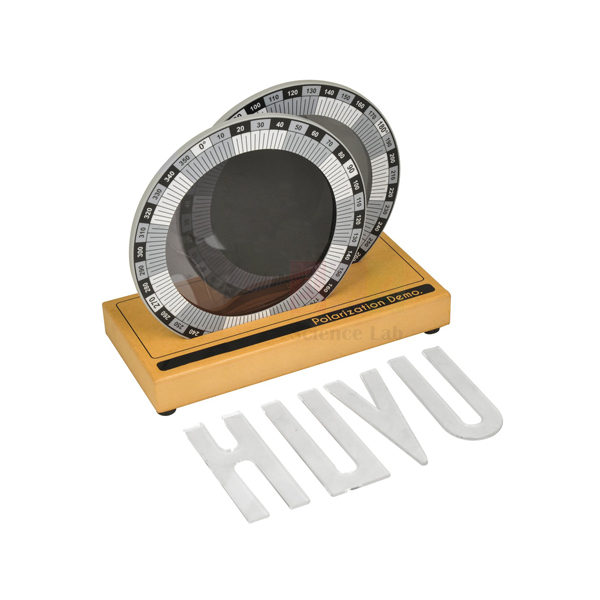
Polarizing Filter Stress Demonstrator
Polarizing Filter Stress Demonstrator (Product Code: SLE/PHY/268) is a large-scale optics demonstrator that uses polarising filters to reveal stress patterns in clear plastic pieces, used in physics and engineering classrooms. Its 5 inch polarising sheets are mounted on a graduated frame on a wooden stand, and it is supplied with clear acrylic pieces of different shapes to squeeze between the filters. It is made by Jain Scientific Equipments Pvt Ltd (ScienceLab), an OEM manufacturer, at its own factory in Ambala, India.
Specifications
| Parameter | Detail |
|---|---|
| Scale | Large-scale demonstrator |
| Filters | 5 inch polarising sheets |
| Mounting | Graduated frame placed on a wooden stand |
| Test pieces | Clear acrylic pieces of different shapes (supplied) |
| Demonstration | Clear pieces are placed between the filters and squeezed, and the stress patterns are observed |
| Product code | SLE/PHY/268 |
| Manufacturer | Jain Scientific Equipments Pvt Ltd (ScienceLab) — OEM |
| Country of origin | India (made in Ambala, Haryana) |
What Is the Polarizing Filter Stress Demonstrator Used For?
The demonstrator introduces photoelasticity. Clear acrylic becomes birefringent when it is stressed: polarised light passing through a loaded piece has its polarisation altered by different amounts wherever the stress differs, and viewing through the second filter turns those differences into coloured bands. The bands crowd together near corners, holes and the points where force is applied, so students can see where a shape is most highly stressed — the reason engineers round off corners in brackets and beams. It doubles as a physics demonstration kit for polarisation itself.
Stand the demonstrator in front of a bright, even light source such as a window or a lamp, and squeeze each acrylic piece slowly and steadily so the class sees the pattern grow; release it and the colours fade. Compare the different shapes one after another. Clean the acrylic and the polarising sheets with a soft cloth only, since scratches show up as marks in the pattern.
OEM Manufacturer
ScienceLab, the trading name of Jain Scientific Equipments Private Limited, is the OEM (original equipment manufacturer) of the Polarizing Filter Stress Demonstrator and builds it at its own licensed factory at Saha, Ambala, Haryana, India. Schools, colleges, institutions, dealers and importers receive it factory-direct, with quotations and any later requests for replacement acrylic pieces handled by the maker — ask us.
The company is a registered MSME enterprise (Udyam UDYAM-HR-01-0003714) and ships export orders under Importer-Exporter Code AAECJ8618A issued by the DGFT. Read more on the ScienceLab profile.
Related Physics Lab Equipment
Items that pair well with a lesson on polarisation and stress:
- Polaroid Slides — hand-held polarising slides for simpler polarisation activities
- Bending Stress In a Beam — a mechanical approach to stress in loaded beams
- Light Guide Demonstrator — another large-scale optics demonstration
- Raybox, 12V — a light source for optics demonstrations
More optics and mechanics items are in Physics Lab Equipment.
Frequently Asked Questions
What does the Polarizing Filter Stress Demonstrator show?
The Polarizing Filter Stress Demonstrator shows stress patterns in clear plastic. When an acrylic piece is squeezed between its polarising filters, coloured bands appear that reveal where the stress is concentrated, making invisible internal forces visible to a whole class.
What comes with the Polarizing Filter Stress Demonstrator?
The Polarizing Filter Stress Demonstrator comes with 5 inch polarising sheets mounted on a graduated frame, placed on a wooden stand, and is supplied with clear acrylic pieces of different shapes so that different stress patterns can be demonstrated.
Why do coloured patterns appear in the Polarizing Filter Stress Demonstrator?
Coloured patterns appear in the Polarizing Filter Stress Demonstrator because stressed acrylic changes the polarisation of light passing through it. The amount of change depends on the stress and on the wavelength, so the second filter shows the stress as bands of colour.
Is the Polarizing Filter Stress Demonstrator suitable for a whole class?
Yes, the Polarizing Filter Stress Demonstrator is a large-scale unit with 5 inch polarising sheets, designed for demonstration at the front of a class. Place it against a bright background so students across the room can watch the patterns change.
Who manufactures the Polarizing Filter Stress Demonstrator?
The Polarizing Filter Stress Demonstrator is manufactured by Jain Scientific Equipments Pvt Ltd (ScienceLab), the OEM, at its own licensed factory in Saha, Ambala, Haryana, India, and supplied direct to buyers in India and international markets.
How do I request a quotation for the Polarizing Filter Stress Demonstrator?
To request a quotation for the Polarizing Filter Stress Demonstrator, send the product code SLE/PHY/268, the number of units, any related optics items you want and your delivery location through the contact page or the enquiry cart.
Request a Quote
Pricing for the Polarizing Filter Stress Demonstrator comes straight from the manufacturer. Use the contact page or add it to the enquiry cart to start your order.
Last updated: 24 September 2026
Polaroid Slides
Polaroid Slides (Product Code: SLE/PHY/269) are polarising sheets mounted in square plastic slides, used to demonstrate the polarisation of light in school and college optics lessons. Teachers use them in pairs — one as the polariser and one as the analyser — so students can watch light dim and almost disappear as one slide is turned against the other. They are supplied by Jain Scientific Equipments Pvt Ltd (ScienceLab), Ambala, India, for any optics experiment kit at school level.
Key Details
| Parameter | Detail |
|---|---|
| Polarising material | Polaroid sheet |
| Mounting | Square plastic slides |
| Intended use | Demonstration purposes — polarisation of light |
| Product code | SLE/PHY/269 |
| Supplied by | Jain Scientific Equipments Pvt Ltd (ScienceLab), Ambala, India |
What Are Polaroid Slides Used For?
Hold one slide up to a lamp and the light passing through is dimmed but still visible. Add a second slide in front and rotate it: the brightness rises and falls, and when the two are at right angles very little light gets through. This simple observation shows that light is a transverse wave and gives a qualitative introduction to Malus’s law before any measurements are taken.
The slides also let students explore polarisation in everyday life: look through one at glare reflected from water or a glass surface at an angle, at an LCD screen as the slide is turned, or at clear plastic objects such as rulers placed between two slides to reveal stress patterns. Hold the slides by their plastic mounts, keep them away from heat and solvents, and wipe the sheets gently with a soft, dry cloth.
Supplier
These Polaroid Slides are supplied by Jain Scientific Equipments Private Limited, which trades as ScienceLab and is based in Ambala, Haryana. Schools, colleges, teacher-training institutes and dealers in India and international markets can source them together with light sources, benches and other optics items. Find out more on the ScienceLab profile.
Related Physics Lab Equipment
Items that help build a complete polarisation lesson:
- Polarizing Filter Stress Demonstrator — a large-scale unit for showing stress patterns to a whole class
- Raybox, 12V — a light source to shine through the slides
- Optical Bench Set — a bench set for wider optics practicals
- Electromagnetic Spectrum Chart — places visible light among the electromagnetic waves
Explore Physics Lab Equipment for more.
Frequently Asked Questions
What are Polaroid Slides used for?
Polaroid Slides are used to demonstrate the polarisation of light. Each slide is a polarising sheet mounted in a square plastic frame; looking through two slides while turning one shows the light fading and returning, proving that light behaves as a transverse wave.
How many Polaroid Slides are needed for a demonstration?
A polarisation demonstration needs at least two Polaroid Slides, one acting as polariser and one as analyser. Tell us how many demonstration sets or student groups you are equipping, and we will confirm the pack quantity available.
What happens when two Polaroid Slides are crossed?
When two Polaroid Slides are crossed, with one turned at right angles to the other, very little light passes through and the view goes dark. Turning one slide back gradually restores the brightness, a clear demonstration of polarisation.
How should Polaroid Slides be cleaned and stored?
Clean Polaroid Slides with a soft, dry cloth, holding them by the plastic mount so the polarising sheet is not scratched or marked. Store them flat in a box away from heat, sunlight and solvents between lessons.
Who supplies Polaroid Slides?
Polaroid Slides are supplied by Jain Scientific Equipments Pvt Ltd (ScienceLab), Ambala, Haryana, India. The company handles orders from schools, colleges and dealers in India and international markets, often alongside other optics apparatus.
What should an enquiry for Polaroid Slides include?
An enquiry for Polaroid Slides should include the product code SLE/PHY/269, the number of slides or pairs needed, any light source or optics apparatus to be quoted with them, and the delivery location, sent via the contact page or enquiry cart.
Request a Quote
To buy Polaroid Slides, add them to the enquiry cart or send the number of slides you need through the contact page.
Last updated: 24 September 2026

Investigating Heat Poster
Investigating Heat Poster (Product Code: SLE/PHY/270) is a laminated wall poster used to explain the key concepts of heat in school physics and general science classrooms. It gives teachers and students an illustrated view of heat sources, the transfer of heat energy, heat absorption and the expansion and contraction of matter, making it a natural companion to a heat energy science kit. It is supplied by Jain Scientific Equipments Pvt Ltd (ScienceLab), Ambala, India.
Key Details
| Parameter | Detail |
|---|---|
| Type | Educational wall poster giving a graphic depiction of key heat concepts |
| Finish | Laminated |
| Topics illustrated | Sources of heat; transfer of heat energy; heat absorption; expansion and contraction of matter; further related heat concepts |
| Product code | SLE/PHY/270 |
| Supplied by | Jain Scientific Equipments Pvt Ltd (ScienceLab), Ambala, India |
What Is the Investigating Heat Poster Used For?
Teachers use the poster as a visual anchor when they introduce thermal physics. Before a practical, the illustrations of heat sources and heat transfer give the class a shared picture of what they are about to observe, and afterwards the same panels help students explain their results in their own words. The panel on expansion and contraction of matter can be linked to everyday examples students already know, such as a tight metal lid loosening under warm water.
Because it is laminated, the poster can be wiped clean and kept on display year after year in a busy laboratory or classroom. Mount it at eye level beside the bench where heat practicals take place, and point back to it during revision of radiation experiment kit work and heat-absorption comparisons.
Supplier
Jain Scientific Equipments Private Limited trades as ScienceLab and supplies the Investigating Heat Poster from Ambala, Haryana, India. The company sources the poster alongside the heat apparatus in its physics range, so a school can order the wall display together with the equipment used in the same lessons. Schools, colleges, dealers and importers can request it directly. See our company profile for more about ScienceLab.
Related Physics Lab Equipment
Apparatus that turns the poster’s topics into hands-on practicals:
- Apparatus Heat/Thermal Conductivity — compares how well different materials conduct heat.
- Apparatus Convection In Liquid — shows convection currents, one of the ways heat energy is transferred.
- Heat Absorption & Radiation Comparator — for practical work on heat absorption by different surfaces.
- Expansion Of Liquids Apparatus — demonstrates the expansion of matter when it is heated.
- Heat Transfer Kit — a set for investigating how heat energy moves.
Browse the full Physics Lab Equipment category for more heat apparatus.
Frequently Asked Questions
What topics does the Investigating Heat Poster cover?
The Investigating Heat Poster gives a graphic depiction of key heat concepts, including an illustrated view of the sources of heat, the transfer of heat energy, heat absorption and the expansion and contraction of matter, along with further related heat topics.
Is the Investigating Heat Poster laminated?
Yes. The Investigating Heat Poster is laminated, which protects the printed surface from handling and makes it easy to wipe clean, so it suits classrooms and laboratories where the same poster is used by several classes every year.
What size is the Investigating Heat Poster?
The dimensions of the Investigating Heat Poster are not stated in this listing. If wall space or a display frame limits the size you can use, ask through our contact page before ordering and we will confirm the details.
Which lessons is the Investigating Heat Poster suited to?
The Investigating Heat Poster suits lessons on thermal energy and heat transfer, heat absorption, and the expansion and contraction of matter. It also works well as a reference on the wall while students carry out practicals on conduction, convection and radiation.
Who supplies the Investigating Heat Poster?
The Investigating Heat Poster is supplied by Jain Scientific Equipments Pvt Ltd (ScienceLab), Ambala, Haryana, India. The company sources the poster and quotes it for schools, colleges, dealers and importers, on its own or with heat apparatus from the same physics range.
What should a quotation request for the Investigating Heat Poster include?
A quotation request for the Investigating Heat Poster should give the product code SLE/PHY/270, the number of posters, any heat apparatus to be quoted with them and the delivery location in India or abroad. Send it through the contact page or the enquiry cart.
Request a Quote
To order the Investigating Heat Poster, send the quantity and delivery details through our contact page or add it to the enquiry cart with the rest of your physics requirements.
Last updated: 24 September 2026
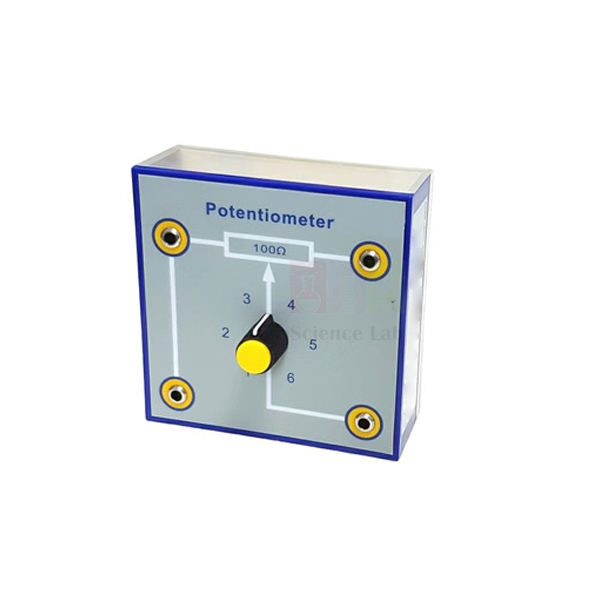
Potentiometer Module
Potentiometer Module (Product Code: SLE/PHY/271) is a rotary linear potentiometer mounted on a channel box, used as a variable resistor or voltage divider in student electricity practicals. This listing is the 100 Ω value, with connections made to 4 mm sockets and a fast-blow fuse that protects the module when students connect it wrongly. It is supplied by Jain Scientific Equipments Pvt Ltd (ScienceLab), Ambala, India.
Specifications
| Parameter | Detail |
|---|---|
| Component | Rotary linear potentiometer |
| Mounting | Channel box |
| Resistance value | 100 Ω (a choice of values is offered) |
| Connections | 4 mm sockets |
| Protection | Fast-blow fuse against wrong connection by students |
| Product code | SLE/PHY/271 |
| Supplied by | Jain Scientific Equipments Pvt Ltd (ScienceLab), Ambala, India |
What Is the Potentiometer Module Used For?
A potentiometer has a resistive track and a moving wiper. Connected across a supply, it works as a voltage divider that gives a smoothly adjustable output for lamp-brightness, motor-speed or diode-characteristic experiments; used with one end of the track and the wiper only, it becomes a simple variable resistor for setting the current in a series circuit. That flexibility makes the module a useful part of an Ohm law experiment kit.
The linear track means equal turns of the knob give roughly equal changes in resistance, which helps students plot tidy graphs. The 100 Ω value suits low-resistance circuits in which a larger current must flow; for finer control at lower currents, compare the 1 kΩ module. If the module stops responding after a wiring mistake, the fast-blow fuse is the first thing to check.
What to Specify When Ordering
- Resistance value: this listing is 100 Ω; the 1 kΩ Potentiometer Module is a separate item.
- Number of modules per bench or student group.
- 4 mm leads, meters or a power supply, if they should be quoted together.
Supplier
ScienceLab is the trading name of Jain Scientific Equipments Private Limited, which supplies the Potentiometer Module from Ambala, Haryana, India. The company sources this channel-box module with the rest of its electricity apparatus and quotes it to schools, colleges, dealers and importers in India and international markets. Follow-up orders for extra modules or a different resistance value can be requested from us directly. Read more on the ScienceLab profile page.
Related Physics Lab Equipment
Items that are wired up with the potentiometer module:
- Potentiometer Module, 1 Kohm — the higher-resistance version for finer current control.
- Stackable Leads — plug leads for the module’s 4 mm sockets.
- Power Supply, Stepped — a low-voltage source for voltage-divider circuits.
- Ammeter Voltmeter — reads the current and voltage the potentiometer sets.
- Standard Digital Multimeter — checks resistance between the terminals.
See the complete Physics Lab Equipment range for more circuit apparatus.
Frequently Asked Questions
What resistance value is the Potentiometer Module?
The Potentiometer Module listed here has a value of 100 Ω. The original listing notes that a choice of values is available, and a 1 kΩ Potentiometer Module is listed separately, so state the value you need when you ask for a quotation.
How is the Potentiometer Module connected into a circuit?
The Potentiometer Module is connected through 4 mm sockets on its channel box, so standard 4 mm plug leads push straight in. Students can add the potentiometer to a bench circuit quickly and remove it again cleanly at the end of the practical.
What protects the Potentiometer Module from wrong connections?
The Potentiometer Module has a fast-blow fuse that protects it against wrong connections by students. If a short circuit or excessive current occurs, the fuse opens the circuit quickly, helping to protect the potentiometer during a busy practical class.
Is the Potentiometer Module linear or logarithmic?
The Potentiometer Module uses a rotary linear potentiometer. On a linear track, resistance changes in proportion to how far the knob is turned, which makes readings easier to predict and graph than with a logarithmic, audio-taper potentiometer.
What current can the Potentiometer Module carry?
A power or current rating for the Potentiometer Module is not stated in this listing. Before using it in higher-current circuits, send your circuit details through our contact page and we will advise whether the 100 Ω module is suitable.
Who supplies the Potentiometer Module?
The Potentiometer Module is supplied by Jain Scientific Equipments Pvt Ltd (ScienceLab) from Ambala, Haryana, India. The company sources the module and quotes it for schools, colleges, dealers and importers, together with leads, meters and power supplies where needed.
Request a Quote
Send the resistance value, quantity and delivery location for the Potentiometer Module through our contact page, or add it to the enquiry cart with the leads and meters you need.
Last updated: 24 September 2026

Power Supply Variable
Power Supply Variable (Product Code: SLE/PHY/272) is a continuously variable AC/DC power supply unit for lab demonstrations and advanced-level student experiments in college and senior school physics. A rotary knob sets the output anywhere from 0 to 25 V at a combined current of up to 8.5 A, and the voltage is shown on a bright green 12.5 mm LED display. It is supplied by Jain Scientific Equipments Pvt Ltd (ScienceLab), Ambala, India.
Specifications
| Parameter | Detail |
|---|---|
| Output | Fine, smooth, continuously variable AC or DC voltage |
| Output voltage | 0 to 25 V, set by rotary knob |
| Current | 8.5 A combined maximum, continuously rated, AC or DC |
| DC smoothing | Internal 2200 µF capacitor |
| Display | Bright green 12.5 mm LED digital voltage display; AC or DC reading selected by toggle switch |
| Rectification | Heavy-duty 40 A Schottky barrier diodes |
| Transformer | High-performance toroidal transformer; no cooling fan needed |
| Primary protection | Slow-blow fuse |
| Transformer protection | Thermal fuse |
| Secondary protection | High-speed, resettable, microprocessor-controlled trip that distinguishes a real short circuit from a temporary current surge |
| Dimensions | 300 x 115 x 155 mm (W x D x H) |
| Weight | 5.5 kg |
| Product code | SLE/PHY/272 |
| Supplied by | Jain Scientific Equipments Pvt Ltd (ScienceLab), Ambala, India |
What Is the Variable Power Supply Used For?
Because the voltage can be wound up smoothly from zero, the unit suits experiments in which a quantity must change in small, even steps: current-voltage graphs for resistors, lamps and diodes, the heating effect of a current, or electromagnets and coils run at a controlled level. The combined 8.5 A rating leaves headroom for low-resistance loads such as heating elements, and the AC or DC output lets one unit serve both rectifier and transformer demonstrations.
Start each experiment with the knob at zero and raise the voltage while watching the display. If the protection trips, clear the fault and reset the unit rather than switching it on and off repeatedly; the microprocessor trip is designed to tell a brief surge, such as a cold lamp filament switching on, from a genuine short circuit. The fanless design also keeps the room quiet during a demonstration.
What to Specify When Ordering
- Number of units: for example one per demonstration bench or per student group in advanced-level practicals.
- Meters, leads or loads to be quoted with the power supply.
- The mains supply at your site, so we can confirm the unit matches it before dispatch.
Supplier
Jain Scientific Equipments Private Limited, trading as ScienceLab, supplies the Power Supply Variable from Ambala, Haryana, India. The company sources this bench power supply for its physics range and quotes it to colleges, schools, training institutes, dealers and importers in India and international markets. For tender and vendor registration, the supplying company’s details are GSTIN 06AAECJ8618A1ZT and LEI 3358004HRD1JIVXKYX49. More about the company is on our profile page.
Related Physics Lab Equipment
Equipment commonly used with a variable bench supply:
- Power Supply, Smoothed — a stepped supply with smoothed output for electronics circuits.
- Ammeter Voltmeter — reads current and voltage in the powered circuit.
- Stackable Leads — connecting leads for bench circuits.
- Potentiometer Module — a variable resistor module for current-control experiments.
- High Tension Power Supply — an alternative for experiments that need higher voltages.
Find more meters and supplies in the Physics Lab Equipment category.
Frequently Asked Questions
What voltage and current does the Power Supply Variable provide?
The Power Supply Variable gives a continuously variable output from 0 to 25 V, set with a rotary knob, at a continuously rated combined current of 8.5 A. The output can be AC or DC, and the DC is smoothed by an internal 2200 µF capacitor.
How is the output voltage of the Power Supply Variable displayed?
The Power Supply Variable shows its output voltage on a bright green 12.5 mm LED digital display. A toggle switch selects whether the display reads the AC or the DC voltage, so students can check the setting at a glance before connecting a load.
How is the Power Supply Variable protected against short circuits?
The Power Supply Variable has a high-speed, resettable, microprocessor-controlled trip on the secondary that tells a real short circuit from a temporary current surge. The primary is protected by a slow-blow fuse and the transformer by a thermal fuse.
Does the Power Supply Variable have a cooling fan?
No. The Power Supply Variable uses heavy-duty 40 A Schottky barrier diodes for rectification and a high-performance toroidal transformer, which reduce weight and wasted power and remove the need for a noisy cooling fan during lessons.
What are the size and weight of the Power Supply Variable?
The Power Supply Variable measures 300 x 115 x 155 mm (W x D x H) and weighs 5.5 kg, a bench-top size that fits beside demonstration apparatus or on a student workstation in an advanced-level physics laboratory.
Is a calibration certificate available for the Power Supply Variable?
Calibration-certificate availability for the Power Supply Variable should be discussed with us before ordering. Explain through the contact page what the display reading needs to be checked against and why, and we will tell you what can be provided.
Who supplies the Power Supply Variable?
The Power Supply Variable is supplied by Jain Scientific Equipments Pvt Ltd (ScienceLab), Ambala, Haryana, India. The company sources the unit and quotes it to colleges, schools, dealers and importers in India and international markets.
Request a Quote
Request a Power Supply Variable quotation through our contact page, or add it to the enquiry cart together with meters and leads. Include the quantity and delivery location so the quote covers everything you need.
Last updated: 24 September 2026
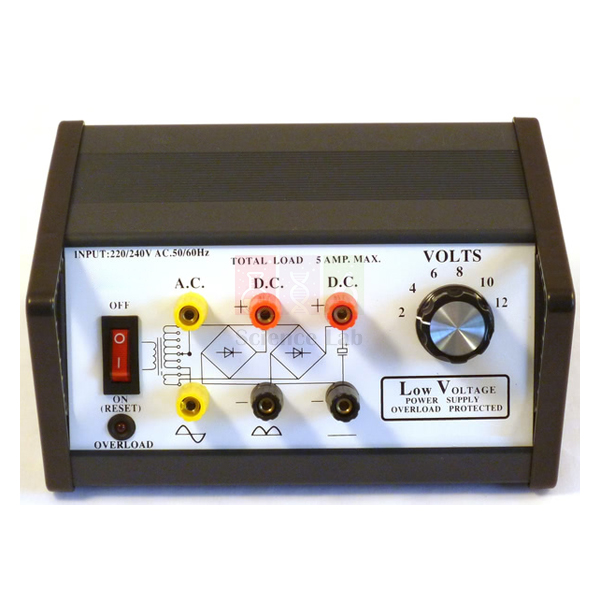
Power Supply, Smoothed
Power Supply, Smoothed (Product Code: SLE/PHY/273) is a stepped low-voltage bench supply with a specially smoothed output, used to power electronics circuits in school and college laboratories. It delivers 2 to 12 V AC or DC in 6 steps at 5 A from a 230 V AC, 50 Hz mains input, and it is the smoothed version of the Power Supply, Stepped. It is supplied by Jain Scientific Equipments Pvt Ltd (ScienceLab), Ambala, India.
Specifications
| Parameter | Detail |
|---|---|
| Type | Stepped power supply, specially smoothed for electronics applications |
| Output | 2-12 V AC/DC in 6 steps |
| Current | 5 A |
| Input | 230 V AC, 50 Hz |
| Dimensions | 220 x 110 x 145 mm (W x H x D) |
| Related model | Same as the Power Supply, Stepped, with a smoothed output |
| Product code | SLE/PHY/273 |
| Supplied by | Jain Scientific Equipments Pvt Ltd (ScienceLab), Ambala, India |
What Is the Smoothed Power Supply Used For?
Transistors, integrated circuits, LEDs and logic gates behave best on a steady DC voltage. A plain rectified supply carries ripple that can make an amplifier hum, upset a timer circuit or make meter readings drift, so this unit adds smoothing to the stepped design. That makes it a practical low-voltage source for electronics practicals such as transistor characteristics, rectifier circuits and simple amplifier work.
Choose the lowest step that will run the circuit, switch off before moving to a different step, and keep the total load within the 5 A rating. For general electricity work with lamps and motors, where ripple does not matter, the standard stepped supply is an alternative, so many laboratories keep both on the shelf.
What to Specify When Ordering
- Smoothed output (this item) or the standard Power Supply, Stepped.
- Number of units per bench or student group.
- Confirmation that your mains matches the 230 V AC, 50 Hz input.
- Leads, meters or components to be quoted with it.
Supplier
ScienceLab, the trading name of Jain Scientific Equipments Private Limited, supplies the Power Supply, Smoothed from Ambala, Haryana, India. The company sources both the smoothed and the standard stepped versions of this supply, so a laboratory can equip its electronics and general electricity benches from one quotation. Enquiries for additional units, or for matching an earlier supply, can be sent to us directly. The ScienceLab profile has more about the company.
Related Physics Lab Equipment
Supplies, meters and components used on an electronics bench:
- Power Supply, Stepped — the unsmoothed version for general electricity work.
- Power Supply Variable — a continuously variable alternative with a digital display.
- Standard Digital Multimeter — checks the output voltage and circuit readings.
- Stackable Leads — connecting leads for the bench circuit.
- NPN Transistor — a component for transistor experiments run from the supply.
Browse the Physics Lab Equipment category for more power supplies.
Frequently Asked Questions
What output does the Power Supply, Smoothed give?
The Power Supply, Smoothed gives 2 to 12 V AC or DC, selected in 6 steps, at a current of 5 A. Its output is specially smoothed, which makes it better suited to electronics circuits than an ordinary stepped supply.
How does the Power Supply, Smoothed differ from the Power Supply, Stepped?
The Power Supply, Smoothed is the same unit as the Power Supply, Stepped, but its output is specially smoothed for electronics applications. Choose the smoothed version for transistors and other sensitive circuits, and the stepped version for general electricity work.
What mains input does the Power Supply, Smoothed need?
The Power Supply, Smoothed runs from a 230 V AC, 50 Hz mains input. If your laboratory uses a different mains voltage or frequency, tell us through the contact page before ordering so we can confirm suitability.
What are the dimensions of the Power Supply, Smoothed?
The Power Supply, Smoothed measures 220 x 110 x 145 mm (W x H x D), a compact bench-top size that leaves room for circuit boards, components and meters on a student workstation.
Who supplies the Power Supply, Smoothed?
The Power Supply, Smoothed is supplied by Jain Scientific Equipments Pvt Ltd (ScienceLab), Ambala, Haryana, India. The company sources the unit and quotes it for schools, colleges, dealers and importers in India and international markets.
What should a quotation request for the Power Supply, Smoothed include?
A quotation request for the Power Supply, Smoothed should give the product code SLE/PHY/273, the number of units, your mains supply and any leads or meters needed with it. Send it through the contact page or the enquiry cart.
Request a Quote
Ask for a Power Supply, Smoothed quotation through our contact page or add it to the enquiry cart; mention whether you also need the standard stepped version so both can be quoted together.
Last updated: 24 September 2026

Prism – Acrylic, Set of 7
Prism – Acrylic, Set of 7 (Product Code: SLE/PHY/274) is a set of seven polished acrylic optical blocks used to study reflection, refraction and total internal reflection with a ray box in school and college optics lessons. Every block is 25 mm thick with all faces fully polished, and the shapes cover bi-convex, bi-concave, rectangular, semi-circular and three triangular prisms. It is made by Jain Scientific Equipments Pvt Ltd (ScienceLab), an OEM manufacturer, at its own factory in Ambala, India.
Specifications
| Parameter | Detail |
|---|---|
| Number of blocks | 7 |
| Material | Acrylic |
| Thickness | 25 mm (all blocks) |
| Finish | All faces fully polished |
| Bi-convex block | 75 mm long curved faces, 100 mm radius |
| Bi-concave block | 75 mm long curved faces, 100 mm radius |
| Rectangular block | 75 x 50 mm |
| Semi-circular block | 75 mm diameter |
| Equilateral triangle | 60° x 60° x 60°, 58 mm side |
| Right-angled isosceles triangle | 90° x 45° x 45°, 75 mm hypotenuse |
| 30-60-90 triangle | 90° x 60° x 30°, 75 mm hypotenuse |
| Product code | SLE/PHY/274 |
| Manufacturer | Jain Scientific Equipments Pvt Ltd (ScienceLab) — OEM |
| Country of origin | India (made in Ambala, Haryana) |
What Is the Acrylic Prism Set Used For?
Laid flat on paper in the path of a ray box beam, each block demonstrates a different part of the optics syllabus. The rectangular block shows lateral displacement and lets students work out refractive index from the angles of incidence and refraction; the semi-circular block is the standard shape for finding the critical angle and showing total internal reflection; and the bi-convex and bi-concave blocks make parallel rays converge or diverge like thin lenses drawn in two dimensions.
The 60° triangle disperses white light into a spectrum, while the two right-angled triangles show how a prism can turn a ray through a right angle or send it back the way it came by total internal reflection, the principle behind periscopes and binoculars. As a compact optics experiment kit for school benches, the set rewards careful handling: store the blocks so they do not rub together, and clean them with a soft cloth rather than solvents, which can craze acrylic.
What to Specify When Ordering
- Number of sets, usually one per student group for ray-optics practicals.
- Ray boxes and slit plates to be quoted with the blocks.
- Whether glass prisms or a glass rectangular block are also needed for comparison.
OEM Manufacturer
Jain Scientific Equipments Private Limited, which trades as ScienceLab, is the OEM (original equipment manufacturer) of this acrylic prism set and makes it at its own licensed factory at Saha, Ambala, Haryana, India. Buying from the manufacturer means schools, colleges, dealers and importers receive the complete seven-block set straight from the source rather than through a trader. Replacement blocks or additional sets for new laboratories can be requested from us directly. Our company profile has more about the business.
Related Physics Lab Equipment
Light sources and optical parts used with the blocks:
- Raybox, 12V — the light source that produces the rays the blocks refract.
- Raybox Slit Plates — split the light into single or multiple narrow rays.
- Prism, Clear Glass — a glass prism for comparing refraction with acrylic.
- Prism – Glass Rectangular Block — a glass block for refractive-index work.
- Lenses Cylindrical Glass, Biconvex — a cylindrical lens for converging-ray experiments.
More optics apparatus is listed in the Physics Lab Equipment category.
Frequently Asked Questions
Which shapes are in the Prism – Acrylic, Set of 7?
The Prism – Acrylic, Set of 7 contains a bi-convex block, a bi-concave block, a 75 x 50 mm rectangle, a 75 mm semi-circular block and three triangles: 60-60-60° with a 58 mm side, and 90-45-45° and 90-60-30° with 75 mm hypotenuses.
How thick are the blocks in the acrylic prism set?
Every block in the Prism – Acrylic, Set of 7 is 25 mm thick, and all faces are fully polished. That thickness gives a block that stands steadily on paper and a face tall enough to trace a ray box beam clearly.
What is the radius of the curved blocks in the set?
In the Prism – Acrylic, Set of 7, the bi-convex and bi-concave blocks both have 75 mm long curved faces with a 100 mm radius, so students can compare converging and diverging ray paths through matching curvatures.
Is acrylic suitable for refraction experiments?
Yes. For school ray-optics work, the Prism – Acrylic, Set of 7 shows refraction, total internal reflection and dispersion clearly, and acrylic is lighter and less likely to shatter than glass if a block is dropped. Glass prisms are listed separately if you prefer glass.
Who manufactures the Prism – Acrylic, Set of 7?
The Prism – Acrylic, Set of 7 is manufactured by Jain Scientific Equipments Pvt Ltd (ScienceLab), the OEM, at its own licensed factory at Saha, Ambala, Haryana, India, and is supplied factory-direct to schools, colleges, dealers and importers.
Can the acrylic prism set be ordered for a whole class?
Yes. The Prism – Acrylic, Set of 7 can be quoted in class quantities, usually one set per student group, together with ray boxes and slit plates. Send the number of sets and the delivery location in India or abroad through our contact page.
Request a Quote
Ask for a Prism – Acrylic, Set of 7 quotation through the contact page or add it to the enquiry cart. Quotations come straight from the manufacturer, so questions about class sets or matching ray boxes are answered in one reply.
Last updated: 24 September 2026
Pulley, Bench Mounting, Ball Bearing
Pulley, Bench Mounting, Ball Bearing (Product Code: SLE/PHY/275) is a 50 mm nylon pulley with a ball bearing, carried on an aluminium boss, used to guide a string and hanging mass in bench mechanics experiments. Tapped holes let the pulley be fitted with its axis of rotation in any one of three planes, and the boss clamps onto rods up to 13 mm in diameter. It is made by Jain Scientific Equipments Pvt Ltd (ScienceLab), an OEM manufacturer, at its own factory in Ambala, India.
Specifications
| Parameter | Detail |
|---|---|
| Type | Bench mounting |
| Pulley | 50 mm diameter, nylon, with ball bearing |
| Boss | Aluminium, 20 x 20 x 110 mm |
| Rod fixing | Hole and clamping screw, accepts rods up to 13 mm diameter |
| Pulley orientation | Tapped holes allow the axis of rotation in any one of three planes |
| Product code | SLE/PHY/275 |
| Manufacturer | Jain Scientific Equipments Pvt Ltd (ScienceLab) — OEM |
| Country of origin | India (made in Ambala, Haryana) |
What Is the Bench Mounting Pulley Used For?
The pulley turns the pull of a hanging mass into a horizontal force on a trolley, block or string, the basic set-up for Newton’s second law, friction and acceleration practicals. Its ball bearing keeps friction at the axle low, so more of the falling mass’s weight goes into accelerating the system and results come closer to theory. Because the wheel can be re-fitted in any of three planes, the same unit can also carry a string round a corner of the apparatus, which makes it a versatile piece of mechanics lab equipment.
Clamp the boss firmly on a support rod of up to 13 mm diameter, check that the string runs in the groove without rubbing the boss, and keep the bearing free of dust and grit. Thin, low-stretch string gives the most consistent readings from one run to the next.
What to Specify When Ordering
- Number of pulleys per bench or student group.
- The diameter of the support rods you use (the boss accepts up to 13 mm).
- Slotted masses, hangers or stands to be quoted with the pulleys.
OEM Manufacturer
ScienceLab is the trading name of Jain Scientific Equipments Private Limited, which manufactures this bench mounting pulley as the OEM at its own licensed factory at Saha, Ambala, Haryana, India. The nylon pulley and aluminium boss come as one assembly, supplied factory-direct to schools, colleges, laboratory dealers and importers. Repeat orders for extra pulleys, or questions about fitting the unit to your existing stands, go straight to the manufacturer; just ask us. See our company profile for background.
Related Laboratory Equipment
Apparatus used with the pulley in force and motion practicals:
- Pulley, Rod & Bench Mounting — a larger 70 mm light-alloy pulley with a bench or rod bracket.
- Slotted Mass Hanger, 500g — hanging masses to pull the string.
- Retort Stand — a stand and rod to carry the aluminium boss.
- Apparatus Newton’s Second Law — acceleration experiments driven by a pulley and falling mass.
- Table Clamp For Rods — fixes a support rod to the bench edge.
See the full Physics Lab Equipment category for more mechanics apparatus.
Frequently Asked Questions
What size is the Pulley, Bench Mounting, Ball Bearing?
The Pulley, Bench Mounting, Ball Bearing has a 50 mm diameter nylon pulley carried on an aluminium boss measuring 20 x 20 x 110 mm. The boss has a hole and clamping screw that accepts support rods up to 13 mm in diameter.
Why does the bench mounting pulley have a ball bearing?
The ball bearing in the Pulley, Bench Mounting, Ball Bearing lets the nylon wheel turn with very little friction, so less of the hanging mass’s pull is lost at the axle and acceleration and force results match theory more closely.
Can the pulley be mounted in different orientations?
Yes. The boss of the Pulley, Bench Mounting, Ball Bearing has tapped holes, so the nylon pulley can be fitted with its axis of rotation in any one of three planes, letting the string run in the direction each experiment needs.
What rods does the Pulley, Bench Mounting, Ball Bearing fit?
The Pulley, Bench Mounting, Ball Bearing clamps onto rods up to 13 mm in diameter using the hole and clamping screw in its aluminium boss. Check that your stand or support rods are 13 mm or thinner before ordering.
Who manufactures the Pulley, Bench Mounting, Ball Bearing?
The Pulley, Bench Mounting, Ball Bearing is manufactured by Jain Scientific Equipments Pvt Ltd (ScienceLab), the OEM, at its own licensed factory at Saha, Ambala, Haryana, India, which quotes it directly to schools, colleges, dealers and importers.
What should a quotation request for the bench mounting pulley include?
For the Pulley, Bench Mounting, Ball Bearing, state the product code SLE/PHY/275, the number of pulleys, your support-rod diameter, any masses or stands to include and the delivery location. Send the request through the contact page or enquiry cart.
Request a Quote
Quotations for the Pulley, Bench Mounting, Ball Bearing come direct from the manufacturer. Write to us through the contact page or add the pulley to the enquiry cart with your other mechanics items.
Last updated: 24 September 2026
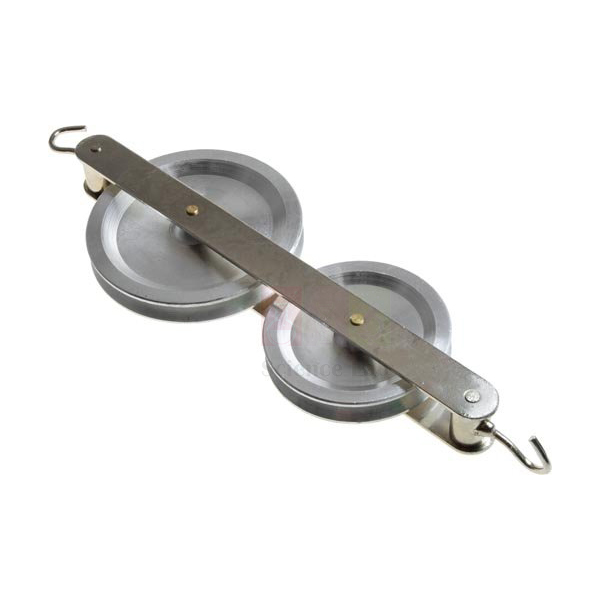
Pulley, Metal, Double
Pulley, Metal, Double (Product Code: SLE/PHY/276) is a tandem metal pulley block with 50 mm and 38 mm wheels, used to build block-and-tackle systems and study mechanical advantage in school physics. Its open-sided frame, with a hook at each end, lets students string it up quickly without any threading, and both pulleys run on ball bearings. It is made by Jain Scientific Equipments Pvt Ltd (ScienceLab), an OEM manufacturer, at its own factory in Ambala, India.
Specifications
| Parameter | Detail |
|---|---|
| Arrangement | Tandem metal pulleys |
| Type | Double |
| Pulley diameters | 50 mm and 38 mm |
| Bearings | Ball bearings |
| Frame | Open-sided, with hooks at each end |
| Stringing | Quick and easy; no threading involved |
| Product code | SLE/PHY/276 |
| Manufacturer | Jain Scientific Equipments Pvt Ltd (ScienceLab) — OEM |
| Country of origin | India (made in Ambala, Haryana) |
What Is the Double Metal Pulley Used For?
Paired with a single pulley or a second double block, it forms a pulley system in which the load is shared between several string segments. Students measure the effort, the load and the distances each one moves, then calculate mechanical advantage, velocity ratio and efficiency. With two wheels in one block, a group can rig systems with a higher velocity ratio than single pulleys allow, and the ball bearings keep frictional losses small so efficiency figures stay realistic.
The open-sided frame is the practical advantage in class: the string is simply laid over each wheel instead of being threaded through, so groups can change from one arrangement to another in moments. Hang the block from a firm support by its top hook, attach loads to the bottom hook, and keep the string seated in the grooves as masses are added. It is a flexible pulley system for the school lab.
What to Specify When Ordering
- Number of double blocks, plus single pulleys if you plan block-and-tackle systems.
- Slotted masses and hangers for the load, and a spring balance for measuring effort.
- Stands or a support frame to hang the pulleys from.
OEM Manufacturer
Jain Scientific Equipments Private Limited trades as ScienceLab and is the OEM of the Pulley, Metal, Double, which it makes at its own licensed factory at Saha, Ambala, Haryana, India. The company (CIN U29309HR2020PTC087597) produces its mechanics apparatus at these premises under Factory Licence AMB-ONLINE-CHD-J-414 and supplies schools, colleges, dealers and importers directly. Additional pulley blocks, or matching single pulleys for an existing set, can be ordered from the manufacturer; just ask us. See our company profile.
Related Laboratory Equipment
Pulleys and accessories for complete pulley-system experiments:
- Pulley, Metal, Double, Parallel — two 50 mm wheels in a metal frame for a different block arrangement.
- Pulley, Metal, Single, Parallel — a single metal pulley to combine with this block.
- Pulley, Plastic Double, with Ball Bearings — a plastic in-line alternative with the same open-sided frame.
- Slotted Mass Hanger, 500g — the load for the bottom hook.
- Force Meter/Spring Balance — measures the effort needed to raise the load.
The Physics Lab Equipment category lists the full pulley range.
Frequently Asked Questions
What sizes are the pulleys in the Pulley, Metal, Double?
The Pulley, Metal, Double carries two metal pulleys in tandem, one 50 mm and one 38 mm in diameter. Both run on ball bearings inside an open-sided frame that has a hook at each end for hanging the block and attaching a load.
What is the advantage of the open-sided frame?
The open-sided frame of the Pulley, Metal, Double lets the string be laid over the wheels instead of threaded through the frame, so students can string up or change a pulley arrangement quickly during a practical lesson.
How is the Pulley, Metal, Double used to show mechanical advantage?
Hang the Pulley, Metal, Double from a support, combine it with a single or second double pulley, and lift a known load with a spring balance. Comparing effort with load, and string pulled with load raised, gives mechanical advantage, velocity ratio and efficiency.
How is the Pulley, Metal, Double different from the parallel version?
The Pulley, Metal, Double has 50 mm and 38 mm pulleys in tandem inside an open-sided frame, while the Pulley, Metal, Double, Parallel has two 50 mm wheels mounted in a metal frame with two hooks. Both build multi-string pulley systems.
Who manufactures the Pulley, Metal, Double?
The Pulley, Metal, Double is manufactured by Jain Scientific Equipments Pvt Ltd (ScienceLab), the OEM, at its licensed factory at Saha, Ambala, Haryana, India, and is supplied directly to schools, colleges, dealers and importers in India and international markets.
What should I include when requesting a quote for the Pulley, Metal, Double?
For the Pulley, Metal, Double, give the product code SLE/PHY/276, the number of pulley blocks, any single pulleys, masses or spring balances needed, and the delivery location. Send the details through the contact page or add the items to the enquiry cart.
Request a Quote
Get a Pulley, Metal, Double quotation straight from the manufacturer by writing through our contact page, or place the block and its accessories in the enquiry cart.
Last updated: 24 September 2026
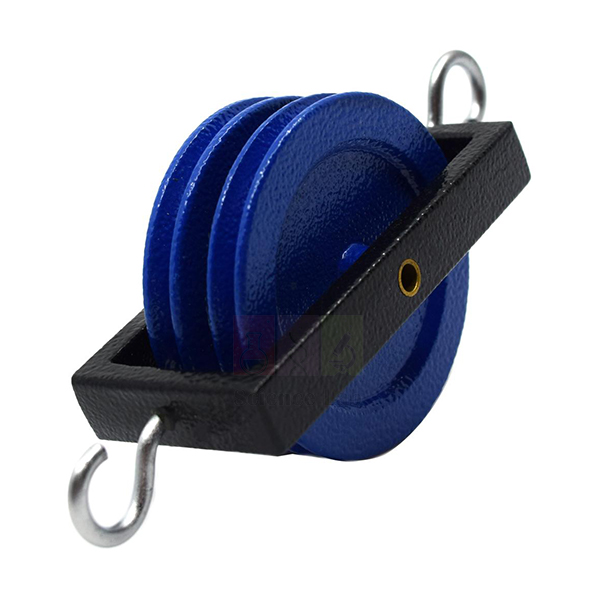
Pulley, Metal, Double, Parallel
Pulley, Metal, Double, Parallel (Product Code: SLE/PHY/277) is a pulley block with two 50 mm wheels mounted in parallel in a metal frame, used to set up multi-string pulley systems for mechanical advantage experiments. With two hooks on the frame, it can hang from a support as the fixed block or travel with the load as the moving block. It is made by Jain Scientific Equipments Pvt Ltd (ScienceLab), an OEM manufacturer, at its own factory in Ambala, India.
Specifications
| Parameter | Detail |
|---|---|
| Type | Double, parallel |
| Wheels | Two, 50 mm diameter |
| Material | Metal |
| Frame | Metal, with 2 hooks |
| Product code | SLE/PHY/277 |
| Manufacturer | Jain Scientific Equipments Pvt Ltd (ScienceLab) — OEM |
| Country of origin | India (made in Ambala, Haryana) |
What Is the Parallel Double Pulley Used For?
Two wheels on one block let a class build a four-string block and tackle when a pair of these pulleys is used together, one fixed above and one moving with the load. Students then find that the effort needed is roughly a quarter of the load while the string must be pulled four times as far, the classic demonstration of mechanical advantage and velocity ratio in a school pulley system lab.
Because both wheels are the same 50 mm size, the supporting strings share the load evenly, which keeps the arithmetic simple for younger students. Hang the fixed block from a rigid stand, pass the string over each wheel in turn, and watch that it does not jump from one groove to the other as masses are added. Measuring the real effort with a spring balance then shows how friction lowers efficiency below the ideal value.
What to Specify When Ordering
- Number of blocks: two per group gives a four-string system.
- Masses, hangers and a spring balance for load and effort.
- Stands or a frame from which to hang the fixed block.
OEM Manufacturer
Jain Scientific Equipments Private Limited, trading as ScienceLab, is the original equipment manufacturer of this parallel double pulley and produces it at its own licensed factory at Saha, Ambala, Haryana, India. Schools, colleges and dealers buying mechanics apparatus receive quotations straight from the maker, and extra blocks for new groups can be added to later orders by asking us. The company’s background is on our profile page.
Related Physics Lab Equipment
Other blocks and accessories for the same experiments:
- Pulley, Metal, Double — tandem 50 mm and 38 mm pulleys in an open-sided frame.
- Pulley, Metal, Single, Parallel — a single 50 mm wheel for simpler systems.
- Pulley, Plastic, Double, Parallel — the plastic-wheel version on a steel frame.
- Hangers with Slotted Weights — loads for the moving block.
- Spring Balance, Tubular — reads the effort on the free end of the string.
Browse Physics Lab Equipment for the complete range.
Frequently Asked Questions
What size are the wheels on the Pulley, Metal, Double, Parallel?
The Pulley, Metal, Double, Parallel has two pulley wheels of 50 mm diameter mounted in a metal frame. The frame carries two hooks, used for hanging the block from a support or for attaching the load.
How many supporting strings does a system with this pulley give?
Using two Pulley, Metal, Double, Parallel blocks, one fixed and one moving, gives four supporting string segments and an ideal mechanical advantage of four. Friction makes the measured value a little lower, which students use to calculate efficiency.
What is the difference between parallel and tandem double pulleys?
In the Pulley, Metal, Double, Parallel both wheels are 50 mm and mounted in parallel in a metal frame, while the tandem Pulley, Metal, Double has two different-sized wheels in an open-sided frame. Both are used to build multi-string pulley systems.
What load can the Pulley, Metal, Double, Parallel take?
A maximum load for the Pulley, Metal, Double, Parallel is not stated in this listing. Tell us the heaviest mass your experiments use through the contact page, and we will confirm whether this metal pulley block is suitable before you order.
Who manufactures the Pulley, Metal, Double, Parallel?
The Pulley, Metal, Double, Parallel is manufactured by Jain Scientific Equipments Pvt Ltd (ScienceLab), the OEM, at its own licensed factory at Saha, Ambala, Haryana, India, and supplied factory-direct to schools, colleges, dealers and importers.
Can the parallel double pulley be ordered in class sets?
Yes. The Pulley, Metal, Double, Parallel can be quoted in class quantities, usually two blocks per group, with masses and spring balances if needed, for delivery in India and international markets. Send the quantities through our contact page or enquiry cart.
Request a Quote
For a Pulley, Metal, Double, Parallel quotation from the manufacturer, use the contact page or add the item to the enquiry cart along with masses and balances.
Last updated: 24 September 2026
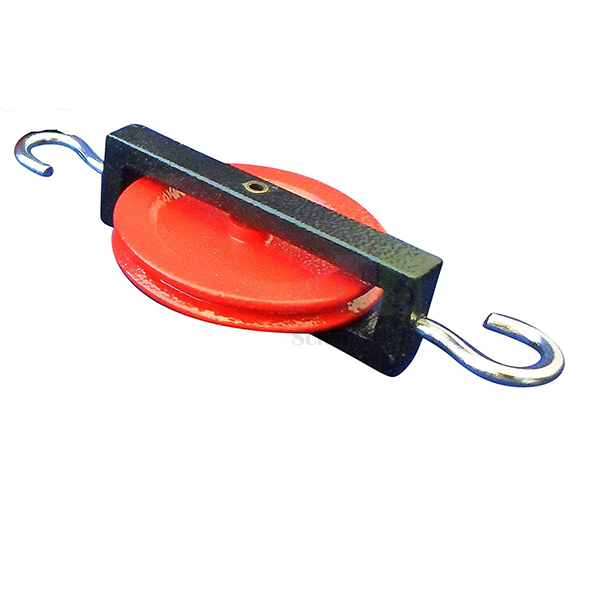
Pulley, Metal, Single, Parallel
Pulley, Metal, Single, Parallel (Product Code: SLE/PHY/278) is a single 50 mm metal pulley wheel mounted in a metal frame with two hooks, used as a fixed or movable pulley in introductory machines and forces experiments. It is the simplest block in the metal pulley range and is well suited to showing how a pulley changes the direction of a force before students move on to multi-wheel systems. It is made by Jain Scientific Equipments Pvt Ltd (ScienceLab), an OEM manufacturer, at its own factory in Ambala, India.
Specifications
| Parameter | Detail |
|---|---|
| Type | Single |
| Wheel | One, 50 mm diameter |
| Material | Metal |
| Frame | Metal, with 2 hooks |
| Product code | SLE/PHY/278 |
| Manufacturer | Jain Scientific Equipments Pvt Ltd (ScienceLab) — OEM |
| Country of origin | India (made in Ambala, Haryana) |
What Is the Single Metal Pulley Used For?
Hung from a stand as a fixed pulley, it shows that the effort equals the load but can act in a more convenient direction, which is why pulleys are used to raise flags and draw water from wells. Attached to the load as a movable pulley, with the string anchored above, it roughly halves the effort while doubling the length of string that must be pulled, giving students their first measurement of mechanical advantage with simple mechanics lab equipment.
The two hooks make the frame easy to use in either role, and the single block combines with double or triple blocks to make three-string and larger systems. Keep the wheel groove clean, check that the wheel turns freely before each lesson, and add masses gradually so the string stays in the groove.
What to Specify When Ordering
- Quantity: two per group lets students compare fixed and movable pulleys side by side.
- Double or triple pulley blocks to combine with it for larger systems.
- Masses, hangers and a spring balance.
OEM Manufacturer
ScienceLab is the brand of Jain Scientific Equipments Private Limited, the OEM that manufactures this single metal pulley at its own licensed factory at Saha, Ambala, Haryana, India. Because the metal pulley range is produced by the same maker, single and double blocks can be ordered together and match one another. For extra quantities or repeat orders, ask us directly. Learn more on our company profile.
Related Laboratory Equipment
Blocks and accessories that extend single-pulley experiments:
- Pulley, Metal, Double, Parallel — a two-wheel block to combine with the single pulley.
- Pulley, Metal, Double — a tandem double pulley with an open-sided frame.
- Pulley, Plastic, Triple, Parallel — three wheels for larger mechanical advantage.
- Slotted Mass Hanger, 1kg — a hanger and masses for the load.
- Force Meter/Spring Balance — measures the effort.
More mechanics apparatus is listed under Physics Lab Equipment.
Frequently Asked Questions
What size is the Pulley, Metal, Single, Parallel?
The Pulley, Metal, Single, Parallel has one pulley wheel of 50 mm diameter mounted in a metal frame. The frame carries two hooks, so the pulley can be hung from a support or attached to a load, depending on the experiment.
Can the single metal pulley be used as both a fixed and a movable pulley?
Yes. The Pulley, Metal, Single, Parallel can hang from a stand as a fixed pulley to change the direction of a force, or be hooked to the load as a movable pulley, which roughly halves the effort needed to lift it.
What else is needed to use the Pulley, Metal, Single, Parallel?
To use the Pulley, Metal, Single, Parallel you need a support stand, string, a set of masses with a hanger and a spring balance for effort. These are listed separately, so include them in your enquiry if you want a single quotation.
How does the single pulley differ from double and triple pulleys?
The Pulley, Metal, Single, Parallel has one 50 mm wheel, while double and triple blocks carry two or three wheels. Combining blocks increases the number of supporting strings, and with it the mechanical advantage students can measure.
Who manufactures the Pulley, Metal, Single, Parallel?
The Pulley, Metal, Single, Parallel is manufactured by Jain Scientific Equipments Pvt Ltd (ScienceLab), the OEM, at its own licensed factory at Saha, Ambala, Haryana, India, and quoted directly to schools, colleges, dealers and importers.
What should a quotation request for the single metal pulley include?
A quotation request for the Pulley, Metal, Single, Parallel should state the product code SLE/PHY/278, the number of pulleys, any other blocks or masses to include and the delivery location in India or abroad. Send it through our contact page.
Request a Quote
Request the Pulley, Metal, Single, Parallel through the contact page or the enquiry cart; the quotation comes directly from the manufacturer.
Last updated: 24 September 2026
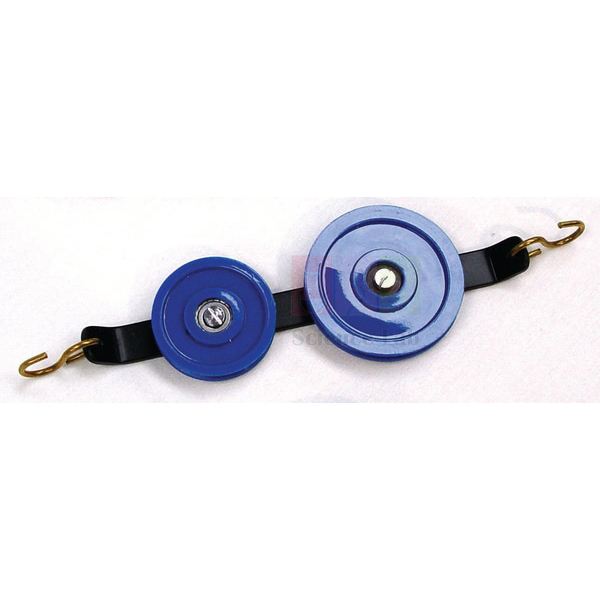
Pulley, Plastic Double, with Ball Bearings
Pulley, Plastic Double, with Ball Bearings (Product Code: SLE/PHY/279) is a double block of in-line plastic pulleys running on ball bearings, used to rig lightweight block-and-tackle systems in school mechanics practicals. Its open-sided frame has a hook at each end and lets students lay the string over the wheels without threading. It is made by Jain Scientific Equipments Pvt Ltd (ScienceLab), an OEM manufacturer, at its own factory in Ambala, India.
Key Details
| Parameter | Detail |
|---|---|
| Material | Plastic pulleys |
| Arrangement | In-line |
| Type | Double |
| Bearings | Ball bearings |
| Frame | Open-sided, with hooks at each end |
| Stringing | Quick and easy; no threading involved |
| Product code | SLE/PHY/279 |
| Manufacturer | Jain Scientific Equipments Pvt Ltd (ScienceLab) — OEM |
| Country of origin | India (made in Ambala, Haryana) |
What Is the Plastic Double Pulley Used For?
Two in-line wheels in one block let students add a second supporting string to a pulley system, and plastic pulleys keep the block light, which matters when the moving block’s own weight would otherwise distort small-load results. Pair it with a single pulley or a second double block, measure effort, load and distance moved, then calculate mechanical advantage and efficiency.
The ball bearings keep friction low, and the open side of the frame means strings are laid in rather than threaded, so a group can switch between arrangements quickly. Wipe the wheels clean, keep them away from heat sources such as burners, and check that each wheel spins freely before the lesson. It is a practical piece of physics lab equipment for school benches.
What to Specify When Ordering
- Number of double blocks, and single pulleys to pair with them.
- Plastic or metal: a metal tandem double pulley is also listed.
- Masses, hangers and spring balances.
- Any wheel-diameter requirement, which we will confirm with the quotation.
OEM Manufacturer
Jain Scientific Equipments Private Limited, trading as ScienceLab, manufactures this plastic double pulley as the OEM at its own licensed factory at Saha, Ambala, Haryana, India. It belongs to a pulley range in plastic and metal that institutions and resellers can source from the maker in a single order. Ask us directly for extra blocks or to match pulleys supplied earlier. The ScienceLab profile has more about the company.
Related Laboratory Equipment
Pulleys and accessories used alongside this block:
- Pulley, Metal, Double — the metal tandem version with 50 mm and 38 mm wheels.
- Pulley, Plastic, Double, Parallel — plastic wheels in parallel on a steel frame.
- Pulley, Plastic, Triple, Parallel — three plastic wheels for larger systems.
- Hangers with Slotted Weights 500 gm — loads for the moving block.
- Force Meter/Spring Balance — measures the effort.
See the Physics Lab Equipment category for the complete pulley range.
Frequently Asked Questions
What is the Pulley, Plastic Double, with Ball Bearings?
The Pulley, Plastic Double, with Ball Bearings is a double pulley block with two in-line plastic pulleys running on ball bearings, held in an open-sided frame with a hook at each end, for pulley-system experiments in school mechanics.
What does in-line mean for this plastic double pulley?
In the Pulley, Plastic Double, with Ball Bearings, in-line means the two plastic pulleys are arranged one after the other along the frame, so each supporting string runs over its own wheel in turn as the system is rigged.
Why is an open-sided frame useful?
The open-sided frame on the Pulley, Plastic Double, with Ball Bearings allows quick and easy stringing because no threading is involved. Students lay the string over each wheel, which saves time when changing pulley arrangements during a lesson.
What diameter are the pulleys?
The wheel diameter of the Pulley, Plastic Double, with Ball Bearings is not stated in this listing. If your experiments need a particular size, ask through our contact page and we will confirm it before you place an order.
Should I choose the plastic or the metal double pulley?
Choose the Pulley, Plastic Double, with Ball Bearings when a light moving block helps small-load experiments; the metal tandem double pulley suits groups that prefer a metal block. Both use ball bearings and an open-sided frame for quick stringing.
Who manufactures the Pulley, Plastic Double, with Ball Bearings?
The Pulley, Plastic Double, with Ball Bearings is manufactured by Jain Scientific Equipments Pvt Ltd (ScienceLab), the OEM, at its own licensed factory at Saha, Ambala, Haryana, India, and quoted directly to schools, colleges, dealers and importers.
Request a Quote
Send your quantity and delivery location for the Pulley, Plastic Double, with Ball Bearings through the contact page, or add it to the enquiry cart. The manufacturer replies with the quotation directly.
Last updated: 24 September 2026
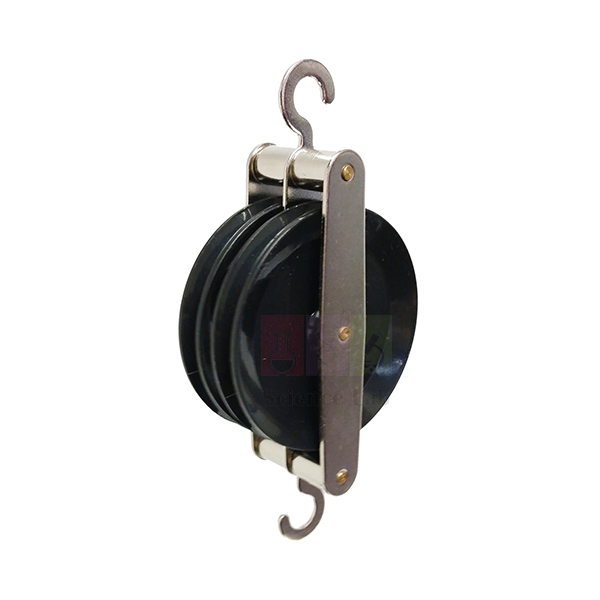
Pulley, Plastic, Double, Parallel
Pulley, Plastic, Double, Parallel (Product Code: SLE/PHY/280) is a pair of 50 mm plastic pulleys mounted in parallel on a steel frame, used to build compound pulley systems in school and college mechanics labs. The frame has a hook at each end, measures 8.9 cm overall and is capable of holding over 13 kg, which gives a good margin for classroom loads. It is made by Jain Scientific Equipments Pvt Ltd (ScienceLab), an OEM manufacturer, at its own factory in Ambala, India.
Specifications
| Parameter | Detail |
|---|---|
| Type | Double, parallel |
| Pulleys | Two, plastic, 50 mm diameter |
| Frame | Steel, with hooks at each end |
| Overall length | 8.9 cm |
| Load capacity | Capable of holding over 13 kg |
| Inner gap of pulley | 4 mm |
| Product code | SLE/PHY/280 |
| Manufacturer | Jain Scientific Equipments Pvt Ltd (ScienceLab) — OEM |
| Country of origin | India (made in Ambala, Haryana) |
What Is the Plastic Parallel Double Pulley Used For?
The block combines light plastic wheels with a strong steel frame, so it can serve as either the fixed or the moving block in a block and tackle. Two of them give four supporting strings; paired with a single pulley they give three. Students measure the effort with a spring balance, compare it with the load and work out mechanical advantage, velocity ratio and efficiency for each arrangement in their pulley system lab work.
The 4 mm inner gap of each pulley suits laboratory string or thin cord, while thicker cord may bind in the groove. The rated capacity of over 13 kg means the block copes comfortably with the slotted masses used in school practicals. Hang the upper block from a rigid support, keep the strings parallel and untwisted, and add masses gradually.
What to Specify When Ordering
- Number of blocks per group; two blocks give a four-string system.
- String or cord that fits the 4 mm pulley gap.
- Masses, hangers and spring balances to be quoted with the pulleys.
OEM Manufacturer
ScienceLab is the trading name of Jain Scientific Equipments Private Limited, the OEM that makes this plastic parallel double pulley at its own licensed factory at Saha, Ambala, Haryana, India. The company is a registered MSME enterprise with manufacturing as its major activity (Udyam UDYAM-HR-01-0003714), and it ships export orders under Importer-Exporter Code AAECJ8618A issued by the DGFT. Schools, colleges, dealers and importers receive quotations straight from the manufacturer. See our company profile.
Related Laboratory Equipment
Blocks and accessories that complete a pulley experiment:
- Pulley, Plastic, Triple, Parallel — three plastic wheels for larger systems.
- Pulley, Metal, Double, Parallel — the metal version with two 50 mm wheels.
- Pulley, Plastic Double, with Ball Bearings — in-line plastic pulleys in an open-sided frame.
- Slotted Mass Hanger, 1kg — loads for the moving block.
- Spring Balance, Tubular — reads the effort.
The complete range is in the Physics Lab Equipment category.
Frequently Asked Questions
What load can the Pulley, Plastic, Double, Parallel hold?
The Pulley, Plastic, Double, Parallel is capable of holding over 13 kg, thanks to its steel frame. That comfortably covers the slotted masses normally used in school and college pulley experiments.
What are the dimensions of the plastic parallel double pulley?
The Pulley, Plastic, Double, Parallel has two plastic pulleys of 50 mm diameter, an overall length of 8.9 cm and an inner pulley gap of 4 mm, with a hook at each end of its steel frame.
What string fits the Pulley, Plastic, Double, Parallel?
Each pulley of the Pulley, Plastic, Double, Parallel has a 4 mm inner gap, so choose laboratory string or cord thinner than 4 mm. Thicker cord can bind in the groove and add friction that distorts effort readings.
Why does this pulley use a steel frame with plastic wheels?
The Pulley, Plastic, Double, Parallel pairs lightweight 50 mm plastic wheels with a steel frame, so the block stays light enough for small-load work while the frame provides the strength to hold over 13 kg.
Who manufactures the Pulley, Plastic, Double, Parallel?
The Pulley, Plastic, Double, Parallel is manufactured by Jain Scientific Equipments Pvt Ltd (ScienceLab), the OEM, at its own licensed factory at Saha, Ambala, Haryana, India, and supplied factory-direct to schools, colleges, dealers and importers.
What should a quotation request for this pulley include?
A quotation request for the Pulley, Plastic, Double, Parallel should state the product code SLE/PHY/280, the number of blocks, any masses, spring balances or string needed and the delivery location in India or abroad. Send it through our contact page.
Request a Quote
Ask the manufacturer for a Pulley, Plastic, Double, Parallel quotation through the contact page, or list it in the enquiry cart with the rest of your mechanics order.
Last updated: 24 September 2026
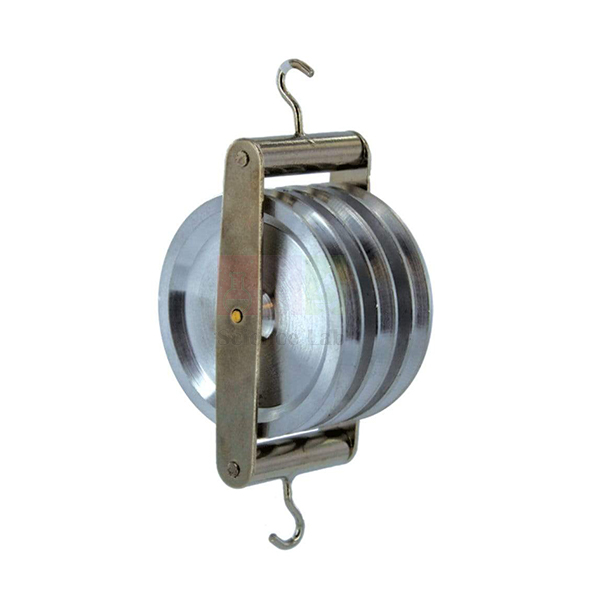
Pulley, Plastic, Triple, Parallel
Pulley, Plastic, Triple, Parallel (Product Code: SLE/PHY/281) is a pulley block with three 50 mm plastic pulleys mounted in parallel in a metal frame with two hooks, used for high-ratio block-and-tackle experiments in physics laboratories. When two blocks are used together, students can build systems with six supporting strings and see mechanical advantage rise with every added segment. It is made by Jain Scientific Equipments Pvt Ltd (ScienceLab), an OEM manufacturer, at its own factory in Ambala, India.
Specifications
| Parameter | Detail |
|---|---|
| Type | Triple, parallel |
| Pulleys | Three, plastic, 50 mm diameter |
| Frame | Metal, with two hooks |
| Product code | SLE/PHY/281 |
| Manufacturer | Jain Scientific Equipments Pvt Ltd (ScienceLab) — OEM |
| Country of origin | India (made in Ambala, Haryana) |
What Is the Triple Pulley Block Used For?
A triple block is the step up from single and double pulleys when students investigate how mechanical advantage depends on the number of supporting strings. Two triple blocks give a six-string tackle, and one triple with a double gives five. Measuring effort and distance moved for each arrangement shows that the effort falls as the length of string pulled grows, and that friction lowers efficiency as more wheels are added.
Keep the strings in order when rigging: work from the fixed block to the moving block one wheel at a time so that segments do not cross. Younger students find rigging easier if each wheel is marked with a small dot of colour. The plastic wheels keep the moving block’s own weight low, which helps when efficiency is calculated, and make this a useful addition to any set of mechanics lab equipment.
What to Specify When Ordering
- Number of triple blocks; two per group give a six-string tackle.
- Double or single pulleys to combine with it.
- Masses, hangers, a spring balance and a rigid support.
OEM Manufacturer
The Pulley, Plastic, Triple, Parallel is manufactured by Jain Scientific Equipments Private Limited, which trades as ScienceLab and is the OEM for its pulley range. Production takes place at the company’s own licensed factory at Saha, Ambala, Haryana, India, and the blocks are supplied direct to schools, colleges, laboratory dealers and importers. Extra blocks or replacements for an existing class set can be requested from the manufacturer; just ask us. Read more on the ScienceLab profile.
Related Laboratory Equipment
Items used with the triple block:
- Pulley, Plastic, Double, Parallel — a two-wheel block for five-string systems.
- Pulley, Metal, Single, Parallel — a single wheel for simpler comparisons.
- Pulley, Plastic Double, with Ball Bearings — in-line plastic pulleys on ball bearings.
- Hangers with Slotted Weights — loads for the moving block.
- Force Meter/Spring Balance — measures the effort.
Visit the Physics Lab Equipment category for more mechanics apparatus.
Frequently Asked Questions
How many pulleys does the Pulley, Plastic, Triple, Parallel have?
The Pulley, Plastic, Triple, Parallel has three plastic pulleys of 50 mm diameter mounted in parallel in a metal frame with two hooks, so it can act as either the fixed or the moving block of a pulley system.
What mechanical advantage can be shown with the triple pulley?
Two Pulley, Plastic, Triple, Parallel blocks give six supporting string segments, an ideal mechanical advantage of six, and one triple with a double gives five. Measured values are lower because of friction, which lets students calculate efficiency.
What else is needed with the Pulley, Plastic, Triple, Parallel?
The Pulley, Plastic, Triple, Parallel needs a rigid support, string, a second pulley block, masses with a hanger and a spring balance. These items are listed separately, so add them to your enquiry to receive a single quotation.
What is the maximum load for the triple pulley?
A load rating for the Pulley, Plastic, Triple, Parallel is not stated in this listing. Tell us the heaviest mass your experiments use through the contact page, and we will confirm suitability before you order.
Who manufactures the Pulley, Plastic, Triple, Parallel?
The Pulley, Plastic, Triple, Parallel is manufactured by Jain Scientific Equipments Pvt Ltd (ScienceLab), the OEM, at its own licensed factory at Saha, Ambala, Haryana, India, and quoted factory-direct to schools, colleges, dealers and importers.
Can the triple pulley be ordered in class sets?
Yes. The Pulley, Plastic, Triple, Parallel can be quoted in class quantities, usually two blocks per group, for schools, colleges, dealers and importers in India and international markets. Send the quantity and destination through our contact page or enquiry cart.
Request a Quote
For a Pulley, Plastic, Triple, Parallel quotation direct from the manufacturer, write through the contact page or add the block to the enquiry cart.
Last updated: 24 September 2026
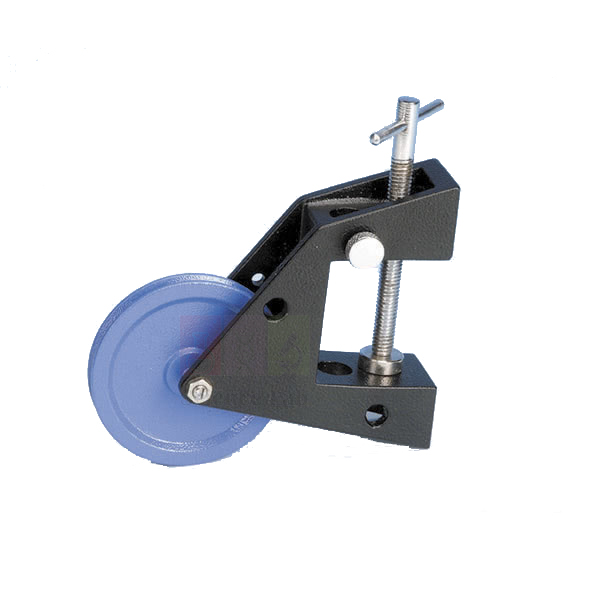
Pulley, Rod & Bench Mounting
Pulley, Rod & Bench Mounting (Product Code: SLE/PHY/282) is a 70 mm light-alloy pulley in an alloy bracket that clamps to a bench edge or a support rod, used to run a string and hanging mass off the bench in dynamics and friction practicals. The wheel turns on a brass/silvered-steel bearing, and the bracket fits bench edges up to 38 mm thick or a 13 mm support rod. It is made by Jain Scientific Equipments Pvt Ltd (ScienceLab), an OEM manufacturer, at its own factory in Ambala, India.
Specifications
| Parameter | Detail |
|---|---|
| Pulley diameter | 70 mm |
| Pulley material | Light alloy |
| Bearing | Brass/silvered-steel |
| Bracket | Alloy, with two clamping screws for bench or rod support |
| Bench mounting | Clamps to a bench edge or similar support up to 38 mm thick |
| Other mounting | Can be screwed to a flat surface or held on a 13 mm diameter support rod |
| Product code | SLE/PHY/282 |
| Manufacturer | Jain Scientific Equipments Pvt Ltd (ScienceLab) — OEM |
| Country of origin | India (made in Ambala, Haryana) |
What Is the Rod and Bench Mounting Pulley Used For?
Clamped at the end of the bench, the pulley lets a string run from a trolley or block over the edge to a hanging mass, the standard arrangement for measuring acceleration against force, finding coefficients of friction and testing Newton’s second law. The larger 70 mm wheel gives the string a gentler bend than a small pulley, which helps it run smoothly over long pulls.
Three mounting options make it easy to fit into different laboratories: clamp it to a bench edge up to 38 mm thick, screw it to a flat surface for a permanent demonstration set-up, or hold it on a 13 mm support rod to raise it to the height of a runway or inclined plane apparatus. Tighten both clamping screws before loading and keep the bearing clean.
What to Specify When Ordering
- Number of pulleys per bench or group.
- Your bench-top thickness (the clamp takes up to 38 mm) or support-rod diameter (13 mm).
- Masses, hangers, trolleys or runways to be quoted with it.
OEM Manufacturer
Jain Scientific Equipments Private Limited, known commercially as ScienceLab, is the OEM of this rod and bench mounting pulley and manufactures it at its own licensed factory at Saha, Ambala, Haryana, India. Institutions and resellers buy it factory-direct, so questions about fitting it to particular benches or rods are answered by the people who make it. For additional pulleys or repeat orders, ask us. More background is on our company profile.
Related Laboratory Equipment
Apparatus that works with a bench pulley in dynamics practicals:
- Pulley, Bench Mounting, Ball Bearing — a smaller 50 mm nylon pulley on an aluminium boss.
- Apparatus Newton’s Second Law — force and acceleration experiments using a bench pulley.
- Inclined Plane with Roller & Pan — for friction and inclined-plane practicals.
- Slotted Mass Hanger, 500g — the hanging mass on the end of the string.
- Bench Pulley — another bench pulley option for student sets.
Find more in the Physics Lab Equipment category.
Frequently Asked Questions
What size is the Pulley, Rod & Bench Mounting?
The Pulley, Rod & Bench Mounting has a 70 mm diameter light-alloy pulley running on a brass/silvered-steel bearing, held in an alloy bracket with two clamping screws for bench or rod support.
How thick a bench can the pulley clamp to?
The bracket of the Pulley, Rod & Bench Mounting clamps to a bench edge or similar support up to 38 mm thick. Measure your bench top before ordering; for thicker benches it can be screwed to a flat surface or held on a support rod.
Can the Pulley, Rod & Bench Mounting be fitted on a support rod?
Yes. The Pulley, Rod & Bench Mounting can be held on a 13 mm diameter support rod, which lets you set the pulley at the height of a runway or inclined plane rather than at bench level.
What bearing does the Pulley, Rod & Bench Mounting use?
The Pulley, Rod & Bench Mounting turns on a brass/silvered-steel bearing held in its alloy bracket, giving the light-alloy wheel a smooth run for dynamics and friction experiments in the school or college laboratory.
Who manufactures the Pulley, Rod & Bench Mounting?
The Pulley, Rod & Bench Mounting is manufactured by Jain Scientific Equipments Pvt Ltd (ScienceLab), the OEM, at its own licensed factory at Saha, Ambala, Haryana, India, and supplied directly to schools, colleges, dealers and importers.
What should a quotation request for this pulley include?
A quotation request for the Pulley, Rod & Bench Mounting should give the product code SLE/PHY/282, the number of pulleys, your bench thickness or rod diameter and the delivery location. Send it through our contact page or the enquiry cart.
Request a Quote
Quotations for the Pulley, Rod & Bench Mounting come from the manufacturer itself. Use the contact page or add the pulley to the enquiry cart.
Last updated: 24 September 2026
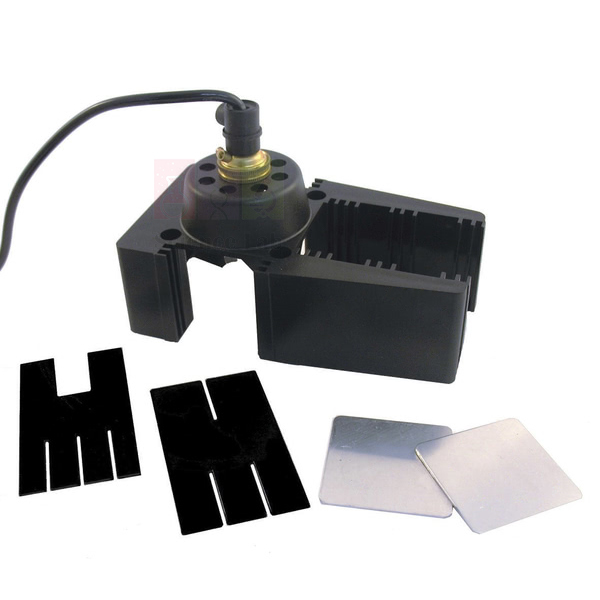
Raybox, 12V
Raybox, 12V (Product Code: SLE/PHY/283) is a 12 V lamp housing that produces narrow rays of light for reflection, refraction and lens experiments in school optics practicals. It has three openings, two of which can be used at the same time by two groups of pupils, and it comes with a 12 V, 24 W B15 bulb, bulb holder, slit plate, aluminium blanking plates and an instruction manual. It is supplied by Jain Scientific Equipments Pvt Ltd (ScienceLab), Ambala, India.
Specifications
| Parameter | Detail |
|---|---|
| Openings | Three; two can be used simultaneously by two sets of pupils |
| Front opening | Seven grooves for accessories and lenses |
| Side openings | Two slots each, for blanking plates and 50 mm slide accessories |
| Ray control | Designed so that, with a biconvex cylindrical lens of 75 mm focal length, divergent or convergent rays are obtained through the slit plate |
| Bulb | 12 V, 24 W, B15 |
| Cable | 2 m, with two 4 mm plugs |
| Supplied with | Cable, bulb, bulb holder, slit plate, aluminium blanking plates and instruction manual |
| Power supply | Not included |
| Product code | SLE/PHY/283 |
| Supplied by | Jain Scientific Equipments Pvt Ltd (ScienceLab), Ambala, India |
What Is the 12V Ray Box Used For?
A ray box turns a bulb into thin, well-defined beams that students can trace on paper, the foundation of ray optics. With a mirror, glass block or prism placed in the beam, pupils measure angles of incidence, reflection and refraction, find the critical angle and see how lenses bring rays to a focus. Only a minimum of accessories is needed to cover a wide range of optics experiments, which makes the ray box a core item of optics lab equipment.
Because two openings can be used at once, one box can serve two groups working on opposite sides, reducing the number of units a class needs. Run it from a separate 12 V supply, let the housing cool before changing the bulb, and dim the room lights slightly for the sharpest rays. The blanking plates close any opening that is not in use so stray light does not disturb the neighbouring group.
What to Specify When Ordering
- Number of ray boxes, remembering that one box can serve two groups.
- A 12 V power supply, since none is included.
- Extra slit plates, a cylindrical lens, prisms or blocks for your planned experiments.
- Spare 12 V, 24 W B15 bulbs.
Supplier
Jain Scientific Equipments Private Limited, trading as ScienceLab, supplies the Raybox, 12V from Ambala, Haryana, India. The company sources the ray box with its standard accessories and can quote the power supply, slit plates and optical blocks that go with it, so a school can equip an optics practical from one enquiry. Schools, colleges, dealers and importers can contact us directly. Our company profile has more about ScienceLab.
Related Physics Lab Equipment
Accessories and optical parts used with the ray box:
- Raybox Slit Plates — additional plates for single or multiple rays.
- Power Supply, Stepped — a low-voltage supply to run the 12 V bulb.
- Prism – Acrylic, Set of 7 — polished blocks for refraction with the rays.
- Lenses Cylindrical Glass, Biconvex — a cylindrical lens for converging rays.
- Mirror, Plane Glass — for reflection experiments.
Browse the Physics Lab Equipment category for more optics apparatus.
Frequently Asked Questions
What comes with the Raybox, 12V?
The Raybox, 12V is supplied with a 2 m cable fitted with two 4 mm plugs, a 12 V, 24 W B15 bulb, a bulb holder, a slit plate, aluminium blanking plates and an instruction manual. A power supply is not included.
Does the Raybox, 12V include a power supply?
No. The Raybox, 12V does not include a power supply. It needs a 12 V source connected through its 2 m cable with two 4 mm plugs, and a suitable low-voltage laboratory power supply can be quoted with it on request.
How many groups can use one Raybox, 12V?
The Raybox, 12V has three openings, and two of them can be used simultaneously by two sets of pupils. That lets one ray box serve two groups at once during reflection and refraction practicals.
How does the Raybox, 12V produce converging and diverging rays?
The front opening of the Raybox, 12V has seven grooves for accessories and lenses. Used with a biconvex cylindrical lens of 75 mm focal length, the slit plate gives divergent or convergent rays, so students can study lenses and focal points.
What bulb does the Raybox, 12V use?
The Raybox, 12V uses a 12 V, 24 W bulb with a B15 fitting, held in the supplied bulb holder. Keeping spare bulbs of the same rating on hand avoids lost lesson time if a bulb fails.
Who supplies the Raybox, 12V?
The Raybox, 12V is supplied by Jain Scientific Equipments Pvt Ltd (ScienceLab), Ambala, Haryana, India. The company sources the ray box with its standard accessories and quotes it to schools, colleges, dealers and importers in India and international markets.
Request a Quote
Send the number of ray boxes, any power supplies or accessories you need, and your delivery location through our contact page, or add the Raybox, 12V to the enquiry cart.
Last updated: 24 September 2026
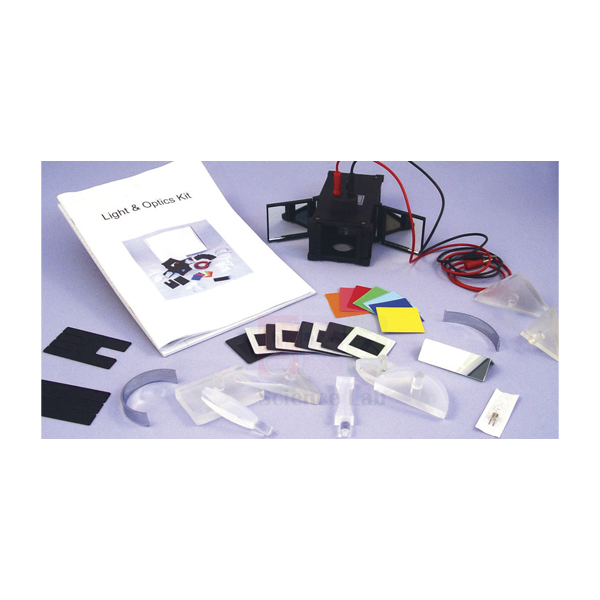
Raybox Mirrored with Accessories
Raybox Mirrored with Accessories (Product Code: SLE/PHY/284) is a ray box with a 12 V, 24 W lamp, used for reflection, refraction and colour-mixing experiments in school and college optics lessons. It produces a convergent, divergent or parallel beam, and an adjustable hinged mirror on the lateral aperture works with a triple aperture system for colour mixing. It is supplied by Jain Scientific Equipments Pvt Ltd (ScienceLab), Ambala, India.
Specifications
| Parameter | Detail |
|---|---|
| Light source | 12 V, 24 W lamp |
| Beam | Convergent, divergent or parallel |
| Parallel beam | Adjustable cylindrical convex lens at one end |
| Colour mixing | Triple aperture system at the other end |
| Lateral aperture | Adjustable hinged mirror |
| Apertures | All fitted with vertical channels to hold slit plates and colour filters |
| Applications | Reflection, refraction and colour-mixing experiments |
| Product code | SLE/PHY/284 |
| Supplied by | Jain Scientific Equipments Pvt Ltd (ScienceLab), Ambala, India |
What Is the Mirrored Ray Box Used For?
The mirrored design adds colour work to ordinary ray optics. At the triple-aperture end, colour filters placed in the vertical channels give beams of different colours, and the adjustable hinged mirror on the lateral aperture can steer a beam so that coloured light overlaps on a white screen, a clear way to show how colours of light combine.
At the other end, the adjustable cylindrical convex lens sets up a parallel beam for tracing rays through blocks, prisms and mirrors, while the box can also give convergent or divergent beams for lens experiments. Slide slit plates into the channels to divide the light into single or multiple rays. Power the 12 V, 24 W lamp from a suitable low-voltage supply and let the box cool before handling the lamp; it is a versatile piece of optics lab equipment for one bench.
What to Specify When Ordering
- Number of ray boxes for the class.
- The slit plates and colour filters you need; we will confirm which accessories are included with the quotation.
- A low-voltage power supply for the 12 V, 24 W lamp, if you do not already have one.
- Spare lamps.
Supplier
ScienceLab, the trading name of Jain Scientific Equipments Private Limited, supplies the Raybox Mirrored with Accessories from Ambala, Haryana, India. The company sources this colour-mixing ray box for school and college physics departments and quotes it with slit plates, lenses and power supplies on request. Buyers completing vendor registration can use the supplying company’s GSTIN 06AAECJ8618A1ZT and Legal Entity Identifier 3358004HRD1JIVXKYX49. Learn more on our profile page.
Related Physics Lab Equipment
Optics items often ordered with the mirrored ray box:
- Raybox, 12V — a two-group ray box with slit plate and blanking plates.
- Raybox Slit Plates — plates for single or multiple rays.
- Newton’s Colour Disc — another way to show colours combining into white.
- Prism, Clear Glass — splits white light into a spectrum.
- Power Supply, Stepped — a low-voltage supply for the 12 V lamp.
More optics apparatus is listed under Physics Lab Equipment.
Frequently Asked Questions
What experiments can be done with the Raybox Mirrored with Accessories?
The Raybox Mirrored with Accessories is designed for reflection, refraction and colour-mixing experiments. It produces convergent, divergent or parallel beams for ray optics, and its triple aperture system and hinged mirror are used for combining coloured beams.
What light source does the mirrored ray box use?
The Raybox Mirrored with Accessories uses a 12 V, 24 W lamp as its light source. Whether a power supply is included is not stated in this listing, so confirm it through our contact page when you ask for a quotation.
How does the Raybox Mirrored with Accessories produce a parallel beam?
One end of the Raybox Mirrored with Accessories has an adjustable cylindrical convex lens for producing a parallel beam. The box can also give convergent or divergent beams, so students can compare all three in lens and mirror experiments.
What is the hinged mirror on the mirrored ray box for?
The lateral aperture of the Raybox Mirrored with Accessories has an adjustable hinged mirror. It can redirect a beam, for example so that it overlaps light from the triple aperture system during colour-mixing experiments.
Which accessories come with the Raybox Mirrored with Accessories?
Every aperture of the Raybox Mirrored with Accessories has vertical channels that hold slit plates and colour filters, but this listing does not give a full contents list. Ask us through the contact page to confirm which accessories are supplied with the ray box.
Who supplies the Raybox Mirrored with Accessories?
The Raybox Mirrored with Accessories is supplied by Jain Scientific Equipments Pvt Ltd (ScienceLab), Ambala, Haryana, India. The company sources the ray box and quotes it for schools, colleges, dealers and importers in India and international markets.
Request a Quote
Request a Raybox Mirrored with Accessories quotation through our contact page, or add it to the enquiry cart together with slit plates, filters and a power supply.
Last updated: 24 September 2026
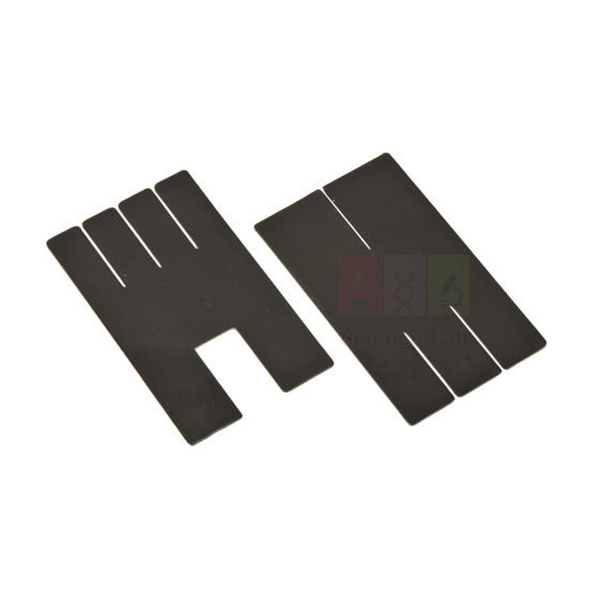
Raybox Slit Plates
Raybox Slit Plates (Product Code: SLE/PHY/285) is a pack of raybox accessories used to shape the lamp’s light into narrow rays for ray optics experiments in school physics laboratories. The pack holds 2 plates, each 84 mm long, 50 mm wide and 1 mm thick, so teachers can keep a spare with every raybox. It is supplied by Jain Scientific Equipments Pvt Ltd (ScienceLab), Ambala, India, for optics experiment kits in schools.
Specifications
| Parameter | Detail |
|---|---|
| Type | Accessories for a raybox |
| Pack size | Pack of 2 |
| Length | 84 mm |
| Width | 50 mm |
| Thickness | 1 mm |
| Product code | SLE/PHY/285 |
| Supplied by | Jain Scientific Equipments Pvt Ltd (ScienceLab), Ambala, India |
What Are Raybox Slit Plates Used For?
A raybox on its own gives a broad patch of light; a slit plate placed in the raybox opening turns it into thin, clearly defined rays that students can trace on paper. With those rays they study reflection at plane and curved mirrors, refraction through glass blocks and prisms, total internal reflection, and how converging and diverging lenses bend parallel rays to a focus. Clear, narrow rays make angle measurements with a protractor far more accurate.
Because each plate is only 1 mm thick, handle it by the edges, keep it flat and store the pair together so neither gets bent or scratched. Darkening the room slightly and placing the raybox close to the paper gives the sharpest rays. Thin accessories like these are easily mislaid in busy classes, so a spare pack per laboratory keeps ray optics lessons running.
What to Specify When Ordering
- Number of packs; each pack contains 2 slit plates.
- The raybox model you use, so we can confirm the 84 x 50 mm plates fit its openings.
- Whether rayboxes, lenses or glass blocks should be quoted as well.
Supplier
ScienceLab is the trading name of Jain Scientific Equipments Private Limited, located in Ambala, Haryana, India. The company supplies Raybox Slit Plates as spares for existing rayboxes and as part of complete ray optics sets for schools, colleges and dealers, and can check fit against your raybox model before quoting. Read more on our company profile.
Related Physics Lab Equipment
Items used with the Raybox Slit Plates:
- Raybox, 12V — ray box with front grooves for slit plates and lenses.
- Raybox Mirrored with Accessories — ray box with channels for slit plates and colour filters.
- Lenses Cylindrical Glass, Biconvex — converges the rays to show a focus.
- Prism – Glass Rectangular Block — refraction and lateral displacement experiments.
- Power Supply, Stepped — low-voltage supply for the raybox lamp.
Explore more optics items in Physics Lab Equipment.
Frequently Asked Questions
What size are the Raybox Slit Plates?
Each of the Raybox Slit Plates is 84 mm long, 50 mm wide and 1 mm thick. Check that your raybox opening takes plates of this size, or send us the raybox model and we will confirm the fit.
How many plates come in a pack of Raybox Slit Plates?
Raybox Slit Plates are supplied as a pack of 2. Order one pack per raybox to replace lost or damaged plates, or extra packs to keep spares in the laboratory.
What are Raybox Slit Plates used for?
Raybox Slit Plates fit in front of a raybox lamp to produce narrow rays of light. Students use these rays to trace reflection, refraction, total internal reflection and lens focusing on paper during ray optics practicals.
How many slits does each of the Raybox Slit Plates have?
The slit pattern of the Raybox Slit Plates is not listed in our current product details. If you need a particular number of rays, tell us through the contact page and we will confirm what is available.
Who supplies the Raybox Slit Plates?
Raybox Slit Plates are supplied by Jain Scientific Equipments Pvt Ltd (ScienceLab), Ambala, Haryana, India. We supply schools, colleges, institutions and dealers in India and international markets, as spares or with complete rayboxes.
Request a Quote
Request a price for Raybox Slit Plates through the contact page, or add them to the enquiry cart with your rayboxes and optics accessories.
Last updated: 24 September 2026
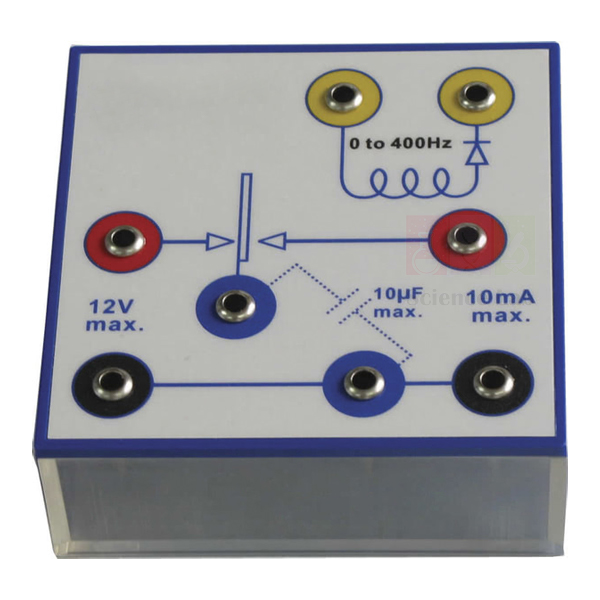
Reed Relay
Reed Relay (Product Code: SLE/PHY/286) is a single pole changeover switching unit used to charge and discharge a capacitor many times per second in school and college physics laboratories. Driven by a power signal generator, it changes over at 5 to 400 Hz, so students can find capacitance from a steady average current. It is supplied by Jain Scientific Equipments Pvt Ltd (ScienceLab), Ambala, India, for physics lab equipment buyers in India and international markets.
Specifications
| Parameter | Detail |
|---|---|
| Type | Single pole changeover reed relay |
| Switching rate | 5 to 400 changeovers per second when driven by a power signal generator |
| Coil drive | Coil operates at up to 400 Hz |
| Maximum contact rating | 12 V, 10 mA |
| Contact protection | Contact current-protected by a 12 ohm resistor |
| Main application | Repeated charge and discharge of parallel plate capacitors |
| Product code | SLE/PHY/286 |
| Supplied by | Jain Scientific Equipments Pvt Ltd (ScienceLab), Ambala, India |
What Is the Reed Relay Used For?
The reed relay is the switching heart of the classic vibrating-switch method for measuring capacitance. Its changeover contact connects a parallel plate capacitor to a DC supply, then discharges it through a sensitive current meter, once in every cycle of the drive signal. Because the capacitor charges and discharges f times per second, the meter shows a steady average current I = fCV, and students calculate C from their readings.
Changing the frequency on the signal generator, the plate separation or the plate area turns one set-up into a full graph-based investigation, including an estimate of the permittivity of free space. It suits senior secondary and undergraduate electricity practicals. Keep the charging circuit within the 12 V, 10 mA contact rating, start at a low switching rate and raise it gradually while watching for a stable meter reading.
What to Specify When Ordering
- Number of reed relay units, usually one per working group.
- Whether you also need a power signal generator to drive the relay coil.
- Parallel plate capacitor and a sensitive meter for the discharge current.
- Delivery location, so the quotation can include packing and freight.
Supplier
ScienceLab is the trading name of Jain Scientific Equipments Private Limited, a laboratory equipment company based in Ambala, Haryana. The company supplies this reed relay to schools, colleges, training institutes and dealers, and can combine it in one quotation with the signal generator, capacitor plates and meters needed for the same experiment. Read more about us on the company profile page.
Related Physics Lab Equipment
These items complete a capacitance practical built around the Reed Relay:
- Signal Generator and Amplifier — supplies the drive signal that sets the switching frequency.
- Demonstrative Plan Condenser/ Capacitor — parallel plate capacitor for charge and discharge measurements.
- Power Supply Variable — DC source for the charging voltage.
- Standard Digital Multimeter — checks the supply voltage and the average current.
- Simple Circuit Module Reed Relay — module-format reed relay for simple circuit work.
Browse the full Physics Lab Equipment range for more electricity apparatus.
Frequently Asked Questions
What does the Reed Relay do in a capacitance experiment?
The Reed Relay switches a capacitor between charging and discharging many times per second. Driven by a power signal generator at 5 to 400 Hz, it produces a steady average current, from which students calculate capacitance using the relation I = fCV.
What are the contact ratings of the Reed Relay?
The Reed Relay contact is rated at a maximum of 12 V and 10 mA, and it is current-protected by a 12 ohm resistor. Keeping the charging circuit within these limits protects the reed contact and keeps readings consistent.
What do I need to operate the Reed Relay?
The Reed Relay coil is driven by a power signal generator at up to 400 Hz. To complete the circuit you also need a DC supply for charging, a parallel plate capacitor and a sensitive current meter, all of which ScienceLab can quote together.
Who supplies the Reed Relay?
The Reed Relay is supplied by Jain Scientific Equipments Pvt Ltd, which trades as ScienceLab from Ambala, Haryana, India. It is offered to schools, colleges, institutions and dealers in India and international markets, alongside the matching signal generator and capacitor.
Can a calibration certificate be provided with the Reed Relay?
If your purchase needs any calibration or test document for the Reed Relay, please raise it with us through the contact page before ordering, and we will confirm what paperwork can accompany the supply.
What should a quotation request for the Reed Relay include?
State the number of Reed Relay units, whether you also need the signal generator, capacitor and meter, and your delivery location. With these details ScienceLab can prepare one quotation covering the complete capacitance practical.
Request a Quote
To order the Reed Relay, send your requirement through our contact page or add it to the enquiry cart and submit it for a quotation. We respond with supply details for single laboratories and bulk orders alike.
Last updated: 24 September 2026
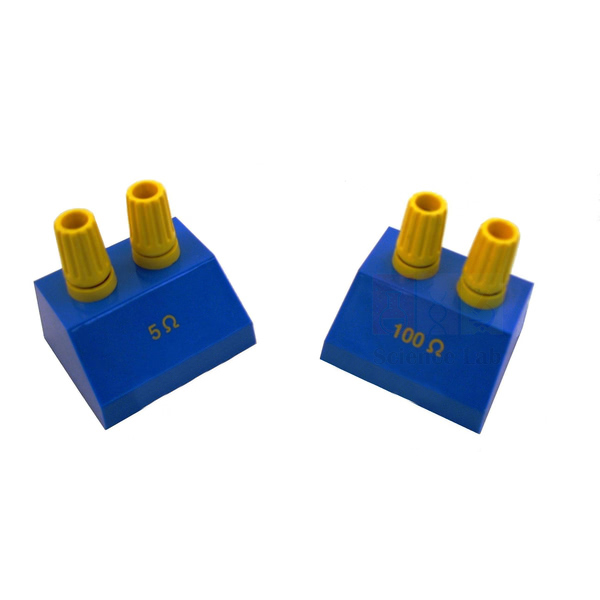
Resistance Coil
Resistance Coil (Product Code: SLE/PHY/287) is a 1 ohm resistance unit used to add a known resistance to a circuit in basic electrical experiments in schools and colleges. Instead of a bare resistor, the coil is built into a block with 4mm sockets, so students connect it quickly with standard leads, keeping no more than 0.7 V across it. It is supplied by Jain Scientific Equipments Pvt Ltd (ScienceLab), Ambala, India, for Ohm law experiment kits and general circuit work.
Specifications
| Parameter | Detail |
|---|---|
| Resistance | 1 ohm |
| Maximum voltage | 0.7 V |
| Connections | 4mm sockets |
| Format | Resistance unit in block form, used in place of a simple resistor |
| Application | Adding resistance to any circuit in basic electrical experiments |
| Product code | SLE/PHY/287 |
| Supplied by | Jain Scientific Equipments Pvt Ltd (ScienceLab), Ambala, India |
What Is the Resistance Coil Used For?
A 1 ohm coil is a convenient known resistance for introductory circuit work. Students place it in series with a cell and an ammeter to see how current changes, use it with a voltmeter to confirm Ohm’s law, or connect several units in series and parallel to compare combined resistance with the calculated value. Because the block takes 4mm plugs, a circuit can be built, changed and checked in minutes without soldering or loose wire ends.
A low value like 1 ohm is also useful as a current-sensing resistance: the voltage across it in volts equals the current through it in amperes. Keep the voltage across the coil to 0.7 V or less, which by Ohm’s law limits the current to about 0.7 A, and switch off between readings so the coil does not warm up and drift.
What to Specify When Ordering
- Number of 1 ohm Resistance Coil units per bench or per class set.
- Whether you also need 4mm connecting leads, meters or a low-voltage supply.
- Any other resistance values your practicals call for, so we can check what else is available.
Supplier
Jain Scientific Equipments Private Limited, trading as ScienceLab, supplies the Resistance Coil from Ambala, Haryana, to schools, colleges, institutes and dealers. The coil can be quoted as part of a complete electricity bench, together with meters, leads and resistance boxes, which saves buyers from sourcing each part separately. Company background is on our profile page.
Related Physics Lab Equipment
Use the Resistance Coil alongside these circuit items:
- Resistance Box — selectable resistance values when one fixed coil is not enough.
- Decade Resistance Box — wider range of values in single steps for comparison work.
- Rheostat — varies the current smoothly in the same circuit.
- Ammeter Voltmeter — measures current and voltage for Ohm’s law readings.
- Stackable Leads — connect the 4mm sockets to the rest of the circuit.
See all items in our Physics Lab Equipment category.
Frequently Asked Questions
What is the resistance value of the Resistance Coil?
The Resistance Coil has a value of 1 ohm. It is built into a block with 4mm sockets so it can be added to any basic electrical circuit, and several units can be combined in series or parallel.
What is the maximum voltage for the Resistance Coil?
The Resistance Coil is rated for a maximum of 0.7 V across it. With 1 ohm resistance, that corresponds to a current of about 0.7 A, so use a low-voltage supply or a series resistance to stay within the limit.
How is the Resistance Coil connected?
The Resistance Coil connects through 4mm sockets, so standard 4mm plug leads fit directly. This avoids soldering and loose wires, and lets students rebuild the circuit quickly between readings.
Who supplies the Resistance Coil?
The Resistance Coil is supplied by Jain Scientific Equipments Pvt Ltd (ScienceLab) of Ambala, Haryana, India. We supply schools, colleges, institutions and dealers across India and international markets, and can bundle the coil with meters and leads.
Is a calibration certificate available for the Resistance Coil?
Requirements for a calibration or test document with the Resistance Coil should be discussed with us before you order. Please describe what your institution needs through the contact page and we will reply with what can be provided.
Can the Resistance Coil be ordered in bulk for class sets?
Yes, the Resistance Coil can be quoted in class-set quantities for schools, colleges and dealers. Send the number of units and your delivery location, and we will include packing and freight in the quotation.
Request a Quote
Ask for a price on the Resistance Coil through the contact page, or place it in the enquiry cart with any other circuit items and send one enquiry for everything.
Last updated: 24 September 2026
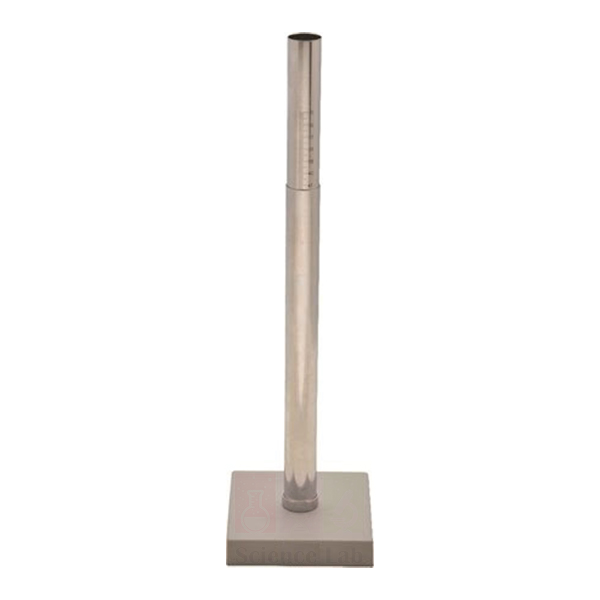
Resonance Apparatus with Brass Tube
Resonance Apparatus with Brass Tube (Product Code: SLE/PHY/288) is an air-column apparatus used to study sound resonance and estimate the speed of sound in school and college physics laboratories. Two metal tubes telescope into each other on a removable base, so students can set the air column anywhere from 300 mm to 530 mm. It is made by Jain Scientific Equipments Pvt Ltd (ScienceLab), an OEM manufacturer, at its own factory in Ambala, India.
Specifications
| Parameter | Detail |
|---|---|
| Tubes | Two metal tubes telescoping into each other (brass tube) |
| Air column length | Adjustable from 300 mm up to 530 mm by moving the outer tube |
| Mounting | Fitted on a removable base |
| Application | Resonance investigations in air columns |
| Product code | SLE/PHY/288 |
| Manufacturer | Jain Scientific Equipments Pvt Ltd (ScienceLab) — OEM |
| Country of origin | India (made in Ambala, Haryana) |
What Is the Resonance Tube Apparatus Used For?
Students hold a sounding tuning fork, or a small loudspeaker driven by a signal generator, just above the open end and slide the outer tube until the note swells to a clear maximum. That length marks a resonance of the air column. In a column closed at the lower end, the first resonance is close to a quarter of a wavelength plus a small end correction, so a known frequency leads to the wavelength and then to the speed of sound from v = fλ.
Repeating the measurement with several forks and plotting length against the reciprocal of frequency turns this resonance tube experiment kit into a graph-based practical that also yields the end correction. Because the length is changed by sliding metal tubes rather than by raising a water level, set-up is dry and quick. Approach each resonance from both directions, average the two positions and note the room temperature, since the speed of sound depends on it.
What to Specify When Ordering
- Number of Resonance Apparatus with Brass Tube sets, usually one per student group.
- Your sound source: tuning fork sets, or a signal generator with a loudspeaker.
- Whether the order is for your own laboratories or for resale as a dealer or importer.
OEM Manufacturer
ScienceLab is the trading name of Jain Scientific Equipments Private Limited, the original equipment manufacturer (OEM) of this resonance apparatus. The telescoping tubes and base are made and assembled at the company’s own licensed factory at Saha, Ambala, Haryana, India, instead of being bought in from a trader, and each order is supplied factory-direct to schools, colleges, institutions, dealers and importers.
For purchase files, the company is incorporated as Jain Scientific Equipments Private Limited (CIN U29309HR2020PTC087597) and produces this apparatus at 449, HSIIDC Industrial Area, Saha, Ambala, under Factory Licence AMB-ONLINE-CHD-J-414. Replacement tubes, bases and repeat orders are handled by the manufacturer itself, so just ask us. More about the company is on our profile page.
Related Physics Lab Equipment
Pair the Resonance Apparatus with Brass Tube with a sound source and supporting items:
- Tuning Fork Set, Steel — forks of known frequency for classic resonance readings.
- Tuning Fork Set, Aluminium — an alternative fork set for the same experiment.
- Signal Generator and Amplifier — drives a loudspeaker at any chosen frequency.
- Loudspeaker Unit — sound source placed over the open end of the tube.
- Resonance Tube Apparatus — another resonance tube design for comparison.
Explore more sound and wave apparatus in Physics Lab Equipment.
Frequently Asked Questions
What air column lengths does the Resonance Apparatus with Brass Tube cover?
The Resonance Apparatus with Brass Tube lets you set the air column anywhere from 300 mm up to 530 mm by sliding the outer tube. The continuous adjustment makes it easy to find a resonance position precisely.
How is the speed of sound measured with the Resonance Apparatus with Brass Tube?
With the Resonance Apparatus with Brass Tube, students find the air column length that gives the loudest sound for a known frequency. For a column closed at one end this length is about a quarter wavelength plus an end correction, and v = fλ then gives the speed of sound.
What sound source works with the Resonance Apparatus with Brass Tube?
Tuning forks of known frequency are the traditional source for the Resonance Apparatus with Brass Tube, while a loudspeaker driven by a signal generator lets students vary the frequency. Both are listed separately and can be added to your quotation.
Who manufactures the Resonance Apparatus with Brass Tube?
The Resonance Apparatus with Brass Tube is manufactured by Jain Scientific Equipments Pvt Ltd (ScienceLab) as the OEM, at its own licensed factory at Saha, Ambala, Haryana, India. Buyers deal directly with the manufacturer for quotations, repeat orders and replacement parts.
Is the base of the Resonance Apparatus with Brass Tube removable?
Yes, the Resonance Apparatus with Brass Tube is fitted on a removable base. The tubes can be taken off the base, which makes the apparatus easier to pack, store and move between laboratories.
Can the Resonance Apparatus with Brass Tube be supplied in bulk or for export?
Yes, the Resonance Apparatus with Brass Tube is supplied in quantity to schools, colleges, dealers and importers in India and international markets. Share the quantity and destination, and the quotation comes directly from the manufacturer in Ambala.
Request a Quote
Send your enquiry for the Resonance Apparatus with Brass Tube through the contact page or add it to the enquiry cart. Quotations come direct from the manufacturer, so pricing and supply details reach you without a middleman.
Last updated: 24 September 2026
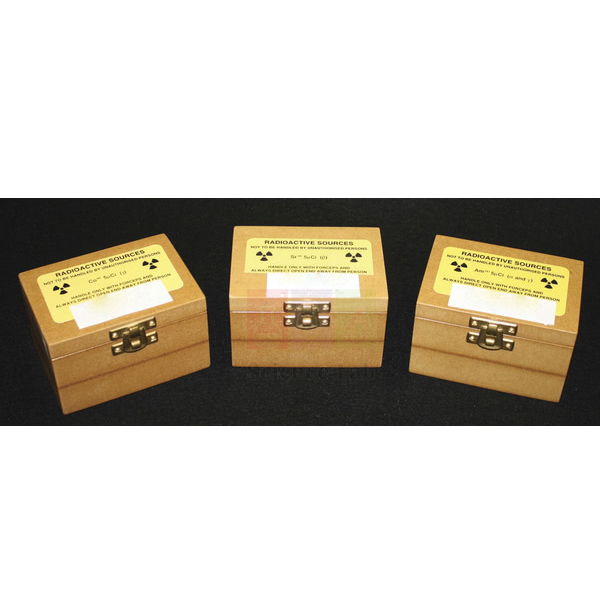
Sealed Radioactive Source, Cobalt
Sealed Radioactive Source, Cobalt (Product Code: SLE/PHY/289) is a 5 µCi (185 kBq) cobalt-60 teaching source used to demonstrate gamma radiation in school and college physics laboratories. An aluminium disc over the active material absorbs the beta particles, so only gamma rays leave the source, and the mount is colour-coded green. It is supplied by Jain Scientific Equipments Pvt Ltd (ScienceLab), Ambala, India, for nuclear physics lab equipment set-ups in India and international markets.
Specifications
| Parameter | Detail |
|---|---|
| Isotope | Cobalt-60 |
| Activity | 5 µCi (185 kBq) |
| Emission | Gamma only; an aluminium disc shields the beta particles |
| Half-life | 5.26 years |
| Construction | Active material enclosed in metal foil, fixed in a cylindrical mount |
| Stem | 4 mm diameter |
| Window protection | Wire gauze cap over the open window guards the foil against accidental damage |
| Identification | Nature and strength engraved on the mount; colour code green |
| Packing | Small lead castle in a labelled MDF storage box, 100 x 75 x 65 mm high |
| Documentation | Data sheet enclosed |
| Product code | SLE/PHY/289 |
| Supplied by | Jain Scientific Equipments Pvt Ltd (ScienceLab), Ambala, India |
What Is the Cobalt-60 Source Used For?
Because the beta component is filtered out, the cobalt source gives a clean gamma beam for the parts of a radioactivity course that alpha and beta sources cannot cover. With a Geiger-Muller tube and counter, students show that gamma rays pass through paper and aluminium almost unchanged and are reduced only gradually by thickening layers of lead. Moving the detector away in measured steps lets them test the inverse-square law, and a magnet placed in the beam shows that gamma rays, unlike beta particles, are not deflected.
Good practice follows the time, distance and shielding rule. Lift the source by its 4 mm stem with tongs, point the window away from people, take readings promptly, and return the source to its lead castle and labelled box straight after use. Keep a written log of each use, store the box in a locked cupboard, and remember that with a 5.26-year half-life the count rate drops noticeably over several years of teaching.
What to Specify When Ordering
- Quantity of cobalt-60 sources, and whether strontium or americium sources are needed as well.
- Any registration or authorisation reference your institution holds for sealed radioactive sources.
- Whether a GM tube holder, counter or scaler should be quoted with the source.
- Full delivery address and country, as transport rules for radioactive material vary.
Supplier
ScienceLab is the trading name of Jain Scientific Equipments Private Limited in Ambala, Haryana, India. The company sources this cobalt-60 teaching source for schools, colleges and institutes, and can quote it together with the detectors and counters used in the same practical. Because radioactive sources are controlled materials in most countries, we confirm documentation and delivery requirements with each buyer before supply. See our company profile for more about us.
Related Physics Lab Equipment
These items complete a radiation practical with the Sealed Radioactive Source, Cobalt:
- Sealed Radioactive Source, Strontium — beta source to contrast with the gamma rays.
- Sealed Radioactive Source, Americium — alpha source that completes the set of three radiations.
- Geiger Muller Tube Holder — holds the detector at a fixed height for distance readings.
- Scaler Timer — records counts over timed intervals for absorption graphs.
- Geiger Counter — checks background radiation and the storage area.
More nuclear and radiation apparatus is listed under Physics Lab Equipment.
Frequently Asked Questions
What radiation does the Sealed Radioactive Source, Cobalt emit?
The Sealed Radioactive Source, Cobalt emits gamma radiation only. Its cobalt-60 is covered by an aluminium disc that absorbs the beta particles, so the source is well suited to gamma penetration, lead absorption and inverse-square law experiments.
What are the activity and half-life of the Sealed Radioactive Source, Cobalt?
The Sealed Radioactive Source, Cobalt holds 5 µCi (185 kBq) of cobalt-60, which has a half-life of 5.26 years. Its activity therefore halves over that period, so note the date of receipt alongside the strength engraved on the mount.
How is the Sealed Radioactive Source, Cobalt identified and packed?
The Sealed Radioactive Source, Cobalt is colour-coded green, with its nature and strength engraved on the mount. It arrives in a small lead castle inside a labelled MDF storage box, 100 x 75 x 65 mm high, with a data sheet enclosed.
Is authorisation needed to buy the Sealed Radioactive Source, Cobalt?
Rules for holding a sealed source such as the Sealed Radioactive Source, Cobalt differ from country to country. Before ordering, check with your national radiation regulatory authority what your institution needs, and share those details with us through the contact page.
How should students handle the Sealed Radioactive Source, Cobalt?
The Sealed Radioactive Source, Cobalt should be moved only with tongs by its 4 mm stem, with the window pointed away from people. Never touch or press the gauze cap, keep exposure time short, and return the source to its lead castle immediately after readings.
Who supplies the Sealed Radioactive Source, Cobalt?
The Sealed Radioactive Source, Cobalt is supplied by Jain Scientific Equipments Pvt Ltd, trading as ScienceLab, from Ambala, Haryana, India. We quote it for schools, colleges and institutions in India and international markets, together with matching detectors and counters.
Request a Quote
Request pricing for the Sealed Radioactive Source, Cobalt through the contact page, or add it to the enquiry cart with your detector and counter. Include your delivery country and any authorisation reference so we can confirm supply terms.
Last updated: 24 September 2026
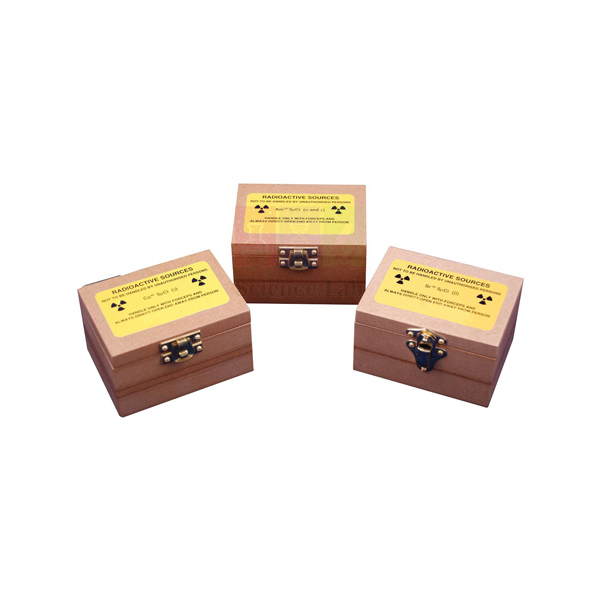
Sealed Radioactive Source, Strontium
Sealed Radioactive Source, Strontium (Product Code: SLE/PHY/290) is a 5 µCi (185 kBq) strontium-90 teaching source used for beta-particle experiments in school and college physics laboratories. Its strontium-90 sits in equilibrium with the daughter nuclide yttrium-90 inside a silver disc that lets most of the beta radiation escape, and the mount is colour-coded yellow. It is supplied by Jain Scientific Equipments Pvt Ltd (ScienceLab), Ambala, India, as part of a radiation experiment kit for institutions.
Specifications
| Parameter | Detail |
|---|---|
| Isotope | Strontium-90 in equilibrium with its daughter nuclide yttrium-90 |
| Activity | 5 µCi (185 kBq) |
| Emission | Beta |
| Half-life | 28 years (strontium-90); 64 hours (yttrium-90) |
| Active element | Incorporated in a silver disc that allows the major proportion of the beta radiation to escape; active material enclosed in metal foil |
| Mount | Cylindrical mount with a 4 mm diameter stem |
| Window protection | Wire gauze cap over the open window |
| Identification | Nature and strength engraved on the mount; colour code yellow |
| Storage | Small lead castle in a labelled MDF box, 100 x 75 x 65 mm high |
| Documentation | Data sheet enclosed with each source |
| Product code | SLE/PHY/290 |
| Supplied by | Jain Scientific Equipments Pvt Ltd (ScienceLab), Ambala, India |
What Is the Strontium-90 Source Used For?
The strontium source is the standard way to show how beta particles behave. Placed in front of a GM tube, it gives a count that paper barely changes but that falls steeply as aluminium sheets of increasing thickness are added, so students can plot absorption curves and estimate the range of the particles. Holding a strong magnet beside the beam bends the particles and moves the count, which demonstrates that beta radiation is charged.
The yttrium-90 daughter has a half-life of only 64 hours, so it stays in equilibrium with the strontium and the source decays at the 28-year rate of strontium-90. In practice the count rate changes very little over a school career, which suits long-term comparison of results. Use tongs, keep the open window facing away from the body, subtract the background count before every reading, and return the source to its lead castle as soon as the measurement is complete.
What to Specify When Ordering
- How many strontium-90 sources you need, and whether cobalt or americium sources are required too.
- Details of any authorisation your institution holds for keeping sealed sources.
- Detection equipment to include: GM tube holder, scaler timer or counter.
- Delivery address and country for the shipment.
Supplier
Jain Scientific Equipments Private Limited, which trades as ScienceLab, supplies the strontium-90 source from Ambala, Haryana, India to schools, colleges and research institutes. The company sources it for teaching use and checks the paperwork and transport conditions for each destination before confirming an order. Details of the company appear on our profile page.
Related Physics Lab Equipment
Buyers of the Sealed Radioactive Source, Strontium often add these items:
- Sealed Radioactive Source, Cobalt — gamma source for comparing penetrating power.
- Sealed Radioactive Source, Americium — alpha source for the short-range end of the comparison.
- Geiger Muller Tube Holder — keeps the detector aligned with the source window.
- Scaler Timer — counts pulses for each absorber thickness.
- Steel Horseshoe Magnet — deflects the beta particles in the magnetic deflection demonstration.
Find detectors and more apparatus in Physics Lab Equipment.
Frequently Asked Questions
What type of radiation comes from the Sealed Radioactive Source, Strontium?
The Sealed Radioactive Source, Strontium emits beta particles. Its strontium-90 and yttrium-90 are incorporated in a silver disc that allows the major proportion of the beta radiation to escape, which makes it the usual choice for beta absorption and deflection practicals.
How long does the Sealed Radioactive Source, Strontium last?
The Sealed Radioactive Source, Strontium decays with the 28-year half-life of strontium-90, while its yttrium-90 daughter has a 64-hour half-life and stays in equilibrium. The count rate therefore falls only slowly over years of classroom use.
What is the activity of the Sealed Radioactive Source, Strontium?
The Sealed Radioactive Source, Strontium contains 5 µCi (185 kBq) of strontium-90 in equilibrium with yttrium-90. The nature and strength are engraved on the mount, which is colour-coded yellow, and a data sheet comes with each source.
How is the Sealed Radioactive Source, Strontium stored?
The Sealed Radioactive Source, Strontium is supplied in a small lead castle inside a labelled MDF box, 100 x 75 x 65 mm high. Keep the box in a locked, marked store away from students, and log each time the source is taken out.
Do regulations apply to buying the Sealed Radioactive Source, Strontium?
Yes, sealed sources such as the Sealed Radioactive Source, Strontium are regulated in most countries. Confirm with your national radiation regulatory authority what your institution must hold, then send those details with your enquiry through the contact page.
Who supplies the Sealed Radioactive Source, Strontium?
The Sealed Radioactive Source, Strontium is supplied by Jain Scientific Equipments Pvt Ltd (ScienceLab), Ambala, Haryana, India. We supply institutions in India and international markets and can combine the source with GM tube holders and counters in one quotation.
Request a Quote
For a quotation on the Sealed Radioactive Source, Strontium, write to us via the contact page or add it to the enquiry cart. Mention the quantity, destination country and any detection equipment you need.
Last updated: 24 September 2026
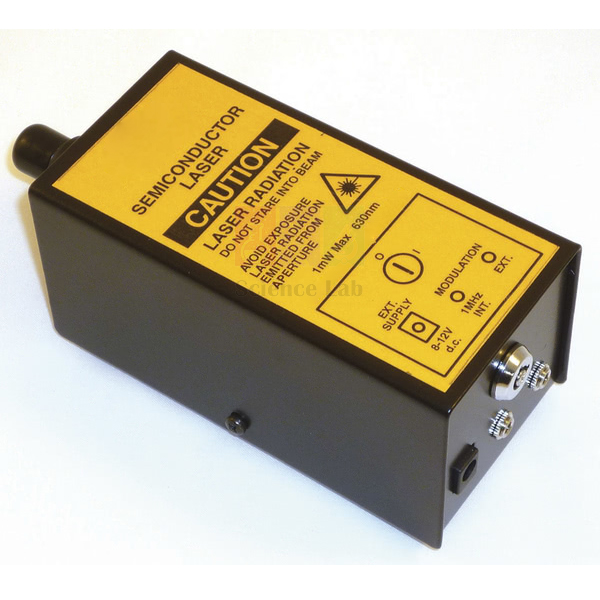
Semiconductor Laser
Semiconductor Laser (Product Code: SLE/PHY/291) is a red diode laser used for optics, speed of light and optical communication experiments in school and college physics laboratories. It emits an intense monochromatic beam at 630 - 640 nm and 0.9 mW (Class II operation), which can be modulated from an external waveform or by its own internal pulse generator. It is supplied by Jain Scientific Equipments Pvt Ltd (ScienceLab), Ambala, India, as a laser experiment kit component for institutions.
Specifications
| Parameter | Detail |
|---|---|
| Beam | Intense, monochromatic red beam |
| Wavelength | 630 - 640 nm |
| Output power | 0.9 mW (Class II operation) |
| Beam divergence | Typically about 1 milliradian |
| External modulation | Digital or analogue waveform applied to the 3.5mm jack socket on the rear panel |
| Internal modulation | Internal generator producing 0.1 µs pulses at approximately 1 MHz |
| Main application | Speed of light experiments; general optics work |
| Product code | SLE/PHY/291 |
| Supplied by | Jain Scientific Equipments Pvt Ltd (ScienceLab), Ambala, India |
What Is the Semiconductor Laser Used For?
The feature that sets this laser apart is modulation. Switched to its internal generator, it sends short 0.1 µs light pulses at about 1 MHz; students place a fast photodetector near the laser and another at the far end of a measured path, display both signals on a dual-trace oscilloscope, and read the delay to calculate the speed of light. Feeding an audio or digital signal into the 3.5mm rear jack instead turns the beam into a simple optical communication link.
Unmodulated, the narrow, low-divergence red beam is ideal for single-slit, double-slit and diffraction grating work, for tracing reflection and refraction through blocks and prisms, and for aligning optical benches. At Class II output the natural blink reflex normally protects the eye, but students should still never look into the beam, point it at people or let it bounce off shiny surfaces towards the class.
What to Specify When Ordering
- Number of Semiconductor Laser units required.
- Whether you plan speed of light work and need an oscilloscope and detectors quoted as well.
- Your modulation source for external signals, such as a signal generator.
- Mains supply voltage at the point of use, so we can confirm the right power arrangement.
Supplier
ScienceLab, the trading name of Jain Scientific Equipments Private Limited in Ambala, Haryana, India, supplies this semiconductor laser to schools, colleges, universities and dealers. We can build a complete optics or speed of light bench around it, with the oscilloscope, optical bench and mirrors listed on our site, and send one consolidated quotation. Read about the company on our profile page.
Related Physics Lab Equipment
Items commonly used with the Semiconductor Laser:
- Oscilloscope Dual Trace — displays sent and received pulses for the speed of light delay.
- Signal Generator and Amplifier — external waveform source for the modulation jack.
- Optical Bench Set — holds slits, lenses and screens in line with the beam.
- Mirror, Plane Glass — folds the beam to lengthen the path in a small room.
- Laser Pen, Red — simple pointer-type laser for basic ray work.
See the wider optics range in Physics Lab Equipment.
Frequently Asked Questions
What wavelength and power does the Semiconductor Laser have?
The Semiconductor Laser emits an intense monochromatic red beam of wavelength 630 - 640 nm at 0.9 mW, corresponding to Class II operation. Its typical beam divergence is about 1 milliradian, giving a narrow spot over long bench distances.
How is the Semiconductor Laser modulated?
The Semiconductor Laser can be modulated by an external digital or analogue waveform applied to the 3.5mm jack on its rear panel. Alternatively, its internal generator produces 0.1 µs pulses at approximately 1 MHz, which suits speed of light measurements.
Can the Semiconductor Laser measure the speed of light?
Yes, the Semiconductor Laser is designed to make speed of light experiments straightforward. Its short internal pulses travel a measured path to a detector, and the delay seen on a dual-trace oscilloscope gives the speed. The detector and oscilloscope are quoted separately.
Is the Semiconductor Laser safe for classroom use?
The Semiconductor Laser operates at Class II, a low power level normally protected by the eye’s blink reflex. Teachers should still prevent anyone from staring into the beam, avoid shiny reflecting surfaces in the beam path and supervise students throughout the practical.
What mains supply does the Semiconductor Laser need?
The supply voltage for the Semiconductor Laser is not listed here, so please tell us the mains voltage used in your laboratory through the contact page. We will confirm the correct power arrangement before quoting.
Who supplies the Semiconductor Laser?
The Semiconductor Laser is supplied by Jain Scientific Equipments Pvt Ltd (ScienceLab), based in Ambala, Haryana, India. We supply schools, colleges, universities and dealers in India and international markets, often as part of a complete optics bench.
Request a Quote
Get a quotation for the Semiconductor Laser by writing to us through the contact page, or add it and any matching items to the enquiry cart and submit a single enquiry.
Last updated: 24 September 2026
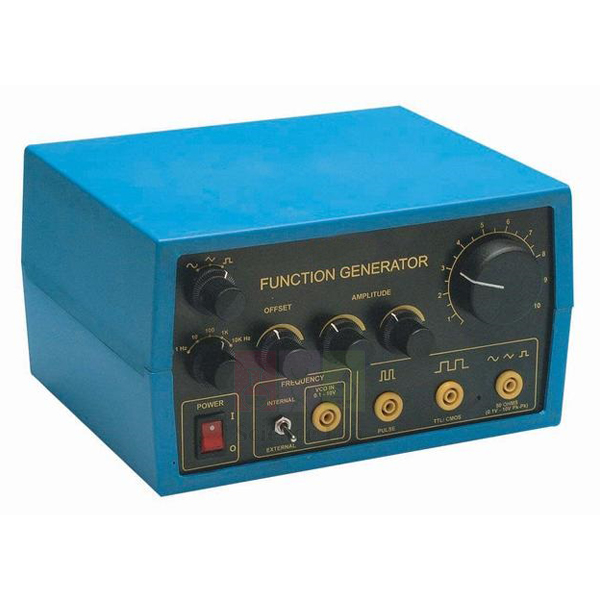
Signal Generator & Amplifier
Signal Generator & Amplifier (Product Code: SLE/PHY/292) is a bench function generator used to produce sine, square, triangular, pulse and TTL/CMOS signals for electronics and physics experiments in schools, colleges and training labs. It covers 1 Hz to 100 kHz in five ranges, and all of its outputs can be used at the same time. It is supplied by Jain Scientific Equipments Pvt Ltd (ScienceLab), Ambala, India, as a function generator for lab use in India and international markets.
Specifications
| Parameter | Detail |
|---|---|
| Waveforms | Sine, square, triangular, pulse and TTL/CMOS-compatible square wave |
| Frequency range | 1 Hz to 100 kHz, adjustable |
| Range steps | Five steps: 1 Hz, 10 Hz, 100 Hz, 1 kHz and 10 kHz, with a x10 multiplier |
| Amplitude control | Coarse and fine controls on the front panel |
| Simultaneous outputs | Pulse, TTL/CMOS and sine/square/triangular outputs all available at once on the front panel |
| Pulse and TTL/CMOS level | Fixed amplitude, compatible with TTL/CMOS logic |
| VCO input | Output frequency follows a DC voltage of 0.1 V to 10 V at the VCO IN socket, with the toggle switch set to external |
| Mains input | 120 V, 60 Hz or 240 V, 50/60 Hz (selectable) |
| Dimensions | 215 x 180 x 130 mm (W x D x H) |
| Weight | About 1.5 kg |
| Product code | SLE/PHY/292 |
| Supplied by | Jain Scientific Equipments Pvt Ltd (ScienceLab), Ambala, India |
What Is the Signal Generator Used For?
A function generator is the standard signal source for an electronics bench. Students feed its sine output into RC and LC circuits to plot frequency response and find resonance, use the square wave to watch capacitor charging on an oscilloscope, and drive counters, flip-flops and logic gates directly from the TTL/CMOS output. Because the pulse, TTL/CMOS and analogue outputs work simultaneously, one unit can clock a digital circuit while also supplying a test signal.
The VCO input adds a useful extra: a DC voltage between 0.1 V and 10 V sets the output frequency, so students can demonstrate frequency modulation or sweep a filter by hand with a potentiometer. In physics lessons the signal generator for electronics labs doubles as the test source for sound and interference demonstrations, and we can advise on driving a loudspeaker directly. Start with the amplitude low, choose the range step first and then fine-tune the frequency.
What to Specify When Ordering
- Number of Signal Generator & Amplifier units, typically one per bench.
- Mains voltage at your site: 120 V, 60 Hz or 240 V, 50/60 Hz.
- Any power output you need for loudspeakers or vibrators, so we can confirm suitability.
- Whether an oscilloscope and leads should be quoted with the generator.
Supplier
ScienceLab is the trading name of Jain Scientific Equipments Private Limited, Ambala, Haryana, which supplies this signal generator to schools, engineering colleges, polytechnics and dealers. For vendor registration, the supplying company is registered under GSTIN 06AAECJ8618A1ZT, and export consignments are shipped under Importer-Exporter Code AAECJ8618A issued by the DGFT. More company information is on our profile page.
Related Physics Lab Equipment
Complete an electronics or waves bench with the Signal Generator & Amplifier:
- Oscilloscope Dual Trace — displays the generator output and the circuit response together.
- Loudspeaker Unit — turns the sine output into sound for wave demonstrations.
- Semiconductor Laser — its modulation jack accepts the generator’s analogue or digital signal.
- Signal Generator And Amplifier (European Version) — model with a 4.5 W power output and digital frequency display.
Browse more instruments in Physics Lab Equipment.
Frequently Asked Questions
What frequency range does the Signal Generator & Amplifier cover?
The Signal Generator & Amplifier covers 1 Hz to 100 kHz. The range is selected in five steps of 1 Hz, 10 Hz, 100 Hz, 1 kHz and 10 kHz with a x10 multiplier, and the frequency is then adjusted within each step.
Which waveforms does the Signal Generator & Amplifier produce?
The Signal Generator & Amplifier produces sine, square and triangular waves plus pulse and TTL/CMOS-compatible square wave outputs. The pulse, TTL/CMOS and analogue outputs are available at the same time on the front panel and can be used together.
What does the VCO input on the Signal Generator & Amplifier do?
The VCO input on the Signal Generator & Amplifier lets a DC voltage of 0.1 V to 10 V control the output frequency. Set the toggle switch to external mode and apply the voltage to the VCO IN socket.
Does the Signal Generator & Amplifier work on 120 V and 240 V mains?
Yes, the Signal Generator & Amplifier has a selectable mains input for 120 V, 60 Hz or 240 V, 50/60 Hz. Set the selector to match your local supply before switching on for the first time.
What power output does the amplifier section provide?
Power output figures for the amplifier section of the Signal Generator & Amplifier are not listed in the product details. If you need to drive a loudspeaker, vibrator or other load, tell us the load through the contact page and we will confirm suitability.
Who supplies the Signal Generator & Amplifier?
The Signal Generator & Amplifier is supplied by Jain Scientific Equipments Pvt Ltd (ScienceLab) of Ambala, Haryana, India. We supply schools, colleges, polytechnics and dealers across India and international markets, and can quote it with oscilloscopes and leads.
Request a Quote
Ask for a quotation on the Signal Generator & Amplifier through our contact page, or place it in the enquiry cart along with the rest of your bench equipment and send one request.
Last updated: 24 September 2026
238.jpg)
Signal Generator And Amplifier (European Version)
Signal Generator And Amplifier (European Version) (Product Code: SLE/PHY/293) is a power signal generator used to drive loudspeakers, vibrators and other low-impedance loads in physics and electronics laboratories. It spans 0.1 Hz to 99.9 kHz on a digital display with 0.01% frequency accuracy and delivers up to 4.5 W across the whole range for every waveform. It is supplied by Jain Scientific Equipments Pvt Ltd (ScienceLab), Ambala, India, for laboratories on 220 - 240 V, 50 Hz mains.
Specifications
| Parameter | Detail |
|---|---|
| Frequency range | 0.1 Hz to 99.9 kHz in six decades, read on a digital display |
| Frequency accuracy | 0.01% (100 ppm) on all ranges |
| Waveforms | Sine, rectangular and triangular |
| Maximum power output | 4.5 W over the entire frequency range for all waveforms; maximum power transfer into a 4 ohm load |
| High impedance output | Up to 17 V peak to peak from an internal source impedance of 600 ohm |
| Low impedance output | 6 V RMS at 4 ohm (about 8.8 V peak for all waveforms) |
| Amplitude control | Zero to maximum in 256 increments, shown on a 10-segment bar graph |
| Attenuation | x1, x0.1, x0.01 (±1%), on the 600 ohm output only |
| Amplifier | Voltage gain 100; frequency response DC to 100 kHz (-3 dB), 4.5 W into a 4 ohm load |
| Settings memory | All control settings except amplitude are stored and updated on any change |
| Output protection | Withstands a prolonged short circuit on the output |
| Earthing | Earth terminal connected to physical earth through the power cord; signal output floating with respect to ground |
| Mains supply | 220 - 240 V, 50 Hz |
| Internal fuse | T315mA L |
| Dimensions | Approx. 210 x 155 x 118 mm (L x W x D) |
| Weight | Approx. 2.05 kg without power cord |
| Product code | SLE/PHY/293 |
| Supplied by | Jain Scientific Equipments Pvt Ltd (ScienceLab), Ambala, India |
What Is the Power Signal Generator Used For?
Its 4.5 W low-impedance output is what makes this generator useful in physics. It can drive a vibration generator for standing waves on strings, a loudspeaker for sound interference and resonance tube work, or the coil of a reed relay for capacitor charging experiments. The digital display and 0.01% accuracy mean students read the frequency straight from the panel, without a separate counter, which speeds up graph-based practicals such as frequency against tension or length.
For electronics, the 600 ohm high-impedance output with its x0.1 and x0.01 attenuators provides small, clean signals for amplifier and filter circuits. Because the signal output floats with respect to ground, decide which terminal connects to the oscilloscope earth before measuring. The unit tolerates an accidental short circuit on the output, but it should never be opened by users; refer any fault to us for advice.
What to Specify When Ordering
- Number of units required for your laboratories.
- Confirmation that your mains supply is 220 - 240 V, 50 Hz; if not, ask us about an alternative model.
- The loads you plan to drive, such as loudspeakers or vibration generators.
- Whether oscilloscopes, leads or vibrators should be added to the quotation.
Supplier
This power signal generator is supplied by ScienceLab, the trading name of Jain Scientific Equipments Private Limited of Ambala, Haryana, India. We supply it to universities, colleges, schools and dealers, and can match it with the vibrators, loudspeakers and oscilloscopes used in the same experiments so the bench arrives complete. Find out more on our company profile.
Related Physics Lab Equipment
Loads and instruments that work with the Signal Generator And Amplifier (European Version):
- Vibration Generator — driven by the power output for standing waves on strings.
- Loudspeaker Unit — converts the output to sound for interference and resonance work.
- Reed Relay — switched by a power signal generator to charge and discharge capacitors.
- Oscilloscope Dual Trace — shows the waveform and the circuit response side by side.
- Signal Generator & Amplifier — function generator with selectable 120 V or 240 V mains input.
View the complete Physics Lab Equipment range.
Frequently Asked Questions
What frequency range and accuracy does the Signal Generator And Amplifier (European Version) offer?
The Signal Generator And Amplifier (European Version) covers 0.1 Hz to 99.9 kHz in six decades, shown on a digital display. Frequency accuracy is 0.01% (100 ppm) on all ranges, so readings can be taken directly from the panel.
How much power can the Signal Generator And Amplifier (European Version) deliver?
The Signal Generator And Amplifier (European Version) delivers a maximum of 4.5 W over its entire frequency range for all waveforms. Maximum power transfer occurs into a 4 ohm load, where the low-impedance output gives 6 V RMS.
What is the difference between the two outputs on the Signal Generator And Amplifier (European Version)?
The Signal Generator And Amplifier (European Version) has a low-impedance power output for loads around 4 ohm, and a high-impedance output of up to 17 V peak to peak from 600 ohm. Only the 600 ohm output has the x1, x0.1 and x0.01 attenuator.
What mains supply does the Signal Generator And Amplifier (European Version) need?
The Signal Generator And Amplifier (European Version) runs on 220 - 240 V, 50 Hz mains and is protected by an internal T315mA L fuse. Its earth is connected through the power cord, while the signal output floats with respect to ground.
Is the Signal Generator And Amplifier (European Version) protected against short circuits?
Yes, the Signal Generator And Amplifier (European Version) is a robust instrument that withstands a prolonged short circuit on its output. Users should not open the case; if a fault appears, contact us through the contact page for advice.
Who supplies the Signal Generator And Amplifier (European Version)?
The Signal Generator And Amplifier (European Version) is supplied by Jain Scientific Equipments Pvt Ltd (ScienceLab), Ambala, Haryana, India. We supply laboratories and dealers in India and international markets and can quote matching vibrators, loudspeakers and oscilloscopes.
Request a Quote
Request a price for the Signal Generator And Amplifier (European Version) through the contact page, or add it to the enquiry cart together with the loads you plan to drive.
Last updated: 24 September 2026
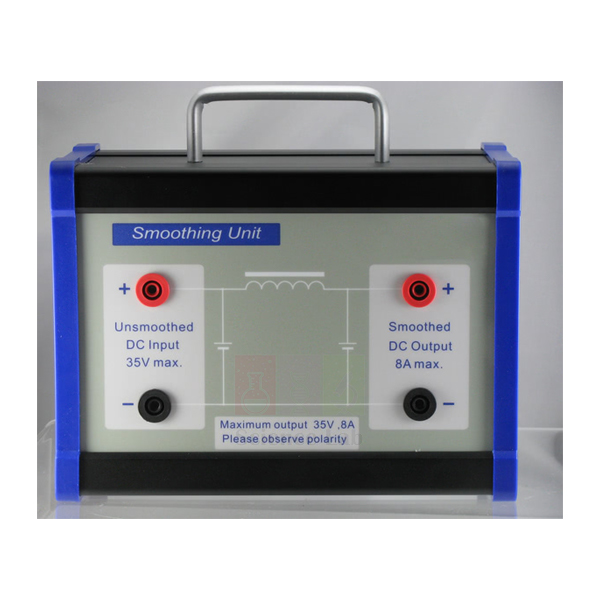
Smoothing Unit
Smoothing Unit (Product Code: SLE/PHY/294) is an LC filter unit used to reduce ripple from non-regulated low-voltage power supplies in school and college laboratories. A toroidal 0.1 H inductor works with a network of 2,200 µF capacitors and diodes to keep the output smooth at currents up to 8 A at 35 V. It is supplied by Jain Scientific Equipments Pvt Ltd (ScienceLab), Ambala, India, as an add-on for the power supply units in a lab.
Specifications
| Parameter | Detail |
|---|---|
| Function | Reduces ripple from non-regulated power supplies |
| Filter components | Toroidal 0.1 H inductor with a network of 2,200 µF capacitors and diodes |
| Input voltage | 0 to 35 V d.c.; absolute maximum 40 V d.c. (d.c. rectified from 28 V a.c.) |
| Current rating | 8 A maximum (up to 8 A at 35 V) |
| Typical ripple | About 1% with a 12 V supply at 3 A |
| Reverse polarity | Works without damage even with reversed polarity |
| Connections | Shrouded sockets accepting standard 4mm plugs and shrouded plugs |
| Dimensions | 208 x 155 x 115 mm (W x H x D); height including handle 187 mm |
| Product code | SLE/PHY/294 |
| Supplied by | Jain Scientific Equipments Pvt Ltd (ScienceLab), Ambala, India |
What Is the Smoothing Unit Used For?
Many school low-voltage supplies deliver rectified but unsmoothed DC, which rises and falls with every mains cycle. Connected between such a supply and the experiment, the Smoothing Unit turns that pulsing output into steady DC, even when the load draws several amperes. That matters for electrolysis, electromagnets, DC motors and any measurement where a fluctuating current would make meter readings jump.
It is also a teaching aid in its own right. Displaying the supply voltage on an oscilloscope before and after the unit shows students exactly what smoothing does, which links neatly with half wave and full wave rectifier kit experiments. Keep the input within 35 V (never above the 40 V absolute maximum), connect with shrouded 4mm leads, and note that an accidental reversal of polarity will not damage the unit.
What to Specify When Ordering
- Number of Smoothing Unit pieces, often one per low-voltage supply.
- The output voltage and current of the power supplies you will smooth, to confirm they are within 35 V and 8 A.
- Whether shrouded 4mm leads or an oscilloscope should be included in the quotation.
Supplier
Jain Scientific Equipments Private Limited, known by its trading name ScienceLab, supplies the Smoothing Unit from Ambala, Haryana, India. Schools, colleges and dealers can order it on its own or with the power supplies and leads it is used with, and we check voltage and current compatibility when preparing the quotation. Visit our profile page to learn more about the company.
Related Physics Lab Equipment
Items that work with the Smoothing Unit:
- Power Supply, Stepped — low-voltage source whose output can be smoothed.
- Power Supply Variable — adjustable supply for circuits that need steady DC.
- Oscilloscope Dual Trace — compares the rippled input with the smoothed output.
- Stackable Leads — 4mm leads for connecting supply, unit and load.
- Power Supply, Smoothed — an alternative when a single supply with smoothed output is preferred.
See more power and circuit items in Physics Lab Equipment.
Frequently Asked Questions
What does the Smoothing Unit do?
The Smoothing Unit reduces ripple from non-regulated power supplies. Its toroidal 0.1 H inductor and network of 2,200 µF capacitors and diodes turn pulsing rectified DC into a steady output, even when high currents are drawn.
What are the voltage and current limits of the Smoothing Unit?
The Smoothing Unit accepts 0 to 35 V d.c. at up to 8 A, with an absolute maximum of 40 V d.c., which corresponds to d.c. rectified from 28 V a.c. Stay within these limits to protect the capacitors and diodes.
How much ripple remains after the Smoothing Unit?
With a 12 V supply delivering 3 A, the Smoothing Unit typically leaves about 1% ripple. The actual figure depends on the supply and the load current, and an oscilloscope shows the result clearly.
Will the Smoothing Unit be damaged if connected the wrong way round?
No, the Smoothing Unit will work without suffering damage even at reverse polarity. This makes it well suited to student use, although correct polarity should still be checked before readings are taken.
What plugs fit the Smoothing Unit?
The Smoothing Unit has shrouded sockets that accept standard 4mm plugs as well as shrouded plugs. It measures 208 x 155 x 115 mm (W x H x D), and 187 mm high including its carrying handle.
Who supplies the Smoothing Unit?
The Smoothing Unit is supplied by Jain Scientific Equipments Pvt Ltd (ScienceLab) of Ambala, Haryana, India. We serve schools, colleges, institutions and dealers in India and international markets, and can quote the unit with suitable power supplies and leads.
Request a Quote
To receive a quotation for the Smoothing Unit, contact us through the contact page or add it to the enquiry cart with your power supplies and leads.
Last updated: 24 September 2026
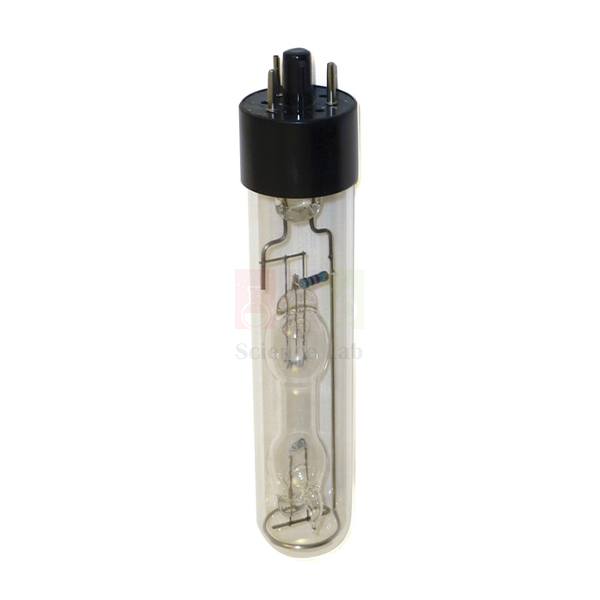
Sodium Spectral Lamp
Sodium Spectral Lamp (Product Code: SLE/PHY/295) is a discharge lamp used to produce the characteristic yellow sodium light for optics experiments in college and school physics laboratories. It fits a spectral lamp power supply through a 4 pin base and measures 30 mm in diameter and 140 mm in length. It is supplied by Jain Scientific Equipments Pvt Ltd (ScienceLab), Ambala, India, as part of its optics lab equipment range for India and international markets.
Specifications
| Parameter | Detail |
|---|---|
| Lamp type | Sodium spectral lamp |
| Base connection | 4 pin |
| Diameter | 30 mm |
| Length | 140 mm |
| Operation | For use with a spectral lamp power supply |
| Product code | SLE/PHY/295 |
| Supplied by | Jain Scientific Equipments Pvt Ltd (ScienceLab), Ambala, India |
What Is the Sodium Lamp Used For?
Sodium light is dominated by the closely spaced yellow D lines, which makes it the standard near-monochromatic source for undergraduate optics. With a spectrometer and a diffraction grating, students measure the grating element or the wavelength of the D lines; with a prism they find the refractive index at a known wavelength. The same lamp illuminates Newton’s rings, Fresnel biprism and air-wedge experiments, where a single dominant colour gives sharp, countable fringes.
A sodium discharge lamp needs a few minutes after switching on before it reaches full, steady brightness, so start it before the class begins. Let it cool completely before removing it from the holder, handle it by the base rather than the glass, and keep the envelope free of fingerprints. Store a spare lamp in its packing so an experiment is not held up when a lamp reaches the end of its life.
What to Specify When Ordering
- Number of Sodium Spectral Lamp units, including spares.
- The make or model of your spectral lamp power supply, so we can confirm it takes a 4 pin lamp of this size.
- Whether a new spectral lamp power supply with lamp holder is needed as well.
Supplier
ScienceLab, the trading name of Jain Scientific Equipments Private Limited in Ambala, Haryana, India, supplies the Sodium Spectral Lamp as a replacement and as part of complete spectroscopy set-ups. We supply colleges, universities, schools and dealers and can quote the lamp together with a power supply and spectrometer. Company details are available on our profile page.
Related Physics Lab Equipment
Use the Sodium Spectral Lamp with these optics items:
- Spectral Lamp Power Supply with Lamp Holder — powers and holds a spectral lamp; ask us to confirm the fit.
- Spectrometer — measures the angles of the sodium lines through a prism or grating.
- Apparatus Newton’s Ring — interference experiment that needs a monochromatic source.
- Prism, Borosilicate Glass — for refractive index measurements on the spectrometer.
- Sodium Lamp Kit — an alternative sodium light source set.
More optics apparatus is listed under Physics Lab Equipment.
Frequently Asked Questions
What are the dimensions of the Sodium Spectral Lamp?
The Sodium Spectral Lamp is 30 mm in diameter and 140 mm long, with a 4 pin base connection. Check that your lamp housing accepts a lamp of this size and base before ordering a replacement.
Which power supply does the Sodium Spectral Lamp need?
The Sodium Spectral Lamp is designed for use with a spectral lamp power supply and cannot run directly from the mains. Send us the details of your existing supply through the contact page, or order a matching power supply with the lamp.
What experiments use the Sodium Spectral Lamp?
The Sodium Spectral Lamp provides yellow, nearly monochromatic light for spectrometer work with prisms and diffraction gratings, and for interference experiments such as Newton’s rings, Fresnel biprism and air-wedge measurements in college and senior school optics.
How should the Sodium Spectral Lamp be handled?
Allow the Sodium Spectral Lamp to cool completely before removing it, hold it by the base instead of the glass, and keep the envelope clean. Give it a few minutes to warm up to steady brightness before taking measurements.
Who supplies the Sodium Spectral Lamp?
The Sodium Spectral Lamp is supplied by Jain Scientific Equipments Pvt Ltd (ScienceLab), Ambala, Haryana, India. We supply institutions and dealers in India and international markets, as a replacement lamp or with a power supply and spectrometer.
Request a Quote
Ask for a quotation on the Sodium Spectral Lamp through the contact page, or add it to the enquiry cart and mention the power supply you use so we can confirm compatibility.
Last updated: 24 September 2026
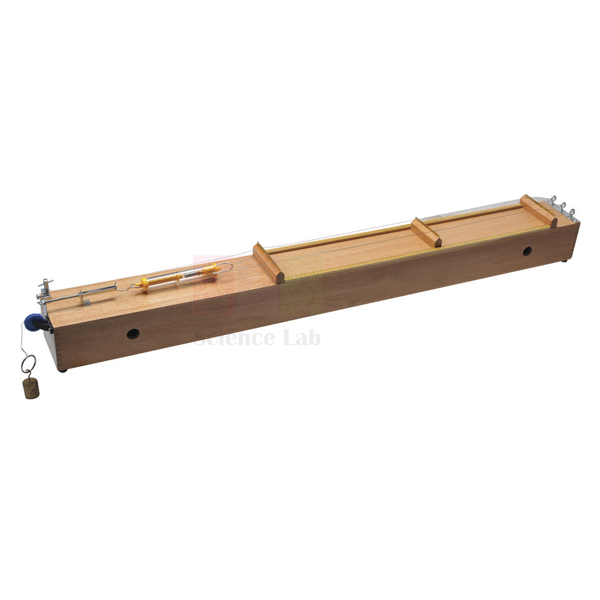
Sonometer, 3 Wire Pattern
Sonometer, 3 Wire Pattern (Product Code: SLE/PHY/296) is a stretched-string apparatus used to study the laws of vibrating strings and compare frequencies in school and college physics laboratories. Its hollow wooden resonance box, 1290 x 130 x 110 mm, carries millimetre scales, a pulley-loaded wire and a 100 N spring balance for measured tension. It is made by Jain Scientific Equipments Pvt Ltd (ScienceLab), an OEM manufacturer, at its own factory in Ambala, India.
Specifications
| Parameter | Detail |
|---|---|
| Resonance box | Hollow, wooden, 1290 x 130 x 110 mm |
| Scales | Divided in millimetres between the fixed bridges over which the wires are stretched |
| Loaded wire | One wire passes over a pulley and can be loaded as desired |
| Tension measurement | Spring balance reading 100 N x 5 N fitted to one end |
| Tension adjustment | Fine adjustment of the tension by a wing nut |
| Pattern | 3 wire |
| Product code | SLE/PHY/296 |
| Manufacturer | Jain Scientific Equipments Pvt Ltd (ScienceLab) — OEM |
| Country of origin | India (made in Ambala, Haryana) |
What Is the 3 Wire Sonometer Used For?
The sonometer lets students verify the three laws of transverse vibration: frequency varies inversely with vibrating length, with the square root of tension, and inversely with the square root of mass per unit length. On this pattern the spring balance sets a measured tension on one wire through the wing nut, while the pulley wire is tensioned by hanging masses, so two methods of applying tension can be compared on one box. A small paper rider on the wire jumps off at resonance when a sounding tuning fork is pressed against the box.
Typical practicals include finding the frequency of an unknown tuning fork, comparing two forks, and plotting vibrating length against 1/f. Move the bridges slowly and read lengths from the millimetre scale at the bridge edges. Release tension at the end of each session so the wires and the spring balance are not left under load, and keep the wooden box dry so its resonance stays consistent.
What to Specify When Ordering
- Number of Sonometer, 3 Wire Pattern sets for your laboratory.
- Tuning fork sets and slotted masses for loading the pulley wire, if needed.
- Spare wire requirements for restringing.
- Whether the order is for your own institution or for resale as a dealer or importer.
OEM Manufacturer
This sonometer is produced by Jain Scientific Equipments Private Limited, trading as ScienceLab, which is the OEM (original equipment manufacturer) rather than a reseller. The wooden resonance box is built, fitted with its scales, pulley, bridges and spring balance, and assembled at the company’s own licensed factory at Saha, Ambala, Haryana, India.
Schools, colleges, government institutions, dealers and importers buy direct from the factory, and quotations come straight from the people who make the apparatus. Ask us about replacement wires, bridges or balances and about repeat orders for additional laboratories. More about the company is on our profile page.
Related Physics Lab Equipment
Items used with the Sonometer, 3 Wire Pattern:
- Tuning Fork Set, Steel — known frequencies for resonance and frequency comparison.
- Slotted Mass Hanger, 1kg — loads the pulley wire in measured steps.
- Steel Wire — wire stock for restringing; confirm the gauge with us.
- Sonometer, Simple Pattern — two-wire model with twin 50 N spring balances.
See more sound and waves apparatus in Physics Lab Equipment.
Frequently Asked Questions
What size is the Sonometer, 3 Wire Pattern?
The Sonometer, 3 Wire Pattern is built on a hollow wooden resonance box measuring 1290 x 130 x 110 mm. Millimetre scales run between the fixed bridges, so vibrating lengths can be read directly without a separate rule.
How is tension applied on the Sonometer, 3 Wire Pattern?
On the Sonometer, 3 Wire Pattern, one end carries a spring balance reading 100 N x 5 N, with a wing nut for fine adjustment of tension. Another wire passes over a pulley and is tensioned by loading it with masses as desired.
Which experiments can be done with the Sonometer, 3 Wire Pattern?
The Sonometer, 3 Wire Pattern is used to verify the laws of vibrating strings, find the frequency of a tuning fork, compare frequencies and investigate how length and tension affect pitch, using a paper rider or ear to detect resonance.
Who manufactures the Sonometer, 3 Wire Pattern?
The Sonometer, 3 Wire Pattern is manufactured by Jain Scientific Equipments Pvt Ltd (ScienceLab), the OEM, at its own licensed factory at Saha, Ambala, Haryana, India. Buyers receive quotations, repeat supplies and replacement parts directly from the manufacturer.
Are tuning forks and masses included with the Sonometer, 3 Wire Pattern?
Tuning forks and slotted masses are listed separately from the Sonometer, 3 Wire Pattern on our site. Tell us which frequencies and loads your practicals need through the contact page, and we will add them to the quotation.
Can the Sonometer, 3 Wire Pattern be ordered in bulk or for export?
Yes, the Sonometer, 3 Wire Pattern is supplied factory-direct in quantity to schools, colleges, dealers and importers in India and international markets. Send the number of sets and the destination for a quotation from the manufacturer.
Request a Quote
Request a quotation for the Sonometer, 3 Wire Pattern through our contact page or the enquiry cart. As the manufacturer, we quote directly, with no trader in between.
Last updated: 24 September 2026
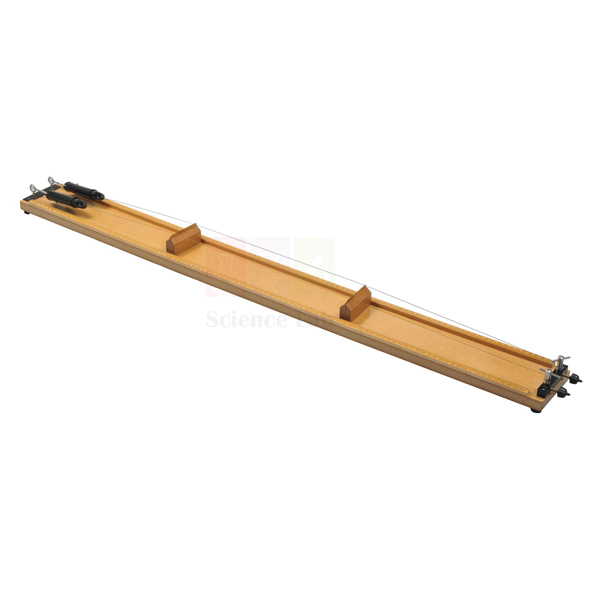
Sonometer, Simple Pattern
Sonometer, Simple Pattern (Product Code: SLE/PHY/297) is a two-wire sonometer used to investigate how length and tension set the pitch of a vibrating string in school and college physics laboratories. Each steel wire has its own 50 N spring balance and wrest pin on a 1140 mm wooden resonance box, so the two strings can be tensioned and compared side by side. It is made by Jain Scientific Equipments Pvt Ltd (ScienceLab), an OEM manufacturer, at its own factory in Ambala, India.
Specifications
| Parameter | Detail |
|---|---|
| Resonance box | Wooden; 1140 mm long, 125 mm wide, 100 mm high |
| Tension measurement | Two 50 N spring balances with hooks at one end of the base |
| Wire anchorage | Two corresponding wrest pins at the other end |
| Wires supplied | Two steel wires, 30 swg, 1 metre long |
| Bridges | Three: one large bridge to span both wires and two small bridges for the individual wires |
| Product code | SLE/PHY/297 |
| Manufacturer | Jain Scientific Equipments Pvt Ltd (ScienceLab) — OEM |
| Country of origin | India (made in Ambala, Haryana) |
What Is the Simple Sonometer Used For?
With two identical 30 swg wires, each on its own spring balance, this sonometer is well suited to comparison work. Students set one wire as a reference, then change the tension or the bridge spacing on the second until both sound in unison, which shows directly how frequency depends on tension and length. The large bridge spans both wires to give them the same vibrating length, while the two small bridges let each wire be adjusted independently.
It also covers the standard sonometer practicals: finding the frequency of a tuning fork by resonance with a paper rider, and plotting vibrating length against the reciprocal of frequency. Simple to set up and read, it is a practical choice of sonometer for Indian school and college labs running several groups at once. Tighten wires gradually with the wrest pins while watching the balance, stay within the 50 N scale, and slacken both wires before storage.
What to Specify When Ordering
- Number of Sonometer, Simple Pattern sets needed.
- Additional 30 swg steel wires as spares for restringing.
- Tuning fork sets to go with the sonometers.
- Delivery destination, whether within India or for export.
OEM Manufacturer
ScienceLab is the brand of Jain Scientific Equipments Private Limited, and the company is the original equipment manufacturer (OEM) of this sonometer. Its wooden resonance box is made, and the balances, wrest pins, bridges and wires are fitted and assembled, at the company’s own licensed factory at Saha, Ambala, Haryana, India, so buyers deal with the maker rather than a trading intermediary.
The factory at 449, HSIIDC Industrial Area, Saha, Ambala operates under Factory Licence AMB-ONLINE-CHD-J-414, and the company’s Corporate Identity Number is U29309HR2020PTC087597 for vendor records. Schools, colleges, institutions, dealers and importers are supplied factory-direct; ask us about spare wires, bridges and repeat orders. See the company profile for more.
Related Physics Lab Equipment
Complete a vibrating-strings practical with these items:
- Tuning Fork Set, Aluminium — reference frequencies for resonance with the wires.
- Tuning Fork on Resonance Box — louder reference note for comparing pitch by ear.
- Steel Wire — wire stock for replacements; confirm the gauge with us.
- Sonometer, 3 Wire Pattern — larger model with a pulley-loaded wire and 100 N balance.
Browse the full Physics Lab Equipment category.
Frequently Asked Questions
What comes with the Sonometer, Simple Pattern?
The Sonometer, Simple Pattern is supplied with two steel wires, 30 swg and 1 metre long, and three bridges: one large bridge to span both wires and two small bridges for the individual wires. Two 50 N spring balances and two wrest pins are fitted.
What are the dimensions of the Sonometer, Simple Pattern?
The Sonometer, Simple Pattern has a wooden resonance box 1140 mm long, 125 mm wide and 100 mm high. The spring balances sit at one end of the base and the wrest pins at the other.
How is wire tension measured on the Sonometer, Simple Pattern?
Each wire on the Sonometer, Simple Pattern is attached to its own 50 N spring balance with a hook, and tightened from the opposite end with a wrest pin. Students read the tension directly from the balance while adjusting the pin.
Who manufactures the Sonometer, Simple Pattern?
The Sonometer, Simple Pattern is manufactured by Jain Scientific Equipments Pvt Ltd (ScienceLab), the OEM, at its own licensed factory at Saha, Ambala, Haryana, India. Quotations, repeat orders and spare parts come directly from the manufacturer.
How does the Sonometer, Simple Pattern differ from the 3 wire pattern?
The Sonometer, Simple Pattern uses two wires, each with a 50 N spring balance and wrest pin, on a 1140 mm box. The 3 wire pattern has a larger box, a pulley-loaded wire and a single 100 N balance with wing-nut adjustment.
Can the Sonometer, Simple Pattern be supplied in quantity?
Yes, the Sonometer, Simple Pattern is supplied factory-direct in class quantities to schools, colleges, dealers and importers in India and international markets. Share the number of sets and destination through the contact page.
Request a Quote
Send your requirement for the Sonometer, Simple Pattern through the contact page or add it to the enquiry cart. The quotation comes direct from the manufacturer in Ambala.
Last updated: 24 September 2026
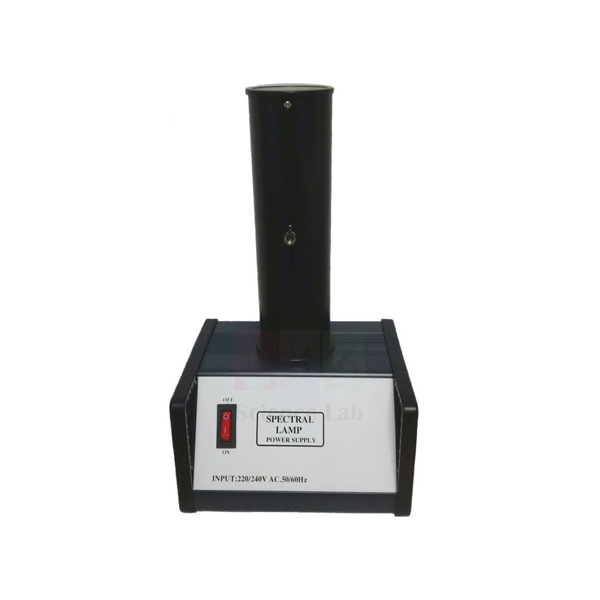
Spectral Lamp Power Supply with Lamp Holder
Spectral Lamp Power Supply with Lamp Holder (Product Code: SLE/PHY/298) is a compact spectral light source used to provide bright line-spectrum illumination for optics experiments and atomic absorption (AA) spectrometry in college and school laboratories. The lamp stands inside a black protective tube on top of the power unit, and turning the outer sleeve selects differently shaped apertures. It is supplied by Jain Scientific Equipments Pvt Ltd (ScienceLab), Ambala, India, for physics and chemistry teaching labs.
Key Details
| Parameter | Detail |
|---|---|
| Configuration | Compact spectral lamp combined with its power supply |
| Lamp mounting | Inside a black protective tube standing up from the top of the power unit |
| Apertures | Different shaped apertures selected by rotating the outer sleeve of the lamp cover |
| Light output | Bright, intense light, unlike the dull light available from spectrum tubes |
| Applications | Optical work and AA spectrometry |
| Product code | SLE/PHY/298 |
| Supplied by | Jain Scientific Equipments Pvt Ltd (ScienceLab), Ambala, India |
What Is the Spectral Lamp Power Supply Used For?
Spectrum tubes are easy to show but often too faint for accurate spectrometer readings. This unit solves that by pairing a spectral lamp with its own supply in one compact housing, giving an intense line source that can be placed right against the spectrometer slit. Students use it to measure spectral line positions with a prism or diffraction grating, to find wavelengths, and to provide the monochromatic light needed for interference experiments.
The rotating sleeve is a practical touch: choosing a suitable aperture shape cuts stray light and matches the beam to the slit or optical set-up, while the black tube keeps glare away from the observer. For chemistry and instrumentation courses, the same bright source demonstrates the principle of atomic absorption. Switch on a few minutes before readings so the output settles, and let the lamp cool before handling it.
What to Specify When Ordering
- Number of units required.
- Which spectral lamp element or elements you need, such as sodium.
- Mains voltage and frequency at your laboratory.
- Whether spare lamps or a spectrometer should be added to the quotation.
Supplier
Jain Scientific Equipments Private Limited, trading as ScienceLab, supplies the Spectral Lamp Power Supply with Lamp Holder from Ambala, Haryana, India. We work with colleges, universities, schools and dealers, and we match the lamp type and mains supply to each buyer’s needs before quoting. More information about the company is on our profile page.
Related Physics Lab Equipment
Items that complete a spectroscopy bench with this light source:
- Sodium Spectral Lamp — 4 pin sodium lamp for spectral lamp power supplies; ask us to confirm the fit.
- Spectrometer — measures the angular position of each spectral line.
- Prism, Clear Glass — disperses the light into its spectrum on the prism table.
- Spectrum Tube Power Supply — for gas spectrum tubes when a simple line display is enough.
- Sodium Lamp Kit — an alternative sodium light source arrangement.
Find more optics apparatus in Physics Lab Equipment.
Frequently Asked Questions
What is the Spectral Lamp Power Supply with Lamp Holder used for?
The Spectral Lamp Power Supply with Lamp Holder provides a bright, intense spectral light source for optical work such as spectrometer and grating measurements, and for AA spectrometry. It is far brighter than the dull light available from spectrum tubes.
How is the lamp mounted on the Spectral Lamp Power Supply with Lamp Holder?
On the Spectral Lamp Power Supply with Lamp Holder, the lamp sits inside a black protective tube standing up from the top of the power unit. This keeps the lamp shielded and directs light towards the experiment.
Can the aperture be changed on the Spectral Lamp Power Supply with Lamp Holder?
Yes, rotating the outer sleeve of the lamp cover on the Spectral Lamp Power Supply with Lamp Holder selects different shaped apertures. This helps match the emerging light to a spectrometer slit or other optical set-up and reduces stray light.
Which lamps and mains voltage suit the Spectral Lamp Power Supply with Lamp Holder?
Lamp element and mains rating for the Spectral Lamp Power Supply with Lamp Holder should be confirmed at the time of enquiry. Tell us the spectrum you need and your local supply through the contact page, and we will confirm the configuration.
Who supplies the Spectral Lamp Power Supply with Lamp Holder?
The Spectral Lamp Power Supply with Lamp Holder is supplied by Jain Scientific Equipments Pvt Ltd (ScienceLab), Ambala, Haryana, India. We supply institutions and dealers in India and international markets, often together with spectrometers, prisms and spare lamps.
Request a Quote
For a quotation on the Spectral Lamp Power Supply with Lamp Holder, use the contact page or add it to the enquiry cart, mentioning the lamp type and mains supply you need.
Last updated: 24 September 2026
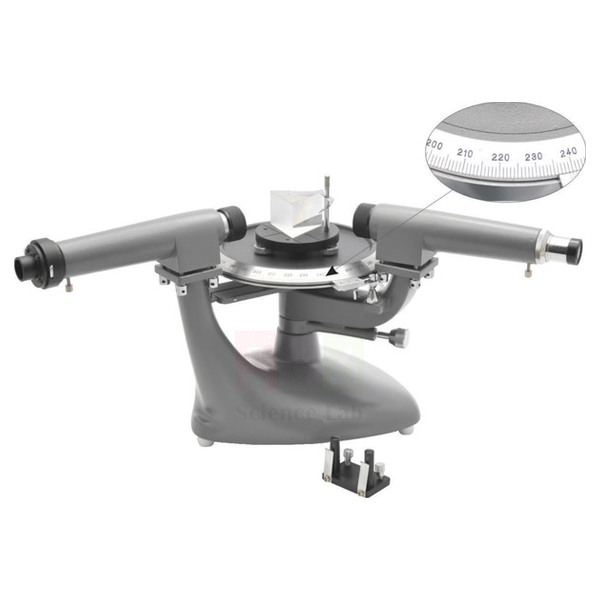
Spectrometer
Spectrometer (Product Code: SLE/PHY/299) is an optical instrument used to measure angles of refraction, dispersion and diffraction for quantitative spectroscopy in college and senior school physics laboratories. Its cast collimator and telescope bodies turn over a 170 mm scale, and a spring-loaded vernier gives readings to 0.1°. It is made by Jain Scientific Equipments Pvt Ltd (ScienceLab), an OEM manufacturer, at its own factory in Ambala, India, as core optics lab equipment for institutions.
Specifications
| Parameter | Detail |
|---|---|
| Construction | Main structural parts, including collimator and telescope bodies, are castings; metal parts well coated with protective finishes |
| Scale | 170 mm diameter, divided 0 to 360° x 1°; rotates independently, with locking screw |
| Vernier | Spring-loaded vernier on the telescope mount, reading to 0.1° |
| Telescope mounting | Movable pillar with locking-screw adjustment and axis adjustment |
| Telescope eyepiece | Ramsden eyepiece with cross wires and locking-ring focus adjustment |
| Telescope objective | 170 mm focal length, 21 mm aperture, in a spiral focusing system |
| Collimator mounting | Fixed pillar with axis adjustment |
| Collimator objective | 150 mm focal length, in a spiral focusing system |
| Slit | Unilaterally adjustable, 6 mm long |
| Prism table | Three levelling screws; lines marked to help place the prism |
| Standard accessories | 1 prism clamp for prisms up to 40 mm high; 1 diffraction grating holder, aperture 25 x 25 mm; 1 small screwdriver; 1 tommy bar for axis adjustment; full instructions |
| Product code | SLE/PHY/299 |
| Manufacturer | Jain Scientific Equipments Pvt Ltd (ScienceLab) — OEM |
| Country of origin | India (made in Ambala, Haryana) |
What Is the Spectrometer Used For?
As a prism spectrometer, it lets students find the angle of the prism and the angle of minimum deviation, and from these the refractive index and dispersive power of the glass. Fitted with a diffraction grating in the 25 x 25 mm holder, it becomes a grating spectrometer for measuring the wavelengths of spectral lines from a sodium or other spectral lamp. The 0.1° vernier reading supports genuinely quantitative results rather than simple demonstrations.
Good results start with adjustment. Focus the Ramsden eyepiece on the cross wires, set the telescope and collimator for parallel light using the spiral focusing, then level the prism table with its three screws. Keep the slit narrow but bright, lock the scale before taking a reading, and keep the instrument covered and away from dust after use. Only the tommy bar and screwdriver supplied should be used for axis adjustments.
What to Specify When Ordering
- Number of spectrometers for your optics laboratory.
- Prisms and diffraction gratings to go with the included clamp and grating holder.
- Light source: sodium spectral lamp and spectral lamp power supply, if needed.
- Whether the order is for institutional use or for resale as a dealer or importer.
OEM Manufacturer
Jain Scientific Equipments Private Limited, which trades as ScienceLab, is the original equipment manufacturer (OEM) of this spectrometer. The cast bodies are finished and assembled with their optics and scales at the company’s own licensed factory at Saha, Ambala, Haryana, India, rather than sourced from a trader, and the finished instruments go factory-direct to colleges, universities, schools, dealers and importers.
Because the manufacturer handles supply itself, requests for replacement eyepieces, prism clamps, grating holders or repeat orders can be raised with us directly. Learn more about the company on our profile page.
Related Physics Lab Equipment
Complete a spectroscopy practical with these items:
- Prism, Borosilicate Glass — for minimum deviation and refractive index work.
- Prism, Clear Glass — an alternative prism for dispersion experiments.
- Sodium Spectral Lamp — bright yellow line source for wavelength measurements.
- Spectral Lamp Power Supply with Lamp Holder — powers and shields the spectral lamp at the slit.
- Sodium Lamp Kit — an alternative sodium light source set.
More optics apparatus is in Physics Lab Equipment.
Frequently Asked Questions
How precise are readings on the Spectrometer?
The Spectrometer has a 170 mm diameter scale divided 0 to 360° in 1° steps, and a spring-loaded vernier on the telescope mount reads to 0.1°. The scale rotates independently and locks with a screw during readings.
What accessories come with the Spectrometer?
The Spectrometer comes with one prism clamp for prisms up to 40 mm high, one diffraction grating holder with a 25 x 25 mm aperture, one small screwdriver, one tommy bar for axis adjustment and full instructions.
What are the telescope and collimator optics of the Spectrometer?
The Spectrometer telescope has a 170 mm focal length objective with a 21 mm aperture and a Ramsden eyepiece with cross wires. The collimator objective has a 150 mm focal length, and both use spiral focusing, with a 6 mm unilaterally adjustable slit.
What is the collimator lens aperture of the Spectrometer?
The collimator focal length of the Spectrometer is 150 mm, but its lens aperture is not confirmed in our current product details. If the aperture matters for your specification, ask us through the contact page and we will confirm it before quoting.
Who manufactures the Spectrometer?
The Spectrometer is manufactured by Jain Scientific Equipments Pvt Ltd (ScienceLab), the OEM, at its own licensed factory at Saha, Ambala, Haryana, India. Quotations, spare parts and repeat orders come directly from the manufacturer rather than through a trader.
Is a calibration certificate available for the Spectrometer?
If your tender or purchase file needs a calibration or inspection document for the Spectrometer, please discuss the requirement with us through the contact page before ordering, and we will confirm what can be provided.
Request a Quote
Ask for a quotation on the Spectrometer through the contact page, or add it with prisms and a light source to the enquiry cart. Quotes come direct from the manufacturer.
Last updated: 24 September 2026
Spectroscope, Direct Vision
Spectroscope, Direct Vision (Product Code: SLE/PHY/300) is a straight-through optical instrument used to view the spectrum of a light source by looking directly at it, in school and college physics laboratories. Teachers and students use it for the rapid examination of the spectral composition of white light sources, and it gives a bright spectrum with a dispersion of approximately 11°. As practical optics lab equipment, it is made by Jain Scientific Equipments Pvt Ltd (ScienceLab), an OEM manufacturer, at its own factory in Ambala, India.
Specifications
| Parameter | Detail |
|---|---|
| Instrument type | Direct-vision spectroscope |
| Dispersion | Approx. 11° |
| Slit | Variable width, adjusted by rotating the end piece |
| Intended use | Rapid examination of the spectral composition of white light sources |
| Storage case | Wooden case |
| Product code | SLE/PHY/300 |
| Manufacturer | Jain Scientific Equipments Pvt Ltd (ScienceLab) — OEM |
| Country of origin | India (made in Ambala, Haryana) |
What Is the Direct Vision Spectroscope Used For?
A direct vision spectroscope lets a learner hold the instrument in line with a lamp and see its light spread into a band of colours, without setting up a prism table, collimator and telescope. In a lesson on light and colour, students can observe the continuous spectrum of a white source such as a filament lamp and discuss why white light contains every visible colour from red to violet.
Turn the end piece to narrow the slit when the source is bright and the colours look blurred, and open it a little for a dim source; the balance between brightness and sharpness is itself a useful teaching point. Never point the instrument at the Sun, and return it to its wooden case after the lesson so the optics stay clean. It suits school physics lab equipment lists in India where a quick, qualitative view of spectra is needed before students move on to measured work.
OEM Manufacturer
Jain Scientific Equipments Private Limited, which trades under the name ScienceLab, is the OEM (original equipment manufacturer) of the Spectroscope, Direct Vision. The instrument is produced at the company's own licensed factory at Saha, Ambala, Haryana, India, and is not bought from a trader and relabelled. Schools, colleges, institutions, dealers and importers in India and international markets buy it factory-direct, and questions about replacement parts or repeat orders go straight to the manufacturer. Read more on our company profile.
Related Physics Lab Equipment
These items support the same lessons on dispersion and spectra:
- Spectrometer — for measured angles and wavelengths once students have seen spectra qualitatively.
- Spectroscope (for high school) — a prism instrument with collimator and telescope for bench work.
- Prism, Clear Glass — shows dispersion of white light on the open bench.
- Prism – Acrylic, Set of 7 — several prism shapes for refraction and dispersion activities.
- Electromagnetic Spectrum Chart — places the visible band within the wider spectrum.
Browse the full range in Physics Lab Equipment.
Frequently Asked Questions
What does the Spectroscope, Direct Vision show?
The Spectroscope, Direct Vision shows the spectrum of a light source when you look straight through it at the source. It is intended for rapid examination of the spectral composition of white light sources and gives a bright spectrum with a dispersion of approximately 11°.
How is the slit width adjusted on the direct vision spectroscope?
The slit of the Spectroscope, Direct Vision has a variable width, set by rotating the end piece. A narrower slit gives sharper colour boundaries, while a wider slit admits more light when the source is faint.
How is the Spectroscope, Direct Vision stored?
The Spectroscope, Direct Vision comes in a wooden case, which protects the instrument during storage and when it is carried between classrooms. Keeping it in the case between lessons also keeps dust off the optics.
Can the direct vision spectroscope measure wavelengths?
No wavelength scale is listed for the Spectroscope, Direct Vision; it is described for quick visual examination of spectra. For measured angles or wavelengths a spectrometer is the usual choice, and we can advise which instrument suits your syllabus through the contact page.
Who manufactures the Spectroscope, Direct Vision?
The Spectroscope, Direct Vision is manufactured by Jain Scientific Equipments Pvt Ltd (ScienceLab), the OEM, at its own licensed factory at Saha, Ambala, Haryana, India. Quotations, repeat orders and spare-part questions are handled directly by the manufacturer.
Can schools order the Spectroscope, Direct Vision in bulk or for export?
Yes. The Spectroscope, Direct Vision can be quoted in class-set quantities for schools, colleges and dealers in India and international markets. Send the quantity and delivery location through our contact page and the manufacturer will prepare the quotation.
Request a Quote
To order the Spectroscope, Direct Vision, send your quantity and delivery details through our contact page or add it to the enquiry cart. Your quotation comes direct from the manufacturer in Ambala.
Last updated: 24 September 2026
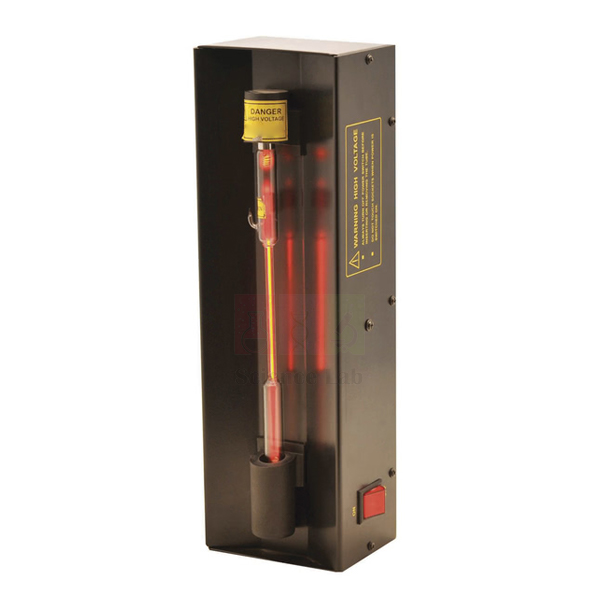
Spectrum Tube Power Supply
Spectrum Tube Power Supply (Product Code: SLE/PHY/301) is a mains-operated unit used to light gas-filled spectrum tubes so that their emission spectra can be studied in school and college physics laboratories. A common item of physics lab equipment in India for atomic-spectra lessons, it takes 26 cm tubes, and its enclosed box holds the tube firmly while stopping students from touching the electrodes. It is supplied by Jain Scientific Equipments Pvt Ltd (ScienceLab), Ambala, India.
Specifications
| Parameter | Detail |
|---|---|
| Suitable tube length | 26 cm |
| Power input | 220 V AC, 50 Hz |
| Tube mounting | Specially designed box holds the tube firmly |
| Student protection | Box prevents students from touching the electrodes |
| Background panel | Black panel behind the tube cuts out distracting ambient light and protects the tube from breakage |
| Product code | SLE/PHY/301 |
| Supplied by | Jain Scientific Equipments Pvt Ltd (ScienceLab), Ambala, India |
What Is the Spectrum Tube Power Supply Used For?
When a high voltage is applied across the low-pressure gas in a spectrum tube, the gas glows with a colour typical of that element. Viewed through a spectroscope or diffraction grating, the glow separates into distinct bright lines rather than a continuous band, which gives students direct evidence that atoms emit light only at particular wavelengths. The black panel behind the tube makes this faint glow stand out even when the room lights are on.
Spectrum tubes run at high voltage, so tubes should be changed only by a teacher or technician with the unit switched off and unplugged, and allowed to cool before handling. Check that your mains supply matches the listed 220 V AC at 50 Hz, and that the tubes you plan to use are 26 cm long.
What to Specify When Ordering
- Your mains supply, so we can confirm it matches the unit's 220 V AC, 50 Hz input.
- The length of any spectrum tubes you already hold (the unit is designed for 26 cm tubes).
- Whether you also need spectrum tubes, and which gases.
- The viewing instrument students will use, such as a spectroscope or spectrometer.
Supplier
Jain Scientific Equipments Private Limited, trading as ScienceLab, supplies the Spectrum Tube Power Supply from Ambala, Haryana, India to schools, colleges, dealers and institutional buyers in India and international markets. The unit is sourced for our physics range, and we confirm its output details and tube compatibility in writing with each quotation. Export shipments are handled under Importer-Exporter Code AAECJ8618A (DGFT), and the supplying company's GSTIN is 06AAECJ8618A1ZT for vendor registration. Read more on our company profile.
Related Physics Lab Equipment
Pair the power supply with these items for a complete emission-spectra practical:
- Spectroscope, Direct Vision — for a quick look at the light from a lit tube.
- Spectrometer — for measuring the positions of individual spectral lines.
- Hydrogen Spectrum Set — a separate set built around a hydrogen discharge tube.
- Spectral Lamp Power Supply with Lamp Holder — a brighter spectral lamp source for optical work.
- Electromagnetic Spectrum Chart — wall reference for visible and invisible radiation.
See more in Physics Lab Equipment.
Frequently Asked Questions
What length of tube does the Spectrum Tube Power Supply take?
The Spectrum Tube Power Supply is designed for 26 cm spectrum tubes. Its specially designed box holds the tube firmly in place, so check the length of any tubes you already own before ordering.
What mains supply does the Spectrum Tube Power Supply need?
The Spectrum Tube Power Supply operates on 220 V AC at 50 Hz. Buyers whose mains supply differs should tell us their voltage and frequency when requesting a quotation, so we can confirm suitability before supply.
Are spectrum tubes included with the Spectrum Tube Power Supply?
The listing for the Spectrum Tube Power Supply does not state that tubes are included. Tell us which gas tubes you need through the contact page, and we will confirm exactly what the quotation covers.
How does the Spectrum Tube Power Supply protect students?
The Spectrum Tube Power Supply holds the tube inside a specially designed box that prevents students from touching the electrodes, and a black panel behind the tube protects it from breakage. A teacher should still change tubes with the unit unplugged.
What is the output voltage of the Spectrum Tube Power Supply?
The output voltage of the Spectrum Tube Power Supply is not listed on this page. Please ask us through the contact page for the current specification sheet, which we confirm with your quotation rather than quoting unverified figures here.
Who supplies the Spectrum Tube Power Supply?
The Spectrum Tube Power Supply is supplied by Jain Scientific Equipments Pvt Ltd (ScienceLab) of Ambala, Haryana, India, to schools, colleges, dealers and institutional buyers in India and international markets. Vendor registration details are provided with the quotation.
Request a Quote
For a quotation on the Spectrum Tube Power Supply, send your quantity, mains supply and delivery location through our contact page, or add the item to the enquiry cart.
Last updated: 24 September 2026
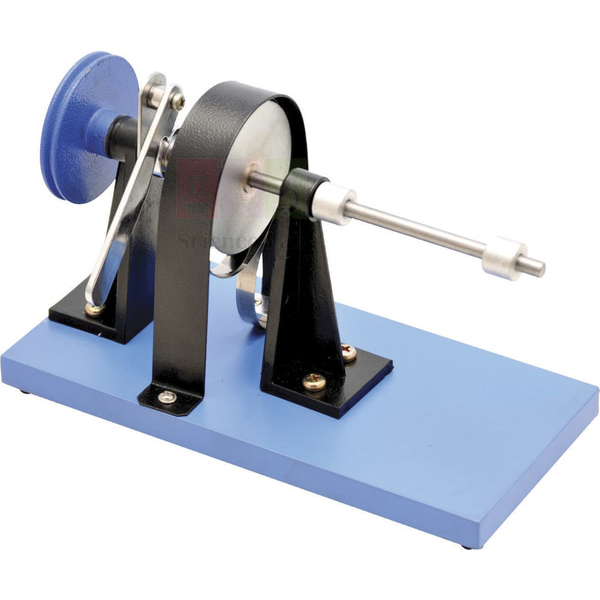
Spring Unit
Spring Unit (Product Code: SLE/PHY/302) is an energy-transfer module used to show how potential energy stored in a wound-up clock spring is converted into electrical energy in school physics lessons. Part of the Energy Transfer Kit, it has a clock spring, free-wheel, winding ratchet and 56 mm aluminium V pulley on a steel shaft, on a 165 x 100 mm base. This physics demonstration kit unit is made by Jain Scientific Equipments Pvt Ltd (ScienceLab), an OEM manufacturer, at its own factory in Ambala, India.
Specifications
| Parameter | Detail |
|---|---|
| Energy conversion shown | Potential energy in a wound-up spring to electrical energy |
| Spring | Clock spring carried on a steel shaft |
| Mechanism | Free-wheel device and winding ratchet |
| Pulley | Aluminium V pulley, 56 mm diameter |
| Base size | 165 x 100 mm (common to all Energy Transfer Kit units) |
| Kit connections | Energy Transfer Kit units have 4 mm socket terminals where appropriate |
| Included | Driving belt |
| Second use | Winding a weight on a cord to show potential-to-kinetic energy changes |
| Product code | SLE/PHY/302 |
| Manufacturer | Jain Scientific Equipments Pvt Ltd (ScienceLab) — OEM |
| Country of origin | India (made in Ambala, Haryana) |
What Is the Spring Unit Used For?
Students wind the clock spring with the ratchet, storing elastic potential energy, and then release it so the free-wheel lets the spring turn the shaft and pulley. With the driving belt linking the pulley to another unit of the Energy Transfer Kit, the stored energy ends up as electrical energy, and the class can trace each step of the chain from spring to belt to output. Because every unit shares the same 165 x 100 mm base, the modules sit neatly in a row on the bench.
The unit also works on its own: attach a cord to the pulley and let the spring wind a small weight upward. The raised weight gains potential energy, which turns into kinetic energy as it falls and can be stored again when it is wound back up. Wind the spring gradually rather than forcing it, and keep the belt at moderate tension so it does not slip or strain the shaft.
What to Specify When Ordering
- How many Spring Units you need per lab group.
- Which other Energy Transfer Kit units you want, since each is available separately.
- Whether you need extra driving belts; ask us about spares.
OEM Manufacturer
Jain Scientific Equipments Private Limited, the company behind the ScienceLab name, is the OEM (original equipment manufacturer) of the Spring Unit. The unit is made and assembled at the company's own licensed factory at Saha, Ambala, Haryana, India, so buyers deal with the maker rather than a trading intermediary. Schools, colleges, dealers and importers in India and international markets can ask the manufacturer directly about repeat orders, belts and other replacement parts. See our company profile for background.
Related Physics Lab Equipment
Other units and accessories that build out the same energy-transfer demonstrations:
- Handwheel Drive Unit — hand-driven input unit from the same Energy Transfer Kit.
- Line Shaft Unit — shaft-and-pulley module from the same kit for transmitting motion.
- Mounted Solar Cell — kit unit showing light energy converted to electrical energy.
- Newton Mass Set 1N Set — small masses for the weight-on-a-cord demonstration.
Explore the wider range in Physics Lab Equipment.
Frequently Asked Questions
What energy change does the Spring Unit demonstrate?
The Spring Unit demonstrates the conversion of potential energy stored in a wound-up clock spring into electrical energy, when its pulley is belted to another Energy Transfer Kit unit. It can also show potential energy changing to kinetic energy and back in a raised weight.
Is the Spring Unit compatible with other Energy Transfer Kit units?
Yes. The Spring Unit is one of the separately available units of the Energy Transfer Kit, and all units in the kit share the same 165 x 100 mm base size. Tell us which other units you plan to combine it with.
What is included with the Spring Unit?
The Spring Unit comes complete with a driving belt. The clock spring, free-wheel device, winding ratchet and 56 mm aluminium V pulley are mounted on its steel shaft; other kit units are ordered separately.
Can the Spring Unit be used without the rest of the kit?
Yes. On its own, the Spring Unit can wind a weight on a cord, so students see the raised weight gain potential energy and then convert it to kinetic energy as it falls. Linking to electrical output needs another kit unit.
Who manufactures the Spring Unit?
The Spring Unit is manufactured by Jain Scientific Equipments Pvt Ltd (ScienceLab), the OEM, at its licensed factory at Saha, Ambala, Haryana, India. Enquiries about belts, replacement parts and repeat orders go directly to the manufacturer.
What does a quotation for the Spring Unit need?
A quotation for the Spring Unit needs the number of units, any other Energy Transfer Kit units you want with it, and the delivery location in India or abroad. Send these through the contact page and we will reply with a manufacturer quotation.
Request a Quote
Request a quotation for the Spring Unit through our contact page, or add it and any companion units to the enquiry cart. Quotes are issued direct by the manufacturer.
Last updated: 24 September 2026
Extension Spring, Steel
Extension Spring, Steel (Product Code: SLE/PHY/303) is a closely wound steel coil spring with looped ends used to study motion, mass and potential energy in school and college physics practicals. Each spring is 225 mm long and 6 mm in diameter, stretches an average of 430 mm under a 200 g load, and is sold in packs of 200 for whole-class use. This mechanics lab equipment item is made by Jain Scientific Equipments Pvt Ltd (ScienceLab), an OEM manufacturer, at its own factory in Ambala, India.
Specifications
| Parameter | Detail |
|---|---|
| Material | Steel |
| Ends | Closely wound, looped |
| Length | 225 mm |
| Diameter | 6 mm |
| Wire | Approx. 19 swg |
| Average extension for 200 g load | 430 mm |
| Maximum deflection | 750 mm |
| Pack size | Pack of 200 |
| Product code | SLE/PHY/303 |
| Manufacturer | Jain Scientific Equipments Pvt Ltd (ScienceLab) — OEM |
| Country of origin | India (made in Ambala, Haryana) |
What Is the Steel Extension Spring Used For?
The most common use is a Hooke's law investigation: hang the spring from a clamp by one looped end, add masses to the other, and record the extension for each load. Plotting load against extension gives a straight line while the spring behaves elastically, and its gradient gives the spring constant. With an average stretch of 430 mm for 200 g, the extensions are large enough to read easily with a metre rule.
The same spring supports oscillation work. Pull a hanging mass down slightly, release it, and time several complete oscillations with a stop clock to study simple harmonic motion and how the period depends on mass. It also shows that a stretched spring stores elastic potential energy. Keep loads well within the 750 mm maximum deflection so the coils return to their original length after each run.
What to Specify When Ordering
- Number of packs required (the spring is listed as a pack of 200).
- The loads you plan to use, so they suit the 430 mm average extension at 200 g and the 750 mm maximum deflection.
- Any masses, hangers, clamp stands or timers you want quoted together.
OEM Manufacturer
ScienceLab is the trading name of Jain Scientific Equipments Private Limited, the OEM (original equipment manufacturer) of the Extension Spring, Steel. Production takes place at the company's own licensed factory at Saha, Ambala, Haryana, India, and packs go factory-direct to schools, colleges, institutions, dealers and importers in India and international markets. Because the maker handles your enquiry, repeat orders for further packs are quoted without a middleman. Learn more on our company profile.
Related Physics Lab Equipment
Items used alongside the spring in elasticity and oscillation practicals:
- Hooke’s Law Apparatus — a complete set-up for measuring load against extension.
- Newton Mass Set 1N Set — masses for loading the spring in steps.
- Retort Stand — a support to hang the spring from.
- Stop Clock (Metal Case) — for timing oscillations of a mass on the spring.
- Metal Slinky, Helical Spring — for wave demonstrations with a longer coil.
Find more in Physics Lab Equipment.
Frequently Asked Questions
How much does the Extension Spring, Steel stretch?
The Extension Spring, Steel has an average extension of 430 mm for a 200 g load and a maximum deflection of 750 mm. These large extensions make readings easy for students in Hooke's law and oscillation experiments.
How many springs are in a pack of the Extension Spring, Steel?
The Extension Spring, Steel is listed as a pack of 200, which suits schools equipping several classes or lab groups at once. Confirm the number of packs you need when you request a quotation.
What are the dimensions of the Extension Spring, Steel?
Each Extension Spring, Steel is 225 mm long and 6 mm in diameter, wound from steel wire of approximately 19 swg. The coils are closely wound and both ends are formed into loops for hanging.
Can the Extension Spring, Steel be used for simple harmonic motion?
Yes. A mass hung from the Extension Spring, Steel can be displaced and released so students time its oscillations and study simple harmonic motion. Keep the total stretch well within the 750 mm maximum deflection.
Who manufactures the Extension Spring, Steel?
The Extension Spring, Steel is manufactured by Jain Scientific Equipments Pvt Ltd (ScienceLab), which is the OEM, at its own licensed factory at Saha, Ambala, Haryana, India. Repeat orders and quotations are handled directly by the manufacturer.
Can the Extension Spring, Steel be supplied for export?
Yes. The Extension Spring, Steel is supplied to buyers in India and international markets. Send the number of packs and the delivery destination through our contact page and we will prepare a quotation.
Request a Quote
To order the Extension Spring, Steel, send the number of packs and your delivery location via our contact page, or place it in the enquiry cart. The quotation is prepared directly by the manufacturer.
Last updated: 24 September 2026
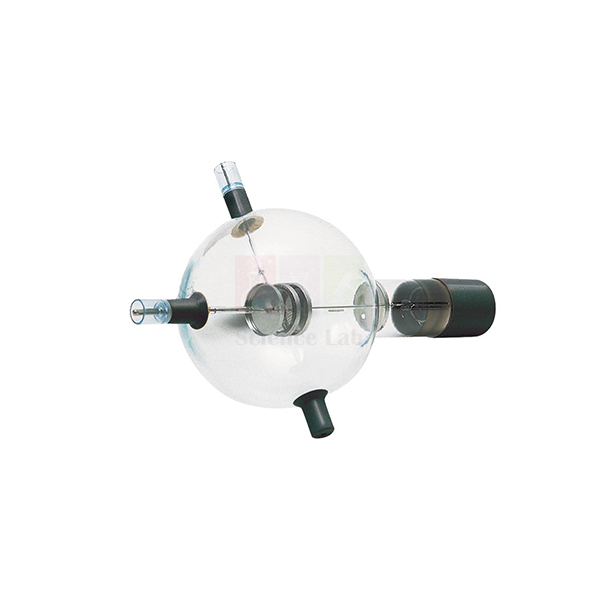
Teltron Diode D
Teltron Diode D (Product Code: SLE/PHY/304) is a thermionic diode tube from the Teltron D range used to demonstrate thermionic emission and the one-way flow of electrons in college and senior school physics laboratories. The D range is the original Teltron series, with the electrical connections fixed on the tube itself, and a diode of this kind is the classic vacuum tube characteristics experiment. It is supplied by Jain Scientific Equipments Pvt Ltd (ScienceLab), Ambala, India.
Key Details
| Parameter | Detail |
|---|---|
| Product type | Thermionic diode demonstration tube |
| Range | Teltron D range (connections fixed on the tube) |
| Brand | Teltron (third-party brand) |
| Operating data | Heater and anode ratings confirmed on the specification sheet sent with your quotation |
| Product code | SLE/PHY/304 |
| Supplied by | Jain Scientific Equipments Pvt Ltd (ScienceLab), Ambala, India |
What Is the Teltron Diode D Used For?
Inside a thermionic diode, a heated cathode releases electrons into the vacuum. They reach the anode only when it is positive with respect to the cathode, so current flows in one direction and not the other. This is the principle behind early valve rectifiers, and it lets students see the link between thermionic emission and rectification in a single piece of apparatus.
In a typical practical, the class varies the anode voltage in steps, records the anode current, and plots the characteristic curve to see how the current rises and then levels off. The tube is fragile evacuated glass, so a teacher or technician should mount it, make the connections to its fixed D-range terminals and switch the supplies on and off.
Supplier
Teltron is a third-party brand. Jain Scientific Equipments Private Limited, which trades as ScienceLab, supplies the Teltron Diode D from Ambala, Haryana, India, sourcing it for colleges, universities and schools that teach thermionic emission. We confirm the current specification and the holder and supplies the tube needs as part of every quotation. More about the company is on our company profile.
Related Physics Lab Equipment
Items that complete a thermionic diode practical or offer an alternative:
- Teltron Diode S — the S-range diode, whose connections sit on the stand.
- Teltron Tube Holder D — mounting for Teltron D-range tubes.
- EHT Power Supply — high-voltage supply listed for use with Teltron tubes.
- Digital Voltmeter/Ammeter With Shunts — for reading voltage and current during the characteristic-curve experiment.
- Semiconductor Diode — the solid-state counterpart for comparison lessons.
Browse all items in Physics Lab Equipment.
Frequently Asked Questions
What does the Teltron Diode D demonstrate?
The Teltron Diode D demonstrates thermionic emission from a heated cathode and the one-way conduction of electrons to a positive anode. Students use it to plot the current-voltage characteristic of a vacuum diode and to understand how valve rectification works.
How does the Teltron Diode D differ from the Teltron Diode S?
The Teltron Diode D belongs to the original Teltron D range, where the connections are fixed on the tube. The Diode S belongs to the newer S range, where the connections are on the stand, so each needs its own matching holder.
What are the technical specifications of the Teltron Diode D?
Please ask us for the current specification sheet of the Teltron Diode D, including heater and anode ratings. We confirm these figures with your quotation instead of printing unverified values on this page, so you can check them against your power supplies.
What other equipment does the Teltron Diode D need?
The Teltron Diode D is normally mounted in a Teltron D-range holder and connected to suitable heater and anode supplies, with meters to read voltage and current. Tell us what your lab already owns and we will confirm the complete set-up.
Is the Teltron Diode D made by ScienceLab?
No. Teltron is a third-party brand, and the Teltron Diode D is supplied, not manufactured, by Jain Scientific Equipments Pvt Ltd (ScienceLab) of Ambala, India. We source it for institutions and confirm its specification with each quotation.
Can students operate the Teltron Diode D themselves?
Students can take readings from the Teltron Diode D, but a teacher or technician should set it up, make the connections and switch the supplies. The tube is evacuated glass and is operated from high-voltage equipment, so careful handling is essential.
Request a Quote
For a quotation on the Teltron Diode D, tell us the quantity and which holders, supplies and meters you already have through our contact page, or add it to the enquiry cart.
Last updated: 24 September 2026
648.jpg)
Stop Clock (Metal Case)
Stop Clock (Metal Case) (Product Code: SLE/PHY/305) is a general-purpose mechanical stop clock used to time experiments, demonstrations and practical tests in school and college laboratories. Its 100 mm dial can be read from across a bench, and large start and reset triggers make it simple to operate, all housed in a black powder-coated metal case. A practical piece of physics lab equipment for schools in India, it is supplied by Jain Scientific Equipments Pvt Ltd (ScienceLab), Ambala, India.
Key Details
| Parameter | Detail |
|---|---|
| Type | Mechanical stop clock, general purpose |
| Dial | 100 mm |
| Controls | Large start and reset triggers |
| Housing | Black powder-coated metal case |
| Packing | Sturdy case with protective foam insert |
| Product code | SLE/PHY/305 |
| Supplied by | Jain Scientific Equipments Pvt Ltd (ScienceLab), Ambala, India |
What Is the Metal-Case Stop Clock Used For?
A bench stop clock is the everyday timer of the science lab. Physics classes use it to time pendulum swings and the oscillations of a mass on a spring, chemistry groups time rates of reaction, and biology practicals time activities such as pulse counts. Because the large dial is visible to a whole group, one clock can serve a demonstration while students record the readings.
For better results, time a number of complete oscillations rather than one and divide, which reduces the effect of human reaction time. Reset the clock before each run, stand it where it will not be knocked, and return it to its foam-lined case after the lesson to protect the mechanism.
Supplier
Jain Scientific Equipments Private Limited, trading as ScienceLab, supplies the Stop Clock (Metal Case) from Ambala, Haryana, India to schools, colleges, laboratories and dealers in India and international markets. We source it as part of our laboratory timing range and can quote it together with the apparatus you are timing. For vendor registration, the supplying company's GSTIN is 06AAECJ8618A1ZT and its Legal Entity Identifier is 3358004HRD1JIVXKYX49. Read more on our company profile.
Related Physics Lab Equipment
Other timers and the apparatus they are most often used with:
- Stop Clock — another stop clock option in our physics range.
- Digital Stopclock — an electronic alternative with a digital readout.
- Stopwatch, Digital — a handheld timer for individual students.
- Mathematical Pendulum Demonstration Apparatus — a classic experiment timed with a stop clock.
- Extension Spring, Steel — for timing the oscillations of a mass on a spring.
See the complete range in Physics Lab Equipment.
Frequently Asked Questions
How large is the dial of the Stop Clock (Metal Case)?
The Stop Clock (Metal Case) has a 100 mm dial, large enough to read from across a laboratory bench. This makes it suitable for class demonstrations as well as group practicals where several students need to see the time.
How is the Stop Clock (Metal Case) started and reset?
The Stop Clock (Metal Case) has large start and reset triggers, so it is quick to operate even when a student is also watching an experiment. Reset it before each run to begin timing from zero.
What is the case of the Stop Clock (Metal Case) made from?
The Stop Clock (Metal Case) is housed in a black powder-coated metal case. It is packed in a sturdy case with a protective foam insert, which is also a good place to store it between lessons.
What are the dial graduations of the Stop Clock (Metal Case)?
The dial graduations and maximum timing range of the Stop Clock (Metal Case) are not listed on this page. Please ask us through the contact page and we will confirm them with your quotation before you order.
Should I choose a mechanical or a digital stop clock?
The Stop Clock (Metal Case) is a mechanical clock with a large 100 mm dial that suits whole-class viewing. If you prefer an electronic readout, our Digital Stopclock is an alternative; tell us how you will use it and we can advise.
Who supplies the Stop Clock (Metal Case)?
The Stop Clock (Metal Case) is supplied by Jain Scientific Equipments Pvt Ltd (ScienceLab) of Ambala, Haryana, India, to schools, colleges and dealers in India and international markets. Bulk quantities for several labs can be quoted together.
Request a Quote
To request a quotation for the Stop Clock (Metal Case), send your quantity and delivery location through our contact page, or add it to the enquiry cart.
Last updated: 24 September 2026
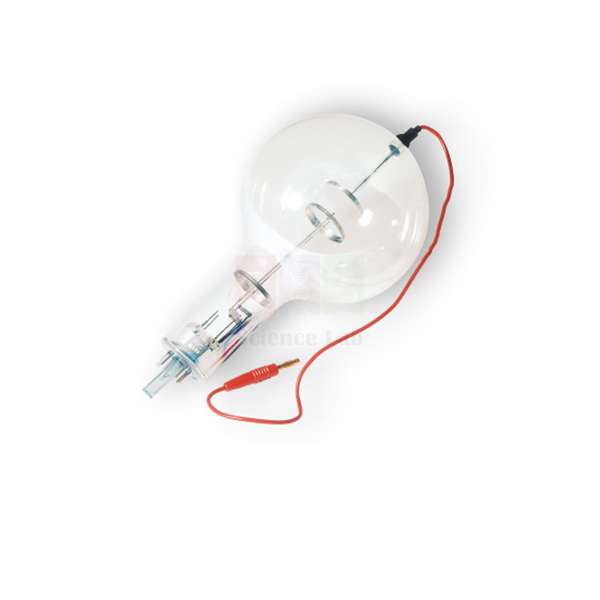
Teltron Diode S
Teltron Diode S (Product Code: SLE/PHY/306) is a high-vacuum electron tube with a thermionic cathode used to demonstrate the Edison effect and diode rectification in advanced school and college physics laboratories. Part of the newer Teltron S range, whose connections sit on the stand rather than on the tube, it gives an anode current of approximately 2 mA at 200 V and accepts up to 500 V on the anode. This physics lab equipment item is supplied by Jain Scientific Equipments Pvt Ltd (ScienceLab), Ambala, India.
Specifications
| Parameter | Detail |
|---|---|
| Tube type | High-vacuum electron tube with thermionic cathode |
| Range | Teltron S range (connections on the stand) |
| Brand | Teltron (third-party brand) |
| Anode current | Approx. 2 mA at 200 V anode voltage |
| Max. heater voltage | 7.5 V AC/DC |
| Max. anode voltage | 500 V |
| Documentation | Instructions included |
| Listed for use with | EHT power supply, digital meter with two shunts, shrouded test leads (red and black) |
| Product code | SLE/PHY/306 |
| Supplied by | Jain Scientific Equipments Pvt Ltd (ScienceLab), Ambala, India |
What Is the Teltron Diode S Used For?
The Edison effect was first noticed as a small current reaching an extra electrode inside a lamp bulb, and it is now understood as electrons boiling off a hot filament. With the Teltron Diode S, students heat the cathode, make the anode positive and watch the emission current appear, then reverse the anode and see it stop. The same tube lets them measure how the emission current changes as the applied voltage is raised, giving the familiar diode characteristic.
Applying an alternating voltage to the anode shows rectification: current flows only during the half-cycles when the anode is positive. Keep the heater at or below 7.5 V and the anode at or below 500 V, use shrouded leads for every high-voltage connection, and follow the instructions supplied with the tube.
What to Specify When Ordering
- Whether you already have a Teltron S-range stand, since the connections for this tube are on the stand.
- Whether you need the EHT power supply and the digital meter with two shunts listed for use with Teltron tubes.
- How many sets of red and black shrouded test leads are required.
- The number of tubes per laboratory.
Supplier
The Teltron Diode S carries a third-party brand, and Jain Scientific Equipments Private Limited, known by its trading name ScienceLab, supplies it from Ambala, Haryana, India. As a physics instruments supplier in India, we source it for colleges, universities and senior schools in India and international markets, and can quote the tube together with its stand, supply and meters. See our company profile for more about us.
Related Physics Lab Equipment
Equipment that works alongside the Teltron Diode S:
- Teltron Tube Holder S — the stand for S-range tubes, where the connections are made.
- EHT Power Supply — listed as other equipment for Teltron tubes.
- Digital Voltmeter/Ammeter With Shunts — for reading emission current and voltage.
- Teltron Diode D — the D-range diode with connections fixed on the tube.
- Teltron Thomson Tube S — the next S-range experiment, measuring e/m of the electron.
More items are listed in Physics Lab Equipment.
Frequently Asked Questions
What experiments can be done with the Teltron Diode S?
The Teltron Diode S is used to demonstrate the Edison effect (thermionic emission), to investigate diode characteristics through rectification, and to measure how emission current depends on the applied voltage. Instructions for these experiments are included with the tube.
What are the voltage limits of the Teltron Diode S?
The Teltron Diode S has a maximum heater voltage of 7.5 V AC/DC and a maximum anode voltage of 500 V. Keeping within these limits protects the cathode and the tube, so check your supplies before connecting them.
What anode current does the Teltron Diode S give?
The Teltron Diode S gives an anode current of approximately 2 mA at an anode voltage of 200 V. A milliammeter or a digital meter with a suitable shunt is needed to read this current during the experiment.
What equipment is needed with the Teltron Diode S?
The Teltron Diode S is listed for use with an EHT power supply, a digital meter with two shunts, and red and black shrouded test leads. Because S-range connections are on the stand, a Teltron S-range holder is also needed.
Is the Teltron Diode S a ScienceLab product?
No. The Teltron Diode S carries the Teltron brand, a third-party name, and is supplied by Jain Scientific Equipments Pvt Ltd (ScienceLab), Ambala, India. We source it for institutions and can quote it with its accessories.
Is a calibration certificate available for the Teltron Diode S?
A calibration certificate is not listed for the Teltron Diode S. If your institution needs any test documentation, please raise it through our contact page before ordering so we can tell you what can be provided with the tube.
Request a Quote
Send the number of tubes and the stands, supplies and leads you need through our contact page, or add the Teltron Diode S to the enquiry cart for a quotation.
Last updated: 24 September 2026
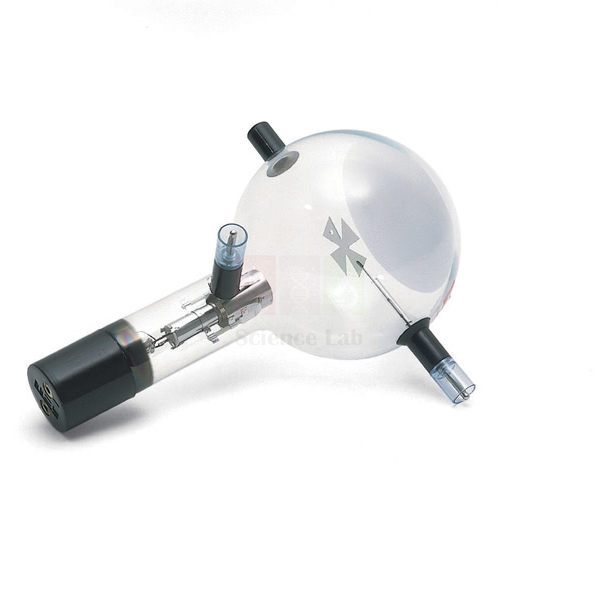
Teltron Maltese Cross Tube D
Teltron Maltese Cross Tube D (Product Code: SLE/PHY/307) is a high-vacuum electron tube used to show that electrons travel in straight lines, by casting the shadow of a Maltese cross onto a fluorescent screen, in college and senior school physics laboratories. Its divergent electron gun runs at up to 5 kV on the anode, and a magnetic field from Helmholtz coils lets students study electron optics such as beam focusing. A clear physics demonstration for cathode-ray lessons, it is supplied by Jain Scientific Equipments Pvt Ltd (ScienceLab), Ambala, India.
Specifications
| Parameter | Detail |
|---|---|
| Tube type | High-vacuum electron tube with divergent electron gun |
| Screen | Fluorescent, partially obscured by a Maltese cross |
| Range | Teltron D range (connections fixed on the tube) |
| Brand | Teltron (third-party brand) |
| Anode current | Approx. 0.1 mA at 4 kV |
| Max. filament voltage | 6.3 V AC |
| Max. anode voltage | 5 kV |
| Documentation | Instructions included |
| Listed for use with | EHT power supply; Helmholtz coils for magnetic-field experiments |
| Product code | SLE/PHY/307 |
| Supplied by | Jain Scientific Equipments Pvt Ltd (ScienceLab), Ambala, India |
What Is the Maltese Cross Tube Used For?
With no electric or magnetic field applied, electrons from the divergent gun travel straight to the fluorescent screen, and the Maltese cross in their path leaves a sharp, cross-shaped shadow. That shadow is the evidence: just as light casts a shadow of an object, the electron stream travels in straight lines. It is one of the first observations students make when they meet cathode rays.
Next, bring in a magnetic field using Helmholtz coils. The shadow shifts and changes, showing that the beam is made of charged particles that respond to a field, and adjusting the field lets the class explore electron optics such as focusing the beam. Darken the room for the clearest image, keep the filament at or below 6.3 V AC and the anode at or below 5 kV, and let a teacher handle all high-voltage connections.
What to Specify When Ordering
- Whether you need the EHT power supply listed for this tube.
- Whether you already own a Teltron D-range holder and Helmholtz coils for the magnetic-field experiments.
- The number of tubes for your laboratory.
Supplier
Jain Scientific Equipments Private Limited, whose trading name is ScienceLab, supplies the Teltron Maltese Cross Tube D from Ambala, Haryana, India. Teltron is a third-party brand; we source the tube for physics departments in India and international markets and can combine it in one quotation with the supply and coils it works with. Visit our company profile for more about the company.
Related Physics Lab Equipment
Items for the same series of electron-beam demonstrations:
- EHT Power Supply — the high-voltage supply listed for use with this tube.
- Teltron Helmholtz Pair of Coils D — magnetic field source for D-range tubes.
- Teltron Tube Holder D — mounting for Teltron D-range tubes.
- Teltron Electron Deflection Tube D — follows on by bending the beam with electric and magnetic fields.
- Teltron Electron Diffraction Tube D — contrasts straight-line travel with the wave behaviour of electrons.
Find the full list in Physics Lab Equipment.
Frequently Asked Questions
What does the Teltron Maltese Cross Tube D demonstrate?
The Teltron Maltese Cross Tube D demonstrates that electrons travel in straight lines when no field is applied, by projecting the shadow of a Maltese cross onto a fluorescent screen. With Helmholtz coils it also shows electron-optics effects such as beam focusing.
What are the operating voltages of the Teltron Maltese Cross Tube D?
The Teltron Maltese Cross Tube D has a maximum filament voltage of 6.3 V AC and a maximum anode voltage of 5 kV, with an anode current of approximately 0.1 mA at 4 kV. Use a supply that stays within these limits.
Which power supply does the Teltron Maltese Cross Tube D need?
An EHT power supply is listed as the other equipment for use with the Teltron Maltese Cross Tube D. Tell us which supply your lab already owns and we will confirm whether it suits the tube before you order.
Can the Teltron Maltese Cross Tube D show magnetic effects?
Yes. Applying a magnetic field with Helmholtz coils to the Teltron Maltese Cross Tube D moves and reshapes the shadow, so students can study how a field acts on the electron beam and explore beam focusing.
Are instructions supplied with the Teltron Maltese Cross Tube D?
Yes, instructions are included with the Teltron Maltese Cross Tube D. They help the teacher set up the tube, connect the supplies safely and run the shadow and magnetic-field demonstrations with a class.
Who supplies the Teltron Maltese Cross Tube D?
The Teltron Maltese Cross Tube D is supplied by Jain Scientific Equipments Pvt Ltd (ScienceLab) of Ambala, India. Teltron is a third-party brand; ScienceLab does not manufacture the tube but sources it for institutions in India and international markets.
Request a Quote
For a quotation on the Teltron Maltese Cross Tube D and any accessories, contact us through our contact page or add it to the enquiry cart.
Last updated: 24 September 2026
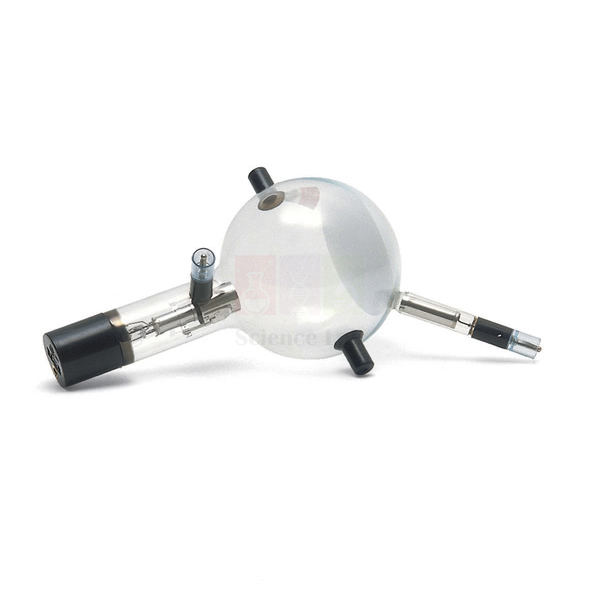
Teltron Perrin Tube D
Teltron Perrin Tube D (Product Code: SLE/PHY/308) is an evacuated electron tube from the Teltron D range used to reproduce Jean Perrin's cathode-ray experiment, which shows that the electron beam carries negative charge, in university and senior school physics teaching. As a D-range tube it has its electrical connections fixed on the tube itself, and it fits into a sequence of D-range tubes that takes students from cathode rays to the properties of the electron. It is supplied by Jain Scientific Equipments Pvt Ltd (ScienceLab), Ambala, India.
Key Details
| Parameter | Detail |
|---|---|
| Product type | Evacuated electron tube for Perrin's experiment |
| Range | Teltron D range, with connections fixed on the tube |
| Brand | Teltron (third-party brand) |
| Specification sheet | Sent on request with your quotation |
| Product code | SLE/PHY/308 |
| Supplied by | Jain Scientific Equipments Pvt Ltd (ScienceLab), Ambala, India |
What Is the Teltron Perrin Tube D Used For?
Before the electron was identified, physicists argued over whether cathode rays were charged particles or a kind of wave. Perrin settled part of the question by catching the rays in an insulated collector and showing that it gained negative charge. In the classic teaching arrangement, a magnetic field steers the beam into the collector, a connected electroscope or electrometer responds, and when the beam is steered away the charging stops, tying the charge to the beam itself.
Among physics lab instruments in India, a tube like this is normally used as a teacher-led demonstration. It needs a suitable high-voltage supply, a D-range holder, a magnetic field source and a charge indicator, and the glass envelope must be handled with care. Confirm the operating voltages and accessory needs with us before ordering, as we send the specification with each quotation.
What to Specify When Ordering
- Whether you already have a Teltron D-range holder and Helmholtz coils.
- The high-voltage supply your laboratory uses, so we can check it suits the tube.
- Which charge indicator you will connect, such as an electroscope.
- The number of tubes required.
Supplier
Jain Scientific Equipments Private Limited, which operates under the ScienceLab name, supplies the Teltron Perrin Tube D from Ambala, Haryana, India to physics departments in India and international markets. Teltron is a third-party brand and the tube is sourced, not made, by us; we check the specification and the D-range accessories it needs before we quote. Our company profile has more about the company.
Related Physics Lab Equipment
Accessories and companion tubes for a Perrin demonstration:
- Teltron Perrin Tube S — the S-range version, with connections on the stand.
- Teltron Tube Holder D — holds D-range tubes during the demonstration.
- Teltron Helmholtz Pair of Coils D — a magnetic field source to steer the beam.
- EHT Power Supply — high-voltage supply for Teltron electron tubes.
- Electroscope in Flask, Gold Leaf — a charge indicator of the kind used in Perrin's experiment.
Browse further in Physics Lab Equipment.
Frequently Asked Questions
Which experiment is the Teltron Perrin Tube D designed for?
The Teltron Perrin Tube D is designed for Perrin's experiment, in which the electron beam is collected and shown to carry negative charge. It gives students experimental evidence that cathode rays are streams of negatively charged particles.
What does the D in Teltron Perrin Tube D mean?
The D identifies the original Teltron D range, in which the electrical connections are fixed on the tube itself. The Teltron Perrin Tube D therefore uses a D-range holder, whereas the S-range version makes its connections on the stand.
Where can I find the specifications of the Teltron Perrin Tube D?
Ask us through the contact page for the current specification sheet of the Teltron Perrin Tube D, including its voltages. We confirm the figures in writing with the quotation rather than publishing unverified values on this page.
What accessories does the Teltron Perrin Tube D need?
The Teltron Perrin Tube D generally needs a D-range holder, a high-voltage supply, a magnetic field source such as Helmholtz coils, and a charge indicator such as an electroscope. List what you already own and we will confirm the rest.
Does ScienceLab manufacture the Teltron Perrin Tube D?
No. The Teltron Perrin Tube D carries the Teltron brand, which belongs to a third party. Jain Scientific Equipments Pvt Ltd (ScienceLab) of Ambala, India supplies it to colleges, universities and schools that teach the discovery of the electron.
Can the Teltron Perrin Tube D be ordered for export?
Yes. The Teltron Perrin Tube D can be quoted for institutions in India and international markets. Send the quantity, accessories and delivery destination through our contact page and we will reply with a quotation.
Request a Quote
Ask for a quotation on the Teltron Perrin Tube D through our contact page, or add it to the enquiry cart along with any holder, coils or supply you need.
Last updated: 24 September 2026
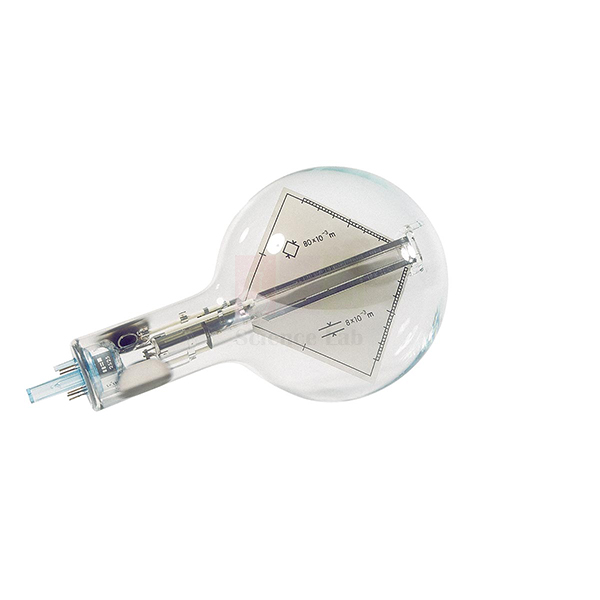
Teltron Thomson Tube S
Teltron Thomson Tube S (Product Code: SLE/PHY/309) is a high-vacuum electron tube used to determine the charge-to-mass ratio (e/m) of the electron by balancing electric and magnetic deflection, in the manner of J.J. Thomson, in college and university physics laboratories. It has a high-accuracy electron gun, a ruled phosphorescent target screen and a built-in plate capacitor rated to 500 V, making it a standard specific charge of the electron experiment. It is supplied by Jain Scientific Equipments Pvt Ltd (ScienceLab), Ambala, India.
Specifications
| Parameter | Detail |
|---|---|
| Tube type | High-vacuum electron tube |
| Electron gun | High-accuracy electron gun |
| Screen | Ruled phosphorescent target screen |
| Beam deflection | Electric field of the built-in plate capacitor; magnetic field of external Helmholtz Coils S |
| Range | Teltron S range (connections on the stand) |
| Brand | Teltron (third-party brand) |
| Max. filament voltage | 6.3 V AC |
| Max. anode voltage | 5 kV |
| Anode current | Approx. 0.1 mA at 4 kV (anode) |
| Max. capacitor voltage | 500 V |
| Listed for use with | EHT power supply, digital meter with two shunts, shrouded test leads (red and black) |
| Product code | SLE/PHY/309 |
| Supplied by | Jain Scientific Equipments Pvt Ltd (ScienceLab), Ambala, India |
What Is the Thomson Tube Used For?
The tube recreates the reasoning of Thomson's classic measurement. First, students bend the beam with the magnetic field of the external Helmholtz coils and read its path against the ruled screen. Then they apply a voltage to the built-in plate capacitor and adjust it until the electric deflection exactly cancels the magnetic one, so the beam runs straight again.
At that balance point the ratio of the two fields gives the mean electron velocity, and combining this with the curvature from the magnetic-only run yields e/m. The same set-up can be used to explore electron optics. Keep within the 6.3 V AC filament, 5 kV anode and 500 V capacitor limits, and make every high-voltage connection with shrouded leads.
What to Specify When Ordering
- Whether you already own Teltron Helmholtz Coils S and an S-range stand.
- Whether the EHT power supply and the digital meter with two shunts should be included.
- How many sets of red and black shrouded test leads you need.
- The number of tubes, for example one per demonstration bench.
Supplier
Jain Scientific Equipments Private Limited, trading as ScienceLab, supplies the Teltron Thomson Tube S from Ambala, Haryana, India to universities, colleges and senior schools in India and international markets. Teltron is a third-party brand; we source this tube and can quote it together with the coils, stand and supplies it works with. For vendor registration, the supplying company is Jain Scientific Equipments Private Limited (CIN U29309HR2020PTC087597, GSTIN 06AAECJ8618A1ZT). Read more on our company profile.
Related Physics Lab Equipment
Equipment needed for the e/m experiment with this tube:
- Teltron Helmholtz Pair of Coils S — the external coils that provide the magnetic deflection.
- Teltron Tube Holder S — the S-range stand that carries the connections.
- EHT Power Supply — high-voltage supply for the anode.
- Digital Voltmeter/Ammeter With Shunts — for measuring coil current and voltages.
- Teltron Dual Beam Tube S — another S-range tube for electron-beam experiments.
View the range in Physics Lab Equipment.
Frequently Asked Questions
What can be measured with the Teltron Thomson Tube S?
The Teltron Thomson Tube S is used to determine the charge-to-mass ratio (e/m) of the electron, to study mean electron velocities by field cancellation, and to explore electron optics. The ruled phosphorescent screen lets students read the beam path directly.
What are the voltage limits of the Teltron Thomson Tube S?
The Teltron Thomson Tube S has a maximum filament voltage of 6.3 V AC, a maximum anode voltage of 5 kV and a maximum capacitor voltage of 500 V. Its anode current is approximately 0.1 mA at 4 kV.
Which coils are used with the Teltron Thomson Tube S?
The Teltron Thomson Tube S is deflected magnetically by external Helmholtz Coils S, and electrically by its built-in plate capacitor. The coils are a separate item, so tell us if you need them included in the quotation.
What other equipment does the Teltron Thomson Tube S need?
The Teltron Thomson Tube S is listed for use with an EHT power supply, a digital meter with two shunts, and red and black shrouded test leads. As an S-range tube, it also needs the S-range stand, where the connections are made.
Who supplies the Teltron Thomson Tube S?
The Teltron Thomson Tube S is supplied by Jain Scientific Equipments Pvt Ltd (ScienceLab) of Ambala, India. Teltron is a third-party brand, so ScienceLab does not manufacture the tube; vendor registration details are given on this page and with the quotation.
Is a calibration certificate available for the Teltron Thomson Tube S?
No calibration certificate is listed for the Teltron Thomson Tube S. If your department requires test or calibration paperwork, please discuss it with us through the contact page before ordering, and we will explain what documentation can accompany the tube.
Request a Quote
To receive a quotation for the Teltron Thomson Tube S, send the quantity and required accessories via our contact page, or add it to the enquiry cart.
Last updated: 24 September 2026
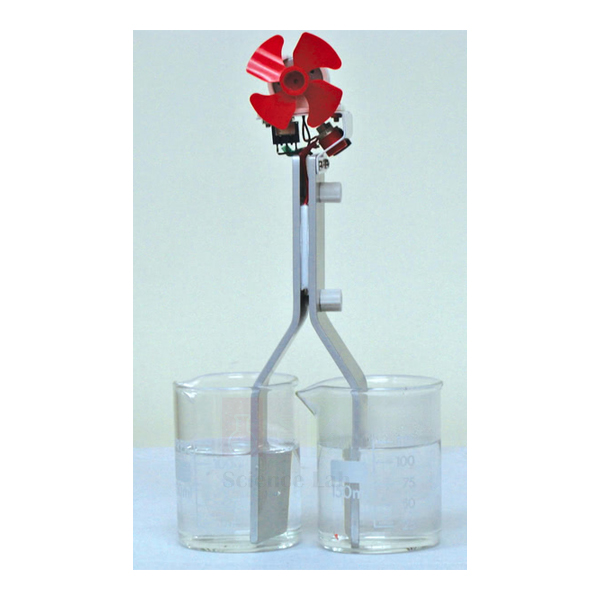
Thermoelectric Converter
Thermoelectric Converter (Product Code: SLE/PHY/310) is a demonstration device used to show that a temperature difference across semiconductor junctions generates electricity, and that electricity can create a temperature difference, in school and college physics lessons. Its semiconducting junction plates sit between two aluminium heat-conducting plates, and a switch connects them either to a small motor fan or to a pair of 4 mm sockets. For heat energy science lessons, it is supplied by Jain Scientific Equipments Pvt Ltd (ScienceLab), Ambala, India.
Key Details
| Parameter | Detail |
|---|---|
| Junctions | Series of semiconducting junction plates |
| Heat-conducting plates | 2 aluminium plates, one on each side of the junctions |
| Visual indicator | Small motor fan driven by the generated current |
| Selector switch | Connects the junction plates to the motor fan or to a pair of 4 mm sockets |
| Reverse (heat-pump) mode | 5 V DC applied at the 4 mm sockets creates a temperature difference, conducted by the aluminium plates |
| Product code | SLE/PHY/310 |
| Supplied by | Jain Scientific Equipments Pvt Ltd (ScienceLab), Ambala, India |
What Is the Thermoelectric Converter Used For?
In generator mode, set the switch to the fan and create a temperature difference between the two aluminium plates, for example by standing one side on a container of warm water and keeping the other cool. Current generated at the semiconductor junctions spins the little fan, a direct and visible example of the Seebeck effect turning heat energy into electrical and then kinetic energy. A larger temperature difference usually gives a livelier fan, which makes a good prompt for discussion.
Switch to the 4 mm sockets and drive them with 5 V DC to reverse the process: the junctions now pump heat, so one plate becomes warmer and the other cooler, which is the Peltier effect used in small electronic coolers. Use only moderate temperatures unless we have confirmed the limits for your unit, and let the plates return to room temperature before touching them.
Supplier
Jain Scientific Equipments Private Limited, which trades as ScienceLab, supplies the Thermoelectric Converter from Ambala, Haryana, India to schools, colleges and dealers in India and international markets. The device is sourced for our heat and energy teaching range, and we confirm its operating details with each quotation. See our company profile for more about the company.
Related Physics Lab Equipment
Items that extend thermoelectric and energy-conversion lessons:
- Thermoelectric Effects Apparatus — a further set-up for studying thermoelectric effects.
- Power Supply Variable — a continuously variable AC or DC source for the heat-pump mode.
- Stackable Leads — 4 mm leads to connect a supply to the sockets.
- Mounted Solar Cell — a contrasting conversion of light energy into electrical energy.
More options are in Physics Lab Equipment.
Frequently Asked Questions
What does the Thermoelectric Converter demonstrate?
The Thermoelectric Converter demonstrates that a temperature difference across semiconducting junction plates produces an electric current, shown by a small motor fan. In reverse, applying 5 V DC to its 4 mm sockets creates a temperature difference across the aluminium plates.
Does the Thermoelectric Converter need a power supply?
The Thermoelectric Converter needs no power supply to run the fan; a temperature difference between the two plates is enough. A 5 V DC supply is needed only when you select the 4 mm sockets to show a temperature difference being created.
What is the switch on the Thermoelectric Converter for?
The switch on the Thermoelectric Converter connects the semiconducting junction plates either to the motor fan, for generating electricity from heat, or to the pair of 4 mm sockets, for driving the junctions with 5 V DC.
What heat sources are safe with the Thermoelectric Converter?
The temperature limits of the Thermoelectric Converter are not listed on this page, so use moderate sources such as warm water and a cool surface. Ask us through the contact page before using hotter sources, and we will confirm what the unit can take.
Who supplies the Thermoelectric Converter?
The Thermoelectric Converter is supplied by Jain Scientific Equipments Pvt Ltd (ScienceLab) of Ambala, Haryana, India, to schools, colleges and dealers in India and international markets. Quotations can include the leads and power supply you need.
Request a Quote
For a quotation on the Thermoelectric Converter, send your quantity and delivery details through our contact page, or add it to the enquiry cart.
Last updated: 24 September 2026
Ticker Tape Carbon Disc
Ticker Tape Carbon Disc (Product Code: SLE/PHY/311) is a replacement carbon disc used in ticker tape timers to transfer a dot onto the paper tape each time the striker hits, in school motion practicals. Each disc measures 50 mm in diameter with a 4 mm hole, and the discs come in boxes of 100 for classes that run regular force and motion experiments. It is supplied by Jain Scientific Equipments Pvt Ltd (ScienceLab), Ambala, India.
Specifications
| Parameter | Detail |
|---|---|
| Diameter | 50 mm |
| Hole | 4 mm |
| For use with | Ticker tape timers |
| Pack | Box of 100 |
| Product code | SLE/PHY/311 |
| Supplied by | Jain Scientific Equipments Pvt Ltd (ScienceLab), Ambala, India |
What Is the Ticker Tape Carbon Disc Used For?
In a ticker tape timer, the striker taps down at a steady rate, and the carbon disc between the striker and the paper tape turns each tap into a small dark dot. As a trolley or falling mass pulls the tape through, the pattern of dots becomes a record of its motion, so a clean, fresh disc is what keeps the dots sharp enough to measure.
When dots start to look faint or patchy, turn the disc slightly so the striker meets an unused area, and replace it once the whole face is worn. Store spare discs flat and dry in their box, and keep a box beside each set of timers so practicals are not held up by a worn disc.
What to Specify When Ordering
- The number of boxes of 100 discs you need for the term or year.
- That your timers take a 50 mm disc with a 4 mm hole.
- Whether you also want ticker tape timers quoted at the same time.
Supplier
Jain Scientific Equipments Private Limited, trading as ScienceLab, supplies the Ticker Tape Carbon Disc from Ambala, Haryana, India as a consumable for motion practicals. We source the discs for schools, colleges and dealers in India and international markets, and can combine them in one quotation with ticker tape timers and trolleys. More about us is on the company profile.
Related Physics Lab Equipment
Apparatus used with the carbon discs in ticker tape experiments:
- Ticker Tape Timer — the electromagnetic timer that uses these discs.
- Dynamics Trolley, Plastic — pulls the tape through the timer in motion experiments.
- Dynamics Trolley, Wooden — a wooden trolley option for the same practicals.
Explore all items in Physics Lab Equipment.
Frequently Asked Questions
What size is the Ticker Tape Carbon Disc?
The Ticker Tape Carbon Disc is 50 mm in diameter with a 4 mm hole. Check that your ticker tape timers take discs of this size before ordering, and ask us if you are unsure which disc your timers use.
How many discs are in a box of Ticker Tape Carbon Discs?
Ticker Tape Carbon Discs are packed in a box of 100. One box can keep several timers supplied across a series of motion practicals, and multiple boxes can be quoted for larger departments.
Which timers use the Ticker Tape Carbon Disc?
The Ticker Tape Carbon Disc is made for ticker tape timers, where a striker presses the disc against the paper tape to print dots. It suits timers that accept a 50 mm disc with a 4 mm hole; ask us to confirm the fit for your timer model.
When should a Ticker Tape Carbon Disc be replaced?
Replace a Ticker Tape Carbon Disc when the dots on the tape become faint or uneven even after turning the disc to a fresh area. Clear dots matter because students measure the spacing between them to work out speed and acceleration.
Does the Ticker Tape Carbon Disc include paper tape?
This listing covers the Ticker Tape Carbon Disc only, packed in a box of 100. Paper tape is not part of this item, so ask us through the contact page if you need tape or timers quoted with the discs.
Who supplies the Ticker Tape Carbon Disc?
The Ticker Tape Carbon Disc is supplied by Jain Scientific Equipments Pvt Ltd (ScienceLab) of Ambala, Haryana, India, to schools, colleges and dealers in India and international markets. Bulk orders of several boxes can be quoted together.
Request a Quote
Send the number of boxes and your delivery location through our contact page, or add the Ticker Tape Carbon Disc to the enquiry cart for a quotation.
Last updated: 24 September 2026
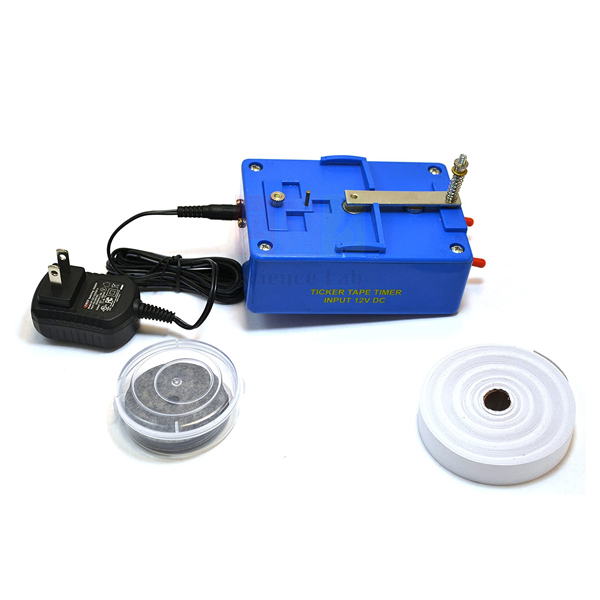
Ticker Tape Timer
Ticker Tape Timer (Product Code: SLE/PHY/312) is an electromagnetic timing device used to record the motion of a trolley or falling object as a trail of dots on paper tape, for measuring velocity, acceleration and general timing in school physics labs. An electromagnet drives a striker that marks the tape through a carbon disc at 50–60 Hz, following the local mains frequency, with connections through 4 mm terminal sockets. This mechanics lab equipment item is supplied by Jain Scientific Equipments Pvt Ltd (ScienceLab), Ambala, India.
Specifications
| Parameter | Detail |
|---|---|
| Mechanism | Electromagnet activating a striker |
| Marking method | Dots printed via a carbon disc on ticker tape |
| Dot rate | 50–60 Hz, depending on the mains frequency |
| Connections | 4 mm terminal sockets |
| Applications | Measurement of velocity, acceleration and general timing |
| Product code | SLE/PHY/312 |
| Supplied by | Jain Scientific Equipments Pvt Ltd (ScienceLab), Ambala, India |
What Is the Ticker Tape Timer Used For?
Fix one end of the paper tape to a trolley, thread it under the striker and carbon disc, switch on and release the trolley. Because the striker hits at the mains frequency, the gap between neighbouring dots always represents the same short time, one-fiftieth of a second on a 50 Hz supply. Evenly spaced dots mean steady speed, while gaps that grow along the tape show acceleration.
A popular technique is to cut the tape into strips of ten dot-spaces and stick them side by side to build a tape chart, which works like a speed-time graph. Students then find average velocity from the length of each strip and acceleration from the change between strips. Check whether your mains supply is 50 or 60 Hz before calculating, keep a spare carbon disc handy, and make connections through the 4 mm sockets with the supply switched off.
What to Specify When Ordering
- Your mains frequency (50 or 60 Hz), which sets the dot rate.
- The power supply and 4 mm leads you will connect the timer with.
- How many boxes of carbon discs to include.
- The number of timers, for example one per practical group.
Supplier
Jain Scientific Equipments Private Limited, trading as ScienceLab, supplies the Ticker Tape Timer from Ambala, Haryana, India to schools, colleges and dealers in India and international markets. The timer is sourced for our mechanics range, and we confirm its supply requirements in writing when we quote. Read about the company on our company profile.
Related Physics Lab Equipment
Consumables, trolleys and alternatives for motion experiments:
- Ticker Tape Carbon Disc — replacement discs that print the dots on the tape.
- Dynamics Trolley, Plastic — pulls the tape through the timer.
- Dynamics Trolley, Wooden — a wooden alternative for the same experiments.
- Stackable Leads — 4 mm leads for connecting the timer.
- Light Gates/Timing Gates — an electronic alternative for timing moving objects.
See the whole range in Physics Lab Equipment.
Frequently Asked Questions
How fast does the Ticker Tape Timer make dots?
The Ticker Tape Timer produces dots at 50 to 60 Hz, depending on the mains frequency. On a 50 Hz supply each gap between dots represents one-fiftieth of a second, which is the time base for speed and acceleration calculations.
How is the Ticker Tape Timer connected?
The Ticker Tape Timer connects through 4 mm terminal sockets. Its operating voltage is not listed on this page, so please ask us through the contact page and we will confirm the supply it needs before you order.
What consumables does the Ticker Tape Timer use?
The Ticker Tape Timer prints dots through a carbon disc onto ticker tape. Carbon discs wear with use, so schools usually keep spares; our Ticker Tape Carbon Disc listing covers replacement discs for this purpose.
Which experiments is the Ticker Tape Timer used for?
The Ticker Tape Timer is used to measure velocity, acceleration and general timing. Typical practicals include trolleys on runways, free fall of a mass pulling the tape, and building tape charts that act as speed-time graphs.
Who supplies the Ticker Tape Timer?
The Ticker Tape Timer is supplied by Jain Scientific Equipments Pvt Ltd (ScienceLab) of Ambala, Haryana, India, to schools, colleges and dealers in India and international markets. Quotations can include carbon discs, trolleys and leads.
Can the Ticker Tape Timer be ordered in bulk?
Yes. The Ticker Tape Timer can be quoted in quantities for several practical groups or schools. Send the number of timers, any accessories and the delivery location through our contact page for a quotation.
Request a Quote
Request a quotation for the Ticker Tape Timer through our contact page, or add it and its carbon discs to the enquiry cart.
Last updated: 24 September 2026
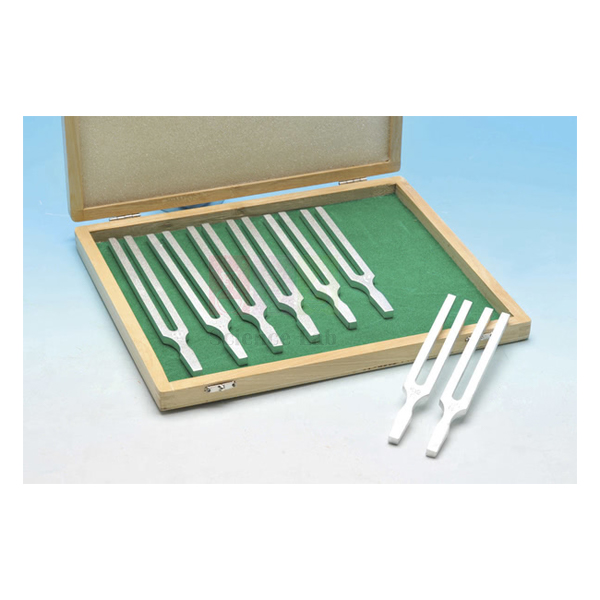
Tuning Fork Set, Aluminium
Tuning Fork Set, Aluminium (Product Code: SLE/PHY/313) is a boxed set of eight aluminium tuning forks used as known-frequency sound sources for resonance and sonometer experiments in school and college physics labs. The forks cover one octave, from C at 256 Hz to C at 512 Hz, and each has a plain shank with its frequency in hertz marked on it. This tuning fork set for school physics in India is made by Jain Scientific Equipments Pvt Ltd (ScienceLab), an OEM manufacturer, at its own factory in Ambala, India.
Specifications
| Parameter | Detail |
|---|---|
| Number of forks | 8 (one of each frequency) |
| Frequencies | C 256 Hz, D 288 Hz, E 320 Hz, F 341 Hz, G 384 Hz, A 426 Hz, B 480 Hz, C 512 Hz |
| Material | Aluminium |
| Shank | Plain |
| Marking | Frequency in hertz marked on each fork |
| Packing | Boxed set |
| Product code | SLE/PHY/313 |
| Manufacturer | Jain Scientific Equipments Pvt Ltd (ScienceLab) — OEM |
| Country of origin | India (made in Ambala, Haryana) |
What Is the Aluminium Tuning Fork Set Used For?
The classic use is the resonance tube experiment for the speed of sound. Strike a fork on a rubber pad, hold it over the open end of an air column and adjust the water level until the sound swells to its loudest. Repeating this with all eight forks gives a set of resonant lengths that students can plot against the reciprocal of frequency to find the speed of sound.
The set also makes the physics of music concrete. The two C forks, at 256 Hz and 512 Hz, show that an octave is a doubling of frequency, while the forks in between step through a musical scale. Always strike the forks on a rubber pad rather than the bench, hold them by the plain shank, and return them to the box so the marked frequencies stay easy to read.
What to Specify When Ordering
- The number of boxed sets, for example one per practical bench.
- Aluminium (this set) or the steel set, which has the same eight frequencies.
- Whether rubber pads, a resonance tube or a sonometer should be quoted with the forks.
OEM Manufacturer
The Tuning Fork Set, Aluminium is manufactured by Jain Scientific Equipments Private Limited, which sells under the ScienceLab name and is the OEM (original equipment manufacturer) for this set. The forks are made at the company's own licensed factory at Saha, Ambala, Haryana, India and dispatched factory-direct to schools, colleges, institutions, dealers and importers in India and international markets. ScienceLab is a registered MSME with manufacturing as its major activity (Udyam UDYAM-HR-01-0003714), and export shipments move under Importer-Exporter Code AAECJ8618A (DGFT). Our company profile has more details.
Related Physics Lab Equipment
Apparatus used with tuning forks in sound experiments:
- Tuning Fork Set, Steel — the same eight frequencies in steel forks.
- Rubber Pad — for striking forks without damaging them.
- Resonance Tube Apparatus — for measuring the speed of sound with each fork.
- Sonometer, Simple Pattern — for tuning a vibrating wire to a fork.
- Tuning Fork on Resonance Box — mounted forks for demonstrating major chords.
More sound apparatus is listed in Physics Lab Equipment.
Frequently Asked Questions
Which frequencies are in the Tuning Fork Set, Aluminium?
The Tuning Fork Set, Aluminium contains one fork each of C 256 Hz, D 288 Hz, E 320 Hz, F 341 Hz, G 384 Hz, A 426 Hz, B 480 Hz and C 512 Hz. Together they span one octave.
Is the frequency marked on each fork in the Tuning Fork Set, Aluminium?
Yes. Every fork in the Tuning Fork Set, Aluminium has its frequency in hertz marked on it, so students can identify each fork quickly and record the correct value in resonance or sonometer experiments.
What is the difference between the aluminium and steel tuning fork sets?
The Tuning Fork Set, Aluminium and the Tuning Fork Set, Steel contain the same eight frequencies from 256 Hz to 512 Hz; the difference is the fork material. Tell us which material your syllabus or lab prefers when requesting a quotation.
How should the forks in the Tuning Fork Set, Aluminium be struck?
Strike the forks of the Tuning Fork Set, Aluminium on a rubber pad and hold them by the plain shank. Striking them on a bench or metal surface can damage the prongs and may affect the sound they produce.
Who manufactures the Tuning Fork Set, Aluminium?
The Tuning Fork Set, Aluminium is manufactured by Jain Scientific Equipments Pvt Ltd (ScienceLab), the OEM, at its own licensed factory at Saha, Ambala, Haryana, India. Quotations and repeat orders are handled directly by the manufacturer.
Is a calibration certificate available for the Tuning Fork Set, Aluminium?
A calibration certificate is not listed for the Tuning Fork Set, Aluminium. If your institution needs frequency test documentation, please discuss it with us through the contact page before ordering so we can explain what is available.
Request a Quote
To order the Tuning Fork Set, Aluminium, send the number of sets and your delivery location through our contact page, or add it to the enquiry cart. Your quotation comes straight from the manufacturer.
Last updated: 24 September 2026
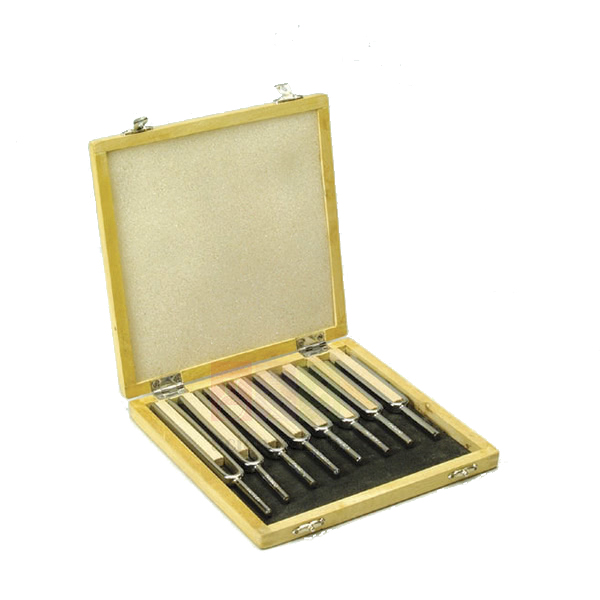
Tuning Fork Set, Steel
Tuning Fork Set, Steel (Product Code: SLE/PHY/314) is a boxed set of eight steel tuning forks used as reference sound sources for sonometer, resonance and pitch experiments in physics laboratories. The plain-shank forks run from C 256 Hz to C 512 Hz in eight steps, and every fork carries its frequency marking. Suited to sonometer work in Indian school and college labs, it is made by Jain Scientific Equipments Pvt Ltd (ScienceLab), an OEM manufacturer, at its own factory in Ambala, India.
Specifications
| Parameter | Detail |
|---|---|
| Material | Steel |
| Set size | Boxed set of 8 |
| Contents | One each of C (256 Hz), D (288 Hz), E (320 Hz), F (341 Hz), G (384 Hz), A (426 Hz), B (480 Hz), C (512 Hz) |
| Shank | Plain |
| Marking | Frequency marked on each fork |
| Product code | SLE/PHY/314 |
| Manufacturer | Jain Scientific Equipments Pvt Ltd (ScienceLab) — OEM |
| Country of origin | India (made in Ambala, Haryana) |
What Is the Steel Tuning Fork Set Used For?
On a sonometer, students place a vibrating fork stem on the sounding board and move the bridge until a small paper rider on the wire jumps off, showing that the wire length is in resonance with the fork. Doing this for each of the eight forks gives a table of frequency against resonant length. The results show that frequency is inversely proportional to length, which is the first law of vibrating strings.
The forks also let a class compare pitch across a full octave and relate each note to a number. Keep the forks in their box between lessons, strike them only on a rubber pad, and avoid dropping them, because a bent prong can change the note a fork gives.
What to Specify When Ordering
- How many boxed steel sets you need.
- Whether you prefer steel (this set) or the aluminium set with the same frequencies.
- Any sonometers, rubber pads or resonance apparatus to include in the same quotation.
OEM Manufacturer
Jain Scientific Equipments Private Limited, trading as ScienceLab, is the OEM (original equipment manufacturer) of the Tuning Fork Set, Steel. The set is produced at the company's own licensed factory at Saha, Ambala, Haryana, India, rather than bought in from a trader, and it reaches schools, colleges, institutions, dealers and importers in India and international markets factory-direct. For replacement forks or repeat sets, ask the manufacturer directly. Read our company profile to learn more.
Related Physics Lab Equipment
Apparatus that pairs with the steel forks:
- Sonometer, 3 Wire Pattern — for the laws of vibrating strings with each fork.
- Tuning Fork Set, Aluminium — the same frequencies in aluminium forks.
- Rubber Pad — the right surface for striking a fork.
- Tuning Forks Set of 2 — a smaller pair for introductory lessons on vibration and sound.
- Resonance Apparatus with Brass Tube — for resonance in an air column.
See more in Physics Lab Equipment.
Frequently Asked Questions
What notes and frequencies does the Tuning Fork Set, Steel include?
The Tuning Fork Set, Steel includes one fork each of C (256 Hz), D (288 Hz), E (320 Hz), F (341 Hz), G (384 Hz), A (426 Hz), B (480 Hz) and C (512 Hz), covering a full octave in eight steel forks.
Can the Tuning Fork Set, Steel be used with a sonometer?
Yes. The Tuning Fork Set, Steel is well suited to sonometer experiments, where each fork is used to find the resonant length of a wire. Using all eight frequencies lets students verify that frequency is inversely proportional to length.
How is the Tuning Fork Set, Steel packed?
The Tuning Fork Set, Steel comes as a boxed set of eight forks. Storing the forks in the box between lessons keeps the set together and protects the prongs from knocks that could alter their pitch.
Are the forks in the Tuning Fork Set, Steel marked?
Yes. Each fork in the Tuning Fork Set, Steel has its frequency marked on it and a plain shank for holding. Students can therefore read the value directly instead of relying on a separate list during the experiment.
Who manufactures the Tuning Fork Set, Steel?
The Tuning Fork Set, Steel is manufactured by Jain Scientific Equipments Pvt Ltd (ScienceLab), the OEM, at its own licensed factory at Saha, Ambala, Haryana, India. Requests for extra forks or repeat sets go directly to the manufacturer.
What information does a quotation for the Tuning Fork Set, Steel need?
A quotation for the Tuning Fork Set, Steel needs the number of sets, any accessories such as sonometers or rubber pads, and the delivery location in India or abroad. Send these through our contact page.
Request a Quote
To request a quotation for the Tuning Fork Set, Steel, use our contact page or add the set to the enquiry cart. Quotations are issued direct by the manufacturer in Ambala.
Last updated: 24 September 2026
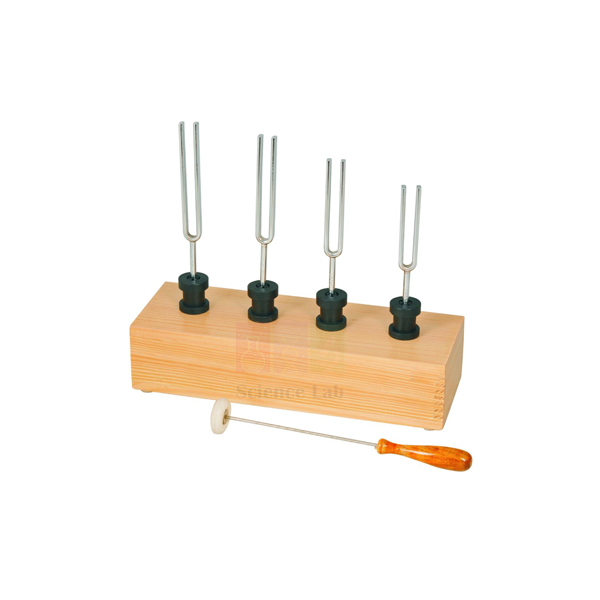
Tuning Fork on Resonance Box
Tuning Fork on Resonance Box (Product Code: SLE/PHY/315) is a set of four steel tuning forks mounted on a wooden resonance box, used to demonstrate how single notes build a basic major chord in school and college sound lessons. Teachers sound C (256Hz), E (320Hz), G (384Hz) and upper C (512Hz) one by one or together, making it a compact physics demonstration kit for a whole class. It is made by Jain Scientific Equipments Pvt Ltd (ScienceLab), an OEM manufacturer, at its own factory in Ambala, India.
Specifications
| Parameter | Detail |
|---|---|
| Fork material | Steel |
| Number of forks | Four, mounted on one wooden box |
| Frequencies | C (256Hz), E (320Hz), G (384Hz), C (512Hz) |
| Intended demonstration | Formation of basic major chords |
| Product code | SLE/PHY/315 |
| Manufacturer | Jain Scientific Equipments Pvt Ltd (ScienceLab) — OEM |
| Country of origin | India (made in Ambala, Haryana) |
What Is the Tuning Fork Resonance Box Used For?
The four forks are tuned to the notes of a C major chord plus its octave. Their frequencies stand in the simple ratio 4:5:6:8, so students can hear why notes whose frequencies form small whole-number ratios sound pleasant together, and why the top C at 512Hz, exactly double 256Hz, sounds like the same note one octave higher. The wooden box acts as a resonator, reinforcing the vibration so the notes carry across a classroom.
In a sound wave experiment, strike one fork at a time with a soft rubber striker, then add the others to build the chord step by step. Touch a prong lightly to stop a note before sounding the next. Never strike the steel forks on a bench or with metal, as this can damage the prongs and shift the pitch.
What to Specify When Ordering
- Confirm that the four-fork chord arrangement (256Hz, 320Hz, 384Hz and 512Hz) suits your lesson plan.
- Number of units needed — one for the demonstration bench, or several for group work.
- Whether a striker should be quoted separately, since the listing covers the forks and box only.
OEM Manufacturer
Jain Scientific Equipments Private Limited, which trades as ScienceLab, is the OEM (original equipment manufacturer) of the Tuning Fork on Resonance Box. The forks and resonance box are made and assembled at the company's own licensed factory at Saha, Ambala, Haryana, India, rather than bought in from a trader. Schools, colleges, dealers and importers therefore deal directly with the maker, and if a unit is ever damaged you can ask us about replacement parts. More about the company is on our company profile.
Related Physics Lab Equipment
These items extend a sound and resonance lesson built around the Tuning Fork on Resonance Box:
- Tuning Fork Set, Steel — loose forks for frequency and pitch experiments at student benches.
- Resonance Apparatus with Brass Tube — air-column resonance to find the speed of sound with a fork.
- Sonometer, Simple Pattern — matches a vibrating wire to a fork’s frequency.
- Tuning Forks Set of 2 — two aluminium forks for comparing frequency and wavelength.
- Forced Oscillation and Resonance Demo — shows resonance in a mechanical system.
See the full Physics Lab Equipment range for more sound, wave and mechanics apparatus.
Frequently Asked Questions
What frequencies are on the Tuning Fork on Resonance Box?
The Tuning Fork on Resonance Box carries four steel forks tuned to C (256Hz), E (320Hz), G (384Hz) and upper C (512Hz). Together they give a C major chord with its octave, which is why the set is used to show how basic major chords are formed.
Why are the forks mounted on a wooden box?
On the Tuning Fork on Resonance Box, the wooden box works as a resonator: the vibrating fork sets the box and the air inside it vibrating too, so the note is much louder than a hand-held fork and can be heard clearly by a whole class.
Is a striker included with the Tuning Fork on Resonance Box?
The listing for the Tuning Fork on Resonance Box covers the four steel forks on their wooden box and does not mention a striker. If you need a rubber striker, say so in your enquiry and we will confirm what can be quoted with the set.
How should the Tuning Fork on Resonance Box be looked after?
Strike the forks of the Tuning Fork on Resonance Box only with a soft rubber striker, never against a bench or metal object. Do not bend or file the prongs, wipe off fingerprints and moisture after use, and store the unit in a dry cupboard to protect the steel.
Who manufactures the Tuning Fork on Resonance Box?
The Tuning Fork on Resonance Box is manufactured by Jain Scientific Equipments Pvt Ltd (ScienceLab) as the OEM, at its own licensed factory at Saha, Ambala, Haryana, India. It is supplied factory-direct to schools, colleges, dealers and importers in India and international markets.
Can a calibration certificate be supplied with the Tuning Fork on Resonance Box?
The forks of the Tuning Fork on Resonance Box are listed at their nominal frequencies. If your institution needs a calibration certificate, please discuss it with us through the contact page before ordering so we can confirm what documentation is possible.
Request a Quote
To order the Tuning Fork on Resonance Box, send the quantity and delivery location through our contact page, or add it to the enquiry cart together with other physics apparatus. Quotations come direct from the manufacturer in Ambala, for single schools as well as bulk orders for India and international markets.
Last updated: 24 September 2026
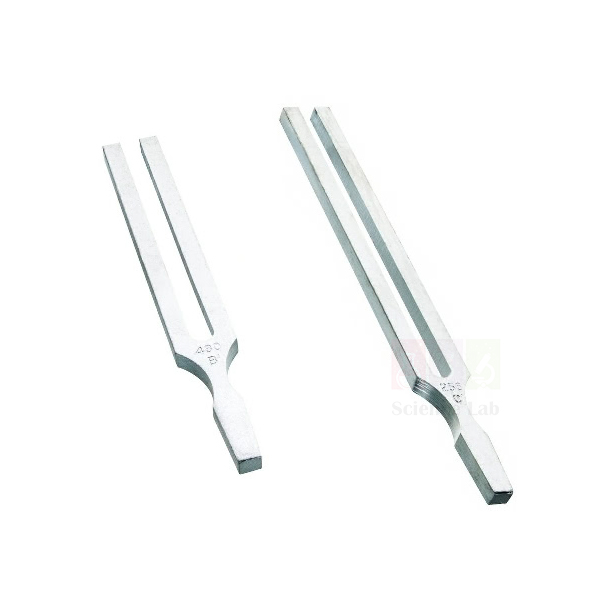
Tuning Forks Set of 2
Tuning Forks Set of 2 (Product Code: SLE/PHY/316) is a pair of aluminium tuning forks used to show students how vibrations produce sound and how frequency relates to wavelength in school science and physics practicals. One fork is tuned to C (256Hz) and the other to B (480Hz), so learners can hear and compare two clearly different pitches side by side. The set is made by Jain Scientific Equipments Pvt Ltd (ScienceLab), an OEM manufacturer, at its own factory in Ambala, India.
Specifications
| Parameter | Detail |
|---|---|
| Contents | Two tuning forks |
| Material | Aluminium |
| Fork 1 | C, 256Hz |
| Fork 2 | B, 480Hz |
| Demonstrates | Relationship between frequency and wavelength; how vibrations produce sound |
| Product code | SLE/PHY/316 |
| Manufacturer | Jain Scientific Equipments Pvt Ltd (ScienceLab) — OEM |
| Country of origin | India (made in Ambala, Haryana) |
What Are the Tuning Forks Set of 2 Used For?
A struck fork vibrates at one steady frequency, which makes it an ideal source for introducing sound. Dip the prongs of a sounding fork into a beaker of water and the splash shows that sound comes from vibration; touch it to a light hanging ball and the ball is pushed away. Sounding the 256Hz fork and then the 480Hz fork lets students hear that a higher frequency gives a higher pitch.
For the frequency and wavelength lesson, remind students that sound travels at the same speed in the same air, so the B fork, vibrating faster, must produce shorter waves than the C fork. This links neatly to wave-speed calculations in a physics lab equipment course for schools in India and elsewhere. Strike the forks only on a rubber pad or soft striker, and hold them by the stem so the prongs ring freely.
OEM Manufacturer
The Tuning Forks Set of 2 is produced by Jain Scientific Equipments Private Limited, known to customers by its trading name ScienceLab. As the original equipment manufacturer (OEM), the company makes these forks at its own licensed factory at Saha, Ambala, Haryana, India, and supplies them straight to schools, colleges, dealers and importers. Quotations and repeat orders are handled by the manufacturer itself, with no trader in between. Read more on our company profile.
Related Physics Lab Equipment
Pair the Tuning Forks Set of 2 with these items for a complete sound and waves practical:
- Tuning Fork Set, Aluminium — a wider range of aluminium forks when more frequencies are needed.
- Tuning Fork on Resonance Box — four box-mounted forks for chord and resonance demonstrations.
- Resonance Tube Apparatus — uses a fork to find the speed of sound from air-column resonance.
- Sonometer, 3 Wire Pattern — compares string vibration with a fork of known frequency.
- Ripple Tank — makes the link between frequency and wavelength visible on water.
Browse all Physics Lab Equipment for further sound and wave apparatus.
Frequently Asked Questions
What frequencies are the Tuning Forks Set of 2 tuned to?
The Tuning Forks Set of 2 contains one fork tuned to C at 256Hz and one tuned to B at 480Hz. Because the two frequencies are well apart, students can easily hear the difference in pitch and relate it to how fast each fork vibrates.
What material are the Tuning Forks Set of 2 made from?
Both forks in the Tuning Forks Set of 2 are made of aluminium. If your syllabus or teacher prefers steel forks, ask us about the separate steel tuning fork set listed in our physics range before you place the order.
Which experiments suit the Tuning Forks Set of 2?
The Tuning Forks Set of 2 suits introductory experiments showing that vibrations produce sound, comparing high and low pitch, and explaining why a higher frequency means a shorter wavelength. With a resonance tube or sonometer, the forks also serve as a known-frequency source.
How do I keep the Tuning Forks Set of 2 in tune?
Keep the Tuning Forks Set of 2 accurate by striking the forks only on a rubber pad or soft striker, never on hard surfaces. Do not drop or bend the prongs, and store both forks together in a dry place when they are not in use.
Who manufactures the Tuning Forks Set of 2?
Jain Scientific Equipments Pvt Ltd (ScienceLab) manufactures the Tuning Forks Set of 2 as the OEM, at its own licensed factory in Saha, Ambala, Haryana, India. Buyers order directly from the maker, whether for one school or for dealers and importers.
Can the Tuning Forks Set of 2 be ordered in bulk?
Yes, the Tuning Forks Set of 2 can be quoted for single schools or larger quantities for dealers, tenders and importers in India and international markets. Send the number of sets and delivery location through the contact page for a quotation.
Request a Quote
Request a quotation for the Tuning Forks Set of 2 through our contact page, or place it in the enquiry cart with the rest of your sound apparatus. You receive the quotation directly from the manufacturer in Ambala.
Last updated: 24 September 2026
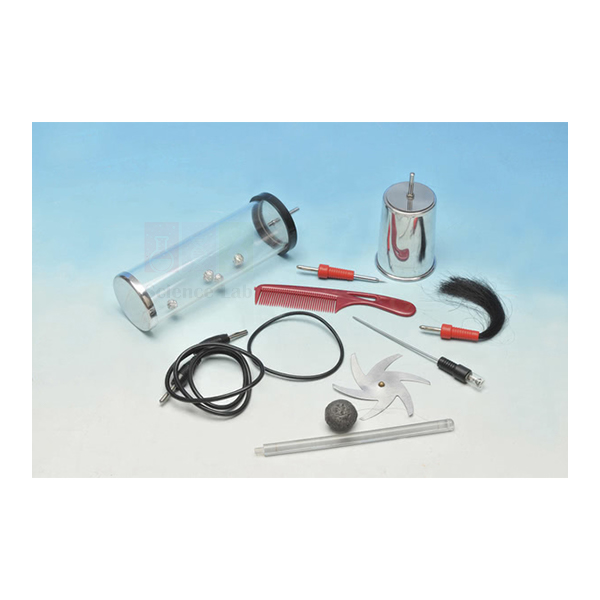
Van De Graaff Accessory Kit
Van De Graaff Accessory Kit (Product Code: SLE/PHY/317) is a set of eight electrostatics accessories used with a Van de Graaff generator to demonstrate charge, repulsion and discharge in school and college physics labs. It brings together a Faraday’s pail, electric whirl, pith-ball pillar, head of hair, neon bulb and more, so one generator can support a full sequence of static electricity experiments. The kit is made by Jain Scientific Equipments Pvt Ltd (ScienceLab), an OEM manufacturer, at its own factory in Ambala, India.
Key Details
| Parameter | Detail |
|---|---|
| Type | Accessory kit for Van de Graaff generator |
| Number of items | Eight (listed below) |
| Generator | Not part of this kit; ordered separately |
| Product code | SLE/PHY/317 |
| Manufacturer | Jain Scientific Equipments Pvt Ltd (ScienceLab) — OEM |
| Country of origin | India (made in Ambala, Haryana) |
Kit contents:
- Faraday’s pail
- Perspex cylinder
- Electric whirl
- Pillar with pith ball
- Comb
- Head of hair
- Point discharger
- Neon bulb
What Is the Van de Graaff Accessory Kit Used For?
Each piece turns the charged dome into a different lesson. The head of hair shows like charges repelling as the strands lift and spread, and the pith ball on its pillar is first attracted and then pushed away once it picks up charge. The electric whirl spins as charge leaks from its pointed tips, while the point discharger shows how sharp points release charge and helps bring the dome back to a safe state.
The neon bulb glows briefly when brought near the charged dome, a vivid sign of the high potential involved, and the Faraday’s pail is used with an electroscope to explore how charge sits on a conductor. Together they make the kit useful school physics lab equipment in India and abroad. Work in dry air, keep electronics away from the generator and discharge the dome before handling any accessory.
What to Specify When Ordering
- Whether you need the Van de Graaff generator as well, or only the accessory kit for an existing machine.
- The make of the generator already in your lab, so we can confirm the accessories suit it.
- Number of kits — usually one per generator.
OEM Manufacturer
This Van De Graaff Accessory Kit is an OEM product of Jain Scientific Equipments Private Limited, the company that trades as ScienceLab. The accessories are made and assembled at its own licensed factory at Saha, Ambala, Haryana, India, the same factory that produces its Van de Graaff generator, so both can be sourced from one manufacturer. For institutional vendor registration, the company’s GSTIN is 06AAECJ8618A1ZT and its LEI is 3358004HRD1JIVXKYX49. Company background is on our company profile.
Related Physics Lab Equipment
Complete your electrostatics bench with these items alongside the Van De Graaff Accessory Kit:
- Van de Graaff Generator — the charge source that every accessory in this kit is designed around.
- Electroscope, Gold Leaf — detects the charge collected in the Faraday’s pail.
- Electroscope, Needle — a sturdier charge indicator for student groups.
- Electrostatic Investigation — charging-by-friction experiments that lead into generator work.
More electrostatics and electricity apparatus is listed under Physics Lab Equipment.
Frequently Asked Questions
What is included in the Van De Graaff Accessory Kit?
The Van De Graaff Accessory Kit contains eight items: a Faraday’s pail, a Perspex cylinder, an electric whirl, a pillar with pith ball, a comb, a head of hair, a point discharger and a neon bulb, all intended for use with a Van de Graaff generator.
Does the Van De Graaff Accessory Kit include the generator?
No. The Van De Graaff Accessory Kit contains accessories only; the generator is listed separately as our Van de Graaff Generator. You can order both together, or order just the kit if your lab already has a working generator.
Which experiments can be shown with the Van De Graaff Accessory Kit?
With the Van De Graaff Accessory Kit a teacher can show repulsion of like charges with the head of hair and pith ball, charge leaking from points with the electric whirl and point discharger, glow from the neon bulb, and charge on conductors with the Faraday’s pail.
How should the Van De Graaff Accessory Kit be used safely?
Use the Van De Graaff Accessory Kit under teacher supervision, change accessories only after the generator dome has been discharged, and keep computers, phones and other electronics well away. Store the parts clean and dry, because dust and damp reduce the charge the generator can build.
Who manufactures the Van De Graaff Accessory Kit?
The Van De Graaff Accessory Kit is manufactured by Jain Scientific Equipments Pvt Ltd (ScienceLab) as the OEM, at its own licensed factory in Saha, Ambala, Haryana, India. The company also makes the matching Van de Graaff generator, so a school can buy both from one maker.
What should I include when asking for a Van De Graaff Accessory Kit quotation?
For a Van De Graaff Accessory Kit quotation, state the number of kits, whether the generator is also required, and your delivery location in India or abroad. Send these through the contact page and the manufacturer will reply directly.
Request a Quote
Send your requirement for the Van De Graaff Accessory Kit through our contact page, or add it and the generator to the enquiry cart. Quotations are prepared directly by the manufacturer in Ambala for schools, colleges, dealers and importers.
Last updated: 24 September 2026
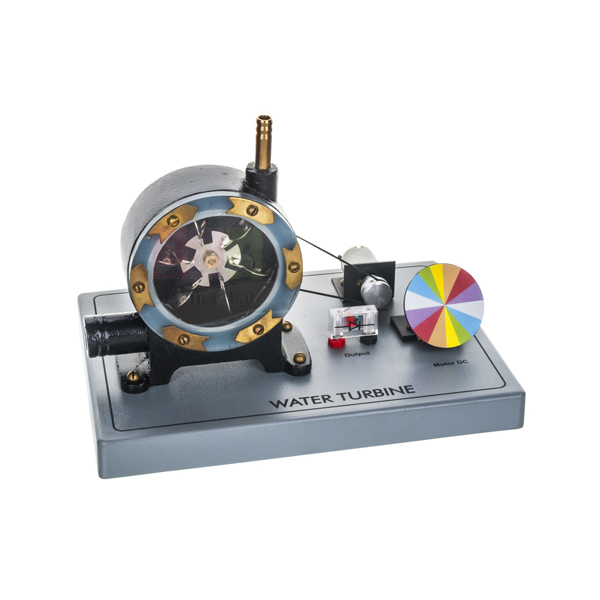
Water Turbine with Dynamo Model
Water Turbine with Dynamo Model (Product Code: SLE/PHY/318) is a working demonstration model used to show the conversion of mechanical energy into electrical energy in school physics and general science lessons. Flowing water turns a small turbine under a transparent cover, and the turbine drives a dynamo coupled directly to it, all fitted on a sturdy plastic base. The model is made by Jain Scientific Equipments Pvt Ltd (ScienceLab), an OEM manufacturer, at its own factory in Ambala, India.
Key Details
| Parameter | Detail |
|---|---|
| Turbine housing | Transparent cover, so the turning wheel is visible |
| Water connections | Inlet and outlet tubes |
| Generator | Dynamo directly connected to the turbine |
| Base | Sturdy plastic base |
| Demonstrates | Conversion of mechanical energy into electrical energy |
| Product code | SLE/PHY/318 |
| Manufacturer | Jain Scientific Equipments Pvt Ltd (ScienceLab) — OEM |
| Country of origin | India (made in Ambala, Haryana) |
What Is the Water Turbine Dynamo Model Used For?
The model is a small-scale picture of a hydroelectric station. Water enters through the inlet tube, strikes the turbine and leaves through the outlet, and the spinning shaft turns the dynamo, which generates a current. Because the cover is transparent, students can watch the wheel speed up as the flow increases and connect what they see to the energy chain from moving water to mechanical rotation to electricity.
For a class demonstration, run the inlet from a tap with a length of tubing and let the outlet drain into a sink or tray. Connect the dynamo terminals to a sensitive meter or a small lamp so the output can be seen, then vary the flow to show how more water gives more electrical output. This makes the model a useful demonstration model for the physics lab and energy topics. Drain and dry the model after use.
OEM Manufacturer
ScienceLab is the trading name of Jain Scientific Equipments Private Limited, the OEM that manufactures the Water Turbine with Dynamo Model. The turbine, cover and base are assembled with the dynamo at the company's own licensed factory at Saha, Ambala, Haryana, India, and the finished model goes factory-direct to schools, colleges, dealers and importers. Questions about spare parts or repeat orders are answered by the manufacturer itself, so just ask us. Read about the company on our company profile.
Related Physics Lab Equipment
Useful items to run and extend a lesson with the Water Turbine with Dynamo Model:
- Rubber Tubing — links a laboratory tap to the turbine inlet.
- Galvanometer, Centre Zero Universal Meter — shows the small current produced by the dynamo.
- Demonstration Dynamo Model — explains what happens inside the dynamo.
- Demonstration Pelton Turbine — a larger turbine for engineering fluid-mechanics labs.
Find more energy and electricity demonstrations in our Physics Lab Equipment range.
Frequently Asked Questions
How does the Water Turbine with Dynamo Model work?
In the Water Turbine with Dynamo Model, water enters the inlet tube and turns the turbine inside its transparent cover. The turbine is connected directly to a dynamo, so its rotation is converted into electrical energy that can be shown with a meter or small lamp.
What water supply does the Water Turbine with Dynamo Model need?
The Water Turbine with Dynamo Model has inlet and outlet tubes, so a laboratory tap with connecting tubing is the usual source, with the outlet draining into a sink or tray. Flow rate and pressure needs are not listed; please ask us through the contact page.
Is a meter or bulb supplied with the Water Turbine with Dynamo Model?
The listing for the Water Turbine with Dynamo Model describes the turbine, cover, tubes, dynamo and plastic base, and does not include a meter or lamp. Mention in your enquiry if you would like a galvanometer or lamp holder quoted alongside it.
Which topics does the Water Turbine with Dynamo Model support?
The Water Turbine with Dynamo Model supports lessons on energy conversion, hydroelectric power and renewable energy, and introduces how generators produce electricity. It suits middle and secondary school science as well as introductory college demonstrations.
Who manufactures the Water Turbine with Dynamo Model?
Jain Scientific Equipments Pvt Ltd (ScienceLab) manufactures the Water Turbine with Dynamo Model as the OEM, at its own licensed factory at Saha, Ambala, Haryana, India. It is supplied directly by the maker to institutions and trade buyers in India and international markets.
How should the Water Turbine with Dynamo Model be stored?
After each use, drain all water from the Water Turbine with Dynamo Model, wipe the transparent cover and base, and let it dry before storing. Keeping the dynamo and its terminals dry protects the electrical part of the model between lessons.
Request a Quote
For a quotation on the Water Turbine with Dynamo Model, write to us through the contact page or add it to the enquiry cart. The quote comes straight from the manufacturer, whether you need one model or a quantity for several schools.
Last updated: 24 September 2026
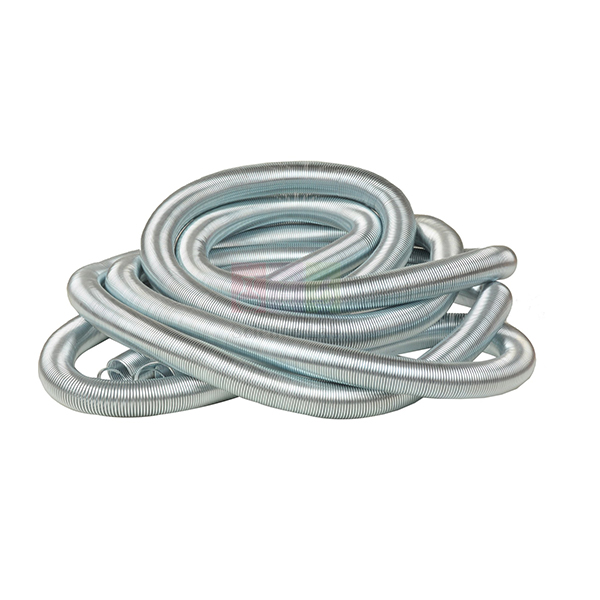
Wave Form, Helix
Wave Form, Helix (Product Code: SLE/PHY/319) is a long, close-wound steel wire spring used to demonstrate transverse and longitudinal waves across a classroom floor or bench in school and college physics. Its 20mm diameter coils close to about 3 metre and stretch to approximately 9 metre, giving pulses room to travel slowly enough for students to follow. It is made by Jain Scientific Equipments Pvt Ltd (ScienceLab), an OEM manufacturer, at its own factory in Ambala, India.
Specifications
| Parameter | Detail |
|---|---|
| Construction | Steel wire, close-wound helix |
| Coil diameter | 20mm |
| Ends | Looped |
| Closed length | 3 metre |
| Extended length | Approx. 9 metre |
| Product code | SLE/PHY/319 |
| Manufacturer | Jain Scientific Equipments Pvt Ltd (ScienceLab) — OEM |
| Country of origin | India (made in Ambala, Haryana) |
What Is the Wave Helix Used For?
Stretch the helix along the floor between two students, or hook one looped end to a fixed point. A quick sideways flick sends a transverse pulse along the coils, while a sharp push along the axis sends a longitudinal pulse of compressions and rarefactions, the same pattern as a sound wave. Students can then watch pulses reflect from a fixed end, see how two pulses pass through each other, and set up standing waves by shaking one end steadily.
As part of a wave motion kit for schools in India or abroad, the long 9 metre stretch is the key advantage: pulses travel far enough to time with a stopwatch, and changing the stretch shows how tension affects wave speed. Never let a stretched helix go suddenly, and keep the coils from tangling or kinking, as a kinked steel spring does not recover its shape.
OEM Manufacturer
Jain Scientific Equipments Private Limited, trading as ScienceLab, manufactures the Wave Form, Helix as the original equipment manufacturer. It is wound and finished at the company's own licensed factory at Saha, Ambala, Haryana, India, and sold directly by the maker to schools, colleges, dealers and importers instead of through a trading house. That means quotations, repeat orders and replacement requests all come back to the factory that made it. See our company profile for more.
Related Physics Lab Equipment
Other apparatus for teaching waves alongside the Wave Form, Helix:
- Metal Slinky, Helical Spring — a shorter spring for desk-top wave work in small groups.
- Slinky Spring — another compact option for longitudinal wave practice.
- Ripple Tank — shows reflection, refraction and interference of water waves.
- Apparatus for Demonstrating the Phenomenon of Wave Propagation and Reflection — a mounted demonstration of travelling and reflected waves.
Explore more wave and sound apparatus in Physics Lab Equipment.
Frequently Asked Questions
How long is the Wave Form, Helix?
The Wave Form, Helix has a closed length of 3 metre and extends to approximately 9 metre. Its coils are 20mm in diameter, and the long working length gives pulses enough distance to be followed by eye and timed across a classroom.
Can the Wave Form, Helix show both transverse and longitudinal waves?
Yes. Moving one end of the Wave Form, Helix from side to side sends a transverse wave along it, while pushing and pulling along its length sends a longitudinal wave of compressions and rarefactions, similar to how sound travels.
What are the looped ends of the Wave Form, Helix for?
The looped ends of the Wave Form, Helix let a student hold it securely or hook it over a fixed point such as a clamp or door handle. Fixing one end is useful for showing how a pulse reflects and inverts at a fixed boundary.
How should the Wave Form, Helix be stored?
Let the Wave Form, Helix close up gently rather than releasing it while stretched, keep the coils in line so they do not tangle, and store it dry to protect the steel wire. A kinked or overstretched helix loses its even spacing.
Who manufactures the Wave Form, Helix?
Jain Scientific Equipments Pvt Ltd (ScienceLab) manufactures the Wave Form, Helix as the OEM at its own licensed factory at Saha, Ambala, Haryana, India. Schools, colleges, dealers and importers buy it directly from the manufacturer for India and international markets.
Request a Quote
Tell us how many Wave Form, Helix springs you need through the contact page, or add the item to the enquiry cart with your other wave apparatus. The quotation is issued directly by the manufacturer in Ambala.
Last updated: 24 September 2026
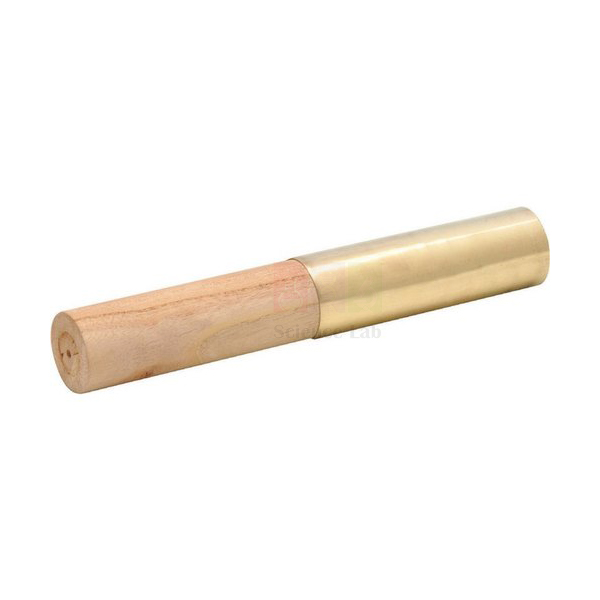
Wood & Metal Cylinder
Wood & Metal Cylinder (Product Code: SLE/PHY/320) is a 200 x 30mm cylindrical rod, half metal and half wood, used to demonstrate the difference between good and poor conductors of heat in school physics and general science labs. Paper wrapped round the rod and held briefly over a Bunsen flame scorches over the wood but stays uncharred over the metal, a result students remember. It is made by Jain Scientific Equipments Pvt Ltd (ScienceLab), an OEM manufacturer, at its own factory in Ambala, India.
Specifications
| Parameter | Detail |
|---|---|
| Form | Cylindrical rod made of two halves |
| Materials | One end metal, the other end wood |
| Dimensions | 200 x 30mm (dia.) |
| Heat source needed | Bunsen flame (not included) |
| Product code | SLE/PHY/320 |
| Manufacturer | Jain Scientific Equipments Pvt Ltd (ScienceLab) — OEM |
| Country of origin | India (made in Ambala, Haryana) |
What Is the Wood and Metal Cylinder Used For?
Wrap a single sheet of paper tightly round the join so that half the paper lies on wood and half on metal, then hold the rod briefly above a Bunsen flame. The metal conducts heat away from the paper so quickly that the paper over it stays below the temperature at which it chars. Wood is a poor conductor, so the paper over the wooden half heats up and scorches almost at once.
The side-by-side result makes this a memorable heat energy science kit piece for lessons on conduction, insulators and everyday examples such as wooden handles on metal pans. Keep the exposure short, hold the rod at the end away from the flame, and have students allow the metal half to cool before touching it or rewrapping.
OEM Manufacturer
The Wood & Metal Cylinder comes from Jain Scientific Equipments Private Limited, which trades as ScienceLab and acts as the OEM for this apparatus. The rods are made and assembled at the company's own licensed factory at Saha, Ambala, Haryana, India, and supplied direct from the factory to schools, colleges, dealers and importers. Ask us for repeat orders or class quantities and the manufacturer will quote directly. Our company profile has more background.
Related Physics Lab Equipment
Items that pair well with the Wood & Metal Cylinder in a conduction lesson:
- Bunsen Burner — the flame source needed for the scorching test.
- Apparatus Heat/Thermal Conductivity — compares how well different materials conduct heat.
- Thermal Conductivity Bars — rods of different metals for ranking conductors.
- Conductivity of Metal Apparatus — a follow-up experiment on conduction in metals.
Browse the Physics Lab Equipment range for more heat apparatus.
Frequently Asked Questions
What does the Wood & Metal Cylinder demonstrate?
The Wood & Metal Cylinder demonstrates that metals conduct heat much better than wood. Paper wrapped round the rod and held over a Bunsen flame chars quickly where it touches the wood, but stays uncharred where it touches the metal, because the metal carries the heat away.
What size is the Wood & Metal Cylinder?
The Wood & Metal Cylinder measures 200 x 30mm (dia.), with one half made of metal and the other of wood. The rod is long enough to hold safely by one end while the join is held over the flame.
What else is needed to use the Wood & Metal Cylinder?
To use the Wood & Metal Cylinder you need a Bunsen burner and a strip of plain paper to wrap tightly round the rod. The burner is not part of this item and can be quoted separately if your lab needs one.
Is the Wood & Metal Cylinder safe for students?
The Wood & Metal Cylinder is safe for supervised use when the rod is held over the flame only briefly. Hold it by the end away from the heat, keep loose paper away from the burner and let the metal half cool before it is handled again.
Who manufactures the Wood & Metal Cylinder?
Jain Scientific Equipments Pvt Ltd (ScienceLab) manufactures the Wood & Metal Cylinder as the OEM at its own licensed factory in Saha, Ambala, Haryana, India. It is supplied factory-direct to schools, colleges and trade buyers in India and international markets.
How can I get a quotation for the Wood & Metal Cylinder?
Send the number of Wood & Metal Cylinder rods you need and your delivery location through the contact page. Mention any companion items, such as Bunsen burners, so the manufacturer can quote everything in one reply.
Request a Quote
Request your quotation for the Wood & Metal Cylinder on the contact page, or add it to the enquiry cart along with other heat apparatus. Quotes come directly from the manufacturer in Ambala.
Last updated: 24 September 2026
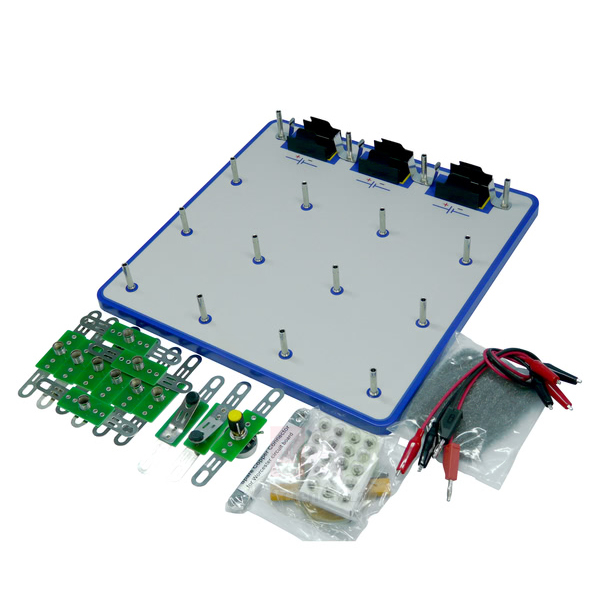
Worcester Circuit Board Kit
Worcester Circuit Board Kit (Product Code: SLE/PHY/321) is a circuit-building kit based on the Worcester circuit board pattern, used to assemble and test simple electric circuits in school science and physics lessons. Teachers choose Worcester-style boards because pupils can lay out a circuit on a baseboard and see every connection clearly, which suits first lessons on current electricity. The kit is made by Jain Scientific Equipments Pvt Ltd (ScienceLab), an OEM manufacturer, at its own factory in Ambala, India.
Key Details
| Parameter | Detail |
|---|---|
| Type | Circuit-building kit, Worcester circuit board pattern |
| Kit contents | Please ask us for the current contents list with your quotation |
| Product code | SLE/PHY/321 |
| Manufacturer | Jain Scientific Equipments Pvt Ltd (ScienceLab) — OEM |
| Country of origin | India (made in Ambala, Haryana) |
What Is the Worcester Circuit Board Kit Used For?
Worcester circuit boards let students build real circuits without soldering. Components are placed on a baseboard and linked together, so a class can move from a single cell and lamp to series and parallel arrangements, add switches, and compare how brightly lamps glow as the circuit changes. Because the layout on the board matches the circuit diagram, students learn to read and draw diagrams at the same time.
As an electricity experiment kit for school labs, the boards also support measurements with an ammeter and voltmeter, tests of conductors and insulators, and simple fault-finding tasks. Keep cells out of the kit when it is stored, check connections are clean before each lesson, and count components back in at the end of the period.
What to Specify When Ordering
- Ask for the current contents list and confirm it covers the experiments in your syllabus.
- Number of kits — for example one per student pair or group.
- Any meters or extra boards you want quoted alongside the kits.
OEM Manufacturer
Jain Scientific Equipments Private Limited, the company behind the ScienceLab brand, is the OEM for the Worcester Circuit Board Kit and its related Worcester circuit boards. The kits are made at the company's own licensed factory at 449, HSIIDC Industrial Area, Saha, Ambala, which operates under Factory Licence AMB-ONLINE-CHD-J-414, and the company is incorporated under CIN U29309HR2020PTC087597. Schools, colleges, dealers and importers buy directly from the factory, and spare boards can be requested from us. Visit our company profile to learn more.
Related Physics Lab Equipment
Items that work with or extend the Worcester Circuit Board Kit:
- Worcester Circuit Board — an individual Worcester board for adding circuit positions.
- Circuit Board Worcester — a board-and-components set in the same pattern.
- Circuits Kit Bulb Holder — extra lamp positions for series and parallel work.
- Ammeter Voltmeter — measures current and voltage in the circuits students build.
See more electricity apparatus in Physics Lab Equipment.
Frequently Asked Questions
What is a Worcester Circuit Board Kit?
A Worcester Circuit Board Kit is a set for building simple electric circuits on Worcester-pattern boards, where components are laid out on a baseboard and connected without soldering. It lets students assemble, test and change circuits quickly during school physics practicals.
What is included in the Worcester Circuit Board Kit?
The contents of the Worcester Circuit Board Kit are not itemised on this page. Please ask for the current contents list through the contact page before ordering, so you can check it against the experiments your syllabus requires.
Which experiments can students do with the Worcester Circuit Board Kit?
With the Worcester Circuit Board Kit, students can build series and parallel circuits, add switches and lamps, test which materials conduct, and practise matching real circuits to circuit diagrams. Adding meters extends the kit to simple current and voltage measurements.
Who manufactures the Worcester Circuit Board Kit?
The Worcester Circuit Board Kit is manufactured by Jain Scientific Equipments Pvt Ltd (ScienceLab) as the OEM, at its own licensed factory at Saha, Ambala, Haryana, India. It is supplied factory-direct to schools, colleges, dealers and importers in India and international markets.
Can extra boards be ordered for the Worcester Circuit Board Kit later?
Yes, you can ask us about extra or replacement boards for the Worcester Circuit Board Kit at any time. Because the kit comes directly from the manufacturer, add-on requests are handled by the same factory; availability is confirmed when you enquire.
What does a quotation for the Worcester Circuit Board Kit need?
A quotation for the Worcester Circuit Board Kit needs the number of kits, any meters or extra boards to include, and the delivery location in India or abroad. Send these details through the contact page for a direct reply.
Request a Quote
Enquire about the Worcester Circuit Board Kit on our contact page or add it to the enquiry cart with the rest of your electricity apparatus. Quotations and contents lists come direct from the manufacturer in Ambala.
Last updated: 24 September 2026
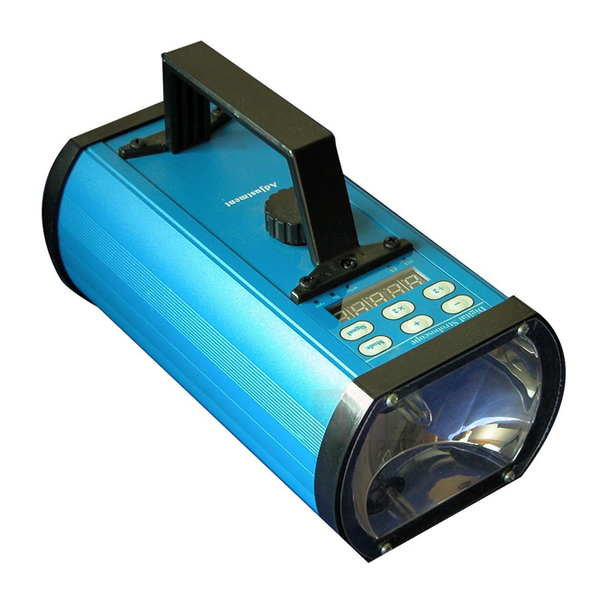
Xenon Stroboscope
Xenon Stroboscope (Product Code: SLE/PHY/322) is a stroboscopic lamp, also called a revolution calibration meter, used to freeze fast rotating or vibrating motion and calculate its speed in physics labs, engineering workshops and industrial settings. Its xenon flash is triggered from 0.2 to 300 Hz, internally or externally, and a 7-segment LED display shows the flashing frequency in real time, making it a practical test and measuring instrument. It is supplied by Jain Scientific Equipments Pvt Ltd (ScienceLab), Ambala, India.
Specifications
| Parameter | Detail |
|---|---|
| Light source | Xenon flash tube, instantaneous intense flash |
| Flash tube intensity | Approximately 10000 lux |
| Triggering frequency range | 0.2–300 Hz (internal and external) |
| Recommended triggering frequency | 0.2–180 Hz |
| External trigger signal | 5–12V pulse signal |
| Frequency adjustment | Rotating encoder for rapid frequency changes |
| Processing and display | Microcontroller processing unit; display chip driving a 7-segment LED showing real-time flash frequency |
| Power supply | AC220V ± 5%, 1.2A |
| Power consumption | Less than 8W maximum |
| Dimensions (L × W × H) | 215mm × 140mm × 150mm |
| Net weight | 2 kg |
| Documentation | Complete operating instructions supplied |
| Product code | SLE/PHY/322 |
| Supplied by | Jain Scientific Equipments Pvt Ltd (ScienceLab), Ambala, India |
What Is the Xenon Stroboscope Used For?
When the flash rate matches the speed of a rotating or vibrating object, the object is lit in the same position each time and appears to stand still; set the rate slightly off and it seems to move slowly forwards or backwards. Turning the encoder until a fan blade, motor shaft or vibrating string appears frozen lets students read the frequency from the display and work out the rotational speed of an object whose speed was unknown.
In physics lessons the stroboscope freezes ripple-tank waves, standing waves on strings and falling water drops, and the frozen motion can be photographed with a standard digital camera. Workshops use it the same way to check machine speeds without touching moving parts. Warn the group before use, since flashing light can affect people who are sensitive to it, and never judge a machine safe to touch because it looks stationary.
What to Specify When Ordering
- Your mains supply, as the listed input is AC220V ± 5%.
- Whether you will trigger it externally, and that your source gives a 5–12V pulse signal.
- Number of units, and any rotating or vibrating apparatus to be quoted with it.
Supplier
Jain Scientific Equipments Private Limited, trading as ScienceLab, supplies the Xenon Stroboscope from Ambala, Haryana, India to schools, colleges, technical institutes, dealers and importers. We source the instrument and ship it with its operating instructions to buyers in India and international markets; tell us your mains and triggering needs when you enquire. To find out more about the company, see our company profile.
Related Physics Lab Equipment
Apparatus often used with the Xenon Stroboscope:
- Ripple Tank — its wave patterns can be frozen under the strobe for study.
- Vibration Generator — drives strings and springs into standing waves to observe.
- Demonstration, Electric Motor — a rotating target for speed measurements.
- Newton’s Colour Disc — a spinning disc that shows strobe effects clearly.
More measuring and demonstration apparatus is listed under Physics Lab Equipment.
Frequently Asked Questions
What frequency range does the Xenon Stroboscope cover?
The Xenon Stroboscope triggers from 0.2 to 300 Hz, using either its internal control or an external signal, with 0.2 to 180 Hz recommended for regular use. The current flash frequency is shown in real time on its 7-segment LED display.
How does the Xenon Stroboscope measure speed?
The Xenon Stroboscope measures speed by matching its flash rate to a moving object. When the object appears stationary, the displayed flash frequency equals its rate of rotation or vibration, so the speed of an object with unknown movement can be calculated.
Can the Xenon Stroboscope be triggered externally?
Yes. The Xenon Stroboscope accepts an external 5 to 12V pulse signal for triggering across the same 0.2 to 300 Hz range. Check that your sensor or signal source can deliver a pulse in that range before connecting it.
What power supply does the Xenon Stroboscope need?
The Xenon Stroboscope is listed for AC220V ± 5% at 1.2A, with maximum power consumption of less than 8W. If your mains supply differs, tell us when you enquire so we can confirm what arrangement is possible before quoting.
Who supplies the Xenon Stroboscope?
The Xenon Stroboscope is supplied by Jain Scientific Equipments Pvt Ltd (ScienceLab), Ambala, Haryana, India, to schools, colleges, technical institutes and trade buyers. We supply it with complete operating instructions to customers in India and international markets.
Is a calibration certificate available for the Xenon Stroboscope?
Calibration documentation for the Xenon Stroboscope is not part of the listing. If your laboratory needs a calibration certificate, please raise it through the contact page before ordering so we can tell you what can be arranged.
Request a Quote
To request a quotation for the Xenon Stroboscope, send the quantity, your mains voltage and delivery location through the contact page, or add it to the enquiry cart with any companion apparatus.
Last updated: 24 September 2026
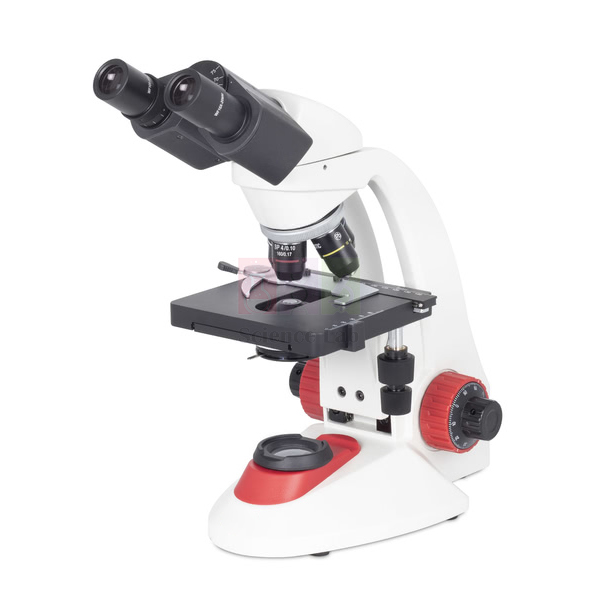
Binocular Microscope, 1000x, LED
Binocular Microscope, 1000x, LED (Product Code: SLE/M/106) is a compound light microscope with a binocular viewing head and LED illumination, used to examine cells, tissues and micro-organisms at up to 1000x in school, college and teaching laboratories. Its achromatic semi-plan objectives run from 4X to a 100X oil immersion lens, and a 30° inclined head that rotates 360° keeps seated viewing comfortable. It is supplied by Jain Scientific Equipments Pvt Ltd (ScienceLab), Ambala, India.
Specifications
| Parameter | Detail |
|---|---|
| Viewing head | Binocular, 30° inclined, rotates 360° |
| Eyepieces | Widefield 10X/20mm |
| Objectives | Achromatic semi-plan 4X/0.10, 10X/0.25, 40X/0.65 and 100X/1.25 oil immersion |
| Maximum magnification | 1000x |
| Nosepiece | Revolving quadruple, with positive click-stops |
| Focusing | Coaxial coarse and fine (2 µm), with tension adjustment |
| Condenser | Spiral-mounted 1.25 N.A. Abbe condenser with iris diaphragm |
| Stage | 140 x 135mm low-position coaxial mechanical stage with sample holder |
| Stage travel (X/Y) | 77 x 25mm |
| Illumination | 3W focusable LED with intensity control |
| Product code | SLE/M/106 |
| Supplied by | Jain Scientific Equipments Pvt Ltd (ScienceLab), Ambala, India |
What Is the 1000x Binocular LED Microscope Used For?
This compound microscope covers the full teaching range: the 4X and 10X objectives locate a specimen and show tissue layout, the 40X objective resolves individual cells and nuclei, and the 100X oil immersion objective brings bacteria and fine cell detail into view at 1000x. Two eyepieces reduce eye strain during long practical sessions, and the rotating head lets students on either side of a bench share the instrument.
Start every slide at the lowest power, centre the area of interest with the mechanical stage, then click up through the nosepiece and refocus with the fine control. At 100X, place a drop of immersion oil between slide and lens, and wipe the lens clean with lens tissue afterwards. Use the iris diaphragm and LED intensity control together to balance brightness and contrast.
What to Specify When Ordering
- Number of microscopes, for example one per student pair or one per bench.
- Your mains voltage, so we can confirm the LED power arrangement before quoting.
- Consumables to include, such as immersion oil, cover glasses and prepared slides.
Supplier
The Binocular Microscope, 1000x, LED is supplied by Jain Scientific Equipments Private Limited, which trades under the name ScienceLab from Ambala, Haryana, India. We source this microscope for schools, colleges, teaching laboratories, dealers and importers, and can combine it with slides and consumables in one consignment for India and international markets. More about us is on our company profile.
Related Laboratory Equipment
Consumables and accessories that support daily use of the Binocular Microscope, 1000x, LED:
- Immersion Oil, 25ml — needed with the 100X/1.25 oil immersion objective.
- Cover Glasses — protect wet mounts and the objective lenses.
- Lens Tissue — for cleaning oil and dust from the optics.
- Prepared Microscope Slide Set – Connective Tissues — ready-made specimens for class practicals.
- Microscope Slide Case — keeps slide collections organised between lessons.
See our full Microscope range, or browse Physics Lab Equipment where this item is also listed.
Frequently Asked Questions
What magnification does the Binocular Microscope, 1000x, LED reach?
The Binocular Microscope, 1000x, LED reaches 1000x by combining its 10X widefield eyepieces with the 100X/1.25 oil immersion objective. Lower powers come from the 4X, 10X and 40X achromatic semi-plan objectives on the quadruple nosepiece.
Does the Binocular Microscope, 1000x, LED need immersion oil?
Yes, for its highest power. The 100X objective of the Binocular Microscope, 1000x, LED is an oil immersion lens, so a drop of immersion oil is needed between slide and lens. The 4X, 10X and 40X objectives are used dry.
What kind of illumination does the Binocular Microscope, 1000x, LED use?
The Binocular Microscope, 1000x, LED uses 3W focusable LED illumination with intensity control, working with a spiral-mounted 1.25 N.A. Abbe condenser and iris diaphragm. Together they let users adjust brightness and contrast for stained and unstained specimens.
How large is the stage on the Binocular Microscope, 1000x, LED?
The Binocular Microscope, 1000x, LED has a 140 x 135mm low-position coaxial mechanical stage with a sample holder and 77 x 25mm X/Y travel. The low-position controls sit close to the focus knobs for comfortable scanning of a slide.
Who supplies the Binocular Microscope, 1000x, LED?
Jain Scientific Equipments Pvt Ltd (ScienceLab), Ambala, Haryana, India, supplies the Binocular Microscope, 1000x, LED to schools, colleges, laboratories, dealers and importers in India and international markets, together with slides and consumables when requested.
What information is needed for a Binocular Microscope, 1000x, LED quotation?
For a Binocular Microscope, 1000x, LED quotation, send the quantity, your mains voltage, any consumables to include and the delivery location. Use the contact page and we will reply with a quotation and availability.
Request a Quote
To get a quotation for the Binocular Microscope, 1000x, LED, contact us through the contact page or add it to the enquiry cart with slides and accessories for a combined quote.
Last updated: 24 September 2026
Folding Magnifier, Single
Folding Magnifier, Single (Product Code: SLE/PHY/323) is a 25mm diameter pocket lens that folds into a plastic case, used to examine small objects such as insects, leaves, seeds, rocks and print at close range in school science and field work. It has a single lens giving approximately x10 magnification, and the folding case protects the glass when it is carried in a pocket or kit bag. It is supplied by Jain Scientific Equipments Pvt Ltd (ScienceLab), Ambala, India.
Specifications
| Parameter | Detail |
|---|---|
| Type | Single lens pocket magnifier |
| Lens diameter | 25mm |
| Magnification | x10 approx. |
| Case | Folding plastic case |
| Product code | SLE/PHY/323 |
| Supplied by | Jain Scientific Equipments Pvt Ltd (ScienceLab), Ambala, India |
What Is the Folding Pocket Magnifier Used For?
A x10 hand lens is the first magnifying tool most students use. In biology it reveals leaf veins and hairs, flower parts and the legs and mouthparts of insects; in earth science it shows crystal faces and grains in rocks and soil; in physics it is a simple example of a converging lens. Because it folds shut and fits in a pocket, it goes on nature walks and field trips as easily as it sits on a lab bench.
For the sharpest view, hold the lens close to the eye and bring the object towards it until it comes into focus, rather than holding the lens at arm’s length. Good daylight or a desk lamp helps at this magnification. As a hand lens magnifier for school kits in India and abroad, it is easy to issue one per student and collect back at the end of a lesson.
Supplier
Jain Scientific Equipments Private Limited, which operates as ScienceLab from Ambala, Haryana, India, supplies the Folding Magnifier, Single to schools, colleges, science kit assemblers, dealers and importers. We source it for single classrooms and for large class-set quantities, and can pack it together with other biology and physics items in one shipment for India and international markets. Details about the company are on our company profile.
Related Physics Lab Equipment
Other magnifiers and observation aids to consider with the Folding Magnifier, Single:
- Magnifier, Folding — another folding magnifier option in the same range.
- Minibeast Magnifier — viewing pot with a magnifying lid for live creatures.
- Hand Lens — a handheld lens for bench observation.
- Microfiber Lens Cloth — keeps the lens free of fingerprints and dust.
Find more optical and general apparatus in Physics Lab Equipment.
Frequently Asked Questions
What magnification does the Folding Magnifier, Single give?
The Folding Magnifier, Single gives approximately x10 magnification through one 25mm diameter lens. That is enough to see fine detail on insects, leaves, seeds and minerals clearly, while keeping a wide enough view to find the object easily.
What does “Single” mean in Folding Magnifier, Single?
In the Folding Magnifier, Single, “Single” is the listed type: the magnifier has one lens in its folding plastic case. It is a straightforward pocket lens rather than a multi-lens folding magnifier.
How should students use the Folding Magnifier, Single?
Students should hold the Folding Magnifier, Single close to the eye and move the object, or their head, until it is sharp. Working in good light helps, and the lens should never be used to look at the sun.
How do I keep the Folding Magnifier, Single in good condition?
Fold the Folding Magnifier, Single back into its plastic case after each use so the lens is protected from scratches. Wipe the lens with a soft lens cloth, avoid rough paper towels, and store the magnifiers in a dry box between lessons.
Who supplies the Folding Magnifier, Single?
Jain Scientific Equipments Pvt Ltd (ScienceLab), Ambala, Haryana, India, supplies the Folding Magnifier, Single to schools, colleges, kit assemblers, dealers and importers. Class-set and bulk quantities can be quoted for buyers in India and international markets.
Request a Quote
Send the quantity of Folding Magnifier, Single lenses you need through our contact page, or add the item to the enquiry cart with any other observation equipment for one combined quotation.
Last updated: 24 September 2026
Minibeast Magnifier
Minibeast Magnifier (Product Code: SLE/PHY/324) is a hand-held bug viewer, a small viewing pot with a magnifying lid, used by young children to observe living creatures up close in early years and primary science. Made for outdoor discovery in the school garden or at a rockpool, it supports a “Hurt no living thing” approach and suits any hands-on science kit for primary schools. It is made by Jain Scientific Equipments Pvt Ltd (ScienceLab), an OEM manufacturer, at its own factory in Ambala, India.
Key Details
| Parameter | Detail |
|---|---|
| Type | Hand-held viewing pot with magnification lid (bug viewer) |
| Intended users | Early years and young children |
| Typical settings | School garden, rockpool and other outdoor habitats |
| Teaching message | “Hurt no living thing” — observe, then release |
| Product code | SLE/PHY/324 |
| Manufacturer | Jain Scientific Equipments Pvt Ltd (ScienceLab) — OEM |
| Country of origin | India (made in Ambala, Haryana) |
What Is the Minibeast Magnifier Used For?
Children use the Minibeast Magnifier to take a closer look at the small animals they find outdoors: beetles, ants, woodlice, snails and rockpool creatures. The creature sits in the pot while the child looks down through the magnifying lid, so small features such as legs, antennae and body segments become easy to see and count. It turns a garden walk into a real investigation, with drawing, sorting and naming to follow.
Coax each creature in gently with a leaf or soft brush rather than fingers, keep the pot in the shade and limit viewing time. The pots also carry an important lesson: every minibeast is a living thing that must not be harmed, and once the children have finished investigating it should be let go, preferably in the same place it was found.
OEM Manufacturer
ScienceLab, the trading name of Jain Scientific Equipments Private Limited, is the OEM that makes the Minibeast Magnifier at its own licensed factory at Saha, Ambala, Haryana, India, alongside its other insect-viewing containers. The company is a registered MSME (Udyam UDYAM-HR-01-0003714), and export orders are shipped under Importer-Exporter Code AAECJ8618A (DGFT). Schools, nurseries, kit makers, dealers and importers buy directly from the manufacturer; see our company profile for more.
Related Physics Lab Equipment
Pair the Minibeast Magnifier with these items for outdoor nature study:
- Centered Magnifier for Insects — another insect viewer for closer study at the bench.
- Plastic Container with a Magnifying Glass Lid for Collecting Insects — a collecting container with a lens in the lid.
- Bug Box, Gridded — helps older pupils estimate the size of what they find.
- Insect Net, Economy — for gently catching flying insects before viewing.
- Folding Magnifier, Single — a pocket lens for plants, bark and soil.
More apparatus for school science is listed under Physics Lab Equipment.
Frequently Asked Questions
What is the Minibeast Magnifier?
The Minibeast Magnifier is a hand-held viewing pot with a magnification lid, often called a bug viewer. Young children place a small creature inside and look through the lid to see it enlarged, which makes it ideal for early years science outdoors.
Where can the Minibeast Magnifier be used?
The Minibeast Magnifier is made for outdoor exploration such as the school garden, a rockpool, a park or a wildlife area. It can also be used indoors to look at small creatures briefly brought into the classroom before they are returned outside.
What magnification does the Minibeast Magnifier lid give?
The magnification of the Minibeast Magnifier lid is not stated in our listing. If you need a specific magnification for a lesson plan or tender, please ask through the contact page and we will confirm it before you order.
How does the Minibeast Magnifier teach care for living things?
The Minibeast Magnifier lets children watch creatures without holding them, and teachers use it to reinforce the “Hurt no living thing” message: observe carefully, never harm the animal, and let it go once finished, preferably back in its original habitat.
Who manufactures the Minibeast Magnifier?
The Minibeast Magnifier is manufactured by Jain Scientific Equipments Pvt Ltd (ScienceLab) as the OEM, at its own licensed factory at Saha, Ambala, Haryana, India. It is supplied factory-direct to schools, nurseries, dealers and importers in India and international markets.
Can the Minibeast Magnifier be ordered as a class set?
Yes, the Minibeast Magnifier can be quoted in class-set or bulk quantities for schools, kit makers and distributors. Tell us how many viewers you need and the delivery location through the contact page, and the manufacturer will reply directly.
Request a Quote
Ask for a quotation on the Minibeast Magnifier through our contact page, or add it to the enquiry cart with other nature-study items. Quotes come directly from the manufacturer in Ambala, for single classes or larger orders.
Last updated: 24 September 2026
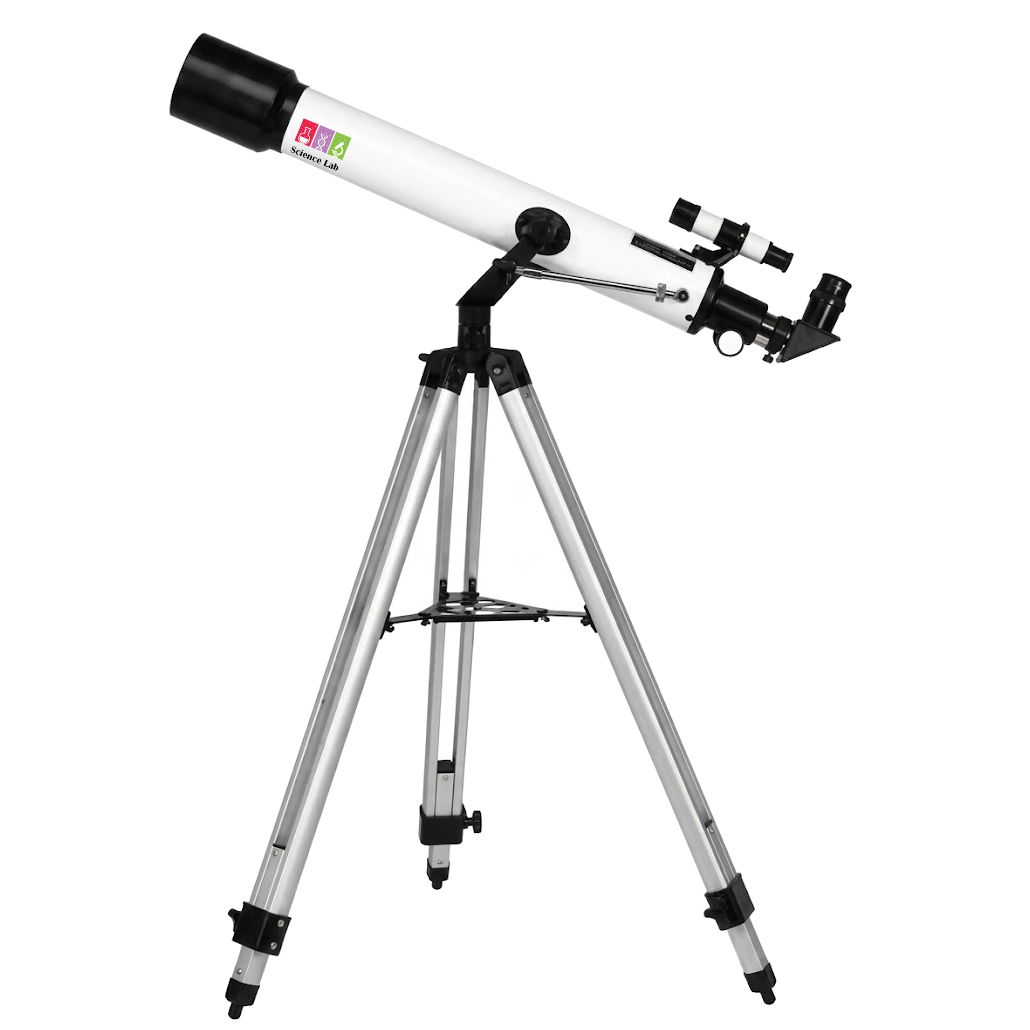
Astronomical Telescope
Astronomical Telescope (Product Code: SCL/AG26-102) is a tripod-mounted optical telescope used to observe the Moon, planets and brighter star fields in school, college and astronomy-club teaching. It has a 114mm aperture, a 5 x 24 finder scope and a set of standard 0.965" eyepieces with a 3X Barlow lens, on an extendable aluminium tripod with slow-motion vertical adjustment, a useful addition to optics lab equipment. It is supplied by Jain Scientific Equipments Pvt Ltd (ScienceLab), Ambala, India.
Specifications
| Parameter | Detail |
|---|---|
| Aperture | 114mm |
| Objective focal length | 700mm, 600mm (as listed) |
| Optical tube | White metal tube, primary objective lens at the front, diagonal eyepiece setup at the rear |
| Finder scope | 5 x 24, small auxiliary sighting scope mounted on top |
| Diagonal | Hybrid diagonal |
| Eyepieces (0.965") | SR4mm, H12.5mm, H20mm |
| Other accessories (0.965") | 3X Barlow lens; 1.5x erector |
| Mount and tripod | Lightweight, extendable aluminium three-legged stand with central accessory brace, manual alt-azimuth elevation rod and slow-motion control rod for vertical micro adjustment |
| Maximum height | 125cm |
| Accessory tray | Included |
| Product code | SCL/AG26-102 |
| Supplied by | Jain Scientific Equipments Pvt Ltd (ScienceLab), Ambala, India |
What Is the Astronomical Telescope Used For?
The 114mm aperture gathers enough light to show craters and mountains on the Moon, the phases of Venus, the four bright moons of Jupiter, the rings of Saturn and many star clusters. Students first line up a target with the small finder scope, then centre it in the main tube with the low-power H20mm eyepiece before moving to the H12.5mm or SR4mm eyepieces, or adding the 3X Barlow lens, for more magnification.
The 1.5x erector gives an upright image, so the same instrument can be used by day for distant landscapes and birds. The slow-motion rod lets you follow an object smoothly as the Earth turns. Never point the telescope or finder at the Sun without a proper solar filter, and let the tube adjust to outdoor temperature before a viewing session.
What to Specify When Ordering
- Which objective focal length you require, as the listing shows both 700mm and 600mm.
- Number of telescopes, for example one per observing group or one for the school.
- Any charts or models you want quoted with it for classroom astronomy lessons.
Supplier
Jain Scientific Equipments Private Limited, which does business as ScienceLab from Ambala, Haryana, India, supplies the Astronomical Telescope to schools, colleges, science centres, dealers and importers. We source the telescope with its finder, eyepieces, Barlow lens, erector and tripod, and can include it in larger physics and geography orders for India and international markets. You can read about the company on our company profile.
Related Physics Lab Equipment
Teaching aids that work well with the Astronomical Telescope:
- Telescope Refractor — another telescope option for comparing designs.
- Celestial Star Globe — helps students find constellations before observing.
- Solar System Model — explains planet positions seen through the eyepiece.
- Convex Lens — for bench experiments on how telescope lenses form images.
Explore more optics apparatus in Physics Lab Equipment.
Frequently Asked Questions
What aperture does the Astronomical Telescope have?
The Astronomical Telescope has a 114mm aperture. Aperture decides how much light the telescope collects, and this size is well suited to observing the Moon, the brighter planets and star clusters from a school or college observing site.
Which eyepieces come with the Astronomical Telescope?
The Astronomical Telescope comes with standard 0.965" accessories: SR4mm, H12.5mm and H20mm eyepieces, a 3X Barlow lens and a 1.5x erector. The finder is a 5 x 24 sighting scope, and an accessory tray keeps the parts together on the tripod.
How tall is the Astronomical Telescope tripod?
The Astronomical Telescope stands on a lightweight, extendable aluminium three-legged tripod with a maximum height of 125cm. It has a manual alt-azimuth elevation rod and a slow-motion control rod for fine vertical adjustment while tracking an object.
Can the Astronomical Telescope be used for daytime viewing?
Yes. With the supplied 1.5x erector, the Astronomical Telescope gives an upright image suitable for distant land objects in daylight. It must never be pointed at or near the Sun unless a proper solar filter is fitted over the front.
Who supplies the Astronomical Telescope?
The Astronomical Telescope is supplied by Jain Scientific Equipments Pvt Ltd (ScienceLab), Ambala, Haryana, India, to schools, colleges, science centres, dealers and importers. It can be combined with other physics and geography items in one order for India and international markets.
What focal length is the Astronomical Telescope?
The Astronomical Telescope listing gives the objective focal length as 700mm and 600mm. Please state which you need when requesting a quotation through the contact page, and we will confirm the exact configuration before you order.
Request a Quote
Request a quotation for the Astronomical Telescope on our contact page, giving the focal length, quantity and delivery location, or add it to the enquiry cart with other astronomy teaching aids.
Last updated: 24 September 2026
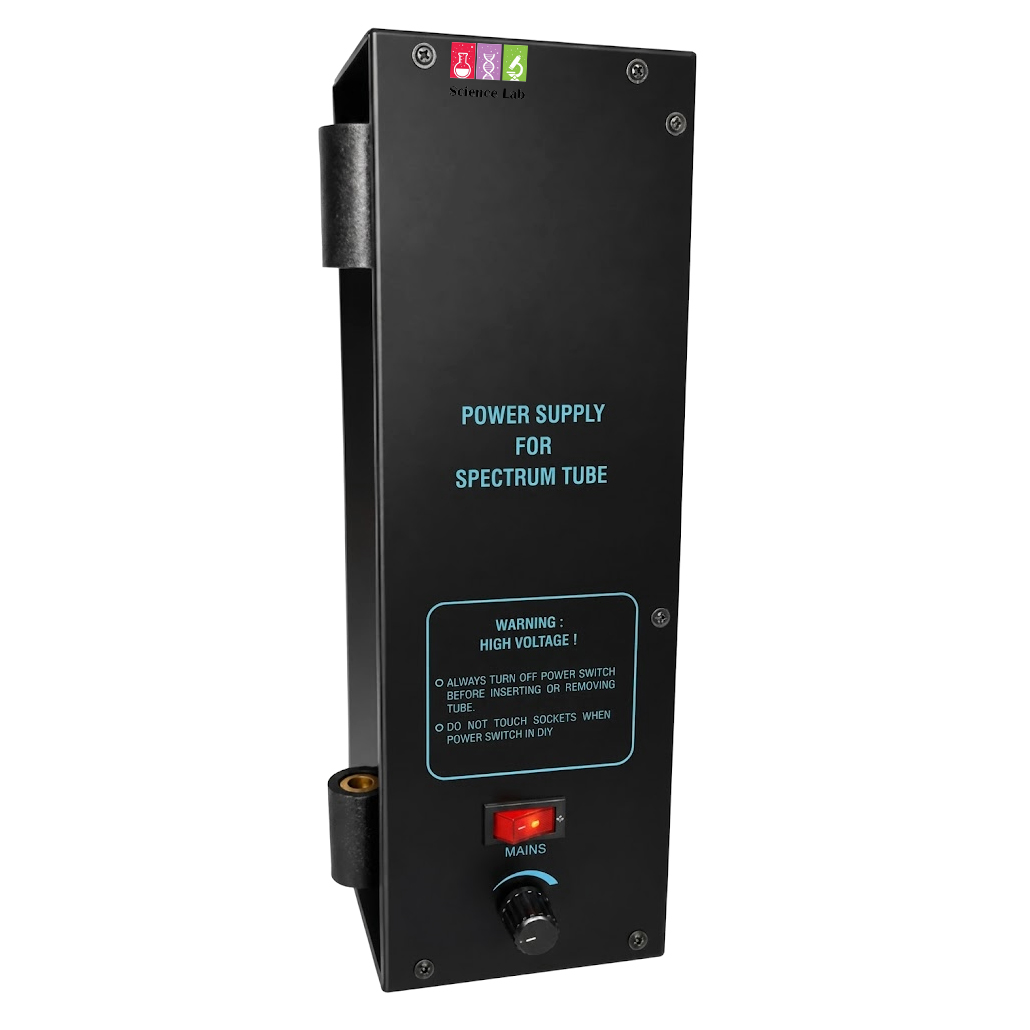
Hydrogen Spectrum Set
Hydrogen Spectrum Set (Product Code: SCL/AG26-108) is a three-unit set of a hydrogen-filled discharge tube, its power supply unit and a support rod assembly, used to produce the line spectrum of hydrogen for study in college and senior school physics laboratories. The self-contained power unit delivers 3kV at 3mA, and the tube’s metal end cap is fully hidden to protect users from accidental contact. It is supplied by Jain Scientific Equipments Pvt Ltd (ScienceLab), Ambala, India.
Specifications
| Parameter | Detail |
|---|---|
| Set composition | Three units: discharge tube, power supply unit, rod assembly |
| Discharge tube | Straight pattern, filled with hydrogen, capillary length 50mm |
| Tube connections | 4mm plug at each end; metal end cap completely hidden to avoid shocks from touch |
| Power unit output | 3kV and 3mA, rms, 50 Hz |
| Power unit top (metal) | ON/OFF switch, pilot lamp, 1A fuse, rod assembly and recessed rubber socket that takes the tube and makes contact with the live side of the circuit |
| Rod assembly | Screw-in support rod, 260mm long, with a horizontal rod at its upper end secured and adjusted by a lock-screw, and a 4mm aperture for tube connection |
| Power unit housing | Plastic box, 168mm x 92mm x 85mm (length, height, width), on four plastic feet |
| Also included | Tommy-bar that screws into the power unit top |
| Product code | SCL/AG26-108 |
| Supplied by | Jain Scientific Equipments Pvt Ltd (ScienceLab), Ambala, India |
What Is the Hydrogen Spectrum Set Used For?
When the power unit is switched on, the high voltage makes the hydrogen in the capillary glow. Viewed through a direct-vision spectroscope, diffraction grating or prism spectrometer, the light splits into a few sharp coloured lines, red, blue-green and violet, instead of a continuous rainbow. This line spectrum is the classic evidence that electrons in atoms occupy fixed energy levels, and it leads directly to the Balmer series and the Rydberg equation.
Set the tube upright in the rubber socket, clamp its top in the horizontal rod, and line the glowing capillary up with the slit of your spectrometer to measure line positions. Always switch off before inserting or removing a tube, let the tube cool after use, and keep the session under teacher supervision because the unit works at 3kV.
What to Specify When Ordering
- Your mains supply, as the input voltage is not stated in the listing; we will confirm it before quoting.
- Whether spare hydrogen discharge tubes should be quoted with the set.
- Any spectroscope or spectrometer needed to view and measure the lines.
Supplier
The Hydrogen Spectrum Set is supplied by Jain Scientific Equipments Private Limited, known as ScienceLab, from Ambala, Haryana, India. We source the complete three-unit set for colleges, schools, universities, dealers and importers, and can group it with spectrometers, spectroscopes and other optics apparatus in a single order for India and international markets. Find out more on our company profile.
Related Physics Lab Equipment
Instruments and light sources used alongside the Hydrogen Spectrum Set:
- Spectroscope, Direct Vision — quick hand-held viewing of the hydrogen lines.
- Spectrometer — for measuring line positions and working out wavelengths.
- Sodium Spectral Lamp — a second line source for comparing spectra.
- Spectrum Tube Power Supply — an alternative supply for running spectrum tubes.
- Spectral Tube Set with Voltage Source (for high school) — a multi-gas option for comparing elements.
See the complete Physics Lab Equipment range for further optics and atomic physics apparatus.
Frequently Asked Questions
What is included in the Hydrogen Spectrum Set?
The Hydrogen Spectrum Set has three units: a straight-pattern hydrogen discharge tube with 50mm capillary and 4mm plugs, a self-contained power supply unit in a 168mm x 92mm x 85mm plastic box, and a rod assembly with a 260mm support rod. A tommy-bar is also included.
What is the output of the Hydrogen Spectrum Set power unit?
The power unit of the Hydrogen Spectrum Set gives 3kV and 3mA, rms, at 50 Hz. Its metal top carries an ON/OFF switch, pilot lamp and 1A fuse, plus the recessed rubber socket that holds the discharge tube.
How does the Hydrogen Spectrum Set protect users from shock?
In the Hydrogen Spectrum Set, the metal end cap of the discharge tube is completely hidden so it cannot be touched, and the tube sits in a recessed rubber socket. Even so, users should switch off before handling the tube, as the unit operates at 3kV.
What else is needed to study spectra with the Hydrogen Spectrum Set?
To study spectra with the Hydrogen Spectrum Set you also need a way to split the light, such as a direct-vision spectroscope, a diffraction grating or a spectrometer. These are not part of the set but can be quoted together with it.
Who supplies the Hydrogen Spectrum Set?
The Hydrogen Spectrum Set is supplied by Jain Scientific Equipments Pvt Ltd (ScienceLab), Ambala, Haryana, India, to colleges, schools, universities, dealers and importers. It can be shipped with other optics and atomic physics items to buyers in India and international markets.
What details are needed for a Hydrogen Spectrum Set quotation?
For a Hydrogen Spectrum Set quotation, send the number of sets, your mains voltage, whether spare tubes or a spectrometer should be added, and the delivery location. Use the contact page and we will reply with a quotation.
Request a Quote
To request a quotation for the Hydrogen Spectrum Set, contact us through the contact page or add the set to the enquiry cart together with the spectroscope or spectrometer you plan to use.
Last updated: 24 September 2026

Microscope Compound 1000
Microscope Compound 1000 (Product Code: SCL/AG26-111) is a compound light microscope with a magnification range of 50 to 1000, used for educational and training work in schools, colleges and basic clinical teaching laboratories. It comes with three objectives, two eyepieces, a condenser with iris diaphragm and a plano-concave mirror for illumination, and is delivered in a cabinet with lock and key, which makes it a practical compound microscope for schools in India and abroad. It is supplied by Jain Scientific Equipments Pvt Ltd (ScienceLab), Ambala, India.
Specifications
| Parameter | Detail |
|---|---|
| Magnification | 50 to 1000 |
| Objectives | 3 |
| Eyepieces | 2 |
| Focusing | Separate coarse and fine adjustment knobs |
| Condenser | With iris diaphragm |
| Illumination | Plano-concave reflecting mirror directing external light through the specimen stage |
| Storage | Cabinet with lock and key |
| Typical users | Schools, colleges and basic clinical laboratories, for education and training |
| Product code | SCL/AG26-111 |
| Supplied by | Jain Scientific Equipments Pvt Ltd (ScienceLab), Ambala, India |
What Is the Compound Microscope 1000 Used For?
Students use it to study plant and animal cells, tissues, pond water organisms and prepared slides, working up from low power to the top of its 50 to 1000 range. Because light comes from a plano-concave mirror rather than a built-in lamp, it can be used with daylight from a window or with a separate bench lamp, which suits classrooms and field centres where power is not always to hand.
Tilt the mirror to send an even circle of light up through the condenser, use the flat side with a strong light source and the concave side with weaker light, and adjust the iris diaphragm for contrast. Focus first with the coarse knob at low power, then refine with the fine knob. After the lesson, lock the microscope in its cabinet to keep dust off the optics.
What to Specify When Ordering
- The powers of the three objectives and two eyepieces you need, which we will confirm with the quotation.
- Number of microscopes for your laboratory or training room.
- Slides, cover glasses or a bench lamp to be quoted with the microscopes.
Supplier
Jain Scientific Equipments Private Limited, trading as ScienceLab from Ambala, Haryana, India, supplies the Microscope Compound 1000 to schools, colleges, training institutes, dealers and importers. We source each microscope complete with its objectives, eyepieces and lockable cabinet, and can ship it together with slides and other biology apparatus to India and international markets. For company details, visit our company profile.
Related Laboratory Equipment
Useful companions for the Microscope Compound 1000:
- Basic Botany Slide (Set of 25) — prepared plant specimens for class practicals.
- Cover Glasses — for students’ own wet-mount preparations.
- Lens Tissue — safe cleaning of eyepieces, objectives and the mirror.
- Monocular Biological Microscope 400x — a lower-power option for junior classes.
- Binocular Microscope, 1000x, LED — a binocular model with built-in LED lighting.
Browse our Microscope range, or the wider Physics Lab Equipment category where this model is listed.
Frequently Asked Questions
What magnification does the Microscope Compound 1000 offer?
The Microscope Compound 1000 offers magnification from 50 to 1000, using its three objectives and two eyepieces in combination. The exact objective and eyepiece powers can be confirmed with your quotation if your syllabus specifies them.
Does the Microscope Compound 1000 need electricity?
No mains connection is listed for the Microscope Compound 1000. It uses a plano-concave reflecting mirror to direct external light, such as daylight or a separate lamp, up through the specimen stage, so it can be used where power is not available.
What comes with the Microscope Compound 1000?
The Microscope Compound 1000 comes with three objectives, two eyepieces, a condenser with iris diaphragm, separate coarse and fine focusing knobs, a plano-concave mirror and a cabinet with lock and key for secure storage between lessons.
How should the Microscope Compound 1000 be looked after?
Keep the Microscope Compound 1000 locked in its cabinet when not in use, clean lenses only with lens tissue, and carry it with one hand under the base. Lower the stage before changing objectives so that lenses and slides are not damaged.
Who supplies the Microscope Compound 1000?
Jain Scientific Equipments Pvt Ltd (ScienceLab), Ambala, Haryana, India, supplies the Microscope Compound 1000 to schools, colleges, training institutes, dealers and importers, and can include slides and accessories in the same shipment for India and international markets.
Request a Quote
For a quotation on the Microscope Compound 1000, send the quantity, preferred objective powers and delivery location through our contact page, or add it to the enquiry cart with slides and accessories.
Last updated: 24 September 2026
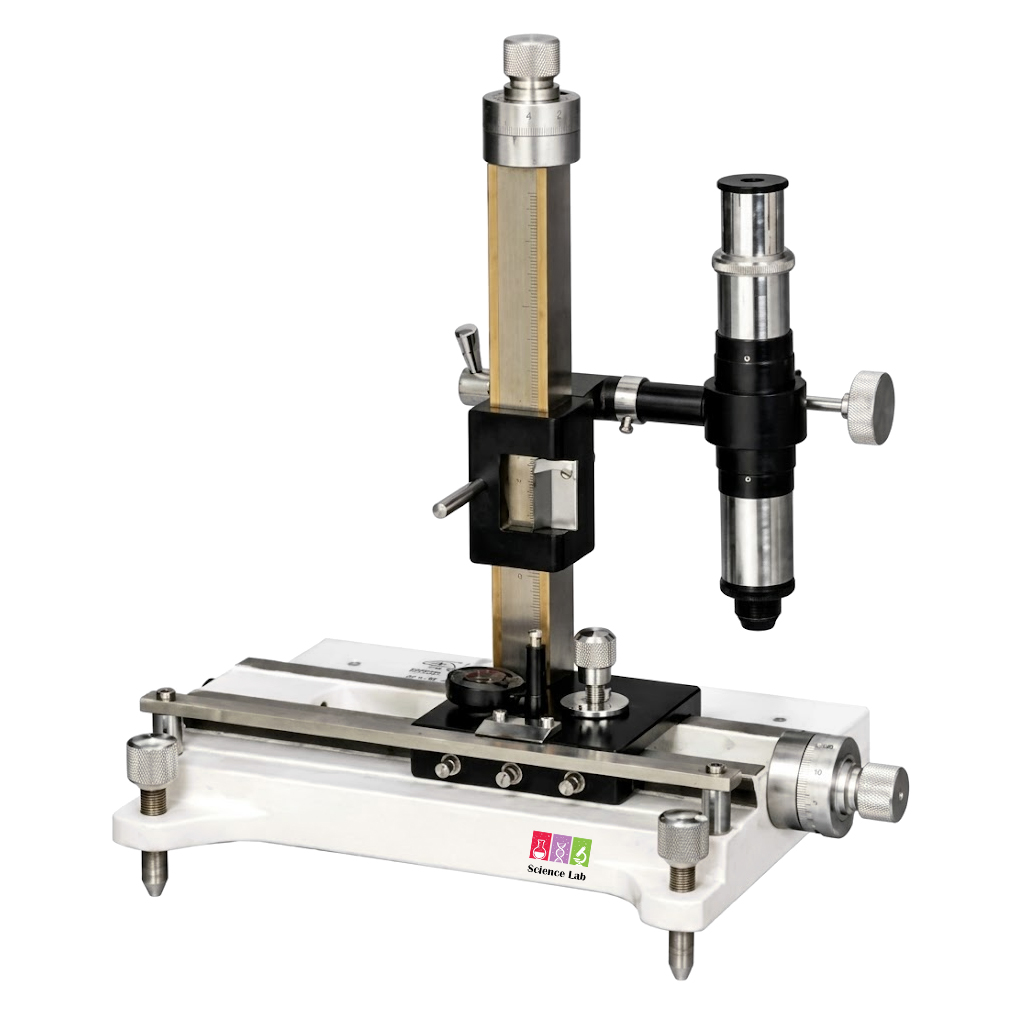
Microscope Travelling (Vernier)
Microscope Travelling (Vernier) (Product Code: SCL/AG26-113) is a vernier travelling microscope used to measure small distances accurately on two axes, horizontal and vertical, in college and senior school physics practicals. A x10 eyepiece and x3 objective ride on brass electroplated main and vernier scales reading 0-165mm horizontally and 0-120mm vertically, over a heavy cast iron base with three levelling screws. It is made by Jain Scientific Equipments Pvt Ltd (ScienceLab), an OEM manufacturer, at its own factory in Ambala, India.
Specifications
| Parameter | Detail |
|---|---|
| Measurement | Two axes (horizontal and vertical scales) |
| Vertical scale | 0-120mm, with vernier |
| Horizontal scale | 0-165mm, with vernier |
| Scale material | Main and vernier scales of brass, electroplated |
| Optics | Eyepiece x10, objective x3 |
| Focal length | 50mm |
| Slides | Vertical slide fitted on the horizontal carriage, operating in a similar way |
| Base | Heavy cast iron base fitted with three levelling screws |
| Levelling and height | Spirit level; height adjustable legs |
| Supplied with | Sturdy protective case and instruction/maintenance manual |
| Product code | SCL/AG26-113 |
| Manufacturer | Jain Scientific Equipments Pvt Ltd (ScienceLab) — OEM |
| Country of origin | India (made in Ambala, Haryana) |
What Is the Vernier Travelling Microscope Used For?
A travelling microscope measures distances too small or too delicate for a ruler or calliper, without touching the object. Typical physics practical equipment tasks include measuring the diameters of Newton’s rings, the bore of a capillary tube for surface tension and viscosity experiments, the real and apparent depth of a glass block to find its refractive index, and the thickness of thin wires or cover slips.
Level the instrument first with the spirit level and levelling screws, then focus on the object and set the cross-wire on one edge. Take the scale and vernier reading, move the carriage to the opposite edge and read again; the difference is the distance. Always approach each edge from the same direction to avoid backlash, and return the microscope to its protective case after use.
What to Specify When Ordering
- Confirm the scale ranges (0-120mm vertical, 0-165mm horizontal) suit your experiments.
- Ask us to confirm the vernier least count if your practical manual specifies one.
- Number of instruments, and any Newton’s rings or capillary apparatus to be quoted with them.
OEM Manufacturer
The Microscope Travelling (Vernier) is manufactured by Jain Scientific Equipments Private Limited, trading as ScienceLab, as the original equipment manufacturer. It is built at the company’s own licensed factory at Saha, Ambala, Haryana, India, and sold factory-direct to colleges, schools, universities, dealers and importers, so quotations and service questions go straight to the maker. Tender and institutional buyers registering a new vendor can use GSTIN 06AAECJ8618A1ZT and LEI 3358004HRD1JIVXKYX49. See our company profile for more.
Related Physics Lab Equipment
Apparatus commonly used with the Microscope Travelling (Vernier):
- Apparatus Newton’s Ring — the ring diameters are read with the travelling microscope.
- Sodium Spectral Lamp — monochromatic light source for Newton’s rings.
- Vernier Travelling Microscope — another travelling microscope model in our range.
- Caliper Vernier (Metal) — for larger dimensions that do not need a microscope.
Browse all Physics Lab Equipment for more optics and measurement apparatus.
Frequently Asked Questions
What can the Microscope Travelling (Vernier) measure?
The Microscope Travelling (Vernier) measures small distances on two axes, horizontally up to 0-165mm and vertically up to 0-120mm. It is used for Newton’s rings diameters, capillary bores, real and apparent depth, and other fine measurements in physics practicals.
What optics does the Microscope Travelling (Vernier) have?
The Microscope Travelling (Vernier) has a x10 optical eyepiece and a x3 objective, with a focal length of 50mm. This gives a clear, magnified view of the edge being measured while leaving working space between the objective and the specimen.
How is the Microscope Travelling (Vernier) levelled?
The Microscope Travelling (Vernier) stands on a heavy cast iron base fitted with three levelling screws and has a spirit level for checking. Height adjustable legs help set it at the right working height before measurements begin.
What is the least count of the Microscope Travelling (Vernier)?
Both scales of the Microscope Travelling (Vernier) carry a vernier for fine readings. If your practical manual requires a specific least count, please ask through the contact page and we will confirm it before you order.
Who manufactures the Microscope Travelling (Vernier)?
Jain Scientific Equipments Pvt Ltd (ScienceLab) manufactures the Microscope Travelling (Vernier) as the OEM at its own licensed factory at Saha, Ambala, Haryana, India. It is supplied factory-direct with a protective case and instruction/maintenance manual to buyers in India and international markets.
Can a calibration certificate be supplied with the Microscope Travelling (Vernier)?
Calibration documentation is not part of the Microscope Travelling (Vernier) listing. If your laboratory needs a calibration certificate, please discuss it with us through the contact page before ordering so we can confirm what is possible.
Request a Quote
Request a quotation for the Microscope Travelling (Vernier) through our contact page, or add it to the enquiry cart with related optics apparatus. Quotations come directly from the manufacturer in Ambala for single colleges and bulk orders.
Last updated: 24 September 2026
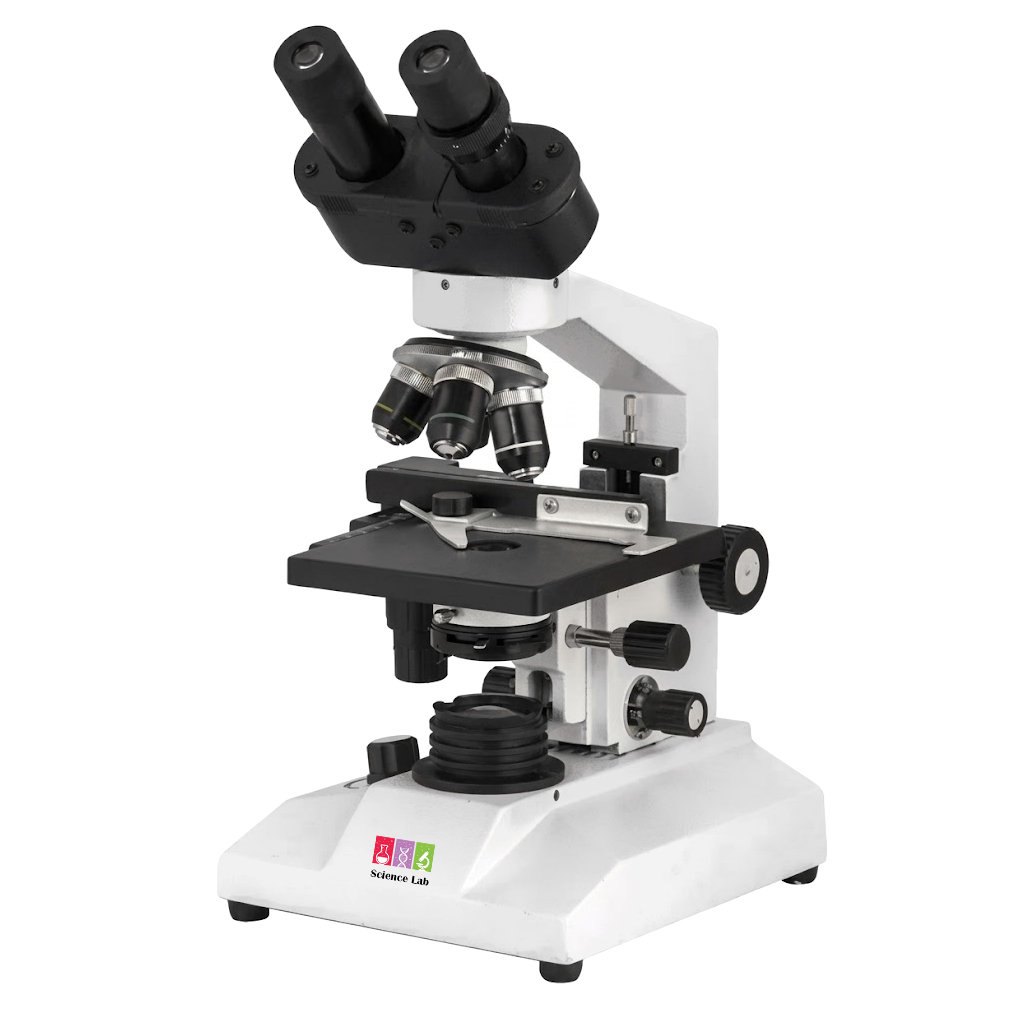
Microscope x 600
Microscope x 600 (Product Code: SCL/AG26-115) is a compound light microscope used to examine specimens at magnifications from 50x to 600x in biology, bacteriology and teaching laboratories. Universities, research institutions and school science departments choose it for its all-metal body, three objectives and two eyepieces with a pointer, packed in a lockable cabinet. It is supplied by Jain Scientific Equipments Pvt Ltd (ScienceLab), Ambala, India, to buyers looking for a sturdy compound microscope in India and abroad.
Specifications
| Parameter | Detail |
|---|---|
| Magnification | 50x to 600x |
| Objectives | 3 |
| Eyepieces | 2, with pointer |
| Body | All-metal, sturdy construction |
| Condenser | With iris diaphragm |
| Mirror | Plano-concave |
| Focusing | Coarse and fine |
| Illumination | Light source included |
| Storage | Cabinet with lock and key, carrying handle |
| Intended use | General biology and bacteriology work in laboratories, research institutions and universities; teaching demonstrations |
| Product code | SCL/AG26-115 |
| Supplied by | Jain Scientific Equipments Pvt Ltd (ScienceLab), Ambala, India |
What Is the 600x Microscope Used For?
In biology and bacteriology practicals, this microscope is used to study cells, tissues and microorganisms on prepared or freshly mounted slides. Students usually find the specimen at 50x, then move up through the objectives until fine structure is visible at 600x. The pointer in the eyepiece lets a teacher mark a nucleus, cell wall or colony so the whole group looks at the same feature during a demonstration.
For good images, use coarse focus only at low power and switch to fine focus once a higher objective is in place. Closing the iris diaphragm on the condenser raises contrast on pale, unstained material, while opening it brightens stained slides. Because it is a complete kit in a locking cabinet, it works well as shared biology lab equipment in India where microscopes move between rooms.
Supplier
Jain Scientific Equipments Private Limited, which trades under the ScienceLab name, supplies the Microscope x 600 from Ambala, Haryana. Schools, colleges, universities, research laboratories and dealers in India and international markets buy it together with slides and related optics in a single order. More about the company is on the ScienceLab company profile.
Related Physics Lab Equipment
These items are used with a 600x microscope for preparing and storing slides, or as alternatives when a different viewing setup is needed:
- Microscope Compound 1000 — an alternative when a higher top magnification is required.
- Binocular Microscope, 1000x, LED — two-eyed viewing with LED lighting for longer sessions.
- Microscope Slides Glass — plain slides for mounting specimens.
- Glass Cover Slips — to cover wet mounts before viewing.
- Blue Box, for storing Microscope Slides — keeps a class set of slides organised.
See the full Physics Lab Equipment range for optics and other practical apparatus.
Frequently Asked Questions
What magnification range does the Microscope x 600 cover?
The Microscope x 600 covers magnifications from 50x to 600x. It reaches this range by combining its three objectives with its two eyepieces, so students can locate a specimen at low power and then examine detail at the top setting.
What comes with the Microscope x 600?
The Microscope x 600 comes with three objectives, two eyepieces with a pointer, a condenser with iris diaphragm, a plano-concave mirror and a light source. Everything is packed in a cabinet with lock and key and a carrying handle for storage and transport.
How is light provided on the Microscope x 600?
The Microscope x 600 is listed with a light source as well as a plano-concave mirror for directing light into the condenser. The iris diaphragm on the condenser then lets the user balance brightness and contrast for each specimen.
Is the Microscope x 600 suitable for bacteriology classes?
Yes, the Microscope x 600 is described for general biology and bacteriology work in laboratories, research institutions and universities. If your syllabus calls for more than 600x, compare it with the higher-power compound microscope listed above or ask us which model fits.
Who supplies the Microscope x 600?
The Microscope x 600 is supplied by Jain Scientific Equipments Pvt Ltd (ScienceLab) of Ambala, Haryana, India. The company provides it to schools, colleges, universities, research laboratories and dealers, and quotes for single units or full class sets.
What should a quotation request for the Microscope x 600 include?
A quotation request for the Microscope x 600 should state the number of microscopes, any slides or cover slips wanted with them, the delivery address and whether the order is for export. Send these details through the contact page for a written quote.
Can the Microscope x 600 be ordered in bulk for export?
Yes, the Microscope x 600 can be quoted in quantity for institutions and distributors in India and international markets. Each unit comes in its own lockable cabinet; share the quantity and destination on the contact page so packing and freight can be planned.
Request a Quote
To order the Microscope x 600, send your quantity and delivery location through the contact page, or add it to the enquiry cart with slides and other items for one combined quotation.
Last updated: 24 September 2026
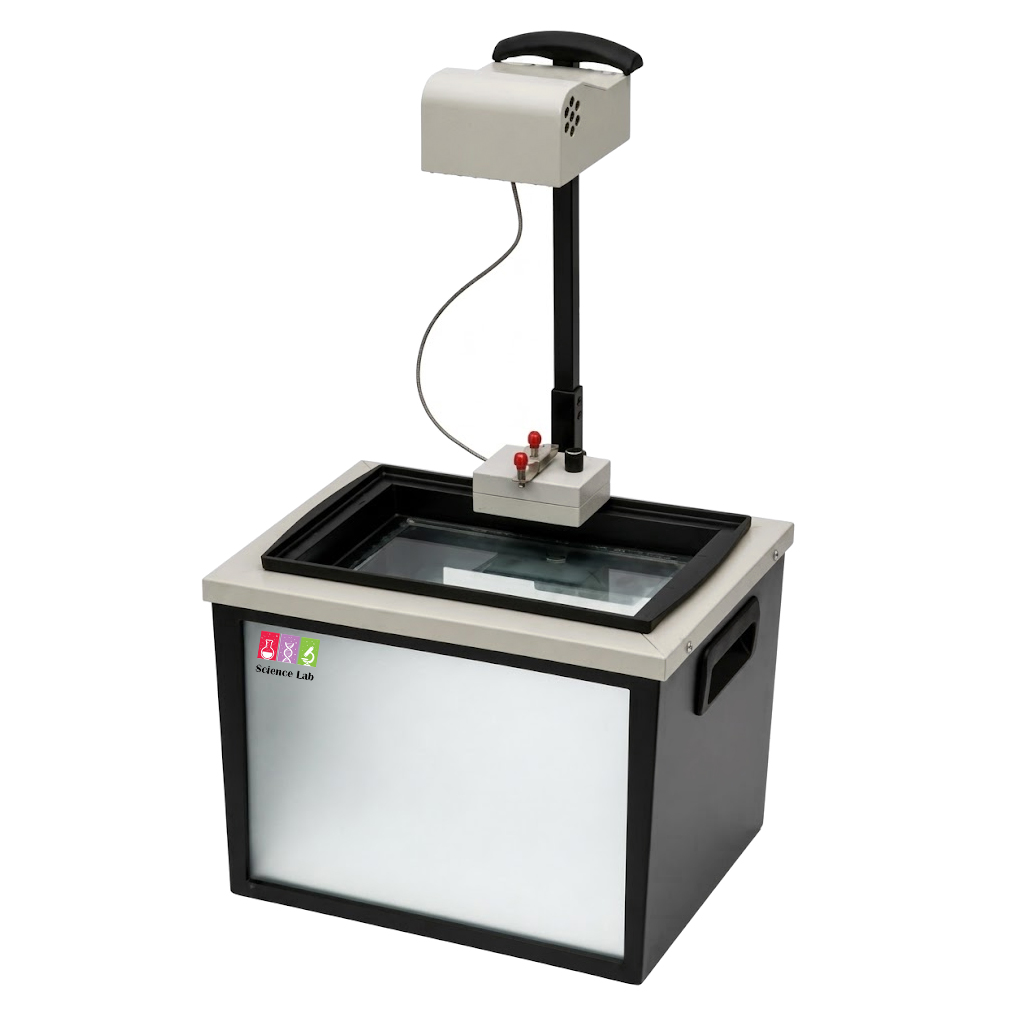
Ripple Tank Kit
Ripple Tank Kit (Product Code: SCL/AG26-117) is a wave demonstration set used to show reflection, refraction, diffraction and interference of water waves in school and college physics laboratories. Teachers run it on a 600 mm × 500 mm wooden tray with a plate-glass base, driven by a small DC motor on a wave generator bar. It is supplied by Jain Scientific Equipments Pvt Ltd (ScienceLab), Ambala, India, with its illuminant, rheostat and power supply unit as a complete wave motion kit for schools.
Specifications
| Parameter | Detail |
|---|---|
| Purpose | Visual demonstration of wave motion: reflection, refraction, diffraction and interference |
| Tray | Wooden, with plate-glass base and detachable legs |
| Tray overall size | 600 mm × 500 mm × 55 mm deep |
| Generator supports | Pair of support rods with integral G clamps attached to the tray sides |
| Wave generator bar | Waxed wood, 330 mm long, with a row of holes; 1.5 to 4.5 V DC electric motor mounted at the centre |
| Dippers | 2 spherical dippers |
| Barriers (set of 4, metal) | Two straight, 150 mm × 25 mm; one curved, 215 mm chord length × 25 mm high; one short straight, 25 mm × 25 mm |
| Beaches | Set of 4 mesh beaches |
| Accessories (one each) | Water dropper; wooden rod 230 mm × 25 mm dia.; rubber tube 600 mm × 6 mm bore; glass plate 300 × 202 × 4 mm; sponge; Hoffmann clip; support for illuminant; illuminant; rheostat to control motor speed; ripple tank power supply unit |
| Spare | Extra 4.5 V DC motor |
| Documentation | Instruction book |
| Product code | SCL/AG26-117 |
| Supplied by | Jain Scientific Equipments Pvt Ltd (ScienceLab), Ambala, India |
What Is the Ripple Tank Used For?
A ripple tank turns invisible wave behaviour into patterns a whole class can watch. With a shallow layer of water in the tray and the illuminant above it, light passing through the glass base throws bright and dark wave bands onto a white sheet below. The vibrating bar sends straight wavefronts across the water, while the spherical dippers produce circular ripples; using both dippers together gives a clear interference pattern.
The metal barriers show reflection from flat and curved surfaces and, set with a gap between them, diffraction through an opening. Laying the glass plate in the tray creates a shallower zone where waves slow down and bend, which demonstrates refraction. Level the tray with its legs, keep the water depth even, and use the rheostat to change motor speed and therefore wavelength; the mesh beaches soak up waves at the edges so patterns stay clean. It makes a practical physics demonstration kit for India's secondary and senior classes.
What to Specify When Ordering
- Number of complete kits (each with tray, wave generator, barriers, dippers, beaches, illuminant, rheostat and power supply unit).
- Whether spare motors are wanted beyond the extra 4.5 V DC motor already included.
- Whether a separate stroboscope is needed to freeze moving wave patterns.
- Delivery location and whether the order is for export.
Supplier
ScienceLab is the trading name of Jain Scientific Equipments Private Limited, Ambala, Haryana, which supplies this ripple tank kit to schools, colleges, teacher-training centres and distributors in India and international markets. Questions about the contents list, spare motors and delivery are handled by the same sales team. Company background is on the ScienceLab profile page.
Related Physics Lab Equipment
These items suit the same wave lessons, either as alternatives to this kit or as additions to it:
- Ripple Tank — a separate ripple tank model to compare.
- Mini Ripple Tank — a compact option for small-group work.
- Xenon Stroboscope — makes moving wave patterns appear to stand still.
- Wave Form, Helix — a second way to show wave motion alongside the tank.
Browse all Physics Lab Equipment for further mechanics, optics and wave apparatus.
Frequently Asked Questions
What experiments can be done with the Ripple Tank Kit?
The Ripple Tank Kit is designed for visual demonstrations of wave motion, including reflection, refraction, diffraction and interference. Its barriers, spherical dippers, mesh beaches and glass plate let a teacher set up each effect in turn in the same tray.
What size is the Ripple Tank Kit tray?
The Ripple Tank Kit tray measures 600 mm × 500 mm overall and 55 mm deep. It is made of wood with a plate-glass base and detachable legs, so the legs can be removed when the tank is put away.
How are waves generated in the Ripple Tank Kit?
Waves in the Ripple Tank Kit come from a 1.5 to 4.5 V DC electric motor mounted at the centre of a waxed wooden wave generator bar, 330 mm long. The bar is carried on support rods with integral G clamps, and a rheostat sets the motor speed.
Is a power supply included with the Ripple Tank Kit?
Yes, the Ripple Tank Kit accessories include a ripple tank power supply unit, a rheostat for motor speed, an illuminant and a support for the illuminant. An extra 4.5 V DC motor is also packed as a spare.
Who supplies the Ripple Tank Kit?
The Ripple Tank Kit is supplied by Jain Scientific Equipments Pvt Ltd (ScienceLab), Ambala, Haryana, India. It is offered to schools, colleges and dealers in India and international markets, with its instruction book included in the set.
What should a quote request for the Ripple Tank Kit include?
A quote request for the Ripple Tank Kit should give the number of kits, any extra spare motors or a stroboscope wanted, the delivery address and whether the shipment is for export. Send these details through the contact page.
Request a Quote
Send your Ripple Tank Kit requirement through the contact page, or add the kit to the enquiry cart with any other wave apparatus to receive one quotation for the whole list.
Last updated: 24 September 2026
Sodium Lamp Kit
Sodium Lamp Kit (Product Code: SCL/AG26-119) is a low-pressure sodium discharge light source used to give monochromatic yellow light for optics experiments in physics and chemistry laboratories. It uses a 45 W sodium discharge tube housed in a metal shield with a 25 mm diameter aperture, for 200–250 V AC supplies. It is supplied by Jain Scientific Equipments Pvt Ltd (ScienceLab), Ambala, India, as part of its optics lab equipment for India and overseas buyers.
Specifications
| Parameter | Detail |
|---|---|
| Lamp type | Low-pressure sodium tubular gas-discharge lamp |
| Tube rating | 45 W sodium discharge tube |
| Housing | Metal shield with a 25 mm diameter aperture |
| Supply | For use on 200–250 V AC supplies |
| Control gear | Designed to operate with a matching electrical ballast/transformer |
| Applications | Physics and chemistry laboratory experiments, optical polarimetry, monochromatic lighting, scientific demonstrations |
| Product code | SCL/AG26-119 |
| Supplied by | Jain Scientific Equipments Pvt Ltd (ScienceLab), Ambala, India |
What Is the Sodium Lamp Used For?
The light from a low-pressure sodium lamp is concentrated in a narrow yellow band, the sodium D lines, so it serves as a reference source wherever one known colour is needed. Physics students shine it on the slit of a spectrometer to measure prism angles and refractive index, and use it for interference work such as Newton's rings. In chemistry, it is the traditional light for a polarimeter measuring the optical rotation of sugar and other solutions.
Always run the lamp through its matching ballast or transformer, never straight from the socket. Give it time after switching on until the yellow output is steady, then turn the 25 mm aperture towards the slit or instrument being lit. Avoid switching it on and off repeatedly during a practical, and let the shield cool before the lamp is moved.
What to Specify When Ordering
- The mains supply at your site (the lamp is for 200–250 V AC supplies).
- Whether a matching ballast, transformer or spectral lamp power supply should be quoted with the lamp.
- The number of kits, and the spectrometers or polarimeters they will serve.
Supplier
Jain Scientific Equipments Private Limited, known by its trading name ScienceLab, supplies the Sodium Lamp Kit from Ambala, Haryana, to physics and chemistry departments, universities, research laboratories and dealers in India and international markets. Buyers who list the instruments the lamp will light can have the power arrangement discussed at quotation stage. Read about the company on the ScienceLab profile.
Related Physics Lab Equipment
These products are used with a sodium light source in optics practicals, or offer another way to set one up:
- Sodium Spectral Lamp — another sodium light source to compare.
- Spectral Lamp Power Supply with Lamp Holder — power and mounting for spectral lamps; ask us about compatibility.
- Spectro Meter — measures angles of deviation using the yellow sodium light.
- Prism, Borosilicate Glass — for refractive-index measurements on the spectrometer table.
More optics and light sources are listed under Physics Lab Equipment.
Frequently Asked Questions
What wattage is the tube in the Sodium Lamp Kit?
The Sodium Lamp Kit uses a 45 W low-pressure sodium discharge tube. The tube sits inside a metal shield, and light leaves through a 25 mm diameter aperture that can be turned towards the slit of an optical instrument.
What mains supply does the Sodium Lamp Kit need?
The Sodium Lamp Kit is for use on 200–250 V AC supplies. It is designed to operate through a matching electrical ballast or transformer rather than directly from the socket, so confirm your supply and control gear when ordering.
Is a ballast included with the Sodium Lamp Kit?
The description of the Sodium Lamp Kit says it works with a matching ballast or transformer but does not state whether one is packed with it. Please ask us through the contact page so the quotation shows exactly what is included.
What is the Sodium Lamp Kit used for?
The Sodium Lamp Kit provides monochromatic yellow light for physics and chemistry laboratory experiments, optical polarimetry and general monochromatic lighting. Typical uses include spectrometer, polarimeter and interference practicals where a single known wavelength is needed.
Who supplies the Sodium Lamp Kit?
The Sodium Lamp Kit is supplied by Jain Scientific Equipments Pvt Ltd (ScienceLab), Ambala, Haryana, India, to schools, colleges, universities and research laboratories. Dealers and institutions in India and international markets can request quotations directly.
How should the Sodium Lamp Kit be handled after use?
Switch the Sodium Lamp Kit off and let the metal shield cool before moving or packing it, because discharge lamps run hot. Handle the kit gently, as the tube inside is a glass gas-discharge lamp, and store it in a dry place.
Request a Quote
For a quotation on the Sodium Lamp Kit, write to us on the contact page with your quantity and mains supply, or place it in the enquiry cart alongside a spectrometer or prism for a single combined quote.
Last updated: 24 September 2026
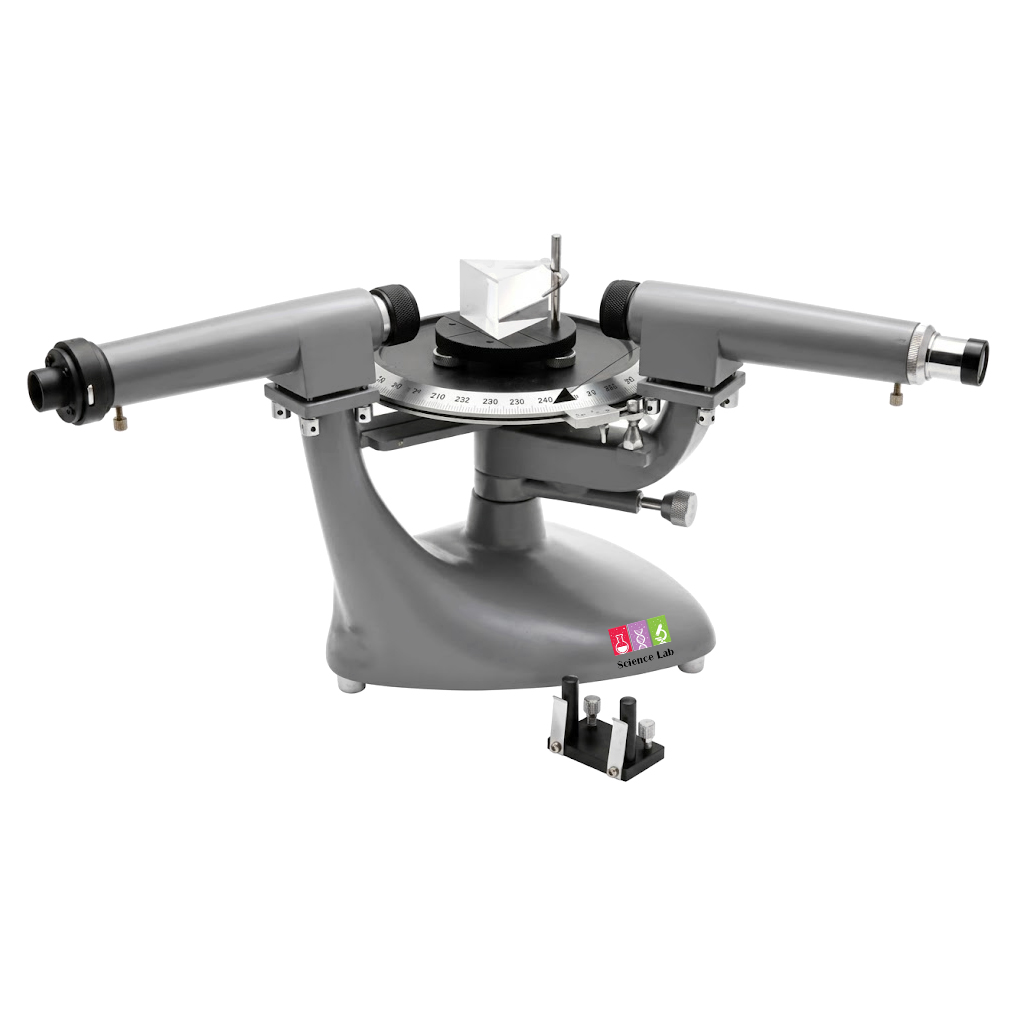
Spectro Meter
Spectro Meter (Product Code: SCL/AG26-121) is a prism and grating spectrometer used to measure angles of deviation, refractive index and wavelengths of light in college and senior-school physics laboratories. Its collimator and telescope are heavy castings, and angles are read on a 170 mm diameter circle scale graduated 0–360° with a spring-loaded vernier. It is made by Jain Scientific Equipments Pvt Ltd (ScienceLab), an OEM manufacturer, at its own factory in Ambala, India, for buyers who need a laboratory spectrometer in India or abroad.
Specifications
| Parameter | Detail |
|---|---|
| Construction | Main structural parts, including collimator and telescope, are heavy castings; other metal parts polished bright |
| Stand | Carried on three plastic legs |
| Circle scale | 170 mm dia., graduated 0–360° in 1° divisions, independently rotatable with locking screw |
| Vernier | Spring-loaded, rust-proof metal |
| Collimator | Axis adjustment; objective lens 150 mm, 21 mm aperture; unilaterally adjustable slit, 6 mm long |
| Telescope | Fine adjustment, locking screw and axis adjustment; objective 170 mm, 21 mm aperture; spiral focusing system |
| Eyepiece | Cross wire, locking-ring focus adjustment |
| Prism table | Three levelling screws; lines marked to assist placing the prism |
| Accessories | Small screwdriver, tommy bar, prism clamp for prisms up to 40 mm high, 1 diffraction grating holder with 25 × 25 mm aperture |
| Packing | Sturdy box with carrying handle |
| Documentation | Instructions and maintenance manual |
| Product code | SCL/AG26-121 |
| Manufacturer | Jain Scientific Equipments Pvt Ltd (ScienceLab) — OEM |
| Country of origin | India (made in Ambala, Haryana) |
What Is the Spectrometer Used For?
The instrument covers the standard optics practicals of undergraduate and senior secondary courses. With a glass prism on the table, students find the angle of the prism and the angle of minimum deviation, then calculate refractive index and dispersive power. Swapping the prism for a diffraction grating in the holder lets them measure the wavelengths of spectral lines from a sodium or other discharge lamp, which is why it is often listed as a prism spectrometer in India's practical syllabi.
Good readings start with setup: level the prism table using its three screws, focus the eyepiece on the cross wire, then focus the telescope and collimator for parallel light. Keep the slit narrow for sharp lines, lock the relevant screw before using the fine adjustment, and add the vernier reading to the main scale value for each angle. The carrying box keeps the optics protected between sessions.
What to Specify When Ordering
- Number of spectrometers needed per laboratory.
- Prisms and diffraction gratings wanted (the clamp takes prisms up to 40 mm high; the grating holder has a 25 × 25 mm aperture).
- Light source to be quoted with it, such as a sodium lamp.
- Delivery location and whether the order is for export.
OEM Manufacturer
Jain Scientific Equipments Private Limited, trading as ScienceLab, is the OEM (original equipment manufacturer) of the Spectro Meter. The company makes this spectrometer at its own licensed factory at Saha, Ambala, Haryana, India, rather than sourcing it from a trader, and supplies it factory-direct to physics departments, colleges, schools, distributors and importers in India and international markets.
Because the maker handles your enquiry itself, questions about matching instruments for a repeat order or about replacement accessories such as the prism clamp or grating holder go straight to the manufacturer — just ask us. Production takes place at the company's licensed factory at 449, HSIIDC Industrial Area, Saha, Ambala (Factory Licence AMB-ONLINE-CHD-J-414), and the company is registered under CIN U29309HR2020PTC087597. Further background is on the ScienceLab company profile.
Related Physics Lab Equipment
These items complete a spectrometer bench, or offer an alternative instrument:
- Sodium Lamp Kit — monochromatic light source for the collimator slit.
- Sodium Spectral Lamp — another sodium source for wavelength work.
- Prism, Clear Glass — a prism for refractive-index practicals on the table.
- Spectrometer — a different spectrometer model to compare.
View the complete Physics Lab Equipment range for more optics apparatus.
Frequently Asked Questions
What scale does the Spectro Meter use?
The Spectro Meter has a 170 mm diameter circle scale graduated from 0 to 360° in 1° divisions, read with a spring-loaded vernier of rust-proof metal. The scale rotates independently and can be fixed in place with its locking screw.
What accessories come with the Spectro Meter?
The Spectro Meter comes with a small screwdriver, a tommy bar, a prism clamp for prisms up to 40 mm high and one diffraction grating holder with a 25 × 25 mm aperture. It is packed in a sturdy box with a carrying handle, plus an instructions and maintenance manual.
Can the Spectro Meter be used with a diffraction grating?
Yes, the Spectro Meter includes a diffraction grating holder with a 25 × 25 mm aperture, so grating experiments can be set up on the prism table. The grating itself is not listed in the contents, so add it to your enquiry if you need one.
What light source is needed with the Spectro Meter?
The Spectro Meter needs a separate light source at the collimator slit, such as a sodium lamp for monochromatic work. Lamps are not listed among its contents, so the Sodium Lamp Kit or Sodium Spectral Lamp can be quoted with it on request.
Who manufactures the Spectro Meter?
The Spectro Meter is manufactured by Jain Scientific Equipments Pvt Ltd (ScienceLab), the OEM, at its own licensed factory in Saha, Ambala, Haryana, India. It is supplied factory-direct to colleges, schools, universities and dealers in India and international markets, with quotations coming from the manufacturer itself.
What should a quotation request for the Spectro Meter specify?
A quotation request for the Spectro Meter should specify the number of instruments, any prisms, gratings or lamps needed with them, the delivery location and whether the order is for export. Send the list through the contact page for a combined quote.
Request a Quote
Ask for a Spectro Meter quotation on the contact page, or build a full optics list in the enquiry cart with lamps and prisms and send it in one go. Quotations come direct from the manufacturer.
Last updated: 24 September 2026
Materials Kit
A selection of materials in the form of rectangular blocks intended to familiarize the student with appearance, feel, texture, hardness and density of a range of common substances.