- Physics Lab Equipment
- Chemistry Lab Equipment
- Biology Lab Equipment
- Anatomical Lab Equipment
- Learning
- Educational Lab Equipment
- Magnets
- Agriculture
- Astronomy
- Earth Science
- Geography Lab Equipment
- Safety Lab Coat
- Laboratory
- Meteorological
- Electricity & Magnetism
- Heat
- School Lab Equipment
- Lab Glassware
- Science Lab Equipment
- Tvet Lab Equipment
- Robotics Kits Supplier and Manufacturer for Schools India
- Math Lab Equipment Manufacturers and Exporters in Ambala
- STEM Kits Manufacturers and Supplier India
- Engineering Lab Equipment
- Hospital Lab Equipment
- Water, Sanitation & Hygiene Supplies
- Cold Chain, Solar & Communication Equipment
- Nutrition
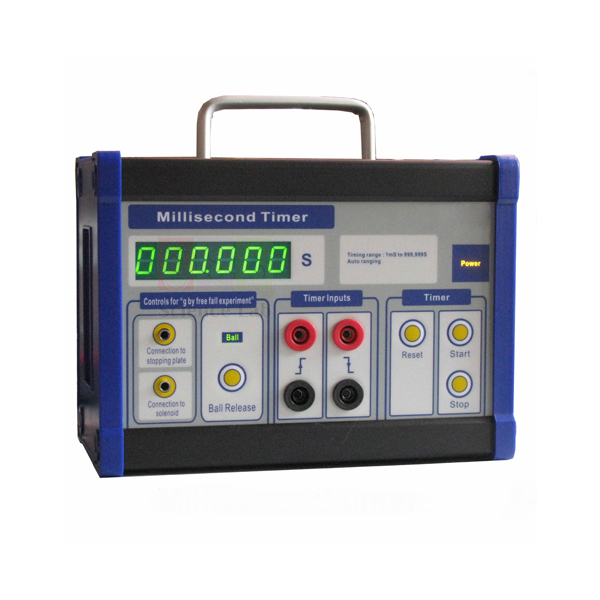
Millisecond Timer
Millisecond Timer (Product Code: SLE/PHY/251) is an electronic laboratory timer used to measure short time intervals in school and college mechanics experiments, including finding the acceleration due to gravity (g) by free fall. It works with free-fall apparatus and/or light gates and also supports manual timing, with 2 switch input sockets and 4 rear sockets for light gates. It is supplied by Jain Scientific Equipments Pvt Ltd (ScienceLab), Ambala, India.
Key Details
| Parameter | Detail |
|---|---|
| Functions | g by free fall experiment; manual timing |
| Works with | G by free fall apparatus and/or light gates |
| Manual switch inputs | 2 input sockets |
| Light gate inputs | 4 input sockets at the back |
| Resolution, range and power | Not stated in the product listing — ask us |
| Product code | SLE/PHY/251 |
| Supplied by | Jain Scientific Equipments Pvt Ltd (ScienceLab), Ambala, India |
What Is a Millisecond Timer Used For?
In the classic g-by-free-fall experiment, the timer starts when a ball is released and stops when it strikes a switch below, giving the fall time for a measured height. Repeating the drop from several heights lets students plot a graph and find g from its gradient. The two manual-switch sockets make the same unit useful for any start-stop event that is too quick to time with a hand-held stopwatch.
With light gates connected to the rear sockets, the timer records how long a card takes to pass through a beam, or the interval between two gates, so students can work out the speeds and accelerations of trolleys and gliders. That flexibility makes it a practical piece of mechanics lab equipment for motion, collision and free-fall work. Keep leads clear of moving parts and reset the display before each run so no earlier reading is carried over.
What to Specify When Ordering
- The number of timers needed for demonstration or student benches.
- Whether you need free-fall apparatus, light gates or both, and how many gates (up to the 4 rear sockets).
- Whether manual switches should be quoted for the 2 switch input sockets.
Supplier
ScienceLab is the brand name used by Jain Scientific Equipments Private Limited of Ambala, Haryana, India. The company supplies the Millisecond Timer to schools, colleges, dealers and institutional buyers in India and international markets, so it can be ordered in one enquiry with the free-fall and light-gate apparatus it works with. Read about the company on the ScienceLab profile page.
Related Physics Lab Equipment
These items are timed with, or can replace, the Millisecond Timer in mechanics practicals:
- G By Freefall Apparatus and Timer — free-fall set-up for the g experiment.
- Apparatus Air Track Light Gate — a light gate for timing gliders on an air track.
- Dynamics Kit, Track & Accessories — trolley experiments that are timed with light gates.
- Digital Timer — an alternative timer in the range.
- Scaler Timer — a combined counting and timing instrument.
Find more mechanics and timing apparatus in the Physics Lab Equipment category.
Frequently Asked Questions
What experiments can the Millisecond Timer be used for?
The Millisecond Timer is designed for the g by free fall experiment and for manual timing, and it can also time motion using light gates. Typical uses are finding the acceleration due to gravity, measuring trolley or glider speeds and timing short switch-controlled events.
How many inputs does the Millisecond Timer have?
The Millisecond Timer has 2 input sockets for connecting a manual switch and 4 input sockets at the back for connecting light gates. One unit can therefore handle simple start-stop timing as well as motion experiments that use several gates.
Does the Millisecond Timer work with light gates?
Yes. The Millisecond Timer can be used with G By Freefall apparatus and/or light gates, which connect to the 4 input sockets at the back. Tell ScienceLab which light gates you already have so the connection can be confirmed before you order.
What is the resolution of the Millisecond Timer?
The product listing for the Millisecond Timer does not state its display resolution, maximum range or power supply. Ask ScienceLab through the contact page for these details before ordering, especially if your experiment needs a particular timing resolution.
Who supplies the Millisecond Timer?
The Millisecond Timer is supplied by Jain Scientific Equipments Pvt Ltd (ScienceLab) of Ambala, Haryana, India, to schools, colleges, dealers and institutional buyers in India and international markets, together with free-fall and light-gate apparatus when required.
Is a calibration certificate available for the Millisecond Timer?
Whether a calibration certificate can be supplied with the Millisecond Timer should be discussed with ScienceLab at the enquiry stage. Share your requirement through the contact page, and the team will confirm what documentation is available for this timer.
Request a Quote
Send the quantity of Millisecond Timers (SLE/PHY/251) and any free-fall or light-gate items you need through the ScienceLab contact page, or add them to the enquiry cart to receive a quotation.
Last updated: 24 September 2026