- Physics Lab Equipment
- Chemistry Lab Equipment
- Biology Lab Equipment
- Anatomical Lab Equipment
- Learning
- Educational Lab Equipment
- Magnets
- Agriculture
- Astronomy
- Earth Science
- Geography Lab Equipment
- Safety Lab Coat
- Laboratory
- Meteorological
- Electricity & Magnetism
- Heat
- School Lab Equipment
- Lab Glassware
- Science Lab Equipment
- Tvet Lab Equipment
- Robotics Kits Supplier and Manufacturer for Schools India
- Math Lab Equipment Manufacturers and Exporters in Ambala
- STEM Kits Manufacturers and Supplier India
- Engineering Lab Equipment
- Hospital Lab Equipment
- Water, Sanitation & Hygiene Supplies
- Cold Chain, Solar & Communication Equipment
- Nutrition
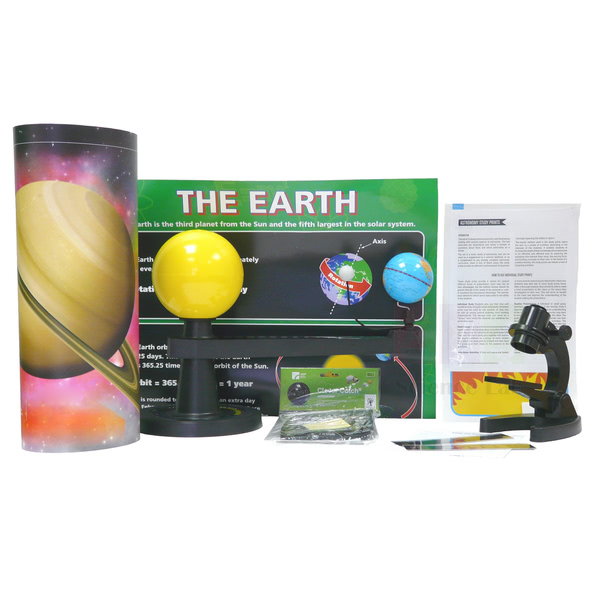
Astronomy Activity Kit
Astronomy Activity Kit (Product Code: SLE/PHY/133) is a classroom activity set used to teach the solar system, from the names and positions of the planets to eclipses, constellations and the seasons, in school science lessons. Its materials also introduce students to other bodies in the solar system, such as asteroids, meteors and comets, which keeps the topic hands-on and engaging. It is made by Jain Scientific Equipments Pvt Ltd (ScienceLab), an OEM manufacturer, at its own factory in Ambala, India.
Key Details
| Parameter | Detail |
|---|---|
| Type | Activity set for exploring the solar system |
| Topics covered | Names and positions of the planets; eclipses; constellations; seasons; the Earth, Sun and Moon |
| Other bodies introduced | Asteroids, meteors and comets |
| Contents | Not itemised in our listing — ask us for the current contents list |
| Product code | SLE/PHY/133 |
| Manufacturer | Jain Scientific Equipments Pvt Ltd (ScienceLab) — OEM |
| Country of origin | India (made in Ambala, Haryana) |
What Is the Astronomy Activity Kit Used For?
The kit follows the natural order of an astronomy unit. Students first become familiar with the names and positions of the planets, then move on to how eclipses happen, how constellations are recognised, and how the Earth, Sun and Moon together explain the seasons. Along the way the materials bring in asteroids, meteors and comets, so learners see that the solar system holds far more than the planets alone.
Teachers can run it as a guided whole-class lesson or split the materials between groups, each taking one topic and reporting back to the class. It pairs well with a solar system model or globe on the teacher's desk, and it suits earth science periods and science clubs as well as regular physics lessons.
What to Specify When Ordering
- Contents — ask for the current contents list so you can check it against your syllabus.
- Quantity — one kit per class, or one per student group.
- Companion models — whether a solar system model, planetarium set or globe should be quoted with it.
OEM Manufacturer
The Astronomy Activity Kit is produced by Jain Scientific Equipments Private Limited under its ScienceLab name, acting as the original equipment manufacturer. Kits are put together at the company's own licensed factory at Saha, Ambala, Haryana, and go straight to schools, education departments, distributors and importers. Buyers completing vendor forms can use the company's GSTIN 06AAECJ8618A1ZT and Legal Entity Identifier 3358004HRD1JIVXKYX49. Read more on our company profile.
Related Laboratory Equipment
Models and instruments that extend the Astronomy Activity Kit in the classroom:
- Solar System Model — mounted model of the planets for the teacher's desk.
- Project Planetarium Set — lets students plot eclipses, moon phases and planet positions.
- Mini Science Kit – Earth, Sun and Moon — activities on seasons, day and night and phases of the Moon.
- Celestial Star Globe — shows constellations and the apparent positions of stars.
- Astronomical Telescope — for moving from classroom activities to observing the night sky.
The kit is listed under Physics Lab Equipment, and more astronomy models appear in our Geography Lab Equipment range.
Frequently Asked Questions
What topics does the Astronomy Activity Kit cover?
The Astronomy Activity Kit takes students from the names and positions of the planets to eclipses, constellations, the seasons and the Earth, Sun and Moon. Its materials also introduce asteroids, meteors and comets as other members of the solar system.
What is included in the Astronomy Activity Kit?
Our listing does not itemise the contents of the Astronomy Activity Kit. Please ask through our contact page for the current contents list before ordering, so you can check it against your syllabus and class size.
Which students is the Astronomy Activity Kit suitable for?
The Astronomy Activity Kit is designed to help school students explore the mysteries of the solar system as an introductory unit. Tell us the class level you teach when you enquire, and we will help you judge whether it fits your curriculum.
Who manufactures the Astronomy Activity Kit?
The Astronomy Activity Kit is manufactured by Jain Scientific Equipments Pvt Ltd (ScienceLab) as the OEM, at its own licensed factory in Saha, Ambala, Haryana, India. Schools and resellers receive quotations directly from the manufacturer, without a trading intermediary.
Can the Astronomy Activity Kit be ordered in bulk?
Yes. The Astronomy Activity Kit can be quoted in class and school sets for education departments, dealers and importers in India and international markets. Share the number of kits and the delivery destination, and mention any companion models you need.
Request a Quote
To receive an Astronomy Activity Kit quotation direct from the manufacturer, message us through the contact page or add the kit and any companion models to the enquiry cart.
Last updated: 24 September 2026