- Physics Lab Equipment
- Chemistry Lab Equipment
- Biology Lab Equipment
- Anatomical Lab Equipment
- Learning
- Educational Lab Equipment
- Magnets
- Agriculture
- Astronomy
- Earth Science
- Geography Lab Equipment
- Safety Lab Coat
- Laboratory
- Meteorological
- Electricity & Magnetism
- Heat
- School Lab Equipment
- Lab Glassware
- Science Lab Equipment
- Tvet Lab Equipment
- Robotics Kits Supplier and Manufacturer for Schools India
- Math Lab Equipment Manufacturers and Exporters in Ambala
- STEM Kits Manufacturers and Supplier India
- Engineering Lab Equipment
- Hospital Lab Equipment
- Water, Sanitation & Hygiene Supplies
- Cold Chain, Solar & Communication Equipment
- Nutrition
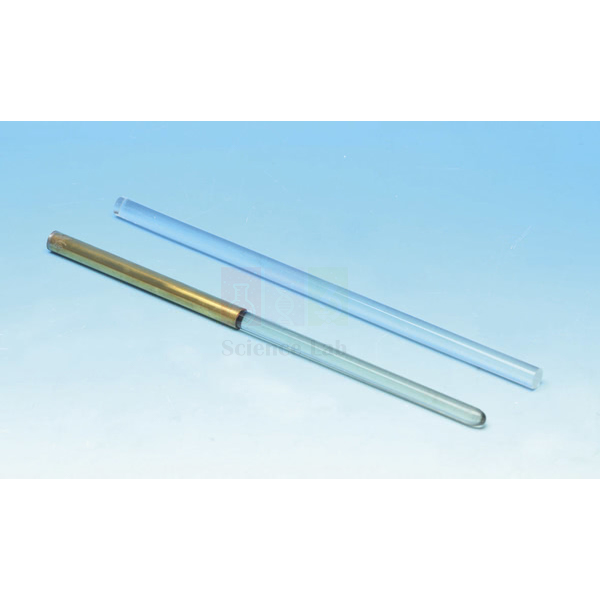
Friction Rod, Glass/Brass, 300mm
Friction Rod, Glass/Brass, 300mm (Product Code: SLE/PHY/106) is an electrostatics rod used to produce and study static electricity by rubbing in school physics experiments. Teachers and students use it to charge objects, attract light scraps of paper and compare like and unlike charges, and it measures 300 x 12 mm. It is made by Jain Scientific Equipments Pvt Ltd (ScienceLab), an OEM manufacturer, at its own factory in Ambala, India, for schools buying physics lab instruments in India.
Specifications
| Parameter | Detail |
|---|---|
| Material | Glass/Brass (as listed) |
| Dimensions | 300 x 12 mm |
| Application | Various experiments involving static electricity |
| Product code | SLE/PHY/106 |
| Manufacturer | Jain Scientific Equipments Pvt Ltd (ScienceLab) — OEM |
| Country of origin | India (made in Ambala, Haryana) |
What Is the Friction Rod Used For?
Rubbing a glass rod with silk leaves it positively charged, which students can show by bringing it near scraps of paper, a thin stream of tap water or the cap of an electroscope. Hanging one charged rod in a paper stirrup and approaching it with another reveals repulsion between like charges, and attraction when the second rod is ebonite or polythene.
Where brass is used, the lesson turns to conductors: a metal rod held directly in the hand will not keep its charge, because the charge leaks away through the body, which is how conductors and insulators are contrasted in class. Static experiments work best on dry days, so wipe the rod clean, warm it slightly if the room is humid and store it in a dry cupboard. The rod fits naturally into physics practical equipment for CBSE-style electrostatics lessons.
What to Specify When Ordering
- Material — glass, brass or both, since the listing gives glass/brass.
- Quantity for group or whole-class work.
- A rubbing cloth and other friction rods (perspex, nylon, ebonite) for comparison.
- An electroscope, if you want to detect and compare the charges produced.
OEM Manufacturer
ScienceLab — the trading name of Jain Scientific Equipments Private Limited — makes this friction rod at its licensed factory in Saha, Ambala, Haryana, India. Buying from the original equipment manufacturer means the rod comes factory-direct rather than through a trader, and matching rods for a complete electrostatics set can be ordered from the same maker. Ask us about replacements, and read our company profile for more about the business.
Related Physics Lab Equipment
Build a full electrostatics kit with these related items:
- Friction Rod, Brass/Ebonite — ebonite takes the opposite charge to glass for comparison.
- Friction Rod, Perspex — another insulating rod for charge experiments.
- Friction Cloth, Cotton — a cloth for rubbing the rods.
- Electroscope, Gold Leaf — detects and compares the charge produced.
Explore the wider Physics Lab Equipment category for more electrostatics apparatus.
Frequently Asked Questions
What size is the Friction Rod, Glass/Brass, 300mm?
The Friction Rod, Glass/Brass, 300mm measures 300 x 12 mm. That length gives students room to hold one end while rubbing the other, and to bring the charged end near paper scraps or an electroscope without touching them.
Is it a glass rod, a brass rod or both?
The listing gives the material of the Friction Rod, Glass/Brass, 300mm as glass/brass. Please state whether you need glass, brass or both when you enquire, and we will confirm exactly what the quotation covers.
What cloth should be used to charge the rod?
Silk is the traditional choice for charging a glass rod such as the Friction Rod, Glass/Brass, 300mm. Other clean, dry fabrics can be compared too, and testing two or three cloths makes a useful student investigation into how well each one charges the rod.
Why do static experiments sometimes fail?
Moisture is the usual reason. On humid days a thin film of water lets charge leak away from the Friction Rod, Glass/Brass, 300mm, so wipe it dry, warm it gently and repeat the rubbing. Grease from fingers can also reduce the effect.
Who manufactures this friction rod?
The Friction Rod, Glass/Brass, 300mm is manufactured by Jain Scientific Equipments Pvt Ltd (ScienceLab) as the OEM at its own factory at Saha, Ambala, Haryana, India. Schools, dealers and importers can order it direct from the manufacturer.
Can I order class sets or export quantities?
Yes. The Friction Rod, Glass/Brass, 300mm can be quoted in class-set or dealer quantities for India and international markets. Give the quantity, the material required and the destination through our contact page to receive a quotation.
Request a Quote
Contact the manufacturer for a quotation on the Friction Rod, Glass/Brass, 300mm through our contact page, or add it to the enquiry cart; quotes come directly from ScienceLab.
Last updated: 24 September 2026