- Physics Lab Equipment
- Chemistry Lab Equipment
- Biology Lab Equipment
- Anatomical Lab Equipment
- Learning
- Educational Lab Equipment
- Magnets
- Agriculture
- Astronomy
- Earth Science
- Geography Lab Equipment
- Safety Lab Coat
- Laboratory
- Meteorological
- Electricity & Magnetism
- Heat
- School Lab Equipment
- Lab Glassware
- Science Lab Equipment
- Tvet Lab Equipment
- Robotics Kits Supplier and Manufacturer for Schools India
- Math Lab Equipment Manufacturers and Exporters in Ambala
- STEM Kits Manufacturers and Supplier India
- Engineering Lab Equipment
- Hospital Lab Equipment
- Water, Sanitation & Hygiene Supplies
- Cold Chain, Solar & Communication Equipment
- Nutrition
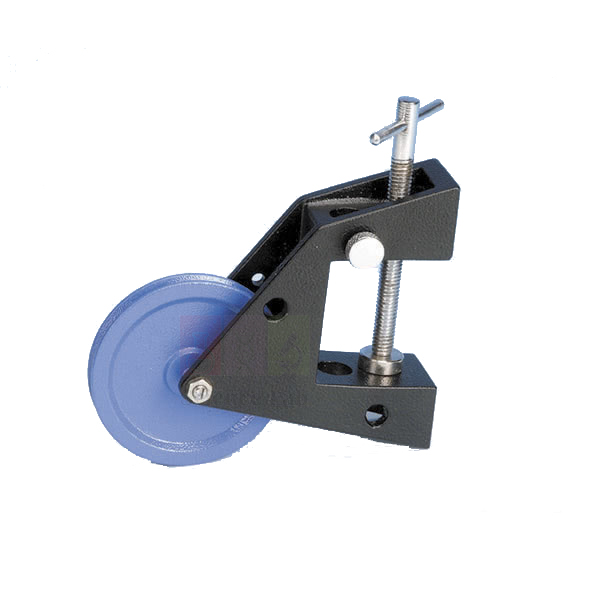
Pulley, Rod & Bench Mounting
Pulley, Rod & Bench Mounting (Product Code: SLE/PHY/282) is a 70 mm light-alloy pulley in an alloy bracket that clamps to a bench edge or a support rod, used to run a string and hanging mass off the bench in dynamics and friction practicals. The wheel turns on a brass/silvered-steel bearing, and the bracket fits bench edges up to 38 mm thick or a 13 mm support rod. It is made by Jain Scientific Equipments Pvt Ltd (ScienceLab), an OEM manufacturer, at its own factory in Ambala, India.
Specifications
| Parameter | Detail |
|---|---|
| Pulley diameter | 70 mm |
| Pulley material | Light alloy |
| Bearing | Brass/silvered-steel |
| Bracket | Alloy, with two clamping screws for bench or rod support |
| Bench mounting | Clamps to a bench edge or similar support up to 38 mm thick |
| Other mounting | Can be screwed to a flat surface or held on a 13 mm diameter support rod |
| Product code | SLE/PHY/282 |
| Manufacturer | Jain Scientific Equipments Pvt Ltd (ScienceLab) — OEM |
| Country of origin | India (made in Ambala, Haryana) |
What Is the Rod and Bench Mounting Pulley Used For?
Clamped at the end of the bench, the pulley lets a string run from a trolley or block over the edge to a hanging mass, the standard arrangement for measuring acceleration against force, finding coefficients of friction and testing Newton’s second law. The larger 70 mm wheel gives the string a gentler bend than a small pulley, which helps it run smoothly over long pulls.
Three mounting options make it easy to fit into different laboratories: clamp it to a bench edge up to 38 mm thick, screw it to a flat surface for a permanent demonstration set-up, or hold it on a 13 mm support rod to raise it to the height of a runway or inclined plane apparatus. Tighten both clamping screws before loading and keep the bearing clean.
What to Specify When Ordering
- Number of pulleys per bench or group.
- Your bench-top thickness (the clamp takes up to 38 mm) or support-rod diameter (13 mm).
- Masses, hangers, trolleys or runways to be quoted with it.
OEM Manufacturer
Jain Scientific Equipments Private Limited, known commercially as ScienceLab, is the OEM of this rod and bench mounting pulley and manufactures it at its own licensed factory at Saha, Ambala, Haryana, India. Institutions and resellers buy it factory-direct, so questions about fitting it to particular benches or rods are answered by the people who make it. For additional pulleys or repeat orders, ask us. More background is on our company profile.
Related Laboratory Equipment
Apparatus that works with a bench pulley in dynamics practicals:
- Pulley, Bench Mounting, Ball Bearing — a smaller 50 mm nylon pulley on an aluminium boss.
- Apparatus Newton’s Second Law — force and acceleration experiments using a bench pulley.
- Inclined Plane with Roller & Pan — for friction and inclined-plane practicals.
- Slotted Mass Hanger, 500g — the hanging mass on the end of the string.
- Bench Pulley — another bench pulley option for student sets.
Find more in the Physics Lab Equipment category.
Frequently Asked Questions
What size is the Pulley, Rod & Bench Mounting?
The Pulley, Rod & Bench Mounting has a 70 mm diameter light-alloy pulley running on a brass/silvered-steel bearing, held in an alloy bracket with two clamping screws for bench or rod support.
How thick a bench can the pulley clamp to?
The bracket of the Pulley, Rod & Bench Mounting clamps to a bench edge or similar support up to 38 mm thick. Measure your bench top before ordering; for thicker benches it can be screwed to a flat surface or held on a support rod.
Can the Pulley, Rod & Bench Mounting be fitted on a support rod?
Yes. The Pulley, Rod & Bench Mounting can be held on a 13 mm diameter support rod, which lets you set the pulley at the height of a runway or inclined plane rather than at bench level.
What bearing does the Pulley, Rod & Bench Mounting use?
The Pulley, Rod & Bench Mounting turns on a brass/silvered-steel bearing held in its alloy bracket, giving the light-alloy wheel a smooth run for dynamics and friction experiments in the school or college laboratory.
Who manufactures the Pulley, Rod & Bench Mounting?
The Pulley, Rod & Bench Mounting is manufactured by Jain Scientific Equipments Pvt Ltd (ScienceLab), the OEM, at its own licensed factory at Saha, Ambala, Haryana, India, and supplied directly to schools, colleges, dealers and importers.
What should a quotation request for this pulley include?
A quotation request for the Pulley, Rod & Bench Mounting should give the product code SLE/PHY/282, the number of pulleys, your bench thickness or rod diameter and the delivery location. Send it through our contact page or the enquiry cart.
Request a Quote
Quotations for the Pulley, Rod & Bench Mounting come from the manufacturer itself. Use the contact page or add the pulley to the enquiry cart.
Last updated: 24 September 2026