- Physics Lab Equipment
- Chemistry Lab Equipment
- Biology Lab Equipment
- Anatomical Lab Equipment
- Learning
- Educational Lab Equipment
- Magnets
- Agriculture
- Astronomy
- Earth Science
- Geography Lab Equipment
- Safety Lab Coat
- Laboratory
- Meteorological
- Electricity & Magnetism
- Heat
- School Lab Equipment
- Lab Glassware
- Science Lab Equipment
- Tvet Lab Equipment
- Robotics Kits Supplier and Manufacturer for Schools India
- Math Lab Equipment Manufacturers and Exporters in Ambala
- STEM Kits Manufacturers and Supplier India
- Engineering Lab Equipment
- Hospital Lab Equipment
- Water, Sanitation & Hygiene Supplies
- Cold Chain, Solar & Communication Equipment
- Nutrition
Electromagnetism apparatus in this sub-range shows students in schools and colleges how electricity and magnetism interact: they map the field around a current-carrying wire, drop a magnet through a coil to induce a pulse, vary the turns on an electromagnet and step voltages up or down with a transformer. Buyers seeking an electromagnetic induction kit or motor and generator demonstrations will find both at Jain Scientific Equipments Pvt Ltd (ScienceLab), Ambala, India. Power supplies, meters and resistance boxes to run these experiments are listed too.
Electromagnetism Experiments by Topic
| Topic | What It Covers | Example Products |
|---|---|---|
| Magnetic fields from currents | Field patterns around wires; adjustable and neodymium magnets for field work | Magnetic Field Unit Vertical Wire, Adjustable Magnet, Neodymium Wand |
| Electromagnetic induction | Faraday’s and Lenz’s laws; detecting changing fields | Faraday’s Law Apparatus, Splat The Rat, Search Coil |
| Electromagnets and transformers | Effect of current and number of turns; turns ratio | Electromagnetic System, Trans-Ratio |
| Motors and generators | Turning electrical energy into motion and back again | Demonstration Electric Motor, A.C. Generator |
| Electric fields and charge | Detecting charge, field patterns and sparks at high voltage | E-Field Detector, Electric Field Apparatus, Proof Plane 20mm Dia, Multi-Wire Spark Detector |
| Supply and measurement | Power, voltage and current readings and switchable resistance or capacitance | Precision Variable Power Supply, Switched Power Supply, Digital Voltmeter, Digital Ammeter, Decade Resistance Box, Capacitance Selector |
| Circuits and sensors | Internal resistance of a cell and sensor applications | Lost Volts, Strain Gauge, Piezo Transducer |
Featured Electricity and Magnetism Apparatus
| Product | Product Code | Typical Use |
|---|---|---|
| Faraday’s Law Apparatus | SLE/EAM/08 | Generating a pulse by dropping a magnet through a coil |
| Splat The Rat | SLE/EAM/27 | A timed demonstration of Lenz’s law as a magnet slows in a tube |
| Electromagnetic System | SLE/EAM/13 | Studying how current and number of turns change electromagnet strength |
| Trans-Ratio | SLE/EAM/30 | Investigating transformer turns ratios with tapped primary and secondary coils |
| A.C. Generator | SLE/EAM/38 | Showing how a rotating magnet induces current in a coil |
| Search Coil | SLE/EAM/25 | Investigating changing magnetic fields with a millivoltmeter or oscilloscope |
| Magnetic Field Unit Vertical Wire | SLE/EAM/10 | Mapping the magnetic field around a vertical current-carrying wire |
Manufacturing & Supply
This apparatus is supplied by Jain Scientific Equipments Private Limited under the ScienceLab name; the company manufactures laboratory teaching equipment at its licensed Saha, Ambala factory (Factory Licence AMB-ONLINE-CHD-J-414) and ships overseas orders under IEC AAECJ8618A. We supply single demonstration units, sets for student groups, bulk institutional orders and tender quantities.
Related Ranges
The name is close to its parent hub, Electricity & Magnetism, which also covers general electrical apparatus and DIY electronics. This sub-range concentrates on electromagnetism.
- Electricity & Magnetism: the parent hub for all electrical and magnetic ranges
- Electricity Equipments: meters, leads, cells, electrolysis and electrostatic machines
- Magnets: permanent magnets and magnet kits for field experiments
- Physics Lab Equipment: oscilloscopes, galvanometers and more induction apparatus
- Physics Lab: practical-lab apparatus including electromagnets for demonstrations
Frequently Asked Questions
Which experiments does this range support?
Magnetic fields around wires, Faraday’s and Lenz’s laws of induction, transformer turns ratios, electromagnet strength against current and turns, and AC generation.
What else do I need to run these experiments?
Most need a power supply and meters, and this range lists both. The Search Coil connects to an AC millivoltmeter or an oscilloscope; the Oscilloscope Dual Trace is in Physics Lab Equipment.
Is the range for schools or colleges?
Both. It covers classroom demonstrations and student experiments at secondary and senior-secondary level, and several items can also support introductory college work.
How does it differ from Electricity Equipments and Magnets?
Electricity Equipments covers general electrical apparatus such as meters, cells and electrolysis. Magnets covers permanent magnets. This range is about the interaction between electricity and magnetism.
Do you supply bulk and export orders?
Yes. Send product codes, quantities and your destination for bulk, tender or export quotations.
Request a Quote or Catalogue
To discuss an electromagnetism setup or price items, get in touch or add products to your enquiry cart.
Last updated: 23 September 2026
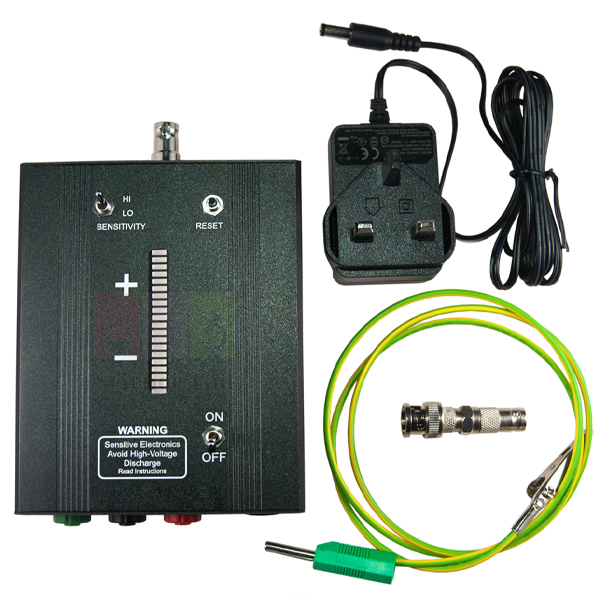
E-Field Detector
E-Field Detector (Product Code: SLE/EAM/01) is an electronic charge detector for electrostatics teaching. Its LED array shows not only whether a charge is positive or negative but also how large it is, and external voltmeter sockets allow quantitative measurements. It can pick up very small charges and their polarity, and detect charge at a distance, so physics teachers can show clearly which way electrons have moved when an object is charged. It is made by Jain Scientific Equipments Pvt Ltd (ScienceLab), Ambala, India.
Specifications
| Parameter | Detail |
|---|---|
| Indicator | LED array showing polarity and size of charge |
| Display range | Hi sensitivity 6 – 125pC; Lo sensitivity 0.6 – 12.5nC |
| Display resolution | Hi sensitivity min. resolution 6pC; Lo sensitivity min. resolution 0.6nC |
| Socket output range | 0 – 4.7V, equivalent to Hi sensitivity 0 – 470pC; Lo sensitivity 0 – 47nC |
| Input voltage | 24V DC |
| Power adapter | 24V AC-DC adapter included |
| Current draw | 50mA |
| Weight | 252g |
| Dimensions (L x W x H) | 145 x 100 x 50mm |
| Instructions | Comprehensive instructions covering traditional electrostatics experiments and newer ways to investigate charge |
Typical Use
School electrostatics has usually relied on attraction-and-repulsion experiments or a delicate gold leaf electroscope, which show that a charge is present but not its sign. With the E-Field Detector the class sees straight away whether rubbing a rod has left it positive or negative, and therefore in which direction electrons have moved. Typical activities include charging different materials by friction, charging by induction, sharing charge with a proof plane, and detecting a charged object held some distance away — turning abstract ideas into observations students can record.
For quantitative work, connect a voltmeter to the output sockets: 0 – 4.7V corresponds to 0 – 470pC on Hi sensitivity or 0 – 47nC on Lo, so results can be tabulated and graphed. Set-up is quick and simple, which helps specialist and non-specialist teachers alike, and the controls are easy enough for students to gather data themselves. Use Hi sensitivity for small charges and Lo for larger ones, and power the unit from the supplied 24V adapter. As physics lab equipment for secondary and college electrostatics, it complements rather than replaces the traditional apparatus.
Manufacturer
The E-Field Detector is manufactured by Jain Scientific Equipments Private Limited, the company behind the ScienceLab brand in Ambala, Haryana. Buyers completing vendor registration can quote GSTIN 06AAECJ8618A1ZT and LEI 3358004HRD1JIVXKYX49. Read more on our company profile.
Related Electricity and Magnetism Equipment
Apparatus for a complete electrostatics practical:
- Digital Voltmeter — reads the detector’s socket output for quantitative charge values
- Proof Plane 20mm Dia — transfers charge samples to the detector
- Electroscope, Gold Leaf — the traditional charge indicator, for side-by-side comparison
- Van de Graaff Generator — a source of larger charges for demonstrations
- Wimshurst Machine — a hand-cranked electrostatic generator
Explore our Electricity and Magnetism category for more apparatus.
Frequently Asked Questions
Can it show whether a charge is positive or negative?
Yes. The LED array indicates the polarity of the charge as well as its size.
What charge range can it display?
6 – 125pC on Hi sensitivity and 0.6 – 12.5nC on Lo sensitivity, with minimum resolutions of 6pC and 0.6nC respectively.
Is a power supply included?
Yes, a 24V AC-DC adapter is included. The detector runs on 24V DC and draws 50mA.
Can readings be recorded with a voltmeter?
Yes. The output sockets give 0 – 4.7V, equivalent to 0 – 470pC (Hi) or 0 – 47nC (Lo).
Does it replace a gold leaf electroscope?
It does things an electroscope cannot, such as showing polarity and giving a voltage output, but many teachers keep both so students can compare the traditional and electronic methods.
Is a calibration certificate available?
Please discuss calibration certificate requirements with us when you enquire — contact us.
What warranty is offered?
Warranty terms are confirmed in the quotation; ask us for details.
What information does an institutional quotation need?
Quantity, delivery location in India or abroad, and any related items such as voltmeters or electrostatic generators; our GSTIN and LEI are given above for vendor registration.
Request a Quote
For E-Field Detector pricing, contact us or add it to the enquiry cart.
Last updated: 24 September 2026
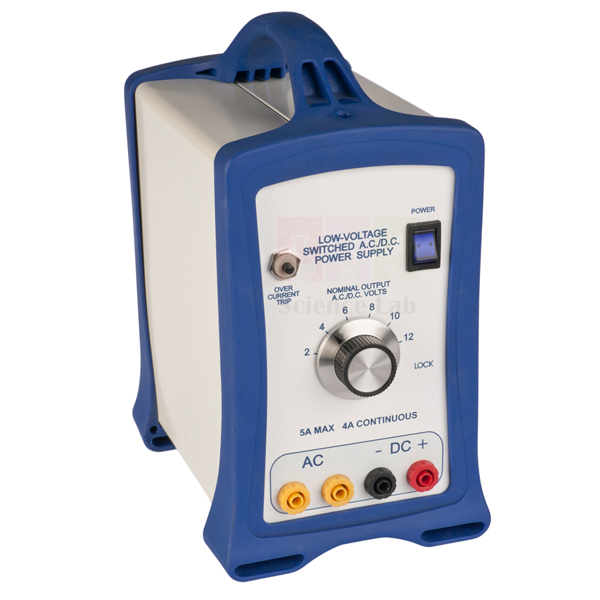
Switched Power Supply
Switched Power Supply (Product Code: SLE/EAM/02) is a rugged bench power unit giving 0 to 12V in 2V steps, as either capacitor-smoothed d.c. or a.c., with an output of up to 5A. It is a traditional switched design meant for laboratory work that needs a dependable source of emf, and it serves schools and colleges looking for a general-purpose lab power supply unit in India. It is supplied by Jain Scientific Equipments Pvt Ltd (ScienceLab), Ambala, India.
Specifications
| Parameter | Detail |
|---|---|
| Output voltage (d.c.) | 0 to 12V in 2V increments, capacitor smoothed |
| Output voltage (a.c.) | 0 to 12V in 2V increments |
| Output current | 5A max, 4A continuous |
| Input | Switched, 230/240V a.c. 50Hz |
| Current protection | Thermal circuit breaker (front-panel thermal trip), manual reset |
| Voltage limiter | Front-panel Allen key insert; the unit can be locked at any setting |
| Switch protection | Internal mechanism disconnects the output while the voltage setting is changed, protecting the switch contacts from overload |
| Case | Robust powder-coated case with integral carrying handle |
| Storage | Sized so that 4 units can be carried in a single storage tray |
Typical Use
Stepped outputs suit practicals where students need repeatable voltages rather than fine adjustment: 2V steps for plotting current against voltage in Ohm’s law work, a low d.c. setting for small motors and electromagnets, or low-voltage a.c. for transformer and induction experiments. Because the output is disconnected while the selector is being moved, changing steps under load does not overload the switch contacts — a real advantage when many hands use the same unit.
Before the class starts, the teacher can use an Allen key through the front panel to lock the unit at the setting the experiment needs. If a circuit draws too much current, the thermal circuit breaker trips; clear the fault and reset it manually from the front panel. Keep continuous loads within 4A, carry units by the integral handle, and store them four to a tray to save bench and cupboard space.
Supplier
This power supply is supplied by Jain Scientific Equipments Private Limited, which trades as ScienceLab from Ambala, Haryana, and provides laboratory equipment to schools, colleges and distributors in India and international markets alongside its own manufactured range. See our company profile for more.
Related Electricity and Magnetism Equipment
Instruments and apparatus used with a bench supply:
- Precision Variable Power Supply — a regulated, continuously variable d.c. alternative
- Precision Switched Power Supply — another switched-output option in the same category
- Digital Voltmeter — checks the output voltage in circuit
- Digital Ammeter — monitors the load current
- Primary and Secondary Coil Set — a transformer experiment that uses the a.c. output
See more in the Electricity and Magnetism category.
Frequently Asked Questions
Which outputs does it provide?
0 to 12V d.c. (capacitor smoothed) and 0 to 12V a.c., both in 2V increments.
How much current can it deliver?
5A maximum and 4A continuous.
What mains input does it need?
230/240V a.c. 50Hz.
What happens if a circuit is overloaded?
The front-panel thermal circuit breaker trips. It is reset manually once the fault is cleared.
Can I stop students from turning the voltage up?
Yes. The voltage limiter uses a front-panel Allen key insert, and the unit can be locked at any setting.
Is the d.c. output regulated?
It is described as capacitor smoothed rather than regulated. For a fully smoothed and regulated output, see the Precision Variable Power Supply.
What warranty and calibration documents are available?
Warranty terms are confirmed with the quotation, and calibration certificate requirements can be discussed with us — contact us.
Can you quote for a full lab set of supplies?
Yes. Send the quantity and delivery location in India or abroad, and we will quote for the units and any meters or leads you need.
Request a Quote
To price the Switched Power Supply, please contact us or add it to the enquiry cart.
Last updated: 24 September 2026
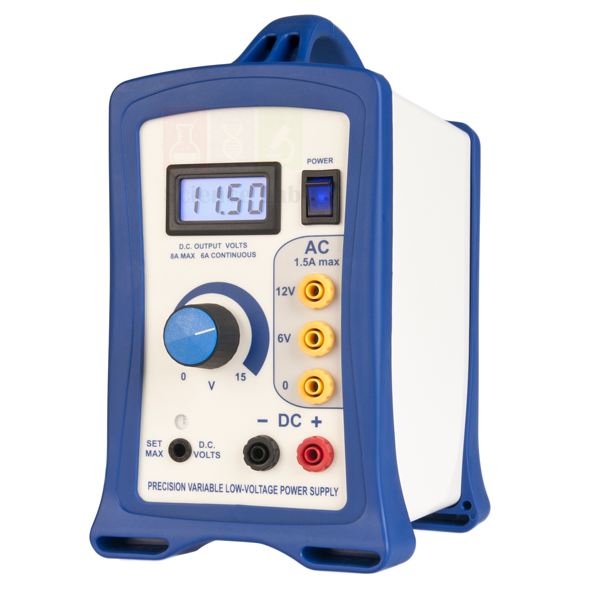
Precision Variable Power Supply
Precision Variable Power Supply (Product Code: SLE/EAM/03) is a regulated bench supply giving 0 to 15V d.c., continuously variable and fully smoothed, at up to 8A, plus separate unregulated 6V and 12V a.c. outputs for transformer work. A built-in digital panel meter, a teacher-set voltage limiter and automatic over-current protection make it a practical regulated power supply for school and college physics labs in India. It is made by Jain Scientific Equipments Pvt Ltd (ScienceLab), Ambala, India.
Specifications
| Parameter | Detail |
|---|---|
| D.C. output voltage | 0 to 15V d.c., continuously variable; fully smoothed and regulated |
| D.C. output current | 8A d.c. max, 6A continuous |
| A.C. outputs | 6V and 12V a.c., unregulated, 1.5A a.c. max; can be used in parallel with the d.c. output |
| Max ripple at full current | 300mV |
| Max voltage variation with load current | 2% |
| Display | Digital panel meter showing the d.c. output (d.c. only) |
| Voltage limiter | Front-panel Allen key adjustment |
| Current protection | Electronic automatic on d.c.; thermal automatic on a.c. Above 8A the d.c. output falls to zero and restores itself once the current is reduced — no resetting required |
| Input | 90–265V a.c. 50/60Hz |
| Case | Robust powder-coated steel with integral plastic handle; removable mains lead |
| Mains switch | Illuminated, front panel |
| Weight | 2.2kg |
| Dimensions | 125 x 175 x 230mm; four units fit in a single storage tray |
| Versions | Same facilities available with continuously variable d.c. (this model) or switched output |
Typical Use
Set the required voltage against the built-in digital meter and the supply holds it as the circuit changes, within the stated 2% variation with load current. That keeps readings steady in Ohm’s law, internal resistance, electrolysis and component-characteristic experiments, where a sagging supply would otherwise distort results. The 6V and 12V a.c. outputs can run at the same time as the d.c. output, so transformer investigations and other a.c. work do not need a second unit on the bench.
Before a practical, the teacher uses an Allen key through the front panel to set the dial to the highest voltage students should use; the main control then works normally up to that value but gives no increase beyond it. If a circuit draws more than 8A, the d.c. output drops to zero and returns by itself once the current is reduced. At 2.2kg and 125 x 175 x 230mm, the unit is easy to carry by its handle and quick to store, leaving more room on the bench.
Manufacturer
Jain Scientific Equipments Private Limited, trading as ScienceLab from Ambala, Haryana, makes this power supply as part of its electricity and magnetism range for education and training laboratories in India and international markets. Our company profile has more on the business.
Related Electricity and Magnetism Equipment
Items commonly used with a regulated bench supply:
- Precision Switched Power Supply — a switched-output alternative if you prefer fixed steps
- Digital Ammeter — measures load current during experiments
- Resistance Substitution Box — selectable resistances for Ohm’s law and load tests
- Primary and Secondary Coil Set — uses the a.c. outputs for transformer investigations
- Voltameter, Copper — an electrolysis cell that benefits from a steady d.c. supply
More apparatus is listed in our Electricity and Magnetism category.
Frequently Asked Questions
Is the d.c. output regulated?
Yes. It is fully smoothed and regulated, with a maximum voltage variation of 2% with load current and maximum ripple of 300mV at full current.
How much current is available?
8A d.c. maximum with 6A continuous, and 1.5A a.c. maximum from the 6V and 12V a.c. outputs.
What mains supply does it accept?
90–265V a.c. at 50/60Hz.
What happens on overload?
On the d.c. side, protection is electronic and automatic: above 8A the output falls to zero and recovers once the current is reduced. The a.c. side has automatic thermal protection.
Can I limit the maximum voltage students use?
Yes, with an Allen key through the front panel; the main control then works normally only up to the value you set.
Is there a switched version?
Yes. The same facilities are offered with either continuously variable d.c. or a switched output. Compare the Precision Switched Power Supply in the same category, or ask us which suits your lab.
Is a calibration certificate or warranty provided?
Calibration certificate requirements can be discussed with us, and warranty terms are confirmed with the quotation — contact us.
What should an institutional quotation request include?
Quantity, delivery location in India or abroad, whether you need variable or switched units, and any meters or leads to be quoted together.
Request a Quote
For pricing on the Precision Variable Power Supply, contact us or add it to your enquiry cart.
Last updated: 24 September 2026
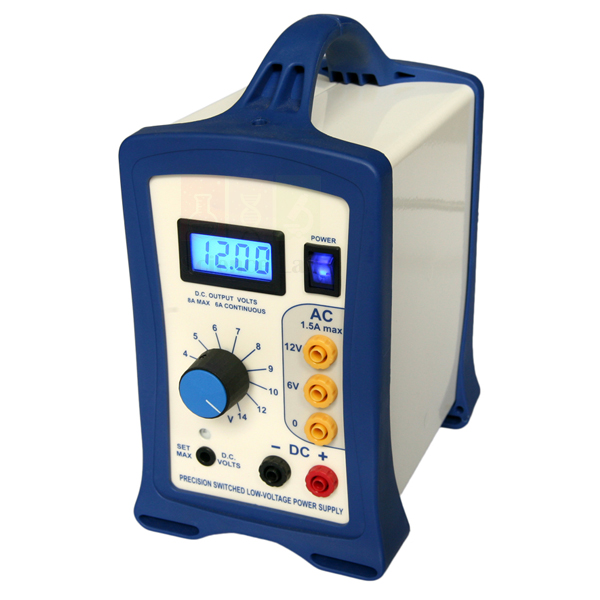
Precision Switched Power Supply
Precision Switched Power Supply (Product Code: SLE/EAM/04) is a compact bench unit that gives a fully smoothed, regulated DC output from 0 to 15 V, plus separate unregulated 6 V and 12 V AC outlets, for student practicals and teacher demonstrations. It is the switched-output member of a series that is also offered with a continuously variable control, and it suits schools and colleges that want one regulated power supply able to handle everything from low-current resistor circuits to high-current electromagnetism work. It is made by Jain Scientific Equipments Pvt Ltd (ScienceLab) in Ambala, India.
Specifications
| Parameter | Detail |
|---|---|
| DC output voltage | 0 to 15 V DC, fully smoothed and regulated |
| Output selection | Switched output on this model; the same design is also offered with continuously variable DC |
| DC output current | 8 A maximum, 6 A continuous |
| AC outputs | 6 V and 12 V AC, unregulated, 1.5 A maximum; can be used in parallel with the DC output |
| Load regulation | Maximum voltage variation with load current: 2% |
| Ripple | 300 mV maximum at full current |
| Display | Built-in digital panel meter showing the DC output in use at all times (DC only) |
| DC current protection | Electronic and automatic: above 8 A the output voltage falls to zero and returns once the current is reduced, with no resetting |
| AC current protection | Thermal, automatic |
| Voltage limiter | Adjusted with an Allen key through the front panel; the main control works normally up to the set ceiling and gives no increase beyond it |
| Mains input | 90–265 V AC, 50/60 Hz |
| Controls | Clear, simple controls with an illuminated front-panel mains switch |
| Case | Robust powder-coated steel with integral plastic handle and removable mains lead |
| Dimensions | 125 x 175 x 230 mm |
| Weight | 2.2 kg |
| Storage | Four units fit in a single storage tray |
Typical Use
Because the output is regulated, the voltage set on the panel meter is held steady whatever is connected, so students plotting current against voltage for a resistor, a filament lamp or a coil get consistent readings from one bench to the next. The high DC current rating makes the unit a natural partner for demonstrations that need several amperes, such as a current-carrying conductor in a magnetic field or the field around a straight wire, while the 6 V and 12 V AC outlets serve transformer investigations and can run at the same time as the DC terminals.
A useful habit before any class practical is to set the Allen-key limiter to the highest voltage the day's components can tolerate; students then have the full range of the main control below that ceiling but cannot push past it. If the display suddenly reads zero, the automatic over-current protection has operated – look for a short circuit or reduce the load and the output returns without any reset. At 2.2 kg, with four units to a tray, this piece of school physics lab equipment is quick to hand out and collect between lessons.
Manufacturer
The supply comes from Jain Scientific Equipments Private Limited, the company behind the ScienceLab name, which designs and manufactures teaching apparatus in Ambala, Haryana, for schools, colleges and training institutes in India and international markets. More about the company is on the ScienceLab company profile page.
Related Electricity and Magnetism Equipment
These items are often ordered with this power supply because they draw on its outputs or measure what it delivers:
- Force on a Conductor Apparatus — the rolling crossbar needs a low-voltage bench supply and currents of several amperes.
- Magnetic Field Unit Vertical Wire — field-pattern units in this series call for a DC supply able to deliver 5–8 A.
- Digital Ammeter — a separate meter for logging the current drawn by the circuit under test.
- Digital Voltmeter — measures the voltage across an individual component rather than the whole output.
- Precision Variable Power Supply — the continuously variable version, for labs that prefer a smooth control.
Browse the full Electricity and Magnetism range for more apparatus.
Frequently Asked Questions
What outputs does this power supply provide?
A regulated 0 to 15 V DC output rated at 8 A maximum (6 A continuous), plus unregulated 6 V and 12 V AC outlets rated at 1.5 A maximum. Only the DC output is shown on the digital display.
Can the AC and DC outputs be used at the same time?
Yes. The AC outlets can be used in parallel with the DC output, for example running a transformer experiment on AC while the DC terminals power another circuit.
What happens if students short-circuit the output?
On the DC side the protection is electronic: once more than 8 A is drawn the output voltage drops to zero and comes back as soon as the current is reduced, with nothing to reset. The AC side uses automatic thermal protection.
How is the switched version different from the variable version?
Both share the same regulation, protection and outputs; the difference is how the DC voltage is selected. For the exact switch positions on this model, please ask us through the contact page before ordering.
Will it run on our local mains supply?
It accepts 90–265 V AC at 50 or 60 Hz and has a removable mains lead. If your site needs a particular plug type, mention it when you enquire.
Is a calibration certificate or warranty available?
Calibration-certificate availability and warranty terms are confirmed with each quotation. Please raise them with us via the contact page.
What should an institutional or bulk enquiry include?
State the quantity, whether you also need the variable version, your delivery location and any tender format required. ScienceLab supplies schools, colleges and distributors in India and international markets.
Request a Quote
To price the Precision Switched Power Supply for your lab, send your requirement through our contact page or add it to the enquiry cart together with the meters and apparatus you plan to use with it.
Last updated: 24 September 2026
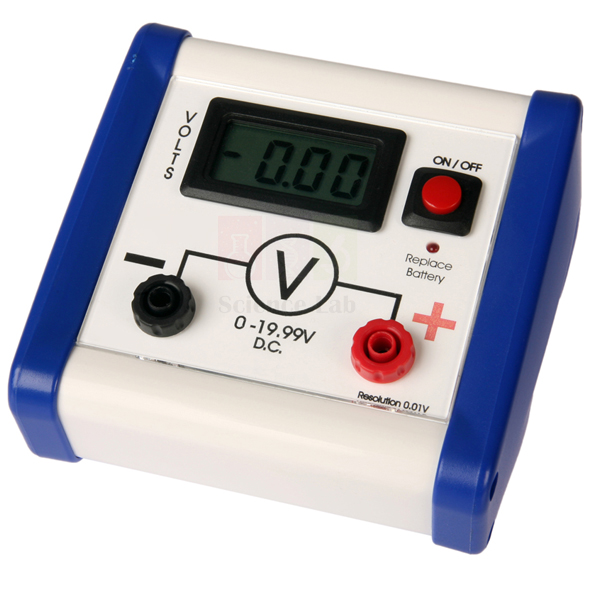
Digital Voltmeter
Digital Voltmeter (Product Code: SLE/EAM/05) is a battery-powered bench meter that reads DC potential difference from 0 to ±20 V with 0.01 V resolution, giving students a clear numerical display for circuit practicals. It sits alongside the other digital measuring instruments in a school or college electricity lab and is housed in a robust ABS and PVC case built for daily handling. The meter is made by Jain Scientific Equipments Pvt Ltd (ScienceLab), Ambala, India.
Specifications
| Parameter | Detail |
|---|---|
| Range | 0 to ±20 V DC |
| Resolution | 0.01 V |
| Accuracy | ±2% |
| Input impedance | 10 MΩ approx. |
| Power | 9 V PP3 battery |
| Battery saving | Auto-off after approximately 50 minutes |
| Battery indicator | LED prompts when the battery needs changing |
| Case | Robust ABS and PVC housing |
| Materials | PVC, ABS, acrylic |
| Dimensions | 110 x 100 x 70 mm |
| Weight | 250 g |
Typical Use
Connected in parallel across a resistor, lamp or cell, the voltmeter supplies the potential-difference half of every Ohm's law experiment, series-and-parallel circuit investigation and cell EMF measurement in the syllabus. Its high input impedance means the meter draws almost no current, so the reading reflects the circuit rather than the instrument, and the 0.01 V resolution lets students see the small drop in terminal voltage when a cell starts supplying current. Because the range covers both polarities, a reversed connection simply shows a negative value, which turns a common wiring slip into a lesson about polarity instead of a damaged meter.
For a class set, the auto-off feature matters: a meter left on at the end of a lesson switches itself off after roughly 50 minutes instead of draining its PP3 overnight, and the LED warning tells the technician which units need a fresh battery before the next practical. The compact 250 g case sits easily on a crowded bench next to a power supply and an ammeter.
Manufacturer
ScienceLab is the trading name of Jain Scientific Equipments Private Limited (CIN U29309HR2020PTC087597), an Ambala, Haryana company that manufactures teaching apparatus at its licensed factory at 449, HSIIDC Industrial Area, Saha, Ambala (Factory Licence AMB-ONLINE-CHD-J-414). Read the company profile for background on the business and its product lines.
Related Electricity and Magnetism Equipment
A voltmeter is only one part of a working circuit; these items complete the set-up:
- Digital Ammeter — the matching current meter, needed for resistance and power calculations.
- Lost Volts — internal-resistance apparatus that is used with a voltmeter, an ammeter and a 6 V DC source.
- Resistance Substitution Box — supplies a choice of known resistances to measure across.
- Precision Switched Power Supply — a regulated DC source for the circuit being tested.
See every meter and apparatus in the Electricity and Magnetism category.
Frequently Asked Questions
What can this voltmeter measure?
DC voltages from 0 to ±20 V, displayed to 0.01 V with an accuracy of ±2%. The published range is DC only, so for AC work please ask us about a suitable alternative.
How is it powered?
By a single 9 V PP3 battery. An auto-off circuit switches the meter off after about 50 minutes, and an LED indicator shows when the battery should be replaced.
Will connecting the meter change the reading in my circuit?
Hardly at all in typical school circuits. With an input impedance of about 10 MΩ, it takes very little current from the circuit it is measuring.
What happens if students connect it the wrong way round?
The meter reads both polarities across its range, so a reversed connection shows as a negative voltage rather than an off-scale reading.
Can you provide a calibration certificate?
Whether a calibration certificate can be supplied is decided order by order. Please discuss it, along with warranty terms, via our contact page.
Do you supply class sets or export orders?
Yes, class quantities are regularly quoted for schools and colleges, and ScienceLab ships to India and international markets. Include the quantity and delivery location in your enquiry.
Request a Quote
Tell us how many Digital Voltmeters you need through the contact page, or place them in the enquiry cart with matching ammeters and power supplies for one combined quotation.
Last updated: 24 September 2026
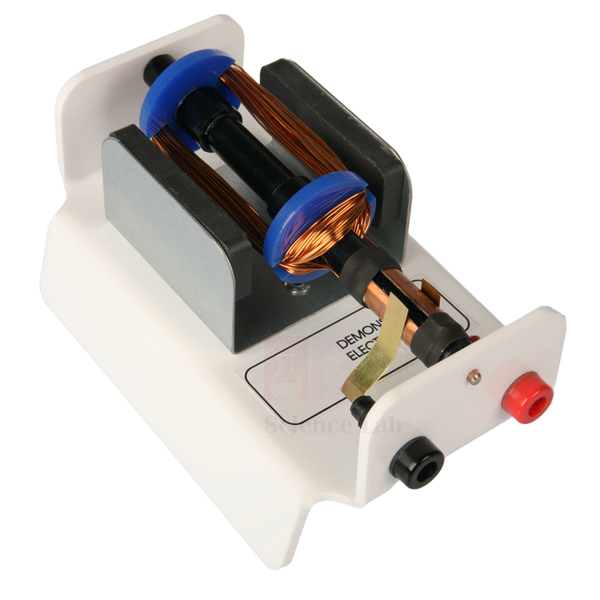
Demonstration Electric Motor
Demonstration Electric Motor (Product Code: SLE/EAM/06) is a ready-built, fully working DC motor laid out so that a whole class can see every essential part of a simple motor: a single rectangular coil, the magnets that provide the field, and the commutator and brushes that keep it turning. Physics teachers use it as a demonstration model for the physics lab when introducing the motor effect, and it runs from a low DC voltage. The unit is made by Jain Scientific Equipments Pvt Ltd (ScienceLab) of Ambala, India.
Key Details
| Parameter | Detail |
|---|---|
| Type | Ready-built, fully functional demonstration DC motor |
| Armature | Single rectangular coil rotating in a linear magnetic field |
| Field magnets | Ferrite slab magnets, reversible to change the field direction |
| Commutation | Simple commutator and brush arrangement |
| Supply required | DC, 1.5 V to 6 V |
| Current reversal | By reversing the supply leads |
| Teaching level | Shows the essential features of a simple motor as taught in the KS4 syllabus |
Typical Use
The motor is ideal for the lesson where students first link the force on a current-carrying wire to continuous rotation. With the coil turning, the teacher can reverse the leads to show that the rotation reverses, then turn the ferrite slab magnets round to show the same thing happening when the field is reversed; doing both at once returns the motor to its original direction, a neat check on Fleming's left-hand rule. Pausing the coil by hand lets the class see how the commutator swaps the current connection every half turn, which is the step many students find hardest to picture.
Start at the low end of the 1.5 V to 6 V range and raise the supply gradually so the class can see the speed respond. Like any single-coil motor, it may occasionally come to rest where the brushes sit on the commutator gap; a gentle flick of the coil sets it going again. Used alongside a simple physics demonstration kit on electromagnetism, it gives a concrete picture that diagrams alone cannot.
Manufacturer
Jain Scientific Equipments Private Limited, known to customers by its ScienceLab brand, produces physics demonstration apparatus from its base in Ambala, Haryana, and supplies teaching labs in India and international markets. The ScienceLab profile page gives more detail about the company.
Related Electricity and Magnetism Equipment
Teachers building a motor-effect lesson usually add some of these:
- Force on a Conductor Apparatus — shows the single-wire force that the motor turns into rotation.
- A.C. Generator — the reverse process, where a rotating magnet induces a current in a coil.
- Battery Holder, C — a single-cell holder that provides 1.5 V, the bottom of the motor's supply range.
- Precision Variable Power Supply — regulated, adjustable DC for exploring speed across the full range.
- Digital Ammeter — records the current the motor draws as the voltage changes.
More motor and electromagnetism apparatus is listed in the Electricity and Magnetism category.
Frequently Asked Questions
What supply does the motor need?
A DC supply between 1.5 V and 6 V. Cells or a low-voltage bench power supply both work, provided they stay within that range.
Can it be run from an AC outlet?
No. The motor is specified for DC, and its commutator design relies on a steady current direction.
Does it need assembling?
No. It is supplied ready-built and fully functional, so it can be used as soon as a DC source is connected.
How do I reverse the direction of rotation?
Either reverse the supply leads to change the current direction, or reverse the ferrite slab magnets to change the field direction.
Which classes is it suitable for?
It covers the essential simple-motor features taught in the KS4 syllabus, so it fits secondary-school lessons on the motor effect and electromagnetism.
Is there a warranty or spare-parts support?
Warranty terms and spares are confirmed when we quote. Please ask through our contact page.
Can you quote for several schools at once?
Yes. For a group or tender enquiry, list the quantity per site and the delivery addresses, and we will prepare a combined quotation for India or international delivery.
Request a Quote
Send your requirement for the Demonstration Electric Motor via the contact page, or add it to the enquiry cart with any supply or meters you need.
Last updated: 24 September 2026
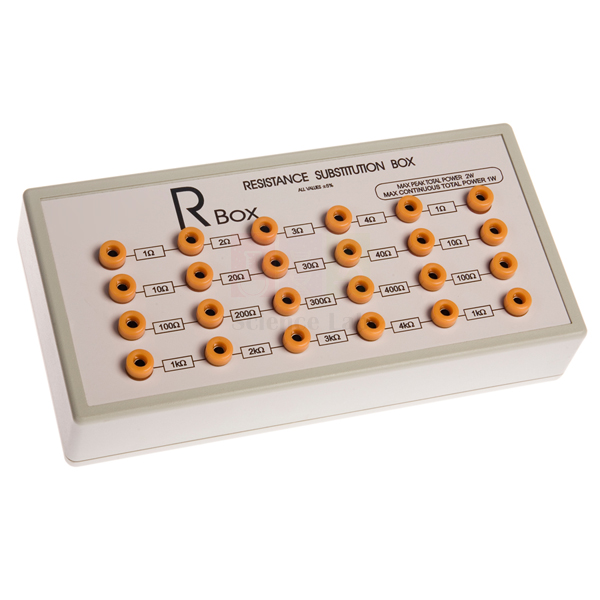
Resistance Substitution Box
Resistance Substitution Box (Product Code: SLE/EAM/07) is a robust resistance box for the physics lab that lets students build any value from 1 to 12,221 Ω by linking its internal resistors in series through 4 mm sockets. A printed connection diagram on the panel shows exactly which sockets to join, so the box works equally well as a known resistor, a variable load or a stand-in for an unknown component. It is made by Jain Scientific Equipments Pvt Ltd (ScienceLab), Ambala, India.
Specifications
| Parameter | Detail |
|---|---|
| Resistance range | 1 to 12,221 Ω |
| Selection method | Resistors selected with 4 mm sockets and arranged in series |
| Power rating | 2 W |
| Panel | Clear connection diagram on the main panel |
| Construction | Robust box design |
Typical Use
The name describes its classic job: the substitution method. Students measure the current through an unknown resistor, swap the box into its place and adjust the selected value until the meter shows the same reading; the box setting then equals the unknown resistance. The same box serves as the known arm when balancing Wheatstone bridge experiments, as a stepped load for plotting current against voltage, and as a series resistor when a lamp or LED needs its current limiting.
Because every resistance is made by joining sockets rather than turning a dial, the circuit on the panel matches the circuit diagram in the notebook, which helps students connect the idea of resistors adding in series with a real measurement. Keep an eye on the 2 W rating: at low resistance settings, a higher supply voltage can push the dissipated power up quickly, so check the expected current before switching on and start at a modest voltage.
Manufacturer
This box is built by Jain Scientific Equipments Private Limited, which trades as ScienceLab from Ambala, Haryana, and is a registered MSME manufacturer (Udyam UDYAM-HR-01-0003714); export consignments are shipped under Importer-Exporter Code AAECJ8618A issued by the DGFT. Visit the company profile to learn more about ScienceLab.
Related Electricity and Magnetism Equipment
To wire the box into a measuring circuit, buyers commonly add:
- Stackable Leads — 4 mm leads for linking the sockets and connecting the box to the circuit.
- Digital Ammeter — provides the matching current reading at the heart of the substitution method.
- Digital Voltmeter — measures the potential difference across the selected resistance.
- Wheatstone Bridge Four Gap — the box can act as the known resistance when balancing the bridge.
- Decade Resistance Box — an alternative style of resistance box for labs comparing formats.
Explore more circuit apparatus in the Electricity and Magnetism category.
Frequently Asked Questions
What resistance values can I set?
Any value from 1 to 12,221 Ω that the internal resistors can make when connected in series, chosen by linking the 4 mm sockets as shown on the panel diagram.
How much power can the box handle?
It is rated at 2 W. Work out the expected power before connecting, especially when a low resistance is selected with a higher supply voltage.
What leads does it take?
Connections are made through 4 mm sockets, so standard 4 mm plug leads are used both to link resistors and to connect the box into a circuit.
What is the tolerance of the resistors?
The tolerance is not listed on this page. If your practical needs a specific tolerance, please check with us through the contact page before ordering.
Is a calibration certificate available?
Certificate availability depends on the order, so please discuss it with us when you request a quote.
What should our purchase enquiry include?
Give the quantity, the delivery location and any tender or vendor-registration paperwork you need; we supply schools, colleges and distributors in India and international markets.
Request a Quote
Ask for pricing on the Resistance Substitution Box through our contact page, or collect it in the enquiry cart with meters and leads for one quotation.
Last updated: 24 September 2026

Faraday's Law Apparatus
Faraday's Law Apparatus (Product Code: SLE/EAM/08) is an electromagnetic induction apparatus used to show and measure the pulse of electricity a falling magnet induces in a coil, in school and college physics labs. A small cylindrical magnet, supplied with it, drops down an acrylic tube through a movable coil, and twin coils of 150 and 300 turns let students compare results. It is made by Jain Scientific Equipments Pvt Ltd (ScienceLab), an OEM manufacturer, at its own factory in Ambala, India, as part of its electromagnetic induction kit range.
Specifications
| Parameter | Detail |
|---|---|
| Guide tube | Acrylic tube supporting an easily moved coil |
| Coils | Twin coils of 150 turns and 300 turns |
| Magnet | Small cylindrical magnet, supplied |
| Output | A pulse of electricity each time the magnet passes through the coil |
| Display needed | Oscilloscope to monitor the pulse and measure its amplitude; PC-based oscilloscopes are particularly suited |
| Documentation | Full instructions included |
| Product code | SLE/EAM/08 |
| Manufacturer | Jain Scientific Equipments Pvt Ltd (ScienceLab) — OEM |
| Country of origin | India (made in Ambala, Haryana) |
What Is the Faraday's Law Apparatus Used For?
A first run is purely qualitative: drop the magnet and watch the oscilloscope trace rise and then swing the other way as the magnet enters and leaves the coil, a direct picture of Lenz's law. Switching between the 150-turn and 300-turn coils then shows how the size of the induced pulse depends on the number of turns, while turning the magnet over reverses the trace. A PC-based oscilloscope makes this especially easy because each single-shot event can be captured, stored and compared on screen.
For senior students the apparatus becomes a quantitative investigation of Faraday's law. Sliding the coil to a different position on the tube changes how far the magnet falls before reaching it, and therefore its speed; students work out that speed from the equations of motion and plot pulse amplitude against it. It is compact physics lab equipment in India's senior classrooms that ties induction to mechanics in one practical. Place a soft pad at the bottom of the tube so the magnet is not chipped by repeated drops.
OEM Manufacturer
Jain Scientific Equipments Private Limited, which trades as ScienceLab, is the OEM (original equipment manufacturer) of the Faraday's Law Apparatus and makes it at its own licensed factory at Saha, Ambala, Haryana, India. The apparatus is built and assembled by the company itself rather than sourced from a trader, and it goes factory-direct to schools, colleges, dealers and importers. If you later need a replacement magnet or coil, ask us: spares and repeat orders are handled by the manufacturer. Read more on the company profile.
Related Electricity and Magnetism Equipment
These products complete an induction practical built around this apparatus:
- Oscilloscope Dual Trace — displays the induced pulse so its amplitude can be measured.
- Metal Ruler — measures the drop height used to work out the magnet's speed.
- Search Coil — a hand-held coil for exploring changing magnetic fields with an oscilloscope.
- A.C. Generator — extends the topic from a single pulse to continuous induced current.
Find more induction and magnetism apparatus in the Electricity and Magnetism category.
Frequently Asked Questions
What comes with the Faraday's Law Apparatus?
The Faraday's Law Apparatus comes with the acrylic guide tube and its movable coil arrangement, twin coils of 150 and 300 turns, a small cylindrical magnet and full instructions. An oscilloscope is needed to display the pulse but is ordered as a separate item.
Does the Faraday's Law Apparatus need an oscilloscope?
Yes. The Faraday's Law Apparatus produces a brief pulse of electricity each time the magnet falls through the coil, and an oscilloscope is used to monitor that pulse and measure its amplitude. PC-based oscilloscopes are particularly suited because they capture single events.
Why does the Faraday's Law Apparatus have two coils?
The twin coils of 150 and 300 turns let students compare the induced pulse for two different numbers of turns on the Faraday's Law Apparatus, adding a second variable alongside magnet speed and showing how the induced voltage depends on the turns.
How do students change the magnet speed?
On the Faraday's Law Apparatus the coil is moved along the acrylic tube, which changes how far the magnet falls before reaching it. Senior students calculate the speed at the coil from the equations of motion and relate it to the measured pulse amplitude.
Who manufactures the Faraday's Law Apparatus?
The Faraday's Law Apparatus is manufactured by Jain Scientific Equipments Pvt Ltd (ScienceLab) as the OEM, at its own licensed factory at Saha, Ambala, Haryana, India. Quotations, repeat orders and questions about a spare magnet come straight from the manufacturer through our contact page.
What should a quotation request include?
For a Faraday's Law Apparatus quotation, send the product code SLE/EAM/08, the number of units, whether an oscilloscope should be quoted with it, and your delivery location. We supply schools and colleges across India and international markets.
Request a Quote
Quotes for the Faraday's Law Apparatus come direct from the manufacturer. Write to us through the contact page or add it to the enquiry cart together with an oscilloscope or other induction apparatus.
Last updated: 24 September 2026
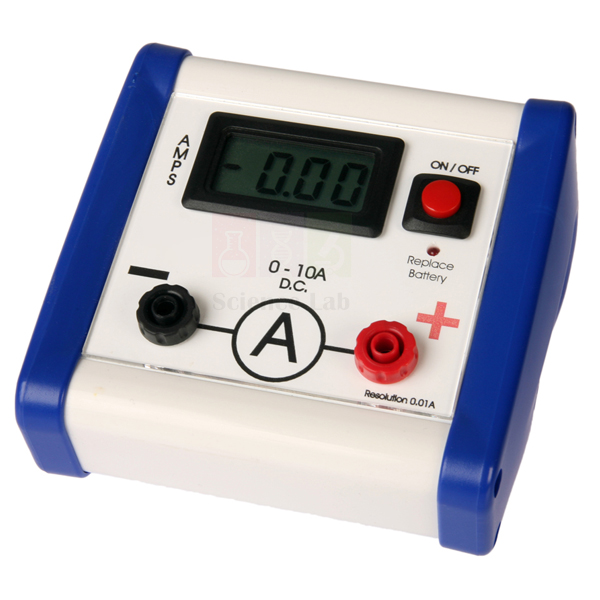
Digital Ammeter
Digital Ammeter (Product Code: SLE/EAM/09) measures direct current from 0 to ±10 A and shows it to 0.01 A, so one meter covers both small lamp circuits and the heavy currents used in electromagnetism demonstrations. Running from a 9 V PP3 battery, it needs no mains connection on the bench, which makes it a practical addition to the physics lab instruments used in school and college practicals. It is made by Jain Scientific Equipments Pvt Ltd (ScienceLab), Ambala, India.
Specifications
| Parameter | Detail |
|---|---|
| Range | 0 to ±10 A DC |
| Resolution | 0.01 A |
| Accuracy | ±2% |
| Input impedance | 0.01 Ω approx. |
| Power | 9 V PP3 battery |
Typical Use
The meter is wired in series with the component being studied, and its very low input impedance means it adds almost nothing to the resistance of the circuit, so the current it shows is the current that would flow without it. Together with a voltmeter it forms the familiar ammeter-voltmeter pair for Ohm's law, resistivity and power experiments, and the bipolar range shows a minus sign rather than a damaged movement if a student connects it the wrong way round.
The upper end of the range is where this meter earns its place. Demonstrations such as the magnetic field around a vertical wire or the force on a current-carrying conductor need several amperes, well beyond many general-purpose classroom meters, and this ammeter lets the class read the actual current rather than guess it. One rule is worth repeating before every practical: an ammeter must never be connected directly across a power supply or cell, because its low impedance would effectively short-circuit the source.
Manufacturer
Jain Scientific Equipments Private Limited, operating under the ScienceLab trade name in Ambala, Haryana, produces this ammeter as part of its range of meters and circuit apparatus for schools, colleges and technical institutes. Company background is available on the ScienceLab profile.
Related Electricity and Magnetism Equipment
The following items are used in the same circuits and demonstrations as this ammeter:
- Digital Voltmeter — the partner meter for potential difference in the same practical.
- Magnetic Field Unit Vertical Wire — runs at 5–8 A, a current this meter can monitor.
- Force on a Conductor Apparatus — takes currents of up to 8 A, within the meter's range.
- Lost Volts — internal-resistance apparatus that needs an ammeter and a voltmeter.
- Precision Switched Power Supply — a regulated, high-current DC source for these circuits.
More meters and apparatus are listed under Electricity and Magnetism.
Frequently Asked Questions
What current range does it cover?
0 to ±10 A DC, displayed in steps of 0.01 A with an accuracy of ±2%.
Is it sensitive enough for very small currents?
It reads in hundredths of an ampere, which suits lamps, motors and electromagnet circuits. For milliamp-level work such as LED characteristics, ask us to suggest a more sensitive meter.
How is it powered?
By a 9 V PP3 battery, so it can be used on any bench without a mains socket.
Can it measure AC current?
The published range is DC only. If you need AC current measurement, contact us before ordering.
How should students connect it?
Always in series with the component. Connecting it across a supply creates a near short circuit because of its very low input impedance of about 0.01 Ω.
Can you provide a calibration certificate or warranty details?
Both are confirmed per order. Please raise them through our contact page when requesting a quote.
Request a Quote
To order Digital Ammeters in class quantities for India or international delivery, contact us through the contact page or add them to the enquiry cart along with voltmeters and supplies.
Last updated: 24 September 2026
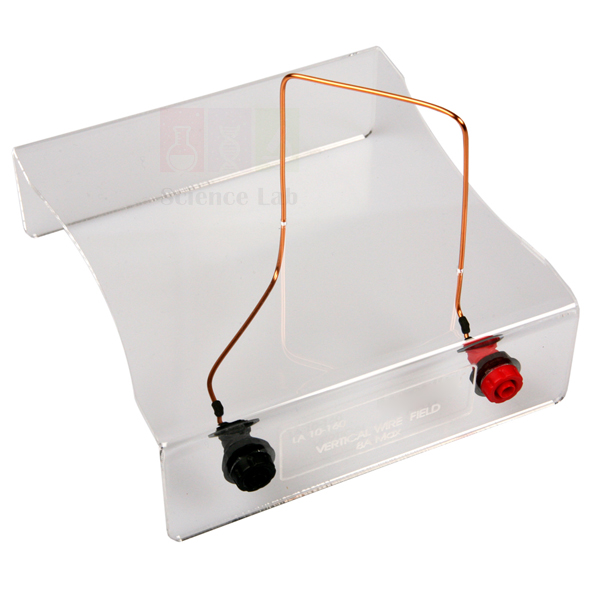
Magnetic Field Unit Vertical Wire
Magnetic Field Unit Vertical Wire (Product Code: SLE/EAM/10) is a clear acrylic base with a straight conductor passing vertically through it, used to reveal the circular magnetic field around a current-carrying wire with plotting compasses or iron filings. It belongs to a small electromagnetic kit for schools made up of three field units, and its transparent base works on the bench or on an overhead projector for whole-class viewing. The unit is made by Jain Scientific Equipments Pvt Ltd (ScienceLab), Ambala, India.
Specifications
| Parameter | Detail |
|---|---|
| Type | Vertical wire field unit |
| Base | Clear acrylic, 150 x 150 x 45 mm |
| Connections | 4 mm sockets |
| Viewing | Suitable for bench or overhead projector use |
| Field detection | Used with plotting compasses or iron filings |
| Supply requirement | DC power supply capable of providing 5–8 A |
| Series | Three types: 15 turn long solenoid, vertical wire field and twin vertical coils |
| Twin coil model (for comparison) | Single-turn coil rated 8 A max; 5-turn coil rated 5 A max |
Typical Use
With the wire connected to a high-current DC supply, students sprinkle a thin layer of iron filings on the acrylic base and tap it gently; the filings settle into concentric rings centred on the wire. Replacing the filings with a ring of plotting compasses shows the direction of the field, and reversing the supply leads makes every needle swing round, which is the ideal moment to introduce the right-hand grip rule. Placed on an overhead projector, the same pattern is thrown onto the screen so the whole room can follow it.
Because the unit needs 5 to 8 A to give a clear pattern, switch the current on only while observing and off again straight after, so the wire and supply stay cool. As a magnetism experiment it pairs naturally with the solenoid and twin-coil versions in the same series, letting students compare the field of a single straight wire with that of a coil. Brush filings onto a sheet of paper afterwards and keep them well away from the sockets.
Manufacturer
This field unit comes from Jain Scientific Equipments Private Limited, which trades as ScienceLab and manufactures physics apparatus in Ambala, Haryana. Institutional and tender buyers who need vendor registration details can quote GSTIN 06AAECJ8618A1ZT and LEI 3358004HRD1JIVXKYX49. The company profile has further information.
Related Electricity and Magnetism Equipment
A complete field-pattern demonstration usually calls for the following:
- Precision Switched Power Supply — regulated DC rated up to 8 A, matching the unit's supply requirement.
- Digital Ammeter — its 10 A range lets students record the current through the wire.
- Compass Plotting (Clear) — small plotting compasses for tracing the field direction around the wire.
- Plotting Compass, Single Glass Face — an alternative compass style for the same task.
- Stackable Leads — 4 mm leads for connecting the unit's sockets to the supply.
See the complete Electricity and Magnetism range for the other field units and accessories.
Frequently Asked Questions
Which version of the field unit is this?
This listing is the vertical wire field unit. The series also includes a 15 turn long solenoid and twin vertical coils; tell us if you need those as well.
What power supply does it need?
A DC supply able to deliver 5–8 A. Ordinary low-current classroom supplies will not produce a clear pattern.
Are plotting compasses or iron filings included?
The unit is designed to be used with them, but they are not listed as part of it. Please confirm what you need through our contact page so they can be added to your quotation.
Can the pattern be shown to the whole class?
Yes. The clear acrylic base is suitable for use on an overhead projector as well as on the bench.
What are the ratings of the twin coil model?
In the twin coil version, the single-turn coil is rated at 8 A maximum and the 5-turn coil at 5 A maximum.
Is there a warranty on the unit?
Warranty terms are stated in each quotation. Ask us for details when you enquire.
Do you handle tender and export orders?
Yes. Share your tender format, quantity and delivery location, and we will quote for India or international markets.
Request a Quote
Request pricing for the Magnetic Field Unit Vertical Wire through the contact page, or add it to the enquiry cart with a suitable power supply and compasses.
Last updated: 24 September 2026
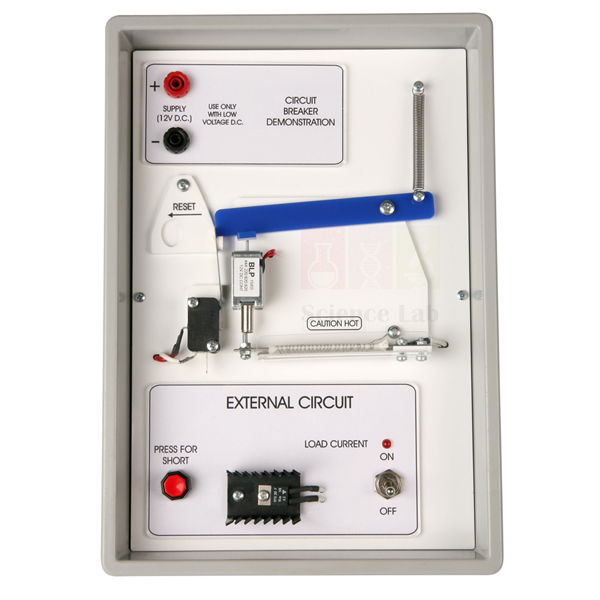
Circuit Breaker
Circuit Breaker (Product Code: SLE/EAM/11) is a demonstration unit that shows, on safe low-voltage DC, how a modern domestic circuit breaker protects a circuit in two different ways: a thermal trip that responds to a slow overload and a solenoid trip that reacts to a sudden current surge. By combining a solenoid experiment with a bi-metal strip demonstration, it links two textbook topics to a device students see in every home. It is made by Jain Scientific Equipments Pvt Ltd (ScienceLab), Ambala, India.
Key Details
| Parameter | Detail |
|---|---|
| Type | Circuit breaker demonstration apparatus |
| Slow overload protection | Thermal trip using a bi-metal strip |
| Surge overload protection | Solenoid (electromagnetic) trip |
| Supply required | 12 V DC, safe low voltage |
| Connections | 4 mm sockets |
| Housing | Robust tray with acrylic protective cover |
| Teaching focus | Applications of solenoids and bi-metal strips; key principles of the domestic circuit breaker |
Typical Use
A lesson usually starts with the slow overload. As the current is held above normal, the bi-metal strip warms, bends and eventually releases the contacts, and students can relate the delay to an overloaded extension board that gets hot before anything trips. The contrasting surge overload makes the solenoid pull in almost at once, showing why a real breaker needs a fast electromagnetic response for short circuits as well as a slower thermal one for sustained overloads.
Because everything runs from 12 V DC and sits under a clear acrylic cover, students can watch both mechanisms at close range without any exposure to mains wiring. The unit works well as a capstone electricity experiment after separate lessons on electromagnets and thermal expansion, and it opens a natural discussion about how breakers differ from fuses in household safety.
Manufacturer
Jain Scientific Equipments Private Limited, whose products carry the ScienceLab name, manufactures electrical demonstration apparatus like this unit in Ambala, Haryana, for classrooms in India and international markets. Find out more on the company profile page.
Related Electricity and Magnetism Equipment
Buyers of this demonstrator often add these items to power it or extend the safety topic:
- Precision Switched Power Supply — regulated DC whose range covers the 12 V this unit needs.
- Digital Ammeter — lets students see the current at which each trip operates.
- Earth Neutral Live Demo — covers fuses, earthing and safe appliance wiring in the same topic.
- Electromagnetic System — builds understanding of the solenoid behind the surge trip.
- Stackable Leads — 4 mm leads for connecting the unit to its supply.
Browse related apparatus in the Electricity and Magnetism category.
Frequently Asked Questions
What power supply does it need?
A 12 V DC supply, connected through the 4 mm sockets on the unit.
Does it connect to the mains?
No. It runs on safe low-voltage DC, so the demonstration involves no mains wiring.
What exactly does it demonstrate?
Two protection mechanisms: a thermal trip operated by a slow overload through a bi-metal strip, and a solenoid trip operated by a current surge, together showing the principles of a domestic circuit breaker.
Can students handle it?
The mechanisms are protected by an acrylic cover inside a robust tray, making it suitable for close viewing under teacher supervision.
How is a circuit breaker different from a fuse?
A fuse wire melts and must be replaced, whereas a breaker opens the circuit mechanically using devices such as a bi-metal strip and a solenoid. Pairing this unit with a fuse demonstration makes the comparison clear.
Are spares or a warranty available?
Spares and warranty terms are confirmed with each quotation; please ask through our contact page.
Request a Quote
For pricing on the Circuit Breaker demonstrator, send us your quantity and delivery location via the contact page, or add it to the enquiry cart with a power supply and leads.
Last updated: 24 September 2026
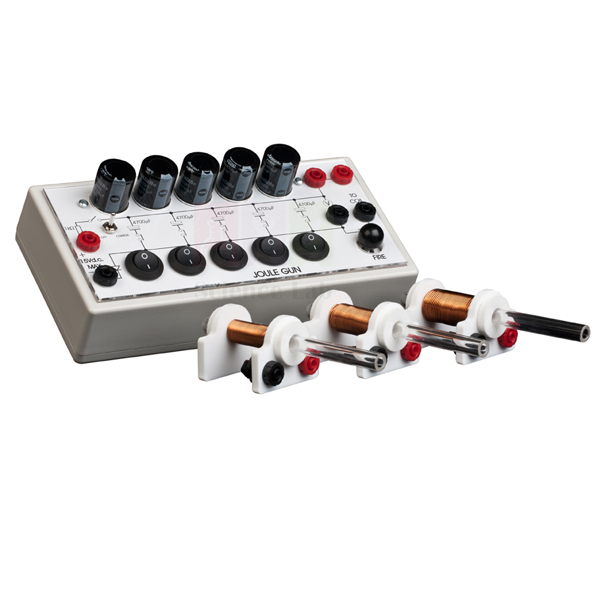
Joule Gun
Joule Gun (Product Code: SLE/EAM/12) stores electrical energy in a bank of capacitors and, at the press of a FIRE button, releases it as a pulse through a low resistance coil that launches a small steel projectile. It turns an abstract chain of ideas – capacitor charging, energy storage, electromagnetism, mechanical energy and efficiency – into one memorable physics experiment kit for senior school and college students. It is made by Jain Scientific Equipments Pvt Ltd (ScienceLab), Ambala, India.
Specifications
| Parameter | Detail |
|---|---|
| Energy store | Control box with five high value capacitors, switched into the charge circuit as required |
| Firing | FIRE button releases the stored energy as a pulse into a low resistance coil |
| Projectile | Small steel projectile |
| Investigable variables | Voltage, time, capacity, distance, kinetic energy and potential energy |
| Topics covered | Energy storage, capacitor charging, mechanical energy, efficiency, electromagnetism |
| Mass | 0.5 kg |
| Dimensions | 220 x 110 x 80 mm, excluding coil |
Typical Use
Students choose how many of the five capacitors to switch into the charge circuit, charge them, note the voltage and calculate the stored energy from E = ½CV². After firing, they measure how far the steel projectile travels and use it to estimate the kinetic energy it gained, or the potential energy it would reach if launched upwards. Comparing that mechanical energy with the electrical energy stored gives a figure for efficiency, and the discussion of where the rest went – heating in the coil and wiring, sound, friction – is often the most valuable part of the lesson.
Because voltage, charging time, capacity and distance can all be changed one at a time, the apparatus supports proper fair-test investigations rather than a single demonstration, and it pairs well with force and motion work on projectiles. Treat every firing as a launch: keep the path clear, never aim the coil at anyone, and have observers wear eye protection.
Manufacturer
Jain Scientific Equipments Private Limited develops and manufactures investigative physics apparatus such as the Joule Gun under its ScienceLab brand in Ambala, Haryana. You can read about the company on its profile page.
Related Electricity and Magnetism Equipment
For measuring the variables and building up the background theory, consider:
- Digital Stopclock — times the charging period when time is the variable under test.
- Metal Ruler — measures the distance travelled by the projectile.
- Capacitor (Charging and Discharging) — introduces capacitor charging before students move on to the gun.
- Capacitance Selector — a switched set of capacitors for exploring how capacitance affects charging.
- Electromagnetic System — shows how coil current creates the magnetic pull used to launch the projectile.
More energy and electromagnetism apparatus is in the Electricity and Magnetism category.
Frequently Asked Questions
How does the Joule Gun work?
Energy is stored in the capacitors in the control box. Pressing FIRE discharges it as a pulse through a low resistance coil, whose magnetic field launches the small steel projectile.
What can students investigate with it?
Voltage, time, capacity, distance, kinetic energy and potential energy can all be varied or measured, which makes efficiency calculations possible.
How many capacitors are there, and what are their values?
There are five high value capacitors that are switched into the charge circuit as needed. Individual values are not listed here, so please ask us via the contact page if you need them for worksheets.
What supply is needed to charge it?
The charging supply is not specified on this page. Confirm the requirement with us before ordering so the right source can be included in your quotation.
How large is the unit?
The apparatus measures 220 x 110 x 80 mm excluding the coil, and the apparatus has a mass of 0.5 kg.
Is it safe for a classroom?
It is intended for supervised use. Keep the firing path clear, never point the coil at people, and use eye protection for everyone nearby.
Can you quote for colleges or export customers?
Yes. Send the quantity and delivery country or city, and we will quote for India or international markets, including warranty terms.
Request a Quote
Get a price for the Joule Gun through our contact page, or add it to the enquiry cart together with the timing and measuring items you need.
Last updated: 24 September 2026
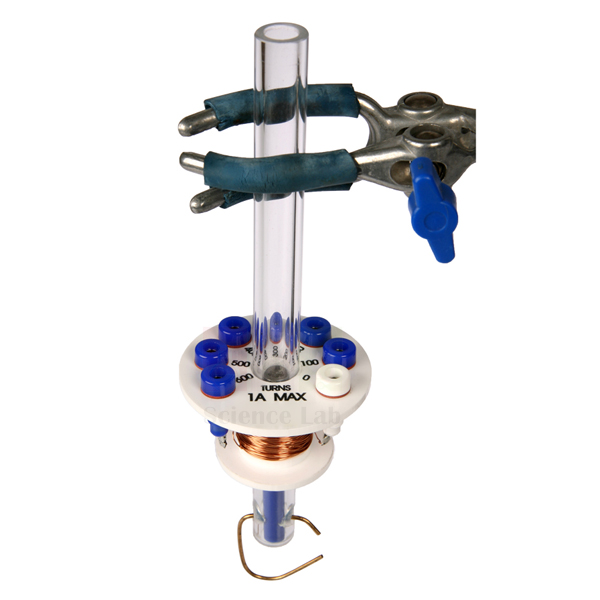
Electromagnetic System
Electromagnetic System (Product Code: SLE/EAM/13) is a self-contained unit that lets students find out how the current and the number of turns affect the strength of an electromagnet. Its coil is tapped at 100, 200, 300, 400, 500 and 600 turns, and ordinary paper clips act as the weights, so a whole investigation needs little more than a low-voltage DC supply. This practical piece of physics lab equipment is made by Jain Scientific Equipments Pvt Ltd (ScienceLab), Ambala, India.
Specifications
| Parameter | Detail |
|---|---|
| Type | Self-contained electromagnet investigation unit |
| Coil tappings | 100, 200, 300, 400, 500 and 600 turns |
| Variables studied | Current and number of turns |
| Strength measurement | Paper clips used as weights |
| Supply required | Low-voltage DC power supply |
| Suggested supply | Designed for use with ScienceLab power supplies |
Typical Use
The unit is set up for a clean two-part investigation. In the first part the current is held steady while the connection is moved from one tapping to the next, and students count how many paper clips the electromagnet will hold at each number of turns. In the second part the tapping stays fixed while the supply is adjusted, with an ammeter recording the current each time. Plotting paper clips against turns and against current gives two graphs that make the relationship obvious, and it is an equally good basis for a science fair project on electromagnet strength.
For consistent results, use clips of the same size, bring them up to the electromagnet the same way each time, and switch the current off between readings so the coil does not warm up during the run. Groups can share one supply by taking turns, since the tappings allow each reading to be set up in seconds.
Manufacturer
The Electromagnetic System is produced by Jain Scientific Equipments Private Limited, an Ambala, Haryana manufacturer that sells its teaching apparatus under the ScienceLab name and designs units like this one to work alongside its own power supplies. The ScienceLab company profile has more on the business.
Related Electricity and Magnetism Equipment
These items supply, control and measure the current in this investigation:
- Precision Variable Power Supply — a smoothly adjustable low-voltage DC source for the current-variation part.
- Digital Ammeter — records the coil current for each reading.
- Rheostat — an alternative way to vary the current from a fixed supply.
- Iron-Clad Electromagnet — a battery-powered electromagnet for comparison demonstrations.
- Circuit Breaker — shows an everyday application of a solenoid once the basics are understood.
Visit the Electricity and Magnetism category for further magnetism apparatus.
Frequently Asked Questions
Which numbers of turns can be selected?
The coil has tappings at 100, 200, 300, 400, 500 and 600 turns, giving six settings for the turns investigation.
What power supply is required?
A low-voltage DC power supply. The unit is designed to be used with ScienceLab power supplies, which can be quoted with it.
What is the maximum current the coil can take?
A current rating is not listed on this page. Please confirm it through our contact page before planning your current range.
How is the strength of the electromagnet measured?
By counting paper clips used as weights, which keeps the method simple and cheap to repeat.
Can students set it up themselves?
Yes. It is self-contained and runs on low voltage, so small groups can carry out the investigation under normal teacher supervision.
Do you supply complete class sets?
Yes. Tell us how many units and supplies you need, plus your delivery location in India or abroad, and we will send a combined quotation including warranty terms.
Request a Quote
Ask for a price on the Electromagnetic System via the contact page, or add it to the enquiry cart with a power supply and ammeter for each group.
Last updated: 24 September 2026
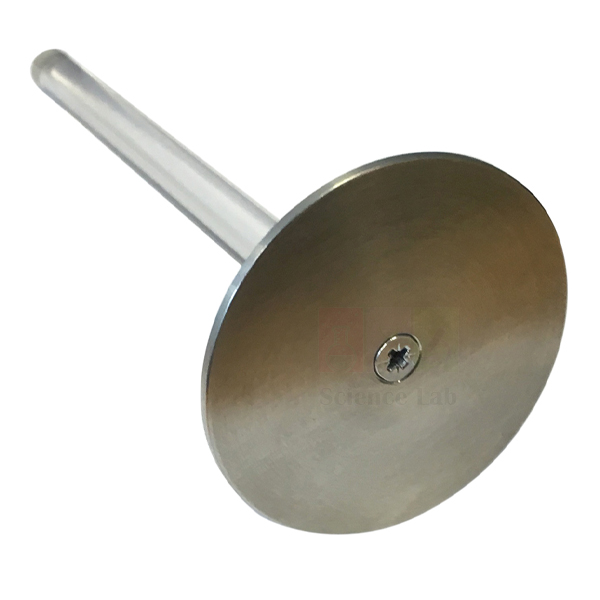
Proof Plane 20mm Dia
Proof Plane 20mm Dia (Product Code: SLE/EAM/14) is a small circular metal plate on an insulating handle, used in electrostatics to pick up a sample of charge from a conductor and carry it to a detector. As the smallest plate in a range of three sizes, it is suited to sampling charge from small areas, for example when comparing different parts of a charged Van de Graaff dome. It is one of the simple but important physics lab instruments made by Jain Scientific Equipments Pvt Ltd (ScienceLab) in Ambala, India.
Specifications
| Parameter | Detail |
|---|---|
| Plate | Circular metal plate, 20 mm diameter |
| Handle | Insulating |
| Purpose | Transferring charge and investigating charge distribution in electrostatics |
| For use with | Van de Graaff generator |
| Other sizes in the range | 40 mm and 60 mm diameter plates |
Typical Use
Holding the proof plane by its handle, the student touches the plate against a charged conductor, lifts it away and brings it to the cap of an electroscope or into a Faraday's pail; the size of the response shows how much charge the plate collected. Repeating this at a sharply curved region and at a flatter region of the same conductor reveals that charge gathers more densely where the surface curves most, which is the principle behind lightning conductors and the point discharge seen on a Van de Graaff generator.
The 20 mm plate is the choice when you want to sample a small, well-defined patch of surface; the larger plates in the range collect more charge and give a bigger deflection. Always discharge the plate by touching it to earth between samples, hold it only by the handle, and keep the handle clean and dry, since grease or damp air lets charge leak away and spoils electrostatics results.
Manufacturer
ScienceLab proof planes are made by Jain Scientific Equipments Private Limited, a manufacturer of electrostatics and general physics apparatus based in Ambala, Haryana. The company profile explains more about the firm and its range.
Related Electricity and Magnetism Equipment
A proof plane needs a charge source and a detector; these items complete the set:
- Van de Graaff Generator — the charged conductor the proof plane is designed to sample.
- Van De Graaff Accessory Kit — includes a Faraday's pail and other items for electrostatics demonstrations.
- Electroscope, Gold Leaf — shows the charge carried by the proof plane through leaf deflection on a scale.
- E-Field Detector — indicates the sign and size of charge with an LED array.
For more electrostatics apparatus, browse Electricity and Magnetism.
Frequently Asked Questions
What size is this proof plane?
The plate is 20 mm in diameter. The same design is also available with 40 mm and 60 mm plates.
Which plate size should I choose?
Choose the 20 mm plate to sample small areas and compare charge density at different points; larger plates pick up more charge and give a stronger signal on the detector. Many labs keep more than one size.
What equipment is it used with?
It is intended for use with a Van de Graaff generator, together with a detector such as an electroscope or a Faraday's pail.
Why do my results fade on humid days?
Moisture or grease on the insulating handle allows charge to leak. Keep the handle clean and dry, and work in the driest part of the room.
Is it supplied singly or in a set?
The pack quantity is not stated on this page. Please tell us how many you need through our contact page and we will confirm.
Can you supply schools in bulk or overseas?
Yes. ScienceLab quotes class and institutional quantities for India and international markets; include your delivery location in the enquiry.
Request a Quote
For pricing on the Proof Plane 20mm Dia, or a mix of plate sizes, contact us through the contact page or add it to the enquiry cart with your electrostatics apparatus.
Last updated: 24 September 2026
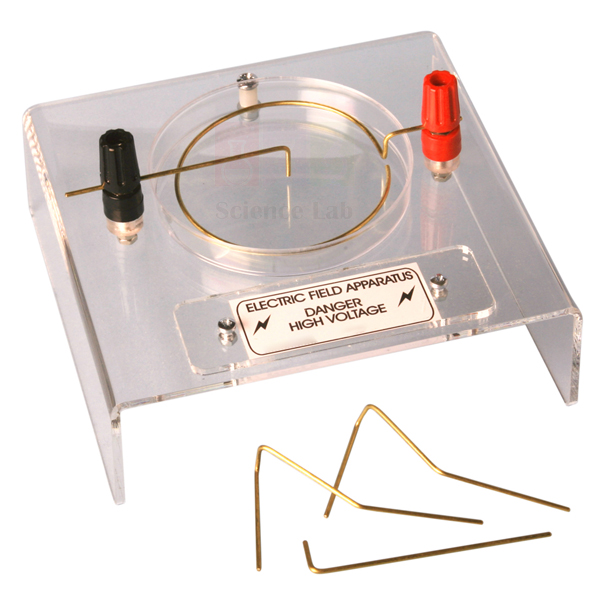
Electric Field Apparatus
Electric Field Apparatus (Product Code: SLE/EAM/15) makes invisible electric fields visible: fine particles floating on liquid paraffin in a 90 mm petri dish line up along the field between a pair of electrodes once a high voltage is applied. Built on a clear acrylic base that can go straight onto an overhead projector, it is a simple physics demonstration kit for showing the field patterns of various electrode configurations to a whole class. It is made by Jain Scientific Equipments Pvt Ltd (ScienceLab), Ambala, India.
Specifications
| Parameter | Detail |
|---|---|
| Type | Electric field pattern demonstration model |
| Dish | 90 mm petri dish, filled with liquid paraffin in use |
| Electrodes | Various electrode configurations |
| Connections | 4 mm terminals for the high-voltage supply |
| Base | Clear acrylic, allows projection with an overhead projector |
| Dimensions | 150 x 150 x 60 mm |
| Supply required | Safe, low-current limited 0–5 kV EHT supply |
| Not supplied | Semolina or fine grass seed |
Typical Use
Pour a shallow layer of liquid paraffin into the petri dish and sprinkle semolina or fine grass seed evenly over the surface. With the EHT supply switched off and turned to zero, connect it to the 4 mm terminals, then raise the voltage slowly: the grains swing round and settle into chains that trace the field lines between the electrodes. Changing the electrode arrangement lets students compare how the pattern differs from one configuration to the next, noting where the lines crowd together and where they spread out, and link each picture to the idea of field strength.
Set on an overhead projector, the acrylic base throws the pattern onto the screen so everyone sees the same result, making this a useful piece of physics lab equipment for introducing electric fields before any calculation. Only use a current-limited EHT supply, make every change to the electrodes with the supply switched off, and clean the paraffin out of the dish after the lesson.
Manufacturer
The apparatus is manufactured by Jain Scientific Equipments Private Limited in Ambala, Haryana, and sold under the company's ScienceLab brand. For purchase departments completing vendor forms, the company's GSTIN is 06AAECJ8618A1ZT and its Legal Entity Identifier is 3358004HRD1JIVXKYX49. See the company profile for more.
Related Electricity and Magnetism Equipment
To run this demonstration and build the wider electrostatics topic around it:
- EHT Power Supply — an adjustable, current-limited high-voltage source of the kind this apparatus requires.
- Magnetic Field Unit Vertical Wire — the magnetic counterpart, also on a clear acrylic base for projection.
- E-Field Detector — indicates the sign and size of charge for follow-up work.
- Proof Plane 20mm Dia — samples charge from conductors when studying charge distribution.
All our electrostatics and field apparatus is listed in Electricity and Magnetism.
Frequently Asked Questions
What power supply does it need?
A safe, low-current limited EHT supply adjustable from 0 to 5 kV, connected through the 4 mm terminals. Do not use a supply without current limiting.
What do I need to add before use?
Liquid paraffin for the dish and semolina or fine grass seed to show the pattern. The semolina or seed is not supplied; if you would like us to include paraffin, mention it through our contact page.
Can the whole class see the pattern?
Yes. The clear acrylic base allows the pattern to be projected with an overhead projector.
How big is the apparatus?
It measures 150 x 150 x 60 mm, which fits the stage of a typical overhead projector, and the dish is 90 mm across.
Which electrode shapes are provided?
The apparatus demonstrates fields between various electrode configurations. For the exact set supplied, please check with us before ordering.
Is a warranty included?
Warranty terms are confirmed in the quotation for your order.
Do you accept institutional and export orders?
Yes. Send your quantity, delivery location and any vendor documentation you need, and we will quote for India or international markets.
Request a Quote
Price the Electric Field Apparatus, with an EHT supply if required, through our contact page or by adding both to the enquiry cart.
Last updated: 24 September 2026
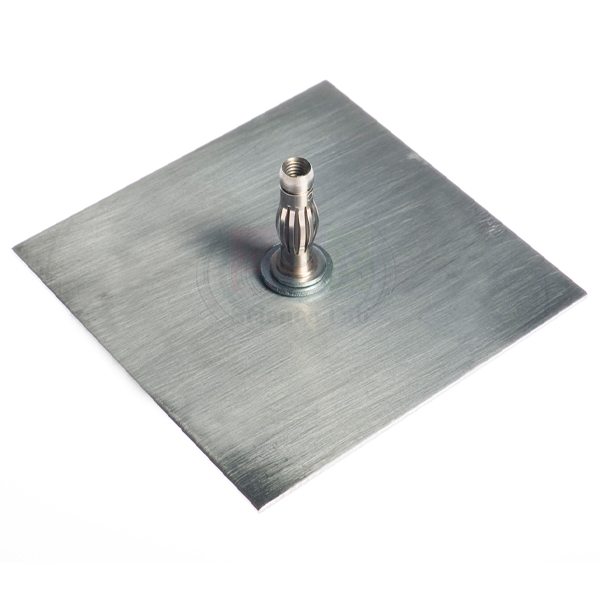
Zinc Plate
Zinc Plate (Product Code: SLE/EAM/16) is a 40 x 40 mm zinc plate mounted on a 4 mm connector so that it can replace the top plate of an electroscope. Once fitted, it turns the electroscope into a simple photoelectric effect kit: a negatively charged plate loses its charge when lit by ultraviolet of a suitable wavelength, which students see as the leaf falling. It is made by Jain Scientific Equipments Pvt Ltd (ScienceLab), Ambala, India.
Specifications
| Parameter | Detail |
|---|---|
| Plate | Zinc, 40 x 40 mm |
| Mounting | 4 mm connector |
| Fits | Replaces the top plate of an electroscope |
| Demonstrates | Discharge under UV lighting; the photo-electric effect |
| Also required | UV lamp of suitable wavelength (not part of this item) |
Typical Use
Clean the zinc surface first, since a dull oxide layer weakens the effect, then plug the plate into the electroscope in place of its usual top plate and give it a negative charge so the leaf rises. When the UV lamp is switched on and aimed at the plate, electrons are emitted from the zinc and the leaf slowly collapses. Repeating with a positive charge produces no discharge, and holding a sheet of ordinary glass between lamp and plate stops the effect as well, because the glass absorbs the short-wavelength ultraviolet that does the work.
Those three observations – negative charge lost, positive charge kept, glass blocks it – lead students to the idea of photons and threshold frequency far more convincingly than a diagram. The demonstration fits naturally into a radiation experiment sequence at senior level. UV lamps can harm eyes and skin, so never look into the lamp, keep exposure short and use suitable eye protection.
Manufacturer
This accessory is produced by Jain Scientific Equipments Private Limited, the Ambala, Haryana company behind the ScienceLab name, which makes electrostatics and modern-physics apparatus for schools and colleges. Read more on the company profile.
Related Electricity and Magnetism Equipment
The zinc plate works as part of an electroscope set-up; these items help complete it:
- Electroscope, Gold Leaf — a plate-topped electroscope with a deflection scale; ask us to confirm fit with the zinc plate.
- E-Field Detector — confirms whether the plate carries negative or positive charge.
- Proof Plane 20mm Dia — transfers charge onto the electroscope from a charged source.
- Van de Graaff Generator — a hand-cranked source of static charge for electrostatics lessons.
More electrostatics apparatus is available in Electricity and Magnetism.
Frequently Asked Questions
What size is the zinc plate?
40 x 40 mm, mounted on a 4 mm connector.
Will it fit my electroscope?
It is designed to replace the top plate of an electroscope using its 4 mm connector. Tell us which electroscope you have through our contact page and we will confirm compatibility.
Is a UV lamp included?
No. A UV lamp of suitable wavelength is required separately. Not every UV source works, since the radiation must be short enough in wavelength to release electrons from zinc, so ask us before choosing a lamp.
Why does the leaf not fall when the plate is positively charged?
Ultraviolet releases electrons from the zinc. A positively charged plate attracts them back, so no charge is lost; this contrast is a key part of the demonstration.
How should the plate be cared for?
Keep the zinc surface clean and bright, cleaning it before each session, and store the plate dry so the surface does not dull.
Can you supply it with other electrostatics apparatus?
Yes. Combined orders for schools and colleges in India and international markets are quoted together, including warranty terms.
Request a Quote
Enquire about the Zinc Plate through the contact page, or add it to the enquiry cart along with the electroscope you plan to use it with.
Last updated: 24 September 2026
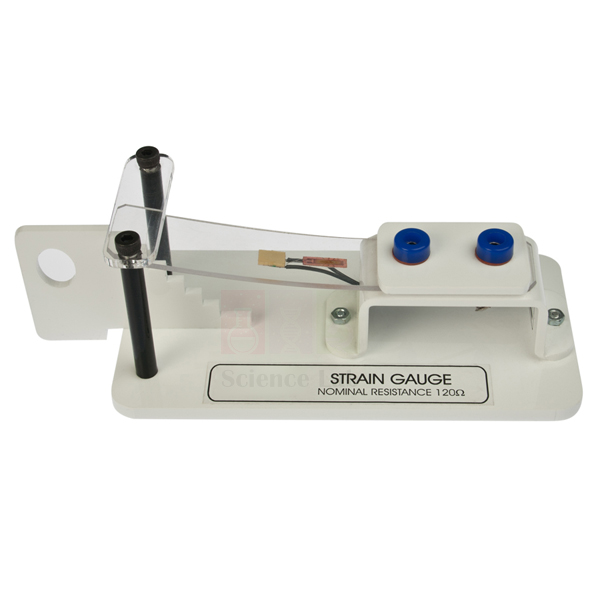
Mini Strain Gauge
Mini Strain Gauge (Product Code: SLE/EAM/17) is a 120 ohm metal foil resistive strain gauge bonded to a flexible plastic strip, designed to show students how bending a material changes the resistance of a gauge attached to it. Travel limiters protect the strip whichever way it is bent, and a step gauge lets it be flexed in repeatable 5 mm increments. A compact teaching item for physics and engineering lab equipment collections, it is made by Jain Scientific Equipments Pvt Ltd (ScienceLab), Ambala, India.
Specifications
| Parameter | Detail |
|---|---|
| Sensor type | Metal foil resistive strain gauge |
| Mounting | Bonded to a flexible plastic strip |
| Gauge resistance | 120 ohms |
| Resistance change | About 1 ohm at maximum flex |
| Bending | Either direction, with travel limiters to prevent damage |
| Step gauge | Provided, for bending the strip in 5 mm increments |
| Connections | 4 mm sockets |
| For real measurements | Use as part of a bridge network with suitable amplification |
Typical Use
A good starting point is to connect a sensitive resistance meter across the sockets and flex the strip one step at a time with the step gauge: the reading creeps up when the foil is stretched and falls when it is compressed. The change, only about one ohm across the full travel, makes the central teaching point for itself – the effect is real but tiny, which is exactly why industrial strain gauges are never read directly.
The next stage is a Wheatstone bridge experiment. With the gauge forming one arm and the bridge balanced at zero flex, each 5 mm step produces a small out-of-balance voltage that an amplifier can raise to a measurable level, mirroring how load cells, electronic scales and structural sensors work. Because the travel limiters stop the strip before it is over-bent, groups can repeat the sequence many times without harming the bonded foil.
Manufacturer
Jain Scientific Equipments Private Limited (CIN U29309HR2020PTC087597) is the incorporated company that trades as ScienceLab; its apparatus is produced at the company's licensed factory in the HSIIDC Industrial Area, Saha, Ambala, Haryana (Factory Licence AMB-ONLINE-CHD-J-414). The company profile gives an overview of its work.
Related Electricity and Magnetism Equipment
To turn the gauge's small resistance change into a measurement, buyers look at:
- Instrumentation Amplifier — a switched-gain amplifier intended for sensors such as strain gauges; ask us about connecting it to this unit.
- Wheatstone Bridge Four Gap — the bridge network in which the gauge forms one arm.
- Resistance Substitution Box — supplies a matching resistance to balance the bridge.
- Strain Gauge — a larger version with the gauge on a steel strip and its own bridge network.
- Digital Strain Display — a multi-channel instrument for direct strain readings at advanced level.
Further sensors and circuit apparatus are in Electricity and Magnetism.
Frequently Asked Questions
What is the resistance of the gauge?
120 ohms, changing by about 1 ohm at maximum flex.
Can I read strain directly with a meter?
You can see the resistance change with a sensitive meter, which demonstrates the principle. For real measurements the gauge must be used in a bridge network with suitable amplification.
Can students damage it by bending it too far?
The strip can be bent in either direction, and travel limiters stop it before damage occurs. Handle the foil area gently all the same.
What does the step gauge do?
It lets the strip be bent in 5 mm increments, so each reading corresponds to a known, repeatable deflection.
How does it connect to other apparatus?
The gauge connections are brought out to 4 mm sockets for use with standard 4 mm leads.
Is a calibration certificate available?
This is a demonstration unit; certificate availability and warranty terms can be discussed with us through the contact page.
Do you supply technical institutes and export buyers?
Yes. We quote for schools, colleges and training institutes across India and international markets; include quantity and delivery details.
Request a Quote
Request pricing for the Mini Strain Gauge through our contact page, or add it to the enquiry cart together with a bridge or amplifier.
Last updated: 24 September 2026

Piezo Transducer
Piezo Transducer (Product Code: SLE/EAM/18) is a 15 mm diameter ceramic piezoelectric element, protected by an integral press-stud, that turns a sharp mechanical tap into a voltage pulse of up to 20 V. Working the other way, it converts an electrical signal into sound, so a single small device shows energy conversion in both directions. It makes a handy addition to STEM science kit activities on energy transfer and is made by Jain Scientific Equipments Pvt Ltd (ScienceLab), Ambala, India.
Specifications
| Parameter | Detail |
|---|---|
| Element | Ceramic, 15 mm diameter |
| Protection | Integral protective press-stud |
| Output | Voltage pulses of up to 20 V when given a sharp tap |
| Output shown on | Voltmeter, data-logger or oscilloscope |
| Reverse effect | Connected to a signal generator, converts the electrical signal to sound waves |
Typical Use
For the direct effect, connect the transducer to an oscilloscope or data-logger and tap the press-stud sharply: a tall, narrow spike appears on the trace, and students can compare light and firm taps to show that more mechanical input produces a larger pulse. A voltmeter can be used too, but because each pulse lasts only a moment the display may just flicker, so an oscilloscope or logger gives the clearest record. The same principle drives the spark in a piezo gas lighter, a link students recognise at once.
For the reverse effect, connect the transducer to a signal generator from the electronics lab and it becomes a small loudspeaker, turning the electrical signal into sound waves. Varying the generator frequency lets the class hear the pitch change, which makes the unit useful in a sound wave experiment as well as in energy-conversion lessons. Always tap the protective stud rather than the edge of the ceramic, which is brittle.
Manufacturer
ScienceLab is the trading identity of Jain Scientific Equipments Private Limited, a maker of physics and electronics teaching apparatus located in Ambala, Haryana, with customers in India and international markets. Company details are on the profile page.
Related Electricity and Magnetism Equipment
These items show the transducer's output or drive its reverse effect:
- Oscilloscope Dual Trace — captures the shape and height of each voltage pulse.
- Signal Generator and Amplifier — provides the electrical signal for the sound-producing reverse effect.
- Digital Voltmeter — its 20 V range suits quick checks of pulse size.
- Gas Lighter, Piezo Electric — an everyday device that uses the same piezoelectric principle.
- Mini Strain Gauge — another sensor that converts mechanical deformation into an electrical change.
See more sensors and apparatus in Electricity and Magnetism.
Frequently Asked Questions
How much voltage does it produce?
Pulses of up to 20 V when the element is given a sharp tap.
What do I need to display the output?
A voltmeter, data-logger or oscilloscope. For brief pulses, an oscilloscope or data-logger shows the result most clearly.
Can it produce sound?
Yes. Connected to a signal generator, it converts the electrical signal into sound waves, demonstrating the reverse piezoelectric effect.
Is it robust enough for students?
The 15 mm ceramic element has an integral protective press-stud, so students tap the stud rather than the ceramic itself. Avoid dropping it on hard floors.
What leads or connectors does it use?
The connection type is not listed on this page. Please confirm it through our contact page so you can order matching leads.
Can you quote for multiple units or overseas delivery?
Yes. Send the quantity and destination, and we will quote for India or international markets, including warranty terms.
Request a Quote
To price the Piezo Transducer, use our contact page or add it to the enquiry cart with an oscilloscope or signal generator if needed.
Last updated: 24 September 2026
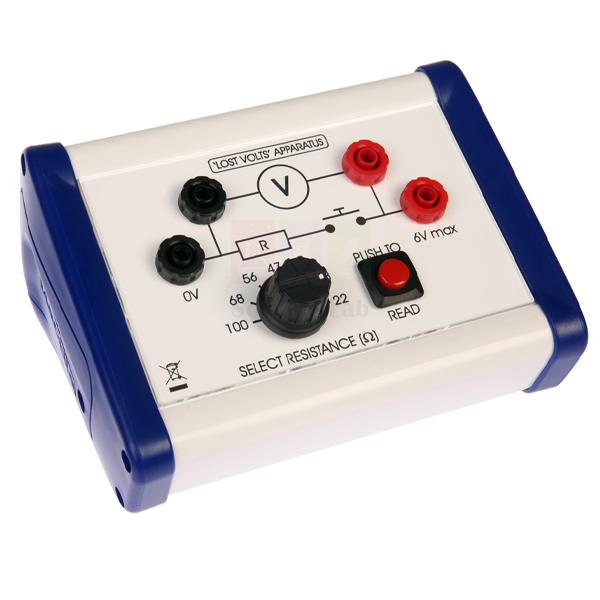
Lost Volts
Lost Volts (Product Code: SLE/EAM/19) is a self-contained apparatus for finding the EMF and internal resistance of a cell by experiment. Seven appropriately rated resistors and a push switch are housed in one unit, so students connect a single source, a voltmeter and an ammeter instead of wiring up a row of loose resistors. It is made by Jain Scientific Equipments Pvt Ltd (ScienceLab), Ambala, India, for school and college laboratories that want a quicker, tidier version of this classic piece of physics practical equipment for CBSE and similar syllabuses.
Specifications
| Parameter | Detail |
|---|---|
| Purpose | Experimental determination of the EMF and internal resistance of a cell |
| Load resistors | Seven appropriately rated resistors housed in the unit |
| Switch | Push switch, reducing unnecessary battery drain and excessive heat in the resistors |
| Source required | 6V DC source of EMF |
| Meters required | One voltmeter and one ammeter |
| Design advantage | Removes the complications of wiring separate resistors |
Typical Use
The name comes from the idea behind the experiment: when a cell drives current through a load, part of its EMF is “lost” across its own internal resistance, so the terminal voltage falls as the current rises. With the 6V DC source connected, the ammeter placed in series and the voltmeter across the source terminals, students press the push switch and record a voltage and current pair with each built-in resistor in circuit. Plotting terminal voltage against current gives a straight line whose intercept on the voltage axis is the EMF and whose gradient gives the internal resistance.
Because the switch only passes current while it is held down, the cell is not left discharging between readings and the resistors do not warm up, which keeps successive readings consistent through a practical period. It is a useful addition to any school physics lab equipment in India where the internal-resistance practical is run by several groups at once. Tip: take each reading promptly after pressing the switch, then release it before changing the load.
Manufacturer
Lost Volts is built by Jain Scientific Equipments Private Limited, a company in Ambala, Haryana that sells its teaching apparatus under the ScienceLab name to schools, colleges and distributors. More about the business and its electricity and magnetism range is on our company profile page.
Related Electricity and Magnetism Equipment
Items that complete the internal-resistance set-up on the bench:
- Digital Voltmeter — reads the terminal potential difference of the source at each load setting
- Digital Ammeter — records the current drawn from the source for the voltage–current graph
- Battery Holder, C — holds cells to build up the source whose internal resistance is being measured
- Stackable Leads — connecting leads for linking the source, meters and unit
- Apparatus for Studying f.e.m. and Internal Battery and Battery Resistance — an alternative apparatus for the same EMF and internal-resistance practical
Browse the complete Electricity and Magnetism range for more circuit and field apparatus.
Frequently Asked Questions
What else do I need to run the experiment?
A 6V DC source of EMF, a voltmeter and an ammeter, plus connecting leads. These are connected to the unit rather than built into it; suitable meters and leads are listed above.
How many load resistors does the unit contain?
Seven, each appropriately rated for the purpose. Individual resistance values are not listed in our current product documentation, so please contact us if your worksheet needs them in advance.
Why is a push switch fitted instead of a toggle switch?
Current flows only while the switch is pressed. This reduces unnecessary drain on the battery and stops excessive heat building up in the resistors between readings.
Can I use a bench power supply as the source?
The unit is intended for a 6V DC source of EMF. A cell or battery is the usual choice, because the aim is to measure that source’s own internal resistance; a well-regulated supply shows very little “lost volts” and gives a less instructive result.
What should an institutional quotation request include?
The product code SLE/EAM/19, the number of units, whether you also need meters, leads or cell holders, and the delivery address. Send these through our contact page.
Is bulk or export supply possible?
Yes. ScienceLab supplies schools, colleges, tender buyers and distributors in India and international markets; quantities and dispatch details are confirmed with each quotation.
Request a Quote
To order Lost Volts for your laboratory, send your requirement through our contact page or add the item to the enquiry cart together with any meters and leads you need, and our team will reply with a quotation.
Last updated: 24 September 2026
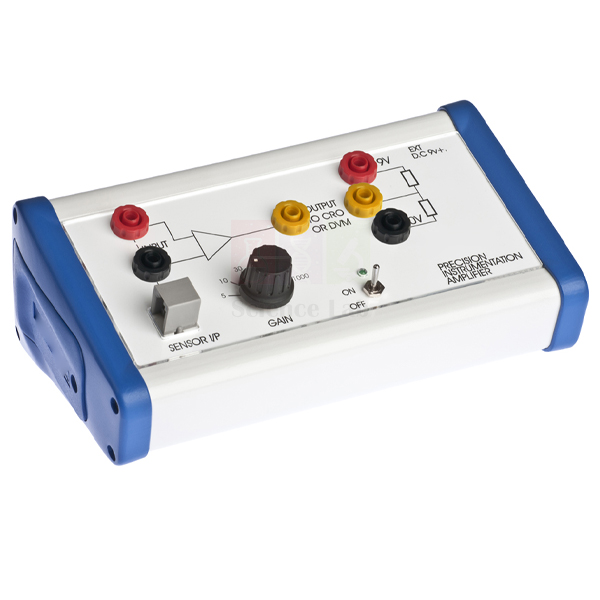
Instrumentation Amplifier
The Instrumentation Amplifier (Product Code: SLE/EAM/20) is a switched-gain precision op-amp unit that boosts the very small signals produced by sensors such as strain gauges, pressure gauges, thermocouples and platinum resistance thermometers until they can be read on an ordinary multimeter. Physics teachers, electronics tutors and engineering instructors use it to turn a sensor experiment into a clear voltage reading. It is produced by Jain Scientific Equipments Pvt Ltd (ScienceLab), Ambala, as part of its range of test and measurement instruments in India for teaching laboratories.
Specifications
| Parameter | Detail |
|---|---|
| Type | Switched-gain precision op-amp |
| Gain settings | 5, 10, 30, 100, 300 and 1000 |
| Sensor input | Telephone type data socket that interfaces with the flying lead of dedicated sensor units |
| Input monitoring | 4mm sockets for monitoring the input signal |
| Output reading | Output voltage measured with a standard multimeter |
| Auxiliary lines | 0V and +9V lines on the front panel for user-designed circuitry |
| Suitable sensors | Strain gauges, pressure gauges, thermocouples, platinum resistance thermometers and similar |
| Dimensions | 190 x 110 x 65mm overall |
Typical Use
Many transducers change their resistance or output voltage by only a tiny amount, far below what a school meter can resolve. The sensor’s flying lead plugs into the data socket, the gain switch is set, and the amplified output is read on a multimeter. A sensible routine is to start on a low gain, confirm the reading is stable, then step up through 30, 100 and beyond until the change of interest is comfortably visible without saturating the output. The 4mm input sockets let students compare the raw signal with the amplified one and work out the actual gain for themselves.
In advanced school physics, polytechnic and first-year engineering classes the unit supports loading experiments with a strain gauge, temperature measurement with thermocouples or resistance thermometers, and pressure sensing. The 0V and +9V lines on the front panel also allow students to build and power small circuits of their own design, which makes the amplifier a flexible choice among lab equipments for technical institutes.
Manufacturer
This amplifier comes from Jain Scientific Equipments Private Limited, trading as ScienceLab, which designs and manufactures physics and electronics teaching apparatus in Ambala, Haryana. The company is a registered MSME enterprise (Udyam UDYAM-HR-01-0003714), and its export consignments are handled under Importer-Exporter Code AAECJ8618A issued by the DGFT. Read more on our company profile.
Related Electricity and Magnetism Equipment
Sensors and meters that work alongside the amplifier in a measurement set-up:
- Strain Gauge — its output lead interfaces directly with this amplifier for strain experiments
- Mini Strain Gauge — a smaller strain-sensing unit for comparative loading work
- Digital Multimeter — reads the amplified output voltage
- Oscilloscope Dual Trace — displays input and output side by side when signals change with time
- Stackable Leads — connects the 4mm monitoring sockets and the meter
More sensors and circuit apparatus are listed in our Electricity and Magnetism category.
Frequently Asked Questions
Which gain settings are available?
Six switched settings: 5, 10, 30, 100, 300 and 1000. Choose the lowest gain that makes the sensor change clearly readable.
How is the output measured?
With a standard multimeter connected to the output. A multimeter is not part of the amplifier; see the related items above if you need one.
Will it work with any sensor?
It is designed for sensors such as strain gauges, pressure gauges, thermocouples and platinum resistance thermometers, and the telephone type data socket is made to accept the flying lead of dedicated sensor units. For a sensor from another source, contact us with its details so we can advise on connection.
What are the 0V and +9V terminals for?
They make the internal supply lines available on the front panel so students can power simple circuits they design themselves.
How large is the unit?
It measures 190 x 110 x 65mm overall, small enough to share a bench with the sensor rig and a meter.
Is a calibration certificate supplied?
Please discuss calibration certificate availability with us when you enquire, as requirements differ between institutions.
Can you quote for a full laboratory order?
Yes. List the amplifier (SLE/EAM/20), matching sensors, meters and quantities, and we will quote for schools, colleges and distributors in India and international markets.
Request a Quote
Add the Instrumentation Amplifier to the enquiry cart along with any sensors you plan to use, or write to us through the contact page for pricing and dispatch details.
Last updated: 24 September 2026
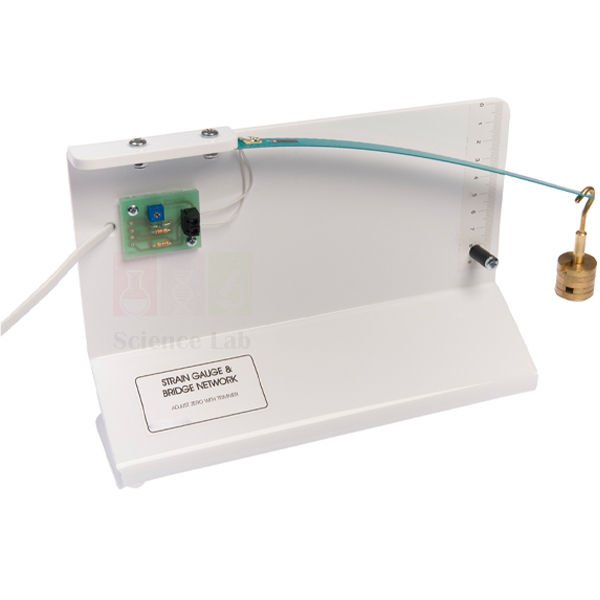
Strain Gauge
The Strain Gauge (Product Code: SLE/EAM/21) lets students watch how the electrical resistance of a gauge changes when the steel blade it is bonded to is bent under strain. The gauge’s terminations are brought out to a resistive bridge network on the main support, and the bridge output lead plugs straight into an Instrumentation Amplifier so the tiny changes become measurable. Manufactured by Jain Scientific Equipments Pvt Ltd (ScienceLab), Ambala, it suits A-level style physics, diploma and engineering lab equipment in India where sensors and materials are taught together.
Specifications
| Parameter | Detail |
|---|---|
| Sensing element | Strain gauge sensor bonded to a steel strip (blade) |
| Circuit | Terminations brought out to a resistive bridge network mounted on the main support |
| Output | Output lead from the bridge interfaces directly with the Instrumentation Amplifier |
| Measurement | Monitors tiny resistance changes when the blade is under strain |
| Spares | Replacement blade/strain gauge available separately |
| Dimensions | 280 x 160 x 65mm overall |
Typical Use
A strain gauge is a fine resistive track that stretches or compresses with the surface it is glued to, changing its resistance very slightly. Placing it in a bridge network turns that small change into an out-of-balance voltage, which the amplifier then raises to a level a multimeter can show. In class, students deflect the blade by increasing amounts, record the amplified output each time and plot output against deflection or load to see how linear the response is. The same set-up opens discussion of how weighing scales, load cells and structural monitoring systems work.
For consistent results, let the bridge settle after switching on, note a zero reading with the blade unloaded, and apply strain gently so the blade is never permanently bent. As a piece of mechanics lab equipment in India it bridges the gap between materials science and electrical measurement, and because the blade and gauge can be replaced separately, the main unit remains usable if a gauge is ever damaged.
Manufacturer
ScienceLab is the brand of Jain Scientific Equipments Private Limited, an Ambala, Haryana manufacturer of sensor, electricity and physics apparatus for teaching laboratories. Visit our company profile to learn how the company works with schools, colleges and distributors.
Related Electricity and Magnetism Equipment
Equipment that completes a strain-measurement experiment:
- Instrumentation Amplifier — the matching amplifier that accepts the bridge output lead directly
- Digital Multimeter — reads the amplified bridge output
- Mini Strain Gauge — a compact alternative for smaller benches or comparison work
- Strain Gauge Trainer — a materials-testing trainer for extending strain studies at engineering level
- Stackable Leads — links the amplifier output to the meter
See all sensors and demonstration units in the Electricity and Magnetism category.
Frequently Asked Questions
Can I read the Strain Gauge without an amplifier?
Not usefully. The resistance changes are tiny, so they need to be monitored by a suitable system such as the Instrumentation Amplifier, whose input accepts the bridge output lead directly.
Is the bridge circuit included?
Yes. The gauge terminations are brought out to a resistive bridge network mounted on the main support, so no separate bridge wiring is needed.
What if the blade or gauge gets damaged?
A replacement blade/strain gauge is available separately. Quote the product code SLE/EAM/21 when you contact us for spares.
How much bench space does it need?
The unit measures 280 x 160 x 65mm overall; allow extra room for the amplifier and meter beside it.
How should the blade be looked after?
Load it gradually, avoid bending it beyond its elastic range, and store the unit flat and dry. Keep the output lead free of sharp kinks.
Do you provide warranty information?
Warranty terms are stated with each quotation; ask our team through the contact page if you need them before ordering.
Request a Quote
For a quotation on the Strain Gauge, with or without the matching amplifier and spare blades, use our contact page or place the items in the enquiry cart. We supply institutions in India and international markets.
Last updated: 24 September 2026
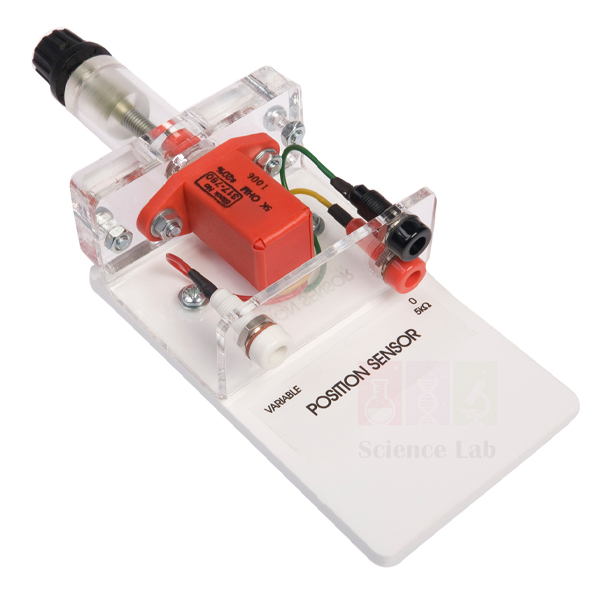
Position Sensor
The Position Sensor (Product Code: SLE/EAM/22) is a precision linear potentiometer whose resistance output changes between 0–5kΩ in step with the position of its slider, so small movements can be converted into an electrical reading. Teachers use it to follow slow movements such as the expansion of metals, and students find almost limitless scope for inventive investigations of their own. It is manufactured by Jain Scientific Equipments Pvt Ltd (ScienceLab), Ambala, a physics instruments supplier in India to schools, colleges and training institutes.
Specifications
| Parameter | Detail |
|---|---|
| Sensor type | Precision linear potentiometer (linear position sensor) |
| Output | Resistance changing between 0–5kΩ with linear position |
| Mounting | Sturdy acrylic base; the whole assembly can be clamped and used in any position |
| Connections | Brought out to 4mm sockets |
| Calibration aid | Bolt-on screw thread jig enables calibration to be carried out easily |
| Dimensions | 180 x 70 x 40mm overall |
Typical Use
Because resistance varies linearly with slider position, the sensor becomes a distance-measuring device once it has been calibrated. Using the bolt-on screw thread jig (similar to the arrangement described in the Advancing Physics notes), students advance the slider by known amounts, record the resistance at each step and draw a calibration graph. They can then attach the slider to a rod being heated, a spring being loaded or any slowly moving object and convert resistance readings straight into displacement.
Classic applications in physics lab equipment in India include measuring the linear expansion of a metal rod, following the extension of a spring, and tracking small movements in project work. The acrylic base can be clamped in a stand horizontally or vertically, and the 4mm sockets accept standard leads to a multimeter or into a potential divider circuit if a voltage output is preferred.
Manufacturer
The sensor is made by Jain Scientific Equipments Private Limited, which operates under the ScienceLab name from Ambala, Haryana and builds measurement and demonstration apparatus for education. For institutional and tender buyers who need vendor registration details, the company’s identifiers are GSTIN 06AAECJ8618A1ZT and LEI 3358004HRD1JIVXKYX49. Our company profile gives further background.
Related Electricity and Magnetism Equipment
Items commonly used with the sensor in expansion and displacement experiments:
- Digital Multimeter — measures the sensor’s resistance output directly
- Expansion Apparatus — provides the heated rod whose expansion the sensor can follow
- Retort Stand — holds the clamped sensor at the height and angle the experiment needs
- Universal Clamp — grips the acrylic base securely on the stand
- Stackable Leads — plug into the 4mm sockets to connect the meter
Find further sensors and circuit apparatus in our Electricity and Magnetism range.
Frequently Asked Questions
What output does the Position Sensor give?
A resistance that changes between 0–5kΩ linearly with position. Read it on an ohmmeter, or wire the sensor as a potential divider to obtain a voltage.
How is it calibrated?
A bolt-on screw thread jig lets you move the slider by known amounts and record the resistance at each step. Please contact us to confirm whether the jig is part of your order.
Can it be mounted vertically?
Yes. The sensor sits on a sturdy acrylic base, and the whole assembly can be clamped and used in any position.
Is it suitable for measuring the expansion of metals?
Yes, monitoring movement such as the expansion of metals is one of its intended uses. The heating apparatus and rod are separate items.
How should the sensor be cared for?
Move the slider smoothly without forcing it past its ends, keep the track free of dust, and avoid loads that could bend the slider.
Is a calibration certificate available?
Certificate availability should be discussed with us at the enquiry stage; in class, the sensor is normally calibrated by the students themselves using the jig.
Do you accept bulk and export orders?
Yes, for schools, colleges and distributors in India and international markets. Share quantities and delivery details with your enquiry.
Request a Quote
Request pricing for the Position Sensor through our contact page, or add it and any stands, clamps and meters to the enquiry cart for a single combined quotation.
Last updated: 24 September 2026
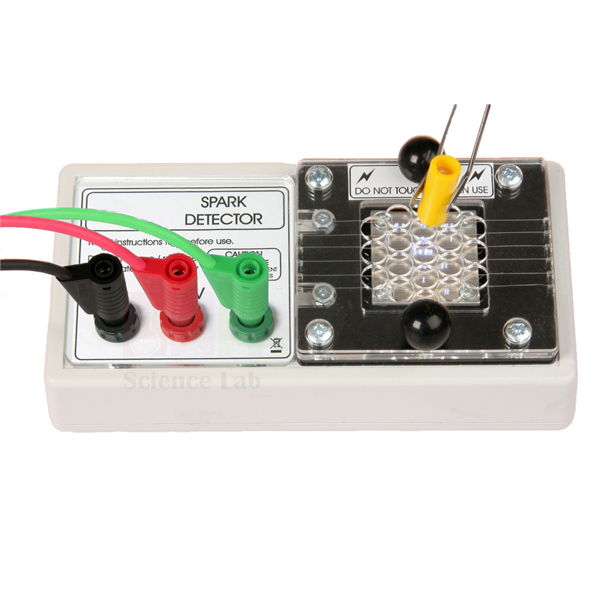
Multi-Wire Spark Detector
The Multi-Wire Spark Detector (Product Code: SLE/EAM/23) gives a memorable, dramatic demonstration of how strongly alpha particles ionise air. A row of fine wires is supported above a metal plate so that the two form electrodes separated by a small air gap; with an EHT supply connected, bringing an alpha source close makes the sparking across the gap increase dramatically, both visibly and audibly. Built by Jain Scientific Equipments Pvt Ltd (ScienceLab), Ambala, it is a teacher-led radiation experiment kit for India’s senior secondary and college physics departments.
Specifications
| Parameter | Detail |
|---|---|
| Construction | Number of fine wires supported above a metal plate, forming two electrodes separated by a small air gap |
| Connections | 4mm terminals for the EHT supply |
| Operating point | Occasional sparks occur when the potential across the gap reaches about 4500V |
| Supply required | EHT power supply capable of providing a negative potential |
| Demonstrates | Ionising properties of alpha particles; their short range and poor penetrating power |
| Indication | Visible and audible sparks |
Typical Use
The teacher raises the EHT voltage slowly until the gap sits just below steady breakdown, at around 4500V, where only the occasional stray spark appears from background ionisation. When an alpha source is brought near the wires, the ion pairs it creates in the air trigger a burst of sparks that the whole class can see and hear. Pulling the source back a few centimetres, or slipping a sheet of paper between source and wires, makes the sparking fall away almost immediately, a direct and convincing way to show the short range and poor penetrating power of alpha radiation.
This demonstration sits well alongside Geiger counter work in any school physics lab equipment in India used for the radioactivity topic. It is intended for teacher operation only: switch off and discharge the EHT supply before touching the terminals, and handle sealed sources with tongs in line with your institution’s radiation safety rules.
Manufacturer
ScienceLab apparatus such as this detector is produced by Jain Scientific Equipments Private Limited of Ambala, Haryana, a manufacturer of physics demonstration equipment for schools and universities. See the company profile for details of the organisation.
Related Electricity and Magnetism Equipment
Supplies and sources needed for the ionisation demonstration, plus a comparison detector:
- EHT Power Supply — an adjustable high-voltage supply; confirm with us that its output arrangement suits the detector
- Sealed Radioactive Source, Americium — an alpha emitter for triggering the sparks
- Sealed Radioactive Source, Strontium — a beta source for contrasting ionising ability with alpha
- Geiger Counter — counts radiation for quantitative range and absorption work
More field and electrostatics apparatus is listed in our Electricity and Magnetism section.
Frequently Asked Questions
What voltage does the detector need?
Sparking begins when the potential across the gap reaches about 4500V, so an EHT power supply is required, and it must be capable of providing a negative potential.
Is a radioactive source included?
No source is described as part of the detector. Alpha sources are separate items and their purchase, storage and use are subject to your local regulations.
Why does an alpha source cause more sparks than other radiation?
Alpha particles have short range but are very effective at ionising air, producing many ion pairs in the gap and triggering breakdown far more readily.
Can students operate it?
Because it runs from an EHT supply and uses radioactive sources, we recommend it as a teacher demonstration with students observing from a safe distance.
How should the wires be looked after?
The wires are fine, so avoid touching or bending them, keep the unit covered and dust-free, and switch off and discharge the supply before any handling.
What details help you prepare an institutional quotation?
The product code SLE/EAM/23, quantity, whether you also need an EHT supply, and the delivery address. Submit them via our contact page.
Request a Quote
Place the Multi-Wire Spark Detector in the enquiry cart or send an enquiry through our contact page; we quote for institutions and distributors in India and international markets.
Last updated: 24 September 2026
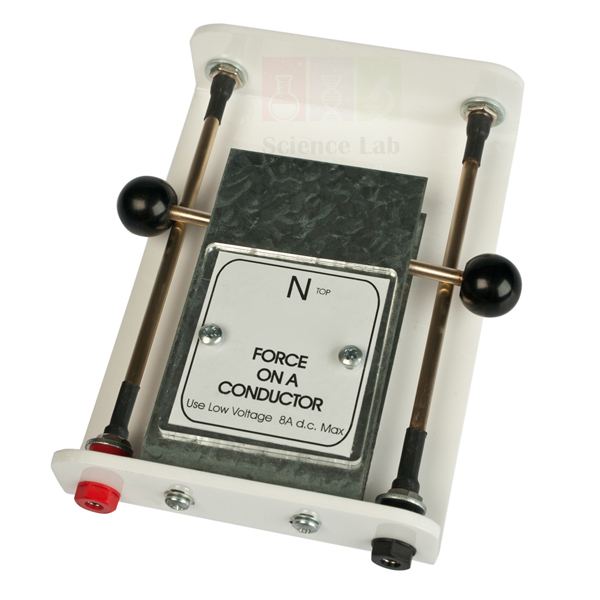
Force on a Conductor Apparatus.
The Force on a Conductor Apparatus. (Product Code: SLE/EAM/24) is a traditional demonstration of the motor effect: a crossbar rests across two side rails between the poles of a magnet, and when current flows through it the crossbar rolls one way or the other under the electromagnetic force. Reversing the current or the magnet reverses the motion, which makes Fleming’s left-hand rule easy to see. It is manufactured by Jain Scientific Equipments Pvt Ltd (ScienceLab), Ambala, and is a straightforward electromagnetic kit for school classrooms in India.
Specifications
| Parameter | Detail |
|---|---|
| Moving conductor | Crossbar that rolls along the side rails |
| Magnet | Clearly labelled poles |
| Connections | 4mm sockets attached to the side rails |
| Operating current | Up to 8A |
| Supply required | Low voltage bench PSU |
| Demonstrates | Force on a current-carrying conductor in a magnetic field |
Typical Use
Connect a low voltage bench power supply to the 4mm sockets on the rails, place the crossbar across them between the magnet poles and switch on: the bar rolls sideways as soon as a sufficient current passes through it. Students predict the direction first using the labelled poles and the direction of conventional current, then check their prediction. Swapping the supply leads sends the bar the other way, and reversing the field would do the same, reinforcing that the force depends on both the field and the current direction.
Raising the current (within the up-to-8A limit) produces a livelier roll, giving a qualitative link between current and force before students meet F = BIL. For a well-rounded physics practical equipment CBSE set, the apparatus pairs naturally with a motor model so learners can see how the same force keeps a coil turning. Keep an ammeter in the circuit, switch off between runs and allow the crossbar to cool, as the high currents involved can warm it.
Manufacturer
Made in Ambala, Haryana by Jain Scientific Equipments Private Limited, whose products are sold under the ScienceLab brand to schools, colleges and distributors. Background on the company is available on our company profile page.
Related Electricity and Magnetism Equipment
Useful partners for a motor-effect lesson:
- Power Supply Variable — a continuously variable AC/DC bench supply for setting the conductor current
- Digital Ammeter — shows the current flowing through the crossbar
- Stackable Leads — connect the supply to the 4mm sockets on the rails
- Aluminium Foil Support Bar — extends the topic to forces between two current-carrying conductors
- Demonstration Electric Motor — shows the same force producing continuous rotation
Explore the wider Electricity and Magnetism collection for more demonstrations.
Frequently Asked Questions
What current does the apparatus need?
It is designed for currents of up to 8A, supplied from a low voltage bench power supply connected to the 4mm sockets on the side rails.
Is a power supply included?
No. A low voltage bench PSU is required and is ordered separately; one option is listed above.
How do students know which way the crossbar should move?
The magnet has clearly labelled poles, so they can apply the left-hand rule using the known field direction and current direction before switching on.
Can the magnet be reversed?
Reversing either the field or the current reverses the force. Changing the supply polarity is the simplest method; please contact us if you need details of how the magnet is mounted.
How should the rails and crossbar be maintained?
Keep the contact surfaces clean and dry so the crossbar makes good electrical contact, and wipe away any tarnish with a soft cloth before a lesson.
Is there a warranty?
Warranty terms are provided with our quotation; ask the sales team if you need them in writing before ordering.
Can you supply several sets for a school or a distributor?
Yes. We supply quantities for schools, colleges and distributors in India and international markets.
Request a Quote
Send us your quantity and delivery location via the contact page, or add the Force on a Conductor Apparatus and a suitable power supply to the enquiry cart to receive one combined quotation.
Last updated: 24 September 2026
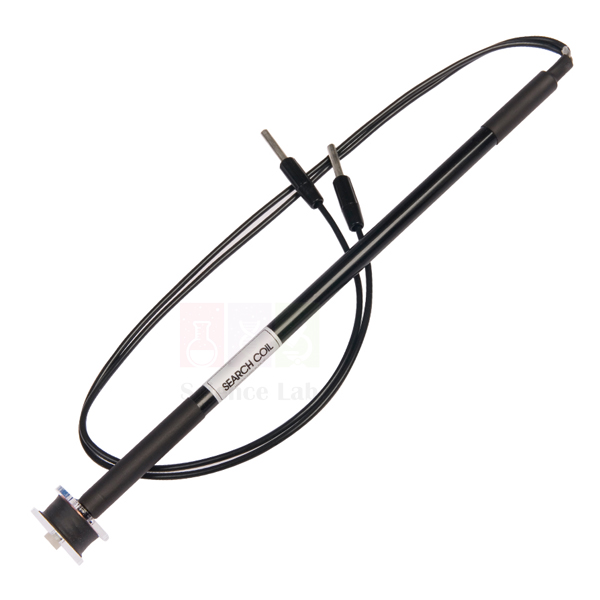
Search Coil
The Search Coil (Product Code: SLE/EAM/25) is a hand-held probe for investigating changing magnetic fields: a 3300 turn, 25mm diameter coil mounted on a plastic handle. When the field through the coil changes, an EMF is induced in its many turns, and connecting the coil to an AC millivoltmeter or oscilloscope turns that EMF into a reading students can compare from place to place. Manufactured by Jain Scientific Equipments Pvt Ltd (ScienceLab), Ambala, it is a compact addition to any electromagnetic induction kit in India for senior school and college physics.
Specifications
| Parameter | Detail |
|---|---|
| Coil | 3300 turns |
| Coil diameter | 25mm |
| Handle | Plastic |
| Connection | 4mm flying leads |
| Read with | AC millivoltmeter or oscilloscope |
| Application | Investigating changing magnetic fields |
Typical Use
A search coil only responds to a field that is changing, so it is normally used near a coil, solenoid or transformer carrying alternating current. Students hold the probe by its handle, move it around the source and watch the induced signal on the meter or oscilloscope trace. Rotating the coil until the reading peaks shows the field direction at that point, while stepping it away from the source shows how quickly the field strength falls with distance. Because the induced EMF is proportional to the rate of change of flux, doubling the supply frequency at the same current also makes a neat demonstration of Faraday’s law.
The large number of turns gives a usable signal even from modest fields, so the probe works well in ordinary physics lab equipment set-ups without special amplifiers. Keep the flying leads twisted together to reduce pick-up, and hold the coil steady while a reading is taken.
Manufacturer
Jain Scientific Equipments Private Limited manufactures this probe under its ScienceLab trading name in Ambala, Haryana, where it produces induction, magnetism and circuit apparatus for classrooms. The company profile describes the business in more detail.
Related Electricity and Magnetism Equipment
Field sources and instruments that complete a search-coil investigation:
- Oscilloscope Dual Trace — displays the induced signal and lets it be compared with the driving current
- Signal Generator and Amplifier — drives a coil with an alternating current to create the changing field
- Primary and Secondary Coil Set — provides coils whose fields can be mapped with the probe
- Faraday’s Law Apparatus — a companion unit for the wider electromagnetic induction topic
For more induction and magnetism apparatus, visit our Electricity and Magnetism category.
Frequently Asked Questions
How many turns does the Search Coil have?
3300 turns, wound as a 25mm diameter coil on a plastic handle.
Can I use it with a steady magnet?
Only while the magnet or coil is moving. A search coil detects changing fields, so a stationary magnet gives no reading; an AC-driven coil gives a continuous signal.
What meter do I need?
An AC millivoltmeter or an oscilloscope, connected through the 4mm flying leads. A standard DC voltmeter will not show the alternating signal properly.
Is a meter supplied with the coil?
No, the meter or oscilloscope is separate. Please contact us if you would like a quote for both together.
Is a calibration certificate available for field measurements?
The probe is intended for comparative classroom measurements. If you need calibration documentation, discuss availability with our team before ordering.
Can you supply class sets and export orders?
Yes. We supply schools, colleges and distributors in India and international markets, and quantities are confirmed with each quotation.
Request a Quote
To buy the Search Coil, send your requirement via the contact page or add it to the enquiry cart with any field sources or meters you need.
Last updated: 24 September 2026
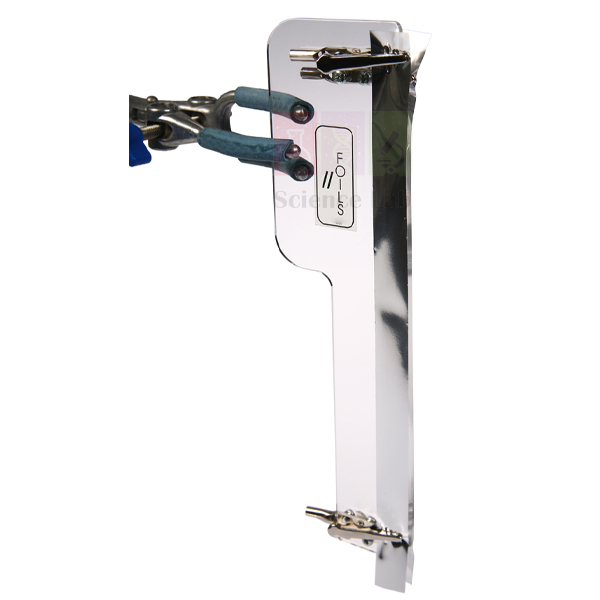
Aluminium Foil Support Bar
The Aluminium Foil Support Bar (Product Code: SLE/EAM/26) is a clear acrylic bar fitted with crocodile clips that holds strips of aluminium foil side by side, giving a neat and effective way to show that current-carrying conductors attract or repel one another. Teachers use it to turn a fiddly bench improvisation into a tidy, repeatable demonstration. It is made by Jain Scientific Equipments Pvt Ltd (ScienceLab), Ambala, alongside the rest of its electricity and magnetism range of physics lab equipment in India.
Key Details
| Parameter | Detail |
|---|---|
| Type | Support bar for foil strips |
| Material | Clear acrylic |
| Fittings | Crocodile clips for gripping and connecting the foil strips |
| Purpose | Demonstrating the attraction and repulsion of current-carrying conductors |
| Suitable for | Teacher demonstrations in secondary and senior secondary physics |
Typical Use
Two strips of aluminium foil are hung from the crocodile clips so they dangle parallel and close together. When they are wired so that current flows the same way in both strips, the magnetic field of each pulls the other towards it and the strips swing together; rewire them so the currents flow in opposite directions and they spring apart. The effect is the basis of the old definition of the ampere and makes a visual follow-up to the force on a single conductor in a magnet’s field.
The clear acrylic lets the class see the strips from any side, and the crocodile clips make it quick to swap in fresh foil when a strip tears. Use short pulses of current from a low-voltage supply rather than continuous current, as thin foil warms quickly, and keep the strips light and narrow so the movement is easy to spot. It is a simple item that earns its place in any set of educational physics lab equipments.
Manufacturer
The support bar is a ScienceLab product, the trading name of Jain Scientific Equipments Private Limited, which makes teaching apparatus at Ambala in Haryana for institutions in India and international markets. Read about the company on our company profile page.
Related Electricity and Magnetism Equipment
Items used with the bar to set up the parallel-conductor demonstration:
- Power Supply, Stepped — a low-voltage AC/DC bench supply for passing current through the strips
- Crocodile Clips & Leads — connect the supply to the foil strips
- Digital Ammeter — shows how much current is flowing during each pulse
- Force on a Conductor Apparatus. — the companion demonstration of force on a single conductor in a magnetic field
- Retort Stand — a convenient support if you prefer to raise the bar above the bench
More demonstrations are listed in our Electricity and Magnetism category.
Frequently Asked Questions
Is aluminium foil included?
The listing describes the acrylic bar and its crocodile clips. Ordinary kitchen-grade aluminium foil cut into strips works well; please contact us if you want foil supplied with your order.
Why is the bar made of clear acrylic?
Acrylic is an electrical insulator, so it holds the strips apart without shorting them, and its transparency keeps the view of the strips clear for the class.
What power source should I use?
A low-voltage laboratory supply is the usual choice. Apply current in brief pulses so the foil does not overheat.
How do I switch between attraction and repulsion?
Change the wiring so that current flows in the same direction through both strips for attraction, or in opposite directions for repulsion.
How should it be cleaned?
Wipe the acrylic with a soft damp cloth and mild soap; avoid solvents, which can craze acrylic surfaces.
Do you take orders from distributors?
Yes. We supply schools, colleges and distributors, and bulk quantities are quoted on request.
Request a Quote
Ask for pricing on the Aluminium Foil Support Bar through our contact page, or add it to the enquiry cart together with a power supply and leads.
Last updated: 24 September 2026
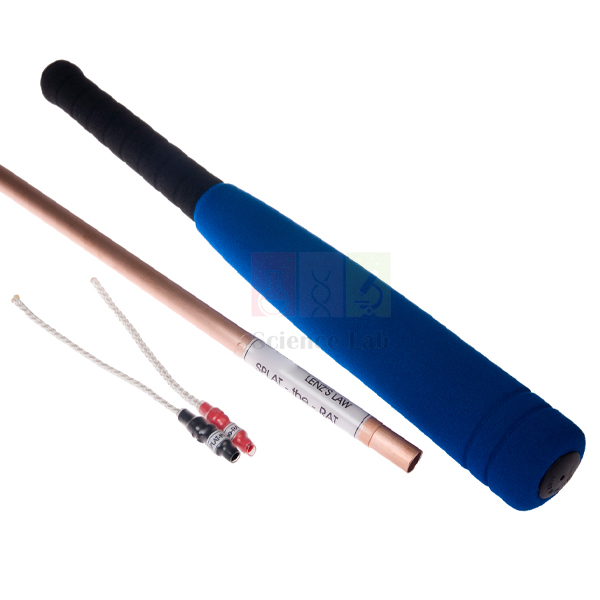
Splat The Rat
Splat The Rat (Product Code: SLE/EAM/27) turns Lenz’s Law into a classroom game based on the traditional village fete challenge. Two ‘rats’ are supplied: one contains strong neodymium magnets and the other is just a metal weight; dropped into a 1m copper tube, the magnetised rat takes about 5 seconds to emerge, so pupils waiting with the foam-covered rounders bat keep swinging too early. Produced by Jain Scientific Equipments Pvt Ltd (ScienceLab), Ambala, it is one of the more memorable STEM science kits in India for teaching induced currents.
Specifications
| Parameter | Detail |
|---|---|
| Tube | 1m copper tube |
| ‘Rats’ supplied | Two: one containing strong neodymium magnets, one containing just a metal weight |
| Bat | Foam-covered rounders bat |
| Magnetised rat exit time | About 5 seconds to exit the tube |
| Weight | 0.3kg |
| Dimensions | 1000 x 30 x 30mm |
| Demonstrates | Lenz’s Law, induced currents and magnetic fields |
Typical Use
Hold the copper tube upright and drop the plain metal-weight rat first: it falls straight through and the pupil with the bat has to be quick. Then drop the magnetised rat. As it falls, its moving field induces eddy currents in the copper, and by Lenz’s Law those currents create a field that opposes the motion, so the rat drifts down slowly and the challenge becomes a test of patience rather than reflexes. The contrast between the two rats does the explaining for you.
Standard eddy current tubes show the same principle with a magnet and an unmagnetised weight, but the game format gets the whole class involved and makes the result hard to forget. Follow up by asking students why a copper tube, which is not magnetic, can slow a magnet at all, and what would change with a plastic or slotted tube. Keep the neodymium rat away from electronics and bank cards, and never let pupils swing the bat near faces.
Manufacturer
Splat The Rat is manufactured by Jain Scientific Equipments Private Limited, known to customers as ScienceLab, at Ambala in Haryana. It holds Udyam registration UDYAM-HR-01-0003714 as an MSME with manufacturing as its major activity, and ships overseas orders under DGFT Importer-Exporter Code AAECJ8618A. Visit our company profile for more.
Related Electricity and Magnetism Equipment
Apparatus that extends the Lenz’s Law lesson:
- Eddy Current Unit — the conventional laboratory version of the falling-magnet experiment
- Stopwatch, Digital — times the fall of each rat for a quantitative comparison
- Faraday’s Law Apparatus — links the braking effect to induced EMF in a coil
- Neodymium Magnets — strong magnets for further eddy current investigations
- Neodymium Wand — handled neodymium magnets for safe pupil exploration of strong fields
See our full Electricity and Magnetism range for more induction demonstrations.
Frequently Asked Questions
What comes in the kit?
A 1m copper tube, two ‘rats’ (one containing strong neodymium magnets and one containing just a metal weight) and a foam-covered rounders bat.
How long does the magnetised rat take to come out?
About 5 seconds, compared with an almost immediate drop for the plain metal-weight rat.
Why include a non-magnetic rat?
It acts as the control. Seeing the weighted rat fall straight through proves that the slow fall is caused by magnetism and induced currents, not friction in the tube.
Is it safe for younger pupils?
The bat is foam-covered for the game, but the neodymium rat is strongly magnetic, so an adult should supervise and keep it away from electronic devices, cards and pacemaker users.
How big and heavy is it?
It measures 1000 x 30 x 30mm and weighs 0.3kg, so it stores easily in a cupboard.
Can you supply several kits for a school group or export order?
Yes. We supply schools, science centres and distributors in India and international markets; share quantities through our contact page.
Request a Quote
Add Splat The Rat to the enquiry cart or send your requirement via the contact page, and we will return a quotation with dispatch details.
Last updated: 24 September 2026
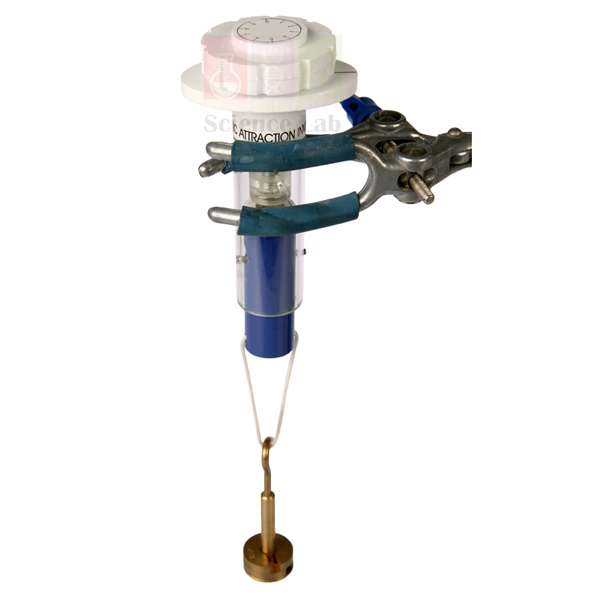
Magnetic Attraction
Magnetic Attraction (Product Code: SLE/EAM/28) is a self-contained apparatus for investigating how the attractive force between a pair of high strength neodymium magnets changes with the distance between them. A calibrated dial sets the separation, and the pull is measured by attaching standard slotted masses until the forces balance. Made by Jain Scientific Equipments Pvt Ltd (ScienceLab), Ambala, it is a practical addition to physics lab instruments in India for magnetism and forces topics.
Specifications
| Parameter | Detail |
|---|---|
| Magnets | Pair of high strength neodymium magnets |
| Separation control | Calibrated dial |
| Force measurement | By attaching standard slotted masses |
| Investigation | Variation of attractive force with separation distance |
| Teaching links | Magnetic investigations and balanced forces |
| Format | Self-contained system |
Typical Use
Students set a separation on the calibrated dial, then add slotted masses until their weight just balances the magnetic pull holding the magnets together. Repeating this at a series of dial settings produces a table of force against distance, and plotting the results shows how steeply magnetic attraction falls away as the gap widens. Plotting force against the inverse of distance, or on log–log axes, lets advanced students look for a power-law relationship rather than simply describing the curve.
Because the measurement relies on balancing two forces, the apparatus doubles as a concrete example of equilibrium for younger classes. Add masses in small steps near the balance point, approach each reading from the same direction to reduce errors, and keep steel tools and other magnets away from the bench. It is a tidy piece of physics practical equipment for CBSE and state-board laboratories that want a quantitative magnetism experiment.
Manufacturer
The apparatus is designed and manufactured in Ambala, Haryana by Jain Scientific Equipments Private Limited, operating as ScienceLab and supplying magnetism, electricity and mechanics apparatus to education. Details of the company are on our company profile.
Related Electricity and Magnetism Equipment
Items to use with, or alongside, the attraction apparatus:
- Magnetic Repulsion — the companion unit for measuring the push between like poles
- Slotted Mass Hanger, 500g — slotted masses for balancing the magnetic force
- Hangers with Slotted Weights — an alternative set of slotted weights for class groups
- Neodymium Wand — lets pupils feel the strength of neodymium magnets safely before measuring it
Browse all magnetism apparatus in our Electricity and Magnetism category.
Frequently Asked Questions
How is the separation between the magnets set?
With a calibrated dial, so each reading is taken at a known, repeatable separation.
Are the slotted masses included?
The force is measured with standard slotted masses. Please contact us to confirm whether masses are part of your order or should be added separately.
What type of magnets does it use?
A pair of high strength neodymium magnets, which give large, easily measured forces over a useful range of separations.
Is it suitable for younger students?
Yes, with supervision. The balanced-forces idea suits middle school, while the force–distance graph suits senior students. Neodymium magnets can pinch fingers, so handle them carefully.
How should it be stored?
Store it away from computers, magnetic media and other magnets, and keep the dial mechanism clean and dry.
Is a calibration certificate provided for the dial?
Discuss calibration certificate availability with our team when requesting a quotation.
Do you supply outside India?
Yes, ScienceLab supplies institutions and distributors in India and international markets.
Request a Quote
For a quotation on Magnetic Attraction, alone or paired with the repulsion unit, use the contact page or add the items to the enquiry cart.
Last updated: 24 September 2026
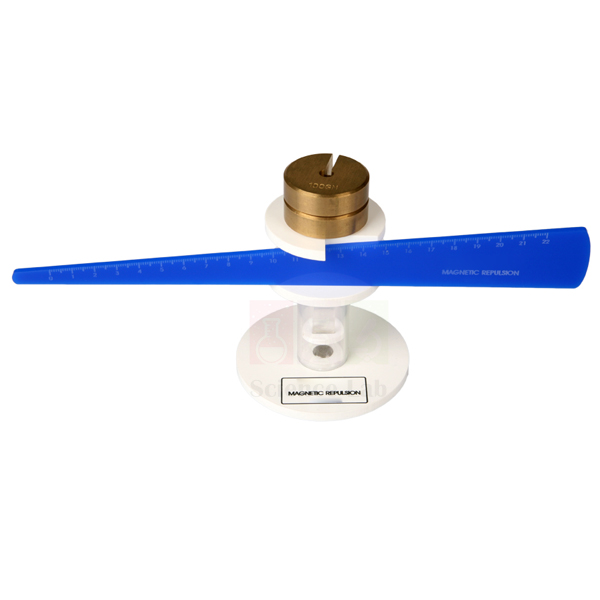
Magnetic Repulsion
Magnetic Repulsion (Product Code: SLE/EAM/29) is a simple system for investigating the force of repulsion between two high strength neodymium magnets. Standard slotted masses placed on the top plate push the magnets closer together against their mutual repulsion, and a direct reading ‘wedge’ gauge measures the separation that results. Designed for physics teachers who want a clean, quantitative magnetism practical, it is manufactured by Jain Scientific Equipments Pvt Ltd (ScienceLab), Ambala, a science apparatus manufacturer in India.
Specifications
| Parameter | Detail |
|---|---|
| Magnets | Two high strength neodymium magnets |
| Separation measurement | Direct reading ‘wedge’ gauge |
| Applying force | Standard slotted masses placed on the top plate |
| Investigation | Force of repulsion between the magnets at different separations |
| Teaching links | Magnetic repulsion and balanced forces |
Typical Use
With the top plate unloaded, the upper magnet floats at its largest separation. Students add slotted masses one at a time; each addition compresses the magnetic “cushion” a little more, and the wedge gauge is slid into the gap to read the new separation directly. When the plate settles, the total weight on it equals the repulsive force at that separation, so the data give a force–distance curve for like poles without any spring balance or sensor.
Running this unit alongside an attraction experiment lets a class compare how quickly attraction and repulsion change with distance. It also makes an effective demonstration of balanced forces, since the floating plate is visibly held up by an invisible push. Add masses gently and centrally so the plate does not tilt, and take each gauge reading only once the plate has stopped moving. Schools looking for a laboratory instruments supplier in India can order it individually or as part of a magnetism set.
Manufacturer
ScienceLab, the brand under which Jain Scientific Equipments Private Limited trades, makes this apparatus in Ambala, Haryana for schools, colleges and education distributors. Find out more on the company profile.
Related Electricity and Magnetism Equipment
Items that complement a repulsion investigation:
- Magnetic Attraction — measures the pull between unlike poles for a side-by-side comparison
- Hangers with Slotted Weights 500 gm — slotted weights for loading the top plate
- Slotted Mass Hanger, 1kg — a larger set of slotted masses when higher loads are needed
- Neodymium Magnets — loose neodymium magnets for open-ended pupil investigations
Our Electricity and Magnetism category lists further magnetism apparatus.
Frequently Asked Questions
How is the gap between the magnets measured?
With a direct reading ‘wedge’ gauge that is slid into the gap, so no ruler or calculation is needed for each reading.
How is the force applied?
By placing standard slotted masses on the top plate. Their weight at balance equals the repulsive force at that separation.
Are slotted masses supplied with the unit?
Our product description does not list them as included. Please contact us so we can confirm and, if needed, quote suitable masses.
What is the difference between this and the Magnetic Attraction apparatus?
This unit measures the push between two neodymium magnets using a wedge gauge and masses on a top plate; the attraction apparatus measures pull using a calibrated separation dial.
Any handling precautions?
Neodymium magnets are strong: keep fingers clear of the gap, keep the unit away from electronics, and never let the magnets snap together.
What should a tender or institutional enquiry mention?
The product code SLE/EAM/29, quantity, any slotted masses required, and the delivery location in India or abroad.
Request a Quote
Place Magnetic Repulsion in the enquiry cart, or send the details of your requirement through our contact page for a prompt quotation.
Last updated: 24 September 2026
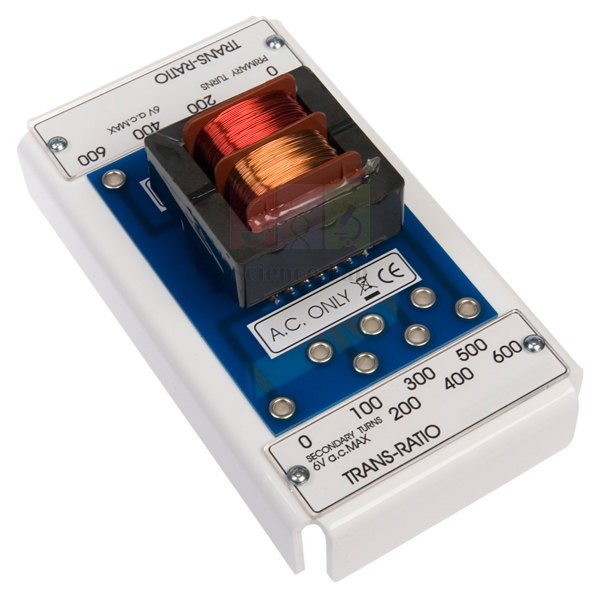
Trans-Ratio
Trans-Ratio (Product Code: SLE/EAM/30) is a fully self-contained transformer system that lets students investigate turns ratios and efficiency with the minimum of complication. The primary coil is tapped at 200, 400 and 600 turns and the secondary at every hundred turns from 100 to 600, with all tappings brought out to 4mm sockets, so dozens of ratios can be set up simply by moving leads. Manufactured by Jain Scientific Equipments Pvt Ltd (ScienceLab), Ambala, it is a ready-to-use transformer experiment kit for school and college laboratories, supplied with full instructions and experiment details.
Specifications
| Parameter | Detail |
|---|---|
| Type | Fully self-contained transformer system |
| Primary tappings | 200, 400 and 600 turns |
| Secondary tappings | 100, 200, 300, 400, 500 and 600 turns |
| Connections | All tappings brought out to 4mm sockets |
| Supply required | AC supply of up to 6V |
| Monitoring | AC voltmeters (not part of the unit) |
| Documentation | Full instructions supplied with experiment details |
| Size | 180 x 100 x 75mm |
Typical Use
Connect an AC supply of up to 6V across a chosen primary tapping and an AC voltmeter across a secondary tapping, then compare the voltage ratio with the turns ratio. Using the 200-turn primary with the 400-turn secondary gives a step-up of two; swapping to the 600-turn primary with the 100-turn secondary shows a strong step-down. Working through several combinations, students tabulate Vs/Vp against Ns/Np and see the transformer equation emerge from their own data, while differences from the ideal ratio open a discussion of flux leakage and losses.
With AC ammeters added in both circuits, the same unit supports efficiency measurements by comparing input and output power. Teachers also use it to show electromagnetic induction in its simplest form: no connection between the coils except the changing magnetic field. As a transformer experiment kit for school use it avoids the loose cores and clamps of demountable sets, which keeps practical time focused on the physics. Always use AC, never DC, and keep the input within the stated limit.
Manufacturer
Trans-Ratio is produced by Jain Scientific Equipments Private Limited, the Ambala, Haryana company behind the ScienceLab brand of teaching apparatus for physics, electricity and magnetism. Learn more on our company profile.
Related Electricity and Magnetism Equipment
Supply and measuring instruments for transformer practicals:
- Power Supply, Stepped — a low-voltage AC/DC bench supply; use its AC output within the unit’s limit
- Analogue Voltmeter AC — monitors primary and secondary voltages
- Analogue Ammeter AC — measures currents for efficiency calculations
- Digital Multimeter — a second meter so both coil voltages can be read at once
- Demountable Transformer Kit — for follow-up work on cores and coil construction
More induction apparatus is available in our Electricity and Magnetism category.
Frequently Asked Questions
Which turns ratios can be set?
Any combination of primary tappings at 200, 400 or 600 turns with secondary tappings at 100, 200, 300, 400, 500 or 600 turns, giving both step-up and step-down ratios.
What supply does it need?
An AC supply of up to 6V. A DC supply will not produce transformer action.
Are meters included?
No. AC voltmeters are required for monitoring, and AC ammeters are useful for efficiency work; these are ordered separately.
Does it come with instructions?
Yes, full instructions are supplied with experiment details, which helps teachers new to the apparatus plan a practical quickly.
How large is the unit?
It measures 180 x 100 x 75mm, compact enough for a student bench with meters and supply alongside.
Is a calibration certificate available?
The unit is a teaching transformer rather than a measuring instrument; for any documentation needs, discuss certificate availability with us before ordering.
Can you supply class sets for India and overseas?
Yes. We quote for schools, colleges and distributors in India and international markets; include quantity and destination in your enquiry.
Request a Quote
Request a quotation for Trans-Ratio through our contact page, or add it with suitable meters and a power supply to the enquiry cart.
Last updated: 24 September 2026
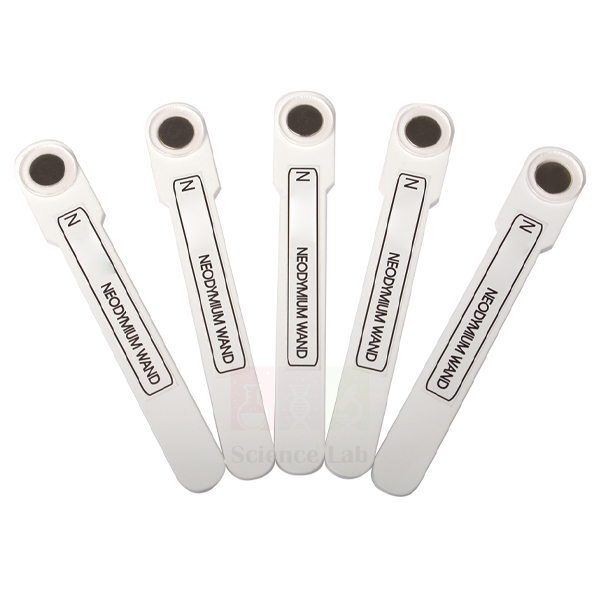
Neodymium Wand
The Neodymium Wand (Product Code: SLE/EAM/31) is a set of 5 acrylic wands, each fitted with a powerful 12mm diameter neodymium button magnet. Mounting each magnet in a wand makes these very strong magnets safe for pupil use, so children can explore attraction, magnetic materials and fields without pinched fingers or magnets snapping together. The set is made by Jain Scientific Equipments Pvt Ltd (ScienceLab), Ambala, and suits primary classrooms, junior science lab equipment collections and secondary physics groups alike.
Specifications
| Parameter | Detail |
|---|---|
| Supplied as | Set of 5 wands |
| Wand material | Acrylic |
| Magnet | Powerful neodymium button magnet, 12mm diameter, one per wand |
| Dimensions | 125 x 20 x 10mm |
| Key benefit | Makes strong magnets safe for pupil use |
Typical Use
Pupils use the wands to sort everyday objects into magnetic and non-magnetic materials, to test whether magnetism acts through paper, card, wood or water, and to count how many paper clips each wand can lift through different thicknesses of material. Because there are five wands in a set, a class can work in small groups at once. Older students can use the wands with a plotting compass to trace field lines or to find the poles of the button magnet.
The strength of neodymium makes effects obvious that weaker classroom magnets only hint at, such as attraction through a tabletop or the drag felt when the wand is moved over a copper or aluminium sheet. Remind users to keep the wands away from phones, cards and computers, and to store them apart so the magnets do not collect filings or clash together.
Manufacturer
These wands are made by Jain Scientific Equipments Private Limited, which trades as ScienceLab and manufactures magnetism and general science apparatus for schools from its base in Ambala, Haryana. Our company profile explains more about the business.
Related Electricity and Magnetism Equipment
Items that pair well with the wands in magnetism lessons:
- Compass Plotting (Clear) — traces the field lines around each button magnet
- Magnetic Field Demonstrator — makes the shape of the field visible to the whole group
- Neodymium Magnets — loose neodymium magnets for teacher-led extension work
- Magnetic Wands — an alternative wand style for younger pupils
- Splat The Rat — a neodymium-magnet demonstration of Lenz’s Law for the next step
See more magnetism apparatus in our Electricity and Magnetism section.
Frequently Asked Questions
How many wands are in a set?
Five acrylic wands, each fitted with its own 12mm diameter neodymium button magnet.
Why mount the magnets in wands?
Neodymium magnets are very strong. The wands make them safe for pupil use by giving a handle to hold and keeping fingers away from the magnet face.
What age groups can use them?
They suit supervised primary and middle-school activities as well as secondary physics; the teacher should brief pupils on keeping the magnets away from electronics.
How should the wands be cleaned and stored?
Wipe the acrylic with a soft damp cloth, remove any iron filings from the magnet with tape, and store the wands so the magnets are not touching each other.
Can I order extra sets for a whole class?
Yes. Multiple sets can be supplied for schools and distributors in India and international markets; contact us with the number of sets required.
Is there a warranty on the magnets?
Warranty terms are confirmed with each quotation. Ask our team if you need them before placing an order.
Request a Quote
Add the Neodymium Wand set to the enquiry cart or send us your quantity through the contact page to receive a quotation.
Last updated: 24 September 2026
RF Telemetry
RF Telemetry (Product Code: SLE/EAM/32) is a complete teaching system for exploring how radio communication behaves. It consists of a 433MHz low power transmitter that sends out a variable audio tone and a matching receiver with a built-in loudspeaker, so students can literally hear when the link is working, weakening or blocked. Built by Jain Scientific Equipments Pvt Ltd (ScienceLab), Ambala, an electronics lab equipment manufacturer for schools and colleges, it supports lessons on directionality, shielding and range.
Specifications
| Parameter | Detail |
|---|---|
| System | Low power transmitter and matching receiver |
| Frequency | 433MHz |
| Transmitter signal | Variable audio tone |
| Receiver output | Built-in loudspeaker |
| Unit size | 90 x 60 x 20mm each, excluding aerials |
| Power | 9V PP3 battery required for each unit |
| Investigations | Directionality, shielding, range and comparison with other communication systems |
Typical Use
With a battery fitted in each unit, the transmitter is switched on and its tone set, and the receiver is carried away from it while students listen. Rotating either aerial shows how orientation affects reception; stepping further away shows how the signal fades with range; and wrapping the transmitter in metal foil, or placing it inside a metal box, shows the effect of shielding, which can then be compared with plastic, wood or a human body in the path. These simple tests make abstract ideas about electromagnetic waves tangible.
The system is particularly effective as a comparison with other communication methods covered in the syllabus, such as infrared remote controllers, visible light links and microwaves, because students can ask the same questions of each and contrast the answers. It fits both physics communication topics and introductory electronics courses. Remove the batteries when the units are stored for long periods.
Manufacturer
RF Telemetry is a ScienceLab product from Jain Scientific Equipments Private Limited, an Ambala, Haryana maker of electronics, physics and electricity apparatus for education. The company profile has more background on the firm.
Related Laboratory Equipment
Apparatus for comparing radio with other communication systems and measuring range:
- Microwave Transmitter/Receiver — lets students contrast microwave behaviour with the radio link
- Apparatus Microwave — further microwave experiments for the waves and communication topic
- Windup Meter Tapes — measures the distance between transmitter and receiver in range tests
Other communication and circuit apparatus appears in our Electricity and Magnetism category.
Frequently Asked Questions
What frequency does the system use?
The transmitter and matching receiver operate at 433MHz and are low power, intended for classroom-scale experiments.
How does the receiver indicate the signal?
Through its built-in loudspeaker, which reproduces the variable audio tone sent by the transmitter.
What batteries are needed?
Each unit requires a 9V PP3 battery. Please contact us to confirm whether batteries are included with your order.
What can students investigate with it?
The directionality, shielding and range of radio communication, especially in comparison with IR controllers, light and microwaves.
How big are the units?
Each measures 90 x 60 x 20mm excluding aerials, so both fit easily on a bench or in a pocket during range tests.
Are there any regulatory points to check for export?
Radio equipment rules vary between countries, so international buyers should share their destination when enquiring and we will discuss the requirements with them.
Do you supply schools in bulk?
Yes. We supply schools, colleges and distributors in India and international markets, with quantities confirmed on the quotation.
Request a Quote
Send your enquiry for RF Telemetry through the contact page, or add it to the enquiry cart with any other communication apparatus you need.
Last updated: 24 September 2026
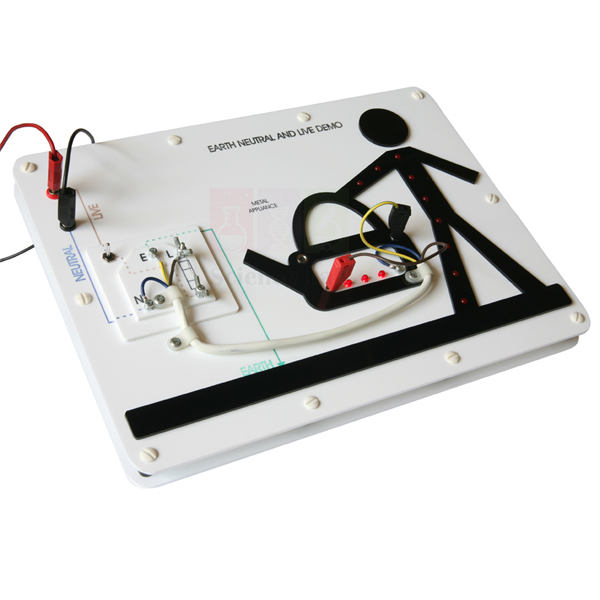
Earth Neutral Live Demo
The Earth Neutral Live Demo (Product Code: SLE/EAM/33) is a safe, low-voltage model of a domestic circuit that shows how the earth wire and fuse act together to protect both the user and the appliance. Students trace the current from the ‘power station’ through a 13A socket, plug and kettle along the live wire and back through the neutral, then watch what happens when a fault is introduced. It is manufactured by Jain Scientific Equipments Pvt Ltd (ScienceLab), Ambala, a school laboratory equipment supplier in India, for electricity-safety teaching in secondary science.
Specifications
| Parameter | Detail |
|---|---|
| Demonstrates | The danger of an unearthed appliance; the safe wiring of an appliance; the action of a fuse |
| Circuit path | ‘Power station’, 13A socket, plug and appliance (kettle), via live and neutral wires |
| Plug layout | 3 pin plug laid out in positionally correct form, showing wiring and fuse position |
| Indicators | LEDs in the kettle show the appliance working or current passing through a person to ground |
| Fuse | Easily visible; can be seen to ‘blow’ when a fault occurs |
| Supplied with | 10 metres of fuse wire and full instructions |
| Power required | 12V D.C. power supply |
| Connections | 4mm shrouded sockets |
| Labelling | Clearly labelled throughout |
Typical Use
The lesson starts with the appliance wired correctly: when the 12V D.C. supply is switched on, the LEDs in the kettle light to show it is working. The teacher then creates a fault by moving the live wire from inside the kettle to its case. With the earth wire connected, a large current flows to earth and the fuse visibly melts, cutting off the supply and protecting both the user and the appliance. With the earth wire removed, the fuse does not blow; instead, LEDs light to show current passing through the ‘person’ to ground, making the danger of an unearthed metal-cased appliance unmistakable.
Because the plug is laid out in its true positions, students can relate what they see to wiring a real plug and to why the fuse sits in the live line. Rewire a new length of fuse wire after each blown-fuse demonstration and keep the supply switched off while changing connections. It is a practical addition to physics lab equipment for schools in India covering domestic electricity, all without exposing pupils to mains voltage.
Manufacturer
This demonstrator is made by Jain Scientific Equipments Private Limited, whose ScienceLab brand covers electricity, magnetism and general physics apparatus manufactured in Ambala, Haryana. More information is on our company profile.
Related Electricity and Magnetism Equipment
Items for powering the demonstration and extending the electrical-safety topic:
- Battery Eliminator 12 Volt — a rectified low-voltage supply option for the DC input
- Power Supply, Stepped — a stepped AC/DC bench supply; use its DC output
- Circuit Breaker — shows how thermal and solenoid trips protect a modern domestic circuit
- Stackable Leads — 4mm connecting leads; check the plug style suits shrouded sockets
Explore our full Electricity and Magnetism range for more circuit demonstrations.
Frequently Asked Questions
Does the demonstration use mains electricity?
No. It requires a 12V D.C. power supply, so the fault conditions can be shown safely in class.
What is supplied with the unit?
The demonstrator comes with 10 metres of fuse wire and full instructions. The 12V D.C. supply and leads are separate.
What faults can be shown?
A live-to-case fault with the earth connected, which blows the fuse, and the same fault without an earth wire, where LEDs light to indicate current flowing through a person to ground.
How is the fuse replaced after a demonstration?
A fresh length is cut from the supplied fuse wire and fitted in place of the blown piece; the full instructions explain the procedure.
How are connections made?
Through 4mm shrouded sockets. Please contact us if you need advice on suitable leads.
What should an institutional quotation include?
Product code SLE/EAM/33, quantity, whether a 12V D.C. supply and leads are needed, and the delivery address in India or abroad.
Is warranty information available?
Yes, warranty terms are given with our quotation on request.
Request a Quote
To order the Earth Neutral Live Demo, add it to the enquiry cart or write to us through the contact page; we supply institutions in India and international markets.
Last updated: 24 September 2026
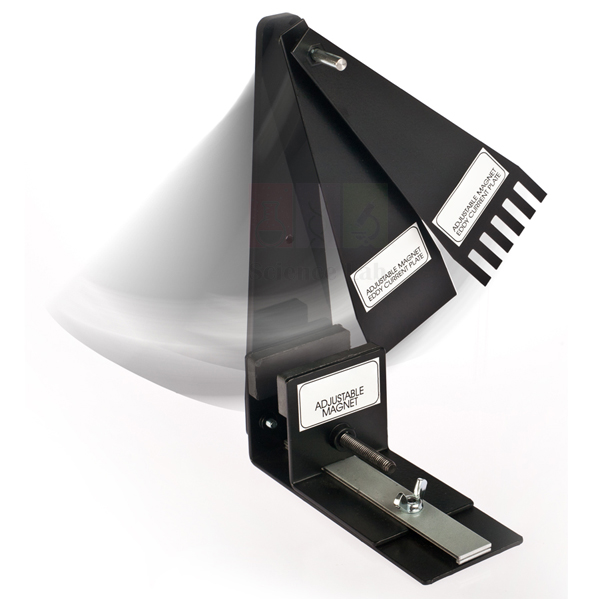
Adjustable Magnet
The Adjustable Magnet (Product Code: SLE/EAM/34) is a variable-gap field source for bench work on magnetism and induction. A steel frame carries lockable, adjustable jaws that hold magnets on either side of a gap, so students can widen or narrow that gap and observe how the field between the poles changes. It is produced by Jain Scientific Equipments Pvt Ltd (ScienceLab), Ambala, for school and college physics laboratories, and works well as the central piece of a practical magnetism experiment kit in India or overseas.
Specifications
| Parameter | Detail |
|---|---|
| Construction | Steel frame with lockable, adjustable jaws |
| Magnets accepted | 50 x 20mm ferrite slab magnets or neodymium button magnets |
| Field adjustment | Field strength changed by adjusting the distance between the jaws |
| Supplied with | 2 ferrite magnets, an eddy current pendulum demonstration and a universal accessory bracket |
| Measurement | Used with a coil to determine the flux density in the gap |
| Dimensions | 120 x 50 x 50mm |
| Mass | 0.25kg |
Typical Use
A common exercise starts with the jaws opened wide: a coil is placed in the gap, a reading of flux density is taken, and the jaws are then closed in small steps with a fresh reading at each setting. Plotting gap against flux density gives students a clear picture of how quickly a magnetic field weakens with distance. Because the jaws lock, the chosen separation holds steady while the reading is recorded, which makes the results repeatable from one group to the next.
The eddy current pendulum demonstration supplied with the unit turns the same gap into a lesson on magnetic braking: a metal pendulum swinging through the field slows noticeably as the currents induced in it oppose its motion. This makes a natural bridge into electromagnetic induction kit topics such as Lenz’s law. Swapping the ferrite slabs for neodymium button magnets (not included) lets a class compare a weaker and a stronger field in the same frame. Keep the magnets away from watches, phones and moving-coil meters, and store them so they cannot snap together and chip.
Manufacturer
This magnet assembly is made by Jain Scientific Equipments Private Limited, the Ambala, Haryana company that sells under the ScienceLab name. The business is incorporated as a private limited company under CIN U29309HR2020PTC087597, and it manufactures at its licensed factory at 449, HSIIDC Industrial Area, Saha, Ambala (Factory Licence AMB-ONLINE-CHD-J-414). More background is available on our company profile page.
Related Electricity and Magnetism Equipment
Items that pair with the Adjustable Magnet in field-strength and induction lessons:
- Search Coil — a coil for probing the field inside the gap
- Neodymium Magnets — stronger magnets to compare with the ferrite slabs (confirm size fit with us)
- Eddy Current Unit — extends the magnetic braking idea shown by the pendulum
- Faraday’s Law Apparatus — follow-on work on induced voltage
- Force on a Conductor Apparatus — shows the motor effect in a magnetic field
See the complete Electricity and Magnetism range for more field, induction and circuit apparatus.
Frequently Asked Questions
What is included with the Adjustable Magnet?
The steel frame with its lockable jaws comes with 2 ferrite magnets, an eddy current pendulum demonstration and a universal accessory bracket.
Which magnets fit in the jaws?
The jaws accept 50 x 20mm ferrite slab magnets or neodymium button magnets. Only the ferrite magnets are supplied; neodymium buttons are a separate purchase.
How do I change the field strength?
Adjust the distance between the jaws and lock them in place. A smaller gap gives a stronger field between the magnets.
Can I measure flux density with this unit alone?
No. The magnet provides the field; a coil and a suitable meter are needed to determine the flux density in the gap.
What is the field value at a given gap?
A rated flux density figure is not part of our current product data. Please contact us if you need typical values before ordering.
Is a calibration certificate available?
This is a teaching field source rather than a reference magnet. If your purchase process needs a certificate, discuss it with our team before placing the order.
Can schools order several units?
Yes. For a class set or tender, send the quantity and delivery location through the contact page; we supply institutions in India and international markets.
Request a Quote
For pricing and availability on the Adjustable Magnet, send us an enquiry or add the item to your enquiry cart with any other apparatus you need.
Last updated: 24 September 2026
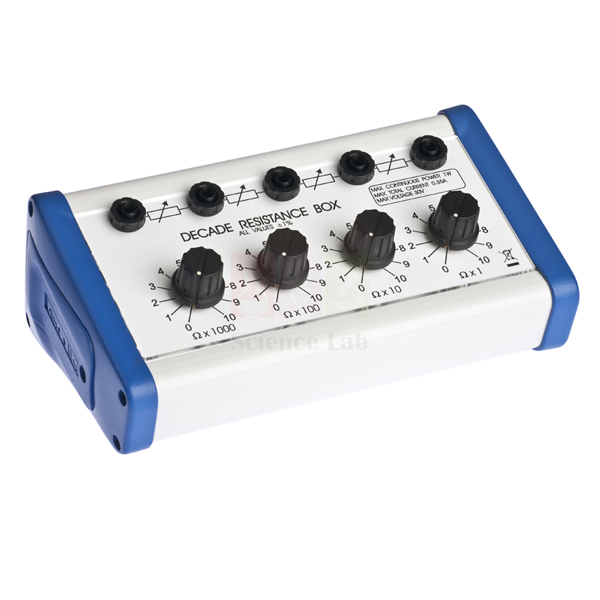
Decade Resistance Box
The Decade Resistance Box (Product Code: SLE/EAM/35) lets students dial in any whole-ohm resistance from 1Ω to 9999Ω, using four decades of 1% tolerance resistors. Physics teachers use it wherever a circuit needs a known, adjustable resistance — Ohm’s law, bridge circuits, potential dividers and meter-range work. It is manufactured by Jain Scientific Equipments Pvt Ltd (ScienceLab), Ambala, and is a practical resistance box for India lab benches in schools, colleges and technical institutes.
Specifications
| Parameter | Detail |
|---|---|
| Type | Four-decade resistance box |
| Range | 1Ω to 9999Ω |
| Step size | 1Ω |
| Resistor tolerance | 1% |
| Power rating | 1W continuous |
| Maximum current | 0.35A |
| Connections | 4mm sockets, which also allow use as a potential divider |
Typical Use
In an Ohm’s law experiment kit the box replaces a drawer full of loose resistors: students set a value, record current and voltage, change one decade and repeat, so the relationship between resistance and current emerges from a single tidy circuit. It also serves as the known arm of a Wheatstone or meter bridge, where the fine 1Ω steps let a class balance the bridge closely, and as a series resistor when extending the range of a meter. Wired through its 4mm sockets as a potential divider, it provides a chosen fraction of a supply voltage for sensor or component tests.
Before switching on, check that the current through the selected setting will stay below the 0.35A maximum and that dissipation stays within the 1W continuous rating — at low resistance settings even a modest supply voltage can exceed these limits. Setting all decades to a high value first and working downwards is a simple habit that protects the resistors.
Manufacturer
Jain Scientific Equipments Private Limited builds this decade box in Ambala, Haryana, and markets it to teaching laboratories under its ScienceLab brand. The company’s range covers physics, chemistry, biology and engineering teaching apparatus; our company profile gives an overview of the business.
Related Electricity and Magnetism Equipment
Apparatus that completes a resistance or Ohm’s law circuit with this box:
- Precision Variable Power Supply — an adjustable source for driving the circuit
- Digital Ammeter — reads the current so it can be kept under the 0.35A limit
- Digital Voltmeter — measures the voltage across the selected resistance
- Resistance Selector — a quicker option when only a few standard values are needed
- Stackable Leads — plug leads for wiring the circuit
Browse our Electricity and Magnetism category for further circuit components and meters.
Frequently Asked Questions
What range does the Decade Resistance Box cover?
From 1Ω to 9999Ω in 1Ω steps, set across four decades.
How close to the set value is the resistance?
The resistors are 1% tolerance, which is adequate for most school and college circuit work.
What current and power can it take?
Maximum current is 0.35A and the power rating is 1W continuous. Stay within both limits, especially at low settings.
How is it different from the Resistance Selector?
The selector switches between a fixed set of standard values, while this box gives every whole-ohm value across its range — better when you need fine adjustment, such as balancing a bridge.
Are connecting leads supplied?
Leads are not listed as part of this item. It uses 4mm sockets, so standard 4mm plug leads such as our Stackable Leads are suitable.
Can you provide a calibration certificate?
Please raise this with our team when you enquire so we can advise on what documentation is available for your order.
What should an institutional quotation request include?
The quantity, delivery address and any tender reference. Send them through our contact page; we supply across India and to international markets.
Request a Quote
Need a price for one box or a full lab set? Contact ScienceLab directly, or place the Decade Resistance Box in the enquiry cart and submit it with the rest of your list.
Last updated: 24 September 2026
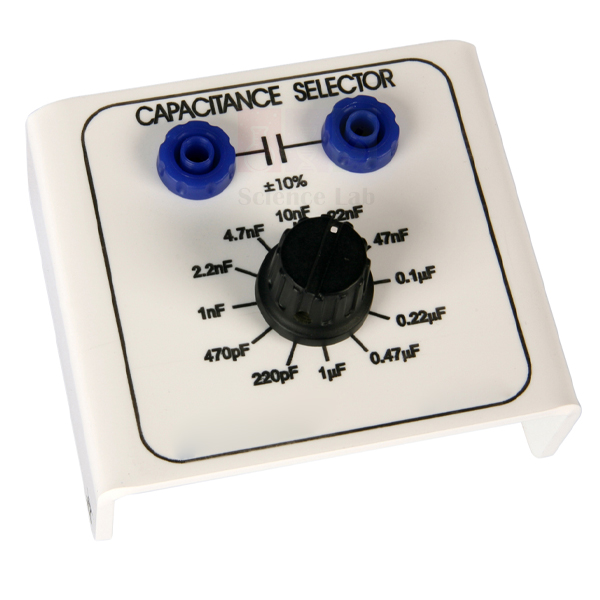
Capacitance Selector
The Capacitance Selector (Product Code: SLE/EAM/36) puts twelve non-electrolytic capacitors, from 220pF up to 1.0µF, behind a single rotary switch on an acrylic base. Instead of hunting for loose components, a student turns the knob to change the capacitance in a circuit and immediately sees the effect on timing, filtering or reactance. The unit is produced by Jain Scientific Equipments Pvt Ltd (ScienceLab), Ambala, for electronics and physics benches and fits naturally into an AC DC circuits experiment kit for senior school and college classes.
Specifications
| Parameter | Detail |
|---|---|
| Number of capacitors | Twelve |
| Capacitor type | Non-electrolytic |
| Picofarad values | 220pF, 470pF, 1000pF |
| Nanofarad values | 2.2nF, 4.7nF, 10nF, 22nF, 47nF |
| Microfarad values | 0.1µF, 0.22µF, 0.47µF, 1.0µF |
| Selection | Rotary switch |
| Base | Acrylic |
Typical Use
The spread of values — roughly doubling at each step from picofarads up to a microfarad — suits experiments where students change capacitance systematically and watch a waveform respond. Paired with a resistor and a signal generator, the selector lets a class measure RC time constants on an oscilloscope, see how a low-pass or high-pass filter’s cut-off shifts, or show capacitive reactance falling as frequency rises. Because the capacitors are non-electrolytic, they are not polarity-sensitive, so they can sit in AC circuits without the orientation worries that come with electrolytic parts.
Teachers find the single-knob design useful for demonstrations too: the same circuit can be shown at several capacitance values in a few seconds. Return the switch to the lowest value between groups, keep the acrylic base clean with a dry cloth, and check the voltage used in your circuit with us before connecting to higher-voltage sources.
Manufacturer
ScienceLab is the brand name used by Jain Scientific Equipments Private Limited, a manufacturer of teaching laboratory apparatus located in Ambala, Haryana. The company makes this selector for schools and colleges and supplies it across India and to international markets. Our company profile describes the business in more detail.
Related Electricity and Magnetism Equipment
Useful companions for RC timing, filter and reactance experiments:
- Resistance Selector — switch the R in an RC circuit as easily as the C
- Signal Generator and Amplifier — supplies the AC or square-wave input
- Oscilloscope Dual Trace — compare input and output waveforms side by side
- Capacitance Substitution Box — an alternative capacitance source for the same experiments
More components and meters are listed in the Electricity and Magnetism collection.
Frequently Asked Questions
Which capacitance values can be selected?
Twelve: 220pF, 470pF, 1000pF, 2.2nF, 4.7nF, 10nF, 22nF, 47nF, 0.1µF, 0.22µF, 0.47µF and 1.0µF.
Are the capacitors polarised?
No. They are non-electrolytic, so orientation in the circuit does not matter.
What is the voltage rating and tolerance?
These figures are not included in our current product listing. Please ask our team before using the unit with higher-voltage supplies.
How are circuit connections made?
The connection type is not specified in our product data; confirm it with us so you can order matching leads.
Is documentation of measured values available?
If your department needs a calibration certificate or test record, discuss it with us at the enquiry stage.
Can the selector be ordered in class quantities?
Yes. Tell us the number of benches you are equipping and the delivery location, and we will prepare an institutional quotation.
Request a Quote
To receive a quotation for the Capacitance Selector, reach us through the contact form or add it to the enquiry cart together with the resistors, meters and generators for your circuit.
Last updated: 24 September 2026
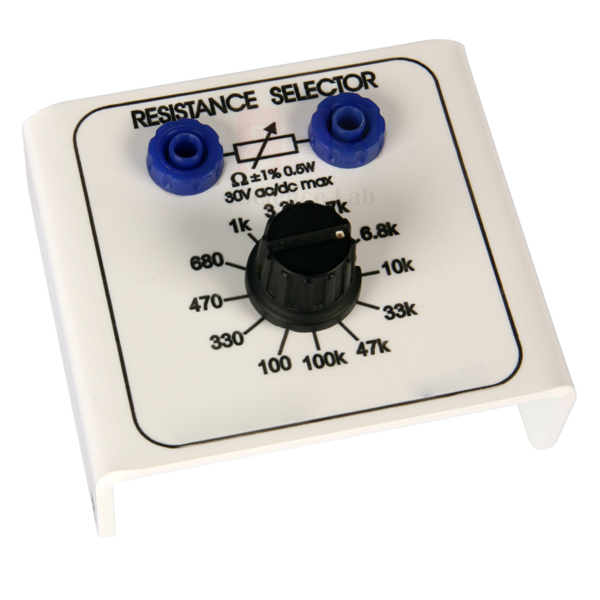
Resistance Selector
The Resistance Selector (Product Code: SLE/EAM/37) is a compact substitution unit: one rotary switch chooses between twelve fixed resistors, from 100Ω to 100kΩ, brought out to 4mm sockets. It saves students from sorting through colour-coded resistors when they want to try several values in the same circuit, and it lets a teacher change a load or bias resistor mid-demonstration with a single turn. Manufactured by Jain Scientific Equipments Pvt Ltd (ScienceLab) in Ambala, it sits comfortably among the electronic lab instruments that India’s schools, polytechnics and colleges use for circuit practicals.
Specifications
| Parameter | Detail |
|---|---|
| Type | Mini resistance substitution unit |
| Selection | Single rotary switch, twelve positions |
| Values | 100Ω, 330Ω, 470Ω, 680Ω, 1kΩ, 3.3kΩ, 4.7kΩ, 6.8kΩ, 10kΩ, 33kΩ, 47kΩ, 100kΩ |
| Tolerance | 5% (all values) |
| Power rating | 0.5W (all values) |
| Connections | 4mm sockets |
Typical Use
The values follow the familiar preferred-value pattern used in electronics, so students meet the same numbers they will later find on real circuit boards. A typical session uses the selector as a trial resistor: set a value, observe an LED’s brightness or a transistor’s collector current, step to the next position and compare. It is equally handy for plotting a load line, choosing the lower arm of a potential divider for a sensor, or setting the gain of an amplifier circuit kit without re-soldering anything.
Because every resistor is rated at 0.5W, the lowest settings deserve care when a higher supply voltage is connected — start on a high value and switch downwards while watching the current. For work that needs values between the twelve fixed steps, pair the selector with a decade box.
Manufacturer
Jain Scientific Equipments Private Limited, trading as ScienceLab, produces this selector at Ambala in Haryana. The company is a registered MSME enterprise (Udyam UDYAM-HR-01-0003714), and shipments to overseas buyers are handled under its DGFT Importer-Exporter Code AAECJ8618A. Visit our company profile for more about the organisation.
Related Electricity and Magnetism Equipment
Items commonly wired up alongside the Resistance Selector:
- Decade Resistance Box — fills in the values between the selector’s fixed steps
- Capacitance Selector — completes an adjustable RC pair for timing and filter work
- Resistance Substitution Box — another substitution option for circuit experiments
- Digital Multimeter — checks current and voltage at each setting
- Stackable Leads — 4mm plug leads to connect the sockets
For the wider range, visit the Electricity and Magnetism category page.
Frequently Asked Questions
How many resistance values does it offer?
Twelve, from 100Ω to 100kΩ, chosen with one rotary switch.
What tolerance and power rating do the resistors have?
All twelve are 5% tolerance and rated at 0.5W.
Can I get a value that is not on the list?
Not from this unit alone. Combine positions with other components, or use a decade resistance box when you need any whole-ohm value.
What kind of leads does it need?
Connections are made through 4mm sockets, so any standard 4mm plug lead will fit. Leads are not listed as part of the supply.
Is it suitable for mains-voltage circuits?
No. It is intended for low-voltage teaching circuits; check the current at each setting so the 0.5W rating is not exceeded.
Is a calibration certificate offered?
Ask our team when you enquire and we will advise what documentation can accompany your order.
Do you export the Resistance Selector?
Yes. We supply institutions in India and international markets; send the quantity and destination through our contact page.
Request a Quote
Add the Resistance Selector to your enquiry cart or write to us with your quantity, and we will respond with pricing and delivery details.
Last updated: 24 September 2026
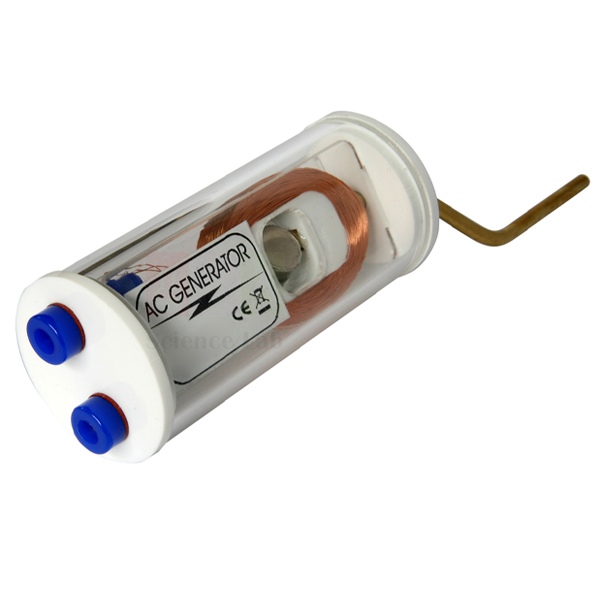
A.C. Generator
The A.C. Generator (Product Code: SLE/EAM/38) is a transparent, hand-held generator in which a permanent magnet spins inside a coil of wire, producing an alternating voltage at two 4mm sockets. It lets students investigate the same principle that powers a bicycle dynamo, with every moving part in view. Made by Jain Scientific Equipments Pvt Ltd (ScienceLab), Ambala, it is a straightforward piece of electromagnetic induction kit for India’s secondary schools and for physics departments abroad.
Specifications
| Parameter | Detail |
|---|---|
| Principle | Permanent magnet rotating inside a coil of wire |
| Drive | Hand-held, direct drive to the rotating magnet (no gearing) |
| Housing | Transparent, showing all the inner workings |
| Output | About 0.5V peak to peak, swinging from + to – each revolution; magnitude varies with speed |
| Waveform | Not a simple sine wave, because of the geometry of the mechanism |
| Output terminals | Two 4mm sockets |
| Display options | Centre-zero moving coil voltmeter or oscilloscope |
| Weight | 120g |
| Dimensions (L x W x H) | 150 x 55 x 55 |
Typical Use
Connected to a centre-zero moving coil voltmeter and turned slowly, the generator makes the needle swing one way and then the other on every revolution — a direct, visible answer to the question of what “alternating” means. Turning faster makes the swings larger, so students can link output magnitude to speed of rotation. Because the drive has no gearing, the magnet turns exactly as fast as the hand, which keeps that cause-and-effect relationship easy to follow.
For a more advanced physics demonstration kit, connect the sockets to an oscilloscope instead. The trace is not a textbook sine wave, and that is a teaching opportunity: with a PC oscilloscope the waveform can be stored and examined in detail, prompting discussion of how magnet and coil geometry shape the output of real generators. Since the peak-to-peak output is about 0.5V, choose a sensitive range on the meter or scope.
Manufacturer
This generator comes from Jain Scientific Equipments Private Limited, an apparatus maker in Ambala, Haryana, that uses ScienceLab as its trading name. The company produces electricity and magnetism teaching equipment for classrooms at home and abroad; read more on our company profile.
Related Electricity and Magnetism Equipment
Equipment that helps students read and extend the A.C. Generator’s output:
- Galvanometer, Centre Zero Universal Meter — a centre-zero meter to show the alternating swing
- Oscilloscope Dual Trace — displays the output waveform shape
- Demonstration Dynamo Model — a larger model for comparing generator designs
- Faraday’s Law Apparatus — explores the induction law behind the generator
- Stackable Leads — 4mm leads for the output sockets
Explore the whole Electricity and Magnetism range for more induction apparatus.
Frequently Asked Questions
How much voltage does the A.C. Generator produce?
About 0.5V peak to peak, with the magnitude rising and falling with the speed at which it is turned.
Why is the output not a pure sine wave?
The geometry of the magnet and coil mechanism shapes the waveform. Storing the trace on a PC oscilloscope lets students study that shape closely.
What do I need to display the output?
A centre-zero moving coil voltmeter or an oscilloscope, connected through the two 4mm sockets. Meters and leads are ordered separately.
Does it need batteries or mains power?
No. It is turned by hand, and the rotating magnet generates the output.
Can students see how it works?
Yes. The body is transparent, so the magnet, coil and direct drive are all visible.
What warranty applies?
Warranty terms are confirmed with each quotation; please contact us for details.
Can we buy a set for every lab bench?
Yes. Send the number of units and your delivery location and we will quote for supply within India or to international markets.
Request a Quote
For a price on the A.C. Generator, get in touch with our sales team, or collect it in the enquiry cart with the meters and leads you plan to use.
Last updated: 24 September 2026