- Physics Lab Equipment
- Chemistry Lab Equipment
- Biology Lab Equipment
- Anatomical Lab Equipment
- Learning
- Educational Lab Equipment
- Magnets
- Agriculture
- Astronomy
- Earth Science
- Geography Lab Equipment
- Safety Lab Coat
- Laboratory
- Meteorological
- Electricity & Magnetism
- Heat
- School Lab Equipment
- Lab Glassware
- Science Lab Equipment
- Tvet Lab Equipment
- Robotics Kits Supplier and Manufacturer for Schools India
- Math Lab Equipment Manufacturers and Exporters in Ambala
- STEM Kits Manufacturers and Supplier India
- Engineering Lab Equipment
- Hospital Lab Equipment
- Water, Sanitation & Hygiene Supplies
- Cold Chain, Solar & Communication Equipment
- Nutrition
Geography lab equipment for schools, colleges and teacher-training institutes supports teaching physical geography through models and practical work. The 22 products listed by Jain Scientific Equipments Pvt Ltd (ScienceLab), Ambala, India, cover the Earth in space, the planet's internal structure, landforms and the ocean floor, and the rock, soil and mineral practicals found in secondary geography courses. The range mixes geography models for front-of-class teaching with kits that student groups can work through at their benches.
Geography Lab Equipment by Topic
| Topic | What it covers | Example products |
|---|---|---|
| Earth and space | The globe, the solar system, orbits and the night sky | Earth Globe Model; Solar System Model; Orbiter Model; Celestial Star Globe; Project Planetarium Set; Astronomy Clever Catch |
| Landforms and Earth structure | Volcanic activity, faults and fractures, the ocean floor and earthquakes | Volcano Model; Fractures, Faults and Dislocations Model; Ocean Floor Raised Relief Map; Seismograph Model |
| Rocks and soils practicals | Classifying igneous, sedimentary and metamorphic rocks; grading soil; building stratified layers | Class Rock Pack; Expanded Rock Collection; Rock Study Kit; Sieves; Geology History Kit; Clever Catch Rocks |
| Mineral identification | Streak, hardness and other identification tests | Mineral Study Kit; Mineral Test Kit; Black Streak Plates; Streak Plates Glass |
| Fossils and Earth history | Fossils from different geological periods with key sheets and time charts | General Fossil Collection; Advanced Fossil Collection |
Featured Geography Lab Equipment
| Product | Product Code | Typical Use |
|---|---|---|
| Earth Globe Model | SLE/GG/02 | Detachable layers that reveal the Earth’s interior from crust to inner core |
| Volcano Model | SLE/GG/03 | Hand-painted sectional model showing the path magma takes through a volcano |
| Fractures, Faults and Dislocations Model | SLE/GG/04 | Cross-sections of structural features along fault planes, with a numbered key card |
| Ocean Floor Raised Relief Map | SLE/GG/20 | World map of land and ocean floor showing ridges, trenches, continental shelves and slopes |
| Class Rock Pack | SLE/GG/05 | Flow-chart lesson for identifying rock and soil samples by texture and permeability |
| Expanded Rock Collection | SLE/GG/07 | Igneous, sedimentary and metamorphic specimens for starting a class rock collection |
| Sieves | SLE/GG/10 | Separating and grading soil and rock samples to study soil make-up |
| Geology History Kit | SLE/GG/11 | Recreating stratified layers with clay to show how rock layers build up |
OEM Manufacturing & Supply
Geography Lab Equipment comes from Jain Scientific Equipments Pvt Ltd, which trades as ScienceLab and both makes and supplies items in this range. The geography models (the Earth globe, solar system, volcano, fault, seismograph and orbiter models, the Celestial Star Globe, the Project Planetarium Set and the Ocean Floor Raised Relief Map), together with the Sieves, Geology History Kit and Mineral Test Kit, are made at the company’s licensed factory in Saha, Ambala, Haryana. The rock packs and collections, the Rock Study Kit and Mineral Study Kit, the two fossil collections, Clever Catch Rocks, Astronomy Clever Catch and the streak plates are supplied. For vendor registration, institutional buyers can use the company’s GSTIN 06AAECJ8618A1ZT, LEI 3358004HRD1JIVXKYX49 and CIN U29309HR2020PTC087597. We supply individual schools, school chains, colleges and tender buyers, with dispatch across India and to international markets.
Related Ranges
- Earth Science — a geology-led range of mineral sets, fossil kits and a stream table; choose it when the focus is geology rather than geography models.
- Astronomy — gathers space teaching aids, including several models from this page and two telescopes.
- Meteorological — thermometers, barometers and humidity instruments for weather and climate topics.
- Measuring — balances, scales and thermometers for weighing samples and recording fieldwork readings.
Frequently Asked Questions
Does this range include student practical kits or only display models?
Both. The globe, volcano, fault and relief models are teacher demonstration pieces, while the Class Rock Pack, Rock Study Kit, Mineral Study Kit, Sieves and Geology History Kit are designed for students to work through themselves.
Which items cover rock and soil practicals in a geography syllabus?
The Class Rock Pack and Expanded Rock Collection support rock classification, the Sieves set lets students grade soil samples, and the Mineral Test Kit with streak plates covers identification tests. Share your syllabus and we will match items to each practical.
Can you equip a complete geography room?
Yes. A typical geography room combines an Earth model, landform and structure models, a relief map, rock and mineral kits and a solar system model from this page, then adds weather instruments listed under our Meteorological page. We can quote the full list together.
Are streak plates available in class quantities?
Yes. Black Streak Plates and Streak Plates Glass are listed separately, so you can order extra plates for every group alongside the kits.
Do you accept tender and export orders for geography equipment?
Yes. We quote against institutional and government tenders and supply buyers in India and overseas. Send the tender document or item list with quantities and the delivery location.
Request a Quote or Catalogue
For a quotation on geography lab equipment, contact us through the contact page or add products to the shopping cart. Include product codes, quantities and the delivery location so we can respond quickly.
Last updated: 24 September 2026
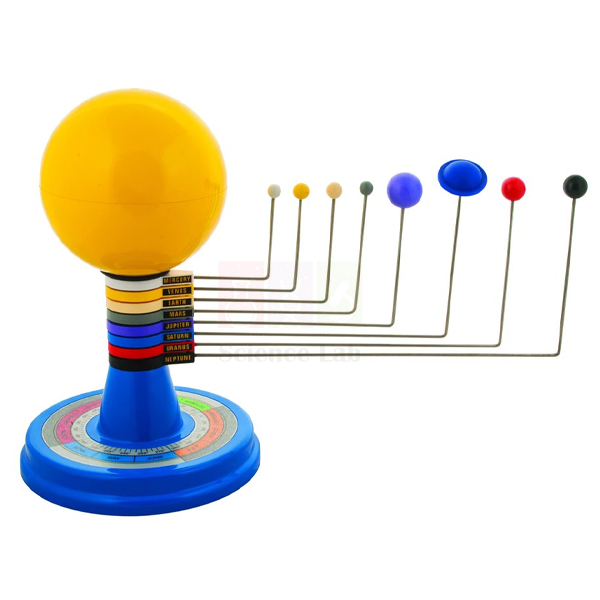
Solar System Model
The Solar System Model (Product Code: SLE/GG/01) is a classroom demonstration model of the planets revolving around the Sun, with the satellites (moons) of the planets also shown. The whole assembly is mounted on a base marked with the 12 zodiac signs, linking the planets’ paths to the constellations of the zodiac seen from Earth. Manufactured by Jain Scientific Equipments Pvt Ltd (ScienceLab), Ambala, it is used in geography rooms, science laboratories and astronomy clubs in schools.
Key Details
| Parameter | Detail |
|---|---|
| Type | Solar system demonstration model |
| Planets shown | Nine planets revolving around the Sun (traditional nine-planet layout) |
| Satellites | Satellites of the planets are also shown |
| Base | Mounted on a base with the 12 zodiac signs |
| Suitable for | Classroom teaching of the solar system, orbits, moons and the zodiac |
Typical Use
Teachers use the model to show the order of the planets outward from the Sun, the idea that planets travel in orbits while moons circle their planets, and the contrast between the small rocky inner planets and the large outer ones. Pointing to each planet in turn while students name it is a quick way to fix the sequence in memory before moving on to distances and orbital periods.
The zodiac ring on the base helps explain why the Sun appears to pass through different constellations during the year as Earth travels round it — a topic that is hard to follow from flat diagrams. The nine-planet layout also gives a ready discussion point: astronomers now class Pluto as a dwarf planet, so current textbooks list eight planets. Together with an Earth globe and a star globe, it forms a compact set of astronomy lab equipment for middle-school geography and science.
Manufacturer
Jain Scientific Equipments Private Limited manufactures this model in Ambala, Haryana, under its trading name ScienceLab, as part of a wider range of geography and science teaching aids. Our company profile has further details.
Related Geography Lab Equipment
Other aids for astronomy and Earth-in-space lessons:
- Orbiter Model — a companion model for teaching orbital motion
- Celestial Star Globe — helps students locate the zodiac constellations named on the base
- Project Planetarium Set — extends the lesson from the planets to the night sky
- Astronomy Clever Catch — a question ball for revising astronomy facts after the demonstration
- Earth Globe Model — moves from Earth’s place in the solar system to its interior
Browse our complete Geography Lab Equipment range.
Frequently Asked Questions
How many planets does the model show?
It is described as showing nine planets revolving around the Sun, the traditional count. Since Pluto is now classed as a dwarf planet, contact us before ordering if your syllabus needs the eight-planet convention.
Are the moons of the planets included?
Yes, the satellites of the planets are shown on the model.
What is marked on the base?
The base carries the 12 zodiac signs, useful for lessons on the Sun’s apparent path through the constellations.
Is it a motorised or hand-cranked model?
The product description does not mention a drive mechanism, so please contact us to confirm how the planets are mounted and whether they move.
How should the model be looked after?
Dust it with a soft dry cloth, avoid solvents on painted parts and keep it out of strong direct sunlight to protect the colours.
Can schools order it in quantity?
Yes. We supply schools and distributors in India and international markets; add it to the enquiry cart with the number required.
Request a Quote
For a price on the Solar System Model, contact us or add it to your enquiry cart.
Last updated: 24 September 2026
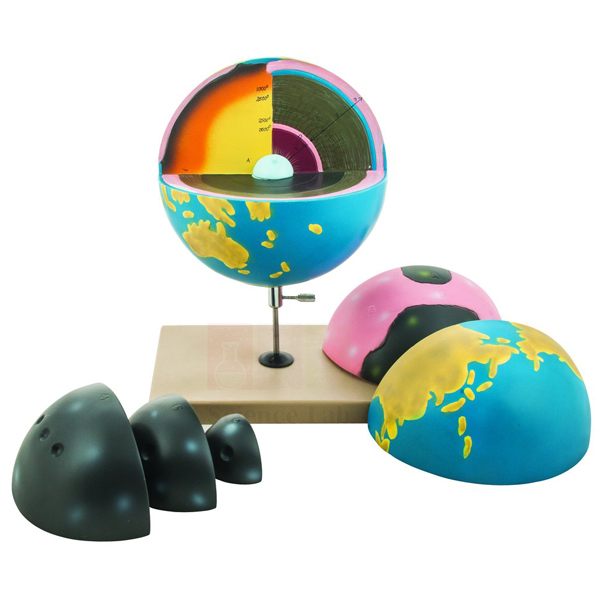
Earth Globe Model
The Earth Globe Model (Product Code: SLE/GG/02) is a sectional globe that opens up to show the layers inside the Earth. It is built from 7 detachable parts: lifting them away one at a time reveals the outer edge of each layer in turn, and once the upper crust is removed the inner core and its surrounding layers come into view. Each layer is finished in a different colour. It is manufactured by Jain Scientific Equipments Pvt Ltd (ScienceLab), Ambala, for geography and earth science teaching in schools.
Specifications
| Parameter | Detail |
|---|---|
| Type | Earth interior (layered) globe model |
| Construction | 7 detachable parts showing the interior of the Earth |
| Layer view | Removing the parts one by one shows the periphery of each layer |
| Core view | Inner core with its layers visible when the upper crust is removed |
| Colour coding | Different colours for different layers |
| Suitable for | Teaching the internal structure of the Earth |
Typical Use
The model turns a flat textbook diagram of the Earth’s interior into something students can take apart. Teachers remove the parts in sequence while naming each layer, then ask a student to rebuild the globe in the right order — a quick check that the class has understood which layer lies where.
The colour coding helps when explaining how temperature and pressure rise with depth, why the outer core is liquid while the inner core is solid, and how the study of earthquake waves revealed this layered structure. Displayed beside a volcano cross-section and a seismograph model, it anchors a geography lab equipment corner on the dynamic Earth.
Manufacturer
ScienceLab is the brand name used by Jain Scientific Equipments Private Limited of Ambala, Haryana, which manufactures geography and science teaching models. The company is a registered MSME enterprise (Udyam UDYAM-HR-01-0003714), and export consignments are shipped under Importer-Exporter Code AAECJ8618A issued by DGFT. See the company profile for more.
Related Geography Lab Equipment
Models that extend a lesson on the Earth’s structure:
- Volcano Model — shows how molten rock from below the crust reaches the surface
- Seismograph Model — explains how earthquake waves, the evidence for the layered interior, are recorded
- Physiographic Relief Globe — shows surface landforms to complement the interior view
- Fractures, Faults and Dislocations Model — crustal structures at a closer scale
- Ocean Floor Raised Relief Map — the relief of the crust beneath the oceans
Explore the full Geography Lab Equipment collection.
Frequently Asked Questions
How many parts does the globe separate into?
It has 7 detachable parts that reveal the interior of the Earth layer by layer.
Can the inner core be seen?
Yes. When the upper crust is removed, the inner core with its layers can be seen.
Are the layers labelled with their names?
The layers are distinguished by colour. Printed labels are not mentioned in the product description, so contact us if you need them confirmed.
Which classes is it suited to?
Middle and secondary school geography and earth science, wherever the structure of the Earth is taught.
How should the parts be stored and handled?
Keep the globe assembled when not in use, lift parts by their edges rather than forcing them, and wipe with a soft dry cloth.
What should a school include in a quotation request?
The quantity, delivery address in India or abroad and any tender reference. Use our contact page or enquiry cart.
Request a Quote
To order the Earth Globe Model for your school, contact us or add it to the enquiry cart.
Last updated: 24 September 2026
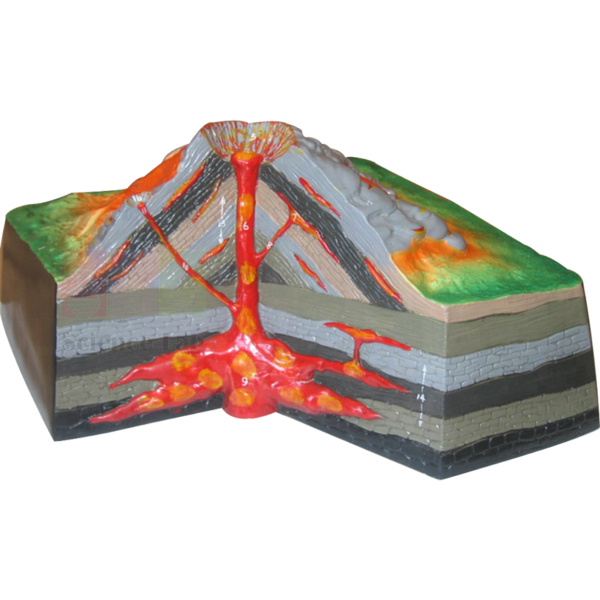
Volcano Model
The Volcano Model (Product Code: SLE/GG/03) is a realistic, hand-painted resin model of a volcano cut through by a vertical section, so students can follow the path magma takes on its upward course through the volcano. It is securely mounted on a sturdy base for display and for handling in class. The model is manufactured by Jain Scientific Equipments Pvt Ltd (ScienceLab), Ambala, for geography and earth science departments in schools.
Key Details
| Parameter | Detail |
|---|---|
| Type | Sectional volcano model |
| Material | Resin, hand painted |
| Section | Vertical section showing the path magma takes on its upward course through the volcano |
| Mounting | Securely mounted on a sturdy base |
| Suitable for | Teaching volcano structure and how eruptions happen |
Typical Use
Using the vertical section, teachers trace the route magma follows on its way up and link it to the terms students meet in textbooks, such as magma chamber, vent, crater and lava flow. Seeing the inside of the cone makes it much easier to explain why pressure builds before an eruption and where the erupted material comes from.
The model pairs well with rock samples: igneous rocks such as basalt or pumice show what magma becomes once it cools. Its resin body and sturdy base make it suitable for passing around a small group or standing on a display shelf, and schools building up geography models often place it next to an Earth-interior globe so students can connect the molten layers below the crust with activity at the surface.
Manufacturer
Jain Scientific Equipments Private Limited is the company behind ScienceLab and manufactures teaching models like this volcano from Ambala, Haryana, India. Learn more on our company profile page.
Related Geography Lab Equipment
Useful alongside the volcano in an earth science lesson:
- Earth Globe Model — shows the interior layers beneath the crust
- Class Rock Pack — includes igneous rock samples for linking volcanoes to rock formation
- Seismograph Model — connects volcanic activity with earthquake monitoring
- Fractures, Faults and Dislocations Model — other crustal features shaped by the Earth’s internal forces
View all items in Geography Lab Equipment.
Frequently Asked Questions
What is the model made of?
Resin, finished by hand painting for a realistic appearance.
Does it show the inside of the volcano?
Yes. A vertical section shows the path magma takes as it moves up through the volcano.
Can it be used for a ‘baking soda’ eruption demonstration?
It is described as a painted sectional display model, not an eruption kit, so we suggest keeping liquids away from it. Contact us if you also need an eruption activity.
How should the painted surface be cleaned?
Use a soft brush or dry cloth to remove dust, and avoid water, solvents and abrasive cleaners on the paintwork.
Are size and weight available?
Dimensions are not stated in the current listing; contact us and we will share them with your quotation.
Do you supply schools outside India?
Yes, we supply schools and distributors in India and international markets.
Request a Quote
Add the Volcano Model to your enquiry cart or contact us for pricing and availability.
Last updated: 24 September 2026
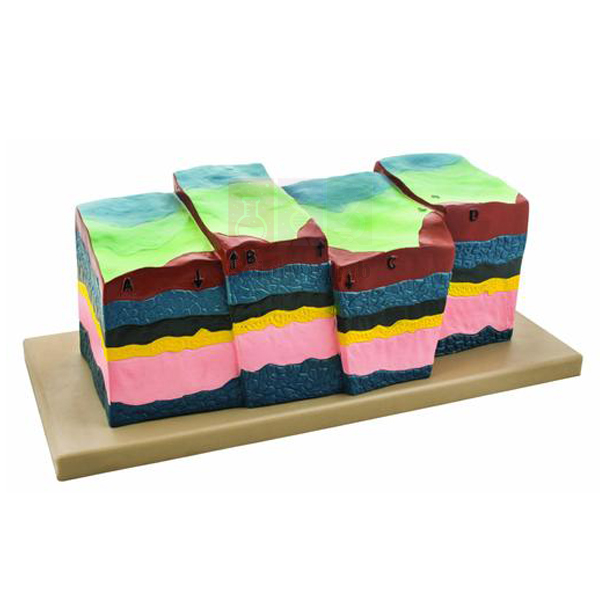
Fractures, Faults and Dislocations Model
The Fractures, Faults and Dislocations Model (Product Code: SLE/GG/04) shows five different structural features of the Earth’s crust in cross-section, illustrating the structures associated with fault planes and fractures. It is made of coloured, unbreakable material, mounted on a base and numbered, with an English key card identifying each feature. The model is manufactured by Jain Scientific Equipments Pvt Ltd (ScienceLab), Ambala, for geography and geology teaching in schools and colleges.
Key Details
| Parameter | Detail |
|---|---|
| Type | Structural geology cross-section model |
| Features shown | Five different structural features, showing structures related to fault planes and fractures |
| Material | Unbreakable material, coloured |
| Mounting | Mounted on base |
| Identification | Numbered, with English key card |
Typical Use
Students match each numbered feature to the key card and describe what has happened to the rock: where it has cracked without moving, and where blocks have slipped past each other along a fault plane. The colouring makes offsets between layers easy to follow, so even beginners can see which side has moved up or down.
Teachers use the model to support lessons on the main fault types — normal, reverse and strike-slip — and on how such movements relate to earthquakes and to landforms such as rift valleys and block mountains; the key card confirms which structures the five sections represent. Because it is made of unbreakable material, it can be handed round a group, which makes it a practical addition to geography lab equipment for secondary schools and undergraduate geology.
Manufacturer
Jain Scientific Equipments Private Limited trades as ScienceLab and manufactures geography teaching models from Ambala, Haryana. For vendor registration forms, our GSTIN is 06AAECJ8618A1ZT and our Legal Entity Identifier (LEI) is 3358004HRD1JIVXKYX49. The company profile gives more background.
Related Geography Lab Equipment
Other models that help explain movements of the crust:
- Seismograph Model — shows how the ground shaking caused by fault slip is recorded
- Earth Globe Model — places the crust in the context of the Earth’s layered interior
- Volcano Model — another way internal forces reshape the crust
- Geology History Kit — explores how rock layers record the Earth’s past
- Ocean Floor Raised Relief Map — sea-floor relief shaped by movements of the crust
See the whole Geography Lab Equipment range.
Frequently Asked Questions
How many features does the model show?
Five different structural features, all shown in cross-section.
How are the features identified?
Each feature is numbered on the model and explained on the English key card supplied with it.
Can students handle it without risk of breakage?
It is made of unbreakable material, so it suits hands-on group work; normal care still keeps the coloured finish looking good.
Which fault types are included?
The key card names the five features. If you need the list before ordering, contact us and we will share it.
Where can we find your registration details for a purchase order?
GSTIN and LEI are given in the Manufacturer section above; other vendor details can be requested through our contact page.
Is bulk or export supply possible?
Yes. We supply schools, colleges and distributors in India and international markets; use the enquiry cart to list quantities.
Request a Quote
For a quotation on this structural geology model, contact us or add it to your enquiry cart.
Last updated: 24 September 2026
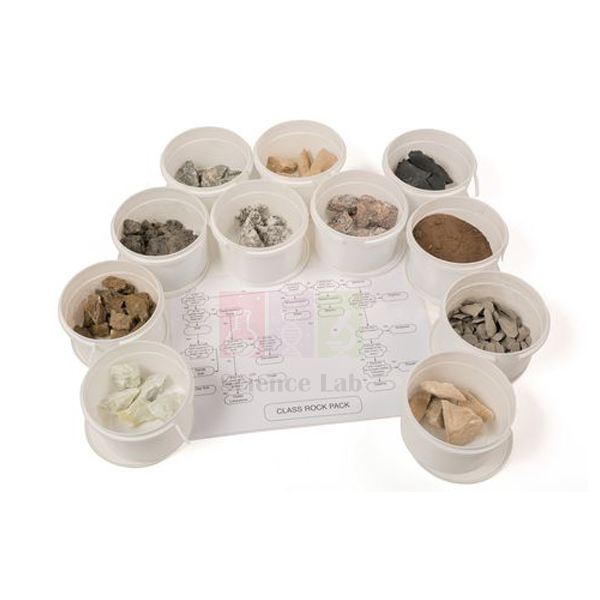
Class Rock Pack
The Class Rock Pack (Product Code: SLE/GG/05) is a complete rock identification lesson in one pack. Over 55 geological samples — igneous, metamorphic and sedimentary rocks together with soil samples — are used with a central laminated flow chart that students follow to identify each sample from characteristics such as texture and permeability. Supplied by Jain Scientific Equipments Pvt Ltd (ScienceLab), Ambala, it is designed to cover the earth science sections of Key Stages 2, 3 and 4.
Specifications
| Parameter | Detail |
|---|---|
| Type | Class rock and soil identification pack |
| Number of samples | Over 55 geological samples |
| Sample types | Igneous, metamorphic and sedimentary rocks, plus soil samples |
| Identification aid | Central laminated flow chart |
| Properties used | Characteristics including texture and permeability |
| Storage | Samples supplied in durable plastic containers |
| Teacher support | Full Teacher’s Notes |
| Curriculum coverage | Earth science sections of Key Stages 2, 3 and 4 |
Typical Use
Groups take a sample, work down the flow chart’s questions — is it made of interlocking crystals or separate grains? does water soak in or run off? — and arrive at a rock group or soil type. A few drops of water from a dropper are enough to test permeability, and a hand lens helps students judge texture, so the lesson stays practical rather than relying on pictures.
Because the pack spans three key stages, the same samples can serve simple sorting activities for younger pupils and discussions of how each rock group forms for older students. The plastic containers keep samples organised between lessons, and the Teacher’s Notes give confidence to staff who are not geology specialists. As an earth science kit, it gives a whole class hands-on material at once instead of a single display set at the front of the room.
Supplier
This rock pack is supplied by Jain Scientific Equipments Private Limited, which trades as ScienceLab from Ambala, Haryana, and sources geological specimens for school laboratories alongside its own teaching apparatus. Read more on our company profile.
Related Geography Lab Equipment
Items that extend or support rock and soil lessons:
- Expanded Rock Collection — a larger set of named rock specimens for further study
- Rock Study Kit — another rock set for identification practice
- Sieves — for separating soil samples by particle size when extending the texture work
- Storage Boxes – Rock – Mineral Specimens — for storing and labelling additional samples
- Clever Catch Rocks — a question ball for revising rock facts after the practical
More options are in our Geography Lab Equipment category.
Frequently Asked Questions
How many samples are in the pack?
Over 55 geological samples, supplied in durable plastic containers.
Does it include soils as well as rocks?
Yes. Soil samples are included alongside igneous, metamorphic and sedimentary rocks.
How do students identify the samples?
By working through the central laminated flow chart, which uses characteristics such as texture and permeability.
Is teaching material included?
Yes, full Teacher’s Notes come with the pack.
Is it only useful for schools following Key Stages?
It is designed around Key Stages 2, 3 and 4, but rock groups, textures and permeability are taught in most earth science syllabuses, so it suits other curricula too.
Can individual samples be replaced?
Replacement availability is not listed; please contact us with the sample you need.
Can you supply several packs for different classrooms or overseas schools?
Yes. We supply schools in India and international markets; add the quantity to your enquiry cart.
Request a Quote
For pricing on the Class Rock Pack, contact us or place it in your enquiry cart.
Last updated: 24 September 2026
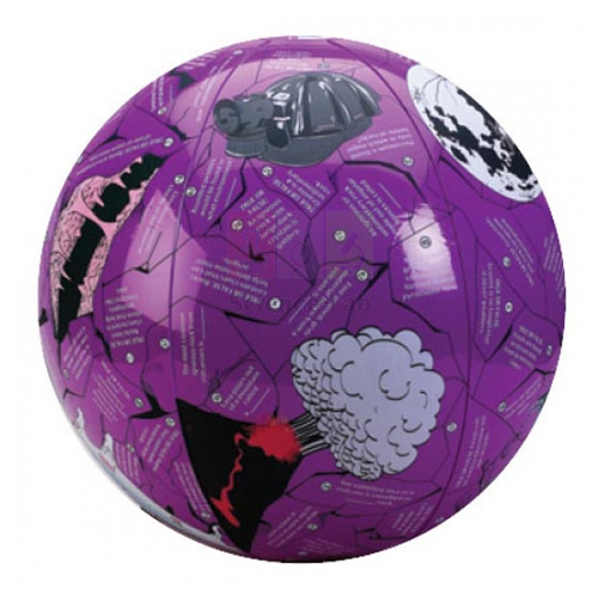
Clever Catch Rocks
Clever Catch Rocks (Product Code: SLE/GG/06) is a question ball for learning about rocks and their properties through play. The ball is tossed around the classroom, and the student who catches it answers the question under their left thumb. It is latex free and comes with a teacher’s guide that contains the answers. Supplied by Jain Scientific Equipments Pvt Ltd (ScienceLab), Ambala, it is a lively revision tool for earth science lessons in primary and middle school.
Key Details
| Parameter | Detail |
|---|---|
| Type | Educational question ball |
| Topic | Rocks and their properties |
| How it works | Ball is tossed around the class; the catcher answers the question under the left thumb |
| Material note | Latex free |
| Teacher support | Teacher’s guide with answers provided |
Typical Use
Teachers bring out the ball for a short warm-up at the start of a rocks lesson or a quick review before a test. Nobody knows who will catch next, so the whole class stays alert, and because the question depends on where the thumb lands, the same ball keeps producing fresh combinations over many sessions.
The teacher’s guide lets the teacher confirm answers on the spot and add a follow-up — for example, asking the student to pick out a matching specimen from the class rock collection. Being latex free, it is a considerate choice where latex sensitivity is a concern, and it gives schools a simple way to add movement and talk to earth science teaching aids that are otherwise mostly specimens and charts.
Supplier
Jain Scientific Equipments Private Limited, trading as ScienceLab in Ambala, Haryana, supplies this question ball as part of its geography and earth science range for schools. Find out more in our company profile.
Related Geography Lab Equipment
Pair the ball with hands-on materials for the same topic:
- Astronomy Clever Catch — the same toss-and-answer format for astronomy topics
- Class Rock Pack — real rock and soil samples to follow up the questions
- Rock Study Kit — rock specimens for identification practice
- Expanded Rock Collection — a larger specimen set covering the three main rock groups
See everything in Geography Lab Equipment.
Frequently Asked Questions
How is Clever Catch Rocks played?
Toss the ball to a student; they answer the question that sits under their left thumb, then throw it on to the next player.
Is the ball latex free?
Yes, it is latex free.
Are answers provided for the teacher?
Yes. A teacher’s guide with answers is provided.
How many questions are on the ball?
The number of questions is not stated in our current listing; contact us if you need it for planning.
How should it be cleaned?
Wipe the surface with a slightly damp cloth and let it dry before storing; avoid soaking or harsh cleaners.
Can we order one for every classroom?
Yes. We supply schools in India and international markets in the quantities needed — list them in your enquiry cart.
Request a Quote
To buy Clever Catch Rocks, contact us or add it to your enquiry cart.
Last updated: 24 September 2026
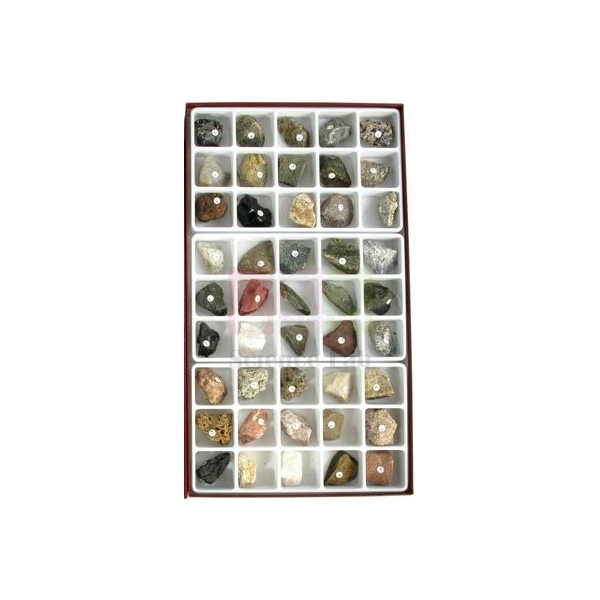
Expanded Rock Collection
The Expanded Rock Collection (Product Code: SLE/GG/07) contains 45 different rock specimens — 15 each of igneous, sedimentary and metamorphic rocks — to start or extend a school rock collection. Each specimen measures approximately 38mm x 38mm, and every category is well represented, so the set works as an integrated classroom study unit. It is supplied by Jain Scientific Equipments Pvt Ltd (ScienceLab), Ambala, for geography and earth science teaching.
Specifications
| Parameter | Detail |
|---|---|
| Number of specimens | 45 different rock specimens |
| Rock groups | 15 igneous, 15 sedimentary and 15 metamorphic |
| Specimen size | Approximately 38mm x 38mm |
| Use | Integrated classroom study unit covering all three major rock types |
Specimens named in the product listing:
- Igneous: Pegmatite, Granite, Syenite, Gabbro, Rhyolite Porphyry, Trachyte Porphyry, Basalt, Rhyolite, Andesite, Tuff, Obsidian, Pitchstone, Pumice, Scoria
- Metamorphic: Gneiss
Typical Use
Rocks are a window into the Earth’s past — how the planet formed, what happened before humans appeared and when the continents took shape — and this collection lets students read that record for themselves. Sorting the specimens into igneous, sedimentary and metamorphic groups is the natural first activity. Students then compare textures within a group, for example coarse-grained granite and gabbro against fine-grained basalt and glassy obsidian, and relate crystal size to how quickly the rock cooled.
Frothy pumice and scoria show gas escaping from lava, while gneiss shows the banding produced when rock is changed by heat and pressure. With equal numbers in each group, the collection suits station-based lessons in which groups rotate between igneous, sedimentary and metamorphic tables, and it makes a sound core for an earth science kit in a school geography room.
Supplier
Jain Scientific Equipments Private Limited, which trades as ScienceLab, supplies this natural specimen collection from Ambala, Haryana. For vendor registration, the company is incorporated under CIN U29309HR2020PTC087597 and registered for GST under GSTIN 06AAECJ8618A1ZT. Visit the company profile for more.
Related Geography Lab Equipment
Useful additions when building a rock and mineral collection:
- Class Rock Pack — rock and soil samples with an identification flow chart for whole-class lessons
- Storage Boxes – Rock – Mineral Specimens — for keeping specimens sorted and labelled
- Mineral Study Kit — minerals such as feldspar, mica and quartz that make up many of these rocks
- Rock Study Kit — a further rock set for identification practice
- General Fossil Collection — fossils, which are usually preserved in sedimentary rocks
Browse all Geography Lab Equipment.
Frequently Asked Questions
How many specimens are included, and of which types?
45 different rock specimens: 15 igneous, 15 sedimentary and 15 metamorphic.
How large is each specimen?
Approximately 38mm x 38mm.
Is the full list of all 45 specimens available?
The listing names the igneous specimens and gneiss shown above. For the complete list of sedimentary and metamorphic specimens, please contact us.
Are the specimens labelled or numbered?
Labelling is not described in the current listing; ask us how the specimens are identified before you order.
Will every specimen look exactly like the photograph?
No. These are natural rocks, so colour, texture and shape vary from piece to piece.
Do you supply schools abroad?
Yes. We supply schools and distributors in India and international markets; use the enquiry cart to send quantities.
Request a Quote
For pricing on the Expanded Rock Collection, contact us or add it to your enquiry cart.
Last updated: 24 September 2026
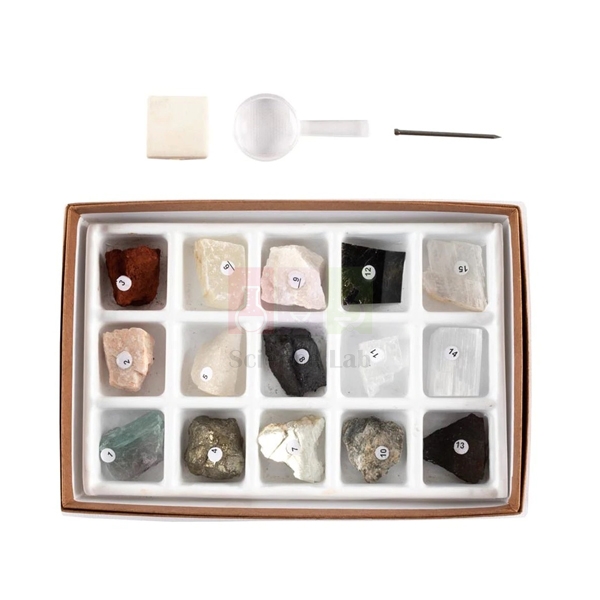
Mineral Study Kit
The Mineral Study Kit (Product Code: SLE/GG/08) brings together 15 important minerals as number-coded, 1-inch specimens that learners can handle, test and study one by one. The set ranges from soft talc and three forms of gypsum to magnetite, metallic pyrite and milky quartz, and it can also be added to an existing rock and mineral collection. It is supplied by Jain Scientific Equipments Pvt Ltd (ScienceLab), Ambala, for geography, earth science and chemistry classrooms.
Specifications
| Parameter | Detail |
|---|---|
| Number of minerals | 15 specimens |
| Specimen size | 1 inch |
| Identification | Number-coded specimens |
| Purpose | Handling, testing and learning about each mineral; can be added to any rock and mineral collection |
The 15 specimens in the kit:
- Fluorite
- Feldspar – Microcline
- Hematite
- Mica – Muscovite
- Magnetite
- Mica – Biotite
- Graphite
- Gypsum – Alabaster
- Talc
- Halite
- Gypsum – Satin Spar
- Gypsum – Selenite
- Pyrite
- Milky Quartz
- Calcite
Typical Use
Students work through simple property tests on each numbered specimen. Scratch tests compare hardness — talc is the softest mineral on the Mohs scale, while quartz is hard enough to scratch glass. A streak test on an unglazed plate shows that hematite leaves a reddish-brown streak even when the specimen looks dark, and a small magnet picks out magnetite straight away.
The two micas peel into thin flexible sheets, a clear example of cleavage; graphite marks paper, which explains its use in pencils; and the three gypsum forms — alabaster, satin spar and selenite — show how one mineral can look very different. Calcite’s reaction with dilute acid is best shown by the teacher. Because the specimens are number-coded, teachers can run blind identification quizzes, and adding a streak plate and a hand lens turns the kit into a complete mineral testing station for an earth science kit or geography lab.
Supplier
ScienceLab, the trading name of Jain Scientific Equipments Private Limited in Ambala, Haryana, supplies this mineral set to schools and colleges alongside its own teaching apparatus. More about us is on the company profile.
Related Geography Lab Equipment
Tools and sets that go with mineral study:
- Mineral Test Kit — a companion kit for testing mineral properties
- Black Streak Plates — show the streak of light-coloured minerals clearly
- Streak Plates Glass — an alternative plate option for streak work
- Mineral ID Starter Set — a further mineral identification set from our earth science range
- Storage Boxes – Rock – Mineral Specimens — keeps the number-coded specimens organised
See more in Geography Lab Equipment.
Frequently Asked Questions
Which minerals are in the kit?
Fluorite, feldspar (microcline), hematite, muscovite and biotite mica, magnetite, graphite, three forms of gypsum (alabaster, satin spar and selenite), talc, halite, pyrite, milky quartz and calcite — 15 in total.
How big are the specimens?
Each specimen is 1 inch in size.
How are the specimens identified?
Each one is number-coded. If you need a printed key for the codes, contact us to confirm what is supplied.
Can it be combined with a collection we already have?
Yes. The kit is intended to be added to any rock and mineral collection.
Are testing tools such as streak plates included?
Testing tools are not listed with this kit; see the Mineral Test Kit and streak plates above if you need them.
Are there any handling precautions?
Students should not taste specimens (halite is rock salt) and should wash their hands after handling minerals such as graphite and hematite, which can leave marks.
Can you supply class quantities or ship overseas?
Yes. We supply schools in India and international markets; list the number of kits in your enquiry cart.
Request a Quote
To order the Mineral Study Kit, contact us or add it to your enquiry cart.
Last updated: 24 September 2026
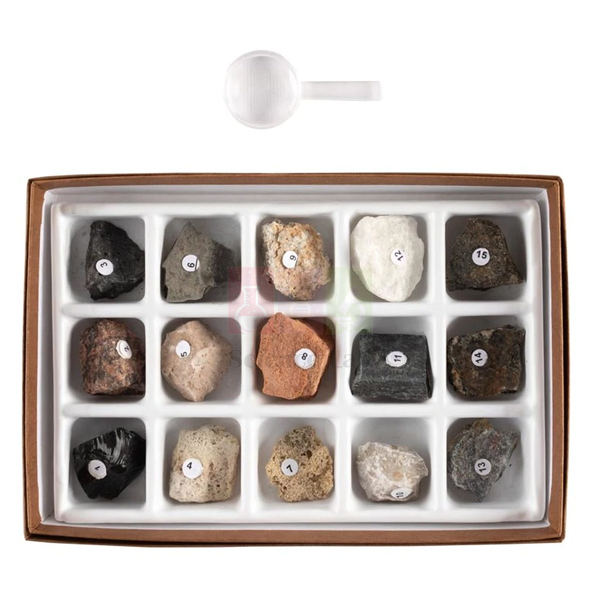
Rock Study Kit
Rock Study Kit (Product Code: SLE/GG/09) is a compact earth science kit built around 15 rock specimens representing the igneous, sedimentary and metamorphic families. Each specimen is about 1 inch across and carries a number code, so students can match what they see under the included magnifier with the identification key and the written description for that rock. It suits geography and general science classes in middle and secondary school, as well as nature-study clubs and teacher-training sessions. The kit is supplied by Jain Scientific Equipments Pvt Ltd (ScienceLab), Ambala, India.
Specifications
| Parameter | Detail |
|---|---|
| Number of specimens | 15 |
| Rock types covered | Igneous, sedimentary and metamorphic |
| Specimen size | 1 inch |
| Specimen marking | Number-coded |
| Magnifier | Included, for close examination of physical properties |
| Display box | 5 x 7 inch |
| Identification key | Rock identification key for the included basic rock types |
| Descriptions | Information and introduction for each rock specimen |
Typical Use
In a typical lesson, students first sort the 15 specimens into the three rock families using visible clues such as crystal size, layering or banding, then confirm their grouping with the identification key. The magnifier helps them look closely at grain size, texture, colour and visible crystals — the physical properties that separate, for example, a coarse-grained igneous rock from a layered sedimentary one. Teachers often pair the activity with a rock-cycle diagram so learners can explain how each type forms and changes into another.
Because the specimens are number-coded and kept in a 5 x 7 inch display box, the kit works well as a reusable station for group rotations and practical assessments: the teacher calls out a number and students name the rock type and justify their answer. For schools building up their geography lab equipment, it is a low-maintenance starting point before moving on to larger collections. Returning every specimen to the display box after class keeps the set complete for the next group.
Supplier
Jain Scientific Equipments Private Limited operates under the ScienceLab name from Ambala, Haryana, and serves schools, colleges and distributors with educational laboratory equipment. As the specimens in this kit are natural rock samples, ScienceLab supplies the kit rather than claiming to make the rocks; enquiries from India and international markets are handled directly by the Ambala team. Learn more on our company profile page.
Related Geography Lab Equipment
These items are often ordered alongside the Rock Study Kit for rock and mineral lessons:
- Expanded Rock Collection — another rock collection for extending identification practice.
- Mineral Study Kit — introduces the minerals that make up the rocks studied here.
- Mineral Test Kit — streak plate, magnet, hardness scale and other tools for testing samples.
- Storage Boxes – Rock – Mineral Specimens — extra storage as a school collection grows.
Browse the complete range in our Geography Lab Equipment category.
Frequently Asked Questions
What comes in the Rock Study Kit?
Fifteen number-coded rock specimens, a magnifier, a 5 x 7 inch display box, a rock identification key and descriptions introducing each specimen. Contact us if you need the names of the individual rocks.
Which rock groups does the kit cover?
Igneous, sedimentary and metamorphic rocks. The kit focuses on basic rock types, so it is best suited to introductory and middle-school earth science work.
Is one kit enough for a whole class?
It is designed for close study by a small group sharing the magnifier and key. For whole-class practicals, schools usually order several kits or combine one with the Class Rock Pack.
How should the specimens be looked after?
Handle them with dry hands, avoid dropping them on hard floors and return them to the display box after each lesson. Avoid scratch or acid tests on these reference pieces so their surfaces stay clear for identification.
Can you supply larger quantities or export orders?
Yes. ScienceLab supplies schools, colleges and distributors in India and international markets. Send the quantity and delivery location through our contact page for a quotation.
What should an institutional enquiry include?
The product code SLE/GG/09, the number of kits, the delivery address or port, and any vendor documents your purchase department requires. This lets us prepare an accurate quotation first time.
Request a Quote
To order the Rock Study Kit, message us via the contact page or add it to your enquiry cart with other geography items for one combined quotation.
Last updated: 24 September 2026
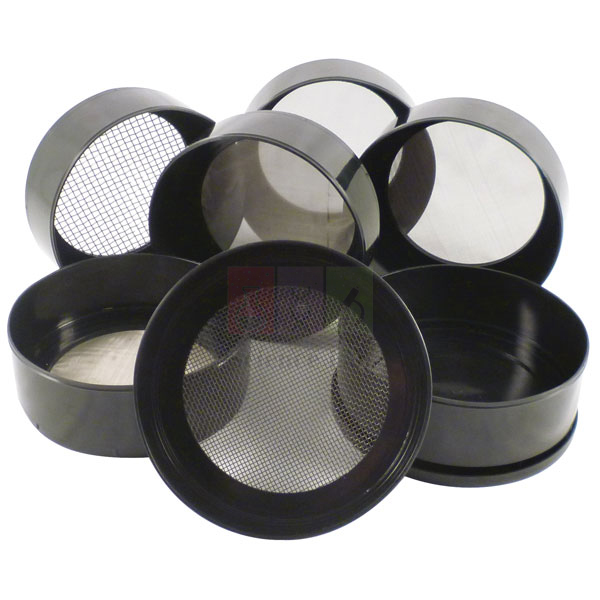
Sieves
Sieves (Product Code: SLE/GG/10) is a set of 6 screen sieves with a bottom pan and lid, used to separate soil and rock samples into size fractions and grade them so students can work out the make-up of soil strata. Screen openings step down from 4 mm to 0.1 mm, giving a clear picture of how much coarse, medium and fine material a sample holds. Geography, earth science and environmental studies teachers use it for soil texture practicals and to follow up field trips. This piece of school lab equipment is manufactured by Jain Scientific Equipments Pvt Ltd (ScienceLab), Ambala.
Specifications
| Parameter | Detail |
|---|---|
| Supplied as | Set of 6 sieves |
| Included with set | Bottom pan and lid |
| 4 mm mesh | 1 sieve |
| 2 mm mesh | 1 sieve |
| 0.5 mm mesh | 2 sieves |
| 0.25 mm mesh | 1 sieve |
| 0.1 mm mesh | 1 sieve |
| Purpose | Separating and grading soil and rock samples to determine the make-up of soil strata |
Typical Use
For a particle-size practical, students dry a soil sample, gently break up any lumps and place it on the coarsest screen. The sieves are then used as a stack — 4 mm at the top, finer meshes below and the pan at the bottom — with the lid in place to stop fine dust escaping while the stack is shaken. Each screen holds back the particles too large to pass, so the material left on every level can be tipped out, weighed and recorded as a share of the whole sample.
Comparing results from topsoil, subsoil and a stream-bed or quarry sample shows learners why some ground drains quickly while other ground stays waterlogged, and how layers in a soil profile differ. The same set supports environmental science projects on erosion and sediment sorting. After each use, tap the screens clean and brush them lightly from the underside so fine particles do not clog the 0.1 mm mesh.
Manufacturer
The sieve set is produced by Jain Scientific Equipments Private Limited, the Ambala, Haryana company that trades as ScienceLab and makes educational laboratory equipment for schools, colleges and training institutes. Orders are prepared at the company’s Ambala facility for customers across India and international markets. Our company profile gives more background on ScienceLab.
Related Geography Lab Equipment
These products complete a soil-sampling and grading practical:
- Garden Auger Soil — for collecting soil samples at different depths before sieving.
- Triple Beam Balance — for weighing the fraction retained on each screen.
- Plastic Weighing Boats — to hold each size fraction during weighing.
- Soil Analysis Kit — adds chemical tests to the physical grading done with the sieves.
- Grid Sieves — an alternative sieve product listed in our agriculture range.
See more items in the Geography Lab Equipment category.
Frequently Asked Questions
Which mesh sizes are in the set?
Six sieves: one each at 4 mm, 2 mm, 0.25 mm and 0.1 mm, and two at 0.5 mm. If your syllabus calls for a different combination, tell us through the contact page.
Are a pan and lid included?
Yes. The set includes a bottom pan to catch the finest material and a lid to cover the top sieve while shaking.
What is the frame material and diameter?
These details are not listed on this page. Please ask our team for the current construction and dimensions before ordering.
Can the sieves be used with wet soil?
Dry samples give the cleanest separation and are easier on the fine meshes. If you plan wet sieving, discuss it with us so we can advise on suitability.
Is a calibration certificate available?
This set is intended for teaching. If your laboratory needs documented aperture verification, discuss the requirement with us before ordering.
Do you supply multiple sets for schools and distributors?
Yes, ScienceLab supplies sets in quantity within India and to international markets. Share the number of sets and the delivery location for a quotation.
Request a Quote
For pricing and availability of the Sieves set, write to us via the contact page, or place it in the enquiry cart alongside the balance and sampling tools you need.
Last updated: 24 September 2026
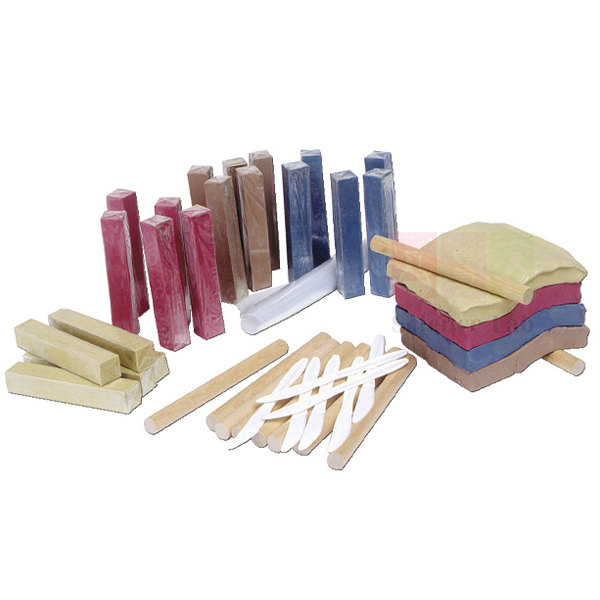
Geology History Kit
Geology History Kit (Product Code: SLE/GG/11) lets students recreate geologic processes by building their own stratified layers from Pleistocene clay, then shaping and cutting them to see how rock strata record the history of a landscape. The kit brings 4 packs of clay, a roller, a cutting tool, plastic sheets and a Teacher’s Guide together in one kit, making it a practical hands-on science kit for geography and earth science lessons on sedimentation, folding and faulting. It is manufactured by Jain Scientific Equipments Pvt Ltd (ScienceLab), Ambala, for schools and teacher-training institutes.
Specifications
| Parameter | Detail |
|---|---|
| Modelling material | Pleistocene clay, 4 packs |
| Roller | 1 |
| Cutting tool | 1 |
| Work surface | Plastic sheets included |
| Teaching support | Teacher’s Guide included |
| Purpose | Recreating geologic processes by preparing stratified layers |
Typical Use
Working on the plastic sheets, students flatten clay with the roller into thin slabs and stack them one on another, just as sediments settle in a lake or sea over thousands of years. Once a stack is built, they can push the ends inward to model folding, slice through it with the cutting tool to create a fault, or trim the top and lay fresh slabs over it to show an unconformity. Cutting a clean vertical section then exposes the “rock record” so the class can apply the principle that lower layers were laid down first.
With the Teacher’s Guide to hand, the model-making format suits both demonstrations at the front of the class and small-group work. Keep opened clay wrapped between lessons so it stays workable, and wipe the roller and cutting tool before storing them in the kit.
Manufacturer
ScienceLab is the brand name used by Jain Scientific Equipments Private Limited, a manufacturer of teaching and laboratory equipment located in Ambala, Haryana. The company develops geography and science kits for classrooms and supplies them to institutions throughout India and to international markets. Visit the ScienceLab profile to learn about the company.
Related Geography Lab Equipment
Teachers often combine this kit with the following resources on rock layers and earth history:
- Fractures, Faults and Dislocations Model — a ready-made model to compare with the faults students cut in clay.
- Investigating Geological Time And Fossils Chart — places the layers students build in the wider geological timescale.
- General Fossil Collection — real fossils to discuss how organisms end up preserved within strata.
- Clay, Modelling, Assorted Color — extra modelling clay if groups want to add more layers.
Explore the wider Geography Lab Equipment range.
Frequently Asked Questions
What is included in the Geology History Kit?
Four packs of Pleistocene clay, one roller, one cutting tool, plastic sheets and a Teacher’s Guide.
Which topics can it demonstrate?
It is built for modelling stratified layers, which leads naturally into lessons on deposition, folding, faulting, unconformities and the relative age of rock layers.
How many groups can one kit serve?
That depends on how thick the layers are rolled and how many models each group builds. Tell us your class size through the contact page and we will suggest a suitable quantity.
Can I order replacement clay?
Please ask our team about the availability of additional clay packs when you place your order.
How should the kit be stored?
Keep clay sealed or wrapped when not in use, store the kit in a cool, dry cupboard and clean the tools before packing them away.
Do you handle school tenders and export enquiries?
Yes. Institutional buyers in India and international markets can request a quotation; include the product code SLE/GG/11, quantity and delivery location.
Request a Quote
Ready to add the Geology History Kit to your lab? Send an enquiry via our contact page or collect it with other items in the enquiry cart.
Last updated: 24 September 2026
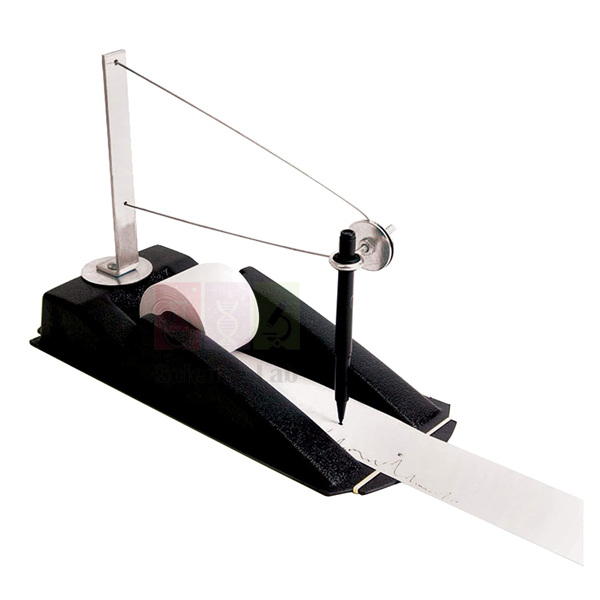
Seismograph Model
Seismograph Model (Product Code: SLE/GG/12) is a newly revised, small table-top unit that shows students how earthquakes are measured and how their intensity is worked out. Pupils create their own simulated tremors, the seismograph records how strong each one is, and the class sees why scientists rate earthquakes on the Richter scale. Geography and earth science teachers use it to turn a textbook topic into a quick, memorable investigation. Like the other geography models in our range, it is manufactured by Jain Scientific Equipments Pvt Ltd (ScienceLab), Ambala, and comes with a detailed Teacher’s Guide.
Key Details
| Parameter | Detail |
|---|---|
| Type | Small table-top seismograph model |
| Version | Newly revised design |
| Demonstrates | How earthquakes are measured and their intensity calculated |
| Student activity | Simulating earthquakes and recording their intensity |
| Teaching support | Detailed Teacher’s Guide |
| Suitable for | Class demonstrations and group investigations in geography and earth science |
Typical Use
Set the unit on a firm, level table and let students generate “earthquakes” of different strengths — a light tap, a firm knock, a longer shake. For each event the seismograph records the intensity, and the class compares the recordings to see how a stronger disturbance produces a larger response. The friendly challenge of trying to “top the Richter scale” keeps every group engaged while they learn what the scale actually measures.
The lesson can then widen into plate tectonics: why earthquakes cluster along plate boundaries, how seismic stations in different places record the same event, and why the Richter scale is logarithmic, so a small step up the scale means much stronger ground motion. Keep the model away from the table edge during vigorous shaking and let it settle fully before starting the next run.
Manufacturer
This model comes from Jain Scientific Equipments Private Limited, which trades as ScienceLab and designs and builds educational apparatus in Ambala, Haryana. Schools, colleges and distributors in India and international markets order from the same catalogue. Read the company profile for an overview of ScienceLab.
Related Geography Lab Equipment
These items help extend an earthquake lesson into the wider study of the Earth’s crust:
- Fractures, Faults and Dislocations Model — shows the fault movements that release earthquake energy.
- Volcano Model — pairs with earthquakes when teaching activity at plate boundaries.
- Ocean Floor Raised Relief Map — locates the ridges and trenches where many earthquakes occur.
- Seismograph Model For Science Lab — another seismograph listing in our earth science range to compare.
More models are listed under Geography Lab Equipment.
Frequently Asked Questions
What does the Seismograph Model demonstrate?
How earthquakes are measured and their intensity calculated. Students simulate tremors and the model records how strong each one is.
Can it detect real earthquakes?
It is a teaching model designed for simulated tremors in the classroom, not a monitoring instrument for real seismic events.
What is supplied with it?
The table-top seismograph model and a detailed Teacher’s Guide. For a full parts list, please ask us through the contact page.
Does it need power or any consumables?
These details are not listed on this page. Please confirm operating requirements with our team before ordering.
How does it differ from the Seismograph Model For Science Lab?
We list more than one seismograph product. Tell us your class level and syllabus and we will help you choose between them.
What warranty applies?
Warranty terms are confirmed with each quotation. Ask our team for the terms that apply to your order.
Can you supply several units for a school network or export order?
Yes. We supply institutions in India and international markets; share the quantity and destination for a quotation.
Request a Quote
For a price on the Seismograph Model, reach us through the contact page or add the product to your enquiry cart and submit it with the rest of your list.
Last updated: 24 September 2026
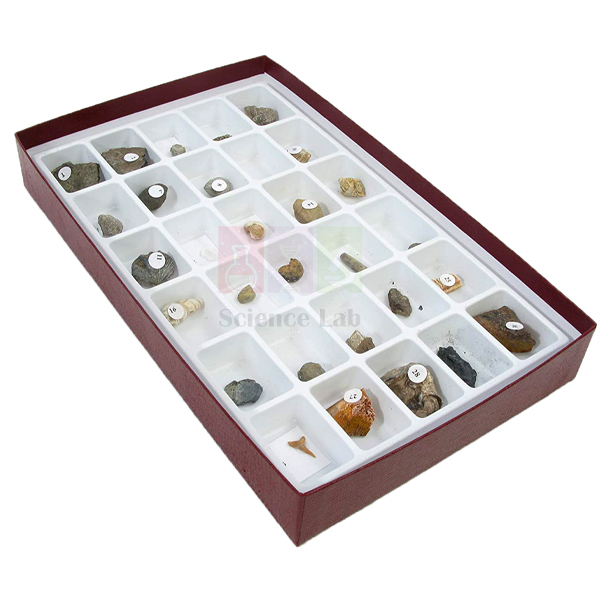
Advanced Fossil Collection
Advanced Fossil Collection (Product Code: SLE/GG/13) is a comprehensive set of 30 fossils chosen as demonstration specimens of animal phyla and plants from the Paleozoic, Mesozoic and Cenozoic. With a descriptive key sheet and a geologic time chart, it lets senior school and college students connect each specimen to its group and its place in Earth’s history. The collection is equally useful to geography, geology and biology departments, where it serves as one of the more detailed biology teaching aids for evolution topics. It is supplied by Jain Scientific Equipments Pvt Ltd (ScienceLab), Ambala, India.
Specifications
| Parameter | Detail |
|---|---|
| Number of fossils | 30 |
| Specimen content | Demonstration specimens of animal phyla and plants |
| Geologic eras represented | Paleozoic, Mesozoic and Cenozoic |
| Reference material | Descriptive key sheet and geologic time chart |
| Supplied as | Complete fossil collection |
Typical Use
A common approach is to give each group a handful of specimens and ask them to identify the phylum or plant group using the descriptive key sheet, then place each fossil on the geologic time chart. When the whole class combines its results, the chart shows how life changed from the Paleozoic through the Mesozoic to the Cenozoic — a strong visual for lessons on evolution, extinction events and the idea of index fossils used to date rock layers.
Because the set spans both animals and plants across three eras, it also supports comparative work in biology, such as tracing how body plans within a phylum persist or change over time. Handle specimens over a tray or cloth-covered bench, keep the key sheet with the collection and count the pieces back in after each session so all 30 stay together.
Supplier
Jain Scientific Equipments Private Limited, trading as ScienceLab from Ambala in Haryana, supplies this collection as part of its earth science and geography range. Since fossils are natural specimens, the company supplies rather than manufactures them, and it serves institutions across India and in international markets. More about the business is on our profile page.
Related Geography Lab Equipment
These resources work well with the Advanced Fossil Collection in earth history lessons:
- General Fossil Collection — a smaller 15-fossil set for introductory classes or extra student stations.
- Investigating Geological Time And Fossils Chart — a wall reference for the eras covered by the specimens.
- Variation And Evolution Fossil Kit — extends the collection into activities on variation and evolution.
- Hand Lens — for examining fine surface detail on each fossil.
- Storage Boxes – Rock – Mineral Specimens — secure storage for specimen collections.
The full range is in our Geography Lab Equipment category.
Frequently Asked Questions
How many fossils are in the collection, and from which eras?
Thirty fossils representing animal phyla and plants from the Paleozoic, Mesozoic and Cenozoic.
How is it different from the General Fossil Collection?
The advanced set has 30 specimens organised around animal phyla and plants across three eras, while the General Fossil Collection has 15 fossils for introducing major life forms. Both include a key sheet and a geologic time chart.
Can I see the list of specimens before ordering?
Yes. Please request the current specimen list through our contact page before placing your order.
How should the fossils be handled and stored?
Handle them over a padded surface, avoid washing or scrubbing them, and store the collection dry with the key sheet so specimens stay matched to their descriptions.
Is this suitable for college laboratories?
Yes, its breadth across phyla and eras suits senior secondary and undergraduate teaching as well as museum-style displays in school labs.
Do you supply to institutions outside India?
Yes. ScienceLab supplies schools, colleges and distributors in India and international markets. Send the quantity and destination for a quotation.
Request a Quote
To request pricing for the Advanced Fossil Collection, contact us via the contact page or add it to the enquiry cart with your other earth science items.
Last updated: 24 September 2026
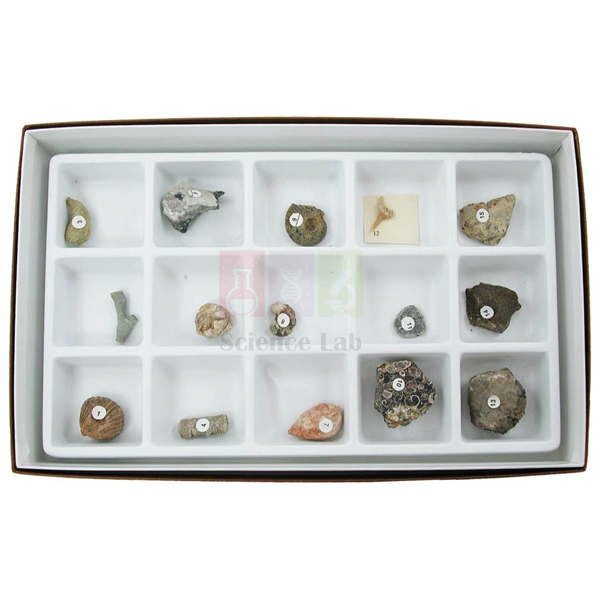
General Fossil Collection
General Fossil Collection (Product Code: SLE/GG/14) is an introductory selection of 15 fossils that illustrates the major life forms present throughout geologic history. A descriptive key sheet and a geologic time chart guide students as they learn to recognise basic fossils and match each one to its era, which makes the set a natural fit for middle-school geography, general science and early biology lessons. As practical junior science lab equipment, it gives learners real specimens to hold instead of textbook pictures. The collection is supplied by Jain Scientific Equipments Pvt Ltd (ScienceLab), Ambala.
Specifications
| Parameter | Detail |
|---|---|
| Number of fossils | 15 |
| Coverage | Major life forms present throughout geologic history |
| Reference material | Descriptive key sheet and geologic time chart |
| Learning aim | Introducing basic fossils and matching each fossil to its era |
| Supplied as | Fossil collection |
Typical Use
Many teachers run the collection as a matching challenge: pairs of students pick a fossil, describe its shape and texture, look it up on the descriptive key sheet and then place it on the correct band of the geologic time chart. With only 15 pieces, the whole set can be worked through in a single lesson, and the finished chart becomes a timeline the class can discuss — which life forms appear early, which come later, and what that suggests about how life on Earth developed.
The collection also makes a good starting point for explaining how fossils form, why most are found in sedimentary rock and what they tell us about past environments. For younger groups, laying a long paper strip on the floor as a timeline and walking the fossils along it helps them grasp the scale of geologic time. Keep the pieces in their packaging between lessons and check the count before putting the set away.
Supplier
ScienceLab is how Jain Scientific Equipments Private Limited, an Ambala, Haryana company, presents its educational range to schools and colleges. The fossils in this collection are natural specimens that the company supplies alongside the key sheet and time chart; it does not describe them as manufactured items. Institutions in India and international markets can find out more on the company profile.
Related Geography Lab Equipment
Pair the General Fossil Collection with these items for a fuller unit on fossils and earth history:
- Advanced Fossil Collection — a 30-fossil step up for senior classes.
- Fossil Hunt Kit — lets students experience how fossils are found and uncovered.
- Geology History Kit — models the rock layers in which fossils are preserved.
- Magnifying Glass — to magnify the texture and outline of each specimen.
Find related items in the Geography Lab Equipment category.
Frequently Asked Questions
What does the General Fossil Collection include?
Fifteen fossils plus a descriptive key sheet and a geologic time chart for matching each fossil to its era.
Which age group is it best for?
It is aimed at introducing basic fossils, so it suits middle-school and early secondary classes. Senior classes may prefer the larger Advanced Fossil Collection.
Can students handle the fossils directly?
Yes, with supervision. Ask students to handle them over a table, avoid dropping or scratching them and return each piece after use.
Is a list of the individual fossils available?
Please ask through our contact page and we will share the specimen list for the collection you are ordering.
Can I buy several collections for different sections or schools?
Yes. Multiple collections can be quoted together for schools, school groups and distributors in India and international markets.
What information speeds up a quotation?
The product code SLE/GG/14, the number of collections, your delivery location and any paperwork your purchase office needs.
Request a Quote
Ask for a quotation on the General Fossil Collection through our contact page, or save it to your enquiry cart while you browse the rest of the range.
Last updated: 24 September 2026
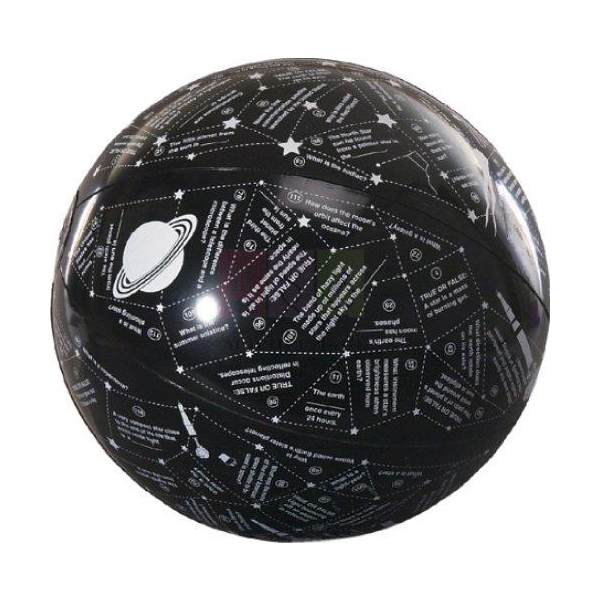
Astronomy Clever Catch
Astronomy Clever Catch (Product Code: SLE/GG/15) is a 24-inch question ball that turns astronomy revision into a game. Players toss the ball to one another, and whoever catches it reads out and answers the astronomy question found under their left thumb. It is a creative way for children to learn astronomy concepts, and the included list of game suggestions, directions and answers means teachers can start playing straight away. Primary and middle-school teachers, science clubs and activity centres use it as a lively addition to their astronomy lab equipment. The game is supplied by Jain Scientific Equipments Pvt Ltd (ScienceLab), Ambala.
Key Details
| Parameter | Detail |
|---|---|
| Type | Question-and-answer catch ball game |
| Ball size | 24 inch |
| Subject | Astronomy concepts |
| How it is played | The catcher answers the question under their left thumb |
| Included | List of game suggestions, directions and answers |
| Suitable for | Children learning astronomy; classroom review and group games |
Typical Use
Arrange students in a circle and start with a simple round: the catcher reads the question under their left thumb, answers it, and tosses the ball on. Because the ball offers many variations of play, teachers can switch formats to suit the lesson — team scoring, “pass it on” where the next player must answer, or a quick-fire round to revise planets, stars and the Moon before a test. The answer list lets the teacher or a student referee confirm responses without slowing the game.
The game works well as a warm-up at the start of a space unit, as an end-of-term review, or as a break between more formal activities with models and globes. Play in a hall or open classroom space away from lights and glassware, and wipe the ball with a slightly damp cloth after use to keep the printed questions readable.
Supplier
ScienceLab, the trading name of Jain Scientific Equipments Private Limited in Ambala, Haryana, supplies this game as part of its geography and astronomy teaching range. For vendor registration, the company's GSTIN is 06AAECJ8618A1ZT, and its export shipments are handled under Importer-Exporter Code AAECJ8618A issued by the DGFT. See our company profile for more details.
Related Geography Lab Equipment
Combine the Astronomy Clever Catch with these items to build a complete space-science unit:
- Solar System Model — a visual reference for questions about planets and their order.
- Astronomy Activity Kit — hands-on activities to follow up the concepts revised in the game.
- Celestial Star Globe — for lessons on stars and constellations.
- Rocks Clever Catch — the same catch-and-answer format for a geology topic.
Browse all products in Geography Lab Equipment.
Frequently Asked Questions
How big is the ball?
It is a 24-inch ball, large enough for a group to see the printed questions and catch it easily.
What comes with the game?
The ball plus a list of game suggestions, directions and answers.
How many children can play at once?
There is no fixed number; the game is played by tossing the ball around a group, so it suits small groups or a full class taking turns.
Which astronomy topics do the questions cover?
The questions address astronomy concepts for children. For the exact question list, please ask us through the contact page.
How do I keep the ball clean?
Wipe it with a slightly damp cloth, let it dry and store it away from sharp objects and direct heat.
Can you supply several balls for a school group or export order?
Yes. We supply schools and distributors in India and international markets; include the quantity and destination in your enquiry.
Request a Quote
For availability and pricing of the Astronomy Clever Catch, get in touch through the contact page or drop it into your enquiry cart along with other astronomy teaching aids.
Last updated: 24 September 2026
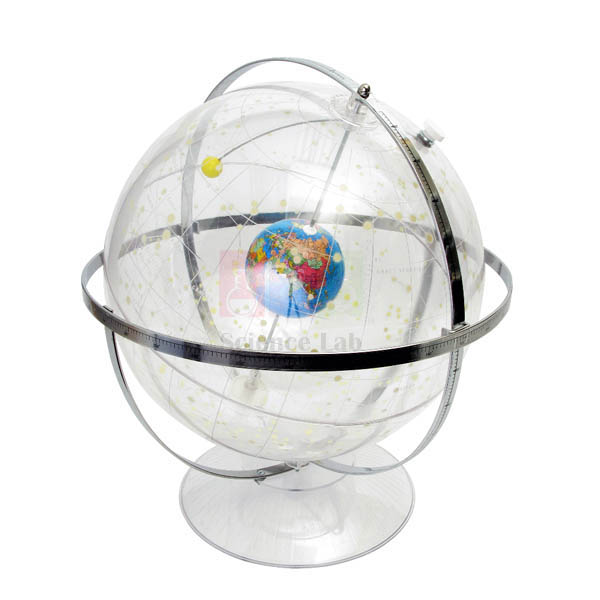
Celestial Star Globe
Celestial Star Globe (Product Code: SLE/GG/16) is a 12-inch diameter globe that clearly and simply demonstrates the apparent relationship between Earth and the stars, planets, galaxies and other celestial objects. It can be set for a chosen time and place so that the constellations sit in their actual positions, giving a class its own small planetarium on the desk. Geography, physics and astronomy teachers use it to explain the night sky before students go outside to observe it. This piece of educational science equipment is manufactured by Jain Scientific Equipments Pvt Ltd (ScienceLab), Ambala, and comes with a detailed study guide.
Specifications
| Parameter | Detail |
|---|---|
| Diameter | 12 inch |
| Demonstrates | Apparent relationship between Earth and the stars, planets, galaxies and other celestial objects |
| Setting | Can be set by time and place to show the actual positions of stars and constellations |
| Marking | Printed on the inside so a crayon may be used to mark positions of the planets or the Moon |
| Included | Detailed study guide |
Typical Use
Start by setting the globe for your school’s location and the date and hour of a planned observation. Students can then pick out which constellations will be above the horizon that evening and in which direction to look — a practical bridge between classroom theory and real stargazing. Turning the globe through a night shows why stars appear to rise and set as Earth rotates, and repeating the setting for another season shows why the visible constellations change through the year.
Because the globe is printed on the inside, a crayon can be used to plot where the Moon or a planet sits among the background stars. Plotting the Moon on several evenings in a row is an effective project that reveals its steady eastward drift. Use crayon only for marking, and store the globe covered to keep it free of dust between lessons.
Manufacturer
Jain Scientific Equipments Private Limited produces the Celestial Star Globe under its ScienceLab brand in Ambala, Haryana, where the company makes geography and science teaching equipment. Schools, colleges and education distributors in India and international markets buy directly from the company. The company profile has further information.
Related Geography Lab Equipment
These products extend the Celestial Star Globe into a complete astronomy corner:
- The Model of The Celestial Sphere (for high school) — an alternative model of the celestial sphere for senior classes.
- Earth Globe Model — compares the terrestrial view with the sky view shown on the star globe.
- Orbiter Model — demonstrates day, night, seasons and lunar phases behind the changing sky.
- Telescope Refractor — for observing the objects students first locate on the globe.
Visit our Geography Lab Equipment category for more.
Frequently Asked Questions
What size is the Celestial Star Globe?
It has a 12-inch diameter.
Can it show the sky for my location?
Yes. The globe can be set according to time and place to show the actual positions of the stars and constellations.
How are planets and the Moon shown?
Their positions change, so they are not fixed on the globe. Because it is printed on the inside, students can mark the positions of the planets or the Moon with a crayon.
Is a teaching guide included?
Yes, the globe comes with a detailed study guide.
Does it come with a stand?
Stand details are not listed on this page. Please confirm the supplied configuration with us through the contact page.
What warranty and after-sales support is offered?
Warranty terms are stated with each quotation, so please raise any after-sales questions when you enquire.
Can you quote for several globes or an export shipment?
Yes. We supply institutions in India and international markets; tell us the quantity and destination.
Request a Quote
Send a price request for the Celestial Star Globe via the contact page, or add it to the enquiry cart to quote it with other astronomy items.
Last updated: 24 September 2026
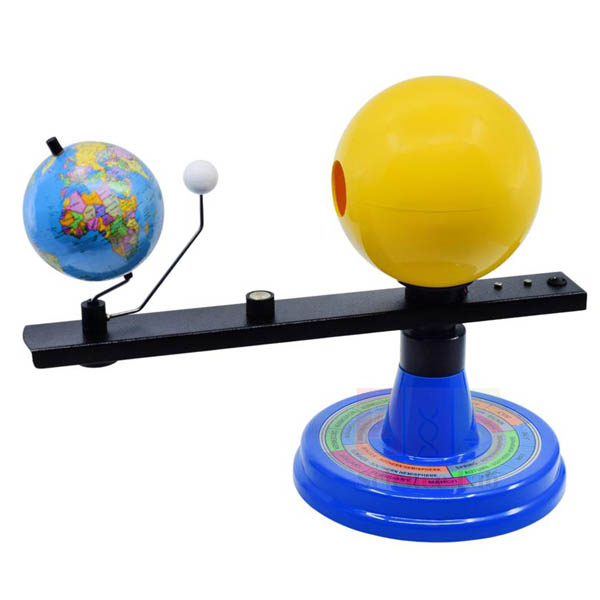
Orbiter Model
Orbiter Model (Product Code: SLE/GG/17) is a gear-driven model of the Sun, Earth and Moon that shows how the three bodies move in relation to one another. A 15-inch arm carries a 4-inch Earth and a 1-inch Moon around a 6-inch Sun, so students can watch daylight and night, the seasons and the phases of the Moon play out in front of them — and answer questions such as how many days Earth takes to revolve around the Sun. It is a dependable Sun-Earth-Moon demonstration model for geography and general science classrooms, manufactured by Jain Scientific Equipments Pvt Ltd (ScienceLab), Ambala, and supplied with a study guide.
Specifications
| Parameter | Detail |
|---|---|
| Mechanism | Gear-driven |
| Arm length | 15 inch |
| Sun diameter | 6 inch |
| Earth diameter | 4 inch |
| Moon diameter | 1 inch |
| Demonstrates | Daylight, night, seasons and phases of the Moon |
| Included | Study guide |
Typical Use
Place the model on a front bench where the whole class can see it and move the Earth slowly along its path. Because the model is gear-driven, the Moon keeps its correct relationship to Earth as the arm turns, so one continuous demonstration can cover several ideas: the side of Earth facing the Sun has day while the other has night, the Moon’s changing position gives its sequence of phases, and Earth’s position around the Sun links to the seasons. Pausing at key points and asking students to predict the next phase keeps the lesson interactive.
Together with the included study guide, the model is useful both for introducing the topic and for revision before exams. Handle the arm gently rather than forcing it, keep the gears free of dust and store the model upright so the Earth and Moon stay correctly aligned.
Manufacturer
The Orbiter Model is one of the teaching models made by Jain Scientific Equipments Private Limited, which does business as ScienceLab from Ambala in Haryana. The company builds apparatus for school and college laboratories and ships to customers in India and international markets. Find out more on the ScienceLab company profile.
Related Geography Lab Equipment
These products are often used alongside the Orbiter Model in lessons on the Earth in space:
- Solar System Model — widens the view from the Sun-Earth-Moon system to all the planets.
- Earth Globe Model — lets students locate places while discussing day length and seasons.
- Project Planetarium Set — small-group plotting of eclipses, moon phases and planet positions.
- Mini Science Kit – Earth, Sun and Moon — individual student activities on the same topic.
See the complete Geography Lab Equipment range.
Frequently Asked Questions
What are the sizes of the Sun, Earth and Moon?
The Sun is 6 inches in diameter, Earth is 4 inches and the Moon is 1 inch, mounted on an arm 15 inches long.
Which concepts can the model demonstrate?
Daylight and night, the seasons and the phases of the Moon, as well as how long Earth takes to revolve around the Sun.
Does the Sun light up?
A light source is not listed for this model. If you need an illuminated Sun for day-and-night demonstrations, please check with us through the contact page.
Is the model built to scale?
No. With a 6-inch Sun and a 4-inch Earth, the sizes are chosen for visibility in a classroom, which gives a good opening to discuss how different the real sizes and distances are.
Is a guide included?
Yes, a study guide is supplied with the model.
Can schools order several units or arrange export delivery?
Yes. We quote for single schools, school groups and distributors in India and international markets.
Request a Quote
To get a price for the Orbiter Model, contact us through the contact page or add it to the enquiry cart together with any other models you need.
Last updated: 24 September 2026
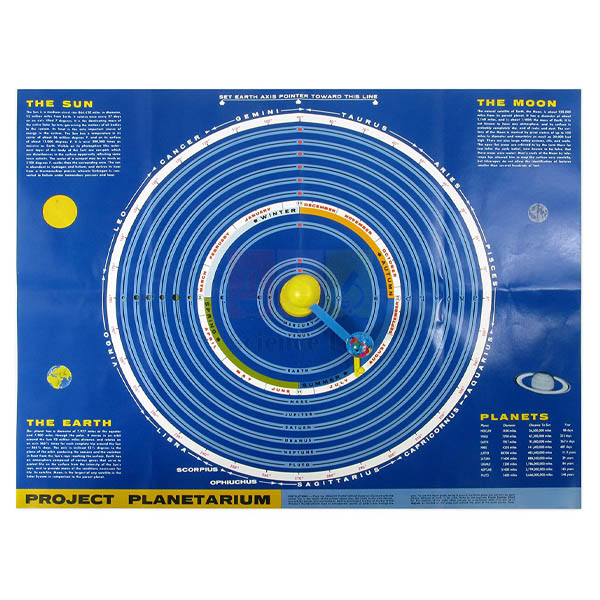
Project Planetarium Set
Project Planetarium Set (Product Code: SLE/GG/18) brings the mysteries of the solar system into the classroom at desk level. Designed for individual or small-group use, it lets students plot eclipses, moon phases and planet positions for themselves, using the study guide, solar system chart and mini Sun-Moon-Earth model included in the set. Part planetarium and part solar system model kit, it suits project work, science-fair preparation and practical astronomy lessons in middle and secondary school. The set is manufactured by Jain Scientific Equipments Pvt Ltd (ScienceLab), Ambala.
Key Details
| Parameter | Detail |
|---|---|
| Type | Planetarium activity set |
| Intended use | Individual or small-group work |
| Activities | Plotting eclipses, moon phases and planet positions |
| Model | Mini Sun-Moon-Earth model |
| Chart | Solar system chart |
| Guide | Study guide |
Typical Use
Working in pairs or small teams, students use the mini Sun-Moon-Earth model to arrange the three bodies for a solar eclipse, with the Moon between the Sun and Earth, and then for a lunar eclipse, with Earth in the middle. They sketch each arrangement and explain why eclipses do not happen every month. The same model helps them track the Moon around Earth and record the sequence of phases they would see from home over several weeks.
The solar system chart moves the activity outward: students plot where the planets are relative to the Sun and to each other, which is a natural launch point for independent projects or class presentations. Because each set serves one learner or a small group, teachers can run several sets side by side and compare results between teams. Keep the chart flat and the small model parts together in the set after each session.
Manufacturer
Jain Scientific Equipments Private Limited makes the Project Planetarium Set and markets it under the ScienceLab name from Ambala, Haryana, alongside a wider range of astronomy and geography teaching aids. For purchase departments that need vendor registration details, the company’s identifiers are GSTIN 06AAECJ8618A1ZT and LEI 3358004HRD1JIVXKYX49. Read more on our company profile.
Related Geography Lab Equipment
These items complement the Project Planetarium Set in space-science teaching:
- Orbiter Model — a larger gear-driven Sun-Earth-Moon model for whole-class demonstrations.
- Solar System Model — a three-dimensional view of the planets students plot on the chart.
- Celestial Star Globe — places the planets against the background stars and constellations.
- Astronomy Activity Kit — further hands-on astronomy activities for groups.
More teaching aids are listed in Geography Lab Equipment.
Frequently Asked Questions
What does the Project Planetarium Set contain?
A study guide, a solar system chart and a mini Sun-Moon-Earth model.
How many students can use one set?
It is designed for one student or a small group. For a full class, most schools order several sets so every group can work at the same time.
What can students plot with it?
Eclipses, moon phases and planet positions.
Is it a projector-type planetarium?
No projection feature is listed for this set; it is a hands-on plotting and modelling set. If you need a projection planetarium, ask us through the contact page.
Is it suitable for science projects?
Yes. Its individual and small-group format makes it a good base for project work on eclipses, the Moon and the solar system.
What details should a school include when requesting a quotation?
The product code SLE/GG/18, the number of sets, the delivery location in India or abroad, and any vendor forms your finance office uses.
Request a Quote
Request pricing for the Project Planetarium Set through the contact page, or add it to the enquiry cart to build a combined astronomy order.
Last updated: 24 September 2026
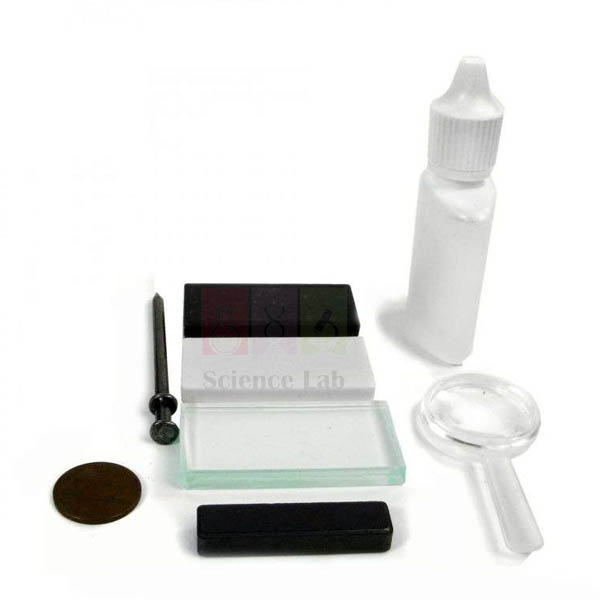
Mineral Test Kit
Mineral Test Kit (Product Code: SLE/GG/19) supplies students with the tools they need for rock, mineral and fossil identification, packed together in a zip-lock pouch for easy storage. The kit contains a penny, streak plate, hand lens, dropper bottle, glass plate, magnet, nail and hardness scale — everything needed to run the classic streak, scratch-hardness and magnetism tests on unknown samples. Geography and earth science teachers hand it to groups during identification practicals and field work, making it a practical science kit for students of all levels. It is manufactured by Jain Scientific Equipments Pvt Ltd (ScienceLab), Ambala.
Specifications
| Parameter | Detail |
|---|---|
| Purpose | Rock, mineral and fossil identification |
| Storage | Zip-lock pouch |
| Kit contents | Penny, streak plate, hand lens, dropper bottle, glass plate, magnet, nail and hardness scale |
What each item is used for:
- Penny, nail and glass plate — everyday reference objects for scratch-hardness comparisons.
- Hardness scale — for ranking a sample once the scratch tests are done.
- Streak plate — for revealing the colour of a mineral’s powder.
- Hand lens — a hand lens magnifier for crystal shape, lustre, grain and fossil detail.
- Magnet — for checking whether a sample is magnetic.
- Dropper bottle — for applying a few drops of a teacher-approved test liquid.
Typical Use
A typical identification practical works through the tests in order. Students first look at the sample under the hand lens, then rub it across the streak plate to see the colour of its powder, which is often more reliable than the colour of the lump itself. Next they try to scratch it with the penny and the nail, and check whether it scratches the glass plate; the results let them place the sample on the hardness scale. A quick pass with the magnet picks out magnetic minerals such as magnetite, and the dropper bottle can be used, under supervision, for a fizz test on carbonate rocks.
Recording each result in a simple table and comparing it with a mineral identification chart turns the kit into a proper investigation rather than a guessing game. Handle the glass plate with care, wipe the streak plate clean between samples, and repack every item in the zip-lock pouch so the next group receives a complete kit.
Manufacturer
Jain Scientific Equipments Private Limited, trading as ScienceLab from Ambala in Haryana, manufactures this test kit as part of its geography and earth science teaching range. The company serves schools, universities and education distributors in India and international markets. You can read about the company on our profile page.
Related Geography Lab Equipment
These products pair naturally with the Mineral Test Kit:
- Mineral Study Kit — mineral samples to practise the tests on.
- Rock Study Kit — igneous, sedimentary and metamorphic specimens for identification work.
- Black Streak Plates — spare streak plates for groups working in parallel.
- Streak Plates Glass — extra glass plates for scratch-hardness testing.
- Mineral ID Starter Set — a mineral identification set for beginners.
See all products in Geography Lab Equipment.
Frequently Asked Questions
What is in the Mineral Test Kit?
A penny, streak plate, hand lens, dropper bottle, glass plate, magnet, nail and hardness scale, stored in a zip-lock pouch.
Does the kit include rock or mineral samples?
No samples are listed in this kit. Pair it with a specimen set such as the Mineral Study Kit or Rock Study Kit.
Is test acid supplied in the dropper bottle?
The kit lists a dropper bottle only. Schools normally fill it with a test liquid chosen under their own laboratory safety rules; please ask us if you need advice.
Can it be used outdoors?
Yes. The compact zip-lock pouch makes it easy to take on field trips, provided the glass plate is handled carefully.
How many kits does a class need?
One kit per group of students is the usual arrangement. Tell us your group numbers through the contact page for a quotation.
Do you supply kits in bulk for tenders or export?
Yes, ScienceLab supplies institutions and distributors in India and international markets.
Request a Quote
To order the Mineral Test Kit, send us an enquiry on the contact page or add it to your enquiry cart with the specimen sets you plan to test.
Last updated: 24 September 2026
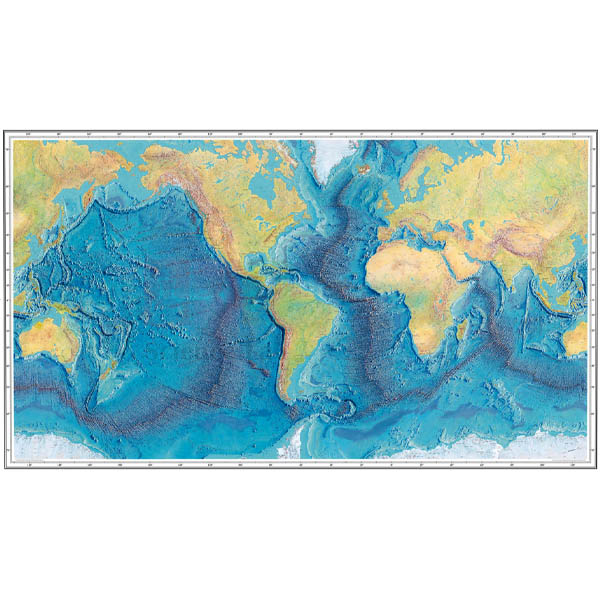
Ocean Floor Raised Relief Map
Ocean Floor Raised Relief Map (Product Code: SLE/GG/20) is a 660 x 990 mm raised relief map of the world that captures the geography of both the land and the ocean floor. Ridges, mountains, continental shelves, trenches, continental slopes and islands stand out in relief, so students can see and feel the shape of the seabed that a flat atlas page hides. Geography and earth science departments use it as a wall or table display for lessons on plate tectonics, oceans and landforms, and framing options are available. The map is manufactured by Jain Scientific Equipments Pvt Ltd (ScienceLab), Ambala.
Specifications
| Parameter | Detail |
|---|---|
| Coverage | World — land and ocean floor |
| Map type | Raised relief |
| Features depicted | Ridges, mountains, continental shelves, trenches, continental slopes and islands |
| Size | 660 x 990 mm |
| Framing | Framing options available |
Typical Use
The map is at its most useful when students trace features with their fingers: following a mid-ocean ridge across an ocean basin, then finding a deep trench beside a chain of islands or a mountain coast. That comparison opens up the idea of plates pulling apart at ridges and sinking at trenches, and explains why earthquakes and volcanoes cluster where they do. Continental shelves and slopes give a clear picture of where the land really ends and the deep ocean begins.
Teachers also use the map for quizzes on ocean names and island groups, and alongside a flat political map to show how much of Earth’s relief lies under water. The tactile surface helps learners who understand shapes best by touch. Like any piece of geography lab equipment, it lasts longer when dusted with a soft, dry brush, kept out of strong direct sunlight and protected from heavy pressure on the raised areas.
Manufacturer
Jain Scientific Equipments Private Limited, known to customers as ScienceLab, produces relief maps and other geography models in Ambala, Haryana. The company supplies schools, colleges and education distributors in India and international markets. Our company profile explains more about ScienceLab.
Related Geography Lab Equipment
Use these items with the Ocean Floor Raised Relief Map for a complete landforms and tectonics unit:
- Landform Relief Maps — relief maps focused on land features and topography.
- Physiographic Relief Globe — shows relief on a globe to avoid map distortion.
- Seismograph Model — links the plate boundaries on the map to how earthquakes are measured.
- Volcano Model — explains the volcanic islands and mountains marked on the map.
Browse further in Geography Lab Equipment.
Frequently Asked Questions
What size is the map?
It measures 660 x 990 mm.
Which ocean-floor features are shown?
Ridges, trenches, continental shelves and continental slopes, along with mountains and islands on land and at sea.
Is the map supplied framed?
Framing options are available. Tell us whether you need a framed or unframed map when you enquire through the contact page.
What material is it made from?
The material is not listed on this page. Please ask our team for construction details before ordering.
How should the map be cleaned?
Dust it gently with a soft, dry brush or cloth. Avoid solvents and do not press hard on the raised relief.
Can you supply maps for several classrooms or export customers?
Yes. ScienceLab quotes for multiple units and ships to institutions in India and international markets.
Request a Quote
Ask for a quotation on the Ocean Floor Raised Relief Map, framed or unframed, through our contact page, or add it to the enquiry cart.
Last updated: 24 September 2026
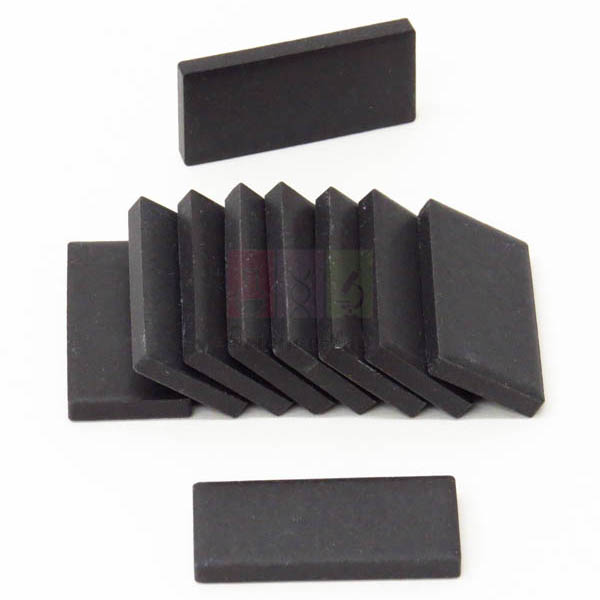
Black Streak Plates
Black Streak Plates (Product Code: SLE/GG/21) are 25 x 50 mm unglazed porcelain tiles for the streak test, one of the essential checks in mineral identification. Rubbing a mineral across the rough, unglazed surface leaves a line of powder, and the colour of that streak is a far steadier clue to a mineral’s identity than the colour of the specimen itself. The dark tile makes pale and white streaks easy to see, so these plates are a useful companion to white plates in school and college geology practicals. They are supplied by Jain Scientific Equipments Pvt Ltd (ScienceLab), Ambala, as part of its range of school lab equipment for earth science.
Specifications
| Parameter | Detail |
|---|---|
| Colour | Black |
| Material | Unglazed porcelain |
| Size | 25 x 50 mm |
| Form | Tile |
| Application | Streak testing of minerals |
Typical Use
Hold the plate flat on the bench and draw a corner or edge of the mineral firmly across it in a single stroke. Students then compare the powder line with a streak chart or identification key and note the colour in their results table. Minerals that look alike in the hand — for example two dark metallic samples — often separate clearly on the plate, which is why the streak test sits alongside lustre, hardness and magnetism in almost every identification routine.
A black plate is the better choice when the expected streak is white, cream or very pale, since those colours disappear against a white tile. Very hard minerals may scratch the plate instead of leaving powder, and that result is itself worth recording. Wipe the surface with a damp cloth between samples so earlier streaks do not confuse the next reading, and replace a plate once its working area becomes worn or smooth.
Supplier
Streak plates are consumable test accessories, so Jain Scientific Equipments Private Limited, the Ambala, Haryana company behind the ScienceLab name, supplies them as part of its mineral testing range. They are available to schools, colleges and distributors in India and international markets together with the company’s wider geography range. More information is on our company profile.
Related Geography Lab Equipment
These products are used in the same mineral identification practicals:
- Streak Plates Glass — clear glass plates for the scratch-hardness test.
- Mineral Test Kit — a pouch of identification tools including a streak plate, magnet and hardness scale.
- Mineral Study Kit — mineral samples to streak-test.
- Mineral ID Starter Set — a beginner’s mineral identification set.
The full range is in Geography Lab Equipment.
Frequently Asked Questions
What size are the Black Streak Plates?
Each tile measures 25 x 50 mm and is made of unglazed porcelain.
When should I use a black plate instead of a white one?
Use the black plate for minerals expected to leave a light-coloured streak; a white plate shows dark streaks better. Many labs keep both.
How many plates come in a pack?
The pack quantity is not listed on this page. Please confirm it, or request a specific quantity, through our contact page.
Can the plates be reused?
Yes. Wipe off the powder after each test; a plate can be used many times until its unglazed surface wears smooth.
Why is the plate unglazed?
A glaze would be too smooth to grind the mineral into powder. The unglazed porcelain surface provides the slight roughness the streak test needs.
Can you supply larger quantities for a school network or export?
Yes. We supply streak plates in quantity to institutions and distributors in India and international markets.
Request a Quote
Tell us how many Black Streak Plates you need via the contact page, or add them to the enquiry cart with your other mineral testing supplies.
Last updated: 24 September 2026
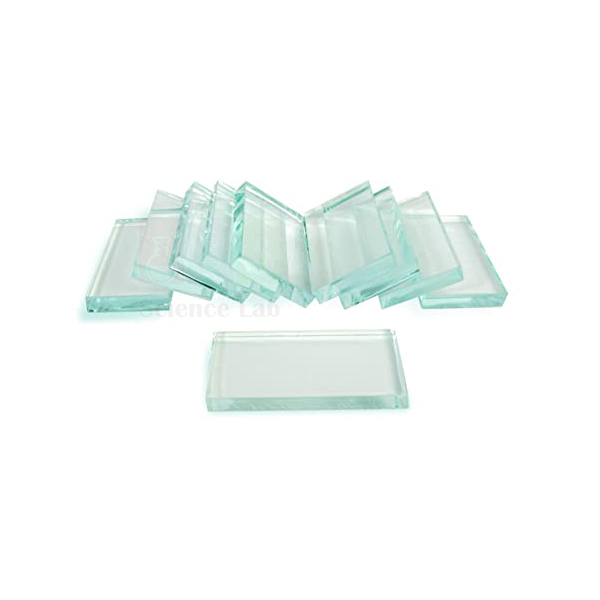
Streak Plates Glass
Streak Plates Glass (Product Code: SLE/GG/22) is a package of 10 clear glass plates, each 6 mm thick, for testing minerals in the classroom. Students try to scratch the plate with each specimen: minerals that cut into the glass are grouped as hard, and those that cannot are grouped as soft, giving a quick first sort before closer identification. The plates suit geography, earth science and geology practicals from middle school to college level. They are supplied by Jain Scientific Equipments Pvt Ltd (ScienceLab), Ambala, as part of its lab consumables range for mineral testing.
Specifications
| Parameter | Detail |
|---|---|
| Material | Glass |
| Colour | Clear |
| Thickness | 6 mm |
| Pack size | Package of 10 |
| Application | Mineral testing — separating hard and soft minerals by scratching the plate |
Typical Use
Lay the plate flat on a bench, hold it steady with one hand kept well away from the test area, and press a sharp point of the mineral firmly across the glass. Then wipe the spot with a finger or cloth: a true scratch remains as a groove, while a line that rubs away is only powder left by a softer mineral. Recording “scratches glass” or “does not scratch glass” for each specimen divides a mixed collection into hard and soft groups in minutes.
Because each package holds 10 plates, one can go to every group so the whole class tests at once. The glass result combines well with scratch tests using a coin or steel nail to narrow a specimen’s position on a hardness scale. Students should wear eye protection, keep the plate flat rather than holding it in the air, and set aside any plate that becomes chipped or heavily scratched.
Supplier
These glass test plates are supplied by Jain Scientific Equipments Private Limited, which operates as ScienceLab from Ambala, Haryana, and equips geography and science laboratories with apparatus and consumables. Orders come from schools, colleges and distributors in India and international markets. Visit our company profile to learn more.
Related Geography Lab Equipment
Buyers of the glass plates often add these items to their mineral testing station:
- Black Streak Plates — unglazed porcelain tiles for checking streak colour.
- Mineral Test Kit — penny, nail, magnet, hardness scale and more for complete identification.
- Expanded Rock Collection — specimens for students to test on the plates.
- Safety Goggles — eye protection while scratching glass.
Explore more in Geography Lab Equipment.
Frequently Asked Questions
How many plates are in a package?
Each package contains 10 clear glass plates.
How thick are the plates?
They are 6 mm thick. Length and width are not listed here, so please ask us if you need the exact dimensions.
Are these used for streak colour or for hardness?
They are used for scratch testing to separate hard and soft minerals. For streak colour, use an unglazed porcelain plate such as our Black Streak Plates.
Are they safe for younger students?
With supervision, yes. Keep the plate flat on the bench, wear eye protection and remove any plate with chipped edges.
Can a scratched plate be reused?
Yes, move to an unmarked area for each new test. Replace the plate once little clean surface remains.
Do you supply multiple packages or export orders?
Yes. Quantities for schools, tenders and distributors in India and international markets can be quoted through our contact page.
Request a Quote
For a price on Streak Plates Glass, message us from the contact page or add the packages you need to the enquiry cart.
Last updated: 24 September 2026