- Physics Lab Equipment
- Chemistry Lab Equipment
- Biology Lab Equipment
- Anatomical Lab Equipment
- Learning
- Educational Lab Equipment
- Magnets
- Agriculture
- Astronomy
- Earth Science
- Geography Lab Equipment
- Safety Lab Coat
- Laboratory
- Meteorological
- Electricity & Magnetism
- Heat
- School Lab Equipment
- Lab Glassware
- Science Lab Equipment
- Tvet Lab Equipment
- Robotics Kits Supplier and Manufacturer for Schools India
- Math Lab Equipment Manufacturers and Exporters in Ambala
- STEM Kits Manufacturers and Supplier India
- Engineering Lab Equipment
- Hospital Lab Equipment
- Water, Sanitation & Hygiene Supplies
- Cold Chain, Solar & Communication Equipment
- Nutrition
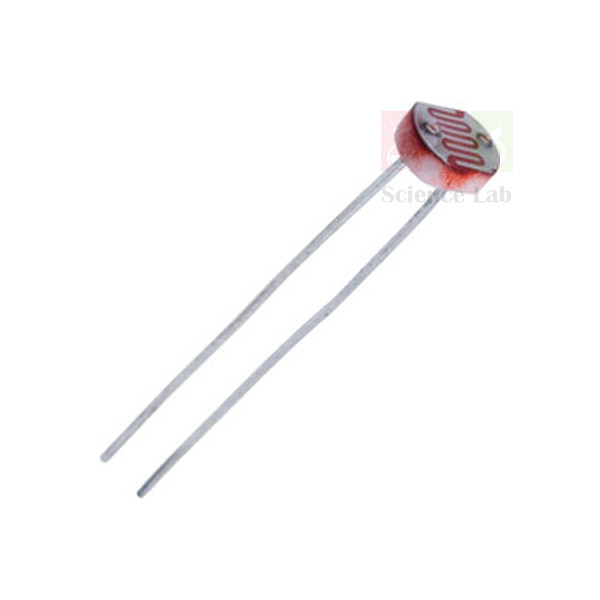
Miniature LDR
Miniature LDR (Product Code: SLE/PHY/65) is a 5 mm light dependent resistor used to sense light levels in physics and electronics experiments, from light-meter circuits to automatic night-lamp projects. Its resistance falls from about 1 MΩ in darkness to 2–4 kΩ at 100 lux, a change large enough to see clearly on a multimeter during physics practical work. It is supplied by Jain Scientific Equipments Pvt Ltd (ScienceLab), Ambala, India.
Specifications
| Parameter | Detail |
|---|---|
| Type | Light Dependent Resistor (LDR) housed in an epoxy package |
| Sensing material | Semiconductor whose conductance changes with luminance |
| Diameter | 5 mm |
| Dark resistance | 1 MΩ |
| Resistance at 10 lux | 10–20 kΩ |
| Resistance at 100 lux | 2–4 kΩ |
| Peak spectral response | 540 nm |
| Max. voltage | 150 V peak, AC or DC |
| Power dissipation | 100 mW |
| Lead pitch | 3 mm |
| Operating temperature | –30 °C to +70 °C |
| Product code | SLE/PHY/65 |
| Supplied by | Jain Scientific Equipments Pvt Ltd (ScienceLab), Ambala, India |
What Is a Miniature LDR Used For?
The simplest investigation connects the LDR to a multimeter on its resistance range and records readings as a lamp is moved closer or a hand shades the sensor; plotting resistance against light level shows how steeply the value falls. In an electronics context the LDR is placed in a potential divider with a fixed resistor, so the changing voltage can switch a transistor, LED or buzzer when it gets dark or bright.
Its peak spectral response at 540 nm lies in the green part of the spectrum, which makes it a good talking point about how sensors and the human eye respond to colour. Keep the power dissipated below 100 mW and the voltage within 150 V peak; in school circuits a series resistor keeps the current low. Solder the leads quickly, or mount the LDR in a component holder to avoid heat damage.
Supplier
Jain Scientific Equipments Private Limited, which trades as ScienceLab, supplies this miniature LDR from Ambala, Haryana, as a component for school and college electronics and physics practicals. It is a sourced semiconductor part rather than an item the company makes, and it can be quoted alongside the meters, holders and leads a sensor practical needs. Company details are on the ScienceLab profile page.
Related Physics Lab Equipment
Items used with the LDR in light-sensing experiments:
- Simple Circuit Module Light Dependent Resistor Board — an LDR already mounted on a board for plug-together circuits.
- LDR — another light dependent resistor listing to compare.
- Digital Multimeter — measures how the LDR’s resistance changes with light.
- Component Holder — holds small components such as the LDR without soldering.
- Crocodile Clips & Leads — clip onto the LDR’s leads for quick connections.
More sensors and meters are in Physics Lab Equipment.
Frequently Asked Questions
What is the resistance range of the Miniature LDR?
The Miniature LDR has a dark resistance of 1 MΩ, falling to 10–20 kΩ at 10 lux and 2–4 kΩ at 100 lux. Its resistance keeps reducing as more light falls on the device.
What are the size and lead spacing of the Miniature LDR?
The Miniature LDR is 5 mm in diameter, housed in an epoxy package, with a lead pitch of 3 mm, which keeps it compact enough for small student circuit layouts.
What are the electrical limits of the Miniature LDR?
The Miniature LDR is rated for a maximum of 150 V peak, AC or DC, and a power dissipation of 100 mW. It operates from –30 °C to +70 °C.
Which light colour does the Miniature LDR respond to most?
The Miniature LDR has its peak spectral response at 540 nm, in the green region of visible light, so it reacts most strongly to green and nearby wavelengths.
Who supplies the Miniature LDR?
Jain Scientific Equipments Pvt Ltd (ScienceLab), Ambala, India, supplies the Miniature LDR (SLE/PHY/65) to schools, colleges and dealers as a sourced electronic component, together with the meters and holders a practical needs.
How should I request a quotation for the Miniature LDR?
For the Miniature LDR, state the quantity, any related items such as multimeters or component holders, and the delivery location through the contact page to receive a single quotation.
Request a Quote
Send your Miniature LDR requirement through the ScienceLab contact page or add it to the enquiry cart. ScienceLab supplies buyers in India and international markets.
Last updated: 24 September 2026