- Physics Lab Equipment
- Chemistry Lab Equipment
- Biology Lab Equipment
- Anatomical Lab Equipment
- Learning
- Educational Lab Equipment
- Magnets
- Agriculture
- Astronomy
- Earth Science
- Geography Lab Equipment
- Safety Lab Coat
- Laboratory
- Meteorological
- Electricity & Magnetism
- Heat
- School Lab Equipment
- Lab Glassware
- Science Lab Equipment
- Tvet Lab Equipment
- Robotics Kits Supplier and Manufacturer for Schools India
- Math Lab Equipment Manufacturers and Exporters in Ambala
- STEM Kits Manufacturers and Supplier India
- Engineering Lab Equipment
- Hospital Lab Equipment
- Water, Sanitation & Hygiene Supplies
- Cold Chain, Solar & Communication Equipment
- Nutrition
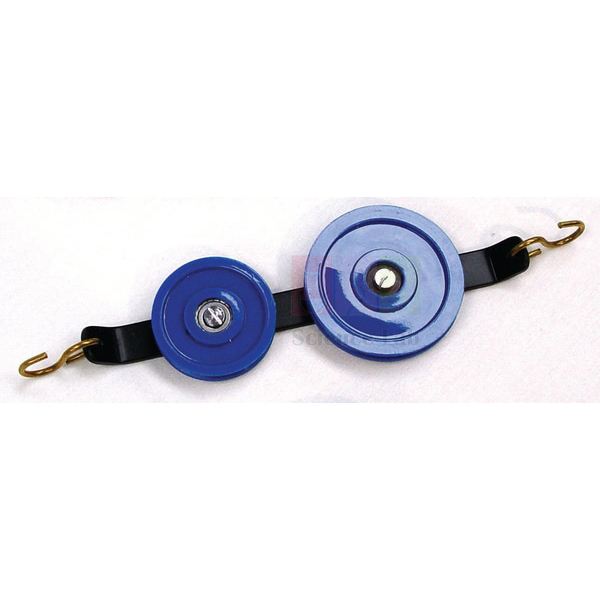
Pulley, Plastic Double, with Ball Bearings
Pulley, Plastic Double, with Ball Bearings (Product Code: SLE/PHY/279) is a double block of in-line plastic pulleys running on ball bearings, used to rig lightweight block-and-tackle systems in school mechanics practicals. Its open-sided frame has a hook at each end and lets students lay the string over the wheels without threading. It is made by Jain Scientific Equipments Pvt Ltd (ScienceLab), an OEM manufacturer, at its own factory in Ambala, India.
Key Details
| Parameter | Detail |
|---|---|
| Material | Plastic pulleys |
| Arrangement | In-line |
| Type | Double |
| Bearings | Ball bearings |
| Frame | Open-sided, with hooks at each end |
| Stringing | Quick and easy; no threading involved |
| Product code | SLE/PHY/279 |
| Manufacturer | Jain Scientific Equipments Pvt Ltd (ScienceLab) — OEM |
| Country of origin | India (made in Ambala, Haryana) |
What Is the Plastic Double Pulley Used For?
Two in-line wheels in one block let students add a second supporting string to a pulley system, and plastic pulleys keep the block light, which matters when the moving block’s own weight would otherwise distort small-load results. Pair it with a single pulley or a second double block, measure effort, load and distance moved, then calculate mechanical advantage and efficiency.
The ball bearings keep friction low, and the open side of the frame means strings are laid in rather than threaded, so a group can switch between arrangements quickly. Wipe the wheels clean, keep them away from heat sources such as burners, and check that each wheel spins freely before the lesson. It is a practical piece of physics lab equipment for school benches.
What to Specify When Ordering
- Number of double blocks, and single pulleys to pair with them.
- Plastic or metal: a metal tandem double pulley is also listed.
- Masses, hangers and spring balances.
- Any wheel-diameter requirement, which we will confirm with the quotation.
OEM Manufacturer
Jain Scientific Equipments Private Limited, trading as ScienceLab, manufactures this plastic double pulley as the OEM at its own licensed factory at Saha, Ambala, Haryana, India. It belongs to a pulley range in plastic and metal that institutions and resellers can source from the maker in a single order. Ask us directly for extra blocks or to match pulleys supplied earlier. The ScienceLab profile has more about the company.
Related Laboratory Equipment
Pulleys and accessories used alongside this block:
- Pulley, Metal, Double — the metal tandem version with 50 mm and 38 mm wheels.
- Pulley, Plastic, Double, Parallel — plastic wheels in parallel on a steel frame.
- Pulley, Plastic, Triple, Parallel — three plastic wheels for larger systems.
- Hangers with Slotted Weights 500 gm — loads for the moving block.
- Force Meter/Spring Balance — measures the effort.
See the Physics Lab Equipment category for the complete pulley range.
Frequently Asked Questions
What is the Pulley, Plastic Double, with Ball Bearings?
The Pulley, Plastic Double, with Ball Bearings is a double pulley block with two in-line plastic pulleys running on ball bearings, held in an open-sided frame with a hook at each end, for pulley-system experiments in school mechanics.
What does in-line mean for this plastic double pulley?
In the Pulley, Plastic Double, with Ball Bearings, in-line means the two plastic pulleys are arranged one after the other along the frame, so each supporting string runs over its own wheel in turn as the system is rigged.
Why is an open-sided frame useful?
The open-sided frame on the Pulley, Plastic Double, with Ball Bearings allows quick and easy stringing because no threading is involved. Students lay the string over each wheel, which saves time when changing pulley arrangements during a lesson.
What diameter are the pulleys?
The wheel diameter of the Pulley, Plastic Double, with Ball Bearings is not stated in this listing. If your experiments need a particular size, ask through our contact page and we will confirm it before you place an order.
Should I choose the plastic or the metal double pulley?
Choose the Pulley, Plastic Double, with Ball Bearings when a light moving block helps small-load experiments; the metal tandem double pulley suits groups that prefer a metal block. Both use ball bearings and an open-sided frame for quick stringing.
Who manufactures the Pulley, Plastic Double, with Ball Bearings?
The Pulley, Plastic Double, with Ball Bearings is manufactured by Jain Scientific Equipments Pvt Ltd (ScienceLab), the OEM, at its own licensed factory at Saha, Ambala, Haryana, India, and quoted directly to schools, colleges, dealers and importers.
Request a Quote
Send your quantity and delivery location for the Pulley, Plastic Double, with Ball Bearings through the contact page, or add it to the enquiry cart. The manufacturer replies with the quotation directly.
Last updated: 24 September 2026