- Physics Lab Equipment
- Chemistry Lab Equipment
- Biology Lab Equipment
- Anatomical Lab Equipment
- Learning
- Educational Lab Equipment
- Magnets
- Agriculture
- Astronomy
- Earth Science
- Geography Lab Equipment
- Safety Lab Coat
- Laboratory
- Meteorological
- Electricity & Magnetism
- Heat
- School Lab Equipment
- Lab Glassware
- Science Lab Equipment
- Tvet Lab Equipment
- Robotics Kits Supplier and Manufacturer for Schools India
- Math Lab Equipment Manufacturers and Exporters in Ambala
- STEM Kits Manufacturers and Supplier India
- Engineering Lab Equipment
- Hospital Lab Equipment
- Water, Sanitation & Hygiene Supplies
- Cold Chain, Solar & Communication Equipment
- Nutrition
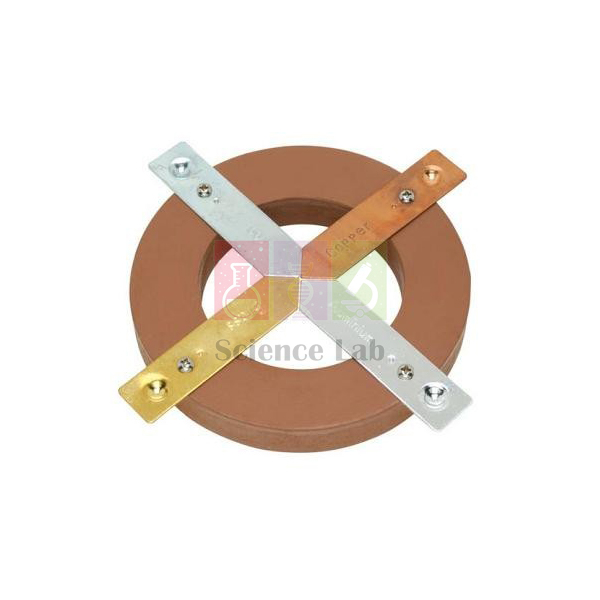
Apparatus Heat/Thermal Conductivity
Apparatus Heat/Thermal Conductivity (Product Code: SLE/PHY/12) is a four-metal comparison ring used to show that different metals conduct heat at different rates in school science and physics labs. Four pointed strips of aluminium, brass, copper and iron meet at the centre of a wooden compound ring, and each carries a small water-holding indentation at its outer end, so the class can watch which drop dries first. It is made by Jain Scientific Equipments Pvt Ltd (ScienceLab), an OEM manufacturer, at its own factory in Ambala, India.
Specifications
| Parameter | Detail |
|---|---|
| Frame | Wood compound ring |
| Metal strips | 4 pointed strips, each of a different metal: aluminium, brass, copper and iron |
| Strip layout | Attached at 90 degrees to each other around the ring, with their points meeting at the centre |
| Outer end of each strip | Indentation for holding water |
| Observation | The water evaporates at different times depending on the conductivity of each metal |
| Product code | SLE/PHY/12 |
| Manufacturer | Jain Scientific Equipments Pvt Ltd (ScienceLab) — OEM |
| Country of origin | India (made in Ambala, Haryana) |
What Is the Thermal Conductivity Apparatus Used For?
The apparatus turns an abstract property into a race. Put an equal drop of water in the indentation at the end of each strip, then warm the centre of the ring where the four points meet, for example over a small spirit-lamp flame. Heat travels outward along each strip at a rate set by its metal, so the drops begin to steam and dry in a clear order. Copper, which conducts heat fastest of the four, usually finishes first and iron last, with aluminium and brass in between.
Because all four strips share one heat source, the comparison is fair without any extra measuring instruments, which makes it a simple heat energy science kit for middle and secondary classes. Let the ring cool before refilling the indentations, and keep the flame under the centre only so the wooden ring is not scorched. Older students can follow up with measured experiments on conduction in rods.
OEM Manufacturer
This thermal conductivity ring is an OEM product of Jain Scientific Equipments Private Limited, the company behind the ScienceLab name. It is produced at the company's licensed factory at Saha, Ambala, Haryana, India, and reaches schools, colleges, dealers and importers directly from the manufacturer, not through a trading house. For institutional vendor registration, the company's details are GSTIN 06AAECJ8618A1ZT and LEI 3358004HRD1JIVXKYX49. Background on the company is on the ScienceLab profile page.
Related Physics Lab Equipment
For a complete lesson sequence on conduction of heat, these items work well alongside the ring:
- Thermal Conductivity Bars — another way to compare how well different materials conduct heat.
- Conductivity of Metal Apparatus — a further conduction experiment for comparing metals.
- Apparatus Conductivity Cam — a related conduction demonstration from the same physics range.
- Glass Spirit Lamp — a small, steady flame for heating the centre of the ring.
Browse all Physics Lab Equipment for more heat and thermodynamics apparatus.
Frequently Asked Questions
What does the Apparatus Heat/Thermal Conductivity show?
The Apparatus Heat/Thermal Conductivity shows that metals conduct heat at different rates. When the centre of the ring is heated, the water held at the end of the aluminium, brass, copper and iron strips evaporates at different times, revealing which metal carries heat fastest.
Which metals are used in the thermal conductivity apparatus?
The thermal conductivity apparatus uses four pointed strips, each made of a different metal: aluminium, brass, copper and iron. They are fixed at 90 degrees to each other around a wood compound ring, with their points meeting at the centre, where heat is applied.
In what order does the water dry on the conductivity ring?
On the Apparatus Heat/Thermal Conductivity, the water at the end of the copper strip usually dries first because copper conducts heat fastest of the four metals, and iron is usually last. Room draughts and uneven drops can change the result, so repeat the test for a fair comparison.
Who manufactures the Apparatus Heat/Thermal Conductivity?
Jain Scientific Equipments Pvt Ltd, trading as ScienceLab, is the OEM manufacturer of the Apparatus Heat/Thermal Conductivity. It is made at the company's own factory in Saha, Ambala, Haryana, India, and supplied direct to schools, colleges, dealers and importers.
What heat source is needed for the thermal conductivity ring?
The Apparatus Heat/Thermal Conductivity needs a small flame, such as a spirit lamp or a low Bunsen flame, placed under the centre where the four metal points meet. The heat source is not part of the apparatus, so order it separately if your lab does not already have one.
Can ScienceLab supply this apparatus for a whole school lab or export order?
Yes. ScienceLab supplies the Apparatus Heat/Thermal Conductivity singly or in quantity for school labs, dealers and importers in India and international markets. Send the required quantity and destination through the contact page to receive a quotation from the manufacturer.
Request a Quote
Ask for a quotation on the Apparatus Heat/Thermal Conductivity through the contact page, or place it in the enquiry cart with the rest of your heat experiments. Quotes are issued directly by the manufacturer, ScienceLab.
Last updated: 24 September 2026