- Physics Lab Equipment
- Chemistry Lab Equipment
- Biology Lab Equipment
- Anatomical Lab Equipment
- Learning
- Educational Lab Equipment
- Magnets
- Agriculture
- Astronomy
- Earth Science
- Geography Lab Equipment
- Safety Lab Coat
- Laboratory
- Meteorological
- Electricity & Magnetism
- Heat
- School Lab Equipment
- Lab Glassware
- Science Lab Equipment
- Tvet Lab Equipment
- Robotics Kits Supplier and Manufacturer for Schools India
- Math Lab Equipment Manufacturers and Exporters in Ambala
- STEM Kits Manufacturers and Supplier India
- Engineering Lab Equipment
- Hospital Lab Equipment
- Water, Sanitation & Hygiene Supplies
- Cold Chain, Solar & Communication Equipment
- Nutrition
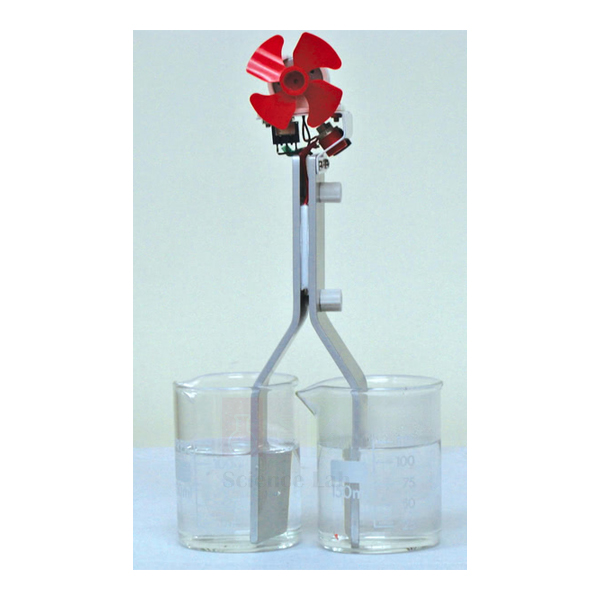
Thermoelectric Converter
Thermoelectric Converter (Product Code: SLE/PHY/310) is a demonstration device used to show that a temperature difference across semiconductor junctions generates electricity, and that electricity can create a temperature difference, in school and college physics lessons. Its semiconducting junction plates sit between two aluminium heat-conducting plates, and a switch connects them either to a small motor fan or to a pair of 4 mm sockets. For heat energy science lessons, it is supplied by Jain Scientific Equipments Pvt Ltd (ScienceLab), Ambala, India.
Key Details
| Parameter | Detail |
|---|---|
| Junctions | Series of semiconducting junction plates |
| Heat-conducting plates | 2 aluminium plates, one on each side of the junctions |
| Visual indicator | Small motor fan driven by the generated current |
| Selector switch | Connects the junction plates to the motor fan or to a pair of 4 mm sockets |
| Reverse (heat-pump) mode | 5 V DC applied at the 4 mm sockets creates a temperature difference, conducted by the aluminium plates |
| Product code | SLE/PHY/310 |
| Supplied by | Jain Scientific Equipments Pvt Ltd (ScienceLab), Ambala, India |
What Is the Thermoelectric Converter Used For?
In generator mode, set the switch to the fan and create a temperature difference between the two aluminium plates, for example by standing one side on a container of warm water and keeping the other cool. Current generated at the semiconductor junctions spins the little fan, a direct and visible example of the Seebeck effect turning heat energy into electrical and then kinetic energy. A larger temperature difference usually gives a livelier fan, which makes a good prompt for discussion.
Switch to the 4 mm sockets and drive them with 5 V DC to reverse the process: the junctions now pump heat, so one plate becomes warmer and the other cooler, which is the Peltier effect used in small electronic coolers. Use only moderate temperatures unless we have confirmed the limits for your unit, and let the plates return to room temperature before touching them.
Supplier
Jain Scientific Equipments Private Limited, which trades as ScienceLab, supplies the Thermoelectric Converter from Ambala, Haryana, India to schools, colleges and dealers in India and international markets. The device is sourced for our heat and energy teaching range, and we confirm its operating details with each quotation. See our company profile for more about the company.
Related Physics Lab Equipment
Items that extend thermoelectric and energy-conversion lessons:
- Thermoelectric Effects Apparatus — a further set-up for studying thermoelectric effects.
- Power Supply Variable — a continuously variable AC or DC source for the heat-pump mode.
- Stackable Leads — 4 mm leads to connect a supply to the sockets.
- Mounted Solar Cell — a contrasting conversion of light energy into electrical energy.
More options are in Physics Lab Equipment.
Frequently Asked Questions
What does the Thermoelectric Converter demonstrate?
The Thermoelectric Converter demonstrates that a temperature difference across semiconducting junction plates produces an electric current, shown by a small motor fan. In reverse, applying 5 V DC to its 4 mm sockets creates a temperature difference across the aluminium plates.
Does the Thermoelectric Converter need a power supply?
The Thermoelectric Converter needs no power supply to run the fan; a temperature difference between the two plates is enough. A 5 V DC supply is needed only when you select the 4 mm sockets to show a temperature difference being created.
What is the switch on the Thermoelectric Converter for?
The switch on the Thermoelectric Converter connects the semiconducting junction plates either to the motor fan, for generating electricity from heat, or to the pair of 4 mm sockets, for driving the junctions with 5 V DC.
What heat sources are safe with the Thermoelectric Converter?
The temperature limits of the Thermoelectric Converter are not listed on this page, so use moderate sources such as warm water and a cool surface. Ask us through the contact page before using hotter sources, and we will confirm what the unit can take.
Who supplies the Thermoelectric Converter?
The Thermoelectric Converter is supplied by Jain Scientific Equipments Pvt Ltd (ScienceLab) of Ambala, Haryana, India, to schools, colleges and dealers in India and international markets. Quotations can include the leads and power supply you need.
Request a Quote
For a quotation on the Thermoelectric Converter, send your quantity and delivery details through our contact page, or add it to the enquiry cart.
Last updated: 24 September 2026