- Physics Lab Equipment
- Chemistry Lab Equipment
- Biology Lab Equipment
- Anatomical Lab Equipment
- Learning
- Educational Lab Equipment
- Magnets
- Agriculture
- Astronomy
- Earth Science
- Geography Lab Equipment
- Safety Lab Coat
- Laboratory
- Meteorological
- Electricity & Magnetism
- Heat
- School Lab Equipment
- Lab Glassware
- Science Lab Equipment
- Tvet Lab Equipment
- Robotics Kits Supplier and Manufacturer for Schools India
- Math Lab Equipment Manufacturers and Exporters in Ambala
- STEM Kits Manufacturers and Supplier India
- Engineering Lab Equipment
- Hospital Lab Equipment
- Water, Sanitation & Hygiene Supplies
- Cold Chain, Solar & Communication Equipment
- Nutrition
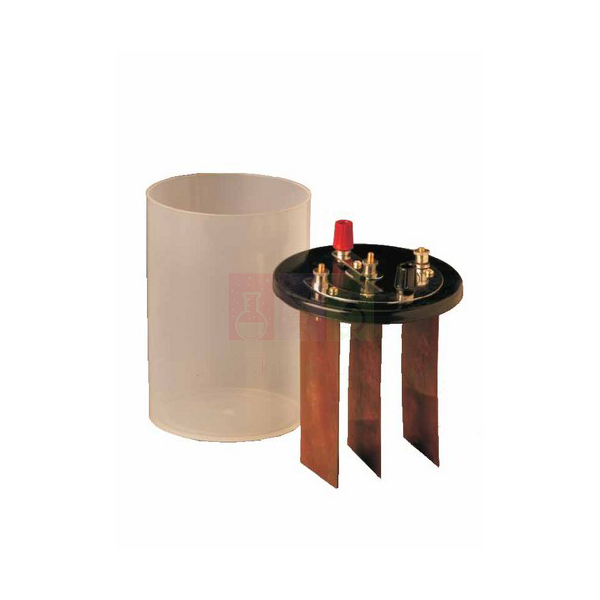
Voltameter, Copper
Voltameter, Copper (Product Code: SLE/EM/27) is an electrolysis cell in which the charge passed is measured by the mass of copper deposited. Three copper plates hang from the bakelite cover of a plastic jar: the two outer plates act together as a double anode, while the inner plate is the cathode and lifts out easily for weighing. Physics and chemistry teachers use it for practicals on Faraday’s laws of electrolysis, making it one of the simpler electrochemistry instruments a school or college lab can own. It is made by Jain Scientific Equipments Pvt Ltd (ScienceLab), Ambala, India.
Specifications
| Parameter | Detail |
|---|---|
| Electrodes | Three copper plates |
| Anode | Two outer plates acting as a double anode, connected to one binding post on top |
| Cathode | Inner copper plate fixed to a second binding post; easily removed for weighing |
| Cover | Bakelite, with the plates suspended from it |
| Vessel | Plastic jar |
Typical Use
To find the electrochemical equivalent of copper, clean and weigh the cathode, fill the jar with copper sulphate solution, and connect the anode and cathode posts to a DC supply through an ammeter, a rheostat and a key. Pass a steady current for a timed interval, then rinse, dry and reweigh the cathode: the gain in mass divided by the charge passed (current × time) gives the result. Because the cathode sits between the two anode plates, copper deposits on both of its faces, which helps give an even coating.
A regulated supply and a rheostat make it easier to hold the current constant during the run. Handle the cathode by its edges once it has been cleaned, dry it thoroughly before each weighing, and rinse all plates after use so that dried electrolyte does not build up on the cover. The same cell can also be used to show that the anode loses copper while the cathode gains it.
Manufacturer
Jain Scientific Equipments Private Limited makes the copper voltameter under its ScienceLab trading name in Ambala, Haryana, as part of an electricity range used by schools and colleges in India and international markets. For company details, visit our profile page.
Related Laboratory Equipment
What you need to run a complete electrolysis practical:
- Cupric Sulphate (Copper Sulphate) — for preparing the electrolyte
- Digital Ammeter — records the current passed through the cell
- Rheostat — keeps the current steady during the timed run
- Precision Variable Power Supply — a regulated DC source for electrolysis
- Electrodes, Copper — separate copper electrodes for other electrolysis set-ups
Visit our Electricity Equipments category for more apparatus.
Frequently Asked Questions
Which plate is the cathode?
The inner copper plate, which is fixed to its own binding post and can be removed easily for weighing. The two outer plates form the double anode.
Is the copper sulphate electrolyte included?
The listing covers the jar, cover and three plates only, so the electrolyte should be ordered or prepared separately — we can quote it with the voltameter.
What experiment is it mainly used for?
Determining the electrochemical equivalent of copper and verifying Faraday’s first law of electrolysis.
What current should be used?
A recommended current is not given in our current listing; contact us and we will advise before you plan the practical.
Why are there two anode plates?
Placing an anode on each side of the cathode lets copper deposit on both faces of the cathode.
How should the plates be looked after?
Rinse them after each use, dry them before storage, and clean the cathode before weighing so that only freshly deposited copper is measured.
Can you supply several voltameters for a practical batch?
Yes. We supply schools, colleges and distributors in India and international markets; send the quantity and delivery location for a quotation.
Request a Quote
For pricing on the Voltameter, Copper, reach us through the contact page or add it to the enquiry cart.
Last updated: 24 September 2026