- Physics Lab Equipment
- Chemistry Lab Equipment
- Biology Lab Equipment
- Anatomical Lab Equipment
- Learning
- Educational Lab Equipment
- Magnets
- Agriculture
- Astronomy
- Earth Science
- Geography Lab Equipment
- Safety Lab Coat
- Laboratory
- Meteorological
- Electricity & Magnetism
- Heat
- School Lab Equipment
- Lab Glassware
- Science Lab Equipment
- Tvet Lab Equipment
- Robotics Kits Supplier and Manufacturer for Schools India
- Math Lab Equipment Manufacturers and Exporters in Ambala
- STEM Kits Manufacturers and Supplier India
- Engineering Lab Equipment
- Hospital Lab Equipment
- Water, Sanitation & Hygiene Supplies
- Cold Chain, Solar & Communication Equipment
- Nutrition
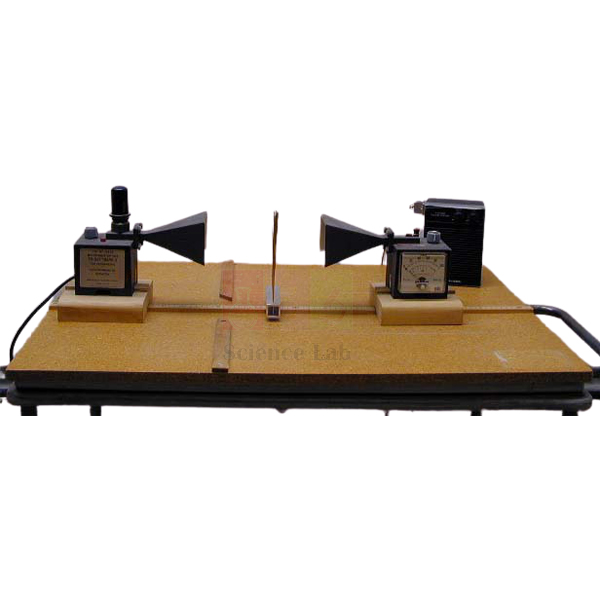
Apparatus Microwave
Apparatus Microwave (Product Code: SLE/PHY/15) is a microwave optics kit used to demonstrate the wave properties of electromagnetic microwaves, namely reflection, polarization, diffraction and interference, in senior school and college physics labs. It pairs a microwave transmitter with a receiver, audio amplifier and loudspeaker, so students hear as well as measure changes in the signal, and it runs from a 12V DC supply. It is supplied by Jain Scientific Equipments Pvt Ltd (ScienceLab), Ambala, India, as a wave motion kit for school and college use.
Specifications
| Parameter | Detail |
|---|---|
| Purpose | Demonstrating wave properties of electromagnetic microwaves for comparison with the behaviour of visible light |
| Effects demonstrated | Reflection, polarization, diffraction, interference |
| Power requirement | 12V DC supply |
| Source and detection | Microwave transmitter; receiver; audio amplifier and loudspeaker |
| Reflectors | Two large aluminium reflectors; one narrow aluminium reflector |
| Other parts | Black hardboard mirror; polarization grille; battery charging lead |
| Documentation | Instruction booklet |
| Product code | SLE/PHY/15 |
| Supplied by | Jain Scientific Equipments Pvt Ltd (ScienceLab), Ambala, India |
What Is the Microwave Apparatus Used For?
Microwaves have wavelengths of a few centimetres, so effects that need a microscope or a laser with visible light can be shown on an ordinary bench. With the transmitter aimed at the receiver, students tilt an aluminium reflector and follow the reflected beam, rotate the polarization grille to make the signal fade and return, send the beam past the narrow reflector to see it spread by diffraction, and set up two paths to produce interference maxima and minima. The loudspeaker makes every change audible to the whole class.
Each result can then be compared directly with the matching experiment in light, which is the main teaching value of the kit. Keep the reflectors flat and clean, work on a clear bench away from metal cupboards that cause stray reflections, and follow the instruction booklet for set-up and safe use. It is a useful piece of physics lab equipment for India's senior-secondary and undergraduate wave-optics topics.
Supplier
Jain Scientific Equipments Private Limited, which trades as ScienceLab, supplies the Apparatus Microwave from Ambala, Haryana, India. The company sources this kit and handles the enquiry, quotation, packing and dispatch for schools, colleges, laboratory dealers and importers. If you need guidance on the contents, the 12V DC supply or items to order alongside it, our team will help — just ask. Read about the company on the ScienceLab profile page.
Related Physics Lab Equipment
These items help extend microwave work or connect it to other wave experiments:
- Microwave Transmitter/Receiver — a separate transmitter and receiver listing; ask us which suits your lab.
- Microwave Accessories Hollow Plano-convex Lens — for refraction and focusing studies; confirm compatibility with us.
- Microwave Accessories Rotating Protractor — helps measure angles in reflection work; confirm compatibility with us.
- Battery Eliminator 12 Volt — a possible bench source; check with us that it matches the kit's 12V DC need.
- Ripple Tank — shows reflection, diffraction and interference with water waves for comparison.
See the wider Physics Lab Equipment range.
Frequently Asked Questions
What experiments can be done with the Apparatus Microwave?
The Apparatus Microwave demonstrates reflection, polarization, diffraction and interference of electromagnetic microwaves. Students compare each result with the behaviour of visible light, using the transmitter, receiver, aluminium reflectors, polarization grille and hardboard mirror supplied in the kit.
What is included in the microwave apparatus kit?
The Apparatus Microwave kit consists of a microwave transmitter, a receiver, an audio amplifier and loudspeaker, two large aluminium reflectors, one narrow aluminium reflector, a black hardboard mirror, a polarization grille, a battery charging lead and an instruction booklet.
What power supply does the Apparatus Microwave need?
The Apparatus Microwave requires a 12V DC supply. The kit includes a battery charging lead, but for the exact connection arrangement and a suitable bench source, ask ScienceLab through the contact page before ordering so the supply matches your laboratory.
Who supplies the Apparatus Microwave?
The Apparatus Microwave is supplied by Jain Scientific Equipments Pvt Ltd (ScienceLab), Ambala, Haryana, India. The company handles quotations, packing and dispatch for schools, colleges, dealers and importers in India and international markets.
Why use microwaves instead of light for wave experiments?
Microwaves have much longer wavelengths than visible light, so with the Apparatus Microwave the spacing of interference maxima and the spreading by diffraction are large enough to find with a receiver on a normal bench. This makes wave behaviour easier to measure and discuss in class.
What should an enquiry for SLE/PHY/15 include?
An enquiry for the Apparatus Microwave, code SLE/PHY/15, should give the number of kits, the delivery location and whether you also need a 12V DC source or microwave accessories. Send it through the ScienceLab contact page or add the kit to the enquiry cart.
Request a Quote
Request a quotation for the Apparatus Microwave via the contact page, or add it to the enquiry cart together with any accessories and power supply you want quoted.
Last updated: 24 September 2026