- Physics Lab Equipment
- Chemistry Lab Equipment
- Biology Lab Equipment
- Anatomical Lab Equipment
- Learning
- Educational Lab Equipment
- Magnets
- Agriculture
- Astronomy
- Earth Science
- Geography Lab Equipment
- Safety Lab Coat
- Laboratory
- Meteorological
- Electricity & Magnetism
- Heat
- School Lab Equipment
- Lab Glassware
- Science Lab Equipment
- Tvet Lab Equipment
- Robotics Kits Supplier and Manufacturer for Schools India
- Math Lab Equipment Manufacturers and Exporters in Ambala
- STEM Kits Manufacturers and Supplier India
- Engineering Lab Equipment
- Hospital Lab Equipment
- Water, Sanitation & Hygiene Supplies
- Cold Chain, Solar & Communication Equipment
- Nutrition
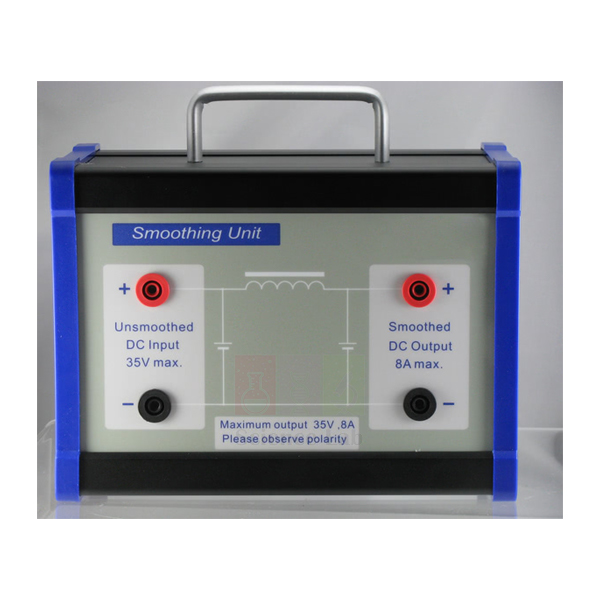
Smoothing Unit
Smoothing Unit (Product Code: SLE/PHY/294) is an LC filter unit used to reduce ripple from non-regulated low-voltage power supplies in school and college laboratories. A toroidal 0.1 H inductor works with a network of 2,200 µF capacitors and diodes to keep the output smooth at currents up to 8 A at 35 V. It is supplied by Jain Scientific Equipments Pvt Ltd (ScienceLab), Ambala, India, as an add-on for the power supply units in a lab.
Specifications
| Parameter | Detail |
|---|---|
| Function | Reduces ripple from non-regulated power supplies |
| Filter components | Toroidal 0.1 H inductor with a network of 2,200 µF capacitors and diodes |
| Input voltage | 0 to 35 V d.c.; absolute maximum 40 V d.c. (d.c. rectified from 28 V a.c.) |
| Current rating | 8 A maximum (up to 8 A at 35 V) |
| Typical ripple | About 1% with a 12 V supply at 3 A |
| Reverse polarity | Works without damage even with reversed polarity |
| Connections | Shrouded sockets accepting standard 4mm plugs and shrouded plugs |
| Dimensions | 208 x 155 x 115 mm (W x H x D); height including handle 187 mm |
| Product code | SLE/PHY/294 |
| Supplied by | Jain Scientific Equipments Pvt Ltd (ScienceLab), Ambala, India |
What Is the Smoothing Unit Used For?
Many school low-voltage supplies deliver rectified but unsmoothed DC, which rises and falls with every mains cycle. Connected between such a supply and the experiment, the Smoothing Unit turns that pulsing output into steady DC, even when the load draws several amperes. That matters for electrolysis, electromagnets, DC motors and any measurement where a fluctuating current would make meter readings jump.
It is also a teaching aid in its own right. Displaying the supply voltage on an oscilloscope before and after the unit shows students exactly what smoothing does, which links neatly with half wave and full wave rectifier kit experiments. Keep the input within 35 V (never above the 40 V absolute maximum), connect with shrouded 4mm leads, and note that an accidental reversal of polarity will not damage the unit.
What to Specify When Ordering
- Number of Smoothing Unit pieces, often one per low-voltage supply.
- The output voltage and current of the power supplies you will smooth, to confirm they are within 35 V and 8 A.
- Whether shrouded 4mm leads or an oscilloscope should be included in the quotation.
Supplier
Jain Scientific Equipments Private Limited, known by its trading name ScienceLab, supplies the Smoothing Unit from Ambala, Haryana, India. Schools, colleges and dealers can order it on its own or with the power supplies and leads it is used with, and we check voltage and current compatibility when preparing the quotation. Visit our profile page to learn more about the company.
Related Physics Lab Equipment
Items that work with the Smoothing Unit:
- Power Supply, Stepped — low-voltage source whose output can be smoothed.
- Power Supply Variable — adjustable supply for circuits that need steady DC.
- Oscilloscope Dual Trace — compares the rippled input with the smoothed output.
- Stackable Leads — 4mm leads for connecting supply, unit and load.
- Power Supply, Smoothed — an alternative when a single supply with smoothed output is preferred.
See more power and circuit items in Physics Lab Equipment.
Frequently Asked Questions
What does the Smoothing Unit do?
The Smoothing Unit reduces ripple from non-regulated power supplies. Its toroidal 0.1 H inductor and network of 2,200 µF capacitors and diodes turn pulsing rectified DC into a steady output, even when high currents are drawn.
What are the voltage and current limits of the Smoothing Unit?
The Smoothing Unit accepts 0 to 35 V d.c. at up to 8 A, with an absolute maximum of 40 V d.c., which corresponds to d.c. rectified from 28 V a.c. Stay within these limits to protect the capacitors and diodes.
How much ripple remains after the Smoothing Unit?
With a 12 V supply delivering 3 A, the Smoothing Unit typically leaves about 1% ripple. The actual figure depends on the supply and the load current, and an oscilloscope shows the result clearly.
Will the Smoothing Unit be damaged if connected the wrong way round?
No, the Smoothing Unit will work without suffering damage even at reverse polarity. This makes it well suited to student use, although correct polarity should still be checked before readings are taken.
What plugs fit the Smoothing Unit?
The Smoothing Unit has shrouded sockets that accept standard 4mm plugs as well as shrouded plugs. It measures 208 x 155 x 115 mm (W x H x D), and 187 mm high including its carrying handle.
Who supplies the Smoothing Unit?
The Smoothing Unit is supplied by Jain Scientific Equipments Pvt Ltd (ScienceLab) of Ambala, Haryana, India. We serve schools, colleges, institutions and dealers in India and international markets, and can quote the unit with suitable power supplies and leads.
Request a Quote
To receive a quotation for the Smoothing Unit, contact us through the contact page or add it to the enquiry cart with your power supplies and leads.
Last updated: 24 September 2026