- Physics Lab Equipment
- Chemistry Lab Equipment
- Biology Lab Equipment
- Anatomical Lab Equipment
- Learning
- Educational Lab Equipment
- Magnets
- Agriculture
- Astronomy
- Earth Science
- Geography Lab Equipment
- Safety Lab Coat
- Laboratory
- Meteorological
- Electricity & Magnetism
- Heat
- School Lab Equipment
- Lab Glassware
- Science Lab Equipment
- Tvet Lab Equipment
- Robotics Kits Supplier and Manufacturer for Schools India
- Math Lab Equipment Manufacturers and Exporters in Ambala
- STEM Kits Manufacturers and Supplier India
- Engineering Lab Equipment
- Hospital Lab Equipment
- Water, Sanitation & Hygiene Supplies
- Cold Chain, Solar & Communication Equipment
- Nutrition
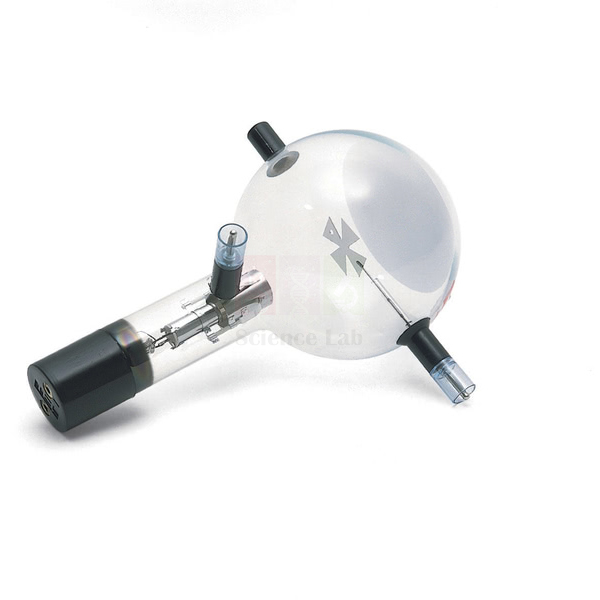
Maltese Cross Tube D
Maltese Cross Tube D (Product Code: SLE/PHY/307) is a high-vacuum electron tube used to show that electrons travel in straight lines, by casting the shadow of a Maltese cross onto a fluorescent screen, in college and senior school physics laboratories. Its divergent electron gun runs at up to 5 kV on the anode, and a magnetic field from Helmholtz coils lets students study electron optics such as beam focusing. A clear physics demonstration for cathode-ray lessons, it is manufactured by Jain Scientific Equipments Pvt Ltd (ScienceLab), Ambala, India.
Specifications
| Parameter | Detail |
|---|---|
| Tube type | High-vacuum electron tube with divergent electron gun |
| Screen | Fluorescent, partially obscured by a Maltese cross |
| Range | D range (connections fixed on the tube) |
| Anode current | Approx. 0.1 mA at 4 kV |
| Max. filament voltage | 6.3 V AC |
| Max. anode voltage | 5 kV |
| Documentation | Instructions included |
| Listed for use with | EHT power supply; Helmholtz coils for magnetic-field experiments |
| Tube family | D type |
| Product code | SLE/PHY/307 |
| Manufacturer | Jain Scientific Equipments Pvt Ltd (ScienceLab), Ambala, India |
What Is the Maltese Cross Tube Used For?
With no electric or magnetic field applied, electrons from the divergent gun travel straight to the fluorescent screen, and the Maltese cross in their path leaves a sharp, cross-shaped shadow. That shadow is the evidence: just as light casts a shadow of an object, the electron stream travels in straight lines. It is one of the first observations students make when they meet cathode rays.
Next, bring in a magnetic field using Helmholtz coils. The shadow shifts and changes, showing that the beam is made of charged particles that respond to a field, and adjusting the field lets the class explore electron optics such as focusing the beam. Darken the room for the clearest image, keep the filament at or below 6.3 V AC and the anode at or below 5 kV, and let a teacher handle all high-voltage connections.
What to Specify When Ordering
- Whether you need the EHT power supply listed for this tube.
- Whether you already own a D-range holder and Helmholtz coils for the magnetic-field experiments.
- The number of tubes for your laboratory.
Manufacturer
Jain Scientific Equipments Private Limited, whose trading name is ScienceLab, manufactures the Maltese Cross Tube D in Ambala, Haryana, India. We manufacture the tube for physics departments in India and international markets and can combine it in one quotation with the supply and coils it works with. Visit our company profile for more about the company.
Related Physics Lab Equipment
Items for the same series of electron-beam demonstrations:
- EHT Power Supply — the high-voltage supply listed for use with this tube.
- Helmholtz Pair of Coils D — magnetic field source for D-range tubes.
- Electron Tube Holder D — mounting for D-range tubes.
- Electron Deflection Tube D — follows on by bending the beam with electric and magnetic fields.
- Electron Diffraction Tube D — contrasts straight-line travel with the wave behaviour of electrons.
Find the full list in Physics Lab Equipment.
Frequently Asked Questions
What does the Maltese Cross Tube D demonstrate?
The Maltese Cross Tube D demonstrates that electrons travel in straight lines when no field is applied, by projecting the shadow of a Maltese cross onto a fluorescent screen. With Helmholtz coils it also shows electron-optics effects such as beam focusing.
What are the operating voltages of the Maltese Cross Tube D?
The Maltese Cross Tube D has a maximum filament voltage of 6.3 V AC and a maximum anode voltage of 5 kV, with an anode current of approximately 0.1 mA at 4 kV. Use a supply that stays within these limits.
Which power supply does the Maltese Cross Tube D need?
An EHT power supply is listed as the other equipment for use with the Maltese Cross Tube D. Tell us which supply your lab already owns and we will confirm whether it suits the tube before you order.
Can the Maltese Cross Tube D show magnetic effects?
Yes. Applying a magnetic field with Helmholtz coils to the Maltese Cross Tube D moves and reshapes the shadow, so students can study how a field acts on the electron beam and explore beam focusing.
Are instructions supplied with the Maltese Cross Tube D?
Yes, instructions are included with the Maltese Cross Tube D. They help the teacher set up the tube, connect the supplies safely and run the shadow and magnetic-field demonstrations with a class.
Who manufactures the Maltese Cross Tube D?
The Maltese Cross Tube D is manufactured by Jain Scientific Equipments Pvt Ltd (ScienceLab) of Ambala, India, for institutions in India and international markets.
Request a Quote
For a quotation on the Maltese Cross Tube D and any accessories, contact us through our contact page or add it to the enquiry cart.
Last updated: 20 November 2026