- Physics Lab Equipment
- Chemistry Lab Equipment
- Biology Lab Equipment
- Anatomical Lab Equipment
- Learning
- Educational Lab Equipment
- Magnets
- Agriculture
- Astronomy
- Earth Science
- Geography Lab Equipment
- Safety Lab Coat
- Laboratory
- Meteorological
- Electricity & Magnetism
- Heat
- School Lab Equipment
- Lab Glassware
- Science Lab Equipment
- Tvet Lab Equipment
- Robotics Kits Supplier and Manufacturer for Schools India
- Math Lab Equipment Manufacturers and Exporters in Ambala
- STEM Kits Manufacturers and Supplier India
- Engineering Lab Equipment
- Hospital Lab Equipment
- Water, Sanitation & Hygiene Supplies
- Cold Chain, Solar & Communication Equipment
- Nutrition
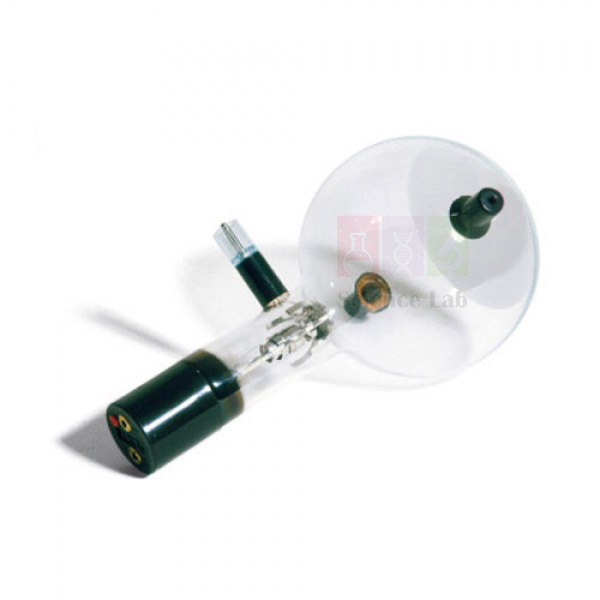
Teltron Electron Diffraction Tube D
Teltron Electron Diffraction Tube D (Product Code: SLE/PHY/46) is a highly evacuated electron tube used to demonstrate the wave nature of electrons by diffraction through a polycrystalline graphite lattice in physics laboratories. The resulting rings appear on a fluorescent screen, and from their radii students determine the electron wavelength as a function of anode voltage, confirming de Broglie's hypothesis. It is supplied by Jain Scientific Equipments Pvt Ltd (ScienceLab), Ambala, India.
Specifications
| Parameter | Detail |
|---|---|
| Tube type | Highly evacuated, with polycrystalline graphite lattice and fluorescent screen |
| Diffraction pattern | Debye–Scherrer rings |
| Max. filament voltage | 6.3 V AC |
| Max. anode voltage | 5 kV |
| Anode current | Approx. 0.1 mA at 4 kV |
| Graphite lattice constants | d10 = 0.213 nm; d11 = 0.123 nm |
| Documentation | Instructions included |
| Product code | SLE/PHY/46 |
| Supplied by | Jain Scientific Equipments Pvt Ltd (ScienceLab), Ambala, India |
What Is the Electron Diffraction Tube Used For?
The Teltron Electron Diffraction Tube D gives one of the most direct demonstrations of wave–particle duality. Electrons accelerated by the anode pass through polycrystalline graphite and interfere, forming concentric Debye–Scherrer rings on the screen; as the anode voltage rises, the electron wavelength shortens and the rings visibly shrink.
Students record the ring radii at a series of anode voltages, then use the graphite lattice plane spacings of 0.213 nm and 0.123 nm to calculate the wavelength and compare it with the de Broglie prediction. As physics lab equipment for undergraduate modern physics courses in India, the rings are easiest to read in a darkened room with a supply able to reach 5 kV.
Supplier
ScienceLab (Jain Scientific Equipments Private Limited) supplies the Teltron Electron Diffraction Tube D from Ambala, Haryana, India. Teltron is a third-party brand; the company sources the tube and can quote it together with a D-series holder and a suitable high-voltage supply. Learn more on our company profile.
Related Physics Lab Equipment
Items that complete or extend a diffraction practical with the Teltron Electron Diffraction Tube D:
- Teltron Tube Holder D — holder for the Teltron D-series tubes.
- EHT Power Supply — adjustable 5 kV output with an auxiliary heater output.
- Teltron Electron Deflection Tube D — shows the particle side of the electron through e/m measurement.
- Teltron Electron Diffraction Tube S — the S-series version of the same experiment.
- Planck's Constant Apparatus — photoelectric experiment for the same quantum physics unit.
See the full Physics Lab Equipment category.
Frequently Asked Questions
What does the Teltron Electron Diffraction Tube D demonstrate?
The Teltron Electron Diffraction Tube D demonstrates the wave nature of electrons. Electrons passing through polycrystalline graphite produce Debye–Scherrer diffraction rings on a fluorescent screen, which lets students confirm de Broglie's hypothesis experimentally.
Which values are needed to calculate the electron wavelength?
With the Teltron Electron Diffraction Tube D you measure the ring radii and use the graphite lattice constants d10 = 0.213 nm and d11 = 0.123 nm. Repeating the measurement at several anode voltages shows how the wavelength depends on voltage.
What power supply does the Teltron Electron Diffraction Tube D need?
The Teltron Electron Diffraction Tube D needs a filament supply of up to 6.3 V AC and an anode supply of up to 5 kV; the anode current is approx. 0.1 mA at 4 kV. Ask us to include a suitable supply in your quotation.
Are instructions included with the Teltron Electron Diffraction Tube D?
Yes, the Teltron Electron Diffraction Tube D is supplied with instructions. Read them before first use, paying particular attention to the voltage limits, and keep them with the tube for future classes.
How should the Teltron Electron Diffraction Tube D be stored?
Store the Teltron Electron Diffraction Tube D in padded packaging, away from knocks and heat, and carry it with both hands. Never operate an evacuated tube whose glass is cracked or chipped; set it aside and contact us for advice.
Who supplies the Teltron Electron Diffraction Tube D?
The Teltron Electron Diffraction Tube D is supplied by Jain Scientific Equipments Pvt Ltd (ScienceLab), Ambala, India. As Teltron is a third-party brand, the company sources the tube for colleges, universities and schools in India and international markets.
Request a Quote
Tell us how many Teltron Electron Diffraction Tube D units you need through the contact page, or add them with a holder and power supply to the enquiry cart.
Last updated: 24 September 2026