- Physics Lab Equipment
- Chemistry Lab Equipment
- Biology Lab Equipment
- Anatomical Lab Equipment
- Learning
- Educational Lab Equipment
- Magnets
- Agriculture
- Astronomy
- Earth Science
- Geography Lab Equipment
- Safety Lab Coat
- Laboratory
- Meteorological
- Electricity & Magnetism
- Heat
- School Lab Equipment
- Lab Glassware
- Science Lab Equipment
- Tvet Lab Equipment
- Robotics Kits Supplier and Manufacturer for Schools India
- Math Lab Equipment Manufacturers and Exporters in Ambala
- STEM Kits Manufacturers and Supplier India
- Engineering Lab Equipment
- Hospital Lab Equipment
- Water, Sanitation & Hygiene Supplies
- Cold Chain, Solar & Communication Equipment
- Nutrition
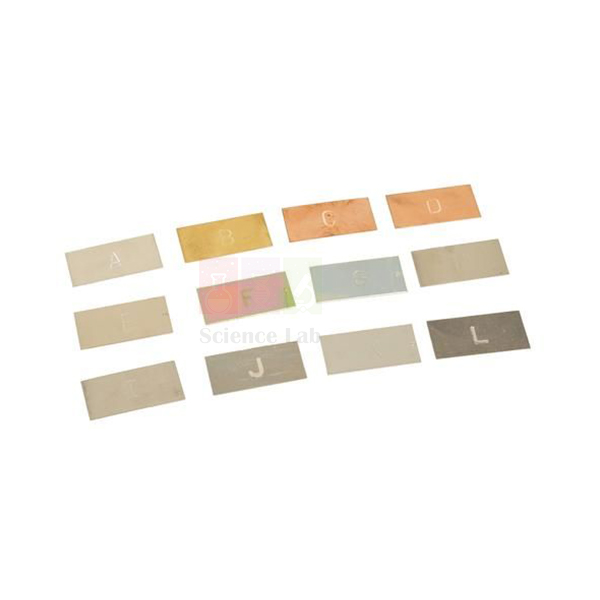
Metal Testing Strips
Metal Testing Strips (Product Code: SLE/PHY/244) is a set of twelve lettered metal strips used to test which metals and alloys are attracted by a magnet in school and college magnetism experiments. This compact magnetism experiment kit mixes magnetic and non-magnetic samples, and each 50 x 25 mm strip carries a stamped key letter for easy identification. It is made by Jain Scientific Equipments Pvt Ltd (ScienceLab), an OEM manufacturer, at its own factory in Ambala, India.
Specifications
| Parameter | Detail |
|---|---|
| Number of strips | 12 |
| Strip size | 50 x 25 mm |
| Identification | Each strip stamped with a key letter |
| Purpose | Magnetism experiments; set contains magnetic and non-magnetic metals |
| Strip A | Soft aluminium |
| Strip B | Brass |
| Strip C | Copper |
| Strip D | Mild steel |
| Strip E | Magnetic stainless steel |
| Strip F | Non-magnetic stainless steel |
| Strip G | Galvanised steel |
| Strip H | Hard aluminium |
| Strip I | Phosphor bronze |
| Strip J | Nickel silver |
| Strip K | Zinc-plated mild steel |
| Strip L | Zinc |
| Product code | SLE/PHY/244 |
| Manufacturer | Jain Scientific Equipments Pvt Ltd (ScienceLab) — OEM |
| Country of origin | India (made in Ambala, Haryana) |
What Are Metal Testing Strips Used For?
Students bring a bar magnet up to each strip in turn and record, by key letter, whether it is attracted strongly, weakly or not at all. Because the key is a letter rather than a printed name, the activity works as a genuine test: learners predict first, then check against the teacher's list from A to L. The set includes instructive pairs, such as magnetic and non-magnetic stainless steel or galvanised and zinc-plated mild steel, so students see that appearance alone does not reveal magnetic behaviour.
The strips also support follow-on work, such as checking whether a zinc coating changes the result or using the brass, copper, phosphor bronze and nickel silver strips to show that many everyday alloys are non-magnetic. Keep the strips dry, and store them away from strong magnets so the steel samples do not stay magnetised between lessons.
What to Specify When Ordering
- The number of sets, usually one per student group.
- Whether magnets should be quoted with the strips, as the listing does not mention one.
- Whether you also want the Metal Discs – Set of 8 for metal-identification lessons.
OEM Manufacturer
Jain Scientific Equipments Private Limited, known to customers as ScienceLab, makes the Metal Testing Strips as an OEM (original equipment manufacturer) at its own licensed factory in Saha, Ambala, Haryana, India. Buying from the maker means schools, colleges, dealers and importers deal with the company that produces the set, and questions about replacement strips or extra sets are answered directly — just ask us. Quotations are issued by the manufacturer, and more about the company appears on the ScienceLab profile.
Related Physics Lab Equipment
These items complete a magnetism practical built around the strips:
- Steel Horseshoe Magnet — a magnet for testing each strip.
- Magnet Set of 4 — several magnets so groups can test at the same time.
- Compass Plotting (Clear) — checks whether a steel strip has become magnetised.
- Metal Discs – Set of 8 — name-stamped discs for metal identification.
- Metal Strips Set — an alternative set of metal samples.
Find more magnetism and electricity apparatus in the Physics Lab Equipment category.
Frequently Asked Questions
Which metals are in the Metal Testing Strips set?
The Metal Testing Strips set contains twelve strips: A soft aluminium, B brass, C copper, D mild steel, E magnetic stainless steel, F non-magnetic stainless steel, G galvanised steel, H hard aluminium, I phosphor bronze, J nickel silver, K zinc-plated mild steel and L zinc.
How are the Metal Testing Strips identified?
Each of the Metal Testing Strips is stamped with a key letter from A to L instead of the metal name. Students can therefore predict and test first, then check their results against the teacher's key, which keeps the magnetism activity a genuine investigation.
What size are the Metal Testing Strips?
Every strip in the Metal Testing Strips set measures 50 x 25 mm. The equal size keeps comparisons fair, so differences in how strongly each strip is attracted come from the metal itself rather than from the shape of the sample.
Who manufactures the Metal Testing Strips?
The Metal Testing Strips are manufactured by Jain Scientific Equipments Pvt Ltd (ScienceLab), an OEM manufacturer with its own licensed factory at Saha, Ambala, Haryana, India. The company supplies the set factory-direct to schools, colleges, dealers and importers in India and international markets.
Are magnets included with the Metal Testing Strips?
The listing for the Metal Testing Strips describes the twelve strips only and does not mention a magnet. If you need magnets for the experiment, add them to your enquiry and ScienceLab can quote suitable magnets from its range together with the strips.
What should a quotation request for the Metal Testing Strips include?
A quotation request for the Metal Testing Strips should give the number of sets, any magnets or related items you need, and your delivery location. The quotation then comes directly from ScienceLab as the manufacturer, covering the complete order.
Request a Quote
Request a manufacturer-direct quote for the Metal Testing Strips (SLE/PHY/244) through the ScienceLab contact page, or add the set to the enquiry cart with your other magnetism items.
Last updated: 24 September 2026