- Physics Lab Equipment
- Chemistry Lab Equipment
- Biology Lab Equipment
- Anatomical Lab Equipment
- Learning
- Educational Lab Equipment
- Magnets
- Agriculture
- Astronomy
- Earth Science
- Geography Lab Equipment
- Safety Lab Coat
- Laboratory
- Meteorological
- Electricity & Magnetism
- Heat
- School Lab Equipment
- Lab Glassware
- Science Lab Equipment
- Tvet Lab Equipment
- Robotics Kits Supplier and Manufacturer for Schools India
- Math Lab Equipment Manufacturers and Exporters in Ambala
- STEM Kits Manufacturers and Supplier India
- Engineering Lab Equipment
- Hospital Lab Equipment
- Water, Sanitation & Hygiene Supplies
- Cold Chain, Solar & Communication Equipment
- Nutrition
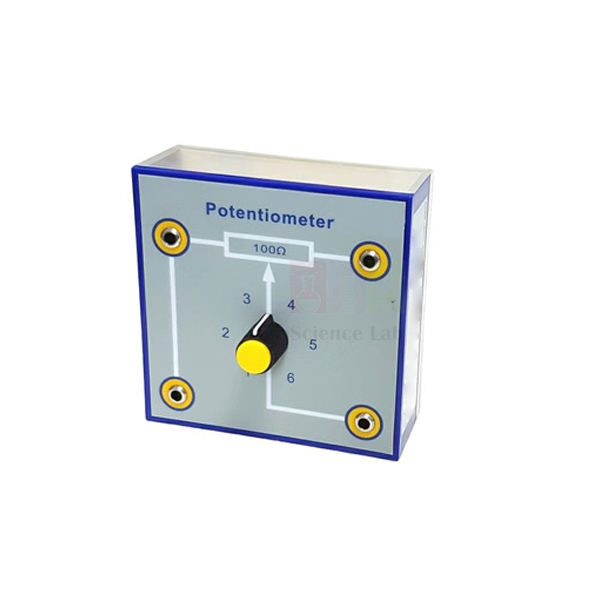
Potentiometer Module
Potentiometer Module (Product Code: SLE/PHY/271) is a rotary linear potentiometer mounted on a channel box, used as a variable resistor or voltage divider in student electricity practicals. This listing is the 100 Ω value, with connections made to 4 mm sockets and a fast-blow fuse that protects the module when students connect it wrongly. It is supplied by Jain Scientific Equipments Pvt Ltd (ScienceLab), Ambala, India.
Specifications
| Parameter | Detail |
|---|---|
| Component | Rotary linear potentiometer |
| Mounting | Channel box |
| Resistance value | 100 Ω (a choice of values is offered) |
| Connections | 4 mm sockets |
| Protection | Fast-blow fuse against wrong connection by students |
| Product code | SLE/PHY/271 |
| Supplied by | Jain Scientific Equipments Pvt Ltd (ScienceLab), Ambala, India |
What Is the Potentiometer Module Used For?
A potentiometer has a resistive track and a moving wiper. Connected across a supply, it works as a voltage divider that gives a smoothly adjustable output for lamp-brightness, motor-speed or diode-characteristic experiments; used with one end of the track and the wiper only, it becomes a simple variable resistor for setting the current in a series circuit. That flexibility makes the module a useful part of an Ohm law experiment kit.
The linear track means equal turns of the knob give roughly equal changes in resistance, which helps students plot tidy graphs. The 100 Ω value suits low-resistance circuits in which a larger current must flow; for finer control at lower currents, compare the 1 kΩ module. If the module stops responding after a wiring mistake, the fast-blow fuse is the first thing to check.
What to Specify When Ordering
- Resistance value: this listing is 100 Ω; the 1 kΩ Potentiometer Module is a separate item.
- Number of modules per bench or student group.
- 4 mm leads, meters or a power supply, if they should be quoted together.
Supplier
ScienceLab is the trading name of Jain Scientific Equipments Private Limited, which supplies the Potentiometer Module from Ambala, Haryana, India. The company sources this channel-box module with the rest of its electricity apparatus and quotes it to schools, colleges, dealers and importers in India and international markets. Follow-up orders for extra modules or a different resistance value can be requested from us directly. Read more on the ScienceLab profile page.
Related Physics Lab Equipment
Items that are wired up with the potentiometer module:
- Potentiometer Module, 1 Kohm — the higher-resistance version for finer current control.
- Stackable Leads — plug leads for the module’s 4 mm sockets.
- Power Supply, Stepped — a low-voltage source for voltage-divider circuits.
- Ammeter Voltmeter — reads the current and voltage the potentiometer sets.
- Standard Digital Multimeter — checks resistance between the terminals.
See the complete Physics Lab Equipment range for more circuit apparatus.
Frequently Asked Questions
What resistance value is the Potentiometer Module?
The Potentiometer Module listed here has a value of 100 Ω. The original listing notes that a choice of values is available, and a 1 kΩ Potentiometer Module is listed separately, so state the value you need when you ask for a quotation.
How is the Potentiometer Module connected into a circuit?
The Potentiometer Module is connected through 4 mm sockets on its channel box, so standard 4 mm plug leads push straight in. Students can add the potentiometer to a bench circuit quickly and remove it again cleanly at the end of the practical.
What protects the Potentiometer Module from wrong connections?
The Potentiometer Module has a fast-blow fuse that protects it against wrong connections by students. If a short circuit or excessive current occurs, the fuse opens the circuit quickly, helping to protect the potentiometer during a busy practical class.
Is the Potentiometer Module linear or logarithmic?
The Potentiometer Module uses a rotary linear potentiometer. On a linear track, resistance changes in proportion to how far the knob is turned, which makes readings easier to predict and graph than with a logarithmic, audio-taper potentiometer.
What current can the Potentiometer Module carry?
A power or current rating for the Potentiometer Module is not stated in this listing. Before using it in higher-current circuits, send your circuit details through our contact page and we will advise whether the 100 Ω module is suitable.
Who supplies the Potentiometer Module?
The Potentiometer Module is supplied by Jain Scientific Equipments Pvt Ltd (ScienceLab) from Ambala, Haryana, India. The company sources the module and quotes it for schools, colleges, dealers and importers, together with leads, meters and power supplies where needed.
Request a Quote
Send the resistance value, quantity and delivery location for the Potentiometer Module through our contact page, or add it to the enquiry cart with the leads and meters you need.
Last updated: 24 September 2026