- Physics Lab Equipment
- Chemistry Lab Equipment
- Biology Lab Equipment
- Anatomical Lab Equipment
- Learning
- Educational Lab Equipment
- Magnets
- Agriculture
- Astronomy
- Earth Science
- Geography Lab Equipment
- Safety Lab Coat
- Laboratory
- Meteorological
- Electricity & Magnetism
- Heat
- School Lab Equipment
- Lab Glassware
- Science Lab Equipment
- Tvet Lab Equipment
- Robotics Kits Supplier and Manufacturer for Schools India
- Math Lab Equipment Manufacturers and Exporters in Ambala
- STEM Kits Manufacturers and Supplier India
- Engineering Lab Equipment
- Hospital Lab Equipment
- Water, Sanitation & Hygiene Supplies
- Cold Chain, Solar & Communication Equipment
- Nutrition
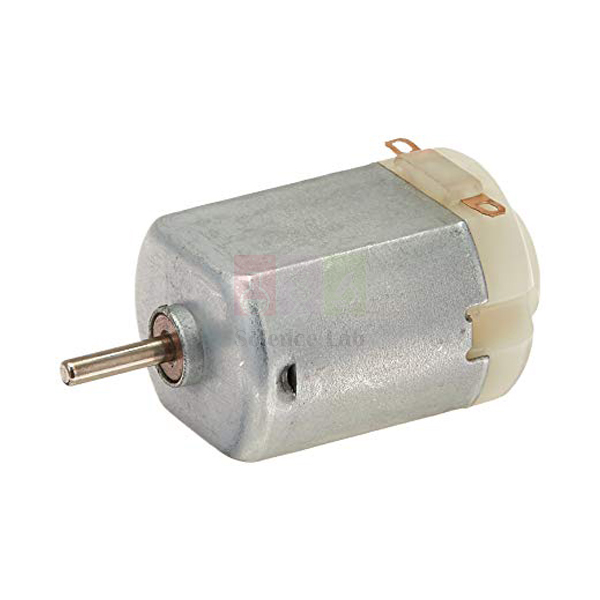
Electric Motor
Electric Motor (Product Code: SLE/PHY/73) is a miniature DC motor used to drive models, robotics projects and educational demonstration equipment in school and college labs. It runs on 1.5 to 4.5 V DC, has a 20 mm body with two flat sides for mounting on a PCB, and uses solder tag terminals. It is supplied by Jain Scientific Equipments Pvt Ltd (ScienceLab), Ambala, India, for STEM projects, science models and physics practicals.
Specifications
| Parameter | Detail |
|---|---|
| Type | Miniature DC motor |
| Operating voltage | 1.5 to 4.5 V DC |
| Body diameter | 20 mm |
| Width across flats | 15 mm |
| Shaft length | 9 mm |
| Shaft diameter | 2 mm |
| Weight | Approx. 17 g |
| Termination | Solder tags |
| Rotation | Counter-clockwise when viewed from the shaft end |
| Mounting | Two flat sides, suited to mounting on a PCB |
| Product code | SLE/PHY/73 |
| Supplied by | Jain Scientific Equipments Pvt Ltd (ScienceLab), Ambala, India |
What Is the Miniature Electric Motor Used For?
Connected to one, two or three 1.5 V cells, the motor shows electrical energy being turned into movement, and students can hear and see its speed rise as cells are added. In science model kit school project work it spins propellers, fan blades and wheels for model cars, windmills and simple robots, and it is a common part in STEM science kit builds.
Swapping the two supply connections reverses the rotation, a quick way to show that current direction affects motion. Solder leads to the tags quickly so the terminals do not overheat, or use crocodile leads for temporary circuits. The 2 mm shaft takes small push-fit pulleys and propellers, and the flat sides help it sit square on a board or panel.
What to Specify When Ordering
- Number of motors needed for the class or project batch
- Whether you prefer a loose motor or a mounted unit such as the Mini Motor Unit
- Cells, holders or leads to be quoted with the motors
Supplier
This miniature motor is a bought-in component that Jain Scientific Equipments Private Limited, trading as ScienceLab, supplies with its school physics range. Teachers and dealers can combine it with circuit parts and demonstration apparatus in one enquiry. See the company profile for background on ScienceLab in Ambala.
Related Physics Lab Equipment
Items that pair with the motor in energy and motion lessons:
- Simple Circuit Module Motor — a motor on a module board for plug-together circuits
- Mini Motor Unit — a mounted motor option for bench use
- Mounted Motor for Solar Cell — for solar energy demonstrations
- Demonstration, Electric Motor — shows the motor principle at teacher-demonstration scale
- Crocodile Clips & Leads — to connect the solder tags without soldering
Find more in Physics Lab Equipment.
Frequently Asked Questions
What voltage does the Electric Motor need?
The Electric Motor operates on 1.5 to 4.5 V DC, so it runs from a single 1.5 V cell up to three cells in series. Running it above 4.5 V is outside the listed operating range and can overheat the motor.
What are the dimensions of the Electric Motor?
The Electric Motor has a 20 mm body diameter, measures 15 mm across its two flats, has a 9 mm long shaft of 2 mm diameter and weighs approximately 17 g, which keeps it light enough for small models and robots.
Which way does the Electric Motor rotate?
Viewed from the shaft end, the Electric Motor rotates counter-clockwise as listed. As with other DC motors, swapping the two supply connections reverses the direction, which students can use to show how current direction changes the motion.
How is the Electric Motor connected and mounted?
The Electric Motor has solder tag terminals for wire connections and two flat sides that let it sit on a PCB or flat panel. Solder leads quickly to avoid heating the tags, or clip crocodile leads on for temporary classroom circuits.
Who supplies the Electric Motor?
The Electric Motor is supplied by Jain Scientific Equipments Pvt Ltd (ScienceLab), Ambala, Haryana, India. It is a sourced miniature DC motor that the company provides with its physics and STEM items for schools, colleges and dealers.
Can schools order the Electric Motor in quantity?
Yes, the Electric Motor can be ordered in quantity for class projects, workshops and dealer stock, for delivery in India and international markets. Send the number of motors and your location through the enquiry cart or contact page for a quotation.
Request a Quote
For a price on the Electric Motor, use the contact page or place it in the enquiry cart along with any cells and leads you need.
Last updated: 24 September 2026