- Physics Lab Equipment
- Chemistry Lab Equipment
- Biology Lab Equipment
- Anatomical Lab Equipment
- Learning
- Educational Lab Equipment
- Magnets
- Agriculture
- Astronomy
- Earth Science
- Geography Lab Equipment
- Safety Lab Coat
- Laboratory
- Meteorological
- Electricity & Magnetism
- Heat
- School Lab Equipment
- Lab Glassware
- Science Lab Equipment
- Tvet Lab Equipment
- Robotics Kits Supplier and Manufacturer for Schools India
- Math Lab Equipment Manufacturers and Exporters in Ambala
- STEM Kits Manufacturers and Supplier India
- Engineering Lab Equipment
- Hospital Lab Equipment
- Water, Sanitation & Hygiene Supplies
- Cold Chain, Solar & Communication Equipment
- Nutrition
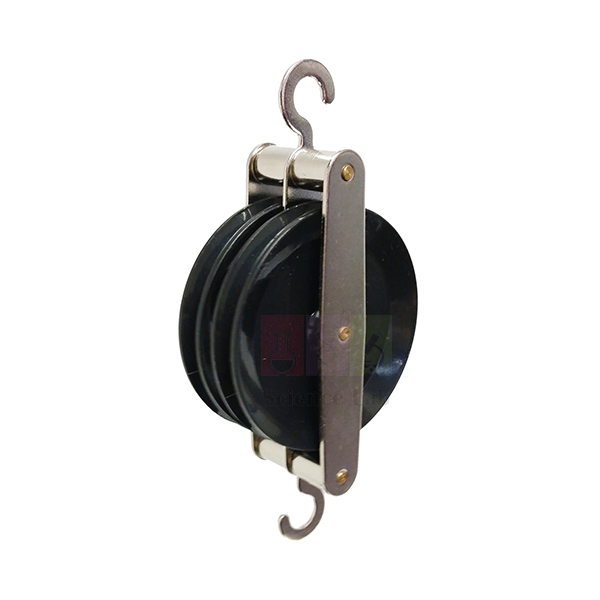
Pulley, Plastic, Double, Parallel
Pulley, Plastic, Double, Parallel (Product Code: SLE/PHY/280) is a pair of 50 mm plastic pulleys mounted in parallel on a steel frame, used to build compound pulley systems in school and college mechanics labs. The frame has a hook at each end, measures 8.9 cm overall and is capable of holding over 13 kg, which gives a good margin for classroom loads. It is made by Jain Scientific Equipments Pvt Ltd (ScienceLab), an OEM manufacturer, at its own factory in Ambala, India.
Specifications
| Parameter | Detail |
|---|---|
| Type | Double, parallel |
| Pulleys | Two, plastic, 50 mm diameter |
| Frame | Steel, with hooks at each end |
| Overall length | 8.9 cm |
| Load capacity | Capable of holding over 13 kg |
| Inner gap of pulley | 4 mm |
| Product code | SLE/PHY/280 |
| Manufacturer | Jain Scientific Equipments Pvt Ltd (ScienceLab) — OEM |
| Country of origin | India (made in Ambala, Haryana) |
What Is the Plastic Parallel Double Pulley Used For?
The block combines light plastic wheels with a strong steel frame, so it can serve as either the fixed or the moving block in a block and tackle. Two of them give four supporting strings; paired with a single pulley they give three. Students measure the effort with a spring balance, compare it with the load and work out mechanical advantage, velocity ratio and efficiency for each arrangement in their pulley system lab work.
The 4 mm inner gap of each pulley suits laboratory string or thin cord, while thicker cord may bind in the groove. The rated capacity of over 13 kg means the block copes comfortably with the slotted masses used in school practicals. Hang the upper block from a rigid support, keep the strings parallel and untwisted, and add masses gradually.
What to Specify When Ordering
- Number of blocks per group; two blocks give a four-string system.
- String or cord that fits the 4 mm pulley gap.
- Masses, hangers and spring balances to be quoted with the pulleys.
OEM Manufacturer
ScienceLab is the trading name of Jain Scientific Equipments Private Limited, the OEM that makes this plastic parallel double pulley at its own licensed factory at Saha, Ambala, Haryana, India. The company is a registered MSME enterprise with manufacturing as its major activity (Udyam UDYAM-HR-01-0003714), and it ships export orders under Importer-Exporter Code AAECJ8618A issued by the DGFT. Schools, colleges, dealers and importers receive quotations straight from the manufacturer. See our company profile.
Related Laboratory Equipment
Blocks and accessories that complete a pulley experiment:
- Pulley, Plastic, Triple, Parallel — three plastic wheels for larger systems.
- Pulley, Metal, Double, Parallel — the metal version with two 50 mm wheels.
- Pulley, Plastic Double, with Ball Bearings — in-line plastic pulleys in an open-sided frame.
- Slotted Mass Hanger, 1kg — loads for the moving block.
- Spring Balance, Tubular — reads the effort.
The complete range is in the Physics Lab Equipment category.
Frequently Asked Questions
What load can the Pulley, Plastic, Double, Parallel hold?
The Pulley, Plastic, Double, Parallel is capable of holding over 13 kg, thanks to its steel frame. That comfortably covers the slotted masses normally used in school and college pulley experiments.
What are the dimensions of the plastic parallel double pulley?
The Pulley, Plastic, Double, Parallel has two plastic pulleys of 50 mm diameter, an overall length of 8.9 cm and an inner pulley gap of 4 mm, with a hook at each end of its steel frame.
What string fits the Pulley, Plastic, Double, Parallel?
Each pulley of the Pulley, Plastic, Double, Parallel has a 4 mm inner gap, so choose laboratory string or cord thinner than 4 mm. Thicker cord can bind in the groove and add friction that distorts effort readings.
Why does this pulley use a steel frame with plastic wheels?
The Pulley, Plastic, Double, Parallel pairs lightweight 50 mm plastic wheels with a steel frame, so the block stays light enough for small-load work while the frame provides the strength to hold over 13 kg.
Who manufactures the Pulley, Plastic, Double, Parallel?
The Pulley, Plastic, Double, Parallel is manufactured by Jain Scientific Equipments Pvt Ltd (ScienceLab), the OEM, at its own licensed factory at Saha, Ambala, Haryana, India, and supplied factory-direct to schools, colleges, dealers and importers.
What should a quotation request for this pulley include?
A quotation request for the Pulley, Plastic, Double, Parallel should state the product code SLE/PHY/280, the number of blocks, any masses, spring balances or string needed and the delivery location in India or abroad. Send it through our contact page.
Request a Quote
Ask the manufacturer for a Pulley, Plastic, Double, Parallel quotation through the contact page, or list it in the enquiry cart with the rest of your mechanics order.
Last updated: 24 September 2026