- Physics Lab Equipment
- Chemistry Lab Equipment
- Biology Lab Equipment
- Anatomical Lab Equipment
- Learning
- Educational Lab Equipment
- Magnets
- Agriculture
- Astronomy
- Earth Science
- Geography Lab Equipment
- Safety Lab Coat
- Laboratory
- Meteorological
- Electricity & Magnetism
- Heat
- School Lab Equipment
- Lab Glassware
- Science Lab Equipment
- Tvet Lab Equipment
- Robotics Kits Supplier and Manufacturer for Schools India
- Math Lab Equipment Manufacturers and Exporters in Ambala
- STEM Kits Manufacturers and Supplier India
- Engineering Lab Equipment
- Hospital Lab Equipment
- Water, Sanitation & Hygiene Supplies
- Cold Chain, Solar & Communication Equipment
- Nutrition
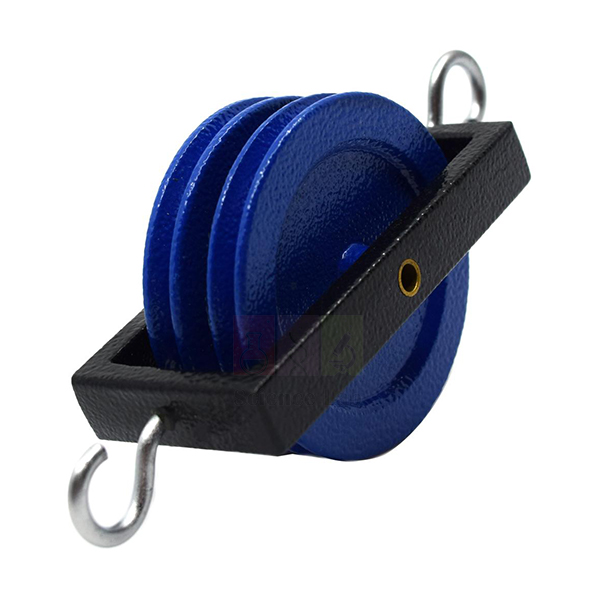
Pulley, Metal, Double, Parallel
Pulley, Metal, Double, Parallel (Product Code: SLE/PHY/277) is a pulley block with two 50 mm wheels mounted in parallel in a metal frame, used to set up multi-string pulley systems for mechanical advantage experiments. With two hooks on the frame, it can hang from a support as the fixed block or travel with the load as the moving block. It is made by Jain Scientific Equipments Pvt Ltd (ScienceLab), an OEM manufacturer, at its own factory in Ambala, India.
Specifications
| Parameter | Detail |
|---|---|
| Type | Double, parallel |
| Wheels | Two, 50 mm diameter |
| Material | Metal |
| Frame | Metal, with 2 hooks |
| Product code | SLE/PHY/277 |
| Manufacturer | Jain Scientific Equipments Pvt Ltd (ScienceLab) — OEM |
| Country of origin | India (made in Ambala, Haryana) |
What Is the Parallel Double Pulley Used For?
Two wheels on one block let a class build a four-string block and tackle when a pair of these pulleys is used together, one fixed above and one moving with the load. Students then find that the effort needed is roughly a quarter of the load while the string must be pulled four times as far, the classic demonstration of mechanical advantage and velocity ratio in a school pulley system lab.
Because both wheels are the same 50 mm size, the supporting strings share the load evenly, which keeps the arithmetic simple for younger students. Hang the fixed block from a rigid stand, pass the string over each wheel in turn, and watch that it does not jump from one groove to the other as masses are added. Measuring the real effort with a spring balance then shows how friction lowers efficiency below the ideal value.
What to Specify When Ordering
- Number of blocks: two per group gives a four-string system.
- Masses, hangers and a spring balance for load and effort.
- Stands or a frame from which to hang the fixed block.
OEM Manufacturer
Jain Scientific Equipments Private Limited, trading as ScienceLab, is the original equipment manufacturer of this parallel double pulley and produces it at its own licensed factory at Saha, Ambala, Haryana, India. Schools, colleges and dealers buying mechanics apparatus receive quotations straight from the maker, and extra blocks for new groups can be added to later orders by asking us. The company’s background is on our profile page.
Related Physics Lab Equipment
Other blocks and accessories for the same experiments:
- Pulley, Metal, Double — tandem 50 mm and 38 mm pulleys in an open-sided frame.
- Pulley, Metal, Single, Parallel — a single 50 mm wheel for simpler systems.
- Pulley, Plastic, Double, Parallel — the plastic-wheel version on a steel frame.
- Hangers with Slotted Weights — loads for the moving block.
- Spring Balance, Tubular — reads the effort on the free end of the string.
Browse Physics Lab Equipment for the complete range.
Frequently Asked Questions
What size are the wheels on the Pulley, Metal, Double, Parallel?
The Pulley, Metal, Double, Parallel has two pulley wheels of 50 mm diameter mounted in a metal frame. The frame carries two hooks, used for hanging the block from a support or for attaching the load.
How many supporting strings does a system with this pulley give?
Using two Pulley, Metal, Double, Parallel blocks, one fixed and one moving, gives four supporting string segments and an ideal mechanical advantage of four. Friction makes the measured value a little lower, which students use to calculate efficiency.
What is the difference between parallel and tandem double pulleys?
In the Pulley, Metal, Double, Parallel both wheels are 50 mm and mounted in parallel in a metal frame, while the tandem Pulley, Metal, Double has two different-sized wheels in an open-sided frame. Both are used to build multi-string pulley systems.
What load can the Pulley, Metal, Double, Parallel take?
A maximum load for the Pulley, Metal, Double, Parallel is not stated in this listing. Tell us the heaviest mass your experiments use through the contact page, and we will confirm whether this metal pulley block is suitable before you order.
Who manufactures the Pulley, Metal, Double, Parallel?
The Pulley, Metal, Double, Parallel is manufactured by Jain Scientific Equipments Pvt Ltd (ScienceLab), the OEM, at its own licensed factory at Saha, Ambala, Haryana, India, and supplied factory-direct to schools, colleges, dealers and importers.
Can the parallel double pulley be ordered in class sets?
Yes. The Pulley, Metal, Double, Parallel can be quoted in class quantities, usually two blocks per group, with masses and spring balances if needed, for delivery in India and international markets. Send the quantities through our contact page or enquiry cart.
Request a Quote
For a Pulley, Metal, Double, Parallel quotation from the manufacturer, use the contact page or add the item to the enquiry cart along with masses and balances.
Last updated: 24 September 2026