- Physics Lab Equipment
- Chemistry Lab Equipment
- Biology Lab Equipment
- Anatomical Lab Equipment
- Learning
- Educational Lab Equipment
- Magnets
- Agriculture
- Astronomy
- Earth Science
- Geography Lab Equipment
- Safety Lab Coat
- Laboratory
- Meteorological
- Electricity & Magnetism
- Heat
- School Lab Equipment
- Lab Glassware
- Science Lab Equipment
- Tvet Lab Equipment
- Robotics Kits Supplier and Manufacturer for Schools India
- Math Lab Equipment Manufacturers and Exporters in Ambala
- STEM Kits Manufacturers and Supplier India
- Engineering Lab Equipment
- Hospital Lab Equipment
- Water, Sanitation & Hygiene Supplies
- Cold Chain, Solar & Communication Equipment
- Nutrition
Last updated: 22 October 2026
Quick Answer
Jain Scientific Equipments Pvt Ltd (ScienceLab), Ambala, Haryana, a laboratory instruments supplier in India, lists 35 balances, scales and mass sets for school, college, university and testing laboratories, arranged in 5 groups from mechanical beam balances and electronic balances to reference mass sets, slotted masses and weighing accessories. 20 of the items are manufactured by ScienceLab at its factory at Saha, Ambala, and 15 are supplied by ScienceLab. Each item has its own product page, linked from the product listing under this description. The company supplies buyers in India and in 110 countries.
Quick links: Request a quotation · Jump to specifications by group · Open your enquiry cart
Explore the Laboratory Balances Range
| Range | Items | What it covers |
|---|---|---|
| Beam and pan balances | 9 | Mechanical physical, chemical and analytical beam balances, a double beam balance, a four-beam single pan balance, a triple-beam balance, a dual-scale lever balance, and Beranger and Roberval two-pan balances. |
| Electronic balances | 11 | Compact, economic compact, portable and portable precision balances, precision and high precision balances, a four-decimal analytical balance, a bench-standing table balance and a high range balance for bulky loads. |
| Dial scales and weighing accessories | 4 | A compression (dial) balance, mechanical bathroom scales with a magnifying dial, a brass hanging scale pan and a granite-slab anti-vibration weighing table. |
| Reference mass sets | 3 | Boxed mass sets with fractional weights for physical and analytical balances, and a mass weighing set on a tray covering 10g to 1990g. |
| Slotted masses and hangers | 8 | Brass slotted mass sets of 100g, 250g and 1000g, cast alloy sets of 100g and 1000g, a pack of cast alloy hangers, and large format 500g and 1kg slotted mass hangers. |
| Total | 35 | All items listed in the Balances range |
Laboratory Balances Specifications
Key specifications below are taken from each product's own page; open a product for its full specifications and product code.
Beam and pan balances (9)
| Product | Key specification |
|---|---|
| Analytical Balance | Capacity: 200 g; Sensitivity: 0.1 mg; Beam: Short triangular beam with rider scale |
| Balance Single Pan | Capacity: 311 g; Readability: 10 mg; Beams: 4, each with a non-removable slider |
| Beranger Balance | Pans: Two; Base: Heavy base; Beam: Pivots on a central knife edge |
| Chemical Balance | Capacity: 200 g; Sensitivity: 0.5 mg; Beam: Engraved with a rider scale, for use with a 10 mg rider |
| Double Beam Balance | Beam ranges: 0–200 g × 10 g and 0–10 g × 0.1 g; Total on beams: 210 g; Extended range: Up to 2 kg with supplementary masses |
| Lever Balance Dual Scale | Range 1: 0–250 g x 1 g; Range 2: 0–1000 g x 5 g; Frame: Die-cast aluminium alloy |
| Physical Balance | Capacity: 250 g; Sensitivity: 2 mg; Beam: Cast alloy, fitted with balancing nuts |
| Roberval Balance | Body: Steel plate; Pans: Metal; Type: Roberval balance, simple model |
| Triple-Beam Balance | Capacity: 2610 g; Readability: 0.1 g; Repeatability: 0.2 g |
Electronic balances (11)
| Product | Key specification |
|---|---|
| Balance, Analytical | Capacity: 220 g; Resolution: 0.0001 g; Draught shield: Large glass shield with 3 sliding doors |
| Balance, High Range | Capacity options: 16000 g, 32000 g; Resolution: 0.1 g; Pan size: 175 x 195 mm |
| Compact Balance 2000g | Capacity: 2000 g; Readability: 0.1 g; Repeatability: 0.1 g |
| Economic Compact Balance | Capacity options: 0.3 kg, 0.6 kg, 3 kg, 6 kg; Readability options: 0.01 g, 0.1 g, 0.5 g, 1 g (by model); Display: LED / LCD |
| High Precision Balance | Response time: 3–4 seconds; Display: VFD (vacuum fluorescent display); Calibration: Automatic external |
| Portable Precision Balance | Capacity: 1000 g; Readability: 0.01 g; Repeatability: 0.01 g |
| Precision Balance | Capacity options: 0.1 kg, 0.2 kg, 0.3 kg, 2 kg; Readability: 0.001 g, 0.01 g (by model); Repeatability: ± 0.001 g, ± 0.01 g |
| Table Top Balance | Capacity options: 3 kg, 10 kg, 30 kg; Readability options: 0.1 g, 0.5 g, 1 g, 2 g (depending on model); Pan size: 210 x 260 mm |
A further 3 items in this group appear in the full product listing below this description.
Dial scales and weighing accessories (4)
| Product | Key specification |
|---|---|
| Balance Anti-Vibration Table | Internal working surface: 400 x 450 mm; Weighing slab: Large, scratch-resistant dark granite; polished finish, easy to clean |
| Bathroom Scales | Capacity: 130 kg (20st 6lb); Size: H 4.4 cm, W 25 cm, D 25 cm; Display: Easy-read dial |
| Compression Balance | Dial: Wide view; Pan: Large; Body: Plastic moulded |
| Scale Pan, Brass | Pan diameter: 75mm; Material: Brass; Suspension: Suspension cords with hook |
Reference mass sets (3)
| Product | Key specification |
|---|---|
| Analytical Balance Mass Set | Rider: 10 mg; Main weights: Brass, chrome plated; Fractional weights: Light alloy |
| Mass Weighing Set on Tray | Weighing range: 10g to 1990g in 10g increments; Materials: 3 steel weights and 6 brass weights |
| Physical Balance Mass Set | Masses: Brass, chrome plated; Fractional weights: Light metal, included; Handling: Forceps included |
Slotted masses and hangers (8)
| Product | Key specification |
|---|---|
| Mass Set, Brass, 1000g | Total mass: 1000g; Hanger: 1 x 100g (included); Slotted masses: 9 x 100g |
| Mass Set, Brass, 100g | Total mass: 100g; Hanger: 1 x 10g (included); Slotted masses: 9 x 10g |
| Mass Set, Brass, 250g | Total mass: 250g; Hanger: 1 x 50g (included); Slotted masses: 9 x 20g, 1 x 10g, 2 x 5g |
| Mass, Cast Alloy, 1000g | Total mass: 1000g; Contents: 9 x 100g slotted masses, 1 x 100g hanger; Material: Cast alloy |
| Mass, Cast Alloy, 100g | Total mass: 100g; Contents: 9 x 10g slotted masses, 1 x 10g hanger; Material: Cast alloy |
| Mass, Cast Alloy, Hanger | Pack size: Pack of 3; Accuracy: 1%; Material: Cast alloy |
| Slotted Mass Hanger, 1kg | Weight: 1kg; Length: 26cm; Width: 7cm |
| Slotted Mass Hanger, 500g | Nominal hanger mass: 500g; Length: 34cm; Width: 8cm |
Related Equipment in Other ScienceLab Ranges
Weighing practicals and mechanics experiments often also need these items from other ScienceLab ranges:
Who Buys This Range
Schools use Roberval, Beranger and triple-beam balances to teach mass comparison and weighing, physical balances with mass sets in physics practicals, and slotted masses with hangers for spring, lever and pulley experiments. Colleges and universities weigh reagents, primary standards and precipitates on chemical and analytical beam balances and on electronic precision balances. Pharmaceutical, quality-control and research laboratories choose the high precision and four-decimal analytical balances and the anti-vibration table for steady readings. Laboratory dealers and distributors order balances and mass sets in class quantities for school supply contracts and tenders.
Other ScienceLab Equipment Ranges
| Range | What it covers |
|---|---|
| Measuring | Classroom measuring tools for mass, length, volume, temperature, time and pH |
| Laboratory Instruments | A UV-VIS spectrophotometer, colorimeter, DO meter, fume cupboards and an incubator |
| Measuring Cylinders | Glass and polypropylene measuring cylinders and gas jars |
| Physics Lab Equipment | Physics apparatus for mechanics, heat, electricity and magnetism, optics, waves and measurement |
| Physics Lab | Physics practical apparatus, from vernier callipers to diode boards and logic gates |
| Chemistry Lab Equipment | Chemistry apparatus by topic, from glassware, burners and titration to consumables and lab safety |
| Anthropometric Equipment | Spring, beam and electronic scales, scales with height rods, length boards and MUAC tapes for growth monitoring |
Frequently Asked Questions
What does the Balances range include?
35 listed items in 5 groups: mechanical beam and pan balances, electronic balances from the 300 g compact model to the high range balance with 16000 g and 32000 g options, dial scales and weighing accessories, cased mass sets, and slotted masses with hangers.
Which balances and masses does ScienceLab manufacture?
20 of the 35 items are manufactured by ScienceLab: the mechanical physical, chemical, analytical, double beam, single pan, lever, Beranger and Roberval balances, the reference mass sets, the brass and cast alloy slotted mass sets and hangers, and the brass scale pan.
Which items are supplied rather than manufactured?
15 items are supplied by ScienceLab, mainly the electronic balances, from the Compact Balance 300g to the Balance, High Range, together with the Triple-Beam Balance, Compression Balance, Bathroom Scales and Balance Anti-Vibration Table.
What capacities and readabilities can I choose from?
Among mechanical models, the Physical Balance takes 250 g at 2 mg sensitivity, the Chemical Balance 200 g at 0.5 mg and the Analytical Balance 200 g at 0.1 mg. Electronic options run from the Compact Balance 300g reading 0.01 g and the Precision Balance, 220g reading 0.001g to the four-decimal Balance, Analytical with 220 g capacity and 0.0001 g resolution.
Which balances suit school classes and which suit college labs?
Roberval and Beranger two-pan balances introduce mass comparison in primary and middle school, and the Triple-Beam Balance weighs up to 2610 g with no power supply. Senior-school and college chemistry uses the Chemical Balance with its 10 mg rider, while college and university labs add the Analytical Balance and the electronic precision models.
Are slotted masses available for physics experiments?
Yes. Brass slotted mass sets of 100g, 250g and 1000g and cast alloy sets of 100g and 1000g each come with a hanger, and the large format 500g and 1kg hangers carry heavier loads for wire-stretching and beam experiments.
Can balances be ordered in bulk or against a tender?
Yes. Balances and mass sets can be ordered singly or in class quantities, tender enquiries and export orders are accepted, and product specifications are provided on request for checking against tender documents.
What should I send for a quotation?
Product names or codes (for example SLE/LB/08 for the Physical Balance), quantities, the capacity and readability needed for electronic models, the delivery location and any tender specification.
Request a Quote
Send product names or codes and quantities through the contact page, or add items to your enquiry cart and submit it.
ScienceLab (Jain Scientific Equipments Pvt Ltd)
1226/1-5, Bengali Mohalla, Science Market, Ambala Cantt, Haryana 133001, India
Phone: +91-7082934803
Email: sales@scilabexport.com

Double Beam Balance
The Double Beam Balance is a two-pan mechanical balance with two beams: one reads 0–200 g in 10 g steps and the other 0–10 g in 0.1 g steps, giving 210 g on the beams. Supplementary masses extend it to 2 kg. Centre-reading sliding masses, a spring-loaded zero adjuster and magnetic damping help groups take readings quickly on its 150 mm stainless steel pans.
Double beam balance specifications
| Parameter | Detail |
|---|---|
| Type | Two-pan balance with two beams |
| Beam ranges | 0–200 g × 10 g and 0–10 g × 0.1 g |
| Total on beams | 210 g |
| Extended range | Up to 2 kg with supplementary masses (whether they are packed with the balance is not stated) |
| Sliding masses | Centre reading |
| Zero adjustment | Spring-loaded zero adjuster |
| Damping | Magnetic damping |
| Pans | Stainless steel, 150 mm diameter |
| Product code | SLE/LB/01 |
| Minimum order | 10 units |
| Dispatch | Usually within 7 to 10 working days |
| Manufacturer | ScienceLab (Jain Scientific Equipments Pvt Ltd), Ambala, India |
Practicals on the two-pan double beam balance
Osmosis in potato cylinders. Make up salt solutions of several strengths with sodium chloride and a measuring cylinder set. Blot and weigh each potato cylinder to 0.1 g, leave it in its solution for a set time, then blot and weigh it again. A graph of percentage change in mass against salt concentration shows where the cells neither gain nor lose water.
Checking packed portions. Put a reference portion of dried peas in a plastic weighing boat on the right pan and a matching empty boat on the left. Fill the left boat with each new portion in turn; the pointer shows at once whether it is heavier or lighter. For a heavier portion, slide the beam masses until the pointer centres to read the excess.
Water lost when fruit dries. Weigh an empty shallow dish, then the dish with thin apple slices, using supplementary masses on the other pan once the load passes 210 g and the beams for the rest. Dry the slices in a warm, airy place for a few days and weigh them again. The loss as a share of the fresh slice mass estimates the water content of the fruit.
Frequently Asked Questions About the Double Beam Balance
Can the balance be used to compare items against a reference?
Yes. Its two pans make comparative weighing simple: put the reference item on one pan and the item under test on the other. The pointer shows straight away which side is heavier. Sliding the beam masses then measures the difference, to 0.1 g on the smaller beam.
What should be checked after the balance is moved to another bench?
Check that the new surface is firm and level, since a sloping bench shifts the rest point. Then recheck the zero with both pans empty and the sliding masses at their zero marks, and correct it with the spring-loaded zero adjuster. Repeat the zero check during long sessions.
How are the supplementary masses used above 210 g?
Place the sample on one pan and the supplementary masses on the other until the sample side is only slightly heavier. Finish the weighing with the two beams. The result is the total of the supplementary masses plus the beam readings, up to the 2 kg limit.
Why must nothing touch the pans or beams while weighing?
A sleeve, a cable, a wall or the edge of a large object can carry part of the load or hold a pan up, and the reading is then wrong. Keep the balance clear on all sides, and ask pupils not to lean on the bench while the pointer settles.
Why can a mass reading not identify what a solid is made of?
Objects of different materials can have the same mass if their sizes differ. To identify a material, measure the volume as well, for example by displacement in a measuring cylinder, and work out the density. Density belongs to the material, while mass depends on how much of it there is.
Why should each pair of pans stay with its own balance?
The pans of one balance are set together with its beam and zero. A pan from another balance can differ slightly in mass, so the zero shifts and readings change. In a room with several balances, keep each pair with its own unit and check the zero if pans are ever swapped.
Accessories and other mechanical balances
- Weighing Paper
- Plastic Weighing Boats
- Triple-Beam Balance
- Balance Single Pan
- Balance Anti-Vibration Table
To request a quotation, send the product name, code and quantity through our contact page or add the item to your enquiry cart.
Last updated: 14 November 2026

Beranger Balance
The Beranger Balance compares the masses of two objects, or weighs one object against standard masses, in school science and mathematics lessons. Its beam pivots on a central knife edge, a pointer shows when the two pans are level, and a heavy base keeps it steady while pupils load the pans.
Beranger balance details
| Parameter | Detail |
|---|---|
| Type | Beranger-pattern two-pan balance |
| Pans | Two |
| Base | Heavy base |
| Beam | Pivots on a central knife edge |
| Indicator | Pointer |
| Purpose | Comparing masses and weighing objects against standard masses |
| Standard masses | Not listed as part of the balance |
| Product code | SLE/LB/02 |
| Minimum order | 10 units |
| Dispatch | Usually within 7 to 10 working days |
| Manufacturer | ScienceLab (Jain Scientific Equipments Pvt Ltd), Ambala, India |
Comparison and weighing activities on the two-pan balance
Heavier or lighter. Give each pair a tray of classroom objects, such as a pencil case, an apple and a ball of clay. Pupils predict which of two objects is heavier, load one on each pan and record whether they were right. Repeated pairings let them put the whole set in order of mass.
Weighing against standard masses. Place an object on one pan and add pieces from a mass weighing set on tray to the other pan, starting with the heavy pieces, until the pointer rests at the centre. Add up the pieces on the pan to find the mass. Lift the small pieces with forceps so they stay clean.
Equal shares of sand or seeds. Stand an empty plastic weighing boat on each pan and check that the pointer still rests at the centre, so the boats cancel out. Pour sand into one boat, then fill the other until the beam is level. The two portions now have equal mass, which turns halving and doubling into a practical maths task.
Moments and equal arms. After weighing, compare the Beranger Balance with a demonstration lever. On the lever, a small load far from the pivot can balance a large load near it. On the balance the arms are fixed and equal, so only equal loads bring the pointer to the centre.
Frequently Asked Questions About the Beranger Balance
Is the bigger object always the heavier one?
No. A large ball of cotton wool can rise against a small stone, because mass depends on the material as well as the size. Ask pupils to predict first, then load one object on each pan. The pan that sinks holds the greater mass, whatever the objects look like.
Why can the pan holding more items still be the lighter side?
Pupils often count objects instead of comparing mass. Five plastic counters may rise against two marbles. The beam responds only to the total mass on each pan, so the side with more pieces is not always heavier. Let pupils test their own counts to see this.
How is an unbalanced pair brought level?
Add small standard masses or cubes to the higher pan one at a time. If that pan drops too far, take the last piece off and try a smaller one. When the pointer settles at the centre, the masses added equal the difference between the two loads.
What should be checked if the pointer is off centre with both pans empty?
Check that the table is level and firm, that both pans sit fully in place and are clean, and that nothing touches the beam. Dust on the knife edge can also stop the beam settling. If the pointer is still off centre, correct it as the supplied operating instructions describe.
Why does a level beam show that the two loads are equal?
The beam pivots at its centre, so the two arms are the same length. Each load turns the beam with a moment equal to its weight times the arm length. With equal arms, the moments match only when the loads match, and the pointer then rests at the centre.
Masses, balances and weighing boats for comparison lessons
- Mass Set, Brass, 1000g
- Mass Weighing Set on Tray
- Roberval Balance
- Plastic Weighing Boats
- Balance Simple Beam
To request a quotation, send the product name, code and quantity through our contact page or add the item to your enquiry cart.
Last updated: 14 November 2026

Roberval Balance
The Roberval Balance gives primary and middle school pupils their first hands-on weighing: an object goes on one pan and standard masses on the other until both sides level. It is a simple model with a steel plate body and metal pans, and its parallel linkage keeps both pans upright as they rise and fall.
Roberval balance construction
| Parameter | Detail |
|---|---|
| Type | Roberval balance, simple model |
| Pans | Two, metal |
| Body | Steel plate |
| Purpose | Comparing masses and weighing against standard masses |
| Product code | SLE/LB/03 |
| Minimum order | 10 units |
| Dispatch | Usually within 7 to 10 working days |
| Manufacturer | ScienceLab (Jain Scientific Equipments Pvt Ltd), Ambala, India |
Classroom mass lessons on the Roberval balance
Roberval's paradox. Put two equal pieces from a mass weighing set on tray on the pans, one at the centre of its pan and the other at the far edge. The balance stays level. Ask pupils to predict what will happen before each move, then trace the parallel linkage together to see why the pans stay upright.
Weighing in cubes first. Balance a toy, an apple or a shoe against linking cubes and record each mass as a number of cubes. Some groups use cubes and others use counters, and the class discusses why their numbers do not agree before switching to gram masses.
Does shape change mass? Roll a ball of modelling clay and balance it against masses. Then squash it flat or break it into pieces and put every piece back on the same pan. The pans still level, which shows young pupils that changing shape does not change mass.
Frequently Asked Questions About the Roberval Balance
How small a difference can pupils detect on this balance?
Sensitivity is not listed for this simple model, so test it. Balance two equal loads, then add the smallest mass you have to one pan. If that pan clearly goes down, the balance shows a difference that small; if not, record results only to the nearest larger mass.
Why does it not matter where the object sits on its pan?
Each pan is carried on an upright part held vertical by the parallel linkage. Wherever the load rests on the pan, its weight reaches the beam at the same distance from the pivot, so the turning effect on the beam stays the same. A hanging-pan balance avoids the problem by hanging each pan from one fixed point.
Is this balance suited to weighing chemicals for a practical?
It is a simple model for comparing masses and first weighing lessons, not for fine reagent weighing. When a practical needs small, exact amounts of a chemical, use a chemical or electronic balance, and keep this one for everyday objects and early mass work.
How should wet sand, soil or water be weighed?
Never put it straight onto the metal pans. Place two identical containers, one on each pan, so their masses cancel, then add the material to one and masses to the other. Wipe and dry the pans after any spill so they do not rust or stain.
Why start with cubes or counters before gram masses?
Young pupils first need the idea that a heavier object needs more units to balance it, and cubes they can count build that idea. When groups using different objects get different numbers, the need for one agreed unit, the gram, becomes clear.
How should the balance be stored between lessons?
Take off all loads, wipe the pans and keep the balance on a level shelf in a dry cupboard, since damp can rust the steel plate body. Carry it by the body rather than the pans so the linkage is not bent.
Two-pan balances, masses and weighing aids for primary classes
- Beranger Balance
- Double Beam Balance
- Mass Weighing Set on Tray
- Mass Set, Brass, 250g
- Linking Cubes
- Weighing Paper
To request a quotation, send the product name, code and quantity through our contact page or add the item to your enquiry cart.
Last updated: 15 November 2026

Compression Balance
The Compression Balance is a direct-reading dial scale: a load on its large pan compresses a spring, and the pointer swings across a wide view dial that a whole group can read at once. Its plastic moulded body suits quick weighing of everyday objects and samples in school science, home science and maths lessons.
Compression balance details
| Parameter | Detail |
|---|---|
| Type | Compression (dial) balance |
| Dial | Wide view |
| Pan | Large |
| Body | Plastic moulded |
| Purpose | Quick, direct-reading weighing of everyday objects and samples |
| Capacity and graduation | Not stated in the current documentation |
| Product code | SLE/LB/04 |
| Minimum order | 10 units |
| Dispatch | Usually within 7 to 10 working days |
| Supplied by | ScienceLab (Jain Scientific Equipments Pvt Ltd), Ambala, India |
Weighing and estimation lessons on the dial balance
Estimate, then weigh. Each group handles a piece of fruit, a book and a bag of sand, writes down an estimate of each mass, then places the item in the middle of the pan and reads the wide view dial. Comparing estimate and reading after each item shows pupils how their sense of grams and kilograms improves during the lesson.
Checking the dial with known masses. Add masses from a mass weighing set on tray to the pan one at a time and record the dial reading for each total. A graph of dial reading against known mass should be a straight line through zero; a bend or an offset shows where the scale reads high or low.
Squashed spring, stretched spring. Weigh one object on the compression balance and then hang it from a force meter, whose spring stretches instead of squashing. Both instruments respond to the pull of gravity on the object, while a two-pan beam balance such as the Roberval balance compares masses directly. Pupils convert between the readings and discuss the difference.
Frequently Asked Questions About the Compression Balance
Why might the pointer fail to return to zero after a load is removed?
The pan may be sitting unevenly or rubbing against the body, or grit may be trapped under it. Lift the pan, clean around its seat and refit it squarely. A balance that has been overloaded can also stay off zero. If a correction is possible, make it as the supplied operating instructions describe.
How can the dial be checked against known masses?
Place standard masses on the centre of the pan, one total at a time, and compare each reading with the known value. An error that is the same at every load means the zero has shifted. An error that grows with the load points to a rubbing pan or a changed spring, so do not use the dial for measured work.
What happens if the balance is dropped or knocked?
A fall can shift the spring or bend the pointer, so readings may move even if the body looks unharmed. After any knock, check the zero with the pan empty and test it with a known mass. Carry the balance by its body, never by the pan.
How do pupils work out what each small mark on the dial is worth?
Find two numbered marks next to each other and count the small spaces between them. Divide the difference between the two numbers by the number of spaces. Pupils often assume every mark is one unit, so practise this step before any weighing begins.
What should pupils record when the pointer stops between two marks?
Read the dial straight on, with the eye level with the pointer. Record the mark the pointer is closest to, or estimate halfway when it sits midway between two marks. Ask pupils to give the reading with its unit, as printed on the dial face.
How do pupils convert a dial reading between kilograms and grams?
Check which unit the dial face shows first. One kilogram equals a thousand grams, so multiply a kilogram reading by a thousand to get grams and divide a gram reading by a thousand to get kilograms. A reading of one and a half kilograms becomes fifteen hundred grams.
Spring and beam instruments and masses for weighing lessons
- Force Meter/Spring Balance
- Spring Balance, Tubular
- Roberval Balance
- Mass Weighing Set on Tray
- Spring Scales, Green, 500 g (5 N)
To request a quotation, send the product name, code and quantity through our contact page or add the item to your enquiry cart.
Last updated: 14 November 2026

Balance Single Pan
The Balance Single Pan is a four-beam mechanical balance that weighs up to 311 g with 10 mg readability. Each beam carries its own non-removable slider, so no separate masses are needed. The stainless steel pan has two pouring spouts and a handle, the beam is magnetically damped, and a platform housed in the base serves for density determination.
Four-beam single pan balance specifications
| Parameter | Detail |
|---|---|
| Capacity | 311 g |
| Readability | 10 mg |
| Beams | 4, each with a non-removable slider |
| Beam graduations | 0–200 g × 100 g; 0–100 g × 10 g; 0–10 g × 1 g; 0–1 g × 10 mg |
| Additional masses | Not required |
| Zero | Zero adjustment provided |
| Pan | Stainless steel, 90 mm diameter, with 2 pouring spouts and handle |
| Damping | Magnetically damped beam movement |
| Density work | Platform housed in the base for density determination |
| Product code | SLE/LB/05 |
| Minimum order | 10 units |
| Dispatch | Usually within 7 to 10 working days |
| Manufacturer | ScienceLab (Jain Scientific Equipments Pvt Ltd), Ambala, India |
Weighing and density practicals on the four-beam balance
Density of an irregular solid. Weigh a metal density cube or a small stone in air and add the four slider readings. Weigh it again fully immersed in water, using the density platform in the base as the supplied operating instructions describe. The loss in weight gives the volume displaced, and mass divided by volume gives the density.
Density of a liquid. Weigh a dry glass measuring cylinder, pour in a measured volume of salt solution or cooking oil and weigh it again. Divide the mass of liquid by its volume, repeat with tap water and compare the two results. Tip the liquid back through a funnel rather than over the pan.
Mass gained on burning magnesium. Coil a strip of magnesium ribbon into a weighed crucible with lid, heat it until it stops glowing, lifting the lid now and then, then cool and weigh again. The gain is the oxygen taken up, and students use it to work out the formula of magnesium oxide.
Frequently Asked Questions About the Balance Single Pan
How are the four beam readings added together?
Move the sliders in order, starting with the heaviest beam: the 100 g beam, then the 10 g beam, the 1 g beam and finally the fine beam marked in 10 mg steps. When the pointer rests on the zero mark, add the four slider values to get the mass of the load.
How is the balance zeroed before weighing?
Empty and wipe the pan, set all four sliders to zero and let the beam come to rest. Turn the zero adjustment until the pointer lines up with the zero mark. Repeat the check at the start of each lesson and whenever the balance has been moved.
How finely can the last beam be read?
The 0 to 1 g beam is marked in 10 mg divisions, which is the readability of the balance. Read the slider against the nearest division with your eye level with the beam. Estimating between marks adds a digit that the balance cannot really support.
How is the density platform used?
Weigh the object in air first. Then, with the water container set up on the platform in the base as the operating instructions describe, weigh the object again fully immersed. The loss in weight in grams equals the volume of water displaced in cubic centimetres, so the mass divided by that loss gives the density.
Why does a trapped air bubble spoil a density result?
A bubble clinging to the object adds buoyancy, so the immersed weighing reads too low. The apparent volume then comes out too large and the density too small. Lower the object slowly, tap it or brush the bubbles away, and check that no air is held in hollows before reading.
What does magnetic damping do on this balance?
It slows the swing of the beam without any contact, so the pointer comes to rest after only a few swings. Students can read the sliders quickly instead of waiting for long oscillations to die away, which keeps a busy practical moving.
Density samples, weighing accessories and other mechanical balances
- Metal Density Cube Set
- Plastic Weighing Boats
- Triple-Beam Balance
- Double Beam Balance
- Glass Measuring Cylinder
To request a quotation, send the product name, code and quantity through our contact page or add the item to your enquiry cart.
Last updated: 14 November 2026

Chemical Balance
The Chemical Balance weighs reagents, primary standards and precipitates for quantitative chemistry practicals, with a capacity of 200 g and a sensitivity of 0.5 mg. Its beam is engraved with a rider scale for a 10 mg rider and swings on agate bearings and knife edges, mounted on a wooden board inside a polished wooden case.
Chemical balance specifications
| Parameter | Detail |
|---|---|
| Capacity | 200 g |
| Sensitivity | 0.5 mg |
| Beam | Engraved with a rider scale, for use with a 10 mg rider |
| Adjustment | Balancing nuts |
| Bearings | Agate bearings and knife edges |
| Mounting | Fitted on a wooden board |
| Case | Polished wooden case |
| Weight box and rider | Weight box not listed as part of the balance; packing of a rider not stated |
| Product code | SLE/LB/06 |
| Minimum order | 10 units |
| Dispatch | Usually within 7 to 10 working days |
| Manufacturer | ScienceLab (Jain Scientific Equipments Pvt Ltd), Ambala, India |
Chemistry practicals on the chemical balance
Standard solution of Mohr's salt. Put masses equal to a clean watch glass plus the required sample on the right pan. Add ferrous ammonium sulphate crystals to the glass until the beam swings equally to each side, using the rider for the last milligrams. Wash the crystals into a volumetric flask with dilute sulphuric acid, make up to the mark and titrate it against potassium permanganate.
Solubility of potassium nitrate. Weigh a dry porcelain dish, pour in a little saturated potassium nitrate solution at a measured temperature and weigh again. Evaporate it to dryness on a water bath, let the dish cool and weigh it once more. The masses give the salt and the water that held it, so solubility follows as grams of salt per hundred grams of water.
Volume of one burette drop. Weigh a small, dry stoppered flask, run a counted number of water drops into it from a burette and weigh it again. Dividing the gain by the number of drops gives the mass, and so roughly the volume, of one drop. Students then see why a single extra drop at the end point matters in a titration.
Frequently Asked Questions About the Chemical Balance
How does a chemical balance differ from a physical balance?
Both are equal-arm beam balances, but the chemical balance is built for finer work. This one senses 0.5 mg, carries a rider scale for the last milligrams and sits in a closed wooden case against draughts. A physical balance reads more coarsely and suits physics practicals such as density and mass.
What does a sensitivity of 0.5 mg mean in practice?
It is the smallest change in load that shifts the beam's rest point clearly. Report weighings no finer than the nearest half milligram. The real uncertainty of a result is larger, because the masses used, the rider setting and the reading of the rest point all add to it.
What happens if more than 200 g is placed on the pans?
The 200 g capacity covers the container as well as the sample. Overloading bends the beam slightly and presses the knife edges into the agate, which blunts them and lowers the sensitivity over time. Weigh heavy flasks or large samples on a coarser balance instead.
Why is a sample never placed directly on the pan?
Chemicals can corrode or stain the pan and change its mass, which shifts every later weighing. Loose crystals also spill onto the bearings and the floor of the case. Use weighing paper or a watch glass, and weigh the container first so its mass can be taken away.
Why does the beam come to rest at a different point each time?
Grains of chemical or dust on the knife edges or agate bearings are a common cause, along with draughts through an open case and a beam jolted while loading. Clean with a soft brush, close the case and let the beam settle each time. Never file or hone a knife edge yourself; a worn edge needs proper servicing.
What is the difference between accuracy and precision when weighing?
Precision is how closely repeat weighings of one object agree with each other. Accuracy is how close they come to the true mass. A balance can repeat well and still read high if the masses or the rider are off, so check it from time to time with a known mass.
Weighing accessories and a finer balance for chemistry practicals
To request a quotation, send the product name, code and quantity through our contact page or add the item to your enquiry cart.
Last updated: 14 November 2026

Analytical Balance
The Analytical Balance is a mechanical beam balance for exact weighings in quantitative analysis, with a capacity of 200 g and a sensitivity of 0.1 mg. A rider moved along its short triangular beam supplies the last fraction of a milligram, and a fully glazed wooden case shields the stirrup-hung pans from draughts and dust.
Analytical beam balance specifications
| Parameter | Detail |
|---|---|
| Capacity | 200 g |
| Sensitivity | 0.1 mg |
| Beam | Short triangular beam with rider scale |
| Knife edges | Agate; relieved by extended beam supports when at rest |
| Pans | Removable, suspended by stirrups from double hooks |
| Pillar | Highly finished |
| Complete with | Rider slide and levelling screws |
| Case | Polished wooden case, fully glazed |
| Product code | SLE/LB/07 |
| Minimum order | 10 units |
| Dispatch | Usually within 7 to 10 working days |
| Manufacturer | ScienceLab (Jain Scientific Equipments Pvt Ltd), Ambala, India |
Quantitative analysis on the analytical balance
Gravimetric estimation of sulphate. Precipitate barium sulphate from the sample solution with barium chloride, filter it, and ignite paper and precipitate in a weighed crucible with lid. Cool the crucible in a vacuum desiccator before every weighing, and repeat heating, cooling and weighing until two results agree.
Standard solution of oxalic acid. Weigh the oxalic acid by difference from a stoppered weighing bottle: weigh the bottle with the crystals, tip a portion into a funnel standing in a volumetric flask, then weigh the bottle again. Dissolve, make up to the mark and work out the exact concentration from the mass delivered.
Sensitivity under load. Find the rest point of the empty balance from the pointer's swings, move the rider by one division and find the new rest point. Repeat with equal masses from the analytical balance mass set on both pans at two or more loads within the capacity, and plot how the sensitivity changes with load.
Frequently Asked Questions About the Analytical Balance
How is the rider used to finish a weighing?
Add masses to the right pan until the next smaller piece would overshoot. Then lift the rider with the rider slide, set it on the beam and move it along the rider scale until the pointer swings evenly about the zero point. Its position gives the remaining milligrams and fractions, which are added to the pan total.
How is the sensitivity of the balance checked?
Find the rest point of the pointer, add a small known mass, usually by moving the rider, and find the new rest point. The shift in scale divisions per milligram is the sensitivity. Check it with empty pans and again under load, because a beam balance usually becomes less sensitive as the load increases.
How should a hygroscopic sample be weighed?
Store it in a desiccator and weigh it inside a closed weighing bottle, never on an open pan or paper. Weigh the bottle with the sample, tip out the portion needed and weigh the bottle again. Because the bottle stays closed on the pan, the sample has little chance to take up moisture while it is weighed.
Does air buoyancy affect a result at 0.1 mg?
It can. Air pushes up on the sample and on the masses in proportion to their volumes, so a bulky, low-density sample appears slightly lighter than it really is. In most student gravimetric work the error is small, but exact work corrects the reading to its value in vacuum.
What checks come before the first weighing of a session?
Level the case with the levelling screws and brush any dust from the pans. Close the case, release the beam supports and note where the pointer's swings centre, which gives the zero point. Raise the beam supports again before anything is placed on a pan.
Weighing and gravimetric apparatus
- Analytical Balance Mass Set
- Analytical Weight Box
- Balance Anti-Vibration Table
- Chemical Balance
- Vacuum Desiccator
- Crucible with lid
To request a quotation, send the product name, code and quantity through our contact page or add the item to your enquiry cart.
Last updated: 14 November 2026

Physical Balance
This student beam balance weighs up to 250 g with a sensitivity of 2 mg. Its cast alloy beam rests on agate bearings and knife edges, and the nickel plated brass pans lift off for cleaning. Double-hook hangers let a sample hang below a pan in water, so the same instrument covers both mass and specific gravity practicals.
Physical balance construction and capacity
| Parameter | Detail |
|---|---|
| Capacity | 250 g |
| Sensitivity | 2 mg |
| Beam | Cast alloy, fitted with balancing nuts |
| Bearings | Agate bearings and knife edges |
| Pans | Detachable, nickel plated brass |
| Hangers | Double hooks for specific gravity experiments |
| Pillar | Enamelled central pillar |
| Levelling | Plumb line and levelling screws |
| Case | Polished wooden case |
| Product code | SLE/LB/08 |
| Minimum order | 10 units |
| Dispatch | Usually within 7 to 10 working days |
| Manufacturer | ScienceLab (Jain Scientific Equipments Pvt Ltd), Ambala, India |
Practicals on the physical balance
Mass of a solid. Level the balance with the levelling screws until the plumb line is centred, then zero the empty beam with the balancing nuts. Put the object on the left pan. Add masses from the Physical Balance Mass Set to the right pan with forceps, starting with the heaviest, and finish with fractional weights.
Relative density of a solid. Weigh a metal density cube in air. Then tie it with fine thread to the lower hook so that it hangs fully under water in a glass beaker that does not touch the pan. Divide the weight in air by the loss of weight in water.
Relative density of a liquid. Use one sinker for three weighings: in air, in water and in the test liquid, such as glycerine or salt solution. The loss of weight in the liquid divided by the loss in water gives its relative density. Rinse and dry the sinker before each liquid.
Double weighing. Weigh one object first in the left pan and then in the right pan. If the readings differ, the arms are not quite equal. The square root of the product of the two readings gives the true mass and removes the arm error.
Frequently Asked Questions About the Physical Balance
Why let the pointer swing instead of waiting for it to stop?
A swinging beam takes a long time to come to rest, and friction can make it stop slightly off true. Equal swings on either side of the centre mark show balance sooner and more reliably. If the swings are uneven, add or remove a fractional weight until they match.
Does the physical balance measure mass or weight?
It measures mass. The unknown is compared with standard masses on a lever with equal arms, so gravity pulls equally on both sides and cancels out. The reading would be the same on the Moon, while a spring balance reads weight and would show a smaller value there.
Why must masses be lifted with forceps and not with fingers?
Moisture and grease from fingers add a little mass and slowly corrode the metal, so the masses drift away from their marked values. Forceps also make it less likely that a mass is dropped onto the pan, which jolts the beam and can blunt the knife edges.
Why does the reading drift near a fan or with a warm sample on the pan?
Moving air pushes on the pans and stops the beam settling. A warm object heats the air around it, and the rising air makes it seem lighter than it is. Weigh away from fans and open windows, and let heated samples cool to room temperature first.
Why must the solid hang clear of the beaker during a relative density reading?
If the solid touches the side or base of the beaker, part of its weight rests on the glass and the balance reads too little. The loss of weight then looks too large and the relative density comes out low. Hang it fully under water, clear of the glass, and brush off any air bubbles first.
How should the knife edges and agate bearings be looked after?
Place loads on the pans gently and stay within the 250 g capacity. Never let an object fall onto a pan. After the practical, remove all masses, wipe the pans and close the wooden case so that dust cannot settle on the bearing surfaces.
Balances, masses and samples for mass and density practicals
- Physical Balance Mass Set
- Chemical Balance
- Physical Balance (Digital)
- Metal Density Cube Set
- Double Beam Balance
- Triple Beam Balance
To request a quotation, send the product name, code and quantity through our contact page or add the item to your enquiry cart.
Last updated: 14 November 2026

Physical Balance Mass Set
The Physical Balance Mass Set keeps chrome plated brass masses, light metal fractional weights and forceps together in one case with a lid. It goes beside a physical balance in school and college practicals: the brass masses do the main weighing and the fractional weights make up the last small difference.
Physical balance mass set contents
| Parameter | Detail |
|---|---|
| Masses | Brass, chrome plated |
| Fractional weights | Light metal, included |
| Handling | Forceps included |
| Storage | Case with lid |
| Supplied as | Complete set |
| Product code | SLE/LB/09 |
| Minimum order | 10 units |
| Dispatch | Usually within 7 to 10 working days |
| Manufacturer | ScienceLab (Jain Scientific Equipments Pvt Ltd), Ambala, India |
Weighing exercises on the physical balance
Relative density with a density bottle. Weigh a clean, dry specific gravity bottle on a physical balance, then weigh it full of water and again full of the test liquid. The mass of liquid divided by the mass of the same volume of water gives the relative density of the liquid.
Mass of one sheet of paper. Weigh ten sheets of the same paper together, finishing the balance with the fractional weights, and divide by ten. Measure one sheet with a metal ruler, work out its mass per square metre and compare it with the value printed on the pack.
Density of a regular block. Measure the length, width and height of a small metal or wooden block with a vernier calliper and multiply them for its volume. Weigh the block, divide mass by volume and compare the result with a table of densities.
Frequently Asked Questions About the Physical Balance Mass Set
What are the fractional weights used for?
They finish a weighing. When the brass masses bring the pointer close to the centre but the next brass piece would be too heavy, add fractional weights one at a time until the pointer swings evenly. Then add their values to the brass total.
Why are the brass masses chrome plated?
Bare brass tarnishes as it reacts with air and moisture, and handling speeds this up. Chrome plating gives a harder surface that resists tarnish and wipes clean. It keeps its finish longest when the masses are lifted with the forceps and the case is kept closed.
Why should every piece go back into the case after weighing?
In the case, pieces cannot roll off the bench, get mixed with another set or collect dust, which adds to their mass. Checking that every piece is back before the lid is closed also shows at once if one has gone missing.
What limits the smallest mass a student can measure with this set?
A result can be no finer than the smallest fractional weight, and no finer than the smallest change the balance responds to. That smallest reliable step is the least count of the weighing, so record results to it and no further.
Why does the object go on the left pan and the masses on the right?
It is a convention that suits right-handed users. The forceps work the right pan while the object rests undisturbed on the left. Keeping to the same sides every time also makes results from different students easier to compare.
What should be done if a mass is dropped?
Pick it up with the forceps, look for dents or scratches and wipe it with a soft dry cloth. A dented or chipped piece may have lost mass, so compare it on the balance with a piece of the same value from another set before using it again.
Balances, mass sets and density apparatus
- Physical Balance
- Fractional Weight With Rider
- Analytical Balance Mass Set
- Mass Weighing Set on Tray
- Specific Gravity Bottles
- Weight Box (Physical)
To request a quotation, send the product name, code and quantity through our contact page or add the item to your enquiry cart.
Last updated: 15 November 2026

Analytical Balance Mass Set
The Analytical Balance Mass Set holds the reference masses used to counterpoise samples on a two-pan analytical or chemical balance. Its main pieces are chrome-plated brass and the smallest fractions are light alloy. A 10 mg rider and a pair of forceps sit with them in a polished case, and the set is listed as accuracy class B.
Analytical mass set contents and finish
| Parameter | Detail |
|---|---|
| Type | Complete mass (weight) set for analytical beam balances |
| Main weights | Brass, chrome plated |
| Fractional weights | Light alloy |
| Rider | 10 mg |
| Handling tool | Forceps, included |
| Storage | Polished case |
| Accuracy class | Class B |
| Product code | SLE/LB/10 |
| Minimum order | 10 units |
| Dispatch | Usually within 7 to 10 working days |
| Manufacturer | ScienceLab (Jain Scientific Equipments Pvt Ltd), Ambala, India |
Weighing exercises with the mass set
Weighing an empty crucible. Put a clean, cool crucible with lid on the left pan of the analytical balance and build the counter-mass on the right pan. Write down each piece as it goes on, then read the total a second time from the empty places in the case and check it again as each piece goes back.
Checking the set against itself. Place one large piece on a pan and balance it with smaller pieces whose nominal values add up to the same total. Swap the two groups between the pans and repeat. A difference that remains after the swap comes from the pieces rather than unequal balance arms, so those pieces should be compared with a reference set.
Water of crystallisation. Weigh a crucible, add hydrated copper sulfate and weigh again on a chemical balance. Heat gently until the blue crystals turn white, cool and weigh, then repeat to constant mass. The loss gives the water driven off, and the ratio of moles gives the formula of the hydrate.
Frequently Asked Questions About the Analytical Balance Mass Set
What does accuracy class B mean for this set?
Class B is the accuracy class the set is listed under. An accuracy class fixes how far each piece may differ from its nominal mass, and a more exacting class allows a smaller error. When a balance must be checked to a stated standard, use weights of the class that standard calls for.
How often should the masses be checked?
No single interval fits every laboratory, because it depends on use and handling. Many departments compare the pieces with a reference set once a year, and sooner after a piece is dropped, scratched or corroded. Keep a written record of each check so slow drift becomes visible.
What slowly changes the mass of a weight?
Fingerprints, dust, corrosive fumes, knocks and wear from sliding pieces across a pan all add or remove a little mass. Chrome plating protects the brass, but a scratch through it lets the metal tarnish. Keep the case closed, away from acid and ammonia fumes, and have any dented piece checked.
Why are the smallest pieces made of light alloy?
A fraction of a gram made in brass would be a tiny chip that is hard to pick up and easy to lose. Light alloy gives a larger piece for the same mass, so it can be gripped with the forceps and its marking read without difficulty.
How is the value of the 10 mg rider read?
The rider sits on the graduated beam and is moved with the rider slide. Its effect depends on where it sits: at the outer end of a scale graduated for this rider it counts as its full 10 mg, and nearer the centre it counts proportionally less. Read the value from the beam graduation it rests on.
In what order should the pieces be added?
Start with the heaviest piece that does not overshoot, then try each smaller piece in turn and keep those that do not tip the beam. Working down in strict order brings the balance close to equilibrium quickly with the fewest pieces. Finish with the light alloy fractions and then the rider.
Balances, weight sets and accessories for the weighing bench
To request a quotation, send the product name, code and quantity through our contact page or add the item to your enquiry cart.
Last updated: 14 November 2026

Table Top Balance
The Table Top Balance weighs kilogram-scale loads on a 210 x 260 mm stainless steel platter. It comes in 3 kg, 10 kg and 30 kg capacities, with readability from 0.1 g to 2 g depending on the model. A built-in rechargeable battery lets it work away from a socket, and readings show on a red LED display.
Table Top Balance specifications
| Parameter | Detail |
|---|---|
| Capacity options | 3 kg, 10 kg, 30 kg |
| Readability options | 0.1 g, 0.5 g, 1 g or 2 g, depending on model |
| Resolution | Up to 30,000 counts |
| Pan size | 210 x 260 mm |
| Platter | Rust-proof stainless steel |
| Display | High-brightness red LED |
| Power | Built-in rechargeable battery; battery indicator; auto power off |
| Interface | RS-232C (optional) |
| Protection | Overload protection design |
| Product code | SLE/LB/11 |
| Minimum order | 10 units |
| Dispatch | Usually within 7 to 10 working days |
| Supplied by | ScienceLab (Jain Scientific Equipments Pvt Ltd), Ambala, India |
Bulk weighing tasks for the Table Top Balance
Water content of soil. Weigh an empty porcelain dish, add fresh soil taken with a soil auger and weigh again. Dry the dish in a laboratory oven, let it cool in a desiccator and reweigh. The mass lost is the water, which is then expressed as a percentage of the dry soil mass.
Sieve analysis of sand. Weigh a dry sand sample, shake it through a stack of test sieves and weigh the portion held on each sieve. The retained masses should add up close to the starting mass; a large shortfall means sand was spilled or left trapped in the mesh.
Off-centre check. Put a known mass from a weight box at the centre of the platter, note the reading, then move it to each corner in turn. If the readings differ, centre bulky loads such as a bucket or a large polypropylene beaker on the platter every time.
Frequently Asked Questions About the Table Top Balance
What should I check if the Table Top Balance will not switch on or keeps switching off?
Look at the battery indicator first and charge the built-in battery fully if it is low. A display that goes blank after a spell without use is usually the auto power off, not a fault. If it still will not start, inspect the charger lead for breaks or loose plugs.
Why should wet soil or sand never go straight onto the platter?
The stainless steel platter does not rust, but water and grit can run off its edges into the body and reach the load cell and electronics. Weigh wet material in a tray or beaker, tare the container first, and wipe the platter with a damp cloth, then dry it, after the session.
Why must dried soil cool in a desiccator before it is weighed again?
A warm tray sets up rising air currents that make the reading low and unsteady. Dry soil left to cool on an open bench also takes moisture back from the air, which raises its mass. Cooling it in a closed desiccator avoids both errors.
How do students know the soil sample is completely dry?
Return the tray to the oven, cool it and weigh it again. When two weighings in a row agree, the soil has reached constant mass. Stopping too early leaves water in the soil, so the calculated water content comes out lower than it really is.
Why should sand be dried before a sieve analysis?
Damp sand clumps together, so fine grains cling to coarse ones and stay on the upper sieves. Its water also adds mass that disappears as the sand dries during shaking. Dry the sample, let it cool, then weigh it before it goes through the sieves.
Balances, weights and trays for bulk weighing
- Balance, High Range
- Economic Compact Balance
- Balance, Portable
- Compact Balance 2000g
- Weight Box (Physical)
- Weighing Tray
To request a quotation, send the product name, code and quantity through our contact page or add the item to your enquiry cart.
Last updated: 15 November 2026

Lever Balance Dual Scale
The Lever Balance Dual Scale reads mass straight from a pointer, so no weights are added during a practical. One scale covers 0–250 g in 1 g steps and the other 0–1000 g in 5 g steps. The frame is die-cast aluminium alloy, zero is set with a levelling screw, and the detachable pan carries a hook for specific gravity work.
Dual-scale lever balance specifications
| Parameter | Detail |
|---|---|
| Type | Simple single-pan lever balance with two scales |
| Range 1 | 0–250 g x 1 g |
| Range 2 | 0–1000 g x 5 g |
| Frame | Die-cast aluminium alloy |
| Other parts | Chrome plated |
| Zero setting | Levelling screw |
| Reading | Pointer, read straight on to avoid parallax error |
| Pan | Detachable, with hook for specific gravity experiments |
| Product code | SLE/LB/12 |
| Minimum order | 10 units |
| Dispatch | Usually within 7 to 10 working days |
| Manufacturer | ScienceLab (Jain Scientific Equipments Pvt Ltd), Ambala, India |
Practicals with the dual-scale lever balance
Relative density of a solid. Tie a cube from the metal density cubes set to the hook with cotton thread and note its weight in air. Lower it fully into a glass beaker of water, clear of the sides and base, and note the smaller reading. Divide the weight in air by the loss in weight.
Upthrust in different liquids. Weigh one sinker in air, in water and then in strong salt solution held in a tall form beaker. The loss in the salt solution divided by the loss in water gives the relative density of that liquid.
Everyday masses for junior classes. Pupils weigh stones, fruit and metal blocks, reading the 250 g scale for light items and the 1000 g scale for heavier ones. Checking one reading against a known piece from a 250 g brass mass set shows how close the scale is.
Frequently Asked Questions About the Lever Balance Dual Scale
What should be checked when the pointer will not return to zero?
Make sure nothing touches the pan or the lever and that the balance stands on a firm, flat bench. With the empty pan in place, turn the levelling screw until the pointer rests on zero. If it still wanders, look for dirt or a bent part fouling the lever.
Which of the two scales should be read for a given load?
Read the 0–250 g scale whenever the load is 250 g or less, because its 1 g divisions give the finer result. For heavier loads, read the 0–1000 g scale, where each division stands for 5 g.
How can students test whether the balance reads correctly?
Put a known mass on the pan and compare the pointer with its marked value at a few points on each scale. Remove it, set it back and read again. A sound balance repeats the same reading for the same load.
Why does a solid appear lighter when it hangs in water?
Water pushes up on the immersed solid with a force equal to the weight of water it displaces. The pointer drops by that amount, the apparent loss in weight, which also tells you the volume of the solid.
What spoils a specific gravity result on a lever balance?
Air bubbles stuck to the solid, the solid touching the beaker, a thick or wet thread, a load still swinging and reading the pointer at an angle all give wrong values. Tap bubbles off, wait for the load to hang still and look straight at the pointer.
Apparatus for mass and density practicals
- Metal Density Cubes (Set of 6)
- Glass Beaker
- Apparatus for Measuring the Density of Solids
- Set to Demonstrate Archimedes' Principle/Law
- Triple Beam Balance
To request a quotation, send the product name, code and quantity through our contact page or add the item to your enquiry cart.
Last updated: 14 November 2026

Precision Balance
The Precision Balance comes in 0.1 kg, 0.2 kg, 0.3 kg and 2 kg capacities, reading to 0.001 g or 0.01 g depending on the model. It has 2,00,000 internal resolutions, a backlit LCD, an RS 232 interface and an in-built rechargeable battery, and it calibrates automatically with an external weight.
Precision balance specifications by model
| Parameter | Detail |
|---|---|
| Capacity options | 0.1 kg, 0.2 kg, 0.3 kg, 2 kg |
| Readability | 0.001 g or 0.01 g (by model) |
| Repeatability / linearity | ± 0.001 g or ± 0.01 g / ± 0.002 g or ± 0.02 g |
| Internal resolution | 2,00,000 |
| Pan size | 80 mm or 180 x 170 mm, stainless steel |
| Calibration, response and tare | Automatic with external weight; response time 3–4 seconds; full tare range |
| Display and functions | LCD with backlight; auto zero tracking, multifunction weighing units, level indicator, adjustable fit |
| Interface, power and protection | RS 232 available; in-built rechargeable battery with low battery indicator; overload protection design |
| Operating temperature, size and weight | 10°C to 40°C; 316 x 210 x 308 mm; approx. 6 kg |
| Product code | SLE/LB/13 |
| Minimum order | 10 units |
| Dispatch | Usually within 7 to 10 working days |
| Supplied by | ScienceLab (Jain Scientific Equipments Pvt Ltd), Ambala, India |
Milligram and centigram work on the precision balance
Checking a pipette by weighing. Weigh a dry, stoppered conical flask on a milligram model. Deliver water into it from a pipette, weigh again and note the water temperature with a laboratory thermometer. Divide the mass of water by its density at that temperature to find the volume the pipette really delivers, and repeat several times.
Ash content of dried leaves. Heat an empty crucible with lid to constant mass and weigh it. Add finely ground dry leaf and weigh again, then heat strongly until only grey ash remains. Cool, weigh, and express the ash mass as a percentage of the leaf mass.
Moisture in grain or flour. On a 0.01 g model, weigh a glass petri dish holding a thin, level layer of sample. Dry it in a laboratory oven, let it cool and weigh again, repeating until two readings agree. The loss in mass is the water the sample held.
Frequently Asked Questions About the Precision Balance
Why does readability get coarser as capacity goes up?
A balance spreads its capacity across a limited number of display steps, so a larger capacity means larger steps. As a rule, the 0.001 g reading goes with the smaller capacities and the 0.01 g reading with heavier work. The pairing is set by model, so check it for the model chosen.
How long should the balance settle before the first weighing?
Switch it on with the pan empty and let it warm up for the time the supplied operating instructions give. Then check the level indicator and calibrate. During weighing, wait for the reading to settle before recording; the listed response time is 3–4 seconds.
Which pan size suits which work?
Pan size goes with the model. The 80 mm pan suits weighing boats, papers and small vials for milligram work, and a small pan is less disturbed by moving air. The 180 x 170 mm pan takes beakers, trays and larger sample containers. Both are stainless steel and wipe clean.
Why must the water temperature be noted when a pipette is checked by weighing?
The density of water changes with temperature, so the same mass of water takes up a slightly different volume when it is warmer or cooler. Look up the density at the measured temperature and divide the mass of water by it to get the delivered volume.
Why do repeat pipette weighings disagree?
Most of the spread comes from technique: reading the mark at an angle, draining the tip differently each time, or warming the pipette with the hand. Draughts and evaporation from an open flask also move the third decimal. Practise the technique, stopper the flask and repeat.
Does the balance need a calibration weight of its own?
Yes. Calibration runs automatically but needs an external weight, and that weight is not listed as part of the supply. Keep a weight of the value the model asks for beside the balance, stored in its own case so it stays clean.
Weighing accessories and other electronic balances
- Precision Balance, 220g
- High Precision Balance
- Balance, Analytical
- Balance Anti-Vibration Table
- Plastic Weighing Boats
- Analytical Weight Box
To request a quotation, send the product name, code and quantity through our contact page or add the item to your enquiry cart.
Last updated: 15 November 2026

Economic Compact Balance
The Economic Compact Balance weighs student samples on a small footprint and runs on six AA batteries, so it can sit on any bench without a cable. It is listed in 0.3, 0.6, 3 and 6 kg capacities, with readability from 0.01 g to 1 g by model, and it has auto zero tracking, a stable indicator and a low battery indicator.
Economic Compact Balance specifications
| Parameter | Detail |
|---|---|
| Capacity options | 0.3 kg, 0.6 kg, 3 kg, 6 kg |
| Readability options | 0.01 g, 0.1 g, 0.5 g, 1 g (by model) |
| Pan size | 120 mm or 155 x 155 mm (by model) |
| Display | LED / LCD |
| Power | Six AA size batteries; DC adaptor optional |
| Calibration | Auto calibration with external weight |
| Functions | Auto zero tracking; stable indicator; low battery indicator |
| Design | Compact and space saving |
| Product code | SLE/LB/14 |
| Minimum order | 10 units |
| Dispatch | Usually within 7 to 10 working days |
| Supplied by | ScienceLab (Jain Scientific Equipments Pvt Ltd), Ambala, India |
Class practicals with the Economic Compact Balance
Mass change in a reaction. Scoop marble chips onto weighing paper with a spoon end spatula and weigh them together with a glass beaker of dilute hydrochloric acid. Tip the chips into the acid and note the total every minute. The falling reading tracks the carbon dioxide leaving the beaker.
Mass of one small grain. On a finer-reading model, tare an empty plastic weighing boat and add a counted batch of rice grains or mustard seeds. Divide the mass by the number of grains to find the mean mass of one grain, then repeat with a larger batch. The larger batch gives the steadier mean, because the reading step is shared among more grains.
Density of metal cubes. On a finer-reading model, weigh each cube from a metal density cube set and measure its sides with a ruler. Divide mass by volume and compare the results with a data table to name each metal.
Frequently Asked Questions About the Economic Compact Balance
Why does the display seem to lose powder that is added very slowly?
Auto zero tracking cancels small, slow changes near zero so that drift does not build up. Powder trickled on in tiny amounts can look like drift, and part of it may be zeroed away. Add the sample in small portions with a short pause between them.
Can weak AA cells upset the readings?
Yes. As the cells run down, the reading can wander or fail to settle before the balance switches itself off. Change all six cells together when the low battery indicator appears, use one type of cell, and take them out before a long break.
Why does the reading jump about on some benches?
A light balance picks up shaking from footsteps, fans and nearby equipment, and a draught from a door or window presses on the pan. Move it to a firm, level bench away from fans and doorways, and keep mobile phones off the bench while weighing.
Which capacity suits a junior class weighing water or soil?
Choose by the heaviest load, container included. The 3 kg and 6 kg models take a beaker of water or a tray of soil, while the 0.3 kg and 0.6 kg models read finer for chemicals and seeds. Loading beyond capacity can damage the weighing cell.
How often should the balance be calibrated with the external weight?
Calibrate when the balance is first set up, after it has been carried to another room, and at the start of each term. Between calibrations, place a known mass on the pan and compare the display with its marked value. Follow the supplied operating instructions for the calibration steps.
Can the optional DC adaptor cause unsteady readings?
It saves batteries in long sessions, but a poor socket or a crowded extension board can make the last digit flicker. If that happens, try another socket or go back to battery power for the weighing.
Balances and weighing aids for student benches
To request a quotation, send the product name, code and quantity through our contact page or add the item to your enquiry cart.
Last updated: 14 November 2026

High Precision Balance
The High Precision Balance weighs, counts and compares samples on a laboratory bench, using a VFD display and automatic external calibration. It offers counting and percentage modes, several weighing units, a built-in under hook for below-balance weighing and a standard RS 232 C output. Density measurement is an option, and capacity and readability are confirmed on enquiry.
High Precision Balance specifications
| Parameter | Detail |
|---|---|
| Display | VFD (vacuum fluorescent display) |
| Calibration | Automatic external |
| Response time and tare range | 3–4 seconds; full tare, up to the maximum capacity of the balance |
| Weighing modes | Multifunction weighing units; counting; percentage (%) weighing |
| Below-balance weighing | Built-in under hook; density measurement optional |
| Data output | RS 232 C interface, standard |
| Operating temperature | 10°C to 40°C |
| Housing and weight | 330 x 200 x 100 mm; approx. 8.5 kg |
| Capacity and readability | Not stated in the listing; confirmed on enquiry |
| Product code | SLE/LB/15 |
| Minimum order | 10 units |
| Dispatch | Usually within 7 to 10 working days |
| Supplied by | ScienceLab (Jain Scientific Equipments Pvt Ltd), Ambala, India |
Laboratory work on the High Precision Balance
Uniformity of weight of tablets. Lift tablets one at a time with fine forceps into a tared weighing boat and record each mass. Students then find the mean and check every tablet against the limit their pharmacopoeia gives for that mean weight.
Counting small parts. Count a reference sample of identical screws, beads or capsules by hand, enter it in counting mode, and pour in the rest of the batch. The balance divides the total mass by the stored average piece weight and shows the count.
Density by suspension. With the balance set up for below-balance weighing as the supplied operating instructions describe, hang a solid from the under hook on cotton thread. Weigh it in air, then fully immersed in a tall form beaker of water. The loss in weight gives its volume and so its density.
Frequently Asked Questions About the High Precision Balance
How large should the reference sample be in counting mode?
Use a larger reference sample when the pieces differ slightly from one another. The balance multiplies any error in the stored average piece weight across the whole batch, so a bigger, carefully hand-counted sample gives a more reliable count.
How is percentage weighing set up for a fill-weight check?
Place a correctly filled reference item on the pan and store it as the 100 percent value. Each item weighed after that reads as a percentage of the reference, so overfilled or underfilled units stand out at once.
Can readings go straight to a computer or printer?
Yes. The standard RS 232 C interface connects to a printer or computer through a serial cable. Make the communication settings match on both ends, following the supplied operating instructions, and readings arrive without hand copying.
Is the optional density function needed to find density with the under hook?
No. The under hook is built in, so a solid can be weighed in air and then hanging in water, and its density worked out by hand from the two readings. The density measurement function is a separate option; the under hook and normal weighing work with or without it.
Can a heavy container be tared on this balance?
Yes. The tare range is full, up to the maximum capacity of the balance, so even a heavy container can be zeroed out. The container still uses up capacity, though, so the sample can only weigh as much as the capacity minus the container.
How is the percentage deviation of each tablet worked out?
Weigh each tablet and find the mean mass. Subtract the mean from each tablet's mass, divide by the mean and multiply by 100. Compare every result with the limit your pharmacopoeia sets for that mean weight.
Balances and accessories for the quality-control bench
- Precision Balance
- Balance, Analytical
- Plastic Weighing Boats
- Metal Density Cube Set
- Tall Form Beaker
To request a quotation, send the product name, code and quantity through our contact page or add the item to your enquiry cart.
Last updated: 14 November 2026

Triple-Beam Balance
The Triple-Beam Balance measures mass up to 2610 g with 0.1 g readability, using three notched, graduated beams and no power supply. A die-cast aluminium body, a 152 mm grade 304 stainless steel pan and magnetic damping suit daily class use, and a 225 g tare takes up the mass of a container.
Triple-Beam Balance specifications
| Parameter | Detail |
|---|---|
| Capacity | 2610 g |
| Readability | 0.1 g |
| Repeatability and linearity | 0.2 g each |
| Tare range | 225 g |
| Calibration | External; zero adjustment |
| Construction | Die-cast aluminium; metal housing |
| Pan | 152 mm diameter, grade 304 stainless steel |
| Beams and damping | Notched, tiered and graduated beams with centre reading; magnetic damping |
| Accessories | Tripod legs for density measurement; weigh-below hook (optional); storage for additional weights; slot for an optional Kensington-type lock |
| Size and net weight | 550 x 110 x 160 mm (W x D x H); 2.7 kg |
| Minimum order | 10 units |
| Dispatch | Usually within 7 to 10 working days |
| Supplied by | ScienceLab (Jain Scientific Equipments Pvt Ltd), Ambala, India |
Chemistry and physics weighings on the triple-beam balance
Density of a stone by suspension. Stand the balance on its tripod legs, fit the optional weigh-below hook and hang a stone from it on cotton thread. Weigh the stone in air, then again fully under water in a glass beaker that it does not touch. The loss in mass equals the stone's volume in cubic centimetres; divide the mass in air by it for the density.
Conservation of mass. Put a little dilute acid and a small tube of calcium carbonate granules inside a polypropylene conical flask with screw cap and weigh it closed. Tip the flask to mix them, and the reading stays the same. Loosen the cap and the mass falls as carbon dioxide escapes.
Density of a liquid. Weigh an empty polypropylene measuring cylinder, pour in a measured volume of tap water and weigh again. Divide the mass of liquid by its volume, then repeat with a salt solution and compare the two densities.
Frequently Asked Questions About the Triple-Beam Balance
In what order should the poises be moved?
Begin with the beam that has the biggest steps. Move its poise one notch at a time until the pointer drops below the centre mark, then step it back one notch. Do the same on the next beam, and finish by sliding the front poise smoothly until the pointer settles on centre.
Why must each notched poise sit fully in its notch?
The notches fix the rear poises at exact values. A poise resting between two notches can still let the pointer balance, but the value read off the beam no longer matches where the poise really is, so the total comes out wrong. Check each one has dropped into place before reading.
Why does the beam stick or stop swinging freely?
Look first for dirt, lint or metal filings caught in the gap of the magnetic damper, and for anything touching the beam or pan. Clear the gap gently with a soft brush or a piece of card. If a part has been bent by a knock, adjust it only as the supplied instructions describe.
How should students carry the balance between benches?
Slide all poises back to zero and take any load off the pan first. Then lift the balance with both hands under its die-cast base, keeping fingers away from the beam end and the damper. Carrying it by the beam or the pan can bend parts and upset its readings.
How is the 225 g tare used with a container?
With every poise at zero, put the empty container on the pan and set the tare until the pointer rests on the centre mark again. A container of up to 225 g is then balanced out, so the beams read only the sample added to it.
Mechanical balances and weighing accessories for class use
- Balance Single Pan
- Double Beam Balance
- Physical Balance
- Lever Balance Dual Scale
- Metric Attachment Weight Set
- Plastic Weighing Boats
To request a quotation, send the product name, code and quantity through our contact page or add the item to your enquiry cart.
Last updated: 15 November 2026

Balance Anti-Vibration Table
The Balance Anti-Vibration Table gives a sensitive balance its own steady base. The balance stands on a scratch-resistant dark granite slab carried on shock-absorbing rubber mounts, while a separate black laminated top around it holds samples and notes without touching the slab. The internal working surface measures 400 x 450 mm.
Anti-vibration weighing table specifications
| Parameter | Detail |
|---|---|
| Type | Anti-vibration weighing table, two-table construction |
| Weighing slab | Large, scratch-resistant dark granite; polished finish, easy to clean |
| Slab mounting | Shock-absorbing rubber mounts |
| Internal working surface | 400 x 450 mm |
| Surrounding work top | Black laminated, for resting samples or documents |
| Frame and feet | Lightweight tubular aluminium frame; adjustable levelling feet for uneven surfaces |
| Overall dimensions | 800 x 600 x 782 mm (W x D x H) |
| Net weight | 55 kg (table and work surface) |
| Assembly | Easy to assemble; all necessary tools supplied |
| Product code | SLE/LB/17 |
| Minimum order | 10 units |
| Dispatch | Usually within 7 to 10 working days |
| Supplied by | ScienceLab (Jain Scientific Equipments Pvt Ltd), Ambala, India |
Setting up and using a weighing station
Installing the station. Assemble the frame with the tools supplied and stand it in its final place before levelling. Turn the levelling feet until a spirit level laid on the granite reads level in both directions. Centre a balance such as the four-decimal analytical balance on the slab, level the balance itself, let it warm up and calibrate it there.
Bench against table. Put a balance on an ordinary bench with a sample in a plastic weighing boat and note how far the last digit wanders while someone walks past or closes a door. Repeat the same test on the granite slab. Students compare the spread of readings and explain where the vibration was absorbed.
Daily routine. Keep the vacuum desiccator, a Chattaway spatula and the notebook on the laminated surround, never on the granite. Wipe spills from the slab at once with a damp cloth and dry it, and recheck the level whenever the table has been moved or cleaned underneath.
Frequently Asked Questions About the Balance Anti-Vibration Table
Why is the weighing slab made of granite?
A heavy stone slab is stiff and has a lot of mass, so small knocks barely move it and it does not flex under the balance. Granite also resists scratches, and its polished surface wipes clean easily after a spill.
Why does the table have a separate surrounding top?
The granite rests on rubber mounts on its own, apart from the laminated top around it. Leaning on that top, writing notes or setting a sample down there does not reach the balance. Keep the gap between the two clear, because anything bridging it passes vibration straight to the slab.
Where in the room should the table stand?
Choose a quiet corner away from doors, windows, air-conditioning outlets and walkways, and away from centrifuges, shakers or pumps. A ground-floor room or a spot beside a solid wall moves less than the middle of an upper floor. Keep it out of direct sunlight so the balance does not warm unevenly.
Why can a reading still drift on the anti-vibration table?
The table damps vibration from the floor, but drift also comes from air currents, a sample warmer or colder than the room, static charge on plastic containers and moisture uptake. Close the balance's draught shield if it has one, let samples reach room temperature and give the balance time to warm up.
How is the table levelled on an uneven floor?
Set the table in its final position first, then turn the adjustable feet until it stands firm without rocking and a spirit level on the granite reads level. Only then level the balance with its own feet, because moving the table later undoes both adjustments.
Balances and accessories for a vibration-damped weighing station
To request a quotation, send the product name, code and quantity through our contact page or add the item to your enquiry cart.
Last updated: 14 November 2026

Balance, Analytical
The Balance, Analytical is a four-decimal electronic balance that weighs up to 220 g with a resolution of 0.0001 g. It uses an electromagnetic force restoration weighing system with internal calibration, and a large glass draught shield with 3 sliding doors encloses the 80 mm pan. A backlit LCD, RS232 interface and a menu of application functions complete it.
Four-decimal analytical balance specifications
| Parameter | Detail |
|---|---|
| Capacity | 220 g |
| Resolution | 0.0001 g |
| Weighing system and calibration | Electromagnetic force restoration; internal calibration |
| Draught shield | Large glass shield with 3 sliding doors |
| Pan size | Ø 80 mm |
| Display and interface | LCD with backlight; RS232 |
| Housing | Double case structure; ergonomic keypad; plastic protection cover |
| Units of measure | Grams, milligrams, carats, ounces, pounds, pennyweights, ounce troy, grain, pieces |
| Application functions | Selectable filter level; selectable units; piece counting; density; peak hold; under hook; checkweighing; percentage weighing; add weighing; animal weighing |
| Product code | SLE/LB/18 |
| Minimum order | 10 units |
| Dispatch | Usually within 7 to 10 working days |
| Supplied by | ScienceLab (Jain Scientific Equipments Pvt Ltd), Ambala, India |
Analytical work on the four-decimal balance
Primary standard for acid titration. Dry sodium carbonate, cool it in a vacuum desiccator and keep it in a stoppered bottle. Place the bottle on the pan, tare, remove a portion with a Chattaway spatula into a titration flask and read the negative value, which is the mass taken. Titrate it against dilute hydrochloric acid to find the acid's exact concentration.
Uniformity of tablet mass. Weigh a batch of tablets together and work out the mean mass, then weigh each one alone and record it. Students work out how far each tablet differs from the mean, and send the readings through the RS232 interface to a printer or computer so the record matches the balance display.
Routine performance check. Place a reference mass from the analytical balance mass set at the centre of the pan and then towards the front, back and sides, and compare the readings. Repeat one mass ten times for repeatability. Stand the balance on a balance anti-vibration table if readings wander with movement in the room.
Frequently Asked Questions About the Balance, Analytical
Should the balance stay switched on between sessions?
In daily use, yes. The weighing cell and electronics give the steadiest readings once they have settled at a stable temperature, so leave the balance connected to the mains. After a cold start, allow the warm-up time the operating instructions give before calibrating or weighing.
What is the difference between taring and internal calibration?
Taring sets the display to zero with the container on the pan, so only the sample is shown. Internal calibration uses the built-in reference to correct the balance across its range. Tare before every weighing, and run the internal calibration after installation, after a move and after a large temperature change.
When is a reading ready to record?
Wait until the last digit stops changing with all doors closed. The filter level setting decides how strongly the balance smooths disturbances: a higher level steadies the display in a busy room but responds more slowly. Record the value straight away and do not round it.
How can static charge be kept from upsetting a weighing?
Plastic containers and dry powders pick up charge, especially in dry air, and the reading then drifts or jumps. Use glass or metal containers where possible, touch the container to an earthed metal surface before weighing and keep the room from becoming very dry.
Why must the draught-shield doors be closed before reading?
At 0.0001 g resolution, air moving through an open door presses on the pan enough to change the last digit. Open only the door needed to load the sample, close it again and wait for the display to settle. Close all 3 sliding doors after use as well.
Does a resolution of 0.0001 g mean results are correct to that figure?
No. Resolution is the smallest step the display shows. Real accuracy also depends on calibration, repeatability, the room and how the sample is handled. A very small sample carries a large relative error, so weigh enough material that the last digit matters little.
Accessories for four-decimal weighing
- Balance Anti-Vibration Table
- Weighing Paper
- Spatula, Chattaway
- Vacuum Desiccator
- Analytical Balance Mass Set
To request a quotation, send the product name, code and quantity through our contact page or add the item to your enquiry cart.
Last updated: 14 November 2026

Balance, High Range
The Balance, High Range is an electronic balance for heavy loads, offered in 16000 g and 32000 g versions that both read to 0.1 g. A high-resolution load cell carries the 175 x 195 mm pan. The balance has a backlit LCD, external calibration, an RS232 interface and functions such as animal weighing, add weighing and piece counting.
High range balance specifications
| Parameter | Detail |
|---|---|
| Capacity options | 16000 g, 32000 g |
| Resolution | 0.1 g |
| Weighing system and calibration | High-resolution load cell; external calibration |
| Pan size | 175 x 195 mm |
| Display and interface | LCD with backlight; RS232 |
| Housing | Double case structure; ergonomic keypad; plastic protection cover |
| Settings | Selectable filter level; selectable measuring units |
| Units of measure | Grams, milligrams, carats, ounces, pounds, pennyweights, ounce troy, grain, pieces |
| Application functions | Add weighing; animal weighing; piece counting; checkweighing; percentage weighing; density; peak hold; under hook |
| Product code | SLE/LB/19 |
| Minimum order | 10 units |
| Dispatch | Usually within 7 to 10 working days |
| Supplied by | ScienceLab (Jain Scientific Equipments Pvt Ltd), Ambala, India |
Bulk and animal weighing tasks
Body weight before dosing. Tare a ventilated container on the pan, put the rat inside and switch to animal weighing so the moving load gives a steady averaged value. Record the mass in grams, convert it to kilograms and work out the dose and volume to draw up. Clean and dry the container between animals.
Sieve analysis of soil. Weigh an oven-dried soil or aggregate sample in a tared tray, shake it through a nest of test sieves and weigh the fraction held on each sieve. Percentage weighing shows each fraction against the whole sample, and the fractions should add back close to the starting mass.
Making up a large batch. Tare a widemouthed polyethylene bottle and use add weighing to put several ingredients into it one after another with a running total. Weigh any ingredient needed in milligram amounts on a precision balance instead, then add it to the batch.
Frequently Asked Questions About the Balance, High Range
Which capacity version suits my work?
Both versions read to 0.1 g, so choose by the heaviest load you will place on the pan, counting the bucket, tray or cage as well as the sample. The 16000 g version suits most bench work, while the 32000 g version leaves room for bulky containers of soil, grain or water.
How is the external calibration carried out?
Set the balance level in its working place and let it warm up. With the pan empty, start calibration from the keypad as the operating instructions describe, place the calibration mass it asks for at the centre of the pan and remove it when prompted. A calibration weight is not listed with the balance, so check that one is available.
How can the load cell be protected from damage?
The load cell measures by flexing very slightly, so a heavy object dropped on the pan or a load above capacity can bend it for good. Lower loads gently, never lean on or stand anything heavy on the pan between weighings, and follow the operating instructions before moving the balance.
Can a high range balance weigh small samples?
It shows 0.1 g at any load, but a small sample carries a large relative error at that step, and repeatability matters more as the sample gets lighter. For a few grams or less, a precision balance with finer readability gives a far more reliable result.
How does animal weighing help with a live rat?
A rat seldom keeps still, so a normal reading keeps changing. The animal weighing function takes many readings over a short period and shows their average as one steady value. Tare the container first, place the animal gently and record the averaged mass straight away.
Why is the body mass converted before a dose is worked out?
Dose rates are usually given in milligrams per kilogram, while this balance shows grams and has no kilogram unit in its list. Divide the reading in grams by a thousand, multiply by the dose rate, then divide by the drug concentration to get the volume. Check the units at every step.
Balances, containers and sieves for bulk weighing
- Table Top Balance
- Precision Balance
- Plastic Beaker Set of 5
- Bottle, Polyethylene, Widemouthed
- Test Sieves
To request a quotation, send the product name, code and quantity through our contact page or add the item to your enquiry cart.
Last updated: 14 November 2026

Balance, Portable
Balance, Portable is an electronic student balance offered in 500 g, 1000 g and 2000 g capacities, each reading to 0.1 g. It runs from the included DC mains supply or from 4 AA batteries bought separately, so groups can carry it outdoors. A spill-resistant ABS body, a 130 mm stainless steel pan and a backlit LCD suit daily class use.
Portable student balance specifications
| Parameter | Detail |
|---|---|
| Capacity options | 500 g, 1000 g, 2000 g |
| Readability | 0.1 g |
| Pan | 130 mm, stainless steel |
| Body | ABS, spill-resistant design to keep liquid out |
| Display | Backlit LCD |
| Weighing units and functions | kg, g, lb, oz, ozt, ct, dwt; counting function |
| Levelling | 4 adjustable feet |
| Power | Mains or batteries; DC mains power supply included; 4 x AA batteries supplied separately |
| Dimensions | 170 x 210 x 65 (W x D x H, as listed) |
| Product code | SLE/LB/20 |
| Minimum order | 10 units |
| Dispatch | Usually within 7 to 10 working days |
| Supplied by | ScienceLab (Jain Scientific Equipments Pvt Ltd), Ambala, India |
Class and field work with the portable balance
Water content of garden soil. Take the balance outdoors on battery power and weigh a fresh soil sample in a tared plastic weighing boat. Back in the lab, spread the soil thinly and leave it to dry in air for several days, then weigh it again on mains power. The loss in mass divided by the fresh mass estimates the water content, as air-dried soil still holds a little water.
Water uptake by seeds. Weigh a counted batch of dry bean or pea seeds, then soak them in a vented petri dish of water. Each day, blot the seeds dry on paper towel and weigh them again. A graph of mass against time shows how fast seeds take up water before they start to germinate.
Conservation of mass. Pour copper sulfate solution into a conical flask and stand a small tube of dilute sodium hydroxide solution upright inside it, so the two liquids stay apart. Weigh the whole set, tilt the flask until a blue precipitate forms, and weigh it again. Wear goggles, as the alkali harms the eyes.
Frequently Asked Questions About the Balance, Portable
Which capacity of the Balance, Portable suits a school lab?
Each model reads to 0.1 g, so the choice rests on the loads your groups handle. The 500 g model suits salts, seeds and density blocks. The 1000 g model also takes small beakers of solution. The 2000 g model weighs a tray of soil or a beaker of water in biology and fieldwork.
When should the balance run on batteries instead of the mains supply?
Use the included DC mains supply on the bench, where a socket is close and the session is long. Fit 4 AA batteries, bought separately, for the school garden, a field trip or a room with no socket. Switch the balance off between groups outdoors so the batteries last the whole trip.
How do students weigh a sample inside a container?
Put the empty container, such as a weighing boat or small beaker, on the pan and press tare so the display returns to zero. Add the sample, wait for the figure to settle and read the mass of the sample alone. Write it straight into the notebook before anyone presses tare again.
What should be done if liquid or powder spills on the balance?
Switch off, lift the container clear and wipe the stainless steel pan and the ABS body with a soft damp cloth, then dry them. The spill-resistant body keeps splashes out, but it is not meant to stand in liquid. Always weigh into a container instead of pouring onto the pan.
How does the counting function work?
Place a set number of identical items, such as washers or paper clips, on the pan as a sample. The balance works out the mass of one item and then shows how many items lie on the pan as more are added. Counting works well only when the items are close in mass.
How is the balance levelled on an uneven bench?
Turn the 4 adjustable feet until the balance sits level and stands firm, with no rocking when a corner is pressed. Check it with a small spirit level on the pan each time the balance moves to a new bench or goes outdoors. A tilted balance can give one group a different reading from the next for the same object.
Weighing accessories, density practical items and other balances
- Plastic Weighing Boats
- Weighing Paper
- Metal Density Cubes (Set of 6)
- Measuring Cylinder Set of 5
- Compact Balance 2000g
- Triple-Beam Balance
To request a quotation, send the product name, code and quantity through our contact page or add the item to your enquiry cart.
Last updated: 14 November 2026

Bathroom Scales
The Bathroom Scales are a mechanical floor scale that weighs people and heavy objects up to 130 kg (20st 6lb) on a magnifying, easy-read dial. They stand 4.4 cm high on a 25 x 25 cm base and work on hard floors or carpet, so a class can weigh students in a laboratory, classroom or hall without batteries or mains power.
Bathroom scale specifications
| Parameter | Detail |
|---|---|
| Type | Mechanical scale with magnifying dial |
| Capacity | 130 kg (20st 6lb) |
| Size | H 4.4 cm, W 25 cm, D 25 cm |
| Display | Easy-read dial |
| Suitable surfaces | Hard floors and carpeted floors |
| Power | None needed; mechanical, works without batteries or mains |
| Product code | SLE/LB/21 |
| Minimum order | 10 units |
| Dispatch | Usually within 7 to 10 working days |
| Supplied by | ScienceLab (Jain Scientific Equipments Pvt Ltd), Ambala, India |
Body measurement and force lessons with a floor scale
Mass and weight in newtons. Each student stands on the scales, reads the mass in kilograms and works out the weight in newtons by multiplying by the gravitational field strength. A force meter then shows weight as a force on smaller objects, so the class meets the same idea with two instruments.
Forces in motion. A student stands still while a partner reads the dial, then crouches quickly and rises quickly. The partner notes whether the pointer moves up or down at each stage and links each change to an unbalanced force on the body. A steady horizontal push against a wall barely moves the pointer, which makes a useful contrast.
Class body measurement data. Fix a measuring tape upright against a wall to record height, then weigh each student on the scales. Enter the pairs in a table, plot mass against height on a scatter graph and describe the trend. Body mass index can be worked out from the same data as a data-handling exercise.
Weighing a school bag. Weigh a student with and without a packed school bag and take the difference as the mass of the bag. Compare the bags across the class as a share of each student's body mass, and discuss how a heavy load should be carried on the back.
Frequently Asked Questions About the Bathroom Scales
Do the scales read the same on carpet as on a hard floor?
They work on both, but a firm floor gives the steadiest results. Thick or soft carpet lets the base sink and tilt, so the reading can shift between weighings. Use the same spot each time, or stand the scales on a rigid board laid over the carpet, and check that the pointer sits at zero there.
How can the reading be checked before a class survey?
Check that the pointer sits at zero with the platform empty. Then weigh the same person on these scales and on a reference scale such as an adult physician scale, on the floor where the survey will take place. If the readings disagree or the zero shifts between weighings, move to a firmer spot and check again.
Why does the pointer swing when a student crouches or rises quickly?
The dial shows how hard the feet push down on the platform. Standing still, that push equals the student's weight. Bending the knees quickly makes the body accelerate, so the push drops for a moment and then rises above normal. The student's mass has not changed, only the force on the scale.
What happens to the reading if the scales are used in a lift?
The reading rises while the lift speeds up on the way up and falls while it speeds up on the way down. At steady speed it returns to the usual value. This shows a class that the scale measures the contact force from the platform, not the mass itself.
How should the dial be read for a fair result?
Ask the student to stand still in the centre of the platform, with the weight spread over both feet. Read the magnified dial from directly above, not from the side, once the pointer stops moving. Remove shoes and heavy items from pockets when results are compared over a term.
How should the scales be cleaned and stored?
Wipe the platform with a damp cloth and dry it, keeping water away from the dial window. Store the scales flat in a cupboard or drawer with nothing stacked on top, as a constant load strains the mechanism. Never drop them or let students jump onto the platform.
Measuring tools for body and force lessons
- Measuring Tape
- Force Meter/Spring Balance
- Scale, Physician, Adult, Metric, 6-180kg
- Scale for Adults with Height Rod
- Spring Balance, Tubular
To request a quotation, send the product name, code and quantity through our contact page or add the item to your enquiry cart.
Last updated: 14 November 2026

Compact Balance 2000g
Compact Balance 2000g is a portable electronic balance that weighs up to 2000 g in 0.1 g steps on a removable 145 x 145 mm platform. The whole unit weighs 0.5 kg and runs from the included 12V adapter or from 6 AA batteries, not included, so schools, kitchens and field teams can carry it. A sealed three-button keypad keeps soil and spills out.
Compact Balance 2000g specifications
| Parameter | Detail |
|---|---|
| Capacity and readability | 2000 g, read in 0.1 g steps |
| Repeatability and linearity | 0.1 g repeatability; 0.2 g linearity |
| Stabilisation time | 2.0 (as listed) |
| Pan | 145 x 145 mm, removable platform |
| Units and calibration | g, oz; external calibration performed through the keypad |
| Display and keypad | High-contrast display with 15 mm digits, visible from a distance; three colour-coded buttons, sealed against dirt and spills |
| Power | 12V AC 50/60Hz 150mA adapter (included) or 6 x AA batteries (not included); battery life 3 hours |
| Software and protection | Auto power-off; zero tracking; overload and low-battery indicators; overload protection for internal components |
| Body, weight and size | ABS plastic; net weight 0.5 kg; 147 x 208 x 40 mm (W x D x H); operating temperature 0° to 40°C |
| Product code | SLE/LB/22 |
| Minimum order | 10 units |
| Dispatch | Usually within 7 to 10 working days |
| Supplied by | ScienceLab (Jain Scientific Equipments Pvt Ltd), Ambala, India |
Fieldwork and food practicals with the 2000 g balance
Plant biomass from a quadrat. Lay a quadrat on the school field, cut every plant inside it at ground level with garden secateurs and weigh the cuttings in a tared bag. Dry them slowly over several days and weigh them again. Dry mass per quadrat lets groups compare a mown patch with an unmown one.
Water held by different soils. Line a glass funnel with filter paper and add a weighed sample of dry sand, loam or clay. Weigh the water before pouring it through, then weigh what drains into a tared beaker. Water added minus water drained gives the mass each soil holds back.
Mass and volume in food practicals. Fill a polypropylene measuring jug to the same mark with flour, sugar and water in turn, and weigh each one. Equal volumes give very different masses, which shows why recipes written in grams are more reliable than cup measures. Switch to ounces to check an older recipe.
Frequently Asked Questions About the Compact Balance 2000g
Why should the balance rest after being carried in from a hot or cold place?
Its readings settle only once the balance has reached the temperature of the room. Leave it switched on for a while before weighing, and wipe off any condensation first. Use it only within the listed operating range of 0° to 40°C, and keep it out of direct sun during fieldwork.
What do the overload and low-battery indicators mean?
The overload indicator shows that the load is above 2000 g, so lift it off at once, even though the internal parts have overload protection. The low-battery indicator means the 6 AA cells are nearly flat. Fit fresh batteries or switch to the included adapter before taking more readings.
Why can a mobile phone near the balance upset the reading?
Radio signals from phones, walkie-talkies and some chargers can make the last digit jump or drift. Keep them a short distance from the balance while weighing. If the display still wanders, look for draughts, vibration or a bench that is not level.
Why do biology groups often record dry mass rather than fresh mass?
Fresh plant material loses water from the moment it is cut, so its mass depends on how long it waited and how damp the day was. Dry mass removes that water and gives a steadier figure. The 0.1 g readability suits whole plants and quadrat samples; tiny seedlings need a finer balance.
Why does the display switch itself off during fieldwork?
Auto power-off shuts the balance down after a spell without use, which saves the batteries; their listed life is 3 hours. Switch it on again, let the display settle and set the zero before the next sample. Carry spare AA cells for a long session outdoors.
What does zero tracking do?
Zero tracking keeps the display steady at zero by correcting very small, slow changes while the platform is empty, such as drift as the balance warms up. It does not cancel a real sample. Wipe the platform clean between groups so no stray soil is weighed with the next sample.
Field and food weighing companions
- Compact Balance 300g
- Balance, Portable
- Bottle, Polyethylene, Widemouthed
- Quadrat
- Measuring Jug, Polypropylene
To request a quotation, send the product name, code and quantity through our contact page or add the item to your enquiry cart.
Last updated: 14 November 2026

Compact Balance 300g
Small reagent quantities in student chemistry and biology practicals are weighed on the Compact Balance 300g, a portable centigram balance. It reads up to 300 g with 0.01 g readability, 0.01 g repeatability and 0.02 g linearity on a 100 mm removable pan. Three colour-coded buttons sit on a sealed keypad, and power comes from the included adapter or from 6 AA batteries that the user supplies.
Compact Balance 300g specifications
| Parameter | Detail |
|---|---|
| Capacity and readability | 300 g; 0.01 g |
| Repeatability and linearity | 0.01 g; 0.02 g |
| Stabilisation time | 2.0 (as listed) |
| Pan | 100 mm, removable platform |
| Units and calibration | g, oz; external calibration, initiated from the keypad |
| Display and keypad | High-contrast, 15 mm digit height; three colour-coded buttons, sealed against dirt and spills |
| Power | 12V AC 50/60Hz 150mA adapter (included) / 6 x AA batteries (not included); battery life 3 hours |
| Software | Auto power-off; zero tracking; overload and low-battery indicators |
| Construction and size | ABS plastic, with overload protection; net weight 0.5 kg; 147 x 208 x 150 mm (W x D x H); operating temperature 0° to 40°C |
| Product code | SLE/LB/23 |
| Minimum order | 10 units |
| Dispatch | Usually within 7 to 10 working days |
| Supplied by | ScienceLab (Jain Scientific Equipments Pvt Ltd), Ambala, India |
Centigram weighing in chemistry and biology practicals
Rate of reaction by mass loss. Stand a conical flask of dilute hydrochloric acid on the pan, add calcium carbonate granules and plug the neck loosely with cotton wool. Record the mass at the start and then at fixed intervals timed with a digital stopwatch. Repeat with powder in place of granules to see how surface area changes the rate.
Solution of known concentration. Tare a sheet of weighing paper, then add sodium chloride with a polypropylene spatula until the display shows the mass needed to two decimal places. Tip the salt through a funnel into a volumetric flask, rinse the paper and funnel into it, and make up to the mark with distilled water.
Water loss from leaves. Pick four similar leaves and coat them with petroleum jelly on the upper side, the lower side, both sides or neither. Weigh each leaf, hang them on a line for a few days and weigh them again. The leaves with a bare lower surface lose the most mass, which shows where most stomata lie.
Frequently Asked Questions About the Compact Balance 300g
How reliable is the last digit of a 0.01 g reading?
Treat the final digit as uncertain by about one step. With 0.01 g repeatability, repeat weighings of one sample may differ in the second decimal place. Record masses to two decimal places, and remember that a sample of only a few hundredths of a gram carries a large percentage uncertainty.
What do the repeatability and linearity figures tell me?
Repeatability of 0.01 g is how closely repeat readings of the same load agree. Linearity of 0.02 g is how far a reading may stray from the true value at different points between zero and 300 g. In the worst case both add together, so allow a few hundredths of a gram on any one result.
Why is a cotton wool plug used when the balance follows a reaction?
The loose plug lets carbon dioxide escape but catches the fine spray of acid that the fizzing throws up. The mass lost is then due to the gas alone, which is what the experiment measures. It also keeps acid droplets off the pan and the sealed keypad.
Why is the reaction of magnesium with acid not followed by mass loss on this balance?
That reaction gives off hydrogen, which is so light that the total mass lost is tiny, often only a few hundredths of a gram. The change is close to the reading uncertainty, so the results scatter. Collect the hydrogen in a gas syringe instead and measure its volume.
Why must the balance be calibrated again after a move?
An electronic balance senses the force of the load, so local gravity, temperature and the slope of the bench all shift its reading slightly. External calibration with a known mass, started from the keypad at the place of use, corrects for them. A calibration mass is not stated as included.
In what units is the rate given when mass loss is recorded?
Rate from mass loss is given in grams per second or grams per minute. A mean rate is the total mass lost divided by the time taken. For the rate at one moment, draw a tangent to the curve of mass against time and work out its gradient.
Accessories and a larger balance for small-quantity weighing
To request a quotation, send the product name, code and quantity through our contact page or add the item to your enquiry cart.
Last updated: 14 November 2026

Portable Precision Balance
The Portable Precision Balance weighs up to 1000 g with a readability of 0.01 g, on mains power or on an internal battery rated for 24 hours. It calibrates internally without external weights, sends results over USB or RS-232 and has a hook for below-balance weighing, so it works at a field station as well as on a lab bench.
Portable precision balance specifications
| Parameter | Detail |
|---|---|
| Capacity and readability | 1000 g x 0.01 g |
| Repeatability / linearity | 0.01 g / 0.02 g |
| Calibration | Internal manual calibration or external calibration |
| Pan | 120 mm diameter, grade 304 stainless steel |
| Weighing units | g, lb, oz, N, GN, ct, dr, dwt, mm, ozt, T, tl.H, tl.S, tl.T |
| Display | Backlit LCD, 18 mm display height, programmable backlight, built-in capacity tracker |
| Interfaces | RS-232 and USB |
| Power | 12V DC 50/60Hz 800mA adapter or internal rechargeable battery, both included; battery life 24 hours |
| Housing | ABS plastic, 174 x 252 x 80 mm (W x D x H), 2 kg net; operating temperature 0° to 40°C |
| Product code | SLE/LB/24 |
| Minimum order | 10 units |
| Dispatch | Usually within 7 to 10 working days |
| Supplied by | ScienceLab (Jain Scientific Equipments Pvt Ltd), Ambala, India |
Field and bench work with the portable balance
Volume of a stone by displacement. Stand a glass beaker of water on the pan and tare it. Hang a stone on cotton thread from a retort stand and lower it until it is fully under water without touching the glass. The rise in grams equals the stone's volume in cubic centimetres, and its mass in air divided by that volume gives its density.
Suspended solids in pond water. Weigh a dry filter paper before the trip. At the pond, filter a measured volume of water through it in a glass funnel and carry the paper back in a labelled petri dish. Dry the paper, weigh it again on the same balance, and the gain is the mass of solids in that volume.
Mass and weight on one display. Weigh an object in grams, then switch the display unit to newtons and note the value. Hang the same object from a force meter, compare the two readings, and discuss why the balance can show newtons only by assuming a value for the pull of gravity.
Weighing functions and fittings
Software functions include parts counting with preset sample sizes, memory accumulation, selectable digital filtering, zero tracking, an audible overload alarm and a programmable auto power-off.
On the hardware side there are dual tare keys for left or right hand, colour-coded keys, three-point shock protection against overload, a level indicator with adjustable feet and an included hook for below-balance weighing. Balances with the 120 mm pan stack for storage, and a slot takes an optional Kensington-type lock and cable.
Frequently Asked Questions About the Portable Precision Balance
Can the balance be calibrated at a field station without carrying weights?
Yes. Its internal manual calibration is started by the user and needs no external weights, so none have to travel. Run it whenever a check reading looks wrong. External calibration is also listed, for labs that want to adjust the balance against their own weights back at base.
How can readings be kept steady outdoors?
Set the balance on a firm surface and turn the adjustable feet until the level indicator is centred. Shield the pan from wind with a cardboard box open on one side, and raise the digital filter setting so the display ignores small movements. Readings then take a little longer to settle.
Why should samples be placed in the middle of the 120 mm pan?
Position can change the reading. A load near the edge may read slightly differently from the same load at the centre, an effect called off-centre loading error. Place samples and containers in the middle of the pan, and keep the same position when readings are compared.
Why does the reading rise when a hanging object is lowered into a beaker of water on the pan?
The water pushes up on the object, and the object pushes down on the water with an equal force. The balance feels that extra push through the beaker. The rise equals the mass of water the object displaces, which is why a tared beaker can measure an object's volume.
Does the newton unit turn the balance into a force meter?
Not quite. The balance is set up to read mass, and in newton mode it multiplies that mass by a standard value of the pull of gravity. A spring force meter responds to the actual pull, so the two readings can differ slightly.
How should the rechargeable battery be looked after?
Charge it fully from the included adapter before a field day, since the 24 hour rating assumes a full charge. Turn on the programmable auto power-off to save charge between weighings. If the battery stops holding charge as long as it did, run the balance from the adapter and have the battery checked.
Electronic balances and accessories for field and bench weighing
- Precision Balance
- Precision Balance, 220g
- Balance, Portable
- Compact Balance 2000g
- Apparatus for Measuring the Density of Solids
- Plastic Weighing Boats
To request a quotation, send the product name, code and quantity through our contact page or add the item to your enquiry cart.
Last updated: 15 November 2026

Precision Balance, 220g
The Precision Balance, 220g reads to 0.001g across its 220g capacity, with a repeatability of 0.002g and a linearity of 0.003g. It prints results with the date and time over USB or RS-232, has a sealed keypad and 24mm backlit digits, and is calibrated externally with weights.
220 g milligram balance specifications
| Parameter | Detail |
|---|---|
| Capacity | 220g |
| Readability / repeatability / linearity | 0.001g / 0.002g / 0.003g |
| Weighing pan | Grade 304 stainless steel, 120mm diameter |
| Display | Backlit LCD, 24mm white digits on a black background |
| Weighing units | mg, g, ct, GN, dr, ozt, dwt, mm, tl.T, tl.H, tl.S, T, custom unit |
| Calibration | External, with weights |
| Interfaces | USB and RS-232 |
| Power supply | 18V DC 50/60Hz 830mA adapter; AC adapter included |
| Housing and conditions | ABS plastic; 224 x 374 x 219mm (w x d x h); 4.1kg net; operating temperature 15° to 35°C |
| Product code | SLE/LB/25 |
| Minimum order | 10 units |
| Dispatch | Usually within 7 to 10 working days |
| Supplied by | ScienceLab (Jain Scientific Equipments Pvt Ltd), Ambala, India |
Milligram practicals on the 220 g balance
Thickness of aluminium foil. Cut a square of kitchen foil, measure its sides with a metal ruler, fold it into a small pad and weigh it. Divide the mass by the density of aluminium and by the area of the square. The answer is the foil thickness, a small fraction of a millimetre.
Yield of copper sulfate crystals. Warm copper oxide with dilute sulfuric acid, filter off the excess and evaporate the blue solution in a porcelain dish until crystals start to form. Dry the crystals on filter paper, weigh them and compare the mass with the yield expected from the acid used, since the copper oxide was in excess.
Growth of mealworms. Tare a plastic weighing boat, add a counted group of larvae and select the dynamic weighing filter so their movement does not upset the reading. Use the hold function to keep the value on the display, return the larvae to their tub, and repeat each week to plot mean mass against time.
Keypad, printing and weighing modes
Colour-coded keys cover the most used functions, and the sealed keypad resists dirt and spills. A level indicator with adjustable feet helps set the balance up on the bench, and a security slot takes an optional Kensington-type lock and cable.
The hold function freezes the displayed weight. Printouts carry the date and time for records kept in line with Good Laboratory Practice guidelines. Selectable digital filtering covers animal and dynamic weighing, and the balance also offers parts counting with preset sample sizes, multilingual text and display, and auto power-off.
Frequently Asked Questions About the Precision Balance, 220g
How do results get printed with the date and time?
Set the balance clock as the supplied operating instructions describe, then connect a printer or computer through USB or RS-232. Each printout then carries the date and time, which helps when practical or quality records must follow Good Laboratory Practice guidelines.
What does the hold function do with a sample that will not keep still?
Hold freezes the weight shown on the display. With the digital filter set for animal or dynamic weighing, the balance first smooths out the movement; press hold once the reading settles and note the value after the sample has been taken off.
What room temperature suits the balance?
Its listed operating range is 15° to 35°C. Within that range a steady temperature matters most, so keep the balance out of direct sun and away from heaters and air-conditioning outlets. A sample warmer than the room sets up air currents that make the last digit drift.
How is foil thickness worked out from its mass?
Volume equals mass divided by density, and for a flat sheet the volume is also length times width times thickness. So thickness equals mass divided by the density of aluminium and the area of the sheet. With grams, grams per cubic centimetre and square centimetres the answer is in centimetres; multiply by ten for millimetres.
Why fold the foil before weighing it?
A flat sheet overhangs the 120mm pan and catches the slightest draught, which makes the third decimal wander. Folded into a small pad, the same foil sits fully on the pan and settles quickly, while its mass stays the same.
What is the custom unit for?
It lets the user set up a unit of their own, as the supplied operating instructions describe. The display then shows the result in that unit, which helps when a method reports in a unit that is not on the standard list.
Milligram weighing accessories and balances
- Precision Balance
- High Precision Balance
- Balance, Analytical
- Balance Anti-Vibration Table
- Weighing Paper
- Plastic Weighing Boats
To request a quotation, send the product name, code and quantity through our contact page or add the item to your enquiry cart.
Last updated: 15 November 2026

Mass Weighing Set on Tray
The Mass Weighing Set on Tray holds nine loose weights for pan balances: three steel and six brass pieces in one blue moulded tray. Together they make any mass from 10g to 1990g in 10g steps, and an empty slot in the tray shows at once when a piece is missing.
Mass weighing set contents and range
| Parameter | Detail |
|---|---|
| Weighing range | 10g to 1990g in 10g increments |
| Number of pieces | Nine: 3 steel and 6 brass |
| Single pieces | 1 each of 1kg, 500g, 200g, 50g and 20g |
| Paired pieces | 2 each of 100g and 10g |
| Storage | Blue moulded tray |
| Product code | SLE/LB/26 |
| Minimum order | 10 units |
| Dispatch | Usually within 7 to 10 working days |
| Manufacturer | ScienceLab (Jain Scientific Equipments Pvt Ltd), Ambala, India |
Weighing practicals with the tray set
Mass of an unknown object. Put a stone or a piece of fruit on one pan of a Roberval balance and the biggest piece that might match it on the other, keeping within the balance's capacity. If the weights go down, swap in the next smaller piece; if they stay up, leave that piece on and add the next one. When the pans level, add up the pieces on the pan.
Building a set value. The teacher writes a mass on the board and each group makes it from the fewest pieces in the tray. They put those pieces on one pan of a Beranger balance and pour sand into a paper bag on the other until the beam levels. Groups then swap bags and check each other's work.
Mass of a measured volume of water. Weigh an empty polypropylene measuring jug on the same two-pan balance, pour in water to the 200 mL mark and weigh it again. The difference comes out close to 200g, so pupils see that one millilitre of water has a mass of about one gram.
Frequently Asked Questions About the Mass Weighing Set on Tray
Why are there two 100g pieces and two 10g pieces?
With only one of each, some values could not be made up. The second 100g and 10g pieces fill those gaps, so every multiple of 10g from 10g to 1990g can be put together from the nine pieces in the tray.
How should pupils record a result made from several pieces?
List every piece on the pan, such as 500g, 200g, 100g and 20g, before adding them up. A written list means no piece is missed, and a partner can check the total against the pan. Record light objects in grams and heavy ones in kilograms as well.
Why should pupils estimate the mass before weighing?
An estimate tells them which piece to try first, which saves time at the balance. Comparing each estimate with the measured value afterwards also sharpens their sense of how heavy a gram or a kilogram feels.
Can every pan balance take the heaviest loads this set makes?
Not always. The nine pieces together make up to 1990g, and a small school pan balance may take far less. Check the capacity of your balance before the 1kg or 500g piece goes on, and keep heavy objects for a balance rated above the load.
How should the brass and steel pieces be cleaned?
Wipe them with a soft, dry cloth. Avoid water and scouring powder, which can mark the brass and let rust start on steel. Lift the weights with clean, dry hands or tweezers, because fingerprints leave grease that dulls the surface.
Can a load be weighed more finely than to the nearest 10g?
Not with this set alone. The smallest piece is 10g, so a result is found to the nearest 10g step. For a finer result, pair the set with a balance that has a rider or a sliding scale.
Pan balances, mass sets and weighing accessories
- Roberval Balance
- Beranger Balance
- Double Beam Balance
- Physical Balance
- Plastic Weighing Boats
- Mass Set, Brass, 1000g
To request a quotation, send the product name, code and quantity through our contact page or add the item to your enquiry cart.
Last updated: 15 November 2026

Scale Pan, Brass
The Scale Pan, Brass is a 75mm hanging pan that carries loose masses, coins, grain or small objects beneath a spring balance, lever arm or stand. It hangs on suspension cords from a hook, so a hook-based set-up can take loads that cannot be hooked on directly.
Brass scale pan details
| Parameter | Detail |
|---|---|
| Type | Hanging scale pan |
| Material | Brass |
| Pan diameter | 75mm |
| Suspension | Suspension cords with hook |
| Product code | SLE/LB/27 |
| Minimum order | 10 units |
| Dispatch | Usually within 7 to 10 working days |
| Manufacturer | ScienceLab (Jain Scientific Equipments Pvt Ltd), Ambala, India |
Practicals with the hanging brass pan
Weighing loose objects. Hang a force meter from a retort stand, hook the pan on and zero the meter with the empty pan in place if it has an adjuster. Pour in a handful of nails or rice, read the force in newtons and convert it to a mass to compare with a balance reading.
A metre stick balance. Balance a metre stick at its centre on a fulcrum, then hang two scale pans at equal distances either side. Put an object in one pan and masses from a 100g brass mass set in the other until the stick levels again, and the class has built and used an equal-arm balance.
Bending of a loaded beam. Clamp one end of a metre stick firmly to the bench edge so most of it sticks out, and hang the pan near the free end. Add small masses a few at a time and measure how far the tip drops against a metal ruler held upright; the drop grows in step with the load.
Frequently Asked Questions About the Scale Pan, Brass
Should the pan's mass be subtracted, or the spring balance zeroed with the pan hanging?
Either works. Zeroing the spring balance with the empty pan in place removes the pan from every reading. If the meter cannot be zeroed, weigh the pan, cords and hook first and subtract that constant value from each reading.
Will taking more readings remove the pan's mass from the result?
No. The pan adds the same amount to every reading, which makes it a systematic error. Averaging many readings only reduces random scatter, so the pan's mass must still be zeroed out or subtracted.
Will the hook fit my spring balance or stand?
The pan hangs from its hook at the top of the cords, which suits the ring or hook of a typical school spring balance, a hole in a lever arm or a rod held in a stand clamp. Check that the hook opening clears the point it hangs from.
How much can be put in the pan?
The limit is usually set by whatever the pan hangs from. Keep the pan and its load within the range of the spring balance or the strength of the lever, and fill the 75mm pan only with what sits in it without spilling.
How can the pan be kept from swinging or tipping?
Let the cords hang to equal length so the pan stays flat, and put the load at the centre. After each addition, steady the pan with a finger and let it come to rest clear of the stand before reading.
Spring balances, stands and masses used with a hanging pan
- Force Meter/Spring Balance
- Balance Spring Tubular Plastic
- Hooke's Law Apparatus
- Mass Set, Brass, 100g
- Hanging Pan Balance
- Retort Stand
To request a quotation, send the product name, code and quantity through our contact page or add the item to your enquiry cart.
Last updated: 15 November 2026
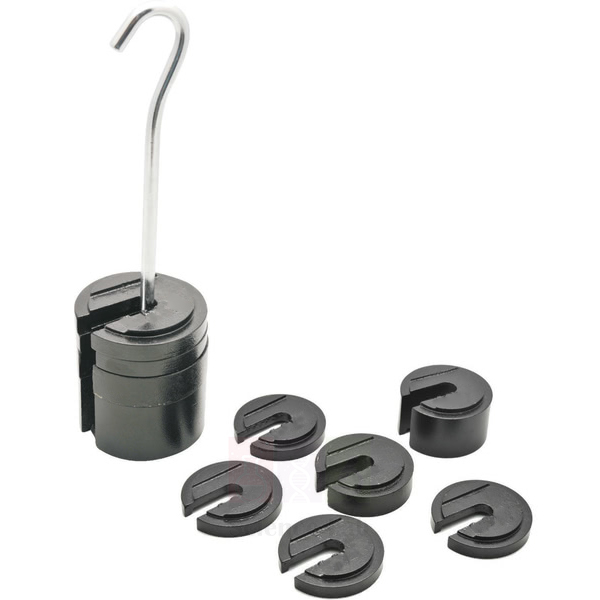
Slotted Mass Hanger, 1kg
The Slotted Mass Hanger, 1kg is a large format cast hanger that weighs 1kg on its own. It carries large slotted masses when a wire, beam or pulley cord is loaded in kilogram steps. The hanger is 26cm long and 7cm wide, and it is supplied as the hanger only, without slotted masses.
1kg slotted mass hanger specifications
| Parameter | Detail |
|---|---|
| Type | Large format slotted mass hanger (cast masses range) |
| Hanger mass | 1kg (1000 g) |
| Length | 26cm |
| Width | 7cm |
| Supplied as | Hanger only; slotted masses not included |
| Product code | SLE/LB/28 |
| Minimum order | 10 units |
| Dispatch | Usually within 7 to 10 working days |
| Manufacturer | ScienceLab (Jain Scientific Equipments Pvt Ltd), Ambala, India |
Heavy-load practicals with the 1kg hanger
Young's modulus by Searle's method. Fix Searle's apparatus to a rigid wall mount and hang the 1kg hanger from the test wire, with a steady load on the reference wire beside it. Add large slotted masses one step at a time, bring the spirit level back to horizontal with the micrometer screw, and note each reading. Repeat while unloading.
Deflection of a loaded beam. On a beam deflection apparatus, hang the hanger at mid-span and add slotted masses in equal steps, noting the deflection at each total load. A straight-line graph of deflection against load shows that the beam is still bending elastically.
Limiting friction. Clamp a ball-bearing bench pulley to the bench edge and run a cord from a heavily loaded wooden block over it to the hanger. Add masses until the block just starts to slide, then divide the hanging weight by the total weight of the block and its load to estimate the coefficient of friction.
Frequently Asked Questions About the Slotted Mass Hanger, 1kg
How much clearance does the 1kg hanger need below its support?
Allow for the hanger's own 26cm length, the height of the slotted masses you plan to stack on it, and any stretch of the wire or cord. Leave a gap above the floor or bench as well, so the load never rests on anything while a reading is taken.
Why does Searle's apparatus use a second wire beside the loaded one?
The reference wire hangs from the same support and carries a constant load. If the room warms or the support gives slightly, both wires move together, so the spirit level between them shows only the extra stretch of the test wire caused by the slotted masses.
Why wait, and tap the frame, after each mass is added?
A freshly loaded wire takes a little time to reach its new length, and the level or screw can stick. Tap the frame lightly, wait until the bubble stays still, then read. Turn the micrometer screw in one direction only while levelling, so backlash does not creep into the reading.
Why take readings while unloading as well as loading?
If the loading and unloading readings agree at each load, the wire has stayed within its elastic limit and has not taken a permanent set. Averaging each pair also evens out small lags, and the mean extension for one load step then goes into the calculation.
How should students handle a hanger this heavy?
Hang it only from a firmly clamped hook or support and keep hands and feet out of the space beneath it. Lower each slotted mass onto the stem instead of letting it drop, and lift the stack off piece by piece at the end of the practical.
Apparatus and hangers for heavy slotted loads
- Searle's Apparatus
- Apparatus Young Modulus Searle's
- Pulley, Bench Mounting, Ball Bearing
- Slotted Mass Hanger, 500g
- Hangers with Slotted Weights
- Cantilever Beam Apparatus
To request a quotation, send the product name, code and quantity through our contact page or add the item to your enquiry cart.
Last updated: 15 November 2026
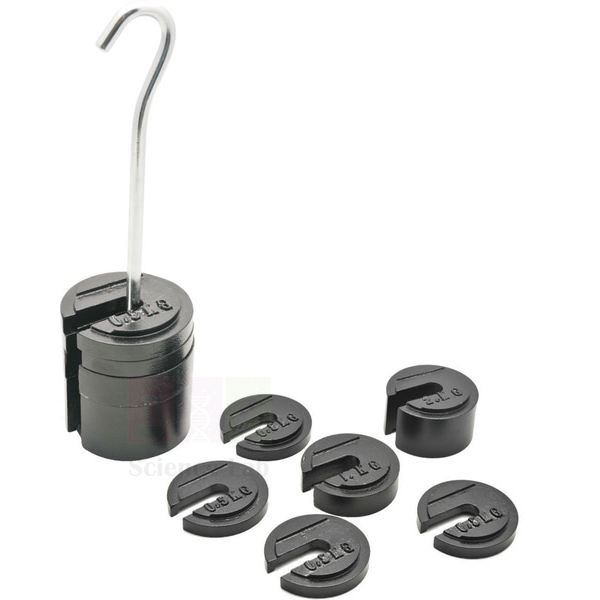
Slotted Mass Hanger, 500g
The Slotted Mass Hanger, 500g gives a half-kilogram starting load for springs, pulley cords and wires before large slotted masses are added. It is a large format cast hanger, listed at 34cm long and 8cm wide. It comes as the hanger alone, so the masses that stack on it are bought separately.
500g slotted mass hanger specifications
| Parameter | Detail |
|---|---|
| Type | Large format slotted mass hanger (cast masses range) |
| Nominal hanger mass | 500g (0.5 kg) |
| Length | 34cm |
| Width | 8cm |
| Supplied as | Hanger only (slotted masses not included) |
| Product code | SLE/LB/29 |
| Minimum order | 10 units |
| Dispatch | Usually within 7 to 10 working days |
| Manufacturer | ScienceLab (Jain Scientific Equipments Pvt Ltd), Ambala, India |
Pulley and spring work with the 500g hanger
Mechanical advantage of a pulley block. Hang the 500g hanger from the lower block of a pulley demonstration set as the load, and pull on the effort string through a spring balance so the load rises slowly and steadily. Measure how far the effort and the load move, then repeat with slotted masses added to the hanger.
Atwood's machine. Clamp a rod-mounted pulley high on a retort stand and hang two 500g hangers from the ends of a light cord. Add a small slotted mass to one side, time its fall over a measured height, and compare the acceleration with the value predicted from the difference and the sum of the two masses.
Stiff springs. On a Hooke's law apparatus, use the hanger as the first load on a stiff steel extension spring, then add masses one at a time and read the pointer at eye level. Remove them in reverse order and check that the pointer comes back to its starting mark.
Frequently Asked Questions About the Slotted Mass Hanger, 500g
Why use two equal 500g hangers in Atwood's machine?
Two equal hangers balance each other, so only the small extra mass drives the motion while both hangers still have to be speeded up. The acceleration is then slow enough to time by hand. Check first that the two hangers balance with no extra mass on either side.
How are mechanical advantage and velocity ratio found in a pulley experiment?
Mechanical advantage is the load divided by the effort needed to raise it steadily. Velocity ratio is the distance the effort moves divided by the distance the load rises in the same time. For a simple pulley block it equals the number of rope sections holding up the lower block.
Why can a real pulley system never be fully efficient?
Some of the work put in is lost to friction at the axles and in the rope, and some goes into lifting the lower pulley block itself. The mechanical advantage therefore always falls short of the velocity ratio, and efficiency, which is their ratio, is always less than one.
Why does efficiency go up as more mass is added to the hanger?
The weight of the moving block and the friction in the pulleys are roughly fixed. With a light load they take a large share of the effort, while with a heavier load they become a smaller part of it. Students should see efficiency climb, then level off, as the load grows.
When is the 500g hanger a better choice than a 1kg hanger?
Use it when the first load step must be smaller: on stiffer springs that a 1kg start would overstretch, in Atwood's machine where both sides need equal hangers, or as a counterweight in pulley demonstrations. A 1kg hanger suits work that runs in whole-kilogram steps.
Hangers, pulleys and spring apparatus for a 500g load
- Slotted Mass Hanger, 1kg
- Hangers with Slotted Weights 500 gm
- Pulley, Rod & Bench Mounting
- Pulley Demonstration Set
- Apparatus for Demonstrating Hooke's Law (Determination of Elasticity Constant)
- Hooke's Law Apparatus
To request a quotation, send the product name, code and quantity through our contact page or add the item to your enquiry cart.
Last updated: 15 November 2026

Mass Set, Brass, 1000g
The Mass Set, Brass, 1000g loads springs and pulley systems in equal 100 g steps up to one kilogram. This small form slotted set is made of brass and holds a 100 g hanger plus nine 100 g slotted masses. The hanger counts as the first step and is part of the 1000 g total.
Specifications of the 1000 g brass slotted set
| Parameter | Detail |
|---|---|
| Type | Small form slotted mass and hanger set |
| Material | Brass |
| Total mass | 1000g, hanger included |
| Hanger | 1 x 100g (included) |
| Slotted masses | 9 x 100g |
| Load steps | 100g steps, from 100g (hanger alone) to 1000g |
| Product code | SLE/LB/30 |
| Minimum order | 10 units |
| Dispatch | Usually within 7 to 10 working days |
| Manufacturer | ScienceLab (Jain Scientific Equipments Pvt Ltd), Ambala, India |
Spring and pulley work with the 1000 g brass set
Force and extension of a stiff spring. Clamp the spring on the Hooke's law apparatus, note the pointer position, then hang the hanger and add the brass masses one at a time. Record each extension and plot weight against extension. The straight part of the graph gives the spring constant.
Springs in series and in parallel. Take two springs of equal stiffness from a set of springs and hang them side by side under a bar, then end to end. Load each arrangement in 100 g steps and compare the extensions with those of a single spring.
Effort against load in a pulley system. Build a block and tackle from two double metal pulleys, hang the loaded hanger from the lower block and pull the effort string through a force meter. Raise the load one mass at a time and work out the mechanical advantage at each step.
Frequently Asked Questions About the Mass Set, Brass, 1000g
How should the masses be stacked so they stay on the hanger?
Slide each mass down the stem until it lies flat, then turn it so its slot points away from the slot of the mass below. Staggered slots hold the stack together when the hanger swings or is knocked.
Why change the masses into newtons before drawing the graph?
A spring responds to force, so the graph needs weight rather than mass. Convert grams to kilograms and multiply by the gravitational field strength. Each 100 g step adds roughly 1 N, which keeps the arithmetic easy for students.
How do students avoid parallax and swinging errors?
Keep the ruler vertical beside the spring and read the pointer with the eye level with it. Wait until the hanger has stopped moving before each reading, because a bobbing load gives a different value every time.
What does a curve at the top of the force-extension graph mean?
The spring has passed its limit of proportionality, so extension no longer rises evenly with load. Beyond the elastic limit it will not return to its first length either. Stop loading once the points begin to bend away from the line.
Is this set suitable for soft springs?
Not usually. Its smallest step is 100 g, which can overstretch a soft spring in a single addition. For light springs and levers, the Mass Set, Brass, 100g gives 10 g steps and the Mass Set, Brass, 250g allows 5 g adjustments.
Other slotted masses and spring apparatus
- Mass Set, Brass, 100g
- Mass Set, Brass, 250g
- Mass, Cast Alloy, 1000g
- Slotted Mass Hanger, 1kg
- Hooke's Law Apparatus
To request a quotation, send the product name, code and quantity through our contact page or add the item to your enquiry cart.
Last updated: 14 November 2026

Mass Set, Brass, 100g
Ten equal 10 g pieces make up the Mass Set, Brass, 100g, the lightest set in the small form slotted brass range. A 10 g hanger carries nine 10 g slotted masses, so soft springs, rubber bands and metre-rule levers can be loaded gently from 10 g to 100 g without overloading them.
100 g brass slotted set specifications
| Parameter | Detail |
|---|---|
| Type | Small form slotted mass and hanger set |
| Material | Brass |
| Total mass | 100g, hanger included |
| Hanger | 1 x 10g (included) |
| Slotted masses | 9 x 10g |
| Smallest step | 10g |
| Product code | SLE/LB/31 |
| Minimum order | 10 units |
| Dispatch | Usually within 7 to 10 working days |
| Manufacturer | ScienceLab (Jain Scientific Equipments Pvt Ltd), Ambala, India |
Light-load practicals with the 100 g brass set
Law of moments on a metre rule. Balance the rule on a knife-edge clamp from the fulcrum and lever set. Hang the brass hanger with a few masses on one side and a known load on the other, slide them until the rule rests level, and compare load times distance on each side.
Mass of a small object by moments. Tie the object with cotton thread near one end of the balanced rule and hang a chosen number of 10 g masses on the other side. Move the loads until the rule is level, then equate the moments to find the unknown mass.
Rubber band against spring. Hang a rubber band and a soft spring side by side from a retort stand, load each in 10 g steps and then unload. The spring returns along the same line, while the band stretches unevenly and comes back by a different path.
Frequently Asked Questions About the Mass Set, Brass, 100g
Why must the 10 g hanger be counted in every reading?
The hanger is one of the ten pieces and weighs the same as each slotted mass. Leaving it out makes every load 10 g too small, which shifts a moments calculation or an extension graph by a whole step.
How is an unknown mass found with a metre rule and this set?
Balance the rule, hang the unknown on one side and the loaded hanger on the other, and move them until the rule is level. Multiply the known mass by its distance from the pivot, then divide by the distance of the unknown.
Does the thread holding a load spoil the result?
A thick or heavy thread adds mass that the calculation leaves out. With loads as small as 10 g, use thin cotton thread or a light wire loop, and make the loops alike on both sides of the pivot.
Why should the metre rule be level before any loads go on?
Balancing the empty rule first puts its centre of gravity over the pivot, so the rule's own weight adds no moment to either side. Use a sharp knife edge, note the balance point if it is not exactly at the centre mark, and take every reading with the loaded rule level.
How can a class keep small brass masses together and clean?
Count the hanger and all nine masses into a tray at the start and end of each lesson. Handle the pieces by their edges, keep them off wet benches and wipe them with a dry cloth before stacking them back on the hanger.
Light mass sets, moments apparatus and a spring balance
- Mass, Cast Alloy, 100g
- Mass Set, Brass, 250g
- Balance Demonstration Fulcrum/Lever
- Lever
- Balance Spring Tubular Plastic
To request a quotation, send the product name, code and quantity through our contact page or add the item to your enquiry cart.
Last updated: 14 November 2026

Mass Set, Brass, 250g
The Mass Set, Brass, 250g sets loads from 50 g to 250 g in 5 g steps for string tension, moment and friction work. Its 50 g hanger takes nine 20 g slotted masses for the main steps, with one 10 g and two 5 g pieces to fill the gaps between them.
250 g brass slotted set specifications
| Parameter | Detail |
|---|---|
| Type | Small form slotted mass and hanger set |
| Material | Brass |
| Total mass | 250g, hanger included |
| Hanger | 1 x 50g (included) |
| Slotted masses | 9 x 20g, 1 x 10g, 2 x 5g |
| Load range | 50g to 250g in 5g steps |
| Product code | SLE/LB/32 |
| Minimum order | 10 units |
| Dispatch | Usually within 7 to 10 working days |
| Manufacturer | ScienceLab (Jain Scientific Equipments Pvt Ltd), Ambala, India |
Fine-step loading with the 250 g brass set
Standing waves on a string. Tie one end of a string to a vibration generator, run it over a ball bearing bench pulley and hang the brass hanger on the free end. Add 20 g masses, then trim with the 10 g and 5 g pieces until a steady pattern of loops forms.
Limiting friction. Lay the tribometer board flat, tie its wooden slider to a cord over the end pulley and hang the hanger on the cord. Add 20 g pieces until the slider is close to moving, then top up in 5 g steps until it just starts to slide.
Balancing a moment disk. Hang the loaded hanger from one point on the disk of the moment of force apparatus and hold the disk still with one of its dynamometers attached at another point. Change the load in 5 g steps and compare load times arm with the dynamometer force times its arm.
Frequently Asked Questions About the Mass Set, Brass, 250g
How are the pieces combined to set a particular load?
Start with the 50 g hanger, add 20 g masses for the bulk, then finish with the 10 g and 5 g pieces. For 100 g, for example, use the hanger, two 20 g masses and the 10 g mass, or both 5 g pieces in place of the 10 g.
Why add only 5 g at a time near the point of sliding?
Static friction grows to match the pull until it reaches its limit, and only then does the slider move. A large step can overshoot that limit, so the friction force comes out too high. Near the point of sliding, add the 5 g pieces gently, one at a time, without jolting the cord.
Why must the pulley turn freely?
Friction at the pulley takes up part of the hanging weight, so the string tension is lower than the load suggests. Use a light pulley that spins easily, and check that the string runs straight in its groove.
How does tension change the note of a stretched string?
For a fixed length of the same string, frequency rises with the square root of the tension, so doubling the frequency needs four times the tension. Near resonance with a tuning fork, a few grams still shift the note enough to matter, which is where the 5 g pieces help.
How does this set differ from the lighter brass set?
The Mass Set, Brass, 100g starts at 10 g and moves in 10 g steps. This set starts at 50 g with its hanger, reaches 250 g and adds 5 g resolution through its two 5 g pieces.
Brass mass sets and string and friction apparatus
- Mass Set, Brass, 100g
- Mass Set, Brass, 1000g
- Vibration Generator
- Pulley, Bench Mounting, Ball Bearing
- Inclined Plane With Accessories
To request a quotation, send the product name, code and quantity through our contact page or add the item to your enquiry cart.
Last updated: 14 November 2026

Mass, Cast Alloy, 100g
The Mass, Cast Alloy, 100g gives each bench group light loads in 10 g steps, from the hanger alone up to 100 g. This small format set holds nine 10 g slotted masses and a 10 g hanger, all in cast alloy, so a whole class can be issued identical sets.
Cast alloy 100 g mass set specifications
| Parameter | Detail |
|---|---|
| Type | Small format cast alloy mass and hanger set |
| Material | Cast alloy |
| Total mass | 100g |
| Contents | 9 x 10g slotted masses, 1 x 10g hanger |
| Load steps | 10g, from 10g (hanger alone) to 100g |
| Product code | SLE/LB/33 |
| Minimum order | 10 units |
| Dispatch | Usually within 7 to 10 working days |
| Manufacturer | ScienceLab (Jain Scientific Equipments Pvt Ltd), Ambala, India |
Weight, force and spring practicals with the cast alloy 100 g set
Weight against mass. Hang the hanger from a tubular plastic spring balance that reads in newtons and add the masses one at a time. Plot weight in newtons against mass in kilograms. The gradient of the line gives the gravitational field strength.
Oscillations of a loaded spring. Hang a steel extension spring from a stand, load it with the hanger and a few masses, and time several full oscillations. Repeat with more mass and plot the square of the period against the load.
Making a simple force meter. Fix a light spring to a retort stand with a card scale behind it. Mark the pointer position with the hanger alone, then again after each added 10 g mass, and the marked card becomes a homemade spring balance.
Frequently Asked Questions About the Mass, Cast Alloy, 100g
What is the difference between the mass and the weight of this set?
Mass is the amount of matter, and the full set has a mass of 100 g wherever it is taken. Weight is the pull of gravity on that mass, measured in newtons, so on the Moon the same set would weigh about one sixth as much.
What does the slope of a weight against mass graph show?
The slope is weight divided by mass, which is the gravitational field strength in newtons per kilogram. A line passing through or very near the origin shows that weight is proportional to mass.
Why zero the spring balance before the set is hung on it?
A spring balance that reads above or below zero when empty adds the same error to every weight reading and shifts the whole line on the graph. Set the zero with nothing on the hook, hold the balance vertical and read it at eye level once the hanger stops swinging.
How close to 10 g is each cast alloy piece?
No tolerance is stated for this set, only the 10 g value of each piece. To check a set, weigh the hanger and each mass on a balance that reads finer than 1 g and set aside any piece that differs clearly from the rest.
Why label each set with a group number?
Pieces from different sets look alike and drift between benches during a lesson. A group number on each set keeps the hanger and its nine masses together, so every group starts the next practical with a full 100 g.
Mass sets, hangers and force meters
- Mass Set, Brass, 100g
- Mass, Cast Alloy, 1000g
- Mass, Cast Alloy, Hanger
- Force Meter/Spring Balance
- Balance Spring Tubular Plastic
To request a quotation, send the product name, code and quantity through our contact page or add the item to your enquiry cart.
Last updated: 14 November 2026

Mass, Cast Alloy, 1000g
The Mass, Cast Alloy, 1000g supplies one kilogram of load as nine 100 g slotted masses and a 100 g hanger, all in cast alloy. Loads rise in equal steps from 100 g with the hanger alone to 1000 g, and the small format pieces move easily between a trolley and the hanger in dynamics work.
Cast alloy 1000 g mass set specifications
| Parameter | Detail |
|---|---|
| Type | Small format cast alloy mass and hanger set |
| Material | Cast alloy |
| Total mass | 1000g |
| Contents | 9 x 100g slotted masses, 1 x 100g hanger |
| Product code | SLE/LB/34 |
| Minimum order | 10 units |
| Dispatch | Usually within 7 to 10 working days |
| Manufacturer | ScienceLab (Jain Scientific Equipments Pvt Ltd), Ambala, India |
Dynamics and beam practicals with the cast alloy set
Force and acceleration at constant mass. Load a plastic dynamics trolley with eight of the masses and hang the hanger plus one mass from a cord over a ball bearing bench pulley. Release it, find the acceleration, then move one mass at a time from trolley to hanger. The pulling force rises while the total mass stays fixed.
Beam reactions. Support the beam of the moments kit from two spring balances and hang the cast alloy hanger at a measured point along it. Add 100 g masses one by one and check that the two support readings always add up to the weight of beam and load.
Frequently Asked Questions About the Mass, Cast Alloy, 1000g
Why move masses from the trolley to the hanger instead of adding new ones?
Newton's second law relates force to the whole mass being accelerated, and that includes the hanger as well as the trolley. Transferring pieces raises the pulling force while the total mass stays the same, so acceleration against force gives a straight line.
Why can the graph give the wrong trolley mass?
The slope of acceleration against force equals one divided by the total mass being accelerated: the trolley, the masses on it and the hanger with its load. Reading it as the trolley mass alone gives a wrong answer. Friction shifts the line off the origin, so first tilt the runway until the trolley rolls at a steady speed with nothing hanging.
Should final or average speed be used to work out the acceleration?
Use the change in velocity divided by the time taken, not one average speed for the whole run. For a trolley starting from rest, acceleration equals twice the distance travelled divided by the square of the time.
How can a missing or mixed-up piece be spotted quickly?
Weigh the full stack on a balance before the lesson. The hanger and all nine masses together should read close to one kilogram, so a missing piece or a mass borrowed from another set shows up at once.
Brass or cast alloy for a class set of 1000 g masses?
Both give a 100 g hanger and nine 100 g masses, so experiments run the same way with either. Match the material to the sets your department already uses; the Mass Set, Brass, 1000g is the brass version.
How should the falling hanger be handled in trolley runs?
Place a box or soft pad under the hanger so it does not strike the floor, and catch the trolley by hand before it reaches the pulley. Keep feet clear of the drop while the run is in progress.
Trolleys, pulleys and other slotted masses
- Dynamics Trolley, Plastic
- Pulley, Bench Mounting, Ball Bearing
- Mass Set, Brass, 1000g
- Mass, Cast Alloy, 100g
- Slotted Mass Hanger, 1kg
To request a quotation, send the product name, code and quantity through our contact page or add the item to your enquiry cart.
Last updated: 14 November 2026

Mass, Cast Alloy, Hanger
The Mass, Cast Alloy, Hanger pack contains three 50g hangers cast in alloy, each with a stated accuracy of 1%. The hangers carry flat slotted masses that have a large central hole and a small slot, so a class can hang loads at three points at once or replace hangers lost from older sets.
Cast alloy hanger pack specifications
| Parameter | Detail |
|---|---|
| Item | Mass hanger, 50g each |
| Pack size | 3 hangers |
| Material | Cast alloy |
| Accuracy | 1% |
| Compatible masses | Flat masses with a large central hole and a small slot that stops them sliding off |
| Product code | SLE/LB/35 |
| Minimum order | 10 units |
| Dispatch | Usually within 7 to 10 working days |
| Manufacturer | ScienceLab (Jain Scientific Equipments Pvt Ltd), Ambala, India |
Multi-load force practicals with three hangers
Parallelogram of forces. Pin a sheet of paper to the board of the law of parallelogram apparatus and run a thread over its pulleys, with a hanger at each end and the third hanger tied to the middle. Load all three, let the knot settle, and mark the thread lines. Two loads drawn to scale as sides of a parallelogram should give a diagonal equal and opposite to the third.
Holding a trolley on a slope. Raise one end of a smooth board, rest a dynamics trolley on it and run a cord, parallel to the board, from the trolley over a bench pulley clamped at the top to one hanger. Add flat masses until the trolley stays at rest. Repeat at steeper angles and compare the hanging load with the trolley's weight times the sine of the angle.
Three springs side by side. Hang three different springs from a set of springs on the rod of a retort stand, one hanger on each, and note every pointer. Add the same flat mass to each hanger in turn, measure the extensions and plot all three lines on one graph to rank the springs by stiffness.
Frequently Asked Questions About the Mass, Cast Alloy, Hanger
Will slotted masses I already have fit these hangers?
They fit if they are flat masses with a large central hole and a small slot, the design these hangers are made for. Check that the slot passes over the stem and the hole drops onto it. Small masses from a lighter set may have a different hole, so try one before a class uses them.
How far can a 50g hanger with 1% accuracy be out?
Each hanger may differ from 50g by up to 1% of that value. That is small beside pulley friction and marking errors in a school force practical, but it adds up when several hangers and masses share one load.
Why must each hanger hang clear of the board?
If a hanger rubs on the board or the bench, that contact takes part of its weight and the thread no longer carries the full load. The knot then settles in the wrong place and the parallelogram will not close.
How does pulley friction affect a three-force result?
Friction lets the knot rest anywhere within a small range instead of at one point, so the marked angles vary. Keep the pulleys clean and lightly oiled, tap the board gently before marking the threads, and repeat with different loads to see how large the spread is.
How should the three loads be chosen for a three-force practical?
No single load may equal or exceed the other two added together, or the knot runs into a pulley and never settles. Loads that leave clear angles between the threads give a larger parallelogram, which is easier to draw and measure accurately.
Hangers, mass sets and force apparatus
- Mass, Cast Alloy, 100g
- Mass, Cast Alloy, 1000g
- Mass Set, Brass, 250g
- Slotted Mass Hanger, 500g
- Law of Parallelogram Apparatus (Gravesande Apparatus)
- Force Table
To request a quotation, send the product name, code and quantity through our contact page or add the item to your enquiry cart.
Last updated: 15 November 2026