- Physics Lab Equipment
- Chemistry Lab Equipment
- Biology Lab Equipment
- Anatomical Lab Equipment
- Learning
- Educational Lab Equipment
- Magnets
- Agriculture
- Astronomy
- Earth Science
- Geography Lab Equipment
- Safety Lab Coat
- Laboratory
- Meteorological
- Electricity & Magnetism
- Heat
- School Lab Equipment
- Lab Glassware
- Science Lab Equipment
- Tvet Lab Equipment
- Robotics Kits Supplier and Manufacturer for Schools India
- Math Lab Equipment Manufacturers and Exporters in Ambala
- STEM Kits Manufacturers and Supplier India
- Engineering Lab Equipment
- Hospital Lab Equipment
- Water, Sanitation & Hygiene Supplies
- Cold Chain, Solar & Communication Equipment
- Nutrition
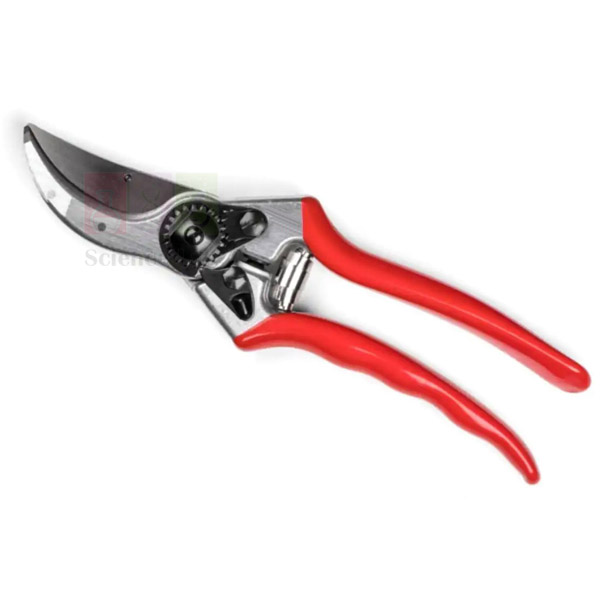
Garden Secateurs
Garden Secateurs (Product Code: SLE/BL/37) are hand-held pruning shears used to snip buds and similar plant material cleanly for flower study, propagation experiments and school-garden care. Listed among the garden tools in the biology range, they give botany teachers a clean cut where ordinary scissors would crush soft stems. They are supplied by Jain Scientific Equipments Pvt Ltd (ScienceLab), Ambala, India, alongside its botany lab equipment in India.
Key Details
| Parameter | Detail |
|---|---|
| Type | Garden secateurs (hand pruning shears) |
| Purpose | Snipping buds and similar plant material |
| Listed among | Garden tools |
| Product code | SLE/BL/37 |
| Supplied by | Jain Scientific Equipments Pvt Ltd (ScienceLab), Ambala, India |
What Are the Garden Secateurs Used For?
Biology teachers use secateurs whenever fresh plant material has to be cut rather than torn: snipping flower buds at different stages of opening to show how petals, stamens and carpels develop; taking soft stem cuttings for rooting trials; and collecting leaves or shoots for identification and microscope work. A clean cut leaves less crushed tissue at the end of the stem, which helps cuttings stay healthy and keeps specimens looking like the living plant.
For cuttings, cut just above a leaf joint on the parent plant and just below one on the piece being rooted. Wipe the blades between plants if you are sampling from different beds, so that disease is not carried from one plant to the next. Pupils should use secateurs only under supervision and hand them over closed, handle first. As part of a school's plant biology teaching aids in India, a pair kept in the prep room saves improvising with scissors that bruise stems.
Supplier
Jain Scientific Equipments Private Limited, trading as ScienceLab from Ambala, Haryana, India, supplies these secateurs together with the plant-study apparatus and fieldwork items a biology department needs. For vendor registration, institutional and tender buyers can record the supplying company's GSTIN 06AAECJ8618A1ZT and LEI 3358004HRD1JIVXKYX49. Read more on our company profile.
Related Biology Lab Equipment
Items used with secateurs in plant study and school garden work:
- Plant Propagation Kit — for rooting the cuttings taken with the secateurs
- Leaf Identification Kit — for identifying the leaves and shoots collected
- Hand Lens — for examining buds and flower parts after cutting
- Typical Flower V.S. Model — to compare a snipped flower with a sectioned model
- Garden Auger Soil — for sampling the soil the plants grow in
Our full Biology Lab Equipment listing covers more botany and fieldwork items.
Frequently Asked Questions
What are the Garden Secateurs used for in a biology lab?
The Garden Secateurs are used to snip buds and similar plant material, for example when cutting flower buds at different stages for dissection, taking soft stem cuttings for rooting trials, or collecting shoots and leaves for identification and microscope work.
What size are the Garden Secateurs, and what are the blades made of?
Size and blade material are not listed for the Garden Secateurs. Please contact us before ordering and we will confirm these details for the secateurs being quoted, so you can check they suit your students and plants.
Can the Garden Secateurs cut thick woody branches?
The Garden Secateurs are described for snipping buds and similar soft material, and no cutting capacity is stated. If you need to cut heavier woody stems in the school garden, ask us before ordering so we can advise on a suitable tool.
Are the Garden Secateurs safe for students to use?
The Garden Secateurs have sharp blades, so younger pupils should use them only under adult supervision. Teach students to hand them over closed and handle first, and store the secateurs closed in the prep room when they are not in use.
How should the Garden Secateurs be looked after?
Wipe sap and soil off the Garden Secateurs after use, dry the blades and store them in a dry place. A drop of light oil on the pivot keeps the action smooth, and wiping the blades between plants avoids carrying disease from bed to bed.
Who supplies the Garden Secateurs?
Jain Scientific Equipments Pvt Ltd (ScienceLab), Ambala, India, supplies the Garden Secateurs (SLE/BL/37) to schools, colleges and distributors in India and international markets. Send your quantity and delivery location via the contact page to receive a quotation with the rest of your botany order.
Request a Quote
To price Garden Secateurs with the rest of your botany order, contact us or add them to the enquiry cart.
Last updated: 24 September 2026