- Physics Lab Equipment
- Chemistry Lab Equipment
- Biology Lab Equipment
- Anatomical Lab Equipment
- Learning
- Educational Lab Equipment
- Magnets
- Agriculture
- Astronomy
- Earth Science
- Geography Lab Equipment
- Safety Lab Coat
- Laboratory
- Meteorological
- Electricity & Magnetism
- Heat
- School Lab Equipment
- Lab Glassware
- Science Lab Equipment
- Tvet Lab Equipment
- Robotics Kits Supplier and Manufacturer for Schools India
- Math Lab Equipment Manufacturers and Exporters in Ambala
- STEM Kits Manufacturers and Supplier India
- Engineering Lab Equipment
- Hospital Lab Equipment
- Water, Sanitation & Hygiene Supplies
- Cold Chain, Solar & Communication Equipment
- Nutrition
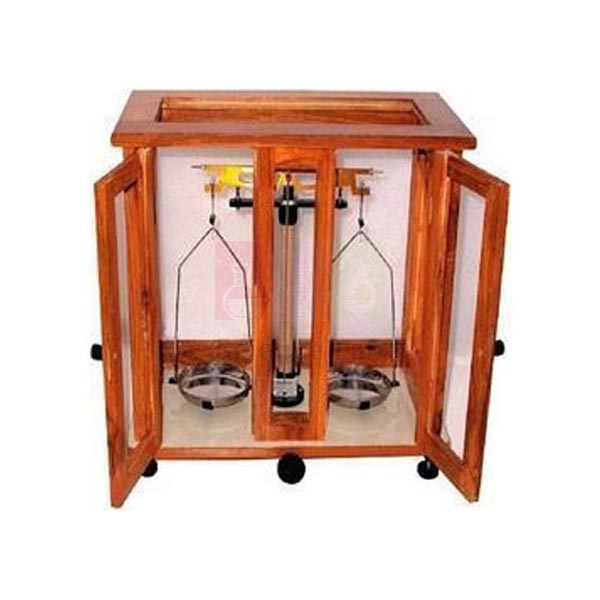
Physical Balance
This student beam balance weighs up to 250 g with a sensitivity of 2 mg. Its cast alloy beam rests on agate bearings and knife edges, and the nickel plated brass pans lift off for cleaning. Double-hook hangers let a sample hang below a pan in water, so the same instrument covers both mass and specific gravity practicals.
Physical balance construction and capacity
| Parameter | Detail |
|---|---|
| Capacity | 250 g |
| Sensitivity | 2 mg |
| Beam | Cast alloy, fitted with balancing nuts |
| Bearings | Agate bearings and knife edges |
| Pans | Detachable, nickel plated brass |
| Hangers | Double hooks for specific gravity experiments |
| Pillar | Enamelled central pillar |
| Levelling | Plumb line and levelling screws |
| Case | Polished wooden case |
| Product code | SLE/LB/08 |
| Minimum order | 10 units |
| Dispatch | Usually within 7 to 10 working days |
| Manufacturer | ScienceLab (Jain Scientific Equipments Pvt Ltd), Ambala, India |
Practicals on the physical balance
Mass of a solid. Level the balance with the levelling screws until the plumb line is centred, then zero the empty beam with the balancing nuts. Put the object on the left pan. Add masses from the Physical Balance Mass Set to the right pan with forceps, starting with the heaviest, and finish with fractional weights.
Relative density of a solid. Weigh a metal density cube in air. Then tie it with fine thread to the lower hook so that it hangs fully under water in a glass beaker that does not touch the pan. Divide the weight in air by the loss of weight in water.
Relative density of a liquid. Use one sinker for three weighings: in air, in water and in the test liquid, such as glycerine or salt solution. The loss of weight in the liquid divided by the loss in water gives its relative density. Rinse and dry the sinker before each liquid.
Double weighing. Weigh one object first in the left pan and then in the right pan. If the readings differ, the arms are not quite equal. The square root of the product of the two readings gives the true mass and removes the arm error.
Frequently Asked Questions About the Physical Balance
Why let the pointer swing instead of waiting for it to stop?
A swinging beam takes a long time to come to rest, and friction can make it stop slightly off true. Equal swings on either side of the centre mark show balance sooner and more reliably. If the swings are uneven, add or remove a fractional weight until they match.
Does the physical balance measure mass or weight?
It measures mass. The unknown is compared with standard masses on a lever with equal arms, so gravity pulls equally on both sides and cancels out. The reading would be the same on the Moon, while a spring balance reads weight and would show a smaller value there.
Why must masses be lifted with forceps and not with fingers?
Moisture and grease from fingers add a little mass and slowly corrode the metal, so the masses drift away from their marked values. Forceps also make it less likely that a mass is dropped onto the pan, which jolts the beam and can blunt the knife edges.
Why does the reading drift near a fan or with a warm sample on the pan?
Moving air pushes on the pans and stops the beam settling. A warm object heats the air around it, and the rising air makes it seem lighter than it is. Weigh away from fans and open windows, and let heated samples cool to room temperature first.
Why must the solid hang clear of the beaker during a relative density reading?
If the solid touches the side or base of the beaker, part of its weight rests on the glass and the balance reads too little. The loss of weight then looks too large and the relative density comes out low. Hang it fully under water, clear of the glass, and brush off any air bubbles first.
How should the knife edges and agate bearings be looked after?
Place loads on the pans gently and stay within the 250 g capacity. Never let an object fall onto a pan. After the practical, remove all masses, wipe the pans and close the wooden case so that dust cannot settle on the bearing surfaces.
Balances, masses and samples for mass and density practicals
- Physical Balance Mass Set
- Chemical Balance
- Physical Balance (Digital)
- Metal Density Cube Set
- Double Beam Balance
- Triple Beam Balance
To request a quotation, send the product name, code and quantity through our contact page or add the item to your enquiry cart.
Last updated: 14 November 2026
