- Physics Lab Equipment
- Chemistry Lab Equipment
- Biology Lab Equipment
- Anatomical Lab Equipment
- Learning
- Educational Lab Equipment
- Magnets
- Agriculture
- Astronomy
- Earth Science
- Geography Lab Equipment
- Safety Lab Coat
- Laboratory
- Meteorological
- Electricity & Magnetism
- Heat
- School Lab Equipment
- Lab Glassware
- Science Lab Equipment
- Tvet Lab Equipment
- Robotics Kits Supplier and Manufacturer for Schools India
- Math Lab Equipment Manufacturers and Exporters in Ambala
- STEM Kits Manufacturers and Supplier India
- Engineering Lab Equipment
- Hospital Lab Equipment
- Water, Sanitation & Hygiene Supplies
- Cold Chain, Solar & Communication Equipment
- Nutrition
Measuring equipment for school and college science covers the tools students use to read mass, force, length, angle, liquid volume, temperature, time, pH and simple electrical values, from rulers and spring scales in primary classes to pH meters and colorimeters in senior practicals. Jain Scientific Equipments Pvt Ltd (ScienceLab), Ambala, makes the spring scales, mass set, rulers, metersticks and immersion and spirit-filled thermometers at its own licensed factory and supplies the balances, pipettors and digital measuring instruments that complete the range.
What Does the Measuring Range Include?
| Quantity | What it covers | Example products |
|---|---|---|
| Mass and force | Weighing and force readings in school science | Triple Beam Balance, Electronic Balances, Spring Scales, Green, 500 g (5 N), Force Meter/Spring Balance, Mass Set |
| Length, distance and angle | Measuring objects, the playground and angles | Metersticks, Fiberglass Tape Measure, Trundle Wheel, Professional Protractor |
| Liquid volume and pipetting | Transferring measured volumes of liquid safely | Research Pipettors, Pipette Controller, Safety Pipet Filler, Silicone, Micropipette Tips |
| Temperature | Liquid, spirit-filled and digital thermometers | Immersion Thermometer, Red Spirit-Filled Thermometers, Digital Pocket Thermometer |
| Time | Timing reactions, pendulums and motion experiments | Digital Stopclock, Bench Stopwatch, Bench Timer |
| pH, colour and melting point | Chemical and physical property measurements for senior classes | pH mV and Temperature Meter, Waterproof pH Meter, Colourwave Colorimeter, Digital Melting Point Apparatus |
| Electrical readings | Meters for demonstrating electrical measurements | Demonstration Meter, Dial, Ohmmeter Series Type |
Featured Measuring Instruments
| Product | Product Code | Typical Use |
|---|---|---|
| Triple Beam Balance | SLE/ME/01 | Introducing mass measurement at the student bench |
| Spring Scales, Green, 500 g (5 N) | SLE/ME/06 | Measuring weight and force in newtons |
| Trundle Wheel | SLE/ME/30 | Measuring longer distances outdoors |
| Metersticks | SLE/ME/27 | Everyday length measurement in class activities |
| Red Spirit-Filled Thermometers | SLE/ME/37 | Reading temperatures in class experiments |
| Digital Stopclock | SLE/ME/41 | Timing experiments and reactions |
| Waterproof pH Meter | SLE/ME/50 | pH testing of solutions and water samples |
| Safety Pipet Filler, Silicone | SLE/ME/20 | Filling pipettes without mouth pipetting |
OEM Manufacturing & Supply
ScienceLab (Jain Scientific Equipments Private Limited) is the OEM for part of this range: the mass set, spring scales and force meters, rulers, metersticks, trundle wheel, protractor, immersion and red spirit-filled thermometers, the pipette carousel stand and the dial demonstration meter and series ohmmeter are made at its licensed factory at 449, HSIIDC Industrial Area, Saha, Ambala, Haryana. The company is incorporated under CIN U29309HR2020PTC087597, and the Saha premises operate under Factory Licence AMB-ONLINE-CHD-J-414. Balances, weighing boats and paper, pipettors, pipette controllers and tips, tape measures, digital thermometers, timers and stopwatches, pH meters, colorimeters and melting point apparatus are supplied. Made and supplied items are quoted together for schools, colleges, dealers, tenders and importers in India and international markets.
Related Ranges
- Educational Lab Equipment — the parent hub for school and college laboratory ranges.
- Balances — the dedicated weighing range with analytical and precision balances and brass mass sets; this page covers weighing only as one of several classroom quantities.
- Measuring Cylinders — graduated cylinders for volume measurement.
- Maths Lab Equipment — geometry and measurement aids for mathematics lessons.
- Scientific Lab Plasticware — plastic labware to use alongside pipettes and weighing boats.
- Physics Lab Equipment — physics apparatus that uses these timers, scales and meters.
Frequently Asked Questions
What does the Measuring range include?
The Measuring range lists 55 tools covering mass and force, length and angle, liquid volume, temperature, time, pH and colour, melting point and basic electrical readings, each with its own SLE/ME product code, so a school can equip every measurement practical from one list.
Which measuring tools suit younger students, and which suit senior classes?
In the Measuring range, rulers, metersticks, trundle wheels, spring scales and spirit-filled thermometers suit younger students learning to read scales, while the pH meters, colorimeters, pipettors and melting point apparatus are aimed at senior secondary and college chemistry and biology practicals.
How is the Measuring range different from the Balances page?
The Measuring range is a classroom range across many quantities, with weighing as only one of them. Balances is a specialist weighing range under Laboratory, so choose it when you need analytical or precision balances and reference mass sets.
Who makes the Measuring range?
The Measuring range is both manufactured and supplied by Jain Scientific Equipments Pvt Ltd (ScienceLab), Ambala. Spring scales, the mass set, rulers, metersticks, the protractor, the trundle wheel and the immersion and spirit-filled thermometers are made at its Ambala factory, while balances, pipettors, digital meters and consumables are supplied.
Are consumables and spare parts available?
Yes. The Measuring range lists Micropipette Tips, Filtered Micropipette Tips, Plastic Cuvettes, Melting-Point Tubes, Weighing Paper and a Spare Colour Filter Wheel for S-Range Digital Colorimeter as separate items, so they can be reordered with the instruments.
What should a measuring equipment quotation request include?
A quotation request for the Measuring range should give SLE/ME product codes or names, the number of students or groups to equip, quantities per item, any tender specification and the delivery location, so every line can be matched to a listed product.
Request a Quote or Catalogue
For class-set quotations or a catalogue of measuring tools, contact the ScienceLab team, or collect items in the shopping cart and send us the list.
Last updated: 24 September 2026
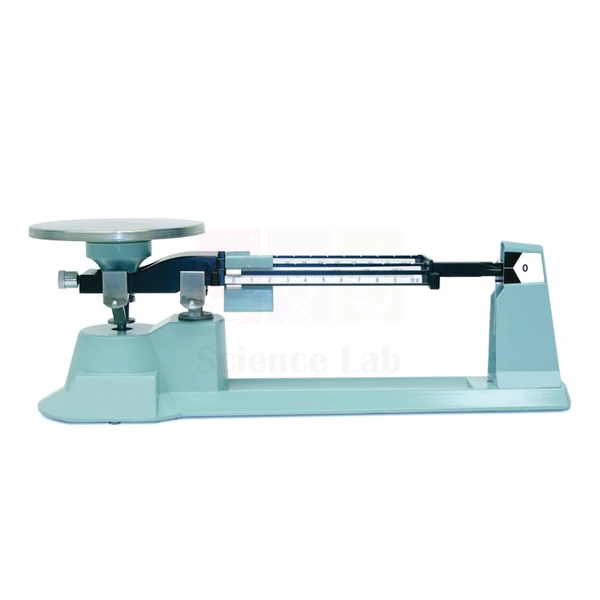
Triple Beam Balance
Triple Beam Balance (Product Code: SLE/ME/01) is a mechanical beam balance used to measure mass up to 610 g, with a readability of 0.1 g, in school and college science laboratories. Teachers and students use it for everyday practical weighing without mains power, and it combines magnetic damping, notched beams and a 6 inch (15.2 cm) stainless-steel pan for steady, repeatable readings. It is supplied by Jain Scientific Equipments Pvt Ltd (ScienceLab), Ambala, India.
Specifications
| Parameter | Detail |
|---|---|
| Capacity | 610 g |
| Readability | 0.1 g |
| Pan | Stainless-steel plate platform, 6 inch (15.2 cm) diameter |
| Body | Large, stable metal body |
| Damping | Magnetic damping |
| Beam positioning | Positive-poise positioning with well-defined notches |
| Product code | SLE/ME/01 |
| Supplied by | Jain Scientific Equipments Pvt Ltd (ScienceLab), Ambala, India |
What Is a Triple Beam Balance Used For?
A triple beam balance finds mass by comparison: the object on the pan is balanced by sliding poises along three graduated beams until the pointer rests at its zero mark, and the three beam readings are added together. Students use it to weigh chemicals for solutions, measure specimens and objects in physics and biology practicals, and find mass for density experiments. Because it works on levers rather than electronics, it also shows learners how a balance actually functions.
For good results, stand the balance on a firm, level bench and check that the pointer sits at zero with the pan empty. Move the heaviest poise first, then fine-tune with the smaller ones; the notches let each poise seat positively, and the magnetic damping settles the pointer quickly. Place hot items or loose chemicals in a weighing boat or on weighing paper, never directly on the pan.
Supplier
Jain Scientific Equipments Private Limited, which trades as ScienceLab, supplies this Triple Beam Balance from Ambala, Haryana, India, to schools, colleges, laboratories, dealers and importers. As a school laboratory equipment supplier in India, the company lets buyers combine the balance with weighing accessories and other measuring instruments in a single enquiry. Company details are on the ScienceLab profile.
Related Measuring Equipment
Weighing sessions with a beam balance usually also need:
- Plastic Weighing Boats — hold powders and granules on the pan and pour them off cleanly.
- Weighing Paper — a disposable surface for small quantities of dry samples.
- Mass Set — known masses for classroom demonstrations of balancing and measuring mass.
- Electronic Balances — a digital alternative when faster readings or finer resolution are needed.
More weighing and measuring instruments are listed under Measuring and Balances.
Frequently Asked Questions
What are the capacity and readability of the Triple Beam Balance?
The Triple Beam Balance (SLE/ME/01) has a capacity of 610 g and a readability of 0.1 g. That range covers most school and college weighing tasks, from preparing solutions to measuring objects for density and mass experiments.
What kind of pan does the Triple Beam Balance have?
The Triple Beam Balance has a stainless-steel plate platform 6 inches (15.2 cm) in diameter. Stainless steel is easy to wipe clean, but samples should still be weighed in a boat or on weighing paper to protect the pan and avoid losing material.
What does magnetic damping do on the Triple Beam Balance?
Magnetic damping on the Triple Beam Balance slows the swinging of the beam so that the pointer settles at its rest position sooner. Students get stable readings faster, which keeps practical sessions moving without affecting the 0.1 g readability.
Does the Triple Beam Balance need electricity or batteries?
No. The Triple Beam Balance is a mechanical instrument that works by balancing poises on its beams, so it needs no mains supply or batteries. That makes it practical for classrooms and laboratories where power points are limited or unreliable.
Is a calibration certificate available for the Triple Beam Balance?
The product description of the Triple Beam Balance does not mention a calibration certificate. If your laboratory or tender requires one, raise it in your enquiry through the contact page so that availability can be discussed before you order.
Who supplies the Triple Beam Balance?
The Triple Beam Balance is supplied by Jain Scientific Equipments Pvt Ltd, trading as ScienceLab, from Ambala, Haryana, India. Schools, colleges, laboratories, dealers and importers in India and international markets can request a quotation through the contact page or the enquiry cart.
What should a Triple Beam Balance quotation request include?
A Triple Beam Balance quotation request should give the number of balances, any accessories such as weighing boats or weighing paper, and the delivery location in India or abroad. Institutional buyers should also mention any tender or documentation requirements when writing to us.
Request a Quote
For a Triple Beam Balance (SLE/ME/01) quotation, contact us through the contact page or add the balance to the enquiry cart with any accessories you need.
Last updated: 24 September 2026
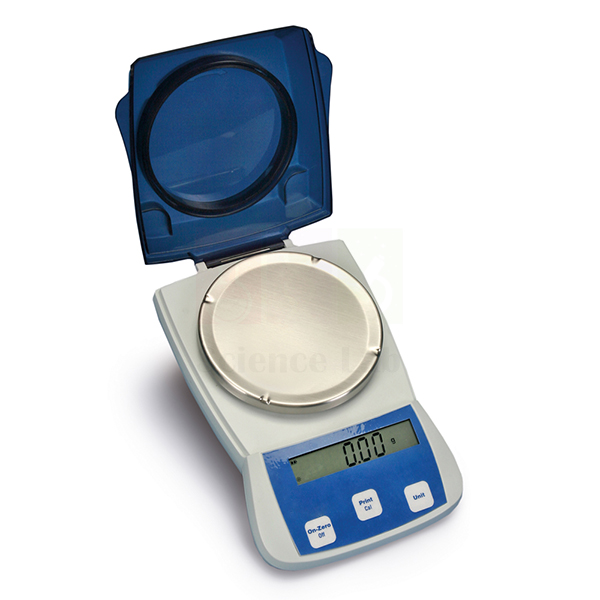
Electronic Balances
Electronic Balances (Product Code: SLE/ME/02) is a range of digital laboratory balances used to weigh samples quickly and precisely in school, college and institutional laboratories. Buyers choose from three models — 150 g x 0.01 g, 300 g x 0.1 g and 3000 g x 0.1 g — each with a hinged draftshield, LCD display, RS232 interface and gram or newton weighing modes, making it a flexible digital weighing balance for India and export labs. They are supplied by Jain Scientific Equipments Pvt Ltd (ScienceLab), Ambala, India.
Specifications
| Parameter | Detail |
|---|---|
| Models (capacity x readability) | 150 g x 0.01 g; 300 g x 0.1 g; 3000 g x 0.1 g |
| Display | LCD |
| Weighing modes | 2 — grams (g) and newtons (N) |
| Draftshield | Hinged, for more accurate weighing |
| Interface | RS232 |
| Keypad | Splash-proof; balance is calibrated from the keypad |
| Pan and body | Stainless-steel pan; sturdy body |
| Load cell protection | 200 lb |
| Power | AC adapter included; can switch to 4 AA batteries (not supplied) in the field |
| Transport | Travel protection lock |
| Security | Lockable with an optional balance security device, sold separately |
| Dimensions | 139 x 228 x 63 mm |
| Product code | SLE/ME/02 |
| Supplied by | Jain Scientific Equipments Pvt Ltd (ScienceLab), Ambala, India |
What Are Electronic Balances Used For?
Electronic balances give a direct digital reading, so students spend lesson time on the experiment rather than on reading beams. The 150 g x 0.01 g model suits weighing small quantities of chemicals for standard solutions; the 300 g x 0.1 g model covers general class practicals; and the 3000 g x 0.1 g model takes larger samples such as soil, water-filled containers or physics apparatus. The newton mode lets physics classes read weight directly as a force.
The hinged draftshield reduces the effect of air currents on small readings, while the splash-proof keypad and stainless-steel pan cope with everyday lab handling. With the AC adapter on the bench or AA batteries outdoors, the same balance serves field studies too. Engage the travel protection lock before carrying it, and recalibrate from the keypad after moving it to a new bench.
What to Specify When Ordering
- Model: 150 g x 0.01 g, 300 g x 0.1 g or 3000 g x 0.1 g.
- Number of balances for each model.
- Whether you need the optional balance security device, which is sold separately.
- Whether AA batteries should be arranged for field use, since they are not supplied with the balance.
Supplier
ScienceLab — Jain Scientific Equipments Private Limited — supplies these Electronic Balances from Ambala, Haryana, India, to schools, colleges, laboratories, dealers and importers. The company sources the balances for its customers and can quote them alongside the rest of a laboratory’s weighing and measuring equipment in one enquiry. For company background, see the ScienceLab profile.
Related Measuring Equipment
Items commonly ordered with a digital balance:
- Plastic Weighing Boats — keep powders off the stainless-steel pan and pour them cleanly.
- Weighing Paper — a disposable weighing surface for small dry samples.
- Electronic Pocket Scales — a smaller, portable option for quick checks.
- Triple Beam Balance — a mechanical balance for benches without a power point.
Compare other instruments under Measuring and Balances.
Frequently Asked Questions
Which models of Electronic Balances are available?
Electronic Balances (SLE/ME/02) come in three models: 150 g capacity with 0.01 g readability, 300 g with 0.1 g readability, and 3000 g with 0.1 g readability. Choose the 0.01 g model for small chemical quantities and the larger models for general or bulk weighing.
How are the Electronic Balances powered?
Electronic Balances include an AC adapter for bench use and can also run on 4 AA batteries in the field. The batteries are not supplied, so arrange them separately if you plan to use the balance away from a power point.
Can the Electronic Balances connect to a computer?
Electronic Balances have an RS232 interface hookup, which is the usual route for sending readings to a computer or printer, given a compatible cable and software at your end. Ask us through the contact page if you need details for a particular setup.
What weighing modes do the Electronic Balances offer?
Electronic Balances offer 2 weighing modes: grams (g) and newtons (N). The newton mode displays the weight of a sample as a force, which helps in physics lessons on gravity and forces, while grams serve chemistry and biology work.
Is a calibration certificate available with the Electronic Balances?
Electronic Balances are calibrated by the user from the keypad. The product description does not mention a calibration certificate, so if your laboratory or tender needs one, please discuss it with us through the contact page before ordering.
Can the Electronic Balances be locked against theft?
Yes. Electronic Balances are lockable with an optional balance security device, which is sold separately and is not part of the standard balance. If you need it, mention it in your enquiry so that it can be included in the quotation.
Who supplies the Electronic Balances?
Electronic Balances are supplied by Jain Scientific Equipments Pvt Ltd, trading as ScienceLab, from Ambala, Haryana, India. Schools, colleges, laboratories, dealers and importers in India and international markets can ask for a quotation through the contact page or the enquiry cart.
Request a Quote
Tell us the model and quantity of Electronic Balances (SLE/ME/02) you need through the contact page, or add them to the enquiry cart for a quotation.
Last updated: 24 September 2026
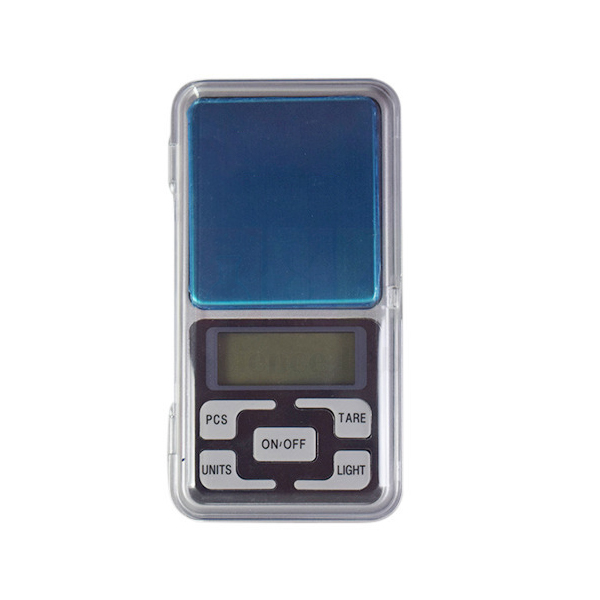
Electronic Pocket Scales
Electronic Pocket Scales (Product Code: SLE/ME/03) is a compact digital scale used for quick, small-quantity weighing on the lab bench, in the classroom or in the field. Two models are offered — 500 g x 0.1 g and 100 g x 0.01 g — each measuring only 4 x 2½ inches with a pan of the same size, a bright backlit LCD, a fast tare function and a cover that doubles as a tray. They are supplied by Jain Scientific Equipments Pvt Ltd (ScienceLab), Ambala, India.
Specifications
| Parameter | Detail |
|---|---|
| Models (capacity x readability) | 500 g x 0.1 g; 100 g x 0.01 g |
| Size | 4 x 2½ inches (roughly 10 x 6 cm); weigh pan is the same size |
| Display | Bright backlit LCD |
| Weighing units | g (grams), ct (carats), dwt (pennyweights), gn (grains) |
| Tare | Very quick tare mode |
| Cover | Doubles as a tray |
| Performance | Good reproducibility |
| Power | 2 AAA batteries (included) |
| Product code | SLE/ME/03 |
| Supplied by | Jain Scientific Equipments Pvt Ltd (ScienceLab), Ambala, India |
What Are Electronic Pocket Scales Used For?
Pocket scales handle the many small weighings that do not need a full laboratory balance: a few grams of salt for a solution, seeds or leaves in a biology investigation, or small components in a physics or design activity. The 100 g x 0.01 g model suits tiny quantities, while the 500 g x 0.1 g model covers everyday classroom objects. Running on batteries and small enough for a pocket, they travel easily on field trips and to science clubs.
Place a container on the pan and press tare to zero it, so that only the sample is weighed; the cover can act as a tray for loose material. Beyond grams, the carat, pennyweight and grain units give teachers a practical way to discuss non-metric units of mass. For consistent readings, keep the scale on a flat, steady surface away from draughts.
What to Specify When Ordering
- Model: 500 g x 0.1 g or 100 g x 0.01 g.
- Number of scales — per group, per student or per field kit.
- Spare AAA batteries if required (two are included with each scale).
Supplier
Jain Scientific Equipments Private Limited, trading as ScienceLab, supplies Electronic Pocket Scales from Ambala, Haryana, India, to schools, colleges, laboratories, dealers and importers. For vendor registration, buyers can note the supplying company’s GSTIN 06AAECJ8618A1ZT and its Importer-Exporter Code AAECJ8618A (DGFT), under which overseas consignments are shipped. Read more on the ScienceLab profile.
Related Measuring Equipment
Useful companions and alternatives for small-scale weighing:
- Electronic Balances — bench balances with a draftshield and RS232 for larger capacities.
- Plastic Weighing Boats — hold small samples on the pan and pour them off neatly.
- Weighing Paper — a disposable surface for powders and crystals.
- Spring Scales, Green, 500 g (5 N) — a mechanical option that reads both force and mass.
See the wider Measuring range for more instruments.
Frequently Asked Questions
Which capacities do the Electronic Pocket Scales come in?
Electronic Pocket Scales (SLE/ME/03) are available in two models: 500 g capacity with 0.1 g readability and 100 g capacity with 0.01 g readability. Choose the 0.01 g model for very small quantities and the 500 g model for general classroom weighing.
What units can the Electronic Pocket Scales display?
Electronic Pocket Scales weigh in four units: grams (g), carats (ct), pennyweights (dwt) and grains (gn). Grams cover normal science work, while the other units help when comparing measurement systems or weighing small items such as gemstones or metal samples.
What batteries do the Electronic Pocket Scales use?
Electronic Pocket Scales run on 2 AAA batteries, which are included. Battery power lets the scales work anywhere — in class, on field trips or in science clubs — without a power point. Remove the batteries if a scale will be stored unused for a long period.
How small are the Electronic Pocket Scales?
Electronic Pocket Scales measure only 4 x 2½ inches (roughly 10 x 6 cm), and the weigh pan is the same size. The cover doubles as a tray, so the scale stays protected in a bag and still offers a handy surface for samples.
Is a calibration certificate available for the Electronic Pocket Scales?
The product description of the Electronic Pocket Scales does not mention a calibration certificate or calibration masses. If you need documentation for a laboratory or tender, discuss it with us through the contact page before placing your order.
Who supplies the Electronic Pocket Scales?
Electronic Pocket Scales are supplied by Jain Scientific Equipments Pvt Ltd, trading as ScienceLab, from Ambala, Haryana, India, to schools, colleges, laboratories, dealers and importers in India and international markets. Quotations can be requested through the contact page or the enquiry cart.
What should an Electronic Pocket Scales quotation request include?
A quotation request for Electronic Pocket Scales should state the model (500 g x 0.1 g or 100 g x 0.01 g), the number of scales, any weighing accessories and the delivery location. Mention tender or vendor-registration needs so the right documents are prepared.
Request a Quote
To receive a quotation for Electronic Pocket Scales (SLE/ME/03), write to us via the contact page or add the scales to the enquiry cart with your chosen model.
Last updated: 24 September 2026
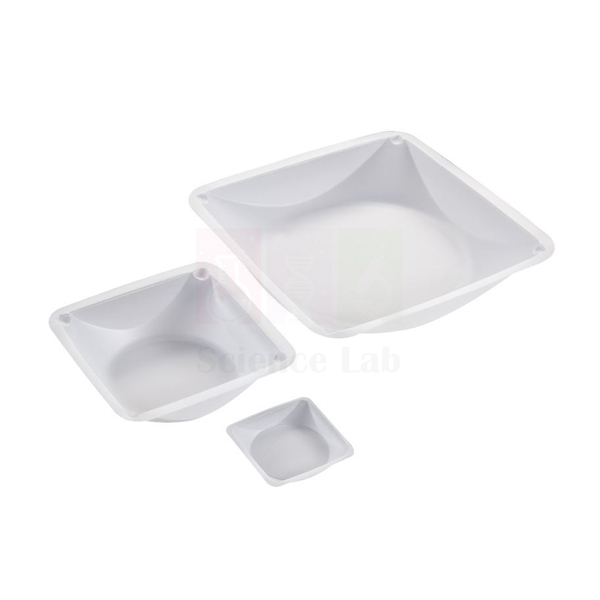
Plastic Weighing Boats
Plastic Weighing Boats (Product Code: SLE/ME/04) is a polystyrene sample holder used to weigh and transfer powdered and granular samples on laboratory balances in schools, colleges and testing labs. They suit all types of balances, and their smooth surface, rounded corners and corner recesses let samples pour off cleanly with little left behind. They are supplied by Jain Scientific Equipments Pvt Ltd (ScienceLab), Ambala, India, as part of its chemistry lab consumables.
Key Details
| Parameter | Detail |
|---|---|
| Material | Polystyrene |
| Balance compatibility | Suitable for all types of balances |
| Surface | Smooth, with rounded corners for easy removal of powdered and granular samples |
| Pouring | Recesses at the corners for controlled pour-off |
| Sizes and pack quantity | Not listed in the product description — ask us |
| Product code | SLE/ME/04 |
| Supplied by | Jain Scientific Equipments Pvt Ltd (ScienceLab), Ambala, India |
What Are Plastic Weighing Boats Used For?
A weighing boat sits on the balance pan and holds the sample, so powders and granules never touch the pan and can be carried straight to a beaker or flask. Tare the empty boat, add the sample until the balance shows the target mass, then tip it out using a corner recess to guide the flow. The smooth polystyrene and rounded corners leave very little material clinging behind, which matters when preparing solutions of known concentration.
Because the boats suit electronic, beam and pocket balances alike, one stock serves every weighing station in a laboratory. Polystyrene can be softened by some organic solvents, so check compatibility before weighing solvent-wet samples, and keep boats away from hot plates and open flames.
Supplier
ScienceLab, the trading name of Jain Scientific Equipments Private Limited, supplies Plastic Weighing Boats from Ambala, Haryana, India, as part of its range of laboratory consumables for schools, colleges, testing laboratories, dealers and importers. Buyers can order them together with balances and other measuring items in one enquiry. See the ScienceLab company profile for more about the company.
Related Measuring Equipment
Weighing boats are used alongside these balances and consumables:
- Weighing Paper — a flat alternative for very small quantities.
- Electronic Balances — digital balances for routine weighing with a boat on the pan.
- Electronic Pocket Scales — compact scales for small samples at the bench or in the field.
- Triple Beam Balance — a mechanical balance that works with boats just as well.
Find more weighing and measuring items in the Measuring category.
Frequently Asked Questions
What are Plastic Weighing Boats made of?
Plastic Weighing Boats (SLE/ME/04) are made of polystyrene. The smooth polystyrene surface and rounded corners help powders and granules slide out completely, so less sample is left behind when it is transferred to a beaker or flask.
Which balances can Plastic Weighing Boats be used on?
Plastic Weighing Boats are suitable for all types of balances, including electronic balances, pocket scales and mechanical beam balances. Place the empty boat on the pan, tare it or note its mass, and then add the sample.
What sizes and pack quantities of Plastic Weighing Boats are available?
The product description of Plastic Weighing Boats does not list sizes, capacities or the number of boats per pack. Tell us your balance type and typical sample amount through the contact page, and we will confirm the available options in our quotation.
Can Plastic Weighing Boats be used with all chemicals?
Plastic Weighing Boats are made of polystyrene, which some organic solvents can soften or dissolve. They suit dry powders and granules; for solvent-wet or reactive samples, check chemical compatibility first or ask us about an alternative through the contact page.
Are Plastic Weighing Boats reusable?
Plastic Weighing Boats are usually treated as single-use items to avoid cross-contamination between samples. A boat used for the same dry material may be wiped and reused where your laboratory’s procedures allow, but discard any boat that is cracked or visibly contaminated.
Who supplies Plastic Weighing Boats?
Plastic Weighing Boats are supplied by Jain Scientific Equipments Pvt Ltd, trading as ScienceLab, from Ambala, Haryana, India. The company serves schools, colleges, laboratories, dealers and importers in India and international markets through the contact page and enquiry cart.
What should a Plastic Weighing Boats quotation request include?
For a Plastic Weighing Boats quotation, give the quantity required, the balance types in use, typical sample sizes and the delivery location in India or abroad. Adding balances or weighing paper to the same enquiry lets us quote everything together.
Request a Quote
Send your Plastic Weighing Boats (SLE/ME/04) requirement through the contact page or add the item to the enquiry cart together with your other lab consumables.
Last updated: 24 September 2026
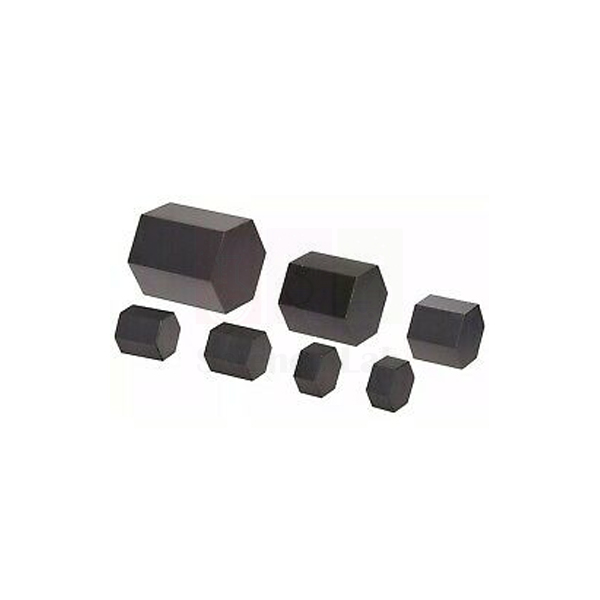
Mass Set
Mass Set (Product Code: SLE/ME/05) is a set of seven hexagonal solid steel masses used for weighing, balancing and simple force experiments in school and college science labs. Teachers pick it because each mass is accurate to 1 g and its length is proportional to its mass, so students see relative sizes at a glance across a range from 50 g to 1000 g. It is made by Jain Scientific Equipments Pvt Ltd (ScienceLab), an OEM manufacturer, at its own factory in Ambala, India.
Specifications
| Parameter | Detail |
|---|---|
| Form | Hexagonal solid steel bars |
| Accuracy | To 1 g |
| Size relationship | Length is proportional to mass |
| Set contents | Two 50 g, two 100 g, one 200 g, one 500 g and one 1000 g mass (7 pieces, 2 kg in total) |
| Handling | Easy to work with |
| Product code | SLE/ME/05 |
| Manufacturer | Jain Scientific Equipments Pvt Ltd (ScienceLab) — OEM |
| Country of origin | India (made in Ambala, Haryana) |
What Is the Mass Set Used For?
A mass set supplies known masses for experiments where the value must be trusted. On a pan balance, students set the masses against an unknown object to find its mass by comparison, and the same pieces provide known loads for simple force and lever experiments in mechanics lessons. Because each bar’s length is proportional to its mass, younger learners can line them up and see that the 1000 g bar is twice as long as the 500 g bar.
Combining pieces builds intermediate values — a 50 g and a 100 g mass placed together, for example — which turns the set into a practical tool for teaching addition of masses. Wipe the steel bars dry after use and keep all seven together so the set stays complete for the next practical.
What to Specify When Ordering
- Number of sets per laboratory (each set holds seven masses totalling 2 kg).
- Whether you need extra pieces of any value — ask us.
- Balances or spring scales to be quoted with the set.
OEM Manufacturer
The Mass Set is manufactured by ScienceLab, the trading name of Jain Scientific Equipments Private Limited, which is the OEM (original equipment manufacturer) of this item. The steel masses are made at the company’s own licensed factory at Saha, Ambala, Haryana, India, and supplied direct to schools, colleges, laboratories, dealers and importers. For replacement pieces or repeat sets, ask us — the manufacturer handles the request itself. More is on the ScienceLab profile.
Related Measuring Equipment
The masses are typically used with these instruments:
- Hanging Pan Balance — a balance for comparing unknown objects against the masses.
- Triple Beam Balance — a mechanical balance for measuring objects and samples directly.
- Spring Scales, Green, 500 g (5 N) — reads force and mass for simple load experiments.
- Metric Attachment Weight Set — another weight set for force and loading experiments.
Explore more instruments in the Measuring category.
Frequently Asked Questions
What is included in the Mass Set?
The Mass Set (SLE/ME/05) contains seven hexagonal solid steel masses: two 50 g, two 100 g, one 200 g, one 500 g and one 1000 g. Together they total 2 kg and can be combined to build many intermediate values.
How accurate are the masses in the Mass Set?
Each mass in the Mass Set is accurate to 1 g, which suits school and college practicals on weighing, balancing and density. The product description does not mention a calibration certificate; if your lab needs one, raise it through the contact page before ordering.
Why are the Mass Set masses hexagonal bars?
The Mass Set uses hexagonal solid steel bars whose length is proportional to their mass, so a 1000 g bar is visibly twice as long as a 500 g bar. The flat hexagonal sides stop bars rolling on the bench and make them easy to pick up.
Who manufactures the Mass Set?
The Mass Set is manufactured by Jain Scientific Equipments Pvt Ltd, trading as ScienceLab, the OEM for this product. The masses are made at the company’s own factory at Saha, Ambala, Haryana, India, and quotations are issued directly by the manufacturer.
How should the Mass Set be cared for?
Keep the Mass Set dry and wipe the steel bars with a clean cloth after use, since moisture and fingerprints can mark steel over time. Store all seven masses together and avoid dropping them, which could dent the bars or damage bench surfaces.
What should a Mass Set quotation request include?
A Mass Set quotation request should give the number of sets, any balances or spring scales to be quoted alongside, and the delivery location in India or abroad. Tender buyers should also mention any documentation they need when contacting us.
Is the Mass Set available in bulk and for export?
Yes. ScienceLab supplies the Mass Set to single schools, school groups, colleges, distributors and importers across India and international markets. Share your quantity and destination through the contact page for a quotation straight from the manufacturer.
Request a Quote
For a Mass Set (SLE/ME/05) quotation, use the contact page or add the set to the enquiry cart. Quotations come direct from the manufacturer in Ambala.
Last updated: 24 September 2026
130.jpg)
Spring Scales, Green, 500 g (5 N)
Spring Scales, Green, 500 g (5 N) (Product Code: SLE/ME/06) is a tubular spring scale used to measure force in newtons and mass in grams, up to 500 g (5 N), in school physics and general-science practicals. Its green colour-coded ends identify the capacity at a glance, and the clear tubular body carries easy-to-read gram and newton scales that can be fully zeroed. It is made by Jain Scientific Equipments Pvt Ltd (ScienceLab), an OEM manufacturer, at its own factory in Ambala, India.
Specifications
| Parameter | Detail |
|---|---|
| Capacity | 500 g (5 N) |
| Graduations | Grams and newtons, easy to read |
| Readings | Direct readings of both force and mass |
| Body | Clear tubular body; durable construction |
| Colour coding | Green ends, colour-coded by capacity |
| Zero adjustment | Can be fully zeroed |
| Product code | SLE/ME/06 |
| Manufacturer | Jain Scientific Equipments Pvt Ltd (ScienceLab) — OEM |
| Country of origin | India (made in Ambala, Haryana) |
What Is the 500 g Spring Scale Used For?
A spring scale measures force from the stretch of a calibrated spring. Students suspend an object and read its weight in newtons and its mass in grams at the same time, which makes the link between the two — 500 g corresponds to 5 N on this scale — easy to see. The same scale measures the pull needed to drag a block across a bench in friction experiments and the effort in simple pulley and inclined-plane set-ups, making it a core piece of mechanics lab equipment.
Before each reading, hold the scale in line with the pull and zero it with nothing attached. Choose a capacity close to the forces being measured: this green 500 g (5 N) scale suits lighter loads, and the colour-coded ends make it easy to hand out the right scale when a class works with several capacities at once.
What to Specify When Ordering
- Number of green 500 g (5 N) scales — one per practical group is common.
- Any other capacities your class uses — ask us, as the colour coding is designed to tell capacities apart.
- Masses or other apparatus to be quoted with the scales.
OEM Manufacturer
Spring Scales, Green, 500 g (5 N) are produced by ScienceLab — Jain Scientific Equipments Private Limited — as OEM (original equipment manufacturer). The scales are made at the company’s own licensed factory at Saha, Ambala, Haryana, India, and dispatched direct to schools, colleges, training institutes, dealers and importers. Repeat orders and questions about other capacities go straight to the manufacturer — ask us. Background is on the ScienceLab company profile.
Related Measuring Equipment
Force and mass practicals often use these alongside the spring scale:
- Force Meter/Spring Balance — another spring-based force meter for mechanics practicals.
- Pull-Spring Scales, Economy — an economical alternative for large class sets.
- Mass Set — known steel masses for loading experiments.
- Balance Spring Tubular Plastic — a tubular spring balance from the physics range.
More force and weighing instruments are listed under Measuring.
Frequently Asked Questions
What is the capacity of the Spring Scales, Green, 500 g (5 N)?
The Spring Scales, Green, 500 g (5 N) (SLE/ME/06) measures up to 500 g of mass or 5 N of force. Its scale is calibrated in both grams and newtons, so students read mass and force directly without converting between units.
Why does the 500 g spring scale have green ends?
The green colour-coded ends identify this spring scale’s 500 g (5 N) capacity. When a class works with scales of several capacities, colour coding helps teachers and students pick the right one quickly and avoid overloading a lower-range scale.
Can the 500 g (5 N) spring scale be zeroed?
Yes. The Spring Scales, Green, 500 g (5 N) can be fully zeroed. Zero it with nothing attached, holding it in the same orientation as the measurement, so that readings in grams and newtons start from a true zero every time.
Which experiments is the 500 g spring scale used for?
The green 500 g (5 N) spring scale suits experiments on weight and mass, friction, simple machines such as pulleys and inclined planes, and the stretching of springs. Its clear tubular body lets students watch the spring extend as the load increases.
Who manufactures the Spring Scales, Green, 500 g (5 N)?
The Spring Scales, Green, 500 g (5 N) is manufactured by Jain Scientific Equipments Pvt Ltd, trading as ScienceLab, the OEM for this instrument. It is made at the company’s own factory at Saha, Ambala, Haryana, India, and schools and dealers receive quotations directly from the manufacturer.
Is a calibration certificate available for the 500 g spring scale?
The product description of the Spring Scales, Green, 500 g (5 N) does not mention a calibration certificate. If your laboratory or tender needs calibration documentation, please raise it through the contact page so that availability can be discussed before ordering.
Can the 500 g spring scale be ordered in bulk or for export?
Yes. ScienceLab supplies the green 500 g (5 N) spring scale in class sets and larger quantities to schools, colleges, distributors and importers in India and international markets. Send the quantity, any other capacities and your delivery location through the contact page for a quotation.
Request a Quote
Order the Spring Scales, Green, 500 g (5 N) (SLE/ME/06) by sending your quantity through the contact page or adding it to the enquiry cart. Quotations come direct from the manufacturer.
Last updated: 24 September 2026
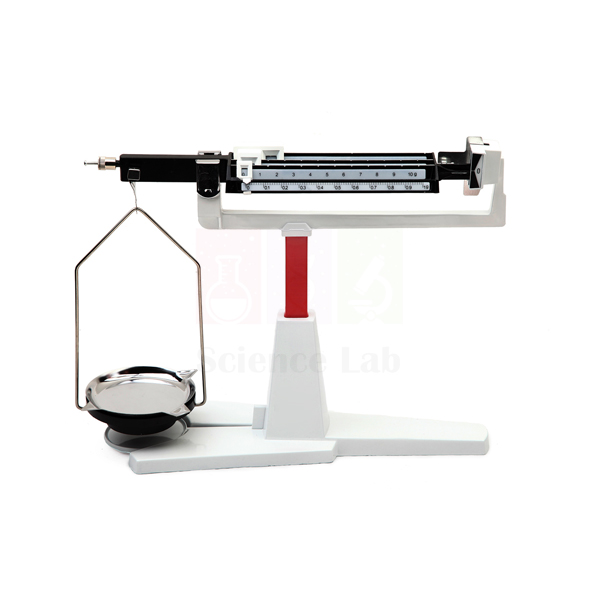
Hanging Pan Balance
Hanging Pan Balance (Product Code: SLE/ME/07) is a precision weighing balance used to measure mass to 0.01 g and to determine specific gravity in school, college and testing laboratories. As a precision chemical balance for India lab benches, it adds a self-storing stainless-steel platform, 3 1/2 in across, that tucks away when not needed, so one instrument handles both routine weighing and density work. It is supplied by Jain Scientific Equipments Pvt Ltd (ScienceLab), Ambala, India.
Specifications
| Parameter | Detail |
|---|---|
| Application | Precision weighing and specific-gravity determination |
| Readability | 0.01 g |
| Material | Stainless steel |
| Specific-gravity platform | Self-storing |
| Platform size | 3 1/2 in diameter × 1/2 in deep |
| Product code | SLE/ME/07 |
| Supplied by | Jain Scientific Equipments Pvt Ltd (ScienceLab), Ambala, India |
What Is a Hanging Pan Balance Used For?
This balance does two jobs on one bench. For everyday weighing, set the sample on the pan and read its mass to the nearest hundredth of a gram, which is fine enough for reagents, seeds or small metal pieces in practical classes. For specific gravity, bring out the stored platform, weigh a solid first in air and then while it hangs fully immersed in water, and use the apparent loss of weight to calculate its specific gravity by Archimedes’ principle.
That second use makes it handy physics lab equipment for density and buoyancy practicals as well as chemistry weighing. Place the balance on a firm, level bench away from draughts, suspend specimens on fine thread so the thread adds almost nothing to the reading, and dry the stainless-steel platform after every immersion. Weigh powders on paper or in a boat rather than directly on the pan.
Supplier
Jain Scientific Equipments Private Limited, trading as ScienceLab, supplies the Hanging Pan Balance from Ambala, Haryana, to schools, colleges, testing laboratories and dealers in India and international markets. It can be quoted together with density cubes, reference masses and weighing paper so a class has everything for a specific-gravity practical. For purchase files and vendor forms, the supplying company’s GSTIN is 06AAECJ8618A1ZT and its Legal Entity Identifier is 3358004HRD1JIVXKYX49. Background on the company is on the ScienceLab company profile.
Related Measuring Equipment
Specific-gravity and weighing practicals usually call for these items alongside the balance:
- Metal Density Cube Set — known solids for students to weigh in air and in water.
- Set to Demonstrate Archimedes’ Principle/Law — introduces the buoyancy idea behind the specific-gravity method.
- Mass Set — reference masses for a quick check of the balance before a lesson.
- Weighing Paper — keeps powders off the pan and speeds up cleaning.
- Electronic Balances — an alternative when a digital readout is preferred.
Browse the full Measuring equipment category for more balances, scales and pipetting tools.
Frequently Asked Questions
What is the readability of the Hanging Pan Balance?
The Hanging Pan Balance reads to 0.01 g, so it resolves differences of one hundredth of a gram. That resolution suits student weighing of reagents and small solids, and it is fine enough to show the weight lost when a solid is suspended in water.
How is specific gravity measured with the Hanging Pan Balance?
With the Hanging Pan Balance, weigh the solid in air, then weigh it again hanging from the specific-gravity platform while fully immersed in water. Dividing the mass in air by the loss in mass gives the specific gravity of the sample.
What is the platform of the Hanging Pan Balance made of?
The platform of the Hanging Pan Balance is stainless steel and measures 3 1/2 in in diameter by 1/2 in deep. It is self-storing, so it stays with the balance between lessons and is less likely to be misplaced or damaged.
What is the maximum capacity of the Hanging Pan Balance?
The product listing for the Hanging Pan Balance gives its readability and platform size but not its maximum capacity. Tell us the heaviest samples you plan to weigh through the contact page, and the capacity of the model quoted will be confirmed.
Is a calibration certificate available for the Hanging Pan Balance?
Calibration documents for the Hanging Pan Balance are not described in the product listing. If your laboratory needs a calibration certificate, mention it in your enquiry so that its availability can be discussed and confirmed in writing before you order.
Who supplies the Hanging Pan Balance?
The Hanging Pan Balance is supplied by Jain Scientific Equipments Pvt Ltd (ScienceLab) of Ambala, Haryana, India. The company quotes schools, colleges, laboratories and dealers in India and international markets, and can combine the balance with related measuring items in one order.
What should a quotation request for the Hanging Pan Balance include?
A quotation request for the Hanging Pan Balance should state the quantity, the delivery location, the heaviest sample you expect to weigh and any accessories such as density cubes or weighing paper. These details allow an accurate, complete offer to be prepared.
Request a Quote
To buy the Hanging Pan Balance, send your quantity and delivery details through the ScienceLab contact page, or add it to the enquiry cart with other measuring equipment to receive one combined quotation.
Last updated: 24 September 2026
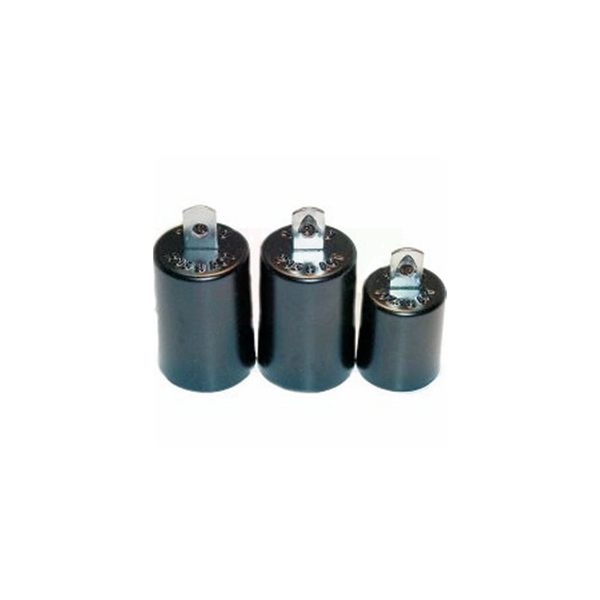
Metric Attachment Weight Set
Metric Attachment Weight Set (Product Code: SLE/ME/08) is a set of metric attachment weights used to extend the weighing capacity of a mechanical beam balance in school and college laboratories. According to the product listing, the set takes a balance with a 610 g capacity up to 2,610 g, so heavier objects can be weighed without buying a second, larger balance. It is supplied by Jain Scientific Equipments Pvt Ltd (ScienceLab), Ambala, India.
Key Details
| Parameter | Detail |
|---|---|
| Product type | Metric attachment weights for a beam balance |
| Capacity extension | From 610 g up to 2,610 g on a compatible balance (as listed) |
| Units | Metric (grams) |
| Product code | SLE/ME/08 |
| Supplied by | Jain Scientific Equipments Pvt Ltd (ScienceLab), Ambala, India |
What Is a Metric Attachment Weight Set Used For?
Attachment weights let a beam balance weigh objects heavier than its sliding riders can reach. Each weight is attached at the end of the beam and adds a fixed amount to the reading; the riders then measure the remainder, and the object’s mass is the sum of the attached weights and the rider readings. Students can weigh rocks, filled containers, soil samples or bulky apparatus that would otherwise overload the balance.
Used this way, a single balance covers both light and heavy work in mechanics lab equipment sets and general science practicals. Zero the balance with nothing on the pan before attaching any weight, handle the weights with clean, dry hands, and keep the set together so no piece goes missing. A dirty or damaged weight changes every reading made with it, so inspect the set at the start of each term.
What to Specify When Ordering
- The make, model and capacity of the beam balance you will use it with (the listing describes use with a 610 g balance).
- How many sets you need, usually one per balance.
- Whether you also need a beam balance quoted with the set.
Supplier
ScienceLab is the trading name of Jain Scientific Equipments Private Limited, which supplies the Metric Attachment Weight Set from Ambala, Haryana, to schools, colleges, science centres and dealers in India and international markets. Because attachment weights have to suit the beam they hang on, buyers are asked to share their balance details in the enquiry so the right set is quoted. Company background is on the ScienceLab profile.
Related Measuring Equipment
These items are commonly ordered with attachment weights:
- Triple Beam Balance — a beam balance to pair with the set; check its capacity against the listing first.
- Balance Triple Beam — the triple beam model offered in the chemistry range.
- Mass Set — known masses for checking the combined reading after the weights are attached.
- Plastic Weighing Boats — containers for loose samples placed on the pan.
See the complete Measuring category for other balances and weighing accessories.
Frequently Asked Questions
What does the Metric Attachment Weight Set do?
The Metric Attachment Weight Set extends the range of a beam balance so that it can weigh heavier objects. According to the product listing, it takes a balance with a 610 g capacity up to a total capacity of 2,610 g.
Which balance is the Metric Attachment Weight Set designed for?
The listing describes the Metric Attachment Weight Set with a beam balance of 610 g capacity. Attachment weights must match the beam they attach to, so please share your balance make and model through the contact page before ordering.
How is the total mass read when using the Metric Attachment Weight Set?
When the Metric Attachment Weight Set is in use, add the values of the attached weights to the readings shown by the beam riders. Zero the balance beforehand with nothing on the pan so that the combined figure is accurate.
What are the individual weight values and material of the Metric Attachment Weight Set?
The product listing for the Metric Attachment Weight Set does not state the individual weight values, the number of pieces or the material. Ask us through the contact page and the make-up of the set will be confirmed before you order.
Who supplies the Metric Attachment Weight Set?
Jain Scientific Equipments Pvt Ltd (ScienceLab), based in Ambala, Haryana, India, supplies the Metric Attachment Weight Set to schools, colleges and dealers in India and international markets, and can quote it together with a suitable beam balance.
What should a quote request for the Metric Attachment Weight Set include?
When requesting a quote for the Metric Attachment Weight Set, list the number of sets, the make and capacity of your balance, and your delivery address. If you still need a balance, add it to the same enquiry.
Request a Quote
Share your balance model and the number of sets on the contact page, or place the Metric Attachment Weight Set in the enquiry cart alongside any balances you need, and a written quotation will follow.
Last updated: 24 September 2026
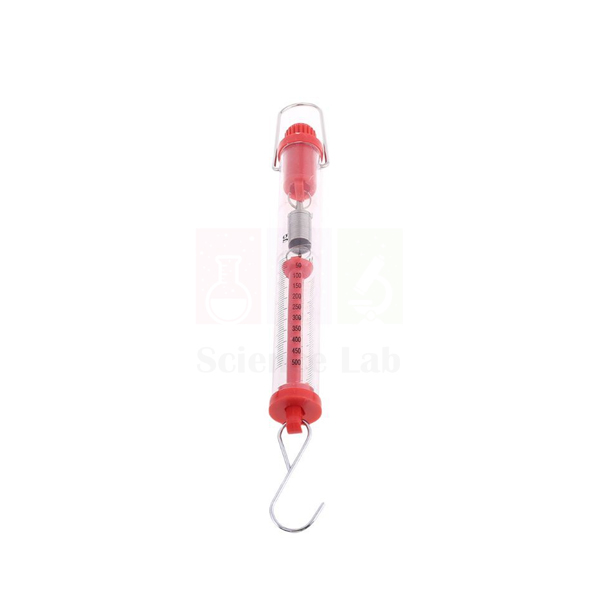
Force Meter/Spring Balance
Force Meter/Spring Balance (Product Code: SLE/ME/09) is a dual-purpose spring instrument used to weigh hanging objects and to measure pushing or pulling forces in school physics and general science lessons. Its extended rod lets students press against or pull on an object as well as hang loads from it, and this red, colour-coded 2 kg version is scaled in both grams and newtons. It is made by Jain Scientific Equipments Pvt Ltd (ScienceLab), an OEM manufacturer, at its own factory in Ambala, India.
Specifications
| Parameter | Detail |
|---|---|
| Functions | Weighs suspended objects; measures push and pull forces using the extended rod |
| Scale units | Grams and newtons |
| Range | 2 kg |
| Colour code | Red |
| Write-on area | Clear, flat area on the rod for drawing your own scale with a dry-wipe marker |
| Included | Instructions and ideas sheet |
| Product code | SLE/ME/09 |
| Manufacturer | Jain Scientific Equipments Pvt Ltd (ScienceLab) — OEM |
| Country of origin | India (made in Ambala, Haryana) |
What Is a Force Meter Used For?
Hang an object from the meter and students read its weight in newtons alongside its mass in grams, which makes the difference between mass and weight concrete. Turn the instrument round and the extended rod becomes a push-pull gauge: pupils can measure the force needed to start a block sliding, compare friction on different surfaces, or push a trolley and feel how force relates to motion. That versatility makes it a core item in any force and motion experiment kit.
The write-on strip on the rod is useful with younger classes, who can mark their own simple scale for a lesson and wipe it clean afterwards. Before each reading, check that the indicator sits at zero with nothing attached, keep the meter in line with the direction of the force, and read it at eye level. Staying within the 2 kg range protects the spring from being overstretched.
OEM Manufacturer
ScienceLab is the trading name of Jain Scientific Equipments Private Limited, the original equipment manufacturer (OEM) of this force meter. It is made and assembled at the company’s own licensed factory at Saha, Ambala, Haryana, rather than bought in from a trader, and goes factory-direct to schools, colleges, science centres, dealers and importers in India and international markets. Repeat batches for extra classes and questions about replacement parts are handled by the manufacturer itself, so simply ask us when you need more. Read about the company on the ScienceLab profile.
Related Measuring Equipment
Force and motion lessons often combine the meter with these items:
- Spring Scales, Green, 500 g (5 N) — a lower range for finer readings of light loads.
- Pull-Spring Scales, Economy — a simple pull-only scale for class sets.
- Dynamics Trolley, Plastic — a trolley to push or pull while measuring the applied force.
- Hooke’s Law Apparatus — explores how a spring stretches under load, the principle behind the meter.
- Newton Mass Set 10N Set — known loads for checking readings in newtons.
Explore the wider Measuring range for balances, scales and other measuring tools.
Frequently Asked Questions
What can the Force Meter/Spring Balance measure?
The Force Meter/Spring Balance measures the weight of objects hung from it and, using its extended rod, the force needed to push or pull an object. One instrument therefore covers weighing, friction and simple force-and-motion activities in class.
What units are marked on the Force Meter/Spring Balance?
The Force Meter/Spring Balance is calibrated in both grams and newtons. Reading the two scales side by side helps students see the link between an object’s mass and the gravitational force acting on it.
What range does the Force Meter/Spring Balance have?
The Force Meter/Spring Balance listed here is the red, colour-coded 2 kg version. Keep loads within that range so the spring is not overstretched; for light loads, a lower-range spring scale gives finer readings.
Can students write their own scale on the Force Meter/Spring Balance?
Yes. The Force Meter/Spring Balance has a clear, flat area on its rod that takes a dry-wipe marker, so students can draw their own scale for an activity and wipe it off afterwards without affecting the printed calibration.
What comes with the Force Meter/Spring Balance?
Each Force Meter/Spring Balance includes an instructions and ideas sheet that explains how to use it and suggests classroom activities. Masses, trolleys and other apparatus for experiments are separate items that can be quoted with it.
Who manufactures the Force Meter/Spring Balance?
The Force Meter/Spring Balance is manufactured by Jain Scientific Equipments Pvt Ltd (ScienceLab), the OEM, at its own licensed factory at Saha, Ambala, Haryana, India. Schools and dealers receive quotations directly from the manufacturer.
Can the Force Meter/Spring Balance be ordered in class sets?
Yes, the Force Meter/Spring Balance can be quoted in class quantities for schools, colleges and dealers in India and international markets. State the number required and your delivery location so the manufacturer can prepare the quotation.
Request a Quote
Quotations for the Force Meter/Spring Balance come straight from the manufacturer. Send your class quantity through the contact page or add it to the enquiry cart with trolleys, masses or other mechanics apparatus.
Last updated: 24 September 2026
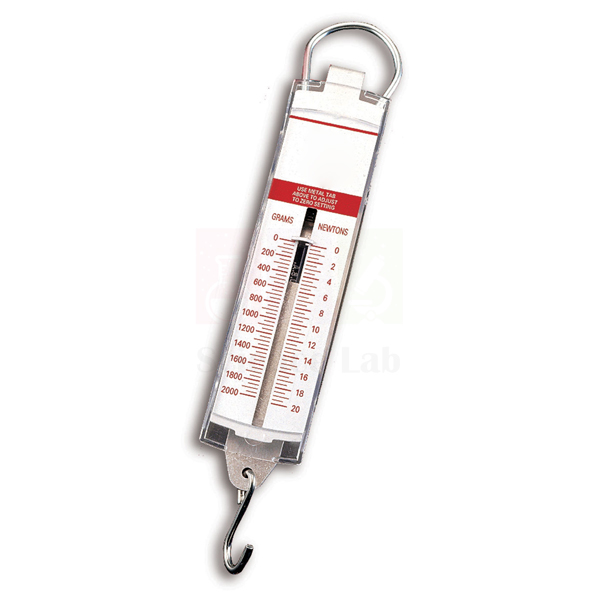
Pull-Spring Scales, Economy
Pull-Spring Scales, Economy (Product Code: SLE/ME/10) is a spring scale used to measure mass and pulling force in grams and newtons during school science practicals. Its dual scale reads up to 500 g in 10 g steps and up to 5 N in 0.1 N steps, with a metal pointer, zero adjustment, suspension ring and load hook on every scale, so whole classes can take their own readings. It is made by Jain Scientific Equipments Pvt Ltd (ScienceLab), an OEM manufacturer, at its own factory in Ambala, India.
Specifications
| Parameter | Detail |
|---|---|
| Scale units | Grams and newtons (g/N) |
| Mass scale (range × division) | 500 g × 10 g |
| Force scale (range × division) | 5 N × 0.1 N |
| Pointer | Metal |
| Zero adjustment | Yes |
| Fittings | Suspension ring and load hook |
| Product code | SLE/ME/10 |
| Manufacturer | Jain Scientific Equipments Pvt Ltd (ScienceLab) — OEM |
| Country of origin | India (made in Ambala, Haryana) |
What Is a Pull-Spring Scale Used For?
Pupils hang an object from the hook to find its mass in grams and its weight in newtons, then use the same scale to measure pulling forces: dragging a wooden block across sandpaper and glass to compare friction, raising a load through a pulley system lab set-up, or pulling a trolley up an inclined plane. Because the scale shows both units, teachers can move from everyday mass to scientific force without changing instruments.
For accurate results, set the zero adjustment with the scale held in the same position as the measurement, vertical for weighing and level for horizontal pulls. Pull smoothly along the axis of the spring so the pointer does not rub, and read at eye level. Loads beyond 500 g can stretch the spring permanently, so move heavier work to a higher-range force meter.
OEM Manufacturer
Jain Scientific Equipments Private Limited, which trades as ScienceLab, is the OEM behind these economy pull-spring scales and produces them at its own licensed factory at Saha, Ambala, Haryana, India. Because the scales come straight from the maker, schools, colleges, dealers and importers can order a first class set and later repeat quantities from one source, with every quotation issued by the manufacturer itself. If a pointer, ring or hook is damaged in use, ask us about replacement parts. More about the company is on the ScienceLab profile.
Related Measuring Equipment
Useful companions for spring-scale practicals:
- Force Meter/Spring Balance — a 2 kg push-pull meter for heavier loads and pushing forces.
- Spring Scales, Green, 500 g (5 N) — a green spring scale covering the same load range.
- Slotted Mass Hanger, 500g — known loads for checking the scale and for Hooke’s law work.
- Pulley, Bench Mounting, Ball Bearing — for measuring the effort needed to lift loads over a pulley.
More options are listed in the Measuring category.
Frequently Asked Questions
What is the range of the Pull-Spring Scales, Economy?
The Pull-Spring Scales, Economy read up to 500 g with 10 g divisions on the mass scale and up to 5 N with 0.1 N divisions on the force scale. This range suits most classroom weighing, friction and pulley activities.
Can the zero be adjusted on the Pull-Spring Scales, Economy?
Yes. Each of the Pull-Spring Scales, Economy has a zero adjustment, so the pointer can be reset before measuring. Set the zero while holding the scale in the position you will use, because orientation affects the reading.
What fittings do the Pull-Spring Scales, Economy have?
The Pull-Spring Scales, Economy have a metal pointer, a suspension ring for hanging the scale from a stand or holding it by hand, and a load hook for attaching objects, string or a mass hanger.
Can the Pull-Spring Scales, Economy measure horizontal pulls?
Yes, the Pull-Spring Scales, Economy measure pulling forces as well as weights. For horizontal pulls, reset the zero with the scale held level and keep the pull in line with the spring so the pointer moves freely.
Who manufactures the Pull-Spring Scales, Economy?
The Pull-Spring Scales, Economy are manufactured by Jain Scientific Equipments Pvt Ltd (ScienceLab) as the OEM at its own licensed factory at Saha, Ambala, Haryana, India, and are supplied factory-direct to schools, colleges and dealers.
How do I request a quote for the Pull-Spring Scales, Economy?
To request a quote for the Pull-Spring Scales, Economy, send the quantity per school or class, your delivery location and any related items such as mass hangers or pulleys. The manufacturer replies with a direct quotation.
Request a Quote
Tell us how many scales each class needs through the contact page, or collect them in the enquiry cart with other mechanics items; the quotation comes direct from the manufacturer in Ambala.
Last updated: 24 September 2026
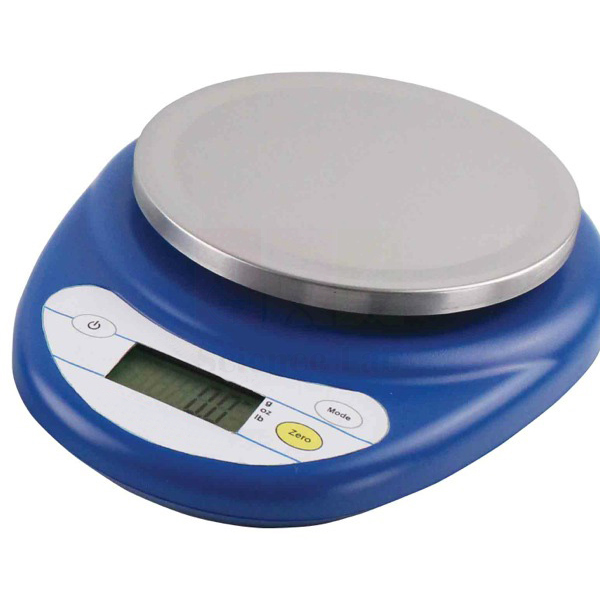
Compact Balance
Compact Balance (Product Code: SLE/ME/11) is a portable electronic balance used to weigh samples up to 220 g with 0.1 g readability in school laboratories, classrooms and outdoor practicals. A handy digital weighing balance for student groups, it has a 132 × 125 mm pan, an LCD display, gram and ounce modes, and runs on three AA batteries (included) or an optional AC adapter. It is supplied by Jain Scientific Equipments Pvt Ltd (ScienceLab), Ambala, India.
Specifications
| Parameter | Detail |
|---|---|
| Capacity | 220 g |
| Readability | 0.1 g |
| Weighing modes | g, oz |
| Tare range | To capacity, by subtraction |
| Stabilisation time | 3 s |
| Pan size | 132 × 125 mm (5-1/5 × 5 in) |
| Overall dimensions | 205 × 140 × 41 mm (8-1/10 × 5-1/2 × 1-3/5 in) |
| Display | LCD (digit size listed as 1/2 × 1-1/5 in) |
| Calibration | Digital, from the keypad |
| Optimal operating temperature | 18 to 25 °C (65 to 77 °F) |
| Power | 3 AA alkaline batteries (included) or AC adapter (sold separately) |
| Product code | SLE/ME/11 |
| Supplied by | Jain Scientific Equipments Pvt Ltd (ScienceLab), Ambala, India |
What Is a Compact Balance Used For?
Students use it to weigh out salts for solutions, measure seeds, leaves or soil for biology and geography work, and follow mass changes in chemistry, such as the loss in mass when marble chips react with acid. Battery power means the balance can move from bench to bench or out to a field site, where no mains socket is needed.
Place a weighing boat or paper on the pan and tare it; the tare works to full capacity by subtraction, so the container’s mass still counts towards the 220 g limit. Wait about 3 seconds for the display to settle, keep the balance away from fans and open windows, and recalibrate from the keypad after moving it to a new room. Its optimal operating range is 18 to 25 °C.
What to Specify When Ordering
- Number of balances, often one per student group.
- Whether you want the AC adapter, which is sold separately, or will run on the 3 AA batteries supplied.
- Whether reference masses for routine checks should be quoted with the balance.
- Consumables such as weighing boats or weighing paper.
Supplier
ScienceLab is the trading name of Jain Scientific Equipments Private Limited, which supplies the Compact Balance from Ambala, Haryana, to schools, colleges, laboratories and resellers in India and international markets. Tender and procurement teams can register the supplier using its Corporate Identification Number U29309HR2020PTC087597 and GST registration 06AAECJ8618A1ZT. See the company profile for more about ScienceLab.
Related Measuring Equipment
Items that make daily weighing with this balance quicker and cleaner:
- Plastic Weighing Boats — tare-able containers for powders and granules.
- Weighing Paper — glazed sheets for small quantities of powder.
- Mass Set — reference masses for spot checks between calibrations.
- Compact Balance 300g — a compact model with a higher capacity.
- Compact Balance 2000g — for heavier samples such as soil or water containers.
Compare more balances in the Measuring category.
Frequently Asked Questions
What is the capacity and readability of the Compact Balance?
The Compact Balance weighs up to 220 g and displays results to 0.1 g. That combination suits student practicals such as weighing salts for solutions, seeds, soil or small metal samples, where tenth-of-a-gram resolution is enough.
How is the Compact Balance powered?
The Compact Balance runs on 3 AA alkaline batteries, which are included, or on an AC adapter that is sold separately. Battery operation makes it easy to move between benches or take outdoors; mention the adapter in your enquiry if you want mains power.
How is the Compact Balance calibrated?
The Compact Balance is calibrated digitally from its keypad. Recalibrate after moving it or when the room temperature changes, using a suitable reference mass; ask us which calibration mass suits the model you are quoted.
Does the Compact Balance have a tare function?
Yes. The Compact Balance can tare to its full capacity by subtraction, so the mass of a weighing boat or paper is removed from the display. The container’s own mass still counts toward the 220 g total.
What units does the Compact Balance display?
The Compact Balance weighs in grams and ounces. Most school and college work uses grams, while the ounce mode helps when comparing results with older references or materials that quote imperial units.
What working conditions suit the Compact Balance?
The Compact Balance is designed to operate at 18 to 25 °C (65 to 77 °F), and a reading settles in about 3 seconds. Place it on a firm, level surface away from fans, open windows and direct sunlight for steady results.
Who supplies the Compact Balance, and is a calibration certificate available?
Jain Scientific Equipments Pvt Ltd (ScienceLab), Ambala, Haryana, India, supplies the Compact Balance to schools, colleges, laboratories and dealers in India and international markets. Calibration-certificate availability can be discussed with us when you request a quotation.
Request a Quote
Send the number of balances and whether you need the AC adapter through the contact page, or add the Compact Balance to the enquiry cart with weighing boats and paper for a single quotation.
Last updated: 24 September 2026
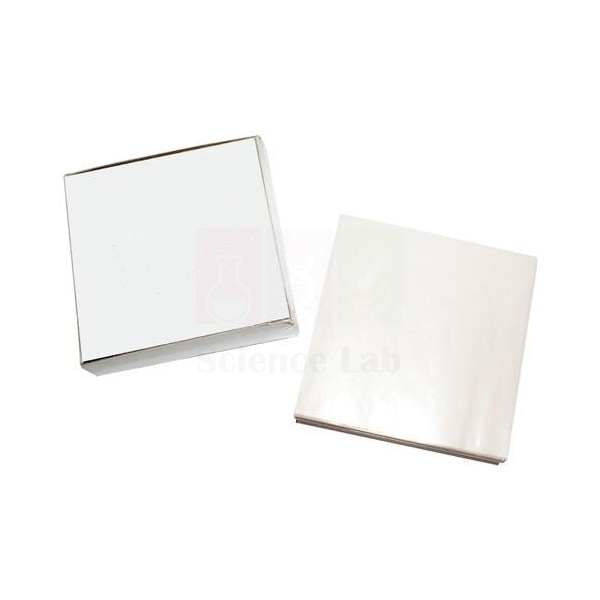
Weighing Paper
Weighing Paper (Product Code: SLE/ME/12) is a glazed paper sheet used to hold powders and small solids on a balance pan so they can be weighed cleanly in school, college and testing laboratories. Each sheet measures 3 × 3 in, and its smooth glazed surface protects the scale and helps prevent contamination from one sample to the next. It is supplied by Jain Scientific Equipments Pvt Ltd (ScienceLab), Ambala, India, among its chemistry consumables.
Specifications
| Parameter | Detail |
|---|---|
| Material | Glazed paper |
| Sheet size | 3 × 3 in |
| Purpose | Protects balance pans and helps prevent sample contamination |
| Product code | SLE/ME/12 |
| Supplied by | Jain Scientific Equipments Pvt Ltd (ScienceLab), Ambala, India |
What Is Weighing Paper Used For?
Whenever a practical calls for a measured amount of a solid, such as copper sulphate for a crystal-growing lesson or sodium chloride for a standard solution, a sheet of weighing paper sits between the chemical and the pan. The glazed finish means powder does not soak in or cling, so almost all of it slides off into the flask, and the pan stays free of corrosive residues.
Fold the sheet once from corner to corner and open it slightly to make a shallow channel. Set it on the pan, tare the balance, add the solid with a clean spatula, then tip it along the crease into the receiving vessel. Use a fresh sheet for each chemical; for liquids, damp materials or larger quantities, a plastic weighing boat is the sturdier choice.
Supplier
Jain Scientific Equipments Private Limited, known by its trading name ScienceLab, supplies Weighing Paper from Ambala, Haryana, to schools, colleges, testing laboratories and dealers in India and international markets. Labs usually add it to orders for balances, spatulas and other consumables so that everything for weighing practicals arrives together. Find out more on the ScienceLab profile page.
Related Measuring Equipment
Weighing paper is used with these balances and tools:
- Plastic Weighing Boats — rigid containers for liquids, damp solids or larger amounts.
- Compact Balance — a portable balance for student weighing.
- Electronic Balances — digital balances for routine laboratory weighing.
- Spatula, 140mm — for transferring small amounts of powder onto the sheet.
- Spatula, Spoon End — scoops granular solids more quickly.
Other weighing items are grouped in the Measuring category.
Frequently Asked Questions
What size is the Weighing Paper?
Each sheet of Weighing Paper measures 3 × 3 in. The compact square is sized for the small quantities of powder typically weighed out for student practicals and solution preparation, and it folds easily into a pouring channel.
Why use Weighing Paper instead of weighing directly on the pan?
Weighing Paper keeps chemicals off the balance pan, which protects the scale from residues and scratches and stops traces of one sample contaminating the next. Its glazed surface also lets the powder slide off completely into the receiving vessel.
How do you use Weighing Paper correctly?
Fold the Weighing Paper once corner to corner and open it slightly so it forms a shallow channel. Place it on the pan, tare the balance, add the sample with a spatula, then pour it along the crease into your flask or beaker.
Can Weighing Paper be reused?
Weighing Paper is meant to be used once for each sample and then discarded, because reusing a sheet can carry residue from one substance to another. For repeated weighing of the same material, a plastic weighing boat is a sturdier alternative.
In what quantities can Weighing Paper be ordered?
The product listing does not state a pack size for Weighing Paper. Tell us roughly how many sheets your laboratory uses in a term through the contact page, and the available packing will be confirmed in the quotation.
Who supplies Weighing Paper?
Weighing Paper is supplied by Jain Scientific Equipments Pvt Ltd (ScienceLab), Ambala, Haryana, India, to schools, colleges, laboratories and dealers in India and international markets, often together with balances, weighing boats and spatulas in one order.
Request a Quote
Let us know the quantity you need on the contact page, or add Weighing Paper to the enquiry cart along with balances or spatulas to receive one combined quotation.
Last updated: 24 September 2026
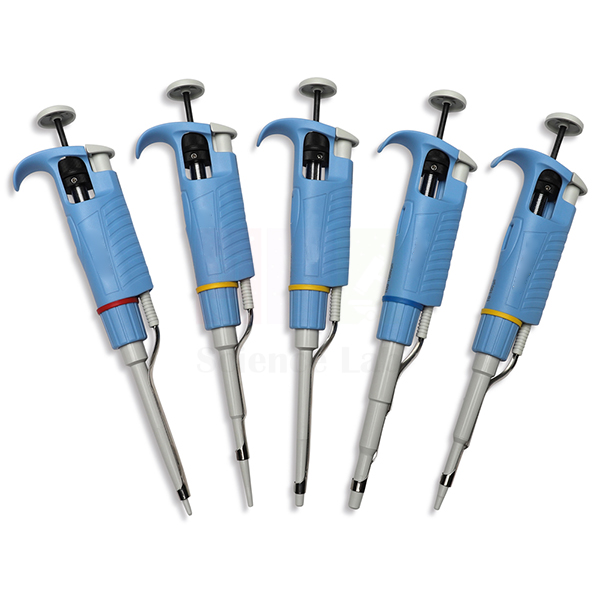
Research Pipettors
Research Pipettors (Product Code: SLE/ME/13) are adjustable-volume micropipettes used to measure and dispense microlitre volumes of liquid in biology, biotechnology and research laboratories. They are offered in four ranges, from 0.5–10 µL up to 20–200 µL, and pair a slim, ergonomic handle and low pipetting forces with a highly durable, UV-resistant shaft and an in-lab recalibration system. They are supplied by Jain Scientific Equipments Pvt Ltd (ScienceLab), Ambala, India.
Specifications
| Parameter | Detail |
|---|---|
| Volume ranges | 0.5 to 10 µL; 2.0 to 20 µL; 10 to 100 µL; 20 to 200 µL |
| Handle | Slim, comfortable, ergonomically designed |
| Pipetting force | Low |
| Shaft | Highly durable, UV resistant |
| Recalibration | In-lab recalibration system |
| Product code | SLE/ME/13 |
| Supplied by | Jain Scientific Equipments Pvt Ltd (ScienceLab), Ambala, India |
What Are Research Pipettors Used For?
These pipettors handle the small, precise volumes that modern life-science practicals depend on: preparing serial dilutions, setting up enzyme assays, mixing PCR reactions, loading electrophoresis gels and adding reagents to microcentrifuge tubes. The four ranges let a lab cover everything from a fraction of a microlitre to a couple of hundred microlitres, making them a core part of microbiology lab equipment in teaching and research settings.
Choose the smallest range that covers the volume you need, set the volume within that range, and fit a fresh tip for every sample. Pre-rinse the tip once, hold the pipettor upright while aspirating, and release the plunger slowly so no air bubbles form. Low pipetting forces reduce thumb strain in long sessions, and the UV-resistant shaft suits work areas where UV lamps are used between runs.
What to Specify When Ordering
- Which range or ranges you need: 0.5–10, 2.0–20, 10–100 or 20–200 µL.
- How many pipettors of each range per lab or student group.
- Matching standard or filtered tips, and how many cases.
- Whether a stand or carousel for storing the pipettors should be included.
Supplier
Research Pipettors are supplied under the ScienceLab name by Jain Scientific Equipments Private Limited of Ambala, Haryana, to universities, colleges, research institutes and distributors in India and international markets. Procurement offices can enter the company on their vendor list with GSTIN 06AAECJ8618A1ZT, and its global Legal Entity Identifier is 3358004HRD1JIVXKYX49. Read about the company on the ScienceLab profile.
Related Measuring Equipment
A micropipetting workstation usually also needs:
- Micropipette Tips — replacement tips; confirm fit with the range you order.
- Filtered Micropipette Tips — barrier tips for PCR and aerosol-sensitive work.
- Micro Tip Box — keeps tips clean and ready at the bench.
- Micro Centrifuge Tube, 1.5ml — small tubes for the samples being pipetted.
- Pipette Carousel — upright storage between uses.
More pipetting and weighing items are in the Measuring category.
Frequently Asked Questions
What volume ranges are available for the Research Pipettors?
Research Pipettors are listed in four ranges: 0.5 to 10 µL, 2.0 to 20 µL, 10 to 100 µL and 20 to 200 µL. Choose the smallest range that covers your working volume, because air-displacement pipettes are usually most accurate toward the upper part of their range.
Can the Research Pipettors be recalibrated in the laboratory?
Yes. Research Pipettors have an in-lab recalibration system, so a trained user can adjust them after gravimetric checks without sending them away. Record each check and adjustment in your equipment log so performance can be traced over time.
Are the Research Pipettors comfortable for long pipetting sessions?
Research Pipettors are ergonomically designed with a slim, comfortable handle and low pipetting forces. That combination reduces thumb and hand strain during repetitive work such as setting up plates, dilution series or gel loading.
Are the Research Pipettors resistant to UV light?
Yes, Research Pipettors are described as UV resistant, and their shaft is highly durable. This helps where pipettes stay inside work areas that use UV lamps between sessions, though surface cleaning should still follow your laboratory’s own procedures.
Which tips fit the Research Pipettors?
Tip fit depends on the pipettor model and range, so tell us which Research Pipettors ranges you are ordering and compatible standard or filtered tips will be confirmed in the same quotation. Poorly fitting tips cause leaks and inaccurate volumes.
Is a calibration certificate supplied with the Research Pipettors?
The product listing for the Research Pipettors does not mention a calibration certificate. If your laboratory needs one for audits, state this in your enquiry so availability can be discussed and confirmed before you place an order.
Who supplies the Research Pipettors?
Research Pipettors are supplied by Jain Scientific Equipments Pvt Ltd (ScienceLab), Ambala, Haryana, India, to colleges, universities, research laboratories and dealers in India and international markets. Send the ranges and quantities you need through the contact page.
Request a Quote
List the ranges, quantities and tips you need on the contact page, or add the Research Pipettors to the enquiry cart with other pipetting items for a single quotation.
Last updated: 24 September 2026
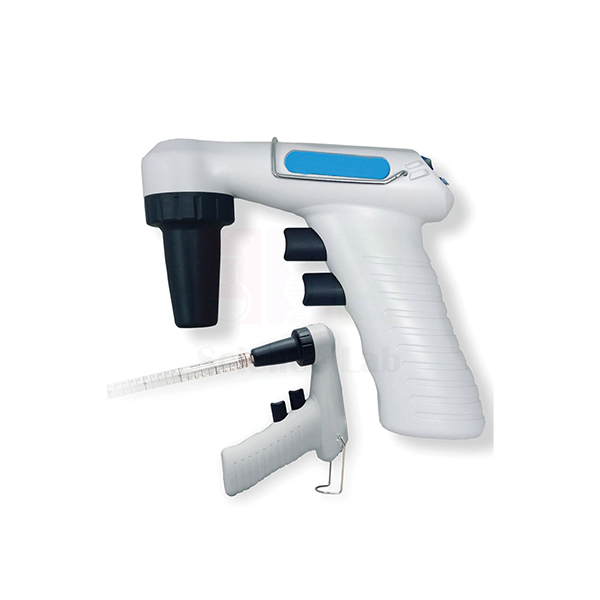
Pipette Controller
Pipette Controller (Product Code: SLE/ME/14) is a battery-powered pipetting aid used to draw up and dispense liquids with pipettes from 1 to 100 mL in chemistry, biology and microbiology laboratories. Weighing only 170 g, it fits either the right or the left hand, and its long-life rechargeable lithium battery runs for up to 8 hours or 2,500 uses on a single 2-hour charge. It is supplied by Jain Scientific Equipments Pvt Ltd (ScienceLab), Ambala, India.
Specifications
| Parameter | Detail |
|---|---|
| Weight | 170 g (6-3/10 oz) |
| Pipette sizes accepted | 1 to 100 mL, via an easy-fit silicone nosepiece |
| Handedness | Fits comfortably in the right or left hand |
| Battery | Long-life rechargeable lithium |
| Operation per charge | Up to 8 hours or 2,500 uses |
| Charging time | 2 hours for a single full charge |
| Speed control | Continuously variable electronic speed adjustment |
| Controls | Low-pressure fingertip control buttons |
| Body | Ergonomic design with computer-balanced weight distribution |
| Supplied with | Charger, filters, holder and instructions |
| Product code | SLE/ME/14 |
| Supplied by | Jain Scientific Equipments Pvt Ltd (ScienceLab), Ambala, India |
What Is a Pipette Controller Used For?
A pipette controller takes the effort and the risk out of filling graduated and serological pipettes. Instead of a rubber bulb or, worse, mouth pipetting, the user presses a fingertip button and the controller draws liquid smoothly up to the mark, then releases it on demand. Typical jobs include dispensing culture media, making up buffers, transferring reagents into flasks and preparing aliquots for a class.
Start slowly with foaming or viscous liquids and speed up with water-like solutions, using the variable speed to set the meniscus precisely. Never draw liquid beyond the upper end of the pipette; if a filter becomes wet, change it before carrying on. Return the controller to its holder between transfers and recharge it after a day’s practical so it is ready for the next session.
What to Specify When Ordering
- Number of controllers, for example one per bench or per student group.
- Spare replacement nosepiece adapters for shared units.
- Extra filters, and the pipette sizes you will use between 1 and 100 mL.
Supplier
The Pipette Controller is supplied by Jain Scientific Equipments Private Limited, which operates as ScienceLab from Ambala, Haryana, and sends laboratory equipment to schools, colleges, research labs and dealers across India and international markets. Buyers can combine the controller, spare nosepieces and pipettes in one order to equip a pipetting bench in a single delivery. Company details are on the ScienceLab profile.
Related Measuring Equipment
Items that work alongside this controller:
- Pipette Controller Replacement Nosepiece Adapter — the spare nosepiece made for this controller.
- Disposable Glass Serological Pipets — pipettes to fill and dispense with the controller.
- Pipet Controller — a cordless two-speed alternative with PTFE filters.
- Safety Pipet Filler, Silicone — a manual back-up that needs no charging.
- Pipette Stand — keeps clean pipettes upright and within reach.
See all pipetting tools in the Measuring category.
Frequently Asked Questions
What pipette sizes does the Pipette Controller accept?
The Pipette Controller accepts pipettes from 1 to 100 mL through its easy-fit silicone nosepiece. That span covers the graduated and serological pipettes used for most media, buffer and reagent transfers in teaching and research labs.
How long does the battery of the Pipette Controller last?
The Pipette Controller’s long-life rechargeable lithium battery runs for up to 8 hours or 2,500 uses on a single charge, and that charge takes 2 hours. Recharging after each practical day keeps it ready for the next session.
What is included with the Pipette Controller?
The Pipette Controller comes with a charger, filters, a holder and instructions. Pipettes are not included; order them separately in the sizes you need, along with spare nosepiece adapters if several users share one controller.
Can left-handed users operate the Pipette Controller?
Yes. The Pipette Controller is designed to sit comfortably in either the right or the left hand. At 170 g, with computer-balanced weight distribution and low-pressure fingertip buttons, it reduces hand fatigue during long pipetting sessions.
How is the dispensing speed of the Pipette Controller set?
The Pipette Controller has continuously variable electronic speed adjustment, so users can fill large pipettes quickly or slow down for careful meniscus setting in small ones. Start slowly with viscous or foaming liquids so they are not drawn into the nosepiece.
Who supplies the Pipette Controller?
Jain Scientific Equipments Pvt Ltd (ScienceLab), Ambala, Haryana, India, supplies the Pipette Controller to schools, colleges, research laboratories and dealers in India and international markets. Replacement nosepiece adapters can be quoted in the same order.
Request a Quote
Send the number of controllers and any spare nosepieces or pipettes through the contact page, or add the Pipette Controller to the enquiry cart for a combined quotation.
Last updated: 24 September 2026
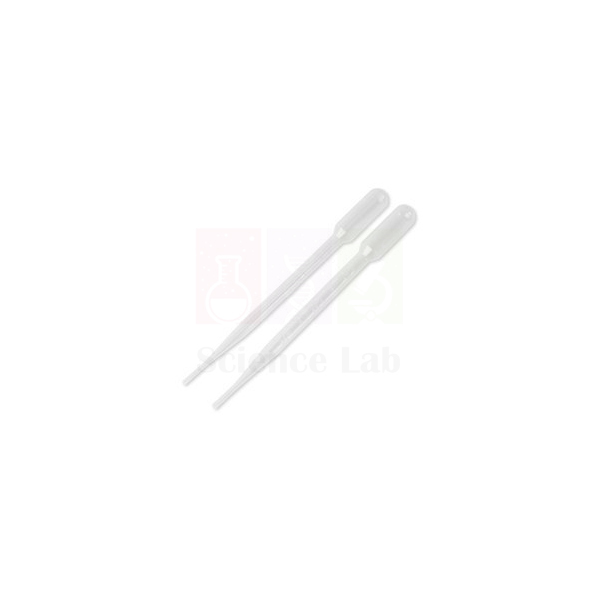
Plastic Microchemistry Pipets
Plastic Microchemistry Pipets (Product Code: SLE/ME/15) are low-density polyethylene pipets used to transfer, drop and hold small volumes of liquid in microscale chemistry practicals. They come in 0.25, 0.5, 0.75 and 1 mL sizes, where the stated capacity includes the bulb, and they can be cleaned and reused, doubling as micro-droppers or tiny reaction vessels. They are supplied by Jain Scientific Equipments Pvt Ltd (ScienceLab), Ambala, India.
Specifications
| Parameter | Detail |
|---|---|
| Material | Low-density polyethylene (LDPE) |
| Sizes | 0.25 mL, 0.5 mL, 0.75 mL and 1 mL |
| Capacity note | Total capacity includes the bulb |
| Reuse | Can be cleaned and reused |
| Uses | Storing and transferring liquids; micro-dropper; reaction vessel |
| Product code | SLE/ME/15 |
| Supplied by | Jain Scientific Equipments Pvt Ltd (ScienceLab), Ambala, India |
What Are Plastic Microchemistry Pipets Used For?
Microscale chemistry scales practicals down to drops instead of test-tube volumes, which cuts chemical use, cost and waste while keeping every student hands-on. These pipets are the basic tool for that approach: students use them to add reagents drop by drop to a spotting surface, count drops in simple titrations, keep a small amount of indicator ready at the bench, or draw two solutions into the bulb to watch a colour change or precipitate form.
As chemistry lab equipment for school classes, they are easy to hand out in sets. Label one pipet per reagent so solutions never mix, squeeze the bulb before dipping the tip rather than after, and rinse each pipet with water and then distilled water straight after the lesson. Polyethylene should not be heated, and some organic solvents can soften it, so reserve the pipets for aqueous work unless compatibility has been checked.
What to Specify When Ordering
- Size or sizes required: 0.25, 0.5, 0.75 or 1 mL.
- Quantity of each size, for example per student or per class set.
- Any dropper bottles or wash bottles to be supplied alongside.
Supplier
Jain Scientific Equipments Private Limited supplies these microchemistry pipets under its ScienceLab name from Ambala, Haryana, to schools, colleges, teacher-training institutes and dealers in India and international markets. They can be combined with reagent bottles, beakers and wash bottles in a single consignment for microscale programmes. Learn more on the ScienceLab profile page.
Related Measuring Equipment
Microscale practical sets often include:
- Transfer Pipette 3ml — a larger plastic pipette for bigger transfers.
- Dropper Bottle, 10 ml — small bottles for holding each reagent at the bench.
- Wash Bottle LDPE with Narrow Mouth — for rinsing the pipets before reuse.
- Plastic Beaker Set of 5 — plastic beakers for stock solutions and rinse water.
Further pipetting items are listed under Measuring.
Frequently Asked Questions
What sizes are Plastic Microchemistry Pipets available in?
Plastic Microchemistry Pipets are listed in 0.25 mL, 0.5 mL, 0.75 mL and 1 mL sizes. Each stated capacity is the total volume including the bulb, not only the stem, so allow for this when planning how much liquid to draw up.
What material are Plastic Microchemistry Pipets made from?
Plastic Microchemistry Pipets are made of low-density polyethylene. This flexible plastic lets the bulb be squeezed easily and does not shatter like glass when dropped, which suits younger students working with small volumes.
Can Plastic Microchemistry Pipets be reused?
Yes. Plastic Microchemistry Pipets can be cleaned and reused. Rinse them several times with water and then distilled water straight after use, dry them tip-down, and keep separate pipets for each reagent to avoid cross-contamination.
How is a Plastic Microchemistry Pipet used as a reaction vessel?
In microscale work, a Plastic Microchemistry Pipet can hold a few drops of two reagents inside its bulb so students can watch colour changes or precipitates form. This uses far smaller amounts of chemicals than test-tube reactions and reduces waste.
Are Plastic Microchemistry Pipets suitable for all chemicals?
Plastic Microchemistry Pipets suit most aqueous solutions used in school chemistry. Low-density polyethylene can soften with some organic solvents and should not be heated, so check compatibility or ask us before using them with solvents or hot liquids.
Who supplies Plastic Microchemistry Pipets?
Jain Scientific Equipments Pvt Ltd (ScienceLab), Ambala, Haryana, India, supplies Plastic Microchemistry Pipets to schools, colleges and dealers in India and international markets. State the sizes and quantities you need through the contact page for a quotation.
Request a Quote
Tell us which sizes and how many pipets you need on the contact page, or add them to the enquiry cart with dropper bottles and beakers for a single quotation.
Last updated: 24 September 2026
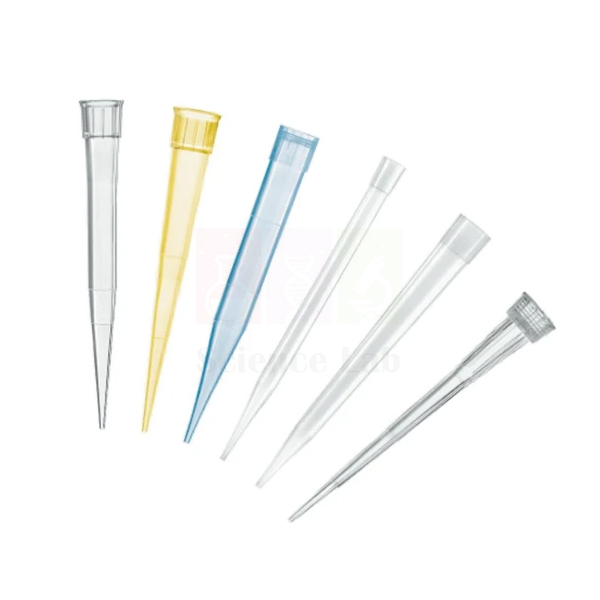
Micropipette Tips
Micropipette Tips (Product Code: SLE/ME/16) are replacement tips used on micropipettes to take up and dispense measured microlitre volumes in biology, chemistry and biotechnology laboratories. They are listed as replacement tips for the United Micropipettors and are sold in cases of 1,000 tips, a practical quantity for labs that change tips between every sample. They are supplied by Jain Scientific Equipments Pvt Ltd (ScienceLab), Ambala, India.
Key Details
| Parameter | Detail |
|---|---|
| Type | Replacement micropipette tips |
| Intended pipettes | United Micropipettors (as listed) |
| Packing | Case of 1,000 tips |
| Product code | SLE/ME/16 |
| Supplied by | Jain Scientific Equipments Pvt Ltd (ScienceLab), Ambala, India |
What Are Micropipette Tips Used For?
The tip is the only part of a micropipette that touches the liquid. It holds the measured volume while the pipette body stays clean, and swapping it for a fresh one between samples prevents carry-over from one solution to the next. In practice that means a new tip for each standard in a dilution series, each sample loaded onto a gel and each reagent added to a reaction tube.
Press the pipette shaft firmly into the tip so it seals evenly, then check it sits straight before drawing liquid. Touch the tip to the side of the receiving vessel to release the last drop, and eject used tips straight into a waste container. Keeping unused tips in a closed tip box protects them from dust, which matters for these everyday lab consumables in shared teaching labs.
What to Specify When Ordering
- The make, model and volume range of your micropipettes (these tips are listed for United Micropipettors).
- Number of cases of 1,000 tips.
- Whether you need filtered tips for PCR or aerosol-sensitive work as well.
Supplier
ScienceLab, the trading name of Jain Scientific Equipments Private Limited, supplies Micropipette Tips by the case from Ambala, Haryana, to schools, colleges, research laboratories and dealers in India and international markets. Regular users often set up repeat orders of tips alongside pipettes, tip boxes and tubes so that consumables never run short mid-term. More about the company is on the ScienceLab profile.
Related Measuring Equipment
Pipetting benches usually stock these items with the tips:
- Filtered Micropipette Tips — tips with a barrier for contamination-sensitive work.
- Micropipette — an adjustable pipette to use the tips with; confirm fit.
- Research Pipettors — micropipettes in four ranges for research work.
- Micro Tip Box — a box for storing tips clean at the bench.
- Micro Centrifuge Tube, 1.5ml — tubes for the samples being transferred.
Browse the Measuring category for further pipetting items.
Frequently Asked Questions
How many Micropipette Tips are in a case?
Micropipette Tips are sold in cases of 1,000 tips each. To plan how many cases you need, multiply the number of students or users by the number of transfers in each practical, since every sample and reagent needs a fresh tip.
Which pipettes do these Micropipette Tips fit?
These Micropipette Tips are listed as replacement tips for the United Micropipettors. If you use another make or model, send its name and volume range through the contact page so fit can be confirmed before quoting, because a poor seal gives inaccurate volumes.
What volume and material are the Micropipette Tips?
The product listing for the Micropipette Tips does not state the tip volume, colour or material. Tell us the volume range of your pipette in your enquiry, and the matching tip specification will be confirmed in writing before you order.
Can Micropipette Tips be reused?
Micropipette Tips are replacement consumables and should be changed between samples to prevent carry-over and contamination. Reusing a tip can leave residue inside it that changes the volume delivered and spoils later results.
Should I choose filtered tips instead of standard Micropipette Tips?
Standard Micropipette Tips suit routine teaching work. For PCR set-ups or any work where aerosols could contaminate the pipette, filtered micropipette tips add a barrier inside the tip; both types can be quoted together in one order.
Who supplies the Micropipette Tips?
Jain Scientific Equipments Pvt Ltd (ScienceLab), Ambala, Haryana, India, supplies Micropipette Tips by the case to schools, colleges, research labs and dealers in India and international markets, alongside micropipettes and tip boxes.
Request a Quote
State the number of cases and your pipette model on the contact page, or add Micropipette Tips to the enquiry cart with pipettes and tip boxes to receive one quotation.
Last updated: 24 September 2026
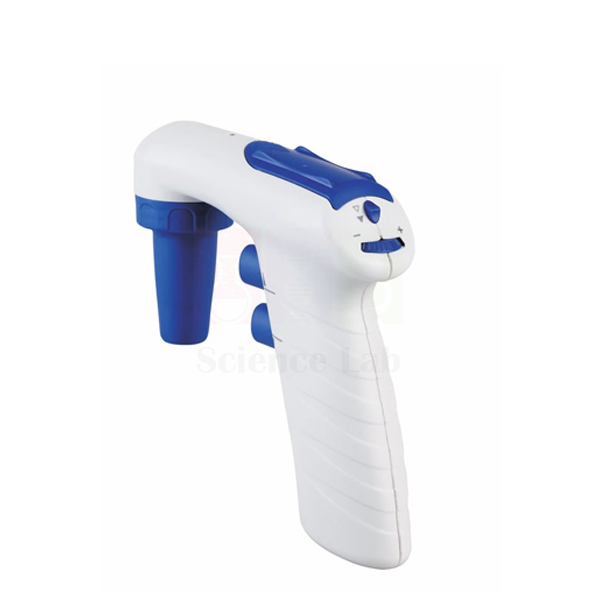
Pipet Controller
Pipet Controller (Product Code: SLE/ME/17) is a cordless, ergonomically designed pipetting aid used to aspirate and dispense liquids with glass or plastic pipets from 1 to 100 mL in teaching and research laboratories. Its low and high aspiration speeds, replaceable 0.2 µm and 0.45 µm PTFE filters and a liquid-blocking valve in the silicone nose protect the unit if liquid is drawn up too far. It is supplied by Jain Scientific Equipments Pvt Ltd (ScienceLab), Ambala, India.
Specifications
| Parameter | Detail |
|---|---|
| Type | Cordless, ergonomically designed pipet controller |
| Pipets accepted | Glass or plastic, 1 to 100 mL |
| Aspiration speed | Low or high setting |
| Filters | Replaceable PTFE, 0.2 µm and 0.45 µm |
| Liquid protection | Liquid-blocking valve in the silicone nose |
| Autoclavable parts | Silicone pipet holder (with valve), nosepiece and PTFE filters |
| Battery indicator | Low-battery warning light |
| Product code | SLE/ME/17 |
| Supplied by | Jain Scientific Equipments Pvt Ltd (ScienceLab), Ambala, India |
What Is a Cordless Pipet Controller Used For?
With no cable to trail across the bench, this controller moves easily between a sink, a media bench and a clean work area. It is used to fill serological and graduated pipets for culture media preparation, buffer make-up, reagent dispensing and routine volumetric transfers, taking the place of mouth pipetting and tiring hand bulbs in microbiology lab equipment set-ups.
Select low speed for small pipets, viscous samples or when setting a meniscus, and high speed to fill large pipets quickly. The finer 0.2 µm filter is the usual choice where the air path must stay especially clean, while the 0.45 µm filter suits general transfers. Autoclave the holder, nosepiece and filters according to your laboratory’s routine, wipe the body clean instead, and restore battery power as soon as the warning light comes on.
What to Specify When Ordering
- Number of controllers needed.
- Spare PTFE filters, stating 0.2 µm, 0.45 µm or both.
- Glass or plastic pipets in the sizes you use between 1 and 100 mL.
Supplier
Jain Scientific Equipments Private Limited, trading as ScienceLab from Ambala, Haryana, supplies the Pipet Controller to colleges, research laboratories, institutes and distributors in India and international markets. Overseas consignments are shipped under Importer-Exporter Code AAECJ8618A issued by the DGFT, and Indian buyers can record the supplier’s GSTIN 06AAECJ8618A1ZT on their purchase documents. Visit the ScienceLab profile for company background.
Related Measuring Equipment
These pipetting items complement the controller:
- Disposable Glass Serological Pipets — glass pipets to use with the controller.
- Pipette Controller — a rechargeable lithium-battery model with variable speed.
- Pipette Stand Rotary — holds pipets upright between transfers.
- Pipet Aid — a simple squeeze-bulb aid for occasional use.
More options are grouped in the Measuring category.
Frequently Asked Questions
What pipets can the Pipet Controller hold?
The Pipet Controller holds glass or plastic pipets from 1 to 100 mL. Push the pipet gently into the silicone holder until it seals, and check that it sits straight so liquid is drawn up smoothly without air leaks.
How is the aspiration speed set on the Pipet Controller?
The Pipet Controller’s aspiration speed can be set to low or high. Low speed gives fine control with small pipets or viscous fluids, while high speed fills large-volume pipets quickly during routine transfers.
How does the Pipet Controller protect itself from liquid?
The Pipet Controller combines replaceable 0.2 µm and 0.45 µm PTFE filters with a liquid-blocking valve in its silicone nose. If liquid is drawn up too far, the valve and filter stop it entering the unit; replace a wetted filter before continuing.
Which parts of the Pipet Controller can be autoclaved?
The silicone pipet holder (with its valve), the nosepiece and the PTFE filters of the Pipet Controller are autoclavable. The main body is not listed as autoclavable, so wipe it clean instead and keep it dry.
How do I know when the Pipet Controller needs power?
The Pipet Controller has a low-battery warning light. When it comes on, restore battery power before beginning a long series of transfers, so the unit is not interrupted part-way through a pipetting run.
How does the Pipet Controller differ from the Pipette Controller in the same range?
Both handle pipettes from 1 to 100 mL. The Pipet Controller stands out for its two-speed setting, choice of 0.2 µm or 0.45 µm PTFE filters and autoclavable holder, nosepiece and filters; ask us to compare both for your lab.
Who supplies the Pipet Controller?
Jain Scientific Equipments Pvt Ltd (ScienceLab), Ambala, Haryana, India, supplies the Pipet Controller to colleges, research laboratories and dealers in India and international markets, and can include spare PTFE filters and pipets in the same quotation.
Request a Quote
Send the number of controllers and the filters you prefer through the contact page, or add the Pipet Controller to the enquiry cart with pipets and stands for a combined quotation.
Last updated: 24 September 2026
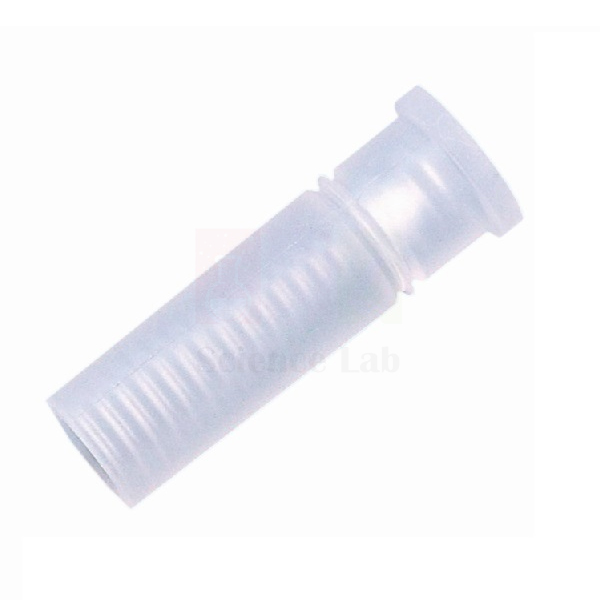
Pipette Controller Replacement Nosepiece Adapter
Pipette Controller Replacement Nosepiece Adapter (Product Code: SLE/ME/18) is a spare nosepiece used to restore a secure pipette grip on the Pipette Controller in laboratories that pipette every day. It is designed to accommodate pipettes from 1 to 100 mL, so a single adapter serves both small and large pipettes, and fitting a new one is a quick fix when the old nosepiece is worn. It is supplied by Jain Scientific Equipments Pvt Ltd (ScienceLab), Ambala, India.
Specifications
| Parameter | Detail |
|---|---|
| Type | Replacement nosepiece adapter |
| For use with | Pipette Controller |
| Pipette sizes accommodated | 1 to 100 mL |
| Product code | SLE/ME/18 |
| Supplied by | Jain Scientific Equipments Pvt Ltd (ScienceLab), Ambala, India |
What Is a Replacement Nosepiece Adapter Used For?
The nosepiece is the part of a pipette controller that grips the pipette and seals the air path. With daily use it can stretch, split or become contaminated, and the signs are easy to spot: pipettes wobble or slip out, liquid creeps down after aspiration, or the controller struggles to hold a column steady. Swapping in this adapter brings back a firm, airtight fit without replacing the whole controller.
Keep a spare with every shared controller so a worn part can be changed in minutes rather than halting a practical. When fitting, push the adapter fully home and check that a pipette sits straight before use. Insert pipettes with a gentle twist instead of forcing them at an angle, which prolongs the life of the new nosepiece and avoids cracking glass pipettes.
Supplier
This spare part is supplied by Jain Scientific Equipments Private Limited, the Ambala, Haryana company that trades as ScienceLab, to schools, colleges, research labs and dealers in India and international markets. It can be ordered on its own or together with the controller and pipettes. For supplier onboarding, the company is registered under GSTIN 06AAECJ8618A1ZT and carries Legal Entity Identifier 3358004HRD1JIVXKYX49. More about ScienceLab is on the company profile.
Related Measuring Equipment
Items that go with this spare nosepiece:
- Pipette Controller — the rechargeable controller this adapter is made for.
- Disposable Glass Serological Pipets — pipettes held by the nosepiece during transfers.
- Pipette Stand — upright storage for clean pipettes near the controller.
- Safety Pipet Filler, Silicone — a manual filler to keep work going while a part is changed.
Find other pipetting accessories in the Measuring category.
Frequently Asked Questions
Which controller does the Pipette Controller Replacement Nosepiece Adapter fit?
The Pipette Controller Replacement Nosepiece Adapter is intended for use with the Pipette Controller listed in the same Measuring range. If you own a different controller, send its make and model through the contact page before ordering so the fit can be checked.
What pipette sizes does the Pipette Controller Replacement Nosepiece Adapter accept?
The Pipette Controller Replacement Nosepiece Adapter is designed to accommodate pipettes from 1 to 100 mL. One adapter therefore covers the full span of pipettes normally used with the controller, from small graduated pipettes to large serological ones.
When should I fit a new Pipette Controller Replacement Nosepiece Adapter?
Fit a new Pipette Controller Replacement Nosepiece Adapter when pipettes start slipping, liquid drifts down after aspiration, or the old nosepiece is cracked, stretched or contaminated. A good seal is essential for the controller to hold liquid steadily.
How many Pipette Controller Replacement Nosepiece Adapters should a lab keep?
Labs that share one controller among several users usually keep at least one spare Pipette Controller Replacement Nosepiece Adapter on hand, so a worn part can be swapped immediately. Ordering spares together with the controller saves a second delivery.
Who supplies the Pipette Controller Replacement Nosepiece Adapter?
Jain Scientific Equipments Pvt Ltd (ScienceLab), Ambala, Haryana, India, supplies the Pipette Controller Replacement Nosepiece Adapter as a spare part to schools, colleges, research labs and dealers in India and international markets.
What should a quote request for the Pipette Controller Replacement Nosepiece Adapter include?
Include the number of Pipette Controller Replacement Nosepiece Adapters needed, the controller they will be used with and your delivery address. List any new pipettes or a second controller in the same enquiry for one combined quotation.
Request a Quote
Tell us how many spare nosepieces you need through the contact page, or add this adapter to the enquiry cart together with the controller or pipettes.
Last updated: 24 September 2026
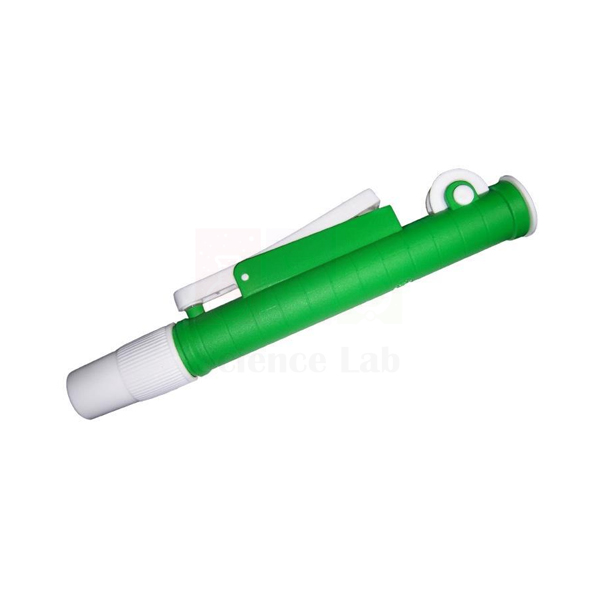
Pipet Pump II
Pipet Pump II (Product Code: SLE/ME/19) is a hand-operated pipet pump used to fill and dispense 10 mL pipets without mouth pipetting in school and college laboratories. This green 10 mL model has a fast-release action, so once the measured volume has been delivered to the mark, any remaining liquid can be let out quickly before the next transfer. It is supplied by Jain Scientific Equipments Pvt Ltd (ScienceLab), Ambala, India.
Key Details
| Parameter | Detail |
|---|---|
| Type | Fast-release pipet pump |
| Pipet size | 10 mL |
| Colour | Green |
| Product code | SLE/ME/19 |
| Supplied by | Jain Scientific Equipments Pvt Ltd (ScienceLab), Ambala, India |
What Is a Pipet Pump Used For?
A pipet pump gives students precise, controlled suction for measuring out a fixed volume, such as 10 mL of an acid for a titration or of a stock solution for a dilution. Fit the upper end of a 10 mL pipet into the pump, draw the liquid slightly above the graduation mark, then let it down slowly until the meniscus sits on the line before transferring it to the flask. It is a staple of any volumetric analysis kit in school and college chemistry.
The fast-release feature saves time when many samples are measured in a lesson. Keep the pump upright while it holds liquid, never let solution reach the pump itself, and wipe the outside after use. Its green colour also makes it easy to pick out on a crowded bench when pumps for other pipet sizes are in use.
Supplier
Jain Scientific Equipments Private Limited, the company behind the ScienceLab name in Ambala, Haryana, supplies the Pipet Pump II to schools, colleges, training institutes and dealers in India and international markets. Laboratories often order it with pipets and pipette stands so each titration station is complete. Learn more on the ScienceLab profile.
Related Measuring Equipment
Other pipet-filling options and accessories:
- Pipette Filler – 10ml — another filler in the same 10 mL size.
- Safety Pipet Filler, Silicone — a solvent-resistant filler that adjusts to any pipet size.
- Pipet Aid — a basic squeeze-bulb alternative for junior classes.
- Pipette Stand — keeps pipets upright and ready between titrations.
The full range is in the Measuring category.
Frequently Asked Questions
What pipet size is the Pipet Pump II for?
The Pipet Pump II listed here is the green 10 mL model. It is intended for pipets of that size, and using a pump that matches the pipet gives a firm seal and good control over the liquid level.
What does fast-release mean on the Pipet Pump II?
The fast-release feature of the Pipet Pump II lets users empty the pipet quickly once the measured volume has been delivered, which saves time when many transfers are made during a practical session.
Why use the Pipet Pump II instead of mouth pipetting?
The Pipet Pump II removes the need to draw liquids by mouth, which is unsafe with acids, alkalis, solvents and other hazardous solutions. Using a pump is a basic laboratory safety rule for students and staff alike.
How should the Pipet Pump II be cared for?
Keep the Pipet Pump II upright while it holds liquid and never draw solution into the pump itself. Wipe the outside after use, store it away from chemical spills, and check that the pipet still fits snugly before each class.
Who supplies the Pipet Pump II?
The Pipet Pump II is supplied by Jain Scientific Equipments Pvt Ltd (ScienceLab), Ambala, Haryana, India, to schools, colleges and dealers in India and international markets, together with pipets and other volumetric apparatus on request.
How can I get a quotation for the Pipet Pump II?
Send the quantity of Pipet Pump II units, your delivery location and any matching 10 mL pipets you need through the contact page or the enquiry cart. ScienceLab will reply with a written quotation.
Request a Quote
Place the Pipet Pump II in the enquiry cart with pipets and stands, or write to us through the contact page with the number of pumps each lab needs.
Last updated: 24 September 2026
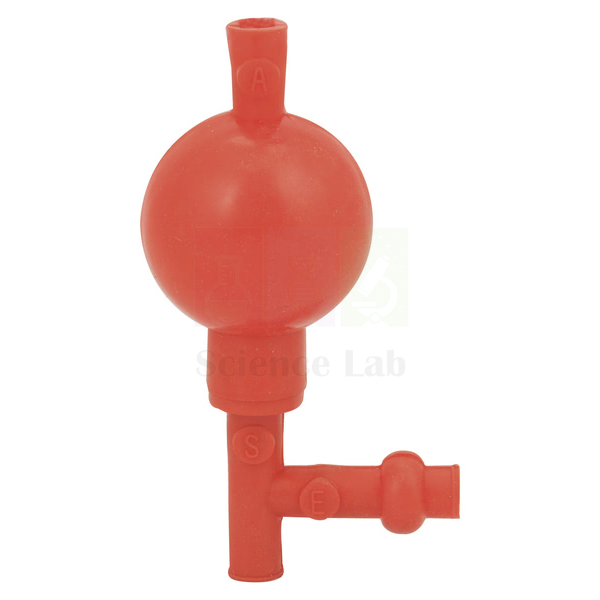
Safety Pipet Filler, Silicone
Safety Pipet Filler, Silicone (Product Code: SLE/ME/20) is a silicone pipet filler used to fill and dispense pipets with one hand in chemistry, biology and teaching laboratories. It adjusts to fit any size of pipet and is highly resistant to organic solvents, since silicone is more chemical resistant and more resilient than PVC or natural rubber. It is supplied by Jain Scientific Equipments Pvt Ltd (ScienceLab), Ambala, India, for safe pipetting in place of mouth suction.
Key Details
| Parameter | Detail |
|---|---|
| Material | Silicone |
| Operation | Filling and dispensing with one hand |
| Pipet fit | Adjusts to fit any size pipet |
| Chemical resistance | Highly resistant to organic solvents |
| Compared with other fillers | More chemical resistant and resilient than PVC or natural rubber |
| Product code | SLE/ME/20 |
| Supplied by | Jain Scientific Equipments Pvt Ltd (ScienceLab), Ambala, India |
What Is a Silicone Pipet Filler Used For?
Titration practicals, standard-solution preparation and any transfer of a measured volume start with filling a pipet, and this filler lets students do it safely with one hand while the other steadies the flask. Because silicone stands up to organic solvents better than PVC or rubber bulbs, the same filler can move from aqueous acid-base work to solvent-based reagents in organic chemistry classes, which makes it a practical addition to any titration kit for schools in India and abroad.
Hold the pipet close to its upper end and ease it into the filler with a gentle twist so the glass is not strained. Draw liquid a little above the mark, let it down to the line, then dispense into the receiving vessel. Keep liquid out of the filler itself, rinse the outside if it gets splashed, and store it where it will not be squashed under heavier apparatus.
Supplier
ScienceLab, the business name of Jain Scientific Equipments Private Limited in Ambala, Haryana, supplies the Safety Pipet Filler, Silicone to schools, colleges, university departments and dealers in India and international markets. It is usually ordered in class sets together with pipets and stands so every bench can pipette safely. Company information is on the ScienceLab profile.
Related Measuring Equipment
Compare or combine this filler with:
- Bulb Type, Pipette Filler — a bulb-style alternative filler.
- Pipette Filler — another pipette filler in the plasticware range.
- Pipet Pump II — a fast-release pump dedicated to 10 mL pipets.
- Disposable Glass Serological Pipets — pipets to fill with it.
- Pipette Stand — upright storage for pipets at each bench.
See more in the Measuring category.
Frequently Asked Questions
What is the Safety Pipet Filler, Silicone made of?
The Safety Pipet Filler, Silicone is made of silicone, which is more chemical resistant and more resilient than PVC or natural rubber. It keeps its flexibility through repeated squeezing, which suits busy teaching laboratories where fillers are used every day.
Can the Safety Pipet Filler, Silicone be used with organic solvents?
Yes. The Safety Pipet Filler, Silicone is highly resistant to organic solvents, so it can be used for solvent-based reagents as well as aqueous solutions. Still keep liquid from entering the filler, and rinse the outside if it is splashed.
Which pipets fit the Safety Pipet Filler, Silicone?
The Safety Pipet Filler, Silicone adjusts to fit any size pipet. Insert the pipet with a gentle twisting motion while holding it close to its upper end, so it seals firmly without putting strain on the glass.
Can the Safety Pipet Filler, Silicone be used with one hand?
Yes. The Safety Pipet Filler, Silicone enables filling and dispensing of pipets with one hand, leaving the other hand free to hold the flask or beaker steady. This is especially helpful when setting a meniscus accurately during titrations.
Why is the Safety Pipet Filler, Silicone safer than mouth pipetting?
The Safety Pipet Filler, Silicone removes any chance of swallowing or inhaling reagents, a real risk when acids, alkalis or solvents are drawn up by mouth. Using a filler is basic laboratory safety practice in schools and colleges.
Who supplies the Safety Pipet Filler, Silicone?
Jain Scientific Equipments Pvt Ltd (ScienceLab), Ambala, Haryana, India, supplies the Safety Pipet Filler, Silicone in class quantities to schools, colleges and dealers in India and international markets. Send your quantity through the contact page.
Request a Quote
Tell us how many fillers your labs need through the contact page, or add the Safety Pipet Filler, Silicone to the enquiry cart with pipets and stands for one quotation.
Last updated: 24 September 2026
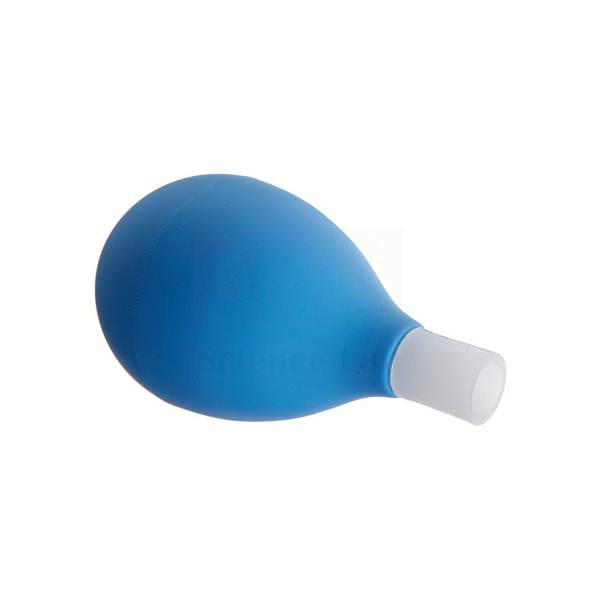
Pipet Aid
Pipet Aid (Product Code: SLE/ME/21) is a simple, economical squeeze-bulb device used to draw liquid into a pipet as a safe and easy alternative to mouth pipetting in school laboratories. It pairs a vinyl bulb with a tapered polyethylene chuck that lets the filled pipet be pulled free quickly, after which a fingertip over the pipet end controls the release. It is supplied by Jain Scientific Equipments Pvt Ltd (ScienceLab), Ambala, India.
Key Details
| Parameter | Detail |
|---|---|
| Bulb | Vinyl; squeeze to draw fluid into the pipet |
| Chuck | Tapered polyethylene, for quick removal once the pipet is filled |
| Dispensing | Pipet removed; release controlled with a finger over the pipet end |
| Purpose | Economical, safe alternative to mouth pipetting |
| Product code | SLE/ME/21 |
| Supplied by | Jain Scientific Equipments Pvt Ltd (ScienceLab), Ambala, India |
What Is a Pipet Aid Used For?
The Pipet Aid is a straightforward way to stop students pipetting by mouth. It is used in junior science lab equipment sets and first chemistry practicals where learners measure out water, dilute acids or indicator solutions, and it teaches the classic fingertip technique of holding a liquid column and letting it down to the mark.
Squeeze the vinyl bulb, fit the pipet into the tapered chuck and release the bulb gently so fluid rises past the graduation. Pull the pipet free, cap its upper end with a dry fingertip, and ease the pressure to lower the meniscus to the line before delivering the liquid. Keep solution out of the bulb, and for one-handed dispensing or solvent work move students on to a silicone safety filler.
Supplier
Jain Scientific Equipments Private Limited supplies the Pipet Aid under the ScienceLab trading name from Ambala, Haryana, to schools, colleges, teacher-training centres and dealers in India and international markets. As an economical way to equip a whole class, it is often quoted alongside pipets and rotary stands for new science rooms. See the ScienceLab profile for company details.
Related Measuring Equipment
Step-up options and accessories for pipetting lessons:
- Safety Pipet Filler, Silicone — one-hand filling and dispensing, resistant to organic solvents.
- Pipet Pump II — fast-release pump for 10 mL pipets.
- Pipet Controller — cordless two-speed controller for 1 to 100 mL pipets.
- Disposable Glass Serological Pipets — glass pipets for measured transfers.
- Pipette Stand Rotary — keeps a class set of pipets upright.
Explore more pipetting and weighing items under Measuring.
Frequently Asked Questions
How do you use the Pipet Aid?
Squeeze the vinyl bulb of the Pipet Aid, fit the pipet into the chuck and release the bulb slowly to draw fluid up. Then pull the pipet free and place a fingertip over its upper end to hold and release the liquid.
What is the Pipet Aid made of?
The Pipet Aid has a squeezable vinyl bulb and a tapered polyethylene chuck. The tapered chuck lets the filled pipet be pulled out quickly, so the user’s fingertip can take over before any liquid runs back down.
Why choose the Pipet Aid over mouth pipetting?
The Pipet Aid gives a safe and easy alternative to mouth pipetting, so students never risk swallowing or breathing in chemical solutions. It is an economical way to equip a whole class with a basic pipetting safety device.
How is the Pipet Aid different from a silicone pipet filler?
The Pipet Aid only draws liquid up; delivery is controlled with a fingertip after the pipet is removed. A silicone safety pipet filler fills and dispenses with one hand and resists organic solvents, suiting more advanced or solvent-based work.
Who supplies the Pipet Aid?
The Pipet Aid is supplied by Jain Scientific Equipments Pvt Ltd (ScienceLab), Ambala, Haryana, India, to schools, colleges and dealers in India and international markets, and can be ordered in class sets together with pipets and pipette stands.
What should a Pipet Aid quotation request include?
For a Pipet Aid quotation, state the number of units, the sizes of pipets your students use and your delivery location. Adding pipets or stands to the same enquiry lets ScienceLab prepare one combined offer.
Request a Quote
Send the number of Pipet Aids for your classes through the contact page, or add them to the enquiry cart with pipets and stands to receive a single quotation.
Last updated: 24 September 2026
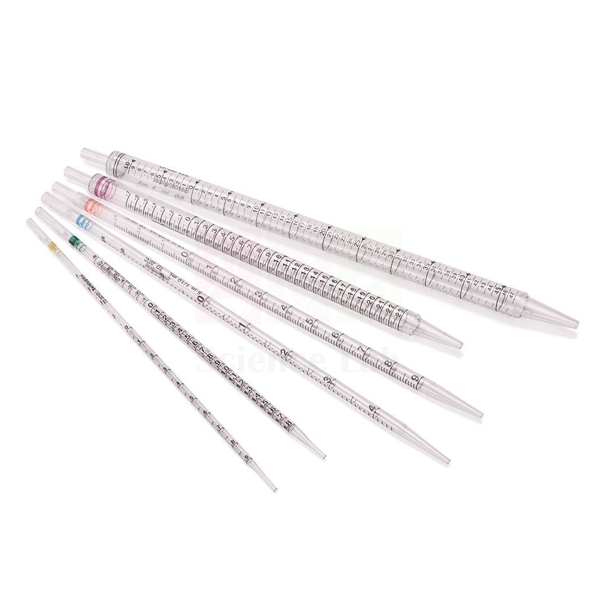
Disposable Glass Serological Pipets
Disposable Glass Serological Pipets (Product Code: SLE/ME/22) are sterile, single-use glass pipets used to measure and transfer small liquid volumes in microbiology, cell-culture and teaching laboratories. Technicians choose them when every transfer needs a fresh, plugged 10 x 0.1 mL pipet with a fire-polished tip and no washing afterwards. They are supplied by Jain Scientific Equipments Pvt Ltd (ScienceLab), Ambala, India, a laboratory equipment supplier in India serving schools, colleges and research labs.
Specifications
| Parameter | Detail |
|---|---|
| Type | Disposable glass serological pipet, plugged |
| Sterility | Sterile; each piece individually wrapped |
| Size | 10 x 0.1 mL (10 mL, graduated in 0.1 mL divisions) |
| Calibration | Total capacity transfer by blow-out |
| Graduations | Negative graduations |
| Tip | Long, slender and tapered; fire-polished for burr-free, even flow rates |
| Wrapper | Easy-open pack, one side paper and one side plastic, printed with colour-coded sizes |
| Product code | SLE/ME/22 |
| Supplied by | Jain Scientific Equipments Pvt Ltd (ScienceLab), Ambala, India |
What Are Disposable Serological Pipets Used For?
Serological pipets are the standard tool for dispensing measured volumes of culture media, buffers, diluents and reagents where carry-over between samples must be avoided. Because each pipet arrives sterile in its own wrapper, a student or technician can open one, make the transfer and discard it, removing the washing and re-sterilising step that reusable glass pipets need.
Fit the plugged end to a pipette filler or controller (never pipette by mouth), draw the liquid slightly above the required mark and let it drain to the reading you need. The long, slender tip reaches into narrow tubes and flasks, and since these pipets are calibrated for blow-out, the last drop is expelled to deliver the full capacity. Peel the wrapper from the plugged end first so the tip stays covered until the moment of use.
Supplier
ScienceLab is the trading name of Jain Scientific Equipments Private Limited, based in Ambala, Haryana. The company supplies sterile disposable pipets like these together with pipetting aids and general lab consumables to institutions, laboratories and dealers in India and international markets, so one enquiry can cover a whole pipetting set-up. For vendor registration, the supplying company is Jain Scientific Equipments Private Limited (CIN U29309HR2020PTC087597, GSTIN 06AAECJ8618A1ZT). More about the company is on the ScienceLab company profile.
Related Measuring Equipment
These items are used alongside serological pipets in the same liquid-handling work:
- Pipette Controller — draws and dispenses liquid through the pipet without mouth pipetting.
- Safety Pipet Filler, Silicone — a simple hand-operated filler for occasional transfers.
- Pipet Aid — another pipetting aid for routine volume transfers.
- Plastic Microchemistry Pipets — disposable plastic pipets for small-scale chemistry work.
- Glass Measuring Cylinder — for larger volumes where fine pipet divisions are not needed.
Browse the full Measuring equipment range for balances, pipetting tools, rulers and thermometers.
Frequently Asked Questions
What size are the Disposable Glass Serological Pipets?
The Disposable Glass Serological Pipets (SLE/ME/22) are listed as 10 x 0.1 mL, meaning a 10 mL pipet graduated in 0.1 mL divisions. Each wrapper is printed with a colour-coded size so the right pipet can be picked quickly from a drawer.
Are the Disposable Glass Serological Pipets sterile?
Yes. Each Disposable Glass Serological Pipet is sterile, plugged and individually wrapped in an easy-open pack with one paper side and one plastic side. Keep the wrapper closed until use and discard the pipet after a single transfer.
How is the full volume dispensed from these serological pipets?
These Disposable Glass Serological Pipets are calibrated for total capacity transfer by blow-out. After the liquid drains, expel the last drop in the tip with the pipette filler or controller so that the full measured volume is delivered.
Can the serological pipets be used with a pipette controller?
The Disposable Glass Serological Pipets are meant for use with a pipette filler or controller, never by mouth. Fit depends on the nosepiece of your controller, so tell us the model you use and ask us to check compatibility when you request a quotation.
Who supplies the Disposable Glass Serological Pipets?
Disposable Glass Serological Pipets are supplied by Jain Scientific Equipments Pvt Ltd (ScienceLab), Ambala, Haryana, India, to laboratories, colleges and dealers in India and international markets. Use the contact page for quotations and bulk quantities.
What should a quotation request for these pipets include?
For a quotation on Disposable Glass Serological Pipets, state the size (10 x 0.1 mL), the number of pipets you need, the delivery location, and any other pipetting items to quote together. Ask us how the pipets are packed so you can plan quantities.
Request a Quote
To order Disposable Glass Serological Pipets, send your quantity and delivery details through our contact page or add the item to the enquiry cart, and we will respond with a quotation.
Last updated: 24 September 2026
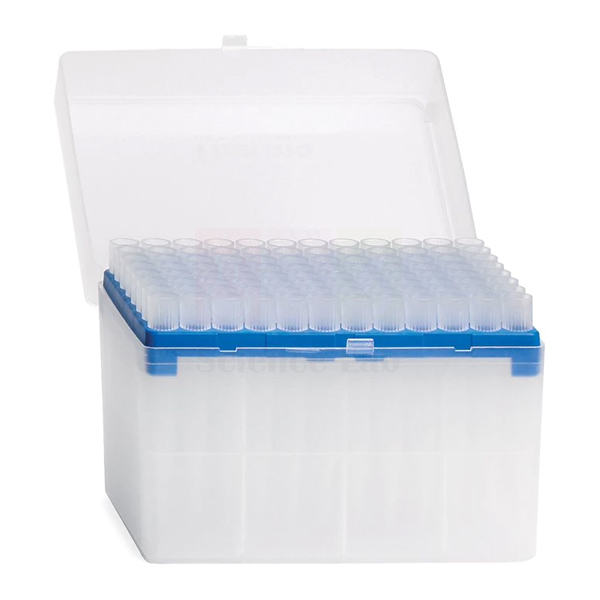
Filtered Micropipette Tips
Filtered Micropipette Tips (Product Code: SLE/ME/23) are sterile, racked pipette tips with a built-in filter barrier, used to protect micropipettes and samples from cross-contamination in molecular biology and microbiology laboratories. They come in a rack of 96, are DNase, RNase and pyrogen free, and offer 99.9% bacterial aerosol filtration efficiency, which suits PCR set-up and nucleic-acid work. They are supplied by Jain Scientific Equipments Pvt Ltd (ScienceLab), Ambala, India, a laboratory instruments supplier in India.
Specifications
| Parameter | Detail |
|---|---|
| Type | Filtered micropipette tips, racked |
| Sterility | Sterile |
| Filter | Hydrophobic design that stops liquids and aerosols entering the micropipette |
| Filtration efficiency | 99.9% bacterial aerosol filtration efficiency |
| Purity | DNase, RNase and pyrogen free |
| Biocompatibility | Noncytotoxic and nonhemolytic |
| Pack | Rack of 96 tips |
| Product code | SLE/ME/23 |
| Supplied by | Jain Scientific Equipments Pvt Ltd (ScienceLab), Ambala, India |
What Are Filtered Micropipette Tips Used For?
When a micropipette draws liquid, fine aerosols can rise into its shaft and carry traces of one sample into the next. The hydrophobic filter in each tip blocks liquid and aerosol before they reach the pipette, which is why filtered tips are the usual choice for setting up PCR reactions before they go into a thermal cycler, for DNA and RNA handling, for cell culture and for work with bacterial cultures in microbiology teaching labs.
Load a tip by pressing the micropipette shaft firmly into it while it is still in the rack, so fingers never touch the tip. Change the tip after every sample, eject used tips straight into a waste container, and keep the rack lid closed between uses so the remaining tips stay sterile.
Supplier
ScienceLab is the trading name of Jain Scientific Equipments Private Limited in Ambala, Haryana. The company sources filtered tips like these and supplies them with micropipettes, standard tips and other liquid-handling consumables to research institutes, teaching laboratories and colleges in India and international markets. Company details are on the ScienceLab profile page.
Related Measuring Equipment
Pair these tips with the pipettes and accessories used in the same workflow:
- Micropipette — the instrument these tips are loaded onto.
- Research Pipettors — pipettors for routine research transfers.
- Micropipette Tips — non-filtered tips for general work where aerosol protection is not needed.
- Filter Pipette Tips — filter tips listed in the clinical laboratory range.
- Pipette Carousel Stand — keeps pipettes upright between sessions.
See more pipetting and measuring items in the Measuring category.
Frequently Asked Questions
How many tips come in a rack of Filtered Micropipette Tips?
Filtered Micropipette Tips (SLE/ME/23) come racked, with 96 tips per rack. The rack lets you load tips directly onto a micropipette without handling them, which helps keep the unused tips sterile. Tell us how many racks you need when you enquire.
What does the filter in these micropipette tips do?
The filter in Filtered Micropipette Tips has a hydrophobic design that stops liquids and aerosols from entering the micropipette. It is rated at 99.9% bacterial aerosol filtration efficiency, helping protect both the pipette and the next sample from cross-contamination.
Are Filtered Micropipette Tips suitable for PCR and RNA work?
Filtered Micropipette Tips are sterile, DNase, RNase and pyrogen free, noncytotoxic and nonhemolytic, which is why laboratories use them for PCR set-up, nucleic-acid handling and cell culture. Confirm that the tip size suits your micropipette before ordering.
Will these filtered tips fit my micropipette?
The fit and volume range of Filtered Micropipette Tips should be matched to your micropipette's make and model, because tip cones differ between pipettes. Send the pipette details through the contact page and ask us which tips to quote.
Can Filtered Micropipette Tips be reused?
No. Filtered Micropipette Tips are supplied sterile for single use. Washing or re-sterilising a filter tip can wet or damage the filter and defeats its purpose, so discard each tip after one sample into a suitable waste container.
Who supplies the Filtered Micropipette Tips?
Filtered Micropipette Tips are supplied by Jain Scientific Equipments Pvt Ltd (ScienceLab), Ambala, Haryana, India. The company quotes single racks and bulk quantities for laboratories, colleges and dealers in India and international markets.
Request a Quote
For Filtered Micropipette Tips, send the number of racks, your micropipette model and delivery location via the contact page, or place the item in the enquiry cart to build a combined request.
Last updated: 24 September 2026
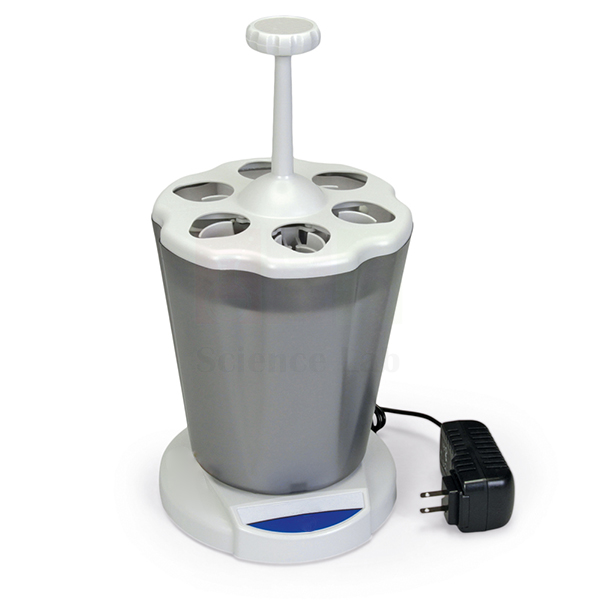
Pipette Carousel
Pipette Carousel (Product Code: SLE/ME/24) is a UV-C decontamination carousel used to hold single-channel pipettes and expose them to ultraviolet light to reduce DNA contamination in molecular biology and PCR laboratories. It takes 6 pipettes in a universal holster, surrounds them with a UV-C lamp and mirrored reflector for 360° exposure, and runs a fixed 28-minute cycle on a compact 17 cm footprint. It is supplied by Jain Scientific Equipments Pvt Ltd (ScienceLab), Ambala, India, a laboratory equipment supplier in India.
Specifications
| Parameter | Detail |
|---|---|
| Function | UV-C lamp and reflector system that destroys 99% of DNA contamination |
| UV exposure | 360° |
| Capacity | 6 single-channel pipettes; universal holster fits all brands |
| Footprint | 6-1/2 in (17 cm) |
| Dimensions | 17 cm D x 33 cm H |
| Lamp | 254 nm UV-C, non-ozone lamp; 450 mW; rated 2,000 hr |
| Timer | Fixed cycle time of 28 min |
| Housing | UV-resistant polycarbonate |
| Reflector | Mirrored, aluminium-coated polyester film |
| Electrical | 100 V, 50 Hz, 1 A |
| Product code | SLE/ME/24 |
| Supplied by | Jain Scientific Equipments Pvt Ltd (ScienceLab), Ambala, India |
What Is a UV Pipette Carousel Used For?
Pipette shafts and ejectors pick up invisible traces of DNA and amplified product, which can carry over into later PCR reactions and give false results. Placing the pipettes in the carousel between sessions exposes their outer surfaces to 254 nm UV-C light, which damages residual DNA on those surfaces. It is used in PCR set-up areas, molecular biology teaching labs and forensic-science practicals where clean pipettes matter.
Wipe away any visible spills first, since UV acts only on surfaces the light reaches, then load the pipettes into the holster and start the cycle at the end of each session. UV-C light is harmful to eyes and skin, so never look directly at the lamp while it is on. UV treatment complements, rather than replaces, filtered tips and good bench practice.
What to Specify When Ordering
- Your site mains supply, compared with the listed 100 V, 50 Hz, 1 A rating.
- Number of units needed, remembering each carousel takes 6 single-channel pipettes.
- Whether you want to ask about replacement UV-C lamps (the lamp is rated 2,000 hr).
- Whether a plain, non-UV stand is also needed for everyday pipette storage.
Supplier
ScienceLab, the trading name of Jain Scientific Equipments Private Limited in Ambala, Haryana, sources this UV pipette carousel for laboratories setting up clean PCR areas. It is supplied together with pipettes, filter tips and other molecular-biology consumables to research, teaching and diagnostic laboratories in India and international markets, so buyers can combine items in one enquiry. Read more on the company profile page.
Related Measuring Equipment
Items commonly used with a UV pipette carousel in PCR and liquid-handling work:
- Pipette Carousel Stand — a rotating non-UV stand for day-to-day storage of 6 pipettes.
- Filtered Micropipette Tips — barrier tips that stop aerosols entering the pipette.
- Research Pipettors — single-channel pipettes to keep in the carousel.
- Micropipette — another pipette option from the plasticware range.
- Micropipette Tips — standard tips for general pipetting.
The complete Measuring range lists more pipetting and measurement items.
Frequently Asked Questions
How many pipettes does the Pipette Carousel hold?
The Pipette Carousel (SLE/ME/24) holds 6 single-channel pipettes. Its universal holster is designed to fit all pipette brands, so a lab with mixed pipettes can decontaminate a full working set in one 28-minute cycle.
What UV lamp does the Pipette Carousel use?
The Pipette Carousel uses a 254 nm UV-C, non-ozone lamp rated at 450 mW and 2,000 hr, backed by a mirrored, aluminium-coated polyester reflector. Together they give 360° exposure and are specified to destroy 99% of DNA contamination.
What power supply does the Pipette Carousel need?
The Pipette Carousel is listed with an electrical rating of 100 V, 50 Hz, 1 A. Mains voltage differs between countries, so state your local supply when requesting a quotation and discuss the power arrangement with us before ordering.
Can the cycle time of the Pipette Carousel be changed?
No. The Pipette Carousel has a fixed cycle time of 28 minutes, so every run gives the same exposure. Start the cycle, leave the pipettes in place until it ends, and keep eyes and skin away from the lamp while it is lit.
Does the Pipette Carousel replace filtered pipette tips?
No. UV exposure in the Pipette Carousel treats the outer surfaces of pipettes, but it does not stop aerosols entering a pipette during use. Most PCR labs combine it with filtered micropipette tips, separate work areas and routine bench cleaning.
Who supplies the Pipette Carousel?
The Pipette Carousel is supplied by Jain Scientific Equipments Pvt Ltd (ScienceLab), Ambala, Haryana, India, to research, teaching and diagnostic laboratories in India and international markets. Send your quantity and site voltage through the contact page for a quotation.
Request a Quote
Request a Pipette Carousel quotation through the contact page, mentioning your mains supply, or add it to the enquiry cart with any tips and pipettes you need.
Last updated: 24 September 2026
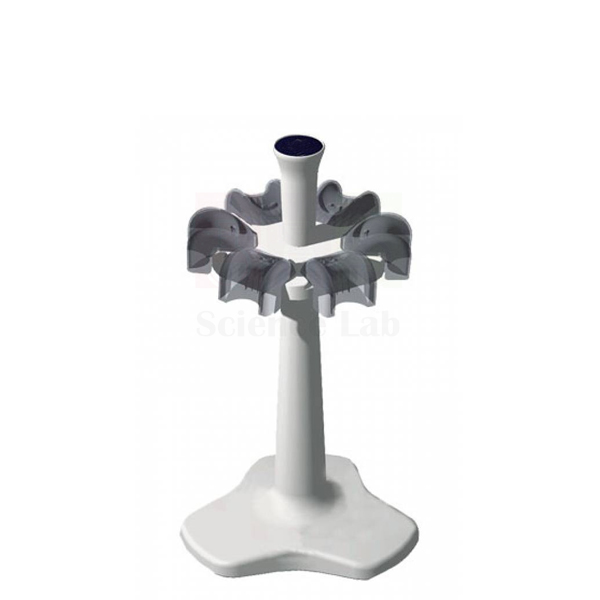
Pipette Carousel Stand
Pipette Carousel Stand (Product Code: SLE/ME/25) is a rotating bench stand used to keep single-channel pipettes upright and within reach in teaching and research laboratories. It holds a set of 6 pipettes on a compact 6-1/4 in diameter base and turns through a full 360°, so any pipette can be brought to the front without reaching across the bench. It is made by Jain Scientific Equipments Pvt Ltd (ScienceLab), an OEM laboratory equipment manufacturer in India, at its own factory in Ambala.
Specifications
| Parameter | Detail |
|---|---|
| Capacity | 6 single-channel pipettes |
| Base diameter | 6-1/4 in |
| Rotation | Full 360° |
| Pipette fit | Universal design for a wide range of pipettes |
| Suitable for | Classrooms and research laboratories |
| Product code | SLE/ME/25 |
| Manufacturer | Jain Scientific Equipments Pvt Ltd (ScienceLab) — OEM |
| Country of origin | India (made in Ambala, Haryana) |
What Is a Pipette Carousel Stand Used For?
Micropipettes are best stored upright between uses, so that liquid residue cannot run back into the shaft, and a pipette left lying on the bench is easily knocked, rolled off or mis-set. The carousel keeps a full working set of 6 in their holders, grouped however the user prefers, and a turn of the stand brings the next one round. It is common on biotechnology practical benches, shared school biology lab stations and research workbenches.
Arrange the pipettes in order of volume so students pick the right one first time, and return each pipette with its tip ejected. Many pipette users set adjustable pipettes to their highest volume before storing them to relax the internal spring. Where a class shares one set, the stand also makes it easy to check that all six pipettes are back at the end of a practical.
OEM Manufacturer
The Pipette Carousel Stand is an original ScienceLab product: Jain Scientific Equipments Private Limited, which trades as ScienceLab, is the OEM and makes it at its own licensed factory at Saha, Ambala, Haryana, India. Because the stand comes straight from the maker rather than through a trading intermediary, schools, colleges, dealers and importers deal directly with the people who produce it. Repeat orders and questions about replacement parts are handled by the manufacturer itself, so just ask us. Company background is on the ScienceLab profile page.
Related Measuring Equipment
Pipettes, tips and storage options that go with this stand:
- Research Pipettors — single-channel pipettes to fill the stand.
- Micropipette — an adjustable pipette for teaching and routine work.
- Micropipette Tips — disposable tips to keep beside the stand.
- Pipette Carousel — a UV-C version for decontaminating pipettes between PCR sessions.
- Pipette Stand Rotary — an alternative rotary stand from the plasticware range.
Explore the wider Measuring equipment category for more pipetting and measurement tools.
Frequently Asked Questions
How many pipettes does the Pipette Carousel Stand hold?
The Pipette Carousel Stand (SLE/ME/25) holds a set of 6 single-channel pipettes. Its universal design accepts a wide range of pipettes, and the full 360° rotation brings each one to the front of the bench when it is needed.
How much bench space does the Pipette Carousel Stand take?
The Pipette Carousel Stand has a compact 6-1/4 in diameter base, so it occupies little bench space. That makes it practical on crowded classroom benches and research workstations where pipettes need to stay upright but close at hand.
Will my pipettes fit the Pipette Carousel Stand?
The Pipette Carousel Stand has a universal design built to fit a wide range of single-channel pipettes. If you use an unusual or very large pipette, send its make and model through the contact page and ask us to check the fit before quoting.
Are pipettes included with the Pipette Carousel Stand?
Pipettes are not listed as part of the Pipette Carousel Stand, which is described as holding a set of 6 single-channel pipettes. Research pipettors and micropipettes appear as separate items and can be quoted with the stand in one enquiry.
Who manufactures the Pipette Carousel Stand?
The Pipette Carousel Stand is manufactured by Jain Scientific Equipments Pvt Ltd (ScienceLab), the OEM, at its own factory in Saha, Ambala, Haryana, India. It is supplied factory-direct to schools, colleges, research labs, dealers and importers in India and international markets.
Can the Pipette Carousel Stand be ordered for several lab benches?
Yes, the Pipette Carousel Stand can be quoted in multiple quantities for schools, colleges and dealers equipping several benches at once. State the number of stands, the delivery location and any pipettes needed with them; the quotation comes directly from the manufacturer.
Request a Quote
Quotations for the Pipette Carousel Stand come direct from the manufacturer. Send your requirement through the contact page or add the stand to the enquiry cart together with pipettes and tips.
Last updated: 24 September 2026
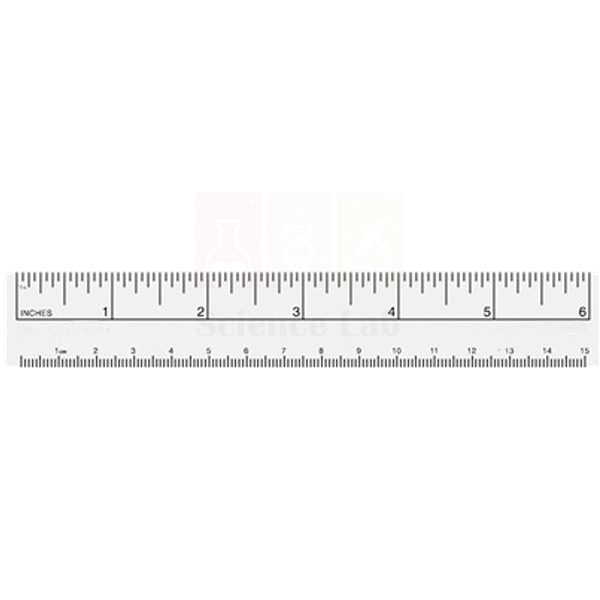
Ruler, White Vinyl
Ruler, White Vinyl (Product Code: SLE/ME/26) is a short dual-scale student ruler used as basic school laboratory equipment to measure lengths in both inches and millimetres during science and maths classes. It carries a 6 in scale and a 150 mm scale, and its reverse side has Celsius and Fahrenheit scales, which makes it a handy aid for comparing temperature units. It is made by Jain Scientific Equipments Pvt Ltd (ScienceLab), an OEM manufacturer, at its own factory in Ambala, India.
Specifications
| Parameter | Detail |
|---|---|
| Material | White vinyl |
| Length scales | 6 in and 150 mm |
| Reverse side | Celsius and Fahrenheit scales |
| Product code | SLE/ME/26 |
| Manufacturer | Jain Scientific Equipments Pvt Ltd (ScienceLab) — OEM |
| Country of origin | India (made in Ambala, Haryana) |
What Is a White Vinyl Ruler Used For?
Students reach for a short ruler many times in a practical: to measure leaf or specimen length, the extension of a spring, a length of wire, a crystal or the axes of a graph. Having inch and millimetre scales on one ruler lets learners see how the two systems compare and convert between them. The Celsius and Fahrenheit scales on the back turn the same ruler into a quick reference during thermometry lessons, read side by side with a dual-scale thermometer.
Measure from the zero mark rather than the physical end of the ruler, and look straight down at the scale to avoid parallax. The white surface gives good contrast on a busy bench. Wipe it with a damp cloth and keep it flat, away from hot plates and burners, so the vinyl stays straight.
OEM Manufacturer
Jain Scientific Equipments Private Limited trades as ScienceLab and is the OEM behind this ruler, producing it at its licensed factory at Saha, Ambala, Haryana, India. The company is a registered MSME enterprise (Udyam UDYAM-HR-01-0003714), and its export consignments move under Importer-Exporter Code AAECJ8618A issued by the DGFT. Schools and distributors buying class sets deal directly with the maker for quotations and repeat orders. See the company profile for more.
Related Measuring Equipment
Other measuring tools often ordered with this ruler:
- Ruler, SI Relationship — shows how decimetres, centimetres and millimetres relate.
- Meter Stick, White — for lengths too long for a short ruler.
- Professional Protractor — measures angles in the same geometry and optics work.
- Immersion Thermometer — a Celsius and Fahrenheit thermometer to pair with the reverse scales.
- Plastic Ruler 30cm — a longer everyday student ruler.
See all rulers, balances and thermometers in the Measuring category.
Frequently Asked Questions
What scales does the Ruler, White Vinyl have?
The Ruler, White Vinyl (SLE/ME/26) carries a 6 in scale and a 150 mm scale for length, plus Celsius and Fahrenheit scales on the reverse side. Students can measure short objects in either unit and compare temperatures between the two systems.
How long is the Ruler, White Vinyl?
The Ruler, White Vinyl is a short ruler with 6 in and 150 mm length scales, sized for small specimens, apparatus parts and graph work on a student bench. For lengths approaching a metre, a meter stick is the better choice.
Why does the Ruler, White Vinyl have temperature scales?
The Celsius and Fahrenheit scales on the back of the Ruler, White Vinyl let students read one temperature against the other without a formula. It works as a quick classroom reference in thermometry lessons alongside a dual-scale thermometer.
How should the Ruler, White Vinyl be cleaned?
Clean the Ruler, White Vinyl with a damp cloth and mild soap, and store it flat away from hot plates, burners and direct sun so the vinyl stays straight. Avoid solvents, which can soften vinyl and spoil the scales.
Who manufactures the Ruler, White Vinyl?
The Ruler, White Vinyl is manufactured by Jain Scientific Equipments Pvt Ltd (ScienceLab) as the OEM at its own licensed factory in Saha, Ambala, Haryana, India, and supplied direct to schools, colleges, dealers and importers in India and international markets.
What does a quotation for the Ruler, White Vinyl need?
A quotation for the Ruler, White Vinyl needs the quantity, for example one per student or per group, your delivery address and any other measuring items you want on the same order. Quotations are issued directly by the manufacturer.
Request a Quote
Ask for a Ruler, White Vinyl quotation, prepared directly by the manufacturer, through the contact page, or add the ruler to the enquiry cart with the rest of your class list.
Last updated: 24 September 2026
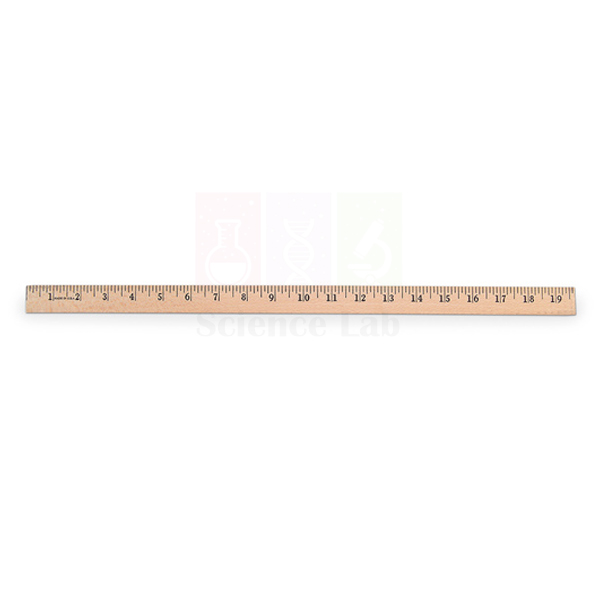
Metersticks
Metersticks (Product Code: SLE/ME/27) are hardwood measuring sticks used to measure lengths up to a metre in school physics, mathematics and general science laboratories. Each stick has a clear lacquer finish, metric graduations in decimetres, centimetres and millimetres on both edges of one face, and an inch scale in eighths on the other face; they are available with plain ends or metal ends. They are made by Jain Scientific Equipments Pvt Ltd (ScienceLab), an OEM manufacturer, at its own factory in Ambala, India.
Specifications
| Parameter | Detail |
|---|---|
| Material | Hardwood |
| Finish | Clear lacquer |
| Metric face | Both edges graduated in decimetres, centimetres and millimetres |
| Imperial face | One edge graduated in inches and eighths |
| Width x thickness | 1 in wide x 5/16 in thick |
| End options | Plain ends or metal ends |
| Product code | SLE/ME/27 |
| Manufacturer | Jain Scientific Equipments Pvt Ltd (ScienceLab) — OEM |
| Country of origin | India (made in Ambala, Haryana) |
What Are Metersticks Used For?
A meterstick is the everyday length standard of a science room. Students use it to set the length of a simple pendulum, measure the height of a ramp or inclined plane, record the extension of a spring in a Hooke's law experiment and mark lens and screen positions on an improvised optical bench. In maths lessons it is a staple of mathematics lab equipment, used to measure desks, doorways and the classroom itself and to compare estimates with real values.
Metal ends help protect the ends of the stick from chipping when it is stood on the floor or dropped, which keeps the starting point reliable over years of use; plain ends suit lighter handling and butting two sticks end to end. For accurate readings, stand the stick on its edge so the graduations touch the object, and read at eye level.
What to Specify When Ordering
- End type: plain ends or metal ends.
- Quantity per class, lab group or school.
- Whether the inch-and-eighths edge is useful to your students or a metric-only stick would suit better.
- Other length-measuring items for the same order, such as tapes or trundle wheels for longer distances.
OEM Manufacturer
Jain Scientific Equipments Private Limited, trading as ScienceLab, makes these metersticks at its own licensed factory at Saha, Ambala, Haryana, and is the OEM rather than a reseller. Schools, colleges, dealers and importers therefore buy factory-direct, with the end type confirmed with the maker at the quotation stage. Follow-on batches for new classrooms are handled by the manufacturer itself. Learn more on the ScienceLab company profile.
Related Measuring Equipment
Length-measuring tools that complement a meterstick:
- Meter Stick, White — a metric-only alternative with a 0.5 cm scale on the reverse.
- Folding Meter Stick — folds away for carrying and storage.
- Half Meter Scale — a shorter scale for bench work.
- Trundle Wheel — measures long distances outdoors.
- Windup Meter Tapes — for field measurements of many metres.
More options are listed in the Measuring category.
Frequently Asked Questions
What graduations are on the Metersticks?
The Metersticks (SLE/ME/27) are graduated in decimetres, centimetres and millimetres along both edges of one face, and in inches and eighths along one edge of the other face, so students can work in metric units and still compare with imperial measurements.
What is the difference between plain-end and metal-end Metersticks?
Metersticks are available with plain ends or metal ends. Metal ends help protect the stick's ends from knocks and wear during frequent use, while plain ends suit lighter classroom handling. State your choice when requesting a quotation.
What are the Metersticks made of?
The Metersticks are made of hardwood with a clear lacquer finish. The cross-section is 1 in wide and 5/16 in thick, which keeps each stick rigid enough to lay flat or stand on edge while readings are taken.
How should Metersticks be stored?
Store Metersticks flat or hanging vertically in a dry place, away from damp floors and heaters, so the hardwood stays straight. Wipe them with a dry or slightly damp cloth; soaking can raise the grain and damage the lacquer finish.
Who manufactures the Metersticks?
Metersticks are manufactured by Jain Scientific Equipments Pvt Ltd (ScienceLab), the OEM, at its own factory at Saha, Ambala, Haryana, India. The company supplies them direct to schools, colleges, dealers and importers in India and international markets.
Is a calibration certificate available for the Metersticks?
A calibration certificate is not listed for the Metersticks. If your school or institution needs one for a tender or an audit, raise it through the contact page before ordering so the requirement can be discussed.
Request a Quote
Metersticks are quoted directly by the manufacturer. Tell us the quantity and end type through the contact page, or add them to the enquiry cart with other items.
Last updated: 24 September 2026
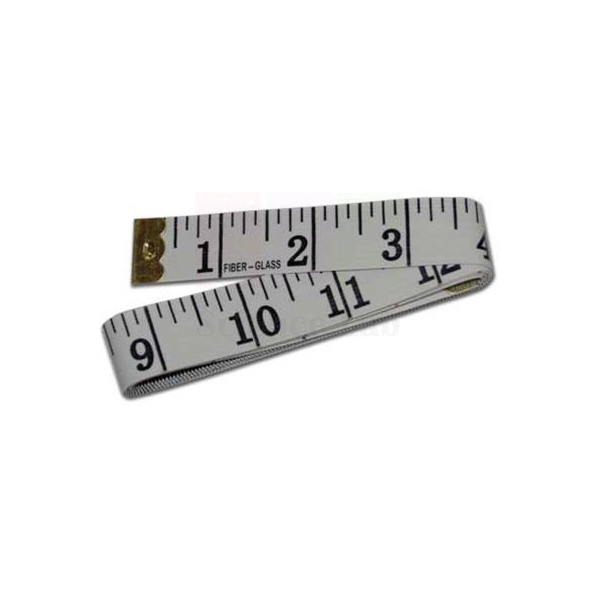
Fiberglass Tape Measure
Fiberglass Tape Measure (Product Code: SLE/ME/28) is a flexible 150 cm measuring tape used to measure curved surfaces, circumferences and body dimensions in biology, physics and maths classes. Its high-strength tape has heat-sealed markings that resist fading, with millimetre graduations on one side and 0.5 cm divisions with coloured decimetre marks on the other. It is supplied by Jain Scientific Equipments Pvt Ltd (ScienceLab), Ambala, India, a school laboratory equipment supplier in India.
Specifications
| Parameter | Detail |
|---|---|
| Length | 150 cm |
| Tape | High-strength fiberglass with heat-sealed markings |
| Side one | Graduated in millimetres with 0.5 cm markings; horizontal readout |
| Side two | Graduated in 0.5 cm with coloured decimetre markings; vertical readout |
| Product code | SLE/ME/28 |
| Supplied by | Jain Scientific Equipments Pvt Ltd (ScienceLab), Ambala, India |
What Is a Fiberglass Tape Measure Used For?
A flexible tape follows curves where a rigid ruler cannot. Classes use it to find the circumference of a cylinder or ball when estimating pi, to record the girth of tree trunks in ecology fieldwork, and to take head, wrist or arm-span measurements in human variation practicals that are a regular part of school biology lab work. It is equally handy for measuring the length of a curved track or the outline of a leaf.
The two readouts suit different jobs: the horizontal millimetre side is easy to read along a bench, while the vertical side with coloured decimetre marks is convenient when the tape runs upright and helps younger students count in tens. Keep the tape snug but not pulled hard, start from the zero end, and wind it loosely after use so it does not kink.
Supplier
ScienceLab, the trading name of Jain Scientific Equipments Private Limited in Ambala, Haryana, supplies this fiberglass tape as part of a wider measuring range for schools, colleges and dealers in India and international markets. It can be ordered together with rulers, metre sticks and trundle wheels in one enquiry. Company details are on the ScienceLab profile.
Related Measuring Equipment
Other tools for measuring length and distance:
- Windup Meter Tapes — longer fiberglass tapes for outdoor distances.
- Tape, Measure, 5 m, Retractable — a retractable tape for room and equipment measurements.
- Metersticks — rigid sticks for straight bench measurements.
- Trundle Wheel — counts metres while walking long distances.
- Ruler, SI Relationship — teaches how millimetres, centimetres and decimetres relate.
View the whole Measuring range for more length, mass and temperature tools.
Frequently Asked Questions
How long is the Fiberglass Tape Measure?
The Fiberglass Tape Measure (SLE/ME/28) is 150 cm long. That length covers most bench, body and object measurements in a classroom; for field distances of many metres, a windup meter tape or a trundle wheel is more practical.
How is the Fiberglass Tape Measure graduated?
One side of the Fiberglass Tape Measure is graduated in millimetres with 0.5 cm markings in a horizontal readout. The reverse is graduated in 0.5 cm steps with coloured decimetre markings in a vertical readout, giving two ways to read the same length.
Will the markings on the Fiberglass Tape Measure fade?
The Fiberglass Tape Measure has heat-sealed markings, described as ensuring accuracy and eliminating fade. Wiping the tape clean and dry after use, especially after outdoor work, helps keep both sides easy to read through repeated class use.
Why choose a Fiberglass Tape Measure instead of a steel tape?
A Fiberglass Tape Measure is flexible and has no sharp metal edges, so it wraps around curved objects, tree trunks and students' arms comfortably. That makes it the usual choice for circumference and girth measurements in school practicals.
Who supplies the Fiberglass Tape Measure?
The Fiberglass Tape Measure is supplied by Jain Scientific Equipments Pvt Ltd (ScienceLab), Ambala, Haryana, India, for schools, colleges and dealers in India and international markets. Class-set quantities can be quoted through the contact page.
What details are needed to quote the Fiberglass Tape Measure?
To quote the Fiberglass Tape Measure, we need the number of tapes, the delivery location and any related items such as rulers or metre sticks. Tell us too if the tapes are for a tender, so the documents required can be discussed.
Request a Quote
Send your Fiberglass Tape Measure requirement through the contact page, or collect it with other items in the enquiry cart for one combined quotation.
Last updated: 24 September 2026
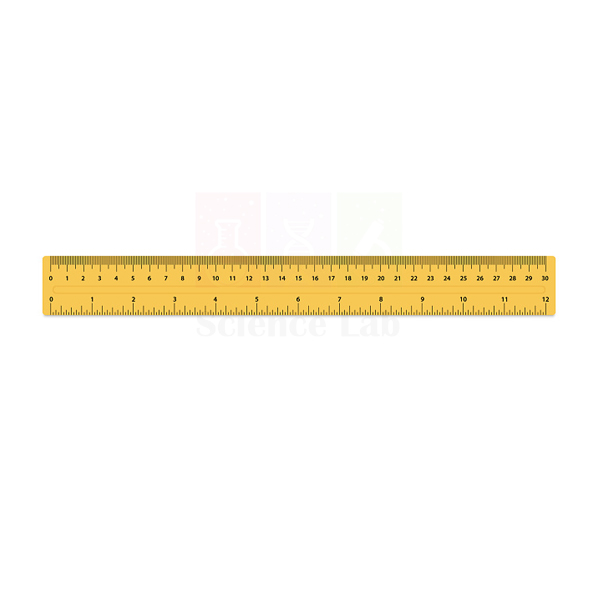
Ruler, SI Relationship
Ruler, SI Relationship (Product Code: SLE/ME/29) is a teaching ruler used to show how the SI length units, decimetres, centimetres and millimetres, relate to one another in primary and secondary science and maths lessons. One edge is laid out to show that relationship, the other is calibrated and numbered in millimetres, and molded-in handles make it easy to hold, a useful addition to mathematics lab kits. It is made by Jain Scientific Equipments Pvt Ltd (ScienceLab), an OEM manufacturer, at its own factory in Ambala, India.
Key Details
| Parameter | Detail |
|---|---|
| Relationship edge | Shows the relationship between decimetres, centimetres and millimetres |
| Measuring edge | Calibrated and numbered in millimetres |
| Markings | Hot-stamped, easy to read; will not wear off |
| Handles | Molded-in handles |
| Product code | SLE/ME/29 |
| Manufacturer | Jain Scientific Equipments Pvt Ltd (ScienceLab) — OEM |
| Country of origin | India (made in Ambala, Haryana) |
What Is an SI Relationship Ruler Used For?
Pupils often learn that 10 mm make a centimetre and 10 cm make a decimetre as facts to memorise. The relationship edge of this ruler makes those conversions visible: learners can see one decimetre divided into centimetres and each centimetre divided into millimetres. Teachers use it for unit-conversion lessons, estimation games and to introduce the decimetre, a unit students rarely meet elsewhere.
Once the idea is clear, students turn to the millimetre edge for real measurements: the sides of shapes, the length of a leaf or seed, or a line on a graph. Holding the ruler by its molded-in handles keeps fingers off the scales, and reading at eye level avoids parallax errors.
OEM Manufacturer
Jain Scientific Equipments Private Limited, which trades as ScienceLab, manufactures the Ruler, SI Relationship as the OEM at its licensed factory at Saha, Ambala, Haryana, India. Buyers get it from the manufacturer directly, not through a middleman, which keeps communication simple for schools, dealers and importers ordering class quantities. Follow-up orders to match an earlier purchase are handled by the manufacturer itself. Read more on the ScienceLab company profile.
Related Measuring Equipment
Tools that extend the same measuring lessons:
- Ruler, White Vinyl — a short inch-and-millimetre ruler with temperature scales on the back.
- Meter Stick, White — shows how decimetres build up to a full metre.
- Metersticks — hardwood sticks for longer measurements.
- Ruler, Plastic, Blackboard, 100cm — a large ruler for teacher demonstrations.
- Caliper Vernier (Metal) — for readings finer than a millimetre.
Find more in the Measuring equipment category.
Frequently Asked Questions
What does SI Relationship mean on the Ruler, SI Relationship?
On the Ruler, SI Relationship (SLE/ME/29), one edge is marked to show how decimetres, centimetres and millimetres relate within the SI metric system. Students see each larger unit divided into the next smaller one instead of memorising conversion factors.
Which edge of the Ruler, SI Relationship is used for measuring?
The Ruler, SI Relationship has a second edge calibrated and numbered in millimetres for ordinary measurement. Students can explore unit relationships on one edge, then turn the ruler to take real readings of objects, drawings and specimens on the other.
Will the markings on the Ruler, SI Relationship wear off?
The markings on the Ruler, SI Relationship are hot-stamped, easy to read and described as markings that will not wear off. That suits rulers shared between classes year after year, where heavy handling would rub away surface print.
What are the handles on the Ruler, SI Relationship for?
The molded-in handles on the Ruler, SI Relationship let students and teachers lift and position it without covering the scales with their fingers, which helps when demonstrating unit relationships to a group or holding the ruler steady on a bench.
Who manufactures the Ruler, SI Relationship?
The Ruler, SI Relationship is manufactured by Jain Scientific Equipments Pvt Ltd (ScienceLab), which is the OEM and makes it at its own factory in Saha, Ambala, Haryana, India, for schools, colleges, dealers and importers in India and international markets.
How long is the Ruler, SI Relationship?
The overall length of the Ruler, SI Relationship is not listed on this page. Ask for the exact dimensions through the contact page when requesting a quotation, and say how many rulers you need per class.
Request a Quote
Quotes for the Ruler, SI Relationship come straight from the manufacturer. Use the contact page or add the ruler to the enquiry cart along with your other classroom measuring items.
Last updated: 24 September 2026
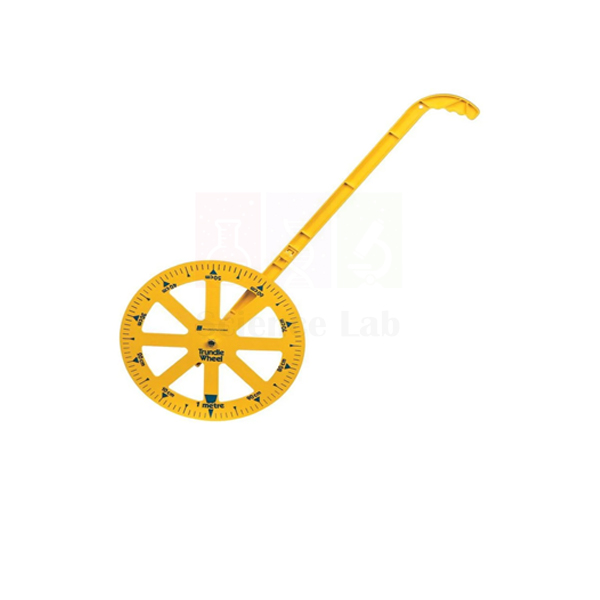
Trundle Wheel
Trundle Wheel (Product Code: SLE/ME/30) is a wheeled distance-measuring tool used to measure long distances on the ground and to demonstrate the relationship between circumference and diameter in school maths and physics lessons. Its wheel circumference measures one metre, its scale is graduated in 1 cm divisions, and an audible, non-wearing clicker sounds with each 1 m revolution in either direction. It is made by Jain Scientific Equipments Pvt Ltd (ScienceLab), an OEM manufacturer, at its own factory in Ambala, India.
Specifications
| Parameter | Detail |
|---|---|
| Wheel circumference | 1 m |
| Scale | Graduated in 1 cm divisions |
| Counter | Audible, non-wearing clicking device, activated with each 1 m revolution in either direction |
| Wheel edges | Grip smooth surfaces to prevent slippage |
| Handle | Sturdy plastic handle for walking while rolling the wheel |
| Uses | Measuring long distances; demonstrating circumference and diameter |
| Product code | SLE/ME/30 |
| Manufacturer | Jain Scientific Equipments Pvt Ltd (ScienceLab) — OEM |
| Country of origin | India (made in Ambala, Haryana) |
What Is a Trundle Wheel Used For?
Students walk the wheel along a corridor, playground or sports field and count the clicks, each one a metre, then read the leftover part-metre from the 1 cm scale at the finish. It is the practical way to measure a running track for speed experiments, map the school grounds in geography, or check how good pupils are at estimating distance, which makes it useful school physics lab equipment as well as a maths tool.
In maths, the wheel shows the circumference formula in action: measure its diameter with a ruler, divide the one-metre circumference by it and the answer comes out close to pi. For accurate readings, set the wheel's starting point on the start line, keep the handle upright and walk steadily in a straight line.
OEM Manufacturer
Jain Scientific Equipments Private Limited trades as ScienceLab and is the OEM of this trundle wheel, producing it at its own licensed factory at Saha, Ambala, Haryana, India. Schools, education departments, dealers and importers buy it factory-direct, and questions about spare parts are answered by the manufacturer, so just ask us. For institutional vendor registration, the company's GSTIN is 06AAECJ8618A1ZT and its LEI is 3358004HRD1JIVXKYX49. See the company profile for more.
Related Measuring Equipment
Items used with a trundle wheel in outdoor measuring and motion lessons:
- Windup Meter Tapes — lay out a fixed line such as a track or transect.
- Stopwatch, Digital — times runners over the measured distance to work out speed.
- Metersticks — for shorter measurements and checking the wheel's diameter.
- Fiberglass Tape Measure — measures the wheel's rim to confirm the circumference.
The full Measuring category includes rulers, tapes, timers and thermometers.
Frequently Asked Questions
How does the Trundle Wheel measure distance?
The Trundle Wheel (SLE/ME/30) has a circumference of one metre, so each full revolution covers one metre and triggers an audible click. Count the clicks while walking, then read any remaining part-metre from the scale graduated in 1 cm divisions.
Does the Trundle Wheel click in both directions?
Yes. The Trundle Wheel's audible, non-wearing clicking device is activated with each 1 m revolution in either direction, so rolling backwards is heard too, and students can correct an overshoot by subtracting the extra clicks.
Will the Trundle Wheel slip on smooth floors?
The wheel edges of the Trundle Wheel are designed to grip smooth surfaces and prevent slippage as it rolls. That keeps readings dependable on corridors, halls and hard courts as well as on outdoor paths and playgrounds.
How is the Trundle Wheel used to teach circumference and diameter?
Students measure the Trundle Wheel's diameter with a ruler and compare it with its one-metre circumference; the ratio comes out close to pi. It links a real object to the formula for the circumference of a circle.
Who manufactures the Trundle Wheel?
The Trundle Wheel is manufactured by Jain Scientific Equipments Pvt Ltd (ScienceLab), the OEM, at its own licensed factory in Saha, Ambala, Haryana, India, and supplied factory-direct to schools, colleges, dealers and importers in India and international markets.
What does a Trundle Wheel quotation need?
For a Trundle Wheel quotation, give the number of wheels, often one per group for outdoor lessons, the delivery location and any other items such as tapes or stopwatches for the same order. The quotation comes directly from the manufacturer.
Request a Quote
Get a Trundle Wheel quote direct from the manufacturer via the contact page, or add it to the enquiry cart with the rest of your outdoor measuring kit.
Last updated: 24 September 2026
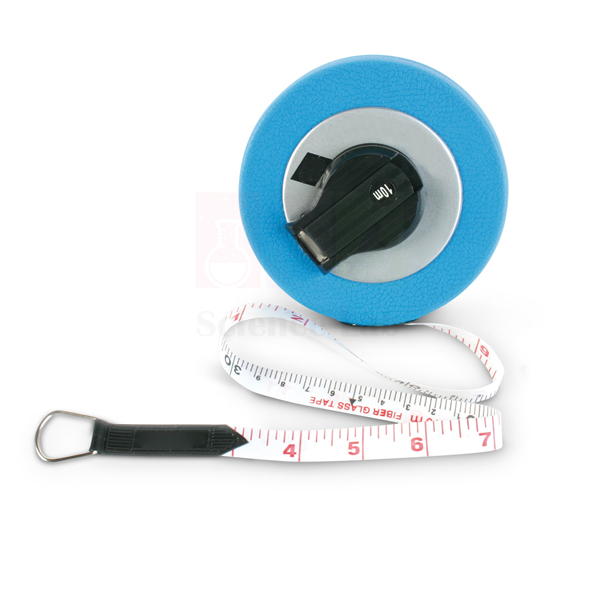
Windup Meter Tapes
Windup Meter Tapes (Product Code: SLE/ME/31) are fiberglass measuring tapes in a plastic windup case, used to measure long distances in outdoor science, geography and sports-field activities. They are available in 10 m, 30 m and 50 m lengths, are calibrated in inches on one side and in 1 cm increments on the other, and the tape will not tear, rust or stretch. They are supplied by Jain Scientific Equipments Pvt Ltd (ScienceLab), Ambala, a source of educational laboratory equipment in India.
Specifications
| Parameter | Detail |
|---|---|
| Tape | Fiberglass; will not tear, rust or stretch |
| Case | Plastic windup case |
| Lengths available | 10 m, 30 m and 50 m |
| Graduations | Inches on one side; 1 cm increments on the other |
| Typical use | Outdoor activities |
| Product code | SLE/ME/31 |
| Supplied by | Jain Scientific Equipments Pvt Ltd (ScienceLab), Ambala, India |
What Are Windup Meter Tapes Used For?
Long tapes turn the school grounds into a laboratory. Classes use them to lay out a straight course for speed and reaction-time experiments, to run transect lines across a field or pond edge in ecology work, to map the grounds in geography, and to follow the changing length of a shadow through the day. Sports staff use the same tapes to mark out events.
Have a partner hold the zero end, keep the tape straight and taut rather than sagging, and read the 1 cm side for metric work. Before winding the tape back into its plastic case, wipe off mud, sand or grass so the mechanism stays free, and wind in slowly to avoid twists.
What to Specify When Ordering
- Length: 10 m, 30 m or 50 m, or a mix for different activities.
- Number of tapes per class or field group.
- Companion tools for shorter measurements, such as a fiberglass tape measure or metre sticks.
- Delivery location and whether the order is for a tender or for dealer stock.
Supplier
Jain Scientific Equipments Private Limited, trading as ScienceLab from Ambala in Haryana, sources these windup tapes and supplies all three lengths to schools, colleges, field-study programmes and dealers in India and international markets. Combining them with other measuring items in one order keeps procurement simple. More about the company is on the ScienceLab profile page.
Related Measuring Equipment
Tools often used alongside long measuring tapes:
- Trundle Wheel — counts metres as you walk, handy for irregular routes.
- Fiberglass Tape Measure — a 150 cm tape for body and object measurements.
- Tape, Measure, 5 m, Retractable — a compact tape for rooms and equipment.
- Stopwatch, Digital — times movement over a measured course.
- Metersticks — rigid sticks for short straight measurements.
Browse all tapes, rulers and timers in the Measuring category.
Frequently Asked Questions
What lengths do the Windup Meter Tapes come in?
Windup Meter Tapes (SLE/ME/31) are available in 10 m, 30 m and 50 m lengths. The 10 m tape suits classrooms and small plots, while the 30 m and 50 m tapes cover running tracks, playing fields and ecology transects.
How are the Windup Meter Tapes graduated?
Windup Meter Tapes are calibrated in inches on one side and in 1 cm increments on the other. The centimetre side is the one most school and field activities use, while the inch side helps when comparing with imperial measurements.
Are Windup Meter Tapes suitable for outdoor use?
Yes. Windup Meter Tapes use a fiberglass tape that will not tear, rust or stretch, which suits outdoor activities on damp grass, sand or dusty ground. Wipe the tape clean and dry before winding it back into the plastic case.
Should I choose Windup Meter Tapes or a trundle wheel?
Windup Meter Tapes give a continuous scale for laying out a fixed line, such as a transect or running track, while a trundle wheel counts metres as you walk a route. Many schools use both for outdoor measuring lessons.
Who supplies the Windup Meter Tapes?
Windup Meter Tapes are supplied by Jain Scientific Equipments Pvt Ltd (ScienceLab), Ambala, Haryana, India, in 10 m, 30 m and 50 m lengths for schools, colleges and dealers in India and international markets.
What is needed for a Windup Meter Tapes quotation?
To get a quotation for Windup Meter Tapes, list how many tapes you need of each length, the delivery location and any tender reference. Send the details through the contact page or add the item to the enquiry cart.
Request a Quote
Request Windup Meter Tapes through the contact page with your chosen lengths, or add them to the enquiry cart for a combined quotation.
Last updated: 24 September 2026
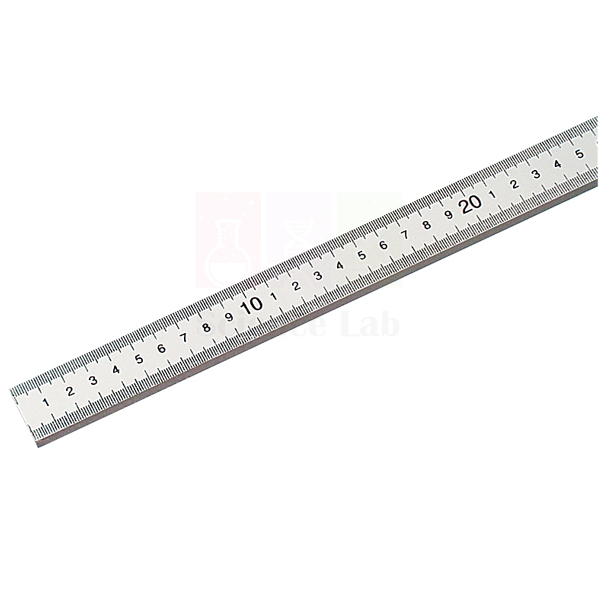
Meter Stick, White
Meter Stick, White (Product Code: SLE/ME/32) is a white metre-length measuring stick used for length measurements, graph work and unit lessons in school physics and maths laboratories. Both edges of its front face are graduated in decimetres, centimetres and millimetres, while the reverse is graduated in 0.5 cm steps with every centimetre numbered, giving younger students an easier scale to read. It is made by Jain Scientific Equipments Pvt Ltd (ScienceLab), an OEM manufacturer, at its own factory in Ambala, India.
Specifications
| Parameter | Detail |
|---|---|
| Colour | White |
| Front face | Both edges graduated in decimetres, centimetres and millimetres |
| Reverse face | Graduated in 0.5 cm, with each centimetre numbered |
| Product code | SLE/ME/32 |
| Manufacturer | Jain Scientific Equipments Pvt Ltd (ScienceLab) — OEM |
| Country of origin | India (made in Ambala, Haryana) |
What Is a White Meter Stick Used For?
In physics practicals the stick measures pendulum lengths, lens-to-screen distances, spring extensions and the drop height of a bouncing ball, the everyday jobs of school physics lab equipment. In maths it helps pupils measure the room, draw large axes on chart paper and compare their estimates with measured values. The white finish stands out clearly on a bench and during front-of-class demonstrations.
The two faces serve two levels of learner. The millimetre front gives full precision for older students, while the reverse, with 0.5 cm divisions and every centimetre numbered, suits primary classes and quick estimates. Lay the stick on its edge against the object to cut parallax errors, and avoid using it as a lever or pointer so it stays straight.
OEM Manufacturer
This white meter stick is manufactured by Jain Scientific Equipments Private Limited, trading as ScienceLab, which is the OEM and produces it at its own licensed factory at Saha, Ambala, Haryana, India. Dealers and importers stocking measuring equipment, as well as schools buying directly, receive it from the factory rather than from a trading house. Questions about repeat supply or matching an earlier order go straight to the maker. Details are on the company profile.
Related Measuring Equipment
Other length-measuring tools for the same lessons:
- Metersticks — hardwood sticks with an inch edge and a choice of plain or metal ends.
- Folding Meter Stick — folds for easy carrying between rooms.
- Half Meter Scale — a shorter scale for bench-top work.
- Ruler, White Vinyl — a small ruler for short specimens and graph work.
- Trundle Wheel — takes over when distances run to many metres.
For more choices, visit the Measuring category.
Frequently Asked Questions
How is the Meter Stick, White graduated?
The Meter Stick, White (SLE/ME/32) has decimetre, centimetre and millimetre graduations along both edges of one face. Its reverse face is graduated in 0.5 cm divisions with each centimetre numbered, giving two levels of reading detail on one stick.
Who is the reverse side of the Meter Stick, White designed for?
The reverse of the Meter Stick, White, with 0.5 cm divisions and every centimetre numbered, is easier for younger students and quick estimates. Older students can switch to the millimetre face when a practical calls for finer readings.
How does the Meter Stick, White differ from the hardwood Metersticks?
The Meter Stick, White is fully metric, with a 0.5 cm scale on the reverse, whereas the hardwood Metersticks carry an inch-and-eighths edge on the reverse and come with plain or metal ends. Choose the white stick when only metric units are taught.
What material is the Meter Stick, White made of?
The material of the Meter Stick, White is not specified on this page. Ask for the material and exact dimensions through the contact page when you request a quotation, especially if they are needed for a tender specification.
How should the Meter Stick, White be stored?
Store the Meter Stick, White flat on a shelf or hanging from a hook so it does not bend, and keep it away from heat sources. Wipe it with a soft, slightly damp cloth; harsh solvents or scrubbing can dull the graduations.
Who manufactures the Meter Stick, White?
The Meter Stick, White is manufactured by Jain Scientific Equipments Pvt Ltd (ScienceLab), the OEM, at its own factory in Saha, Ambala, Haryana, India. Schools, colleges, dealers and importers in India and international markets are supplied factory-direct.
Request a Quote
The manufacturer quotes the Meter Stick, White directly. Send quantities through the contact page or add it to the enquiry cart alongside rulers and tapes.
Last updated: 24 September 2026
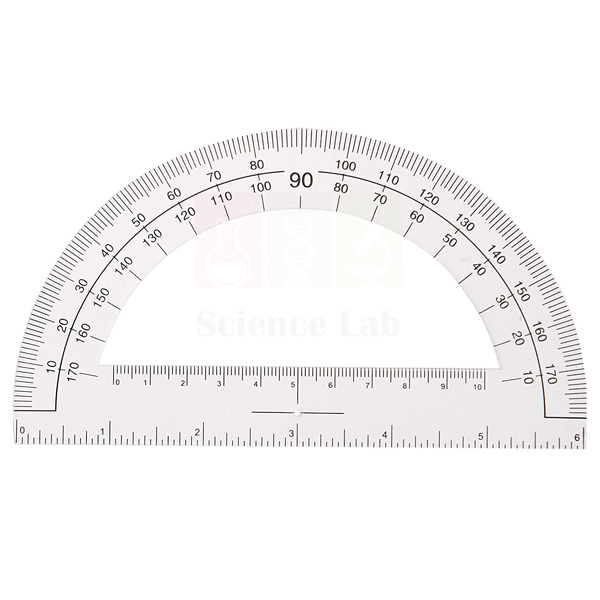
Professional Protractor
Professional Protractor (Product Code: SLE/ME/33) is a clear plastic angle-measuring instrument used to measure and draw angles in geometry, technical drawing and physics lessons such as optics ray diagrams. It has an open centre for marking the vertex, a 6 in ruler along its straight edge and permanently bonded calibrations, a practical piece of mathematics lab equipment. It is made by Jain Scientific Equipments Pvt Ltd (ScienceLab), an OEM manufacturer, at its own factory in Ambala, India.
Key Details
| Parameter | Detail |
|---|---|
| Material | Clear plastic |
| Centre | Open centre |
| Straight edge | 6 in ruler |
| Calibrations | Permanently bonded |
| Product code | SLE/ME/33 |
| Manufacturer | Jain Scientific Equipments Pvt Ltd (ScienceLab) — OEM |
| Country of origin | India (made in Ambala, Haryana) |
What Is a Professional Protractor Used For?
Geometry classes use it to measure the angles of triangles and polygons and to construct given angles. In physics it measures angles of incidence, reflection and refraction when tracing rays through mirrors and glass blocks, the slope of an inclined plane, and the directions of forces in vector diagrams. Technical-drawing students use it for angled lines and layouts.
The clear body lets students see the lines underneath, and the open centre allows a pencil point to mark the vertex exactly. With a 6 in ruler on the straight edge, the arms of an angle can be drawn and measured without switching instruments. Place the centre point exactly on the vertex and the baseline along one arm before reading, and keep the protractor away from solvents and hot surfaces.
OEM Manufacturer
Jain Scientific Equipments Private Limited, which trades as ScienceLab, is the OEM for the Professional Protractor and produces it at the company's own licensed factory at Saha, Ambala, Haryana, India. Maths departments, stationery and lab dealers, and importers placing class-set orders buy directly from the manufacturer, and repeat orders for new groups of students are handled the same way. See the ScienceLab profile for company background.
Related Measuring Equipment
Drawing and measuring instruments used in the same geometry and optics work:
- Safe-T Compass — draws circles and arcs for constructions.
- Geometry Set — a set of drawing instruments for students.
- Protractor, Plastic, for Blackboard, 44cm — a large version for teacher demonstrations.
- Ruler, White Vinyl — a short ruler for measuring the sides of figures.
- T-Square — guides horizontal lines in technical drawing.
More instruments are listed in the Measuring category.
Frequently Asked Questions
What are the main features of the Professional Protractor?
The Professional Protractor (SLE/ME/33) is made of clear plastic with an open centre, a 6 in ruler on the straight edge and permanently bonded calibrations. The combination lets students measure an angle and draw its arms with one instrument.
Why does the Professional Protractor have an open centre?
The open centre of the Professional Protractor lets students see and mark the exact vertex on their paper instead of guessing through solid plastic. It also makes it easier to line the protractor up over existing lines on ray diagrams and constructions.
Will the calibrations on the Professional Protractor rub off?
The calibrations on the Professional Protractor are permanently bonded, so they are intended to stay legible through repeated handling in classrooms and exam practice. Clean it with a soft cloth and keep it away from solvents that can mark clear plastic.
Is the Professional Protractor suitable for physics practicals?
Yes. The Professional Protractor suits measuring angles of incidence, reflection and refraction in optics practicals, angles on inclined planes and force diagrams, as well as school geometry. Its clear body keeps the traced ray or line visible underneath.
Who manufactures the Professional Protractor?
The Professional Protractor is manufactured by Jain Scientific Equipments Pvt Ltd (ScienceLab) as the OEM at its own factory in Saha, Ambala, Haryana, India, and is supplied direct to schools, colleges, dealers and importers in India and international markets.
What does a Professional Protractor quotation need?
A quotation for the Professional Protractor needs the quantity, for example a class set, the delivery address and any other geometry items such as compasses, rulers or set squares. Quotations are prepared directly by the manufacturer.
Request a Quote
Ask the manufacturer for a Professional Protractor quote through the contact page, or add it to the enquiry cart together with other geometry instruments.
Last updated: 24 September 2026
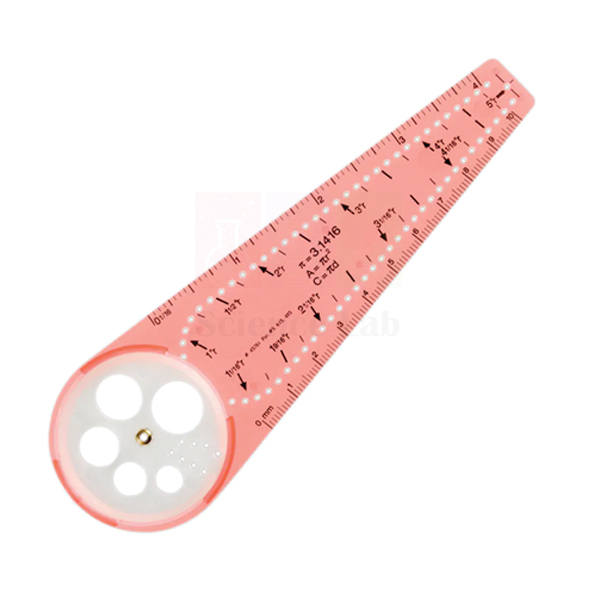
Safe-T Compass
Safe-T Compass (Product Code: SLE/ME/34) is a plastic drawing compass without a sharp point, used to draw circles and arcs safely in primary and secondary school maths and science classes. It is brightly coloured and shatterproof, draws circles from 1/4 to 10 in diameter, has edges ruled in inches and millimetres, and leaves desks unscratched, making it a common choice for mathematics lab kits. It is supplied by Jain Scientific Equipments Pvt Ltd (ScienceLab), Ambala, India.
Specifications
| Parameter | Detail |
|---|---|
| Type | Plastic drawing compass with no sharp point |
| Material | Brightly coloured, shatterproof plastic |
| Circle range | 1/4 in to 10 in diameter |
| Edges | Ruled in inches and millimetres |
| Desk safety | No sharp point, so desks remain unscratched |
| Product code | SLE/ME/34 |
| Supplied by | Jain Scientific Equipments Pvt Ltd (ScienceLab), Ambala, India |
What Is a Safe-T Compass Used For?
Students use it for every circle-based task in the syllabus: drawing circles of a set radius, bisecting lines and angles, constructing triangles and hexagons, and drawing pie charts and Venn diagrams. Science classes use it for orbit diagrams, lens and mirror constructions and labelled cell outlines. Because there is no steel spike, younger pupils can use it without the risk of pricked fingers or damaged desks.
Hold the centre steady with one hand and draw slowly with the other for a smooth, closed circle. The ruled edges double as a short ruler, so the radius can be checked or a straight line added to the same construction without reaching for another instrument. Keep the compass away from heat, which can warp plastic.
Supplier
ScienceLab is the trading name of Jain Scientific Equipments Private Limited, which supplies the Safe-T Compass alongside protractors, rulers and geometry sets to schools, teacher resource centres and dealers in India and international markets. Buyers completing vendor registration can use the company's registration details: CIN U29309HR2020PTC087597 and GSTIN 06AAECJ8618A1ZT. Read more on the company profile page.
Related Measuring Equipment
Geometry tools that pair with this compass:
- Professional Protractor — measures and constructs angles in the same drawings.
- Geometry Set — a full set of student drawing instruments.
- Compass, Plastic, for Blackboard, 45cm — for teachers drawing circles on the board.
- Ruler, White Vinyl — a short ruler for measuring radii and sides.
- Student's Geometry Set/BOX-20 — boxed sets for whole classes.
See more classroom measuring tools in the Measuring category.
Frequently Asked Questions
What size circles can the Safe-T Compass draw?
The Safe-T Compass (SLE/ME/34) draws circles from 1/4 in up to 10 in in diameter. That range covers small construction arcs as well as large circles for pie charts, Venn diagrams and classroom posters.
Why does the Safe-T Compass have no point?
The Safe-T Compass has no sharp point, so there is no metal spike to prick young hands, and desks remain unscratched. That makes it suitable for younger classes and for schools that restrict pointed instruments in the classroom.
Will the Safe-T Compass break if dropped?
The Safe-T Compass is made of brightly coloured, shatterproof plastic, so it stands up to being dropped and carried in pencil cases. Keep it away from heat, which can warp plastic and affect the accuracy of the circles drawn.
Can the Safe-T Compass be used as a ruler?
Yes. The edges of the Safe-T Compass are ruled in inches and millimetres, so students can measure a radius or draw a straight line without picking up a separate ruler during a geometry construction.
What colours does the Safe-T Compass come in?
The Safe-T Compass is described as brightly coloured; the specific colours and any colour mix per order are not listed here. If colour matters for your classroom, mention it in your enquiry through the contact page.
Who supplies the Safe-T Compass?
The Safe-T Compass is supplied by Jain Scientific Equipments Pvt Ltd (ScienceLab), Ambala, Haryana, India, to schools, colleges and dealers in India and international markets. Class-set quantities can be quoted on request.
Request a Quote
To order the Safe-T Compass, share your quantity and delivery details on the contact page, or add it to the enquiry cart with other geometry items.
Last updated: 24 September 2026
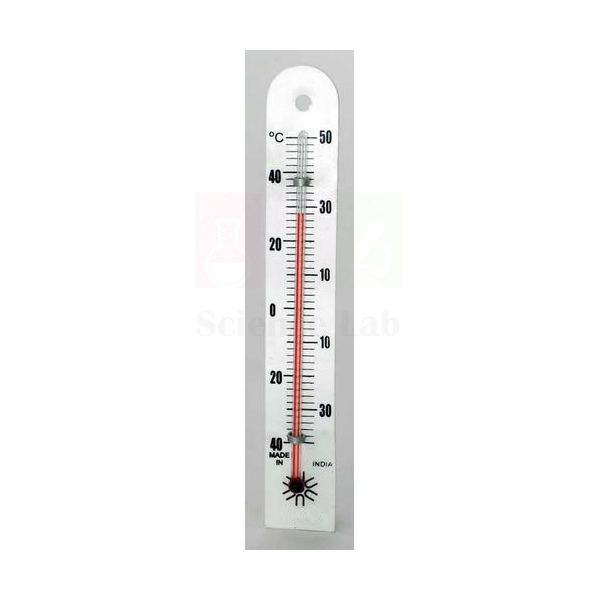
Immersion Thermometer
Immersion Thermometer (Product Code: SLE/ME/35) is a red-alcohol-filled, dual-scale thermometer used to measure the temperature of liquids, water baths and air in school and college laboratories. It reads -10 to 110 °C in 1° steps and 0 to 230 °F in 2° steps, and its tube sits in a recessed groove on a metal V-shaped backing for protection. It is made by Jain Scientific Equipments Pvt Ltd (ScienceLab), an OEM manufacturer, at its own factory in Ambala, India.
Specifications
| Parameter | Detail |
|---|---|
| Fill | Red alcohol |
| Scales | Dual: Celsius and Fahrenheit |
| Celsius range | -10 to 110 °C, in 1° increments |
| Fahrenheit range | 0 to 230 °F, in 2° increments |
| Tube protection | Tube set in a recessed groove |
| Backing | Metal, V-shaped |
| Product code | SLE/ME/35 |
| Manufacturer | Jain Scientific Equipments Pvt Ltd (ScienceLab) — OEM |
| Country of origin | India (made in Ambala, Haryana) |
What Is an Immersion Thermometer Used For?
This is everyday thermometry apparatus for the school lab. Students use it to plot heating and cooling curves of water, follow melting ice, keep a water bath at the right temperature for enzyme experiments, record temperature changes in calorimetry and dissolving experiments, and log room or outdoor air temperature. The dual scale lets classes compare Celsius and Fahrenheit readings directly.
Immerse the bulb in the liquid, keep it clear of the bottom of a heated vessel, stir gently and wait until the red column stops moving before reading at eye level. Do not use it beyond the top of its scale. The metal backing and recessed groove protect the tube from knocks, but it should still be laid down carefully rather than dropped into a drawer.
OEM Manufacturer
Jain Scientific Equipments Private Limited, known by its trade name ScienceLab, is the OEM of this immersion thermometer and makes it at its own licensed factory at Saha, Ambala, Haryana, India. Laboratories, schools, dealers and importers get quotations straight from the maker, and replacement thermometers for breakages during the school year can be requested from the same source, so just ask us. The company profile has more background.
Related Measuring Equipment
Apparatus used with a thermometer in heat and temperature practicals:
- Digital Pocket Thermometer — a digital option with min/max readings.
- Red Spirit-Filled Thermometers — further spirit-filled thermometers for class sets.
- Thermometer Clamp — holds the thermometer steady above a heated beaker.
- Glass Beaker — the usual vessel for heating and cooling experiments.
- Immersion Heater — supplies heat for specific heat capacity experiments.
Find more thermometers and meters in the Measuring category.
Frequently Asked Questions
What is the range of the Immersion Thermometer?
The Immersion Thermometer (SLE/ME/35) reads -10 to 110 °C in 1° increments and 0 to 230 °F in 2° increments. That covers ice-water mixtures, room-temperature work and heating water to boiling in typical school experiments.
What liquid is in the Immersion Thermometer?
The Immersion Thermometer is filled with red alcohol rather than mercury. The red column is easy for students to see against the scale, and an alcohol fill avoids the handling concerns that come with a broken mercury thermometer.
How is the Immersion Thermometer protected from breakage?
The tube of the Immersion Thermometer sits in a recessed groove attached to a metal V-shaped backing. The groove shields the glass from knocks on the bench, while the backing keeps the scale rigid and comfortable to hold.
How do you get an accurate reading from the Immersion Thermometer?
For accurate readings with the Immersion Thermometer, immerse the bulb, keep it off the bottom of a heated vessel, wait until the red column stops moving and read at eye level. Gently stirring the liquid helps the reading settle.
Who manufactures the Immersion Thermometer?
The Immersion Thermometer is manufactured by Jain Scientific Equipments Pvt Ltd (ScienceLab), the OEM, at its own factory in Saha, Ambala, Haryana, India, and is supplied factory-direct to schools, colleges, laboratories, dealers and importers in India and international markets.
Is a calibration certificate available for the Immersion Thermometer?
A calibration certificate is not listed with the Immersion Thermometer. If your laboratory needs calibration records, discuss the requirement through the contact page before ordering, so the manufacturer can tell you what can be provided.
Request a Quote
Immersion Thermometer quotations come direct from the manufacturer. Send your quantity via the contact page or add the thermometer to the enquiry cart with clamps, beakers and other apparatus.
Last updated: 24 September 2026
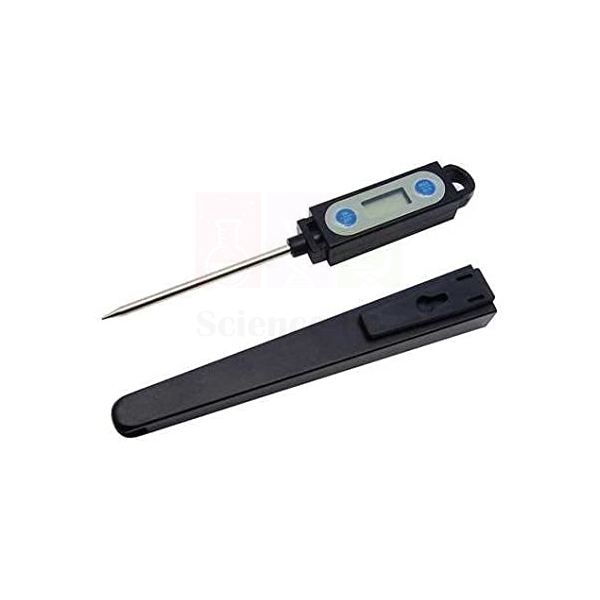
Digital Pocket Thermometer
Digital Pocket Thermometer (Product Code: SLE/ME/36) is a battery-powered probe thermometer used to take quick temperature readings of liquids and samples in school, college and research laboratories. It reads -50 to 200 °C (-58 to 392 °F) with 0.1° resolution between -19.9 and 199.9°, is accurate to ±1 °C/±2 °F over the full range, and has a 4-1/4 in probe light enough to use in beakers and tubes without tipping them. It is supplied by Jain Scientific Equipments Pvt Ltd (ScienceLab), Ambala, a laboratory instruments supplier in India.
Specifications
| Parameter | Detail |
|---|---|
| Temperature range | -50 to 200 °C; -58 to 392 °F |
| Resolution | 0.1° C or F from -19.9 to 199.9°; 1° otherwise |
| Accuracy | ±1 °C / ±2 °F over full range |
| Probe | 4-1/4 in; usable in beakers, cylinders, flasks and tubes without tipping |
| Controls | On/off switch and °C/°F button |
| Functions | Min/max function and auto shutoff |
| Case | Polycarbonate case with pocket clip |
| Power | 1.5 V battery, included |
| Product code | SLE/ME/36 |
| Supplied by | Jain Scientific Equipments Pvt Ltd (ScienceLab), Ambala, India |
What Is a Digital Pocket Thermometer Used For?
A pocket probe thermometer is the quick way to check a water bath, a reaction mixture, a freezing mixture or a hot oil bath without waiting for a glass thermometer to settle. The min/max function records the extremes reached during a cooling curve or an overnight run, and the digital display removes the parallax errors students often make when reading a liquid column.
Dip only the probe into the sample, let the reading steady, and wipe the probe between samples to avoid carry-over. The case is not described as waterproof, so keep the body dry. Switch off after use; the auto shutoff also helps save the battery if the thermometer is left on.
Supplier
ScienceLab, the trading name of Jain Scientific Equipments Private Limited in Ambala, Haryana, supplies this pocket thermometer for laboratories that want a fast digital reading alongside, or instead of, liquid-in-glass thermometers. It is available to schools, colleges, research labs and dealers in India and international markets, and can be ordered with beakers, stands and other measuring items. See the company profile.
Related Measuring Equipment
Temperature tools and vessels used with a probe thermometer:
- Immersion Thermometer — a red-alcohol, dual-scale thermometer for class sets.
- Digital Thermometer — another digital model in the Measuring range.
- Red Spirit-Filled Thermometers — glass thermometers for general use.
- pH mV and Temperature Meter — measures pH and temperature together.
- Glass Beaker — the vessel most readings are taken in.
Explore the Measuring category for more thermometers and meters.
Frequently Asked Questions
What temperature range does the Digital Pocket Thermometer cover?
The Digital Pocket Thermometer (SLE/ME/36) measures from -50 to 200 °C, or -58 to 392 °F. Readings switch between Celsius and Fahrenheit with the °C/°F button, so one instrument suits classes working in either unit.
How accurate is the Digital Pocket Thermometer?
The Digital Pocket Thermometer is accurate to ±1 °C or ±2 °F over its full range. It displays 0.1° resolution between -19.9 and 199.9°, and 1° resolution outside that band, which suits most teaching and routine laboratory measurements.
Does the Digital Pocket Thermometer come with a battery?
Yes, the Digital Pocket Thermometer comes with a 1.5 V battery. The auto shutoff function turns the unit off when it is left on, helping the battery last, and the on/off switch lets users turn it off after each reading.
What does the min/max function on the Digital Pocket Thermometer do?
The min/max function on the Digital Pocket Thermometer keeps the lowest and highest temperatures reached while it is on, which is useful for tracking a cooling curve, checking a water bath or confirming that a sample stayed within range.
Can the Digital Pocket Thermometer be used in test tubes and flasks?
Yes. The Digital Pocket Thermometer's 4-1/4 in probe and lightweight build let it be used in beakers, cylinders, flasks and tubes without tipping them over. Only the probe should be immersed; keep the case dry.
Who supplies the Digital Pocket Thermometer?
The Digital Pocket Thermometer is supplied by Jain Scientific Equipments Pvt Ltd (ScienceLab), Ambala, Haryana, India. Schools, laboratories and dealers in India and international markets can request single units or class quantities through the contact page.
Request a Quote
For a Digital Pocket Thermometer quotation, write to us through the contact page, or add the thermometer to the enquiry cart with any other lab items you need.
Last updated: 24 September 2026
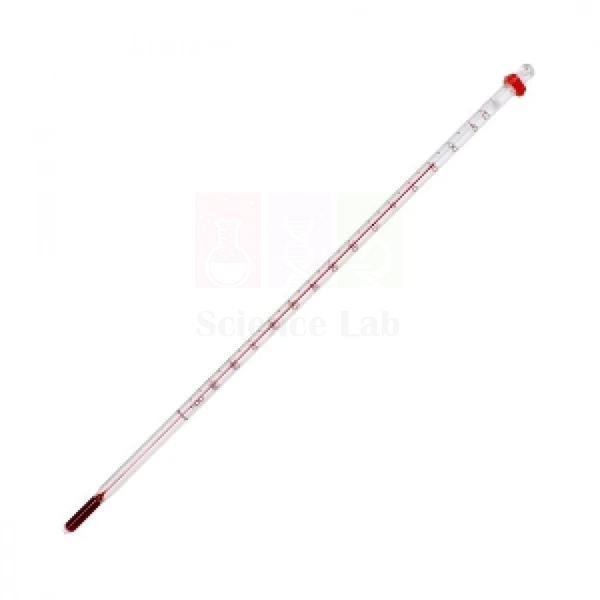
Red Spirit-Filled Thermometers
Red Spirit-Filled Thermometers (Product Code: SLE/ME/37) are mercury-free liquid thermometers used to measure temperature during practical work in school and college science laboratories. Teachers choose them for student benches because the column is a petroleum-based liquid coloured with red dye, which is significantly safer than mercury, and each thermometer has a slim 6–7 mm outer diameter. They are made by Jain Scientific Equipments Pvt Ltd (ScienceLab), an OEM manufacturer, at its own factory in Ambala, India — a school lab equipment manufacturer supplying institutions directly.
Specifications
| Parameter | Detail |
|---|---|
| Thermometric liquid | Petroleum-based column with red dye (no mercury) |
| Outer diameter | 6–7 mm |
| Bulb diameter | Equal to or smaller than the stem diameter |
| Main advantages | Increased safety and economy in everyday student use |
| Product code | SLE/ME/37 |
| Manufacturer | Jain Scientific Equipments Pvt Ltd (ScienceLab) — OEM |
| Country of origin | India (made in Ambala, Haryana) |
What Are Red Spirit-Filled Thermometers Used For?
Red spirit-filled thermometers are the everyday choice for heating and cooling curves, simple calorimetry, measuring the temperature change of dissolving or neutralisation reactions, and keeping an eye on water-bath temperatures in biology practicals. The coloured column stands out clearly against the scale, and because no mercury is involved, a breakage on a crowded bench is much simpler to clear up — a practical reason to choose them when stocking up thermometry apparatus for schools in India.
Because the bulb is no wider than the stem, the thermometer can be passed bulb-first through a correctly bored stopper or held in a thermometer clamp without forcing it. For reliable readings, keep the bulb fully immersed without touching the bottom of the vessel, read the top of the column at eye level, and never use the thermometer as a stirring rod. Store the thermometers flat or upright in a rack so the column stays continuous.
What to Specify When Ordering
- Quantity required per laboratory or per student group.
- Temperature range and scale needed for your practicals — the range is not listed on this page, so please state it in your enquiry.
- Whether thermometer clamps or holders should be quoted along with the thermometers.
OEM Manufacturer
ScienceLab is the trading name of Jain Scientific Equipments Private Limited, the OEM (original equipment manufacturer) of these red spirit-filled thermometers. They are made at the company's own licensed factory at Saha, Ambala, Haryana, India, rather than bought in from a trader, and are supplied factory-direct to schools, colleges, laboratory dealers and importers.
Repeat orders and replacement thermometers for existing lab sets are handled by the manufacturer itself — just ask us when breakages need replacing. Read more about the company on the ScienceLab company profile.
Related Measuring Equipment
These items are often ordered with red spirit-filled thermometers for temperature practicals:
- Thermometer Clamp — holds the thermometer on a stand so the bulb stays clear of the vessel base.
- Alloy Test Tube and Thermometer Holder — supports a thermometer or test tube during heating work.
- Glass Beaker — the usual vessel for water baths and heating-curve experiments.
- Digital Thermometer — an electronic probe alternative when a digital readout is preferred.
Browse the full Measuring category for balances, pipettes, timers and other thermometers.
Frequently Asked Questions
What liquid is inside the Red Spirit-Filled Thermometers?
The Red Spirit-Filled Thermometers contain a petroleum-based liquid column coloured with red dye instead of mercury. This makes them significantly safer for student practicals, because an accidental breakage does not release mercury onto the laboratory bench.
What is the diameter of the Red Spirit-Filled Thermometers?
Each of the Red Spirit-Filled Thermometers has an outer diameter of 6–7 mm, and the bulb is equal to or smaller than the stem in diameter, so the thermometer passes easily through a suitably bored stopper or clamp.
What temperature range do the Red Spirit-Filled Thermometers cover?
The temperature range of the Red Spirit-Filled Thermometers (SLE/ME/37) is not listed on this page. Please tell us the range and scale your practicals need through our contact page, and we will confirm the matching thermometer in your quotation.
Who manufactures the Red Spirit-Filled Thermometers?
The Red Spirit-Filled Thermometers are manufactured by Jain Scientific Equipments Pvt Ltd (ScienceLab), the OEM, at its own licensed factory at Saha, Ambala, Haryana, India. They are supplied factory-direct to schools, colleges, dealers and importers without a trading middleman.
Is a calibration certificate available for the Red Spirit-Filled Thermometers?
Calibration-certificate availability for the Red Spirit-Filled Thermometers should be discussed with us before you order. Mention the requirement in your enquiry and our team will confirm what documentation can be provided with the thermometers.
Can the Red Spirit-Filled Thermometers be ordered in bulk or for export?
Yes. The Red Spirit-Filled Thermometers can be quoted in class-set or bulk quantities for schools, dealers and importers in India and international markets. Send the quantity, the range you need and the delivery destination, and the quotation will come straight from the manufacturer.
Request a Quote
To order Red Spirit-Filled Thermometers (SLE/ME/37), send your quantity and required range through our contact page, or add them to the enquiry cart with other laboratory items. Quotations come direct from the manufacturer in Ambala.
Last updated: 24 September 2026
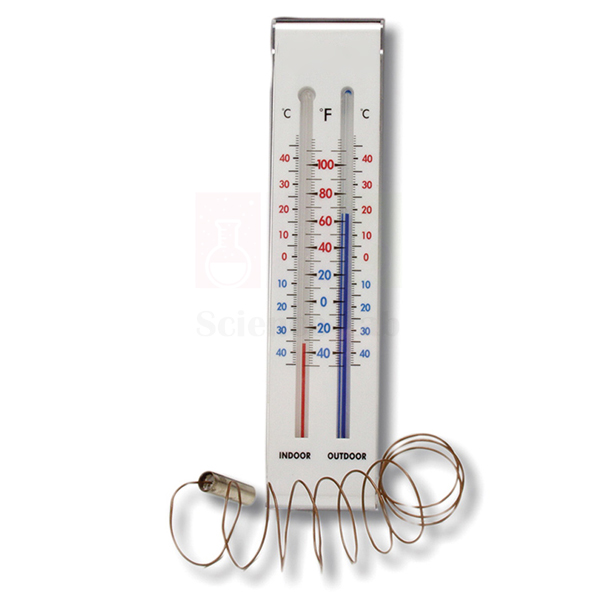
Indoor/Outdoor Thermometer
Indoor/Outdoor Thermometer (Product Code: SLE/ME/38) is a dual-reading thermometer used to monitor inside and outside air temperatures from within a classroom, laboratory or school weather corner. Teachers and students read both temperatures from indoors on the same °C and °F scales, which run from -55 to 55 °C and -50 to 130 °F. It is supplied by Jain Scientific Equipments Pvt Ltd (ScienceLab), Ambala, India, as part of its junior science lab equipment range.
Specifications
| Parameter | Detail |
|---|---|
| Celsius range | -55 to 55 °C |
| Fahrenheit range | -50 to 130 °F |
| Readings | Outside and inside temperatures, both read from inside |
| Scales | The same °C and °F scales serve both readings |
| Size | 2 1/4 × 9 in (H) |
| Product code | SLE/ME/38 |
| Supplied by | Jain Scientific Equipments Pvt Ltd (ScienceLab), Ambala, India |
What Is an Indoor/Outdoor Thermometer Used For?
Comparing the two readings side by side gives pupils a real data set every day. A class can log the outdoor temperature at the same time each morning, plot it across a month or a season, and set it against the room temperature to discuss insulation, ventilation and how sunshine warms a building. Because both values share one dual scale, the thermometer is also a handy prompt for practising conversion between Celsius and Fahrenheit.
Site it so that the outdoor reading is taken in shade, away from walls and paving that store the sun's heat, and keep the indoor side clear of heaters, air-conditioner outlets and direct sunlight. Read at eye level and write the time beside every value, so that records made by different groups or on different days can be compared fairly.
Supplier
ScienceLab is the trading name of Jain Scientific Equipments Private Limited of Ambala, Haryana, which supplies this Indoor/Outdoor Thermometer to schools, colleges, laboratories and dealers in India and international markets. As a school laboratory equipment supplier in India, the company can include it in a wider quotation that covers thermometers, balances and other measuring instruments. More about the company is on the ScienceLab profile.
Related Measuring Equipment
Instruments that build a simple school weather station around this thermometer:
- Digital Hygrometer - Thermometer — adds humidity readings to the daily weather log.
- Aneroid Barometer — records air pressure alongside temperature.
- Thermometer, Electronic, Max/Min — captures the highest and lowest temperatures between readings.
- Window Thermometer, Large — a larger window thermometer for a classroom display.
More instruments are listed in the Measuring category.
Frequently Asked Questions
What temperature range does the Indoor/Outdoor Thermometer cover?
The Indoor/Outdoor Thermometer covers -55 to 55 °C on its Celsius scale and -50 to 130 °F on its Fahrenheit scale. That span takes in normal room temperatures as well as the outdoor air temperatures students usually record in weather studies.
Can both temperatures on the Indoor/Outdoor Thermometer be read from inside?
Yes. The Indoor/Outdoor Thermometer lets you read the outside and the inside temperature from inside the room, on the same °C and °F scales, so pupils can compare the two values without going outdoors or converting units.
How big is the Indoor/Outdoor Thermometer?
The Indoor/Outdoor Thermometer has a listed size of 2 1/4 × 9 in (H). Check the space at the window or wall where you plan to fit it, and ask us through the contact page if another dimension needs confirming.
Who supplies the Indoor/Outdoor Thermometer?
The Indoor/Outdoor Thermometer is supplied by Jain Scientific Equipments Pvt Ltd (ScienceLab), Ambala, Haryana, India. Schools, colleges, laboratories and dealers in India and international markets can request a quotation for single units or class quantities.
Is a calibration certificate available for the Indoor/Outdoor Thermometer?
Calibration-certificate availability for the Indoor/Outdoor Thermometer should be discussed with us before ordering. State the document you need when you enquire through the contact page, and we will confirm what can be provided with the supply.
What should a quotation request for the Indoor/Outdoor Thermometer include?
A quotation request for the Indoor/Outdoor Thermometer (SLE/ME/38) should give the quantity, the delivery city or country, and any other measuring instruments you want priced together, so that one complete quotation can be prepared.
Request a Quote
To get a quotation for the Indoor/Outdoor Thermometer, send your requirement through our contact page or add it to the enquiry cart along with the rest of your measuring and weather-study equipment.
Last updated: 24 September 2026
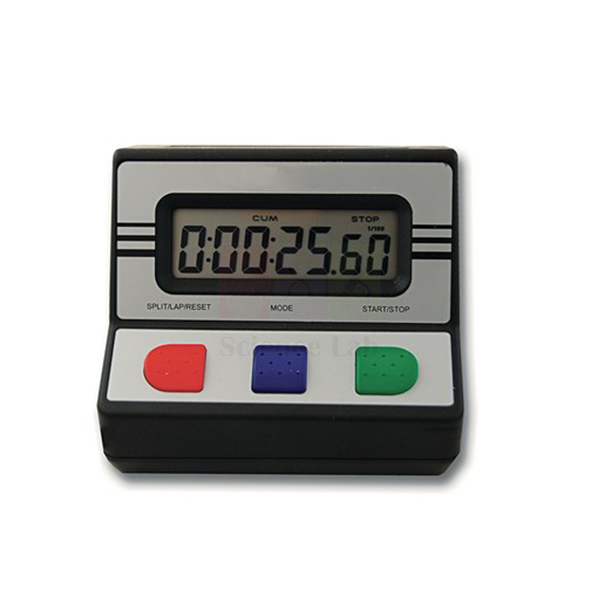
Bench Timer
Bench Timer (Product Code: SLE/ME/39) is a bench-top digital timer used to time practical work, reactions and demonstrations in school science laboratories. It counts up to 9 hours, 59 minutes and 59 seconds with lap and split timing, and its colour-coded buttons and clear LCD display sit in a robust ABS casing that stands up to everyday student use. It is supplied by Jain Scientific Equipments Pvt Ltd (ScienceLab), Ambala, India, complete with operating instructions and batteries.
Specifications
| Parameter | Detail |
|---|---|
| Type | Bench-top count-up timer, particularly suited to schools |
| Timing period | Up to 9 hours, 59 minutes and 59 seconds |
| Timing functions | Count up, lap timing and split timing |
| Display | Clear LCD |
| LCD dimensions | 63.7 x 19.7 mm |
| Controls | Colour-coded buttons |
| Casing | Robust ABS |
| Overall dimensions | 100 x 90 x 70.5 mm |
| Supplied with | Full operating instructions and batteries |
| Product code | SLE/ME/39 |
| Supplied by | Jain Scientific Equipments Pvt Ltd (ScienceLab), Ambala, India |
What Is a Bench Timer Used For?
A bench timer stands where the whole group can see it, which makes it practical for any experiment that runs for a set time or needs elapsed time recorded: rate-of-reaction work such as the disappearing-cross test, cooling curves, dissolving and diffusion practicals, and timed observations of yeast or germinating seeds. Lap timing records successive intervals without stopping the count, while split timing holds an intermediate reading on screen as the timer keeps running.
The long timing period also covers extended runs such as drying, evaporation or crystal-growth checks spread across a school day. Colour-coded buttons help younger students start, stop and reset without confusion, and keeping spare batteries in the prep room avoids a timing being lost halfway through a lesson. It sits as comfortably among physics lab equipment for schools in India as it does on chemistry and biology benches.
Supplier
Jain Scientific Equipments Private Limited, trading as ScienceLab from Ambala, Haryana, supplies this Bench Timer to schools, colleges, training institutes and dealers in India and international markets. The timer can be quoted on its own or together with stopwatches and other measuring instruments to equip every bench in a practical room. Company details are on the ScienceLab profile page.
Related Measuring Equipment
Other timing instruments to compare with, or order alongside, the Bench Timer:
- Bench Stopwatch — another bench-standing timer that also works as a clock with alarm.
- Digital Stopclock — a digital stopclock alternative for timing class experiments.
- Stopwatch, Digital — a handheld timer for individual students and field work.
- Reaction Timer — for measuring human reaction times in biology practicals.
Browse the full Measuring category for more instruments.
Frequently Asked Questions
How long can the Bench Timer time?
The Bench Timer has a timing period of up to 9 hours, 59 minutes and 59 seconds. It counts up from zero, so it suits both short rate-of-reaction experiments and longer practical sessions that run for most of a school day.
Does the Bench Timer have lap and split timing?
Yes. The Bench Timer counts up and offers lap and split timing, so students can record several intervals or intermediate readings during a single run, such as successive stages of a reaction, without restarting the timer.
Are batteries included with the Bench Timer?
Yes. The Bench Timer is supplied complete with batteries and full operating instructions, so it can go into use on the bench as soon as it arrives. Ask us if you need the battery type confirmed before ordering.
What size are the Bench Timer and its display?
The Bench Timer measures 100 x 90 x 70.5 mm overall, and its clear LCD display is 63.7 x 19.7 mm. The compact ABS body takes little bench space while keeping the readout visible to a small group of students.
Who supplies the Bench Timer?
The Bench Timer is supplied by Jain Scientific Equipments Pvt Ltd (ScienceLab), Ambala, Haryana, India. Schools, colleges and dealers in India and international markets can request quotations for single timers or for a set covering every bench.
Can the Bench Timer be ordered in class sets?
Yes. The Bench Timer can be quoted in class sets, for example one per bench group, for schools, tenders and dealers. Give the quantity and delivery location through the contact page to receive a quotation.
Request a Quote
Request a quotation for the Bench Timer through the contact page, or add it to the enquiry cart together with stopwatches, thermometers and other measuring items for your laboratory.
Last updated: 24 September 2026
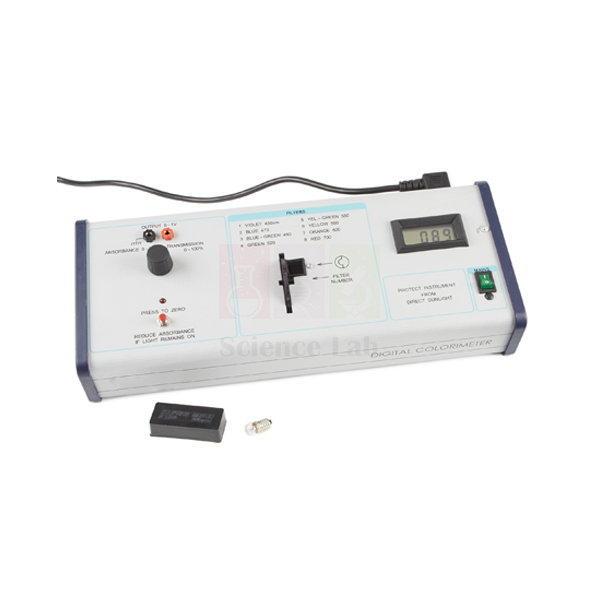
S-Range Digital Colorimeter - 240V
S-Range Digital Colorimeter - 240V (Product Code: SLE/ME/40) is a single-cuvette digital colorimeter used to measure the absorbance and transmission of coloured solutions in school, college and teaching laboratories. Chemistry and biology teachers use it for concentration and reaction-rate work, and its eight colour filters span 430–700 nm with push-button automatic zeroing. It is supplied by Jain Scientific Equipments Pvt Ltd (ScienceLab), Ambala, India, a laboratory analytical instruments supplier.
Specifications
| Parameter | Detail |
|---|---|
| Absorbance ranges | 0–1 (linear) and 0–2 |
| Transmission range | 0–100% (linear) |
| Max. initial absorbance of reference solution | 0.8A, 1.0A, 10% (as listed for the ranges) |
| Zero adjustment | Automatic, push-button zeroing with LED indicator (automatic gain control) |
| Light source | 6V, 0.15A MES lamp |
| Filters | 8 colour filters, 430–700 nm (violet to red), in a rotatable filter holder |
| Detector | Silicon photodiode |
| Output | 0–1V sockets, fitted as standard, for dataloggers or computers |
| Cuvette holder | Single holder for 10 mm path length cuvettes |
| Ambient light | Insensitive to normal ambient lighting |
| Mains version | 240V |
| Dimensions | 380 × 160 × 80 mm |
| Mass | 1.5 kg |
| Supplied with | 2 m detachable mains cable, filter disc, spare lamp, dust cover for the filter disk and cuvette socket |
| Product code | SLE/ME/40 |
| Supplied by | Jain Scientific Equipments Pvt Ltd (ScienceLab), Ambala, India |
What Is the S-Range Digital Colorimeter Used For?
Colorimetry lets students turn the intensity of a colour into a number. With the S-Range Digital Colorimeter, a class can prepare standard solutions, plot absorbance against concentration to demonstrate the Beer–Lambert relationship, and then read an unknown sample from the calibration line. The same instrument follows colour changes over time in reaction-rate and enzyme experiments, which makes it a versatile colorimeter for India's school and college labs.
Choose the filter whose colour is complementary to the solution (for example, a red or orange filter for a blue solution), zero the instrument on a blank with one press of the switch, then insert each sample cuvette in turn. Because the colorimeter is insensitive to normal room lighting, the lab does not need to be darkened, and the 0–1V output can feed a datalogger or computer for continuous recording.
What to Specify When Ordering
- Confirm that your mains supply suits the 240V version.
- Number of cuvettes needed — the single holder takes 10 mm path length cuvettes.
- Whether a Spare Colour Filter Wheel should be quoted with the instrument.
- Whether you will connect the 0–1V output to a datalogger or computer, so we can advise on the connection you need.
Supplier
ScienceLab, the trading name of Jain Scientific Equipments Private Limited in Ambala, Haryana, sources and supplies the S-Range Digital Colorimeter - 240V to schools, colleges, teaching laboratories and dealers. The matching spare filter wheel is listed separately, so replacement parts can be requested on the same enquiry as the instrument. Company details are on the ScienceLab company profile.
Related Measuring Equipment
Items that complete a colorimetry practical with this instrument:
- Spare Colour Filter Wheel for S-Range Digital Colorimeter — a replacement eight-filter wheel for this colorimeter.
- Plastic Cuvettes — sample cells; check that the path length suits the 10 mm holder.
- Research Pipettors — for measuring standard and sample volumes accurately into cuvettes.
- Colourwave Colorimeter — a compact alternative with RS232 digital output.
Explore more instruments in the Measuring category.
Frequently Asked Questions
What wavelengths does the S-Range Digital Colorimeter - 240V cover?
The S-Range Digital Colorimeter - 240V has eight colour filters covering 430–700 nm, from violet to red. They are held in a rotatable filter holder, so the user can quickly select the filter that suits the colour of the test solution.
Which cuvettes fit the S-Range Digital Colorimeter - 240V?
The S-Range Digital Colorimeter - 240V has a single cuvette holder that takes cuvettes with a 10 mm path length. Tell us how many cuvettes each class needs and suitable ones can be included in the same quotation.
Can the S-Range Digital Colorimeter - 240V connect to a datalogger or computer?
Yes. The S-Range Digital Colorimeter - 240V has 0–1V output sockets fitted as standard for dataloggers or computers. The interface or cable for your particular logging system is not listed here, so please ask us before ordering.
What comes with the S-Range Digital Colorimeter - 240V?
The S-Range Digital Colorimeter - 240V is supplied with a 2 m detachable mains cable, a filter disc, a spare lamp, and a dust cover for the filter disk and cuvette socket, so it is ready for laboratory use on arrival.
Does room lighting affect the S-Range Digital Colorimeter - 240V?
No. The S-Range Digital Colorimeter - 240V is insensitive to normal ambient lighting, and its automatic gain control zeros the instrument when you press a switch, with an LED indicator showing the adjustment, so the lab need not be darkened.
Who supplies the S-Range Digital Colorimeter - 240V?
The S-Range Digital Colorimeter - 240V is supplied by Jain Scientific Equipments Pvt Ltd (ScienceLab), Ambala, Haryana, India, to schools, colleges, laboratories and dealers in India and international markets. Quotations are prepared on request through the contact page.
Is a calibration certificate available for the S-Range Digital Colorimeter - 240V?
Calibration-certificate availability for the S-Range Digital Colorimeter - 240V should be discussed with us before ordering. Mention the requirement on the contact page and we will confirm what documentation can be provided.
Request a Quote
For a quotation on the S-Range Digital Colorimeter - 240V (SLE/ME/40), send the quantity, cuvette needs and delivery location through our contact page, or add it to the enquiry cart with the spare filter wheel.
Last updated: 24 September 2026
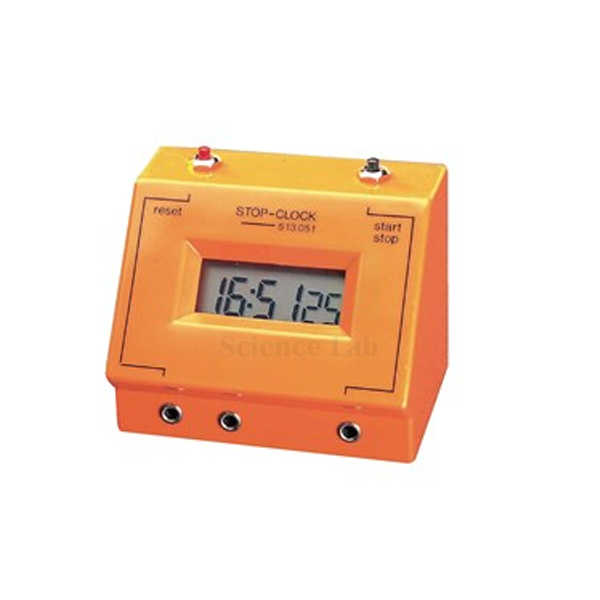
Digital Stopclock
Digital Stopclock (Product Code: SLE/ME/41) is a battery-powered digital timer used to time physics and general science experiments to 1/100 second in school and college laboratories. Its large 12 mm high display and front-panel 4 mm sockets, which let start/stop and reset be triggered externally as well as from the top-mounted push switches, set it apart from a handheld stopwatch. It is supplied by Jain Scientific Equipments Pvt Ltd (ScienceLab), Ambala, India, among its physics lab instruments.
Specifications
| Parameter | Detail |
|---|---|
| Timing range | Up to 1 hour |
| Resolution | 1/100 second |
| Timing functions | Start/stop, reset, split (lap) timing when required |
| Display | Large, 12 mm high |
| Controls | Top-mounted push switches, or front-panel 4 mm sockets |
| Power | Two AA/R6 or HP7 cells, giving many months of use |
| Light-gate work | A separate Centisecond Timer Module provides extra facilities when light gates are used |
| Product code | SLE/ME/41 |
| Supplied by | Jain Scientific Equipments Pvt Ltd (ScienceLab), Ambala, India |
What Is the Digital Stopclock Used For?
A stopclock with a display the whole bench can read is ideal for timing pendulum swings, trolley runs down a ramp, falling objects, cooling curves and the rate of simple chemical reactions. The split (lap) function records an intermediate time without stopping the count, so students can note, for example, the time for ten oscillations and then twenty in a single run.
The 4 mm sockets make it possible to wire the stopclock to external switches or contacts, so the clock starts and stops at the exact moment an event happens rather than when a student reacts. This reduces human reaction-time error and is a good way to introduce the idea of systematic error in physics lab instruments work in India's schools and colleges.
What to Specify When Ordering
- Number of stopclocks needed per laboratory or group.
- Whether AA/R6 or HP7 cells should be included with your order.
- Whether you plan external switching through the 4 mm sockets, or light-gate timing, so we can advise on suitable accessories.
Supplier
ScienceLab is the trading name of Jain Scientific Equipments Private Limited, Ambala, Haryana, and supplies the Digital Stopclock to schools, colleges and laboratory dealers alongside its wider range of timers and measuring instruments. Buyers can request timers, stopwatches and experiment apparatus on one enquiry. See the ScienceLab company profile for more about the company.
Related Measuring Equipment
Timing instruments and apparatus that pair well with the Digital Stopclock:
- Bench Stopwatch — a desk stopclock with calendar and alarm for longer sessions.
- Stopwatch, Digital — a handheld option for fieldwork and outdoor timing.
- Millisecond Timer — for experiments that need finer time resolution.
- Mathematical Pendulum Demonstration Apparatus — a classic experiment timed with a stopclock.
Find more timers and instruments in the Measuring category.
Frequently Asked Questions
How precise is the Digital Stopclock?
The Digital Stopclock times in steps of 1/100 second for periods of up to 1 hour. It also offers split (lap) timing, so intermediate times can be recorded during the same run without stopping the main count.
Can the Digital Stopclock be started by an external switch?
Yes. The Digital Stopclock has front-panel 4 mm sockets through which start/stop and reset can be operated, as an alternative to its top-mounted push switches, so an experiment can be timed from switches or contacts rather than by hand.
What batteries does the Digital Stopclock use?
The Digital Stopclock is powered by two AA/R6 or HP7 cells, which give many months of use in normal school timing. Please ask us whether cells should be included when we prepare your quotation.
Can the Digital Stopclock be used with light gates?
For light-gate work, a separate Centisecond Timer Module provides extra facilities beyond the Digital Stopclock itself. Please contact us to check which light-gate timing option we can quote for your experiment before you place an order.
Who supplies the Digital Stopclock?
The Digital Stopclock is supplied by Jain Scientific Equipments Pvt Ltd (ScienceLab), Ambala, Haryana, India. Schools, colleges, training institutes and dealers in India and international markets can request a quotation through the enquiry cart or the contact page.
What should a quotation request for the Digital Stopclock include?
When requesting the Digital Stopclock (SLE/ME/41), state the quantity, whether cells are needed, whether you plan external switching or light-gate work, and your delivery location. This lets us send an accurate quotation in one reply.
Request a Quote
To get a quotation for the Digital Stopclock (SLE/ME/41), send your requirements through the contact page or add the stopclock to the enquiry cart along with other timing apparatus.
Last updated: 24 September 2026
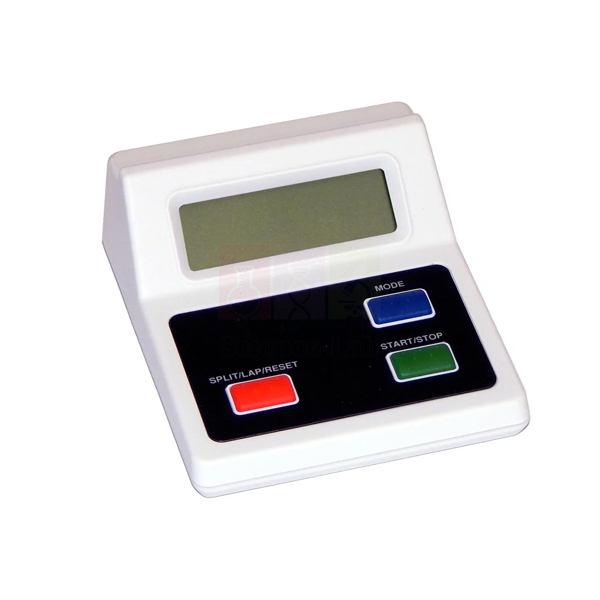
Bench Stopwatch
Bench Stopwatch (Product Code: SLE/ME/42) is a simple 1/100 second stopclock used to time experiments, practical sessions and classroom activities on school and college laboratory benches. As well as counting up to 24 hours, it works as a clock with calendar and alarm, all operated with just three buttons in a white case. It is supplied by Jain Scientific Equipments Pvt Ltd (ScienceLab), Ambala, India, with an R6 battery included, as part of its educational lab equipment for India and overseas buyers.
Specifications
| Parameter | Detail |
|---|---|
| Resolution | 1/100 second |
| Counting range | Up to 24 hours |
| Timing function | Lap facility |
| Other functions | Clock with calendar, and alarm |
| Buttons | Three: mode; split/lap/reset; start/stop |
| Case | White |
| Battery | R6, included |
| Size | L120 × W100 × H45 mm |
| Product code | SLE/ME/42 |
| Supplied by | Jain Scientific Equipments Pvt Ltd (ScienceLab), Ambala, India |
What Is the Bench Stopwatch Used For?
The Bench Stopwatch suits any practical where a group needs to share one clearly placed timer: timing a reaction until a solution turns cloudy, recording how long a candle burns under a jar, or noting the interval between readings in osmosis and rate-of-cooling experiments. Its 24-hour count also covers overnight or all-day investigations without restarting the timer.
Between experiments, the clock-and-calendar mode keeps the bench useful as a lab clock, and the alarm can remind students when the next reading is due. Keep it away from water baths and sinks, and replace the R6 battery when the display begins to fade.
Supplier
Jain Scientific Equipments Private Limited, which trades as ScienceLab from Ambala, Haryana, supplies the Bench Stopwatch to schools, colleges, coaching institutes and dealers. It is usually requested together with other timing and measuring instruments, and all of these can be included on the same quotation. Company background is available on the ScienceLab company profile.
Related Measuring Equipment
Other timers buyers compare with, or order alongside, the Bench Stopwatch:
- Bench Timer — a bench-top count-up timer with colour-coded buttons.
- Digital Stopclock — adds 4 mm sockets for starting and stopping from external switches.
- Digital Chronometer (Stopwatch) — a handheld stopwatch for individual students.
- Reaction Timer — for human reaction-time investigations in biology.
View all timers, balances and thermometers in the Measuring category.
Frequently Asked Questions
How long can the Bench Stopwatch count?
The Bench Stopwatch counts up to 24 hours in steps of 1/100 second, with a lap facility for recording intermediate times. This makes it suitable for both short reaction timings and long investigations that run through a full school day.
What extra functions does the Bench Stopwatch have?
Besides stopwatch timing, the Bench Stopwatch works as a clock with calendar and has an alarm. The alarm can be used to remind students when the next reading in a long experiment is due, keeping measurements evenly spaced.
How is the Bench Stopwatch operated?
The Bench Stopwatch uses three buttons: mode, split/lap/reset, and start/stop. This simple layout lets younger students learn to use it quickly, while the split and lap function still supports more careful timing in senior practicals.
Is a battery included with the Bench Stopwatch?
Yes, an R6 battery is included with the Bench Stopwatch, so it can be used as soon as it is unpacked. Ask us if you would like replacement R6 batteries quoted together with your order.
What is the size of the Bench Stopwatch?
The Bench Stopwatch measures L120 × W100 × H45 mm and comes in a white case. It stands on a laboratory bench where a whole group can see it, without taking up much working space.
Who supplies the Bench Stopwatch?
The Bench Stopwatch is supplied by Jain Scientific Equipments Pvt Ltd (ScienceLab), Ambala, Haryana, India. Schools, colleges and dealers in India and international markets can send quantities through the contact page to receive a quotation.
Request a Quote
Request a quotation for the Bench Stopwatch (SLE/ME/42) through the contact page, or place it in the enquiry cart with the other items on your laboratory list.
Last updated: 24 September 2026
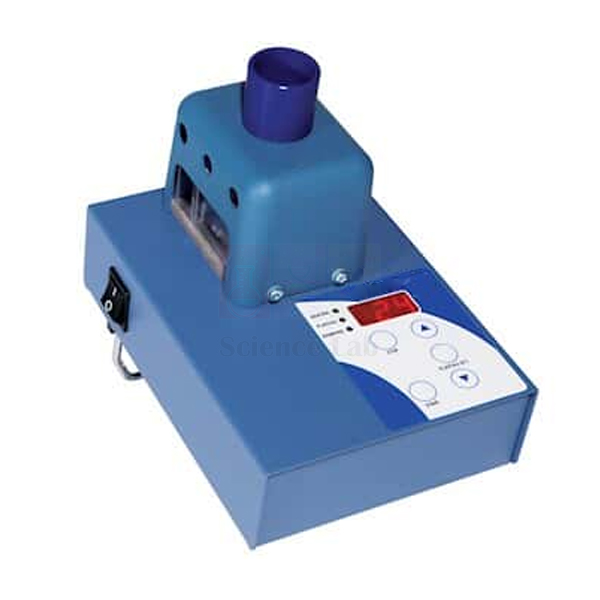
Digital Melting Point Apparatus
Digital Melting Point Apparatus (Product Code: SLE/ME/43) is a bench instrument used to determine the melting point of solid samples in chemistry, pharmacy and teaching laboratories. It heats two samples at once from ambient to 300 °C, climbing at 20 °C per minute to a chosen plateau and then at 2 °C per minute through the melt, with a PT100 sensor and a large three-digit LED readout. It is supplied by Jain Scientific Equipments Pvt Ltd (ScienceLab), Ambala, India.
Specifications
| Parameter | Detail |
|---|---|
| Number of samples | 2 |
| Temperature range | Ambient to 300 °C |
| Temperature resolution | 1 °C |
| Temperature accuracy | ±1% of displayed temperature |
| Display | Large three-digit LED |
| Sample status | Three LEDs show the state of the sample |
| Sensor | PT100 |
| Ramp rates | 20 °C per minute to plateau; 2 °C per minute to melt |
| Heating block | Behind a protective screen; heats quickly and holds the selected plateau temperature until the test is started |
| Viewing cover | Easily removed for access to the bulb and for cleaning |
| Feet | Extendable, to view samples at an optimum angle |
| Overall size | W160 x D220 x H170 mm |
| Mass | 1.8 kg |
| Product code | SLE/ME/43 |
| Supplied by | Jain Scientific Equipments Pvt Ltd (ScienceLab), Ambala, India |
What Is a Digital Melting Point Apparatus Used For?
Melting point is one of the quickest checks on the identity and purity of a crystalline solid: a pure compound melts sharply near its literature value, while impurities lower and widen the melting range. Students use this apparatus to confirm products they have synthesised or recrystallised, to compare an unknown with reference compounds, and to see how a mixed melting point shows whether two samples are the same substance. With two sample positions, an unknown and a reference can be run side by side.
In practice the block is first taken quickly to a plateau a little below the expected melting point, where it waits until the operator is ready; the slower 2 °C per minute ramp then gives time to watch the crystals collapse and note the temperature. Load finely ground, dry sample to a short, even depth in each tube, and set the extendable feet so the view through the cover is comfortable. The three status LEDs help students follow each stage of the test.
Supplier
ScienceLab is the trading name of Jain Scientific Equipments Private Limited, which supplies this Digital Melting Point Apparatus from Ambala, Haryana, India. Working as a chemistry lab instruments supplier, the company quotes it for colleges, pharmacy institutes, testing laboratories and dealers in India and international markets, together with melting-point tubes and small lab items if required. Read more on the company profile.
Related Measuring Equipment
Items used to prepare and run melting point tests, plus alternative models:
- Melting-Point Tubes — the tubes that carry samples into the heating block.
- Porcelain Mortar with Crusher — grinds crystals to a fine powder before loading.
- Spatula, Chattaway — handles small quantities of solid sample.
- Analogue Melting Point — a knob-controlled alternative with a magnifying eyepiece.
- Melting Point Apparatus, Digital — a digital model that tests three samples at once.
See more instruments in the Measuring category.
Frequently Asked Questions
How many samples can the Digital Melting Point Apparatus test at once?
The Digital Melting Point Apparatus takes 2 samples at a time. Running an unknown beside a reference compound, or two recrystallised fractions side by side, makes comparisons quicker and helps students judge purity from the melting behaviour.
What temperature range and accuracy does the Digital Melting Point Apparatus offer?
The Digital Melting Point Apparatus works from ambient temperature to 300 °C, with 1 °C resolution and an accuracy of ±1% of the displayed temperature. Readings come from a PT100 sensor and appear on a large three-digit LED display.
How does heating work on the Digital Melting Point Apparatus?
The Digital Melting Point Apparatus heats at 20 °C per minute to a selected plateau and holds there until you start the test. It then ramps at 2 °C per minute to the melt, giving time to observe each sample closely.
How is the Digital Melting Point Apparatus cleaned?
The viewing cover of the Digital Melting Point Apparatus is easily removed, giving access to the bulb and allowing cleaning. Take out used tubes once the block has cooled, and wipe away any spilled sample so it does not affect later readings.
What mains supply does the Digital Melting Point Apparatus need?
The mains supply for the Digital Melting Point Apparatus is not stated in our current listing. Tell us your laboratory voltage and frequency through the contact page, and we will confirm suitability before the quotation is issued.
Who supplies the Digital Melting Point Apparatus?
The Digital Melting Point Apparatus is supplied by Jain Scientific Equipments Pvt Ltd (ScienceLab), Ambala, Haryana, India, to colleges, pharmacy institutes, laboratories and dealers in India and international markets, with quotations prepared on request.
Is a calibration certificate available for the Digital Melting Point Apparatus?
Calibration-certificate availability for the Digital Melting Point Apparatus should be discussed with us before you order. Mention the document you need when you enquire, and we will confirm what can accompany the instrument.
Request a Quote
For a quotation on the Digital Melting Point Apparatus, write to us through the contact page or add it to the enquiry cart with melting-point tubes and any other items for your chemistry laboratory.
Last updated: 24 September 2026
Melting-Point Tubes
Melting-Point Tubes (Product Code: SLE/ME/44) are thin-walled capillary tubes used to hold small powdered samples during melting point determination in chemistry, pharmacy and teaching laboratories. Each tube is 100 mm long and 1 mm in diameter, so it needs only a tiny amount of sample and lets heat pass quickly from the heating block to the solid. They are supplied by Jain Scientific Equipments Pvt Ltd (ScienceLab), Ambala, India, a lab consumables supplier for India and international markets.
Specifications
| Parameter | Detail |
|---|---|
| Type | Thin-walled capillary tubes |
| Length | 100 mm |
| Diameter | 1 mm |
| Typical use | Holding samples for capillary melting point determination |
| Product code | SLE/ME/44 |
| Supplied by | Jain Scientific Equipments Pvt Ltd (ScienceLab), Ambala, India |
What Are Melting-Point Tubes Used For?
In the capillary method, a finely ground solid is packed into the closed end of a melting-point tube, the tube is placed in a melting point apparatus, and the temperature at which the solid starts and finishes melting is recorded. A pure compound melts over a narrow range, while impurities lower and broaden it, so these tubes are central to identifying organic compounds and checking the purity of products such as recrystallised samples in school and college chemistry lab equipment sets.
To fill a tube, press the open end into a small heap of dry, powdered sample, then tap or drop the tube, closed end down, so the solid settles into a short, tightly packed column. Use a fresh tube for every determination and wipe the outside clean before inserting it into the heating block.
What to Specify When Ordering
- Number of tubes required — the pack size is not listed here, so tell us your total quantity.
- Which melting point apparatus you use, so we can check the 1 mm diameter suits its sample holes.
- Whether one end should already be sealed, or whether you seal the tubes yourself.
Supplier
ScienceLab, the trading name of Jain Scientific Equipments Private Limited in Ambala, Haryana, supplies Melting-Point Tubes as a consumable for chemistry and pharmacy practicals. Because the tubes are used once and discarded, schools and colleges usually re-order them each term alongside their melting point apparatus and other consumables. Learn more on the ScienceLab company profile.
Related Measuring Equipment
Apparatus and tools used with melting-point tubes:
- Digital Melting Point Apparatus — a two-sample instrument with an LED temperature display.
- Analogue Melting Point — a knob-controlled unit with a magnifying eyepiece.
- Apparatus Melting Point — another block-heated option for teaching laboratories.
- Pestle And Mortar — for grinding samples to the fine powder the tubes need.
See the complete Measuring category for more laboratory instruments.
Frequently Asked Questions
What size are the Melting-Point Tubes?
The Melting-Point Tubes are thin-walled capillary tubes, 100 mm long and 1 mm in diameter. The narrow bore holds only a small amount of sample, which helps the solid heat evenly and makes the start and end of melting easier to see.
Are the Melting-Point Tubes sealed at one end?
This listing does not state whether the Melting-Point Tubes are supplied with one end sealed. Please confirm with us before ordering; tubes open at both ends are normally sealed at one end in a small flame before filling.
Which apparatus can the Melting-Point Tubes be used with?
The Melting-Point Tubes are intended for capillary melting point apparatus, such as the digital and analogue melting point units in our Measuring range. Check that the 1 mm tube diameter suits the sample holes of your apparatus before ordering.
Can the Melting-Point Tubes be reused?
No, the Melting-Point Tubes are normally used once, because the melted and re-solidified sample cannot easily be cleaned out of such a narrow bore. Dispose of used tubes safely in a sharps container.
How many Melting-Point Tubes come in a pack?
The pack size of the Melting-Point Tubes is not listed on this page. Tell us the total number of tubes you need through the contact page, and we will confirm the pack quantities we can supply in the quotation.
Who supplies the Melting-Point Tubes?
The Melting-Point Tubes are supplied by Jain Scientific Equipments Pvt Ltd (ScienceLab), Ambala, Haryana, India, to schools, colleges, pharmacy institutes and dealers in India and international markets, with quotations sent on request.
Request a Quote
To order Melting-Point Tubes (SLE/ME/44), send the quantity and the apparatus you use through our contact page, or add them to the enquiry cart with your melting point apparatus.
Last updated: 24 September 2026
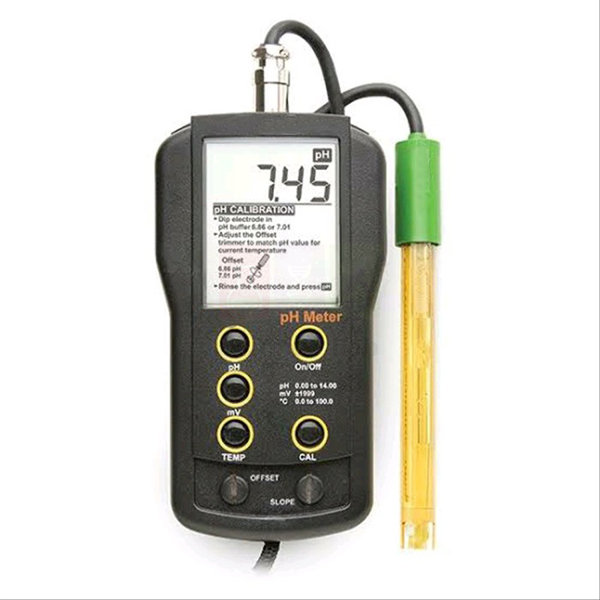
pH mV and Temperature Meter
pH mV and Temperature Meter (Product Code: SLE/ME/45) is a portable three-parameter meter used to measure the pH, millivolt potential and temperature of solutions in school, college and field laboratories. Its plastic-bodied pH electrode has the temperature sensor built in, so one probe gives pH to ±0.01 and temperature to ±0.4 °C, with temperature-compensated readings up to 70 °C. It is supplied by Jain Scientific Equipments Pvt Ltd (ScienceLab), Ambala, India, for pH meter laboratory work across India and international markets.
Specifications
| Parameter | Detail |
|---|---|
| pH range | 0.00 to 14.00 |
| pH accuracy | ±0.01 pH |
| mV range | ±1999 mV |
| mV resolution | ±1 mV |
| Temperature range | 0.0 to 100.0 °C |
| Temperature accuracy | ±0.4 °C |
| Temperature compensation | Readings compensated up to 70 °C |
| Probe | Plastic-bodied pH electrode containing the temperature sensor |
| Calibration | Manual, using trimmers on the front, with instructions shown on the screen |
| Display | Large LCD |
| Battery | 9V |
| Dimensions | 145 × 80 × 36 mm |
| Weight | 230 g |
| Supplied with | pH/°C probe, battery, instructions and case |
| Product code | SLE/ME/45 |
| Supplied by | Jain Scientific Equipments Pvt Ltd (ScienceLab), Ambala, India |
What Is the pH mV and Temperature Meter Used For?
Because it reads three quantities from one portable unit, this meter covers a wide range of practicals: plotting pH titration curves, testing soil extracts and pond water on field trips, comparing buffer solutions, and following temperature alongside pH as a reaction proceeds. The ±1999 mV range adds electrochemistry work such as measuring the potential of simple cells and redox reactions.
Before a session, calibrate the meter with buffer solutions by adjusting the front-panel trimmers while following the on-screen instructions. Rinse the electrode with distilled water between samples, blot it gently rather than wiping, and keep the probe tip moist during storage so readings stay stable from one class to the next.
What to Specify When Ordering
- Number of meters needed per laboratory or field group.
- Whether calibration buffer solutions should be quoted with the meters, as they are not listed in the supplied items.
- Whether a spare pH/°C probe or spare 9V batteries are required.
Supplier
ScienceLab is the trading name of Jain Scientific Equipments Private Limited, Ambala, Haryana, which supplies the pH mV and Temperature Meter to schools, colleges, environmental-science departments and dealers. Probes, batteries and related electrochemistry items can be requested on the same enquiry. Company information is on the ScienceLab company profile.
Related Measuring Equipment
Other pH instruments and accessories for the same practicals:
- Waterproof pH Meter — a floating-case meter with automatic calibration for fieldwork.
- 2 pH Meter — a pocket-sized meter when only pH is needed.
- Wash Bottle LDPE with Narrow Mouth — for rinsing the electrode between samples.
- Beaker, Polypropylene — plastic sample containers for field and bench use.
More instruments are listed in the Measuring category.
Frequently Asked Questions
What does the pH mV and Temperature Meter measure?
The pH mV and Temperature Meter measures pH from 0.00 to 14.00 with ±0.01 pH accuracy, potential across ±1999 mV with ±1 mV resolution, and temperature from 0.0 to 100.0 °C with ±0.4 °C accuracy.
How is the pH mV and Temperature Meter calibrated?
The pH mV and Temperature Meter uses manual calibration. You adjust the trimmers on the front of the instrument while following the instructions shown on the screen, normally with standard buffer solutions, before starting a set of measurements.
Does the pH mV and Temperature Meter compensate for temperature?
Yes. The pH mV and Temperature Meter gives temperature-compensated pH readings up to 70 °C. The temperature sensor sits inside the plastic-bodied pH electrode, so a single probe handles both measurements at once.
What is supplied with the pH mV and Temperature Meter?
The pH mV and Temperature Meter is supplied complete with a pH/°C probe, a battery, instructions and a case. Calibration buffer solutions are not listed as included, so please ask us if you need them quoted.
How big is the pH mV and Temperature Meter?
The pH mV and Temperature Meter measures 145 × 80 × 36 mm, weighs 230 g and runs on a 9V battery, which makes it easy to carry for fieldwork as well as to use on the laboratory bench.
Who supplies the pH mV and Temperature Meter?
The pH mV and Temperature Meter is supplied by Jain Scientific Equipments Pvt Ltd (ScienceLab), Ambala, Haryana, India, to schools, colleges, laboratories and dealers in India and international markets. Send your requirement through the contact page for a quotation.
Is a calibration certificate available for the pH mV and Temperature Meter?
Calibration-certificate availability for the pH mV and Temperature Meter should be discussed with us before ordering. Mention the requirement through the contact page and we will confirm what documentation can be provided.
Request a Quote
For a quotation on the pH mV and Temperature Meter (SLE/ME/45), send the quantity and any spares or buffers you need through our contact page, or add it to the enquiry cart.
Last updated: 24 September 2026
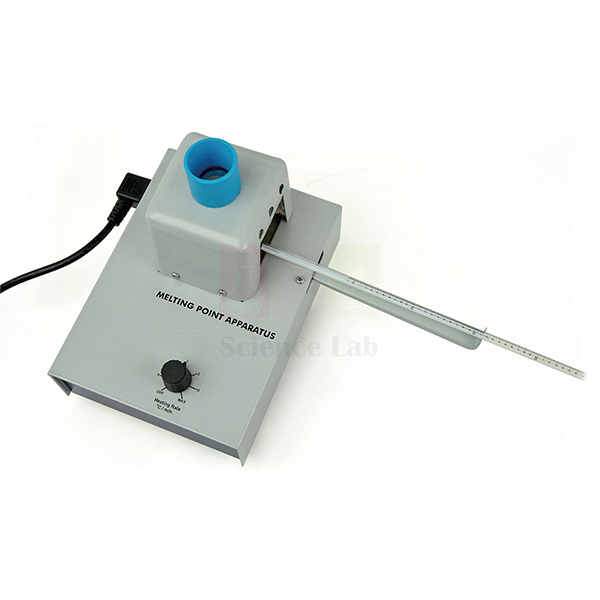
Analogue Melting Point
Analogue Melting Point (Product Code: SLE/ME/46) is a knob-controlled melting point apparatus used to observe and determine the melting temperature of solid samples in chemistry and pharmacy teaching laboratories. Its dual heating block takes up to two samples at once, working from ambient to 380 °C at a heating rate set on a rotary knob up to 20 °C/min, while a magnifying eyepiece lit by a white LED shows the melt clearly. It is supplied by Jain Scientific Equipments Pvt Ltd (ScienceLab), Ambala, India, a chemistry lab instruments supplier.
Specifications
| Parameter | Detail |
|---|---|
| Samples | Up to two at a time (dual heating block) |
| Operating range | Ambient temperature to 380 °C |
| Heating rate | Adjustable with a rotary knob, up to a maximum of 20 °C/min |
| User interface | Rotary knob |
| Temperature unit | °C |
| Sample viewing | Magnifying lens in the eyepiece, illuminated by a bright white LED |
| Electrical supply | 230V, 50Hz, 50W |
| Cabinet dimensions | W185 × D220 × H176 mm |
| Net weight | 1.2 kg |
| Product code | SLE/ME/46 |
| Supplied by | Jain Scientific Equipments Pvt Ltd (ScienceLab), Ambala, India |
What Is the Analogue Melting Point Apparatus Used For?
With two sample positions, this apparatus is well suited to the mixed melting point test taught in organic chemistry: one tube holds the unknown and the other holds the unknown mixed with a known reference compound. If both melt at the same temperature, the identity is supported; a lower, broader melt in the mixture shows they differ. Pharmacy students use the same side-by-side comparison to check the purity of recrystallised drug substances.
For good results, turn the knob to a faster rate to approach the expected melting point, then reduce the heating rate so the last few degrees rise slowly, and watch both samples through the illuminated eyepiece. Allow the block to cool before loading the next pair of tubes, and keep the eyepiece clean so the melt is easy to judge.
What to Specify When Ordering
- Confirm that your laboratory supply matches 230V, 50Hz.
- Quantity of melting-point capillary tubes to be quoted with the apparatus.
- Number of units needed per laboratory or practical group.
Supplier
ScienceLab, the trading name of Jain Scientific Equipments Private Limited of Ambala, Haryana, supplies the Analogue Melting Point apparatus to school chemistry departments, pharmacy colleges, training laboratories and dealers. Capillary tubes and sample-preparation items can be added to the same enquiry. Read about the company on the ScienceLab company profile.
Related Measuring Equipment
Consumables and alternatives used with this melting point apparatus:
- Melting-Point Tubes — thin-walled capillaries that hold the samples.
- Digital Melting Point Apparatus — a digital-display alternative with preset heating ramps.
- Melting Point Apparatus Simple — a basic option for junior heat and melting practicals.
- Pestle And Mortar — for grinding samples finely before loading the tubes.
Browse other instruments in the Measuring category.
Frequently Asked Questions
How many samples can the Analogue Melting Point apparatus test at once?
The Analogue Melting Point apparatus has a dual heating block that tests up to a maximum of two samples simultaneously. This allows an unknown and a reference, or two student samples, to be compared under exactly the same heating conditions.
What temperature range does the Analogue Melting Point apparatus cover?
The Analogue Melting Point apparatus operates from ambient temperature up to 380 °C, with temperatures shown in °C. This covers the melting points of the organic compounds normally studied in school, college and pharmacy practicals.
How is the heating rate controlled on the Analogue Melting Point apparatus?
On the Analogue Melting Point apparatus, a rotary knob sets the heating rate, up to a maximum of 20 °C/min. Users typically heat faster at first and then turn the rate down as the sample approaches its expected melting point.
How are samples viewed in the Analogue Melting Point apparatus?
The Analogue Melting Point apparatus has a magnifying lens in its eyepiece, and a bright white LED illuminates the samples. Together they give a clear view of each sample as it softens and melts inside its capillary tube.
What power supply does the Analogue Melting Point apparatus need?
The Analogue Melting Point apparatus runs on a 230V, 50Hz electrical supply and is rated at 50W. Its cabinet measures W185 × D220 × H176 mm with a net weight of 1.2 kg, so it fits easily on a laboratory bench.
Who supplies the Analogue Melting Point apparatus?
The Analogue Melting Point apparatus is supplied by Jain Scientific Equipments Pvt Ltd (ScienceLab), Ambala, Haryana, India, to schools, colleges, pharmacy institutes and dealers in India and international markets, with quotations prepared on request.
Request a Quote
To request a quotation for the Analogue Melting Point apparatus (SLE/ME/46), send the quantity and any capillary tubes you need through the contact page, or add it to the enquiry cart.
Last updated: 24 September 2026
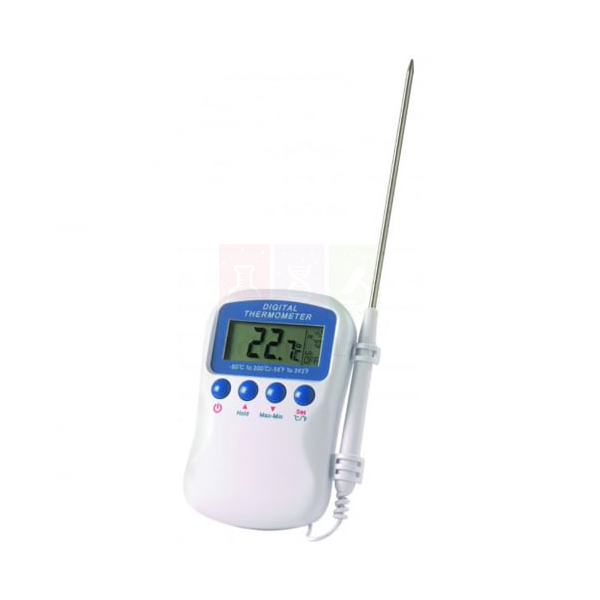
Digital Thermometer
Digital Thermometer (Product Code: SLE/ME/47) is a cable-probe electronic thermometer used to follow temperature changes in heating, cooling and reaction experiments in science laboratories. It reads -40 to 300 °C (-40 to 572 °F) with 0.1° resolution through a removable stainless-steel probe on a 110 cm cable, and adds MAX/MIN memory, data hold and a magnetic back. It is supplied by Jain Scientific Equipments Pvt Ltd (ScienceLab), Ambala, India, for schools, colleges and research labs.
Specifications
| Parameter | Detail |
|---|---|
| Temperature range | -40 to 300 °C / -40 to 572 °F |
| Resolution | 0.1° |
| Accuracy | ±1 °C (from -40 to 150 °C) |
| Probe | Removable stainless steel, 90 mm long, Ø 3.5 mm |
| Cable length | 110 cm |
| Functions | MAX/MIN, data hold |
| Mounting | Magnetic back |
| Product code | SLE/ME/47 |
| Supplied by | Jain Scientific Equipments Pvt Ltd (ScienceLab), Ambala, India |
What Is a Digital Thermometer Used For?
Because the probe sits on a 110 cm cable, the display can stay well away from the heat source while the tip rests in a beaker, water bath or reaction vessel. That suits cooling curves, specific and latent heat practicals, enzyme activity at set temperatures, and checking the temperature of water baths and hot plates. MAX/MIN memory captures the extremes reached during a run, and data hold freezes the value on screen so a student can write it down before it changes.
The magnetic back lets the unit sit on a steel stand, oven side or bench frame at eye level. Wipe the stainless-steel probe clean after each use, keep the cable away from hot surfaces and flames, and check the accuracy you need with us before relying on readings above 150 °C for critical work. It is a useful addition to the digital measuring instruments in India's school and college laboratories.
Supplier
Jain Scientific Equipments Private Limited, which trades as ScienceLab, supplies this Digital Thermometer from Ambala, Haryana, to schools, colleges, research laboratories and dealers in India and international markets. It can be quoted alone or alongside water baths, hot plates and glassware for a complete heating and thermometry set-up. Company information is available on the ScienceLab profile.
Related Measuring Equipment
Instruments and apparatus often used with this thermometer:
- Digital Pocket Thermometer — a compact probe thermometer for quick bench checks.
- Immersion Thermometer — an immersion-type option for liquid temperature practicals.
- Water Bath — a heated bath whose temperature the probe can monitor.
- Hot Plate General Purpose — heats beakers during heating-curve experiments.
- Thermometer, Electronic, Max/Min — records the highest and lowest readings over time.
More thermometers and instruments are in the Measuring category.
Frequently Asked Questions
What range and resolution does the Digital Thermometer have?
The Digital Thermometer measures from -40 to 300 °C, equivalent to -40 to 572 °F, with a resolution of 0.1°. That covers ice-salt mixtures, boiling water and hot oil baths in routine teaching and laboratory work.
How accurate is the Digital Thermometer?
The Digital Thermometer is listed as accurate to ±1 °C between -40 and 150 °C. If you need a stated accuracy for readings above 150 °C, ask us through the contact page before ordering so we can confirm it.
Is the probe of the Digital Thermometer removable?
Yes. The Digital Thermometer uses a removable stainless-steel probe, 90 mm long and 3.5 mm in diameter, on a 110 cm cable. Ask us about a spare probe when you request your quotation.
What do the MAX/MIN and data hold functions do on the Digital Thermometer?
On the Digital Thermometer, MAX/MIN keeps the highest and lowest temperatures reached during a measurement, while data hold freezes the current reading on the display. Together they help students record reliable values during fast-changing experiments.
Who supplies the Digital Thermometer?
The Digital Thermometer is supplied by Jain Scientific Equipments Pvt Ltd (ScienceLab), Ambala, Haryana, India. Schools, colleges, laboratories and dealers in India and international markets can request quotations for single units or bench sets.
Is a calibration certificate available for the Digital Thermometer?
Calibration-certificate availability for the Digital Thermometer should be discussed with us before ordering. State the document you require in your enquiry, and we will confirm what can be supplied with the instrument.
Request a Quote
Ask for a quotation on the Digital Thermometer via our contact page, or place it in the enquiry cart with water baths, hot plates and other items you need.
Last updated: 24 September 2026
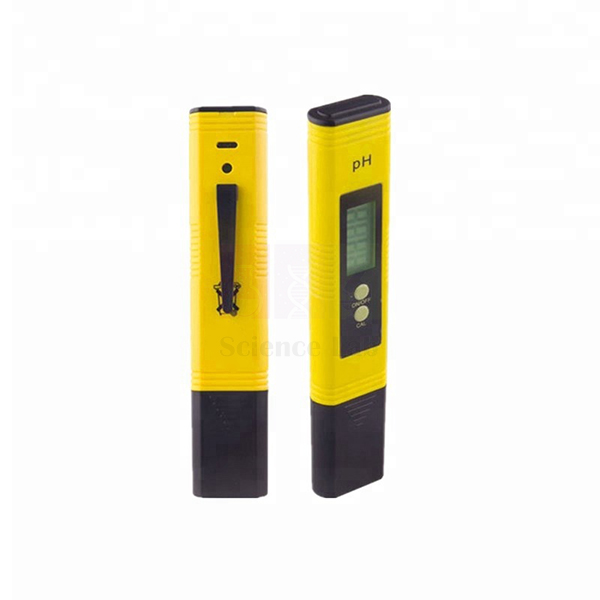
2 pH Meter
2 pH Meter (Product Code: SLE/ME/48) is a pocket-sized pH meter used to check the acidity or alkalinity of solutions in school laboratories, field studies and small testing rooms. Just 160 mm long, it reads pH 1 to 13 with 0.01 pH resolution and ±0.01 pH accuracy — the accuracy of a bench meter — and its replaceable electrode has a built-in amplifier. It is supplied by Jain Scientific Equipments Pvt Ltd (ScienceLab), Ambala, India, as one of the lab instruments it supplies across India and abroad.
Specifications
| Parameter | Detail |
|---|---|
| Range | 1 to 13 pH |
| Resolution | 0.01 pH |
| Accuracy | ±0.01 pH |
| Temperature compensation | Automatic, from 0 to 70 °C |
| Operating temperature | 0 to 50 °C |
| Calibration | Dual-point |
| Electrode | Replaceable, with built-in amplifier |
| Power | Three 1.5V button cells (type 675H or A76) |
| Length | 160 mm |
| Supplied with | Batteries, a small screwdriver for calibration and a carrying case |
| Product code | SLE/ME/48 |
| Supplied by | Jain Scientific Equipments Pvt Ltd (ScienceLab), Ambala, India |
What Is the 2 pH Meter Used For?
A pocket pH meter lets students move beyond indicator colours to real numbers. The 2 pH Meter can follow pH during an acid–alkali neutralisation, test rainwater, pond and tap water on a field trip, check soil-water extracts in agriculture and environmental projects, and compare household substances in an introductory acids-and-bases lesson.
Calibrate at two points with standard buffers, using the small screwdriver supplied, before each session. Automatic temperature compensation from 0 to 70 °C corrects readings for sample temperature, but the meter itself should be used within its 0 to 50 °C operating range. Rinse the electrode after every sample and replace it when readings become slow or unstable — the electrode is designed to be changed.
What to Specify When Ordering
- Number of meters needed per class or field group.
- Whether spare replaceable electrodes should be quoted with the meters.
- Whether spare 675H or A76 button cells and calibration buffers are needed.
Supplier
Jain Scientific Equipments Private Limited, trading as ScienceLab from Ambala, Haryana, supplies the 2 pH Meter to schools, colleges, agricultural and environmental-science departments, and dealers. Replacement electrodes, cells and buffers can be requested on the same enquiry as the meters. More about the company is on the ScienceLab company profile.
Related Measuring Equipment
Other pH tools and accessories for the same experiments:
- pH mV and Temperature Meter — adds millivolt and temperature readings in one portable unit.
- Waterproof pH Meter — a floating-case meter for work near water.
- Paper, Universal, pH 1-14 — quick colour screening before a meter reading.
- Wash Bottle LDPE with Narrow Mouth — for rinsing the electrode between samples.
More instruments are available in the Measuring category.
Frequently Asked Questions
What is the range and accuracy of the 2 pH Meter?
The 2 pH Meter measures from pH 1 to 13 with a resolution of 0.01 pH and an accuracy of ±0.01 pH, giving pocket-meter convenience with the accuracy normally expected from a bench meter.
How is the 2 pH Meter calibrated?
The 2 pH Meter uses dual-point calibration. It is supplied with a small screwdriver for making the calibration adjustment, normally carried out with two standard buffer solutions before a set of measurements begins.
Does the 2 pH Meter compensate for temperature?
Yes. The 2 pH Meter has automatic temperature compensation from 0 to 70 °C, while the meter itself is designed to operate between 0 and 50 °C, so readings stay reliable in normal laboratory and outdoor conditions.
Can the electrode of the 2 pH Meter be replaced?
Yes. The 2 pH Meter has a replaceable electrode with a built-in amplifier, so a worn electrode can be changed instead of replacing the whole meter. Ask us to quote spare electrodes with your order.
What batteries does the 2 pH Meter use?
The 2 pH Meter is powered by three 1.5V button cells of type 675H or A76. Batteries are supplied with the meter, together with a small calibration screwdriver and a carrying case.
Who supplies the 2 pH Meter?
The 2 pH Meter is supplied by Jain Scientific Equipments Pvt Ltd (ScienceLab), Ambala, Haryana, India, to schools, colleges, laboratories and dealers in India and international markets. Quotations are sent on request through the contact page.
Request a Quote
For a quotation on the 2 pH Meter (SLE/ME/48), send the quantity and any spare electrodes, cells or buffers through the contact page, or add it to the enquiry cart.
Last updated: 24 September 2026
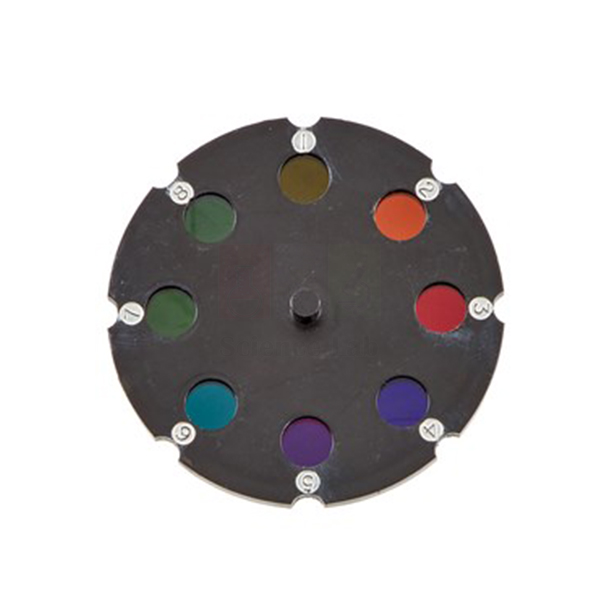
Spare Colour Filter Wheel for S-Range Digital Colorimeter
Spare Colour Filter Wheel for S-Range Digital Colorimeter (Product Code: SLE/ME/49) is a replacement filter wheel used to select the measuring colour band in the S-Range Digital Colorimeter in teaching and college laboratories. It carries eight narrow-pass filters in a plastic circular mount, running from violet (380–470 nm) to red (625 nm to infrared). It is supplied by Jain Scientific Equipments Pvt Ltd (ScienceLab), Ambala, India, which handles lab equipment spare parts for the instruments it supplies.
Specifications
| Parameter | Detail |
|---|---|
| Compatible instrument | S-Range Digital Colorimeter |
| Number of filters | Eight narrow-pass filters |
| Mount | Plastic circular mount |
| Violet | 380–470 nm |
| Blue | 440–490 nm |
| Blue/green | 470–520 nm |
| Green | 500–540 nm |
| Yellow/green | 530–570 nm |
| Yellow | 560–610 nm |
| Orange | 580–700 nm |
| Red | 625 nm to infrared |
| Product code | SLE/ME/49 |
| Supplied by | Jain Scientific Equipments Pvt Ltd (ScienceLab), Ambala, India |
What Is the Spare Colour Filter Wheel Used For?
The filter wheel decides which band of light passes through the sample in the colorimeter, so a scratched, cracked or faded wheel quickly spoils results. Keeping a spare wheel lets a school replace a damaged one at once, or run two colorimeters for parallel classes. For each experiment, pick the filter whose colour is complementary to the solution: a blue copper(II) solution absorbs most strongly in the orange-red, while a yellow solution calls for a violet or blue filter.
Handle the wheel by its plastic mount only, so the filter surfaces stay free of fingerprints, and keep it under the colorimeter's dust cover or in a clean box when it is not fitted. A quick test with a known solution after changing wheels confirms that readings are consistent with earlier results.
Supplier
ScienceLab is the trading name of Jain Scientific Equipments Private Limited in Ambala, Haryana, which supplies this spare filter wheel for owners of the S-Range Digital Colorimeter. Spare wheels can be requested on their own or together with the instrument, cuvettes and other colorimetry items. See the ScienceLab company profile for company details.
Related Measuring Equipment
The instrument and consumables this filter wheel works with:
- S-Range Digital Colorimeter - 240V — the colorimeter this spare wheel is designed to fit.
- Plastic Cuvettes — sample cells for colorimetry readings.
- Cuvettes, Plastic — another cuvette option for class sets.
- Colourwave Colorimeter — a compact colorimeter alternative for teaching labs.
More laboratory instruments are in the Measuring category.
Frequently Asked Questions
Which instrument does the Spare Colour Filter Wheel for S-Range Digital Colorimeter fit?
The Spare Colour Filter Wheel for S-Range Digital Colorimeter is a replacement wheel for the S-Range Digital Colorimeter. Tell us the model and mains version of your colorimeter when ordering, so the correct spare is confirmed in the quotation.
How many filters does the Spare Colour Filter Wheel for S-Range Digital Colorimeter hold?
The Spare Colour Filter Wheel for S-Range Digital Colorimeter holds eight narrow-pass filters in a plastic circular mount: violet, blue, blue/green, green, yellow/green, yellow, orange and red, covering bands from 380 nm up to the infrared.
Which filter on the Spare Colour Filter Wheel for S-Range Digital Colorimeter should I use?
On the Spare Colour Filter Wheel for S-Range Digital Colorimeter, choose the filter complementary to the solution colour, for example orange or red for a blue solution. The filter giving the highest absorbance for a standard is usually the right choice.
How should the Spare Colour Filter Wheel for S-Range Digital Colorimeter be stored?
Store the Spare Colour Filter Wheel for S-Range Digital Colorimeter in a clean, dry box or under the colorimeter's dust cover, and handle it only by the plastic mount so fingerprints and scratches do not affect the filters.
Who supplies the Spare Colour Filter Wheel for S-Range Digital Colorimeter?
The Spare Colour Filter Wheel for S-Range Digital Colorimeter is supplied by Jain Scientific Equipments Pvt Ltd (ScienceLab), Ambala, Haryana, India, to schools, colleges, laboratories and dealers in India and international markets.
What should a quotation request for the Spare Colour Filter Wheel for S-Range Digital Colorimeter include?
For the Spare Colour Filter Wheel for S-Range Digital Colorimeter (SLE/ME/49), include the number of wheels, your colorimeter model and your delivery location. Add cuvettes or other colorimetry items to the same enquiry if needed.
Request a Quote
To order the Spare Colour Filter Wheel for S-Range Digital Colorimeter (SLE/ME/49), contact us through the contact page or add it to the enquiry cart with your other colorimetry items.
Last updated: 24 September 2026
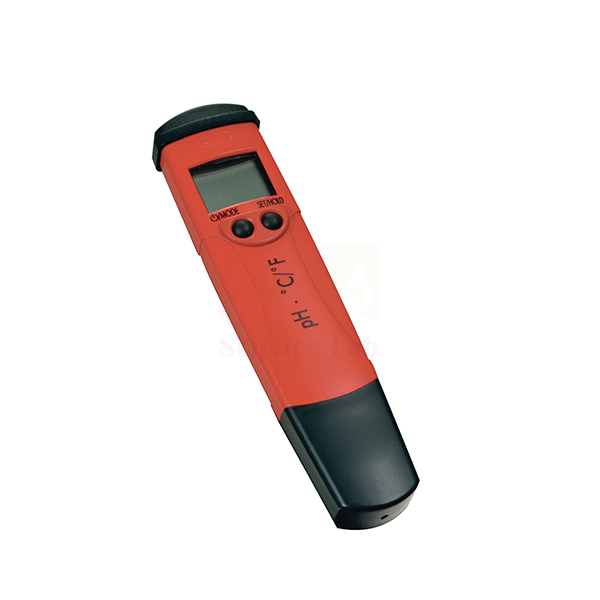
Waterproof pH Meter
Waterproof pH Meter (Product Code: SLE/ME/50) is a handheld waterproof pH meter used to measure the pH and temperature of water samples in school laboratories and during outdoor fieldwork. Its casing floats if dropped in water, and a dual-level LCD shows pH and temperature together, with automatic temperature compensation from 0 to 50 °C. It is supplied by Jain Scientific Equipments Pvt Ltd (ScienceLab), Ambala, India, which supplies pH meters for laboratories across India and international markets.
Specifications
| Parameter | Detail |
|---|---|
| Construction | Waterproof casing that floats if dropped in water |
| Display | Dual-level LCD showing pH and temperature readings simultaneously |
| Temperature compensation | Automatic, 0 to 50 °C |
| Calibration | Automatic, 1 or 2 points, using push buttons, with a choice of five buffer values |
| Hold function | HOLD button keeps the pH reading on the LCD |
| Power saving | Automatic switch-off to preserve battery life |
| Battery | 4 × V675HP |
| User-replaceable part | Replaced by simply plugging in a new one (confirm the matching spare with us) |
| Product code | SLE/ME/50 |
| Supplied by | Jain Scientific Equipments Pvt Ltd (ScienceLab), Ambala, India |
What Is the Waterproof pH Meter Used For?
Fieldwork is where a waterproof meter earns its place. Students can measure pH and temperature at several points along a stream, compare pond, well and tap water, monitor an aquarium or hydroponics tank, or record rainwater acidity through the season. Because the case floats, a slip at the water's edge does not mean a lost instrument, and the dual-level display lets pupils note both readings at once.
Calibrate before each session with one or two buffers, selecting the values you use from the five buffer choices, then rinse the electrode between samples. Press HOLD to keep a reading on the screen after lifting the meter out of the sample, and let the automatic switch-off save battery life between measurements — simple pH meter calibration and handling routines that suit younger users.
What to Specify When Ordering
- Number of meters needed per class or field group.
- Which buffer values your laboratory uses, and whether buffer solutions should be quoted.
- Whether spare V675HP batteries or a spare plug-in replacement part should be included.
Supplier
ScienceLab is the trading name of Jain Scientific Equipments Private Limited, Ambala, Haryana, which supplies the Waterproof pH Meter to schools, colleges, environmental-science programmes and dealers. Batteries, buffers and replacement parts can be requested on the same enquiry. Company details are on the ScienceLab company profile.
Related Measuring Equipment
Other pH instruments and accessories for field and bench work:
- 2 pH Meter — a pocket meter with a replaceable electrode.
- pH mV and Temperature Meter — adds a millivolt range for electrochemistry.
- Plastic Beaker Set of 5 — sample containers for buffers and collected water.
- Wash Bottle LDPE with Narrow Mouth — for rinsing the electrode between samples.
Find more instruments in the Measuring category.
Frequently Asked Questions
What happens if the Waterproof pH Meter is dropped in water?
The Waterproof pH Meter has a waterproof casing that floats if dropped in water, so it can be recovered easily during stream, pond or tank sampling. This makes it well suited to outdoor fieldwork with students.
How is the Waterproof pH Meter calibrated?
The Waterproof pH Meter calibrates automatically at 1 or 2 points using push buttons, with a choice of five buffer values. Tell us which buffers your laboratory uses so that suitable solutions can be quoted alongside the meter.
Does the Waterproof pH Meter show temperature?
Yes. The Waterproof pH Meter has a dual-level LCD that shows pH and temperature readings at the same time, and it applies automatic temperature compensation from 0 to 50 °C to the pH reading.
What batteries does the Waterproof pH Meter use?
The Waterproof pH Meter runs on 4 × V675HP batteries. It switches itself off automatically to preserve battery life, and the HOLD button keeps a reading on the display after the meter is taken out of the sample.
What details of the Waterproof pH Meter should I confirm before ordering?
For the Waterproof pH Meter, the pH range and resolution are not listed on this page. Please ask us to confirm them, along with the matching plug-in replacement part, through the contact page before you order.
Who supplies the Waterproof pH Meter?
The Waterproof pH Meter is supplied by Jain Scientific Equipments Pvt Ltd (ScienceLab), Ambala, Haryana, India, to schools, colleges, laboratories and dealers in India and international markets, with quotations prepared on request.
Request a Quote
To request a quotation for the Waterproof pH Meter (SLE/ME/50), send the quantity and any buffers or spares through the contact page, or add it to the enquiry cart.
Last updated: 24 September 2026
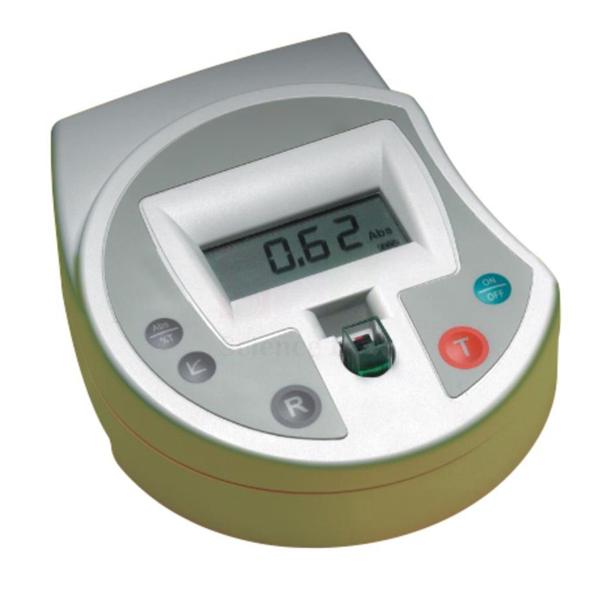
Colourwave Colorimeter
Colourwave Colorimeter (Product Code: SLE/ME/51) is a filter colorimeter used to measure the absorbance and transmission of coloured solutions for concentration and reaction-rate studies in school, college and teaching laboratories. Eight gelatin filters cover 440–680 nm, it reads -0.3 to 1.99 A or 0 to 199 %T, and it accepts 10 mm cuvettes or 16 mm tubes, with analogue and RS232 outputs for recording results. It is supplied by Jain Scientific Equipments Pvt Ltd (ScienceLab), Ambala, India.
Specifications
| Parameter | Detail |
|---|---|
| Absorbance range | -0.3 A to 1.99 A |
| Transmission range | 0 to 199 %T |
| Filters | Eight gelatin filters, 440–680 nm range |
| Bandwidth | 40 nm |
| Repeatability | ±0.02 A at 1 A |
| Analogue output | 0–2 V for 0–2 A; 0–1.99 V for 0–199 %T; via 2 x 4 mm sockets |
| Digital output | RS232 |
| Cuvette holder | Fixed, with drain hole |
| Sample vessels | 10 mm path length cuvettes or 16 mm diameter tubes |
| Power | 240 V; transformer supplied |
| Dimensions | 180 x 150 x 60 mm |
| Mass | 0.5 kg |
| Product code | SLE/ME/51 |
| Supplied by | Jain Scientific Equipments Pvt Ltd (ScienceLab), Ambala, India |
What Is the Colourwave Colorimeter Used For?
A colorimeter turns the depth of a solution's colour into a number, so students can explore the Beer–Lambert relationship, build a calibration curve from standards and read off the concentration of an unknown. Typical practicals include copper(II) sulfate or food-dye concentration, iodine clock and other rate studies, starch digestion by amylase, and estimating cell density in cultures. Choosing the filter whose colour is complementary to the solution gives the largest change in absorbance.
Because the holder is fixed and has a drain hole, a spill runs out instead of pooling around the optics; keep cuvettes clean and handle them by their non-optical sides. The analogue output on 4 mm sockets can feed a chart recorder or data-logging interface, while the RS232 port sends readings to a computer for longer kinetic runs. It is a practical entry point to analytical lab instruments in India for schools and colleges.
What to Specify When Ordering
- The sample vessels you plan to use: 10 mm path length cuvettes or 16 mm diameter tubes.
- Your mains supply, since the unit runs at 240 V through the transformer supplied.
- How results will be recorded: the analogue 4 mm sockets, the RS232 output, or both.
- The number of units, for example one per practical group or one per laboratory.
Supplier
The Colourwave Colorimeter is supplied by Jain Scientific Equipments Private Limited, the Ambala, Haryana company that trades as ScienceLab. It is sourced for schools, colleges, teaching laboratories and dealers in India and international markets, and can be quoted together with volumetric glassware and other measuring instruments. Visit the ScienceLab profile for company details.
Related Measuring Equipment
Alternative colorimeters and items used when preparing standards:
- S-Range Digital Colorimeter - 240V — an alternative digital colorimeter for the same practicals.
- Digital Photo Colorimeter 5 Filters — a five-filter instrument for routine colorimetry.
- Colorimeter — another colorimeter option from the chemistry range.
- Volumetric Flask — for making up accurate standard solutions for a calibration curve.
Find more instruments in the Measuring category.
Frequently Asked Questions
What wavelengths does the Colourwave Colorimeter cover?
The Colourwave Colorimeter uses eight gelatin filters spanning 440 to 680 nm, with a 40 nm bandwidth. Selecting the filter complementary to the solution's colour gives the greatest absorbance change for concentration and reaction-rate measurements.
What is the measuring range of the Colourwave Colorimeter?
The Colourwave Colorimeter reads absorbance from -0.3 A to 1.99 A and transmission from 0 to 199 %T, with repeatability of ±0.02 A at 1 A. This suits calibration curves and routine concentration work in teaching laboratories.
What cuvettes or tubes fit the Colourwave Colorimeter?
The Colourwave Colorimeter accepts 10 mm path length cuvettes or 16 mm diameter tubes in its fixed cuvette holder. The holder has a drain hole, so any spilled solution drains away instead of collecting around the optics.
Can the Colourwave Colorimeter connect to a computer or data logger?
Yes. The Colourwave Colorimeter has an analogue output of 0–2 V for 0–2 A and 0–1.99 V for 0–199 %T through two 4 mm sockets, plus a digital RS232 output for sending readings to a computer.
What power supply does the Colourwave Colorimeter use?
The Colourwave Colorimeter runs from a 240 V supply through the transformer supplied with it. If your laboratory uses a different mains voltage, mention it in your enquiry through the contact page so we can confirm suitability before quoting.
Who supplies the Colourwave Colorimeter?
The Colourwave Colorimeter is supplied by Jain Scientific Equipments Pvt Ltd (ScienceLab), Ambala, Haryana, India. Schools, colleges and dealers in India and international markets can request quotations for single units or for several laboratories.
Is a calibration certificate available for the Colourwave Colorimeter?
Calibration-certificate availability for the Colourwave Colorimeter should be discussed with us before you order. Mention the document you need when you enquire, and we will confirm what can accompany the instrument with your quotation.
Request a Quote
Request a quotation for the Colourwave Colorimeter through the contact page, or add it to the enquiry cart with glassware and other instruments for your analytical practicals.
Last updated: 24 September 2026
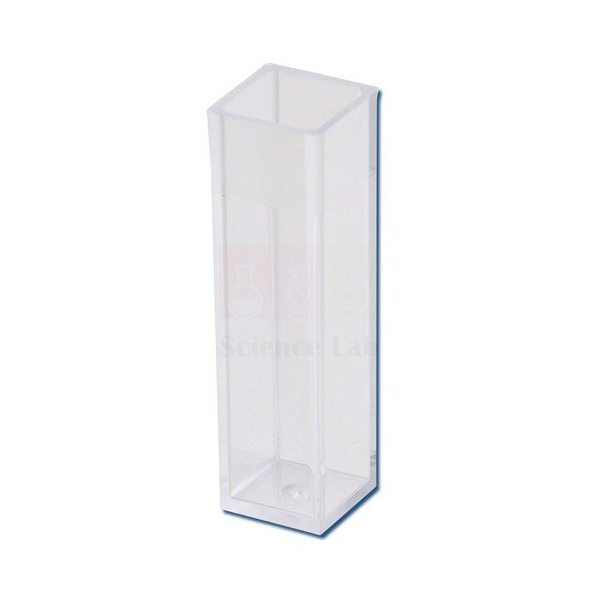
Plastic Cuvettes
Plastic Cuvettes (Product Code: SLE/ME/53) are parallel-sided sample cells used to hold liquid samples in the light beam of a colorimeter or spectrophotometer in school, college and research laboratories. Teachers and lab technicians use them for routine absorbance work because each cuvette gives a fixed 10mm path length in a compact 12.55 x 12.65 x 44.5mm body. They are supplied by Jain Scientific Equipments Pvt Ltd (ScienceLab), Ambala, India, a lab consumables supplier in India for teaching and testing labs.
Specifications
| Parameter | Detail |
|---|---|
| Type | Plastic cuvette (sample cell) |
| Sides | Parallel sided |
| Optical path length | 10mm |
| Dimensions | 12.55 x 12.65 x 44.5mm |
| Product code | SLE/ME/53 |
| Supplied by | Jain Scientific Equipments Pvt Ltd (ScienceLab), Ambala, India |
What Are Plastic Cuvettes Used For?
Plastic Cuvettes hold a coloured or cloudy solution so that a colorimeter or spectrophotometer can measure how much light it absorbs. Because absorbance depends on the distance the light travels through the sample, the constant 10mm path length lets students compare readings and plot calibration curves. Typical practicals include finding the concentration of a copper sulphate solution, following the rate of a reaction and measuring enzyme activity in biology.
For reliable results, fill one cuvette with the solvent alone to zero the instrument, hold each cuvette by the edges away from the light path and wipe the clear faces with lint-free tissue before inserting it. Keep the same orientation in the holder for every reading. If your method uses ultraviolet wavelengths, check with us before ordering, as not every plastic transmits UV light.
Supplier
Jain Scientific Equipments Private Limited trades under the name ScienceLab and supplies Plastic Cuvettes from Ambala, Haryana, as part of its Measuring range. The cuvettes are sourced for schools, colleges, research and testing laboratories, dealers and importers. They can be quoted alongside colorimeters, pipettes and other items from the same catalogue, so a lab receives one consolidated offer. Read more about the company on the ScienceLab company profile.
Related Measuring Equipment
These items are used with Plastic Cuvettes in the same absorbance and sample-handling workflow:
- S-Range Digital Colorimeter - 240V — a bench colorimeter for concentration readings; compare its cell holder with the cuvette dimensions.
- Colourwave Colorimeter — another colorimeter option for class absorbance experiments.
- Single Beam Microprocessor UV-VIS Spectrophotometer — for wavelength-selectable absorbance measurements in higher-level labs.
- Plastic Microchemistry Pipets — for transferring small sample volumes into the cuvette without spills.
- Research Pipettors — for dispensing set volumes when preparing standard solutions.
Browse the full Measuring equipment range for balances, pipettes, timers and meters.
Frequently Asked Questions
What is the path length of the Plastic Cuvettes?
The Plastic Cuvettes (SLE/ME/53) have a 10mm optical path length between their parallel sides. Absorbance calculations usually assume this path length, so readings from different samples, groups or sessions can be compared directly when the same cuvettes are used.
Will these Plastic Cuvettes fit my colorimeter or spectrophotometer?
These Plastic Cuvettes measure 12.55 x 12.65 x 44.5mm. Compare these dimensions with the sample holder of your colorimeter or spectrophotometer; if you are unsure, send us the instrument make and model through the contact page and we will help you check before you order.
Can Plastic Cuvettes be used for ultraviolet measurements?
Plastic Cuvettes are generally used for visible-light absorbance work, and this listing does not specify the plastic grade for UV transmission. If your method needs ultraviolet wavelengths, ask us before ordering so we can suggest a suitable sample cell for your instrument.
How should Plastic Cuvettes be handled to avoid errors?
Handle Plastic Cuvettes by the edges away from the light path, fill them to the same level each time, tap gently to remove bubbles and wipe the optical faces with lint-free tissue. Fingerprints, scratches and bubbles scatter light and make absorbance readings higher than they should be.
Who supplies the Plastic Cuvettes?
Plastic Cuvettes are supplied by Jain Scientific Equipments Pvt Ltd, trading as ScienceLab, from Ambala in Haryana, India. The company supplies laboratory consumables and measuring instruments to schools, colleges, laboratories, dealers and importers across India and international markets.
What details should I include when requesting a quote for Plastic Cuvettes?
When requesting a quote for Plastic Cuvettes, state the number of cuvettes required, the instrument they will be used in and the delivery location. Add the item to the enquiry cart or send the details through our contact page for a reply with availability and terms.
Request a Quote
To order Plastic Cuvettes (SLE/ME/53), add them to the enquiry cart or share your requirement on the contact page. Mention the quantity and your instrument model so we can confirm suitability in our reply.
Last updated: 24 September 2026
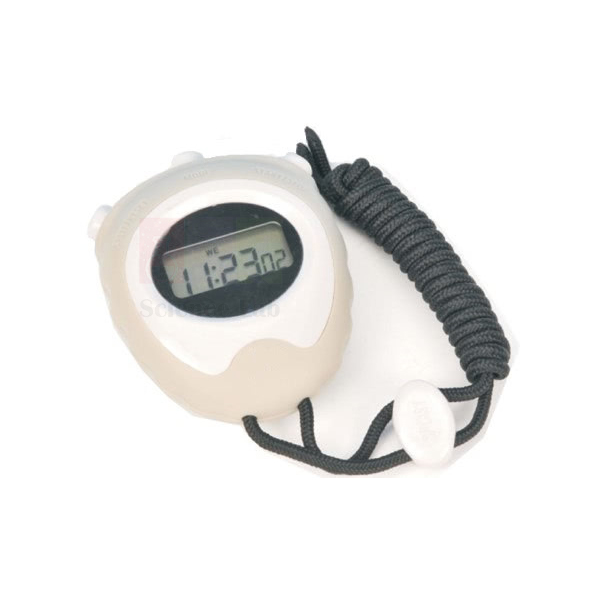
Stopwatch, Digital
Stopwatch, Digital (Product Code: SLE/ME/52) is a handheld electronic timer used to measure elapsed time in physics practicals, chemistry rate experiments, sports lessons and field work. It reads to the nearest 1/100th of a second and also works as a quartz clock with day, date, month and alarm functions, making it everyday physics lab equipment for schools in India. It is supplied with a neck cord by Jain Scientific Equipments Pvt Ltd (ScienceLab), Ambala, India.
Specifications
| Parameter | Detail |
|---|---|
| Timing resolution | Nearest 1/100th second |
| Timer | Quartz |
| Clock display | Normal time in hours, minutes and seconds |
| Calendar display | Day, date and month |
| Alarm | Alarm function included |
| Design | Ergonomically designed handheld body |
| Supplied with | Neck cord |
| Product code | SLE/ME/52 |
| Supplied by | Jain Scientific Equipments Pvt Ltd (ScienceLab), Ambala, India |
What Is a Digital Stopwatch Used For?
A digital stopwatch is the standard timer for hand-timed school experiments: measuring the period of a simple pendulum, timing a trolley down an inclined plane, recording how long a reaction mixture takes to turn cloudy, or checking pulse rate before and after exercise. With a 1/100th second display, the reading itself is rarely the limiting factor; the observer's reaction time is.
To reduce reaction-time error, time several oscillations or repeats and then divide or average, start and stop on a clear visual signal, and let the same student operate the watch for a whole set of readings. The neck cord keeps it at hand during outdoor fieldwork and sports-day timing, while the clock, calendar and alarm modes let it serve as a lab timekeeper between experiments.
Supplier
ScienceLab is the trading name of Jain Scientific Equipments Private Limited, which supplies this digital stopwatch from Ambala as part of its Measuring range. Schools, colleges, sports departments, dealers and importers can source it in the same order as the pendulum and mechanics apparatus it is used with, keeping a physics practical set on one quotation. Company background is on the ScienceLab profile page.
Related Measuring Equipment
Consider these timers and timing apparatus alongside the Stopwatch, Digital:
- Digital Stopclock — an alternative digital timer for bench or demonstration use.
- Bench Stopwatch — a stopwatch format suited to fixed lab stations.
- Stop Clock (Metal Case) — a stop clock in a metal case for class timing.
- Mathematical Pendulum Demonstration Apparatus — a pendulum set-up whose oscillations students time with the stopwatch.
- Digital Chronometer (Stopwatch) — another handheld timing option in the lab equipment range.
See the complete Measuring range for balances, thermometers and meters.
Frequently Asked Questions
What resolution does the Stopwatch, Digital have?
The Stopwatch, Digital displays time to the nearest 1/100th of a second. In hand-timed practicals, human reaction time is normally a far larger source of error than this display resolution, so timing several repeats and averaging them gives the most dependable result.
Does the Stopwatch, Digital also show the time and date?
Yes. The Stopwatch, Digital has a quartz timer that shows normal time in hours, minutes and seconds and displays the day, date and month. An alarm function is also built in, so the watch can act as a lab clock or reminder between timing tasks.
What accessories come with the Stopwatch, Digital?
The Stopwatch, Digital is supplied with a neck cord, so students and coaches can wear it during outdoor work or sports sessions. For the battery type or any other accessory, ask us when you request a quotation and we will confirm the details for your order.
Which school experiments use the Stopwatch, Digital?
The Stopwatch, Digital is used to time pendulum oscillations, objects moving down a ramp, reaction rates such as the disappearing-cross experiment, cooling curves and pulse-rate investigations. It suits any practical in which a student starts and stops the timing by hand.
Is a calibration certificate available for the Stopwatch, Digital?
A calibration certificate is not listed for the Stopwatch, Digital. If your laboratory needs documented timing traceability, raise the requirement through our contact page before ordering so we can tell you what documentation is possible.
Can the Stopwatch, Digital be ordered for a whole class or for export?
Yes, the Stopwatch, Digital can be quoted in class sets or larger quantities for schools, sports departments, distributors and importers in India and international markets. State the quantity and delivery destination, and we will include packing and shipping details in the quotation.
Request a Quote
Send your requirement for the Stopwatch, Digital (SLE/ME/52) through the contact page or add it to the enquiry cart. Include the number of stopwatches and the delivery location so we can reply with availability and terms.
Last updated: 24 September 2026
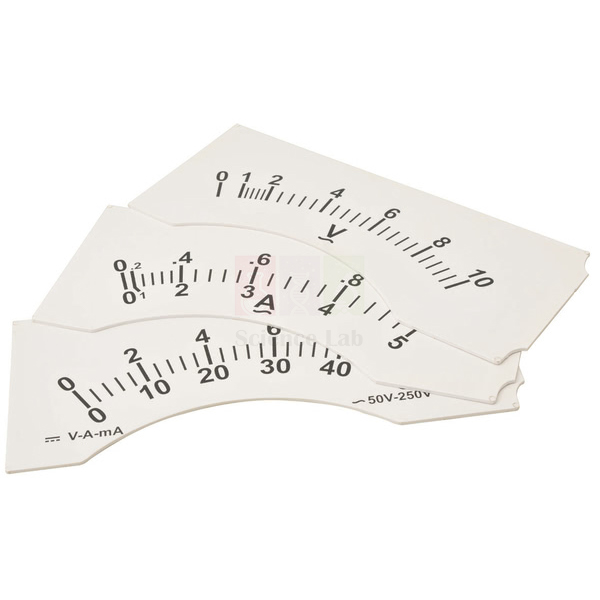
Demonstration Meter, Dial
Demonstration Meter, Dial (Product Code: SLE/ME/54) is a large-scale meter dial used to show current readings to a whole class during electricity demonstrations in school and college physics labs. Its laminated plastic panel measures 315 x 115mm, and a sealed moulded box at one end holds the shunt or voltage multiplier matched to its 2.5-0-2.5mA DC scale. It is made by Jain Scientific Equipments Pvt Ltd (ScienceLab), an OEM manufacturer, at its own factory in Ambala, India.
Specifications
| Parameter | Detail |
|---|---|
| Scale | 2.5-0-2.5mA DC (centre zero) |
| Dial panel | Laminated plastic, 315 x 115mm |
| Range component | Sealed moulded box at one end containing the shunt or voltage multiplier appropriate to the scale |
| Product code | SLE/ME/54 |
| Manufacturer | Jain Scientific Equipments Pvt Ltd (ScienceLab) — OEM |
| Country of origin | India (made in Ambala, Haryana) |
What Is a Demonstration Meter Dial Used For?
Teachers use a demonstration meter dial when a small bench meter would be unreadable from the back of the room. The 2.5-0-2.5mA DC scale has its zero in the centre, so the pointer can swing either way. That makes it well suited to showing the direction of small currents, for example when a magnet is pushed into and pulled out of a coil, or when the connections to a simple cell are reversed.
As a demonstration model for the physics lab, the dial lets the whole class read the same value at the same moment. Because the shunt or multiplier is sealed inside the moulded box, the scale and its matching component stay together between lessons. Connect it in series with the circuit, include a protective resistance when trying a new arrangement, and make changes gradually so the pointer does not hit the end of the scale.
What to Specify When Ordering
- The scale required — this listing covers the 2.5-0-2.5mA DC dial.
- Whether you need the dial alone or a complete demonstration meter; ask us what the quotation includes.
- The number of dials needed for each laboratory or classroom.
OEM Manufacturer
ScienceLab is the trading name of Jain Scientific Equipments Private Limited, the OEM (original equipment manufacturer) of this Demonstration Meter, Dial. The dial is produced at the company's own licensed factory at Saha, Ambala, Haryana, India, rather than bought in from a trader, and it is supplied factory-direct to schools, colleges, institutions, dealers and importers.
Because the maker handles your enquiry directly, questions about matching scales, replacement dials or repeat orders for additional classrooms go straight to the manufacturer — just ask us. More about the company is on the ScienceLab profile.
Related Measuring Equipment
Use these meters and circuit items with the Demonstration Meter, Dial:
- Ammeter DC Dual Range OHP — a projectable ammeter for currents larger than the milliamp dial covers.
- Galvanometer, Centre Zero Universal Meter — a bench centre-zero meter for student groups repeating the demonstration.
- Ohmmeter Series Type — a companion meter for resistance measurements in the same electricity unit.
- Rheostat — to adjust circuit resistance and control the current shown on the dial.
- Analogue Voltmeter — to show the voltage across a circuit alongside the current reading.
Explore the full Measuring range for more meters, balances and timers.
Frequently Asked Questions
What scale does the Demonstration Meter, Dial have?
The Demonstration Meter, Dial has a 2.5-0-2.5mA DC scale with zero at the centre. The pointer can deflect in either direction, so the class can see both the size and the direction of a small direct current during a demonstration.
How large is the Demonstration Meter, Dial?
The Demonstration Meter, Dial is built on a laminated plastic panel measuring 315 x 115mm. The large panel is intended for teacher demonstrations, where students seated across a classroom need to read the scale without crowding around the bench.
What is inside the moulded box on the Demonstration Meter, Dial?
The sealed moulded box at one end of the Demonstration Meter, Dial contains the shunt or voltage multiplier appropriate to its scale. Keeping this component sealed with the dial means the correct range is always in place whenever that dial is used.
Who manufactures the Demonstration Meter, Dial?
The Demonstration Meter, Dial is manufactured by Jain Scientific Equipments Pvt Ltd (ScienceLab), an OEM manufacturer with its own licensed factory at Saha, Ambala, Haryana, India. Quotations, repeat orders and questions about replacement dials are handled directly by the manufacturer.
Is a calibration certificate supplied with the Demonstration Meter, Dial?
A calibration certificate is not listed for the Demonstration Meter, Dial. If your institution needs one for inspection or tender records, mention it through our contact page when requesting a quote, and we will discuss what can be provided.
What should a quotation request for the Demonstration Meter, Dial include?
For the Demonstration Meter, Dial, tell us the scale you need, the number of units, whether a complete demonstration meter is required and the delivery destination. These details let the manufacturer quote accurately the first time.
Request a Quote
Quotes for the Demonstration Meter, Dial (SLE/ME/54) come direct from the manufacturer. Send your requirement through the contact page or add the item to the enquiry cart, stating the scale and quantity you need.
Last updated: 24 September 2026
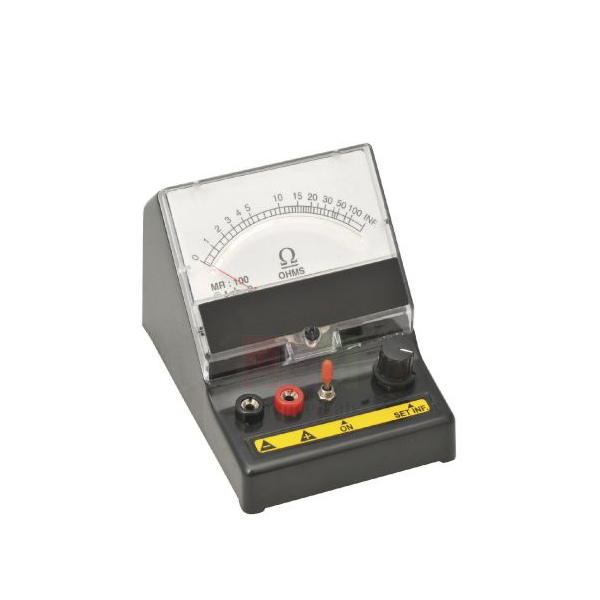
Ohmmeter Series Type
Ohmmeter Series Type (Product Code: SLE/ME/55) is an analogue meter used to measure resistance in electric circuits over a 0-100 ohm range in school and college physics practicals. Its dry battery cell is fixed to the stand from the bottom side, and the meter is housed in an unbreakable case with a clear front cover. It is manufactured by Jain Scientific Equipments Pvt Ltd (ScienceLab), an OEM manufacturer, at its own factory in Ambala, India.
Specifications
| Parameter | Detail |
|---|---|
| Range | 0-100 ohms |
| Function | Measuring resistance in electric circuits |
| Power source | Dry battery cell, fixed to the stand from the bottom side |
| Housing | Unbreakable case with clear front cover |
| Product code | SLE/ME/55 |
| Manufacturer | Jain Scientific Equipments Pvt Ltd (ScienceLab) — OEM |
| Country of origin | India (made in Ambala, Haryana) |
What Is a Series Type Ohmmeter Used For?
A series type ohmmeter measures an unknown resistance by driving a small current from its own cell through the meter and the resistor connected in series. The lower the resistance, the larger the current and the further the pointer moves, so the scale runs in the opposite direction to an ammeter and is not evenly spaced. Students use it to check resistors, coils, lamp filaments and connections, and to compare measured values with results from an Ohm's law experiment.
Always switch off and disconnect the power supply before measuring, because the ohmmeter supplies its own current and an external source can damage the movement or give false readings. Take the component out of the circuit where possible, keep measurements within the 0-100 ohm range and check the cell regularly, as a weak cell shifts the readings. The clear front cover lets the class watch the pointer without opening the case.
OEM Manufacturer
Jain Scientific Equipments Private Limited, which trades as ScienceLab, is the original equipment manufacturer (OEM) of the Ohmmeter Series Type. The meter is made at the company's licensed factory at Saha, Ambala, Haryana, India, and goes factory-direct to schools, colleges, training institutes, dealers and importers without a trading intermediary.
Quotations come straight from the manufacturer, and requests for spare parts or matching meters for additional lab benches can be raised with the same team — ask us about current availability. See the company profile for background on ScienceLab.
Related Measuring Equipment
These resistance standards and meters are used with the Ohmmeter Series Type in electricity practicals:
- Decade Resistance Box — known resistance values for checking readings across the scale.
- Resistance Box — a set of standard resistances for comparison measurements.
- Rheostat 30 Ohm — a variable resistor whose settings students can measure with the ohmmeter.
- Standard Digital Multimeter — a digital instrument for cross-checking resistance values.
- Demonstration Meter, Dial — a large centre-zero meter for teacher demonstrations in the same unit.
View more instruments in the Measuring category.
Frequently Asked Questions
What range does the Ohmmeter Series Type cover?
The Ohmmeter Series Type measures resistance from 0 to 100 ohms. It suits the low-value resistors, wire coils and lamp filaments used in school electricity practicals; for higher values, a multimeter or a meter with a wider range is the better choice.
How is the Ohmmeter Series Type powered?
The Ohmmeter Series Type is powered by a dry battery cell fixed to the stand from the bottom side. The cell drives the measuring current through the resistance under test, so check or replace it when readings drift or become unsteady.
Why does the scale of the Ohmmeter Series Type read in reverse?
In the Ohmmeter Series Type, the resistance being measured is in series with the meter, so a low resistance lets more current flow and gives a large deflection. Zero ohms therefore sits at the high-current end, and the divisions crowd together at higher resistances.
Is the Ohmmeter Series Type durable enough for student benches?
The Ohmmeter Series Type is housed in an unbreakable case with a clear front cover, which protects the movement from knocks on a busy student bench while keeping the scale visible. As with any meter, avoid dropping it and never connect it to a powered circuit.
Who manufactures the Ohmmeter Series Type?
Jain Scientific Equipments Pvt Ltd, trading as ScienceLab, manufactures the Ohmmeter Series Type as the OEM at its own licensed factory in Saha, Ambala, Haryana, India. Schools, colleges, dealers and importers buy it factory-direct and receive quotations from the manufacturer itself.
Can the Ohmmeter Series Type be supplied in bulk for export?
Yes, the Ohmmeter Series Type can be quoted in bench sets or larger quantities for institutions, distributors and importers in India and international markets. Share the quantity and destination through our contact page or the enquiry cart to receive a manufacturer's quotation.
Request a Quote
For the Ohmmeter Series Type (SLE/ME/55), quotations are issued directly by the manufacturer. Use the contact page or the enquiry cart and tell us how many meters you need and where they should be delivered.
Last updated: 24 September 2026