- Physics Lab Equipment
- Chemistry Lab Equipment
- Biology Lab Equipment
- Anatomical Lab Equipment
- Learning
- Educational Lab Equipment
- Magnets
- Agriculture
- Astronomy
- Earth Science
- Geography Lab Equipment
- Safety Lab Coat
- Laboratory
- Meteorological
- Electricity & Magnetism
- Heat
- School Lab Equipment
- Lab Glassware
- Science Lab Equipment
- Tvet Lab Equipment
- Robotics Kits Supplier and Manufacturer for Schools India
- Math Lab Equipment Manufacturers and Exporters in Ambala
- STEM Kits Manufacturers and Supplier India
- Engineering Lab Equipment
- Hospital Lab Equipment
- Water, Sanitation & Hygiene Supplies
- Cold Chain, Solar & Communication Equipment
- Nutrition
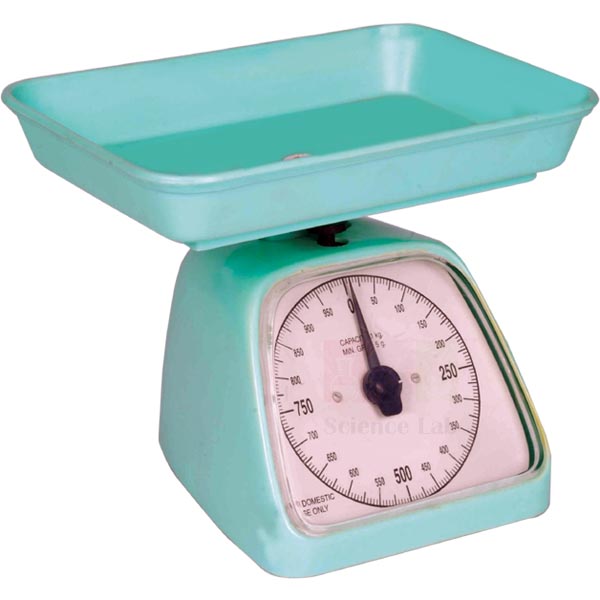
Compression Balance
The Compression Balance is a direct-reading dial scale: a load on its large pan compresses a spring, and the pointer swings across a wide view dial that a whole group can read at once. Its plastic moulded body suits quick weighing of everyday objects and samples in school science, home science and maths lessons.
Compression balance details
| Parameter | Detail |
|---|---|
| Type | Compression (dial) balance |
| Dial | Wide view |
| Pan | Large |
| Body | Plastic moulded |
| Purpose | Quick, direct-reading weighing of everyday objects and samples |
| Capacity and graduation | Not stated in the current documentation |
| Product code | SLE/LB/04 |
| Minimum order | 10 units |
| Dispatch | Usually within 7 to 10 working days |
| Supplied by | ScienceLab (Jain Scientific Equipments Pvt Ltd), Ambala, India |
Weighing and estimation lessons on the dial balance
Estimate, then weigh. Each group handles a piece of fruit, a book and a bag of sand, writes down an estimate of each mass, then places the item in the middle of the pan and reads the wide view dial. Comparing estimate and reading after each item shows pupils how their sense of grams and kilograms improves during the lesson.
Checking the dial with known masses. Add masses from a mass weighing set on tray to the pan one at a time and record the dial reading for each total. A graph of dial reading against known mass should be a straight line through zero; a bend or an offset shows where the scale reads high or low.
Squashed spring, stretched spring. Weigh one object on the compression balance and then hang it from a force meter, whose spring stretches instead of squashing. Both instruments respond to the pull of gravity on the object, while a two-pan beam balance such as the Roberval balance compares masses directly. Pupils convert between the readings and discuss the difference.
Frequently Asked Questions About the Compression Balance
Why might the pointer fail to return to zero after a load is removed?
The pan may be sitting unevenly or rubbing against the body, or grit may be trapped under it. Lift the pan, clean around its seat and refit it squarely. A balance that has been overloaded can also stay off zero. If a correction is possible, make it as the supplied operating instructions describe.
How can the dial be checked against known masses?
Place standard masses on the centre of the pan, one total at a time, and compare each reading with the known value. An error that is the same at every load means the zero has shifted. An error that grows with the load points to a rubbing pan or a changed spring, so do not use the dial for measured work.
What happens if the balance is dropped or knocked?
A fall can shift the spring or bend the pointer, so readings may move even if the body looks unharmed. After any knock, check the zero with the pan empty and test it with a known mass. Carry the balance by its body, never by the pan.
How do pupils work out what each small mark on the dial is worth?
Find two numbered marks next to each other and count the small spaces between them. Divide the difference between the two numbers by the number of spaces. Pupils often assume every mark is one unit, so practise this step before any weighing begins.
What should pupils record when the pointer stops between two marks?
Read the dial straight on, with the eye level with the pointer. Record the mark the pointer is closest to, or estimate halfway when it sits midway between two marks. Ask pupils to give the reading with its unit, as printed on the dial face.
How do pupils convert a dial reading between kilograms and grams?
Check which unit the dial face shows first. One kilogram equals a thousand grams, so multiply a kilogram reading by a thousand to get grams and divide a gram reading by a thousand to get kilograms. A reading of one and a half kilograms becomes fifteen hundred grams.
Spring and beam instruments and masses for weighing lessons
- Force Meter/Spring Balance
- Spring Balance, Tubular
- Roberval Balance
- Mass Weighing Set on Tray
- Spring Scales, Green, 500 g (5 N)
To request a quotation, send the product name, code and quantity through our contact page or add the item to your enquiry cart.
Last updated: 14 November 2026
