- Physics Lab Equipment
- Chemistry Lab Equipment
- Biology Lab Equipment
- Anatomical Lab Equipment
- Learning
- Educational Lab Equipment
- Magnets
- Agriculture
- Astronomy
- Earth Science
- Geography Lab Equipment
- Safety Lab Coat
- Laboratory
- Meteorological
- Electricity & Magnetism
- Heat
- School Lab Equipment
- Lab Glassware
- Science Lab Equipment
- Tvet Lab Equipment
- Robotics Kits Supplier and Manufacturer for Schools India
- Math Lab Equipment Manufacturers and Exporters in Ambala
- STEM Kits Manufacturers and Supplier India
- Engineering Lab Equipment
- Hospital Lab Equipment
- Water, Sanitation & Hygiene Supplies
- Cold Chain, Solar & Communication Equipment
- Nutrition
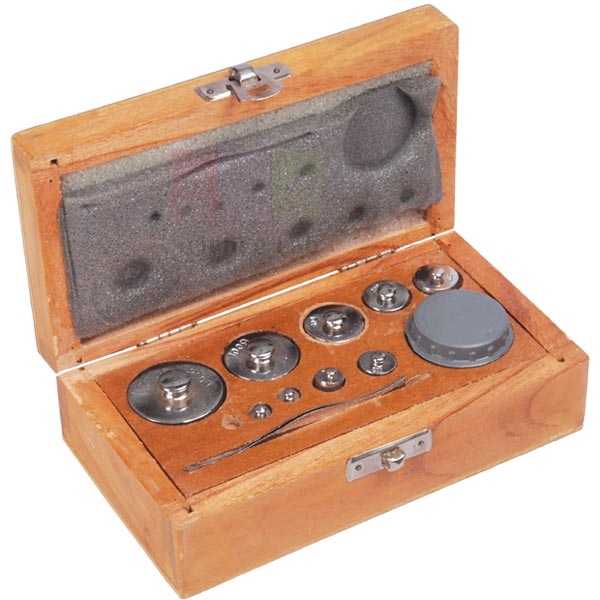
Physical Balance Mass Set
The Physical Balance Mass Set keeps chrome plated brass masses, light metal fractional weights and forceps together in one case with a lid. It goes beside a physical balance in school and college practicals: the brass masses do the main weighing and the fractional weights make up the last small difference.
Physical balance mass set contents
| Parameter | Detail |
|---|---|
| Masses | Brass, chrome plated |
| Fractional weights | Light metal, included |
| Handling | Forceps included |
| Storage | Case with lid |
| Supplied as | Complete set |
| Product code | SLE/LB/09 |
| Minimum order | 10 units |
| Dispatch | Usually within 7 to 10 working days |
| Manufacturer | ScienceLab (Jain Scientific Equipments Pvt Ltd), Ambala, India |
Weighing exercises on the physical balance
Relative density with a density bottle. Weigh a clean, dry specific gravity bottle on a physical balance, then weigh it full of water and again full of the test liquid. The mass of liquid divided by the mass of the same volume of water gives the relative density of the liquid.
Mass of one sheet of paper. Weigh ten sheets of the same paper together, finishing the balance with the fractional weights, and divide by ten. Measure one sheet with a metal ruler, work out its mass per square metre and compare it with the value printed on the pack.
Density of a regular block. Measure the length, width and height of a small metal or wooden block with a vernier calliper and multiply them for its volume. Weigh the block, divide mass by volume and compare the result with a table of densities.
Frequently Asked Questions About the Physical Balance Mass Set
What are the fractional weights used for?
They finish a weighing. When the brass masses bring the pointer close to the centre but the next brass piece would be too heavy, add fractional weights one at a time until the pointer swings evenly. Then add their values to the brass total.
Why are the brass masses chrome plated?
Bare brass tarnishes as it reacts with air and moisture, and handling speeds this up. Chrome plating gives a harder surface that resists tarnish and wipes clean. It keeps its finish longest when the masses are lifted with the forceps and the case is kept closed.
Why should every piece go back into the case after weighing?
In the case, pieces cannot roll off the bench, get mixed with another set or collect dust, which adds to their mass. Checking that every piece is back before the lid is closed also shows at once if one has gone missing.
What limits the smallest mass a student can measure with this set?
A result can be no finer than the smallest fractional weight, and no finer than the smallest change the balance responds to. That smallest reliable step is the least count of the weighing, so record results to it and no further.
Why does the object go on the left pan and the masses on the right?
It is a convention that suits right-handed users. The forceps work the right pan while the object rests undisturbed on the left. Keeping to the same sides every time also makes results from different students easier to compare.
What should be done if a mass is dropped?
Pick it up with the forceps, look for dents or scratches and wipe it with a soft dry cloth. A dented or chipped piece may have lost mass, so compare it on the balance with a piece of the same value from another set before using it again.
Balances, mass sets and density apparatus
- Physical Balance
- Fractional Weight With Rider
- Analytical Balance Mass Set
- Mass Weighing Set on Tray
- Specific Gravity Bottles
- Weight Box (Physical)
To request a quotation, send the product name, code and quantity through our contact page or add the item to your enquiry cart.
Last updated: 15 November 2026
