- Physics Lab Equipment
- Chemistry Lab Equipment
- Biology Lab Equipment
- Anatomical Lab Equipment
- Learning
- Educational Lab Equipment
- Magnets
- Agriculture
- Astronomy
- Earth Science
- Geography Lab Equipment
- Safety Lab Coat
- Laboratory
- Meteorological
- Electricity & Magnetism
- Heat
- School Lab Equipment
- Lab Glassware
- Science Lab Equipment
- Tvet Lab Equipment
- Robotics Kits Supplier and Manufacturer for Schools India
- Math Lab Equipment Manufacturers and Exporters in Ambala
- STEM Kits Manufacturers and Supplier India
- Engineering Lab Equipment
- Hospital Lab Equipment
- Water, Sanitation & Hygiene Supplies
- Cold Chain, Solar & Communication Equipment
- Nutrition
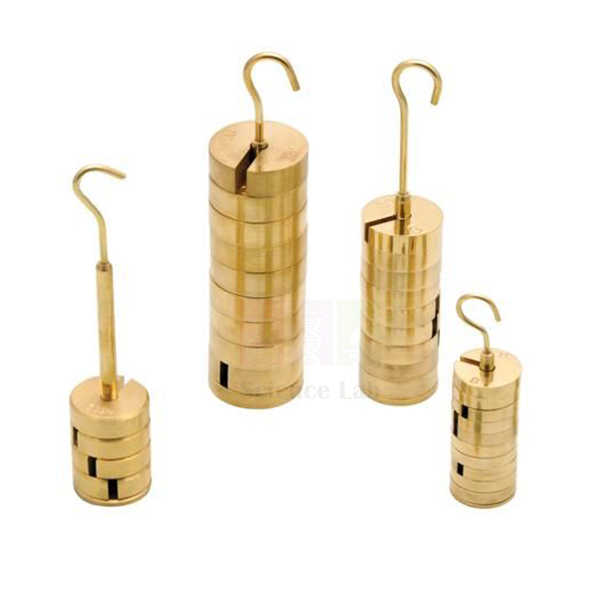
Mass Set, Brass, 250g
The Mass Set, Brass, 250g sets loads from 50 g to 250 g in 5 g steps for string tension, moment and friction work. Its 50 g hanger takes nine 20 g slotted masses for the main steps, with one 10 g and two 5 g pieces to fill the gaps between them.
250 g brass slotted set specifications
| Parameter | Detail |
|---|---|
| Type | Small form slotted mass and hanger set |
| Material | Brass |
| Total mass | 250g, hanger included |
| Hanger | 1 x 50g (included) |
| Slotted masses | 9 x 20g, 1 x 10g, 2 x 5g |
| Load range | 50g to 250g in 5g steps |
| Product code | SLE/LB/32 |
| Minimum order | 10 units |
| Dispatch | Usually within 7 to 10 working days |
| Manufacturer | ScienceLab (Jain Scientific Equipments Pvt Ltd), Ambala, India |
Fine-step loading with the 250 g brass set
Standing waves on a string. Tie one end of a string to a vibration generator, run it over a ball bearing bench pulley and hang the brass hanger on the free end. Add 20 g masses, then trim with the 10 g and 5 g pieces until a steady pattern of loops forms.
Limiting friction. Lay the tribometer board flat, tie its wooden slider to a cord over the end pulley and hang the hanger on the cord. Add 20 g pieces until the slider is close to moving, then top up in 5 g steps until it just starts to slide.
Balancing a moment disk. Hang the loaded hanger from one point on the disk of the moment of force apparatus and hold the disk still with one of its dynamometers attached at another point. Change the load in 5 g steps and compare load times arm with the dynamometer force times its arm.
Frequently Asked Questions About the Mass Set, Brass, 250g
How are the pieces combined to set a particular load?
Start with the 50 g hanger, add 20 g masses for the bulk, then finish with the 10 g and 5 g pieces. For 100 g, for example, use the hanger, two 20 g masses and the 10 g mass, or both 5 g pieces in place of the 10 g.
Why add only 5 g at a time near the point of sliding?
Static friction grows to match the pull until it reaches its limit, and only then does the slider move. A large step can overshoot that limit, so the friction force comes out too high. Near the point of sliding, add the 5 g pieces gently, one at a time, without jolting the cord.
Why must the pulley turn freely?
Friction at the pulley takes up part of the hanging weight, so the string tension is lower than the load suggests. Use a light pulley that spins easily, and check that the string runs straight in its groove.
How does tension change the note of a stretched string?
For a fixed length of the same string, frequency rises with the square root of the tension, so doubling the frequency needs four times the tension. Near resonance with a tuning fork, a few grams still shift the note enough to matter, which is where the 5 g pieces help.
How does this set differ from the lighter brass set?
The Mass Set, Brass, 100g starts at 10 g and moves in 10 g steps. This set starts at 50 g with its hanger, reaches 250 g and adds 5 g resolution through its two 5 g pieces.
Brass mass sets and string and friction apparatus
- Mass Set, Brass, 100g
- Mass Set, Brass, 1000g
- Vibration Generator
- Pulley, Bench Mounting, Ball Bearing
- Inclined Plane With Accessories
To request a quotation, send the product name, code and quantity through our contact page or add the item to your enquiry cart.
Last updated: 14 November 2026