- Physics Lab Equipment
- Chemistry Lab Equipment
- Biology Lab Equipment
- Anatomical Lab Equipment
- Learning
- Educational Lab Equipment
- Magnets
- Agriculture
- Astronomy
- Earth Science
- Geography Lab Equipment
- Safety Lab Coat
- Laboratory
- Meteorological
- Electricity & Magnetism
- Heat
- School Lab Equipment
- Lab Glassware
- Science Lab Equipment
- Tvet Lab Equipment
- Robotics Kits Supplier and Manufacturer for Schools India
- Math Lab Equipment Manufacturers and Exporters in Ambala
- STEM Kits Manufacturers and Supplier India
- Engineering Lab Equipment
- Hospital Lab Equipment
- Water, Sanitation & Hygiene Supplies
- Cold Chain, Solar & Communication Equipment
- Nutrition
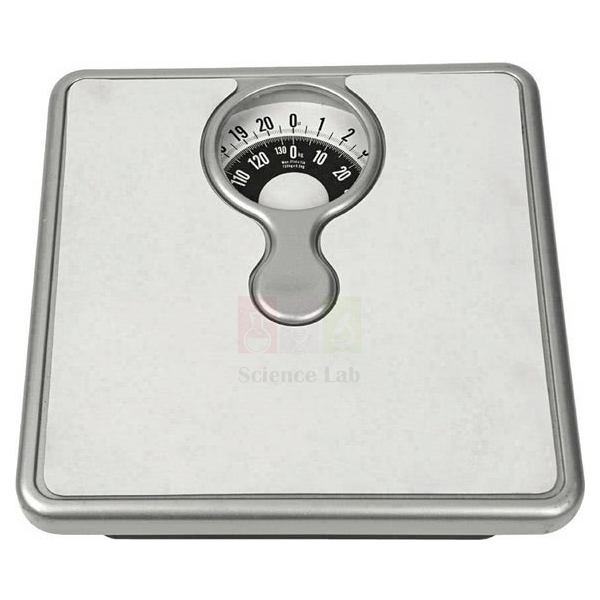
Bathroom Scales
The Bathroom Scales are a mechanical floor scale that weighs people and heavy objects up to 130 kg (20st 6lb) on a magnifying, easy-read dial. They stand 4.4 cm high on a 25 x 25 cm base and work on hard floors or carpet, so a class can weigh students in a laboratory, classroom or hall without batteries or mains power.
Bathroom scale specifications
| Parameter | Detail |
|---|---|
| Type | Mechanical scale with magnifying dial |
| Capacity | 130 kg (20st 6lb) |
| Size | H 4.4 cm, W 25 cm, D 25 cm |
| Display | Easy-read dial |
| Suitable surfaces | Hard floors and carpeted floors |
| Power | None needed; mechanical, works without batteries or mains |
| Product code | SLE/LB/21 |
| Minimum order | 10 units |
| Dispatch | Usually within 7 to 10 working days |
| Supplied by | ScienceLab (Jain Scientific Equipments Pvt Ltd), Ambala, India |
Body measurement and force lessons with a floor scale
Mass and weight in newtons. Each student stands on the scales, reads the mass in kilograms and works out the weight in newtons by multiplying by the gravitational field strength. A force meter then shows weight as a force on smaller objects, so the class meets the same idea with two instruments.
Forces in motion. A student stands still while a partner reads the dial, then crouches quickly and rises quickly. The partner notes whether the pointer moves up or down at each stage and links each change to an unbalanced force on the body. A steady horizontal push against a wall barely moves the pointer, which makes a useful contrast.
Class body measurement data. Fix a measuring tape upright against a wall to record height, then weigh each student on the scales. Enter the pairs in a table, plot mass against height on a scatter graph and describe the trend. Body mass index can be worked out from the same data as a data-handling exercise.
Weighing a school bag. Weigh a student with and without a packed school bag and take the difference as the mass of the bag. Compare the bags across the class as a share of each student's body mass, and discuss how a heavy load should be carried on the back.
Frequently Asked Questions About the Bathroom Scales
Do the scales read the same on carpet as on a hard floor?
They work on both, but a firm floor gives the steadiest results. Thick or soft carpet lets the base sink and tilt, so the reading can shift between weighings. Use the same spot each time, or stand the scales on a rigid board laid over the carpet, and check that the pointer sits at zero there.
How can the reading be checked before a class survey?
Check that the pointer sits at zero with the platform empty. Then weigh the same person on these scales and on a reference scale such as an adult physician scale, on the floor where the survey will take place. If the readings disagree or the zero shifts between weighings, move to a firmer spot and check again.
Why does the pointer swing when a student crouches or rises quickly?
The dial shows how hard the feet push down on the platform. Standing still, that push equals the student's weight. Bending the knees quickly makes the body accelerate, so the push drops for a moment and then rises above normal. The student's mass has not changed, only the force on the scale.
What happens to the reading if the scales are used in a lift?
The reading rises while the lift speeds up on the way up and falls while it speeds up on the way down. At steady speed it returns to the usual value. This shows a class that the scale measures the contact force from the platform, not the mass itself.
How should the dial be read for a fair result?
Ask the student to stand still in the centre of the platform, with the weight spread over both feet. Read the magnified dial from directly above, not from the side, once the pointer stops moving. Remove shoes and heavy items from pockets when results are compared over a term.
How should the scales be cleaned and stored?
Wipe the platform with a damp cloth and dry it, keeping water away from the dial window. Store the scales flat in a cupboard or drawer with nothing stacked on top, as a constant load strains the mechanism. Never drop them or let students jump onto the platform.
Measuring tools for body and force lessons
- Measuring Tape
- Force Meter/Spring Balance
- Scale, Physician, Adult, Metric, 6-180kg
- Scale for Adults with Height Rod
- Spring Balance, Tubular
To request a quotation, send the product name, code and quantity through our contact page or add the item to your enquiry cart.
Last updated: 14 November 2026