- Physics Lab Equipment
- Chemistry Lab Equipment
- Biology Lab Equipment
- Anatomical Lab Equipment
- Learning
- Educational Lab Equipment
- Magnets
- Agriculture
- Astronomy
- Earth Science
- Geography Lab Equipment
- Safety Lab Coat
- Laboratory
- Meteorological
- Electricity & Magnetism
- Heat
- School Lab Equipment
- Lab Glassware
- Science Lab Equipment
- Tvet Lab Equipment
- Robotics Kits Supplier and Manufacturer for Schools India
- Math Lab Equipment Manufacturers and Exporters in Ambala
- STEM Kits Manufacturers and Supplier India
- Engineering Lab Equipment
- Hospital Lab Equipment
- Water, Sanitation & Hygiene Supplies
- Cold Chain, Solar & Communication Equipment
- Nutrition
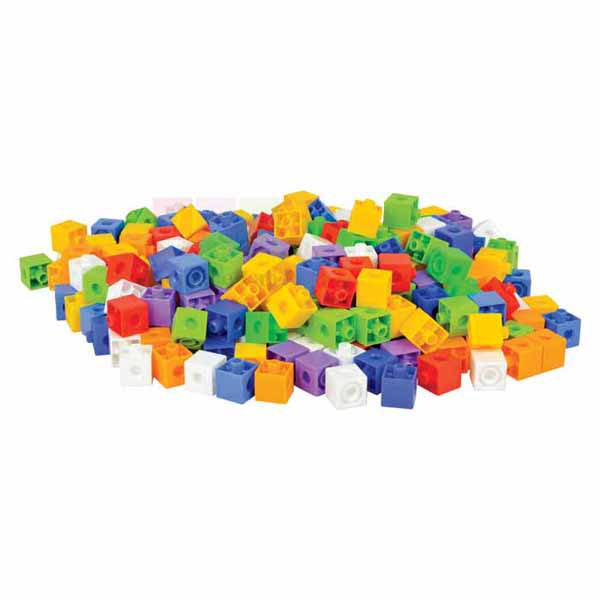
Linking Cubes
Linking Cubes (Product Code: SLE/MAT/48) are connecting cube manipulatives used to build, count and measure in early-years and school maths lessons. They connect easily, so the same set moves from counting and sorting with toddlers to place value, patterns, area and volume with older pupils. They are made by Jain Scientific Equipments Pvt Ltd (ScienceLab), an OEM manufacturer of educational science equipment, at its own factory in Ambala, India.
Key Details
| Parameter | Detail |
|---|---|
| Type | Linking (connecting) cubes |
| Handling | Easy to connect, stack and build |
| Concepts | Counting, place value, measurement, number operations, sorting, patterns, algebra and mensuration |
| Also explores | Numbers, area, volume and geometry |
| Early-years benefit | Supports motor skill development in toddlers |
| Product code | SLE/MAT/48 |
| Manufacturer | Jain Scientific Equipments Pvt Ltd (ScienceLab) — OEM |
| Country of origin | India (made in Ambala, Haryana) |
What Are Linking Cubes Used For?
Linking Cubes let children see numbers as objects they can join and break apart. Young learners build trains of cubes to count, compare lengths and repeat patterns, while pushing cubes together builds finger strength and hand control.
Older pupils use the same cubes for place value by grouping trains of ten, for measuring length in cube units, and for mensuration by building cuboids to count volume and covering flat faces to find area. In algebra lessons, growing cube patterns help pupils write a general rule for any term in the pattern.
OEM Manufacturer
Jain Scientific Equipments Private Limited, known by its trading name ScienceLab, manufactures Linking Cubes as the OEM at its own licensed factory in Saha, Ambala, Haryana, India. Pre-schools, primary schools, special educators, distributors and importers can order from the factory rather than a middleman, and questions about replacement cubes for incomplete sets go straight to the maker. More details are on the ScienceLab company profile.
Related Maths Lab Equipment
These items extend Linking Cubes into place value and fine-motor work:
- Interlocking Cubes — 2 cm cubes for similar counting, pattern and measurement activities.
- Base Ten Blocks — the next step from grouped cubes to formal place value.
- Beads – Bobbles & Laces — a threading and counting activity for young learners.
- Maths Kit Junior — a wider set of maths resources for junior classes.
Browse the Maths Lab Equipment range for more manipulatives for early and primary maths.
Frequently Asked Questions
What can children learn with Linking Cubes?
Linking Cubes support counting, place value, measurement, number operations, sorting, patterns, algebra and mensuration. Pupils can also use them to explore numbers, area, volume and geometry, so one set serves many topics across different class levels.
Are Linking Cubes suitable for toddlers?
Linking Cubes are easy to connect and support motor skill development in toddlers, which makes them useful in early-years settings. As with any small manipulative, young children should use Linking Cubes under adult supervision.
What is the cube size and number of cubes in a set of Linking Cubes?
The cube size and pack quantity of Linking Cubes are not stated on this page. Please ask through the contact page and ScienceLab will confirm the details and suggest a quantity for your class.
How are Linking Cubes different from Interlocking Cubes?
Linking Cubes and Interlocking Cubes are both joining-cube manipulatives in ScienceLab’s maths range. Linking Cubes are described for counting, place value, algebra and mensuration at all levels, while Interlocking Cubes are listed as 2 cm cubes; ask ScienceLab which suits your lessons.
Who manufactures Linking Cubes?
Linking Cubes are manufactured by Jain Scientific Equipments Pvt Ltd (ScienceLab), the OEM, at its own licensed factory at Saha, Ambala, Haryana, India. Quotations, repeat orders and requests for replacement cubes are handled by the manufacturer.
Can Linking Cubes be ordered for many classrooms?
Yes. Linking Cubes can be quoted for a single classroom, a whole school, or larger orders from dealers and importers in India and international markets. Give the number of sets and the delivery location in your enquiry.
Request a Quote
For a Linking Cubes quotation, write to us through the ScienceLab contact page or add the cubes to the enquiry cart. Pricing comes straight from the manufacturer.
Last updated: 24 September 2026
