- Physics Lab Equipment
- Chemistry Lab Equipment
- Biology Lab Equipment
- Anatomical Lab Equipment
- Learning
- Educational Lab Equipment
- Magnets
- Agriculture
- Astronomy
- Earth Science
- Geography Lab Equipment
- Safety Lab Coat
- Laboratory
- Meteorological
- Electricity & Magnetism
- Heat
- School Lab Equipment
- Lab Glassware
- Science Lab Equipment
- Tvet Lab Equipment
- Robotics Kits Supplier and Manufacturer for Schools India
- Math Lab Equipment Manufacturers and Exporters in Ambala
- STEM Kits Manufacturers and Supplier India
- Engineering Lab Equipment
- Hospital Lab Equipment
- Water, Sanitation & Hygiene Supplies
- Cold Chain, Solar & Communication Equipment
- Nutrition
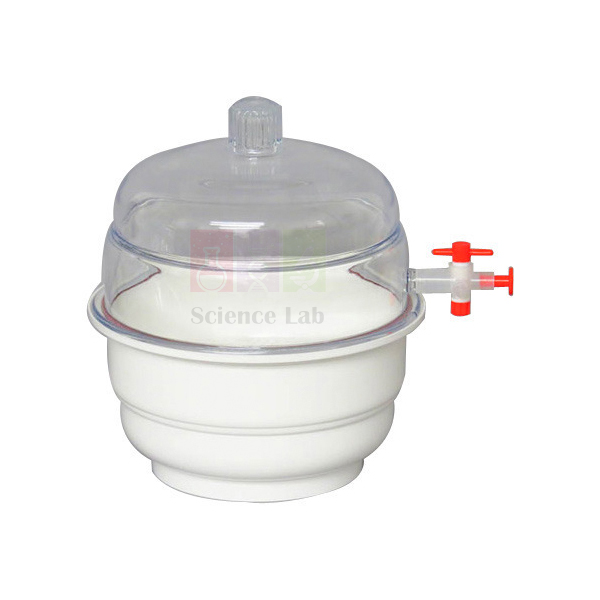
Vacuum Desiccator
Vacuum Desiccator (Product Code: SLE/CH/93) is a sealable chamber for drying samples, or keeping them dry, over a desiccant, with a stopcock that allows the air inside to be pumped out so moisture leaves faster. Its moulded polycarbonate dome is rigid and transparent, giving a clear view of the desiccant and samples without breaking the seal, while the lower part is polypropylene. Analytical, research and teaching laboratories use it to cool crucibles after ignition, store moisture-sensitive reagents and dry solids to constant weight. It is made by Jain Scientific Equipments Pvt Ltd (ScienceLab), Ambala, a laboratory equipment supplier in India.
Specifications
| Parameter | Detail |
|---|---|
| Materials | Polypropylene and polycarbonate |
| Top dome | Moulded in rigid, transparent polycarbonate; knurled knob on top for easy handling |
| Lower part | Polypropylene |
| Seal | Internal groove on the flange to hold a silicone rubber O-ring |
| Vacuum holding | Up to 740 mm of Hg for 24 hrs without any greasing |
| Stopcock | Polypropylene, fitted with a self-lubricating PTFE plug |
| Stopcock action | Three-way: vacuum creation, shutting off and vacuum releasing |
| Sterilisation | Autoclavable |
Typical Use
Charge the lower section with fresh desiccant, place the sample vessels inside, and seat the dome so the O-ring bears evenly on the flange. Connect the stopcock to a vacuum pump, turn the PTFE plug to the evacuating position and pump down, then turn it to shut off and disconnect the pump; the chamber is specified to hold up to 740 mm of Hg for 24 hrs with no grease on the flange. When you need to open it, turn the plug slowly to the release position so air bleeds back gently and does not scatter fine powders.
In gravimetric work, crucibles and weighing bottles are cooled here between heating and weighing so they do not pick up atmospheric moisture, and hygroscopic salts or dried precipitates can be stored for days. Keep the flange and O-ring free of dust, replace spent desiccant regularly, and clean the polycarbonate dome with mild detergent rather than harsh solvents. Chemistry, pharmacy and materials departments choosing lab equipment for college use in India will find it a dependable option for dry storage.
Manufacturer
Jain Scientific Equipments Private Limited trades as ScienceLab and is based in Ambala, Haryana, India, where it makes laboratory apparatus for education and research. Buyers completing vendor registration can use the company's GSTIN 06AAECJ8618A1ZT and Legal Entity Identifier (LEI) 3358004HRD1JIVXKYX49. Read our company profile for more background.
Related Laboratory Equipment
Items that complete a vacuum drying set-up:
- Vacuum Pump, Hand — manual pumping through the stopcock where no power point is nearby
- Vacuum Pump, Electric — for labs that pump the desiccator down frequently
- Vacuum Tubing — thick-walled tube to link the pump to the stopcock without collapsing
- Silica Gel Coarse — desiccant to charge the lower section
- Crucible with lid — one of the vessels most often cooled inside a desiccator before weighing
Browse our Chemistry Lab Equipment range for more drying, heating and weighing apparatus.
Frequently Asked Questions
How long does the Vacuum Desiccator hold vacuum?
It is specified to hold vacuum up to 740 mm of Hg for 24 hrs without greasing. A clean flange and an undamaged O-ring are needed to achieve this.
Do I need vacuum grease on the flange?
No. The silicone rubber O-ring seated in the flange groove seals without grease, so there is no grease residue to contaminate samples.
Is desiccant included?
A desiccant is not listed as part of the supply. Order it separately, for example our Silica Gel Coarse, or ask us to add it to your quotation.
Can it be autoclaved?
Yes, it is described as autoclavable. For the recommended cycle, please check with us through our contact page.
What internal diameter or capacity does it have?
Dimensions are not listed on this page; contact us with the size of the vessels you want to store and we will advise.
How does the three-way stopcock work?
The PTFE plug is turned to one position to evacuate the chamber, another to shut it off after pumping, and a third to release the vacuum before opening.
What should an institutional quotation request include?
State the quantity, any preferred size, whether you also need pumps or desiccant, and the delivery location. We supply institutions in India and international markets.
Request a Quote
To price the Vacuum Desiccator, add it to the enquiry cart or send your requirements through our contact page.
Last updated: 24 September 2026