- Physics Lab Equipment
- Chemistry Lab Equipment
- Biology Lab Equipment
- Anatomical Lab Equipment
- Learning
- Educational Lab Equipment
- Magnets
- Agriculture
- Astronomy
- Earth Science
- Geography Lab Equipment
- Safety Lab Coat
- Laboratory
- Meteorological
- Electricity & Magnetism
- Heat
- School Lab Equipment
- Lab Glassware
- Science Lab Equipment
- Tvet Lab Equipment
- Robotics Kits Supplier and Manufacturer for Schools India
- Math Lab Equipment Manufacturers and Exporters in Ambala
- STEM Kits Manufacturers and Supplier India
- Engineering Lab Equipment
- Hospital Lab Equipment
- Water, Sanitation & Hygiene Supplies
- Cold Chain, Solar & Communication Equipment
- Nutrition
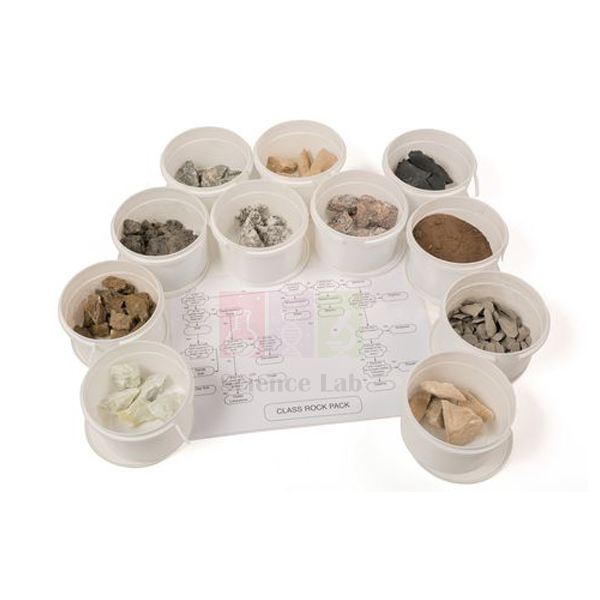
Class Rock Pack
The Class Rock Pack (Product Code: SLE/GG/05) is a complete rock identification lesson in one pack. Over 55 geological samples — igneous, metamorphic and sedimentary rocks together with soil samples — are used with a central laminated flow chart that students follow to identify each sample from characteristics such as texture and permeability. Supplied by Jain Scientific Equipments Pvt Ltd (ScienceLab), Ambala, it is designed to cover the earth science sections of Key Stages 2, 3 and 4.
Specifications
| Parameter | Detail |
|---|---|
| Type | Class rock and soil identification pack |
| Number of samples | Over 55 geological samples |
| Sample types | Igneous, metamorphic and sedimentary rocks, plus soil samples |
| Identification aid | Central laminated flow chart |
| Properties used | Characteristics including texture and permeability |
| Storage | Samples supplied in durable plastic containers |
| Teacher support | Full Teacher’s Notes |
| Curriculum coverage | Earth science sections of Key Stages 2, 3 and 4 |
Typical Use
Groups take a sample, work down the flow chart’s questions — is it made of interlocking crystals or separate grains? does water soak in or run off? — and arrive at a rock group or soil type. A few drops of water from a dropper are enough to test permeability, and a hand lens helps students judge texture, so the lesson stays practical rather than relying on pictures.
Because the pack spans three key stages, the same samples can serve simple sorting activities for younger pupils and discussions of how each rock group forms for older students. The plastic containers keep samples organised between lessons, and the Teacher’s Notes give confidence to staff who are not geology specialists. As an earth science kit, it gives a whole class hands-on material at once instead of a single display set at the front of the room.
Supplier
This rock pack is supplied by Jain Scientific Equipments Private Limited, which trades as ScienceLab from Ambala, Haryana, and sources geological specimens for school laboratories alongside its own teaching apparatus. Read more on our company profile.
Related Geography Lab Equipment
Items that extend or support rock and soil lessons:
- Expanded Rock Collection — a larger set of named rock specimens for further study
- Rock Study Kit — another rock set for identification practice
- Sieves — for separating soil samples by particle size when extending the texture work
- Storage Boxes – Rock – Mineral Specimens — for storing and labelling additional samples
- Clever Catch Rocks — a question ball for revising rock facts after the practical
More options are in our Geography Lab Equipment category.
Frequently Asked Questions
How many samples are in the pack?
Over 55 geological samples, supplied in durable plastic containers.
Does it include soils as well as rocks?
Yes. Soil samples are included alongside igneous, metamorphic and sedimentary rocks.
How do students identify the samples?
By working through the central laminated flow chart, which uses characteristics such as texture and permeability.
Is teaching material included?
Yes, full Teacher’s Notes come with the pack.
Is it only useful for schools following Key Stages?
It is designed around Key Stages 2, 3 and 4, but rock groups, textures and permeability are taught in most earth science syllabuses, so it suits other curricula too.
Can individual samples be replaced?
Replacement availability is not listed; please contact us with the sample you need.
Can you supply several packs for different classrooms or overseas schools?
Yes. We supply schools in India and international markets; add the quantity to your enquiry cart.
Request a Quote
For pricing on the Class Rock Pack, contact us or place it in your enquiry cart.
Last updated: 24 September 2026
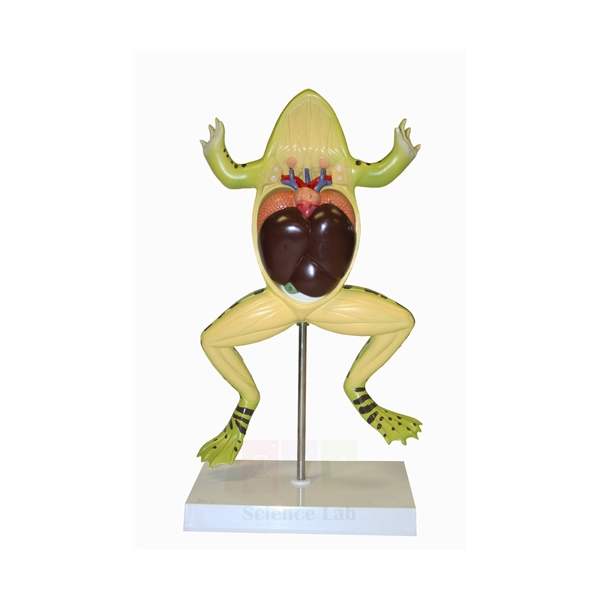
Frog Dissection Model
Frog Dissection Model (Product Code: SLE/A/119) is a ventrally sectioned frog model, about 2-1/2 times life size, used to teach amphibian thoracic and abdominal anatomy in school and college zoology. Its 4 removable parts are held by magnets rather than pins or hooks, and the stand lifts off for close examination, making it a reusable companion or alternative to a frog dissection kit. It is made by Jain Scientific Equipments Pvt Ltd (ScienceLab), the OEM manufacturer, at its own factory in Ambala, India.
Specifications
| Parameter | Detail |
|---|---|
| Scale | About 2-1/2 x life size |
| Size (without stand) | 35 x 24 x 5 cm |
| Sectioning | Sectioned ventrally |
| Removable parts | 4 |
| Fixing of parts | Magnets (no pins or hooks) |
| Stand | Mounted on a stand that is removable for examination |
| Structures shown | Thoracic and abdominal structures |
| Product code | SLE/A/119 |
| Manufacturer | Jain Scientific Equipments Pvt Ltd (ScienceLab) — OEM |
| Country of origin | India (made in Ambala, Haryana) |
What Is the Frog Dissection Model Used For?
The frog is the classic vertebrate type study, and this model follows the ventral view in which that dissection is usually taught. With the parts in place, students see the thoracic and abdominal organs as they would lie after the body wall is opened; lifting out the four magnetic pieces then reveals the structures beneath, so the class can discuss each organ in its true position and relate it to the diagrams in their practical manuals. Because nothing is pinned, parts can be passed around a group and set back without wear.
Many institutions now teach frog anatomy with models, charts and digital resources instead of animals, and a sturdy enlarged model sits at the centre of that approach. Where specimens are still used, it serves as a reference beside the dissection tray, and its 2-1/2 times enlargement keeps small organs readable from several paces away — useful zoology lab equipment for any Indian school or college practical room.
OEM Manufacturer
ScienceLab is the brand name of Jain Scientific Equipments Private Limited, the OEM that makes the Frog Dissection Model at its own licensed factory at Saha, Ambala, Haryana, India. The model reaches schools, colleges, dealers and importers factory-direct, so pricing, repeat orders and any request for a replacement magnetic part come straight from the manufacturer. Read about us on the company profile.
Related Animal Models
Items that complete a frog anatomy practical:
- Frog Skeleton — a natural-bone skeleton under an acrylic cover to show the framework beneath the organs.
- Mi-Own Frog Model — a life-sized, washable student model with 22 removable parts for individual work.
- Dissection Pan — a black-wax tray for courses that still carry out specimen dissection.
- Stereoscopic Dissection Microscopes — low-power magnification for examining fine structures.
For more zoology models, visit the Animal Model category.
Frequently Asked Questions
How are the removable parts of the Frog Dissection Model held in place?
The four removable parts of the Frog Dissection Model are secured by magnets, so there are no pins or hooks to lose or bend, and pieces can be passed around a group and set back without wearing the model.
How big is the Frog Dissection Model?
The Frog Dissection Model is about 2-1/2 times life size and measures 35 x 24 x 5 cm without its stand, which makes small organs readable from several paces away during a class demonstration.
Can the Frog Dissection Model be lifted off its stand?
Yes. The stand of the Frog Dissection Model is removable, so the model can be taken in the hand and turned to examine the thoracic and abdominal structures from different angles.
Who manufactures the Frog Dissection Model?
Jain Scientific Equipments Pvt Ltd (ScienceLab) is the OEM and manufactures the Frog Dissection Model at its own licensed factory at Saha, Ambala, Haryana, India; it is sold factory-direct with quotations prepared by the manufacturer.
Is an identification key supplied with the Frog Dissection Model?
A key is not listed in the Frog Dissection Model's product details. Please ask through the contact page what labelling is supplied with current production if students will need numbered references for practical work.
How should the magnetic parts of the Frog Dissection Model be stored?
Keep the magnetic parts fitted on the Frog Dissection Model when it is not in use, and store it away from strong magnets and electronic equipment so the pieces stay together and in their correct positions.
Request a Quote
To order the Frog Dissection Model, reach us through the contact page or add it to the enquiry cart with your other zoology items; the manufacturer sends the quotation.
Last updated: 24 September 2026
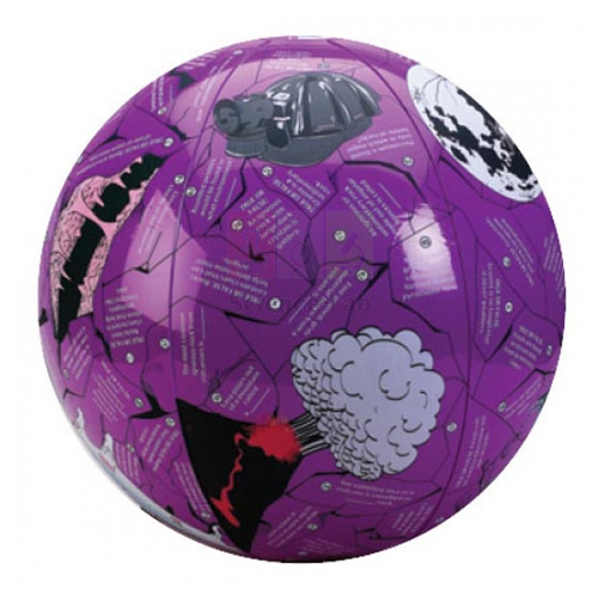
Clever Catch Rocks
Clever Catch Rocks (Product Code: SLE/GG/06) is a question ball for learning about rocks and their properties through play. The ball is tossed around the classroom, and the student who catches it answers the question under their left thumb. It is latex free and comes with a teacher’s guide that contains the answers. Supplied by Jain Scientific Equipments Pvt Ltd (ScienceLab), Ambala, it is a lively revision tool for earth science lessons in primary and middle school.
Key Details
| Parameter | Detail |
|---|---|
| Type | Educational question ball |
| Topic | Rocks and their properties |
| How it works | Ball is tossed around the class; the catcher answers the question under the left thumb |
| Material note | Latex free |
| Teacher support | Teacher’s guide with answers provided |
Typical Use
Teachers bring out the ball for a short warm-up at the start of a rocks lesson or a quick review before a test. Nobody knows who will catch next, so the whole class stays alert, and because the question depends on where the thumb lands, the same ball keeps producing fresh combinations over many sessions.
The teacher’s guide lets the teacher confirm answers on the spot and add a follow-up — for example, asking the student to pick out a matching specimen from the class rock collection. Being latex free, it is a considerate choice where latex sensitivity is a concern, and it gives schools a simple way to add movement and talk to earth science teaching aids that are otherwise mostly specimens and charts.
Supplier
Jain Scientific Equipments Private Limited, trading as ScienceLab in Ambala, Haryana, supplies this question ball as part of its geography and earth science range for schools. Find out more in our company profile.
Related Geography Lab Equipment
Pair the ball with hands-on materials for the same topic:
- Astronomy Clever Catch — the same toss-and-answer format for astronomy topics
- Class Rock Pack — real rock and soil samples to follow up the questions
- Rock Study Kit — rock specimens for identification practice
- Expanded Rock Collection — a larger specimen set covering the three main rock groups
See everything in Geography Lab Equipment.
Frequently Asked Questions
How is Clever Catch Rocks played?
Toss the ball to a student; they answer the question that sits under their left thumb, then throw it on to the next player.
Is the ball latex free?
Yes, it is latex free.
Are answers provided for the teacher?
Yes. A teacher’s guide with answers is provided.
How many questions are on the ball?
The number of questions is not stated in our current listing; contact us if you need it for planning.
How should it be cleaned?
Wipe the surface with a slightly damp cloth and let it dry before storing; avoid soaking or harsh cleaners.
Can we order one for every classroom?
Yes. We supply schools in India and international markets in the quantities needed — list them in your enquiry cart.
Request a Quote
To buy Clever Catch Rocks, contact us or add it to your enquiry cart.
Last updated: 24 September 2026
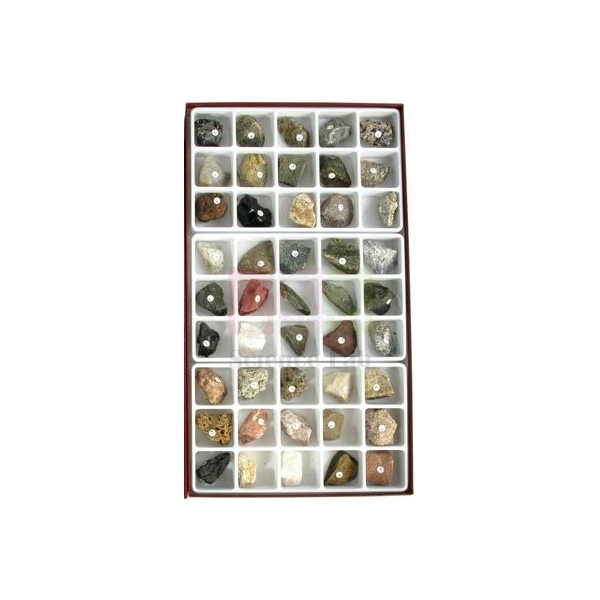
Expanded Rock Collection
The Expanded Rock Collection (Product Code: SLE/GG/07) contains 45 different rock specimens — 15 each of igneous, sedimentary and metamorphic rocks — to start or extend a school rock collection. Each specimen measures approximately 38mm x 38mm, and every category is well represented, so the set works as an integrated classroom study unit. It is supplied by Jain Scientific Equipments Pvt Ltd (ScienceLab), Ambala, for geography and earth science teaching.
Specifications
| Parameter | Detail |
|---|---|
| Number of specimens | 45 different rock specimens |
| Rock groups | 15 igneous, 15 sedimentary and 15 metamorphic |
| Specimen size | Approximately 38mm x 38mm |
| Use | Integrated classroom study unit covering all three major rock types |
Specimens named in the product listing:
- Igneous: Pegmatite, Granite, Syenite, Gabbro, Rhyolite Porphyry, Trachyte Porphyry, Basalt, Rhyolite, Andesite, Tuff, Obsidian, Pitchstone, Pumice, Scoria
- Metamorphic: Gneiss
Typical Use
Rocks are a window into the Earth’s past — how the planet formed, what happened before humans appeared and when the continents took shape — and this collection lets students read that record for themselves. Sorting the specimens into igneous, sedimentary and metamorphic groups is the natural first activity. Students then compare textures within a group, for example coarse-grained granite and gabbro against fine-grained basalt and glassy obsidian, and relate crystal size to how quickly the rock cooled.
Frothy pumice and scoria show gas escaping from lava, while gneiss shows the banding produced when rock is changed by heat and pressure. With equal numbers in each group, the collection suits station-based lessons in which groups rotate between igneous, sedimentary and metamorphic tables, and it makes a sound core for an earth science kit in a school geography room.
Supplier
Jain Scientific Equipments Private Limited, which trades as ScienceLab, supplies this natural specimen collection from Ambala, Haryana. For vendor registration, the company is incorporated under CIN U29309HR2020PTC087597 and registered for GST under GSTIN 06AAECJ8618A1ZT. Visit the company profile for more.
Related Geography Lab Equipment
Useful additions when building a rock and mineral collection:
- Class Rock Pack — rock and soil samples with an identification flow chart for whole-class lessons
- Storage Boxes – Rock – Mineral Specimens — for keeping specimens sorted and labelled
- Mineral Study Kit — minerals such as feldspar, mica and quartz that make up many of these rocks
- Rock Study Kit — a further rock set for identification practice
- General Fossil Collection — fossils, which are usually preserved in sedimentary rocks
Browse all Geography Lab Equipment.
Frequently Asked Questions
How many specimens are included, and of which types?
45 different rock specimens: 15 igneous, 15 sedimentary and 15 metamorphic.
How large is each specimen?
Approximately 38mm x 38mm.
Is the full list of all 45 specimens available?
The listing names the igneous specimens and gneiss shown above. For the complete list of sedimentary and metamorphic specimens, please contact us.
Are the specimens labelled or numbered?
Labelling is not described in the current listing; ask us how the specimens are identified before you order.
Will every specimen look exactly like the photograph?
No. These are natural rocks, so colour, texture and shape vary from piece to piece.
Do you supply schools abroad?
Yes. We supply schools and distributors in India and international markets; use the enquiry cart to send quantities.
Request a Quote
For pricing on the Expanded Rock Collection, contact us or add it to your enquiry cart.
Last updated: 24 September 2026
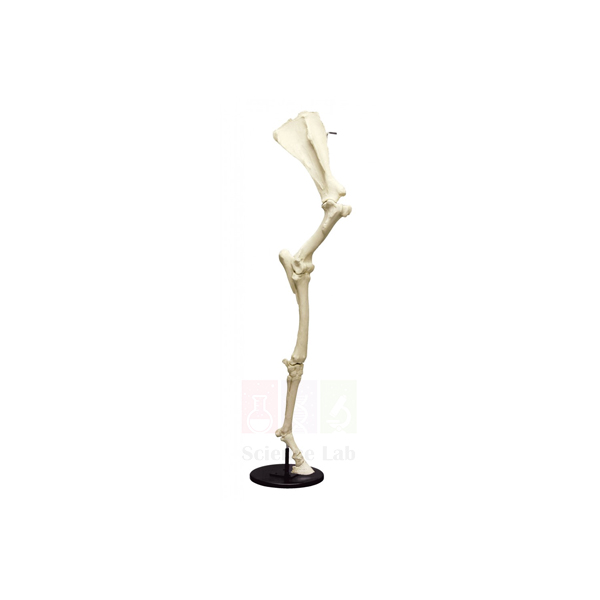
Horse Forelimb Skeleton
Horse Forelimb Skeleton (Product Code: SLE/A/120) is an articulated natural-bone specimen of an adult horse's forelimb used to study equine skeletal anatomy in veterinary, animal-science and zoology teaching. It stands on a square wooden base with a steel support rod, and the hoof capsule is mounted separately so it can be removed for close-up examination. The specimen is supplied by Jain Scientific Equipments Pvt Ltd (ScienceLab), Ambala, India.
Specifications
| Parameter | Detail |
|---|---|
| Material | Natural bone |
| Specimen | Adult horse (equine) forelimb, articulated mount |
| Size | Around 13 x 51-1/2 in. |
| Base | Square wooden base, 11-1/4 x 11-1/4 in. |
| Support | Steel support rod |
| Hoof capsule | Mounted separately on the base; removable for close examination |
| Product code | SLE/A/120 |
| Supplied by | Jain Scientific Equipments Pvt Ltd (ScienceLab), Ambala, India |
What Is the Horse Forelimb Skeleton Used For?
In veterinary osteology the horse forelimb is studied bone by bone, and an articulated natural-bone specimen shows how each joint actually fits together in a way that loose bones cannot. Students trace the limb from its upper long bones down to the single functional digit, note where tendons and ligaments would attach, and relate joint angles to how a horse stands and moves. The removable hoof capsule lets the class compare the outer hoof with the bone it encloses.
The specimen is equally valuable as evidence for evolution. A limb reduced to one weight-bearing digit is a textbook example of adaptation for running, and placing it beside a human arm, a bat wing or a bird wing helps students recognise one basic bone pattern modified for different purposes. Mounted upright on its base, it also makes a striking display in an anatomy hall and a distinctive addition to zoology lab equipment in India.
Supplier
Jain Scientific Equipments Private Limited, which trades as ScienceLab from Ambala, Haryana, supplies this natural-bone forelimb mount to veterinary colleges, zoology departments, anatomy museums and dealers in India and international markets. The company sources specimens of this kind and handles quotations, packing advice and delivery questions directly. See our company profile for more about the company.
Related Animal Models
Skeletons that support a lesson on homologous limbs:
- Bat Skeleton — a forelimb adapted as a wing, in natural bone with a key card.
- Pigeon Skeleton — shows the bird wing for comparison with the equine limb.
- Human Skeleton, Rod-Supported — a life-size human skeleton for comparing the arm and hand.
- Frog Skeleton — an amphibian limb pattern to complete the vertebrate series.
More specimens and models are in the Animal Model category.
Frequently Asked Questions
Is the Horse Forelimb Skeleton real bone or a cast?
The Horse Forelimb Skeleton is natural bone. The bones are articulated and held by a steel support rod on a square wooden base, so students see the real joint surfaces and proportions of an adult horse's forelimb.
What size is the Horse Forelimb Skeleton?
The Horse Forelimb Skeleton measures around 13 x 51-1/2 inches and stands on a square wooden base of 11-1/4 x 11-1/4 inches, so plan for a tall display space or a sturdy bench.
Can the hoof be removed from the Horse Forelimb Skeleton?
Yes. On the Horse Forelimb Skeleton the hoof capsule is mounted separately on the base and can be taken off, allowing students to compare the outer hoof with the bones it encloses.
Who supplies the Horse Forelimb Skeleton?
The Horse Forelimb Skeleton is supplied by Jain Scientific Equipments Pvt Ltd (ScienceLab), Ambala, Haryana, India, to veterinary colleges, zoology departments and museums in India and international markets, with quotations issued directly by the company.
How should the Horse Forelimb Skeleton be cared for?
Keep the Horse Forelimb Skeleton in a dry room away from damp and direct sunlight, dust it with a soft brush, and avoid washing it or applying chemical cleaners, which can damage natural bone over time.
Are there shipping considerations for the Horse Forelimb Skeleton?
Documentation and packing needs for a natural-bone specimen such as the Horse Forelimb Skeleton can vary by destination. Tell us where the order will be delivered, in India or abroad, and we will advise in the quotation.
Is a labelled key included with the Horse Forelimb Skeleton?
A key is not mentioned in the Horse Forelimb Skeleton's product details. If your osteology course needs one, please ask through the contact page before ordering so we can confirm what accompanies the specimen.
Request a Quote
Ask for a price on the Horse Forelimb Skeleton through our contact page, or add it to the enquiry cart alongside other skeletons.
Last updated: 24 September 2026
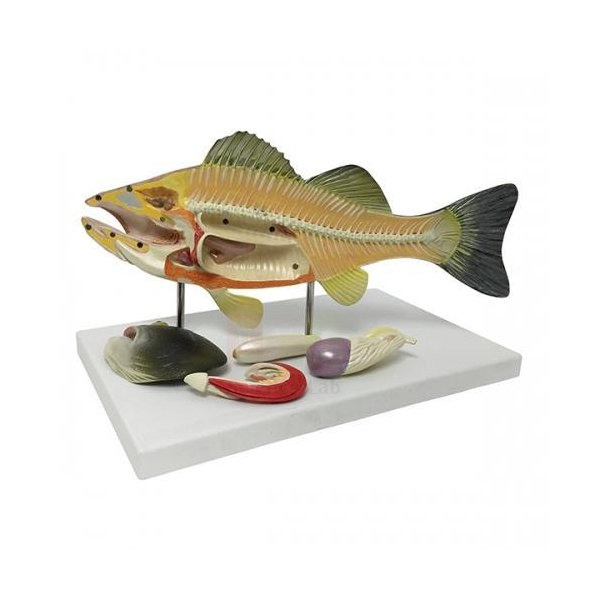
Fish Dissection Model
Fish Dissection Model (Product Code: SLE/A/121) is a life-size, 5-part longitudinal dissection of a bony fish used for organ-identification practicals in school biology, fisheries and college zoology. Its removable components are held by magnets and a numbered key identifies 24 structures, giving clear views of both internal and external anatomy. It is made by Jain Scientific Equipments Pvt Ltd (ScienceLab), the OEM manufacturer, at its own factory in Ambala, India, as part of its high school biology lab equipment.
Specifications
| Parameter | Detail |
|---|---|
| Subject | Bony fish, longitudinal dissection |
| Scale | Life size |
| Construction | 5 parts |
| Size (without base) | 45 x 21 x 7 cm |
| Fixing of parts | Removable components secured with magnets |
| Mounting | On a base |
| Key | Numbered key with 24 identified structures |
| Product code | SLE/A/121 |
| Manufacturer | Jain Scientific Equipments Pvt Ltd (ScienceLab) — OEM |
| Country of origin | India (made in Ambala, Haryana) |
What Is the Fish Dissection Model Used For?
The 24-point key makes this model well suited to assessed practical work. A common format is to give each group the model with its parts in place and a blank outline drawing: students remove the magnetic components one at a time, match what they uncover to the numbered key and label their drawing, then reassemble the fish for the next group. Teachers can also cover the key and use the numbers for a quick oral test in revision periods before board practicals.
Because the dissection runs along the length of the body, students see how organs are arranged from head to tail and how the internal layout relates to the fish's outer shape. The magnets return each part to exactly the right position without pins, so the model stays tidy through repeated handling across a term. Institutions equipping several labs often include it in a biology model kit bulk order together with frog and bird models.
OEM Manufacturer
Jain Scientific Equipments Private Limited, operating as ScienceLab, is the OEM of the Fish Dissection Model and makes it at its own licensed factory at Saha, Ambala, Haryana, India. Campuses and distributors buying several units deal directly with the manufacturer for quotations, repeat orders and questions about spare magnetic components. Our company profile gives more background.
Related Animal Models
Items that work with this model in fish and vertebrate practicals:
- Bony Fish Model — a life-size carp replica with a removable air bladder, as an alternative format.
- Fish Dissection — a preserved dissection in a glass container to compare with the model.
- Dissection Pan, Pad & Cover — a pan-and-pad system that replaces dissection wax, for courses that also dissect real specimens.
- Frog Dissection Model — uses the same magnet-held parts for the amphibian type study.
The full range is listed in the Animal Model category.
Frequently Asked Questions
How many structures does the Fish Dissection Model's key identify?
The numbered key supplied with the Fish Dissection Model identifies 24 structures, which makes the model well suited to assessed identification exercises in which students locate each numbered organ and label an outline drawing.
How many parts does the Fish Dissection Model have?
The Fish Dissection Model is a longitudinal dissection in five parts. Its removable components are secured with magnets, so they return to exactly the right position after handling without the need for pins or hooks.
What are the dimensions of the Fish Dissection Model?
The Fish Dissection Model measures 45 x 21 x 7 cm without its base, and the fish is shown life size, so students see organs at the same scale they would meet in a real specimen.
Who manufactures the Fish Dissection Model?
The Fish Dissection Model is manufactured by Jain Scientific Equipments Pvt Ltd (ScienceLab), which is its OEM, at the company's own licensed factory at Saha, Ambala, Haryana, India. Schools, colleges and dealers order it factory-direct, with quotations from the manufacturer.
Which fish species is the Fish Dissection Model based on?
The Fish Dissection Model represents a bony fish; the exact species is not stated in its product details. If your syllabus names a particular fish, ask through the contact page and we will confirm the details before you order.
Should I choose the Fish Dissection Model or the Bony Fish Model?
Choose the Fish Dissection Model for key-driven identification work with numbered structures and magnet-held parts. The Bony Fish Model, a carp replica with external and internal sides and three removable organs, suits a more general introduction to fish anatomy.
Request a Quote
For pricing on the Fish Dissection Model, use the contact page or add it to the enquiry cart with any other models you need; quotations come straight from the manufacturer.
Last updated: 24 September 2026
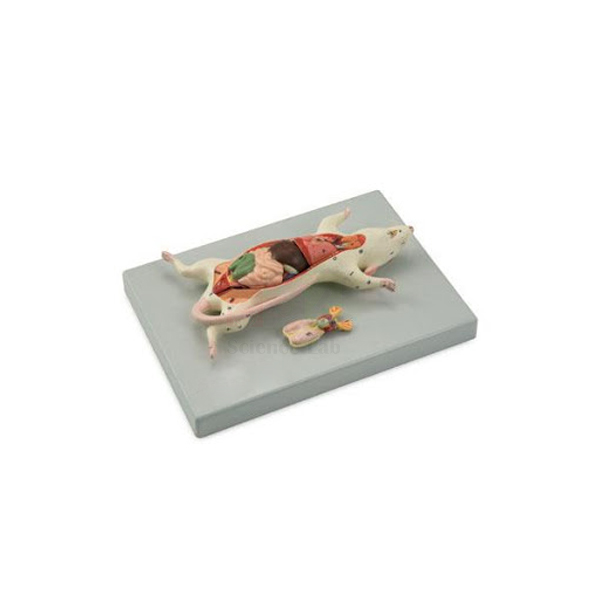
Male and Female Rat Model
Male and Female Rat Model (Product Code: SLE/A/122) is a life-size model of an adult rat, mounted supine, used to teach mammalian anatomy and to compare male and female reproductive systems in zoology and life-science courses. The reproductive systems are interchangeable, the organs detach in 4 pieces and a numbered key is included, so one model covers both sexes. It is made by Jain Scientific Equipments Pvt Ltd (ScienceLab), the OEM manufacturer, at its own factory in Ambala, India.
Specifications
| Parameter | Detail |
|---|---|
| Subject | Adult rat |
| Scale | Life size |
| Position | Mounted supine |
| Size (without base) | 12 x 21 x 4 cm |
| Detachable organs | 4 pieces |
| Reproductive systems | Interchangeable male and female |
| Base | Model removable from base for examination |
| Supplied with | Numbered key |
| Product code | SLE/A/122 |
| Manufacturer | Jain Scientific Equipments Pvt Ltd (ScienceLab) — OEM |
| Country of origin | India (made in Ambala, Haryana) |
What Is the Male and Female Rat Model Used For?
The rat is a standard mammal for anatomy teaching, and the supine position matches the way it is traditionally opened in a practical, so students see organs in the orientation used in their textbooks. A lesson can begin with one reproductive system fitted, identifying the general body organs from the numbered key, then switch to the other system so the class compares male and female structures directly on the same body. Detaching the four organ pieces lets students handle each one and see where it sits in the body cavity.
At life size the model is small, so it works best for bench work in pairs or small groups; students can lift it off the base and turn it to view structures from different angles. For departments that have moved away from animal dissection it is a reusable way to meet mammalian anatomy objectives, and among the animal models a biology lab keeps it pairs naturally with bird and amphibian models for cross-class comparison.
OEM Manufacturer
The Male and Female Rat Model is manufactured by Jain Scientific Equipments Private Limited, which trades as ScienceLab and is the OEM (original equipment manufacturer). It is made at the company's own licensed factory at Saha, Ambala, Haryana, and supplied factory-direct to colleges, paramedical institutes, dealers and importers, who can ask the manufacturer itself about spare organ pieces or repeat orders. The company profile explains more.
Related Animal Models
Items that build on this model in reproduction and comparative anatomy lessons:
- Human Male and Female Urogenital Systems Model — the human equivalent for comparing mammalian reproductive anatomy.
- Hen Model — shows a bird reproductive system with an egg for cross-class comparison.
- Frog Dissection Model — the amphibian type study with magnet-held removable parts.
- Stereoscopic Dissection Microscopes — low-power viewing for fine details on small specimens and models.
Browse the Animal Model category for more.
Frequently Asked Questions
Does one Male and Female Rat Model show both sexes?
Yes. The Male and Female Rat Model has interchangeable male and female reproductive systems on the same adult rat, so a class can study both without buying two separate models or dissecting animals.
How large is the Male and Female Rat Model?
The Male and Female Rat Model is life size and measures 12 x 21 x 4 cm without its base, which suits bench work in pairs or small groups rather than display in a large lecture hall.
How many parts come off the Male and Female Rat Model?
On the Male and Female Rat Model the organs detach in four pieces, and the whole rat can be removed from its base so students can turn it and examine structures from different angles.
Who manufactures the Male and Female Rat Model?
Jain Scientific Equipments Pvt Ltd (ScienceLab) is the OEM of the Male and Female Rat Model and manufactures it at its own licensed factory at Saha, Ambala, Haryana, India, supplying it factory-direct with quotations from the manufacturer.
Is a key included with the Male and Female Rat Model?
Yes. A numbered key is included with the Male and Female Rat Model, so students can identify the body organs and both sets of reproductive structures and use the same names in their practical records.
How should the small parts of the Male and Female Rat Model be kept safe?
Store the spare reproductive system and detached organs of the Male and Female Rat Model in a labelled box with the model, and check that all pieces are returned at the end of each class.
Request a Quote
Enquire about the Male and Female Rat Model through the contact page or place it in the enquiry cart for a combined quotation sent directly by the manufacturer.
Last updated: 24 September 2026
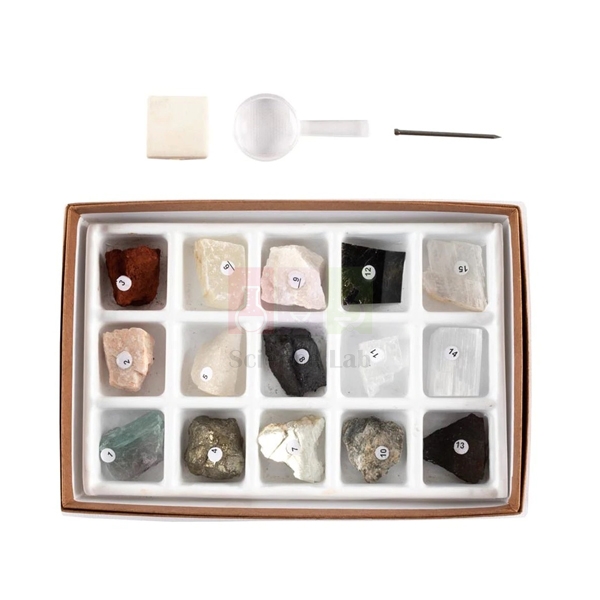
Mineral Study Kit
The Mineral Study Kit (Product Code: SLE/GG/08) brings together 15 important minerals as number-coded, 1-inch specimens that learners can handle, test and study one by one. The set ranges from soft talc and three forms of gypsum to magnetite, metallic pyrite and milky quartz, and it can also be added to an existing rock and mineral collection. It is supplied by Jain Scientific Equipments Pvt Ltd (ScienceLab), Ambala, for geography, earth science and chemistry classrooms.
Specifications
| Parameter | Detail |
|---|---|
| Number of minerals | 15 specimens |
| Specimen size | 1 inch |
| Identification | Number-coded specimens |
| Purpose | Handling, testing and learning about each mineral; can be added to any rock and mineral collection |
The 15 specimens in the kit:
- Fluorite
- Feldspar – Microcline
- Hematite
- Mica – Muscovite
- Magnetite
- Mica – Biotite
- Graphite
- Gypsum – Alabaster
- Talc
- Halite
- Gypsum – Satin Spar
- Gypsum – Selenite
- Pyrite
- Milky Quartz
- Calcite
Typical Use
Students work through simple property tests on each numbered specimen. Scratch tests compare hardness — talc is the softest mineral on the Mohs scale, while quartz is hard enough to scratch glass. A streak test on an unglazed plate shows that hematite leaves a reddish-brown streak even when the specimen looks dark, and a small magnet picks out magnetite straight away.
The two micas peel into thin flexible sheets, a clear example of cleavage; graphite marks paper, which explains its use in pencils; and the three gypsum forms — alabaster, satin spar and selenite — show how one mineral can look very different. Calcite’s reaction with dilute acid is best shown by the teacher. Because the specimens are number-coded, teachers can run blind identification quizzes, and adding a streak plate and a hand lens turns the kit into a complete mineral testing station for an earth science kit or geography lab.
Supplier
ScienceLab, the trading name of Jain Scientific Equipments Private Limited in Ambala, Haryana, supplies this mineral set to schools and colleges alongside its own teaching apparatus. More about us is on the company profile.
Related Geography Lab Equipment
Tools and sets that go with mineral study:
- Mineral Test Kit — a companion kit for testing mineral properties
- Black Streak Plates — show the streak of light-coloured minerals clearly
- Streak Plates Glass — an alternative plate option for streak work
- Mineral ID Starter Set — a further mineral identification set from our earth science range
- Storage Boxes – Rock – Mineral Specimens — keeps the number-coded specimens organised
See more in Geography Lab Equipment.
Frequently Asked Questions
Which minerals are in the kit?
Fluorite, feldspar (microcline), hematite, muscovite and biotite mica, magnetite, graphite, three forms of gypsum (alabaster, satin spar and selenite), talc, halite, pyrite, milky quartz and calcite — 15 in total.
How big are the specimens?
Each specimen is 1 inch in size.
How are the specimens identified?
Each one is number-coded. If you need a printed key for the codes, contact us to confirm what is supplied.
Can it be combined with a collection we already have?
Yes. The kit is intended to be added to any rock and mineral collection.
Are testing tools such as streak plates included?
Testing tools are not listed with this kit; see the Mineral Test Kit and streak plates above if you need them.
Are there any handling precautions?
Students should not taste specimens (halite is rock salt) and should wash their hands after handling minerals such as graphite and hematite, which can leave marks.
Can you supply class quantities or ship overseas?
Yes. We supply schools in India and international markets; list the number of kits in your enquiry cart.
Request a Quote
To order the Mineral Study Kit, contact us or add it to your enquiry cart.
Last updated: 24 September 2026