- Physics Lab Equipment
- Chemistry Lab Equipment
- Biology Lab Equipment
- Anatomical Lab Equipment
- Learning
- Educational Lab Equipment
- Magnets
- Agriculture
- Astronomy
- Earth Science
- Geography Lab Equipment
- Safety Lab Coat
- Laboratory
- Meteorological
- Electricity & Magnetism
- Heat
- School Lab Equipment
- Lab Glassware
- Science Lab Equipment
- Tvet Lab Equipment
- Robotics Kits Supplier and Manufacturer for Schools India
- Math Lab Equipment Manufacturers and Exporters in Ambala
- STEM Kits Manufacturers and Supplier India
- Engineering Lab Equipment
- Hospital Lab Equipment
- Water, Sanitation & Hygiene Supplies
- Cold Chain, Solar & Communication Equipment
- Nutrition
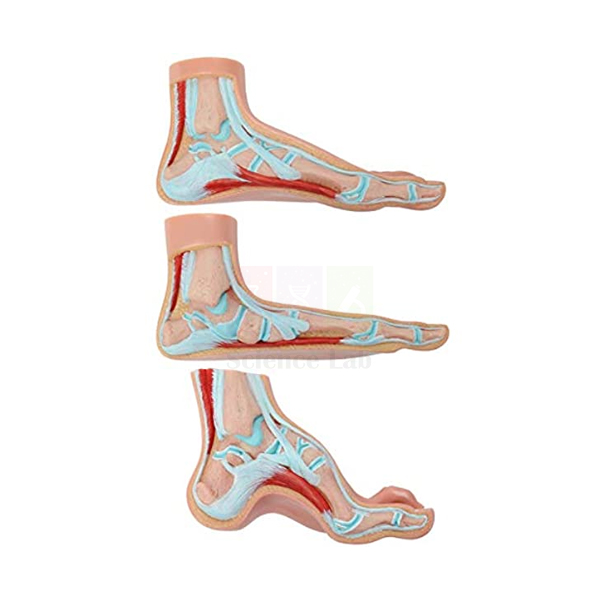
Human Foot Model Set
Human Foot Model Set (Product Code: SLE/A/107) contains 3 life-size models representing cross sections of a normal, a flat and an arched human foot, supplied with a key. Unlike a general human body model kit, this set focuses on one clear comparison: how the shape of the foot's arch changes the structure of the foot. It is used in physiotherapy, podiatry, sports science and biology teaching, and is manufactured by Jain Scientific Equipments Pvt Ltd (ScienceLab), Ambala.
Specifications
| Parameter | Detail |
|---|---|
| Type | Set of cross-section models of the human foot |
| Models in set | 3 — normal foot, flat foot and arched foot |
| Scale | Life size |
| Size | 22 x 12 x 8 cm (each model) |
| Key | Included |
Typical Use
Lined up side by side in the same orientation, the three sections let students see at once how a flat foot and an arched foot differ from a normal one. Teachers use the comparison to explain what the arch does, spreading body weight and absorbing impact during walking and running, and why a collapsed or exaggerated arch can lead to discomfort in the feet, knees or back.
Physiotherapy, podiatry and orthotics students use the set when learning to assess foot posture, sports-science courses use it in lessons on gait and footwear, and schools use it in health education sessions on posture and choosing suitable shoes. Because each model is life size, learners can compare the sections directly with their own feet. Keep the key with the set so every structure can be named during practicals.
Manufacturer
This foot set is manufactured by Jain Scientific Equipments Private Limited. Operating as ScienceLab out of Ambala, Haryana, the company builds and supplies anatomy models and laboratory equipment for education buyers throughout India and international markets. Details are on the company profile.
Related Human Models
Models that extend a lesson on the foot and lower limb:
- Human Skeletal Foot Model — shows the bones that form the arches
- Human Foot Set Model — an alternative foot set for comparison
- Human Leg and Portion of Pelvis Model — places the foot within the whole lower limb
- Human Knee Joint Model, Life Size — for discussing how foot posture affects the knee
- Human Elbow Cross-Section Model — another life-size section for a sectional anatomy series
The Human Models category lists our complete range.
Frequently Asked Questions
What does the set contain?
Three life-size cross-section models, one each of a normal, flat and arched human foot, plus a key.
How big is each model?
Each model measures 22 x 12 x 8 cm.
What is the teaching point of having three feet?
Comparing them side by side shows how arch shape alters the structure of the foot, which is the basis for understanding flat feet and high arches.
Can the models be purchased separately?
The item is listed as a set of 3. If you need individual models, please contact us to check availability.
Is the set suitable for physiotherapy and podiatry courses?
Yes, it is well suited to foot-posture and gait teaching in these courses, as well as sports science and school health education.
How should the set be stored?
Store the three models together in a closed cabinet, away from heat and direct sunlight, and wipe them with a soft damp cloth when needed.
Can you deliver outside India?
Yes, we supply institutions in India and international markets. Send the quantity and destination via the enquiry cart; warranty and delivery terms come with the quotation.
Request a Quote
To receive a quotation for the Human Foot Model Set, contact us or add it to your enquiry cart.
Last updated: 24 September 2026
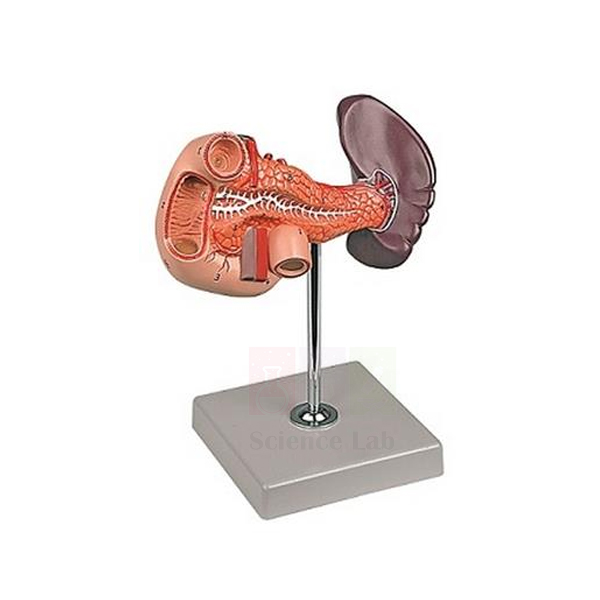
Human Spleen, Duodenum, and Pancreas Model
Human Spleen, Duodenum, and Pancreas Model (Product Code: SLE/A/108) is a life-size model of three neighbouring upper-abdominal organs, mounted on a stand with base. It shows the pancreatic duct, the blood vessels and a partially opened duodenum, helping students understand how the pancreas delivers its secretions into the intestine. The model is used in anatomy, physiology and nursing teaching and is made by Jain Scientific Equipments Pvt Ltd (ScienceLab), Ambala, one of the human anatomical model manufacturers in India.
Specifications
| Parameter | Detail |
|---|---|
| Type | Model of the spleen, duodenum and pancreas |
| Scale | Life size |
| Size | 12 × 22 × 23 cm (H) |
| Mounting | On stand with base |
| Structures shown | Pancreatic duct, blood vessels and partially opened duodenum |
Typical Use
This region is hard to picture from diagrams because the organs sit deep in the abdomen, tucked behind the stomach. The model brings them out where a class can see them: students follow the pancreatic duct through the pancreas towards the duodenum, then look into the opened section of the duodenum to understand where digestive juices meet food leaving the stomach. The blood vessels give a starting point for discussing how these organs are supplied.
It also prompts a useful discussion of function, since the pancreas works in both digestion and blood-sugar control while the spleen, despite its position, belongs to the immune and blood-filtering systems. Zoology and physiology departments add it to their zoology lab equipment for these lessons, and nursing courses use it when introducing conditions such as pancreatitis and diabetes. Its compact size makes it easy to pass between small groups.
Manufacturer
ScienceLab is the name under which Jain Scientific Equipments Private Limited manufactures and sells its products, including this abdominal organ model. The company works from Ambala, Haryana, and serves schools, colleges and dealers in India and international markets. More information is on the company profile.
Related Human Models
Models used alongside this one in digestive and abdominal anatomy:
- Human Pancreas, Spleen and Duodenum Model — an alternative model of the same organ group
- Pathology of the Human Pancreas, Duodenum, and Gallbladder Model — adds disease states for clinical courses
- Human Liver and Gallbladder Model — completes the story of secretions reaching the duodenum
- Human Digestive Tract Model — shows where the duodenum fits in the whole tract
- Rear Organs of the Upper Abdomen — a regional view of the organs behind the stomach
Browse all Human Models for more.
Frequently Asked Questions
Which structures are shown?
The spleen, duodenum and pancreas, with the pancreatic duct, blood vessels and a partially opened duodenum.
Why is the duodenum partly opened?
So students can see inside the part of the intestine that receives the pancreatic duct, rather than only its outer surface.
What size is it?
It is life size and measures 12 × 22 × 23 cm in height on its stand with base.
Does the model come apart?
Our listing does not describe it as dissectible. Contact us if you need to confirm this before ordering.
Are the liver and gallbladder included?
No, they are not listed as part of this model. The Human Liver and Gallbladder Model in the related list covers them.
What care does it need?
Wipe it gently with a soft cloth, lift it by the stand or base, and store it covered when not in use.
How do we request a formal quotation?
Send the quantity, delivery location and any companion models through the contact form or enquiry cart; warranty terms are given in the quotation.
Request a Quote
For pricing on the Human Spleen, Duodenum, and Pancreas Model, contact us or add it to the enquiry cart.
Last updated: 24 September 2026
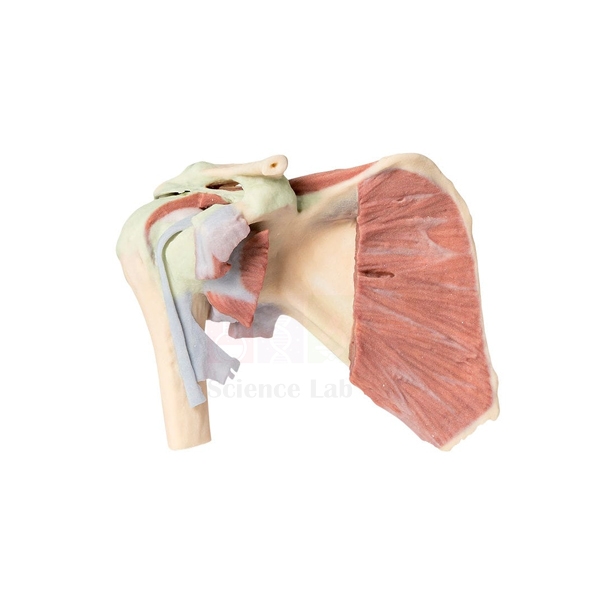
Shoulder Girdle with Musculature Model
Shoulder Girdle with Musculature Model (Product Code: SLE/A/109) is a one-piece, about life-size model that gives a 360° view of the muscular and bony elements of the human shoulder girdle and upper arm. Rod-mounted on a durable polymer base and supplied with a numbered key, it is a practical piece of educational lab equipment in India's physiotherapy, sports-science, nursing and medical colleges. It is manufactured by Jain Scientific Equipments Pvt Ltd (ScienceLab), Ambala.
Specifications
| Parameter | Detail |
|---|---|
| Type | Muscular model of the shoulder girdle and upper arm |
| Scale | About life size |
| Size (without base) | 17 × 21 × 10 cm |
| Construction | One-piece model |
| Mounting | Rod-mounted on durable polymer base |
| View | 360° view of muscular and bony elements |
| Key | Numbered key included |
Typical Use
The shoulder is the most mobile joint in the body, and that mobility depends on muscles as much as bones. Mounted on a rod above its base, this model can be studied from the front, back and sides, so students can see how muscles wrap over and around the shoulder girdle and continue down the upper arm. Using the numbered key, they can identify each muscle and bone and then discuss which muscles lift, rotate and stabilise the arm.
Physiotherapy and sports-science tutors use it when explaining common shoulder injuries and rehabilitation exercises, while nursing and medical students use it for upper-limb anatomy practicals and injection-site orientation. Because it is a single piece with no removable parts, it withstands frequent handling in busy practical classes, a useful quality in shared biology lab equipment. Place it in the centre of a group table so everyone gets a different viewing angle.
Manufacturer
Ambala-based Jain Scientific Equipments Private Limited manufactures this shoulder model and markets it, like the rest of its range, as ScienceLab. The company is registered in Haryana and supplies educational institutions in India and international markets. For more about who we are, see the company profile.
Related Human Models
Models that complete an upper-limb and shoulder lesson:
- Human Shoulder Joint Model — the joint itself, for studying bones and articulation
- Shoulder Joint Model — an alternative shoulder joint model for group work
- Human Muscular Arm Model — continues the musculature down to the forearm and hand
- Human Elbow Cross-Section Model — a sectional view of the next joint along the arm
- Human Muscular Torso with Head and Open Back Model — shows the back and chest muscles that attach to the shoulder girdle
Find further models in the Human Models category.
Frequently Asked Questions
Does the model come apart?
No. It is a one-piece model, so there are no parts to lose or reassemble.
How large is it?
It is about life size and measures 17 × 21 × 10 cm without the base.
What anatomy can be studied?
The muscular and bony elements of the shoulder girdle and upper arm, visible from all sides thanks to the 360° view.
Is a key supplied?
Yes, a numbered key is included for identifying the structures.
How is it mounted?
It is rod-mounted on a durable polymer base, which holds the model clear of the table for viewing.
How should it be cleaned?
Wipe with a soft cloth lightly dampened with water, dry it, and avoid harsh chemicals on the model and base.
Can you quote for export or large orders?
Yes. We quote for institutions and distributors in India and international markets; provide quantity and destination via the contact page or enquiry cart. Warranty terms are confirmed in the quotation.
Request a Quote
Get a price for the Shoulder Girdle with Musculature Model by contacting us or adding it to your enquiry cart.
Last updated: 24 September 2026
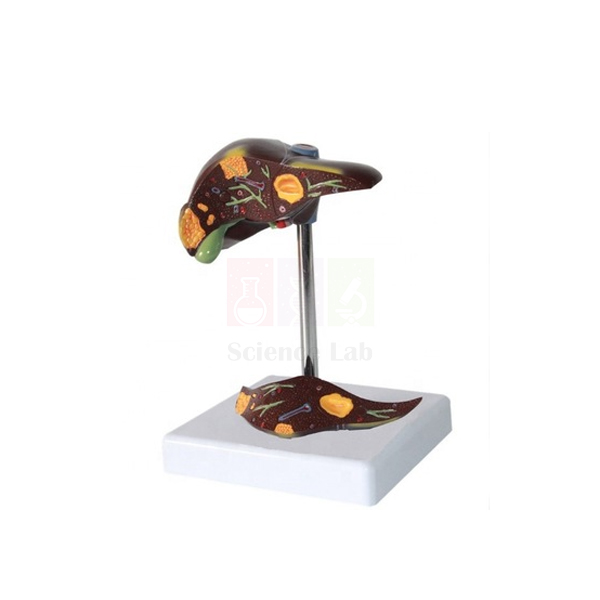
Human Liver Pathology Model
Human Liver Pathology Model (Product Code: SLE/A/110) is a life-size model of the human liver and gallbladder that depicts common pathologies of these organs, supplied with a full-colour, double-sided, illustrated key card that explains what each area shows. It is manufactured by Jain Scientific Equipments Pvt Ltd (ScienceLab), Ambala, for medical and nursing education, hepatology and gastroenterology patient counselling, and advanced biology teaching where disease is taught alongside normal anatomy.
Specifications
| Parameter | Detail |
|---|---|
| Scale | Life size |
| Organs | Human liver and gallbladder |
| Content | Common pathologies of the liver and gallbladder |
| Key | Full-colour, double-sided, illustrated key card included |
| Size | 8 x 4-1/2 x 5-1/2 in |
Typical Use
Pathology is easier to remember when it can be seen on a real-sized organ. Tutors hand out the illustrated key card, and students locate each depicted condition on the model before discussing its causes and consequences. Used next to a healthy liver model, it shows clearly how disease changes the appearance of liver and gallbladder tissue, which supports lectures on alcohol, infection, diet and other risk factors for liver disease.
In clinics, a doctor or dietitian can use the model and card to explain a diagnosis to a patient in plain terms. For colleges assembling a human biology model set with a disease component, it covers the digestive organs that are most often asked about. Store the key card with the model so the two are never separated, and clean the surface with a dry cloth only.
Manufacturer
Jain Scientific Equipments Private Limited manufactures this model under its ScienceLab brand in Ambala, Haryana, where the company develops teaching models and laboratory apparatus. Procurement teams completing vendor registration can use the company’s GSTIN 06AAECJ8618A1ZT and LEI 3358004HRD1JIVXKYX49. Further information is on our company profile.
Related Digestive System Models
Models that help teach liver and biliary disease against normal anatomy:
- Human Liver and Gallbladder Model — enlarged healthy internal anatomy for comparison
- Human Liver Model — a normal liver reference for introductory lessons
- Gallstone Model — focuses on gallstones and gallbladder inflammation in the biliary system
- Pathology of the Human Pancreas, Duodenum, and Gallbladder Model — extends pathology teaching to neighbouring digestive organs
See the complete Digestive System category for more organ models.
Frequently Asked Questions
Which pathologies are shown?
The model depicts common pathologies of the liver and gallbladder, identified on the included key card. For the full list before ordering, contact us and we will share it.
What is on the key card?
It is a full-colour, double-sided, illustrated card that explains the features shown on the model, so the model can be used without a separate textbook.
What are the dimensions?
The model is life size and measures 8 x 4-1/2 x 5-1/2 inches.
Is the model a single piece?
Our description does not state that it separates into parts. Please check with us if you need a take-apart version.
Can you provide vendor registration details for a tender?
Yes. Our GSTIN and LEI appear in the Manufacturer section above, and further documents required by your tender can be discussed with our team.
Is bulk supply to several campuses possible?
Yes. Give us the quantity and delivery points, in India or abroad, and we will quote accordingly.
Request a Quote
Request pricing for the Human Liver Pathology Model through our contact page, or add it to your enquiry cart to combine it with healthy liver models in one quotation.
Last updated: 24 September 2026
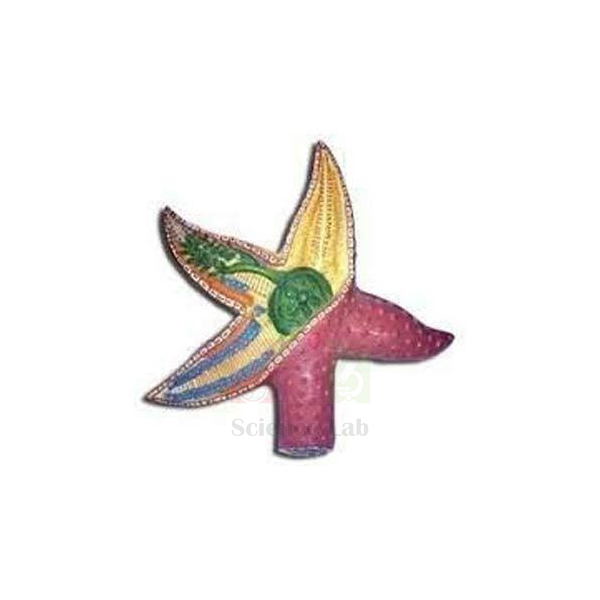
Starfish Model
Starfish Model (Product Code: SLE/A/111) is a three-part zoology model of Asterias used to teach the external and internal anatomy of a starfish in echinoderm practicals. Three of its five arms are cut in longitudinal section at different stages of dissection, taking students from normal organ positions down to the nerve ring, and a numbered key is included. It is made by Jain Scientific Equipments Pvt Ltd (ScienceLab), the OEM manufacturer, at its own factory in Ambala, India.
Specifications
| Parameter | Detail |
|---|---|
| Species | Asterias (starfish) |
| Construction | Three-part model showing detailed internal and external anatomy |
| Size | 53 x 35 x 31 cm |
| Sectioned arms | 3 of the 5 arms shown in longitudinal section |
| Arm 1 | Normal organ positioning |
| Arm 2 | Pyloric caeca and gonads removed to show ampullae, Polian vesicles and the ring canal |
| Arm 3 | Completely dissected to reveal the nervous system (nerve ring and radial nerve) |
| Supplied with | Numbered key |
| Product code | SLE/A/111 |
| Manufacturer | Jain Scientific Equipments Pvt Ltd (ScienceLab) — OEM |
| Country of origin | India (made in Ambala, Haryana) |
What Is the Starfish Model Used For?
The staged arms make the model work like a guided dissection. A teacher can start on the first arm to show where the digestive glands and gonads sit, move to the second to explain the water vascular system through the ampullae, Polian vesicles and ring canal that drive the tube feet, and finish on the third to trace the nerve ring and radial nerve that coordinate an animal with no brain. Students then sketch each arm and label it from the numbered key, building the observation skills expected in practical examinations.
Echinoderms often confuse learners because adult starfish show five-part radial symmetry. Keeping this model with other invertebrate models lets a class compare body plans across phyla, and it is a sound choice for colleges building up zoology lab equipment in India where preserved marine specimens are difficult to obtain or maintain.
OEM Manufacturer
The Starfish Model is an own-make product of Jain Scientific Equipments Private Limited, which trades as ScienceLab and acts as the OEM (original equipment manufacturer). It is produced at the company's licensed factory at Saha, Ambala, Haryana, and dispatched factory-direct to schools, universities, dealers and importers. If one of the three parts ever needs replacing, ask us — the maker handles such requests itself. The company profile has more background.
Related Animal Models
Other items for an invertebrate zoology unit:
- Hydra Model — a cnidarian for comparing a simpler radially arranged body plan.
- Comparative Tapeworm Set — adds flatworms to a comparison across invertebrate phyla.
- Invertebrate Sampling Tray — for sorting live invertebrates collected on field trips.
- Classification of Living Things Poster — places echinoderms within the animal kingdom at a glance.
The complete range is in our Animal Model category.
Frequently Asked Questions
Which starfish does the Starfish Model represent?
The Starfish Model represents Asterias, the starfish genus commonly used for echinoderm type studies. Its three-part construction shows both the external surface and the internal organs, so one model covers the anatomy normally taught for this group.
What does each dissected arm of the Starfish Model show?
On the Starfish Model, one sectioned arm shows normal organ positions, one has the pyloric caeca and gonads removed to expose the ampullae, Polian vesicles and ring canal, and one is fully dissected to reveal the nerve ring and radial nerve.
How big is the Starfish Model?
The Starfish Model measures 53 x 35 x 31 cm, large enough for a group demonstration on a bench or teacher's desk. It comes with a numbered key so students can match each labelled structure to its name.
Who manufactures the Starfish Model?
The Starfish Model is made by Jain Scientific Equipments Pvt Ltd (ScienceLab), its OEM, at the company's own licensed factory at Saha, Ambala, Haryana, India. Institutions and dealers order it factory-direct, with quotations issued by the manufacturer.
Can the Starfish Model replace dissection of a real specimen?
The Starfish Model covers the same structures in a reusable form and is useful where preserved starfish are hard to obtain or store. Many teachers use it alongside specimen work, or instead of it, depending on their syllabus and institutional policy.
How should the Starfish Model be stored?
Keep the three parts of the Starfish Model together in a closed cabinet away from heat and direct sunlight, and dust the surfaces with a soft brush or dry cloth so the detail and numbered labels remain easy to read.
Request a Quote
Request a price for the Starfish Model on our contact page, or add it to the enquiry cart while you browse other models; the manufacturer replies with the quotation.
Last updated: 24 September 2026
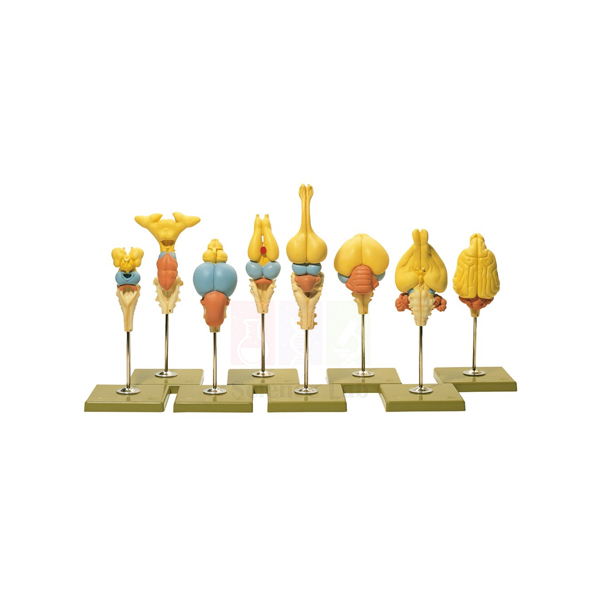
Vertebrate Brains Model Set
Vertebrate Brains Model Set (Product Code: SLE/A/112) is a set of 8 one-part brain models used to compare the brain anatomy of different vertebrates in lessons on comparative anatomy, the nervous system and evolution. Homologous structures share the same colour on every model, so senior school and college zoology students can follow one brain region across species at a glance. The set is made by Jain Scientific Equipments Pvt Ltd (ScienceLab), the OEM manufacturer, at its own factory in Ambala, India.
Specifications
| Parameter | Detail |
|---|---|
| Contents | 8 brain models |
| Model construction | Each model is 1 part |
| Coverage | Each model depicts the detailed anatomy of a particular vertebrate |
| Colour coding | Homologous structures shown in the same colour across species |
| Study areas | Comparative anatomy, the nervous system, evolution |
| Product code | SLE/A/112 |
| Manufacturer | Jain Scientific Equipments Pvt Ltd (ScienceLab) — OEM |
| Country of origin | India (made in Ambala, Haryana) |
What Is the Vertebrate Brains Model Set Used For?
Comparative lessons on the vertebrate brain usually look at how regions such as the olfactory bulbs, cerebrum, optic lobes and cerebellum change in relative size between groups, and what that says about each animal's senses and behaviour. Because matching structures share one colour throughout the set, students can line the eight models up on a bench, follow a single region along the row and record which animals devote most of the brain to smell, vision or coordination. The same arrangement is a strong visual for homology: similar parts, inherited from a common ancestor, modified for different ways of life.
Teachers often give each group one model to describe and then combine the findings in a class comparison table. As one-part models they are quick to hand out and collect, and they pair naturally with a human brain model for the last step of the comparison, making the set one of the more versatile biology teaching aids in India for evolution topics.
OEM Manufacturer
Jain Scientific Equipments Private Limited, trading as ScienceLab, is the original equipment manufacturer (OEM) of this brain set. The eight models are produced at the company's own licensed factory at Saha, Ambala, Haryana, and supplied factory-direct to schools, colleges, teacher-training institutes, dealers and importers. Questions about the species list, repeat orders or replacing a single model go straight to the manufacturer — ask us. Further details are on our company profile.
Related Animal Models
Good companions for a comparative anatomy series:
- Vertebrate Hearts Model Set — applies the same comparative approach to the circulatory system.
- Human Brain Model, 8 Parts — a dissectible human brain to finish the vertebrate comparison.
- Human Brain Model, 4 Parts — a simpler human brain option for junior classes.
- Classification of Living Things Poster — shows where each vertebrate group sits in the animal kingdom.
See all zoology models in the Animal Model category.
Frequently Asked Questions
How many models are in the Vertebrate Brains Model Set?
The Vertebrate Brains Model Set contains eight brain models, each a one-part model depicting the detailed brain anatomy of a particular vertebrate, so a class can line them up and compare the same regions from animal to animal.
Which animals are included in the Vertebrate Brains Model Set?
The species list for the Vertebrate Brains Model Set is not given in its product details. Please request it through the contact page so you can check the eight vertebrates against your syllabus before placing an order.
Why are some structures the same colour across the Vertebrate Brains Model Set?
In the Vertebrate Brains Model Set, homologous structures share one colour across all eight models. Students can therefore trace the same brain region from species to species quickly, which makes homology and evolutionary change easy to discuss.
Who manufactures the Vertebrate Brains Model Set?
The Vertebrate Brains Model Set comes from Jain Scientific Equipments Pvt Ltd (ScienceLab), which manufactures it as the OEM at its own licensed factory at Saha, Ambala, Haryana, India. Institutions and dealers receive quotations directly from the manufacturer.
Can individual models from the Vertebrate Brains Model Set be bought separately?
The Vertebrate Brains Model Set is offered as a complete set of eight. If your department needs only certain brains, or a replacement for one model, ask the manufacturer through the contact page and we will tell you what is possible.
Do the models in the Vertebrate Brains Model Set come apart?
No. Each brain in the Vertebrate Brains Model Set is a single-part model, which keeps handling simple when the models are handed out to groups and collected again at the end of a practical session.
Request a Quote
For the Vertebrate Brains Model Set, send an enquiry via the contact page or put it in the enquiry cart with the hearts set for a combined quote issued by the manufacturer.
Last updated: 24 September 2026
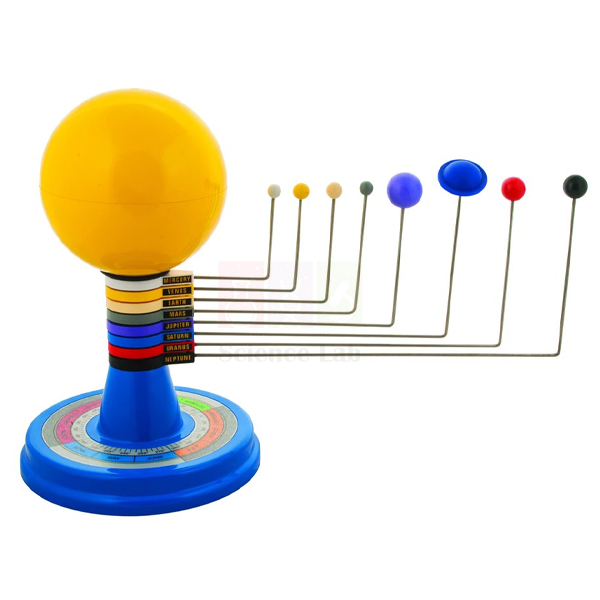
Solar System Model
The Solar System Model (Product Code: SLE/GG/01) is a classroom demonstration model of the planets revolving around the Sun, with the satellites (moons) of the planets also shown. The whole assembly is mounted on a base marked with the 12 zodiac signs, linking the planets’ paths to the constellations of the zodiac seen from Earth. Manufactured by Jain Scientific Equipments Pvt Ltd (ScienceLab), Ambala, it is used in geography rooms, science laboratories and astronomy clubs in schools.
Key Details
| Parameter | Detail |
|---|---|
| Type | Solar system demonstration model |
| Planets shown | Nine planets revolving around the Sun (traditional nine-planet layout) |
| Satellites | Satellites of the planets are also shown |
| Base | Mounted on a base with the 12 zodiac signs |
| Suitable for | Classroom teaching of the solar system, orbits, moons and the zodiac |
Typical Use
Teachers use the model to show the order of the planets outward from the Sun, the idea that planets travel in orbits while moons circle their planets, and the contrast between the small rocky inner planets and the large outer ones. Pointing to each planet in turn while students name it is a quick way to fix the sequence in memory before moving on to distances and orbital periods.
The zodiac ring on the base helps explain why the Sun appears to pass through different constellations during the year as Earth travels round it — a topic that is hard to follow from flat diagrams. The nine-planet layout also gives a ready discussion point: astronomers now class Pluto as a dwarf planet, so current textbooks list eight planets. Together with an Earth globe and a star globe, it forms a compact set of astronomy lab equipment for middle-school geography and science.
Manufacturer
Jain Scientific Equipments Private Limited manufactures this model in Ambala, Haryana, under its trading name ScienceLab, as part of a wider range of geography and science teaching aids. Our company profile has further details.
Related Geography Lab Equipment
Other aids for astronomy and Earth-in-space lessons:
- Orbiter Model — a companion model for teaching orbital motion
- Celestial Star Globe — helps students locate the zodiac constellations named on the base
- Project Planetarium Set — extends the lesson from the planets to the night sky
- Astronomy Clever Catch — a question ball for revising astronomy facts after the demonstration
- Earth Globe Model — moves from Earth’s place in the solar system to its interior
Browse our complete Geography Lab Equipment range.
Frequently Asked Questions
How many planets does the model show?
It is described as showing nine planets revolving around the Sun, the traditional count. Since Pluto is now classed as a dwarf planet, contact us before ordering if your syllabus needs the eight-planet convention.
Are the moons of the planets included?
Yes, the satellites of the planets are shown on the model.
What is marked on the base?
The base carries the 12 zodiac signs, useful for lessons on the Sun’s apparent path through the constellations.
Is it a motorised or hand-cranked model?
The product description does not mention a drive mechanism, so please contact us to confirm how the planets are mounted and whether they move.
How should the model be looked after?
Dust it with a soft dry cloth, avoid solvents on painted parts and keep it out of strong direct sunlight to protect the colours.
Can schools order it in quantity?
Yes. We supply schools and distributors in India and international markets; add it to the enquiry cart with the number required.
Request a Quote
For a price on the Solar System Model, contact us or add it to your enquiry cart.
Last updated: 24 September 2026
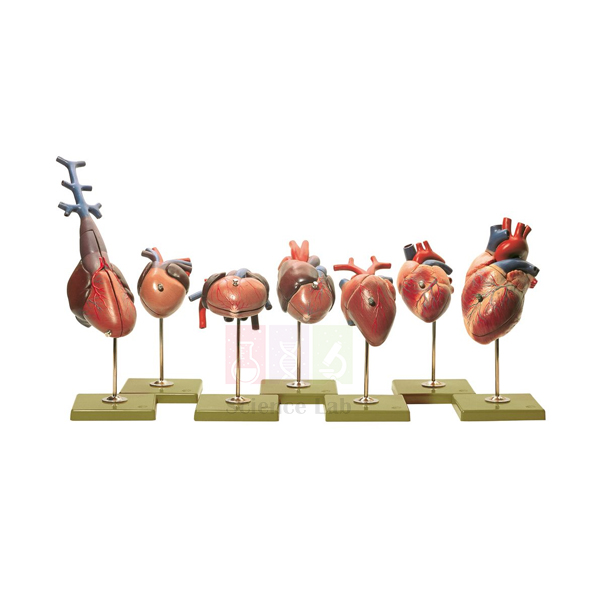
Vertebrate Hearts Model Set
Vertebrate Hearts Model Set (Product Code: SLE/A/113) is a set of 7 two-part heart models used to compare 2-, 3- and 4-chambered vertebrate hearts in lessons on the circulatory system, comparative anatomy and evolution. Each heart is life size or slightly enlarged and has the direction of blood flow marked, which suits senior school biology, college zoology and physiology classes. The set is made by Jain Scientific Equipments Pvt Ltd (ScienceLab), the OEM manufacturer, at its own factory in Ambala, India.
Specifications
| Parameter | Detail |
|---|---|
| Contents | 7 individual heart models |
| Model construction | Each model is 2 parts, for identifying external and internal structures |
| Scale | Life size or slightly enlarged |
| Blood flow | Direction of flow marked on each model |
| Heart types compared | 2-, 3- and 4-chambered hearts |
| Study areas | Comparative anatomy, circulatory system, evolution |
| Product code | SLE/A/113 |
| Manufacturer | Jain Scientific Equipments Pvt Ltd (ScienceLab) — OEM |
| Country of origin | India (made in Ambala, Haryana) |
What Is the Vertebrate Hearts Model Set Used For?
The set turns a textbook diagram of single and double circulation into something students can hold. Opening each two-part heart lets them count the chambers, find where oxygen-poor and oxygen-rich blood enter, and follow the marked flow direction to see where the two streams stay apart and where they can mix. A good exercise is to arrange the seven hearts from the least to the most divided and ask learners to explain how efficiently each can deliver oxygen to the body, linking structure to an animal's activity level.
Because the models are life size or only slightly enlarged, they also give a realistic sense of how heart size varies between animals. For departments comparing heart model anatomy options in India, the set extends teaching beyond the human heart alone, and it works equally well for evolution lessons, where the gradual separation of chambers is a classic example of modification over time.
OEM Manufacturer
ScienceLab is the trading name of Jain Scientific Equipments Private Limited (CIN U29309HR2020PTC087597), the OEM that makes this seven-heart set. Production takes place at the company's licensed factory at 449, HSIIDC Industrial Area, Saha, Ambala (Factory Licence AMB-ONLINE-CHD-J-414), from where sets go factory-direct to schools, colleges, dealers and importers. Replacement halves or repeat sets can be requested from the manufacturer itself. Learn more on our company profile.
Related Animal Models
Items that extend a circulatory system lesson:
- Human Heart Model — an enlarged, 3-piece human heart for detailed study of the four-chambered design.
- Human Cardiac Beat And Blood Circulation — demonstrates the heartbeat and the full circulation route.
- Hen Model — its sectioned side shows the heart in place among the other organs of a bird.
- Vertebrate Brains Model Set — the matching comparative series for the nervous system.
More zoology teaching models are in the Animal Model category.
Frequently Asked Questions
How many hearts does the Vertebrate Hearts Model Set contain?
The Vertebrate Hearts Model Set contains seven individual heart models. Each is built in two parts, so students can compare the outside of every heart and then look at its chambers and internal structures.
Are the models in the Vertebrate Hearts Model Set to scale?
Each heart in the Vertebrate Hearts Model Set is life size or slightly enlarged. The enlargement is kept small so that detailed structures are easy to identify while the set still gives a realistic sense of heart size.
Is blood flow shown on the Vertebrate Hearts Model Set?
Yes. The direction of blood flow is marked on every model in the Vertebrate Hearts Model Set, making it straightforward to discuss where oxygen-rich and oxygen-poor blood mix or stay separate in 2-, 3- and 4-chambered hearts.
Who manufactures the Vertebrate Hearts Model Set?
Jain Scientific Equipments Pvt Ltd (ScienceLab) is the OEM that manufactures the Vertebrate Hearts Model Set at its own licensed factory at Saha, Ambala, Haryana, India; the set is supplied factory-direct, with quotations issued by the manufacturer.
Which animals are represented in the Vertebrate Hearts Model Set?
The Vertebrate Hearts Model Set covers 2-, 3- and 4-chambered hearts, but the individual species are not listed in its product details. Please ask through the contact page for the current species list so you can match it to your syllabus.
How should the Vertebrate Hearts Model Set be looked after?
After each lesson, fit both halves of every heart in the Vertebrate Hearts Model Set back together, store the set in a closed cupboard and clean the surfaces with a soft dry cloth only, avoiding solvents.
Request a Quote
Ask for a quotation on the Vertebrate Hearts Model Set through the contact page, or add it to your enquiry cart; prices come direct from the manufacturer.
Last updated: 24 September 2026