- Physics Lab Equipment
- Chemistry Lab Equipment
- Biology Lab Equipment
- Anatomical Lab Equipment
- Learning
- Educational Lab Equipment
- Magnets
- Agriculture
- Astronomy
- Earth Science
- Geography Lab Equipment
- Safety Lab Coat
- Laboratory
- Meteorological
- Electricity & Magnetism
- Heat
- School Lab Equipment
- Lab Glassware
- Science Lab Equipment
- Tvet Lab Equipment
- Robotics Kits Supplier and Manufacturer for Schools India
- Math Lab Equipment Manufacturers and Exporters in Ambala
- STEM Kits Manufacturers and Supplier India
- Engineering Lab Equipment
- Hospital Lab Equipment
- Water, Sanitation & Hygiene Supplies
- Cold Chain, Solar & Communication Equipment
- Nutrition
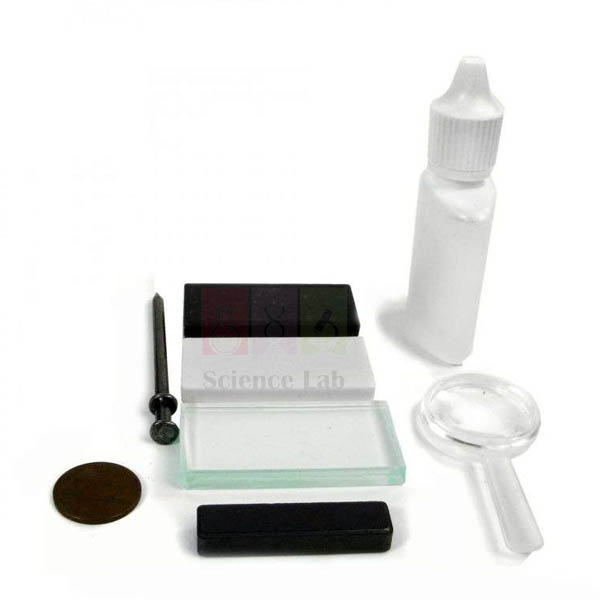
Mineral Test Kit
Mineral Test Kit (Product Code: SLE/GG/19) supplies students with the tools they need for rock, mineral and fossil identification, packed together in a zip-lock pouch for easy storage. The kit contains a penny, streak plate, hand lens, dropper bottle, glass plate, magnet, nail and hardness scale — everything needed to run the classic streak, scratch-hardness and magnetism tests on unknown samples. Geography and earth science teachers hand it to groups during identification practicals and field work, making it a practical science kit for students of all levels. It is manufactured by Jain Scientific Equipments Pvt Ltd (ScienceLab), Ambala.
Specifications
| Parameter | Detail |
|---|---|
| Purpose | Rock, mineral and fossil identification |
| Storage | Zip-lock pouch |
| Kit contents | Penny, streak plate, hand lens, dropper bottle, glass plate, magnet, nail and hardness scale |
What each item is used for:
- Penny, nail and glass plate — everyday reference objects for scratch-hardness comparisons.
- Hardness scale — for ranking a sample once the scratch tests are done.
- Streak plate — for revealing the colour of a mineral’s powder.
- Hand lens — a hand lens magnifier for crystal shape, lustre, grain and fossil detail.
- Magnet — for checking whether a sample is magnetic.
- Dropper bottle — for applying a few drops of a teacher-approved test liquid.
Typical Use
A typical identification practical works through the tests in order. Students first look at the sample under the hand lens, then rub it across the streak plate to see the colour of its powder, which is often more reliable than the colour of the lump itself. Next they try to scratch it with the penny and the nail, and check whether it scratches the glass plate; the results let them place the sample on the hardness scale. A quick pass with the magnet picks out magnetic minerals such as magnetite, and the dropper bottle can be used, under supervision, for a fizz test on carbonate rocks.
Recording each result in a simple table and comparing it with a mineral identification chart turns the kit into a proper investigation rather than a guessing game. Handle the glass plate with care, wipe the streak plate clean between samples, and repack every item in the zip-lock pouch so the next group receives a complete kit.
Manufacturer
Jain Scientific Equipments Private Limited, trading as ScienceLab from Ambala in Haryana, manufactures this test kit as part of its geography and earth science teaching range. The company serves schools, universities and education distributors in India and international markets. You can read about the company on our profile page.
Related Geography Lab Equipment
These products pair naturally with the Mineral Test Kit:
- Mineral Study Kit — mineral samples to practise the tests on.
- Rock Study Kit — igneous, sedimentary and metamorphic specimens for identification work.
- Black Streak Plates — spare streak plates for groups working in parallel.
- Streak Plates Glass — extra glass plates for scratch-hardness testing.
- Mineral ID Starter Set — a mineral identification set for beginners.
See all products in Geography Lab Equipment.
Frequently Asked Questions
What is in the Mineral Test Kit?
A penny, streak plate, hand lens, dropper bottle, glass plate, magnet, nail and hardness scale, stored in a zip-lock pouch.
Does the kit include rock or mineral samples?
No samples are listed in this kit. Pair it with a specimen set such as the Mineral Study Kit or Rock Study Kit.
Is test acid supplied in the dropper bottle?
The kit lists a dropper bottle only. Schools normally fill it with a test liquid chosen under their own laboratory safety rules; please ask us if you need advice.
Can it be used outdoors?
Yes. The compact zip-lock pouch makes it easy to take on field trips, provided the glass plate is handled carefully.
How many kits does a class need?
One kit per group of students is the usual arrangement. Tell us your group numbers through the contact page for a quotation.
Do you supply kits in bulk for tenders or export?
Yes, ScienceLab supplies institutions and distributors in India and international markets.
Request a Quote
To order the Mineral Test Kit, send us an enquiry on the contact page or add it to your enquiry cart with the specimen sets you plan to test.
Last updated: 24 September 2026
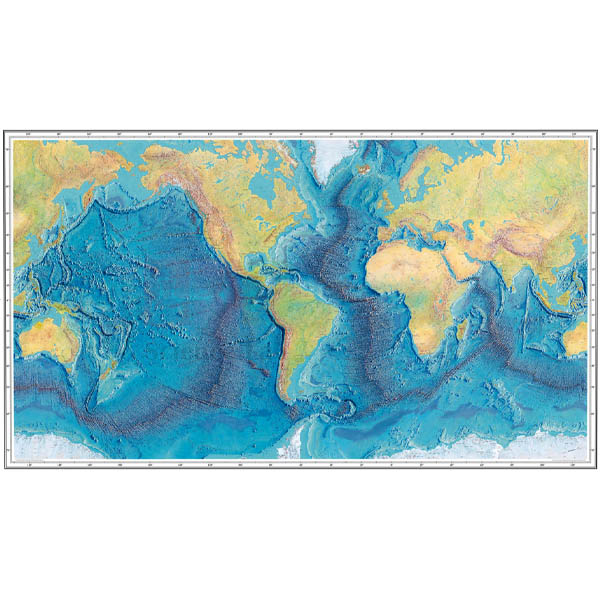
Ocean Floor Raised Relief Map
Ocean Floor Raised Relief Map (Product Code: SLE/GG/20) is a 660 x 990 mm raised relief map of the world that captures the geography of both the land and the ocean floor. Ridges, mountains, continental shelves, trenches, continental slopes and islands stand out in relief, so students can see and feel the shape of the seabed that a flat atlas page hides. Geography and earth science departments use it as a wall or table display for lessons on plate tectonics, oceans and landforms, and framing options are available. The map is manufactured by Jain Scientific Equipments Pvt Ltd (ScienceLab), Ambala.
Specifications
| Parameter | Detail |
|---|---|
| Coverage | World — land and ocean floor |
| Map type | Raised relief |
| Features depicted | Ridges, mountains, continental shelves, trenches, continental slopes and islands |
| Size | 660 x 990 mm |
| Framing | Framing options available |
Typical Use
The map is at its most useful when students trace features with their fingers: following a mid-ocean ridge across an ocean basin, then finding a deep trench beside a chain of islands or a mountain coast. That comparison opens up the idea of plates pulling apart at ridges and sinking at trenches, and explains why earthquakes and volcanoes cluster where they do. Continental shelves and slopes give a clear picture of where the land really ends and the deep ocean begins.
Teachers also use the map for quizzes on ocean names and island groups, and alongside a flat political map to show how much of Earth’s relief lies under water. The tactile surface helps learners who understand shapes best by touch. Like any piece of geography lab equipment, it lasts longer when dusted with a soft, dry brush, kept out of strong direct sunlight and protected from heavy pressure on the raised areas.
Manufacturer
Jain Scientific Equipments Private Limited, known to customers as ScienceLab, produces relief maps and other geography models in Ambala, Haryana. The company supplies schools, colleges and education distributors in India and international markets. Our company profile explains more about ScienceLab.
Related Geography Lab Equipment
Use these items with the Ocean Floor Raised Relief Map for a complete landforms and tectonics unit:
- Landform Relief Maps — relief maps focused on land features and topography.
- Physiographic Relief Globe — shows relief on a globe to avoid map distortion.
- Seismograph Model — links the plate boundaries on the map to how earthquakes are measured.
- Volcano Model — explains the volcanic islands and mountains marked on the map.
Browse further in Geography Lab Equipment.
Frequently Asked Questions
What size is the map?
It measures 660 x 990 mm.
Which ocean-floor features are shown?
Ridges, trenches, continental shelves and continental slopes, along with mountains and islands on land and at sea.
Is the map supplied framed?
Framing options are available. Tell us whether you need a framed or unframed map when you enquire through the contact page.
What material is it made from?
The material is not listed on this page. Please ask our team for construction details before ordering.
How should the map be cleaned?
Dust it gently with a soft, dry brush or cloth. Avoid solvents and do not press hard on the raised relief.
Can you supply maps for several classrooms or export customers?
Yes. ScienceLab quotes for multiple units and ships to institutions in India and international markets.
Request a Quote
Ask for a quotation on the Ocean Floor Raised Relief Map, framed or unframed, through our contact page, or add it to the enquiry cart.
Last updated: 24 September 2026
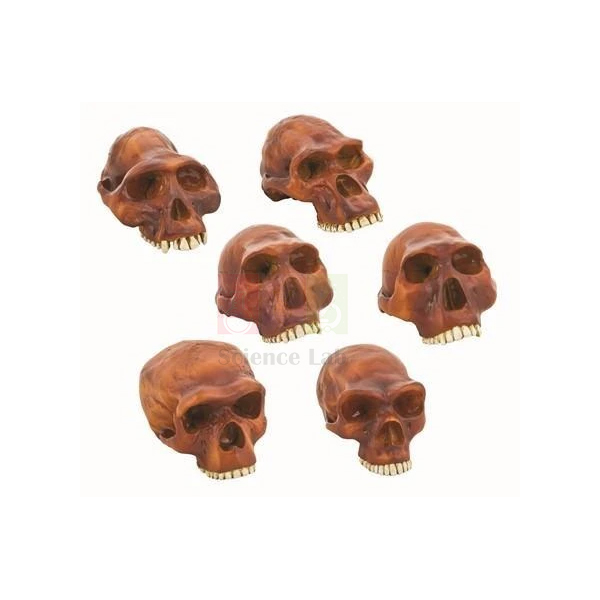
Anthropology Cranium Set
Anthropology Cranium Set (Product Code: SLE/A/129) is a set of 5 cast Hydrostone replicas of early hominid-type crania used to teach human evolution in anthropology, biology and archaeology courses. It covers Australopithecus afarensis, Australopithecus africanus, Homo habilis, Homo erectus and Homo neanderthalensis, so students can compare the crania side by side. It is made by Jain Scientific Equipments Pvt Ltd (ScienceLab), an OEM manufacturer, at its own factory in Ambala, India.
Key Details
| Parameter | Detail |
|---|---|
| Contents | 5 cranium replicas of well-known early hominid-type species |
| Crania in the set | Australopithecus afarensis; Australopithecus africanus; Homo habilis; Homo erectus; Homo neanderthalensis |
| Material | Hydrostone |
| Production | Cast replicas |
| Product code | SLE/A/129 |
| Manufacturer | Jain Scientific Equipments Pvt Ltd (ScienceLab) — OEM |
| Country of origin | India (made in Ambala, Haryana) |
What Is the Anthropology Cranium Set Used For?
Placed in the order in which the species appear in the fossil record, the five crania let students see the broad trends of human evolution for themselves. The braincase becomes larger and more rounded, the face projects less, and the jaws and teeth become smaller, while the heavy brow ridge of the Neanderthal cranium invites discussion of how closely related species differed. Students can also compare the position of the opening at the skull base where the spinal cord passes, a clue to upright walking.
A good practical asks groups to describe each cranium in their own words, then set it beside a modern human skull and list the differences. Homo habilis leads naturally into early stone-tool use, and Homo erectus into how early humans spread across continents. Hydrostone is a hard gypsum-based casting material, so handle the crania over a padded surface, keep them dry and dust them with a soft brush. For departments comparing human anatomical model manufacturers in India, the set adds evolutionary depth to a skull collection.
OEM Manufacturer
Jain Scientific Equipments Private Limited, known to customers as ScienceLab, is the OEM (original equipment manufacturer) of the Anthropology Cranium Set and produces it at its own factory in Saha, Ambala, Haryana, India. Universities, schools, museums, dealers and importers order the set factory-direct, with no trading intermediary.
The company is incorporated under CIN U29309HR2020PTC087597, and its premises at 449, HSIIDC Industrial Area, Saha, Ambala operate under Factory Licence AMB-ONLINE-CHD-J-414. If one cranium is damaged, ask us about a replacement. More detail is on the ScienceLab profile.
Related Skulls
Skulls that give the hominid crania a point of comparison:
- Human Skull — a life-sized modern human skull with colour-coded bones.
- Economy Human Skull — a detailed modern skull showing sutures, foramina and processes.
- Human Skull Model — a 3-part modern skull with full dentition for comparing teeth and jaws.
- Sheep Skull, Plastic — a non-primate skull for wider comparative anatomy.
Explore the Skulls category for more human and animal skulls.
Frequently Asked Questions
Which crania are included in the Anthropology Cranium Set?
The Anthropology Cranium Set includes 5 cranium replicas: Australopithecus afarensis, Australopithecus africanus, Homo habilis, Homo erectus and Homo neanderthalensis. Together they represent well-known early hominid-type species used in human evolution teaching.
What material is the Anthropology Cranium Set made of?
The Anthropology Cranium Set is cast in Hydrostone, a hard gypsum-based casting material. Handle the crania over a padded surface, keep them dry, and clean them with a soft brush rather than washing them with water.
Does the Anthropology Cranium Set include a modern human skull?
No. The Anthropology Cranium Set contains the 5 early hominid-type crania only. For comparison with modern humans, add a skull such as the Human Skull or the Economy Human Skull from our range to the same enquiry.
Which courses use the Anthropology Cranium Set?
The Anthropology Cranium Set is used in physical anthropology, in the human evolution units of biology and zoology courses, in archaeology teaching and in museum education, where learners compare braincase size, brow ridges and facial projection across species.
Who manufactures the Anthropology Cranium Set?
The Anthropology Cranium Set is manufactured by Jain Scientific Equipments Pvt Ltd (ScienceLab), the OEM, at its own licensed factory at Saha, Ambala, Haryana, India. Quotations, repeat orders and replacement questions go directly to the manufacturer.
Can a single cranium from the Anthropology Cranium Set be ordered?
Whether one cranium from the Anthropology Cranium Set can be supplied on its own is confirmed case by case. Please name the species you need on our contact page, and we will state availability in the quotation.
Request a Quote
Ask for an Anthropology Cranium Set quotation through our contact page or add the set to the enquiry cart. The quotation is issued directly by the manufacturer.
Last updated: 24 September 2026
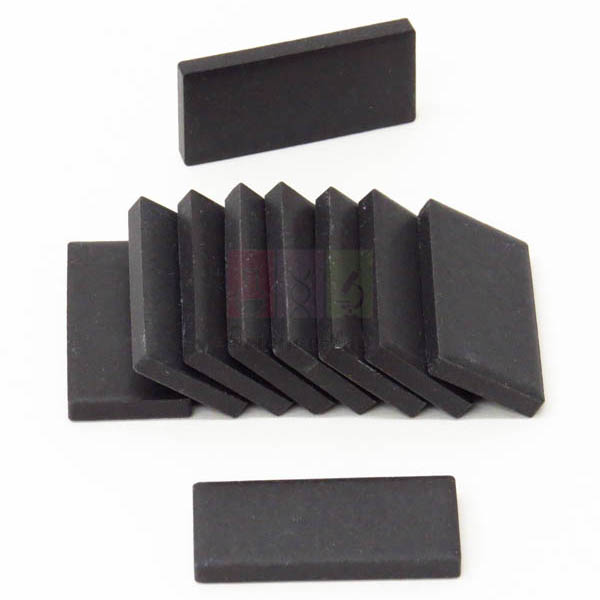
Black Streak Plates
Black Streak Plates (Product Code: SLE/GG/21) are 25 x 50 mm unglazed porcelain tiles for the streak test, one of the essential checks in mineral identification. Rubbing a mineral across the rough, unglazed surface leaves a line of powder, and the colour of that streak is a far steadier clue to a mineral’s identity than the colour of the specimen itself. The dark tile makes pale and white streaks easy to see, so these plates are a useful companion to white plates in school and college geology practicals. They are supplied by Jain Scientific Equipments Pvt Ltd (ScienceLab), Ambala, as part of its range of school lab equipment for earth science.
Specifications
| Parameter | Detail |
|---|---|
| Colour | Black |
| Material | Unglazed porcelain |
| Size | 25 x 50 mm |
| Form | Tile |
| Application | Streak testing of minerals |
Typical Use
Hold the plate flat on the bench and draw a corner or edge of the mineral firmly across it in a single stroke. Students then compare the powder line with a streak chart or identification key and note the colour in their results table. Minerals that look alike in the hand — for example two dark metallic samples — often separate clearly on the plate, which is why the streak test sits alongside lustre, hardness and magnetism in almost every identification routine.
A black plate is the better choice when the expected streak is white, cream or very pale, since those colours disappear against a white tile. Very hard minerals may scratch the plate instead of leaving powder, and that result is itself worth recording. Wipe the surface with a damp cloth between samples so earlier streaks do not confuse the next reading, and replace a plate once its working area becomes worn or smooth.
Supplier
Streak plates are consumable test accessories, so Jain Scientific Equipments Private Limited, the Ambala, Haryana company behind the ScienceLab name, supplies them as part of its mineral testing range. They are available to schools, colleges and distributors in India and international markets together with the company’s wider geography range. More information is on our company profile.
Related Geography Lab Equipment
These products are used in the same mineral identification practicals:
- Streak Plates Glass — clear glass plates for the scratch-hardness test.
- Mineral Test Kit — a pouch of identification tools including a streak plate, magnet and hardness scale.
- Mineral Study Kit — mineral samples to streak-test.
- Mineral ID Starter Set — a beginner’s mineral identification set.
The full range is in Geography Lab Equipment.
Frequently Asked Questions
What size are the Black Streak Plates?
Each tile measures 25 x 50 mm and is made of unglazed porcelain.
When should I use a black plate instead of a white one?
Use the black plate for minerals expected to leave a light-coloured streak; a white plate shows dark streaks better. Many labs keep both.
How many plates come in a pack?
The pack quantity is not listed on this page. Please confirm it, or request a specific quantity, through our contact page.
Can the plates be reused?
Yes. Wipe off the powder after each test; a plate can be used many times until its unglazed surface wears smooth.
Why is the plate unglazed?
A glaze would be too smooth to grind the mineral into powder. The unglazed porcelain surface provides the slight roughness the streak test needs.
Can you supply larger quantities for a school network or export?
Yes. We supply streak plates in quantity to institutions and distributors in India and international markets.
Request a Quote
Tell us how many Black Streak Plates you need via the contact page, or add them to the enquiry cart with your other mineral testing supplies.
Last updated: 24 September 2026
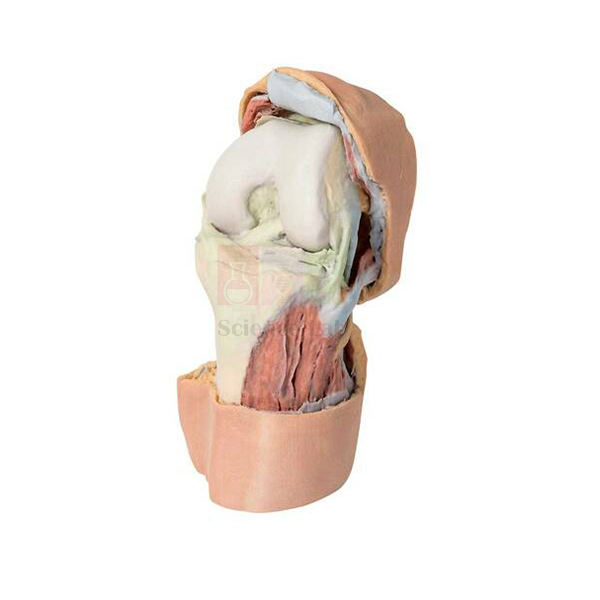
3D Printed Human Flexed Knee Joint
3D Printed Human Flexed Knee Joint (Product Code: SLE/A/130) is a 3-D printed anatomical model of a deep dissection of a flexed left knee, used to study detailed knee anatomy in medical and allied-health teaching without human cadavers. It measures 11-4/5" L x 9-4/5" W x 9-4/5" H and is designed to be as realistic as possible, giving departments without a dissection hall a lasting specimen for small-group work. It is supplied by Jain Scientific Equipments Pvt Ltd (ScienceLab), Ambala, India.
Specifications
| Parameter | Detail |
|---|---|
| Type | 3-D printed dissection model of the knee joint |
| Side | Left knee |
| Position | Flexed |
| Dissection shown | Deep dissection |
| Size | 11-4/5" L x 9-4/5" W x 9-4/5" H |
| Purpose | Realistic specimen study without human cadavers |
| Product code | SLE/A/130 |
| Supplied by | Jain Scientific Equipments Pvt Ltd (ScienceLab), Ambala, India |
What Is the 3D Printed Flexed Knee Joint Used For?
A flexed knee opens the front of the joint in a way that an extended model cannot, which is why dissection guides often study the knee in this position. With a deep dissection of the left knee in front of them, students can work through their dissection manual, locate the deeper joint structures it describes and relate them to landmarks they feel on their own legs. Instructors in medical, physiotherapy, sports medicine and orthopaedic courses use it for small-group demonstrations and for spotting tests where each station asks students to name a structure.
Because it is printed rather than preserved, the model needs no fixative chemicals or special disposal arrangements, which makes it a practical alternative to biological specimens alongside other human anatomical models. Handle it with both hands, avoid pressing on fine dissected details, dust it with a soft brush and keep it in a closed cabinet away from direct sunlight between classes.
Supplier
Jain Scientific Equipments Private Limited, trading as ScienceLab from Ambala, Haryana, supplies this 3-D printed knee dissection as part of the anatomy range it offers to medical, physiotherapy and sports science colleges. Buyers can combine it with the company's bone and joint models in a single quotation, and ScienceLab handles dispatch to institutions in India and international markets.
Read more about the company on the ScienceLab profile.
Related Bone Models
These models help build a complete lower-limb and joint teaching set around the dissected knee:
- Human Knee Joint Model, Life Size — a whole-joint model with flexible ligaments to compare with the dissected view.
- Miniature Functional Knee Joint — a half-size functional knee for demonstrating how the joint bends and straightens.
- Human Femur Bone Model — the thigh bone that forms the upper half of the knee.
- Hip Joint Model Human — the joint at the other end of the femur.
- 3-D Printed Human Superficial Hand Dissection Model — another printed dissection model for upper-limb lessons.
For more joints and skeletons, visit the Bone Model category.
Frequently Asked Questions
Which knee does the 3D Printed Human Flexed Knee Joint show, and in what position?
The 3D Printed Human Flexed Knee Joint shows a left knee held in flexion and prepared as a deep dissection, so the deeper structures of the joint are exposed for study rather than hidden beneath the surface layers.
Is the 3D Printed Human Flexed Knee Joint a real specimen?
No. The 3D Printed Human Flexed Knee Joint is a 3-D printed model designed to be as realistic as possible, which lets students study knee anatomy in detail without the need for human cadavers or preserved tissue.
What size is the 3D Printed Human Flexed Knee Joint?
The 3D Printed Human Flexed Knee Joint measures 11-4/5" L x 9-4/5" W x 9-4/5" H, a size that sits comfortably on a bench for a small group to gather round during a demonstration or spotting test.
Can the joint be moved?
No movement is described for the 3D Printed Human Flexed Knee Joint; it presents the knee fixed in flexion. For bending and straightening demonstrations, pair it with a functional knee model such as the Miniature Functional Knee Joint.
Is an identification key supplied with the model?
A key or numbered legend is not listed for the 3D Printed Human Flexed Knee Joint. Please contact us before ordering and we will confirm what documentation accompanies the model with your quotation.
Who supplies the 3D Printed Human Flexed Knee Joint?
The 3D Printed Human Flexed Knee Joint is supplied by Jain Scientific Equipments Pvt Ltd (ScienceLab), Ambala, India, which offers it alongside its bone and joint models so that anatomy departments can source a complete teaching set in one order.
What should an institutional enquiry include?
For the 3D Printed Human Flexed Knee Joint, give the code SLE/A/130, the quantity and the delivery location. ScienceLab supplies institutions in India and international markets and will reply with a written quotation.
Request a Quote
To ask about the 3D Printed Human Flexed Knee Joint, contact ScienceLab, or save it in your enquiry cart and send it with the rest of your anatomy order.
Last updated: 24 September 2026
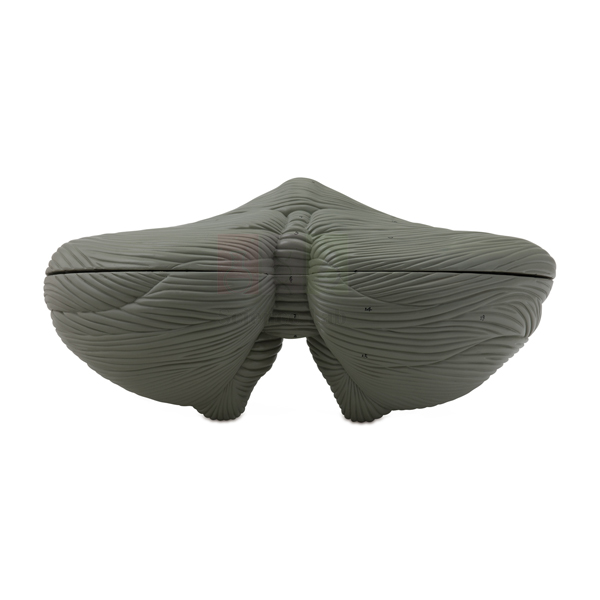
Enlarged Human Cerebellum Model
Enlarged Human Cerebellum Model (Product Code: SLE/A/131) magnifies the human cerebellum to 4x life size and is dissected to show details of its internal organization. It separates into 2 parts and comes with a numbered key, giving neuroanatomy lecturers a large, clear model for teaching the part of the brain that coordinates movement and balance. As school and college biology lab equipment in India, it suits advanced biology, psychology and health-science courses. It is manufactured by Jain Scientific Equipments Pvt Ltd (ScienceLab), Ambala.
Specifications
| Parameter | Detail |
|---|---|
| Type | Enlarged, dissected model of the human cerebellum |
| Scale | 4x life size |
| Size | 40 x 19 x 18 cm |
| Dissection | Dissectible into 2 parts |
| Internal detail | Dissected to show details of internal organization |
| Key | Numbered key included |
| Mounting | Not on base |
Typical Use
At life size the cerebellum is small and tucked beneath the back of the brain, so its structure is easy to overlook. Enlarged four times, it becomes a centrepiece for lessons on how the brain controls posture, balance and smooth, coordinated movement. Separating the 2 parts exposes the internal organization, and the numbered key lets students name what they see while the teacher explains how grey and white matter are arranged inside.
Physiotherapy and sports-science courses use it when discussing balance disorders and motor learning, psychology and neuroscience students use it in brain-structure modules, and senior biology classes use it to go beyond a whole-brain overview. It works well as part of a college biology lab setup alongside a brain stem model. Since it is not supplied on a base, rest it on a flat, padded surface during lessons and handle it with both hands.
Manufacturer
This cerebellum model is made by Jain Scientific Equipments Private Limited, an Ambala, Haryana manufacturer whose products are sold under the ScienceLab brand to education buyers in India and international markets. The company profile explains more about the business.
Related Laboratory Equipment
Models that fit alongside it in a neuroanatomy course:
- Enlarged Human Brain Stem Model — an enlarged companion for the structure the cerebellum connects to
- Human Brain Stem Model — a smaller brain stem model for group work
- Human Brain Model, 15 Parts — shows where the cerebellum sits in the whole brain
- Human Regional Brain Model — for teaching the functional regions of the brain
- Human Nervous System Model — links the brain to the rest of the nervous system
More models are available in the Human Models category.
Frequently Asked Questions
How large is the model?
It is 4x life size and measures 40 x 19 x 18 cm.
Is it supplied on a base or stand?
No, it is not on a base. It rests directly on a table, so a padded mat or tray is advisable.
How many parts does it have?
It is dissectible into 2 parts, which open to show the internal organization of the cerebellum.
Does it include a key?
Yes, a numbered key is included.
Which courses benefit most from it?
Neuroanatomy, psychology, physiotherapy and sports science, as well as senior school biology units on the brain.
How should it be stored?
Keep the two parts together in a closed cabinet or padded box, away from heat and sunlight, and wipe with a soft damp cloth when needed.
How do we get a price and warranty terms?
Send the quantity and delivery location via our contact page or enquiry cart; pricing and warranty terms are provided in the quotation.
Request a Quote
For a quotation on the Enlarged Human Cerebellum Model, contact us or add it to the enquiry cart.
Last updated: 24 September 2026
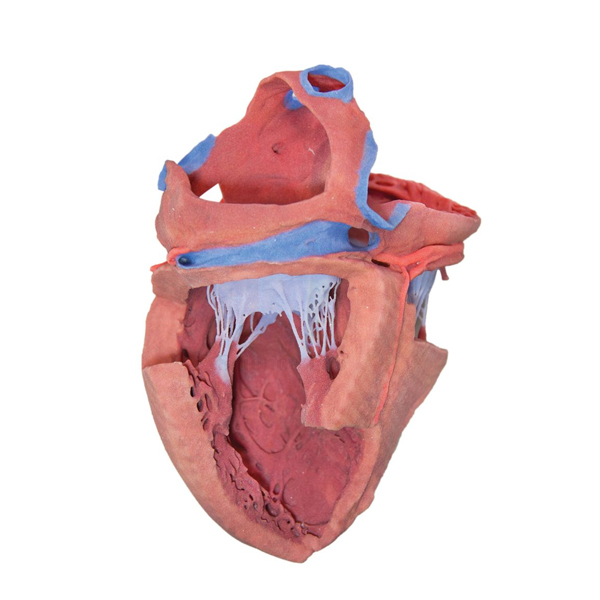
3-D Printed Internal Heart Structures Model
3-D Printed Internal Heart Structures Model (Product Code: SLE/A/132) is an about life-size, 3-D printed heart that has been dissected to display the internal structures of its chambers. It lets students study a specimen that is as realistic as possible without the need for human cadavers, which makes it valuable for cardiovascular teaching in medical, nursing and paramedical programmes. It is manufactured by Jain Scientific Equipments Pvt Ltd (ScienceLab), Ambala, a biology lab equipment supplier to institutions in India and abroad.
Specifications
| Parameter | Detail |
|---|---|
| Type | 3-D printed dissected model of the internal heart structures |
| Scale | About life size |
| Size | 11-4/5" W x 9-4/5" H x 9-4/5" L |
| Structures shown | Internal structures of the chambers of the heart |
| Purpose | Realistic specimen study without the need for human cadavers |
Typical Use
Understanding the heart means understanding what happens inside it. With the chambers opened, a lecturer can trace the route of blood from the body into the right side of the heart, out to the lungs, back into the left side and onward to the body, using the model's interior to explain how valves and the dividing wall keep that flow moving in one direction. Students who have only seen a heart model from the outside often find this the point at which the double circulation finally makes sense.
Because it is 3-D printed rather than preserved tissue, the model can be handled freely in ordinary classrooms and skills labs, with no specimen storage or chemical handling. It is used in anatomy practicals, cardiac nursing modules and paramedic training, and it complements a conventional heart model in anatomy classes across India: the external model for surface features, this one for the chambers within.
Manufacturer
Jain Scientific Equipments Private Limited manufactures the 3-D Printed Internal Heart Structures Model and trades under the ScienceLab name from Ambala, Haryana. Purchasing departments that require the company's registration documents for vendor onboarding can ask for them when requesting a quotation. See our company profile for more background.
Related Human Models
Models that round out a cardiovascular lesson:
- Human Heart Model — for the external features that complement this internal view
- Heart 3 times Natural Size Model — an enlarged heart for lecture-hall demonstrations
- Human Heart on Diaphragm Model — shows the heart in position with the diaphragm and pericardium
- 3-D Printed Human Superficial Hand Dissection Model — another cadaver-free 3-D printed dissection
- Microslide The Circulatory System — prepared slides for studying circulatory tissues under the microscope
Browse the Human Models category for our full anatomy range.
Frequently Asked Questions
What does the model show?
The internal structures of the chambers of the heart, exposed by dissection.
What are its dimensions?
It is listed as about life size, measuring 11-4/5" W x 9-4/5" H x 9-4/5" L. If exact dimensions matter for display or storage, contact us to confirm.
What is the advantage of a 3-D printed heart?
It gives students a realistic specimen to study without the need for human cadavers, so it can be used in any classroom.
Do sections come apart?
The model is dissected to reveal the chambers; removable parts are not listed in our product details. Please ask us if you need to confirm this.
Is a key or labelling guide included?
A key is not listed for this model. Contact us to check what is supplied with it.
How should it be cleaned?
Remove dust with a soft brush or dry cloth and use only a lightly dampened cloth for marks; keep it away from heat and solvents.
How do we arrange a quotation or export order?
Tell us the quantity, destination and any vendor documents you need through the contact page or enquiry cart. We supply India and international markets, and warranty terms are included in the quotation.
Request a Quote
For pricing on the 3-D Printed Internal Heart Structures Model, contact our team or add it to your enquiry cart.
Last updated: 24 September 2026
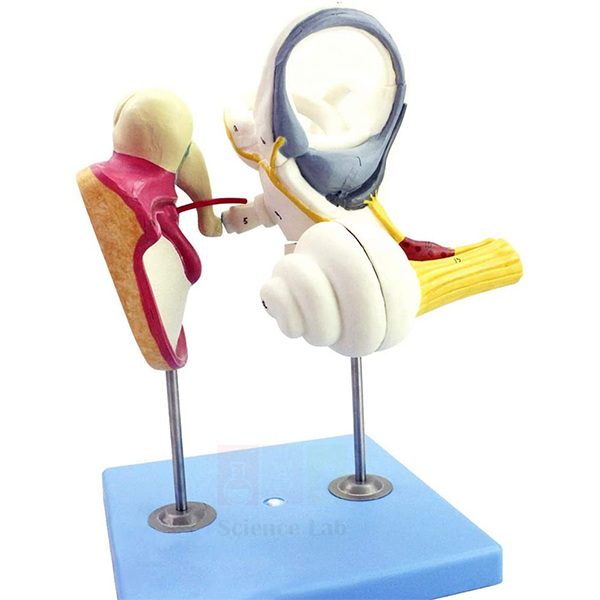
Human Inner Ear Model, 4x
The Human Inner Ear Model, 4x (Product Code: SLE/A/133) enlarges the organs of hearing that sit hidden inside the skull to about four times life size, so a class can follow sound from the eardrum, across the ear bones and into the cochlea. Biology teachers, nursing and paramedical tutors and ENT or audiology instructors use it as a compact ear model for anatomy lab teaching in India and abroad. It is made by Jain Scientific Equipments Pvt Ltd (ScienceLab), Ambala.
Specifications
| Parameter | Detail |
|---|---|
| Scale | About 4× life size |
| Size | 18 × 18 × 20 cm (H) |
| Mounting | On stand with base |
| Cochlea | Dissectible into 3 parts |
| Structures included | Cochlea, ear bones and tympanic membrane |
Typical Use
In a lesson on hearing, the teacher can start at the tympanic membrane, show how the ear bones pass vibration inward, and then lift the cochlea apart into its 3 parts to reveal the coiled interior where sound is turned into nerve signals. Because the structures are held on a stand, the model can be turned to face the class or passed along a bench for close inspection without anyone handling loose pieces.
The model also supports revision of common hearing problems, such as why damage to the eardrum or the ear bones reduces conduction while cochlear damage affects sensing. Among biology teaching aids for secondary school, nursing and allied-health courses, a bench-sized inner ear like this is easy to store and quick to set out for practical examinations.
Manufacturer
This inner ear model comes from Jain Scientific Equipments Private Limited, a company in Ambala, Haryana that sells its educational and laboratory range under the ScienceLab name. Schools, colleges and distributors can read about the company’s background on our company profile page.
Related Human Models
Models and apparatus that fit the same lesson on the ear and hearing:
- Human Inner Ear Model, 18x — a much larger view of the inner ear for detailed study of the labyrinth
- Human Ear Model, 5 Parts — puts the inner ear in context with the outer and middle ear
- Human Ear Model — a one-piece ear with blood vessels for quick overview teaching
- Tuning Fork Set, Steel — for simple sound and hearing demonstrations alongside the model
See the complete Human Models range for more anatomy teaching models.
Frequently Asked Questions
Which parts of the ear does this model include?
It includes the cochlea, the ear bones and the tympanic membrane (eardrum), mounted together on a stand with base.
Can the cochlea be opened?
Yes. The cochlea is dissectible into 3 parts so students can see its internal structure.
How does it compare with the 18x inner ear model?
This 4x version keeps the eardrum, ear bones and cochlea together at a bench-friendly 18 × 18 × 20 cm. Choose the 18x model if you need much greater magnification of the inner ear alone.
Is a numbered key or teaching guide supplied?
A key is not listed in our current documentation for this model. Please contact us to confirm what accompanies it before you order.
How should the model be cleaned?
Wipe it with a soft, dry or slightly damp cloth and avoid solvents or abrasive cleaners. Keep the small cochlea parts together on the stand after each class.
Can you supply several units for a school or an overseas order?
Yes. We supply schools, colleges and distributors across India and international markets; share the quantity and delivery location for a quotation.
Request a Quote
To order the Human Inner Ear Model, 4x, contact us with your quantity and delivery details, or add it to the enquiry cart together with other models for one combined quotation.
Last updated: 24 September 2026