- Physics Lab Equipment
- Chemistry Lab Equipment
- Biology Lab Equipment
- Anatomical Lab Equipment
- Learning
- Educational Lab Equipment
- Magnets
- Agriculture
- Astronomy
- Earth Science
- Geography Lab Equipment
- Safety Lab Coat
- Laboratory
- Meteorological
- Electricity & Magnetism
- Heat
- School Lab Equipment
- Lab Glassware
- Science Lab Equipment
- Tvet Lab Equipment
- Robotics Kits Supplier and Manufacturer for Schools India
- Math Lab Equipment Manufacturers and Exporters in Ambala
- STEM Kits Manufacturers and Supplier India
- Engineering Lab Equipment
- Hospital Lab Equipment
- Water, Sanitation & Hygiene Supplies
- Cold Chain, Solar & Communication Equipment
- Nutrition
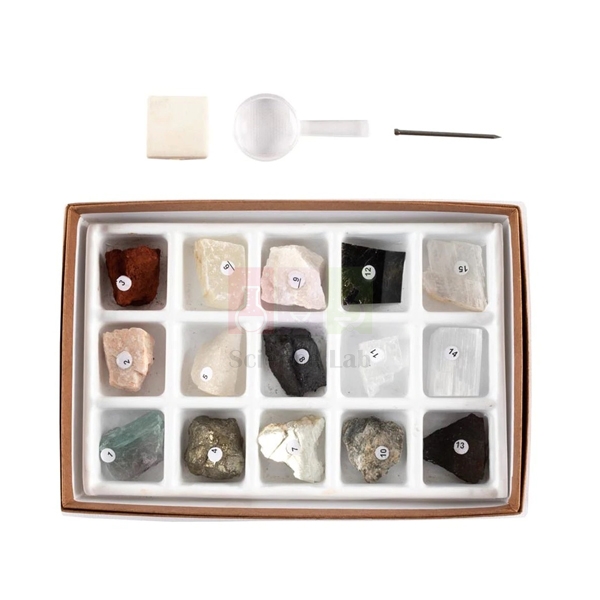
Mineral Study Kit
The Mineral Study Kit (Product Code: SLE/GG/08) brings together 15 important minerals as number-coded, 1-inch specimens that learners can handle, test and study one by one. The set ranges from soft talc and three forms of gypsum to magnetite, metallic pyrite and milky quartz, and it can also be added to an existing rock and mineral collection. It is supplied by Jain Scientific Equipments Pvt Ltd (ScienceLab), Ambala, for geography, earth science and chemistry classrooms.
Specifications
| Parameter | Detail |
|---|---|
| Number of minerals | 15 specimens |
| Specimen size | 1 inch |
| Identification | Number-coded specimens |
| Purpose | Handling, testing and learning about each mineral; can be added to any rock and mineral collection |
The 15 specimens in the kit:
- Fluorite
- Feldspar – Microcline
- Hematite
- Mica – Muscovite
- Magnetite
- Mica – Biotite
- Graphite
- Gypsum – Alabaster
- Talc
- Halite
- Gypsum – Satin Spar
- Gypsum – Selenite
- Pyrite
- Milky Quartz
- Calcite
Typical Use
Students work through simple property tests on each numbered specimen. Scratch tests compare hardness — talc is the softest mineral on the Mohs scale, while quartz is hard enough to scratch glass. A streak test on an unglazed plate shows that hematite leaves a reddish-brown streak even when the specimen looks dark, and a small magnet picks out magnetite straight away.
The two micas peel into thin flexible sheets, a clear example of cleavage; graphite marks paper, which explains its use in pencils; and the three gypsum forms — alabaster, satin spar and selenite — show how one mineral can look very different. Calcite’s reaction with dilute acid is best shown by the teacher. Because the specimens are number-coded, teachers can run blind identification quizzes, and adding a streak plate and a hand lens turns the kit into a complete mineral testing station for an earth science kit or geography lab.
Supplier
ScienceLab, the trading name of Jain Scientific Equipments Private Limited in Ambala, Haryana, supplies this mineral set to schools and colleges alongside its own teaching apparatus. More about us is on the company profile.
Related Geography Lab Equipment
Tools and sets that go with mineral study:
- Mineral Test Kit — a companion kit for testing mineral properties
- Black Streak Plates — show the streak of light-coloured minerals clearly
- Streak Plates Glass — an alternative plate option for streak work
- Mineral ID Starter Set — a further mineral identification set from our earth science range
- Storage Boxes – Rock – Mineral Specimens — keeps the number-coded specimens organised
See more in Geography Lab Equipment.
Frequently Asked Questions
Which minerals are in the kit?
Fluorite, feldspar (microcline), hematite, muscovite and biotite mica, magnetite, graphite, three forms of gypsum (alabaster, satin spar and selenite), talc, halite, pyrite, milky quartz and calcite — 15 in total.
How big are the specimens?
Each specimen is 1 inch in size.
How are the specimens identified?
Each one is number-coded. If you need a printed key for the codes, contact us to confirm what is supplied.
Can it be combined with a collection we already have?
Yes. The kit is intended to be added to any rock and mineral collection.
Are testing tools such as streak plates included?
Testing tools are not listed with this kit; see the Mineral Test Kit and streak plates above if you need them.
Are there any handling precautions?
Students should not taste specimens (halite is rock salt) and should wash their hands after handling minerals such as graphite and hematite, which can leave marks.
Can you supply class quantities or ship overseas?
Yes. We supply schools in India and international markets; list the number of kits in your enquiry cart.
Request a Quote
To order the Mineral Study Kit, contact us or add it to your enquiry cart.
Last updated: 24 September 2026