- Physics Lab Equipment
- Chemistry Lab Equipment
- Biology Lab Equipment
- Anatomical Lab Equipment
- Learning
- Educational Lab Equipment
- Magnets
- Agriculture
- Astronomy
- Earth Science
- Geography Lab Equipment
- Safety Lab Coat
- Laboratory
- Meteorological
- Electricity & Magnetism
- Heat
- School Lab Equipment
- Lab Glassware
- Science Lab Equipment
- Tvet Lab Equipment
- Robotics Kits Supplier and Manufacturer for Schools India
- Math Lab Equipment Manufacturers and Exporters in Ambala
- STEM Kits Manufacturers and Supplier India
- Engineering Lab Equipment
- Hospital Lab Equipment
- Water, Sanitation & Hygiene Supplies
- Cold Chain, Solar & Communication Equipment
- Nutrition
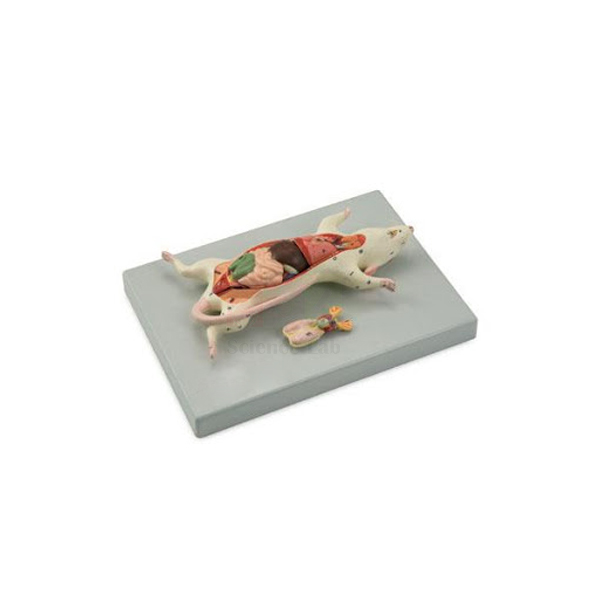
Male and Female Rat Model
A life-size model of an adult rat lying on its back, the position used for a practical. The organs come away in 4 pieces, and the male and female reproductive systems are interchangeable, so one body serves for both sexes. The rat lifts off its base for handling, and a numbered key comes with it.
Rat anatomy model specifications
| Parameter | Detail |
|---|---|
| Subject | Adult rat |
| Scale | Life size |
| Position | Mounted supine (on its back) |
| Size without base | 12 x 21 x 4 cm |
| Detachable organs | 4 pieces |
| Reproductive systems | Interchangeable male and female |
| Base | Model lifts off the base for examination |
| Supplied with | Numbered key |
| Product code | SLE/A/122 |
| Minimum order | 10 units |
| Dispatch | Usually within 7 to 10 working days |
| Manufacturer | ScienceLab (Jain Scientific Equipments Pvt Ltd), Ambala, India |
Mammal anatomy lessons with the rat model
Organ survey. With one reproductive system in place, pairs name the body organs from the numbered key. They then lift away the 4 organ pieces one at a time and record what lies underneath, building a layered sketch of the body cavity from front to back.
Male and female side by side. Swap the reproductive systems during the lesson so that students draw both on the same outline. They trace the path of sperm and the path of an egg, then compare the rat layout with the Human Male and Female Urogenital Systems Model.
From model to microscope. After locating the testes and ovaries on the model, students examine a TS of mammalian testis and a TS of mammalian ovary under the microscope and match the tissue they see to the organ it came from.
Reproduction across classes. Set the rat beside the Hen Model, whose sectioned side shows the reproductive system and an egg. Students list how a mammal that carries a litter in its uterus differs from a bird that lays a shelled egg.
Frequently Asked Questions About the Male and Female Rat Model
Why does the female rat have two uterine horns?
The rat has a duplex uterus: two long, separate horns, each opening into the vagina through its own cervix. Embryos implant in a row along each horn, so a whole litter can develop at once. The human uterus, by contrast, is a single pear-shaped chamber that usually holds one baby.
How do you tell a male rat from a female rat?
Look at the gap between the anus and the genital opening: it is clearly longer in the male, and adult males also have a visible scrotum. Females show a shorter gap and two rows of nipples along the belly. On the model, swap the systems to show the internal difference.
Which duct carries both urine and sperm in the male rat?
The urethra. It runs from the bladder through the penis and carries urine, and during mating it also carries semen arriving from the vas deferens. In the female rat the urethra carries urine only and opens separately from the vagina.
Does a rat have a gallbladder?
No. Rats have no gallbladder, so bile flows from the liver straight into the small intestine through the bile duct. Students who know human anatomy often search for one, so point this out before they start naming the digestive organs.
What route does sperm take in the male reproductive system?
Sperm form in the testes and mature in the coiled epididymis beside each testis. They then travel up the vas deferens to the urethra, where the seminal vesicles and prostate add fluid to form semen. Students can trace this route on the male system before swapping in the female one.
Models, slides and a microscope for reproduction lessons
- Human Male and Female Urogenital Systems Model
- Hen Model
- Ts Of Testis (Mammalian)
- Ts Of Ovary (Mammalian)
- Stereoscopic Dissection Microscopes
To request a quotation, send the product name, code and quantity through our contact page or add the item to your enquiry cart.
Last updated: 14 November 2026