- Physics Lab Equipment
- Chemistry Lab Equipment
- Biology Lab Equipment
- Anatomical Lab Equipment
- Learning
- Educational Lab Equipment
- Magnets
- Agriculture
- Astronomy
- Earth Science
- Geography Lab Equipment
- Safety Lab Coat
- Laboratory
- Meteorological
- Electricity & Magnetism
- Heat
- School Lab Equipment
- Lab Glassware
- Science Lab Equipment
- Tvet Lab Equipment
- Robotics Kits Supplier and Manufacturer for Schools India
- Math Lab Equipment Manufacturers and Exporters in Ambala
- STEM Kits Manufacturers and Supplier India
- Engineering Lab Equipment
- Hospital Lab Equipment
- Water, Sanitation & Hygiene Supplies
- Cold Chain, Solar & Communication Equipment
- Nutrition
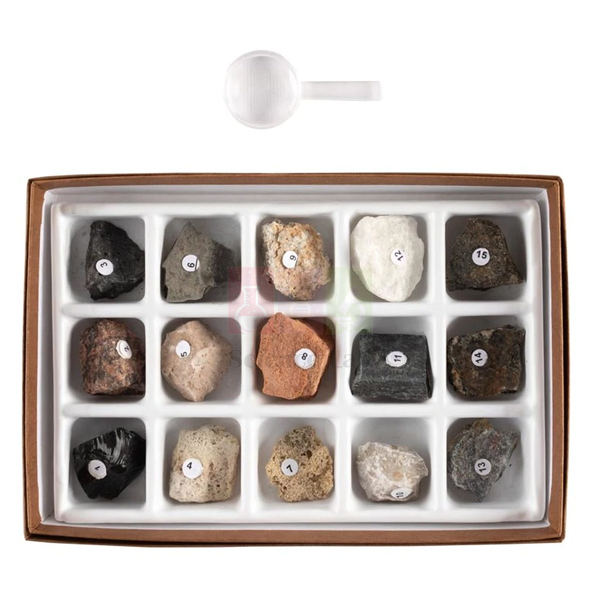
Rock Study Kit
Rock Study Kit (Product Code: SLE/GG/09) is a compact earth science kit built around 15 rock specimens representing the igneous, sedimentary and metamorphic families. Each specimen is about 1 inch across and carries a number code, so students can match what they see under the included magnifier with the identification key and the written description for that rock. It suits geography and general science classes in middle and secondary school, as well as nature-study clubs and teacher-training sessions. The kit is supplied by Jain Scientific Equipments Pvt Ltd (ScienceLab), Ambala, India.
Specifications
| Parameter | Detail |
|---|---|
| Number of specimens | 15 |
| Rock types covered | Igneous, sedimentary and metamorphic |
| Specimen size | 1 inch |
| Specimen marking | Number-coded |
| Magnifier | Included, for close examination of physical properties |
| Display box | 5 x 7 inch |
| Identification key | Rock identification key for the included basic rock types |
| Descriptions | Information and introduction for each rock specimen |
Typical Use
In a typical lesson, students first sort the 15 specimens into the three rock families using visible clues such as crystal size, layering or banding, then confirm their grouping with the identification key. The magnifier helps them look closely at grain size, texture, colour and visible crystals — the physical properties that separate, for example, a coarse-grained igneous rock from a layered sedimentary one. Teachers often pair the activity with a rock-cycle diagram so learners can explain how each type forms and changes into another.
Because the specimens are number-coded and kept in a 5 x 7 inch display box, the kit works well as a reusable station for group rotations and practical assessments: the teacher calls out a number and students name the rock type and justify their answer. For schools building up their geography lab equipment, it is a low-maintenance starting point before moving on to larger collections. Returning every specimen to the display box after class keeps the set complete for the next group.
Supplier
Jain Scientific Equipments Private Limited operates under the ScienceLab name from Ambala, Haryana, and serves schools, colleges and distributors with educational laboratory equipment. As the specimens in this kit are natural rock samples, ScienceLab supplies the kit rather than claiming to make the rocks; enquiries from India and international markets are handled directly by the Ambala team. Learn more on our company profile page.
Related Geography Lab Equipment
These items are often ordered alongside the Rock Study Kit for rock and mineral lessons:
- Expanded Rock Collection — another rock collection for extending identification practice.
- Mineral Study Kit — introduces the minerals that make up the rocks studied here.
- Mineral Test Kit — streak plate, magnet, hardness scale and other tools for testing samples.
- Storage Boxes – Rock – Mineral Specimens — extra storage as a school collection grows.
Browse the complete range in our Geography Lab Equipment category.
Frequently Asked Questions
What comes in the Rock Study Kit?
Fifteen number-coded rock specimens, a magnifier, a 5 x 7 inch display box, a rock identification key and descriptions introducing each specimen. Contact us if you need the names of the individual rocks.
Which rock groups does the kit cover?
Igneous, sedimentary and metamorphic rocks. The kit focuses on basic rock types, so it is best suited to introductory and middle-school earth science work.
Is one kit enough for a whole class?
It is designed for close study by a small group sharing the magnifier and key. For whole-class practicals, schools usually order several kits or combine one with the Class Rock Pack.
How should the specimens be looked after?
Handle them with dry hands, avoid dropping them on hard floors and return them to the display box after each lesson. Avoid scratch or acid tests on these reference pieces so their surfaces stay clear for identification.
Can you supply larger quantities or export orders?
Yes. ScienceLab supplies schools, colleges and distributors in India and international markets. Send the quantity and delivery location through our contact page for a quotation.
What should an institutional enquiry include?
The product code SLE/GG/09, the number of kits, the delivery address or port, and any vendor documents your purchase department requires. This lets us prepare an accurate quotation first time.
Request a Quote
To order the Rock Study Kit, message us via the contact page or add it to your enquiry cart with other geography items for one combined quotation.
Last updated: 24 September 2026
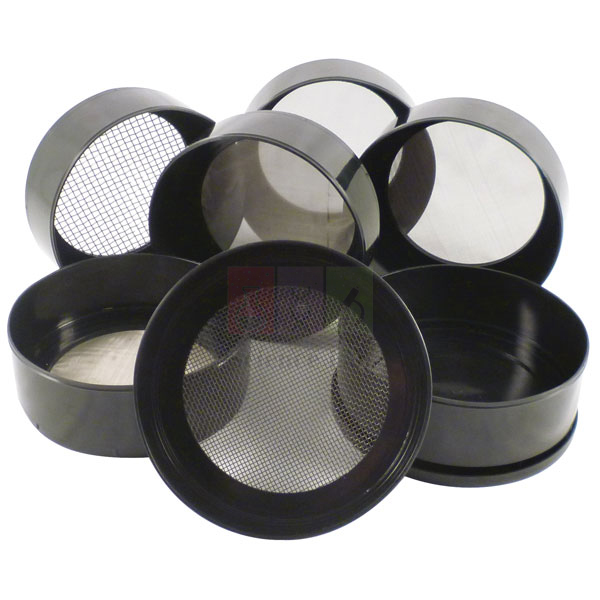
Sieves
Sieves (Product Code: SLE/GG/10) is a set of 6 screen sieves with a bottom pan and lid, used to separate soil and rock samples into size fractions and grade them so students can work out the make-up of soil strata. Screen openings step down from 4 mm to 0.1 mm, giving a clear picture of how much coarse, medium and fine material a sample holds. Geography, earth science and environmental studies teachers use it for soil texture practicals and to follow up field trips. This piece of school lab equipment is manufactured by Jain Scientific Equipments Pvt Ltd (ScienceLab), Ambala.
Specifications
| Parameter | Detail |
|---|---|
| Supplied as | Set of 6 sieves |
| Included with set | Bottom pan and lid |
| 4 mm mesh | 1 sieve |
| 2 mm mesh | 1 sieve |
| 0.5 mm mesh | 2 sieves |
| 0.25 mm mesh | 1 sieve |
| 0.1 mm mesh | 1 sieve |
| Purpose | Separating and grading soil and rock samples to determine the make-up of soil strata |
Typical Use
For a particle-size practical, students dry a soil sample, gently break up any lumps and place it on the coarsest screen. The sieves are then used as a stack — 4 mm at the top, finer meshes below and the pan at the bottom — with the lid in place to stop fine dust escaping while the stack is shaken. Each screen holds back the particles too large to pass, so the material left on every level can be tipped out, weighed and recorded as a share of the whole sample.
Comparing results from topsoil, subsoil and a stream-bed or quarry sample shows learners why some ground drains quickly while other ground stays waterlogged, and how layers in a soil profile differ. The same set supports environmental science projects on erosion and sediment sorting. After each use, tap the screens clean and brush them lightly from the underside so fine particles do not clog the 0.1 mm mesh.
Manufacturer
The sieve set is produced by Jain Scientific Equipments Private Limited, the Ambala, Haryana company that trades as ScienceLab and makes educational laboratory equipment for schools, colleges and training institutes. Orders are prepared at the company’s Ambala facility for customers across India and international markets. Our company profile gives more background on ScienceLab.
Related Geography Lab Equipment
These products complete a soil-sampling and grading practical:
- Garden Auger Soil — for collecting soil samples at different depths before sieving.
- Triple Beam Balance — for weighing the fraction retained on each screen.
- Plastic Weighing Boats — to hold each size fraction during weighing.
- Soil Analysis Kit — adds chemical tests to the physical grading done with the sieves.
- Grid Sieves — an alternative sieve product listed in our agriculture range.
See more items in the Geography Lab Equipment category.
Frequently Asked Questions
Which mesh sizes are in the set?
Six sieves: one each at 4 mm, 2 mm, 0.25 mm and 0.1 mm, and two at 0.5 mm. If your syllabus calls for a different combination, tell us through the contact page.
Are a pan and lid included?
Yes. The set includes a bottom pan to catch the finest material and a lid to cover the top sieve while shaking.
What is the frame material and diameter?
These details are not listed on this page. Please ask our team for the current construction and dimensions before ordering.
Can the sieves be used with wet soil?
Dry samples give the cleanest separation and are easier on the fine meshes. If you plan wet sieving, discuss it with us so we can advise on suitability.
Is a calibration certificate available?
This set is intended for teaching. If your laboratory needs documented aperture verification, discuss the requirement with us before ordering.
Do you supply multiple sets for schools and distributors?
Yes, ScienceLab supplies sets in quantity within India and to international markets. Share the number of sets and the delivery location for a quotation.
Request a Quote
For pricing and availability of the Sieves set, write to us via the contact page, or place it in the enquiry cart alongside the balance and sampling tools you need.
Last updated: 24 September 2026
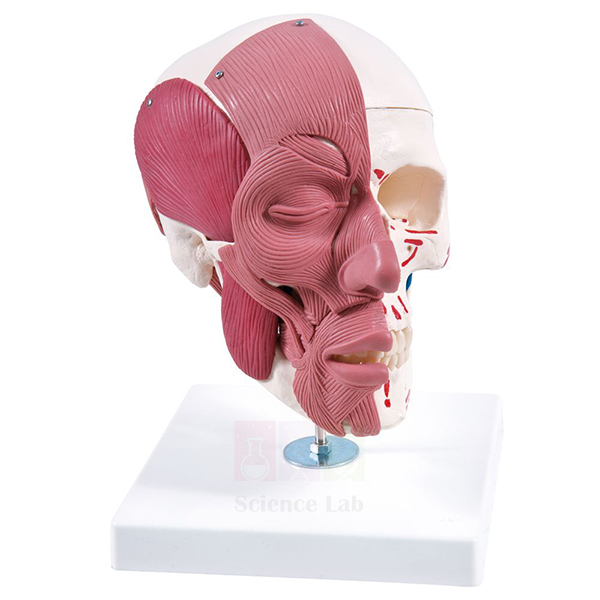
Human Skull with Facial Muscles
Human Skull with Facial Muscles (Product Code: SLE/A/123) is a life-size plastic skull model used to teach the muscles of facial expression and mastication in anatomy, dental and physiotherapy classrooms. Its facial and masticatory muscles are colour-differentiated, the masseter is removable, the left side is painted with muscle origins (red) and insertions (blue), and a moveable jaw on the right demonstrates chewing. It is made by Jain Scientific Equipments Pvt Ltd (ScienceLab), an OEM manufacturer, at its own factory in Ambala, India.
Specifications
| Parameter | Detail |
|---|---|
| Type | Skull with facial and masticatory muscles |
| Scale and material | Life-size plastic replica |
| Size | 18 × 18 × 25 cm |
| Weight | 1.1 kg |
| Muscles | Facial and masticatory muscles differentiated by colour; masseter muscle removable |
| Skull cap | Occipitofrontalis and temporalis can be reflected to allow removal of the skull cap |
| Left side | Painted points of muscle origin (red) and insertion (blue) |
| Right side | Moveable jaw and flexible muscles to demonstrate the basic chewing motion |
| Product code | SLE/A/123 |
| Manufacturer | Jain Scientific Equipments Pvt Ltd (ScienceLab) — OEM |
| Country of origin | India (made in Ambala, Haryana) |
What Is the Skull with Facial Muscles Used For?
Learning a muscle means knowing where it starts, where it ends and what it does when it contracts. This skull covers all three: the red and blue painted points on the left side show origin and insertion, while the flexible muscles and moveable jaw on the right let a student open and close the mouth and watch the chewing muscles respond. Removing the masseter exposes the deeper structures beneath it, a common step in dental anatomy practicals.
Reflecting the occipitofrontalis and temporalis and lifting off the skull cap takes the class from the muscles to the cranial cavity in one demonstration. Colour differentiation between the facial and masticatory groups helps beauty-therapy and physiotherapy learners separate expression muscles from jaw muscles. Among biology lab equipment in India it is a compact choice, at 1.1 kg, that is easy to pass around a class.
OEM Manufacturer
Jain Scientific Equipments Private Limited, which trades as ScienceLab, is the OEM (original equipment manufacturer) of this muscle skull and produces it at its own licensed factory at Saha, Ambala, Haryana, India. As an anatomical models manufacturer selling factory-direct, it supplies medical, dental and nursing colleges, schools, dealers and importers in India and international markets without a trading middleman.
Repeat orders and questions about replacement parts, such as a lost masseter piece, go straight to the maker – just ask us. For vendor registration, the company's GSTIN is 06AAECJ8618A1ZT and its Legal Entity Identifier is 3358004HRD1JIVXKYX49. Read the company profile for more.
Related Skulls
These skull and head models are commonly used with the muscle skull in the same course:
- Human Skull Model, Life Size Colored — bones painted in different colours for learning where these muscles attach.
- Human Skull Bones Model — sectioned into many parts for studying the individual cranial and facial bones.
- Human Skull with Cervical Spine Model — shows how the skull joins the upper spine, with a spring-mounted jaw.
- Head and Neck Model — continues the muscle and vessel study down into the neck.
See the full Skulls category for more human and animal skull models.
Frequently Asked Questions
Which muscle can be removed from the Human Skull with Facial Muscles?
On the Human Skull with Facial Muscles, the masseter muscle is removable. The occipitofrontalis and temporalis are reflected rather than removed, which frees the skull cap so students can move from the facial muscles to the cranial cavity in one demonstration.
Does the jaw of the Human Skull with Facial Muscles move?
Yes. The Human Skull with Facial Muscles has a moveable jaw and flexible muscles on its right side, so students can open and close the mouth and demonstrate the basic chewing motion while watching the masticatory muscles respond.
What do the red and blue markings on the muscle skull mean?
On the left side of the Human Skull with Facial Muscles, red paint marks the points where muscles originate and blue marks where they insert, helping students learn each muscle's attachments before studying what it does.
How large and heavy is the Human Skull with Facial Muscles?
The Human Skull with Facial Muscles is a life-size plastic replica measuring 18 × 18 × 25 cm and weighing 1.1 kg, light enough to pass around a class or carry between teaching rooms.
How should the flexible muscles on the skull be cared for?
Move the jaw of the Human Skull with Facial Muscles gently and avoid over-stretching its flexible parts. Clean the model with a slightly damp cloth, keep it away from heat and direct sun, and do not use solvents on the painted surfaces.
Who manufactures the Human Skull with Facial Muscles?
The Human Skull with Facial Muscles is manufactured by Jain Scientific Equipments Pvt Ltd (ScienceLab), the OEM, at its own licensed factory at Saha, Ambala, Haryana, India. Colleges, schools, dealers and importers buy it factory-direct, with quotations sent by the manufacturer.
Is the Human Skull with Facial Muscles supplied outside India?
Yes. The Human Skull with Facial Muscles is supplied to institutions across India and international markets. Share the quantity and delivery location through the contact page, and the quotation will come directly from the manufacturer.
Request a Quote
Request pricing for SLE/A/123 through our contact page, or add the skull to the enquiry cart if you are building a list of several models. Quotations are issued direct by the manufacturer.
Last updated: 24 September 2026
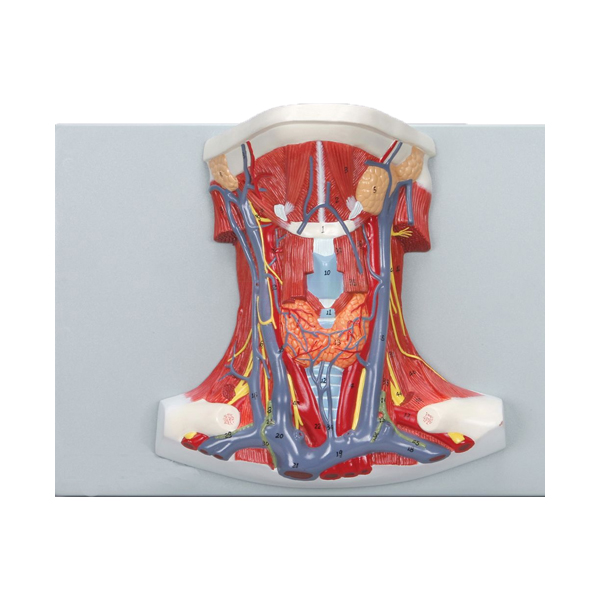
Anatomy of the Human Neck Model
Anatomy of the Human Neck Model (Product Code: SLE/A/124) is a life-size ventral dissection of the human neck that gives clear views of its muscles, vascular structures, nerves and glands, with a printed key identifying 47 anatomical features. Anatomy departments, dental and nursing colleges and paramedical training centres use it to teach one of the most crowded regions of the body. It is manufactured by Jain Scientific Equipments Pvt Ltd (ScienceLab), a laboratory equipment manufacturer in India based in Ambala.
Specifications
| Parameter | Detail |
|---|---|
| Type | Ventral dissection model of the human neck |
| Scale | Life size |
| Size (without base) | 23 x 14 x 32 cm |
| Mounting | Durable polymer base |
| Structures shown | Muscles, vascular structures, nerves and glands |
| Key | Printed key identifying 47 anatomical features |
Typical Use
In a short stretch of the body the neck carries blood to and from the head, air to the lungs, food to the stomach and nerve signals in both directions, all wrapped in layers of muscle and alongside important glands. Viewed from the front, this dissection lets a lecturer work through those layers in order, using the printed key to name each of the 47 features and to explain how the vessels, nerves and glands lie in relation to the neck muscles.
The model supports head-and-neck anatomy courses and clinical skills teaching, where students need to picture what lies beneath the skin before learning procedures or examinations in this area. It is a long-lasting addition to biology teaching aids for colleges because the key allows independent revision: students can cover the key, name the numbered features themselves and then check their answers.
Manufacturer
The Anatomy of the Human Neck Model is manufactured by Jain Scientific Equipments Private Limited, known to customers as ScienceLab. From Ambala in Haryana, the company provides anatomical models and laboratory equipment to educational and training institutions in India and international markets. Read more on the company profile.
Related Laboratory Equipment
Models that build on a neck anatomy lesson:
- Head and Neck Model — follows the neck structures up into the head
- 3-D Printed Head and Neck Section Model — a sectional view to complement the front dissection
- Larynx Human Model — a closer look at the airway structures in the neck
- Human Cervical Spinal Column Model — the vertebrae that support the neck from behind
- Human Endocrine Organs Model — places the neck glands within the endocrine system
See the full Human Models range for more.
Frequently Asked Questions
How many features does the key identify?
The printed key identifies 47 anatomical features.
From which direction is the neck dissected?
It is a ventral dissection, so the neck is shown from the front.
What are the dimensions?
It is life size and measures 23 x 14 x 32 cm without its base, which is made of durable polymer.
Which body systems are represented?
Muscles, vascular structures, nerves and glands are all shown.
Can parts be removed?
Removable parts are not listed for this model. Contact us to confirm before ordering if you need a dissectible version.
Which courses is it designed for?
Human anatomy, dental and ENT teaching, nursing and paramedical training, and any course covering the anatomy of the head and neck.
What should be included in a quotation request?
The required quantity, delivery location and preferred delivery date; warranty terms will be stated in our reply. Use the contact form or enquiry cart.
Request a Quote
To receive pricing for the Anatomy of the Human Neck Model, write to us or add it to the enquiry cart.
Last updated: 24 September 2026
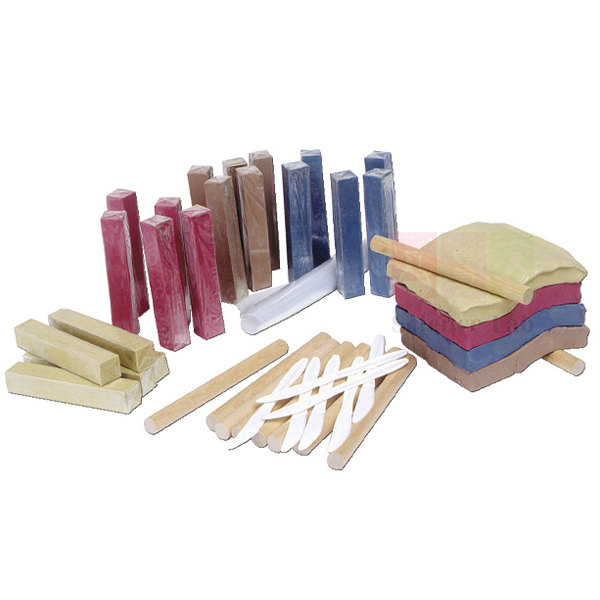
Geology History Kit
Geology History Kit (Product Code: SLE/GG/11) lets students recreate geologic processes by building their own stratified layers from Pleistocene clay, then shaping and cutting them to see how rock strata record the history of a landscape. The kit brings 4 packs of clay, a roller, a cutting tool, plastic sheets and a Teacher’s Guide together in one kit, making it a practical hands-on science kit for geography and earth science lessons on sedimentation, folding and faulting. It is manufactured by Jain Scientific Equipments Pvt Ltd (ScienceLab), Ambala, for schools and teacher-training institutes.
Specifications
| Parameter | Detail |
|---|---|
| Modelling material | Pleistocene clay, 4 packs |
| Roller | 1 |
| Cutting tool | 1 |
| Work surface | Plastic sheets included |
| Teaching support | Teacher’s Guide included |
| Purpose | Recreating geologic processes by preparing stratified layers |
Typical Use
Working on the plastic sheets, students flatten clay with the roller into thin slabs and stack them one on another, just as sediments settle in a lake or sea over thousands of years. Once a stack is built, they can push the ends inward to model folding, slice through it with the cutting tool to create a fault, or trim the top and lay fresh slabs over it to show an unconformity. Cutting a clean vertical section then exposes the “rock record” so the class can apply the principle that lower layers were laid down first.
With the Teacher’s Guide to hand, the model-making format suits both demonstrations at the front of the class and small-group work. Keep opened clay wrapped between lessons so it stays workable, and wipe the roller and cutting tool before storing them in the kit.
Manufacturer
ScienceLab is the brand name used by Jain Scientific Equipments Private Limited, a manufacturer of teaching and laboratory equipment located in Ambala, Haryana. The company develops geography and science kits for classrooms and supplies them to institutions throughout India and to international markets. Visit the ScienceLab profile to learn about the company.
Related Geography Lab Equipment
Teachers often combine this kit with the following resources on rock layers and earth history:
- Fractures, Faults and Dislocations Model — a ready-made model to compare with the faults students cut in clay.
- Investigating Geological Time And Fossils Chart — places the layers students build in the wider geological timescale.
- General Fossil Collection — real fossils to discuss how organisms end up preserved within strata.
- Clay, Modelling, Assorted Color — extra modelling clay if groups want to add more layers.
Explore the wider Geography Lab Equipment range.
Frequently Asked Questions
What is included in the Geology History Kit?
Four packs of Pleistocene clay, one roller, one cutting tool, plastic sheets and a Teacher’s Guide.
Which topics can it demonstrate?
It is built for modelling stratified layers, which leads naturally into lessons on deposition, folding, faulting, unconformities and the relative age of rock layers.
How many groups can one kit serve?
That depends on how thick the layers are rolled and how many models each group builds. Tell us your class size through the contact page and we will suggest a suitable quantity.
Can I order replacement clay?
Please ask our team about the availability of additional clay packs when you place your order.
How should the kit be stored?
Keep clay sealed or wrapped when not in use, store the kit in a cool, dry cupboard and clean the tools before packing them away.
Do you handle school tenders and export enquiries?
Yes. Institutional buyers in India and international markets can request a quotation; include the product code SLE/GG/11, quantity and delivery location.
Request a Quote
Ready to add the Geology History Kit to your lab? Send an enquiry via our contact page or collect it with other items in the enquiry cart.
Last updated: 24 September 2026
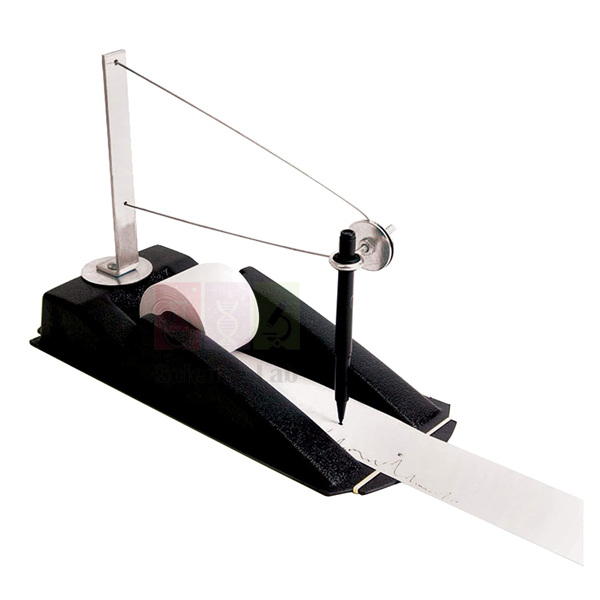
Seismograph Model
Seismograph Model (Product Code: SLE/GG/12) is a newly revised, small table-top unit that shows students how earthquakes are measured and how their intensity is worked out. Pupils create their own simulated tremors, the seismograph records how strong each one is, and the class sees why scientists rate earthquakes on the Richter scale. Geography and earth science teachers use it to turn a textbook topic into a quick, memorable investigation. Like the other geography models in our range, it is manufactured by Jain Scientific Equipments Pvt Ltd (ScienceLab), Ambala, and comes with a detailed Teacher’s Guide.
Key Details
| Parameter | Detail |
|---|---|
| Type | Small table-top seismograph model |
| Version | Newly revised design |
| Demonstrates | How earthquakes are measured and their intensity calculated |
| Student activity | Simulating earthquakes and recording their intensity |
| Teaching support | Detailed Teacher’s Guide |
| Suitable for | Class demonstrations and group investigations in geography and earth science |
Typical Use
Set the unit on a firm, level table and let students generate “earthquakes” of different strengths — a light tap, a firm knock, a longer shake. For each event the seismograph records the intensity, and the class compares the recordings to see how a stronger disturbance produces a larger response. The friendly challenge of trying to “top the Richter scale” keeps every group engaged while they learn what the scale actually measures.
The lesson can then widen into plate tectonics: why earthquakes cluster along plate boundaries, how seismic stations in different places record the same event, and why the Richter scale is logarithmic, so a small step up the scale means much stronger ground motion. Keep the model away from the table edge during vigorous shaking and let it settle fully before starting the next run.
Manufacturer
This model comes from Jain Scientific Equipments Private Limited, which trades as ScienceLab and designs and builds educational apparatus in Ambala, Haryana. Schools, colleges and distributors in India and international markets order from the same catalogue. Read the company profile for an overview of ScienceLab.
Related Geography Lab Equipment
These items help extend an earthquake lesson into the wider study of the Earth’s crust:
- Fractures, Faults and Dislocations Model — shows the fault movements that release earthquake energy.
- Volcano Model — pairs with earthquakes when teaching activity at plate boundaries.
- Ocean Floor Raised Relief Map — locates the ridges and trenches where many earthquakes occur.
- Seismograph Model For Science Lab — another seismograph listing in our earth science range to compare.
More models are listed under Geography Lab Equipment.
Frequently Asked Questions
What does the Seismograph Model demonstrate?
How earthquakes are measured and their intensity calculated. Students simulate tremors and the model records how strong each one is.
Can it detect real earthquakes?
It is a teaching model designed for simulated tremors in the classroom, not a monitoring instrument for real seismic events.
What is supplied with it?
The table-top seismograph model and a detailed Teacher’s Guide. For a full parts list, please ask us through the contact page.
Does it need power or any consumables?
These details are not listed on this page. Please confirm operating requirements with our team before ordering.
How does it differ from the Seismograph Model For Science Lab?
We list more than one seismograph product. Tell us your class level and syllabus and we will help you choose between them.
What warranty applies?
Warranty terms are confirmed with each quotation. Ask our team for the terms that apply to your order.
Can you supply several units for a school network or export order?
Yes. We supply institutions in India and international markets; share the quantity and destination for a quotation.
Request a Quote
For a price on the Seismograph Model, reach us through the contact page or add the product to your enquiry cart and submit it with the rest of your list.
Last updated: 24 September 2026
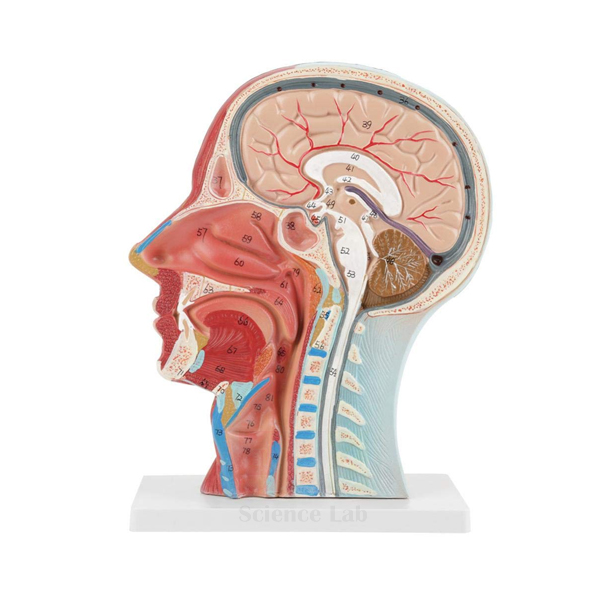
Human Head Section Model
Human Head Section Model (Product Code: SLE/A/125) is an about life-size relief of the human head in median section, used to show the oronasal and buccal cavities, cervical spine and brain in introductory anatomy. Schools, nursing colleges and dental and speech courses value its slim 26 x 33 x 5 cm format on a base. It is made by Jain Scientific Equipments Pvt Ltd (ScienceLab), an OEM manufacturer, at its own factory in Ambala, India, for any biology lab setup in schools across India.
Specifications
| Parameter | Detail |
|---|---|
| Type | Relief model of the head in median section |
| Scale | About life size |
| Size | 26 x 33 x 5 cm |
| Structures shown | Oronasal and buccal cavities, cervical spine and brain |
| Mounting | Mounted on a base |
| Product code | SLE/A/125 |
| Manufacturer | Jain Scientific Equipments Pvt Ltd (ScienceLab) — OEM |
| Country of origin | India (made in Ambala, Haryana) |
What Is the Human Head Section Model Used For?
Because it is a relief rather than a full head, this model works well as a bench-top reference that a whole class can see at once. A teacher can run a finger along the midline from the nasal cavity to the throat, point out the tongue within the buccal cavity, then move up to the brain and down to the cervical vertebrae, all in one continuous explanation. Its slim 5 cm depth makes it easy to store in a cabinet or keep on a shelf between lessons.
It is especially helpful when introducing sagittal MRI views, since the median plane matches what students later see on sagittal scans. For practical tests, examiners place numbered pins or labels on the relief and ask candidates to identify each structure. It forms a sensible first purchase in a human biology model set for India's schools and colleges before more detailed dissectible heads are added.
OEM Manufacturer
ScienceLab, the trading name of Jain Scientific Equipments Private Limited, is the OEM (original equipment manufacturer) of the Human Head Section Model. The relief is made at the company's own licensed factory at 449, HSIIDC Industrial Area, Saha, Ambala, Haryana, India (CIN U29309HR2020PTC087597, Factory Licence AMB-ONLINE-CHD-J-414).
Schools, colleges, dealers and importers buy the relief factory-direct, and repeat orders or questions about replacement parts are handled by the manufacturer — just ask us. See the company profile for more.
Related Brain Models
Models that add depth or another viewing plane to this median section:
- Head Section with Larynx Model — a dissectible head that opens to show the pharynx, larynx and trachea
- Horizontally Sectioned Model of the Human Head — the same region cut in horizontal slices
- Human Half Head Model — another way to view one half of the head, with a dissected side
- Human Cervical Spinal Column Model — separate vertebrae for studying the cervical spine seen on the relief
Explore more options in the Brain Models section.
Frequently Asked Questions
Is the Human Head Section Model a full head or a relief?
The Human Head Section Model is a relief model of the head in median section, about life size and mounted on a base, so it presents the midline anatomy on one flat face rather than as a full three-dimensional head.
Which regions does the Human Head Section Model cover?
The Human Head Section Model shows all the relevant structures of the oronasal and buccal cavities, the cervical spine and the brain on one median section, giving a continuous view from the nose and mouth to the upper spine.
How much space does the Human Head Section Model take?
The Human Head Section Model measures 26 x 33 x 5 cm, so its slim depth lets it fit on a shelf, in a cabinet or on a narrow display bench between lessons without crowding other models.
Are the structures on the Human Head Section Model numbered?
A numbered key is not listed for the Human Head Section Model in our product information. Please ask via our contact page if your course needs a labelled version or a printed reference list.
Can the Human Head Section Model be wall-mounted?
The Human Head Section Model is supplied mounted on a base for bench or shelf display. If your room needs a different arrangement, discuss your display requirements with us before ordering so we can advise what is possible.
Who manufactures the Human Head Section Model?
The Human Head Section Model is manufactured by Jain Scientific Equipments Pvt Ltd (ScienceLab), the OEM, at its own licensed factory at Saha, Ambala, Haryana, India, and is supplied factory-direct to schools, colleges and distributors.
Can we order it for several schools in one consignment?
Yes. Multi-school and bulk orders of the Human Head Section Model for India and international markets can be quoted together; send the delivery addresses and quantities with your enquiry and the manufacturer will reply directly.
Request a Quote
To receive a price for SLE/A/125, get in touch through the contact page or add the model to the enquiry cart and submit your list. Quotations come straight from the manufacturer.
Last updated: 24 September 2026
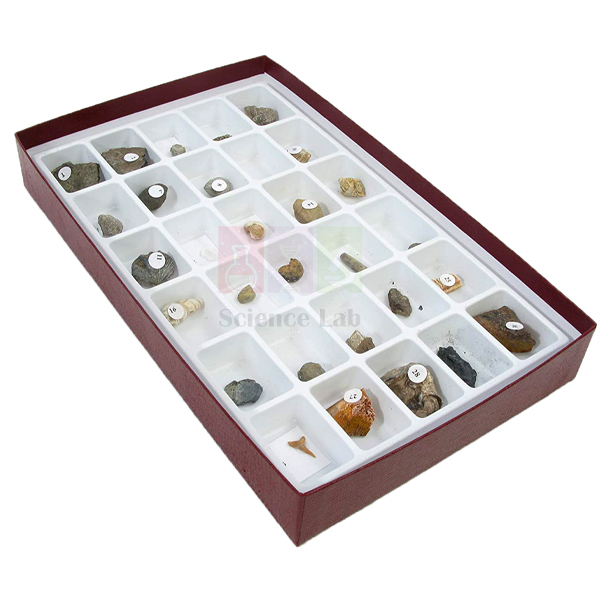
Advanced Fossil Collection
Advanced Fossil Collection (Product Code: SLE/GG/13) is a comprehensive set of 30 fossils chosen as demonstration specimens of animal phyla and plants from the Paleozoic, Mesozoic and Cenozoic. With a descriptive key sheet and a geologic time chart, it lets senior school and college students connect each specimen to its group and its place in Earth’s history. The collection is equally useful to geography, geology and biology departments, where it serves as one of the more detailed biology teaching aids for evolution topics. It is supplied by Jain Scientific Equipments Pvt Ltd (ScienceLab), Ambala, India.
Specifications
| Parameter | Detail |
|---|---|
| Number of fossils | 30 |
| Specimen content | Demonstration specimens of animal phyla and plants |
| Geologic eras represented | Paleozoic, Mesozoic and Cenozoic |
| Reference material | Descriptive key sheet and geologic time chart |
| Supplied as | Complete fossil collection |
Typical Use
A common approach is to give each group a handful of specimens and ask them to identify the phylum or plant group using the descriptive key sheet, then place each fossil on the geologic time chart. When the whole class combines its results, the chart shows how life changed from the Paleozoic through the Mesozoic to the Cenozoic — a strong visual for lessons on evolution, extinction events and the idea of index fossils used to date rock layers.
Because the set spans both animals and plants across three eras, it also supports comparative work in biology, such as tracing how body plans within a phylum persist or change over time. Handle specimens over a tray or cloth-covered bench, keep the key sheet with the collection and count the pieces back in after each session so all 30 stay together.
Supplier
Jain Scientific Equipments Private Limited, trading as ScienceLab from Ambala in Haryana, supplies this collection as part of its earth science and geography range. Since fossils are natural specimens, the company supplies rather than manufactures them, and it serves institutions across India and in international markets. More about the business is on our profile page.
Related Geography Lab Equipment
These resources work well with the Advanced Fossil Collection in earth history lessons:
- General Fossil Collection — a smaller 15-fossil set for introductory classes or extra student stations.
- Investigating Geological Time And Fossils Chart — a wall reference for the eras covered by the specimens.
- Variation And Evolution Fossil Kit — extends the collection into activities on variation and evolution.
- Hand Lens — for examining fine surface detail on each fossil.
- Storage Boxes – Rock – Mineral Specimens — secure storage for specimen collections.
The full range is in our Geography Lab Equipment category.
Frequently Asked Questions
How many fossils are in the collection, and from which eras?
Thirty fossils representing animal phyla and plants from the Paleozoic, Mesozoic and Cenozoic.
How is it different from the General Fossil Collection?
The advanced set has 30 specimens organised around animal phyla and plants across three eras, while the General Fossil Collection has 15 fossils for introducing major life forms. Both include a key sheet and a geologic time chart.
Can I see the list of specimens before ordering?
Yes. Please request the current specimen list through our contact page before placing your order.
How should the fossils be handled and stored?
Handle them over a padded surface, avoid washing or scrubbing them, and store the collection dry with the key sheet so specimens stay matched to their descriptions.
Is this suitable for college laboratories?
Yes, its breadth across phyla and eras suits senior secondary and undergraduate teaching as well as museum-style displays in school labs.
Do you supply to institutions outside India?
Yes. ScienceLab supplies schools, colleges and distributors in India and international markets. Send the quantity and destination for a quotation.
Request a Quote
To request pricing for the Advanced Fossil Collection, contact us via the contact page or add it to the enquiry cart with your other earth science items.
Last updated: 24 September 2026