- Physics Lab Equipment
- Chemistry Lab Equipment
- Biology Lab Equipment
- Anatomical Lab Equipment
- Learning
- Educational Lab Equipment
- Magnets
- Agriculture
- Astronomy
- Earth Science
- Geography Lab Equipment
- Safety Lab Coat
- Laboratory
- Meteorological
- Electricity & Magnetism
- Heat
- School Lab Equipment
- Lab Glassware
- Science Lab Equipment
- Tvet Lab Equipment
- Robotics Kits Supplier and Manufacturer for Schools India
- Math Lab Equipment Manufacturers and Exporters in Ambala
- STEM Kits Manufacturers and Supplier India
- Engineering Lab Equipment
- Hospital Lab Equipment
- Water, Sanitation & Hygiene Supplies
- Cold Chain, Solar & Communication Equipment
- Nutrition
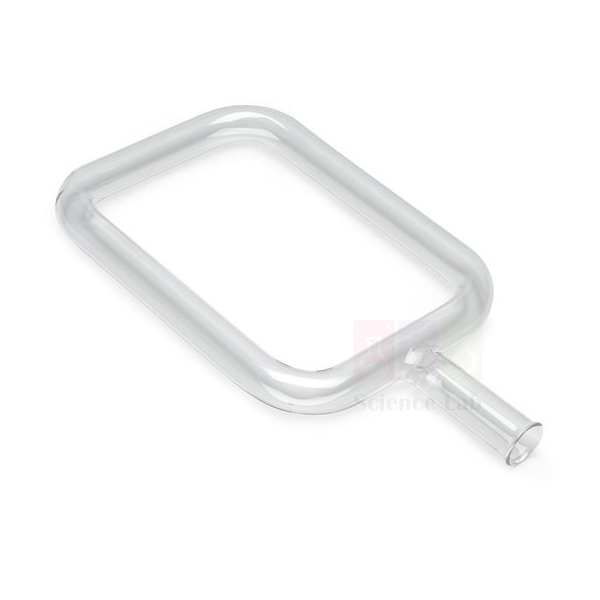
Apparatus Convection In Liquid
Apparatus Convection In Liquid (Product Code: SLE/PHY/08) is a rectangular loop of glass tubing used to show convection currents circulating in water in school and college physics and science classes. The 350 × 210 mm rectangle is made from 22 mm glass tubing, so a few potassium permanganate crystals trace the moving water clearly when one lower corner is gently heated. It is made by Jain Scientific Equipments Pvt Ltd (ScienceLab), an OEM manufacturer, at its own factory in Ambala, India.
Specifications
| Parameter | Detail |
|---|---|
| Form | Rectangle of glass tubing |
| Size | 350 × 210 mm |
| Tubing | 22 mm glass tubing |
| Operation | Convection currents generated by gently heating one of the lower corners |
| Indicator | A small amount of potassium permanganate (VII) crystals dropped into the tube |
| Mounting in use | Mounted vertically in a retort stand |
| Product code | SLE/PHY/08 |
| Manufacturer | Jain Scientific Equipments Pvt Ltd (ScienceLab) — OEM |
| Country of origin | India (made in Ambala, Haryana) |
What Is the Convection Tube Used For?
Fill the rectangle with water, clamp it upright in a retort stand and drop a few potassium permanganate crystals into the tube. When a small flame warms one lower corner, the heated water expands, becomes less dense and rises up that side, while cooler water sinks down the opposite side to replace it, and the purple colour shows the whole loop circulating. The demonstration links directly to sea breezes, hot-water systems and the way a pan of water heats from the bottom.
Use only a gentle flame on one corner, never the whole base, so that a single clear current forms. Warm the glass gradually to avoid thermal shock, use just a few crystals so the colour stays traceable, and let the water cool before emptying and rinsing the tube. It gives any heat energy science kit a vivid, reusable convection demonstration for middle and secondary classes.
OEM Manufacturer
The Apparatus Convection In Liquid is produced by Jain Scientific Equipments Private Limited, better known by its trading name ScienceLab, which acts as the OEM (original equipment manufacturer) for its heat and physics apparatus. It is manufactured at the company’s own licensed factory at Saha, Ambala, Haryana, India, and supplied factory-direct to schools, colleges, dealers and importers; enquiries about repeat orders or replacement glass go straight to the maker, so just ask us.
The company is a registered MSME (Udyam UDYAM-HR-01-0003714), and its export orders are shipped under Importer-Exporter Code AAECJ8618A (DGFT). See our company profile for more.
Related Physics Lab Equipment
Items needed to run the convection demonstration, plus related apparatus:
- Potassium Permanganate — the crystals that colour the moving water
- Retort Stand — holds the glass rectangle upright during heating
- Glass Spirit Lamp — a gentle flame for warming one lower corner
- Convection in Air Apparatus — shows the same principle in a gas
- Convection of Gas Apparatus — a further demonstration of convection in gases
Explore the full Physics Lab Equipment category for more heat apparatus.
Frequently Asked Questions
What size is the Apparatus Convection In Liquid?
The Apparatus Convection In Liquid is a 350 × 210 mm rectangle made from 22 mm glass tubing. In use it is mounted vertically in a retort stand, so check that your stand and clamp can hold a frame of that size securely.
How do you show convection currents with this apparatus?
To use the Apparatus Convection In Liquid, fill it with water, mount it vertically, drop a few potassium permanganate crystals into the tube and gently heat one lower corner. The coloured water rises on the heated side and circulates around the rectangle.
Is potassium permanganate included with the Apparatus Convection In Liquid?
The Apparatus Convection In Liquid uses potassium permanganate crystals as its indicator, and the crystals are also listed as a separate product in our range. Tell us in your enquiry whether you need them, so the quotation covers everything for the demonstration.
What heat source should be used with the convection apparatus?
The Apparatus Convection In Liquid needs only gentle heat at one lower corner, so a spirit lamp or a low Bunsen flame is suitable. Warm the glass gradually and never heat the whole base, which would blur the single convection current.
Who manufactures the Apparatus Convection In Liquid?
The Apparatus Convection In Liquid is manufactured by Jain Scientific Equipments Pvt Ltd (ScienceLab), the OEM, at its own licensed factory at Saha, Ambala, Haryana, India. Schools, colleges and dealers buy it directly from the manufacturer.
Can the Apparatus Convection In Liquid be ordered for several labs or for export?
Yes, the Apparatus Convection In Liquid can be quoted in multiple units for schools, colleges, dealers and importers in India and international markets. Because it is glassware, mention the destination so suitable protective packing can be included in the quotation.
Request a Quote
For a manufacturer-direct quotation on the Apparatus Convection In Liquid, write to us via the contact page or add it to the enquiry cart along with potassium permanganate and a retort stand.
Last updated: 24 September 2026

Apparatus Coulomb's Law
Apparatus Coulomb's Law (Product Code: SLE/PHY/09) is an electrostatics apparatus used to verify Coulomb's law by directly measuring the force between two charged spheres in school and college physics labs. One sphere hangs from the top of a box and the other rests on its bottom; students read the hanging sphere's deflection on a ruler, with a mirror to remove parallax. It is made by Jain Scientific Equipments Pvt Ltd (ScienceLab), an OEM manufacturer, at its own factory in Ambala, India.
Key Details
| Parameter | Detail |
|---|---|
| Purpose | Verifies Coulomb's law of the force between charges by direct measurement |
| Sphere arrangement | One sphere suspended from the top of a box; the other rests on the bottom |
| Measurement | Deflection of the hanging sphere read on an easy-to-read ruler, from which the force is calculated |
| Parallax control | A mirror assures accuracy by eliminating parallax |
| Construction | Fully assembled and self-contained |
| Product code | SLE/PHY/09 |
| Manufacturer | Jain Scientific Equipments Pvt Ltd (ScienceLab) — OEM |
| Country of origin | India (made in Ambala, Haryana) |
What Is the Coulomb's Law Apparatus Used For?
When the two spheres carry like charges and are brought together, the hanging sphere is pushed aside. Its sideways deflection, read on the ruler while lining the sphere up with its reflection in the mirror, lets students calculate the electrostatic force from the geometry of the suspension. Repeating the reading at different separations shows the force falling as the spheres move apart, which students then compare with the inverse-square relationship.
Electrostatic experiments work best in dry air, so run them away from open windows and humid corners, and discharge both spheres by touching them to earth between trials. Charge them from a source such as a friction rod or a suitable high-voltage supply, and keep hands and sleeves clear of the box while readings are taken. As educational physics lab equipment, it turns an abstract formula into a quantity students can measure for themselves.
OEM Manufacturer
Jain Scientific Equipments Private Limited sells under the ScienceLab brand and is the OEM (original equipment manufacturer) of the Apparatus Coulomb's Law. The apparatus is manufactured at the company’s licensed factory at Saha, Ambala, Haryana, India, and delivered fully assembled, so institutions and dealers buy it straight from the maker and can ask us directly about repeat orders or replacement parts. The company profile has more about the business.
Related Physics Lab Equipment
Electrostatics items used with this apparatus:
- Van de Graaff Generator — a source of charge for the spheres
- EHT Power Supply — an adjustable high-voltage supply for charging
- Friction Rod, Brass/Ebonite — charges the spheres by friction and contact in simple classes
- Electroscope, Gold Leaf — confirms the presence of charge before readings are taken
- Electrostatic Investigation — a related electrostatics item in the same range
Browse the full Physics Lab Equipment range for more electricity and electrostatics apparatus.
Frequently Asked Questions
What does the Apparatus Coulomb's Law measure?
The Apparatus Coulomb's Law measures the force between two charged spheres directly. One sphere hangs from the top of a box and deflects away from the other, and students read that deflection on a ruler to calculate the force and test Coulomb's law.
How does the mirror improve accuracy on the Apparatus Coulomb's Law?
The Apparatus Coulomb's Law includes a mirror that eliminates parallax. Students line up the hanging sphere with its reflection before reading the ruler, so the eye is square to the scale and every reading is taken from the same viewpoint.
Does the Apparatus Coulomb's Law need assembly?
No, the Apparatus Coulomb's Law is fully assembled and self-contained, with the spheres, box, ruler and mirror arranged ready for use. Teachers only need a means of charging the spheres before the class starts taking readings.
How are the spheres of the Apparatus Coulomb's Law charged?
The charging method is not specified in the description of the Apparatus Coulomb's Law. A friction rod or a suitable high-voltage source is commonly used in electrostatics work; tell us what your lab already has and we will advise on what fits.
Why can readings on the Apparatus Coulomb's Law vary from day to day?
Readings on the Apparatus Coulomb's Law can vary because charge leaks away faster in humid air. Work in a dry room, recharge the spheres before each set of readings, and take several measurements at each separation to average out the effect.
Who manufactures the Apparatus Coulomb's Law?
The Apparatus Coulomb's Law is manufactured by Jain Scientific Equipments Pvt Ltd (ScienceLab), the OEM, at its licensed factory at Saha, Ambala, Haryana, India, and sold factory-direct to schools, colleges, dealers and importers.
Can the Apparatus Coulomb's Law be supplied for export?
Yes, the Apparatus Coulomb's Law can be quoted for schools, colleges, dealers and importers in India and international markets. Send the quantity and destination through our contact page, and the quotation will come directly from the manufacturer.
Request a Quote
To request pricing for the Apparatus Coulomb's Law, use the contact page or add it to the enquiry cart; quotations are prepared directly by the manufacturer.
Last updated: 24 September 2026
44.jpg)
Apparatus Falling Bodies (Projectile)
Apparatus Falling Bodies (Projectile) (Product Code: SLE/PHY/10) is a spring-release demonstration block used to show that the horizontal and vertical motions of a projectile are independent in school and college physics labs. One press of the trigger catch drops one steel ball straight down and projects a second sideways, and both strike the floor at the same instant. This compact projectile motion kit for school classrooms is made by Jain Scientific Equipments Pvt Ltd (ScienceLab), an OEM manufacturer, at its own factory in Ambala, India.
Specifications
| Parameter | Detail |
|---|---|
| Demonstrates | Independence of horizontal and vertical motion |
| Body | Wooden block, approx. 190 x 58 x 30 mm |
| Launch mechanism | Pivoted L-section, spring-loaded metal launching bar with a trigger catch |
| Projectiles | 2 steel balls |
| Storage | Recess in the block to hold the steel balls |
| Result on release | One ball drops vertically, the other is projected horizontally; both hit the floor at the same time |
| Product code | SLE/PHY/10 |
| Manufacturer | Jain Scientific Equipments Pvt Ltd (ScienceLab) — OEM |
| Country of origin | India (made in Ambala, Haryana) |
What Is the Falling Bodies Projectile Apparatus Used For?
Many students expect a ball fired sideways to stay in the air longer than one that is simply let go. This apparatus tests that idea directly: set the block at the edge of a level bench, place the two steel balls in position and release the trigger catch. The launching bar swings, one ball falls straight down while the other flies out horizontally, and the class hears a single sound as both land together.
The lesson is that gravity gives both balls the same downward acceleration whatever their sideways speed, so the horizontal motion does not change the time of fall. Run it over a hard floor so the landings are easy to hear, keep the landing zone clear, and return the balls to the recess in the block after use. It fits naturally into mechanics lab equipment for secondary and senior-secondary projectile lessons.
OEM Manufacturer
ScienceLab is the trading name of Jain Scientific Equipments Private Limited, the OEM (original equipment manufacturer) of this falling bodies apparatus. It is produced at the company's own licensed factory at Saha, Ambala, Haryana, India, and sold factory-direct rather than through a trading middleman. Schools, colleges, laboratory dealers and importers deal with the maker itself, so questions about spare steel balls or repeat orders reach the people who build the unit — just ask us. More about the company is on the ScienceLab company profile.
Related Physics Lab Equipment
These items help a teacher build a full lesson on falling bodies and projectile motion around this demonstration:
- G By Freefall Apparatus and Timer — moves the class from a qualitative demonstration to a measured value of g.
- Guinea & Feather Apparatus — shows how air resistance, not mass, changes how bodies fall.
- Apparatus Newton's Second Law — a clamp-mounted spring unit that also drops one ball while projecting another.
- Meter Stick, White — for measuring the drop height and the horizontal landing distance.
See the complete range of Physics Lab Equipment from ScienceLab.
Frequently Asked Questions
What does the Apparatus Falling Bodies (Projectile) demonstrate?
The Apparatus Falling Bodies (Projectile) demonstrates that horizontal and vertical motions are independent. When the trigger catch is released, one steel ball drops vertically while the other is projected horizontally, and both hit the floor at the same time because gravity accelerates each of them downward equally.
What comes with the falling bodies projectile apparatus?
The falling bodies projectile apparatus consists of a wooden block of about 190 x 58 x 30 mm carrying a pivoted L-section, spring-loaded metal launching bar with a trigger catch. It is supplied with 2 steel balls, which are kept in a storage recess in the block.
How should the projectile apparatus be set up in class?
Place the Apparatus Falling Bodies (Projectile) at the edge of a level bench above a hard floor, so the two landings can be heard clearly. Keep students out of the landing area, release the trigger catch, and then return both steel balls to the recess in the block.
Who manufactures the Apparatus Falling Bodies (Projectile)?
The Apparatus Falling Bodies (Projectile) is manufactured by Jain Scientific Equipments Pvt Ltd, trading as ScienceLab, as the OEM at its own factory in Saha, Ambala, Haryana, India. Buyers order it direct from the manufacturer instead of through a reseller.
What should a quotation request for SLE/PHY/10 include?
A quotation request for the Apparatus Falling Bodies (Projectile), code SLE/PHY/10, should state the quantity, the delivery city or country, and any other physics items you want on the same order. Send these details through the ScienceLab contact page for a quote from the manufacturer.
Can schools and dealers order the falling bodies apparatus in bulk?
Yes. ScienceLab supplies the Apparatus Falling Bodies (Projectile) in class-set and bulk quantities to schools, colleges, dealers and importers in India and international markets. Share the quantity and destination through the contact page so the order and shipment can be planned.
Request a Quote
To order the Apparatus Falling Bodies (Projectile), send your quantity and delivery location through the ScienceLab contact page, or add the item to the enquiry cart together with the rest of your physics list. The quotation comes straight from the manufacturer.
Last updated: 24 September 2026
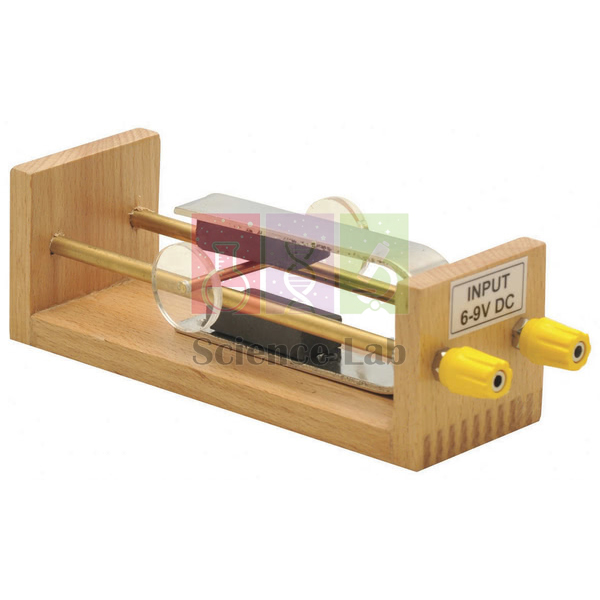
Apparatus Force of Conductor
Apparatus Force of Conductor (Product Code: SLE/PHY/11) is a rolling-axle demonstration unit used to show Fleming's left-hand rule, the force on a current-carrying conductor in a magnetic field, in school physics labs. A brass axle with plastic discs rests on a pair of brass rails between the poles of a strong U-shaped magnet, and it rolls one way or the other depending on the direction of the current. It is made by Jain Scientific Equipments Pvt Ltd (ScienceLab), an OEM manufacturer, at its own factory in Ambala, India.
Specifications
| Parameter | Detail |
|---|---|
| Principle shown | Fleming's law: a conductor carrying current in a magnetic field experiences a force whose direction depends on the direction of the current |
| Moving conductor | Brass axle with plastic discs, free to roll along the rails |
| Rails | Pair of brass rails |
| Terminals | 4 mm socket terminals |
| Magnet | Strong U-shaped magnet |
| Product code | SLE/PHY/11 |
| Manufacturer | Jain Scientific Equipments Pvt Ltd (ScienceLab) — OEM |
| Country of origin | India (made in Ambala, Haryana) |
What Is the Force of Conductor Apparatus Used For?
This is the classic "motor effect" demonstration. Current enters one brass rail through a 4 mm socket, crosses the brass axle and leaves by the other rail, so the axle itself becomes the conductor sitting in the field of the U-shaped magnet. As soon as current flows, the axle is pushed along the rails; reverse the supply leads, or turn the magnet over, and it rolls back the other way. Students can predict each result with Fleming's left-hand rule before switching on.
Use a low-voltage DC source and switch the current on only briefly, as a short circuit through the rails and axle warms the leads quickly. The plastic discs keep the axle rolling true on the rails, so the effect is easy to see from the back of the room. As an electromagnetic kit for school physics, it links neatly to lessons on electric motors and on current-carrying coils.
OEM Manufacturer
Jain Scientific Equipments Private Limited, which trades as ScienceLab, is the original equipment manufacturer (OEM) of the Apparatus Force of Conductor. The unit is built at the company's licensed factory at Saha, Ambala, Haryana, India, and goes out factory-direct to schools, teacher-training colleges, dealers and importers. If you later need a replacement axle, rails or magnet, or want to repeat an earlier order, ask the manufacturer directly. Read more on the company profile page.
Related Physics Lab Equipment
To run the demonstration and extend it into a full electromagnetism lesson, labs usually add:
- Power Supply, Stepped — a bench supply for sending current through the rails.
- Stackable Leads — leads for joining the supply to the socket terminals.
- Knife Switch – Single Pole — lets the teacher apply current in short bursts.
- Force on a Conductor Apparatus — an alternative design for the same Fleming's rule experiment.
- Induced Current Apparatus — shows the reverse effect, where motion in a field produces current.
More items are listed under Physics Lab Equipment.
Frequently Asked Questions
What does the Apparatus Force of Conductor demonstrate?
The Apparatus Force of Conductor demonstrates that a conductor carrying current in a magnetic field is pushed by a force. The brass axle rolls along the brass rails in one direction, and reverses when the current direction is reversed, which students can check with Fleming's left-hand rule.
What parts make up the force of conductor apparatus?
The force of conductor apparatus comprises a strong U-shaped magnet, a pair of brass rails fitted with 4 mm socket terminals, and a brass axle with plastic discs that is free to roll along the rails. A DC supply and connecting leads are needed to run it.
What power source does the Apparatus Force of Conductor need?
The Apparatus Force of Conductor is run from a low-voltage DC source connected to the 4 mm sockets on the brass rails. Switch the current on only for short periods. For advice on a supply that suits your lab, send your existing equipment list through the ScienceLab contact page.
Who manufactures the Apparatus Force of Conductor?
Jain Scientific Equipments Pvt Ltd, trading as ScienceLab, manufactures the Apparatus Force of Conductor as the OEM at its own factory in Saha, Ambala, Haryana, India. Schools and dealers buy it direct from the manufacturer and can ask the same team for replacement parts.
Which class levels use the force of conductor apparatus?
The Apparatus Force of Conductor suits secondary-school lessons on the motor effect and Fleming's left-hand rule, and it is also used for revision demonstrations in senior-secondary and junior college physics. Teachers use it before introducing the electric motor so students first see the basic force on a single conductor.
How can I get a quotation for SLE/PHY/11?
For a quotation on the Apparatus Force of Conductor, code SLE/PHY/11, send the quantity, delivery city or country and any supply or lead requirements through the ScienceLab contact page or enquiry cart. ScienceLab supplies schools, dealers and importers in India and international markets.
Request a Quote
Add the Apparatus Force of Conductor to the enquiry cart or write to us through the contact page with your quantity and destination. Because ScienceLab is the manufacturer, the quote comes directly from the factory team.
Last updated: 24 September 2026
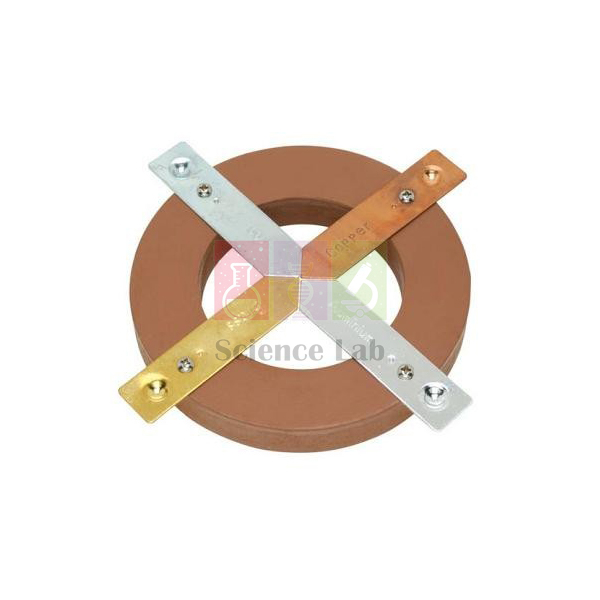
Apparatus Heat/Thermal Conductivity
Apparatus Heat/Thermal Conductivity (Product Code: SLE/PHY/12) is a four-metal comparison ring used to show that different metals conduct heat at different rates in school science and physics labs. Four pointed strips of aluminium, brass, copper and iron meet at the centre of a wooden compound ring, and each carries a small water-holding indentation at its outer end, so the class can watch which drop dries first. It is made by Jain Scientific Equipments Pvt Ltd (ScienceLab), an OEM manufacturer, at its own factory in Ambala, India.
Specifications
| Parameter | Detail |
|---|---|
| Frame | Wood compound ring |
| Metal strips | 4 pointed strips, each of a different metal: aluminium, brass, copper and iron |
| Strip layout | Attached at 90 degrees to each other around the ring, with their points meeting at the centre |
| Outer end of each strip | Indentation for holding water |
| Observation | The water evaporates at different times depending on the conductivity of each metal |
| Product code | SLE/PHY/12 |
| Manufacturer | Jain Scientific Equipments Pvt Ltd (ScienceLab) — OEM |
| Country of origin | India (made in Ambala, Haryana) |
What Is the Thermal Conductivity Apparatus Used For?
The apparatus turns an abstract property into a race. Put an equal drop of water in the indentation at the end of each strip, then warm the centre of the ring where the four points meet, for example over a small spirit-lamp flame. Heat travels outward along each strip at a rate set by its metal, so the drops begin to steam and dry in a clear order. Copper, which conducts heat fastest of the four, usually finishes first and iron last, with aluminium and brass in between.
Because all four strips share one heat source, the comparison is fair without any extra measuring instruments, which makes it a simple heat energy science kit for middle and secondary classes. Let the ring cool before refilling the indentations, and keep the flame under the centre only so the wooden ring is not scorched. Older students can follow up with measured experiments on conduction in rods.
OEM Manufacturer
This thermal conductivity ring is an OEM product of Jain Scientific Equipments Private Limited, the company behind the ScienceLab name. It is produced at the company's licensed factory at Saha, Ambala, Haryana, India, and reaches schools, colleges, dealers and importers directly from the manufacturer, not through a trading house. For institutional vendor registration, the company's details are GSTIN 06AAECJ8618A1ZT and LEI 3358004HRD1JIVXKYX49. Background on the company is on the ScienceLab profile page.
Related Physics Lab Equipment
For a complete lesson sequence on conduction of heat, these items work well alongside the ring:
- Thermal Conductivity Bars — another way to compare how well different materials conduct heat.
- Conductivity of Metal Apparatus — a further conduction experiment for comparing metals.
- Apparatus Conductivity Cam — a related conduction demonstration from the same physics range.
- Glass Spirit Lamp — a small, steady flame for heating the centre of the ring.
Browse all Physics Lab Equipment for more heat and thermodynamics apparatus.
Frequently Asked Questions
What does the Apparatus Heat/Thermal Conductivity show?
The Apparatus Heat/Thermal Conductivity shows that metals conduct heat at different rates. When the centre of the ring is heated, the water held at the end of the aluminium, brass, copper and iron strips evaporates at different times, revealing which metal carries heat fastest.
Which metals are used in the thermal conductivity apparatus?
The thermal conductivity apparatus uses four pointed strips, each made of a different metal: aluminium, brass, copper and iron. They are fixed at 90 degrees to each other around a wood compound ring, with their points meeting at the centre, where heat is applied.
In what order does the water dry on the conductivity ring?
On the Apparatus Heat/Thermal Conductivity, the water at the end of the copper strip usually dries first because copper conducts heat fastest of the four metals, and iron is usually last. Room draughts and uneven drops can change the result, so repeat the test for a fair comparison.
Who manufactures the Apparatus Heat/Thermal Conductivity?
Jain Scientific Equipments Pvt Ltd, trading as ScienceLab, is the OEM manufacturer of the Apparatus Heat/Thermal Conductivity. It is made at the company's own factory in Saha, Ambala, Haryana, India, and supplied direct to schools, colleges, dealers and importers.
What heat source is needed for the thermal conductivity ring?
The Apparatus Heat/Thermal Conductivity needs a small flame, such as a spirit lamp or a low Bunsen flame, placed under the centre where the four metal points meet. The heat source is not part of the apparatus, so order it separately if your lab does not already have one.
Can ScienceLab supply this apparatus for a whole school lab or export order?
Yes. ScienceLab supplies the Apparatus Heat/Thermal Conductivity singly or in quantity for school labs, dealers and importers in India and international markets. Send the required quantity and destination through the contact page to receive a quotation from the manufacturer.
Request a Quote
Ask for a quotation on the Apparatus Heat/Thermal Conductivity through the contact page, or place it in the enquiry cart with the rest of your heat experiments. Quotes are issued directly by the manufacturer, ScienceLab.
Last updated: 24 September 2026
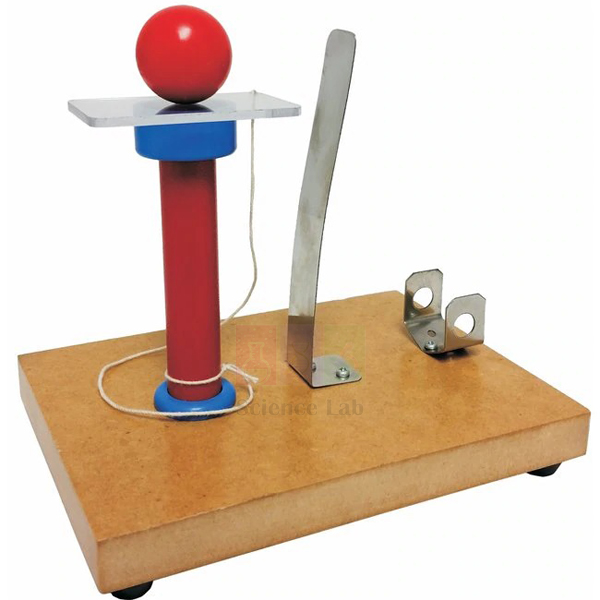
Apparatus Inertia
Apparatus Inertia (Product Code: SLE/PHY/13) is a spring-flick demonstration set used to illustrate inertia, the tendency of a body at rest to stay at rest, in primary, middle and secondary school science classes. In this hands-on physics demonstration kit, a spring snaps a card out from under a glass ball, and the ball drops into the cup on the post instead of flying off with the card. It is made by Jain Scientific Equipments Pvt Ltd (ScienceLab), an OEM manufacturer, at its own factory in Ambala, India.
Specifications
| Parameter | Detail |
|---|---|
| Purpose | Illustrating an effect of inertia |
| Contents | Glass ball, card, plastic base, post, hardware and instructions |
| Action | Pulling back and releasing the spring shoots the card forward while the ball drops back into the cup on the post |
| Glass ball | Has a 5 mm flat spot that lets it rest on the card |
| Extension | The same experiment can be tried with a coin |
| Product code | SLE/PHY/13 |
| Manufacturer | Jain Scientific Equipments Pvt Ltd (ScienceLab) — OEM |
| Country of origin | India (made in Ambala, Haryana) |
What Is the Inertia Apparatus Used For?
It is the classroom version of pulling a tablecloth from under the dishes. The card is laid over the cup on the post, the glass ball rests on the card on its 5 mm flat spot, and the spring is pulled back. When the spring is let go it strikes the card sharply and sends it flying, but the ball, which was at rest, tends to stay at rest. The brief friction from the card moves it only a little, so it drops straight down and settles into the cup instead of travelling with the card.
Ask students to predict the outcome before each release, then repeat with a coin in place of the ball to show the same effect on a different object. A quick, confident release gives the cleanest result; a slow push drags the ball along and is itself a useful comparison. As a force motion experiment kit, it opens discussion of Newton's first law, seat belts and why loose objects slide in a braking bus.
OEM Manufacturer
ScienceLab is the brand name of Jain Scientific Equipments Private Limited, which is the OEM for the Apparatus Inertia. The set is manufactured at the company's own licensed factory in Saha, Ambala, Haryana, India, and supplied straight from there to schools, science centres, dealers and importers. Because the maker handles every enquiry, spare glass balls or cards and repeat class sets can simply be requested from us. Company details are on the ScienceLab profile.
Related Physics Lab Equipment
Teachers covering Newton's laws and momentum often pair this set with:
- Newton's Pendulum (Newton's Cradle) — carries the lesson on to momentum and energy transfer in collisions.
- Dynamics Trolley, Plastic — for experiments on force, mass and acceleration.
- Apparatus Collision 2 Dimension — a follow-on apparatus for studying collisions.
- Apparatus Falling Bodies (Projectile) — another quick mechanics demonstration built around a spring release.
The full list is under Physics Lab Equipment.
Frequently Asked Questions
What does the Apparatus Inertia demonstrate?
The Apparatus Inertia demonstrates that a body at rest tends to stay at rest. When the spring flicks the card away, the glass ball does not travel with it; it drops into the cup on the post, showing inertia and introducing Newton's first law of motion.
What is included in the Apparatus Inertia set?
The Apparatus Inertia set contains a glass ball, a card, a plastic base, a post, the fitting hardware and instructions. The spring used to flick the card forms part of the apparatus, and the glass ball has a 5 mm flat spot so it can rest steadily on the card.
Why does the inertia apparatus ball have a flat spot?
The glass ball of the Apparatus Inertia has a 5 mm flat spot so it can sit on the card without rolling off before the spring is released. The flat spot keeps each trial starting from rest, which makes the inertia effect repeatable for the whole class.
Can the inertia apparatus be used with other objects?
Yes. Besides the glass ball supplied with the Apparatus Inertia, the same experiment can be tried with a coin placed on the card. Comparing the two helps students see that inertia is a property of all objects, not only of the ball.
Who manufactures the Apparatus Inertia?
The Apparatus Inertia is manufactured by Jain Scientific Equipments Pvt Ltd (ScienceLab) as the OEM, at its own factory in Saha, Ambala, Haryana, India. The company supplies it directly to schools, dealers and importers, and handles requests for replacement parts itself.
What information is needed for a quote on SLE/PHY/13?
For a quote on the Apparatus Inertia, code SLE/PHY/13, tell ScienceLab how many sets you need, the delivery location in India or abroad, and whether spare balls or cards should be included. Use the contact page or enquiry cart to send the request.
Request a Quote
Put the Apparatus Inertia in the enquiry cart or send quantities through the contact page. You will receive the quotation directly from ScienceLab as the manufacturer.
Last updated: 24 September 2026

Apparatus Newton's Ring
Apparatus Newton's Ring (Product Code: SLE/PHY/14) is an optical interference unit used to display the ring pattern formed when light reflects between two surfaces, in physics and optics lab classes. A convex lens rests on a flat lens inside a metallic frame with three terminals, and the complete ring measures 4 inches in diameter and 1-1/2 inches thick. Schools and colleges use it as a sturdy Newton rings apparatus made in India by Jain Scientific Equipments Pvt Ltd (ScienceLab), an OEM manufacturer, at its own factory in Ambala.
Specifications
| Parameter | Detail |
|---|---|
| Phenomenon shown | Interference pattern caused by the reflection of light between two surfaces |
| Optical parts | Convex lens mounted over a flat lens |
| Mounting | Metallic frame with three terminals |
| Size | 4 inches in diameter, 1-1/2 inches thick |
| With monochromatic light | A series of dark and light rings |
| With white light | A series of rainbow-coloured rings |
| Product code | SLE/PHY/14 |
| Manufacturer | Jain Scientific Equipments Pvt Ltd (ScienceLab) — OEM |
| Country of origin | India (made in Ambala, Haryana) |
What Is the Newton's Ring Apparatus Used For?
Where the curved face of the convex lens meets the flat lens, a very thin film of air is trapped, growing thicker away from the contact point. Light reflected from the two surfaces bounding this film interferes, and wherever the path difference matches, the reflections reinforce or cancel. The result is a set of concentric rings centred on the point of contact, a clear visual proof that light behaves as a wave.
Viewed under a monochromatic source such as a sodium lamp, the unit shows crisp alternating dark and light rings that advanced students can measure to find the radius of curvature of the lens or the wavelength of the light. Under ordinary white light the same pattern appears as rainbow-coloured rings, which is ideal for a quick class demonstration. Handle the lenses by the frame only and keep them free of dust, since any particle between the glass surfaces spoils the rings. It suits any optics lab equipment set for senior-secondary and undergraduate practicals.
OEM Manufacturer
Jain Scientific Equipments Private Limited, trading as ScienceLab, is the OEM (original equipment manufacturer) of the Apparatus Newton's Ring. The unit is manufactured at the company's licensed factory at Saha, Ambala, Haryana, India, and supplied factory-direct to colleges, schools, laboratory dealers and importers. Buying from the maker means one point of contact for quotations and for any later replacement parts or matching units — just ask us. See the company profile for background.
Related Physics Lab Equipment
A complete Newton's rings experiment normally needs a light source and a measuring instrument as well:
- Sodium Spectral Lamp — a monochromatic source for sharp dark and light rings.
- Spectral Lamp Power Supply with Lamp Holder — powers and holds the spectral lamp.
- Vernier Travelling Microscope — for measuring ring diameters in quantitative work.
- Newton's Ring Model — an alternative Newton's ring unit in a different frame design.
Explore more optics items in Physics Lab Equipment.
Frequently Asked Questions
What does the Apparatus Newton's Ring show?
The Apparatus Newton's Ring shows the interference pattern produced when light reflects between two surfaces: the curved face of a convex lens and the flat lens beneath it. The trapped air film produces concentric rings around the contact point, demonstrating the wave nature of light.
What size is the Newton's ring apparatus?
The Apparatus Newton's Ring measures 4 inches in diameter and 1-1/2 inches thick. Its convex lens and flat lens are held together in a metallic frame with three terminals, making it compact enough to place on an optical bench or under a microscope.
What light source is needed to see the rings?
The Apparatus Newton's Ring can be viewed with monochromatic light, which gives a series of dark and light rings, or with white light, which gives rainbow-coloured rings. For measurements, a monochromatic source such as a sodium lamp is the usual choice.
Who manufactures the Apparatus Newton's Ring?
The Apparatus Newton's Ring is manufactured by Jain Scientific Equipments Pvt Ltd, which trades as ScienceLab, as the OEM at its own factory in Saha, Ambala, Haryana, India. Colleges and dealers buy it direct from the manufacturer rather than through a trader.
How should the Newton's ring lenses be cared for?
Keep the Apparatus Newton's Ring in a dust-free box, hold it only by the metallic frame, and clean the outer glass faces with a soft lens tissue. Dust or fingerprints between or on the surfaces distort the rings and make diameter readings unreliable.
Can a calibration certificate be provided with SLE/PHY/14?
Whether any calibration or test document can accompany the Apparatus Newton's Ring, code SLE/PHY/14, should be discussed with ScienceLab before ordering. Mention this requirement in your enquiry through the contact page along with the quantity and delivery location.
Request a Quote
Send your requirement for the Apparatus Newton's Ring through the ScienceLab contact page or add it to the enquiry cart with any light source you need. The quotation is prepared by ScienceLab directly as the manufacturer.
Last updated: 24 September 2026
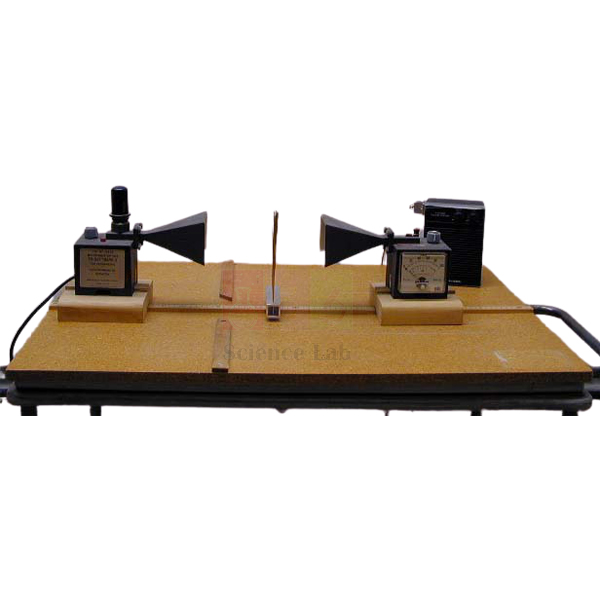
Apparatus Microwave
Apparatus Microwave (Product Code: SLE/PHY/15) is a microwave optics kit used to demonstrate the wave properties of electromagnetic microwaves, namely reflection, polarization, diffraction and interference, in senior school and college physics labs. It pairs a microwave transmitter with a receiver, audio amplifier and loudspeaker, so students hear as well as measure changes in the signal, and it runs from a 12V DC supply. It is supplied by Jain Scientific Equipments Pvt Ltd (ScienceLab), Ambala, India, as a wave motion kit for school and college use.
Specifications
| Parameter | Detail |
|---|---|
| Purpose | Demonstrating wave properties of electromagnetic microwaves for comparison with the behaviour of visible light |
| Effects demonstrated | Reflection, polarization, diffraction, interference |
| Power requirement | 12V DC supply |
| Source and detection | Microwave transmitter; receiver; audio amplifier and loudspeaker |
| Reflectors | Two large aluminium reflectors; one narrow aluminium reflector |
| Other parts | Black hardboard mirror; polarization grille; battery charging lead |
| Documentation | Instruction booklet |
| Product code | SLE/PHY/15 |
| Supplied by | Jain Scientific Equipments Pvt Ltd (ScienceLab), Ambala, India |
What Is the Microwave Apparatus Used For?
Microwaves have wavelengths of a few centimetres, so effects that need a microscope or a laser with visible light can be shown on an ordinary bench. With the transmitter aimed at the receiver, students tilt an aluminium reflector and follow the reflected beam, rotate the polarization grille to make the signal fade and return, send the beam past the narrow reflector to see it spread by diffraction, and set up two paths to produce interference maxima and minima. The loudspeaker makes every change audible to the whole class.
Each result can then be compared directly with the matching experiment in light, which is the main teaching value of the kit. Keep the reflectors flat and clean, work on a clear bench away from metal cupboards that cause stray reflections, and follow the instruction booklet for set-up and safe use. It is a useful piece of physics lab equipment for India's senior-secondary and undergraduate wave-optics topics.
Supplier
Jain Scientific Equipments Private Limited, which trades as ScienceLab, supplies the Apparatus Microwave from Ambala, Haryana, India. The company sources this kit and handles the enquiry, quotation, packing and dispatch for schools, colleges, laboratory dealers and importers. If you need guidance on the contents, the 12V DC supply or items to order alongside it, our team will help — just ask. Read about the company on the ScienceLab profile page.
Related Physics Lab Equipment
These items help extend microwave work or connect it to other wave experiments:
- Microwave Transmitter/Receiver — a separate transmitter and receiver listing; ask us which suits your lab.
- Microwave Accessories Hollow Plano-convex Lens — for refraction and focusing studies; confirm compatibility with us.
- Microwave Accessories Rotating Protractor — helps measure angles in reflection work; confirm compatibility with us.
- Battery Eliminator 12 Volt — a possible bench source; check with us that it matches the kit's 12V DC need.
- Ripple Tank — shows reflection, diffraction and interference with water waves for comparison.
See the wider Physics Lab Equipment range.
Frequently Asked Questions
What experiments can be done with the Apparatus Microwave?
The Apparatus Microwave demonstrates reflection, polarization, diffraction and interference of electromagnetic microwaves. Students compare each result with the behaviour of visible light, using the transmitter, receiver, aluminium reflectors, polarization grille and hardboard mirror supplied in the kit.
What is included in the microwave apparatus kit?
The Apparatus Microwave kit consists of a microwave transmitter, a receiver, an audio amplifier and loudspeaker, two large aluminium reflectors, one narrow aluminium reflector, a black hardboard mirror, a polarization grille, a battery charging lead and an instruction booklet.
What power supply does the Apparatus Microwave need?
The Apparatus Microwave requires a 12V DC supply. The kit includes a battery charging lead, but for the exact connection arrangement and a suitable bench source, ask ScienceLab through the contact page before ordering so the supply matches your laboratory.
Who supplies the Apparatus Microwave?
The Apparatus Microwave is supplied by Jain Scientific Equipments Pvt Ltd (ScienceLab), Ambala, Haryana, India. The company handles quotations, packing and dispatch for schools, colleges, dealers and importers in India and international markets.
Why use microwaves instead of light for wave experiments?
Microwaves have much longer wavelengths than visible light, so with the Apparatus Microwave the spacing of interference maxima and the spreading by diffraction are large enough to find with a receiver on a normal bench. This makes wave behaviour easier to measure and discuss in class.
What should an enquiry for SLE/PHY/15 include?
An enquiry for the Apparatus Microwave, code SLE/PHY/15, should give the number of kits, the delivery location and whether you also need a 12V DC source or microwave accessories. Send it through the ScienceLab contact page or add the kit to the enquiry cart.
Request a Quote
Request a quotation for the Apparatus Microwave via the contact page, or add it to the enquiry cart together with any accessories and power supply you want quoted.
Last updated: 24 September 2026
