- Physics Lab Equipment
- Chemistry Lab Equipment
- Biology Lab Equipment
- Anatomical Lab Equipment
- Learning
- Educational Lab Equipment
- Magnets
- Agriculture
- Astronomy
- Earth Science
- Geography Lab Equipment
- Safety Lab Coat
- Laboratory
- Meteorological
- Electricity & Magnetism
- Heat
- School Lab Equipment
- Lab Glassware
- Science Lab Equipment
- Tvet Lab Equipment
- Robotics Kits Supplier and Manufacturer for Schools India
- Math Lab Equipment Manufacturers and Exporters in Ambala
- STEM Kits Manufacturers and Supplier India
- Engineering Lab Equipment
- Hospital Lab Equipment
- Water, Sanitation & Hygiene Supplies
- Cold Chain, Solar & Communication Equipment
- Nutrition
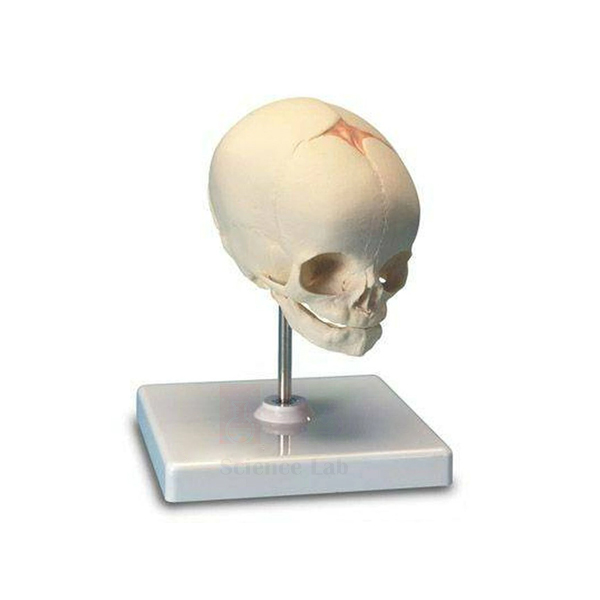
Fetal Skull
Fetal Skull (Product Code: SLE/A/126) is a fetal skull model used to teach fontanelles, sutures and the moulding of a baby's head during birth in midwifery, nursing and obstetrics training. It has a moveable spring-held jaw and is rod-mounted on a durable polymer base, from which the skull detaches for examination; without the stand it measures 11 × 11 × 20 cm. It is made by Jain Scientific Equipments Pvt Ltd (ScienceLab), an OEM manufacturer, at its own factory in Ambala, India.
Specifications
| Parameter | Detail |
|---|---|
| Model | Fetal skull |
| Jaw | Moveable, spring-held |
| Mounting | Rod-mounted on a durable polymer base |
| Stand | Skull detaches from the stand for examination |
| Size (without stand) | 11 × 11 × 20 cm |
| Product code | SLE/A/126 |
| Manufacturer | Jain Scientific Equipments Pvt Ltd (ScienceLab) — OEM |
| Country of origin | India (made in Ambala, Haryana) |
What Is the Fetal Skull Model Used For?
At birth the bones of a baby's skull have not yet fused. The soft gaps between them, the fontanelles, and the sutures that join them are the landmarks a midwife feels for during examination to judge how the head is lying in the birth canal. With this model, students learn to find the diamond-shaped anterior fontanelle and the smaller triangular posterior fontanelle, and to trace the sagittal, coronal and lambdoid sutures that connect them.
Lifting the skull off its rod lets each learner hold it the way it would be felt during a delivery, while the tutor explains how unfused bones allow the head to mould and pass through the pelvis. Placed beside an adult skull, it also shows how large the cranium is compared with the face at this stage of life. Return it to the polymer base after the session so it stays on display and ready for the next group. As one of the human anatomical models made in India for maternal-health teaching, it is a core item for midwifery skills labs.
OEM Manufacturer
Jain Scientific Equipments Private Limited operates under the ScienceLab name and is the OEM (original equipment manufacturer) of this fetal skull, which it makes at its own licensed factory in Saha, Ambala, Haryana, India. Nursing schools, midwifery programmes, medical colleges, dealers and importers receive it directly from the maker.
For a replacement base or rod, or for repeat orders, ask us, as the manufacturer deals with these requests itself. The ScienceLab profile has more about the company.
Related Skulls
Models that complete a childbirth and fetal-development teaching station:
- Human Birth Demonstration Model — a female pelvis with a miniature skull for showing passage through the birth canal.
- Human Adult Female Pelvis Structural Model — the bony pelvis the fetal head must pass through.
- Fetal Positions Before Birth — shows how the baby may lie before delivery.
- Human Fetal Circulation Model — explains blood flow before birth.
- Human Skull Model, Fetal Child — another fetal skull, in PVC with a spring-hung mandible.
See the Skulls category for adult, fetal and animal skull models.
Frequently Asked Questions
Can the Fetal Skull be removed from its stand?
Yes. The Fetal Skull is rod-mounted on a durable polymer base, and the skull detaches from the stand for examination, so students can hold it in the hand to find the fontanelles and sutures, then return it to the stand for display.
What size is the Fetal Skull?
Without its stand, the Fetal Skull measures 11 × 11 × 20 cm. The stand adds to the overall height, so if you need the displayed or packed size for a cabinet, ask us through the contact page before ordering.
Does the jaw of the Fetal Skull move?
Yes. The Fetal Skull has a moveable, spring-held jaw. The spring keeps the lower jaw attached while still letting it move, so it stays in place when the skull is lifted off the stand and turned during examination.
Who uses the Fetal Skull?
The Fetal Skull is used by nursing and midwifery schools, obstetrics departments and biology teachers to explain fontanelles, sutures and how a baby's skull bones can overlap during birth, often alongside a pelvis or birth demonstration model.
Who manufactures the Fetal Skull?
The Fetal Skull is manufactured by Jain Scientific Equipments Pvt Ltd (ScienceLab), the OEM, at its own licensed factory at Saha, Ambala, Haryana, India. Quotations and repeat orders come straight from the manufacturer, not a trader.
How can I order the Fetal Skull in quantity?
The Fetal Skull can be ordered singly or in quantity by nursing colleges, dealers and importers in India and international markets. Send the product code SLE/A/126, the number of models and the delivery location to receive a quotation.
Request a Quote
Ask for a Fetal Skull quotation through our contact page, or add it to the enquiry cart with any pelvis or birth models you need. Prices are quoted directly by the manufacturer.
Last updated: 24 September 2026
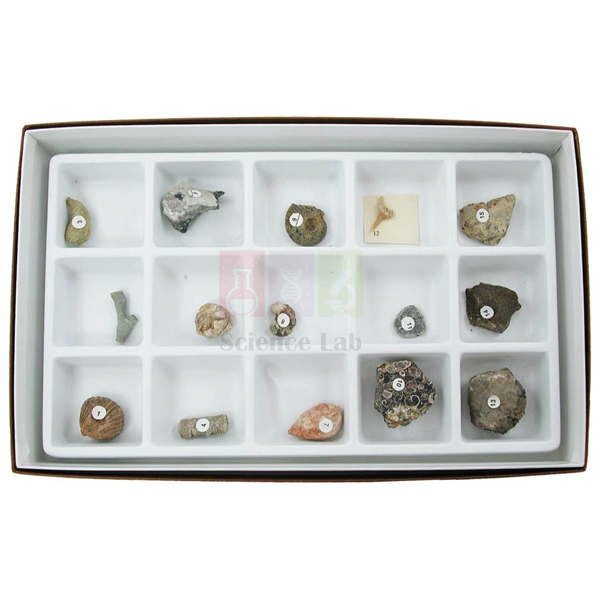
General Fossil Collection
General Fossil Collection (Product Code: SLE/GG/14) is an introductory selection of 15 fossils that illustrates the major life forms present throughout geologic history. A descriptive key sheet and a geologic time chart guide students as they learn to recognise basic fossils and match each one to its era, which makes the set a natural fit for middle-school geography, general science and early biology lessons. As practical junior science lab equipment, it gives learners real specimens to hold instead of textbook pictures. The collection is supplied by Jain Scientific Equipments Pvt Ltd (ScienceLab), Ambala.
Specifications
| Parameter | Detail |
|---|---|
| Number of fossils | 15 |
| Coverage | Major life forms present throughout geologic history |
| Reference material | Descriptive key sheet and geologic time chart |
| Learning aim | Introducing basic fossils and matching each fossil to its era |
| Supplied as | Fossil collection |
Typical Use
Many teachers run the collection as a matching challenge: pairs of students pick a fossil, describe its shape and texture, look it up on the descriptive key sheet and then place it on the correct band of the geologic time chart. With only 15 pieces, the whole set can be worked through in a single lesson, and the finished chart becomes a timeline the class can discuss — which life forms appear early, which come later, and what that suggests about how life on Earth developed.
The collection also makes a good starting point for explaining how fossils form, why most are found in sedimentary rock and what they tell us about past environments. For younger groups, laying a long paper strip on the floor as a timeline and walking the fossils along it helps them grasp the scale of geologic time. Keep the pieces in their packaging between lessons and check the count before putting the set away.
Supplier
ScienceLab is how Jain Scientific Equipments Private Limited, an Ambala, Haryana company, presents its educational range to schools and colleges. The fossils in this collection are natural specimens that the company supplies alongside the key sheet and time chart; it does not describe them as manufactured items. Institutions in India and international markets can find out more on the company profile.
Related Geography Lab Equipment
Pair the General Fossil Collection with these items for a fuller unit on fossils and earth history:
- Advanced Fossil Collection — a 30-fossil step up for senior classes.
- Fossil Hunt Kit — lets students experience how fossils are found and uncovered.
- Geology History Kit — models the rock layers in which fossils are preserved.
- Magnifying Glass — to magnify the texture and outline of each specimen.
Find related items in the Geography Lab Equipment category.
Frequently Asked Questions
What does the General Fossil Collection include?
Fifteen fossils plus a descriptive key sheet and a geologic time chart for matching each fossil to its era.
Which age group is it best for?
It is aimed at introducing basic fossils, so it suits middle-school and early secondary classes. Senior classes may prefer the larger Advanced Fossil Collection.
Can students handle the fossils directly?
Yes, with supervision. Ask students to handle them over a table, avoid dropping or scratching them and return each piece after use.
Is a list of the individual fossils available?
Please ask through our contact page and we will share the specimen list for the collection you are ordering.
Can I buy several collections for different sections or schools?
Yes. Multiple collections can be quoted together for schools, school groups and distributors in India and international markets.
What information speeds up a quotation?
The product code SLE/GG/14, the number of collections, your delivery location and any paperwork your purchase office needs.
Request a Quote
Ask for a quotation on the General Fossil Collection through our contact page, or save it to your enquiry cart while you browse the rest of the range.
Last updated: 24 September 2026
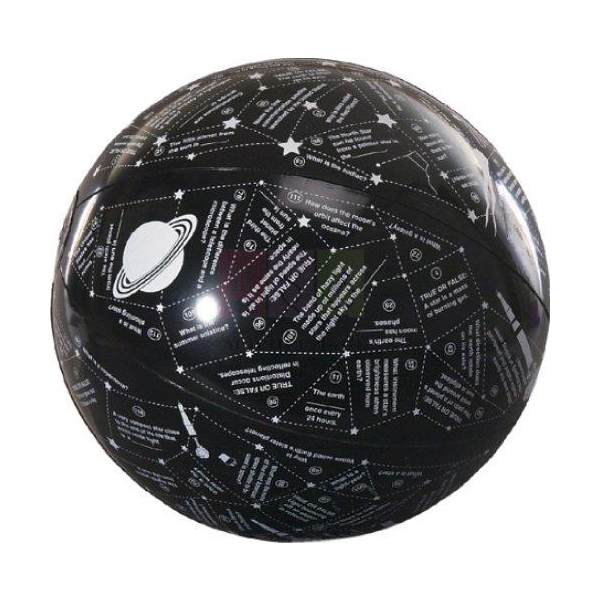
Astronomy Clever Catch
Astronomy Clever Catch (Product Code: SLE/GG/15) is a 24-inch question ball that turns astronomy revision into a game. Players toss the ball to one another, and whoever catches it reads out and answers the astronomy question found under their left thumb. It is a creative way for children to learn astronomy concepts, and the included list of game suggestions, directions and answers means teachers can start playing straight away. Primary and middle-school teachers, science clubs and activity centres use it as a lively addition to their astronomy lab equipment. The game is supplied by Jain Scientific Equipments Pvt Ltd (ScienceLab), Ambala.
Key Details
| Parameter | Detail |
|---|---|
| Type | Question-and-answer catch ball game |
| Ball size | 24 inch |
| Subject | Astronomy concepts |
| How it is played | The catcher answers the question under their left thumb |
| Included | List of game suggestions, directions and answers |
| Suitable for | Children learning astronomy; classroom review and group games |
Typical Use
Arrange students in a circle and start with a simple round: the catcher reads the question under their left thumb, answers it, and tosses the ball on. Because the ball offers many variations of play, teachers can switch formats to suit the lesson — team scoring, “pass it on” where the next player must answer, or a quick-fire round to revise planets, stars and the Moon before a test. The answer list lets the teacher or a student referee confirm responses without slowing the game.
The game works well as a warm-up at the start of a space unit, as an end-of-term review, or as a break between more formal activities with models and globes. Play in a hall or open classroom space away from lights and glassware, and wipe the ball with a slightly damp cloth after use to keep the printed questions readable.
Supplier
ScienceLab, the trading name of Jain Scientific Equipments Private Limited in Ambala, Haryana, supplies this game as part of its geography and astronomy teaching range. For vendor registration, the company's GSTIN is 06AAECJ8618A1ZT, and its export shipments are handled under Importer-Exporter Code AAECJ8618A issued by the DGFT. See our company profile for more details.
Related Geography Lab Equipment
Combine the Astronomy Clever Catch with these items to build a complete space-science unit:
- Solar System Model — a visual reference for questions about planets and their order.
- Astronomy Activity Kit — hands-on activities to follow up the concepts revised in the game.
- Celestial Star Globe — for lessons on stars and constellations.
- Rocks Clever Catch — the same catch-and-answer format for a geology topic.
Browse all products in Geography Lab Equipment.
Frequently Asked Questions
How big is the ball?
It is a 24-inch ball, large enough for a group to see the printed questions and catch it easily.
What comes with the game?
The ball plus a list of game suggestions, directions and answers.
How many children can play at once?
There is no fixed number; the game is played by tossing the ball around a group, so it suits small groups or a full class taking turns.
Which astronomy topics do the questions cover?
The questions address astronomy concepts for children. For the exact question list, please ask us through the contact page.
How do I keep the ball clean?
Wipe it with a slightly damp cloth, let it dry and store it away from sharp objects and direct heat.
Can you supply several balls for a school group or export order?
Yes. We supply schools and distributors in India and international markets; include the quantity and destination in your enquiry.
Request a Quote
For availability and pricing of the Astronomy Clever Catch, get in touch through the contact page or drop it into your enquiry cart along with other astronomy teaching aids.
Last updated: 24 September 2026
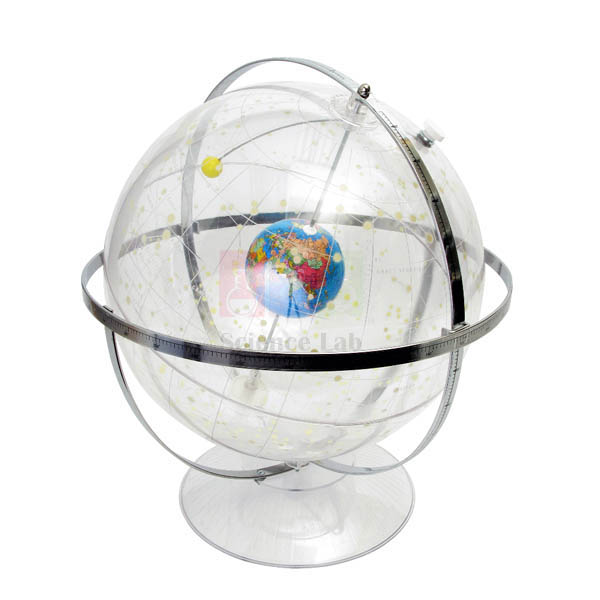
Celestial Star Globe
Celestial Star Globe (Product Code: SLE/GG/16) is a 12-inch diameter globe that clearly and simply demonstrates the apparent relationship between Earth and the stars, planets, galaxies and other celestial objects. It can be set for a chosen time and place so that the constellations sit in their actual positions, giving a class its own small planetarium on the desk. Geography, physics and astronomy teachers use it to explain the night sky before students go outside to observe it. This piece of educational science equipment is manufactured by Jain Scientific Equipments Pvt Ltd (ScienceLab), Ambala, and comes with a detailed study guide.
Specifications
| Parameter | Detail |
|---|---|
| Diameter | 12 inch |
| Demonstrates | Apparent relationship between Earth and the stars, planets, galaxies and other celestial objects |
| Setting | Can be set by time and place to show the actual positions of stars and constellations |
| Marking | Printed on the inside so a crayon may be used to mark positions of the planets or the Moon |
| Included | Detailed study guide |
Typical Use
Start by setting the globe for your school’s location and the date and hour of a planned observation. Students can then pick out which constellations will be above the horizon that evening and in which direction to look — a practical bridge between classroom theory and real stargazing. Turning the globe through a night shows why stars appear to rise and set as Earth rotates, and repeating the setting for another season shows why the visible constellations change through the year.
Because the globe is printed on the inside, a crayon can be used to plot where the Moon or a planet sits among the background stars. Plotting the Moon on several evenings in a row is an effective project that reveals its steady eastward drift. Use crayon only for marking, and store the globe covered to keep it free of dust between lessons.
Manufacturer
Jain Scientific Equipments Private Limited produces the Celestial Star Globe under its ScienceLab brand in Ambala, Haryana, where the company makes geography and science teaching equipment. Schools, colleges and education distributors in India and international markets buy directly from the company. The company profile has further information.
Related Geography Lab Equipment
These products extend the Celestial Star Globe into a complete astronomy corner:
- The Model of The Celestial Sphere (for high school) — an alternative model of the celestial sphere for senior classes.
- Earth Globe Model — compares the terrestrial view with the sky view shown on the star globe.
- Orbiter Model — demonstrates day, night, seasons and lunar phases behind the changing sky.
- Telescope Refractor — for observing the objects students first locate on the globe.
Visit our Geography Lab Equipment category for more.
Frequently Asked Questions
What size is the Celestial Star Globe?
It has a 12-inch diameter.
Can it show the sky for my location?
Yes. The globe can be set according to time and place to show the actual positions of the stars and constellations.
How are planets and the Moon shown?
Their positions change, so they are not fixed on the globe. Because it is printed on the inside, students can mark the positions of the planets or the Moon with a crayon.
Is a teaching guide included?
Yes, the globe comes with a detailed study guide.
Does it come with a stand?
Stand details are not listed on this page. Please confirm the supplied configuration with us through the contact page.
What warranty and after-sales support is offered?
Warranty terms are stated with each quotation, so please raise any after-sales questions when you enquire.
Can you quote for several globes or an export shipment?
Yes. We supply institutions in India and international markets; tell us the quantity and destination.
Request a Quote
Send a price request for the Celestial Star Globe via the contact page, or add it to the enquiry cart to quote it with other astronomy items.
Last updated: 24 September 2026
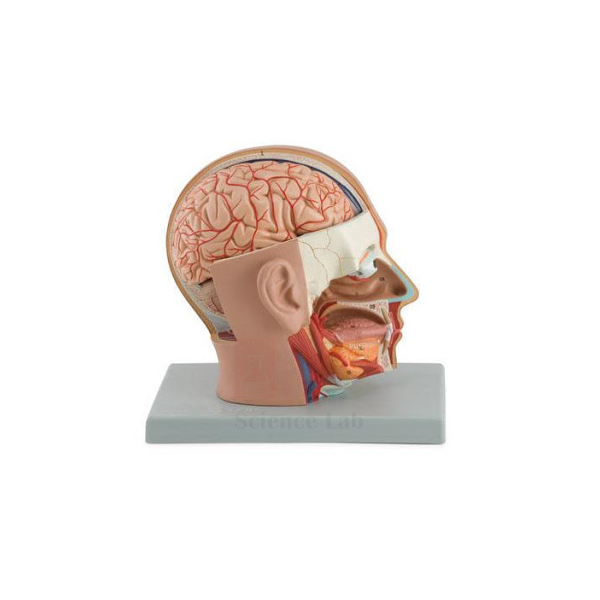
Human Head Dissection Model
Human Head Dissection Model (Product Code: SLE/A/127) is an about life-size dissectible head used to study the brain and the orbit together in anatomy, optometry, nursing and neuroscience classes. The right cerebral hemisphere, right cerebellar lobe and right eye are removable, and the eye comes out with its extrinsic muscles, lacrimal gland, lacrimal duct and optic nerve. It is made by Jain Scientific Equipments Pvt Ltd (ScienceLab), an OEM manufacturer of biology lab equipment, at its own factory in Ambala, India.
Specifications
| Parameter | Detail |
|---|---|
| Type | Dissectible human head model |
| Scale | About life size |
| Size (without base) | 21 x 21 x 18 cm |
| Removable parts | Right cerebral hemisphere, right cerebellar lobe, right eye |
| Eye detail | Extrinsic muscles, lacrimal gland, lacrimal duct and optic nerve |
| Labelling | All significant structures numbered and referenced on the accompanying key |
| Mounting | Durable plastic base |
| Product code | SLE/A/127 |
| Manufacturer | Jain Scientific Equipments Pvt Ltd (ScienceLab) — OEM |
| Country of origin | India (made in Ambala, Haryana) |
What Is the Human Head Dissection Model Used For?
This model is handy for teaching the visual pathway from front to back. Start by removing the right eye to show the extrinsic muscles that move it and the lacrimal gland and duct that keep it moist, then follow the optic nerve backwards. Lifting out the right cerebral hemisphere next reveals the deeper parts of the brain, and taking out the right cerebellar lobe shows what lies at the back of the skull.
With the key in hand, students can work through the numbered structures independently in a practical period, reassembling the parts when they finish. Optometry and ophthalmic assistant courses appreciate the removable eye with its surrounding structures, while general anatomy students gain a combined view of brain and orbit. Departments searching for eye model anatomy in India will find the head context here more useful than an isolated eyeball for some lessons.
OEM Manufacturer
The Human Head Dissection Model is an OEM (original equipment manufacturer) product of Jain Scientific Equipments Private Limited, trading as ScienceLab, made at the company's own licensed factory at Saha, Ambala, Haryana, India.
Optometry schools, anatomy departments, dealers and importers are supplied factory-direct. Because small removable parts such as the eye can go astray, you can ask the manufacturer directly about replacements or repeat orders. Our company profile gives more background.
Related Laboratory Equipment
Add these to a lesson on the eye, orbit and brain:
- Human Eye in Orbit Model — studies the eye and its bony socket at a closer level
- Human Eye Model — an eyeball model for the internal layers not shown on the head
- Human Brain Model in Head — another head-and-brain model for comparison
- Horizontally Sectioned Human Head Model — shows the same region in horizontal slices
It belongs to the Brain Models category, where related heads are listed.
Frequently Asked Questions
Which parts of the Human Head Dissection Model come out?
Three parts of the Human Head Dissection Model are removable: the right cerebral hemisphere, the right cerebellar lobe and the right eye, which lets students look into the skull and the orbit step by step.
What structures are on the removable eye?
The removable right eye of the Human Head Dissection Model is complete with its extrinsic muscles, the lacrimal gland, the lacrimal duct and the optic nerve, so eye movement and tear drainage can be taught on one piece.
Is there a key with the Human Head Dissection Model?
Yes. All significant structures on the Human Head Dissection Model are numbered and referenced on the accompanying key, so students can work through the model independently during a practical period.
How big is the Human Head Dissection Model?
The Human Head Dissection Model is about life size and measures 21 x 21 x 18 cm without its durable plastic base, a convenient size for a single bench or for passing around a small group.
Is the head dissection model useful for optometry courses?
Yes. The Human Head Dissection Model suits optometry and ophthalmic assistant courses because the removable eye shows the extrinsic muscles, lacrimal apparatus and optic nerve in the context of the brain and skull rather than as an isolated eyeball.
What if a small removable part is lost?
If a removable part of the Human Head Dissection Model goes missing, contact us with the product code SLE/A/127 and a description of the part; the manufacturer will advise on replacement options.
Who manufactures the Human Head Dissection Model?
The Human Head Dissection Model is manufactured by Jain Scientific Equipments Pvt Ltd (ScienceLab), the OEM, at its own licensed factory at Saha, Ambala, Haryana, India, and is supplied factory-direct to institutions and distributors.
Request a Quote
Send your quantity and delivery details for the Human Head Dissection Model via the contact page, or use the enquiry cart to request several products at once. Quotes are prepared by the manufacturer itself.
Last updated: 24 September 2026
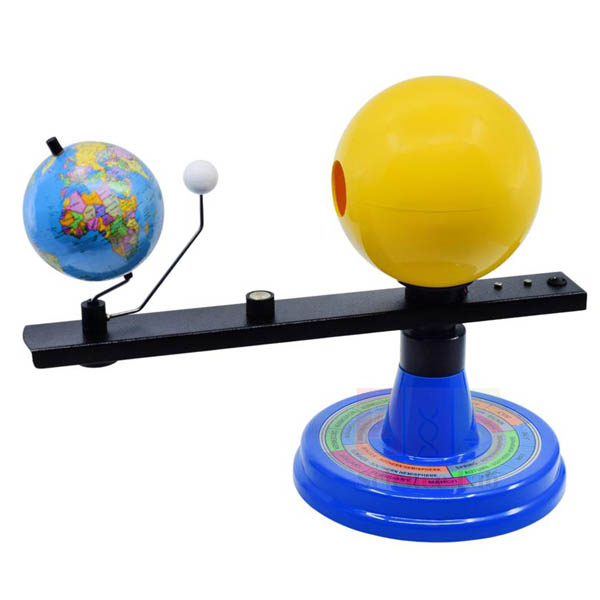
Orbiter Model
Orbiter Model (Product Code: SLE/GG/17) is a gear-driven model of the Sun, Earth and Moon that shows how the three bodies move in relation to one another. A 15-inch arm carries a 4-inch Earth and a 1-inch Moon around a 6-inch Sun, so students can watch daylight and night, the seasons and the phases of the Moon play out in front of them — and answer questions such as how many days Earth takes to revolve around the Sun. It is a dependable Sun-Earth-Moon demonstration model for geography and general science classrooms, manufactured by Jain Scientific Equipments Pvt Ltd (ScienceLab), Ambala, and supplied with a study guide.
Specifications
| Parameter | Detail |
|---|---|
| Mechanism | Gear-driven |
| Arm length | 15 inch |
| Sun diameter | 6 inch |
| Earth diameter | 4 inch |
| Moon diameter | 1 inch |
| Demonstrates | Daylight, night, seasons and phases of the Moon |
| Included | Study guide |
Typical Use
Place the model on a front bench where the whole class can see it and move the Earth slowly along its path. Because the model is gear-driven, the Moon keeps its correct relationship to Earth as the arm turns, so one continuous demonstration can cover several ideas: the side of Earth facing the Sun has day while the other has night, the Moon’s changing position gives its sequence of phases, and Earth’s position around the Sun links to the seasons. Pausing at key points and asking students to predict the next phase keeps the lesson interactive.
Together with the included study guide, the model is useful both for introducing the topic and for revision before exams. Handle the arm gently rather than forcing it, keep the gears free of dust and store the model upright so the Earth and Moon stay correctly aligned.
Manufacturer
The Orbiter Model is one of the teaching models made by Jain Scientific Equipments Private Limited, which does business as ScienceLab from Ambala in Haryana. The company builds apparatus for school and college laboratories and ships to customers in India and international markets. Find out more on the ScienceLab company profile.
Related Geography Lab Equipment
These products are often used alongside the Orbiter Model in lessons on the Earth in space:
- Solar System Model — widens the view from the Sun-Earth-Moon system to all the planets.
- Earth Globe Model — lets students locate places while discussing day length and seasons.
- Project Planetarium Set — small-group plotting of eclipses, moon phases and planet positions.
- Mini Science Kit – Earth, Sun and Moon — individual student activities on the same topic.
See the complete Geography Lab Equipment range.
Frequently Asked Questions
What are the sizes of the Sun, Earth and Moon?
The Sun is 6 inches in diameter, Earth is 4 inches and the Moon is 1 inch, mounted on an arm 15 inches long.
Which concepts can the model demonstrate?
Daylight and night, the seasons and the phases of the Moon, as well as how long Earth takes to revolve around the Sun.
Does the Sun light up?
A light source is not listed for this model. If you need an illuminated Sun for day-and-night demonstrations, please check with us through the contact page.
Is the model built to scale?
No. With a 6-inch Sun and a 4-inch Earth, the sizes are chosen for visibility in a classroom, which gives a good opening to discuss how different the real sizes and distances are.
Is a guide included?
Yes, a study guide is supplied with the model.
Can schools order several units or arrange export delivery?
Yes. We quote for single schools, school groups and distributors in India and international markets.
Request a Quote
To get a price for the Orbiter Model, contact us through the contact page or add it to the enquiry cart together with any other models you need.
Last updated: 24 September 2026
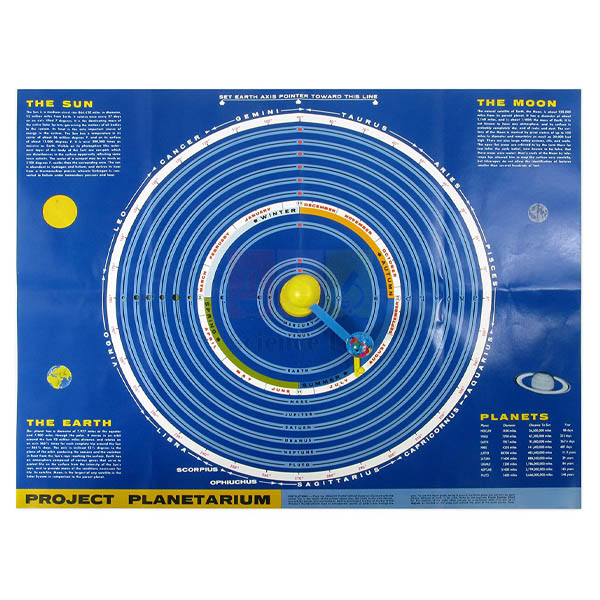
Project Planetarium Set
Project Planetarium Set (Product Code: SLE/GG/18) brings the mysteries of the solar system into the classroom at desk level. Designed for individual or small-group use, it lets students plot eclipses, moon phases and planet positions for themselves, using the study guide, solar system chart and mini Sun-Moon-Earth model included in the set. Part planetarium and part solar system model kit, it suits project work, science-fair preparation and practical astronomy lessons in middle and secondary school. The set is manufactured by Jain Scientific Equipments Pvt Ltd (ScienceLab), Ambala.
Key Details
| Parameter | Detail |
|---|---|
| Type | Planetarium activity set |
| Intended use | Individual or small-group work |
| Activities | Plotting eclipses, moon phases and planet positions |
| Model | Mini Sun-Moon-Earth model |
| Chart | Solar system chart |
| Guide | Study guide |
Typical Use
Working in pairs or small teams, students use the mini Sun-Moon-Earth model to arrange the three bodies for a solar eclipse, with the Moon between the Sun and Earth, and then for a lunar eclipse, with Earth in the middle. They sketch each arrangement and explain why eclipses do not happen every month. The same model helps them track the Moon around Earth and record the sequence of phases they would see from home over several weeks.
The solar system chart moves the activity outward: students plot where the planets are relative to the Sun and to each other, which is a natural launch point for independent projects or class presentations. Because each set serves one learner or a small group, teachers can run several sets side by side and compare results between teams. Keep the chart flat and the small model parts together in the set after each session.
Manufacturer
Jain Scientific Equipments Private Limited makes the Project Planetarium Set and markets it under the ScienceLab name from Ambala, Haryana, alongside a wider range of astronomy and geography teaching aids. For purchase departments that need vendor registration details, the company’s identifiers are GSTIN 06AAECJ8618A1ZT and LEI 3358004HRD1JIVXKYX49. Read more on our company profile.
Related Geography Lab Equipment
These items complement the Project Planetarium Set in space-science teaching:
- Orbiter Model — a larger gear-driven Sun-Earth-Moon model for whole-class demonstrations.
- Solar System Model — a three-dimensional view of the planets students plot on the chart.
- Celestial Star Globe — places the planets against the background stars and constellations.
- Astronomy Activity Kit — further hands-on astronomy activities for groups.
More teaching aids are listed in Geography Lab Equipment.
Frequently Asked Questions
What does the Project Planetarium Set contain?
A study guide, a solar system chart and a mini Sun-Moon-Earth model.
How many students can use one set?
It is designed for one student or a small group. For a full class, most schools order several sets so every group can work at the same time.
What can students plot with it?
Eclipses, moon phases and planet positions.
Is it a projector-type planetarium?
No projection feature is listed for this set; it is a hands-on plotting and modelling set. If you need a projection planetarium, ask us through the contact page.
Is it suitable for science projects?
Yes. Its individual and small-group format makes it a good base for project work on eclipses, the Moon and the solar system.
What details should a school include when requesting a quotation?
The product code SLE/GG/18, the number of sets, the delivery location in India or abroad, and any vendor forms your finance office uses.
Request a Quote
Request pricing for the Project Planetarium Set through the contact page, or add it to the enquiry cart to build a combined astronomy order.
Last updated: 24 September 2026
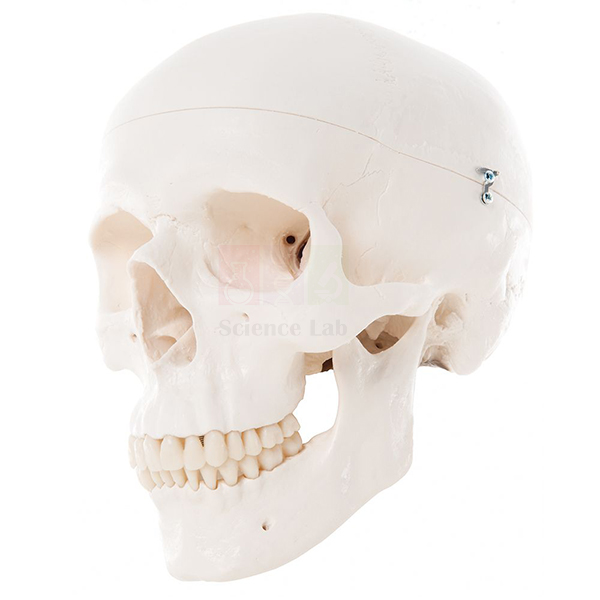
Human Skull Model
Human Skull Model (Product Code: SLE/A/128) is a life-size, 3-part human skull replica used to teach skull bones, sutures and teeth in school, dental and medical anatomy classes. Its sutures are coloured and its bones are number-coded against a comprehensive key, and it has full dentition, a spring-held lower jaw and a removable skull cap and mandible. It is made by Jain Scientific Equipments Pvt Ltd (ScienceLab), an OEM manufacturer, at its own factory in Ambala, India.
Specifications
| Parameter | Detail |
|---|---|
| Scale | Life-size |
| Parts | 3-part replica |
| Size | 20.0 × 13.5 × 15.5 cm |
| Sutures | Coloured |
| Bones | Number-coded, with a comprehensive key |
| Teeth | Full dentition |
| Lower jaw | Spring-held |
| Removable parts | Skull cap and mandible |
| Material | Hard plastic |
| Product code | SLE/A/128 |
| Manufacturer | Jain Scientific Equipments Pvt Ltd (ScienceLab) — OEM |
| Country of origin | India (made in Ambala, Haryana) |
What Is the 3-Part Human Skull Model Used For?
Number coding turns this skull into a ready-made test. A teacher calls out a number, a student names the bone, and the key settles the answer, which makes it well suited to viva practice and revision before practical exams. The coloured sutures show exactly where neighbouring bones meet, so students can follow the coronal, sagittal, lambdoid and squamous sutures around the skull without guessing.
Full dentition makes the model just as useful in a dental anatomy class: learners identify incisors, canines, premolars and molars on both jaws, then close the spring-held lower jaw to see how the teeth meet in a bite. Removing the skull cap and mandible divides the replica into its 3 parts for separate study of the cranial cavity and lower jaw. It is a versatile addition to biology lab equipment for schools in India as well as to college anatomy museums.
OEM Manufacturer
This 3-part skull is made by Jain Scientific Equipments Private Limited, the company that trades as ScienceLab and acts as the OEM (original equipment manufacturer), at its own licensed factory at Saha, Ambala, Haryana, India. Dental colleges, medical and nursing institutions, schools, dealers and importers can buy it factory-direct for India and international markets.
If the key is misplaced or a part needs replacing, ask us and the manufacturer will advise directly. Company information is on the ScienceLab profile.
Related Skulls
Other skull models and accessories often chosen alongside the 3-part skull:
- Human Skull — an unmounted skull with colour-coded bones rather than numbers.
- Human Skull Bones Model — disarticulated into many sections, with a sagittally sectioned base showing the sinuses.
- Human Skull Model, Life Size Colored — a 3-part life-size skull with bones painted in different colours.
- Human Skull Storage Case, Black Plastic — keeps the 3 parts and key together between classes.
- Human Brain Model in Head — shows the brain within the cranial cavity.
More skulls are listed in the Skulls category.
Frequently Asked Questions
How are the bones identified on the Human Skull Model?
On the Human Skull Model the bones are number-coded and the sutures are coloured. A comprehensive key explains what each number refers to, so students can name bones by number and check their own answers.
What are the dimensions of the Human Skull Model?
The Human Skull Model is life-size and measures 20.0 × 13.5 × 15.5 cm. It is a 3-part replica, so allow storage space for the removable skull cap and mandible as well as the main skull and its key.
Does the Human Skull Model include teeth?
Yes. The Human Skull Model has full dentition, so dental and biology students can identify the incisors, canines, premolars and molars on both jaws and see how the teeth meet when the spring-held lower jaw is closed.
Which parts of the Human Skull Model can be removed?
The skull cap and the mandible of the Human Skull Model are both removable. The lower jaw is also spring-held, so it can be shown opening and closing while attached, then taken off for separate study.
What is the Human Skull Model made of?
The Human Skull Model is made of hard plastic. Clean it with a soft, damp cloth, avoid solvents that could affect the coloured sutures or number codes, and keep the parts and the key together in storage.
Who manufactures the Human Skull Model?
The Human Skull Model (SLE/A/128) is manufactured by Jain Scientific Equipments Pvt Ltd (ScienceLab), the OEM, at its own licensed factory at Saha, Ambala, Haryana, India. Quotations and repeat orders are handled by the manufacturer directly.
Request a Quote
Request a quotation for the Human Skull Model through our contact page or add it to the enquiry cart with your required quantity. The price comes straight from the manufacturer.
Last updated: 24 September 2026