- Physics Lab Equipment
- Chemistry Lab Equipment
- Biology Lab Equipment
- Anatomical Lab Equipment
- Learning
- Educational Lab Equipment
- Magnets
- Agriculture
- Astronomy
- Earth Science
- Geography Lab Equipment
- Safety Lab Coat
- Laboratory
- Meteorological
- Electricity & Magnetism
- Heat
- School Lab Equipment
- Lab Glassware
- Science Lab Equipment
- Tvet Lab Equipment
- Robotics Kits Supplier and Manufacturer for Schools India
- Math Lab Equipment Manufacturers and Exporters in Ambala
- STEM Kits Manufacturers and Supplier India
- Engineering Lab Equipment
- Hospital Lab Equipment
- Water, Sanitation & Hygiene Supplies
- Cold Chain, Solar & Communication Equipment
- Nutrition

ID Bracelet, Child, Blue
A blue, transparent wristband that gives each child in a clinic, nutrition programme or survey a personal identity tag. Details are written straight onto the band with a ballpoint pen, or onto a paper strip slid inside it, and a single-use clip locks it shut. Many centres pair blue bands with red ones to mark two groups.
Blue child ID band specifications
| Parameter | Detail |
|---|---|
| Colour | Blue |
| Use | Paediatric personal identification; single use |
| Band | Transparent, tamper proof, supple non-stretch plastic (LDPE-based, vinyl or equivalent) |
| Chemical resistance | Resistant to water, common solvents and soaps |
| Feel | Soft to the touch; strong and durable |
| Locking | Single-use clip; once clicked into position it cannot be removed |
| Recording details | Ballpoint pen directly on the band (non-erasable), or on a paper strip slid into the transparent band |
| Size | Approximately 1 cm wide x 25 cm long |
| Fitting | Length adjusts at the closure; excess strap can be trimmed where it leaves the clip |
| Product code | SLE/AE/05 |
| Minimum order | 10 units |
| Dispatch | Usually within 7 to 10 working days |
| Supplied by | ScienceLab (Jain Scientific Equipments Pvt Ltd), Ambala, India |
Registering children with the blue ID band
Pre-written survey bands. Before a field round, the team writes the household or survey number on a batch of blue bands and lets the ink dry. On site, the child's name is added, the band is fitted and the same number goes on the record sheet beside the mother and child scale reading.
Two-colour sorting. In a feeding programme, children in one enrolment group wear blue and those in another wear the red ID band, following the centre's own protocol. Staff can then call one group at a time to the infant clinic scale without reading every tag.
Desk preparation with inserts. When many bands are made up before a session, staff fill in the paper strips first and check each name against the register. Each strip then slides into a clear band, ready to fit as the child arrives for MUAC screening.
Frequently Asked Questions About the ID Bracelet, Child, Blue
What should I write on the blue band with?
Use an ordinary ballpoint pen. Details written directly on the band cannot be rubbed off. Press firmly, keep the letters clear and let the ink dry for a moment before fastening, so nothing smears while the band is handled.
When is the paper insert better than writing on the band?
Use the insert when bands are prepared in advance at a desk, because the strips can be filled in and checked against the register first. Write on the strip with a ballpoint pen, then slide it into the transparent band so the text lies flat behind the plastic. Writing directly on the band is quicker for a single admission.
Why should every band in a programme follow one layout?
When all bands follow one pattern, staff know where to look and what each colour stands for. Agree which group wears blue, which details go on the band and in what order, and which wrist is used. Then keep to that pattern at every session.
What should staff do if a band is missing or cannot be read?
Pause the task and confirm the child's identity with the caregiver and the register before going on. Cut off the old band if it is still in place, write a fresh blue band and fit it. Never write over faded details on a band that is already fastened.
Will the blue band survive washing and bathing?
Yes. It is made of supple non-stretch plastic that resists water, common solvents and soaps, so it can stay on through bathing and hand washing. Check the writing at each visit and replace a band whose details have become hard to read.
Registration and screening items for child-health work
- ID Bracelet, Child, Red
- MUAC, Child 11.5 Red
- Scale, Infant, Clinic, Beam Type, 16kg x 10g
- Scale Mother/Child Batteries Mains Solar
- Portable Baby/Child L-hgt
To request a quotation, send the product name, code and quantity through our contact page or add the item to your enquiry cart.
Last updated: 14 November 2026

Plastic Hand Scrubbing Brush
Plastic Hand Scrubbing Brush (Product Code: SLE/MU/04) is a reusable nylon-bristle brush used to scrub hands before surgical intervention in operating theatres, delivery rooms and minor procedure rooms. Theatre teams choose it for its soft nylon bristles set in at least 5 rows on a compact polypropylene head of 7 to 9 cm. It is supplied non-sterile by Jain Scientific Equipments Pvt Ltd (ScienceLab), Ambala, India.
Specifications
| Parameter | Detail |
|---|---|
| Head material | Polypropylene |
| Bristle material | Nylon, soft |
| Bristle rows | Minimum 5 |
| Head length | 7 to 9 cm |
| Width | 3 to 4 cm |
| Height | 1 cm |
| Use type | Reusable |
| Condition on supply | Non-sterile |
| Product code | SLE/MU/04 |
| Supplied by | Jain Scientific Equipments Pvt Ltd (ScienceLab), Ambala, India |
What Is the Hand Scrubbing Brush Used For?
Before gloving for an operation, surgeons, midwives and theatre nurses wash their hands and forearms with soap or a surgical scrub solution, and a brush helps work the lather around the nails and fingertips. The soft nylon bristles of this brush are meant for that task, and the small polypropylene head, only about 1 cm high and 3 to 4 cm wide, sits comfortably in the palm.
The brush is supplied non-sterile and is reusable, so each facility should decide how it will be cleaned and reprocessed between users according to its own theatre procedures. Keep a stock large enough that a clean brush is always available at the scrub sink, and replace brushes whose bristles have worn, flattened or split.
Supplier
Jain Scientific Equipments Private Limited supplies this scrubbing brush under its ScienceLab trading name from Ambala, Haryana. Theatres, maternity units, NGOs, dealers and importers can list it with soap, gloves and other scrub-area supplies on one enquiry. Find out more on the company profile.
Related Medical Utensils
Supplies used at the same scrub station:
- Soap Toilet Bar Approx. 100-110g Wrapped — wrapped bar soap for hand washing.
- Soap Box Plastic — keeps the soap bar off the wet sink edge.
- Hand Wash Station — a dedicated hand washing point for the ward or clinic.
- Gloves, Surgical Powdered Free — surgical gloves put on after scrubbing.
Browse all Medical Utensils.
Frequently Asked Questions
What is the Plastic Hand Scrubbing Brush used for?
The Plastic Hand Scrubbing Brush is used for scrubbing hands before a surgical intervention. Its soft nylon bristles help work soap or scrub solution around the fingers and nails at the theatre or delivery room scrub sink.
What are the dimensions of the Plastic Hand Scrubbing Brush?
The Plastic Hand Scrubbing Brush has a head length of 7 to 9 cm, a width of 3 to 4 cm and a height of 1 cm. The bristles are set in a minimum of 5 rows on the polypropylene head.
Is the Plastic Hand Scrubbing Brush sterile?
No. The Plastic Hand Scrubbing Brush is supplied non-sterile. Because it is reusable, clean and reprocess it according to your facility's own theatre procedures before it is placed at the scrub sink.
Is the scrubbing brush disposable or reusable?
The Plastic Hand Scrubbing Brush is reusable. Replace it when the nylon bristles become worn or misshapen, and keep enough brushes in rotation that one is always clean and ready for each person scrubbing in.
Who supplies the Plastic Hand Scrubbing Brush?
The Plastic Hand Scrubbing Brush is supplied by Jain Scientific Equipments Pvt Ltd, trading as ScienceLab, Ambala, Haryana, India. It is available to hospitals, maternity units, NGOs, dealers and importers in India and international markets; send your quantity through the contact page.
Request a Quote
Ask for a price on the Plastic Hand Scrubbing Brush through the contact page, or add it to the enquiry cart along with soap and gloves for your scrub area.
Last updated: 24 September 2026
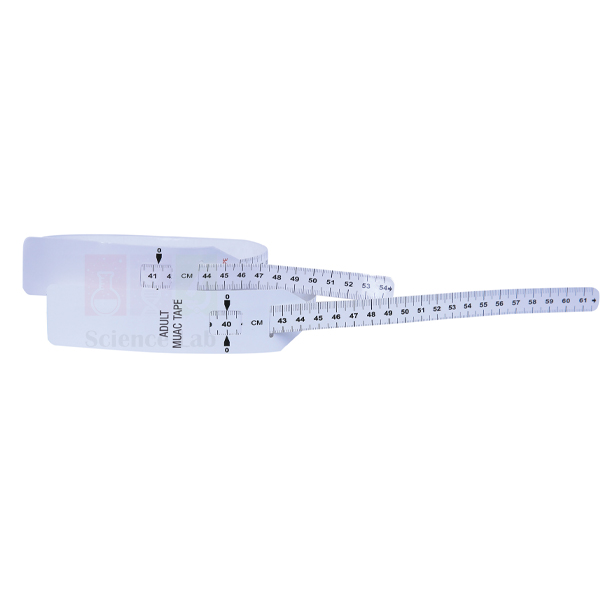
MUAC, Adult, Without Color Code
A plain, numerically graduated tape for measuring an adult's mid-upper arm circumference (MUAC) up to 50 cm. It carries no colour bands: it gives the actual reading in 1 mm divisions, which the user compares with their own protocol. The tape is non-tear, stretch-resistant plasticised synthetic paper with permanent print that stays readable in low light.
Adult MUAC tape specifications
| Parameter | Detail |
|---|---|
| Type | MUAC measuring tape for adults, without colour code |
| Range | Up to 50 cm |
| Graduation | 1 mm |
| Accuracy | ±1 mm of the maximum measurement (50 cm) |
| Operating temperature | 0°C to +40°C |
| Material | Non-tear, stretch-resistant plasticised synthetic paper |
| Thickness | Minimum 0.3 mm |
| Permanent, resistant to solvents, easily readable in low light | |
| Product code | SLE/AE/06 |
| Minimum order | 10 units |
| Dispatch | Usually within 7 to 10 working days |
| Supplied by | ScienceLab (Jain Scientific Equipments Pvt Ltd), Ambala, India |
Measuring adult arm circumference with the plain tape
Marking and reading. The person stands with the elbow bent at a right angle. The measurer finds the tip of the shoulder and the tip of the elbow, measures between them and marks the halfway point on the skin. With the arm hanging loose again, the tape goes round at the mark and the reading is taken to the nearest millimetre.
Part of a full adult assessment. Record the arm reading with body weight from the adult physician scale and standing height from the baby, child and adult length/height board. Writing all three on one form at the same visit keeps the assessment complete.
Observer practice in class. In a nursing or dietetics session, pairs measure the same volunteers twice each and compare results. The class looks at how far repeat readings drift and why: a misplaced mark, a loose or tight tape, or a sleeve left on. Trainers who also teach child screening can show the colour-banded child MUAC tape alongside.
Frequently Asked Questions About the MUAC, Adult, Without Color Code
How do I find the midpoint of the upper arm?
Ask the person to bend the elbow to a right angle with the forearm across the body. Find the bony tip of the shoulder and the point of the elbow, measure the distance between them with the tape and mark the halfway point. Then let the arm hang relaxed before measuring round it.
How tight should the tape be?
Snug enough to touch the skin all the way round, but not so tight that it presses into the soft tissue. Keep the tape level, parallel to the floor, at the marked midpoint. A gap under the tape gives a high reading and a squeezed arm gives a low one.
Which arm should be measured?
Use the arm your protocol names, often the left or non-dominant arm, and use the same arm at every visit. Measure on bare skin, because a sleeve rolled up tightly above the mark or left under the tape changes the result.
Why take more than one reading?
Small differences in tape position and tension make each reading vary a little, both for one measurer and between staff. Take two readings, re-wrapping the tape each time, and take a third if they differ by more than your protocol allows. Record the average to the nearest millimetre.
Can different MUAC tapes give different readings?
Yes. Tapes differ in design and thickness, and a thicker tape can read slightly differently on the same arm. This tape is stretch resistant with a minimum thickness of 0.3 mm. Use one tape type throughout a survey or a patient's follow-up, and note the type in your records.
How is the tape cleaned, stored and checked?
Wipe it between people with a cloth moistened with a mild cleaning agent; the print is permanent and solvent resistant. Store it flat and dry. From time to time, lay it along a steel rule to check for stretch, and withdraw any tape that is creased, cut or hard to read.
Tapes, scales and boards for nutritional assessment
- Scale, Physician, Adult, Metric, 6-180kg
- Portable Baby/Chd/adult L-H
- Scale Mother/Child Batteries Mains Solar
- MUAC, Child 11.5 Red
- Scale for Adults with Height Rod
To request a quotation, send the product name, code and quantity through our contact page or add the item to your enquiry cart.
Last updated: 14 November 2026
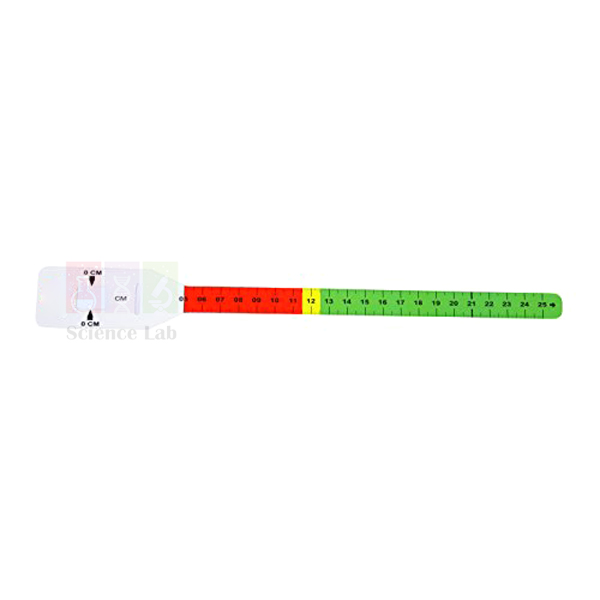
MUAC, Child 11.5 Red
A colour-banded tape for measuring a child's mid-upper arm circumference during nutrition screening. The reading falls in a red zone up to 11.5 cm, a yellow zone from 11.5 to 12.5 cm or a green zone above that. The tape is also graduated in 1 mm steps up to 26.5 cm, so an exact figure can be written down as well as the colour.
Child MUAC tape specifications
| Parameter | Detail |
|---|---|
| Type | Child MUAC measuring tape, colour coded |
| Range | Up to 26.5 cm |
| Graduation | 1 mm, with a thicker line at 21.0 cm |
| Accuracy | ±1 mm of the maximum measurement (26.5 cm) |
| Red zone | 0 to 11.5 cm (Pantone 1795 C) |
| Yellow zone | 11.5 to 12.5 cm (Pantone 107 C) |
| Green zone | 12.5 to 26.5 cm (Pantone 369 C) |
| Operating temperature | 0°C to +40°C |
| Material and print | Non-tear, stretch-resistant plasticised synthetic paper, minimum thickness 0.3 mm; permanent, solvent-resistant print, easily readable in low light |
| Product code | SLE/AE/07 |
| Minimum order | 10 units |
| Dispatch | Usually within 7 to 10 working days |
| Supplied by | ScienceLab (Jain Scientific Equipments Pvt Ltd), Ambala, India |
Screening children with the colour-coded MUAC tape
Door-to-door rounds. The health worker measures the child's relaxed arm at the midpoint and notes both the colour at the reading point and the millimetre value. Both go on the record sheet next to the name written on the child's blue ID band or red ID band.
Screening camp stations. After the arm reading, each child moves on to the spring-type infant scale with weighing trousers, then to the length/height board. Keeping the same order at every camp means no step is missed when queues are long.
Caregiver practice. On a training day, each caregiver measures their own child while the trainer watches, then repeats it while the trainer checks tape tension and the reading point. Any reading that differs from the trainer's is taken again together until the two agree.
Checking a new batch. When tapes arrive, compare the red, yellow and green bands against the programme's colour references. The tape lists Pantone 1795 C, 107 C and 369 C, so a printed swatch card is enough for a quick check.
Frequently Asked Questions About the MUAC, Child 11.5 Red
What do the three colour zones on the tape cover?
The tape is red from 0 to 11.5 cm, yellow from 11.5 to 12.5 cm and green from 12.5 to 26.5 cm. The tape itself does not decide anything: how each colour is interpreted and acted on, and for which age group, follows your national or programme guidelines.
Where on the tape is the result read?
Read it at the reading point, where the end of the tape meets the scale after it has been passed round the arm. Note the colour under that point and the millimetre value. Look straight down at the tape, not from an angle, so you do not read the line next to it.
What mistakes give a wrong reading on a child?
The usual ones are pulling the tape so tight that it pinches the skin, leaving it so loose that it gapes, and measuring above or below the midpoint. A tensed or bent arm also changes the result, so let the arm hang loosely at the side before you wrap the tape.
Do I need to know the child's exact age?
Not to take the reading, but the colour bands apply only to the age group named in your programme protocol, so check that the child falls within it. Do not read the colours for anyone outside that group. Measure them as their own protocol says, for example with a plain numerical tape such as the MUAC, Adult, Without Color Code.
How can caregivers learn to use the tape?
Show the method first on a child while the caregiver watches. Then let the caregiver measure while you check the arm position, the tension and the reading point. Practise until both of you get the same colour and value. The colour method is quick to learn, so short refresher sessions are usually enough.
Tapes, scales, boards and ID bands for nutrition screening
- MUAC, Adult, Without Color Code
- Scale, Infant, Spring Type, 25kg x 100g
- Weighing Trousers
- Portable Baby/Child L-hgt
- ID Bracelet, Child, Red
- ID Bracelet, Child, Blue
To request a quotation, send the product name, code and quantity through our contact page or add the item to your enquiry cart.
Last updated: 14 November 2026
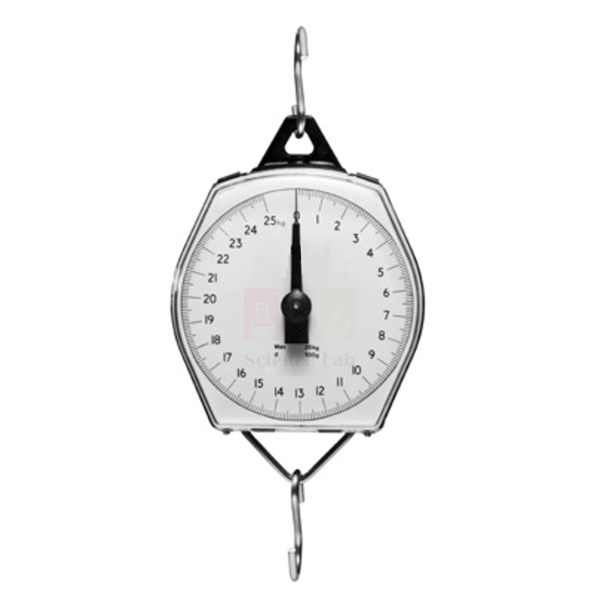
Scale, Infant, Spring Type, 25kg x 100g
Hung from a hook or beam, this dial-faced spring scale weighs babies and young children from 0 to 25 kg. The dial, 15 to 20 cm across, reads in 100 g divisions and in kilograms only. A damping mechanism steadies the pointer when a toddler moves, and a reading takes less than 15 seconds.
25 kg infant spring scale specifications
| Parameter | Detail |
|---|---|
| Type | Spring-type mechanical scale for infants, dial face |
| Measuring range | 0–25 kg |
| Minimum graduation | 100 g |
| Readout and dial | Metric (kg) only; dial 15 to 20 cm in diameter, readable in low light |
| Reading time | Less than 15 seconds |
| Zero setting | Easy zero adjustment / reset-to-zero (tare) function |
| Stabilising | Damping mechanism for faster reading |
| Hooks | 2 non-removable hooks: upper for hanging, lower for weighing trousers or a sling; stainless steel or high-grade galvanised steel |
| Materials and build | Dial metal or ABS-type plastic; body stainless steel, epoxy-coated steel or ABS-type plastic; splash proof, shock resistant, light-weight |
| Product code | SLE/AE/08 |
| Minimum order | 10 units |
| Dispatch | Usually within 7 to 10 working days |
| Supplied by | ScienceLab (Jain Scientific Equipments Pvt Ltd), Ambala, India |
Field weighing tasks with the 25 kg dial scale
Monthly growth-monitoring session. Hang the scale from a beam at the reader's eye level, fit weighing trousers to the lower hook and set the pointer to zero. Lower the child in, wait for the needle to settle and write the weight to the nearest 100 g on the growth card. Arm circumference follows with a child MUAC tape.
Field check with a known mass. At the start of a session, hang a slotted mass hanger from the lower hook and confirm the dial reading. A wrong result calls for the calibration screw, and the check goes into the team's log.
Training on reading the dial. Students take turns reading the same load from straight in front and then from an angle, and record both figures. The gap between them shows why the scale must hang at the reader's eye level and why the dial is always read straight on.
Frequently Asked Questions About the Scale, Infant, Spring Type, 25kg x 100g
How should the scale be hung so the dial reads true?
Hang the upper hook from a firm beam, tripod or door frame so the scale swings freely and does not touch a wall. The dial should sit at the reader's eye level. Reading it from below or from the side gives a parallax error.
What helps when a toddler cries or struggles on the scale?
Let the mother stay close and talk to the child, and lower the child into the trousers quickly and gently. The damping mechanism calms the swing, so the pointer settles once the child is still. If the struggling goes on, lift the child out, calm them and try again.
Does the scale need batteries or power?
No. It is a mechanical spring scale, so it works on outreach visits with no electricity at all. All it needs is a firm point to hang from and a carrier on the lower hook.
How should the scale be looked after between sessions?
Wipe off dust and moisture and store the scale dry with nothing hanging from it, so the spring is not left under load. Before the next session, check that the pointer returns to zero with both hooks empty.
Which carrier goes on the lower hook?
Children who can sit are weighed in weighing trousers rated to 25 kg. Newborns who need to lie flat go in a sling. Neither carrier comes with the scale. Wash the trousers between sessions and keep a spare pair in the kit.
How finely can a weight be read on this scale?
To the nearest 100 g, the smallest division on the dial, which suits babies and young children up to 25 kg. Where small changes in a newborn matter, a finer scale such as the 25 g tubular spring scale is the better choice.
Carriers and companion tools for hanging scales
- Weighing Trousers
- Sling for use with Scale
- Scale, Infant, Spring Type, 5kg x 25g
- MUAC, Child 11.5 Red
- Portable Baby/Child L-hgt
To request a quotation, send the product name, code and quantity through our contact page or add the item to your enquiry cart.
Last updated: 14 November 2026

Measuring Jug 1 litre
Measuring Jug 1 litre (Product Code: SLE/MU/05) is a 1000ml polypropylene jug with a handle, used to measure and pour liquids in hospitals, laboratories, kitchens and feeding centres. Buyers pick it because the graduations are embossed at every 50ml, so they cannot wear off with washing, and the polypropylene body is autoclavable. It is supplied by Jain Scientific Equipments Pvt Ltd (ScienceLab), Ambala, India, a laboratory equipment supplier in India.
Specifications
| Parameter | Detail |
|---|---|
| Capacity | 1000ml (1 litre) |
| Material | Polypropylene, autoclavable |
| Graduation | Indelible, embossed, every 50ml |
| Handle | Yes |
| Typical settings | Kitchen, laboratory, hospital, feeding centre |
| Product code | SLE/MU/05 |
| Supplied by | Jain Scientific Equipments Pvt Ltd (ScienceLab), Ambala, India |
What Is the 1 Litre Measuring Jug Used For?
This is a basic, multiple-use item. In a hospital it measures water for diluting cleaning and disinfectant concentrates, or fluids for patient care; in a feeding centre it portions water for preparing feeds; and in a laboratory it measures larger volumes where the precision of a measuring cylinder is not needed. The handle and pouring shape make it easy to fill bottles and bowls without spills.
To read a volume, stand the jug on a level surface and read at eye level against the nearest 50ml mark. Because the markings are embossed into the polypropylene rather than printed, they stay readable after repeated washing and autoclaving. Many facilities keep separate jugs for food preparation and for chemicals, and label them clearly so they are never swapped.
Supplier
ScienceLab, the trading name of Jain Scientific Equipments Private Limited, supplies this measuring jug from Ambala, Haryana, both with its medical utensils and with its laboratory plasticware. Hospitals, nutrition programmes, schools, dealers and importers in India and international markets can include it on a wider order. Read about the company on the profile page.
Related Medical Utensils
Items often used with the 1 litre measuring jug:
- Plastic Bottle 1 litre With Screw Cap — a matching-volume bottle for storing what you measure.
- Measuring Jug, Polypropylene — a polypropylene jug from the lab plasticware range.
- Measuring Cylinder, Polypropylene — for more precise volume readings.
- Round Bowl Polypropylene — a large bowl to pour measured solutions into.
See the Medical Utensils range.
Frequently Asked Questions
What is the capacity of the Measuring Jug 1 litre?
The Measuring Jug 1 litre has a capacity of 1000ml. It is graduated with indelible embossed marks at every 50ml, so volumes from 50ml up to the full litre can be measured directly.
Can the Measuring Jug 1 litre be autoclaved?
Yes. The Measuring Jug 1 litre is made of autoclavable polypropylene. Follow your autoclave's standard cycle for plastics, and let the jug cool on a flat surface so it keeps its shape.
Will the markings on the measuring jug wear off?
The graduations on the Measuring Jug 1 litre are embossed into the polypropylene and described as indelible, so they are part of the moulding rather than printed ink. They remain readable after routine washing and autoclaving.
Does the Measuring Jug 1 litre come with a calibration certificate?
No calibration certificate is listed for the Measuring Jug 1 litre, which is a general-purpose graduated jug for routine measuring. If your procurement requires documentation, raise it through the contact page before ordering so we can discuss it.
Who supplies the Measuring Jug 1 litre?
Jain Scientific Equipments Pvt Ltd, trading as ScienceLab from Ambala, Haryana, India, supplies the Measuring Jug 1 litre. Hospitals, feeding programmes, laboratories, dealers and importers in India and international markets can order it singly or in bulk.
Request a Quote
Send the quantity of Measuring Jug 1 litre you need through the contact page, or add it to the enquiry cart with product code SLE/MU/05.
Last updated: 24 September 2026
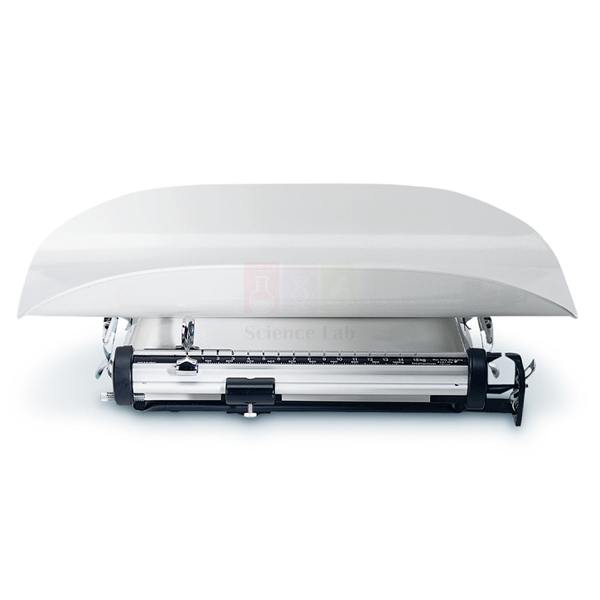
Scale, Infant, Clinic, Beam Type, 16kg x 10g
A mechanical beam scale for weighing babies lying in a removable curved tray. It covers 0–16 kg in 10 g divisions and needs no batteries or mains power. Adjustable feet and a built-in round level bubble set it level, and a stabilising mechanism brings a reading in about 30 seconds.
Infant beam scale specifications
| Parameter | Detail |
|---|---|
| Type | Beam-type mechanical scale for infants |
| Measuring range and graduation | 0–16 kg in 10 g divisions |
| Readout and display | Metric (kg); signal-white numbers on a black surface, readable in low light |
| Reading time | About 30 seconds, with stabilising mechanism |
| Zero setting | Easy zero adjustment |
| Tray | Removable curved tray, powder-coated, light grey |
| Levelling | Adjustable feet; built-in round level bubble with centre indication |
| Body and calibration screw | Metal only (stainless steel or epoxy-coated steel); stainless steel calibration screw |
| Protection and build | Rust-proof mechanics; UV-resistant plastic parts; splash proof, shock resistant, light-weight; smooth finish for cleaning and disinfection |
| Product code | SLE/AE/09 |
| Minimum order | 10 units |
| Dispatch | Usually within 7 to 10 working days |
| Supplied by | ScienceLab (Jain Scientific Equipments Pvt Ltd), Ambala, India |
Clinic and skills-lab tasks with the infant beam scale
Daily set-up. Place the scale on a firm table and turn the feet until the bubble sits in the centre. With the empty tray in place, plus any cloth that will be used, set the beam to zero. Weigh the undressed baby, then move to the child length-height board for recumbent length.
Function check with known masses. Put a brass mass set in the tray, balance the beam and compare the reading with the marked value. Repeat with a larger load. If the zero or the readings have drifted, adjust with the calibration screw and note it in the equipment log.
Skills-lab comparison. Nursing students weigh the same weighted doll on this beam scale and on an electronic baby scale, then discuss why the readings differ and how long each method takes. The exercise teaches levelling, zeroing and reading a beam straight on.
Frequently Asked Questions About the Scale, Infant, Clinic, Beam Type, 16kg x 10g
Why must the scale be levelled before it is zeroed?
A beam scale balances correctly only when it stands level. On a sloping or soft surface the zero shifts and every reading carries the error. Use a firm, flat table, turn the adjustable feet until the bubble is centred, and only then set the zero.
How do I allow for a cloth or blanket in the tray?
Lay the cloth in the tray first and set the zero with it in place. The beam then reads the baby's weight alone. If cloths of different thickness are used, set the zero again each time the cloth changes.
Should the baby be undressed for weighing?
Yes, as long as the room is warm. Clothes and a wet nappy add weight that shows on the reading and makes visit-to-visit comparison unreliable. If a nappy has to stay on, use a dry one and note it in the record.
What if the beam does not move freely?
Check that nothing touches the tray or the beam, such as a cloth hanging over the edge or the scale standing against a wall. Make sure the tray is seated properly and the scale is level. If the beam still sticks, have the mechanism checked before further use.
How long does a reading take?
About 30 seconds. The stabilising mechanism damps the beam's movement so that it settles sooner. A beam scale is slower than an electronic one, but it keeps working where there is no power supply.
How is the tray cleaned between babies?
Lift out the curved tray, wipe it with a cloth and the disinfectant your clinic uses, and dry it before refitting. The powder-coated finish and smooth body make this quick. Clean the whole scale at the end of each day.
Clinic weighing and measuring items
- Electronic Scale Baby
- Portable Baby/Child L-hgt
- Scale, Physician, Adult, Metric, 6-180kg
- Scale, Infant, Spring Type, 5kg x 25g
- Sling for use with Scale
To request a quotation, send the product name, code and quantity through our contact page or add the item to your enquiry cart.
Last updated: 14 November 2026
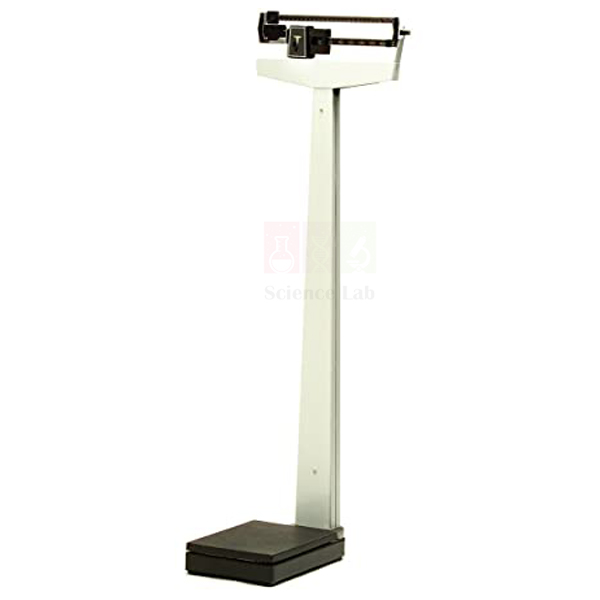
Scale, Physician, Adult, Metric, 6-180kg
Standing adults are weighed on this floor-standing beam scale from 6 kg up to 180 kg, in 100 g steps. Black numbers on a silver surface can be read from both sides, so the clinician and the person on the platform both see the result. It has an attached hand pole and adjustable feet, but no height rod.
Adult physician beam scale specifications
| Parameter | Detail |
|---|---|
| Type | Beam-type mechanical scale for adults |
| Capacity | 6–180 kg |
| Minimum graduation | 100 g |
| Readout and display | Metric (kg); black numbers on a silver surface, readable from both sides and in low light |
| Reading time | Less than 15 seconds, with stabilising mechanism |
| Zero setting | Easy zero adjustment |
| Hand pole and height rod | Hand pole attached; height rod not included |
| Levelling | Adjustable feet for horizontal levelling |
| Body and calibration screw | Metal only (stainless steel or epoxy-coated steel); stainless steel calibration screw |
| Product code | SLE/AE/010 |
| Minimum order | 10 units |
| Dispatch | Usually within 7 to 10 working days |
| Supplied by | ScienceLab (Jain Scientific Equipments Pvt Ltd), Ambala, India |
Clinic routines with the adult beam scale
Adult assessment station. Weigh the person on the beam scale, then measure standing height on a portable length-height board, since this model has no rod. Mid-upper arm circumference taken with an adult MUAC tape completes the record.
Accuracy check. With the platform empty, confirm the zero. Then stack enough cast alloy masses of known value in the centre of the platform to pass the 6 kg lower limit, and compare the beam reading with their total. Adjust with the calibration screw if the zero has drifted, and log the date of the check.
Antenatal or occupational-health follow-up. Weigh each person on the same scale, at a similar time of day, without shoes or heavy items, so that monthly readings can be compared. Write the figure down straight away rather than from memory.
Frequently Asked Questions About the Scale, Physician, Adult, Metric, 6-180kg
What should I do if the platform rocks?
Turn the adjustable feet until the platform sits firm and does not tilt when pressed at each corner. Use a hard, level floor; a soft mat or uneven tiles let the base move during weighing and upset the beam.
How is the zero set on this beam scale?
With nobody on the platform and the beam set to zero, use the zero adjustment until the beam floats level at its balance mark. Check the zero at the start of each session and after the scale has been moved.
How should the person use the hand pole?
Only for balance while stepping on and off. Once on the platform, the person stands still in the centre with arms by the sides. Leaning on or gripping the pole moves part of the body weight off the platform, and the reading falls.
How can height be measured when the scale has no rod?
Use a separate measuring board, such as the Portable Baby/Chd/adult L-H, which reads standing height up to 204 cm. Measure barefoot with heels, buttocks and head against the board, and record the height straight after the weight.
How do I keep repeat weighings comparable over months?
Use the same scale at a similar time of day, with shoes and heavy items removed and similar light clothing. Check the zero before each session. Changes between visits then reflect the person rather than the method.
Can the reading be kept from the person being weighed?
Yes, if the person stands facing away from the beam. The figures can be read from both sides, so the health worker reads the result from where they stand without showing it. A person who wants to know can face the beam and watch instead. Weigh in a screened space where possible.
Weighing and measuring items for clinic stations
- Portable Baby/Chd/adult L-H
- MUAC, Adult, Without Color Code
- Scale for Adults with Height Rod
- Scale Mother/Child Batteries Mains Solar
- Scale, Infant, Clinic, Beam Type, 16kg x 10g
To request a quotation, send the product name, code and quantity through our contact page or add the item to your enquiry cart.
Last updated: 14 November 2026