- Physics Lab Equipment
- Chemistry Lab Equipment
- Biology Lab Equipment
- Anatomical Lab Equipment
- Learning
- Educational Lab Equipment
- Magnets
- Agriculture
- Astronomy
- Earth Science
- Geography Lab Equipment
- Safety Lab Coat
- Laboratory
- Meteorological
- Electricity & Magnetism
- Heat
- School Lab Equipment
- Lab Glassware
- Science Lab Equipment
- Tvet Lab Equipment
- Robotics Kits Supplier and Manufacturer for Schools India
- Math Lab Equipment Manufacturers and Exporters in Ambala
- STEM Kits Manufacturers and Supplier India
- Engineering Lab Equipment
- Hospital Lab Equipment
- Water, Sanitation & Hygiene Supplies
- Cold Chain, Solar & Communication Equipment
- Nutrition
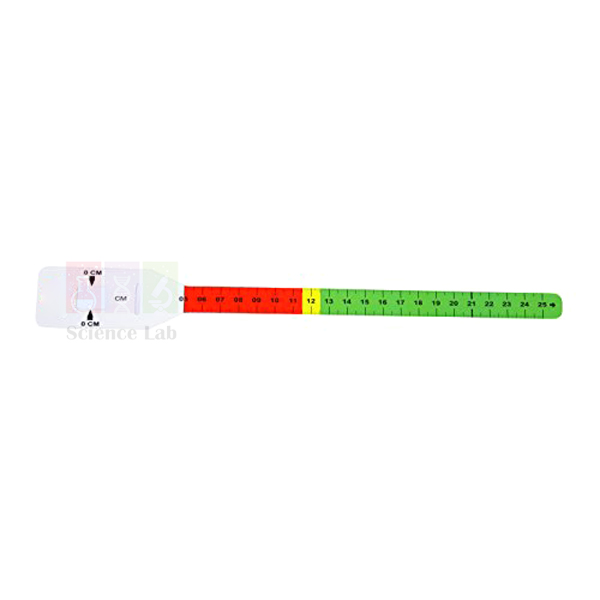
MUAC, Child 11.5 Red
A colour-banded tape for measuring a child's mid-upper arm circumference during nutrition screening. The reading falls in a red zone up to 11.5 cm, a yellow zone from 11.5 to 12.5 cm or a green zone above that. The tape is also graduated in 1 mm steps up to 26.5 cm, so an exact figure can be written down as well as the colour.
Child MUAC tape specifications
| Parameter | Detail |
|---|---|
| Type | Child MUAC measuring tape, colour coded |
| Range | Up to 26.5 cm |
| Graduation | 1 mm, with a thicker line at 21.0 cm |
| Accuracy | ±1 mm of the maximum measurement (26.5 cm) |
| Red zone | 0 to 11.5 cm (Pantone 1795 C) |
| Yellow zone | 11.5 to 12.5 cm (Pantone 107 C) |
| Green zone | 12.5 to 26.5 cm (Pantone 369 C) |
| Operating temperature | 0°C to +40°C |
| Material and print | Non-tear, stretch-resistant plasticised synthetic paper, minimum thickness 0.3 mm; permanent, solvent-resistant print, easily readable in low light |
| Product code | SLE/AE/07 |
| Minimum order | 10 units |
| Dispatch | Usually within 7 to 10 working days |
| Supplied by | ScienceLab (Jain Scientific Equipments Pvt Ltd), Ambala, India |
Screening children with the colour-coded MUAC tape
Door-to-door rounds. The health worker measures the child's relaxed arm at the midpoint and notes both the colour at the reading point and the millimetre value. Both go on the record sheet next to the name written on the child's blue ID band or red ID band.
Screening camp stations. After the arm reading, each child moves on to the spring-type infant scale with weighing trousers, then to the length/height board. Keeping the same order at every camp means no step is missed when queues are long.
Caregiver practice. On a training day, each caregiver measures their own child while the trainer watches, then repeats it while the trainer checks tape tension and the reading point. Any reading that differs from the trainer's is taken again together until the two agree.
Checking a new batch. When tapes arrive, compare the red, yellow and green bands against the programme's colour references. The tape lists Pantone 1795 C, 107 C and 369 C, so a printed swatch card is enough for a quick check.
Frequently Asked Questions About the MUAC, Child 11.5 Red
What do the three colour zones on the tape cover?
The tape is red from 0 to 11.5 cm, yellow from 11.5 to 12.5 cm and green from 12.5 to 26.5 cm. The tape itself does not decide anything: how each colour is interpreted and acted on, and for which age group, follows your national or programme guidelines.
Where on the tape is the result read?
Read it at the reading point, where the end of the tape meets the scale after it has been passed round the arm. Note the colour under that point and the millimetre value. Look straight down at the tape, not from an angle, so you do not read the line next to it.
What mistakes give a wrong reading on a child?
The usual ones are pulling the tape so tight that it pinches the skin, leaving it so loose that it gapes, and measuring above or below the midpoint. A tensed or bent arm also changes the result, so let the arm hang loosely at the side before you wrap the tape.
Do I need to know the child's exact age?
Not to take the reading, but the colour bands apply only to the age group named in your programme protocol, so check that the child falls within it. Do not read the colours for anyone outside that group. Measure them as their own protocol says, for example with a plain numerical tape such as the MUAC, Adult, Without Color Code.
How can caregivers learn to use the tape?
Show the method first on a child while the caregiver watches. Then let the caregiver measure while you check the arm position, the tension and the reading point. Practise until both of you get the same colour and value. The colour method is quick to learn, so short refresher sessions are usually enough.
Tapes, scales, boards and ID bands for nutrition screening
- MUAC, Adult, Without Color Code
- Scale, Infant, Spring Type, 25kg x 100g
- Weighing Trousers
- Portable Baby/Child L-hgt
- ID Bracelet, Child, Red
- ID Bracelet, Child, Blue
To request a quotation, send the product name, code and quantity through our contact page or add the item to your enquiry cart.
Last updated: 14 November 2026
