- Physics Lab Equipment
- Chemistry Lab Equipment
- Biology Lab Equipment
- Anatomical Lab Equipment
- Learning
- Educational Lab Equipment
- Magnets
- Agriculture
- Astronomy
- Earth Science
- Geography Lab Equipment
- Safety Lab Coat
- Laboratory
- Meteorological
- Electricity & Magnetism
- Heat
- School Lab Equipment
- Lab Glassware
- Science Lab Equipment
- Tvet Lab Equipment
- Robotics Kits Supplier and Manufacturer for Schools India
- Math Lab Equipment Manufacturers and Exporters in Ambala
- STEM Kits Manufacturers and Supplier India
- Engineering Lab Equipment
- Hospital Lab Equipment
- Water, Sanitation & Hygiene Supplies
- Cold Chain, Solar & Communication Equipment
- Nutrition
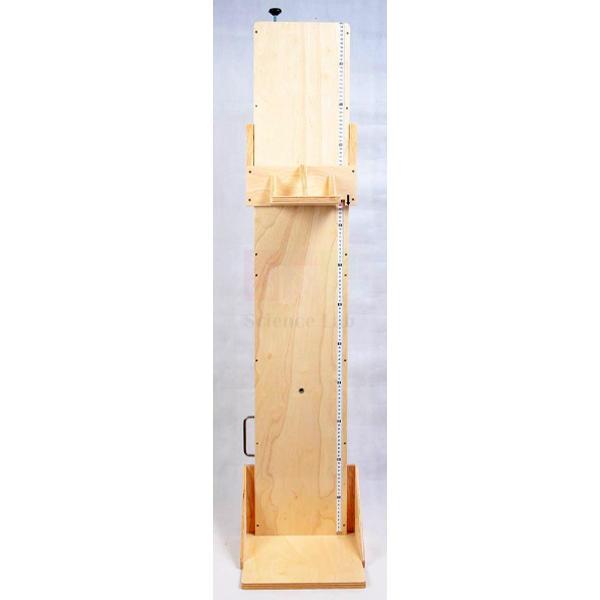
Portable Baby/Child L-hgt
Sized for children only, this fold-up board reads 0–120 cm in 0.1 cm steps on a metal scale. Laid flat, it takes the recumbent length of babies up to 24 months. Stood upright on its adjustable feet, it takes the standing height of children from 24 months. Accuracy and precision are both given as ±0.2 cm.
Child length-height board specifications
| Parameter | Detail |
|---|---|
| Measures | Recumbent length of babies up to 24 months; standing height of children aged 24 months and above |
| Measurement range | 0–120 cm |
| Graduation | Centimetres; smallest graduation 0.1 cm |
| Accuracy and precision | ±0.2 cm each |
| Measurement scale | Metal, fully integrated; numerals along the board; readable in low light; board about 25 cm wide |
| Foot/head piece | Large piece with adjustable feet for uneven floors; base when upright, headboard when flat |
| Measuring slide | Smooth gliding; lockable or friction-held; reading points marked with arrow or pictogram |
| Folding and carrying | Fold-up, low weight; spring-loaded bolts or spring clasps; integrated handle plus removable shoulder or back strap |
| Set-up | No tools and no calibration needed; all parts have fixed positions |
| Product code | SLE/AE/012 |
| Minimum order | 10 units |
| Dispatch | Usually within 7 to 10 working days |
| Supplied by | ScienceLab (Jain Scientific Equipments Pvt Ltd), Ambala, India |
Growth-monitoring tasks with the child measuring board
Under-two length check. Lay the board flat with the headpiece at one end. One measurer cups the baby's head against it while the second keeps the body straight, presses gently on the knees and brings the wedge against both heels. Weigh the same baby on the newborn spring scale or the 25 kg dial spring scale and record both figures together.
Anganwadi health round. Stand the board upright, turn the adjustable feet until it stops rocking, and measure each child barefoot. Take arm circumference with a child MUAC tape, then weigh the child in weighing trousers on a hanging scale, so each child passes three stations in order.
Training practice. Nursing or public-health students take turns measuring the same child-sized doll, then compare their readings. The spread between results shows where technique slips: a bent knee, a tilted head or a wedge that was not locked before reading.
Frequently Asked Questions About the Portable Baby/Child L-hgt
Why does measuring a baby's length need two people?
One person holds the head still against the headpiece while the other straightens the body and legs and moves the wedge. A single measurer cannot do both, and a baby who turns or bends gives a short reading. A parent standing close by can help keep the baby calm.
How are the legs kept straight when the wedge is brought up?
Rest one hand gently over both knees to press the legs flat, with the toes pointing straight up. With the other hand, slide the wedge until it sits firmly against both heels. Lock it before letting go of the baby, then read at the arrow.
Can a tape measure replace a length board for babies?
Not well. A flexible tape laid beside a lying baby bends and slips, and there is nothing square at the head or the feet. The board has a fixed headpiece and a sliding wedge that meet the body at right angles, so the length is read between two firm stops.
How often should the board be checked?
It needs no calibration, because all its parts have fixed positions. Still, look it over before each session: the slide should glide and lock, the bolts should hold the panels firm and the markings should be clean. Compare the scale with a known length from time to time.
Will the board stand steady on an uneven floor?
Yes. The large foot piece has adjustable feet. Turn them until the upright board no longer rocks before the child steps on. When the board is laid flat for a baby, the same piece serves as the fixed headboard.
What happens when a child grows past 120 cm?
The range ends at 120 cm, so taller children need the full-range baby, child and adult board, which reads to 204 cm with two extensions. Teams that see all age groups often carry one of each.
Child growth-monitoring equipment
- Portable Baby/Chd/adult L-H
- MUAC, Child 11.5 Red
- Scale, Infant, Spring Type, 25kg x 100g
- Weighing Trousers
- Electronic Scale Baby
To request a quotation, send the product name, code and quantity through our contact page or add the item to your enquiry cart.
Last updated: 14 November 2026