- Physics Lab Equipment
- Chemistry Lab Equipment
- Biology Lab Equipment
- Anatomical Lab Equipment
- Learning
- Educational Lab Equipment
- Magnets
- Agriculture
- Astronomy
- Earth Science
- Geography Lab Equipment
- Safety Lab Coat
- Laboratory
- Meteorological
- Electricity & Magnetism
- Heat
- School Lab Equipment
- Lab Glassware
- Science Lab Equipment
- Tvet Lab Equipment
- Robotics Kits Supplier and Manufacturer for Schools India
- Math Lab Equipment Manufacturers and Exporters in Ambala
- STEM Kits Manufacturers and Supplier India
- Engineering Lab Equipment
- Hospital Lab Equipment
- Water, Sanitation & Hygiene Supplies
- Cold Chain, Solar & Communication Equipment
- Nutrition
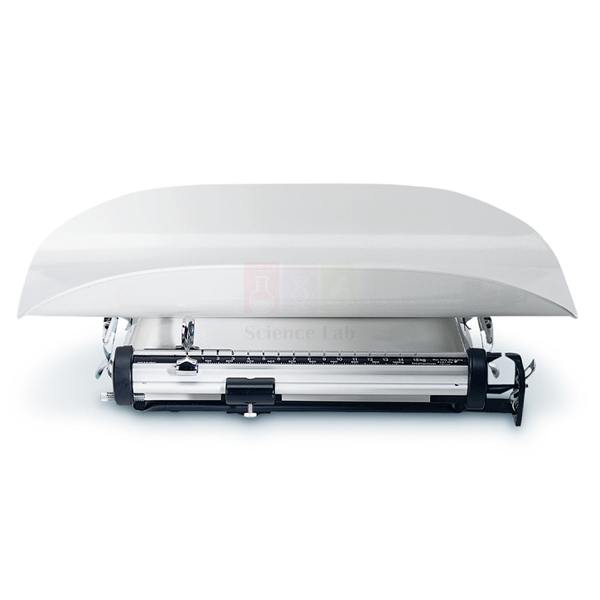
Scale, Infant, Clinic, Beam Type, 16kg x 10g
A mechanical beam scale for weighing babies lying in a removable curved tray. It covers 0–16 kg in 10 g divisions and needs no batteries or mains power. Adjustable feet and a built-in round level bubble set it level, and a stabilising mechanism brings a reading in about 30 seconds.
Infant beam scale specifications
| Parameter | Detail |
|---|---|
| Type | Beam-type mechanical scale for infants |
| Measuring range and graduation | 0–16 kg in 10 g divisions |
| Readout and display | Metric (kg); signal-white numbers on a black surface, readable in low light |
| Reading time | About 30 seconds, with stabilising mechanism |
| Zero setting | Easy zero adjustment |
| Tray | Removable curved tray, powder-coated, light grey |
| Levelling | Adjustable feet; built-in round level bubble with centre indication |
| Body and calibration screw | Metal only (stainless steel or epoxy-coated steel); stainless steel calibration screw |
| Protection and build | Rust-proof mechanics; UV-resistant plastic parts; splash proof, shock resistant, light-weight; smooth finish for cleaning and disinfection |
| Product code | SLE/AE/09 |
| Minimum order | 10 units |
| Dispatch | Usually within 7 to 10 working days |
| Supplied by | ScienceLab (Jain Scientific Equipments Pvt Ltd), Ambala, India |
Clinic and skills-lab tasks with the infant beam scale
Daily set-up. Place the scale on a firm table and turn the feet until the bubble sits in the centre. With the empty tray in place, plus any cloth that will be used, set the beam to zero. Weigh the undressed baby, then move to the child length-height board for recumbent length.
Function check with known masses. Put a brass mass set in the tray, balance the beam and compare the reading with the marked value. Repeat with a larger load. If the zero or the readings have drifted, adjust with the calibration screw and note it in the equipment log.
Skills-lab comparison. Nursing students weigh the same weighted doll on this beam scale and on an electronic baby scale, then discuss why the readings differ and how long each method takes. The exercise teaches levelling, zeroing and reading a beam straight on.
Frequently Asked Questions About the Scale, Infant, Clinic, Beam Type, 16kg x 10g
Why must the scale be levelled before it is zeroed?
A beam scale balances correctly only when it stands level. On a sloping or soft surface the zero shifts and every reading carries the error. Use a firm, flat table, turn the adjustable feet until the bubble is centred, and only then set the zero.
How do I allow for a cloth or blanket in the tray?
Lay the cloth in the tray first and set the zero with it in place. The beam then reads the baby's weight alone. If cloths of different thickness are used, set the zero again each time the cloth changes.
Should the baby be undressed for weighing?
Yes, as long as the room is warm. Clothes and a wet nappy add weight that shows on the reading and makes visit-to-visit comparison unreliable. If a nappy has to stay on, use a dry one and note it in the record.
What if the beam does not move freely?
Check that nothing touches the tray or the beam, such as a cloth hanging over the edge or the scale standing against a wall. Make sure the tray is seated properly and the scale is level. If the beam still sticks, have the mechanism checked before further use.
How long does a reading take?
About 30 seconds. The stabilising mechanism damps the beam's movement so that it settles sooner. A beam scale is slower than an electronic one, but it keeps working where there is no power supply.
How is the tray cleaned between babies?
Lift out the curved tray, wipe it with a cloth and the disinfectant your clinic uses, and dry it before refitting. The powder-coated finish and smooth body make this quick. Clean the whole scale at the end of each day.
Clinic weighing and measuring items
- Electronic Scale Baby
- Portable Baby/Child L-hgt
- Scale, Physician, Adult, Metric, 6-180kg
- Scale, Infant, Spring Type, 5kg x 25g
- Sling for use with Scale
To request a quotation, send the product name, code and quantity through our contact page or add the item to your enquiry cart.
Last updated: 14 November 2026
