- Physics Lab Equipment
- Chemistry Lab Equipment
- Biology Lab Equipment
- Anatomical Lab Equipment
- Learning
- Educational Lab Equipment
- Magnets
- Agriculture
- Astronomy
- Earth Science
- Geography Lab Equipment
- Safety Lab Coat
- Laboratory
- Meteorological
- Electricity & Magnetism
- Heat
- School Lab Equipment
- Lab Glassware
- Science Lab Equipment
- Tvet Lab Equipment
- Robotics Kits Supplier and Manufacturer for Schools India
- Math Lab Equipment Manufacturers and Exporters in Ambala
- STEM Kits Manufacturers and Supplier India
- Engineering Lab Equipment
- Hospital Lab Equipment
- Water, Sanitation & Hygiene Supplies
- Cold Chain, Solar & Communication Equipment
- Nutrition
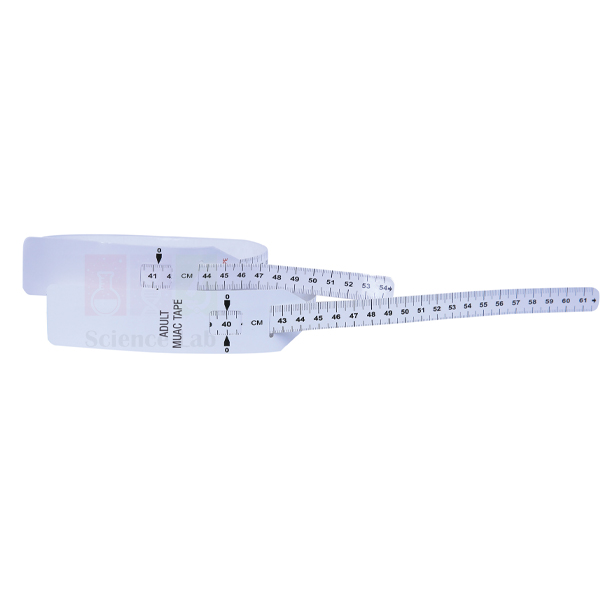
MUAC, Adult, Without Color Code
A plain, numerically graduated tape for measuring an adult's mid-upper arm circumference (MUAC) up to 50 cm. It carries no colour bands: it gives the actual reading in 1 mm divisions, which the user compares with their own protocol. The tape is non-tear, stretch-resistant plasticised synthetic paper with permanent print that stays readable in low light.
Adult MUAC tape specifications
| Parameter | Detail |
|---|---|
| Type | MUAC measuring tape for adults, without colour code |
| Range | Up to 50 cm |
| Graduation | 1 mm |
| Accuracy | ±1 mm of the maximum measurement (50 cm) |
| Operating temperature | 0°C to +40°C |
| Material | Non-tear, stretch-resistant plasticised synthetic paper |
| Thickness | Minimum 0.3 mm |
| Permanent, resistant to solvents, easily readable in low light | |
| Product code | SLE/AE/06 |
| Minimum order | 10 units |
| Dispatch | Usually within 7 to 10 working days |
| Supplied by | ScienceLab (Jain Scientific Equipments Pvt Ltd), Ambala, India |
Measuring adult arm circumference with the plain tape
Marking and reading. The person stands with the elbow bent at a right angle. The measurer finds the tip of the shoulder and the tip of the elbow, measures between them and marks the halfway point on the skin. With the arm hanging loose again, the tape goes round at the mark and the reading is taken to the nearest millimetre.
Part of a full adult assessment. Record the arm reading with body weight from the adult physician scale and standing height from the baby, child and adult length/height board. Writing all three on one form at the same visit keeps the assessment complete.
Observer practice in class. In a nursing or dietetics session, pairs measure the same volunteers twice each and compare results. The class looks at how far repeat readings drift and why: a misplaced mark, a loose or tight tape, or a sleeve left on. Trainers who also teach child screening can show the colour-banded child MUAC tape alongside.
Frequently Asked Questions About the MUAC, Adult, Without Color Code
How do I find the midpoint of the upper arm?
Ask the person to bend the elbow to a right angle with the forearm across the body. Find the bony tip of the shoulder and the point of the elbow, measure the distance between them with the tape and mark the halfway point. Then let the arm hang relaxed before measuring round it.
How tight should the tape be?
Snug enough to touch the skin all the way round, but not so tight that it presses into the soft tissue. Keep the tape level, parallel to the floor, at the marked midpoint. A gap under the tape gives a high reading and a squeezed arm gives a low one.
Which arm should be measured?
Use the arm your protocol names, often the left or non-dominant arm, and use the same arm at every visit. Measure on bare skin, because a sleeve rolled up tightly above the mark or left under the tape changes the result.
Why take more than one reading?
Small differences in tape position and tension make each reading vary a little, both for one measurer and between staff. Take two readings, re-wrapping the tape each time, and take a third if they differ by more than your protocol allows. Record the average to the nearest millimetre.
Can different MUAC tapes give different readings?
Yes. Tapes differ in design and thickness, and a thicker tape can read slightly differently on the same arm. This tape is stretch resistant with a minimum thickness of 0.3 mm. Use one tape type throughout a survey or a patient's follow-up, and note the type in your records.
How is the tape cleaned, stored and checked?
Wipe it between people with a cloth moistened with a mild cleaning agent; the print is permanent and solvent resistant. Store it flat and dry. From time to time, lay it along a steel rule to check for stretch, and withdraw any tape that is creased, cut or hard to read.
Tapes, scales and boards for nutritional assessment
- Scale, Physician, Adult, Metric, 6-180kg
- Portable Baby/Chd/adult L-H
- Scale Mother/Child Batteries Mains Solar
- MUAC, Child 11.5 Red
- Scale for Adults with Height Rod
To request a quotation, send the product name, code and quantity through our contact page or add the item to your enquiry cart.
Last updated: 14 November 2026