- Physics Lab Equipment
- Chemistry Lab Equipment
- Biology Lab Equipment
- Anatomical Lab Equipment
- Learning
- Educational Lab Equipment
- Magnets
- Agriculture
- Astronomy
- Earth Science
- Geography Lab Equipment
- Safety Lab Coat
- Laboratory
- Meteorological
- Electricity & Magnetism
- Heat
- School Lab Equipment
- Lab Glassware
- Science Lab Equipment
- Tvet Lab Equipment
- Robotics Kits Supplier and Manufacturer for Schools India
- Math Lab Equipment Manufacturers and Exporters in Ambala
- STEM Kits Manufacturers and Supplier India
- Engineering Lab Equipment
- Hospital Lab Equipment
- Water, Sanitation & Hygiene Supplies
- Cold Chain, Solar & Communication Equipment
- Nutrition
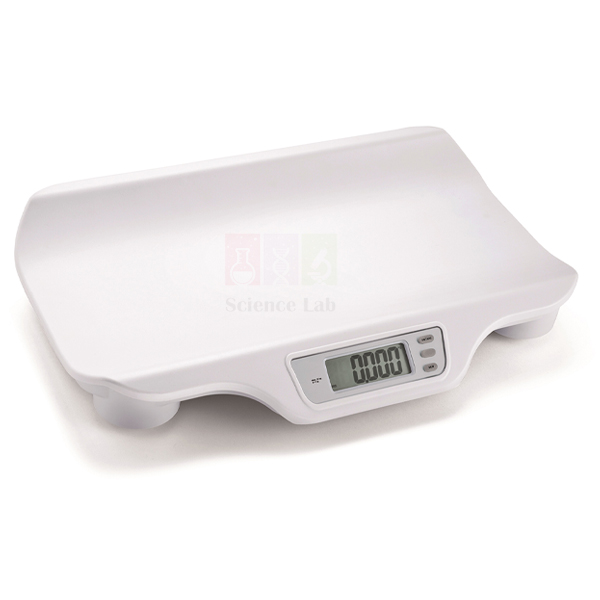
Electronic Scale Baby
An electronic scale for weighing babies from 0 to 10 kg, reading in 5 g steps on a large LCD within 5 seconds. TARE removes the weight of a blanket or liner, HOLD keeps the figure on screen after the baby is lifted off, and the scale calibrates itself at every switch-on. It runs on 220 V/50 Hz mains or on replaceable batteries.
Electronic baby scale specifications
| Parameter | Detail |
|---|---|
| Weighing range | 0 to 10 kg |
| Minimum graduation | 5 g |
| Accuracy | ±5 g |
| Display | Large LCD, reading in kilograms |
| Reading time | Maximum 5 seconds |
| Functions | Automatic switch-off, TARE, HOLD, auto-calibration with each switch-on |
| Power | 220 V/50 Hz; customer-replaceable batteries as an additional supply |
| Materials and body | Vital parts rust proof and child-friendly; transparent plastic display cover; light-weight, splash proof and shock resistant body with a smooth surface for cleaning and disinfection |
| Colour | White or similar (off-white, cream, light grey) |
| Product code | SLE/AE/14 |
| Minimum order | 10 units |
| Dispatch | Usually within 7 to 10 working days |
| Supplied by | ScienceLab (Jain Scientific Equipments Pvt Ltd), Ambala, India |
Weighing routines with the electronic baby scale
Clinic weighing with a liner. Set the scale on a firm, level table and switch it on so it calibrates. Lay a clean paper liner on the tray and press TARE until the display reads zero. Lay the undressed baby in the centre, wait for the figure to settle and write it down in kilograms.
Weight and length together. Straight after weighing, measure the baby lying down on the Portable Baby/Child L-hgt board. Both figures then go onto the growth record at the same visit, so weight can be read against length.
Back-up and outreach weighing. Keep a beam-type infant clinic scale in the room for days when there is no power and the batteries are flat. For home visits, a spring-type infant scale with a weighing sling does the same job away from the clinic.
Skills practice for trainees. In a nursing skills session, students weigh a training doll on a liner twice, once after pressing TARE and once without it. Comparing the two figures shows how a forgotten tare changes the recorded weight.
Frequently Asked Questions About the Electronic Scale Baby
How do I weigh a baby on a blanket or liner?
Switch the scale on and let it calibrate. Place the blanket or liner on the tray and press TARE so the display returns to zero. Now lay the baby on it. The figure shown is the baby alone, without the weight of the cover.
Should the baby be undressed before weighing?
Yes, for figures that can be compared between visits. Remove clothes and weigh the baby in a clean, dry nappy or none, following your clinic's routine. Clothing and a wet nappy add weight that changes from one visit to the next and can hide the small gains a 5 g scale is meant to show.
How do I get a steady reading when the baby keeps moving?
Settle the baby first, then lay them flat in the middle of the tray. Wait for the display to stop changing, which takes no more than 5 seconds. If the baby starts to wriggle, press HOLD so the figure stays on screen while you lift the child off and write it down.
Where should the baby lie on the tray?
In the centre, with the whole body on the tray and nothing resting on the table or the edge. An off-centre position or a hand touching the tray changes the reading. Never step away while the baby is on the scale; keep one hand just above the child without touching.
Does the scale show kilograms or pounds?
It reads in kilograms on its LCD, with a minimum graduation of 5 g. Most clinic records and growth charts use metric units, so the figure can be written straight onto the chart without converting from pounds and ounces.
How should the scale be cleaned between babies?
Change the paper liner for every baby. Wipe the tray with a cloth lightly dampened with the clinic's usual surface disinfectant, then dry it. The body is splash proof, so a damp wipe is fine, but do not pour liquid over the scale or put it in water.
Scales and boards for infant growth checks
- Portable Baby/Child L-hgt
- Portable Baby/Chd/adult L-H
- Scale, Infant, Clinic, Beam Type, 16kg x 10g
- Scale, Infant, Spring Type, 5kg x 25g
- Scale Mother/Child Batteries Mains Solar
To request a quotation, send the product name, code and quantity through our contact page or add the item to your enquiry cart.
Last updated: 14 November 2026