- Physics Lab Equipment
- Chemistry Lab Equipment
- Biology Lab Equipment
- Anatomical Lab Equipment
- Learning
- Educational Lab Equipment
- Magnets
- Agriculture
- Astronomy
- Earth Science
- Geography Lab Equipment
- Safety Lab Coat
- Laboratory
- Meteorological
- Electricity & Magnetism
- Heat
- School Lab Equipment
- Lab Glassware
- Science Lab Equipment
- Tvet Lab Equipment
- Robotics Kits Supplier and Manufacturer for Schools India
- Math Lab Equipment Manufacturers and Exporters in Ambala
- STEM Kits Manufacturers and Supplier India
- Engineering Lab Equipment
- Hospital Lab Equipment
- Water, Sanitation & Hygiene Supplies
- Cold Chain, Solar & Communication Equipment
- Nutrition
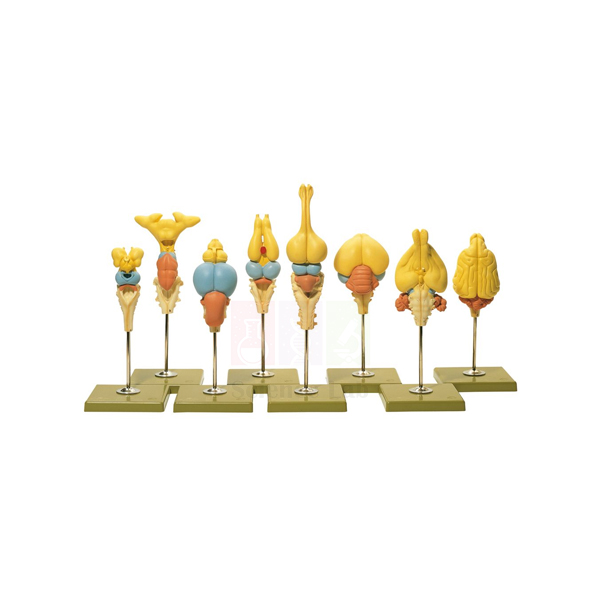
Vertebrate Brains Model Set
A set of 8 one-part brain models, each showing the brain anatomy of a different vertebrate in detail. Homologous structures carry the same colour on every model, so a class can follow one region, such as the cerebellum or the olfactory bulbs, along the whole row and see how it changes from animal to animal.
Vertebrate brain set specifications
| Parameter | Detail |
|---|---|
| Contents | 8 brain models |
| Model construction | Each model in 1 part |
| Coverage | Each model shows the detailed brain anatomy of a particular vertebrate |
| Colour coding | Homologous structures in the same colour across species |
| Study areas | Comparative anatomy, the nervous system, evolution |
| Product code | SLE/A/112 |
| Minimum order | 10 units |
| Dispatch | Usually within 7 to 10 working days |
| Manufacturer | ScienceLab (Jain Scientific Equipments Pvt Ltd), Ambala, India |
Comparative anatomy lessons with the brain set
Region-by-region table. Line the eight brains up in evolutionary order on one bench. Each group takes one colour, measures or estimates how large that region is compared with the whole brain, and enters it in a class table. The finished table shows which animals rely most on smell, sight or balance.
Ending with the human brain. After the comparison, hand out the Human Brain Model, 8 Parts, or the simpler Human Brain Model, 4 Parts for junior classes. Students find the same regions and notice how far the human cerebrum has grown back over the other parts.
Two organ systems, one story. Pair this set with the Vertebrate Hearts Model Set and place each animal group on the Classification of Living Things Poster. Students write a short account of how the heart and the brain both changed as vertebrates moved from water onto land.
Frequently Asked Questions About the Vertebrate Brains Model Set
What does it mean that homologous structures share one colour?
Homologous parts are those inherited from a common ancestor, even when their size or shape now differs. On this set, the same colour marks the same region in every brain. Homology rests on shared ancestry and development, not on what the part does today, so a region can match even if its job has changed.
Which brain regions should students compare across the models?
Use the five adult regions. Every vertebrate brain starts as a forebrain, midbrain and hindbrain, which develop into the telencephalon with the cerebrum and olfactory bulbs, the diencephalon, the midbrain with its optic lobes, the cerebellum and the medulla.
What trends show up from fish to mammals?
In fish the olfactory bulbs and optic lobes stand out and the cerebrum is small. Moving towards birds and mammals, the cerebrum takes up a much larger share of the brain, and the cerebellum grows in animals that fly or make fine, fast movements.
Do birds have a layered cerebral cortex like mammals?
Not in the same form. In mammals the cortex is a sheet of grey matter built in layers. In birds the matching forebrain tissue is grouped into clusters of neurons called nuclei. Researchers still debate exactly which bird regions correspond to which parts of the mammalian brain.
Why are the olfactory bulbs large on some brains and small on others?
Bulb size follows how much an animal depends on smell. Animals that find food or mates by scent tend to have large bulbs, while animals that rely mainly on sight have small bulbs and large visual areas. Ask students to rank the eight models by bulb size and explain the order.
Models and a chart for comparative anatomy and the nervous system
- Vertebrate Hearts Model Set
- Human Brain Model, 8 Parts
- Human Brain Model, 4 Parts
- Classification of Living Things Poster
- Human Nervous System Model
To request a quotation, send the product name, code and quantity through our contact page or add the item to your enquiry cart.
Last updated: 14 November 2026