- Physics Lab Equipment
- Chemistry Lab Equipment
- Biology Lab Equipment
- Anatomical Lab Equipment
- Learning
- Educational Lab Equipment
- Magnets
- Agriculture
- Astronomy
- Earth Science
- Geography Lab Equipment
- Safety Lab Coat
- Laboratory
- Meteorological
- Electricity & Magnetism
- Heat
- School Lab Equipment
- Lab Glassware
- Science Lab Equipment
- Tvet Lab Equipment
- Robotics Kits Supplier and Manufacturer for Schools India
- Math Lab Equipment Manufacturers and Exporters in Ambala
- STEM Kits Manufacturers and Supplier India
- Engineering Lab Equipment
- Hospital Lab Equipment
- Water, Sanitation & Hygiene Supplies
- Cold Chain, Solar & Communication Equipment
- Nutrition
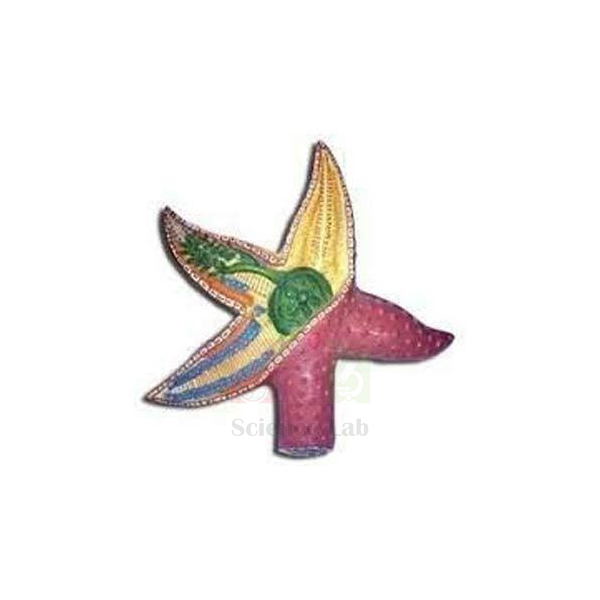
Starfish Model
Starfish Model (Product Code: SLE/A/111) is a three-part zoology model of Asterias used to teach the external and internal anatomy of a starfish in echinoderm practicals. Three of its five arms are cut in longitudinal section at different stages of dissection, taking students from normal organ positions down to the nerve ring, and a numbered key is included. It is made by Jain Scientific Equipments Pvt Ltd (ScienceLab), the OEM manufacturer, at its own factory in Ambala, India.
Specifications
| Parameter | Detail |
|---|---|
| Species | Asterias (starfish) |
| Construction | Three-part model showing detailed internal and external anatomy |
| Size | 53 x 35 x 31 cm |
| Sectioned arms | 3 of the 5 arms shown in longitudinal section |
| Arm 1 | Normal organ positioning |
| Arm 2 | Pyloric caeca and gonads removed to show ampullae, Polian vesicles and the ring canal |
| Arm 3 | Completely dissected to reveal the nervous system (nerve ring and radial nerve) |
| Supplied with | Numbered key |
| Product code | SLE/A/111 |
| Manufacturer | Jain Scientific Equipments Pvt Ltd (ScienceLab) — OEM |
| Country of origin | India (made in Ambala, Haryana) |
What Is the Starfish Model Used For?
The staged arms make the model work like a guided dissection. A teacher can start on the first arm to show where the digestive glands and gonads sit, move to the second to explain the water vascular system through the ampullae, Polian vesicles and ring canal that drive the tube feet, and finish on the third to trace the nerve ring and radial nerve that coordinate an animal with no brain. Students then sketch each arm and label it from the numbered key, building the observation skills expected in practical examinations.
Echinoderms often confuse learners because adult starfish show five-part radial symmetry. Keeping this model with other invertebrate models lets a class compare body plans across phyla, and it is a sound choice for colleges building up zoology lab equipment in India where preserved marine specimens are difficult to obtain or maintain.
OEM Manufacturer
The Starfish Model is an own-make product of Jain Scientific Equipments Private Limited, which trades as ScienceLab and acts as the OEM (original equipment manufacturer). It is produced at the company's licensed factory at Saha, Ambala, Haryana, and dispatched factory-direct to schools, universities, dealers and importers. If one of the three parts ever needs replacing, ask us — the maker handles such requests itself. The company profile has more background.
Related Animal Models
Other items for an invertebrate zoology unit:
- Hydra Model — a cnidarian for comparing a simpler radially arranged body plan.
- Comparative Tapeworm Set — adds flatworms to a comparison across invertebrate phyla.
- Invertebrate Sampling Tray — for sorting live invertebrates collected on field trips.
- Classification of Living Things Poster — places echinoderms within the animal kingdom at a glance.
The complete range is in our Animal Model category.
Frequently Asked Questions
Which starfish does the Starfish Model represent?
The Starfish Model represents Asterias, the starfish genus commonly used for echinoderm type studies. Its three-part construction shows both the external surface and the internal organs, so one model covers the anatomy normally taught for this group.
What does each dissected arm of the Starfish Model show?
On the Starfish Model, one sectioned arm shows normal organ positions, one has the pyloric caeca and gonads removed to expose the ampullae, Polian vesicles and ring canal, and one is fully dissected to reveal the nerve ring and radial nerve.
How big is the Starfish Model?
The Starfish Model measures 53 x 35 x 31 cm, large enough for a group demonstration on a bench or teacher's desk. It comes with a numbered key so students can match each labelled structure to its name.
Who manufactures the Starfish Model?
The Starfish Model is made by Jain Scientific Equipments Pvt Ltd (ScienceLab), its OEM, at the company's own licensed factory at Saha, Ambala, Haryana, India. Institutions and dealers order it factory-direct, with quotations issued by the manufacturer.
Can the Starfish Model replace dissection of a real specimen?
The Starfish Model covers the same structures in a reusable form and is useful where preserved starfish are hard to obtain or store. Many teachers use it alongside specimen work, or instead of it, depending on their syllabus and institutional policy.
How should the Starfish Model be stored?
Keep the three parts of the Starfish Model together in a closed cabinet away from heat and direct sunlight, and dust the surfaces with a soft brush or dry cloth so the detail and numbered labels remain easy to read.
Request a Quote
Request a price for the Starfish Model on our contact page, or add it to the enquiry cart while you browse other models; the manufacturer replies with the quotation.
Last updated: 24 September 2026