- Physics Lab Equipment
- Chemistry Lab Equipment
- Biology Lab Equipment
- Anatomical Lab Equipment
- Learning
- Educational Lab Equipment
- Magnets
- Agriculture
- Astronomy
- Earth Science
- Geography Lab Equipment
- Safety Lab Coat
- Laboratory
- Meteorological
- Electricity & Magnetism
- Heat
- School Lab Equipment
- Lab Glassware
- Science Lab Equipment
- Tvet Lab Equipment
- Robotics Kits Supplier and Manufacturer for Schools India
- Math Lab Equipment Manufacturers and Exporters in Ambala
- STEM Kits Manufacturers and Supplier India
- Engineering Lab Equipment
- Hospital Lab Equipment
- Water, Sanitation & Hygiene Supplies
- Cold Chain, Solar & Communication Equipment
- Nutrition
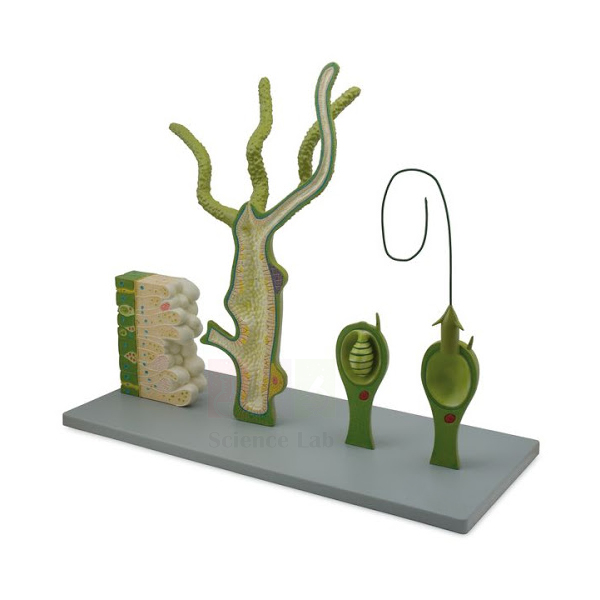
Hydra Model
Hydra Model (Product Code: SLE/A/116) is a large, 4-part dissectible model of the freshwater cnidarian Hydra used for the Hydra type study in school and undergraduate zoology. Its longitudinal and cross-sectional views, a 250x life size tissue block and a separate armed-and-triggered cnidoblast are all referenced by a printed key to 26 structures. The model is made by Jain Scientific Equipments Pvt Ltd (ScienceLab), the OEM manufacturer, at its own factory in Ambala, India.
Specifications
| Parameter | Detail |
|---|---|
| Construction | Dissectible into 4 parts |
| Size (without base) | 58 x 14 x 59 cm |
| Mounting | Durable base |
| Sectional views | Longitudinal and cross-sectional: ectoderm, mesoglea, coelenteron, egg cells, buds, mouth opening |
| Cross-sectional block | 250x life size; nematocysts, sensory and epithelial cells, interstitial structures, nerve plexus |
| Cnidoblast | Shown separately, armed and triggered |
| Key | Printed key referencing all 26 anatomical structures |
| Product code | SLE/A/116 |
| Manufacturer | Jain Scientific Equipments Pvt Ltd (ScienceLab) — OEM |
| Country of origin | India (made in Ambala, Haryana) |
What Is the Hydra Model Used For?
A real Hydra is only a few millimetres long, so most students first meet it as a faint outline on a slide. This model bridges that gap. The longitudinal view explains the two-layered body wall with the jelly-like mesoglea between the layers, the single gut cavity (coelenteron) that opens only through the mouth, and the two ways the animal reproduces: budding and egg cells. The 250x block then zooms in on the tissue itself, where the nerve plexus, sensory cells and stinging nematocysts can be picked out, and the separate cnidoblast shows the stinging cell before and after it fires.
In practical classes it works well next to a microscope: students observe prepared slides of Hydra, draw what they see, and then use the model and its 26-point key to label structures they could not resolve. At 58 cm across it is easy to see in whole-class demonstrations, and its four parts can be separated to focus on one region at a time, which makes it a dependable piece of biology lab equipment in India for invertebrate teaching.
OEM Manufacturer
The Hydra Model is produced by Jain Scientific Equipments Private Limited, which trades as ScienceLab and is the OEM (original equipment manufacturer): it is made at the company's own licensed factory at Saha, Ambala, Haryana, not sourced from a trader. Universities, schools, dealers and importers therefore get quotations and follow-up support straight from the maker. Find more on our company profile.
Related Animal Models
Useful with the Hydra Model in a cnidarian or invertebrate practical:
- Hydra — a prepared glass slide of the real animal to compare with the model.
- Monocular Biological Microscope 400x, LED — for viewing the slide in class.
- Stereo Binocular Microscope — low magnification for watching live specimens collected from ponds.
- Starfish Model — another radially arranged invertebrate for comparison.
- Comparative Tapeworm Set — continues the survey of invertebrate body plans with flatworms.
Find more models in the Animal Model category.
Frequently Asked Questions
How many structures does the Hydra Model's key identify?
The printed key supplied with the Hydra Model references all 26 anatomical structures shown on the model, from the ectoderm and mesoglea to the nematocysts and nerve plexus, so students can label their drawings accurately.
What is the enlarged block on the Hydra Model for?
The Hydra Model includes a cross-sectional block at 250x life size. It shows nematocysts, sensory and epithelial cells, interstitial structures and the nerve plexus, tissue detail that is very hard to resolve on a school microscope slide.
Does the Hydra Model show how the stinging cell works?
Yes. The Hydra Model shows a cnidoblast separately in both its armed and triggered states, so teachers can explain how the stinging thread is held ready and how it looks after it has been discharged.
Who manufactures the Hydra Model?
The Hydra Model is manufactured by its OEM, Jain Scientific Equipments Pvt Ltd (ScienceLab), at the company's own licensed factory at Saha, Ambala, Haryana, India. Institutions, dealers and importers buy it factory-direct with quotations from the manufacturer.
How much space does the Hydra Model need?
The Hydra Model measures 58 x 14 x 59 cm without its base, so allow a little extra for the base on a shelf or bench. Its size makes it easy to see during whole-class demonstrations.
Can the Hydra Model be taken apart?
Yes. The Hydra Model is dissectible into four parts, which lets a teacher separate one region at a time and focus on the body wall, the coelenteron or the reproductive buds and egg cells.
Request a Quote
To buy the Hydra Model, contact us via the contact page or save it to your enquiry cart for a combined quotation from the manufacturer.
Last updated: 24 September 2026