- Physics Lab Equipment
- Chemistry Lab Equipment
- Biology Lab Equipment
- Anatomical Lab Equipment
- Learning
- Educational Lab Equipment
- Magnets
- Agriculture
- Astronomy
- Earth Science
- Geography Lab Equipment
- Safety Lab Coat
- Laboratory
- Meteorological
- Electricity & Magnetism
- Heat
- School Lab Equipment
- Lab Glassware
- Science Lab Equipment
- Tvet Lab Equipment
- Robotics Kits Supplier and Manufacturer for Schools India
- Math Lab Equipment Manufacturers and Exporters in Ambala
- STEM Kits Manufacturers and Supplier India
- Engineering Lab Equipment
- Hospital Lab Equipment
- Water, Sanitation & Hygiene Supplies
- Cold Chain, Solar & Communication Equipment
- Nutrition
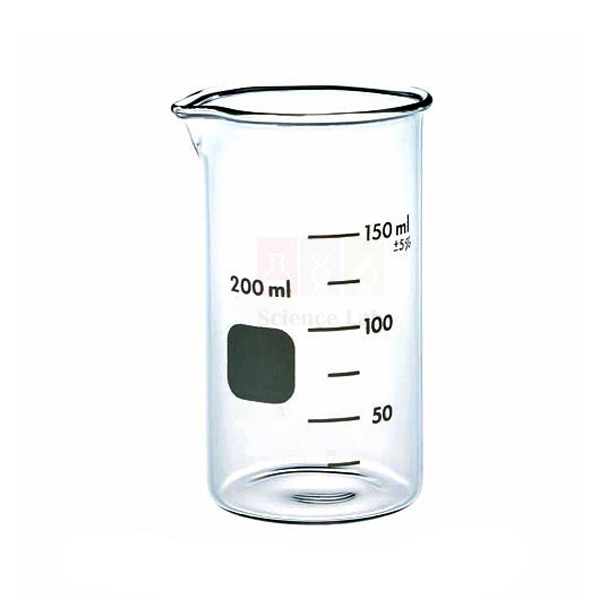
Tall Form Beaker
Tall Form Beaker (Product Code: SLE/GB/12) is a clear borosilicate glass beaker with a taller, narrower profile than a standard low-form beaker, available in capacities from 10 ml to 2000 ml. The extra height helps keep liquid in the beaker during vigorous stirring or boiling and gives a deeper column for immersing an electrode or thermometer. Graduated, heat resistant and chemical resistant, it is made by Jain Scientific Equipments Pvt Ltd (ScienceLab), Ambala, for chemical laboratories as part of its borosilicate laboratory glassware range in India.
Specifications
| Parameter | Detail |
|---|---|
| Material | Borosilicate glass |
| Form | Tall form |
| Capacities | 10 ml, 25 ml, 50 ml, 100 ml, 250 ml, 500 ml, 1000 ml, 2000 ml |
| Markings | Graduated |
| Heat resistance | Heat resistant |
| Chemical resistance | Chemical resistant |
| Colour | Clear |
| Application | Chemical laboratory |
Typical Use
Tall form beakers are a favourite for titrations carried out on a magnetic stirrer: the burette tip sits just inside the rim, the stir bar spins without throwing droplets over the edge, and a pH or conductivity electrode can dip well below the surface. They are equally handy in gravimetric work, where a precipitate is digested and allowed to settle, and for boiling solutions that tend to froth. In volumetric analysis practicals for college and senior-school students, a tall beaker also makes colour changes at the end point easier to see against a white tile.
Heat tall beakers gradually on a hot plate or over a burner with a wire gauze, and remember that a taller vessel is easier to tip — clamp or support larger sizes when stirring. The graduations indicate approximate volume only.
Manufacturer
Tall form beakers in this range are manufactured by Jain Scientific Equipments Private Limited, a company in Ambala, Haryana, that markets its laboratory glassware and apparatus as ScienceLab. The company profile describes the business in more detail.
Related Laboratory Equipment
Apparatus that is commonly set up with a tall form beaker for titration and stirring work:
- Glass Beaker — standard low-form beakers for general mixing and heating
- Pyrex Beaker, Low Form — a wider, lower alternative with a marking spot
- Burette, Class-B, with Glass Key — delivers titrant into the beaker
- Magnetic Stirrer — keeps the solution mixed during titration
- Stirring Rod, Glass — for manual stirring and guiding pours
See every beaker type in the Glassware Beaker category.
Frequently Asked Questions
How does a tall form beaker differ from a normal beaker?
It is taller and narrower for the same capacity. That reduces splashing, suits electrodes and stirrers, and makes it easier to see changes in the liquid, while a low-form beaker is steadier and easier to reach into.
Which capacities are available?
Eight sizes: 10, 25, 50, 100, 250, 500, 1000 and 2000 ml.
Can it be heated?
Yes. It is made of heat resistant borosilicate glass; heat it gradually on a hot plate or on a wire gauze over a burner, and do not heat it empty.
Is it suitable for use with a magnetic stirrer?
Tall form beakers are widely used on magnetic stirrers. Choose a stir bar that fits the base of the size you use and start at a low speed.
Can the graduations be used for measuring?
Only as an approximate guide. For titrations and standard solutions, measure with a pipette, burette or volumetric flask.
How should a tender or institutional enquiry be sent?
List each capacity with its quantity and the delivery location in India or abroad through our contact page; we reply with a formal quotation.
Request a Quote
For prices on any capacity, contact us or add the beaker to your enquiry cart.
Last updated: 24 September 2026

Glass Funnel
Glass Funnel (Product Code: SLE/GF/01) is a conical, short-stemmed funnel in borosilicate glass for filtering mixtures through filter paper and for transferring liquids into narrow-necked vessels without spills. Offered in 75 mm, 90 mm and 120 mm diameters, it is a basic item of borosilicate laboratory glassware used in chemistry experiments at every level from secondary school to university. It is manufactured by Jain Scientific Equipments Pvt Ltd (ScienceLab), Ambala.
Specifications
| Parameter | Detail |
|---|---|
| Material | Borosilicate glass |
| Shape | Conical |
| Stem | Short stem |
| Diameters | 75 mm, 90 mm, 120 mm |
| Resistance | Heat resistant and chemical resistant |
| Used in | Laboratory work and chemistry experiments |
Typical Use
For gravity filtration, a circle of filter paper is folded into a cone, seated in the funnel and wetted so it clings to the glass; the mixture is then poured down a glass rod onto the paper, with the stem resting against the inside wall of the receiving beaker or flask so the filtrate runs down smoothly. Separating sand from salt solution, collecting a precipitate and clarifying a solution before crystallisation are routine examples in school chemistry lab equipment sessions.
The short stem is less likely to clog with solids and is preferred for hot filtration, where a long stem can cool the liquid enough for crystals to form inside it. Choose the 75 mm funnel for small test-tube and beaker work, 90 mm for general practicals and 120 mm for larger volumes. Because it is borosilicate, the funnel can take hot solutions and most laboratory solvents.
Manufacturer
Glass funnels in this range are made by Jain Scientific Equipments Private Limited, a company in Ambala, Haryana that trades as ScienceLab and supplies laboratory glassware and apparatus to education and industry. Find out more on our company profile.
Related Glassware Funnels and Accessories
Items needed to set up a complete filtration at the bench:
- Filter Paper — folded into the funnel to retain solids
- Funnel Stand, Double — holds two funnels above the receivers
- Stirring Rod, Glass — guides the liquid onto the paper without splashing
- Glass Beaker — collects the filtrate beneath the funnel
- Plastic Funnel — an unbreakable option for junior classes and cold liquids
See the full range in Glassware Funnels.
Frequently Asked Questions
Which diameters are available?
75 mm, 90 mm and 120 mm.
What size of filter paper should I use?
Choose a paper that, once folded, sits just below the rim of the funnel so liquid cannot run over the edge of the paper. Contact us if you would like us to suggest paper for your funnel size.
What is the benefit of the short stem?
It clogs less easily with solids and reduces cooling of hot solutions, so crystals are less likely to block the stem during hot filtration.
Should I choose glass or plastic?
Glass is the choice for hot liquids and organic solvents. A plastic funnel is lighter and does not break, which suits younger students and cold aqueous work.
How do I clean it?
Rinse immediately after use, wash with laboratory detergent and a soft brush, and give a final rinse with distilled water before drying upside down.
Can you supply funnels in bulk for schools or for export?
Yes. Send the diameters, quantities and delivery location in India or abroad, and we will prepare a quotation.
Request a Quote
For pricing, contact us or add the Glass Funnel in the sizes you need to your enquiry cart.
Last updated: 24 September 2026
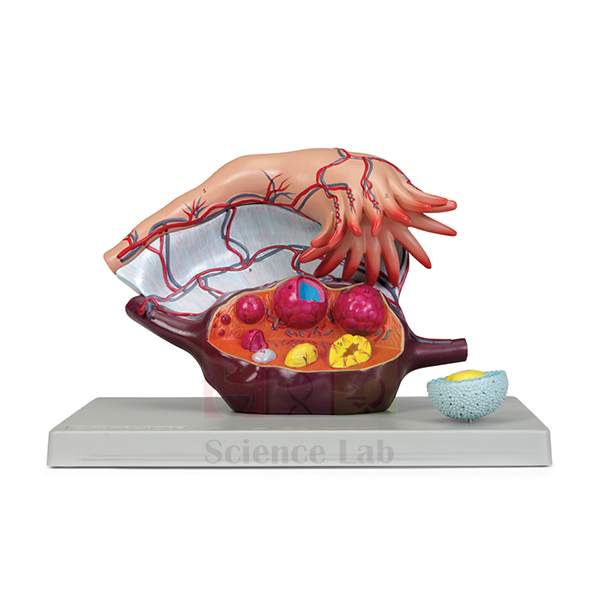
Human Ovary Model
Human Ovary Model (Product Code: SLE/A/70) enlarges the ovary to about 5x life size and sections it to reveal follicles at successive stages of maturation, from the primary ovarian follicle through to the corpus luteum and corpus albicans. A removable fallopian tubule and the vascular and suspensory structures complete the picture, and a numbered key is included. It serves reproductive biology, histology, gynaecology and nursing teaching, and suits high school biology lab equipment lists for classes covering the menstrual cycle. It is made by Jain Scientific Equipments Pvt Ltd (ScienceLab), Ambala.
Specifications
| Parameter | Detail |
|---|---|
| Scale | About 5x life size |
| Size | 33 x 23 x 21 cm |
| Base | Mounted on a durable polymer base |
| Removable part | Fallopian tubule |
| External features | Vascular and suspensory structures |
| Sectioned ovary | Follicles at various stages of maturation, from the primary ovarian follicle to the corpus luteum and corpus albicans |
| Follicle detail | Primary follicle cross-sectioned to reveal the oocyte and zona pellucida |
| Key | Numbered key included |
Typical Use
The model turns the ovarian cycle into a sequence students can follow with a finger: begin at the primary follicle, trace the growing follicles across the cut surface, reach the corpus luteum that forms after ovulation, and end at the corpus albicans that remains when it regresses. The enlarged cross-section of the primary follicle then shows the oocyte and its surrounding zona pellucida, linking the gross model to what students later see under the microscope.
Removing the fallopian tubule makes it easier to explain where the released egg travels and where fertilisation normally takes place. In college histology and embryology classes the model is often shown before slide work, and in nursing and midwifery courses it supports teaching on fertility and hormonal changes. Keep the model on its base and clean it with a soft, slightly damp cloth.
Manufacturer
ScienceLab is the brand of Jain Scientific Equipments Private Limited, an Ambala, Haryana company that makes reproductive, skeletal and organ models for teaching. For vendor registration, the company's GSTIN is 06AAECJ8618A1ZT and its Legal Entity Identifier (LEI) is 3358004HRD1JIVXKYX49. More information is on the company profile.
Related Human Models
For a reproductive-biology teaching set, consider adding:
- Ts Of Ovary (Mammalian) — a transverse section for comparing the model with real tissue under the microscope.
- Human Female Genital Organs Model — shows the ovary in relation to the uterus and other organs.
- Human Female Ovary Model — an alternative ovary model for a second teaching station.
- Human Embryo Development Set — continues the story from fertilisation into early development.
Further models are in the Human Models category.
Frequently Asked Questions
How much is the ovary enlarged?
About 5x life size, with an overall size of 33 x 23 x 21 cm.
Which follicle stages can students see?
Follicles from the primary ovarian follicle through maturing stages to the corpus luteum and corpus albicans, plus a cross-sectioned primary follicle showing the oocyte and zona pellucida.
Which part is removable?
The fallopian tubule can be removed from the ovary.
Is there a key to the numbered features?
Yes, a numbered key is included.
What is the base made of?
The model is mounted on a durable polymer base.
What documents can you provide for a college purchase order?
We can supply the quotation along with company details such as GSTIN and LEI. Tell us what your purchase department requires via the contact page.
Request a Quote
Ask for pricing on SLE/A/70 through the contact page, or add it to the enquiry cart to combine it with other reproductive-system models.
Last updated: 24 September 2026
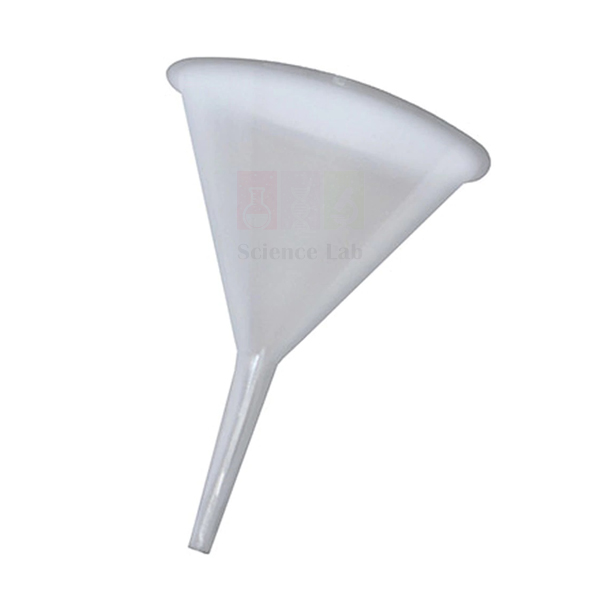
Plastic Funnel
Plastic Funnel (Product Code: SLE/GF/02) is a lightweight, chemical-resistant conical funnel for pouring and filtering at the bench, offered in 35 mm, 65 mm and 100 mm diameters. Being plastic, it is far less likely to break than glass, so primary and middle-school science teachers, lab assistants and technicians use it for everyday liquid transfers and simple filtration activities. It is part of the lab plasticware manufactured by Jain Scientific Equipments Pvt Ltd (ScienceLab), Ambala.
Specifications
| Parameter | Detail |
|---|---|
| Material | Plastic |
| Shape | Conical |
| Diameters | 35 mm, 65 mm, 100 mm |
| Resistance | Chemical resistant |
| Capacity (as described) | Two ounces |
| Stem (as described) | 30 mm stem with a 3 mm diameter opening |
| Recommended filter paper | 11 cm; when folded it fits inside the funnel without overhang |
Typical Use
Younger students use the funnel to pour water or solutions into bottles, test tubes and measuring cylinders in school practicals, and to filter muddy water or separate sand from salt solution with a folded filter paper. Technicians keep one beside each reagent stock for topping up dropping and wash bottles, where a narrow stem and a steady pour prevent spills on the bench.
Pick the 35 mm funnel for filling small bottles and tubes, 65 mm for general bench transfers and 100 mm when larger volumes are poured. Because heat resistance is not listed for this plastic funnel, use a borosilicate glass funnel for hot liquids. Rinse it after each use so residues do not carry over between reagents.
Manufacturer
Made by Jain Scientific Equipments Private Limited, which operates as ScienceLab from Ambala in Haryana and serves schools, colleges and laboratories in India and international markets. Read our company profile for more about the business.
Related Laboratory Equipment
Items commonly ordered with plastic funnels for school labs:
- Filter Paper — for simple filtration activities
- Funnel, HDPE — another plastic funnel option in our funnel range
- Powder Funnel — for transferring solids into narrow-necked containers
- Measuring Cylinder, Polypropylene — a plastic cylinder that is often filled through a funnel
- Wash Bottle LDPE with Narrow Mouth — refilled easily through a small funnel
More options are listed under Glassware Funnels.
Frequently Asked Questions
Which diameters can I order?
35 mm, 65 mm and 100 mm.
Do the two-ounce capacity and 30 mm stem apply to every size?
Our description gives these figures for the funnel without linking them to a particular diameter. If stem length or capacity matters for your use, contact us and we will confirm the details of the size you need.
What filter paper fits?
An 11 cm filter paper is recommended; folded, it sits inside the funnel without overhang.
Can I pour hot liquids through it?
Heat resistance is not listed for this funnel, so we advise using a Glass Funnel for hot solutions.
Which plastic is it made from?
The listing describes it as a chemical-resistant plastic without naming the polymer. If your work requires a specific material, ask us before ordering.
Can you supply class quantities?
Yes. Tell us the sizes, quantities and delivery location, and we will quote for school or distributor supply.
Request a Quote
Please contact us for prices, or add the Plastic Funnel to your enquiry cart with the diameters you require.
Last updated: 24 September 2026

Buchner Funnel, 90 mm, Porcelain
Buchner Funnel, 90 mm, Porcelain (Product Code: SLE/GF/03) is a one-piece porcelain funnel for vacuum filtration, with a flat perforated filter platform 90 mm in diameter and a capacity of about 200 ml. Paired with a filter flask and a vacuum source, it pulls liquid rapidly through a flat filter paper, leaving crystals or precipitate as a dry cake — much faster than gravity filtration. A core item of chemistry lab equipment for college, university and pharmacy practicals, it is manufactured by Jain Scientific Equipments Pvt Ltd (ScienceLab), Ambala.
Specifications
| Parameter | Detail |
|---|---|
| Material | Porcelain — durable, acid and alkali resistant, easy to clean, autoclavable |
| Construction | One-piece design |
| Diameter | 90 mm |
| Capacity | About 200 ml |
| Stem | Tapers from about 22 mm OD at the end to 30 mm OD at the cone |
| Filter platform | Dozens of small holes, each about 1/8 inch |
| Filter paper | Order with 11 cm filter paper, cut down to fit |
| Application | Vacuum filtration |
Typical Use
The funnel is pushed into a rubber bung seated in the neck of a filter flask, and the flask’s side arm is connected to a vacuum pump or water aspirator with thick-walled tubing. A filter paper is laid flat on the perforated platform so that it covers every hole without curling up the sides, wetted with a little solvent to seal it, and the vacuum is switched on before the mixture is poured in. This is the standard way to collect product after a crystallisation, wash it with cold solvent and draw air through the cake to dry it.
Because 11 cm filter paper is larger than the 90 mm platform, trim each circle to size before use. When the filtration is finished, release the vacuum at the flask before switching off the pump to avoid suck-back. Porcelain resists acids and alkalis and can be autoclaved, so the funnel can be cleaned thoroughly and reused over many sessions.
Manufacturer
This funnel is manufactured by Jain Scientific Equipments Private Limited, better known by its trade name ScienceLab, from its base in Ambala, Haryana. The company makes laboratory apparatus for educational institutions and laboratories in India and international markets — see our company profile.
Related Laboratory Equipment
Everything needed to build a vacuum filtration set-up around this funnel:
- Conical Filter Flask — the side-arm flask the funnel sits in
- Buchner Bungs (Black) — seals the funnel stem into the flask neck
- Vacuum Pump, Hand — a simple manual vacuum source for student benches
- Vacuum Tubing — connects the flask side arm to the pump
- Filter Paper — trimmed to lie flat on the perforated plate
Compare other funnels in our Glassware Funnels category.
Frequently Asked Questions
What filter paper should I order?
Order 11 cm filter paper and cut it down so it lies flat on the 90 mm platform, covering all the holes without folding up the sides.
How much does the funnel hold?
About 200 ml.
Which bung fits the stem?
The stem tapers from about 22 mm OD at the end to 30 mm OD at the cone, so choose a bung whose bore grips the stem within that range and whose outside suits your filter flask neck. Contact us if you want us to match a bung to your flask.
Can it be sterilised?
Yes, porcelain is autoclavable, which makes the funnel suitable for work that requires sterilised apparatus.
Porcelain or polypropylene — which should I choose?
The porcelain funnel is a rigid one-piece unit that resists acids and alkalis. The polypropylene version is a lighter two-part design; choose based on weight, handling and the bungs you already have.
What warranty applies?
Warranty terms are confirmed with the quotation; ask us for the current terms when you enquire.
Can you quote for a full class set-up?
Yes. Tell us how many filtration stations you need and whether pumps, flasks and bungs should be included, and we will quote them together.
Request a Quote
For pricing, contact us or add this funnel and its accessories to your enquiry cart.
Last updated: 24 September 2026
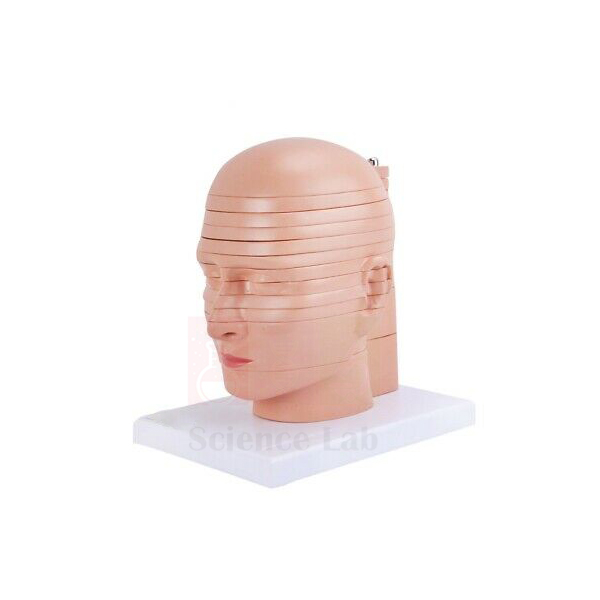
Horizontally Sectioned Human Head Model
Horizontally Sectioned Human Head Model (Product Code: SLE/A/71) is a life-size human head sliced horizontally into 12 sections, used for hands-on sectional anatomy in neuroanatomy, nursing and allied-health classes. Each section can be rotated or removed, and the numbered structures on the slices include muscles, nerves and the gyri and sulci of the brain. It is made by Jain Scientific Equipments Pvt Ltd (ScienceLab), an OEM scientific lab equipment manufacturer, at its own factory in Ambala, India.
Specifications
| Parameter | Detail |
|---|---|
| Type | Horizontally sliced human head model |
| Scale | Life size |
| Number of sections | 12 horizontal sections |
| Handling | Sections can be rotated or removed for closer observation |
| Labelled structures | Numbered muscles, nerves, and brain gyri and sulci |
| Product code | SLE/A/71 |
| Manufacturer | Jain Scientific Equipments Pvt Ltd (ScienceLab) — OEM |
| Country of origin | India (made in Ambala, Haryana) |
What Is the 12-Section Human Head Model Used For?
The value of this model is in the handling. A student can swing one slice aside or lift it out entirely, turn it over in the hand and compare its upper and lower faces with the slices next to it. Tracing a numbered nerve or muscle across several consecutive sections shows how a structure runs through the head, something a single flat diagram cannot do. On the brain surfaces, the numbered gyri and sulci give a concrete way to practise naming the folds of the cortex.
In practical examinations, examiners often remove one or two sections and ask candidates to name the numbered points or place the slice at the correct level. Returning each piece to its position after the session keeps the set complete. For a department buying biology teaching aids in India, a model like this supports small-group work where several students examine different sections at the same time.
OEM Manufacturer
Jain Scientific Equipments Private Limited operates the ScienceLab brand and is the OEM (original equipment manufacturer) of this 12-section head. The model is made at the company's own licensed factory at Saha, Ambala, Haryana, India, not sourced from a trading house, and goes factory-direct to colleges, dealers and importers.
Because the slices are separate pieces, ask us if one is lost; replacement questions and repeat orders are handled by the manufacturer. Read the ScienceLab company profile for more.
Related Brain Models
These models extend the study of the head and cortex covered by the sliced head:
- Horizontally Sectioned Model of the Human Head — a base-mounted alternative with 10 slices aligned to the CT/MR plane
- Human Regional Brain Model — helps students locate the cortical regions whose gyri they name on the slices
- Human Brain with Cortical Functional Centers Model — links surface anatomy to function
- Human Head Dissection Model — a dissection view of the head for comparison with the horizontal cuts
Browse the Brain Models category for the complete selection.
Frequently Asked Questions
How many slices does the Horizontally Sectioned Human Head Model have?
The Horizontally Sectioned Human Head Model has 12 horizontal sections, and each one can be rotated or removed for closer observation, so students can compare the upper and lower faces of every slice in turn.
Which structures are numbered on the sliced head?
Muscles, nerves, and the gyri and sulci of the brain are among the numbered anatomical structures on the Horizontally Sectioned Human Head Model, allowing students to trace one structure across several consecutive sections.
What size is the Horizontally Sectioned Human Head Model?
The Horizontally Sectioned Human Head Model is life size. Overall dimensions and weight are not listed in our product information, so please ask us through the contact page if you need them for storage or shipping.
Is a printed key supplied with the 12-section head?
The listing for the Horizontally Sectioned Human Head Model confirms numbered structures but does not describe the reference format. Please confirm the accompanying key or list with us when you enquire, so it matches your practical sessions.
How do we prevent sections of the head model from getting lost?
Count the slices of the Horizontally Sectioned Human Head Model before and after each class and return every section to its place before storage. If one is misplaced, contact the manufacturer about a replacement.
Who manufactures the Horizontally Sectioned Human Head Model?
The Horizontally Sectioned Human Head Model is manufactured by Jain Scientific Equipments Pvt Ltd (ScienceLab), the OEM, at its own licensed factory at Saha, Ambala, Haryana, India, for colleges, dealers and importers.
Can you ship the sliced head model outside India?
Yes. ScienceLab supplies the Horizontally Sectioned Human Head Model to buyers in India and international markets. Include your country, quantity and delivery address in the enquiry, and the manufacturer will quote accordingly.
Request a Quote
To receive a quotation for SLE/A/71, send us your quantity and address through the contact page, or collect several models in the enquiry cart and submit one combined request. You will hear back directly from the manufacturer.
Last updated: 24 September 2026
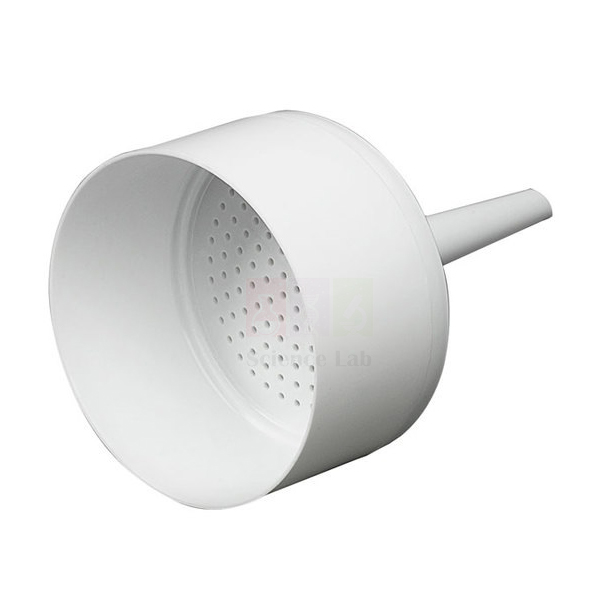
Buchner Funnel, 90 mm, Polypropylene
Buchner Funnel, 90 mm, Polypropylene (Product Code: SLE/GF/04) is a lightweight two-part funnel for vacuum filtration: the upper section snaps onto the lower one to form a vacuum-tight seal without grease, and its 90 mm filter plate carries hundreds of small perforations for efficient filtration. It holds about 300 ml and has a slimmer stem than typical porcelain Buchner funnels. Chemistry, pharmacy and life-science teaching labs choose it as practical lab equipment for college and research benches; it is manufactured by Jain Scientific Equipments Pvt Ltd (ScienceLab), Ambala.
Specifications
| Parameter | Detail |
|---|---|
| Material | Polypropylene — lightweight, acid and alkali resistant, easy to clean, autoclavable |
| Construction | Two-part; top snaps to the lower part, forming a vacuum-tight seal that does not need grease |
| Diameter | 90 mm |
| Capacity | About 300 ml |
| Filter plate | Hundreds of small perforations |
| Stem | Tapers from about 13 mm OD at the end to 18 mm OD at the cone |
| Application | Vacuum filtration |
Typical Use
Set the funnel in a filter flask with a bung that grips its narrow stem, connect the flask to a vacuum source, lay a trimmed filter paper flat across the perforated plate and wet it, then pour the mixture in with the vacuum running. Students use this arrangement to recover crystals after recrystallisation, collect precipitates in gravimetric exercises and dry a washed solid quickly, as the suction pulls air through the filter cake.
Because the funnel is light and will not shatter like ceramic if knocked over, it is well suited to busy pharmacy lab equipment sets and large practical classes. After use, unsnap the two sections so the plate and bowl can be rinsed separately, and autoclave the parts when sterile apparatus is required. Its smaller stem fits flasks and bungs that would be too narrow for a porcelain funnel.
Manufacturer
The funnel is produced by Jain Scientific Equipments Private Limited (CIN U29309HR2020PTC087597), trading as ScienceLab, which manufactures at its licensed factory at 449, HSIIDC Industrial Area, Saha, Ambala, Haryana (Factory Licence AMB-ONLINE-CHD-J-414). More about the company is on our company profile.
Related Laboratory Equipment
Pumps, flasks and fittings for a complete vacuum filtration station:
- Conical Filter Flask — receives the filtrate and connects to the vacuum line
- Vacuum Pump, Electric — steady suction for repeated filtrations
- Vacuum Pump with Pressure Gauge — lets you watch the vacuum level during filtration
- Buchner Bungs (Black) — for sealing the funnel into the flask neck (check the bore suits the slim stem)
- Buchner Funnel, 90 mm, Porcelain — the rigid one-piece ceramic alternative
Browse all funnel types in Glassware Funnels.
Frequently Asked Questions
How do the two parts fit together?
The top portion snaps onto the lower one, creating a vacuum-tight seal with no grease required. The parts can be separated again for cleaning.
What is the capacity?
About 300 ml, with a 90 mm diameter filter plate.
Will it fit my existing filter flask?
The stem tapers from about 13 mm OD at the end to 18 mm OD at the cone, which is much smaller than typical porcelain Buchner funnels. Use a bung or adapter with a bore to suit, and contact us if you need help matching one.
Can it be autoclaved?
Yes, polypropylene is autoclavable, and it also resists acids and alkalis.
What filter paper should I use?
Use a circle that lies flat on the 90 mm plate and covers all the perforations; trim larger papers to size. We can suggest a suitable paper on request.
Do you supply export and distributor orders?
Yes, ScienceLab supplies institutions and distributors in India and international markets. Send the quantity and destination for a quotation.
Request a Quote
For a price, contact us or add this funnel, a filter flask and a pump to your enquiry cart.
Last updated: 24 September 2026
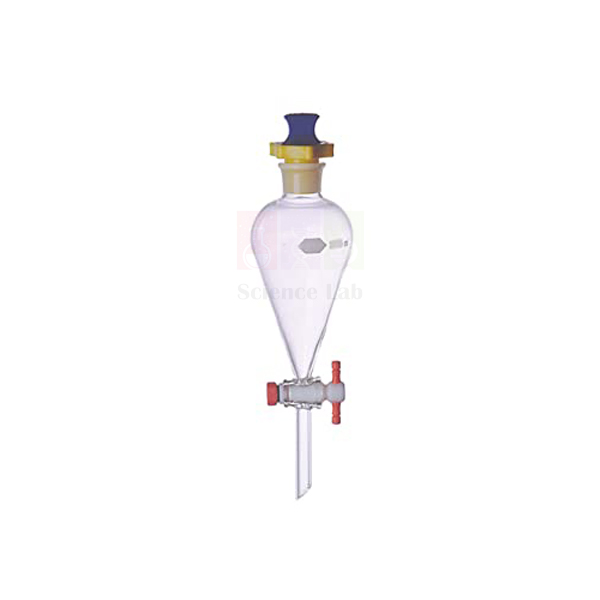
Separatory Funnel, Squibb style
Separatory Funnel, Squibb style (Product Code: SLE/GF/05) is a conical borosilicate glass separating funnel used to separate two immiscible liquids of different densities: the heavier liquid settles to the bottom and is drawn off through the PTFE stopcock, which never needs greasing. It is closed at the top with a 19/26 polyethylene stopper and is offered in 250 ml, 500 ml and 1000 ml capacities. Chemistry teachers, pharmacy and research labs use it for solvent extraction and for slowly adding reagents; it is manufactured by Jain Scientific Equipments Pvt Ltd (ScienceLab), Ambala.
Specifications
| Parameter | Detail |
|---|---|
| Style | Squibb, conical shape |
| Material | Borosilicate glass, made to withstand typical laboratory temperature variations |
| Stopcock | PTFE, never needs greasing |
| Stopper | Polyethylene, size 19/26 |
| Capacities | 250 ml, 500 ml, 1000 ml |
| Resistance | Heat resistant and chemical resistant |
| Uses | Separating immiscible liquids; slowly adding a reagent in a distillation or reaction |
Typical Use
For a liquid–liquid extraction the funnel is held in a ring or clamp on a retort stand with the stopcock closed, the two liquids are poured in, and the stopper is inserted. The funnel is then inverted, vented through the open stopcock pointing away from people, shaken gently and vented again, before being returned to the stand to let the layers separate. With the stopper removed, the lower layer is run off into a beaker or flask and the upper layer poured out through the top. Separating an organic product from an aqueous wash and extracting iodine or caffeine into a solvent are familiar practical examples.
The same separating funnel can serve as an addition funnel, feeding a reagent drop by drop into a reaction or distillation flask by adjusting the PTFE stopcock. Pick the 250 ml funnel for student extractions, 500 ml for general use and 1000 ml for larger washes. Always leave headspace above the liquids, vent frequently when volatile solvents are involved, and rinse the funnel and stopcock after use.
Manufacturer
Manufactured by Jain Scientific Equipments Private Limited, an Ambala, Haryana company whose laboratory glassware is sold under the ScienceLab brand to schools, colleges and laboratories in India and international markets. Our company profile tells you more about who we are.
Related Laboratory Equipment
Supports and receivers used with a separatory funnel during extraction:
- Retort Stand — the upright support for the funnel while the layers settle
- Funnel Holder — holds the funnel securely on the stand
- Glass Beaker — collects the lower layer as it is drained
- Conical Flask — a stoppable receiver for the separated layers
- Separatory Funnel — another separatory funnel design in our range
Explore other styles under Glassware Funnels.
Frequently Asked Questions
What does Squibb style mean?
It describes a conical-bodied separatory funnel. The tapering shape narrows the boundary between the two layers as it drains, which makes it easier to close the stopcock right at the interface.
Does the stopcock need grease?
No. The PTFE stopcock never needs greasing, so there is no grease to contaminate your extract.
What stopper is supplied?
A polyethylene stopper, size 19/26.
Which capacities are available?
250 ml, 500 ml and 1000 ml.
Can it be used to add reagents to a reaction?
Yes. It can slowly add a reagent in a distillation or to a reaction process, with the flow set by the stopcock.
Why must the funnel be vented while shaking?
Shaking volatile solvents builds up vapour pressure inside the stoppered funnel; venting through the stopcock releases it safely and keeps the stopper from being forced out.
How do I request an institutional quotation?
Send the capacities, quantities, delivery location and any tender reference through our contact page, and we will reply with pricing and dispatch details.
Request a Quote
To order, contact us or place the Squibb separatory funnel in your enquiry cart with the capacities you need.
Last updated: 24 September 2026