- Physics Lab Equipment
- Chemistry Lab Equipment
- Biology Lab Equipment
- Anatomical Lab Equipment
- Learning
- Educational Lab Equipment
- Magnets
- Agriculture
- Astronomy
- Earth Science
- Geography Lab Equipment
- Safety Lab Coat
- Laboratory
- Meteorological
- Electricity & Magnetism
- Heat
- School Lab Equipment
- Lab Glassware
- Science Lab Equipment
- Tvet Lab Equipment
- Robotics Kits Supplier and Manufacturer for Schools India
- Math Lab Equipment Manufacturers and Exporters in Ambala
- STEM Kits Manufacturers and Supplier India
- Engineering Lab Equipment
- Hospital Lab Equipment
- Water, Sanitation & Hygiene Supplies
- Cold Chain, Solar & Communication Equipment
- Nutrition
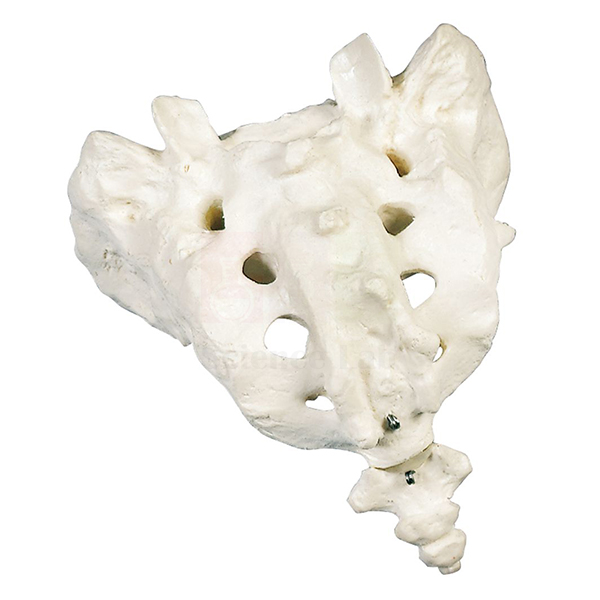
Human Sacrum and Coccyx
Human Sacrum and Coccyx (Product Code: SLE/A/62) is a life-size, one-part model of the lowest section of the vertebral column: the wedge-shaped sacrum and the small tailbone below it. Anatomy, physiotherapy and nursing students use it to learn the landmarks of this region without handling a full skeleton, and it is a convenient desk piece when a complete human skeleton model is shared by a large class. It is made by Jain Scientific Equipments Pvt Ltd (ScienceLab), Ambala.
Specifications
| Parameter | Detail |
|---|---|
| Bones represented | Human sacrum and coccyx |
| Scale | Life-size |
| Construction | 1-part model |
| Size | 20 x 15 x 15 cm |
| Weight | 0.2 kg |
Typical Use
Osteology practicals usually ask students to identify the sacral promontory, the sacral foramina through which nerves pass, the auricular surfaces that meet the hip bones and the joint between sacrum and coccyx. A single-piece, life-size model lets each student turn the bone in the hand, compare the anterior and posterior surfaces and sketch them, then return it for the next group. At 0.2 kg it is light enough for repeated handling during a long practical.
Physiotherapy and sports-science tutors use the same model to explain low back and tailbone pain, the sacroiliac joint and the attachment points of pelvic muscles. It also works as an item of school biology lab equipment when senior students study the regions of the spine, because it shows clearly how several vertebrae fuse into one bone. Store it in a closed cupboard to keep it free of dust.
Manufacturer
The sacrum and coccyx model is part of the anatomy range made by Jain Scientific Equipments Private Limited, a company in Ambala, Haryana that sells its products under the ScienceLab brand. You can read how the company works on the profile page.
Related Human Models
These items extend a lesson on the lower spine and pelvis:
- Human Sacrum and Coccyx-2 — an alternative unmounted plastic version of the same bones.
- Human Pelvis with Lower Lumbar and Femur Heads — shows the sacrum in place between the hip bones.
- Human Lumbar Set Model — the vertebrae that sit directly above the sacrum.
- Female Skeletal Pelvis — for studying the sacrum as part of the pelvic ring.
Explore more in the Human Models category.
Frequently Asked Questions
Is the Human Sacrum and Coccyx life-size?
Yes. It is a life-size model made as a single part.
What are its size and weight?
It measures 20 x 15 x 15 cm and weighs 0.2 kg.
Does the coccyx come apart from the sacrum?
No. This is a 1-part model, so the sacrum and coccyx form one piece.
How does it differ from Human Sacrum and Coccyx-2?
Both are life-size. This version is a one-part model with a listed weight of 0.2 kg and size of 20 x 15 x 15 cm, while the -2 version is an unmounted plastic replica with different dimensions. Compare both pages or ask us which suits your course.
What material is it made of?
The material is not stated in the product details. Please ask through the contact page if you need this for a tender specification.
Can it be ordered in class sets?
Yes. Tell us how many units you need and the delivery location, and we will quote for the set.
Request a Quote
To receive a quotation for SLE/A/62, use the contact page or collect items in the enquiry cart and send them to us together.
Last updated: 24 September 2026
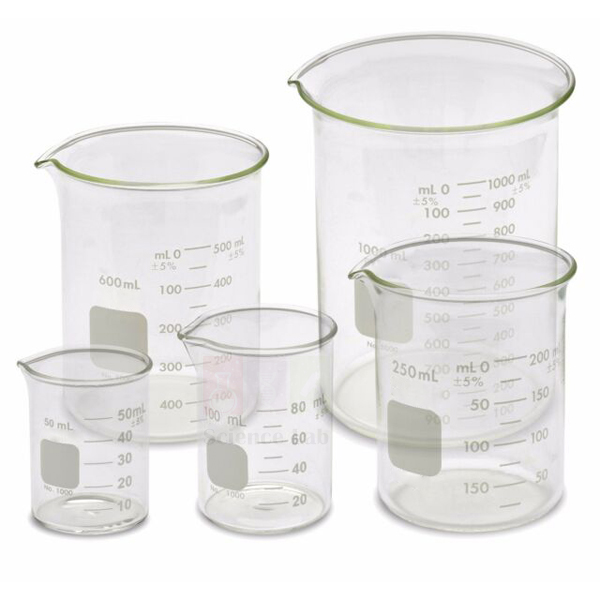
Pyrex Beaker Set of 5
Pyrex Beaker Set of 5 (Product Code: SLE/GB/04) groups five Pyrex glass beakers into one pack for general laboratory work such as mixing, heating and cooling solutions. Every beaker carries a single metric scale printed in white enamel and an extra-large marking spot, so the set is easy to label and read at a glance on a busy practical bench. It is supplied by Jain Scientific Equipments Pvt Ltd (ScienceLab), Ambala, to schools, colleges and lab stores that want a lab glassware supplier in India able to combine glass and apparatus in one order.
Key Details
| Parameter | Detail |
|---|---|
| Supplied as | Set of 5 beakers |
| Material | Pyrex glass |
| Heat resistance | Heat resistant |
| Chemical resistance | Chemical resistant |
| Scale | Single graduated metric scale with white enamel graduations; approximate, not intended for accurate liquid measurement |
| Labelling | Extra-large marking spot on each beaker |
| Suitable for | Mixing, heating and cooling in general laboratory use |
| Capacities in the set | Confirmed on quotation — please ask before ordering |
Typical Use
A five-beaker pack works well as a starter kit for a new practical bench or as a replacement pack when individual beakers break over a term. In a single experiment a teacher can assign one beaker to each stage — dissolving a solid, heating the solution, cooling it for crystals, holding rinse water and collecting waste — and write the stage on each marking spot so students do not mix them up. This makes the set useful chemistry lab equipment for school labs in India where several groups share the same bench.
Heat the beakers gradually on a hot plate or on a gauze over a burner, and let hot glass cool before washing it in cold water. Since the enamel scale is only approximate, measure reagents with a cylinder or pipette and use the beaker markings as a rough level guide.
Supplier
ScienceLab is the trading name of Jain Scientific Equipments Private Limited in Ambala, Haryana, which supplies this Pyrex beaker set as part of a wider glassware and apparatus offer for teaching and testing laboratories. Read more on our company profile.
Related Laboratory Equipment
Useful additions when the set is used for heating and preparing solutions:
- Pyrex Beaker, Low Form — individual Pyrex beakers when you need one specific capacity
- Glass Beaker Set of 5 — a borosilicate glass set as an alternative
- Hot Plate General Purpose — flameless heating for the beakers
- Glass Measuring Cylinder — for accurate volumes before transferring to a beaker
- Brush, Beaker, Nylon — for cleaning the beakers after use
More beakers and handling accessories are listed in the Glassware Beaker category.
Frequently Asked Questions
Which sizes come in the set?
The individual capacities are not listed on this page. Contact us and we will confirm the five sizes before you order; single sizes are also available from the Pyrex Beaker, Low Form range.
Can the beakers be heated?
Yes, the Pyrex glass is heat resistant. Warm them gradually on a hot plate or gauze and avoid sudden temperature changes such as placing hot glass on a wet surface.
How precise are the graduations?
They are approximate and not meant for accurate liquid measurement; they help you judge fill levels while mixing or heating.
How do I label the beakers?
Each has an extra-large marking spot that accepts pencil or marker, so sample names or group numbers can be written directly on the glass.
Is a calibration certificate offered?
These are general-purpose beakers with approximate scales. If your order needs documentation of any kind, raise it with us via the contact page first.
Can you supply sets in bulk to schools or overseas buyers?
Yes, we handle orders for schools, colleges and distributors in India and international markets — tell us the number of sets and the delivery destination.
Request a Quote
For current pricing, send us your requirement or add the set to your enquiry cart.
Last updated: 24 September 2026
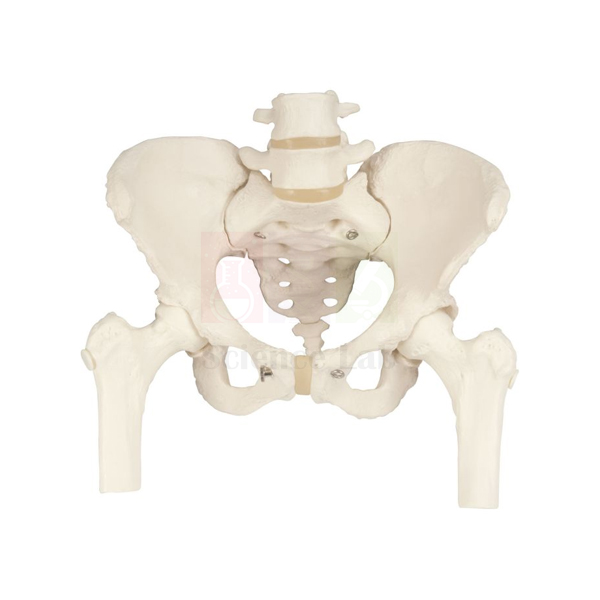
Human Pelvis with Lower Lumbar and Femur Heads
Human Pelvis with Lower Lumbar and Femur Heads (Product Code: SLE/A/63) is a life-size plastic replica that joins the pelvic bones, sacrum and coccyx to the heads of both femurs and to the last two lumbar vertebrae, L4 and L5, with their intervertebral discs. Showing the lumbosacral junction and both hip joints on one piece makes it a practical reference for orthopaedics, physiotherapy, chiropractic and anatomy teaching. The replica is made by Jain Scientific Equipments Pvt Ltd (ScienceLab), Ambala, and is widely used as lab equipment for college anatomy departments.
Specifications
| Parameter | Detail |
|---|---|
| Scale | Life-size replica |
| Material | Plastic |
| Pelvic structures | Pelvic bones, sacrum and coccyx |
| Femur | Femur heads |
| Spine | Lower lumbar vertebrae L4 and L5 with intervertebral discs |
Typical Use
Low back pain, disc problems and hip disorders all involve the zone this model covers. A physiotherapy lecturer can point to the L4 and L5 discs to explain why this level is so often involved in disc prolapse, then move down to the sacrum and across to the femur heads to discuss how load passes from the spine through the pelvis into the legs. Because the femur heads sit in their sockets, students can also see the orientation of the hip joint relative to the pelvis.
In general anatomy and sports-science classes the model supports lessons on the pelvic girdle, posture and the differences between the lumbar spine and the fused sacral vertebrae. It is also useful at patient-education desks in clinics, where a life-size replica helps explain a diagnosis. Keep it on a flat surface when not in use and clean the plastic with a mild soap solution and a soft cloth.
Manufacturer
Jain Scientific Equipments Private Limited, which operates as ScienceLab from Ambala, Haryana, makes this pelvis replica as part of its skeletal and anatomical model line. The company is a registered MSME enterprise (Udyam UDYAM-HR-01-0003714), and its export shipments are handled under Importer-Exporter Code AAECJ8618A issued by the DGFT. Further details are on the company profile.
Related Human Models
Useful companions for spine and hip teaching include:
- Human Spine with Femur Heads Model — extends the view upward to the full vertebral column.
- Human Hip Joint Model — a closer look at the joint formed by the femur head and pelvis.
- Human Lumbar Set Model — covers the lumbar vertebrae above L4 and L5.
- Human Sacrum and Coccyx — the sacral bones as a separate piece for handling.
- Male Skeletal Pelvis — for comparing pelvic shape between the sexes.
The full selection is in the Human Models category.
Frequently Asked Questions
Which vertebrae are included?
The lower lumbar vertebrae L4 and L5, each with its intervertebral disc, attached above the sacrum.
What material is the model made from?
Plastic, which makes it suitable for regular handling in practical classes.
Are both femur heads included?
Yes. The replica includes the femur heads with the pelvic bones, so the hip joints can be shown.
Is it life-size?
Yes, it is a life-size replica. Overall dimensions are not listed; ask us if you need them for storage planning.
Is there a stand or mounting?
A stand is not mentioned in the product details. Please confirm the supplied configuration through the contact page.
What vendor details can you provide for a college purchase?
We can share company registration details such as our Udyam and IEC numbers along with the quotation. Send your purchase requirements and we will include what your institution needs.
Request a Quote
Ask for a quotation for SLE/A/63 on the contact page, or add it to the enquiry cart along with other skeletal models you plan to buy.
Last updated: 24 September 2026
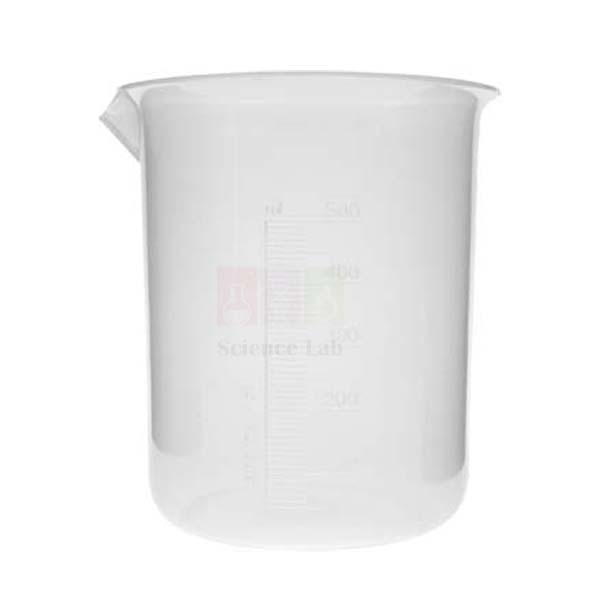
Beaker, Polypropylene
Beaker, Polypropylene (Product Code: SLE/GB/05) is a lightweight plastic beaker with a pouring spout and marked graduations, made in six sizes from 50 ml to 2000 ml. It handles hot liquids — though never an open flame — and is a much lower-cost option than glass, which makes it a sensible choice for classrooms, field work and routine lab chores where breakage is a worry. It is manufactured by Jain Scientific Equipments Pvt Ltd (ScienceLab), Ambala, as part of the range it offers as a lab plastic ware supplier in India.
Specifications
| Parameter | Detail |
|---|---|
| Material | Polypropylene |
| Capacities | 50 ml, 100 ml, 250 ml, 500 ml, 1000 ml, 2000 ml |
| Chemical resistance | Chemical resistant |
| Graduations | Graduated; the beaker described in our listing is marked in 10 ml steps |
| Size as listed | Approximately 6 cm tall and 5 cm in diameter (please confirm the dimensions of other capacities when enquiring) |
| Spout | With spout |
| Heat limits | Can hold hot liquids; not for use in an open flame |
Typical Use
Polypropylene beakers earn their place wherever glass would be at risk: middle-school practicals where younger students carry solutions between benches, collecting rinse water at a sink, preparing salt or sugar solutions for demonstrations, or holding water for floating-and-sinking and density activities. Hot water can be poured in straight from a kettle or a glass beaker, so they also serve as warm-water containers for dissolving experiments. For schools stocking school chemistry lab equipment in India on a tight budget, a few sizes of plastic beaker cover many non-heating tasks.
Keep them well away from burners and do not heat them directly; when a solution must be boiled, do it in glass and let it cool slightly before transferring. The spout helps pour cleanly into a funnel or cylinder.
Manufacturer
ScienceLab is the brand name used by Jain Scientific Equipments Private Limited of Ambala, Haryana, which makes this polypropylene beaker together with a broad catalogue of plastic and glass labware for teaching and testing labs. Background on the company is in our company profile.
Related Laboratory Equipment
Plasticware and tools that work alongside these beakers:
- Plastic Beaker Set of 5 — several polypropylene sizes packed together
- Beaker, Polypropylene, Set of 4 — another ready-made plastic beaker set
- Measuring Cylinder, Polypropylene — measures volumes more exactly before mixing in the beaker
- Stirring Rod, Polypropylene — stirs without scratching the plastic
- Pitcher, Polypropylene, 500 ml — a handled vessel for pouring into several beakers
The Glassware Beaker category lists glass and plastic beakers side by side.
Frequently Asked Questions
Can I put this beaker on a burner or hot plate?
No. Polypropylene beakers can hold hot liquids but must not be used in an open flame, and we do not recommend direct heating on a hot plate either. Choose a glass beaker for heating.
Which sizes are available?
Six capacities: 50, 100, 250, 500, 1000 and 2000 ml. Tell us the mix of sizes you need when you enquire.
What graduation steps do the beakers have?
The beaker described in our listing is marked in 10 ml graduations and measures about 6 cm tall by 5 cm across. Graduation steps and dimensions for the larger sizes can be confirmed through our contact page.
Why choose plastic instead of glass?
Polypropylene is much less expensive than glass, lighter to handle and less likely to break if knocked over, which suits classrooms and field use where no heating is needed.
How should the beakers be cleaned?
Wash with warm water and a mild laboratory detergent using a soft brush, then rinse; avoid abrasive pads that scratch the surface and make the graduations harder to read.
Do you take bulk orders from institutions and distributors?
Yes. We quote for schools, colleges and distributors in India and international markets; include the sizes, quantities and delivery location in your request.
Request a Quote
Ask for a price on any size via our contact form, or collect several items in the enquiry cart and send them together.
Last updated: 24 September 2026
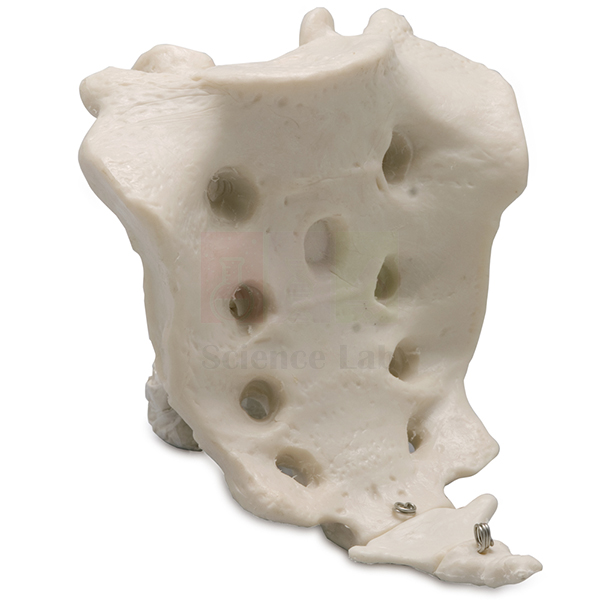
Human Sacrum and Coccyx-2
Human Sacrum and Coccyx-2 (Product Code: SLE/A/64) is an unmounted, life-size plastic replica of the sacral vertebrae together with the coccyx. With no stand attached, it can be picked up, turned over and laid flat on a tray, which suits hands-on bone identification and station-based practical exams. It is made by Jain Scientific Equipments Pvt Ltd (ScienceLab), Ambala, whose school and college lab equipment range includes a wide choice of skeletal models.
Specifications
| Parameter | Detail |
|---|---|
| Structures | Sacral vertebrae with the coccyx |
| Scale | Life-size replica |
| Material | Plastic |
| Mounting | Unmounted |
| Size | 20 x 11 x 6 cm |
Typical Use
The sacrum forms when five sacral vertebrae fuse during development, and a loose replica is the easiest way to show students the traces of that fusion: the transverse ridges on the front surface, the rows of foramina and the median crest at the back. Because the piece is unmounted, examiners can place it at a practical station in any orientation and ask candidates to decide which side is anterior, which end is the base and where the coccyx articulates.
In zoology lab equipment collections it can be set beside animal skeletons to compare how the tail region is reduced in humans. Nursing and physiotherapy tutors also use it when discussing sitting posture, coccyx injuries and the location of sacral injection sites. The plastic surface can be wiped clean after each class, and the compact size allows several pieces to be stored in one drawer.
Manufacturer
This unmounted replica is produced by Jain Scientific Equipments Private Limited, known to customers as ScienceLab, which designs and supplies anatomy teaching aids from Ambala in Haryana. The company profile gives an overview of its work.
Related Human Models
To build a lower-spine practical station, consider adding:
- Human Sacrum and Coccyx — the one-part version of the same region, useful as a second specimen.
- Human Pelvis Structural Model With 5 Pcs Lumbar Vertebraes — places the sacrum within the pelvis and below the lumbar spine.
- Human Lumbar Spinal Column Model — the section of spine that rests on the sacrum.
- Disarticulated Human Skeleton — for full-body bone identification sessions.
Browse other skeletal and organ models in the Human Models category.
Frequently Asked Questions
Does Human Sacrum and Coccyx-2 come on a stand?
No. It is supplied unmounted so it can be handled freely.
How big is the replica?
20 x 11 x 6 cm, reproducing the bones at life size.
What is it made of?
Plastic, which is easy to clean between practical groups.
Which one should I choose, this or the one-part Human Sacrum and Coccyx?
Choose this version if you want an unmounted plastic piece of 20 x 11 x 6 cm for handling and practical stations. If you are unsure, send us your course needs and we will suggest the better fit.
How should it be cleaned?
Wipe it with a soft cloth dampened with mild soapy water, then dry it. Avoid solvents that may mark the surface.
Is a bulk order possible for a medical or nursing college?
Yes. Give us the quantity and delivery details through the contact page and we will prepare a quotation for the batch.
Request a Quote
Price and delivery details for SLE/A/64 are available on request: reach us via the contact page or save the item in your enquiry cart.
Last updated: 24 September 2026
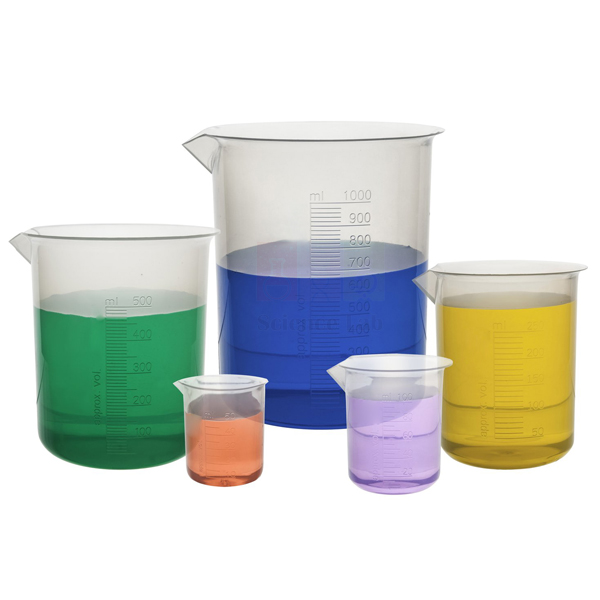
Plastic Beaker Set of 5
Plastic Beaker Set of 5 (Product Code: SLE/GB/06) is a group of five spouted polypropylene beakers in different sizes, running from 50 ml up to 1000 ml. The set is meant for mixing and holding solutions, including hot liquids, in places where glass is a liability — junior science classes, outreach demonstrations or shared preparation areas. Made by Jain Scientific Equipments Pvt Ltd (ScienceLab), Ambala, it is a low-risk addition to any junior science lab equipment list.
Specifications
| Parameter | Detail |
|---|---|
| Supplied as | Set of five beakers in different sizes |
| Capacity range | 50 ml to 1000 ml |
| Material | Polypropylene |
| Chemical resistance | Chemical resistant |
| Graduations | Graduated; approximate, not intended for accurate liquid measurement |
| Spout | With spout |
| Heat limits | Can hold hot liquids; not to be used over an open flame or on an electric hot plate |
Typical Use
Teachers use a graded plastic set for activities where students mix, observe and compare rather than heat: dissolving salt or sugar in cold versus warm water, watching colour changes when an indicator is added to household liquids, building simple density layers, or sorting soluble and insoluble substances. Because every size is shatter-resistant plastic, the set can travel to a classroom trolley or a science fair table without the packing that glass needs.
When a practical needs warm water, heat it in a glass vessel first and then pour it into the polypropylene beaker, since the set must not go over a flame or onto a hot plate. Use a measuring cylinder when quantities matter, as the beaker markings only give an approximate level.
Manufacturer
Jain Scientific Equipments Private Limited manufactures this plastic beaker set in Ambala, Haryana, and sells it under its ScienceLab trade name to schools, colleges and distributors. Visit the company profile to learn how the business is organised.
Related Laboratory Equipment
Pair the set with these items for complete non-heating practicals:
- Beaker, Polypropylene — single polypropylene beakers, including a larger size than the set offers
- Glass Beaker Set of 5 — the borosilicate glass set for experiments that need a flame
- Stirring Rod, Polypropylene — stirring without scratching the beakers
- Wash Bottle LDPE with Narrow Mouth — rinsing beakers and topping up with distilled water
- Measuring Cylinder Set of 5 — measuring liquids accurately before they go into the beakers
Explore more options in the Glassware Beaker category.
Frequently Asked Questions
Which capacities make up the set?
Five sizes between 50 ml and 1000 ml. The exact intermediate capacities are confirmed on the quotation; ask us if your syllabus needs particular sizes.
Can the beakers be heated?
No. They can hold hot liquids, but they must not be used over an open flame or on an electric hot plate. Heat liquids in glass and pour them in afterwards.
Are the scales precise?
No — the graduations are approximate and not intended for accurate liquid measurement.
Is the set suitable for younger students?
Yes. Polypropylene is light and far less likely to break than glass, which is why plastic beakers are popular for primary and middle-school activities that involve no heating.
Which liquids can I use in them?
The beakers are chemical resistant and suit common aqueous solutions used in school practicals. For strong solvents or unusual reagents, check compatibility with us before use.
What warranty applies?
Warranty and replacement terms are stated with each quotation; please contact us for the current terms.
Can you supply class sets in quantity?
Yes. We supply schools, colleges and distributors in India and international markets; share the number of sets needed and the delivery address.
Request a Quote
For a price on class quantities, contact us or use the enquiry cart to list everything your lab needs.
Last updated: 24 September 2026
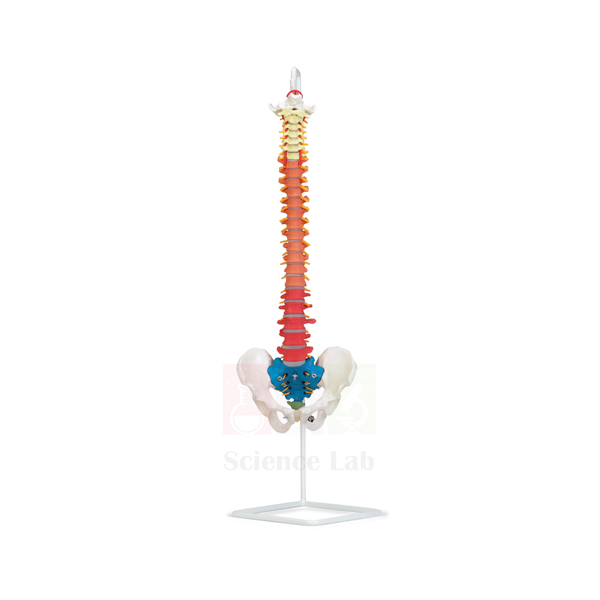
Economy Human Flexible Vertebral Column, Color Coded
Economy Human Flexible Vertebral Column, Color Coded (Product Code: SLE/A/65) is a fully flexible, life-sized plastic spine that runs from the occipital plate at the base of the skull down through the cervical, thoracic and lumbar vertebrae to the sacrum, coccyx and complete pelvis. Each region is color coded, and the model adds vertebral arteries, spinal nerves and a prolapsed L3–L4 disc, so one piece covers normal anatomy, movement and a common clinical problem. It is made by Jain Scientific Equipments Pvt Ltd (ScienceLab), Ambala, for schools, colleges, physiotherapy departments and clinics that need a spine without buying a full human skeleton model.
Specifications
| Parameter | Detail |
|---|---|
| Scale | Life-sized |
| Material | Plastic |
| Flexibility | Fully flexible vertebral column |
| Skeletal parts | Occipital plate; cervical, thoracic and lumbar vertebrae; sacrum; coccyx; complete pelvis |
| Colour coding | Regions of the vertebral column color coded for easy identification |
| Soft structures | Vertebral arteries and spinal nerves |
| Pathology | Prolapsed L3–L4 intervertebral disc |
Typical Use
Because the column bends, a teacher can flex, extend and side-bend it in front of the class to show how the curves of the neck, chest and lower back change with movement. The colour coding lets beginners count and name the regions quickly, and the spinal nerves leaving the column make it easy to explain why a disc prolapse can cause pain or numbness further down the body. Pointing out the prolapsed L3–L4 disc next to the healthy levels turns an abstract diagnosis into something students can see.
Physiotherapists and chiropractors use the model at the treatment desk to explain posture and back problems to patients, and sports-science, nursing and school biology lab setups use it for units on the skeletal and nervous systems. When storing it, hang or lay it straight so the column does not stay bent for long periods, and dust it with a soft cloth.
Manufacturer
This vertebral column is part of the budget-friendly anatomy line from Jain Scientific Equipments Private Limited, which trades as ScienceLab and is based in Ambala, Haryana. For tender and vendor-registration paperwork, the company's details are GSTIN 06AAECJ8618A1ZT and LEI 3358004HRD1JIVXKYX49. Read more on the company profile page.
Related Human Models
Spine and nervous-system lessons often use these models alongside the flexible column:
- Human Spinal Cord Section Model — shows the cord that the vertebral column protects.
- Human Lumbar Spinal Column Model — a focused look at the lower back region.
- Human Cervical Spinal Column Model — detail of the neck vertebrae for comparison.
- Human Advanced Osteoporosis Model — adds bone-loss pathology to a lesson on spinal disorders.
- Human Vertebral Column Model With Skull — an alternative that includes the skull.
Other anatomy models are listed in the Human Models category.
Frequently Asked Questions
Is the whole column really flexible?
Yes. The product details describe it as a fully flexible vertebral column, so it can be bent to demonstrate spinal movement.
Which parts of the spine and pelvis are included?
The occipital plate, cervical, thoracic and lumbar vertebrae, sacrum, coccyx and a complete pelvis.
What does the colour coding show?
Each region of the vertebral column is coloured differently, so students can identify cervical, thoracic, lumbar and sacral sections at a glance.
Does it show any pathology?
Yes. It includes a prolapsed intervertebral disc at L3–L4, together with vertebral arteries and spinal nerves.
Is a stand included?
A stand is not listed in the product details. Please ask through the contact page about stand options before ordering.
What does “Economy” mean for this model?
It indicates the budget version in our vertebral column range. For a side-by-side comparison with other spine models, tell us your requirements and we will advise.
Can you supply it for a government or institutional tender?
Yes. Share the tender quantity and delivery location; we can provide our GSTIN and LEI details with the quotation.
Request a Quote
Request current terms for SLE/A/65 through the contact page, or add the column to your enquiry cart with other items for the same order.
Last updated: 24 September 2026
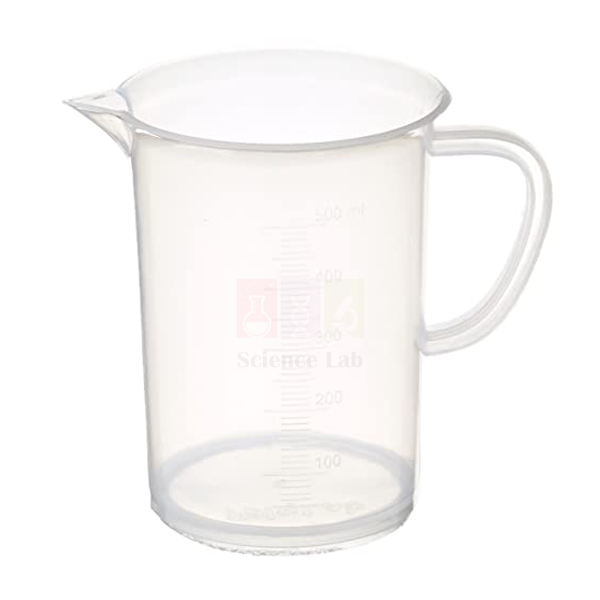
Pitcher, Polypropylene, 500 ml
Pitcher, Polypropylene, 500 ml (Product Code: SLE/GB/07) looks much like a beaker but adds a sturdy handle and a larger spout, so liquids can be poured one-handed with better control. It is graduated every 25 ml from 25 to 500 ml, stands approximately 11 cm tall with a diameter of about 9 cm, and copes with hot liquids as long as it is kept out of an open flame. Made by Jain Scientific Equipments Pvt Ltd (ScienceLab), Ambala, it is one of the everyday prep-room items that a school lab equipment supplier in India is asked for when benches are being stocked.
Specifications
| Parameter | Detail |
|---|---|
| Capacity | 500 ml |
| Material | Polypropylene |
| Graduations | 25 ml steps, from 25 ml to 500 ml |
| Height | Approximately 11 cm |
| Diameter | Approximately 9 cm |
| Handle and spout | Sturdy handle; larger spout for easy pouring |
| Chemical resistance | Chemical resistant |
| Heat limits | Handles hot liquids; not for open flame |
Typical Use
A 500 ml pitcher is the natural tool for handing out measured portions at the start of a practical: a lab assistant can fill it with distilled water or a diluted reagent and pour a set portion into each group's beaker, reading the 25 ml marks on the way. It is equally handy for topping up a water bath, refilling wash bottles through a funnel or carrying warm water from a kettle to the bench for dissolving experiments.
The handle keeps fingers away from hot contents, and the wide spout reduces drips down the side. Treat the scale as a dispensing guide; transfer to a measuring cylinder when a precise volume is required, and keep the pitcher away from burners and hot plates.
Manufacturer
This pitcher comes from Jain Scientific Equipments Private Limited — known to customers as ScienceLab — an Ambala, Haryana maker of laboratory apparatus for education and industry. Read our profile page for details of the company.
Related Laboratory Equipment
Items commonly used with a lab pitcher when dispensing and transferring liquids:
- Pitcher, Polypropylene, 2000 ml — the larger pitcher for bulk quantities
- Beaker, Polypropylene — receiving vessels for the portions you pour out
- Measuring Jug, Polypropylene — an alternative handled jug for measuring liquids
- Measuring Cylinder, Polypropylene — for volumes that need more precision than pitcher marks
- Plastic Funnel — pouring into narrow-neck bottles without spills
Find more beakers and pitchers in the Glassware Beaker category.
Frequently Asked Questions
How is a pitcher different from a beaker?
It has a similar body but adds a sturdy handle and a larger spout, which make pouring easier and safer, especially with warm liquids.
How finely is it graduated?
In 25 ml steps from 25 to 500 ml — suitable for dispensing portions. Use a measuring cylinder for exact volumes.
Can it hold hot water?
Yes, polypropylene pitchers handle hot liquids, but they must not be placed in an open flame or heated directly.
How big is it?
About 11 cm tall and 9 cm in diameter, compact enough to store on a reagent shelf or in a sink-side rack.
Can it be autoclaved?
Autoclave suitability is not stated for this pitcher, so please contact us before using it for sterilised work.
What details do you need for a school or college quotation?
The quantity, delivery location in India or abroad, and any other labware you want quoted at the same time; we will reply with a consolidated quote.
Request a Quote
To order the 500 ml pitcher, contact our team or add it to the enquiry cart along with other items.
Last updated: 24 September 2026